



Abstract
This study examines the relations between memory, social media experience, and testimony in the Eva Stories Instagram project. By conducting a combined visual and multimodal analysis of the stories, as well as a close analysis of the relations between social media experience and testimony, we claim that Eva Stories establishes a new responsive space for remembering the Holocaust. This space enables users to inscribe themselves into mediated Holocaust memory and to become media witnesses through the co-creation of socially mediated experiences. The self-inscription of the user is made possible by three interrelated modes of media witnessing, which continuously evoke user engagement. These new modes, we argue, indicate a new kind of agency in relation to media witnessing: the ability to testify on one’s own present social media engagement with mediated memory, and become a witness to it.
During the 2019 Israeli Holocaust Remembrance Day, a series of stories was posted on the social media sharing platform Instagram under a user profile named Eva Stories, portraying the experiences of 13-year-old Eva Heyman living in Nagyvárad, Hungary in the days prior to her deportation to Auschwitz. The Eva Stories project, a private initiative of the Israeli media entrepreneur Mati Kochavi and his daughter Maya, rapidly attracted the attention of Instagram users in Israel, the majority of them belonging to the third and fourth generations born after the Holocaust. Huge billboard advertisements were posted in Tel Aviv, bringing Eva Stories to the attention as well of those who were not active on social media. With the slogan “What if a girl in the Holocaust had Instagram?” the project evoked intense discussions about Holocaust memory in social media, mostly on whether Instagram and similar platforms are appropriate for commemorating the Holocaust. Notwithstanding Eva Stories received vast global attention, gaining more than a million followers on the actual day the stories were posted.
In their privately funded project, Mati and Maya Kochavi chose to break loose from institutional commemoration practices. “In Israel,” says Mati Kochavi, “the Holocaust is a holy topic. I didn’t want to confront them [official institutions] with this project and have them say no” (in Kershner, 2019). Instead, the Kochavis aspired to provide new mnemonic practices for commemorating the Holocaust in social media: in the digital era when the attention threshold drops and the excitement threshold rises, and against the background of the ever-diminishing number of survivors, there’s a tremendous need to find new models of testimony and memory [. . .]. The idea of the project is to use the social networks to create a new genre of memory. (in Sones, 2019)
In order to critically inspect the proposal of the producers, our study examines the relations between memory, the users’ social media experience, and testimony in the Eva Stories project. By conducting a combined visual and multimodal analysis that focuses on the relations between social media experience and testimony, we claim that Eva Stories does not primarily establish a new genre as Kochavi suggested but rather a responsive space for remembering the Holocaust. This space enables users to become media witnesses by means of co-creating socially mediated experiences, and thereby to inscribe themselves in mediated Holocaust memory. This self-inscription of the users is made possible by three new interrelated modes of media witnessing (Frosh and Pinchevski, 2009): the journalist witnessing mode, the atrocity witnessing mode, and the social media witnessing mode. These modes are connected to and depend on the visual aesthetics of the project, which continuously evoke user engagement. The new modes also stress the changing relations between the witness, the interlocutor, and the media in the social media driven digital age, as they focus on the social functions of showing, telling, and sharing; while the journalist witnessing mode focuses on the reporting of the event and the atrocity witnessing mode focuses on attesting to humiliation, violence, and other atrocities, the social media witnessing mode focuses on sharing experiences. These modes, we argue, indicate a new kind of agency in relation to media witnessing: the ability to testify about a remote experience by co-creating a new, somewhat related experience of your own present social media engagement with mediated memory, and become a witness to it.
Memory in the digital age
Facing fundamental changes in the architecture of Holocaust memory, its mediation in online environments poses challenging questions and raises elementary concerns on how the Holocaust will be remembered, and whether digital media offer new possibilities to engage with the past (Commane and Potton, 2019: 159). Kansteiner (2017) argues that the 20th-century media that gave way to the constitution of cultural environments for Holocaust memory of that time, such as memorials, cinema, and television, are no longer suitable for provoking intense reactions among contemporary digital users. Instead, he suggests that a “resurrection” (Kansteiner, 2017: 310) of Holocaust commemoration can occur in digital environments, which can create immersive, simulative, and even counterfactual memories of the Holocaust.
The focus of memory studies has changed in the past decades as rapid technological changes established a new digital ecology, which has a deep effect on the ways individuals and collectives remember and forget (Garde-Hansen et al., 2009: 3). From the study of collective and national commemorative culture focused on memorial sites and events (Halbwachs, 1980; Nora, 1989), it shifted toward dynamic ecologies (Hoskins, 2016) that are characterized by extremely mobile and often intersecting memories (Erll, 2011; Rothberg, 2009), as well as by mediated forms of adopting and absorbing distant memories (Landsberg, 2004). Hirsch (2001) defines such mediated memories as a form of intergenerational transmission of traumatic experiences that constitute what she terms postmemory. Relying on the iconic visual imagery of the Holocaust, postmemory is powerful “precisely because its connection to its object or source is mediated not through collection but through representation, projection, and creation” ( Hirsch, 2001: 9).
A useful conceptualization of the crucial role of media in mnemonic practice is Landsberg’s (2004: 28–31) concept of prosthetic memory, an alternative memory produced and distributed at experiential sites, such as film theaters. Although it stresses the significance of empathy and participation in the acquisition of new memories through the use of media, prosthetic memory pays little attention to participatory culture (Jenkins, 2006), and in particular to the ability of individuals to visually create memories of their own through contemporary digital social media. Having said that, Landsberg (2015: 3) identifies elsewhere an “experiential mode of engagement” resulting from the “desire to bring things close and, in this context, to have a personal, felt connection to the past.” Being an effect of mediated culture, engagement depends on formal and stylistic elements as well as on narrative structures (Landsberg, 2015: 20), therewith also constituting an essential element of “interactive environments” (Landsberg, 2015: 7).
A concept, which is closely related to participatory culture and can help with further developing our understanding of user engagement in digital media ecologies as well as the constitution of memories through these ecologies, is the notion of co-creation. Burgess and Banks (2010) apply co-creation as a descriptive term that highlights the ways that users or consumers, within the constraints and affordances of platforms provided by others, collectively contribute to the social, cultural and economic value of the media products and the experiences associated with those platforms; and likewise, it indicates the ways in which platform providers (however imperfectly) integrate user participation into their own models of production. (p. 298)
Stressing the joint work from both producers and users, Burgess and Banks define co-creation as a state from which both sides should benefit. Further developing this concept in relation to Instagram, Leaver, Highfield and Abidin (2020: 379) argue that co-creation can be perceived as a model which stresses the shared responsibility and awareness of users in the ways they affect, shape, and create the traces and stories of other users online; in this light, co-creation does not only refer to active user generated content, a central attribute of participatory culture, but also to the social involvement of users in the culturing and creation of online presence of subjects, which cannot speak for themselves, such as fetuses or deceased persons (Leaver, 2019). Thus, co-creation recognizes “active” as well as “passive” online experiences as something that is created together and formed through social engagement of various users. Furthermore, co-creation relates to shared experiences of those who are alive, as well as to experiences and memories of the deceased. Thus, co-creation is not only meant for the living, but also for constituting memories of the dead.
Yet, memories are affected, created, and changed in digital media ecologies not only by the co-creations of users, but also by the way digital media transfers content through space and time. Reading (2016) defines memories that have been affected by digitization and globalization in the 21st century as globital memories, which “produce an ecology of immersive connective memory on the move” (p. 46). Drawing on Frosh and Pinchevski’s (2014) formulation of Deleuze and Guattari’s (1987) configuration of the assemblage, she regards globital memories as “assemblages”—not as distinct or singular memories, but as memories that “connect with and disconnect from over time and space with other images, other sounds, other texts, other embodied subjects and discursive practices which may be digital and analogue” (p. 47). The memories of the globital age are not only transformed with regard to their position as collective or personal memories, they are decentralized in space and time, forming various relations and bonds with each other.
Digital social media also establish new forms of online engagement with Holocaust commemoration, creating a social, temporal, and spatial dispersed environment that offers different ways for commemoration in various social platforms and among versatile audiences (Pentzold and Sommer, 2011: 80). By doing so, social media affects its audience and the possible ways to co-create and remember, as well as the ways content is saved and stored, constituting new forms of “decentralized archival regimes” (Zalewska, 2017: 100).
In terms of content, social-media platforms shift from mainly text-based to exponentially image-centered content (Zalewska, 2017: 98). Instagram, an online platform for posting and sharing photos, was the first social media that primarily focused on visual content. In 2016, Instagram (2016a) launched its Stories feature, which allows users to post photos and videos in their personal story feed, expiring after 24 hours. During that year, Instagram (2016b) also added stickers to Instagram Stories. In 2018, Instagram launched the questions sticker and the emoji poles; the former enables users to post questions in their stories to which other users can reply and the latter offers users the opportunity to ask “more nuanced questions [. . .] to find out how your friends feel about something” (Instagram, 2018).
Eva Stories adopted these features for its specific approach toward digital Holocaust remembrance through Instagram. The prefabricated stories were posted in 70 segments, which the producers adjusted to the structure of Instagram Stories. Integrating into the personal feeds of the users and thus streaming between the posts of other Instagram accounts, the stories of Eva continuously addressed their followers, offering them the opportunity to participate in polls, reply to questions, and express their emotions with regard to Eva’s story. In turn, many users also posted segments of the Eva Stories project in their personal user stories, either by reposting photographs from the Eva Stories profile, or by taking screenshots from the actual stories or the user profile, and posting them in their feed or in their own stories. Some users also augmented those screenshots with additional texts, emojis, personal photographs, hashtags, and nametags. All these media-based practices illustrate new strategies of adopting a position of actively witnessing traces of the past within social media environments, which are not only exhibitionist, but also call for user engagement.
Testimony in the digital age
The late-20th-century memorial culture significantly focused on the surviving witnesses and was therefore characterized as the “era of the witness” (Wieviorka, 2006). During that era, which began in the late 1970s, the survivors became authoritative figures for Holocaust commemoration and education. Simultaneously, audiovisual collections of Holocaust testimonies were established (Wieviorka, 2006: 96–97). Several institutions began preserving Holocaust testimonies, and during the 1990s, they were conveyed into digital assets, gradually accessible online (Shandler, 2017).
When performed, testimony is connective. It connects between past and present, history, and experience (Laub, 1992: 85), and between the survivors and the interlocutors (Laub, 1992: 71). Nowadays, not many witnesses are still able to testify. Their absence calls for new ways of transmitting their testimonies to the third and fourth generations born after the Holocaust. Pinchevski (2019: 89) argues that digitization led to a significant transformation in the media of testimony, focusing on reception and interactive modes of engagement as techniques of memorialization. Moreover, interaction rather than narration became the new paradigm of digital Holocaust memory, and testimony became more focused on connection and dialogue than its customary focus on documentation and preservation (Pinchevski, 2019: 88–90).
This changing paradigm also affects the position of the users. Understanding postmemory as “retrospective witnessing by adoption” of historic images, which replaces the missing pieces in the traumatic memories of the survivor generation, Hirsch (2001) discovered among the second generation a process of “inscribing them [the images] into one’s own life story” (p. 10). While Hirsch refers to photographs, which later generations inscribe through novels, films, and graphic novels into their life stories, digital culture slightly changes the parameters of postmemory. Now, the users inscribe themselves into a process of digitally bearing witness. Due to a changing media logic, various media platforms that utilize the affordances of digital technologies involve users in the articulation and representation of testimony, as Pinchevski (2019) emphasizes. A characteristically user-centered design shifts the focus from the witness as the medium of testimony to the participant, which Pinchevski (2019) calls the witnessee, “the digitally enabled participatory recipient” (p. 104). Thus, although witnessing remains a crucial aspect of Holocaust memory in the digital age, especially in the context of social media practices, it changes with regard to the users, who do not only act as interlocutors, but also as co-creators in a process of remediating past memories.
Media witnessing, multimodality, and the assemblage
A central configuration of witnessing that encompasses the relations between media and witnessing is the form of media witnessing, “the witnessing performed in, by, and through the media. [. . .] It refers simultaneously to the appearance of witnesses in media reports, the possibility of media themselves bearing witness, and the positioning of media audiences as witnesses to depicted events” (Frosh and Pinchevski, 2009: 1–3). Shot exclusively with a mobile phone camera, presenting events as if they were occurring live, we argue in the following that Eva Stories provides a media ecology for a deliberate, multifaceted form of media witnessing.
In our configuration of media witnessing, we combine elements of visual and multimodal analyses. Just as Eva Stories adjusts aspects of film, editing, and animation with visual social media aesthetics, Instagram, as well as its feature Instagram Stories, is characterized as a primarily visual albeit multilayered platform (Highfield and Leaver, 2016). In our visual analysis, we especially focus on the shot composition as well as on visual patterns and conventions. In doing so, we are mainly interested in the connection of specific visual techniques with witnessing modes, and especially in the relations between selfie aesthetics and witnessing, and in the implications of first-person point-of-view shots in combination with handheld cameras as visual expression of witnessing (Ebbrecht, 2011: 174). This approach allows us to relate the visual composition, and in particular, the references to cross-media conventions and visual patterns, to specific visualization techniques, which are characteristic of Instagram as an aesthetic visual communication tool (Manovich, 2017: 41).
In addition, we broaden our focus to a multimodal analysis. Multimodality here refers to the integrated use of different forms of expression and sensory address, such as language, image, sound, voice, or text (Kress, 2000; Kress and Van Leeuwen 2001; Van Leeuwen, 2014). In doing so, we are especially interested in the exploration of the relations between those modalities. We consider this approach as best suitable in order to analyze the perception of digital media environments enabling access to memories from the Holocaust. We premise, however, that these modalities are closely intertwined and cannot be separated. Thus, we indicate and explore the interplay of visual, sonic, and textual components of multimodal and multilayered social media environments that establish “expanded image spaces experienced polysensorily and interactively” (Grau, 2003: 9). We will address this in our analysis as assemblage, through which Eva Stories establishes “an arrangement that draws attention to things-in-relation to each other” (Walden, 2019: 3).
On that account, our multimodal analysis also reflects the specifics of the medium Instagram with its stories feature, as well as the social media environment, in which Eva Stories unfolds. That is why we specifically focus on a variety of social media elements such as selfie aesthetics, after-effects, text layers, hashtags, interactive tools, and emojis. This corresponds to the approach of Instagrammatics, which Highfield and Leaver (2016) have introduced. Instagrammatics takes into account platform specifics as well as the interplay of different social media environments, and reflects their impact on visual storytelling, multilayered collaged imagery and visual appropriation. Correspondingly, we analyze Eva Stories not as a representation of Holocaust memory on social media but as the formation of these memories through digital visual storytelling, which results from a co-created multimodal interplay that characterizes social media practices in general and Instagram in particular. In this context, we focus on how the multilayered modalities affect the specific adaptation of media witnessing in Eva Stories.
Our analysis also reflects the ways in which the digital environment affects the users subject position in relation to the mediated historical experiences. Constituting a sense of solidarity and symbolizing the loss of innocence, the child victim plays an important role in Holocaust commemoration artifacts (Anderson, 2007). Having been a female child victim herself, the character of Eva matches Christie’s (1986: 18-20) definition of an ideal victim, as throughout the stories she performs the noble act of documenting her life under Nazi occupation. She cannot be blamed for the atrocities she is going through, and for becoming a victim of the Nazi rule, which bears no personal connection to her. Yet, the most salient attribute of Eva as an ideal victim is that she is powerful enough to voice and communicate her experiences to others, which acknowledge her as a victim. Partaking in Eva’s mediated experiences, mostly from her perspective, her Instagram followers adapt to the role of engaged users. While the Eva Stories project passes down Eva’s voice to them, they in turn listen to her experiences, sometimes also passing her voice on to others by re-voicing Eva in their personal profiles.
In one of the stories tagged with the date “1 May,” Eva expresses her concern over her fate under Nazi occupation: “I would go any place in the world where they don’t know that I’m Jewish, I don’t want them to take me to Poland like they took my cousin.” She is shown while looking at a small mirror, which she is holding in both hands (Figure 1). Technically speaking, it is not clear whose perspective this shot correlates with. Instead of holding a camera, Eva is holding the mirror as if it were a camera in a selfie position; instead of seeing the camera in the mirror, we see Eva’s face; and instead of seeing Eva directly portrayed, we see her reflection in the mirror. This can be considered a true-to-historical-times kind of choice, pushing the physical digital media off site and replacing it with “old” media—in this case, the mirror. Furthermore, the paradoxical composition appears as a weird collage of views: Eva’s first-person perspective is overlaid and incorporated with the selfie perspective.
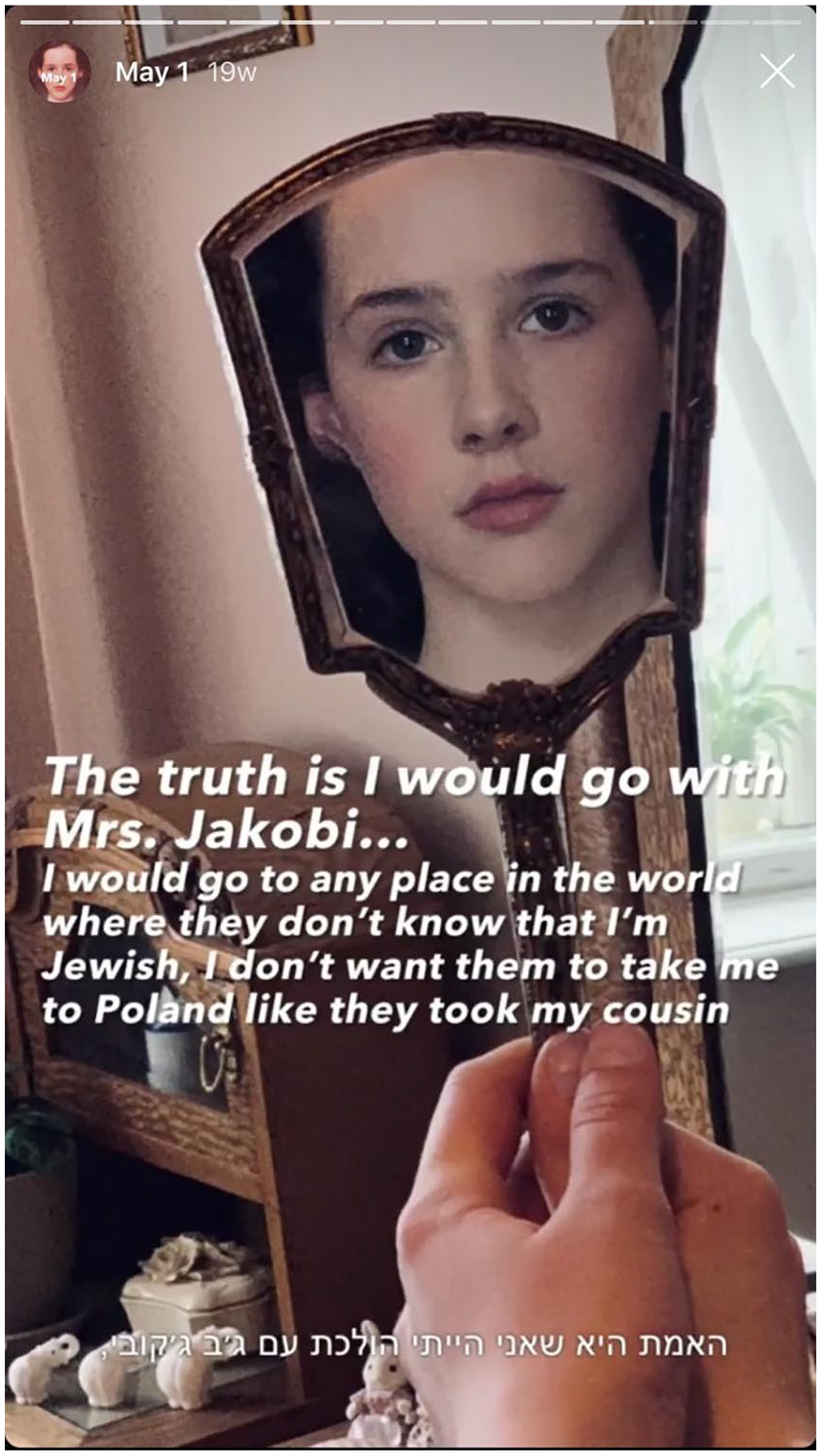
The Eva stories story from 1 May, https://www.instagram.com/stories/highlights/17892500953317225/ (Courtesy Eva Stories).
Most apparent in the Eva Stories project is the extensive use of Eva’s subjective point of view in rendering the events and the selfie perspective. We watch Eva conspicuously taking selfies—at home and in school, at her grandfather’s pharmacy and in the ghetto. She is even taking a selfie in the cattle car destined for Auschwitz. One can consider this act narcissistic, though according to Frosh (2019), one should tend to regard the selfie as a reflexive gesture of media sociability calling for a response from other users. Through physical gestures, the selfie invites them to interact with the visual depiction and connect to it by different means: following, commenting, uploading a selfie of themselves, liking, reposting, and other practices of social network engagement (Frosh, 2019: 114–137). In this manner, we can consider Eva’s selfies gestures inviting users to engage with the portrayed event. But, unlike authentic and personal profiles, and since it is composed of various perspectives, we argue that Eva’s personal perspective is fragmented, a choice that renders possible users’ own inscription onto mediated memories through co-creation. Positioning Eva in front of a mirror stresses the gap between seeing and experiencing in a segmented digital environment. This also indicates that Eva is not the main protagonist in the Eva Stories project, but rather is the users’ act of her memorialization. Thus, the segmented experience offered in Eva Stories keeps a distinct differentiation between Eva’s subject position as a victim and the users subject position as co-creators of her social media memory. Such “sense of distance” (Landsberg, 2015: 16) is characteristic of any media engagement with the past. The paradoxical conceptualization of Eva Stories further intensifies this effect through a constant oscillation between proximity and distance, which “pushes us back into our sown shoes, forcing us to account for what we see” (Landsberg, 2015: 33). Suggesting that the posts are streamed and unfolding live, Eva Stories wants the users not only to watch the events, but also to engage with them by integrating them into their personal social media life.
Therefore, we regard the image of Eva and the mirror as also emblematic of the ongoing practice of superimposition, which is very much related to practices of co-creation of social media experiences. This practice, we claim, expresses Frosh and Pinchevski (2014) configuration of Deleuze and Guattari’s (1987) concept of assemblage, which is composed of heterogeneous intersecting objects that establish new constantly changing relations (Frosh and Pinchevski, 2014: 602). In the context of media witnessing, the assemblage signifies ways in which various components connect with and disconnect from one another, assembling the witnessed event in a decentralized media environment (Frosh and Pinchevski, 2014: 602; Frosh and Pinchevski, 2018: 137). This results in “an arrangement of multiple points of agency perpetually poised for activation at different moments in time” (Frosh and Pinchevski, 2014: 602–603). Thus, the assemblage is closely related to the fragmented character of memory as well as to productive practices of commemoration. According to Walden (2019), by relating past and present, assemblages “open up a space for remembering collaboratively.” (p. 14). In the social media environment of Eva Stories, the assemblage is a result of the users’ co-creations who together constitute the shared experience of witnessing Eva’s story on Instagram. Through following, reposting, screenshotting, tagging, and posting, the followers of Eva Stories take part in constituting a mediated event to be witnessed and remembered socially and collaboratively.
The Eva Stories project also intersects various digital recording modes: the original diary as a modified source; reenactment techniques with social-media practices; and various icons, signs, and (audiovisual) expressions. Through this superimposition of images and perspectives, Eva Stories establishes a responsive space for users that activates different temporalities: memories from the past intertwined with present social media consumption. This space enmeshes perceptions of self and other and of the past and the present, which calls for user engagement and self-inscription.
The phenomenon of the assemblage is also apparent in the perception of time. According to Frosh and Pinchevski (2018), media witnessing is characterized by two temporal qualities: eventfulness and eventness. Within the temporality of eventfulness, “the present is the contingent, never fully formed node of multiple trajectories of repetition and anticipation” (Frosh and Pinchevski, 2018: 137). This quality relates to the pervasive recordings of the everyday as such that allow for the possibility that every recorded moment will become an event, in present time or in the future, in retrospective discovery. Whereas in the era of live broadcasting, the media event was temporarily discrete and framed as such, media witnessing regards “the thickness of the so-called real time” (Frosh and Pinchevski, 2018: 137); in the ubiquitously documented, decentralized environment, every moment can be, or become, an event. Sorted and identified by dates, the stories making up Eva Stories constantly stress the eventfulness of what Eva documents, sometimes framed as recorded by chance.
The quality of eventness refers to the vast, ongoing distribution of events. Different from the broadcasting of media events, which was disseminated by a few and consumed by wide audiences, media witnessing temporarily constitutes the event “both as duration and aggregation” (Frosh and Pinchevski, 2018: 137–140) as it is formed and regarded as assemblages. In this manner, less attention is given to hierarchy in the perception of time, as the temporal center of the event becomes dynamic and open to changes.
We can think of the constant use of time and space annotations in the Eva Stories project as establishing shots that usually open a scene, providing the spectator with the context for the following episodes (Giannetti, 2001: 534). This choice makes sense, for it takes into consideration all kinds of users, in particular, those who were watching it “live” during Holocaust Remembrance Day 2019, but also the ones who were only watching parts of the project and needed spatial and temporal orientation. But it also makes sense regarding digital visual stories as assemblages. The past, present, and future are persistent in Eva Stories as layers that are sometimes positioned one on top of the other. Mixing past with present, Eva Stories stresses the eventness of each story, offering users the opportunity to co-create Eva’s memory as a part of their present social media use, thus contributing to the event, which is consumed through, experienced in, and mediated by social media.
Tell, show, and share: three modes of media witnessing
Eva Stories is a rather unusual and unique example of media witnessing, for it inhabits all three kinds of its performance: “in, by and through the media” (Frosh and Pinchevski, 2009: 1). In some cases, the main character of Eva acts as a witness, testifying about her experienced reality while addressing her audience as interlocutors; in some cases, the medium itself bears witness to the events; and in other cases, the users function as witnesses to the portrayed events. These performances define the three modes of media witnessing apparent in Eva Stories: the journalist witnessing mode, the atrocity witnessing mode, and the social media witnessing mode.
The first mode of witnessing is the journalist witnessing mode. It is characterized by Eva’s adoption of new journalism norms, such as reporting on instant “live” events from various sites in a network composed of a dispersed audience, and in a straightforward and iterative manner (Fenton, 2010: 6). In this mode, Eva reports about the occurring events. Sometimes, personal incidents occur as historical events, sometimes her reports keep some emotional or physical distance, and sometimes she stresses her personal involvement. In this mode, the audience is addressed as a distant audience, watching Eva performing her testimony as a witness telling about what is happening. This sort of distancing is apparent in the different manifestations of Eva’s monologues: while sharing her feelings on the Nazi occupation of her hometown, Eva addresses her audience as distant observers when she states, “You are so lucky that you cannot feel what terrible things are happening to us” (Figure 2). In a reflexive manner, the journalist witnessing mode does not focus so much on the historical event as it does on the act of accounting for events through media to a distant audience. This mode is also characterized by the use of the “#reporterlife” hashtag. It can also be considered as a memorial gesture to the historical Eva Heyman who actually wished to become a news photographer.
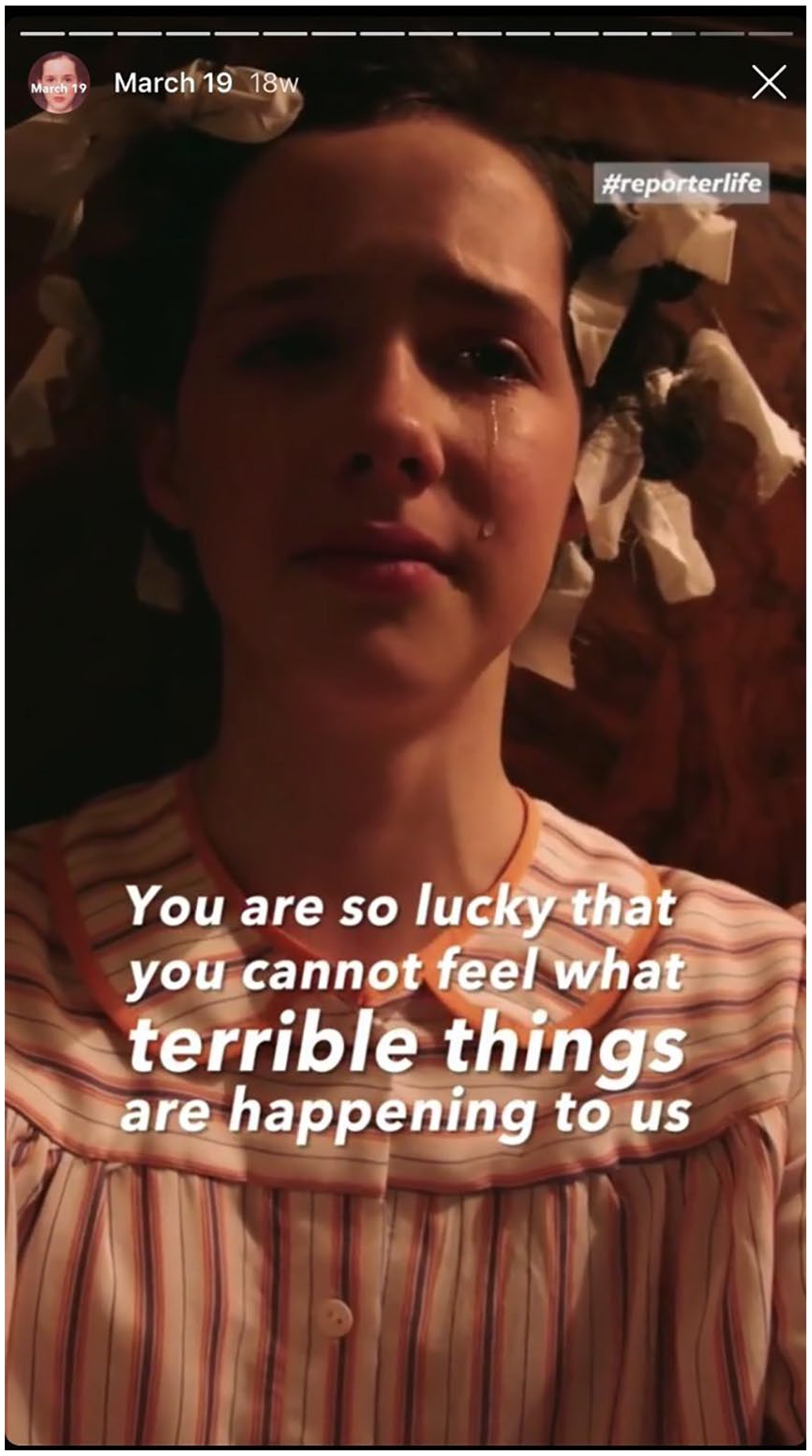
The Eva stories story from 19 March, https://www.instagram.com/stories/highlights/18044323096098797/ (Courtesy Eva Stories).
The second mode of witnessing is the atrocity witnessing mode, in which Eva acknowledges and stresses the importance of her testimony and its dissemination to others, exhibiting the atrocities she and her social environment and family experience. This mode is mostly evidential, utilizing the users’ preexisting cultural knowledge of Holocaust imagery and, as Didi-Huberman (2008: 30–40) argues, the power of the photograph to bear witness to historical events. In most cases, the atrocity witnessing mode focuses on the ability of the medium to attest to the events as the camera is witnessing the atrocities. Sometimes, this mode stresses the corporeal aspects of the atrocities, showing Eva and her environment in miserable physical condition, such as in the story that depicts Eva and her friend Annie devouring a jar of jam (Figure 3). In this story, the camera witnesses this incident, rendering the two in a low angle shot, as if neither of them noticed that the camera was on, also stressing its eventfulness as an accidentally recorded event.
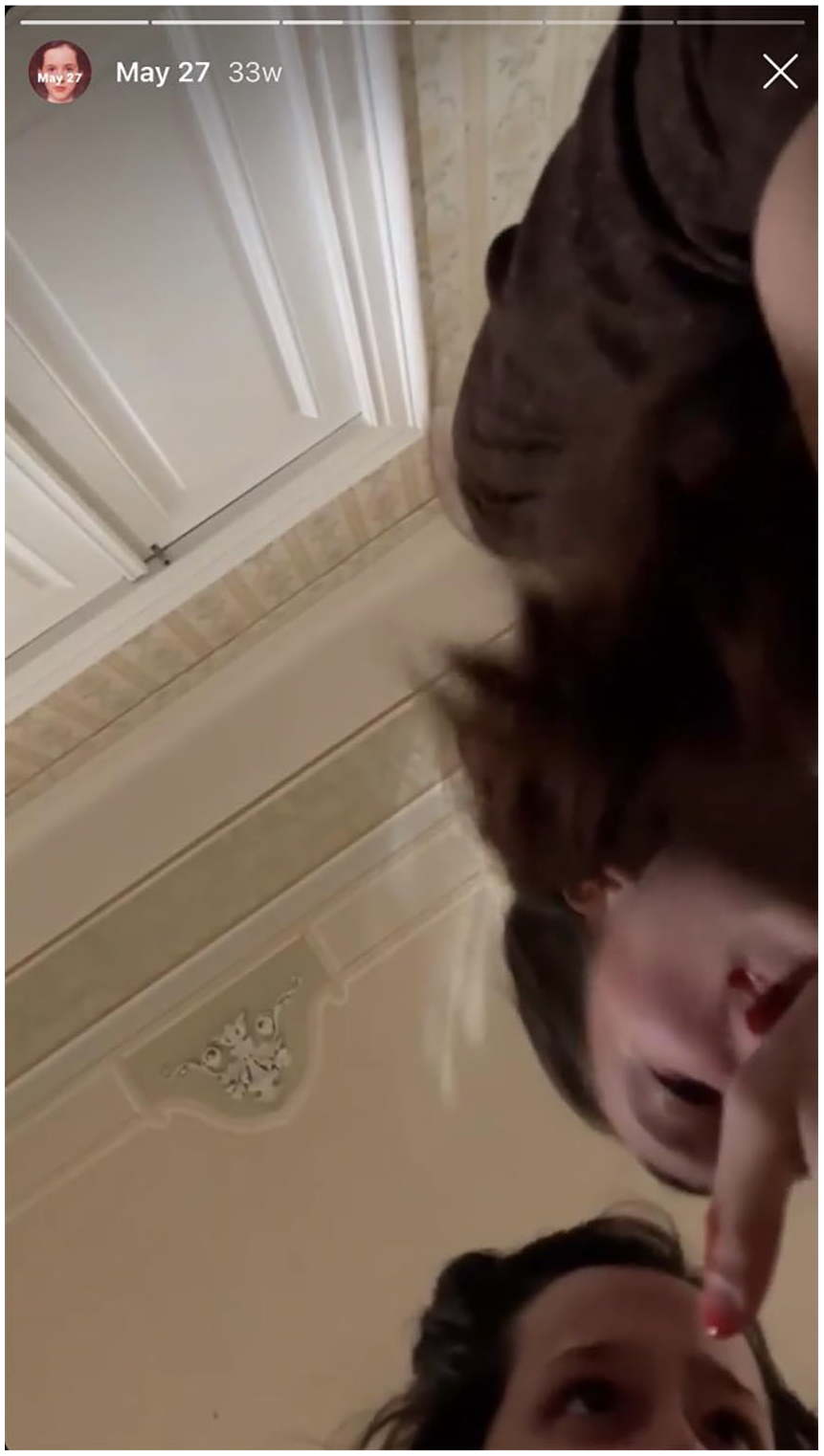
The Eva stories story from 27 May, https://www.instagram.com/stories/highlights/17998880767204695/ (Courtesy Eva Stories).
The reenacting of historical or popular culture Holocaust imagery also adds to the atrocity witnessing mode. These representations refer to the users’ cultural knowledge and interpretation. They also function as a visual basis for the mode, referring to how Holocaust-related atrocity should look. Such is the indirect reference to the iconic image of the girl in the red dress from Spielberg’s Schindler’s List (USA, 1993). By making Eva’s cousin Martha, who was deported to Poland and is assumed dead, look like the girl from Schindler’s List, her character symbolizes the death of innocents (Figure 4). Dressed in a red dress with a matching red hat, she visually signals to the users an atrocity, which they will not see on the mobile screen but recognize from other popular culture representations.
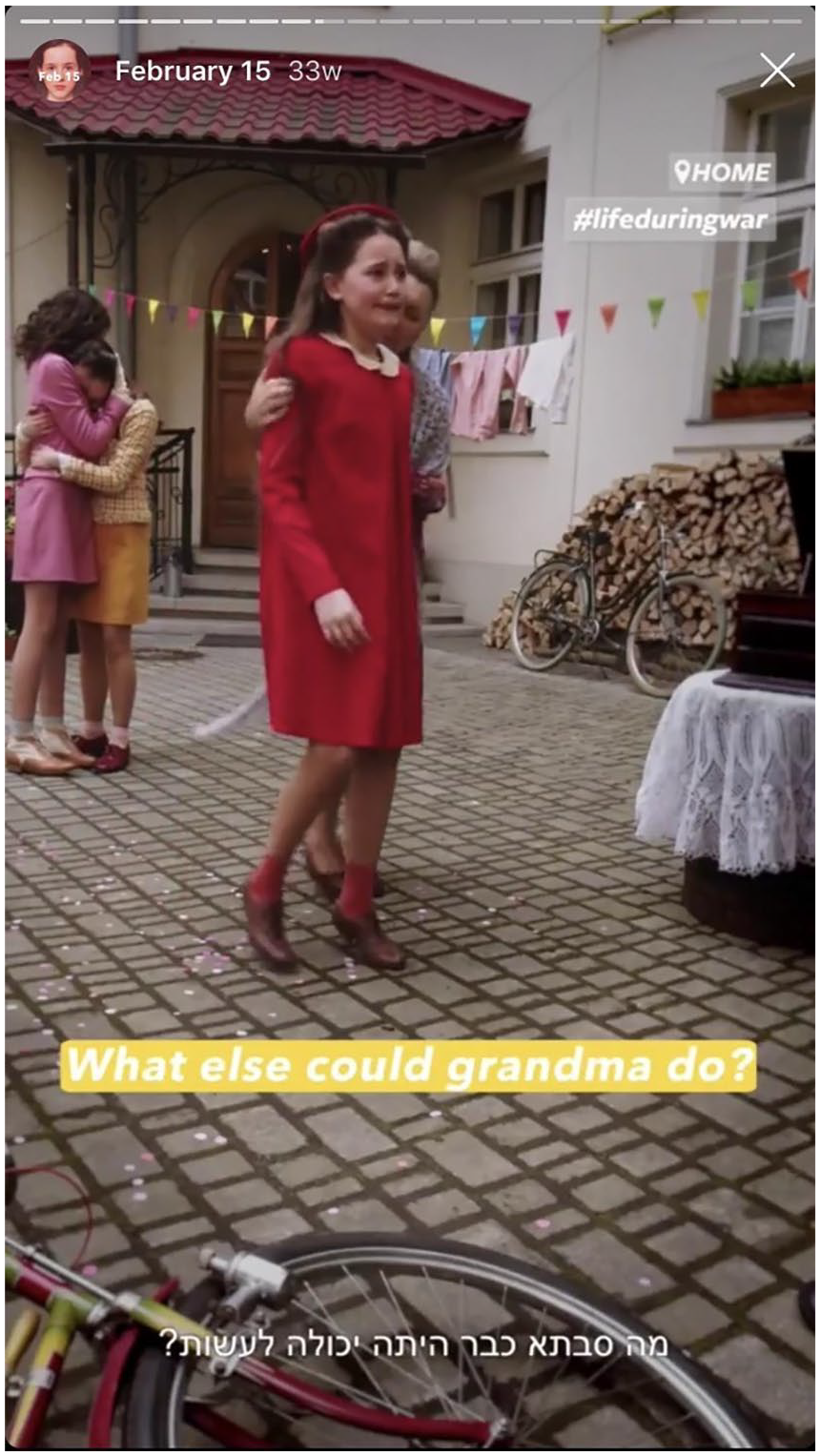
The Eva stories story from 15 February, https://www.instagram.com/stories/highlights/17998120066205191/ (Courtesy Eva Stories).
In a similar manner, the atrocity witnessing mode is also characterized by the use of photos and footage of Eva and her social environment as archival images, stressing the spatial and temporal assemblatic form of presenting the presence of the past as an absence in present time. In the clusters of stories tagged “February 19,” two boomerang clips show Eva and her friend Annie dancing while Eva expresses how much she misses her cousin Martha; “I miss my cousin everyday,” “I dream about her every night, ‘But I try my hardest to keep seeing the sun. Thank God I have my BFF Annie!’” (Figures 5 and 6). These textual expressions are superimposed over the boomerang clips, which are also augmented by a kaleidoscope and a filmstrip-looking filter. Using visible objects to visualize the physically absent subjects is a common practice in Holocaust remembrance and testimony, also known as “an emergent iconography of the Holocaust” (Landsberg, 2004: 71, 80). Thus, the atrocity witnessing mode has to do with deciphering the recording of an instance that clearly indicates itself as an atrocity; it may be carried out by referencing popular culture images or reenacting historical imagery taken in the ghettos or during the liberation of concentration camps, but manipulated by Instagram features.
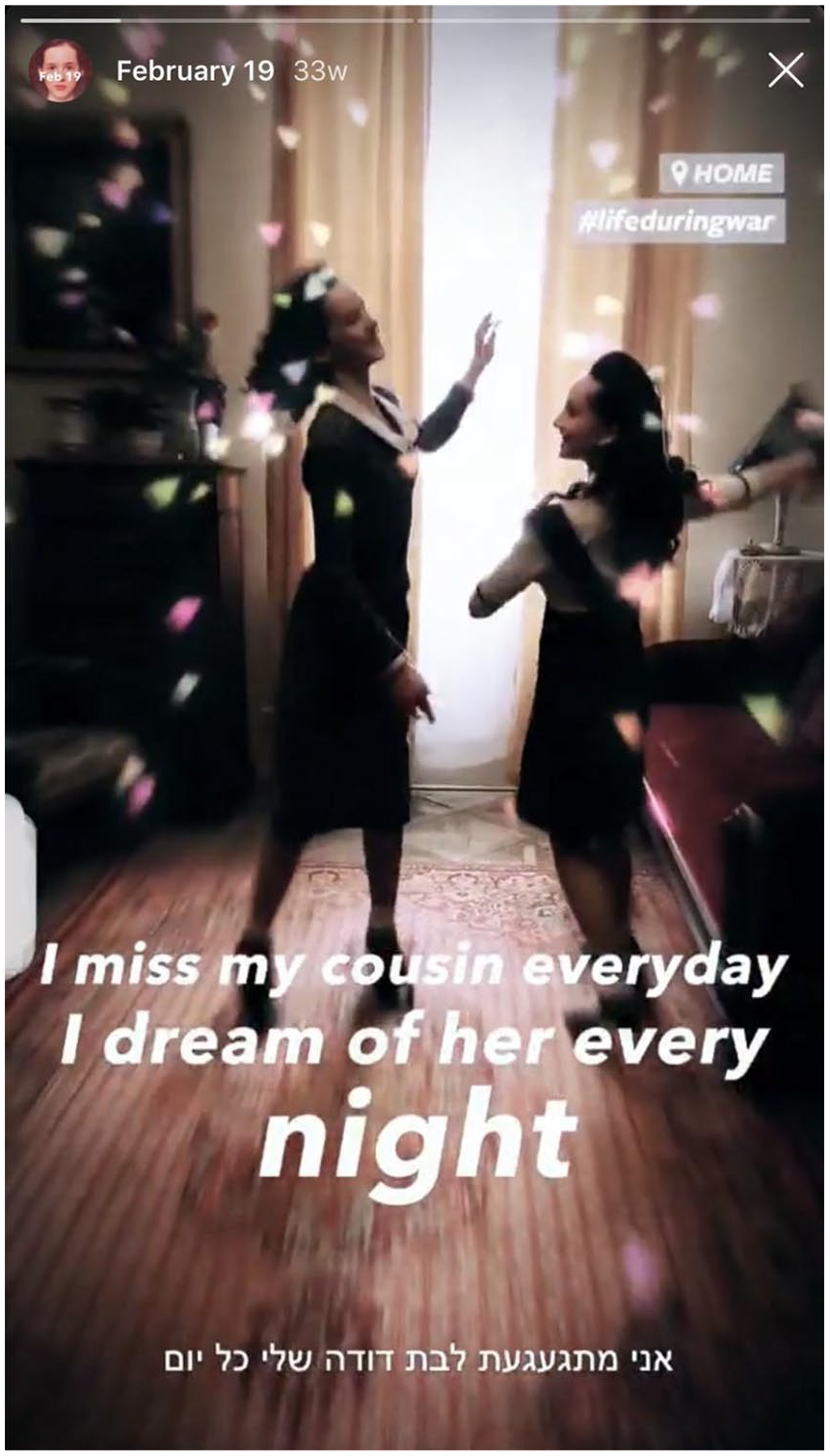
The Eva stories story from 19 February, https://www.instagram.com/stories/highlights/18020733661168059/ (Courtesy Eva Stories).
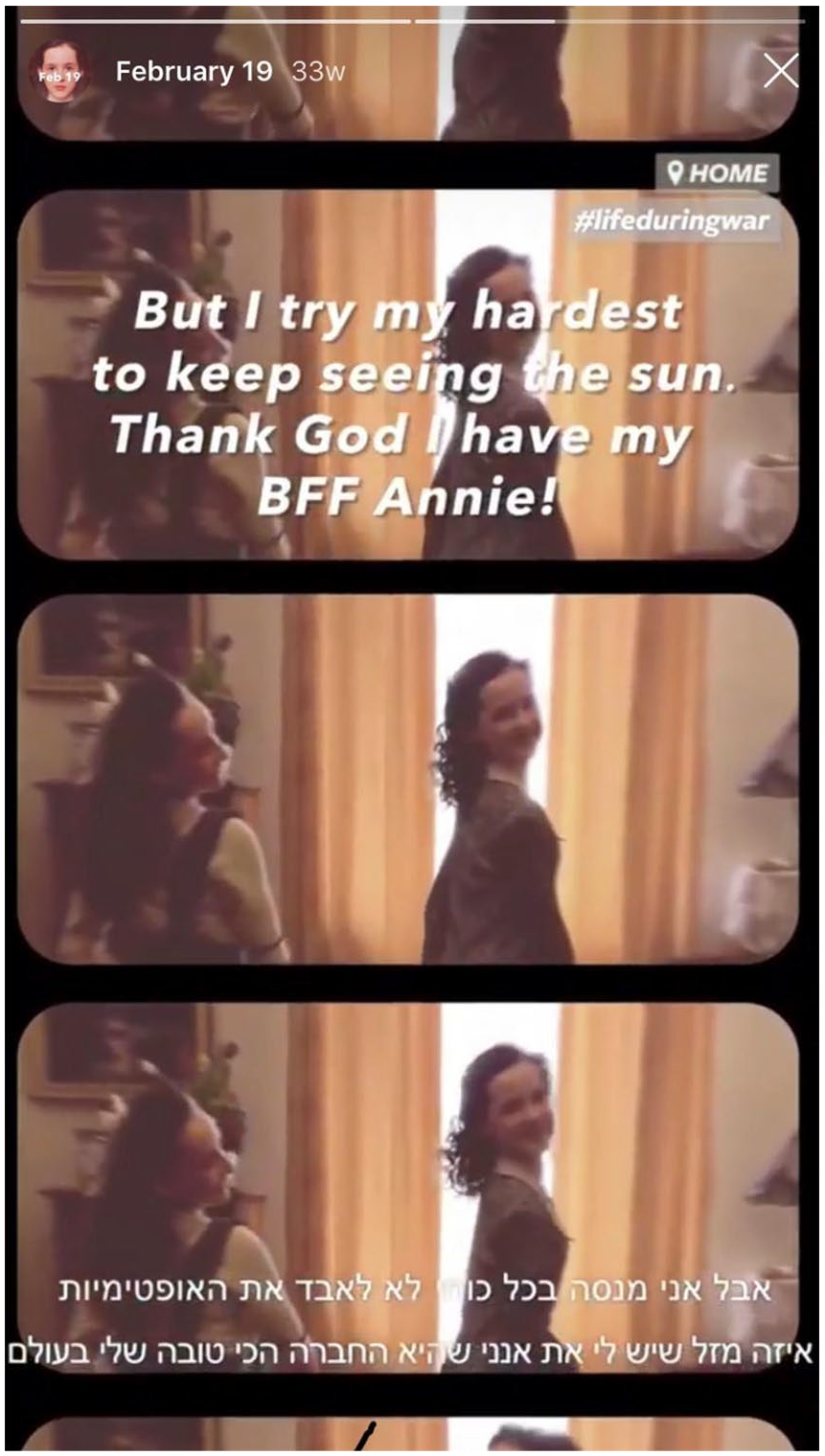
The Eva stories story from 19 February, https://www.instagram.com/stories/highlights/18020733661168059/ (Courtesy Eva Stories).
Both the kaleidoscope and the filmstrip-looking filter emphasize the power of looking and the transfiguration of an image through technology. The kaleidoscope alters what is seen with constant movements, light, and duplication; the film strip defines the image through light, duplication, chemicals, and movement. They indicate the possibility of manipulation, but also suggest different ways of capturing and looking at a depicted reality from the assemblatic point of view. In this sense, the atrocity witnessing mode self-reflexively stresses the showing of the imagery, with the camera being the witness and the audience its receptors. Simultaneously, it also informs of a drifting from the indexical, historical imagery, and the affinity toward the symbolic, self-made imagery, and memory.
The third mode is the social media witnessing mode, in which Eva records her personal, everyday experience and shares it with her followers. The social media witnessing mode is about the ubiquitous use of digital social media, inscribing memories into social media networks, and considering the audience as co-creators of this experience. It transforms the engaging space of social media into a responsive space for users, who are connected to the commemorated events by social media engagement. In doing so, it calls for a connection with other users by following the Eva Stories project and watching the stories, sharing, commenting, and posting the social media memory of the portrayed events. Adopting a thought from Walden (2019), Eva Stories invites the users to collaborate in the co-creation of this responsive space, “in which memory can be produced” (p. 6).
The social media witnessing mode invites the users to co-create a socially shared experience. Every user can connect and be nurtured by the memories communicated in the Eva Stories project by taking part in the event unfolding in social media, which is public and simultaneously addresses the individual’s experience. Thus, the witnessed event is a shared event that the social networks acknowledge as an event, interrelating the users with their followers. And so, while the journalist witnessing mode focuses on telling about what is happening, and the atrocity witnessing mode focuses on showing humiliation and perpetration, the social media witnessing mode focuses on sharing an experience by co-creating it. It cannot occur without the response of users who take an active part in the co-creation of a mediated experience, and become witnesses to it.
In one of the first stories in the project, Eva describes the state of Hungary in 1944 with a hand-drawn drawing (Figure 7). It renders Eva, her mother, and grandmother holding the Hungarian flag while standing on an island-looking detached soil with Nazi and Russian soldiers surrounding them. The story utilizes this illustration in order to simulate testifying about historical times in Hungary, which is one of the earlier functions of illustrating (Spiegelman in Chute, 2016: 28). In the next story, Eva superimposes that image with emoticons and the textual depiction “That’s me!” (Figure 8). The superimposition supposedly conveys Eva’s emotions—sadness and distress—as well as her present situation. But this sort of superimposition also indicates the ability of each user to become a co-creator of the experience related to the image by engaging with it, be it through screenshotting the image and superimposing it with another image or text, and then posting it in the users’ personal profiles, following the stories, or commenting on them. This practice is apparent in various stories, mostly through superimposition with emoticons, graphics interchange formats (GIFs), and short texts. Thus, the hand-drawn illustration of Eva allows not only for the inscription of Eva into history, but also offers the opportunity for users to inscribe their social media experience with Eva’s story into their own social media presence. Demonstrating the affordance of the format to instantly affect the ownership of an image by superimposing it, it also tells of a prominent practice the visual medium of Instagram offers to its users. The image is no longer a personal and static image of the event, nor is it recorded reality. It invites users to regard the image as suitable for the co-creation of experiences, which relate to them as well as to other users. Therefore, by creating a visual responsive space, users inscribe themselves by co-creation into the mediated memories and become social media witnesses.
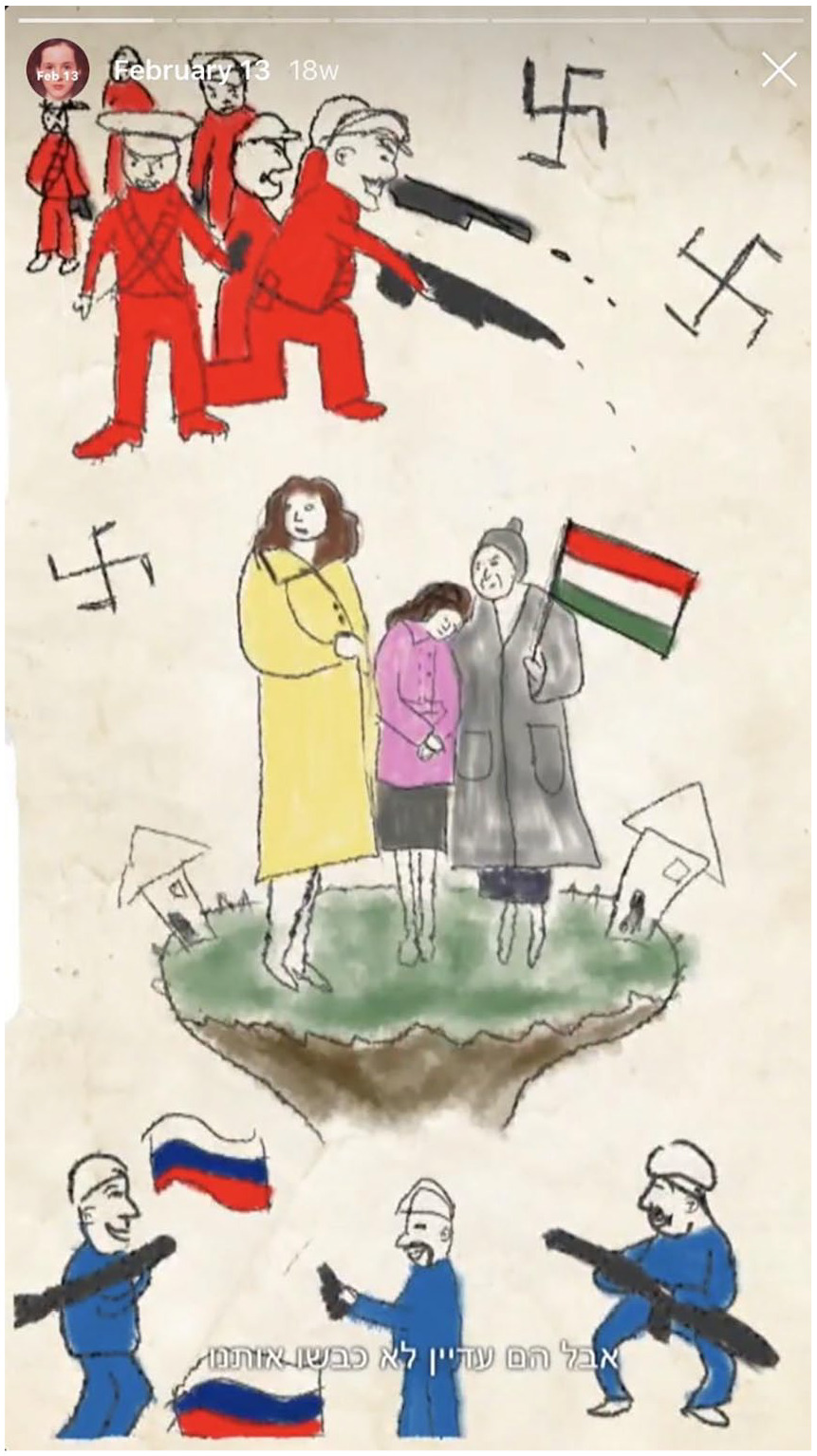
The Eva stories story from 13 February, https://www.instagram.com/stories/highlights/17860421761386848/ (Courtesy Eva Stories).
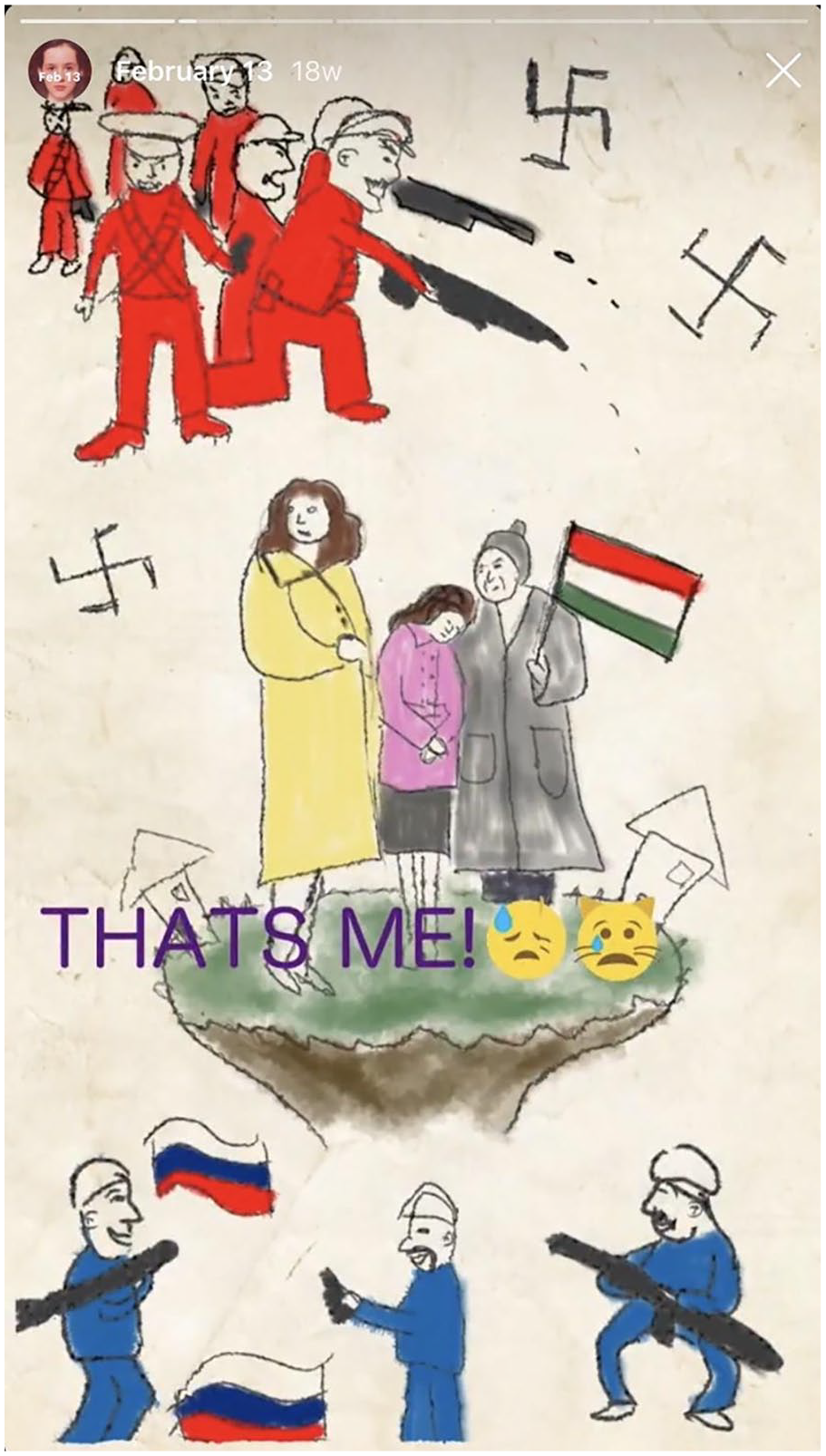
The Eva stories story from 13 February, https://www.instagram.com/stories/highlights/17860421761386848/ (Courtesy Eva Stories).
Conclusion: engaging social media memory
Refining Frosh and Pinchevski’s concept, the three modes of media witnessing that we identified and characterized in this article present three different ways in which users can connect to and inscribe themselves onto the mediated memories of the Eva Stories project. Adopting significant stylistic and narrative strategies from Instagram and other social media platforms, Eva Stories attempts on one hand to integrate a Holocaust-related memory into the social media “life” of its followers. On the other hand, Eva Stories establishes a responsive space for its audience. The followers are turned into witnesses of Eva’s story by utilizing selfie aesthetics, subjective point-of-view shots, and the Instagram stories’ resemblance to a diary. In doing so, Eva Stories combines the social media “act of ‘self-witnessing’” (Nunes, 2017: 113) with the paradigm of media witnessing and the crucial meaning of testimony for Holocaust memory.
Posted during Israel’s highly ritualized Holocaust Remembrance Day, the Eva Stories project constituted a form of alternative commemoration on an individual basis that complemented the official collective memory routine. Subsequently, Eva’s virtual Instagram profile became a new responsive space for Holocaust memory. Through the assemblage character of Eva Stories, users are not only invited to view memories from the past from different perspectives, related to different temporalities and adjusted to social media practices. The stories also provoked alternative responsive acts of social media memory, which reached beyond official forms of Holocaust commemoration.
An attempt of reintegrating Eva Stories into such established commemoration patterns was apparent in January 2020, when Israel’s President Reuven Rivlin asked world leaders to interact with Eva’s Instagram profile and send “Never Again” pledges in the run-up to the Fifth World Holocaust Forum that took place in Jerusalem (Yalon, 2020). This official initiative responded to the observation that social media such as Instagram “encourages conversation and empathy, keeping the Holocaust visible in youth discourses” (Commane and Potton, 2019: 160). Accordingly, ordinary teenagers used @Eva.Stories as an address for their messages marking the International Holocaust Remembrance Day as well as Israel’s Holocaust Remembrance Day in 2020.
The three witnessing modes that we identified are not exclusive to the Eva Stories project and can be ascribed to other recent digital Holocaust commemoration projects posted on social media as well. Since Eva Stories went online, others adopted the same question which back in 2019 arouse so much attention: “What if a girl in the Holocaust had Instagram.” Produced by the Anne Frank House in Amsterdam, and uploaded on YouTube throughout April and May 2020, the Anne Frank Video Diary even asks a similar question: “What if Anne Frank had a camera instead of a diary?” The 15-episode series depicts several events that Anne documented in her diary during the Nazi occupation of the Netherlands, this time in a video blog format. The series is another example of the journalist and atrocity witnessing modes, showcasing the ways in which producers consciously relate to social digital media and its ability to share personal experiences in new ways.
Stressing her personal involvement in present events, Anne continuously performs the journalist witnessing mode while she accounts for events happening outside her hiding place in occupied Netherlands. In the first episode, for example, she is holding the camera in a selfie position, reporting to the video camera on the current arrests of Jews, and voicing her concerns over her and her family’s state, a day before going into hiding (Figure 9). The last episode depicts the moments of discovery of the secret annex and the group’s arrest by the Gestapo. This episode starts with a depiction of Anne documenting another ordinary morning in hiding, when suddenly she hears that the Gestapo is searching the building. She abruptly drops her camera, and as if accidently taping, the camera depicts the scene from a low angle shot, showing only the inhabitants’ and Gestapo officers’ shoes (Figure 10). Referencing in an indirect manner, the famous images of piles of shoes from the liberated camps, the ending scene depicts Anne and the rest of the hiding group as Holocaust victims. In this manner, the scene is another example of the atrocity witnessing mode, as the camera functions as the witness to the portrayed event, already utilizing the users prior knowledge of iconic imagery in order to indicate and symbolize Anne Frank’s fate.
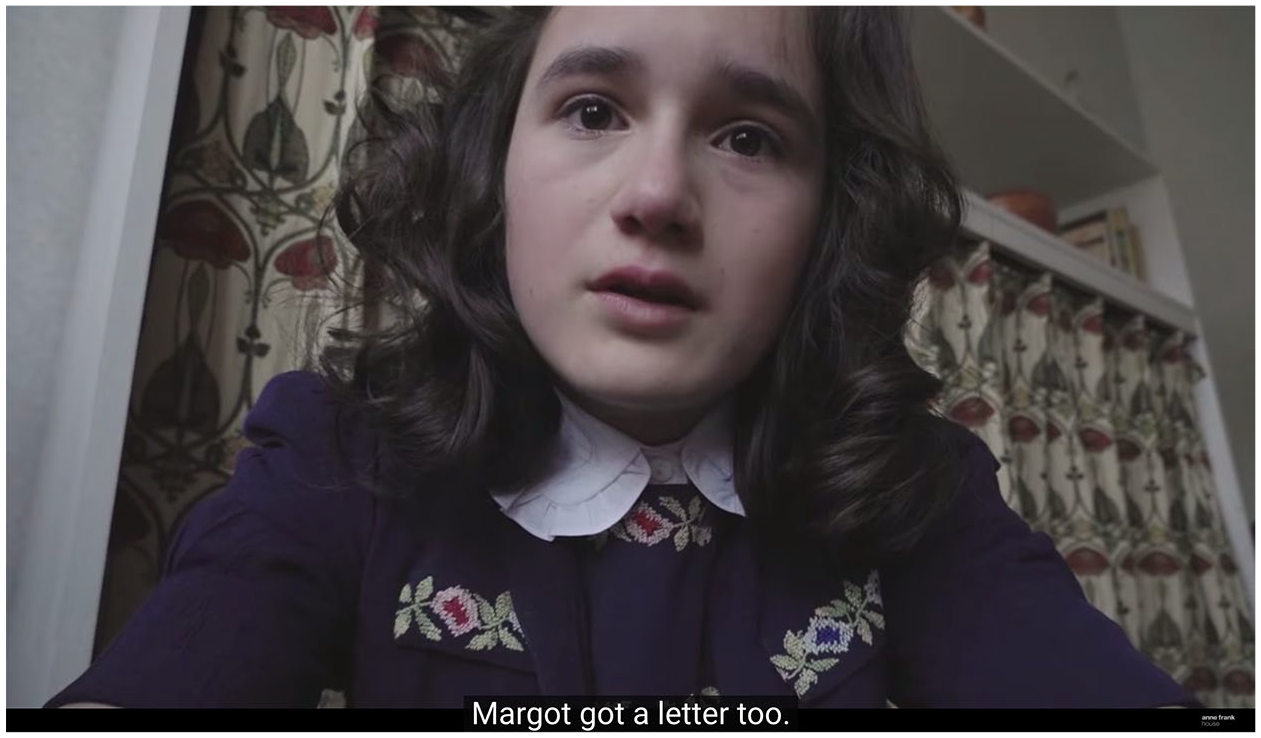
My best present—Anne Frank video diary—Episode #1—Anne Frank House, https://www.youtube.com/watch?v=ZWFjgWGI_YE&list=PLDwwb2V397Q6192UeDFpcNuSoK8uS1cgz&index=1
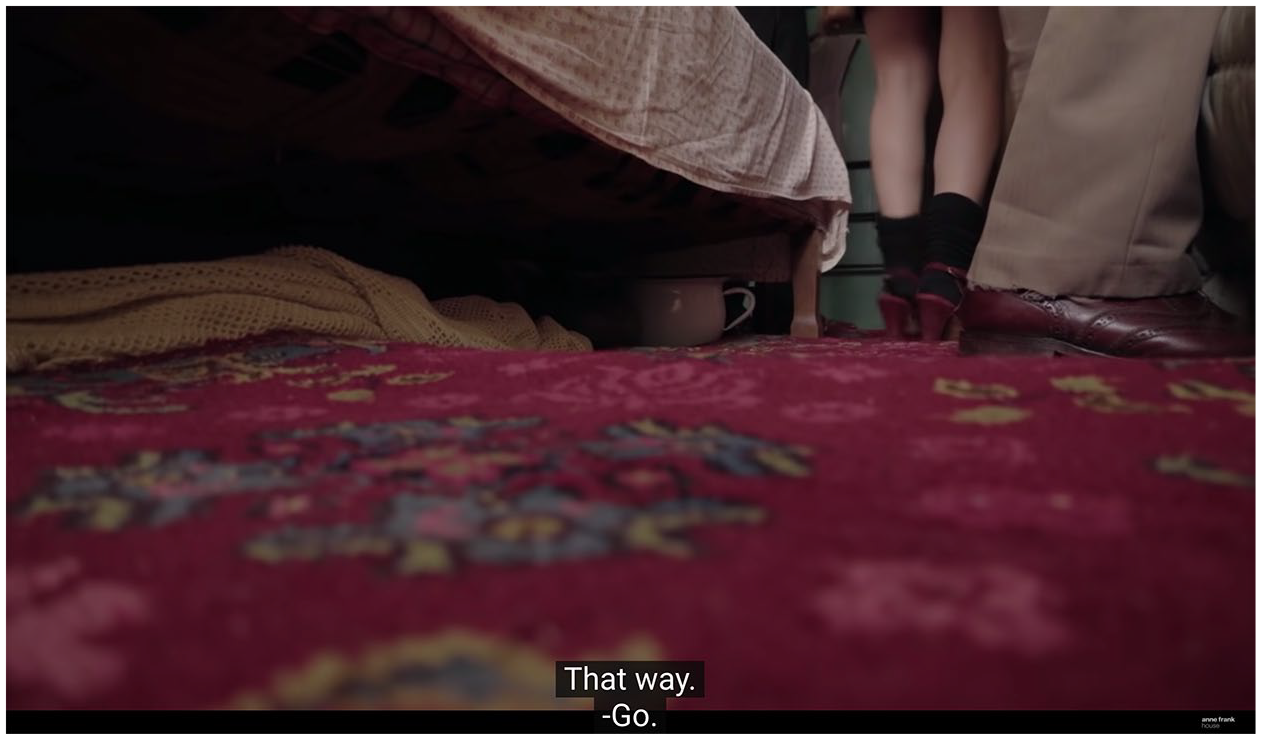
Discovered—Anne Frank video diary—Episode #15—Anne Frank House, https://www.youtube.com/watch?v=a4lxDhPC8gY&list=PLDwwb2V397Q6192UeDFpcNuSoK8uS1cgz&index=15
Mainly adopting video blog practices, the project lacks the engaging dimension of social media witnessing that was prevalent in Eva Stories. Framed by explanatory videos including questions for discussion, the Anne Frank Video Diary follows more traditional ways of mediating Holocaust memory, while still demonstrating an innovative approach to new media in order to share the memory of Anne Frank.
Many projects, however, also started experimenting with more participatory forms of social media witnessing, such as the virtual name reading campaign #RememberingFromHome, a social media initiative by the Israeli Holocaust memorial Yad Vashem (2020). This project responded to the restrictions caused by the COVID-19 pandemic, and demonstrated the increased use of social media platforms as new memory ecologies. #RememberingFromHome engages the users socially and visually by asking them to take videos of themselves or their family members while reciting names of Holocaust victims. Users could then upload those short videos to social media platforms, and thereby, contribute to a collaborative virtual name reading by using the hashtags #RememberingFromHome and #ShoahNames. During Holocaust Remembrance Day, Yad Vashem compiled these user generated videos into an online name reading ceremony (Figure 11). As users from various homes and countries recorded and proclaimed the victims’ names, age, and places of death, in various languages, #RememberingFromHome became a digital responsive space that turned social media users into social media witnesses. Not only the “active” users who uploaded videos of themselves became social media witnesses, but also those who engaged with the project by watching the videos of others, commenting and sharing them in their personal profiles. The users also became social media witnesses not only to those who were murdered in the Holocaust, but also, as it is characteristic of the assemblage character of co-creation, to the presentness of their memory in contemporary social media experiences that integrate into the personal timelines of present-day social media accounts. In doing so, #RememberingFromHome applies co-creation for the constitution of social media memory for a wide and diverse group of global users.
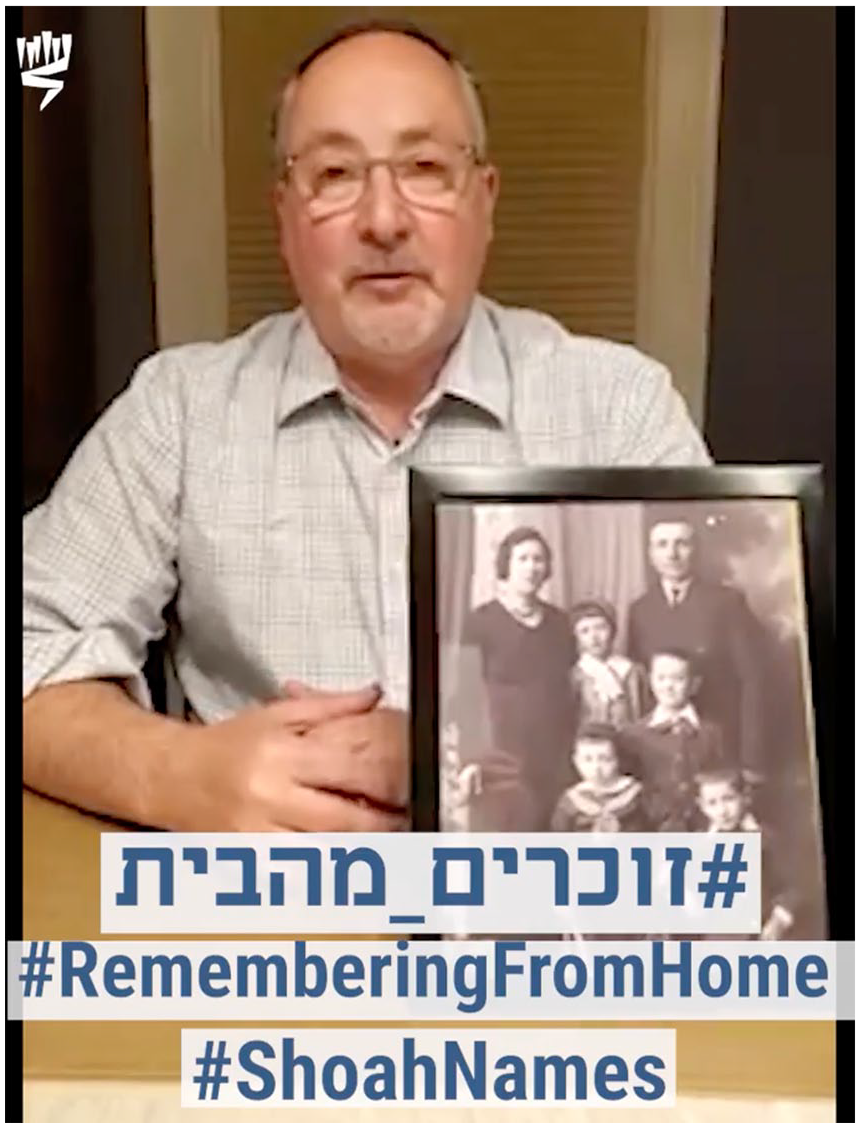
Virtual Name-Reading Campaign initiated by Yad Vashem to mark Holocaust Remembrance Day 2020, https://www.facebook.com/yadvashem/videos/230161068230371/ (Courtesy Yad Vashem website).
While the #RememberingFromHome evokes social media witnessing and the Anne Frank Video Diary expresses the journalist and atrocity witnessing modes, Eva Stories is a unique example that combines all three modes of media witnessing within social media memory frameworks. The current intensification of digital memory initiatives in response to social distancing regulations caused by the COVID-19 pandemic, especially the increased use of social media platforms as memory ecologies, however, will most likely lead to additional formats that intersect our three modes of media witnessing.
Memorializing the Holocaust through social media ecologies such as Instagram allows for digital commemoration that is focused on the present experiences of users rather than the historical experience and evidence, on the responsive space rather than the historical site, and on short expressions of emotions rather than the narration of historical information. In doing so, attention shifts from past to present, from history to experience, and from the “other” to “self,” focusing on the exploration of a responsive space filled by the users with assemblages of self-focused digitally co-created memories. With the actual witnesses passing away, the increased feeling of their absence seems to be filled with the presence of engaging social media memory that inscribes the users into the mediation of past events and memory into present media lives. These significant transformations in memorialization practices demand further historical, ethical, and technological reflection.
Footnotes
Funding
The author(s) received no financial support for the research, authorship, and/or publication of this article.
