




Abstract
Online news consumers have the tendency to select political news that confirms their prior attitudes, which may further fuel polarized divides in society. Despite scholarly attention to drivers of selective exposure, we know too little about how healthier cross-cutting news exposure patterns can be stimulated in digital media environments. Study 1 (N = 553) exposed people to news media literacy (NML) interventions using injunctive and descriptive normative language. The findings reveal the conditional effect of such online interventions: Participants with pro-immigration attitudes engaged in more cross-cutting exposure while the intervention was only to a certain extent effective for Democrats, ineffective for Republicans, and even boomeranged for partisans with anti-immigration attitudes. In response to these findings, Study 2 (N = 579) aimed to design interventions that work across issue publics and party affiliation. We show that NML messages tailored on immigration beliefs can be effective across the board. These findings inform the design of more successful NML interventions.
Keywords
In a digital media environment characterized by an overload of information, the supply-side of news seems to respond with formats that stand a higher chance of selection. One way to attract audiences is to provide news that resonates with people’s ideology or issue attitudes. Accordingly, we increasingly see online news content and sources that, for example, echo either more conservative or liberal perspectives on an issue (e.g. Knobloch-Westerwick et al., 2014). On the demand-side of news, people may, respectively, be motivated to select content that is in line with their own ideologies and political views (e.g. Knobloch-Westerwick et al., 2020), even though the digital news setting also affords exposure to a wide variety of differing political viewpoints. As a result, news consumers are less likely to engage in cross-cutting news exposure and are not stimulated to expose themselves to diverse angles, sources, and perspectives (e.g. Goldman and Mutz, 2011). When individuals no longer receive a similar picture of the world around them, due to exposure to different media realities, it hinders informed political decision-making and increases fragmentation (e.g. Stroud, 2008).
Previous selective exposure studies have demonstrated how audiences are indeed biased toward selecting attitude-congruent news—that is, driven by a confirmation bias (e.g. Knobloch-Westerwick et al., 2020). Yet, there is little empirical research that systematically investigates how cross-cutting news exposure can be encouraged with journalistic tools or online interventions (but see, for example, Vraga and Tully, 2019). Hence, an important unanswered question is how healthier selection behavior on the demand-side of online news audiences can be stimulated in a high-choice, fragmented media environment. In this article, we aim to contribute to selective exposure literature on confirmation biases by relying on news media literacy (NML) research to understand how to fight biased news diets.
A valuable research line has shown how NML interventions have clear merits (Vraga and Tully, 2015, 2019). Yet, these studies also demonstrate the challenges of designing such interventions as the effects are found to be at least partially dependent on media context and audience characteristics (Jeong et al., 2012; Tully et al., 2020; Vraga and Tully, 2019) or, at times, such efforts do not work at all (Vraga et al., 2020). The conditional effectiveness of such NML interventions indicates that the process of correcting behavior with communicative efforts is complex at best, and therefore requires additional research.
The central focus of the experimental studies reported in this article is to deepen our current understanding of how NML interventions can stimulate cross-cutting selective exposure into online political news. In a first step (Study 1), we translate a well-established intervention approach from a related communication field that has relied on injunctive or descriptive normative language (e.g. Cialdini et al., 2006) to online interventions that stimulate cross-cutting online news diets. So far, these types of interventions have mainly been tested to stimulate behavior like reducing alcohol intake, smoking cessation, or preventing littering (Jeong et al., 2012) but remain untested in the context of healthier cross-cutting news exposure. In a second step (Study 2), based on the outcomes of Study 1, we tailor NML interventions (Haenschen and Jennings, 2019) for online cross-cutting exposure to see if reactance by issue publics can be overcome when NML interventions reassure people’s issue attitudes or partisan ideologies.
Confirmation biased versus cross-cutting selective exposure
Selective exposure has typically been defined as the guiding role of citizens’ prior attitudes, beliefs, and (ideological) identities on the selection of information (e.g. Garrett, 2009; Iyengar and Hahn, 2009; Stroud, 2008). In the setting of political communication, patterns of selective exposure or avoidance are mainly understood as resulting from a confirmation bias (e.g. Knobloch-Westerwick et al., 2020; Winter et al., 2016). This means that people’s prior attitudes or identities function as a perceptual screen or attitudinal filter: Congruent information stands a higher chance of selection than incongruent information. Psychologically, confirmation-biased selective exposure is typically understood as motivated by the need to avoid cognitive dissonance (e.g. Bennett and Iyengar, 2008; Knobloch-Westerwick et al., 2020; Taber and Lodge, 2006; Winter et al., 2016). Encountering information that challenges (partisan) views and ideologies results in discomfort and the experience of cognitive dissonance (Festinger, 1957). Digital information settings in particular allow individuals to avoid dissonant views and opinions—which may reinforce biases in online news diets (e.g. Bennett and Iyengar, 2008; Knobloch-Westerwick et al., 2014).
In contrast to confirmation-biased selective exposure, a rich body of literature concentrates on news selection that is incongruent with audiences’ pre-existing beliefs, namely, cross-cutting news exposure. Cross-cutting exposure means that news consumers are exposed to political perspectives that are dissimilar to one’s own views (e.g. Goldman and Mutz, 2011; Mutz, 2002; Mutz and Martin, 2001). Scholars have argued that being exposed to cross-cutting views is crucial for the functioning of deliberative democracy (e.g. Calhoun, 1988). For example, exposure to dissimilar or conflicting views can stimulate constructive political dialogue between citizens (Mutz, 2002; Mutz and Martin, 2001). Confirmation-biased selective exposure, in contrast, reinforces political views and bolsters polarized divides (e.g. Stroud, 2008) and therefore does not contribute to learning from the other side (e.g. Arendt, 2006). More specifically, exposure to dissimilar views contributes to a more profound understanding of people’s own position and that of others, which may correspond to normatively better views, and enhanced legitimacy of political decisions (Mutz, 2002).
Empirical evidence on the deliberative implications of cross-cutting exposure is mixed (see Matthes et al., 2019 for an overview). On one hand, Mutz (2002), for example, argues that exposure to dissimilar views may impede political participation because people are afraid of negative social ramifications associated with expressing dissimilar views. On the other hand, other studies observed positive effects of cross-cutting exposure on political participation (Huckfeldt et al., 2004) or found no significant effects (Eveland and Hutchens Hively, 2009; Nir, 2011). Since this inconclusiveness may partially be due to differences in the operationalization of cross-cutting exposure (Eveland and Hutchens Hively, 2009; Matthes et al., 2019), it is crucial to explain the operationalization applied in this article.
As argued by Eveland and Hutchens Hively (2009), there are three different relevant dimensions to consider when studying cross-cutting exposure: (1) frequency (i.e. how often do people discuss politics with others or how often are they exposed to [dis]similar views), (2) network size (i.e. with how many different people are politics discussed, or diversity of media environments), and (3) heterogeneity (how dissimilar are the views that people encounter when discussing politics or exposing themselves to the news). The dimension of heterogeneity can be conceptualized on both the individual and network level (Eveland and Hutchens Hively, 2009). In this article, we focus on the former heterogeneity dimension of cross-cutting news exposure: We measure the extent to which individuals engage in selection behavior that includes views that are dissimilar to one’s own political perspectives. Here, we distinguish between three levels of encountering dissimilar views: (1) only being exposed to views that confirm existing beliefs (confirmation-biased exposure), (2) seeking out an equal amount of similar and dissimilar views (balanced exposure), and (3) exclusively selecting dissimilar views (full incongruent news exposure). In this conceptual approach, exposure to news that disagrees with an individual’s pre-existing attitudes or beliefs is rated as the highest level of cross-cutting exposure in an attempt to capture audiences’ willingness to expose themselves to dissimilar views. It could also be argued that balanced exposure (i.e. exposure to both incongruent and congruent news) should be seen as the highest form of cross-cutting exposure. Yet, because one’s own position is often already firmly established, especially if it comes to salient and contested political issues that tend to polarize citizens (Stroud, 2008), we argue that it is more insightful to regard full dissimilar exposure as the highest level. Using this conceptualization, we approach cross-cutting news exposure as the central dependent variable and ask how we can stimulate exposure to dissimilar views in today’s digital information settings, and motivate news consumers to rely less on their existing views and confirmation bias when selecting news.
Stimulating cross-cutting exposure by NML interventions
NML involves the knowledge and skills needed for people to navigate their information environment in a mindful and critical way (Ashley et al., 2017). Literate news consumers understand how news content is produced, consumed, and, importantly, how people’s personal beliefs and identities may impact the interpretation of news (Craft et al., 2016). Although many people become more skilled in selecting news from digital platforms, news audiences in general are not competent when it comes to a more critical evaluation of this information (Jeong et al., 2012; Tully et al., 2020).
In this setting, NML interventions may offer a partial solution to stimulate media literacy skills in digital settings. NML interventions can be understood as any type of (communication-based) intervention that has the key aim of enhancing news consumers’ critical skills to navigate their information setting (also see Jeong et al., 2012). In research related to promoting different healthy behaviors, a meta-analysis by Jeong et al. (2012) shows that NML interventions have positive effects on different outcomes, such as media knowledge and actual behaviors. In the context of political news, previous studies have demonstrated that NML interventions can reduce hostile media perceptions (Vraga and Tully, 2015) and exacerbate partisan divides in perceptions of biased content (Vraga et al., 2009). Yet, it should be emphasized that extant literature points to partisan differences in the way that NML interventions are interpreted. Vraga and Tully (2015) found that a media literacy message intended to reduce hostile-media perceptions was only effective among conservatives, whereas liberals did not update their evaluations based on the intervention they were exposed to. Yet, other research found the opposite effect: Vraga et al. (2009) show that NML interventions are more effective in reducing perceived biases among liberals than conservatives. These findings show that the effectiveness of NML interventions may depend on ideological perceptual screens, and that liberals and conservatives may be persuaded by different types of media literacy messages.
Although selective exposure research has pointed to the real-life democratic implications of confirmation biases—most saliently the fostering of polarized societal divides (e.g. Stroud, 2008), we know relatively little about how healthier cross-cutting media diets can be stimulated by inducing NML (but see, for example, Vraga and Tully, 2019). Vraga and Tully did demonstrate that exposing partisans to NML messages can reduce tendencies of selective exposure but not avoidance. Partisan selective exposure, which was more pronounced among Republicans than Democrats, was reduced to non-significance by exposing people to certain NML messages. Against this backdrop, we expect that NML interventions can stimulate cross-cutting selective exposure:
H1. Exposure to a NML intervention stimulating cross-cutting exposure induces more cross-cutting media exposure compared to the absence of such an intervention.
Types of NML interventions: injunctive versus descriptive norms
NML messages are typically designed as a set of recommendations on what people should do to perform a certain healthy behavior (e.g. Jeong et al., 2012). In the setting of news exposure, Vraga and Tully (2019) rely on interventions that remind people that they have to be critical when evaluating media content. Three out of four of their interventions significantly reduced partisan selective exposure to news about the 2016 election campaign. Effective NML messages reminded participants on how personal viewpoints influence individual news interpretations and/or focused on the value of a free press for a democratic society.
If we relate this approach of designing NML messages to the rich body of research on social norms—concerned with how the communication of social norms can spur or guide human behavior—the line of argumentation in such messages can be regarded as mostly communicating an injunctive norm. Injunctive norms contain a description of what should be done in a certain situation (e.g. Cialdini et al., 2006; Gerber and Rogers, 2009). Such normative language is found to promote norm-congruent behaviors in different settings, such as health communication and littering (e.g. Reno et al., 1993). Next to the injunctive norm, research has also documented how the communication of a descriptive norm can sometimes better guide behavior. Descriptive norms describe the (perceived) actual behavior of the majority (e.g. Cialdini et al., 2006). More specifically, descriptive norms do not explicitly advocate desired behavior, but rather describe what behavior is most common in a particular setting. Extant research indicates that such norms can have an impact on desired behavior (e.g. for recycling (Cialdini, 2003) or voter turnout (Gerber and Rogers, 2009)). In an effort to offer practical recommendations for the design of NML messages to stimulate cross-cutting selective exposure, we compare the effectiveness of these norms in NML messages.
In a highly partisan setting, such as US politics, descriptive norms may result in less resistance than injunctive norms as they do not tell people what they should do, but rather describe majority behavior. In the United States, where confirmation-biased selective exposure has been regarded as a key driver of media effects (Bennett and Iyengar, 2008), we expect that descriptive norms result in a stronger tendency to perform norm-consistent behavior than injunctive norms. Hence, when people are told what they should do, more reactance may occur—as such messages take away more freedom compared to the description of the majority behavior (Albarracín and Vargas, 2010) and induce higher levels of cognitive dissonance. We, therefore, hypothesize as follows:
H2. Descriptive norms are more effective in stimulating cross-cutting media exposure than injunctive norms.
Method Study 1
To explore if different types of NML interventions can stimulate cross-cutting news exposure, Study 1 relies on a selective exposure experiment. The experiment concerns a three-factor (NML intervention: injunctive vs descriptive vs absence) between-subjects design. Prior to measuring participants selective exposure behavior in an online setting, they either were exposed to a NML intervention to stimulate cross-cutting news exposure with injunctive norms, a NML intervention with descriptive norms, or they were not exposed to a NML intervention at all in a control condition. Similar to the NML interventions used by Vraga and Tully (2015), immigration was selected as the topic for the news items as it is a polarized issue that strongly relates to the preferences of different issue publics and party affiliations in the US public opinion data which emphasize that a large proportion of the US population considers immigration to be a very important issue (Pew Research Center, 2014). Yet, the issue is surrounded by strong partisan disagreement: 57% of Republicans say that open borders are a risk to losing the American identity, whereas the majority of Democrats (86%) feel that open borders are a key defining characteristic of US identity (Pew Research Center, 2019). Stimulating cross-cutting exposure on a high-involvement issue that strongly divides US society may thus have crucial ramifications for deliberative democracy.
Sample
A varied sample of US participants was recruited online via Dynata in May 2019. A total of 533 completes were included in the final analyses (completion rate 83.7%). Those who did not correctly answer a pre-stimuli attention check were excluded from the final sample. In recruiting participants, we relied on quotas on prior (anti)immigration attitudes to ensure that we would obtain a somewhat balanced sample with respondents who supported (256) and opposed (277) immigration. Participants that did not have an opinion on the topic were excluded (23.4%). The average age of the sample was 44.87 (standard deviation (SD) = 14.81) and 54% was female. The distribution of education was as follows: 25.9% was lower educated, 19.3% was higher educated, and 54.8% had a moderate level of education.
Procedure and stimuli
Participants entered the experiment via an online link distributed by the sampling company. After they were introduced to the study and gave informed consent, participants answered an issue-attitude question on a 7-point Likert-type scale to assess their general support of immigrants coming to the United States. Those who answered “neither oppose or support” (four) were excluded from the survey as we needed to match respondents with the political stance in the news items to assess whether they exposed themselves to cross-cutting news (for a comparable approach see, for example, Hameleers and van der Meer, 2020). This exclusion was done pre-randomization to avoid undermining the random allocation to conditions. Afterwards, several general questions were shown in the pre-treatment survey.
In the next step, participants either saw a NML message with injunctive norms, a NML message with descriptive norms, or did not see a NML message at all. For those exposed to one of the NML messages, participants were instructed that they would read a public service announcement (PSA) from the Media Literacy Coalition (MLC) that was published in that week (Vraga and Tully, 2019). Both NML messages contained information about why it is important to select cross-cutting views. Explanations were provided about how the current online media environment can result in people selecting only news that is in line with their attitude, and how this can be problematic. Next, it was indicated how these problems can be countered by selecting cross-cutting news. Each intervention ended with three bullet points of what people should remember when selecting news.
The NML messages with injunctive versus descriptive norms primarily differed on how the recommendations were communicated. In the injunctive-norm condition, the NML message was formulated in a more normative way. The descriptive-norm condition provided the information by showing how the majority of US citizens are in favor of a more balanced media diet. For example, the intervention in the injunctive-norm condition stated that it is important to seek out news that offers multiple viewpoints about an issue while the PSA with descriptive normative language stated that most citizens know that this is important to do. In addition, in the descriptive norm condition, it was stated that 78% of US citizens engage in cross-cutting news exposure. To ensure accuracy, we based this percentage on PEW research that showed that up to 78% of US citizens indicated that they favor unbiased news coverage (Pew Research Center, 2018). Both interventions were pilot tested among a US Amazon Mechanical Turk sample of 65 adults in May 2019. The interventions were both evaluated as understandable on a 7-point Likert-type scale (injunctive PSA: M = 6.21, SD = .74; descriptive PSA: M = 6.08, SD = 1.20). Moreover, we found that those who read the descriptive norm intervention were more likely to think that the majority of people engage in selecting balanced news (M = 6.08, SD = 1.02) as compared to those who read the injunctive one, M = 5.22, SD = 1.34, t(51) = 48.40, p < .05. The same question, included in Study 1 as a manipulation check, showed the same pattern, descriptive PSA: M = 5.44, SD = 1.05; injunctive PSA: M = 5.06, SD = 1.10, t(334) = 3.20, p < .01. In Supplemental Appendix 1, both PSA messages are included.
On the next page, participants were informed that they would view an online news website. They were asked to browse through this website to gain an impression of the headlines of the articles, which were all about refugees and the American job market. On this news website, six different news items, based on recent real news articles on this topic, were presented in a random order. Three items were formulated in line with the issue position of supporting refugees to come to the United States—for example, “Help wanted: Rural America needs refugee workers.” The other three news items were in line with opposing stances on the issue of welcoming refugees—for example, “More deportations of refugees will bring back American jobs.”
Participants were requested to read two articles in total. After reading the first article, they returned to the news website to select the second news headline to read another article. This gave us the opportunity to see if they would engage in cross-cutting exposure or not. Software recorded what articles were selected and reading time was monitored to see if respondents actually spent some time reading the articles. Participants were instructed to read the article as they normally would. The articles were based on existing news articles and were adjusted to be comparable in length (±500 words). We decided to keep the sub topic (job market and immigration) consistent across all news items to ensure that participants would not select news items based on the sub topic but rather on how the issue is approached: either in a way that supports or opposes immigration. In the same pilot test (N = 65), we tested 12 headlines about immigration and the job marketed to select those news items that most clearly conveyed the respective stance on the issue to participants and did not differ on other elements that are known to influence news selection, namely, level of ambiguous, attention-grabbing, personally interesting, and similarity to other coverage on refugees. Supplemental Appendix 2 shows the news website with all the six headlines.
Measures
Cross-cutting news selection
To see if the news items selected by participants were congruent or incongruent with their existing political attitudes, we had to match their political attitude with the news item’s stance on the political issue. At the start of the questionnaire, respondents were asked to indicate how strongly they support or oppose that immigrants are entering the United States on a 7-point Likert-type scale. Those who scored 1 through 3 were labeled as opposing this issue position, and those who scored 5 through 7 were labeled as supporters. Next, news items were coded as congruent if they were in line with participants’ prior attitude on immigration and were coded incongruent if they countered their views on immigration. Although we relied on a single-item measure (to ensure a balanced distribution of issue publics during the survey flow), our post hoc analyses comparing the single item measure to an elaborate scale of immigration attitudes shows a very strong correlation.
To test if participants engaged in cross-cutting news selection, we constructed a single measure of cross-cutting news exposure behavior with the following scores: –1 = two attitude-congruent articles (N = 213, 40%), 0 = one attitude-congruent and one attitude-incongruent article (N = 253, 47.5%), and 1 = two attitude-incongruent articles (N = 67, 12.5%).
Control variables
Several control variables were included in the analysis that are known to affect news selection and partisan attitudes. Although we randomly assigned participants to conditions, the re-coding of the dependent variable based on congruence with prior attitudes made it relevant to control for perceptions related to these attitudes. First, we control for whether participants felt that the general public opinion was hostile toward their immigration attitudes, hostile (N = 101), non-hostile (N = 347). Second, political interest (M = 4.77, SD = 1.82) was captured with one item asking respondents how interested they are in politics and public affairs on a 7-point scale. Third, media skepticism was measured with six items on a 7-point Likert-type scale (M = 3.23, SD = 1.68, Cronbach’s α = .98) (Tsfati and Cappella, 2003). Fourth, party affiliation was measured on a 7-point Likert-type scale asking respondents whether they identify more as Republicans or Democrats (M = 4.21, SD = 1.94).
Results Study 1
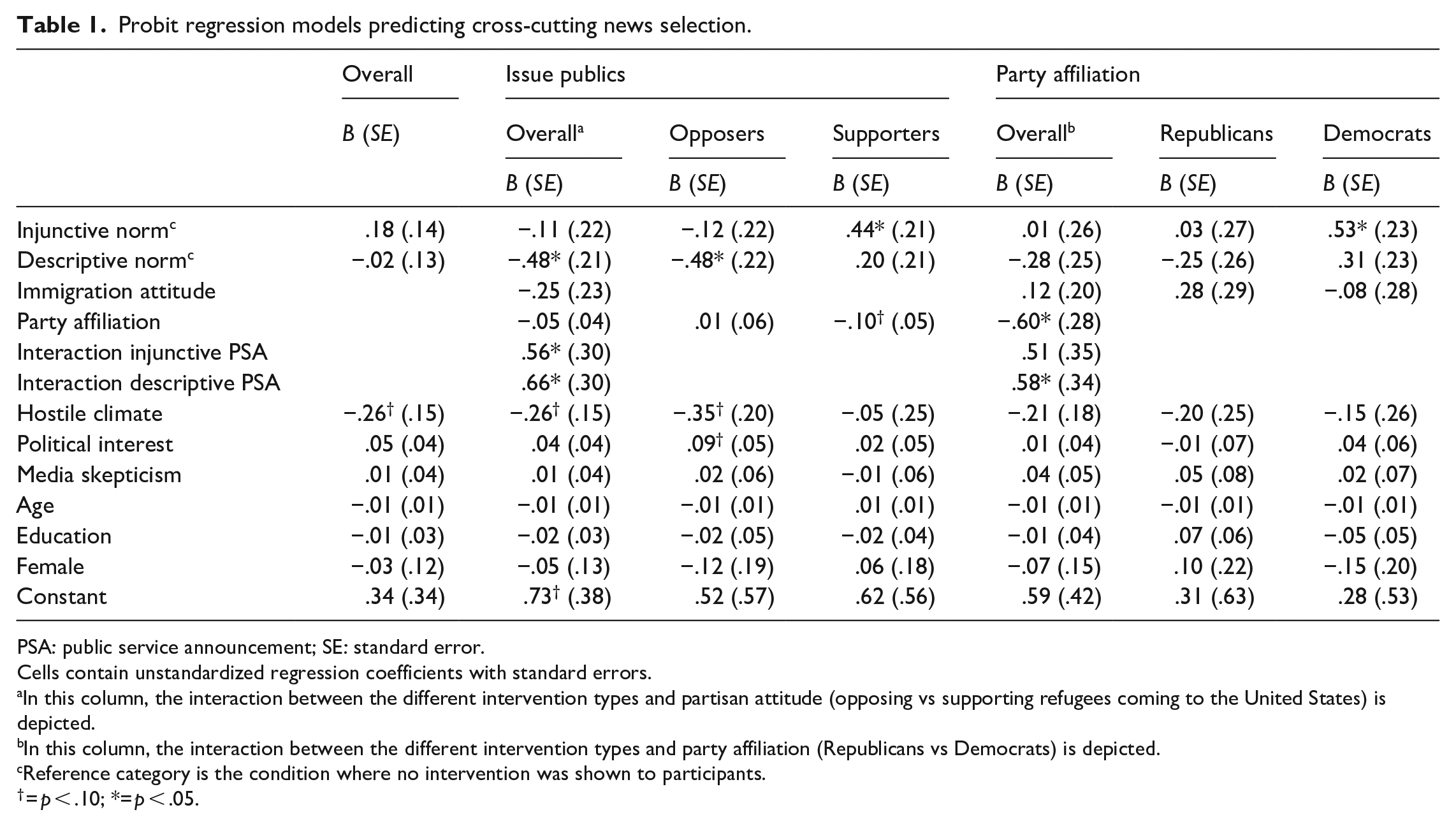
H1 predicted that a NML intervention stimulates cross-cutting news exposure, and H2 focused on whether exposure to a NML message with descriptive norms stimulating more cross-cutting news selection compared to an NML message that relies on injunctive norms. To test these hypotheses, probit regressions were run with cross-cutting news selection as dependent variable, and the presence of the different interventions and control variables as predictors. Based on the results depicted in Table 1, it can be observed that there were no significant effects for the overall sample. However, when we run interaction analyses, a clear picture arises. These interaction analyses show the conditional effectiveness of the different types of interventions based on people’s immigration beliefs or party affiliation (Table 1). First, when splitting up the analysis for issue publics, we see that a PSA with injunctive norms actually stimulates supporters of immigration to engage in cross-cutting news selection (Table 1). 1 The intervention with injunctive norms had no effect on the opposers of immigration. When focusing on the descriptive norm, we can see that this intervention was unsuccessful in stimulating supporters to obtain a more cross-cutting media diet while it even backfired for the opposers. After seeing the intervention with descriptive norms, opposers of immigration were even less likely to select cross-cutting news. Figure 1(a) shows how the predictive margins for cross-cutting exposure go down for opposers when exposed to NML interventions, while an injunctive intervention significantly increases cross-cutting exposure, compared to the absence of an intervention, for supporters.
Probit regression models predicting cross-cutting news selection.
PSA: public service announcement; SE: standard error.
Cells contain unstandardized regression coefficients with standard errors.
In this column, the interaction between the different intervention types and partisan attitude (opposing vs supporting refugees coming to the United States) is depicted.
In this column, the interaction between the different intervention types and party affiliation (Republicans vs Democrats) is depicted.
Reference category is the condition where no intervention was shown to participants.
= p < .10; *= p < .05.
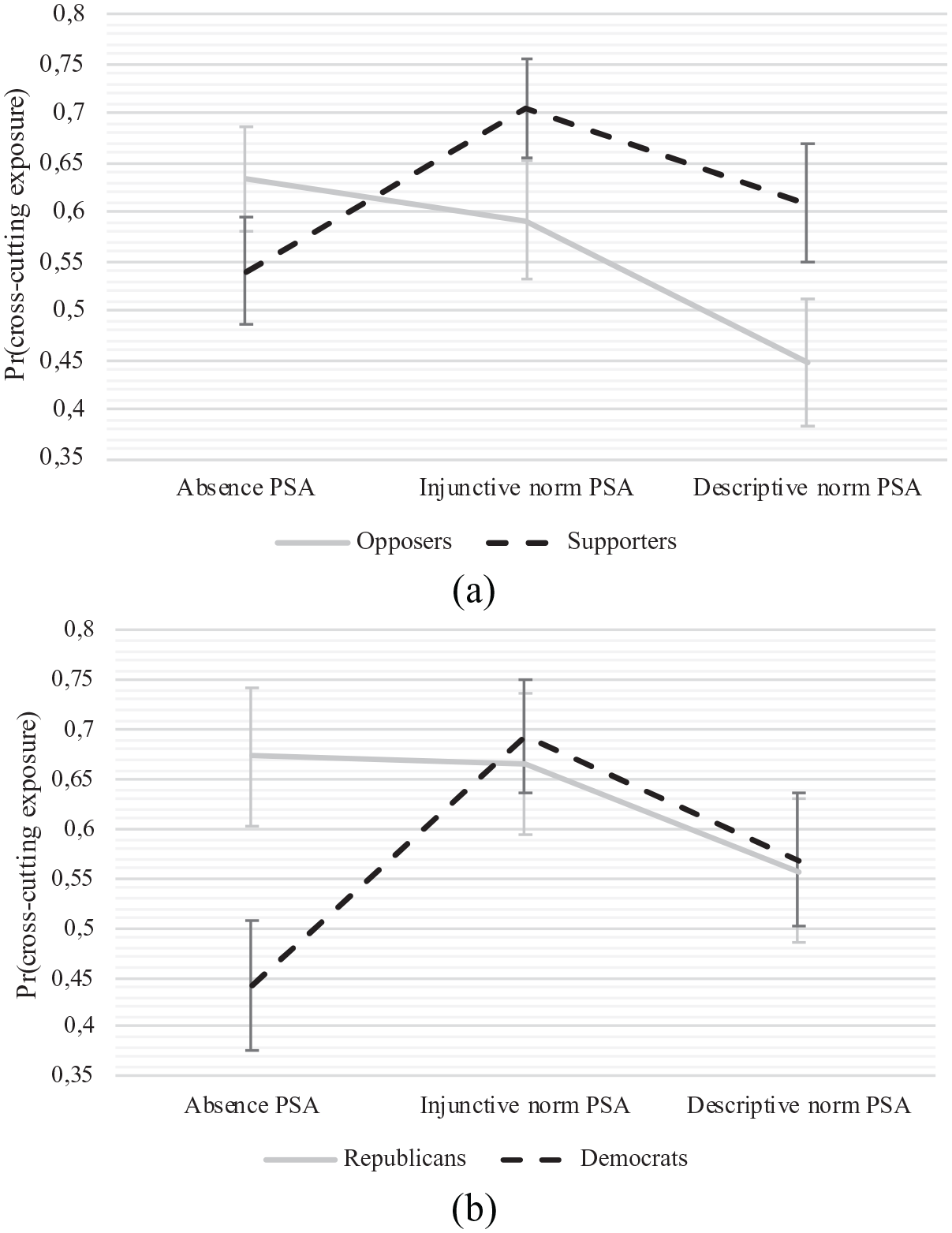
(a) Predictive margins plots of interaction between types of NML intervention with issue publics. (b) Predictive margins plots of interaction between types of NML intervention with party affiliation.
Second, when looking at the interaction with party affiliation, it can be observed that exposure to either type of intervention was largely ineffective. We see that cross-cutting exposure only gets lower for Republicans after exposure to either an intervention with injunctive or descriptive normative language compared to the control condition. This difference is, however, not significant (see Figure 1(b)). For Democrats, Table 1 and Figure 1(b) show how the injunctive intervention results in significantly more cross-cutting exposure compared to the control condition. Yet, this finding is mainly driven by the low level of cross-cutting exposure for Democrats in the control condition (a probit regression shows that the likelihood of cross-cutting exposure is significantly lower for Democrats than Republicans in the control condition (b = –.47, p < .05)). Figure 1(b) shows that the probability of cross-cutting exposure is at a similar level for both Democrats and Republicans in the injunctive norm condition. This finding suggests that the injunctive norm intervention does help Democrats to become aware of their selection bias, which was at a high level without any intervention. Exposure to such normative language does, however, not result in more cross-cutting exposure for Democrats compared to Republicans. This higher confirmation bias of Democrats is surprising as previous studies found that Republicans tend to engage in less cross-cutting exposure (e.g. Vraga and Tully, 2019). Moreover, Table 1 does show a significant interaction between the descriptive PSA and party affiliation. This interaction refers to the drop in cross-cutting exposure for Republicans after exposure to a descriptive intervention, while the cross-cutting exposure is higher for Democrats after seeing a PSA with descriptive norms compared to the control condition (see Figure 1(b)). In sum, both H1 and H2 cannot be fully supported: Exposure to a NML intervention with injunctive norms only stimulates cross-cutting exposure among supporters of immigration and partially for Democrats. An intervention relying on descriptive norms is unsuccessful, and even has a boomerang effect for opposers of immigration.
Conclusion and discussion Study 1
Against the backdrop of increasing concerns about confirmation biases and polarization in high-choice information settings, this first experiment aimed to demonstrate how cross-cutting selective exposure could be stimulated by using different NML interventions. The outcomes are mixed. A NML intervention only stimulates cross-cutting exposure among participants that support the issue position that refugees are coming to the United States and partially for Democrats, while it is ineffective among Republicans and even boomerangs among partisans opposing immigration. More specifically, a NML intervention with injunctive norms was only successful among partisans with pro-immigration attitudes and increased the low level of cross-cutting exposure among Democrats, while NML interventions with descriptive norms were unsuccessful and even resulted in less cross-cutting news exposure for anti-immigration issue publics.
The central conclusion of Study 1 is that the effectiveness of NML interventions is contingent upon people’s prior partisan attitudes and partisan ideology. Discrepancy between the message’s arguments and people’s belonging to issue publics could plausibly be caused by feelings of reactance toward the normative language, resulting even in a boomerang effect of the intervention. Indeed, the source of the reactance among people opposing immigration may be that they did not identify with the majority group addressed in the descriptive normative NML intervention—and rather identified with a “silenced minority” to whom general public opinion and media coverage is hostile. The NML intervention tells people to change their behavior in a way that runs counter to their defensive motivations (Taber and Lodge, 2006). When people feel attacked by such uncongenial information, social reactance may occur and the intervention might have the opposite effect instead of the desired outcome.
As we found that NML interventions do have the potential to stimulate cross-cutting exposure, it is important to assess how they can be successful across the board. Therefore, in line with the recommendation of Tully et al. (2020), NML messages may work best if they are tailored, or respond to the (partisan) identity of news consumers. As online media settings allow for the tailoring of messages, in the next study, we adjust the NML interventions to match people’s in-group identifications and perceptual screens on two different levels: (1) their prior issue attitudes related to immigration and (2) their party affiliation. Arguably, with exposure to these tailored interventions, partisans actually feel part of the (majority) group targeted in a NML message, making the intervention more relevant and potentially avoid backfiring effects for news selection.
Study 2
In a first step, we need to further understand the source of reactance to NML interventions, which can guide the design of effective interventions that overcome reactance on ideological and issue-specific levels. We base our second study on psychological literature that has identified how partisan attitudes and party affiliation can guide information selection—especially in terms of motivated reasoning (e.g. Carney et al., 2008). It has, for example, been argued that Republicans are more likely to prefer familiarity and consistency in news than Democrats (Carney et al., 2008)—which implies that Democrats are more open to cross-cutting news and interventions that ask them to change their news choices (although Study 1 showed the divergent finding that, without intervention, Republicans were most likely to engage in cross-cutting news exposure). In addition, Republicans are found to respond more negatively to challenging stimuli than Democrats (Shook and Fazio, 2009)—which was confirmed in Study 1. As argued by Garrett and Stroud (2014), Republicans are thus more likely to avoid cognitive dissonance than Democrats. As challenging stimuli may be more likely to be perceived negatively or as an attack by Republicans (Shook and Fazio, 2009), we can also expect that they show stronger reactance when exposed to NML interventions that might challenge their existing views.
Republicans are more likely to hold negative attitudes toward immigration whereas Democrats have more positive attitudes toward immigrants entering the United States (e.g. Iyengar and Hahn, 2009). It can be argued that supporting immigration is the most societally acceptable opinion. Conservative issue publics that oppose immigration may consequentially perceive the opinion climate and media reporting as biased against their views (also see Eveland and Shah, 2003; Watts et al., 1999). Hence, when the NML intervention tells partisans opposing immigration to select more news supporting immigration (the issue position they perceive media coverage to be already in favor of), more reactance may occur. In other words, cognitive dissonance is strongest among issue publics that may perceive that their positions are marginalized in media coverage.
To recap, the ineffectiveness and boomerang effect of NML interventions found in Study 1 might relate to important partisan differences in the processing of (challenging) information. The more negative response to challenging information among Republicans—which resonates with the Conservative position of opposing immigration—can be a source of reactance toward interventions. As indicated by Albarracín and Vargas (2010), reactance is most likely to occur when the freedom to perform a certain behavior is taken away—or when a message threatens to remove this freedom. Extrapolated to our study, exposure to a NML might feel as an attack as it removes freedom by suggesting to select into cross-cutting news. Especially Republicans and those who hold an anti-immigration attitude may counter-argue or reject NML messages to avoid cognitive dissonance caused by the deprivation of freedom. We, therefore, introduce the following hypotheses:
H3a. Reactance toward NML messages is stronger among people who oppose than support immigration.
H3b. Reactance toward NML messages is stronger for Republicans than Democrats.
To overcome reactance among partisans and issue publics, it is important that cognitive dissonance between the statement of the NML message and people’s prior attitudes and beliefs is reduced. Among other things, reactance may be overcome by reducing perceived persuasive intent and increasing the consonance between the persuasive message and the prior beliefs of receivers (e.g. Albarracín and Vargas, 2010). Reactance may thus be countered by exposing people to messages that strengthen their in-group identification—which also means that the persuasive intent and the freedom-depriving nature of the NML message is perceived less centrally. Thus, NML interventions may be more effective when they cultivate a sense of belonging to people’s in-group that performs or should perform the targeted behavior, either on the level of party affiliation (i.e. Republicans vs Democrats) or issue positions (i.e. supporting or opposing immigration).
The potential effectiveness of messages that aim to overcome cognitive dissonance by cultivating closeness to partisans’ political identity or issue attitudes can also be based on (micro)targeting research (e.g. Dobber et al., 2019; Haenschen and Jennings, 2019; Hager, 2019). More specifically, it has been argued that targeted or tailored messages, such as Internet ads, can boost turnout (Haenschen and Jennings, 2019) or even affect vote choice (Hager, 2019). In line with recent developments in micro-targeting, tailored NML messages may be most effective when analytics are used to correctly identify audience segments that feel addressed by the interventions—which is already technically possible in an online context (e.g. Haenschen and Jennings, 2019; Hager, 2019).
In developing tailored NML interventions, we built upon the findings from Study 1. Study 1 revealed that distinguishing between descriptive and injunctive norms is not successful when NML messages speak to society at large and therewith do not specifically address partisans. In designing targeted NML messages, we integrate references to both injunctive and descriptive norms. First, Study 1 indicates that injunctive norms seem to have the potential to work, but only for liberals, arguably because they feel less attacked by such uncongenial information than conservatives. Thus, injunctive norms are useful in NML interventions to specify the desired behavioral change and might work across partisans when a source of reactance is taken away. Second, descriptive norms are needed to effectively target receivers based on their party affiliation or political preferences (Haenschen and Jennings, 2019). To strengthen people’s in-group identification, the tailored interventions need to refer to the desired behavior (i.e. descriptive norms) of like-minded others. Despite that Study 1 showed how descriptive norms are ineffective and can even backfire, a tailored intervention might overcome the source of reactance and have the desired outcome when the descriptive norms describe others with similar beliefs. Accordingly, for the tailored intervention, we rely less explicitly on descriptive norms that describe the behavior of the majority of the population (as was done in Study 1), and more “carefully” address that more and more members of the partisan in-group engage in cross-cutting news exposure. In sum, for effective cultivation of personal relevance and group norms, it is thus important that tailored NML interventions describe the actual behavior of people’s in-group (i.e. descriptive norm) while specifying what is expected of them (i.e. injunctive norm). Against this backdrop, we expect that NML messages that are targeted to the political preferences and identities of partisans are more effective in motivating cross-cutting exposure than messages that are not targeted. We hypothesize as follows:
H4. A tailored NML intervention about cross-cutting exposure can stimulate more cross-cutting news selection across issue publics.
Method Study 2
Study 2 relied on a quasi-experimental set up with a three-factor between-subjects design (NML intervention: tailored on issue publics vs tailored on party affiliation vs absence). This study was largely a conceptual replication of Study 1. However, the NML messages were targeted on two concepts that strongly resonate with people’s identification: (1) on the level of issue publics and (2) on the level of party affiliation. Thus, participants either saw an intervention tailored on the level of their political attitude toward immigration (pro immigration vs counter immigration) or their party affiliation (Democrats vs Republicans). Comparable to Study 1, a third group did not receive any NML intervention.
Sample
For Study 2, we again relied on Dynata to collect the responses of 579 US participants in July 2019 (89.55% completion rate). To ensure equal distribution among issue publics and partisans, quotas were set for attitudes on immigration (N supporting immigration = 281; N opposing immigration = 298) and party affiliation (N Democrats = 289, N Republicans = 290). Those who did not have an opinion on immigration were excluded from the survey (23.6%). The average age of the sample was 46.43 (SD = 14.69) years and 67.86% was female, 23.0% was lower educated, 15.4% was higher educated, and 61.7% had a moderate level of education.
Procedure/stimuli
The overall procedure of Study 2 replicated the survey flow of Study 1. Only the types of interventions that were shown to the participants were different. The conditions no longer reflected a difference between injunctive and descriptive norms in the NML interventions, but a combination of both norms was applied to tailor them on the level of issue publics or party affiliation. The normative reasons to select balanced news were again stressed in the intervention. The normative language was especially prominent in the end of the intervention where the recommendations for readers were listed. On the descriptive level, it was important to rely on descriptive normative language in order to be able to tailor the injunctive message on immigration attitudes and party identification (for an approach that targeted audience segments by using descriptive language see Haenschen and Jennings, 2019). These messages highlighted that more members of the group the participants indicated to be part of (either on the level of issue publics or party affiliation) already engage in such behavior. For accuracy reasons, the tailored interventions did not talk about the “majority” of people, like the descriptive PSA in Study 1, but communicated that “more and more” members of the respective group engaged in this behavior. For the full text of interventions, see Supplemental Appendix 4.
To test if the injunctive norm in these tailored PSAs was still picked up by the respondents, a post hoc data collection was performed. In the effort of tailoring the PSAs, the descriptive norm became quite prominent as it, for example, appeared in the title. An US Amazon Mechanical Turk sample of 99 adults was randomly exposed to a neutral untailored intervention, one of the interventions from Study 1, or one of the interventions from Study 2. Respondents were asked to indicate to what extent the intervention talked about what people should do (i.e. injunctive norm perception) or what people actually do (i.e. descriptive norm perception). Supplemental Appendix 5 provides the statistical comparisons and shows that there were no differences between the PSAs from Study 2 and the injunctive PSA from Study 1 regarding the injunctive norm perception. These findings indicate that the injunctive norms in the tailored PSAs from Study 2 were still picked up as they came across equally strongly as in the injunctive PSA from Study 1.
To test if the interventions were perceived as tailored, a manipulation check question in the survey of Study 2 asked, after respondents’ exposure to a tailored PSA, to what extent participants agreed with the statement (7-point Likert-type scale): “The PSA referred to people who share my political beliefs.” The findings showed above-average scores for all PSAs (PSA tailored to opposers: M = 4.11, SD = 1.13; PSA tailored to supporters: M = 4.32, SD = 1.13; PSA tailored to Republicans: M = 4.48; SD = 1.09; and PSA tailored to Democrats: M = 4.28; SD = 1.30), which might indicate that respondents perceiving the interventions as being tailored. In addition, the post hoc data collection compared whether the stimuli in Study 2 were perceived as more tailored to respondents’ beliefs compared to an untailored intervention. In this post hoc sample, respondents who were exposed to one of the four tailored NML interventions used in Study 2 (PSA tailored to opposers: M = 4.56, SD = 1.08, p < .10; PSA tailored to supporters: M = 5.42, SD = .88, p < .01; PSA tailored to Republicans: M = 5.41, SD = .83, p < .05; and PSA tailored to Democrats: M = 5.43, SD = 1.43, p < .01) perceived it as referring more to people who share their political beliefs compared to those who saw an untailored NML intervention, M = 3.65, SD = 1.57, F(1, 59) = 5.82.
Measures
Cross-cutting news selection
The measure of cross-cutting news selection was operationalized the same way as in Study 1.
Party affiliation
Just like in Study 1, party identification was measured on a 7-point Likert-type scale (M = 4.03, SD = 2.04).
Reactance toward NML interventions
In addition to Study 1, Study 2 measured the extent to which participants felt reactance toward the media literacy PSA they were exposed to. They were asked to what extend they agreed with the following four items on a 7-point Likert-type scale “I didn’t like it that the PSA told me how to act,” “I like to make my own decisions rather than follow the advice from the PSA,” “I don’t like it that the PSA tried to correct me,” and “I felt uncomfortable being told how to act by the PSA” (M = 4.23, SD = 1.33, Cronbach’s α = .89).
Control variables
The control variables hostile public opinion (N = 100), political interest (M = 4.73, SD = 1.82), and media skepticism (M = 3.03, SD = 1.67, Cronbach’s α = 97) were measured. Although the random assignment to conditions in experimental designs should decrease the necessity to include control factors, we believe that for our design—varying the absence/presence of a corrective message and tailoring the message to prior attitudes—it is relevant to include prior attitudes that could relate to resistance to the PSAs.
Results Study 2
H3 assumed that reactance experienced toward NML interventions depends on participants’ immigration attitude (H3a) and party affiliation (H3b). To assess if opposers indeed experience more reactance to such interventions than supporters of immigration (H3a), we ran an analysis of variance (ANOVA). Findings indicate that opposers (M = 4.47, SD = 1.30) overall feel significantly more reactance toward interventions (irrespective of the type of the tailored PSA they were exposed to) than supporters, M = 3.94, SD = 1.31, F(1, 367) = 15.55, p < .001, supporting H3a. A comparable finding for party affiliation (H3b) was observed, Republicans (M = 4.44, SD = 1.33) felt more reactance than Democrats, M = 4.01, SD = 1.32, F(1, 367) = 13.43, p < .05, supporting H3b. Similar findings are demonstrated when analyses of reactance are performed by experimental conditions. Opposers exposed to an intervention tailored on issue publics reported significantly more feelings of reactance toward the intervention (M = 4.44, SD = 1.23) compared to supporters, M = 3.92, SD = 1.29, t(188) = 2.81, p < .01. In addition, Republicans exposed to an intervention tailored on party affiliation were found to report more reactance (M = 4.32, SD = 1.39) than Democrats, M = 4.01, SD = 1.37, t(177) = 1.76, p < .10.
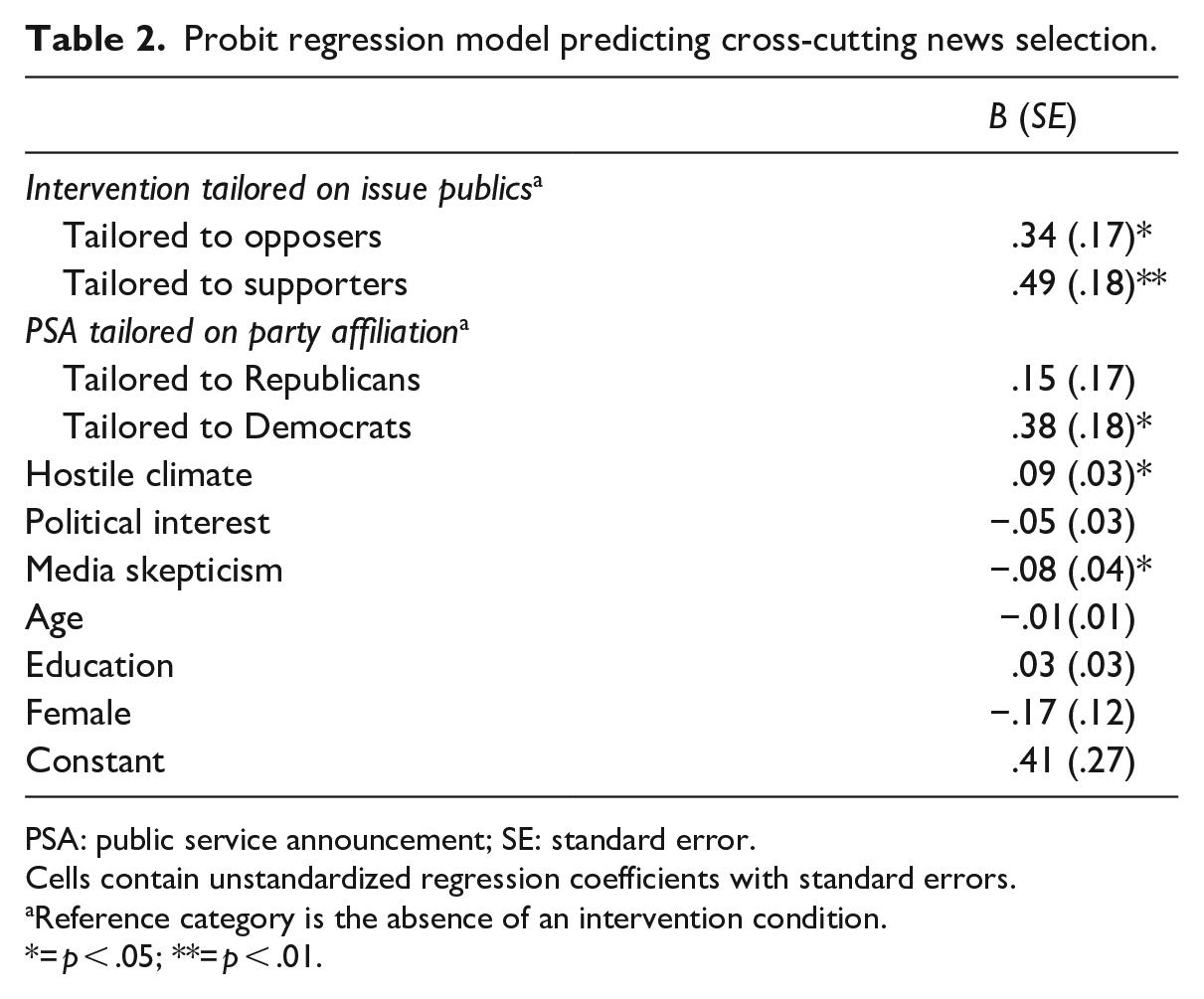
Hypothesis 4 assumed that a tailored or targeted (either on the level of issue publics or party affiliation) NML intervention stimulating cross-cutting exposure results in more cross-cutting selection behavior. To test this assumption, probit regression models were run with cross-cutting news selection variable as dependent variable, and the different types of tailored interventions and control variables as predictors. As can be seen in Table 2 2 and in Figure 2, the NML intervention tailored on issue publics was successful. Both opposers and supporters of immigration selected more cross-cutting news after being exposed to an intervention tailored on their attitude toward immigration compared to seeing no NML intervention. The intervention tailored on party affiliation was only successful for those who identify as Democrats, but not for Republicans. In any case, a boomerang effect of NML interventions was no longer demonstrated for the tailored messages. These findings partly support H4.
Probit regression model predicting cross-cutting news selection.
PSA: public service announcement; SE: standard error.
Cells contain unstandardized regression coefficients with standard errors.
Reference category is the absence of an intervention condition.
= p < .05; **= p < .01.
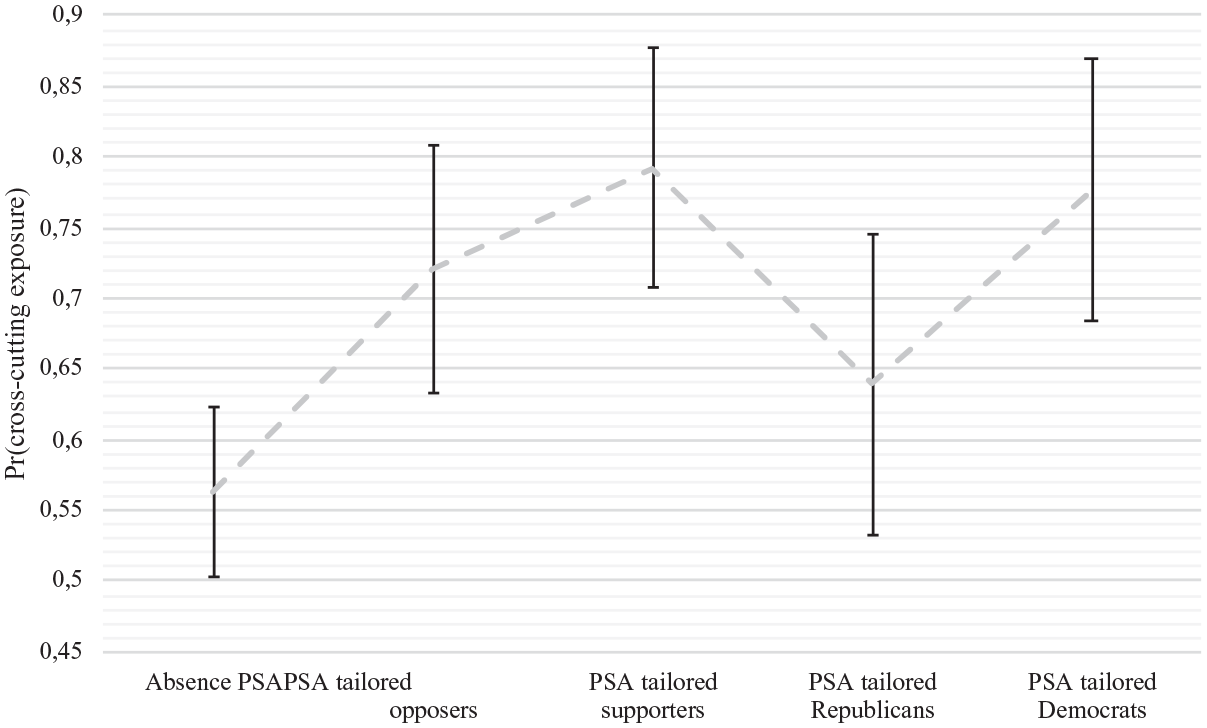
Predictive margins plot for cross-cutting news exposure based on different tailored NML interventions.
Conclusion and discussion Study 2
In response to the findings of Study 1, Study 2 explored if boomerang effects of NML interventions can be overcome. As a first confirmation, Study 2 established that issue publics that oppose immigrants coming to the United States and Republicans are indeed more likely to demonstrate reactance toward interventions that aim to stimulate a cross-cutting news diet. These findings verify research that shows how those with a more conservative ideology tend to view information as more biased and hostile against their own views compared to people who hold more liberal views (Eveland and Shah, 2003; Watts et al., 1999). The means observed in this study for reactance by partisan group are quite high, even though the interventions were tailored on ideology. Therefore, potential reactance effects should be taken into account in future developments of NML interventions, considering the finding that reactance is generally hard to overcome.
The second aim was to see if tailored NML interventions would stimulate members from different issue publics and party affiliations to engage in cross-cutting news exposure. The findings are hopeful. Tailoring NML interventions, by targeting issue publics, made them effective across all respondents. In any case, no boomerang effect of the interventions, as found in Study 1, was observed for the tailored interventions in Study 2. These findings indicate that, to design a successful intervention, it is key to ensure that citizens can identify with the communicated social norm and do not feel attacked or excluded by the message.
Overall conclusion and discussion
As cross-cutting exposure may lead to a better-informed electorate (Calhoun, 1988) and less polarized societies (e.g. Stroud, 2008), it is important to stimulate more cross-cutting news diets. Against this backdrop, we conducted two experiments in which we exposed US participants to NML interventions that either relied on (1) injunctive versus descriptive norms or (2) tailored messages to cultivate a stronger in-group identity. The combination of both studies provides a more comprehensive understanding of what makes NML interventions successful in stimulating a cross-cutting news diet.
As we observed in Study 1 that the same intervention is successful for one group, but boomerangs for another group, it can be stated that designing an effective intervention scheme, related to how news consumers process partisan information, is a complex endeavor at best. The findings indicate that normative language causes reactance among people who might feel part of a minority group. In line with research that found that Republicans tend to perceive their information setting as more hostile than Democrats (e.g. Eveland and Shah, 2003; Watts et al., 1999), partisans and issue publics that oppose immigration seem to experience a stronger attack on their beliefs by a NML message, and counter-argue information when they are not addressed by their partisan identification.
Against this backdrop, we designed NML interventions for Study 2 that aimed to overcome reactance by tailoring normative language to the in-groups that issue publics should feel close to: either based on their prior attitudes or their party affiliation. As our most important finding, the results indicate that a tailored intervention can actually overcome boomerang effects and, in certain cases, stimulate cross-cutting media exposure across the board. More specifically, when the NML intervention was tailored for issue publics, it became effective across the board. However, the intervention tailored on party affiliation was only successful among Democrats and not for Republicans, yet, in any case, no boomerang effects of the NML interventions were observed in the second study. Here, it needs to be noted that differences in partisans’ feelings of reactance are still present in the context of tailored NML interventions. However, the documented successes of tailored NML interventions create some optimism toward stimulating more cross-cutting exposure to political information, and therewith counter one source of political divides.
The primary conclusion of this research is that the success of NML interventions is contingent upon political identification. Audiences’ political attitudes and ideology determine whether certain interventions are successful or actually backfire, and tailoring on the level of issue publics can actually make NML efforts worthwhile. As countries across the world are dealing with audience fragmentation along the lines of issues as gun ownership, climate change, vaccines, and immigration, it is crucial to maintain an equal flow of (factual) information across partisan divides. As people may be driven by congruency over accuracy motivation (Taber and Lodge, 2006), and as falsehoods may persist in times when both communicators and audiences aim to reinforce existing beliefs (e.g. Hameleers and van der Meer, 2020), we need to stimulate news diets that also take information from the other side into account.
The current studies bear some limitations. First, our experiments were limited to only one salient and polarized issue in the United States. Future research could examine if tailoring NML interventions also works for other contested issues and in other countries, where polarized divides may manifest itself into different cleavages. Second, future studies could look at the duration of the effectiveness or resistance of a NML message. To what extent is repeated exposure needed to ensure a consistent cross-cutting diet? Third, future research may assess selection effects in more realistic media settings, where news consumers can select more than just political news from a similar source. Despite these limitations, this article makes an important contribution to selective exposure and NML research by demonstrating the potential of addressing segments of the audience in interventions to stimulate cross-cutting exposure.
Supplemental Material
Online_appendix – Supplemental material for Fighting biased news diets: Using news media literacy interventions to stimulate online cross-cutting media exposure patterns
Supplemental material, Online_appendix for Fighting biased news diets: Using news media literacy interventions to stimulate online cross-cutting media exposure patterns by Toni G.L.A. van der Meer and Michael Hameleers in New Media & Society
Footnotes
Funding
The author(s) disclosed receipt of the following financial support for the research, authorship, and/or publication of this article: This work was supported by a VENI grant from the Netherlands Organization for Scientific Research (NWO) (Grant no. 016.Veni.195.067).

Supplemental material
Supplemental material for this article is available online.
Notes
Author biographies
References
Supplementary Material
Please find the following supplemental material available below.
For Open Access articles published under a Creative Commons License, all supplemental material carries the same license as the article it is associated with.
For non-Open Access articles published, all supplemental material carries a non-exclusive license, and permission requests for re-use of supplemental material or any part of supplemental material shall be sent directly to the copyright owner as specified in the copyright notice associated with the article.
