




Abstract
The complexities of platforms are increasingly at odds with the narrow legal and economic concepts in which their governance is grounded. This article aims to analyze platformization through the metaphorical lens of a tree to make sense of information ecosystems as hierarchical and interdependent structures. The layered shape of the tree draws attention to the dynamics of power concentration: vertical integration, infrastructuralization, and cross-sectorization. Next, the metaphor helps to revision the current patchwork of European regulatory frameworks, addressing the power asymmetry between citizens and the data-driven systems through which their daily practices are governed. Finally, the platformization tree serves to identify points of intervention that may inform European regulatory bodies and policy-makers to act as agents of change. Taking a holistic approach to platformization, this visual metaphor may inspire a set of principles that reshapes the platform ecosystem in the interest of society and the common good.
Keywords
All the ways you imagine us are always amputations. Your kind never sees us whole. You miss the half of it, and more. There’s always as much belowground as above. That’s the trouble with people, their root problem. Life runs alongside them, unseen.
Introduction
What makes American Big Tech companies powerful and their platforms’ governance complex? This article argues it is because they collectively operate an exclusive set of competing-cum-coordinating platforms that reign the core of the world’s digital information systems from which they leverage unprecedented economic, societal, and (geo-)political control. In recent years, tech companies have turned products into data services where customers pay mostly with their personal information and attention. Markets and public sectors, infrastructures, and utilities are drawn into a data-driven ecosystem which is thoroughly commodified and whose impact grows in line with bourgeoning new fields, such as artificial intelligence and robotics technologies. The complexities of platforms are increasingly at odds with the narrow legal and economic concepts in which their governance is grounded. Instead of concentrating on tech firms leveraging an ever growing number of platforms, we propose to shift the focus to the dynamics of platformization and adjust governance strategies accordingly.
Platformization is a process akin to industrialization or electrification, referring to a multifaceted transformation of globalized societies (Poell et al., 2019). The rise of corporate and state-controlled platform ecosystems has upended the once popular ideal of a universal and neutral Internet that connects the world. To some extent, it has also undermined classic distinctions between state, market, and civil society—concepts that are still vital in demarcating governmental arrangements. Global information systems reigned by techno-corporate apparatuses now supersede the economic powers of nations; their influence arguably surpasses the political clout of elected governments and administrations when it comes to regulating democracies and civic life (Moore, 2018). While tech platforms increasingly control the gateways to all Internet traffic, data circulation, and content distribution—making entire societies dependent on their systems—they have managed to dodge conventional regulatory scrutiny (Gillespie, 2018). National and supranational regulatory frameworks (i.e. the European Union (EU)) typically scrutinize one aspect of governance, such as market concentration, freedom of information, or privacy rights, even when platformization runs across legal frameworks and across continents.
There is a growing need to understand how platformization works and to create new imaginaries that help redraft compartmentalized governance frameworks into a more holistic approach (section “From platform governance to governing platformization”). In an attempt to visualize the dynamics of platformization and its actors, this article proposes a “tree” as a constitutive metaphor (section “The platformization tree”). Such metaphorical imagine may help make sense of information systems as complex structures whose operative power is wielded through hierarchical and interdependent layers; these layers intertwine visibly and invisibly, belowground as well as aboveground, horizontally and also vertically. The layered yet integrated shape of the tree draws attention to the dynamics of platformization: vertical integration, infrastructuralization, and cross-sectorization (section “The dynamics of platformization”). The metaphor also helps to revision the current patchwork of regulatory frameworks, addressing the power asymmetry between citizens and the information systems through which they are governed (section “Governing the unruly status of intermediary platforms”). Finally, the platformization tree serves to identify points of intervention that regulatory bodies, particularly in the EU, may deploy to act as agents of change, for instance by articulating a set of principles and values that reshapes the platform ecosystem in the interest of society and the common good (section “Reshaping governance to promote platform diversity”).
From platform governance to governing platformization
“The platform Web is made up of privately owned public spaces, largely governed by the commercial incentives of private actors rather than the collective good of the broader society” is how Taylor Owen (2019) sums up the problem of a the current platform society (Van Dijck et al., 2018). There is a growing discontent with tech companies that have become too big and multifaceted to operate transparently in the public eye; their extraordinary power also negatively affects markets and democracies. The social and economic costs of power concentration are becoming a global problem, due to “surveillance capitalism” that underpins the economic logic of data extraction controlling the lives of Western consumers (Couldry and Mejias, 2019; Srnicek, 2017; Zuboff, 2019). The American-based system is largely monopolized by five Big Tech companies (Alphabet-Google, Amazon, Facebook [FB], Apple, and Microsoft, a.k.a. GAFAM), which has now penetrated the core of economic and civic life on most continents, except for China. China operates a state-controlled, corporately run ecosystem of platforms revolving around their big three companies (Baidu, Alibaba, and Tencent or BAT). Increasingly, the ideological clash between state-powers manifests itself as a techno-corporate clash. Such clashes reveal that rather than operating as distinct platform ecosystems, they are intertwined at various levels. The entanglement between American, Chinese, and European interests in the global governance of digital innovation is a driver of mounting tensions between continental super powers and their allies (DeNardis, 2020; Jia, 2018; Mueller, 2017; Steinberg, 2019; Winseck, 2017).
The European Union (EU), despite a scarcity of home-grown “big” tech companies, tries to position itself as a governmental agent of change in the global digital economy. In its policy document Shaping Europe’s digital future (2019), the European Commission (EC) articulated its seemingly incongruous ambitions to prioritize tech innovation leadership in the data economy alongside a commitment to protect democratic and public values in the platform society, promoting a level playing field and open markets along with transparency, trustworthiness, and privacy. The EC has so far deployed a patchwork of regulatory interventions to deal with the problems caused by globally operating platform companies—from monopolization of online markets and violation of privacy protection to curbing disinformation and hate speech. The EC intends to make Europe the place-to-go for high-quality industrial data that can be used to create, for instance, AI-tools; at the same time and by the same means, it wants to create a framework for “common European data spaces”—a new digital data infrastructure that will stimulate and incentivize privately held data to be shared and used for the common good (European Commission [EC], 2020). To achieve such bold ambitions in 2021, it will be critical to refashion Europe’s current patchwork of rule-based regulations and data policies into a holistic, principle-based type of governance.
Acknowledging the need for new imaginaries, we propose a visual metaphor that configures platformization as a dynamic process. In the past, platforms have often been examined as metaphorical constructs with technological, social, economic, and political dimensions (Gillespie, 2010; Van Dijck, 2013). Platforms are fueled by data and governed by algorithms; yet they function as part of platform ecosystems—an assemblage of networked platforms, governed by a particular set of mechanisms (Van Dijck et al., 2018: 9). In his seminal work, Benjamin Bratton (2016) has argued that platforms such as smart grids, clouds, and mobile apps evolve not as separate objects but as a computational apparatus with a new governing architecture. The layered architecture of platforms has been visualized as a collection of “stacks,” reflecting features of modularity and accumulation (Andersson Schwarz, 2017; Tiwana, 2014; Walton, 2017). Internet activist Marleen Stikker (2019) distinguishes between three different types of stacks—the state, corporate, and public stack—to theorize the convergent and divergent interests of governments, markets, and commons. Yet other theorists configure constellations where stacks are partitioned into “core” and “peripheral” platforms (Constantinides et al., 2018).
Two problems we run into when configuring platform ecosystems as “stacks” is that some envision single platforms as entities distinct from the larger digital and social infrastructures through which they operate, and some still presume the possibility of separating corporate from state interests, even though they appear increasingly difficult to disentangle in the new platform order. As Langlois and Elmer (2019) have convincingly argued, tech giants are moving away from the enclosed platform model toward building a data-based infrastructure that affords them to take over the running of cities, transportation, communication, retail, and so on. While doing so, they are “claiming the need not to be subjected to public regulation because they are breaking new grounds, in effect demanding a new state of ‘permissionless innovation’ to shape our conditions of existence” (Langlois and Elmer, 2019: 248). For platform governance, such transformation is problematic not only because these constellations evade existing regulatory frameworks but also because they defy the very economic and legal concepts in which they are grounded—firms, markets, consumers, infrastructures, as well as states, citizens, and public and private sectors. Moreover, not all platforms are equal, and they are not “stacked” randomly. Some are more equal than others as platform ecosystems are organized hierarchically and interdependently. In sum, the “stack” may no longer be adequate to imagine the complex dynamics underlying the system as a whole (Donovan, 2019).
Therefore, we propose to move away from imaging platforms as distinct entities, cumulated in “stacks,” toward envisioning platformization as an evolving dynamic process, propelled by human and nonhuman actors. Platformization pertains to “the interpenetration of the digital infrastructures, economic processes, and governmental frameworks of platforms in different economic sectors and spheres of life” (Poell et al., 2019: 6). Favoring a combined STS and political economy approach, we try to understand how sociotechnical systems and political-economic actors (firms, states) build symbiotic relationships to create connective value and develop coordinating power. The impact of platformization has already been documented with regard to the Web as such (Helmond, 2015) to cultural production (Nieborg and Poell, 2018) and to mobile app systems (Nieborg and Helmond, 2019). The next section argues how a new metaphor, the platformization tree, can be used as a prism for disentangling complex platform ecosystem dynamics.
The platformization tree
To envisage the platform ecosystem’s hierarchical and interdependent nature, we imagine a tree that consists of three interconnected layers: the roots of digital infrastructures all leading to the trunk of intermediary platforms which branches out into industrial and societal sectors that all grow their own twigs and leaves. The tree metaphor emphasizes how platforms constitute “living” dynamic systems, always morphing and hence co-shaping its species. Like air and water can be absorbed by leaves, branches, and roots to make the tree grow, platformization is a process in which data are continuously collected and absorbed. Data (knowingly) provided and (unknowingly) exhaled by users form the oxygen and carbon dioxide feeding the platform ecosystem. Due to the ubiquitous distribution of APIs, the process of absorbing data and turning them into nutrients—a metaphorical kind of photosynthesis—stimulates growth, upward, downward, and sideways. Each tree is part of a larger ecosystem—a global connective network driven by organic and anorganic forces. Resisting the temptation to build on this metaphor, we instead concentrate on the three layers that constitute its basic shape: roots, trunk, and branches (Figure 1).
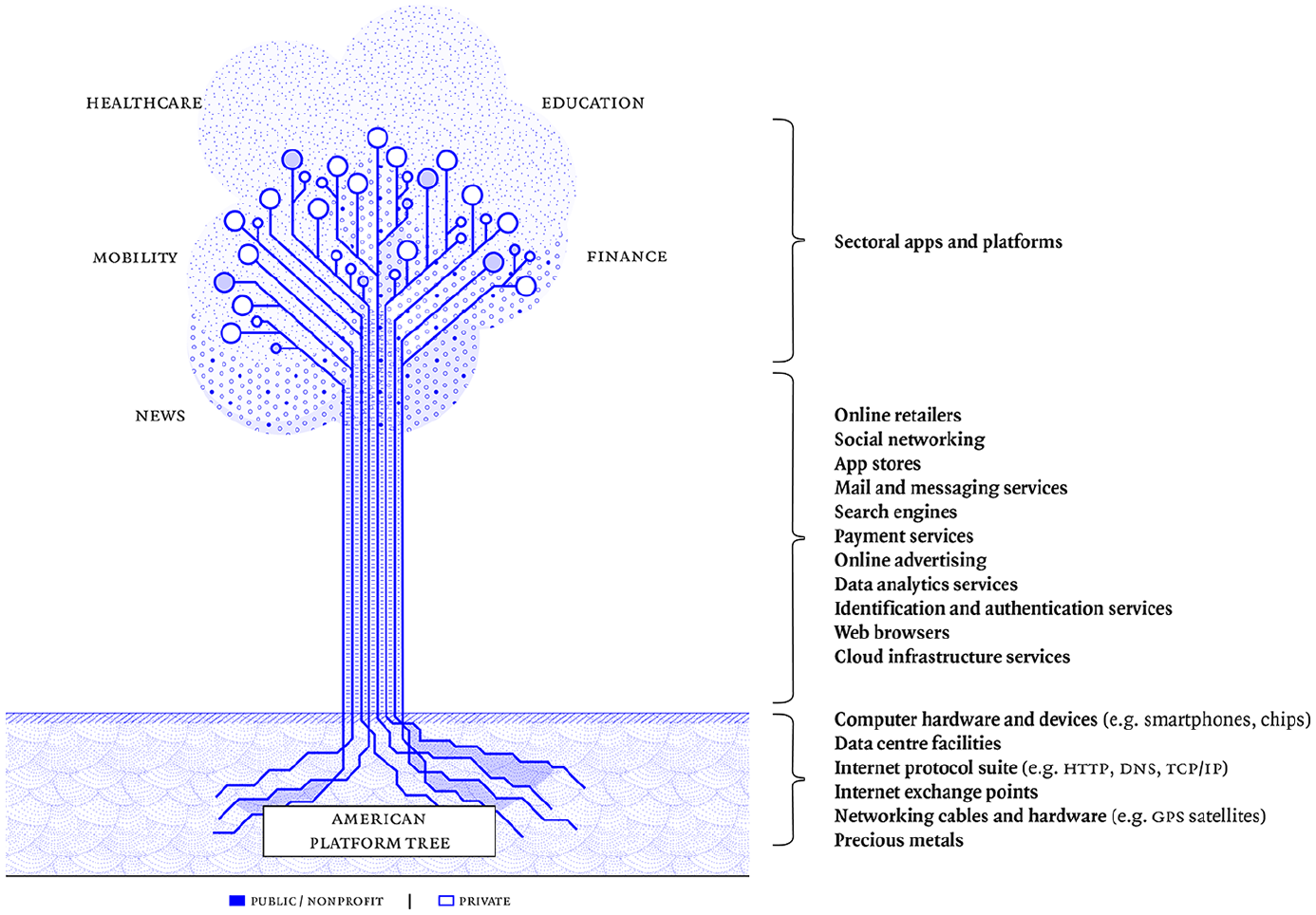
American Platform Tree (Giant Sequoia).
The roots of the tree refer to the layers of digital infrastructure which penetrate into the soil; roots can run deep underground and spread widely, connecting trees to one another. Roots signify the infrastructural systems on which the Internet is built—cables, satellites, microchips, data centers, semi-conductors, speed links, wireless access points, caches, and more. Material infrastructures enable telecommunications and networks like the Internet and intranets to send data packages. Online traffic is organized through coded protocols, such as the TCP/IP protocol that helps identify every location with an IP-address, and a domain name system (DNS) for proper routing and delivering of messages. The World Wide Web is one such protocol system which helps routing data seamlessly across the net. Internet service providers (ISPs) can provide the infrastructure on which clients can build applications, such as browsers.
All separate root elements contribute to a global digital infrastructure—a structure on which many companies and states depend to build their platforms and online services. The Internet itself was originally meant to serve as a “utility,” independently organized and managed, indifferent to various geopolitical and corporate interests, to guarantee the global fluidity of Internet traffic. For instance, Internet Corporation for Assigned Names and Numbers (ICANN) represents the ideal of multi-stakeholder governance, an ideal that has come under pressure as companies and states are extending their powers to appropriate the “deep” architecture of the Internet. 1 On one hand, tech firms privatize vital parts of the infrastructure (Malcick, 2018; Plantin et al., 2018). Google, for instance, invested billions of dollars in data centers across the globe and underwater cables for data distribution. On the other hand, states and governments increasingly seek control over digital infrastructures, illustrated by American government interventions in Huawei’s efforts to develop 5G networks in Europe.
While control over the “deeper” infrastructural layers has privatized and politicized, we can see similar struggles in the layers situated in the gradual changeover between the roots and the trunk of the tree, for example consumer hardware and cloud services. Hardware devices such as mobile phones, laptops, tablets, digital assistants (Siri, Echo, Alexa), and navigation boxes allow for Internet activity to spread among users. Inside these devices, hardware components—including hubs, switches, network interface cards, modems, and routers—are tied to proprietary software components such as operating systems (iOS, Android) and browsers (Chrome, Explorer, Safari). The architecture of cloud services forms a blueprint for data storage, analytics, and distribution; control over cloud architecture increasingly informs the governance of societal functions and sectors. Amazon Web Services, Google Cloud, and Microsoft Azure dominate this layer, and while states and civil society actors become increasingly dependent on them, public control over their governance is dwindling. Blurring the boundaries between “digital infrastructure” and “intermediary services” allows for further incorporation.
The intermediary platforms in the trunk of the tree constitute the core of platform power, as they mediate between infrastructures and individual users, as well as between infrastructures and societal sectors. The stack at this level includes identification or login services (FB ID, Google ID, Amazon ID, Apple ID), pay systems (Apple Pay, Google Pay), mail and messaging services (FB Messenger, Google Mail, MS Mail, Skype, FaceTime), social networks (Facebook, Instagram, WhatsApp, YouTube), search engines (Google Search, Bing), advertising services (FB Ads, Google), retail networks (Amazon Marketplace, Prime), and app stores (Google Play, Apple). This list is neither exhaustive nor static. None of these intermediary platforms is essential for all Internet activities, but together they derive their power from being central information gateways in the middle, where they dominate one or more layers in the trunk, allowing them to channel data flows upward and downward. What characterizes intermediary services is that (1) GAFAM platforms strategically dominate this space while there is hardly any nonmarket or state presence and (2) these super-platforms are highly interdependent, governing the platform ecosystem through competition and coordination. In the next section, we will explain in more detail how power is exercised from this intermediary level.
When we move to the branches that sprout out of the trunk of the tree, we may see their volume expanding and diversifying into smaller arms and twigs, allowing for foliage to sprawl infinitely toward the sky. The branches represent the sectoral applications which are built on platform services in the intermediary layer (trunk) and enabled by the digital infrastructure (roots). The numerous branches of the tree represent the many societal sectors where platformization is taking shape. Some sectors are mainly private, serving markets as well as individual consumers; others are mainly public, serving citizens and guarding the common good. In principle, sectoral platforms can be operated by companies—including the Big Five, incumbent (legacy) companies, and (digital native) startups—but also by governmental, nongovernmental, or public actors (Van Dijck et al., 2018). In practice, we have seen an increasing number of corporate players taking the lead in sectoral data-based services, even if these sectors are predominantly public (e.g. health, education).
The platformization tree exemplifies a complex system that comprises a variety of human and nonhuman actors, which all intermingle to define private and public space. Unlike the “stack” metaphor, the platformization tree shows the order and accumulation of platforms is not random but the result of invisible forces shaping the tree into its current form: from the circulation of its resources via its root structure and intermediary trunk all the way to feeding its twigs and foliage. As the tree grows bigger and taller, the influence of private actors’ operating platforms across all levels and layer of the tree is mounting. There is more diversity of players in the branches than there is in the trunk, just as there is (still) more diversity in the infrastructural roots than there is in the trunk. In the next section, we will focus on the dynamics of platformization by scrutinizing the privileged position of intermediary platforms as “orchestrators in the digital ecology value chain” (Mansell quoted in Lynskey, 2017: 9).
The dynamics of platformization
The process of seamlessly stitching infrastructural, intermediary, and sectoral platforms together causes distinctions between these levels to be obliterated. However, emphasizing their dissimilarities and hierarchy is key to seeing how and why some platforms have obtained rule-setting and coordinating power (Castells, 2009). Firms that operate various platforms across all three levels have more operative power; by fortifying their position in the trunk layer, they develop and consolidate controlling power over the system as such. What characterizes intermediary platforms is that they form “obligatory passage points” between the roots and the branches (Callon, 1986). They can mediate all kinds of interactions between (end) users and service suppliers; they can accumulate intelligence from data and content flowing between various layers; they can transform data flows into monetary value; and they can apply gatekeeping and moderation activities to data and content flows (Helmond et al., 2019). Owners of critical intermediary platforms are afforded extraordinary power to set the rules for data trafficking in the global network as such. The Big Five tech companies owe their concentration of power to at least three types of platformization dynamics: the vertical integration of platforms, the infrastructuralization of intermediary platforms, and the cross-sectorization of platforms. We will explain each type in more detail below.
Vertical integration of platforms
As said earlier, the distinction between infrastructural, intermediary, and sectoral platforms is increasingly fluid, allowing data flows to move across the connective system. Platformization pushes control over data flows in two directions: from the trunk downward toward the infrastructural layer as well as upward toward the branches of sectoral platforms and built-on applications. Plantin et al. (2018) have called the first part of this process the “platformization of infrastructure”; the Internet’s digital infrastructure is increasingly transformed into a service model, illustrated by the integration of cloud services, hardware configuration, and analytics services into the intermediary platforms. Think, for instance, of Apple Pay which has a built-in NFC chip for exclusive use; other pay systems or rivaling services cannot deploy the hardware build into its iPhone. Hardware devices, computer chips, and cloud architectures are hence “platformized” to consolidate a company’s position as an intermediary.
Platformization also pushes upward, spilling out from the trunk into a wide variety of sectors. A continuous influx of user data happens via the leaves; sucked up by twigs and branches they can be seamlessly transported toward the trunk. Looking at the public sector of primary education, we can illustrate how this works. Google Suite for Education is a software package based on personalized learning algorithms designed to bring spelling and math tools into the classroom. The app package is built into Chromebook laptops, which are also equipped with Google Search, Google Login, Gmail, and so on. Vertical integration of platforms across the (de)fault lines of companies allows data streams to flow seamlessly between root, trunk, and branches, hence facilitating information flows to move upstream and downstream, channeling users into the proprietary Google stack. Hence, the dependence of schools on proprietary information systems effectively funnels pupils’ data, generated in a public context, into a proprietary data flow controlled by one corporation’s platforms.
Vertical integration, often promoted as the seamless integration of platforms to facilitate user convenience, in practice results in the privatization of data flows causing user lock-in and vendor lock-in (Van Alstyne et al., 2016). Although we can still witness a lot more diversity of public and private actors at the sectoral level than at the intermediary level, the growing presence of the Big Five platforms in many branches of the tree marks society’s increased dependency on them. Vertical integration of platforms not just obfuscates the boundaries between infrastructures and sectors, private and public platforms; it also negatively affects the need for developing independent platforms, adding to a privatized Internet where “information may never have to journey across public infrastructure” (Srnicek, 2017: 113).
Infrastructuralization of intermediary platforms
Intermediary platforms are increasingly moving toward becoming infrastructures for users—a process Plantin et al. (2018: 306) have called the “infrastructuralization of platforms.” We commonly locate infrastructures at the root layer; however, intermediary platforms in the trunk increasingly manage to obtain infrastructural status (Plantin and De Seta, 2019). Mark Zuckerberg has often called Facebook a “social” infrastructure; with over two billion users, the social network has become a vital obligatory passage point for data flows passing through the trunk. Through its “family of apps” (WhatsApp, Instagram, Messenger, Login, Advertising, Analytics), Facebook is garnering a central position in the middle where it can connect content and data flows in the invisible backend.
This horizontal movement toward building a denser presence across one or more layers in the trunk strengthens a tech company’s position in the system as a whole. The intermediary level of the American ecosystem, operated by a handful of major players, constitutes a self-organized and self-governed core. Being part of the trunk is crucial for companies to exert power upward, downward, and sideways. As long as data and content flows keep passing through the trunk—flows that can be exclusively mined, processed, combined, and repurposed—their operators define the tree’s shape. A bigger and taller trunk layer means more control over the tree; less operators in the trunk means more efficient coordination.
The intermediary level is rather exclusive and restricted. If you need access to a large number of users, you have to go through Facebook; for selling products to mass customers, you are dependent on Amazon’s retail network; for downloading apps, Apple’s and Google’s app stores are unavoidable bottlenecks; to find information, you have to pass through Google’s or Microsoft’s search engine territory. But the Big Five are also interdependent: Apple’s iCloud is built on Amazon Web Services and Microsoft’s Azure; and Facebook is dependent on Apple and Google for allowing its platforms in their app stores. Interdependencies turn the Big Five platforms into “coordinating competitors”—a form of “coopetition” that easily escapes scrutiny by regulatory agencies who tend to focus on individual firms (Daidj and Egert, 2018; Kostis, 2018).
Cross-sectorization
Platformization becomes even more pervasive as companies expand their influence across sectors. “Cross-sectorization,” as we call this process, allows companies to collect and connect personal information and behavioral data from multiple sectors. For instance, Amazon is concomitantly nesting itself in the medical sector, the transportation sector, and the insurance sector. In 2018, Amazon built a software platform for searching medical files (Amazon Comprehend Medical) and acquired pharmaceutical giant PillPack. Partnering with two other companies, it also started an insurance unit (Haven) to offer 1.2 million employees healthcare insurance. Cross-sectorization allows for connecting not just services—Amazon could grow into a one-stop-shop for diagnostics, and ordering and delivery of medication—but also for controlling information about users through combining their data flows. The more data flows can be connected, the more information can be derived from the system and fed back into it. Data flows are the oxygen feeding algorithmic intelligence, hence providing the nutrients for value creation.
Vertical integration, infrastructuralization, and cross-sectorization are the main dynamics that boost platformization. All three dynamics point toward power concentration in the system’s middle; the Big Five platform operators are “trunking the tree” into a gigantic Californian sequoia by growing it thicker and taller—thicker by swelling its ringed structure while making it an exclusive centralized space and taller by enlarging the trunk upward and downward, incorporating the roots and the branches while erasing the distinctions between them and also obliterating the boundaries between market and nonmarket sectors. The power of platformization emanates from Big Tech companies’ ability to engage in an unprecedented form of competition-cum-coordination, particularly via their intermediary platforms. They attain a precarious balance by carving out spaces for their own platform functionalities, while opening up to rivals in other areas; by coordinating online space with other major players while competing in other segments; and by integrating their own platforms vertically while maintaining competition in ‘oligopolistic’ platform markets (Dolata and Schrape, 2018). The lens of platformization dynamics allows us to see how regulatory practices may apply to various levels and various firms, not in isolation but in conjunction, which brings us to the question: What makes platform ecosystems so difficult to govern and why is platformization seemingly impervious to regulatory forces?
Governing the unruly status of intermediary platforms
Legal intervention in the current ecosystem is complicated, particularly due to the slippery ontology and unruly status of intermediary platforms. They constitute a vague and impermeable layer due to their “in betweenness,” a liminal position pertaining both to their functionality and to the status of their operators, commonly called “information companies” or “tech firms.” Tech companies deliberately push their platforms to vacillate between sectors and infrastructures, between markets and nonmarkets, between private and public interests, between a marketplace for goods and services and a marketplace of ideas, while adopting features of both. Moreover, they exert unprecedented power over people’s lives, affecting autonomy and freedom through imposing their architectural choice design upon users—powers that were previously assigned to state actors in charge of shaping governance institutions and rulings. Such hybrid positioning poses serious challenges to regulators and lawmakers, who are bound to act within the available frameworks (e.g. competition law, privacy law, antitrust law, fundamental rights law), while other legal regimes pertain to governing sectoral responsibilities (e.g. banking, media, or education) or to infrastructures (e.g. public utilities vs private infrastructures). Each of these legal frameworks has a limited scope and reach, commonly focusing on single actors (e.g. firms, markets) and arguing in the private interest of consumers or in the public interest of citizens.
Looking at two different examples—one from antitrust law and the other from information law—we can illustrate how legal scholars have used compartmentalized frameworks to reign the “unruly” status of intermediary platforms. Lina Khan (2016), taking the perspective of competition and antitrust law, meticulously analyzes Amazon’s conduct. She demonstrates how the firm’s ability to observe clients’ usage of its web services (AWS) allows to detect and stymie the success of upcoming firms. Connecting data flows derived from AWS to those of Amazon Marketplace and onto delivery services and retail products, Kahn argues how Amazon distorts the level playing field, exploiting exclusive knowledge from data flows to prioritize its own products and services. To counterbalance the firm’s power, she first proposes a “prophylactic ban” on vertical integration by driving a wedge between the exploitation of online infrastructures and sectoral services. Kahn’s second suggestion is for regulators to apply certain common carrier obligations and duties onto certain crucial platforms—conditions that traditionally apply to public utilities. This can only work, though, if a new legal definition of “essential facilities” justifies a restricted functionality (Khan, 2016: 801). Staying within the parameters of markets and single companies, Kahn keenly illuminate aspects of Amazon’s anticompetitive structure and conduct while underscoring deficiencies in the current legal doctrine (Khan and Vaheesan, 2017).
A similar case exposing the unruly status of intermediary platforms originates from the angle of information and media law. Philip Napoli (2019) atgues that Facebook adopts a double legitimacy as a public square and a market place while avoiding public accountabilities. The company recuses itself from the liabilities of the news sectors, settin its own rules with regards to filtering out hate speech and fake news. Facebook owes its Janus-faced status to a tactical maneuver which allowed the company to evade the limited public interest protections inscribed in the US legal system. Section 230 of the 1996 Telecommunications Act grants immunity to various forms of legal liability to online content providers for “content produced or disseminated on the platform by third parties even if they actively engage in various forms of editorial selection, filtering, or curation” (Napoli, 2019: 158). This analysis leads him to conclude the following: “The fact that the public-interest standard has no regulatory foothold in either the structure or behavior of social media platforms means that we have a growing disconnect between regulatory motivations and rationales that needs to be addressed” (Napoli, 2019: 153).
Arguing from different legal perspectives, Kahn and Napoli both come to the conclusion that narrow regulatory frameworks inhibit governments’ abilities to regulate the larger societal interests at stake in these individual cases concerning Amazon and Facebook. Their insights can hardly be considered in isolation, though, and this is where the tree metaphor might offer new imaginary space. If we approach platformization more expansively, we start seeing how it promotes vertical integration, infrastructuralization, and cross-sectorization across all levels and layers of the ecosystem, turning it into a constellation that fuses corporate, public, and civic interests. Second, it helps notice that platform power lies not with individual companies, but in the coordinating, rule-setting power of the connective ecosystem as a whole. And third, the metaphor may also help understand ecosystems as (geo-)political-economic constructs which are interconnecting various layers at all three levels. We will elaborate on each of these arguments below.
To start with the first, looking at the Amazon and Facebook cases through the platformization-tree lens helps focus on the effects of their shared dynamics. Amazon’s vertical integration of data flows, its infrastructuralization of services in the trunk (AWS), as well as its extensive cross-sectorization (medical, transport, insurance, etc.) consolidates their powerful position, which allows them enormous control and leverage over the datafied ecosystem as it evolves over time. Inadvertently feeding the metaphor, CEO Jeff Bezos once said in an interview: “We are comfortable growing seeds and waiting for them to grow into trees” (Anders, 2012). Facebook, for their part, primarily “trunks the tree” by merging data flows from platforms that have a marketing purpose (Advertising) with those primarily serving political information, public deliberation, and interpersonal communication (Facebook, WhatsApp, Instagram, Messenger). Similar mechanisms can be identified in how Google, Apple, and Microsoft—each in their own distinct way and yet strikingly similar—operate their platforms across all three level, divulging a commanding pattern. While quite a number of scholars have properly addressed the respective horizontal, vertical, and cross-sectoral envelopment strategies deployed by individual firms, few have pursued a comprehensive approach to platformization across all layers (Dolata and Schrape, 2018). The tree might help envision why the ecosystem is no longer a collection of separate “stacks”—neatly divided into infrastructural and sectoral, public and private platforms—but has morphed into its current tiered “trunked” shape. If public interests become virtually dependent on private infrastructures while state or civil representatives have little sway over the conditions of its architecture, affordances, and functionalities, the information ecosystem gradually assumes a monocratic status.
Second, the tree metaphor helps shift the focus from individual companies running multiple platforms in a competitive market to a set of collaborating competitors that manages to standardize the technical and social rules for all online traffic. Last year, Mark Zuckerberg called the proposal to break up Facebook, Google, or Amazon, an “existential threat” to these companies while failing to change the system “because now the companies can’t coordinate and work together” (Stevens, 2019, emphasis added). Only those platform operators who have the ability to deploy data flows upstream, downstream, and side-stream have the ability to jointly control and organize the information system as such. Platformization works to their advantage when tech companies can align their crucial gatekeeping and monetizing functionalities across infrastructures and sectors, sustaining their proprietary data flows without assuming the costly implications of civic governance. While public and civil society actors are still present in the root and branch layers, they hardly occupy any space in the trunk that grows thicker and taller, diminishing the egalitarianism and diversity of actors operating within the system. The most compelling argument used in favor of allowing a corporate “oligopoly” to run an ecosystem is that it allows for a “frictionless” user-consumer experience (Smyrnaios, 2018). A forceful argument against it is that the seamless system is virtually impermeable to outsiders—be it other companies, governments, nongovernmental actors, or citizens. Platformization dynamics shape the tall and thick trunk of the Californian sequoia, hence stipulating the growth of a monoculture rather than promoting a diverse ecosystem.
Finally, the tree metaphor allows insight in the political-economic dimensions of globally interconnected platform ecosystems, which can hardly be viewed separately from their sociotechnical affordances. The American GAFAM-system and the Chinese BAT-system are both dominant platform ecosystems. In spite of their ideological differences, the two species are remarkably similar: both the Californian sequoia and the Chinese bamboo tree have developed sizable tall trunks; both blend state and corporate interests across the roots, trunk, and branches into seamlessly integrated services. Their striking sociotechnical similarities enable widespread economic entanglement. As mentioned earlier, tensions between the three main blocs (United States, China and Europe) rise as fights over geopolitical power become fights over infrastructural power in digital space. These various contests are proof of how platform ecosystems are no longer separate entities but are deeply intertwined—not only at the roots, as illustrated by Huawei’s disputed role in developing the 5G infrastructure but also at the trunk and branches. For instance, while Apple still derives 40% of its app store revenue from Chinese users, it is now pressured by the American government to move some of its hardware production back to the United States. Alibaba’s and Amazon’s conquests of online retail markets in Europe are crowding out national and local services, triggering resentment. The more societies are governed by and through globally operating connective ecosystems, the more difficult it seems for regulatory bodies to govern their unruly dynamics. The lack of effective national and transnational—let alone global—regulatory frameworks complicates comprehensive governance efforts.
Reshaping governance to promote platform diversity
This section brings us back to Europe’s role in reshaping platform governance. Since the world’s information systems are predominantly owned and operated by American and Chinese companies, it may befall onto European legislators and regulators to act as global agents of change. While they lack the technological prowess of either one system, Europeans control access to a huge continental market which they aim to protect in line with its democratic ideals, but which suffers from policy diffraction. The main question, then, becomes how Europe can move from a patchwork of siloed frameworks toward a comprehensive approach. Or, as Owens (2019) argues, we need a new set of rules to bridge the global governance gap of our time: “The challenges we confront are systemic, built into the architecture of digital media markets, therefore public policy response must be holistic and avoid reactions that solve for one aspect of the problem while ignoring the rest.” Given the EU’s ambition, cited at the beginning of this article, to design a new digital data infrastructure that will incentivize data flows to be shared and used for the common good, what would be needed to shape such agenda?
So far, the EU has reacted to the negative consequences of platformization mostly through mobilizing its conventional legal frameworks, for example competition and market regulation, copyright and privacy regulation, and hate speech and misinformation directives. 2 Staying within its narrow confines, the EC has taken up concrete cases against individual companies. In recent years, substantial fines were imposed on Google for proven anticompetitive behavior; more recently, the EC started an investigation into whether Amazon is unfairly using data collected by third-party sellers to advance its own price policy; and Apple’s app store and its payment system Apple Pay have drawn antitrust scrutiny. The introduction of the general data protection regulation (GDPR) in 2018 infused privacy law and data protection as meaningful parameters into a debate that was previously fueled primarily by market principles. And European governments (i.e. Germany) have called for tech companies to take responsibility for removing unlawful content, such as hate speech and discriminatory utterances. Invoking the plight of tech companies as being on par with those of media organizations, they have mobilized media law to broaden the juridical spectrum, gravitating the center of the debate from market power to societal responsibility. Such shift at least acknowledges that platform power spills beyond market structures, affecting society as such (Nemitz, 2018). As a result, legal disputes that were before limited to antitrust and competition law have been expanded to include other relevant legal frameworks; they might well be extended further and also pertain to human rights law and public law (Jorgensen, 2019).
Each of these regulatory and policy interventions has sent strong signals of the EC’s disapproval of Big Tech’s practices, but neither fines nor sweeping single-issue policies have so far resulted in systemic changes. As some scholars have argued, we “need to bring together disparate policy instruments into a coherent overall framework and regulatory architecture” (Tambini, 2017: n.p.). Others contend we should move from “rules-based regulation” toward “principles-based regulation” (Nooren et al., 2018: 282). But this is easier said than done with an EU whose global power may exceed its transnational policy leverage. Instead of pursuing various policies directed at regulating single platforms, individual firms, and isolated issues, Europe might try a novel strategy—one that targets platformization dynamics as a meaningful starting point for regulatory counterpower. European societies have a long tradition of organizing their democracies based on balanced cooperation between market, state, and civil society actors (Mager, 2018). So they should feel particularly compelled to go back to the drawing board and articulate set of principles that prioritizes the common good by empowering citizens and civil society organizations to help governments design an open and diverse ecosystem.
Again, the platformization tree might provide an interesting metaphorical lens for articulating various sets of normative-legal, technical-ethical, and democratic-civil principles, to name just a few. For starters, normative-legal principles could help define the ontological distinction between infrastructural, intermediary, and sectoral platforms, which in turn may inform various legal conditions to run them in isolation or in conjunction, and state the responsibilities pertaining to their operation. For instance, if cloud services were labeled digital infrastructures they could be held up to certain standards of neutrality and openness; if they were labeled intermediary platforms, they might be subject to content liability. Similarly, if social network platforms were categorized as sectoral services, like news organisations, they could be held responsible for content in different ways than when they were categorized as infrastructural services, such as telecoms. An urgent normative question arising with regard to platforms now operating at the intermediary level will be whether they are granted a separate status that comes with specific responsibilities and liabilities or whether they will have a binary choice between infrastructural and sectoral regimes.
By the same token, technical-ethical principles may be issued to inform the design of data and algorithmically driven systems. The principles of fairness, accountability, interoperability, and responsibility—also known as FAIR principles for scientific data management and stewardship (GO Fair Initiative, 2016)—may be applied up and down all three levels, from infrastructures to sectoral platforms. Pursuing such principles may alleviate power asymmetry, allowing individuals to control their data without losing the benefits of connectivity. For instance, if platform interoperability and data portability were facilitated across platforms, this might create conditions for safeguarding cross- platform traffic while promoting the open exchange of data flows. Mandating such principles at the technical level may also support legal rules aimed at preventing vertical integration and cross-sectorization.
Furthermore, democratic-civil principles based on public values could be used to inform a balanced architecture. The platformization tree has shown how the obliteration of private, corporate, state, and civic space requires the reassertion of these distinct interests in a democratic online structure. Do infrastructural platforms, such as cloud services, offer public or private services and what warrants their distinction? If intermediary platforms, such as social networks, are public spaces, what responsibilities and liabilities pertain to their operation? And is the incorporation of data flows generated in public sectors (e.g. schools, hospitals) permitted when they can be connected to data flows outside the public realm? The principle of data sovereignty gives users the ability to control the storage, accessibility, and processing of their own (meta)data. When switching between different platforms, users could be afforded to choose a specific data regime: they can keep their self-generated data private, donate it anonymously to a “data commons,” or put their data at the disposal of particular platform operators. Tim Berners-Lee initiative Solid (2018) exemplifies how such set of principles may inform a platform’s architecture.
It is beyond the scope of this article to provide a full description of sets of principles; we merely want to illustrate how a new imaginary may help design an open and diverse platform ecosystem (Gorwa, 2019). However, it should be clear that articulating such principles may shape a species different from the California sequoia or the Chinese bamboo tree. The European tree does not have a trunk that grows taller and thicker fed by proprietary data flows, but it has a “federated,” decentralized shape. It features switching nodes between and across all levels and layers, allowing users to change between platforms and define at each point how their data may be deployed. Such tree may help grow a different kind of ecosystem—one that allows for more variety, openness, and interoperability at all levels (Figure 2).
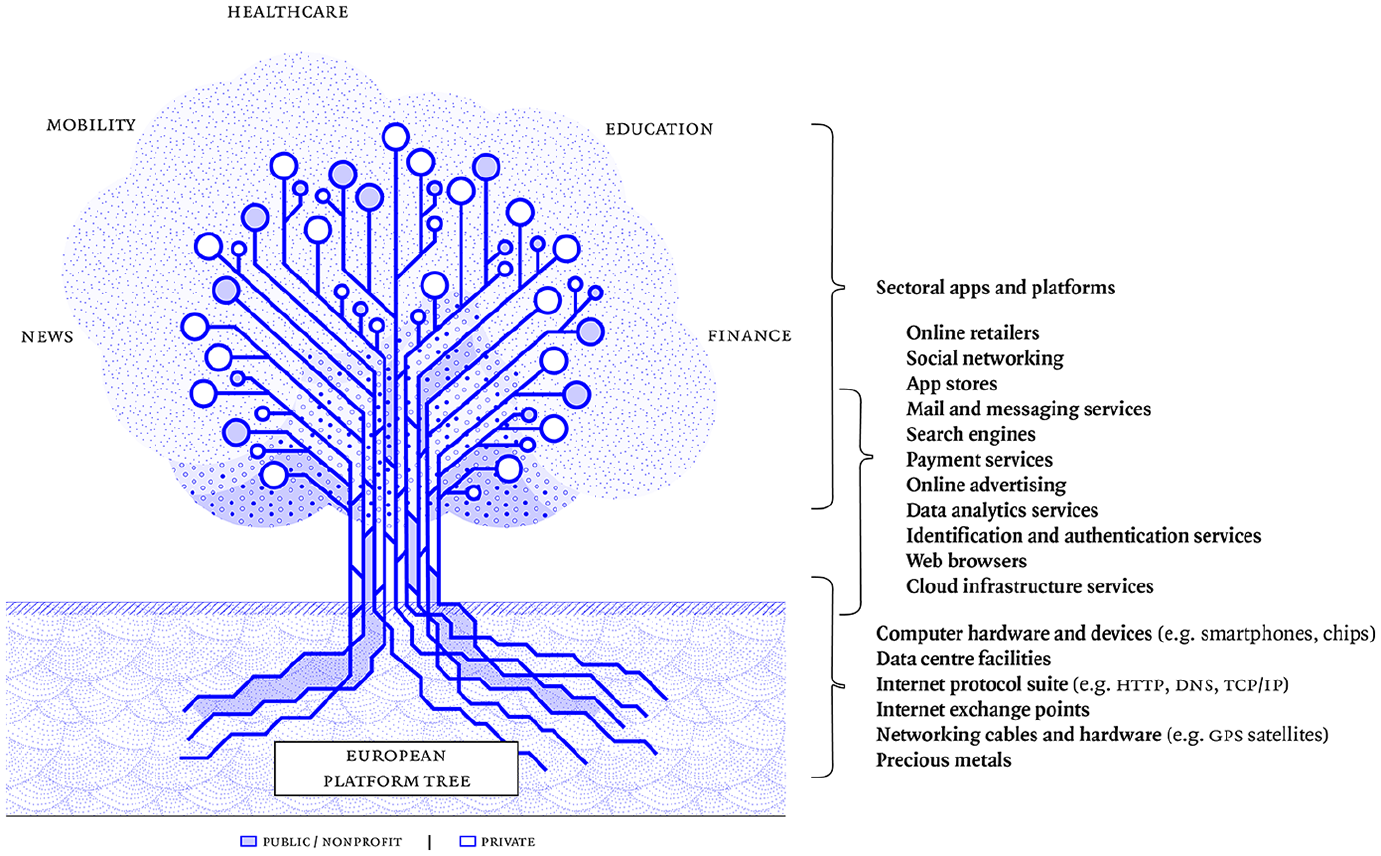
European platform tree.
Crucial to reshaping the ecosystem’s architecture is to maintain diversity at the infrastructural, intermediary, and sectoral levels. Indeed, European nations and the EU should be concerned about protecting public values and interests at all three levels, while carving out space for independent institutions and civil society actors to operate independent platforms. In 2019, German chancellor Angela Merkel called for a European public cloud service and for setting standards of cloud computing based on public values such as privacy, security, and democratic control. The recent German-French initiative GAIA-X aims to build a digital infrastructure based on principles of data sovereignty, public accountability, interoperability, and decentralization (Federal German Ministry of Economic Affairs, 2019). Both actions signal the acutely felt need to reshape the system’s architecture to reflect European norms and values. Instead of adding to the geopolitical tension, European policy-makers could exploit their relative position as outsiders to redirect their regulatory efforts to counterpoise the adverse effects of platformization dynamics.
Growing a diverse and sustainable platform ecosystem requires a comprehensive vision; the tree allows us to visualize a platform constellation that comprises multiple levels, visible and invisible, underground and above surface. By allowing a handful of tech companies to define the principles of a market-driven ecosystem, they are afforded all rule-setting and governing power over the world’s information ecosystems. Focusing on single firms, markets, or individual platforms will not lead to profound, systemic changes. We need to see the forest for the trees in order to understand how to effectively govern their connective structures hidden in layers of code. The tree, although merely a metaphor, expresses the urgency to diversify the platform ecosystem in order to keep it sustainable. Without diversity, we can’t grow a rich, nutritious forest; without a variety of actors with distinct and respected societal roles, we cannot control its unbridled growth; and without a set of principles, we cannot govern its dynamics. Changing a system starts with vision and visualization.
Footnotes
Acknowledgements
I would like to thank the anonymous reviewers of New Media & Society for their valuable comments; I am very grateful to Janneke Gerards, Jean-Christophe Plantin, Anna Gerbrandy, Thomas Poell, and David Nieborg for their critical readings and discussions. Thanks to Fernando van der Vlist for designing the two tree-figures.
Funding
The author(s) received no financial support for the research, authorship, and/or publication of this article.
