




Abstract
Selfie posting is now a well-established practice, particularly for young women. However, it is nevertheless much maligned in popular discourses. As a counterpoint to digital narcissism, selfie posting is also constituted as relational. This Q methodological study explored how young women make sense of selfie practices. Twenty-seven young women aged 18–23 sorted a set of statements about selfies into a quasi-normal grid. These sorts were factor analysed to identify shared patterns. Four factors were identified which were subsequently analysed qualitatively, producing a narrative for each. These included (1) ‘Presenting . . . Me!’, (2) ‘I am what I am’, (3) ‘Sharing is caring’ and (4) ‘The In-crowd – beautiful and popular’. The complexity of identity curation evidenced in this study highlights the importance of moving beyond both polarised characterisations and the pathologisation of young women selfie takers in order to explicate the interplay between normative femininities and the digital self.
Keywords
Introduction
The selfie has become a prolific subgenre of everyday photography in contemporary visual culture. A common definition now used in the academic literature is taken from the Oxford English Dictionary which describes the selfie as ‘A photograph that one has taken of oneself, typically one taken with a smartphone or webcam and shared via social media’ (Oxford English dictionary, 2013). In everyday talk, however, the definition has extended to group shots taken with forward-facing mobile camera technologies (Capdevila and Lazard, 2020).
The smartphone as a networked device with its portability and forward-facing camera has undoubtedly been instrumental in establishing selfie-taking and -sharing on social media as a routine practice for many. Rates of actual selfie posting have been found to be variable across data sets, likely reflecting different sampling methods and criteria. For example, across a sample of one billion active Android Smartphone users, the number of selfies taken each day was reported to be 93 million (Reisinger, 2014). The Selfiecity project (n.d.), which surveyed selfie posting in five cities (Bangkok, Berlin, Moscow, New York and Sao Paulo), in 2014 found about 4% of the images they randomly collected to be selfies. Their summary report indicates that selfies were significantly more often of women than men and that young people were most represented with an average age of 23.7. These gendered and generational patterns around selfie-posting practices are consistent with previous findings around both selfies and generic social media usage. For instance, Duggan and Brenner (2012) found that women engage more frequently with social networking sites (SNS), while research conducted by Dhir et al. (2016) indicated that they engage in photo-sharing practices more often than men. Dhir et al. (2016) further found that young adults (aged 20–30) typically engage more frequently in selfie-sharing compared to adolescents and adults. Multiple markers of difference, beyond age and gender, can be made visible (or indeed invisible) through selfie-posting and audiencing practices including (dis)ability, class, ethnicity, geography, race and sexuality. However, for the purposes of this article, we focus on gender and generation, or specifically young women as they, we would argue, are the most often vilified for these practices.
As the use of social media, and user-generated content in particular, becomes ever more ubiquitous, the role of selfies has concomitantly diversified. While earlier selfies often drew on the widely disparaged ‘duck face’, the complexity and proficiency of current selfie practices have developed to enrol affect, irony and expertise as young women endeavour to communicate within the parameters of normative femininities (see, for example, Duguay, 2016 or Warfield, 2014). Although selfie posting is now a well-established practice, particularly for young women, it is nevertheless much maligned in popular discourses as superficial and narcissistic. That selfie-taking and -posting is a recognisable and popular everyday practice appears incongruent with such predominantly negative characterisations of selfies and those who post them, not least because selfies appear to attract a high number of ‘likes’ on social media (Souza et al., 2015). These characterisations of selfie-taking and -sharing as both negative and as socially supported practices, point to a number of tensions and complexities in and around how selfie-taking is understood in the current cultural context.
Problematising selfies
Concern around selfies has centred on the relationship between the frequency of selfie posting and mental health. In the popular press, selfie practices are described as intensifying preoccupations with the self and self-image. This preoccupation is further encouraged by the editing facilities built in to digital photographic technologies that can be used to create a ‘best’ look (Authors, 2017). The problematisation of selfies, then, lies in how they are taken to both indicate and reproduce a toxic culture of narcissism that invites constant comparison and produces insecurity (Maguire, 2018). In this way, selfies are seen to induce ‘a kind of compensatory self-obsession that requires the approval of others and is thereby pathologically beholden to them’ (Goldberg, 2017: 3).
These popular conceptualisations are reflected in psychological empirical research which has sought to establish links between selfie-taking and -sharing and socially problematic personality traits, most notably narcissism. The evidence for this is mixed; however, with some research reporting a link between selfie posting and narcissism (e.g. McCain et al., 2016; Weiser, 2015) and others finding no links between the two at all (e.g. Etgar and Amichai-Hamburger, 2017). As Pearce and Moscardo (2015) point out, it is important to be aware that even when links are found between selfie behaviour and narcissism, they are not always consistent or strong (e.g. Barry et al., 2017; Fox and Rooney, 2015). Interestingly, Karwowski and Arkadiusz Brzeski (2017) note that when positive associations between narcissistic-related traits and selfie-taking and -posting are found, they tend to be more consistent among men than women. They go on to argue that this indicates that narcissism does not necessarily offer a firm explanation for women’s selfie behaviour. We would go further to argue that, while the use of trait theory to explain selfie posting, in any context, remains unsubstantiated, young women and girls are still particularly subject to this form of pathologisation, social concern and disapproval (Senft and Baym, 2015; Warfield, 2014).
In a similar vein, low self-esteem has been implicated in problematic online behaviours. This includes social media addiction – of which selfie posting has been hypothesised to be a key manifestation (e.g. Barry et al., 2017). As with research on selfie posting and narcissism, links between selfie behaviour and self-esteem are mixed, with research indicating associations between posting and greater self-esteem as well as posting and lower self-esteem, or no links at all, or links with self-viewing but not with posting (e.g. Gonzales and Hancock, 2011; McCain et al., 2016; Wang et al., 2018).
Despite the mixed empirical evidence for the connection between selfies, problematic personality traits and poor mental health, these characterisations appear to persist and inform judgements made about those who post their selfies on social media. For example, Re et al. (2016) reported that individuals were rated more positively when they appeared in a photo that was clearly taken by another person than one taken by themselves. This finding is consistent with Krämer et al. (2017) results which suggested that individual selfie takers were rated as less trustworthy, less socially attractive, less open to new experiences, more narcissistic and more extroverted than when they appeared in photos taken by others.
The problematisation of selfie-taking is particularly relevant to young women given that they share these photos more often than men. It is young women, therefore, who are primarily subject to social disapproval. The association between women, femininity and narcissism, of course, predates the selfie phenomenon (see, for example, Bartky, 1982) and reveals long-standing tensions in social obligations around femininity and beauty imperatives. The requirement for women to conform to normative beauty standards necessitates the taking of an outsider’s perspective in order to produce themselves in line with these standards. Concomitantly, as Anderson (2018) points out, this involves looking at themselves with some frequency. Meyer’s (2002), in what she refers to as the visual culture of feminine narcissism, argues that there is considerable social ambivalence to women looking at themselves in the mirror. On the one hand, self-gaze is treated as an important practice for cultivating a feminine appearance and non-participation becomes positioned as unfeminine. However, participation in self-gaze practices are also trivialised as vain and inconsequential. This is resonant with Warfield’s (2014) claim that dominant media discourses characterise ‘selfies as narcissistic vanity rituals by (predominantly) vacuous teenage girls’ (p. 2).
Selfie practices, as mentioned earlier, are treated as magnifying self-gaze through the ways they invite engagement with what has traditionally been the remit of professional photography. This includes taking multiple photos and selecting the ‘best’ as well as attention to lighting and options for filtering to prepare photos for upload. The affordances of smart phones, equipped as they are with forward-facing cameras, blurring the subject and object distinction (Tiidenberg and Gómez Cruz, 2015), produce the gaze as both self-reflective and intimate. Together these processes are well grounded and familiar in contemporary culture and, in this way, selfie posting can render visible and export the self-gaze to a wider audience. This is perhaps most clearly exemplified by the ‘mirror’ selfie – a selfie taken of one’s reflection in a mirror. Given this, it is perhaps not surprising that the selfie phenomenon has become framed by discourses of feminine narcissism with the associated moral panics.
The link between young women, selfies and narcissism has implications for relational feminine identities. The popular association between narcissism, grandiosity and self-absorption is problematically positioned as distinct from, rather than interwoven with, the relationality which dominantly defines normative femininities thereby obscuring the nuance we have argued is inherent to selfie-posting practices.
Negotiating selfie relationality
While the notion of a reduction or absence in relational expression has been important to predominant articulations problematising selfies, counter discourses highlight positive social functions of selfie practices online. For example, the results from a 2017 survey suggested selfie posting was a means for respondents to clarify their sense of self, develop relationships with friends and family, express themselves, signal relief from distress, share information with others and store memories as well as entertain others (Williamson et al., 2017). Goldberg (2017) neatly summarises such counter discourses in arguing that ‘apologias for the selfie phenomenon are typically grounded in the assertion that selfies are about connecting with others in ways that reproduce, rather than diverge from, valued forms of relationality, though often with the caveat that selfies might sometimes express narcissistic tendencies’ (p. 3). Valued forms of relationality are predicated on the idea that the communication of something ‘real’ about oneself is a necessary component of establishing meaningful connection with others. For instance, selfies have been used to create these connections in activist organising such as the My Stealthy Freedom movement which invites Iranian women to post pictures of themselves without a headscarf (Stewart and Schultze, 2019). Enli (2009, 2015) argues that, in the context of social media, content that comes across as authentic produces a connection with the audience. Similarly, Senft and Baym (2015) draw on connection – ‘the transmission of human feeling in the form of a relationship’ – in their definition (p. 1589). As such, the selfie can be seen to function as an assemblage (Hess, 2015) bringing various elements into relation. In establishing this relationality, selfies become positioned as an expression of some aspect of a real and connected self, rather than as a display of self-absorption in digital narcissism.
Departing from the constitution of selfie-editing practices as a form of hubristic manipulation, research primarily in cultural and visual media studies, has highlighted the complex identity work done in and through selfie-sharing online (Senft and Baym, 2015; Tiidenberg, 2016). Central to this body of work is the focus on how selfie takers themselves understand their engagement with selfie practices and how that engagement becomes constituted. More specifically, studies suggest that selfie-taking and -editing processes are heavily shaped by parameters of social acceptability. This, we would posit, is the context in which the identity work must be done. For example, Warfield’s (2016) analysis of young women’s accounts of selfie-taking demonstrates that a number of considerations inform the taking and sharing of selfies, not least of which were normative conventions for femininity which among other effects would censure narcissism while fostering relational practices. Young women described their use of feminine photographic tropes in the production of ‘good’ selfies such as camera angles to produce normative images of the body in line with societal ideals of feminine beauty and in relation to acceptable feminine characteristics (e.g. being smiley and ‘cute’; see also Warfield, 2016). Unlike conceptualisations of selfie-taking mentioned earlier as, for example, manipulated, false and hence untrustworthy, the young women in Warfield’s study described the importance of identifying selfies to post which best captured something genuine, ‘real’ or authentic about themselves. Editing, thus, while presented as a highly expert and technical process, was not presented as at odds with authenticity, but rather as a means of communicating it, which points to multiplex considerations in the constitution of digital feminine subjectivities.
Context of the present study
While it is clear that a burgeoning body of research has produced more nuanced conceptualisations of selfie practices as producing and reproducing complex digital subjectivities, much of this body of work focuses on the ways in which young women understand and make sense of their own selfies. There has not been a consistent focus on the multiplicity of cultural understandings of selfie practices which extends discussion beyond polarisation of selfie-taking practices as either narcissistic or relational. As mentioned earlier, characterisations of selfie takers predominantly reflect polarised understandings of selfie posting as negative and indicative of pathology or as serving positive social functions online. However, to date, there has not been a systematic analysis of how shared social understandings of selfie practices are constituted. This is important because such understandings have implications for how selfie posters become positioned and are treated which, in turn, can shape and constrain the subjectivities of the selfie poster.
The aim of the current study was to explore and gain insight into how young women themselves make sense of selfie posting on social media. This research extends the discussion of current scholarship by moving attention away from polarised stances on the selfie phenomenon to explore multiple considerations that may shape or frame how selfie practices become understood. It does so by empirically mapping narratives that allow the making sense of selfie posting.
Methodology
Q methodology was developed by William Stephenson (1935) as a means of studying subjectivity but more recently described by Steven R Brown (1980) and Watts and Stenner (2012). With roots in psychology, the method is now used across the social sciences to investigate contestable issues that can be understood in a variety of ways, for instance, sexual harassment (Lazard, 2009), experiences of mothering such as post pregnancy body image (Jordan et al., 2005) or stepmothering (Roper and Capdevila, 2010) and user experiences of Facebook (Orchard et al., 2015). Through a unique blend of quantitative and qualitative analysis, it identifies patterns of sense-making across and within groups of individuals.
In a Q methodological study, participants are asked to sort statements or items about the topic under investigation into a quasi-normal grid. As Q sorting progresses, the bulk of statements are located towards the centre of the grid and those that the participant feels most strongly about, or would like to prioritise, are placed at the appropriate (positive or negative or most agree to most disagree) end of the grid.
This method of data collection allows the absolute positioning of an item (not unlike a Likert-type scale) but, critically, also allows its relative positioning. For example, a participant might strongly agree with two items, however, it may be important to a specific understanding of a topic that one item is more strongly agreed with than the other. In this case, it is not only the absolute, or specific, positioning that is relevant but also its relative, or relational, positioning, and thus relational meaning, which allows for a reading of the factor.
The grids produced by the participants are then inverse factor analysed (by person rather than by item) to identify patterns across the sortings. A weighted average of those sorts that correlate highly with each factor are merged to produce an exemplar sort that represents each factor. It is these exemplars that are analysed thematically to capture shared understandings of that topic. This analysis is qualitative in character as it relies on the meaning-based interpretation of the content and distribution of the items rather than their numerical placing (Stenner and Stainton Rogers, 2004). We refer to these shared understandings as narratives to highlight this gestalt approach to sense-making of this relative placements of the statements – we read it as a story. Further detail on this process can be found in Brown (1980) and Watts and Stenner (2012).
Method
Ethics
Close attention was paid to the ethical implications for both the pilot and main study. Qualtrics software allowed for the anonymous and confidential collection of data. Participants were recruited using personal and institutional Facebook and twitter accounts. Only demographic characteristics were requested, and no personal information was collected beyond a self-chosen pseudonym provided by participants themselves. Rationale and purpose of the study were made explicit in the online material provided and participants were made aware they were free to withdraw at any time until the start of analysis. Explicit informed consent was required before access to the study was granted. Institutional contact details for the researchers were provided as were links to further information. Participants were not financially incentivised to take part. The study received ethical approval from the Open University Human Research Ethics Committee.
Pilot study
In this study, we collected items about selfie-taking and -posting through a cultural analysis which included sources such as focus groups, academic literature, media reports as well as publicly available online discussions. Once collected, the aim was to identify all issues that might be seen to be relevant to selfie posting from a diversity of perspectives (beyond those of the researchers themselves). These included not only issues identified in the literature review, such as authenticity and relationality, but also others, for instance, altruism, digital violence and mundanity which were not found to be prominent in this study. This produced an initial pool of items (approximately 200) which were then scrutinised by the researchers for specificity and duplication. Original wording was maintained as far as possible, with only minor editing for clarity and readability. Through this process, we identified 110 individual statements which were piloted for balance, clarity and coverage. Participants in the pilot study (n = 15) included young women demographically similar to those in the main study as well as a small group of academic methodologists to feedback on the design more broadly. The pilot study, conducted on Qualtrics, asked participants to judge if they agreed or disagreed with each statement or whether they found it to be ‘not relevant’ or ‘not clear’. Pilot study participants were also asked to provide comments including any topic gaps or potential oversights. The data were then analysed to produce a refined set of 47 items which met the requirements of the study in that they were judged to be clear, included a comprehensive set of ideas relevant to the topic, and were balanced across different perspectives.
Main study
Participants
Twenty-seven young women between the ages of 18 and 23 (average age 20.6) from across England took part in the main study. We did not collect any data from them other than age and gender as, per above, the focus was to capture shared understanding rather than individual ones.
Procedure
The data were collected using Qualtrics online software. Participants sorted 47 statements on a grid with a quasi-normal distribution ranging from +5 to −5. They were also provided an opportunity to comment on any of the items and encouraged to do so for those items at either end of the distribution. These participant comments were used to inform the final analysis. The 27 completed sorts were statistically analysed with KenQ, an online bespoke programme used for Q methodological analysis. Principal Components Analysis was chosen along with Varimax rotation to produce orthogonal (uncorrelated) factors. Seven factors were identified as having an eigenvalue greater than 1 as this assured that each accounted for more of the variance explained than that of a single Q sort, indicating their status as a ‘shared understanding’. The seven factors together explained 71% of the variance. Those sorts loading, or with correlations of, at least 0.6 on any one factor and no more than 0.4 on any other were merged, using a weighted average, to create reconstructed, exemplar sorts. Due to space constraints, for the purposes of this article, we will focus on four factors of the seven identified. Together they explain 46% of the variance (Factor 1 accounted for 13%, Factor 2 for 15%, Factor 3 for 7% and Factor 4 for 11%). The rationale for our choice is both statistical (Watts and Stenner, 2012) and theoretical (Brown, 1980). First Factors 1, 2 and 4 are the three with the highest loadings, so most representative of the participant group statistically. However, Factor 3, which statistically accounted for the second lowest amount of variance, was also the only factor which did not correlate over 0.3 with any of the other factors and included the two items with the highest Z score in terms of consensus and disagreement of statements. Theoretically, Factor 3 presents a narrative that was conceptually different from those of the other six. For this reason, we chose to include it among the four described here.
Findings
Table 1 represents a listing of each item and where it appears in each of the four factors that will be analysed. (A full factor array for each factor is available as online Supplemental material.)
Item placement by factor.
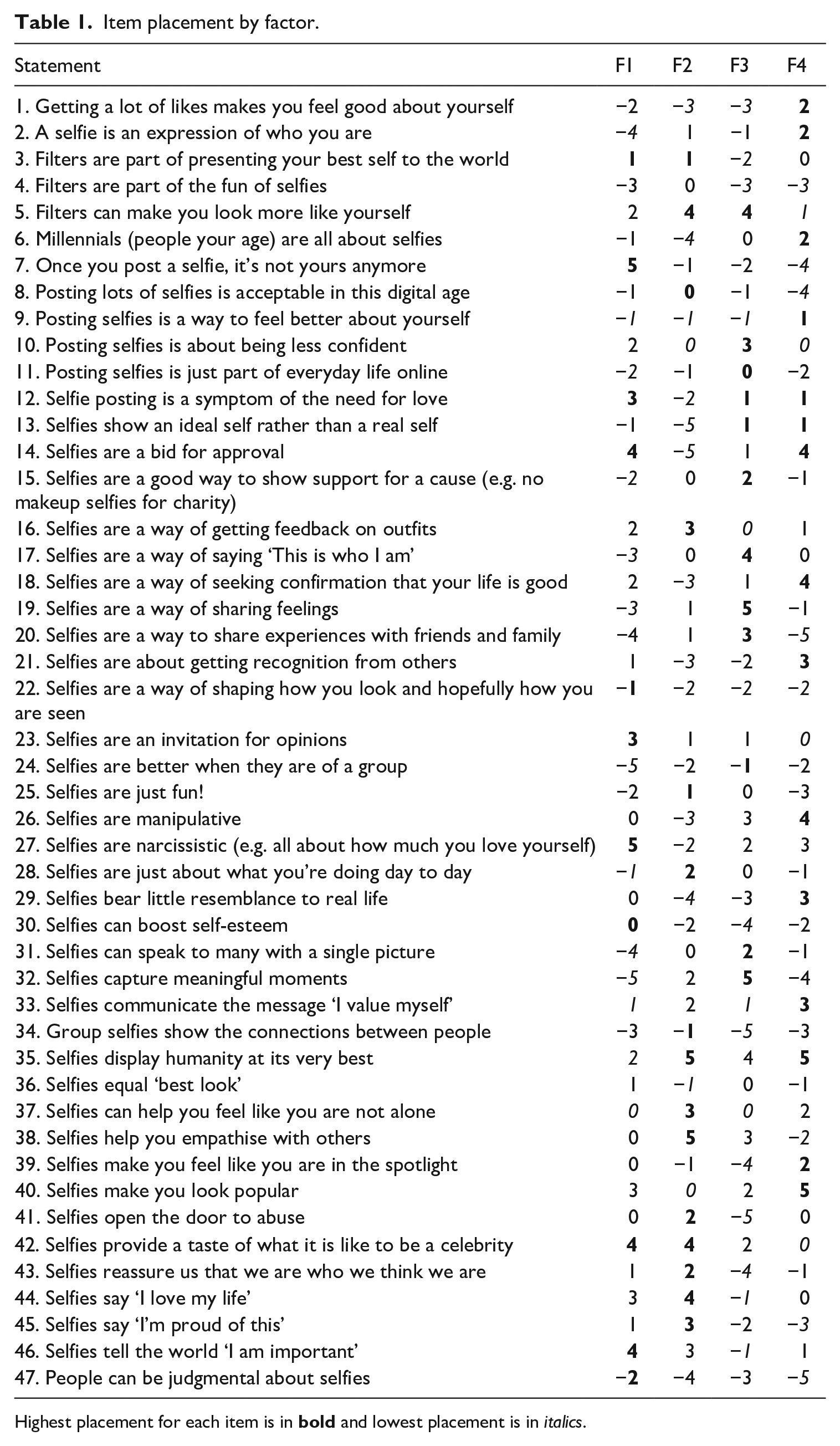
Highest placement for each item is in
Factor 1: presenting . . . me!
The ‘Presenting . . . Me!’ narrative is the only narrative among those analysed that prioritises self-posting as an expression of narcissism (27, +5). In line with this, items which are prioritised reflect the idea that selfie posting is a means of communicating messages around self-love and self-importance. These are given precedence over other concerns such as authenticity (27, +5; 46, +4; 44, +3; 2, −4; 17, −3). Resonant with the idea that selfies are narcissistic, there is a firm emphasis on selfies of individuals rather than groups. More specifically, selfies are not primarily concerned with showing connections between people or sharing feelings or experiences with family and friends. Indeed, they are not about meaningful moments at all. The placement of these items underscores the idea that selfies are primarily concerned with narcissistic self-love (24, −5; 32, −5; 31, −4; 20, −4; 34, −3; 19, −3). Consideration as to whether these narcissistic presentations on social media may belie the actual confidence of the selfie poster is less of a concern in this narrative. As such, the idea that selfie posting is a means to develop or improve positive self-regard is not prioritised (10, +2; 1, −2; 9, −1). This is not to say that selfies are unrelated to approval seeking. However, the purpose of validation is not to compensate for lack of positive self-regard. Instead, when contextualised by narcissism, the idea that selfie posting is a symptom of the need for love (12, 3) and a bid for approval (14, 4) in the context of the overall item array shows that selfie posting is about consolidating narcissistic self-love. This is accomplished through seeking social approval and creating the impression of popularity. As such, selfie posting can provide a taste of what it is like to be a celebrity (42, +4; 14, +4; 12, +3; 40, +3). In this narrative, it is recognised that once posted, the individual is no longer exclusively in control of the photo. As such, selfies become an invitation for opinions (7, +5; 23, +3). However, the dissemination of selfies via posting is not rendered particularly problematic. This is because, as the placement of items 14, 42, 12, 40 indicate, the function of selfies here is, at least in part, to invite approval and strengthen expressions of a narcissistic self-love.
Factor 2: I am what I am
In the ‘I am what I am’ narrative, selfies show real selves and communicate something about the poster’s real life. Filters can be used to make one look more like how they see themselves and given that this technology is used to ‘correct’ or improve photos, this may suggest that selfies also display the best possible version of oneself (13, −5; 29, −5; 5, +4). Given the emphasis in this narrative on selfies as capturing real selves, selfie-taking and -editing practices are not presented as manipulative (26, −3). Indeed, this narrative was the only one of the four analysed that strongly negated the idea that selfies are manipulative (26, −3). The selfie is instead treated as a medium that captures and confirms how the selfie poster sees themselves and their life. In a similar vein to the ‘Presenting . . . Me!’ narrative, distinctions are made here around posting and associated external affirmation. However, the ‘I am what I am’ narrative is the only factor analysed that does not present selfies as a bid for approval (14, −4). Similarly, items reflecting selfie posting as a tool to develop or improve some aspect of positive self-regard are least agreed with or not prioritised (18, −3; 1, −3; 21, −3). Rather, external affirmation functions to consolidate one’s own perspective (13, −5). Audience response in the form of digital ‘likes’ and how that can make one feel better about oneself is less relevant here (12, −2; 30, −2; 9, −1). This may indicate that audience response is subsidiary to how the selfie poster sees themselves. Indeed, in this narrative, the practice of selfie posting is treated as overwhelmingly positive for individuals because it allows the selfie poster to communicate something about their own importance and the best aspects of their lives as they live it (44, +4; 46, +3). As well as the emphasis in this narrative on ‘best’ selves, selfies provide an outlet to focus on and celebrate oneself (42, +4; 45, +3).
This narrative draws attention to how selfie positing can function to bring others from our online network into our offline lives through inviting comment. The relational work accomplished by selfie posting is positive (38, +5; 16, +3; 37, +3; 47, −4). Indeed, selfies are relational in the sense that they can facilitate empathy and feelings of connectedness that are free from social judgement. This focus on relationality does not undermine the selfie as primarily an individual identity project; group selfies and connections between people are not vital to this account (24, −2; 34, −2). Unlike ‘the Presenting . . . Me!’ narrative, the focus on best self and individual accomplishment does not render selfie posting as particularly narcissistic. There was also strong disagreement that selfie posting is a millennial pursuit. Taken together, the placement of these items runs counter to these predominant characterisations of selfie posters (27, −2; 6, −4). In summary, unlike ‘Presenting . . . Me!’, the ‘I am what I am’ narrative treats selfie posting as a means of communicating an accurate, albeit overwhelming positive, description of a person’s life.
Factor 3: sharing is caring
The ‘Sharing is caring’ narrative was particularly distinctive among the factors analysed for its emphasis on emotional relationality between individuals in the social network. It was the only narrative among those analysed that prioritised the role of selfies in capturing meaningful moments, sharing feelings and experiences with friends and family (19, 5; 20, 3; 32, 5). Item placements suggest that the selfie is treated as a visual representation of affect and experience which facilitates empathy through the viewing and sharing of specific moments in a person’s life (19, +5; 32, +5; 38, +3; 20, +3). While relationality is emphasised, this narrative did not prioritise distinctions between individual and group selfies. Indeed, the least agreed with was number 34 (group selfies show the connections between people), indicating that the group selfie in and of itself is not necessarily sufficient to demonstrate relational connections (34, −5; 24, −1). Given that, in this narrative, selfies are seen as a medium for relating to others, it perhaps is unsurprising that individually focused motivations for posting such as being in the spotlight were least agreed with (34, −4). However, these item placements do not reflect a straightforward polarisation between the individual and relationality. Instead, in the ‘Sharing is caring’ narrative, the point is made that posting selfies is about being less confident (10, +3). Crucially, however, this narrative is distinctive in arguing that selfies do not improve self-esteem and audience reaction in the form of digital likes will not necessarily make one feel good about themselves or provide reassurance (30, −4; 1, −3).
In the ‘Sharing is caring’ narrative, the posted selfie is not necessarily an expression of individual identity but rather a public statement of who one is (2, −1; 43, −4; 17, +4). Selfies are treated as a worked up impression of oneself. They are worked up in the sense that they require effort, through the application of filters. Filters then are not simply fun – they are doing key identity work and they do so, like the ‘I am what I am’ narrative, by contributing to the presentation of the best version of oneself online (5, +4; 4, −3; 26, +3; 35, +4). Agreement with the idea that selfies are manipulative may suggest that the posting of a filtered self is a way to control the narrative of one’s identity project online (26; +3). Through the selection and editing of selfies, the poster can exercise some control not only over how they look in the photo but also how they will be seen and understood by the viewing audience when communicating about their ‘real’ offline life (29, −3). The exercise of controlling how one is seen on social media is associated with avoidance of more negative experiences online such as audience judgement and abuse (41, −5; 47, −3). Overall, this narrative places emphasis on emotional relationality, much more so than any of the factors identified. It offers a nuanced account of the presentation of online self which highlights issues around confidence without strong recourse to ideas around pathology. In this sense, this narrative does not clearly resonate with popular discourses which polarise selfie posters as either overly confident narcissists or under-confident and lacking in self-esteem. In fact, the ‘Sharing is caring’ narrative draws on different elements of these polarisations to work with a self that is fashioned for online presence.
Factor 4: the in-crowd – beautiful and popular
The narrative prioritises the idea that selfies display humanity at its very best (35, +5). However, it is distinctive in that it prioritises the role of selfies in creating the impression of popularity to a greater extent than the other factors analysed (40, 5). Thus, the display of ‘best’ selves is done within the context of popularity seeking. Items that are strongly agreed with situate selfies as a positive statement about one’s own self-worth, as well as a means to establish oneself as well-liked, and garner positive recognition. The presentation of best self is underscored by disagreement with the idea that selfies and filters are just fun (4, −3; 25, −3). In this narrative, the application of filters is neither trivialised nor rendered playful, suggesting that the filtered selfie is implicated in the identity work of the popularity seeker online (40, +5; 14, +4; 21, +3; 33, +3; 4, −3; 25, −3).
This narrative draws distinctions between notions of self-value and pride which suggest that self-value is not tied to personal achievement but rather to a fragile form of narcissistic self-love (33, +3; 45, −3; 27, +3) in which the selfie poster is in need of reassurance of their own popularity. This can be seen in this narrative’s distinctive emphasis on the idea that selfies are a way of seeking confirmation from others that their lives are good (18, 4) and that posting selfies are a means of gaining recognition from others (21, 3). What is particularly distinctive is this narrative, as compared to the others, is the prioritisation of the idea that selfies bear little resemblance to real life (29, 3), which in the context of the other item positionings suggests that popularity seeking is prioritised over authenticity.
In a similar vein to the ‘Sharing is caring’ narrative, agreement with the idea that selfies are manipulative may suggest that the posting of a filtered self is a way to control the narrative of one’s identity project online. In this sense the selfie poster retains control and ownership of the posted selfie (26, + 4; 7, −4).
In line with the idea that selfies are superficial and based on individual need for popularity, there is less of a concern with selfies as a mechanism for engaging and consolidating connections and meaningful relational interaction (20, −5; 32, −4; 34, −3). This narrative recognises normative selfie behaviour through agreement with the idea that a high frequency of posts is less socially acceptable. In this sense, selfies are subject to social judgements. As such people are not seen as being overly judgemental about selfie posting because some social judgements are warranted (47, −5; 8, −4). In summary, in this narrative, selfie posting is about the presentation of oneself as popular and, relatedly, garnering positive recognition.
Discussion
The four narratives identified in this study bring together a number of issues relevant to selfie-taking and -sharing practices in ways that are not straightforwardly marked by polarisations of the ‘good’ relational selfie and the ‘bad’ narcissistic selfie post. Indeed, the identification of multiple understandings or narratives in this study suggest that everyday understandings of selfie posting are more nuanced than implied by the predominant representations of it. Attending to this nuance is valuable because it avoids the tendency to pathologise young women which, as discussed, is heavily reproduced in the literature on both selfie practices and young women themselves.
It is the case that the most dominant narrative identified in this study is resonant with digital narcissism discourses. In many respects, the ‘Presenting . . . Me!’ narrative (Factor 1) speaks to the polarisation of self-love and relationality in so far as this narrative constitutes selfie practices as a means to consolidate self-love rather than as a tool to relate to others. In this sense, narcissism overshadows forms of relationality that are grounded in a conceptualisation of a self which priorities connection with others. As mentioned earlier, valued forms of relationality are predicated on ideas around the need for give the whole ‘real’, and thus ‘unfiltered’ or ‘unedited’ self over to others to establish meaningful intimacy and connectedness (Goldberg, 2017). The ‘Presenting . . . Me!’ narrative represents a particular problematisation and pathologisation of the feminine selfie subject because narcissism, with its associations with self-centredness, represents a transgression of the normative feminine as a self-for-others – as caring, communal and self-sacrificing (Weisstein, 1993).
Narcissism was, however, less important to the ‘I am what I am’ narrative (Factor 2) and the ‘Sharing is caring’ narrative (Factor 3). The ‘I am what I am’ narrative focuses on the communication of one’s own importance in terms of self-value rather than digital narcissism. Importantly, this understanding of the self in selfies was positioned as compatible with empathetic relating. Thus, this narrative appears to transgress binaries around individually focused versus relational selfie displays that underpin polarisations around self-posting practices. Unlike the other factors identified, the ‘Sharing is caring’ narrative centralised the importance of relationality and was the only factor to highly prioritise selfies as a tool to share feelings (see also Senft and Baym, 2015). However, relationality was done in the context of the selfie as a display of one’s ‘best’ self. This display was linked to selfie takers as having less confidence but not pathologically so. In this sense, this narrative shares themes with the ‘I am what I am’ narrative in that it appears to transgress self-focused/relational dichotomies.
Important to the ‘I am what I am’ narrative and the ‘Sharing is caring’ narrative is, as previously mentioned, the idea that selfies are a worked up display of best selves. However, what is notable is that both narratives emphasise that selfies, as a laboured production, work to capture some aspect of one’s sense of embodied self. This is resonant with research that has highlighted the importance of the notion of authenticity to young women’s selfie practices (e.g. Senft and Baym, 2015; Warfield, 2016). This notion complicates the respective conflation between what is real (e.g. spontaneous, unedited) or not (laboured, edited) and offline and online life. As Valentine and Holloway (2002) point out, the offline world is one which has become marked as real or authentic, whereas in contrast, online life is treated as false and inauthentic. This false world is also understood as problematically impinging on users ‘real’ life by, for example, detaching them from reality and ‘“real” human existence’ (p. 304). What is noteworthy is this conflation is not made in the ‘I am what I am’ narrative and the ‘Sharing is caring’ narrative which point to alternative and culturally dominant ways of understanding the relationship between real (offline) and unreal (online) identities.
The real/unreal binary is relevant to conceptualisations of both online narcissism and relationality. As Goldberg (2017) argues, It is no coincidence that narcissists are thought to be insufficiently concerned both with other people and with the real – those depths that lie hidden beneath the surfaces by which the narcissist has been seduced; the other is the real to which the image-obsessed narcissist has failed to attend. When we are scolded for not attending to the ‘real world’ or our ‘real lives’, this invariably means that we are somehow failing our social obligations. (p. 7)
For Goldberg, these social obligations speak directly to what becomes constituted as valued forms of relationality mentioned earlier – the giving over of a ‘real’ ‘unfiltered’ self to others to bring about meaningful connection. The ‘I am what I am’ narrative and the ‘Sharing is caring’ narrative trouble an uncomplicated sense of a stable real self grounded in real offline embodiment by highlighting the role of digital filters to visually produce some aspect of what is ‘real’ for the selfie taker. Indeed, this is what makes the ‘I am what I am’ narrative particularly distinctive. The selfie as a visual production in both these narratives speaks to the selfie taker’s life as both digitalised and ‘real’ which does not preclude a filtered relational self.
Relational social obligations are of particular relevance to the digital feminine subject who, as mentioned earlier, is required to be communal and caring in order to produce themselves in line with normative femininities. In the context of neoliberalism, the feminine subject is also required to be autonomous, self-managing and enterprising (Gill and Scharff, 2011). As Rose (1999) points out, within neoliberal cultures, individuals are ‘obliged to be free’ (Rose, 1999: 153). This obligation translates into imperatives around individual responsibility for the ‘free’ choices that individuals make, particularly for ‘understanding and improving ourselves in relation to that which is true, permitted and desirable’ (Rose, 1999: 153). The desirability of pursuing self-improvement and self-fulfilment imply individual responsibility for goal attainment. These obligations come together in the ‘I am what I am’ narrative through the prioritisation of selfies as a means to communicate one’s own importance and achievements. However, this form of feminine autonomy does not run counter to the affective functions of selfies as vehicles for digital empathy and connectedness.
In contrast to the ‘I am what I am’ narrative, the ‘Sharing is caring’ narrative gives precedence to relationality over self-importance and achievement. As such, the feminine subject appears to be much more akin to conventional feminine normativities as selfies become narrativised as a means to affectively relate to others in the social network. Keeping connected through sharing of feelings and experiences is not unlike findings which suggest that women engage more frequently than men in relationship maintenance through, for example, communicating family updates (e.g. Hess Brown and DeRycke, 2010). In this sense, selfies function as emotional labour. However, the digital self in the ‘Sharing is caring’ narrative does not straightforwardly reflect a ‘real’ self but one that is crafted for audience consumption. This crafted self troubles the ‘real’ self as a basis for meaningful relational connection and points to how the crafted relational self navigates intimacy in a network comprised of multiple relationships.
While narcissism is less important to the ‘I am what I am’ and the ‘Sharing is caring’ narrative, it is relevant to the ‘In crowd – beautiful and popular’ narrative (Factor 4). Whereas the ‘Presenting . . . Me’ narrative similarly prioritises narcissism, the ‘In crowd – beautiful and popular’ narrative gains distinctiveness in its prioritisation of selfies as a means to garner recognition from others as well as producing oneself as popular. The selfie poster is produced as somewhat superficial, manipulative and in need of reassurance of their own popularity. This resembles Goldberg’s (2017) summary of the constitution of digital narcissism as ‘a kind of compensatory self-obsession that requires the approval of others and is thereby pathologically beholden to them’. This narrative, when located within feminine subjectivities, is not unlike the cultural trope, ‘the plastics’ which was popularised by the film ‘Mean Girls’. The ‘plastic’ popular girls derive their status from looking good, manipulation and acknowledgement of their elevated position by others. Much like the ‘mean girl’, this narrative promotes a sense of feminine emotional neediness and fragility because self-valuations are constituted as dependent on others. The feminine subject in this narrative is dependent, self-centred and disengaged from valued forms of relationality which offers a counterpoint to ‘good’ femininities in which women are called upon to perform supportive communal ways of being (e.g. Ringrose and Renold, 2010).
Taken together, these narratives point to the difficulties in navigating social imperatives around ‘good’ femininities when participating in the now routine practice of selfie posting. They also highlight novel ways that young women bring together normative aspects of femininity and the digital filtered self. A point of reflection for this study results from the specificity of the participants. As discussed above, we recruited only young women between the ages of 18 and 23. Focussing on this much maligned demographic allowed us to contrast their sense-making with the more dominant discourses found in the media and in academic texts which are unlikely to include representatives of this group. Rather than trivialising selfie practices, ‘I am what I am’ narrative and the ‘Sharing is caring’ narrative, in particular, were able to highlight how a number of issues and concerns can be brought together to establish a more complex characterisation of young women’s selfie engagement.
While, we would argue, this research makes an important contribution to our understanding of young women’s use of selfies to interrogate how we make sense of both young women and selfies, there are limitations inherent in the methodology. Q methodology is an approach that is best at capturing a snapshot of cultural understanding of the object of study. This limits the questions that it is able to address. Future research could cultivate a more processual approach to research on selfie production and posting to further develop understandings of the phenomenon (see Capdevila and Lazard, 2020).
This study, however, was concerned with tapping into general understandings of selfie posting and as such did not ask the young women who participated in this study to make a distinction between their own and others selfie-posting practices. It is possible that these young women made these distinctions in any case in the completion of their Q sorts. For example, the ‘Presenting . . . Me!’ narrative and ‘The In-crowd – beautiful and popular’ narrative may reflect understandings of other people’s selfies whereas the ‘I am what I am’ narrative and the ‘Sharing is caring’ narrative may be consonant with participants’ own selfie practices. Future research which explicitly asks participants to distinguish between their own and others selfie postings may provide further insight into the complexities of navigating the multiple characterisations of selfie postings that cut across self and other. In particular, such an empirical investigation may highlight the ways in which normative and non-normative femininities become relevant to understanding young women’s digital identities online.
Supplemental Material
Factor_1_Presenting...Me! – Supplemental material for She’s so vain? A Q study of selfies and the curation of an online self
Supplemental material, Factor_1_Presenting...Me! for She’s so vain? A Q study of selfies and the curation of an online self by Lisa Lazard and Rose Capdevila in New Media & Society
Supplemental Material
Factor_2_I_am_what_I_am – Supplemental material for She’s so vain? A Q study of selfies and the curation of an online self
Supplemental material, Factor_2_I_am_what_I_am for She’s so vain? A Q study of selfies and the curation of an online self by Lisa Lazard and Rose Capdevila in New Media & Society
Supplemental Material
Factor_3_Sharing_is_caring – Supplemental material for She’s so vain? A Q study of selfies and the curation of an online self
Supplemental material, Factor_3_Sharing_is_caring for She’s so vain? A Q study of selfies and the curation of an online self by Lisa Lazard and Rose Capdevila in New Media & Society
Supplemental Material
Factor_4_The_In-crowd – Supplemental material for She’s so vain? A Q study of selfies and the curation of an online self
Supplemental material, Factor_4_The_In-crowd for She’s so vain? A Q study of selfies and the curation of an online self by Lisa Lazard and Rose Capdevila in New Media & Society
Footnotes
Funding
The author(s) received no financial support for the research, authorship, and/or publication of this article.

Supplemental material
Supplemental material for this article is available online.
Author biographies
References
Supplementary Material
Please find the following supplemental material available below.
For Open Access articles published under a Creative Commons License, all supplemental material carries the same license as the article it is associated with.
For non-Open Access articles published, all supplemental material carries a non-exclusive license, and permission requests for re-use of supplemental material or any part of supplemental material shall be sent directly to the copyright owner as specified in the copyright notice associated with the article.
