




Abstract
Data activism has emerged as a response to asymmetries in how data and the means of knowledge production are distributed. This article examines MyData, a data activism initiative developing principles for a new technical and commercial ecosystem in which individuals control the use of personal data. Analyzing material collected at a formative event shaping MyData activism, we examine how more just data arrangements are framed to enhance equal participation. Our analysis shows agreement on what is ultimately at stake: individual data agency and fair competition in the data economy. However, two alternatives are offered for what participation involves. Collaboration with commercial actors favors framing participation as agency in data markets, thereby potentially limiting the scope of what is at stake. The alternative framing presents a rights-based understanding of economic and civic agency, potentially leading to a broader understanding of participation in a datafied society.
Introduction
Routine aspects of our lives today produce data, which play an increasingly important role in contemporary capitalism. Companies have long stressed the social benefits, democratic potential, and consumer empowerment accruing from the collection and exploitation of user data (West, 2019). In contrast, scholarship forming what could be called the data economy’s “counternarrative” (Pasquale, 2017) has focused on the asymmetric distribution among companies and individuals of the means of data-based knowledge production (Andrejevic, 2014; Citron and Pasquale, 2014; Crain, 2018; Tufekci, 2014; Van Dijck, 2014; West, 2019; Zuboff, 2015). Data practices that dominate the digital environment have developed alongside technologies that convert aspects of social life into quantifiable data, and ahead of ethical scrutiny, public understanding, and regulation (Zuboff, 2015). These developments have given rise to advocacy and experimentation connected with people’s rights, capabilities, and roles as users, consumers, and citizens in the information society—or digital citizenship (Hintz et al., 2017). Examples include advocating the rights of consumers to participate in content production (Postigo, 2012); employing open source principles for digital rights campaigning (Breindl, 2013) or open data promotion (Baack, 2015); hacking as a form of data agency (Pybus et al., 2015); using digital media for political causes (Kaun and Uldam, 2017); the deployment of infrastructure and tools by civic hackers (Schrock, 2016); and alternative data collection and analytics practices in the Quantified Self (QS) community (Sharon and Zandbergen, 2017). Technology and advocacy movements indicate different ways of responding to the closing off and monopolizing of knowledge production and value creation in digital environments, and emerging movements may either support or resist the dominant political economy of data. The QS community, for example, engages in “soft resistance” (Nafus and Sherman, 2014) to dominant data practices by welcoming big data actors but questioning who gets to aggregate data and how. QS is also ambiguous in terms of its valuations, allowing the values of sharing to thrive alongside the commercialization of self-tracking (Barta and Neff, 2016).
This article contributes to research on data activism, referring to civic engagement and political action responding to the uneven distribution of data access and capabilities in datafied times (Baack, 2015; Milan and Van der Velden, 2016). Data activism “seeks to challenge existing data power relations and to mobilize data in order to enhance social justice” (Kennedy, 2018: 18), recognizing that more just practices can be promoted in the place of dominant ones (Dencik, 2018). As data activism is rooted in data and software, it can involve the promotion of alternative technologies and associated policies, which may in turn involve some form of collaboration with the industry (Milan and Van der Velden, 2016), such as the producers of data-related technologies. This collaboration can serve pragmatic ends; while technology-oriented activism requires the development and production of alternative technologies, firms producing such technologies can in turn seek markets for their outputs (Hess, 2005). In mobilizing more just data arrangements—how organizations collect and use data, the policies that govern such practices, and new capabilities for people to engage with data (Kennedy, 2018)—data activism may then concern firms as participants and beneficiaries. Our contribution is to examine the tensions that emerge between activist and commercial interests, when commercial actors are involved in data activism.
In scholarship on data justice (Dencik et al., 2016; Taylor, 2017), social harms resulting from dominant data practices are seen to both exacerbate existing injustices and produce new ones. We take the normative view that justice requires arrangements that permit all to participate as peers in social life (Cinnamon, 2017; Fraser, 2008). From this point of view, the more just data arrangements envisaged by data activists pertain to enhancing citizen participation in the information society by removing obstacles that hamper equal engagement. Starting from this understanding of justice enables alternative views of the issues relevant to it: injustices can concern the economic dimension of distribution, sociocultural recognition, or political representation (Fraser, 2008). Dominant data practices can be seen to pose threats to equal participation in all three dimensions (Cinnamon, 2017). Asymmetric data accumulation practices give rise to distributive injustice, denying some the resources necessary for participation. This also lays the foundation for sociocultural misrecognition through profiling and social sorting, and for political misrepresentation by restricting people’s means of contesting how they are represented by data. The asymmetric distribution of data can, therefore, be seen as the initial injustice that enables further injustices.
This article focuses on how equal participation is framed in data activism involving commercial actors and interests. What injustices hamper equal participation, what are their remedies, and whose interests deserve consideration? Our empirical context is MyData, a data governance initiative that originated within open data activism in Finland, and has since expanded into an international movement. MyData proponents argue that, to realize their individual, commercial, and societal benefits fully, personal data should be released from the confines of monopolistic data holders, provided that individuals “have an easy way to see where data […] goes, specify who can use it, and alter these decisions over time” (https://mydata.org/what-we-want). MyData envisions a technological and commercial ecosystem where people would control the sharing of their data between interoperable data sources and endpoints. Commercial actors would occupy positions in the ecosystem as, for example, technology providers, service developers, or intermediaries. Ultimately, the expansion of this ecosystem is expected to transform individuals into “empowered actors, not passive targets, in the management of their personal lives both online and offline” (Poikola et al., 2015: 2). Even though MyData aims to increase people’s capabilities to use their data, it also promises to serve firms’ prevailing economic interests in personal data: “[MyData] combines digital human rights and industry need to have access to data” (Poikola et al., 2015: 4). It, therefore, provides an example of data activism explicitly involving commercial data use, making it highly relevant to our research interest.
Our data were collected at the first large international gathering of people interested in MyData’s aims, which turned out to be a formative event for the MyData community. Applying frame analysis to keynote presentations and audience responses at this influential event, we examine how injustices and their remedies are presented in MyData. Our analysis identifies agreement on what is ultimately at stake: individual data agency in the information society. Dominant contemporary data arrangements are framed as hampering equal participation, the remedy being the development of a technological infrastructure providing people with agency over their data and allowing their participation in data collection, sharing, and processing. This was simultaneously framed as a means to redistribute data so that firms can equally compete in an environment currently dominated by monopolistic data holders. However, while general consensus was reached on these means of achieving equal participation, alternative framings for participation itself were suggested. One framing equated participation with the ability to choose between alternative data uses in the market, while another considered participation more broadly in terms of rights and digital citizenship. These frames evidence multiple interpretations of specific dimensions of justice by either construing individuals as market agents or, alternatively, also allowing the consideration of economic and civic agency in broader terms. It is here, we argue, that the involvement of commercial interests in data activism becomes significant. When data agency must serve both activist and commercial interests, and market agency is more readily transformed to serve commercial data uses, what is at stake risks being reduced to participation in data markets.
Data activism and equal participation
Data activism includes variable forms of engagement with existing data arrangements and their politics, and different ways of mobilizing more just data arrangements. By taking an unjust distribution of data as the initial injustice preventing equal participation in the information society (Cinnamon, 2017), we may examine how alternative data arrangements proposed by data activists aim to address this inequity.
Proactive data activism understands data as a potent force for social change, and sees active engagement with data as “a pathway to empowerment, equal participation and action” (Milan and Gutierrez, 2018: 58). This may mean employing data infrastructure for explicit advocacy goals, such as impeding environmental threats through data collection, sharing, and visualization, and the promotion of data transparency (Milan and Gutierrez, 2018). Here, addressing distributive injustice is a means to combat other injustices. Another example is open data activism, which advocates the redistribution of data, aiming to break the interpretative monopoly of governments, and to balance the unjust distribution of power and knowledge (Baack, 2015). Redistribution of data, however, does not automatically promote justice; open data exist only in relation to the political economy of data, and due to asymmetrically distributed capabilities to do with data, opening data might benefit corporations, but not citizens (Johnson, 2014). More broadly, the involvement of corporations in data activism has been objected due to concerns over potential co-optation, as well as dubious political alignments (see Schrock, 2016); for example, political processes restricting the counter-hegemonic potential of open data can instead shape it to support the marketization of public services (Bates, 2013). Data activists themselves can act as a monitorial elite enabled by open data, guarding the public against unjust data use (Schrock, 2016), and may also recognize the need for intermediaries that help to make open data more accessible to the public (Baack, 2015).
For personal data, an unjust distribution results from data industry’s dominant practices separating people from their data and enabling data accumulation by corporations (Cinnamon, 2017). Some data activists posit these data practices as threats to individual rights, and combat them with technical self-protection, such as anonymity, obfuscation, and encryption (Milan and Van der Velden, 2016). In response to an unjust data distribution, this kind of reactive data activism attempts to prevent the production of data in the first place, avoiding the potential harm as well as the benefits accruing from exchanges involving personal data. Here, seeking justice becomes a private act relying on technical skill and ability (Dencik, 2018). Some recent, more proactive instances of data activism focus on redistributing personal data, or their benefits, from firms to people. In addition to MyData, developments include the “re-decentralization” initiative of web pioneer Berners-Lee, aiming to make personal data a resource for people (https://solid.inrupt.com; Andrejevic, 2014; Brooker, 2018); the proposal by another Internet pioneer, Lanier (2013), to achieve commercial symmetry between firms and users by remunerating people for personal data use; the development of software (see Lehtiniemi, 2017) and devices (Crabtree et al., 2016) to provide users with means to exercise control over data collection and use; and “smart disclosure” programs releasing machine-readable personal data from firms to consumer-citizens (Iemma, 2016). Whereas the data analytics industry promises to put organizations in charge of their data for their own advantage (Beer, 2018), these initiatives aim to do the same for individuals. On the surface, they seem to advocate economic agency for people in the information society. They can, however, be criticized on many grounds: for example, that they are excessively individual-centric and reliant on markets that do not work economically (Charitsis et al., 2018); that over-individualization can make them susceptible to private sector co-optation in the same way as the protection of privacy (Coll, 2014); and that they are driven by the judgments of the technical elite about just data practices (Kennedy, 2018). Despite this, they represent work-in-progress experimentation on what a more just data economy could look like; we, therefore, consider them as “moments where meaningful change can occur” (Schrock, 2016: 583). The following section describes our empirical approach to one such moment.
Data and analysis method
The MyData conference
The first author has closely followed MyData in Finland through participant observation in research projects since 2014 (see Lehtiniemi and Ruckenstein, 2019). Data for this research were collected in the context of participant observation at a conference called “MyData 2016” (https://mydata2016.org). In the previous year, the Finnish activists had published a report outlining MyData’s aims (Poikola et al., 2015) which attracted interest from like-minded activists around the globe, eventually leading to organizing the conference in collaboration with the nonprofit Open Knowledge Finland and the French think-tank FING. The event attracted an audience of 700 domain experts 1 with an interest in “human-centric personal data management,” including businesspeople, entrepreneurs, technologists, researchers, privacy advocates, and public sector officials. The event became a formative step for the MyData community, providing grounds for further developments: annual follow-up conferences, a declaration outlining MyData principles (https://mydata.org/declaration/) and the launch of an international NGO “MyData Global” in 2018, with the expressed goal of creating “a fair, sustainable, and prosperous digital society” (https://mydata.org).
If MyData is considered as an emerging field (Fligstein and McAdam, 2012) of data activism, the conference may be regarded an example of a field-configuring event (Lampel and Meyer, 2008); these are events which shape technologies, markets, or industries by assembling diverse interest groups, offering interaction opportunities and facilitating information exchange, and collective sensemaking. Actors in an emerging field have the leeway to shape it to suit their own interests by inducing the cooperation of others (Fligstein, 2001), and a professional conference offers a venue for contestation between future visions, as well as an environment facilitating selection between alternatives (Garud, 2008). Indeed, “if the whole field were to be contained in a nutshell, a conference would be its most likely manifestation” (Garud, 2008: 1084). At the MyData conference, then, actors attempted to shape what MyData is “about” to suit their activist, policy, or commercial ends.
Data and analysis
Our empirical approach is based on analyzing the frames constructed by the conference’s keynote presentations, and the reception of these frames by the audience. Frames in general offer a schema for highlighting aspects of a situation, functioning as modes for articulating strategy to be undertaken. Those constructed in keynotes suggested ways of understanding the current situation, identifying issues to act on, and ways of acting on them. As an analytical framework, we employ the identification of collective action frames (Benford and Snow, 2000; Snow and Benford, 1988) that diagnose the issue in need of change and who is to blame, prognose solutions and how to achieve them, and motivate collective action. By focusing on keynotes, we employ a form of purposive sampling of settings where the processes of interest are most likely to be observed (Silverman, 2006: 306–307). Three features make keynotes suitable for our purpose: first, the biases demonstrated by the choice of speakers, as the event organizers selected them with an eye toward shaping MyData (see Lampel and Meyer, 2008); second, keynote lectures concerned MyData’s means and ends generally rather than detailed issues such as technical or legal minutiae; and third, related to this, the majority of the conference public was present during the keynotes, necessitating that speakers navigate the varied interests of conference participants. Overall, we can expect keynote speakers to attempt to construct frames that resonate with their audience’s interests; however, while different keynote speakers represented different interests and backgrounds, investigating only the constructed frames risks devaluing the power relations in play. In order to take this into account, we also examine the success of framing efforts (Snow and Benford, 1988) through audience responses to them, allowing us to examine not only how injustices are framed as obstructing equal participation, and the means suggested for their removal, but also the extent of agreement on these issues.
Our material consists of two datasets. First, we transcribed video recordings 2 of 12 keynote talks and the follow-up Q&A sessions, totaling some 7 hours of recordings. Second, we received access to 750 anonymous messages sent by audience members using online backchannel software developed for real-time audience interactions at events (Nelimarkka et al., 2016). The software allowed people to send anonymous messages during keynote lectures, specifically prompting “comments and feedback to speakers” as well as “key lessons.” The messages were public to the conference audience. While commenting was continuously encouraged by conference hosts, strong agreement, and disagreement with issues raised may be over-represented. Nevertheless, we argue that this method of gathering audience data is fruitful as there is a low barrier to giving feedback, and immediate responses can be gathered from a wide range of participants. In addition, we prepared field notes on our observations during the conference, which were employed as background material for this study. Using Atlas.ti, we initially identified sections from the keynote transcriptions that represented collective action frames and broadly concerned participation in the information society. We classified these sections with an open coding scheme, and iteratively reclassified them until reaching the six frames presented in the next section. We included only frames that were either widespread or contested. The audience interaction data were then employed to examine agreement and tensions arising in response to the identified frames.
To present our results, we divided the keynote speakers into five groups based on their affiliation: one conference organizer; advocates including an NGO representative and a journalist/author; technology developers from a start-up and a research consortium; speakers affiliated with private sector firms such as a telecom company, financial services companies, and a consultancy; and speakers from the public sector including a ministry official, a data protection authority official, and a Finnish government minister. Two of the speakers came from Finland, the others from elsewhere in Europe, Australia, and the United States. We also include quotations from anonymous audience members.
Framing MyData
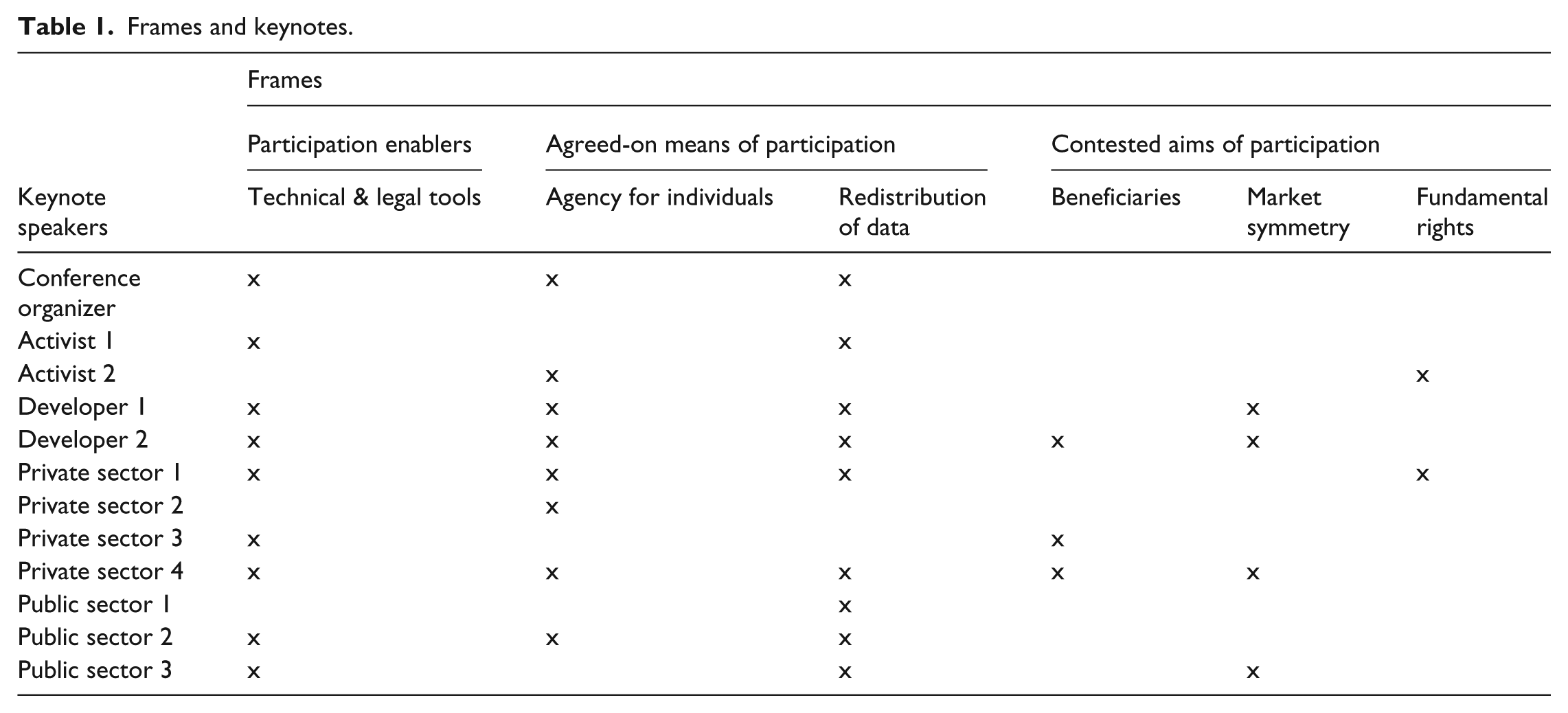
An overview of the frames of participation—under three headings—and how they were employed in keynotes, is presented in Table 1. Participation enablers exhibit a widely employed frame describing how favorable developments in technological and regulatory environments make promoting new data arrangements possible. Agreed-on means of participation include two frames identifying key injustices and their remedies. One was the inability of people to act on their personal data, with the solution being to develop technologies that provided users with data agency, and another was the asymmetric access to personal data that hindered firms’ opportunities; both were framed to allow simultaneous redistribution of data between firms. These frames were employed by all speaker groups and widely accepted by the audience. Contested aims of participation include alternative framings that also received contrasting audience responses. Notably, many speakers avoided them completely. One contested issue was whether the data economy’s giants should be allowed to benefit from opportunities emerging from data activism. Alternative frames were also constructed for what equal participation involved. Some speakers, including technology developers, framed equal participation as market symmetry between users and firms. The alternative was to frame participation as based on rights and citizenship.
Frames and keynotes.
Participation enablers
Technical and legal tools
Two major developments were framed as enabling dominant data arrangements to be challenged: evolving personal data technologies and a changing regulatory environment. The technological driver was the increasing availability of personal data technologies for individuals to use for their own benefit. While data collection, storage and analysis had so far been only available to corporations, the underlying technologies were reaching a level of mundanity and ubiquity, which meant that individuals could claim control of their data. This was framed as technology democratization countering unjust data arrangements: “the only thing that has been limiting us up until now, is the ability for us to have that technology” (Developer 1). The regulatory driver were rulings to ensure data access and interoperability, whose role was instrumental; in order for people to have control over their personal data, new services would need to work together, and data would need to be accessible and technically and semantically interoperable. Of notable importance was the then-upcoming EU’s General Data Protection Regulation containing data portability rulings ensuring machine-readable access to personal data: “GDPR is really important and is about to […] rebalance […] the relationships between individuals and companies” (Public sector 2).
The significance of these developments was not contested and their combination was an opportunity to shape new data arrangements: “[Data] portability is really a legal tool that we will be able to mobilize for the MyData projects” (Private sector 1). The responsibility of the MyData community was to ensure that the opportunities are properly exploited: “the legal tools […] become really useful if they meet a social movement, if they meet a cultural change” (Private sector 1).
Agreed-on means of participation
Agency for individuals
Central to diagnosing the injustice of dominant data arrangements was that they worked in the interest of firms and organizations, but not individuals. The majority of keynote speakers mentioned the inability of individuals to act in relation to data, presenting the digital environment as detrimental to human agency. As individuals did not have the meaningful capability to make decisions on their data, their choices were constrained: “The idea of […] a complete opt out or this total surveillance [is] no agency at all. That’s not a social contract that’s sustainable” (Developer 1). The culprit was technology that only firms could use for their own benefit: “Why is it we cannot have more freedom to do digital stuff ourselves? Because we don’t have our own platform” (Developer 2).
The prognostic component of this frame was the development of technologies allowing the control of data use, transforming individuals from objects of data collection into subjects with data agency. MyData was about “empowering people with their data” (Organizer) or “engaging with information in a way that actually enriches our life” (Developer 1). Agency was hence framed as the capacity to decide who can use data and on what terms. “Personal agency systems” (Developer 1) would allow people to use data for their own advantage; selective sharing of data would enable the conveyance of abstract notions such as intentions or preferences, leading to the fulfillment of personalized wants and punctual service delivery. Agency was framed as the defining feature of MyData: “PIMS 3 are when you give individuals agency through new technologies […]. It’s about something that’s personal and mine, [that] understands me […] and acts in my interest” (Private sector 4). In addition to individual benefits, agency was framed as realizing societal benefits; the developed technologies would lead to an information society characterized by individual rights and free will, in which people would participate by making their voices heard.
A concern was that what was being offered would not be recognized: “People have been formatted for 20 years to get excellent services without caring about their data” (Private sector 1). The problematic assumption of willing and capable technology users was, however, to be addressed by augmenting human capabilities with technology: “We don’t want to be constantly processing […] our consent [rather] we will be able to outsource some of these things” (Developer 1). Audience reactions were largely supportive of the identified problems and proposed solutions; for example, as one person observed, “We have no agency today. But can’t we build it back? Via MyData tools?” (Audience). Some comments, however, were aimed at broadening the view to extend beyond technological solutions, such as “The real question is who sets the norms?” (Audience), and, “How to make people desire that agency?” (Audience).
Redistribution of data
Equally prominent was a frame diagnosing another asymmetry in the data economy: the unjust distribution of data between firms. Its prognostic element framed the technologies providing data agency to individuals as also benefiting firms.
Data economy kingpins were presented as being successful due to how data aggregation and monopolization further cemented their position: “Gathering a lot of data is kind of [an arms race]. It’s not a game we can win, because we are a small company” (Private sector 3). At the same time, the economic model, based on commercial surveillance, was framed as erosive, raising doubts about its sustainability: “Trust towards organizations […] has never been so low. And business data practices play a big part in that growing mistrust” (Organizer). Correcting the unjust distribution of data was required: “We have to move from winner-takes-all to competition-takes-all” (Private sector 1). Individual agency in relation to data was expected to bring about a “disruption to current data aggregator models” (Public sector 1). When individuals can decide how and by whom data are used, it will no longer be possible to build monopolistic positions on proprietary data assets; instead, people will share personal data with firms and organizations that serve their interests. Competition for users’ data would not only reinstate trust in data-using businesses in general, but would also provide a competitive edge to firms that earn consumers’ trust: “The more trusted you [are], the more data you’ll be able to handle and collect from the individual, [and] the more revenue you create” (Private sector 4). This would lead to opportunities “for you and I to absolutely revolutionize the creation of new value” (Developer 1) by means of new innovative services.
Reacting to this framing, vocal audience members demanded concrete evidence of business success, pointing out, for example, “Every time monetary values come up, discussion gets vague and disconnected from reality” (Audience). Converting visions to concrete reality was thought to require not only abstract promises of business opportunities, but also evidence of commercial success.
Contested aims of participation
Beneficiaries
This frame concerned the interests that could be served by the business opportunities which, it was expected, equal participation in the data economy would create. At issue here were the dominant players—or GAFA 4 as they were referred to—and whether they should be strictly resisted, or whether data agency was what always mattered.
On most occasions when mention was made of GAFA, MyData was about explicit resistance: there was “a battle to address” (Private sector 3). One speaker, a technology developer, first expressed the will to collaborate and share technology with “anyone who feels the way we do.” When directly asked about GAFA by the audience, the speaker stated, however, that they “don’t want Facebook there” (Developer 2). Resisting GAFA was, societally, the right thing to do: “The rules which have been laid down by GAFA could represent a threat for liberty and […] the free market” (Private sector 3). The audience humorously supported resistance: “How do we kill Google, Apple, Facebook and Amazon?” (Audience) and “Google and Facebook are fundamentally doomed” (Audience).
The other way to regard GAFA was less explicit and inclusive of anyone following the MyData principles. Large corporations in particular would react slowly, so patience should be exercised, and inclusion in MyData should be based on future actions. An example of attempting to include GAFA was this avoidance of drawing boundaries: Is Facebook a PIMS? I think platforms […] that give individuals agency […] can start to be considered as PIMS. […] We need to be very careful of thinking that PIMS are a binary. (Private sector 4)
In this view, it was not important to categorize the firms, but rather to consider whether their technologies “gave individuals agency.”
Many speakers did not express their position on this issue. This reluctance was evident to the extent that GAFA were on more than one occasion referred to as “the elephants in the room.” The audience had no such restraint. Several anonymous audience comments, for example, directly demanded the above speaker to acknowledge a previous consultancy relationship: “Facebook has hired you [so] the goal must be to sell Facebook as a PIMS?” (Audience). The tension over who should be allowed to benefit from user data mainly emerged through audience responses.
Market symmetry
Above, individual agency with regard to data was framed as a prerequisite for participation in the information society. Data agency would transform individuals into empowered subjects; however, framing agency and participation relied on two different understandings of what participation involved, so we begin by discussing how parity of participation was framed as market symmetry.
The asymmetric relationship between individuals and firms was framed as arising from the inability of individuals to exercise economic interest in terms of their data. The problem was the asymmetric commodification of data by commercial players; consequently, this frame extended the commodification of personal data so that they would become saleable, or rather exchangeable, by individuals themselves. The offline world offered an illustrative comparison: “We have many more freedoms in physical lives […] because […] we have freedom of property. By owning stuff, we are free to use it make our lives better” (Developer 2). The objective was to shape an economy where “customer data is not just a corporate asset, but also a personal asset” (Private sector 4). This framing presented individuals as market agents, data agency as market agency, and participation in the information society as making choices in the marketplace from different options for data use. Benefits on the societal level would emerge from the rational actions of individuals who were treating their data as an asset serving their own interests. As individuals seek to make their lives better by exchanging data for services, competition between firms to provide these services would ensure the best possible options from which to choose. Many reactions from the audience were supportive of individual benefit-seeking through data markets, something enunciated in the comment, “Love the idea [of] helping people achieve outcomes and experiences they desire and that have real value to them” (Audience).
Fundamental rights
The second framing of participation by means of data presented equal participation in data collection and use as something resembling a fundamental right. It was aligned with the market symmetry frame in the diagnosis of problems arising from the privileged economic relationship some firms had with data. However, agency was not framed as making market choices between alternative data uses, but as the right of individuals to determine what can be done with their data. While the argumentation was not extensively spelled out—possibly due to this frame’s being provoked as a reaction to the observed inadequacy of the market symmetry frame—extending the commodification of data was nonetheless seen as a dubious means to reduce the harm that commodification had initially caused: You give me some information as if you’re handing me a pile of stuff. […] It’s not what really goes on with participation. (Activist 2) We should stop talking about owning our data. […] We should anchor them to […] fundamental rights, and […] clearly refuse those approaches of people who want to monetize personal data in exchange for openness. (Private sector 1)
An approach rooted in rights would better contain the harm caused by the commodification of data by commercial actors. These “fundamental rights” concerned data agency in the sense of participating in processes that determine how and for what purposes data are used, such as democratic governance over sharing the value produced with data. In this model, individuals could also participate in the information society beyond the pursuit of economic self-interest: We need to [emphasize] the community, the crowd, the strengths of collective action […] Let’s put participation in this sense in the very center of the way we think about data. (Private sector 1)
The aim was, then, to produce subjectivities that would transform people from objects of data collection into digital citizens with rights and entitlements.
In audience responses, the market symmetry frame was challenged as well, mainly due to the complexities involved in the ownership of digital goods: “We may have different rights in data, […] but not ownership like in property” (Audience). Audience reactions were, however, divided: for example, both “personal data is not property” and “personal data is property” were proposed and up-voted as important lessons learned at the closure of the conference.
Discussion: the dimensions of equal participation
Our analysis shows that MyData proponents agree on the diagnosis that the lack of individuals’ agency over personal data is the principal problem, and on proposing MyData technology as the means of resolving the problem. The agreed-on goal for MyData was to transform people into “proper modern agentic individuals” (Meyer and Jepperson, 2000) able to manage their lives on- and offline. This would be achieved through an ecosystem of personal data technologies providing people with the capability to make data serve their own interests rather than only those of commercial firms. Contestation over who participates and how (Zuboff, 2015) was, therefore, framed as a question that needs to be tackled with technology development, and specific kinds of technology were a condition for having agency in a datafied environment.
MyData proponents framed new data arrangements in terms of user empowerment, but simultaneously presented them as supporting the recovery of missed economic opportunities and as providing innovation potential for firms and society at large. While early discourse on the dominant arrangements of the data economy also focused on consumer power accruing from data gathering, it had largely masked companies’ economic interests in data use (West, 2019). Here, in contrast, commercial data use is part and parcel of the envisioned realization of datafication’s benefits, and the lack of commercial success stories to exemplify the economic potential of more just data arrangements was lamented. However, although commercial data use is in principle lauded if it involves data agency, the tensions involved in allowing the GAFA to enjoy MyData’s commercial benefits demonstrate that the ethics of acceptable data use could be more nuanced.
Even if MyData proponents agreed on data agency and a more just distribution of data as the first steps toward settling further injustices and achieving equal participation (see Cinnamon, 2017), this agreement does not imply specific form of participation. Here, we identified two alternative frames. The first frame, participation as market symmetry, not only focuses on the economic dimension of participation in the information society, but it also involves narrowing the economic dimension down to market exchange. Equal participation, here, primarily signifies the ability to choose between alternative uses for personal data in the marketplace. It is proposed that the obstacles preventing equal participation could be dismantled by providing people with the means to exchange personal data, and the market is expected to take care of the rest. In this framing, MyData aims to transform people into consumer-participants in the information society (see Lehtiniemi, 2017), and to base participation in market agency. The routinization of data collection (Couldry and Yu, 2018) is not seen as a problem as such, but the aim is rather to subjugate it to the market, with the belief that suitable end-user technologies will allow people to exercise control in the sphere.
This frame constitutes an extension of data industry rhetoric presenting personal data as an asset to be turned into value (Sadowski, 2019)—in this case, for users themselves. The promise for firms is fair competition in markets for alternative data uses, where access to user data would be gained by supplying enticing services. The ability of firms to exploit data for competitive advantage would, then, not stem from a position in a locus of user activities which enables the monopolistic extraction of user data (Zuboff, 2015), but from the quality of their offerings. The value of personal data is primarily understood to lie in exploiting data as a scarce resource: in the case of users, for the purposes of self-interest; in the case of firms, for competitive advantage. This “competitive value” derived from data is what already motivates the data industry (Cinnamon, 2017). Framing participation as market symmetry, then, does not fundamentally question the data industry’s dominant economic rationale, but rather aims to transform it to serve the ends of both activism and commercial actors.
The other alternative frame for participation is based on rights. Here, market symmetry is presented as a dubious means of achieving equal participation. Instead, people are to be transformed into digital citizens more broadly understood, with rights, entitlements, and the ability to participate in more democratic governance of data use (Cardullo and Kitchin, 2018; Evans, 2017). This frame allows data technologies to be considered as a means of not only correcting the initial distributive injustice, but also directly addressing other dimensions of it, such as misrecognition or misrepresentation (Cinnamon, 2017). The imagined data agency can be understood in terms of what Hintz et al. (2017) call ideal configurations of digital citizenship: “comprehensive self-determination in a datafied environment” (p. 735) made possible by an amalgamation of the necessary infrastructure, its informed use, an enabling regulation, and public knowledge. In terms of the economic dimension of participation, this frame also presents a broader view than merely market participation: the economic can be considered not only as meeting market demand but also, more generally, in terms of provisioning goods and services that meet the needs of humans (Elder-Vass, 2016: 28–29; Nelson, 1993). From this viewpoint, data activism seeking just data arrangements for equal participation would explicitly consider which arrangements allow provisioning for human needs. This would involve the inclusion of other kinds of value derived from data, in addition to the competitive value gained from data that others do not have. Value could be drawn from using data for the common good, or for serving the interests of specific communities (Lehtiniemi and Ruckenstein, 2019; Cinnamon, 2017). The roles offered to people could, therefore, be extended from consumers toward participants in a manner that is grounded in rights and the common good (Cardullo and Kitchin, 2018).
These alternative frames of participation, which are at least potentially at odds with each other, encourage consideration of the relationship between the involvement of commercial interests, and the goal setting of data activism. Examples from technology movements in symbiotic relations with the private sector, such as the free software movement, indicate that when a movement’s innovations are incorporated within industries, they are transformed to serve profitability concerns more effectively, potentially leading to conflicts within the movement (Hess, 2005). The QS community, however, provides contrasting evidence: it maintains ambiguous valuations and supports the commercialization of self-tracking technologies, while simultaneously preventing the co-optation of the community by commercial values (Barta and Neff, 2016). Significantly, whereas QS pursues individual and community learning, MyData’s means for social change are dependent on success in shaping an ecosystem of new, also commercial, services (see Lehtiniemi and Ruckenstein, 2019). Instigating social change by means of a gradually expanding technical and commercial ecosystem necessitates, for example, demonstrating the benefits for start-ups that aim to occupy niches in it. Commercial values are thus inherent to the sought-after social change. The ideas of individual data agency, their implementation in data technologies and imagined business benefits come neatly together in the market symmetry frame. The rights-based framing of participation does not bring together commercial interests with an understanding of data agency in equally concrete terms. Commercial data use, then, seems to favor a specific understanding of data and participation: data as an asset for individuals, and data agency as participation in data markets. This understanding, however, leaves potentially narrow parameters for what is at stake; it risks seeing data’s value in terms of the competitive dynamics of data markets, and relies on the market to resolve further injustices once the distributive injustice is resolved.
Conclusion
Data activism only exists in relation to the political economy of personal data and its sociotechnical arrangements. This suggests that commercial potential and alignment with existing interests toward data can have a powerful role in determining the success of data activism’s innovations. Our analysis shows how commercial interests involved in data activism can be served by a market framing for data agency and societal participation. The conflation of data agency with the ability to make choices on sharing data can serve firms, but such an approach obviously glosses over the multitude of factors that influence and limit independent choice (Lehtiniemi and Ruckenstein, 2019), and could in the end lead to people sharing more, and more nuanced, personal data. This suggests the course of remaining skeptical of the potential that data activism collaborating with commercial actors has to enhance people’s participation in the information society in a sufficient and sustainable manner.
However, it can be difficult for us, as a society, to identify and start resolving data economy’s injustices without people’s awareness of modes of data collection, access to data, and ability to express choice. While these capabilities are not sufficient for equal participation in the information society, our analysis indicates that they can act as starting points for resolving a variety of economic, sociocultural, and political injustices, provided that data agency is not understood only in terms of data markets and private benefits. This suggests that data activism involving commercial interests can aid in the development of data arrangements that are more just in a sense that surpasses participation in markets, but this may hinge on developing a normative agenda for what participation in a datafied society should involve, and also on articulating nonmarket data agency in concrete terms. Leaving this as an open question may hopefully provide further motivation for scholars to investigate data activism initiatives.
Footnotes
Acknowledgements
The authors wish to thank Kai Kuikkaniemi and Jogi Poikola for the opportunity to collect data in the MyData 2016 conference, Minna Ruckenstein and other colleagues for their helpful comments at various stages of this research, and the anonymous reviewers for their thoughtful feedback.
Funding
The author(s) disclosed receipt of the following financial support for the research, authorship, and/or publication of this article: The research for this article was supported by Tekes, Kone Foundation and Helsingin Sanomat Foundation.
