




Abstract
This study examined concerns about Internet surveillance among Internet users in Saudi Arabia, Tunisia, Lebanon, Qatar, and the UAE (N = 4160). Despite common stereotypes about how variables like gender, youth, income, nationality, and liberal or conservative ideology affect political and cultural attitudes in Arab countries, these indicators were not significant predictors of concerns about online surveillance by governments and companies. Arab nationals reported greater concern about companies monitoring their online activity, while expatriates were more worried about government surveillance. The study uses literature on the attribute substitution heuristic to discuss how people might form stereotypes about large groups.
Few regions in the world endure as much stereotyping as the Middle East. Historically, in Hollywood and popular culture at least, depictions of Arabs as short-tempered and sexually depraved were common (Shaheen, 2003). Still today, so common are some stereotypes about Arab Muslims, that beliefs that Arab men are oppressive and Arab women oppressed have been established as common among schoolchildren in the United States as young as 6–11 years old (Brown et al., 2017). Recent stereotypes about Arabs, however, are somewhat different for their subtlety. Since the Arab uprisings of late 2010 and on, other stereotypes of Arabs have emerged, particularly renderings of the Arab Internet user. Drawn from a small sample of Arab uprisings, in Egypt, Tunisia, and Libya, common stereotypes presume Arab Internet users are young, progressive, politically motivated (also disenfranchised), and reliant on social media for their goals (Radcliffe, 2016).
Recent research, however, has tested, and impugned, several such stereotypes of the online Arab public sphere. Martin and Schoenbach (2016) found that, rather than motivated by traits commonly associated with political disaffection—youth, unemployment, distrust of news media, and so on—those who blog in Arab countries, and blog heavily, tend to be those who simply do many things online. Another stereotype holds that, frustrated by censorial governments and a lack of ways to express themselves, Arab citizens turn to the Internet to enjoy freedom and organize politically. Martin et al. (2016), however, found that indicators such as being unemployed, feeling one’s country is on the wrong track, and being distrustful of mainstream media were poor predictors of online political efficacy—one’s sense that the Internet is politically useful—and instead showed that increased trust in mass media positively predicted efficacy. Also, Martin, Martins and Wood (2016) found that religiosity—commonly believed to be a predictor of political attitudes in Muslim societies—was not positively correlated with support for censorship in Saudi Arabia, Qatar, or the UAE, and in Saudi Arabia religiosity was negatively associated with support for censorship; that is, respondents who attended religious observances frequently were more opposed to censorship.
Prior research shows that, when asked, Internet users express substantive concerns about online privacy (Paine et al., 2007), but many of those same individuals leave their personal information exposed to corporate interests, government intelligence agencies, or even the average online interloper (Norberg et al., 2007; O’Neill, 2001). A study of privacy concerns among Internet users in the United States, China, and India found that US respondents reported the greatest concern for online privacy but, in contrast, the lowest interest in reducing visibility of information they post on social media (Wang et al., 2011).
Digital privacy concerns among Internet users in Western Europe, the Americas, and several large Asian countries have been examined in numerous studies. We know less, however, about privacy concerns and their correlates in the Arab region, though we do know Internet penetration has increased precipitously in recent years in the countries studied here (Dennis et al., 2016), and several Arab countries have some of the world’s highest penetration rates for platforms like Snapchat and Instagram (Dennis et al., 2013). This study examined concerns about, and predictors of, Internet surveillance in five Arab countries: Saudi Arabia, Tunisia, Lebanon, Qatar, and the UAE. At the same time, it tests whether some common stereotypes about Arab Internet users hold up.
The attribute substitution heuristic and stereotypes about Arabs
Stereotypes about Arabs, like other prejudices, seem to arise from an errant flipping of conditional probability. For example, some restrictions on freedom of speech in Saudi Arabia are, in fact, employed using religious “justification,” so some observers may jump from this knowledge to the (incorrect) assumption that the more religious someone in Saudi Arabia is, the more they support censorship. Similarly, some prominent bloggers and microbloggers in the Arab region are young, political, unemployed or underemployed, and so on. So some people then assume most Arab bloggers are political, young, disenfranchised, and so on.
This practice is referred to in psychology literature as the attribute substitution heuristic (Kahneman and Frederick, 2002). When faced with a difficult question such as “Who would be supportive of censorship in Arab countries?” we may replace it with an easier question that has an answer more available in our memories, like “What is a justification for censorship in some Arab countries that I have heard about?” and we too readily accept the answer to the easier question as the solution to the initial, hard question. Available in our memory might be that religious justification is sometimes used as reasoning for censorship in Arab countries and elsewhere, so we then answer the more difficult question—“Who in Arab countries supports censorship?”—with the presumption: “More religious individuals in Arab countries are more supportive of censorship.” Similarly, the question “Who blogs most in Arab countries?” can be easily substituted with “Which Arab bloggers come to mind?” to which we are tempted to answer, “Young, disenfranchised activists.”
Attribute substitution literature details one of the outcomes that can result from the availability bias, which is the process of estimating the frequency of something based on how readily it is in memory (Tversky and Kahneman, 1974). Attribute substitution describes well how human beings often use highly limited, available knowledge about a few, salient individuals or incidents to make assessments of larger groups of people, which is what stereotypes are (Judd and Park, 1993). Attribute substitution is “the mechanism that generates heuristic judgments, in which the answer to a simpler [and more accessible] question is substituted for a difficult one,” wrote Morewedge and Kahneman (2010: 437).
Curiously, literature to date on attribute substitution, which is among the younger of the heuristics and biases that emerged from Kahneman and Tversky’s work, has only minimally connected the heuristic to the way people make stereotypical judgments about large groups. However, literature on attribute substitution is a natural fit for better understanding how certain characteristics about a few, salient people—for instance, made available in our memories by news reportage—subsequently contribute to broad assumptions of those groups.
The Middle East includes mostly relationship-based, instead of rule-based, cultures, argued Hooker (2012). In other words, social behavior in the Middle East is strongly influenced by one’s family, peers, and superiors—typical for what Hall (1976) calls a high-context culture—where many behaviors are regarded as self-evident and do not need formalization. In his classic work, Hofstede (1984) found a value system for the Arab world also based on hierarchical relationships of masculinity and “power distance.”
Relatedly, common beliefs about the Arab region might lead to several broad conjectures. One such speculation is that women in the Arab region are vulnerable and cloistered, so they should be more concerned about online surveillance (see Al Jazeera, 2003). There is also a presumption that young people in Arab countries are politically frustrated and envious of the political openness in the West ( Nydell, 2006), as well as politically active (see “The Economist,” 2016), which may lead to greater privacy concerns. Another common trope is that Internet users in Arab countries are liberal/progressive individuals using the web to counter conservative, oppressive regimes (see The Economist, 2015). For this reason, we include in this study a measure of conservatism/progressivism among predictors of concerns about surveillance.
In the Arab Gulf, expatriates are vulnerable to deportation (Dhal, 2014), so it might be assumed that they are more concerned about digital privacy than nationals. Of course, assumptions about the relationship between nationality and privacy concerns in Arab countries could go the other way; that is, Western expats, who may share or post things online in English, French, German, or other non-Arabic languages, may be left alone by government monitors, while citizens, more likely to self-publish or broadcast online in Arabic, and about whom regimes may have greater concerns about political mobilization, ought therefore to worry more about online privacy.
This study is exploratory, and so we pose mostly research questions on demographic and cultural predictors of concern about online surveillance, and one hypothesis. It is possible, of course, that common stereotypes about Arabs will find some support in data analyzed here—for example, as mentioned above, the notion that women in Arab societies are vulnerable and therefore hold greater concerns about online surveillance by governments and companies. Stereotypes can at times be accurate, after all (Judd and Park, 1993). So far, we have simply highlighted recent research that counters common stereotypes about Arabs’ media use and related attitudes and also discussed research on a psychological heuristic that can lead to misjudgments about groups of people. The results of this study are discussed by drawing on these two areas of literature.
Predictors of concerns about digital privacy
Surveys in the last decade have found that many Internet users express concerns about privacy online (Xu et al., 2008), and that those concerns are heightened just by spending more time using the Internet (Yao and Zhang, 2008). For example, heavy Facebook use is associated with greater concern about online privacy controls (Jordaan and van Heerden, 2017). But researchers have also identified a number of specific personal traits that seem to predict greater fear of online intrusion. Youn (2009) found that sensitivity as a personality trait was related to concern about Internet privacy—for instance, how risky adolescents believed disclosing personal information online is. Bergstrom (2014) reported that trust in other people was a strong, negative predictor of privacy concerns in a large sample of Swedish adults.
Dinev and Hart (2004) reported that individuals’ perceived vulnerability on the Internet correlated positively and strongly with online privacy concerns, while measures of Internet self-efficacy are negatively associated with these worries (Akhter, 2014). In general, older Internet users, those with less income, and those with lower education levels tend to express greater concern about Internet privacy, while gender is not a consistent predictor (Zukowski and Brown, 2007).
In addition, recent research has shown that Internet users’ worries about online privacy are also highly dependent upon nationality and differences in national culture, research particularly relevant to this study, which is a comparative analysis of six countries. In a study by Cho et al. (2009), Internet users in New York and Sydney expressed greater concern about online privacy than respondents in Seoul or Bangalore, India, though respondents in Singapore worried more about privacy than all other respondents. Miltgen and Peyrat-Guillard (2014) found that respondents from Eastern Europe tended to feel they had less of a choice in online privacy matters—that people are forced to disclose information by outside forces—whereas respondents from the south of Europe were confident about their agency in online disclosure.
In general, there is limited research on online privacy concerns in the Arab region, and not enough to form specific hypotheses about how demographic factors and media use predict concerns about online surveillance in Arab states. In perhaps the only study examining digital privacy concerns in Arab countries to date, beliefs in the importance of cultural collectivism were positively associated with concern for online privacy (Abbas and Mesch, 2015). That is, people who report collectivist ideals in terms of community orientation tend to express greater worries about digital privacy. Relatedly, this study also examines support for cultural preservation as a predictor of support for censorship in several Arab countries. Some other recent research has claimed to examine concerns about privacy in the Arab world (Saleh et al., 2018), but has used very small samples that are not nationally representative of one Arab country let alone the Arab region.
Media system differences and online surveillance in the Arab countries under study
Just as Arab states differ in many social, political, and economic respects, the Arab countries in this study also exhibit many differences in their mass media systems (Rugh, 2004). Lebanon and the UAE, for example, are powerhouses of media production, in music and music video, book publishing, filmmaking, and TV news (Schoenbach et al., 2016). But while Lebanon may have the freest media environment and lightest censorship among the countries in this study, the UAE is one of the most restrictive, both in terms of persecuting dissident bloggers, writers, and academics (see Committee to Protect Journalists, 2017), as well as broader content-neutral restrictions that favor the government’s security apparatuses (Clark et al., 2017). While many news outlets in Lebanon are privately owned or affiliated with political parties (BBC News, 2016)—a reality that contributes to a freer, if noisy, political environment—news outlets in the UAE tend to be owned or subsidized by government entities (see Bekhit, 2009).
Qatar is not a major producer of mass media, with the exception of news (Seib, 2012). The country’s Al Jazeera and BeIn properties are among the world’s foremost providers, respectively, of general news and political coverage and sports media. Al Jazeera does not cover Qatar with the same enthusiasm as it covers other governments (see Laub, 2017), but neither does Qatar persecute bloggers, social media personalities, or academics with any frequency close to that of UAE. In 2016, however, Qatar blocked access to Doha News (Freedom House, 2017), an outlet founded by a graduate of Northwestern University, of which Qatar hosts a campus. That founder had to sell the site, which was bought by government panderers, leaving the country without a robust, local investigative news operation. Like the UAE, Qatar censors the Internet and has blocked VoIP calls on platforms like WhatsApp and Skype (Khatri, 2017).
Saudi Arabia is in a class of its own in several ways among the countries studied here: the kingdom is a minor player in terms of media production for global distribution (Schoenbach et al., 2016); Saudi Internet is censored more aggressively than in the other countries in this study (Reporters Sans Frontieres [RSF], 2014); and media options for Saudi citizens are the most paltry (movie theaters are only starting to open, slowly, in 2018; Zavis, 2018). And yet Saudis are also among the most active consumers of news and entertainment media content among nationals in Arab countries (Dennis et al., 2016). To help address this gap, Saudi officials announced in early 2018 they will spend US$64 billion in the ensuing 10 years on expanding live entertainment offerings in the country (The Guardian, 2018).
Tunisia is unique among the countries in this study for the overthrow of its regime in late 2010, the pro-social progress the country has made since (Chomiak, 2016), and for the liberalization of its media system in its post-revolution years. Prior to the 2010 uprising, Tunisians suffered from one of the world’s most censorial regimes, and a regime with one of the most severe surveillance systems (Martin, 2010). More recently, human rights organizations have offered optimism about media freedom in Tunisia. The Committee to Protect Journalists (2015) reported in late 2015 that Tunisian leaders had told their organization in meetings that Tunisia needs a free press to flourish and said they would attempt to shield journalists from both security forces in the country and extremist groups. Freedom House (2017) rates Tunisia “partly free” in its press freedom status, and the country was repeatedly rated “not free” during Ben Ali’s reign prior to 2011.
Internet users in the five countries in this study experience different versions of the Internet. Two of these countries, Saudi Arabia and the UAE, were among RSF (2014) “Enemies of the Internet.” For what is known of it, Saudi Arabia’s system of Internet surveillance and censorship is the most severe among the countries examined in this study. The country ranks abysmally, 58th of 65 countries, in Freedom House’s Freedom on the Net index. Raif Badawi, a Saudi blogger, was sentenced to 10 years in prison and 1000 lashes in 2012 because he criticized some political and religious beliefs in the kingdom (Nianias, 2015). Expansive Internet surveillance in Saudi Arabia was approved by a recent anti-terrorism law, under which those who insult the state are deemed terrorists (RT, 2014).
As in Saudi Arabia, Internet surveillance and censorship in the UAE are pervasive. Along with many bloggers, several citizens and residents have been jailed or fined because they posted a parody video or a statement on social media that criticized social or economic policies of the UAE (Shaker, 2016). What makes Internet surveillance even more worrisome for citizens in the UAE is a law that renders it illegal to use VPNs, virtual private networks, as well as VoIP smartphone apps, such as WhatsApp and Viber, for phone calling (Russon and Lillywhite, 2016).
Qatar also has formidable online surveillance and censorship, especially since a cybercrime law was passed in 2014 (Amnesty International, 2014). What exacerbates citizens’ concerns is the ambiguity of the law in not stating which specific types of content will be penalized. Internet censorship and surveillance in Lebanon are less stringent than in the Arab Gulf countries in this study. Lebanon, for instance, does not block social media or specific apps, though scores of political, social, and sexual sites are proscribed (Freedom House, 2015). An absence of a specific cybercrime law in Lebanon means the legality of different types of content shared online is unclear (Miller, 2016), but the environment is nonetheless more open. There have been several incidents in recent years when bloggers and other Internet users in Lebanon were called in by the Anti-Cybercrime and Intellectual Property Rights Bureau for ambiguous reasons (Miller, 2016).
Like Lebanon, Tunisia monitors Internet content less vigilantly than some other Arab countries. While Internet censorship and surveillance in Tunisia have become less stringent since the country’s revolution, citizens are still concerned about online privacy (Fathy, 2014). Such concerns may be fostered by the establishment of the Tunisian Technical Agency for Telecommunications in 2013, which aids the government in cybercrime investigations. One of the main reasons cited by Tunisia’s Ministry of Communications Technology for this agency is a need for mass surveillance in the country following terrorist attacks—near the resort city of Sousse and at the Bardo Museum in Tunis (BBC News, 2015; Graham, 2015).
Research questions and hypothesis
Among the stereotypes of the Arab region is that citizens live under oppressive regimes, and they are fearful of those regimes, though Arabs themselves do not necessarily feel that way (Nydell, 2006). In this study, the dependent variable is an index assessing concerns about online surveillance by governments and also by companies. While this index has high measures of internal reliability in all five countries, it is possible that there are differences between Arab nationals’ levels of concern about government surveillance versus corporate monitoring. Based on these considerations and literature, we ask the following research questions:
RQ1. Are there significant differences in concern about online surveillance among nationals in the five countries in this study: Saudi Arabia, Tunisia, Lebanon, Qatar, and the UAE?
RQ2. Are there differences between Arab nationals’ concerns about government versus corporate surveillance?
RQ3. Are measures of presumed cultural and economic vulnerability in Arab countries—earning less income, being less educated, being female, being young, being a non-citizen of a given country—positive predictors of concerns about online surveillance in the five countries under study?
According to literature cited above (e.g. Yao and Zhang, 2008), people who spend more time in online environments often report that they feel their online privacy is more vulnerable. Based on the review of such literature, we offer the following hypothesis:
H1. Internet use and other measures of digital engagement—number of social media platforms one uses, number of Facebook friends, online news consumption, watching films online, and playing video games, for example—will be positively associated with concerns about online surveillance among Internet users in five Arab countries.
Method
This study examined media use and demographic predictors of concerns about Internet surveillance in five Arab countries. It is a secondary analysis of data from Media Use in the Middle East, 2016 by Northwestern University in Qatar, in partnership with Doha Film Institute (Dennis et al., 2016). The longitudinal Media Use studies have been conducted every year, beginning in 2013. The survey focuses on news use and media-related attitudes generally, though versions of the survey in even-numbered years carry an expanded focus on entertainment media consumption and relevant attitudes. The omnibus study by Northwestern surveys six countries in the Arab region each year, the five nations studied here—Lebanon, Qatar, Saudi Arabia, Tunisia, and the UAE—plus Egypt. Egypt was not included in this analysis because Egyptian government officials did not permit surveillance questions to be asked.
The basis of our analyses are 4160 Internet users, 18 years and older, in Lebanon (n = 839), Qatar (n = 901), Saudi Arabia (n = 945), Tunisia (n = 489), and the UAE (n = 984). Internet penetration rates at the time data were collected: Lebanon = 84%, Qatar = 93%, Saudi Arabia = 93%, Tunisia = 49%, and UAE = 99%. The data were gathered via in-person interviewing in each country (though not in Qatar, where data were collected by phone, following random-digit generation), 1 under direction by Northwestern University in Qatar and Harris Interactive. Data collection began on 20 December 2015 and was completed on 27 February 2016. Interviews took approximately a half an hour each. Survey costs were funded at 50% by support from the Qatar National Research Fund, the remaining half from Doha Film Institute.
In all countries, nationals and non-nationals were surveyed. The percentages are the respondents in each country who were Arab nationals: Saudi Arabia (68%), Tunisia (93%), Lebanon (100%), Qatar (24%), and UAE (22%). Respondents in all countries could complete the survey in Arabic or English, and additionally French in Tunisia and Lebanon. Response rates for the survey were high: Saudi Arabia = 78%, Tunisia = 86%, Lebanon = 50%, Qatar = 52%, and UAE = 82%. Weighting was used to strengthen population representativeness, and weight components in each survey country were as follows: Lebanon: age, region of country; Qatar: sex and age by citizenship, region of country; Saudi Arabia: sex and age by citizenship, region of country; Tunisia: sex by citizenship, age, region of country; and UAE: sex by age and citizenship, region of country.
Sampling, in countries where applicable, did not occur among certain demographic groups: visitors without permanent residence, farmers, persons with psychological disability, persons in army or military housing, hospitalized patients, residents of university dorms, prison inmates, or persons in labor housing facilities. In Qatar, interviewees were contacted by phone, and so some individuals from the aforementioned demographic groups were included in the sample, if they were able to comprehend Arabic or English.
Interviews
Survey field operators received a beginning geographical spot in a designated area or neighborhood. Multi-gender interview teams then passed over a number of domiciles equal to the sample interval (four homes) and completed the survey in the next designated dwelling. The interviewer requested from the household contact a list of denizens 18 years of age and older, beginning with the most senior to the most junior members and used a Kish grid to select a prospective respondent.
In Qatar, phone interviews were carried out by human interviewers. Qatar’s phone database consists of mobile phone numbers, and lists are provided by the country’s two mobile service providers: Ooredoo and Vodafone. Before constructing a sample, phone records were repeatedly shuffled to keep contacts randomized in each stratum, and an extraction program was used to choose numbers at fixed intervals from the roster. Multi-stage random probability sampling from the phone number lists was therefore conducted to yield a representative sample for interviews. If a prospective respondent was not reached on the first dialing, five additional calls were placed, at differing times of day or evening. If this yielded no interviewee, that number was not called again and another mobile number was randomly chosen.
Measurement
The dependent variable in this study is concern about Internet surveillance, which was measured by an additive index of two, 5-point Likert-type items: “I am worried about governments checking what I do online” and “I am worried about companies checking what I do online.” Guttman split-half reliability coefficients were calculated, instead of Cronbach’s alpha, as the index combined two items. These coefficients were strong: Lebanon = .91, Qatar = .90, Saudi Arabia = .86, Tunisia = .80, and UAE = .87.
Characteristics presumed to indicate vulnerability in Arab countries
The literature review identified two main categories of predictors of concern about online surveillance: (1) characteristics of respondents that may increase their vulnerability in society and (2) Internet use and general digital engagement. Descriptive statistics for the following predictors in all countries are found in Appendix 1. Nationality: 1 = national of country, 0 = non-citizen. As mentioned above, expatriates could be more worried about infringements on their privacy on the Internet. Nationality was included as a predictor in Saudi Arabia, Qatar, and the UAE, as those countries have large numbers of expatriates. Tunisia and Lebanon both had fewer than 40 expatriates in their samples:
Age
“What is your age?”—an interval-ratio scale. Some prior literature has shown that younger Internet users have heightened concerns about online surveillance.
Gender (1 = female, 0 = male)
A common stereotype about Arabs, particularly Arab Muslims, is that men are overbearing and women are oppressed (see above), and that such meekness translates to an increased desire for seclusion and privacy.
Education
Scale of 1–10: 1 = no primary education and 10 = master’s degree or more. Prior literature on predictors of privacy concerns have found that lower levels of education are positively associated with concerns about Internet privacy (see above).
Income (monthly)
Scale from 1 = less than US$800 to 12 = more than US$12,000. The literature has found income to be inversely correlated with online privacy concerns.
Cultural conservatism
“Compared to most people in your country, do you consider yourself”: 1 = culturally very conservative, 2 = culturally conservative, 3 = neither, 4 = culturally progressive/not conservative, and 5 = culturally very progressive/not conservative. Previous research (see again Abbas et al.) has found that a sense of cultural connectivity is a positive predictor of digital privacy concerns.
Measures of Internet use and digital engagement
As described above, concerns about possible infringements of one’s privacy should depend on how extensively they use the Internet. This was gauged by the following:
Frequency of Internet use.
“How often do you spend doing the following things online: Pass time online?”: 1 = not at all and 6 = several times a day.
Number of social media platforms respondents use.
Operationalized by the question “Which of the following do you use?” Platforms were as follows: Facebook, Twitter, Instagram, WhatsApp, Snapchat, and Facebook Messenger. The range of this variable, then, was 0–6.
Number of Facebook friends.
This was an interval scale. “How many Facebook friends do you have? Your best guess is fine.”
Online news use.
“How frequently do you do each of these activities? Check news online”: 1 = not at all and 6 = several times a day.
Watching films online.
“How often do you do each of the following? Watch films on the Internet”: 1 = not at all, 6 = several times a day.
Playing video games.
“In a typical week, how many hours do you spend playing video games?”
Analyses
For research question 3 and hypothesis 1, we ran multiple regressions for each country separately, because, while there are no doubt similarities among some Arab countries, there are many marked religious, ethnic, political, and economic differences. A multicollinearity threshold of .20 was set. No predictors needed to be omitted from regression models for surpassing this threshold. In each model, a pairwise exclusion of respondents was employed when there were missing values for one or more independent variables.
Results
This article examined concerns about Internet surveillance in five Arab countries, as well as correlates of such concerns. Research question 1 asked whether there are significant differences in concerns about online surveillance among nationals in the five Arab countries under study. Table 1 reports means for the two-item Concern index and results of a one-way analysis of variance for means in the five countries. Tunisian Internet users reported the greatest concern for Internet surveillance, while Qataris reported the least.
Means and post hoc comparisons for concern about online monitoring among Arab nationals.
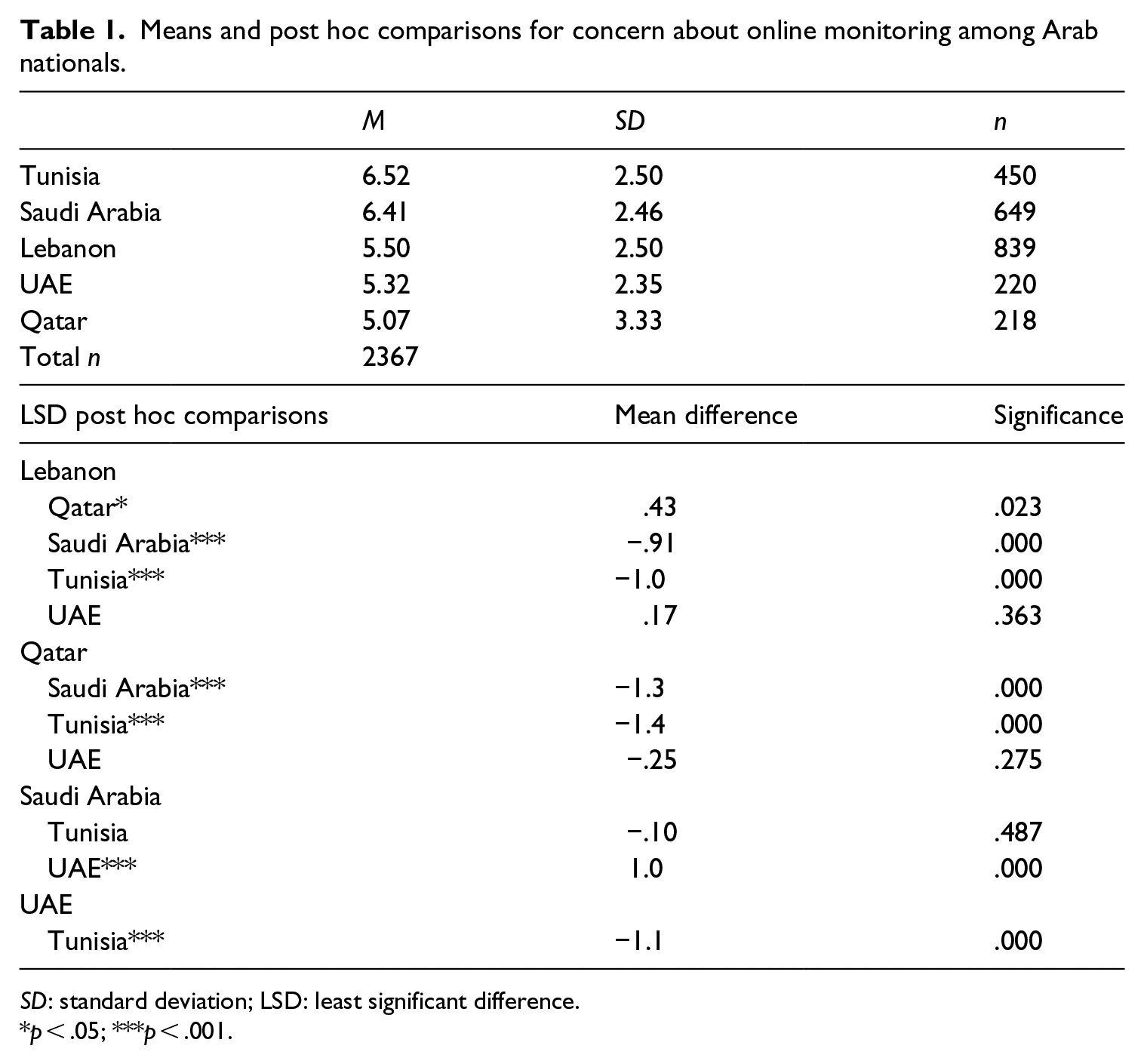
SD: standard deviation; LSD: least significant difference.
p < .05; ***p < .001.
Research question 2 asked whether respondents in the five countries harbor greater concern specifically for surveillance by governments or by companies, and whether there are differences in Concern among nationals versus non-nationals. Table 2 reports percent agreement for the two variables in the Concern index by country, and for both nationals and non-nationals. Paired-samples t-tests found that Arab nationals were more concerned about online surveillance by companies than by governments, in all countries except Qatar. Non-nationals, however, in two of the three Arab Gulf countries in the study (Saudi Arabia and the UAE) with expatriate populations large enough to allow such comparisons, reported the opposite: greater concern for online monitoring by governments than by countries.
Concerns about online monitoring by governments and companies.
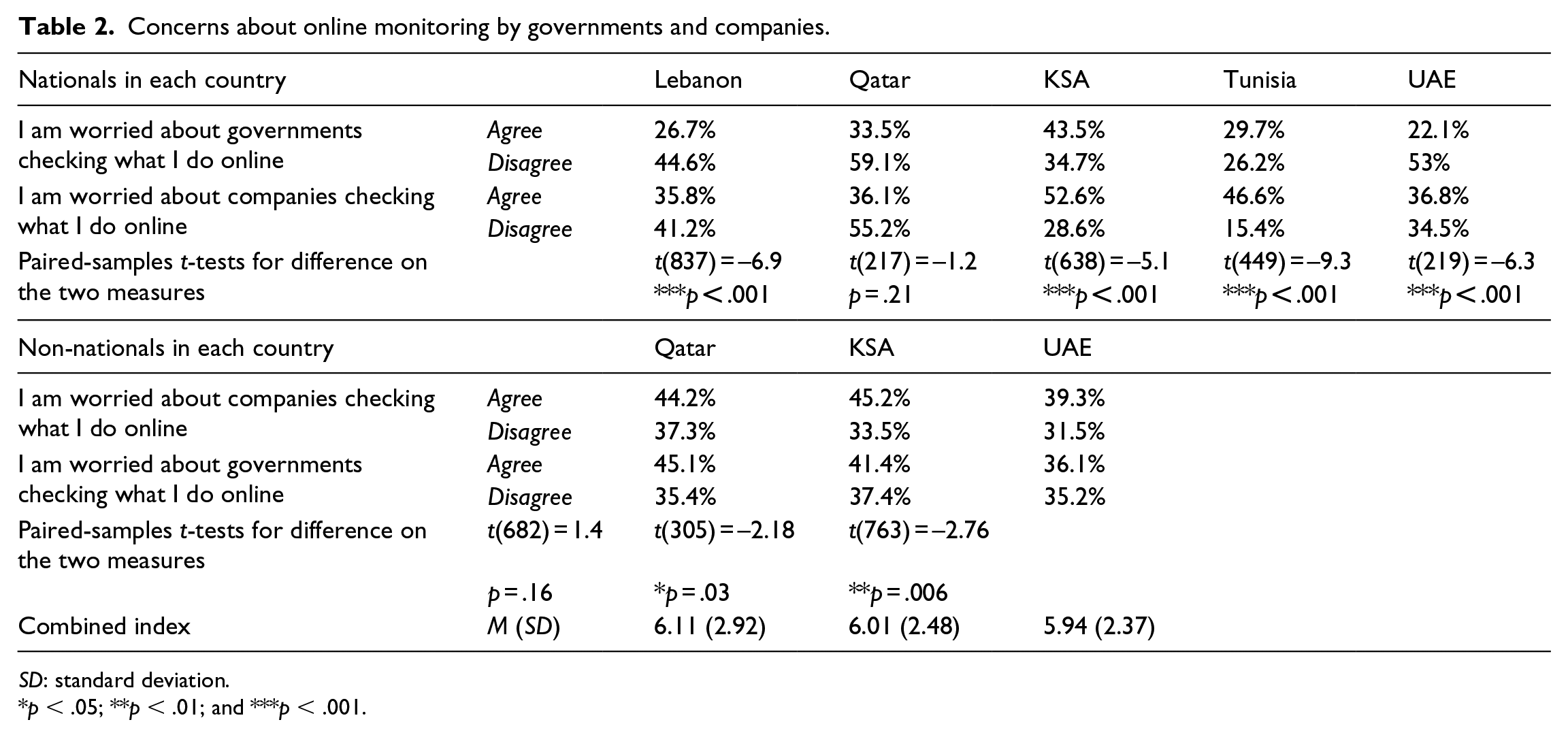
SD: standard deviation.
p < .05; **p < .01; and ***p < .001.
Research question 3 asked whether variables associated with economic and cultural vulnerability in Arab countries are predictive of concerns about Internet surveillance. Standardized betas with significance thresholds of p < .05*, p ⩽ .01**, and p < .001***, respectively, are asterisked in Table 3. The multiple regression models explained modest amounts of variance in Concern in Tunisia (6%), Lebanon (3%), Saudi Arabia (11%), and the UAE (9%). The model explained virtually none of the variance in Qatar (1%). The answer to research question 1, then, is largely no; only a smattering of relationships that follow several common beliefs about the Arab region were associated with concerns about Internet surveillance.
Correlates of concern about online surveillance (standardized betas).
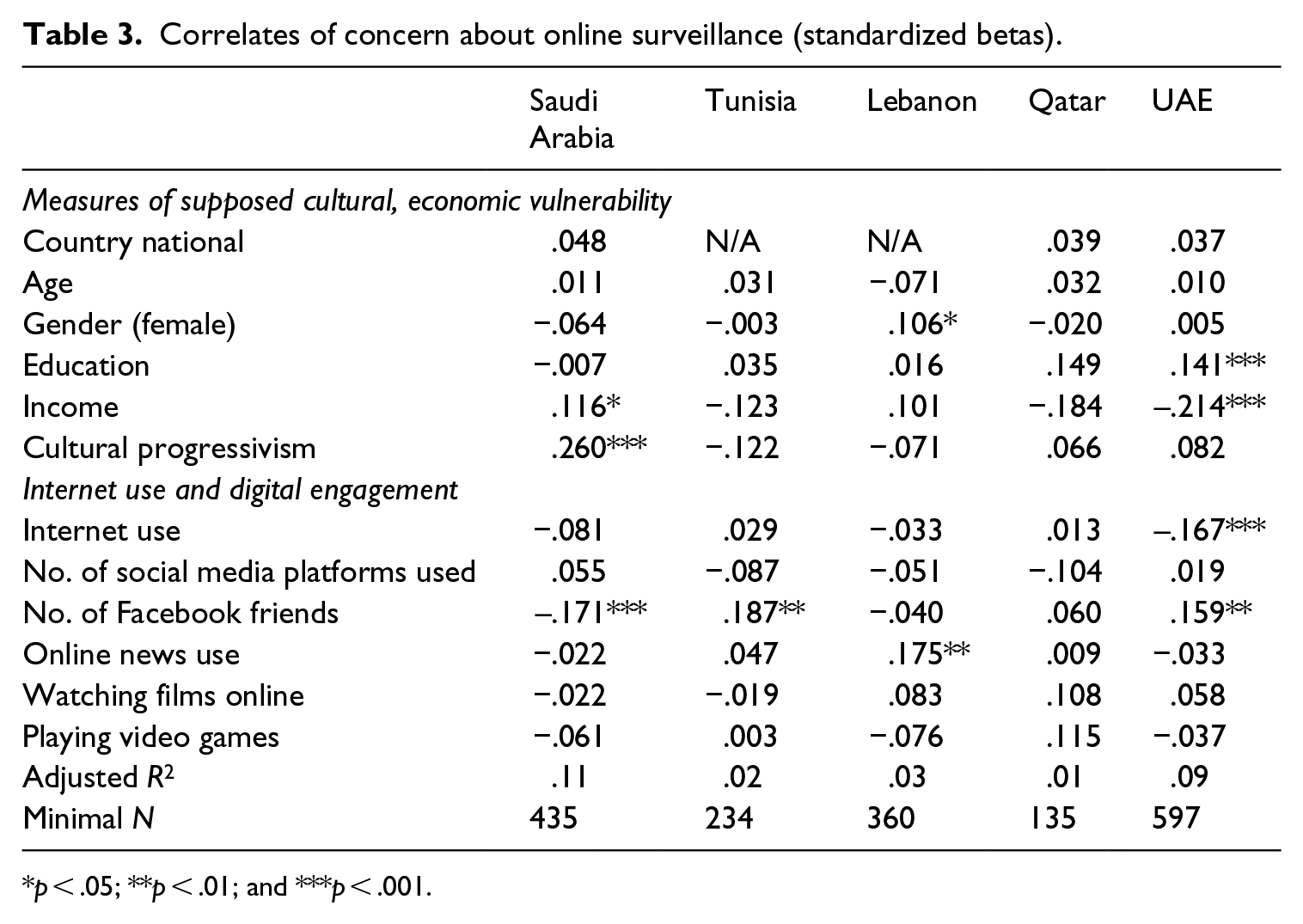
p < .05; **p < .01; and ***p < .001.
Gender (being female) was not predictive of greater Concern in any country except Lebanon. Expatriates in none of the countries reported significantly higher overall Concern, neither did young people, or those with lower education (more educated people in the UAE expressed greater Concern). Identifying as conservative or liberal/progressive did not correlate with the dependent variable except in Saudi Arabia, where progressives tended to express greater Concern. In sum, indicators of potential vulnerability had no systematic explanatory significance vis-à-vis concerns about Internet surveillance.
Hypothesis 1 said that extensive Internet use and digital engagement would be positive predictors of concern about Internet surveillance in the five Arab countries. This hypothesis was not supported; there were either no correlations or weak and contradicting ones. Moreover, Internet use in general was a negative correlate of Concern in the UAE and was not correlated with the dependent variable in the other four countries. While respondents’ number of Facebook friends was a positive predictor of Concern in Tunisia and the UAE (though a negative predictor in Saudi Arabia), none of the other digital engagement variables were significantly associated with Concern in more than one of the Arab countries under study.
Discussion
This study found that supposed measures of cultural and economic vulnerability—such as being female, poor, uneducated, expatriate, and so on—were not consistent, significant predictors of concern about Internet surveillance in five Arab countries. In addition, the hypothesis, based on a corpus of existing literature, that Internet use and digital engagement generally would positively correlate with concerns about online surveillance in these five countries was likewise not supported. In three countries, a specific form of online engagement does seem to be related to more concern about privacy; number of Facebook friends was predictive of concerns about privacy in three of the five countries, but the correlation was not in the same direction across countries; a larger network of Facebook friends correlated with greater Concern in Tunisia and the UAE, having fewer friends in Saudi Arabia was predictive of greater Concern.
Concerns about Internet privacy in the five Arab countries studied here do not align with common perceptions about differences in media freedom between these countries; for example, in Tunisia, considered one of the most progressive Arab countries (see again Freedom House, 2017), citizens reported the greatest concern about online surveillance, while Qataris, citizens of a country considered more politically and culturally conservative, registered the lowest concern. Lebanon, often considered the most liberal Arab country, fell in the middle of the five nations in terms of privacy concerns.
As mentioned earlier in the literature review, Tunisians were among the most intensely surveilled people in the world before the overthrow in 2010 of their country’s decades-old regime, and Tunisians’ elevated privacy concerns found here may be a reflection of the fear generated by that gone but not forgotten dictatorship. Also in Tunisia, respondents with larger Facebook friend networks were more worried about online privacy. Tunisia has one of the world’s highest Facebook penetration rates among Internet users (Dennis et al., 2013), and the rate was also high at the time of the Tunisian revolution. Some Tunisian Internet users may recall persecution of Facebook users by the erstwhile Ben Ali regime.
The regression models in this study predict a modest amount of the variance in Concern in Saudi Arabia and the UAE, and even less variance in the remaining three countries. So, the major result of this study is that variables that quite plausibly should predict concern about Internet surveillance seem to matter little in these five Arab countries. This study employed literature on the attribute substitution heuristic, which explains how people often make misjudgments when faced with difficult, broad questions about uncertainties.
Research on this heuristic can help explain how availability biases may contribute to inaccurate judgments about large groups of people. In the context of this study, some common Western perceptions about the Arab region—that women are oppressed, bloggers are politically motivated, governments are draconian, and so on—are at least partly based on salient representations of Arab citizens in news reports and popular culture. This study adds to literature showing that many common, readily available tropes about the Arab region and its media do not hold up under when tested with nationally representative survey data from multiple Arab countries.
Arab nationals were more worried about companies surveilling them online than about governments doing so, while expatriates—in two of the three countries with large expat populations—reported the opposite: expats were more worried about governments monitoring their online activity. Some news consumers and other observers in Europe and North America often perceive citizens of Arab countries as oppressed by their governments, but those citizens themselves do not necessarily feel that way, at least vis-à-vis online government surveillance.
Limitations and subsequent research
We do not make broad generalizations about concern for Internet surveillance in the Arab region in general or the Middle East, and for good reason. The five countries in this study, while they represent a robust sample of Arab nations for a single comparative study, may not be representative of the entire region. There are more than a dozen Arab nations not included in our study, and the largest Arab country by far, Egypt, while surveyed in the omnibus project from which data in this exploratory study are drawn, did not permit the fielding of the surveillance questions, and so we do not know about media use predictors of surveillance concerns in that Arab country important in so many political and economic matters in the region. Nonetheless, this study represents an advance in our understanding of digital privacy concerns in Arab countries, as well as correlates of such apprehensions.
Footnotes
Appendix
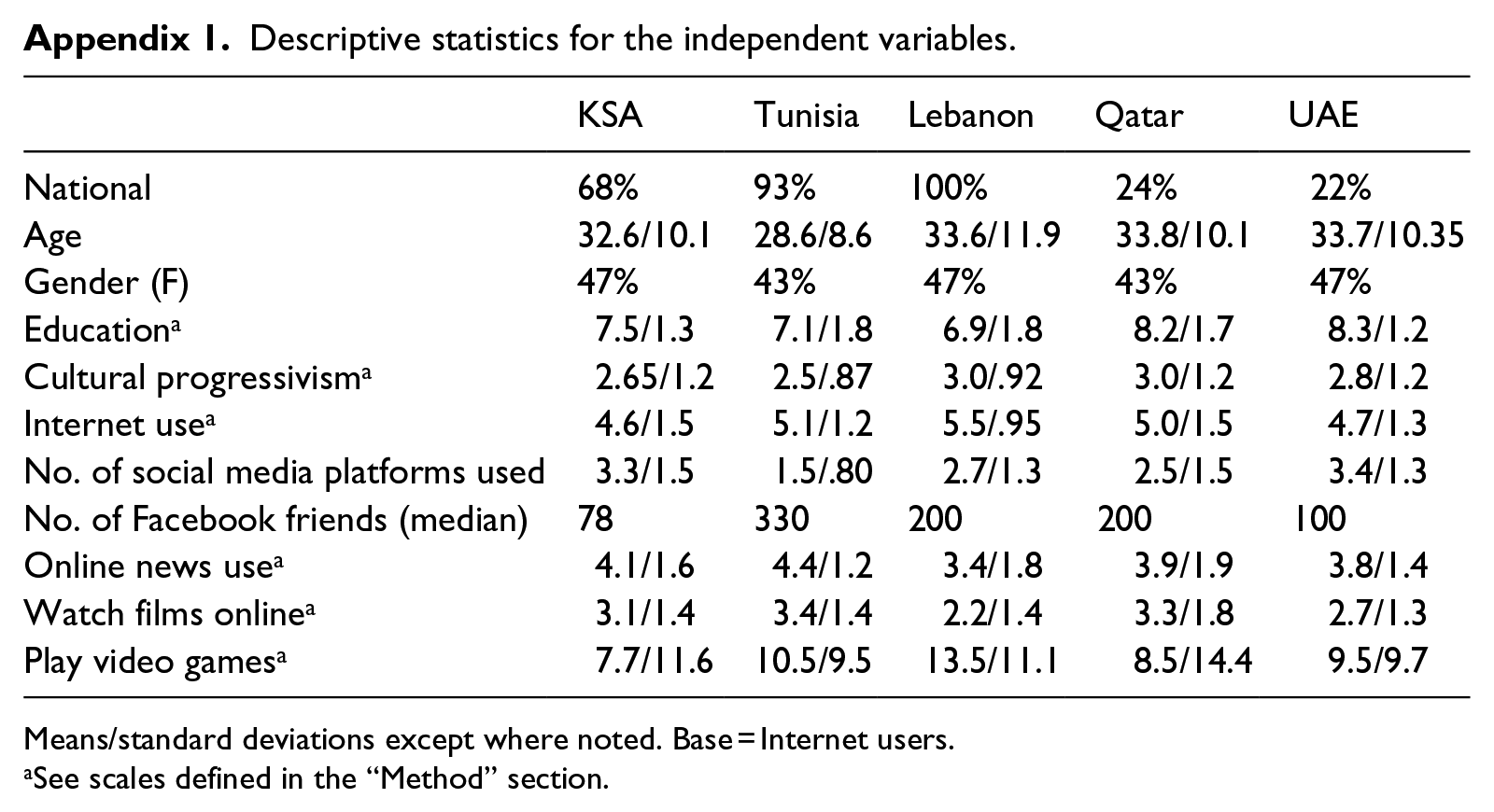
Descriptive statistics for the independent variables.
| KSA | Tunisia | Lebanon | Qatar | UAE | |
|---|---|---|---|---|---|
| National | 68% | 93% | 100% | 24% | 22% |
| Age | 32.6/10.1 | 28.6/8.6 | 33.6/11.9 | 33.8/10.1 | 33.7/10.35 |
| Gender (F) | 47% | 43% | 47% | 43% | 47% |
| Education a | 7.5/1.3 | 7.1/1.8 | 6.9/1.8 | 8.2/1.7 | 8.3/1.2 |
| Cultural progressivism a | 2.65/1.2 | 2.5/.87 | 3.0/.92 | 3.0/1.2 | 2.8/1.2 |
| Internet use a | 4.6/1.5 | 5.1/1.2 | 5.5/.95 | 5.0/1.5 | 4.7/1.3 |
| No. of social media platforms used | 3.3/1.5 | 1.5/.80 | 2.7/1.3 | 2.5/1.5 | 3.4/1.3 |
| No. of Facebook friends (median) | 78 | 330 | 200 | 200 | 100 |
| Online news use a | 4.1/1.6 | 4.4/1.2 | 3.4/1.8 | 3.9/1.9 | 3.8/1.4 |
| Watch films online a | 3.1/1.4 | 3.4/1.4 | 2.2/1.4 | 3.3/1.8 | 2.7/1.3 |
| Play video games a | 7.7/11.6 | 10.5/9.5 | 13.5/11.1 | 8.5/14.4 | 9.5/9.7 |
Means/standard deviations except where noted. Base = Internet users.
See scales defined in the “Method” section.
Funding
The author(s) received no financial support for the research, authorship, and/or publication of this article.