




Abstract
In this article, we argue that social media platforms like Tumblr and Twitter have facilitated an emergence of “digitized narratives” of sexual violence. These narratives are rooted in historical ways in which feminists have discursively articulated sexual violence, yet are shaped by distinctive “platform vernacular” or the conventions, affordances, and restrictions of the platforms in which they appear. Drawing on a qualitative content and critical discourse analysis of 450 texts from the Tumblr site Who Needs Feminism? and the hashtag #BeenRapedNeverReported, we argue that digital platforms such as Tumblr and Twitter produce new vernacular practices which shape how “digitized narratives” of sexual violence are not only disclosed and known, but felt and experienced across digital networks.
Keywords
Introduction
In 2012, 16 students enrolled in the “Women in the Public Sphere” course at Duke University designed a class assignment titled Who Needs Feminism? which sought to problematize the negative associations with the word “feminism.” Using the popular social networking site Tumblr, they encouraged fellow students to post photos of themselves with signs explaining why feminism continues to be relevant in contemporary society, challenging dominant postfeminist sensibilities found within media cultures suggesting feminism is outdated and no longer needed (Gill, 2007; McRobbie, 2009). Since the campaign began, there have been over 5000 submissions to the Tumblr site, and over 60 other educational institutions have launched their own Who Needs Feminism? campaigns and separate websites (Seidman, 2013), demonstrating a widespread desire to problematize narratives that feminism is redundant or passé.
Two years later in 2014, the #BeenRapedNeverReported hashtag began to trend on Twitter after allegations broke within the Canadian news media of sexual violence by prominent radio host Jian Ghomeshi (see also Keller et al., 2018; Mendes et al., 2019). The hashtag, started by two female Canadian journalists, was a public response to those who suggested Ghomeshi’s accusers were lying because they had not previously reported their assaults to the police and served to document the myriad of reasons why victims do not report sexual violence. Many women (and some men) used the hashtag to share their own reasons for not reporting their assaults, creating an archive of 8 million tweets that document the prevalence of sexual violence.
Who Needs Feminism? and #BeenRapedNeverReported are just two examples of the ways the public increasingly use technology in creative ways to make visible, challenge, and call out sexual violence. Drawing from a qualitative content analysis and critical discourse analysis (CDA) of 450 texts, we argue that social media platforms like Tumblr and Twitter have facilitated an emergence of “digitized narratives” of sexual violence. These narratives draw on the ways in which feminists have discursively articulated sexual violence, extending them into digital spaces that are governed by distinctive “platform vernaculars” (Gibbs et al., 2015), or the conventions, affordances, and restrictions of the platforms in which they appear. This article then addresses two primary research questions: how are digitized narratives of sexual violence articulated on Tumblr and Twitter? and What types of affects are produced through these digital disclosures?
Platform vernaculars and sexual scripts
For several decades, feminist scholars have been interested in the narrative accounts of sexual violence in court cases, media, autobiographical accounts, and interviews (see Doherty and Anderson, 1998; Gunnarsson, 2018; Karlsson, 2019; Loney-Howes, 2018; O’Neil, 2018; Spry, 1995; Wood and Rennie, 1994). According to Young and McGuire (2003), the way people discuss sexually violent experiences is important because it shapes how they make sense of their assault. As a result, scholars have attended to the use of language and narrative accounts of violence, paying attention to the ways many victims have been unable to speak about their experiences, or had them invalidated during disclosures (Kelly and Radford, 1990). While this work provides important insights into how victims construct experiences of sexual violence and therefore shape what we know about it, the emergence of digital technologies opens new ways of communicating, disclosing, and narrating previously invisible experiences, emotions, and affects.
As part of the increased visibility of feminist activism in recent years, there has come a renewed focus on combatting sexual violence. In particular, digital campaigns have emerged to not only challenge sexual violence, but give victims a voice and provide them alternative forms of justice (see Drueke and Zobl, 2016; Fileborn, 2017; Loney-Howes, 2018; Olson, 2016; Powell, 2015; Salter, 2013; Wånggren, 2016; Wood et al., 2018). Many of these initiatives rely on sharing personal testimonials of violence, and scholars have begun to study the ways disclosures of violence are shared in digital spaces using digital devices and apps (see Bivens and Hasinoff, 2018; Dodge, 2016; Fileborn, 2019; Loney-Howes, 2015, 2018; Mendes et al., 2019; O’Neil, 2018). Bianca Fileborn (2019) argues that disclosure of sexual violence must be understood as a “curated” process in which careful decisions are made about whom to disclose, which experiences to share, and how narratives should be shaped. Others have identified how digitally curated disclosures hold the capacity to challenge victim-blaming narratives and female responsibilization of violence, making way for new narratives to emerge (Loney-Howes, 2018; Salter, 2013).
Although scholars are increasingly attending to narratives of sexual violence in digital spaces, few have theorized the particular narrative forms that circulate online, nor the technological, cultural, and material factors shaping them. This article aims to address this gap in research by considering how the “platform vernacular” (Gibbs et al., 2015) of Tumblr and Twitter shape the ways in which sexual violence is discursively produced. Platform vernacular refers to the ways each social media platform develops its own “unique combination of styles, grammars, and logics” (Gibbs et al., 2015: 257), and for the purposes of our study, how narratives of sexual violence are told. Stylistic and visual elements also contribute to a platform’s vernacular and are especially important given the visual orientation of platforms like Tumblr and Instagram. Thus, platform vernacular emerges from within social networks, where meaning and affective value are constituted and established through both use and context (Warfield, 2016: 3). This concept or the variant of “digital vernacular” has been used by a range of scholars studying digital social practices (see Cho, 2015; Kanai, 2016; Mendes et al., 2019; Warfield, 2016). We find it a useful way to consider how “group communication and grammar emerges on social media platforms” to highlight the ways in which digital platforms are simultaneously governed by social norms, conventions, and practices in addition to technological constraints (Warfield, 2016: 3).
We are particularly interested in how platform vernaculars shape the affective experiences of engaging with sexual violence disclosures on Tumblr and Twitter. In other words, how do vernacular practices not only shape what we know about sexual violence but also how we come to know and feel these experiences? Our theoretical framework is informed by theories of “networked affect” (Hillis et al., 2015) which explore how the digital remediates and extends bodily capacities via connectivity, virality, and spread (boyd, 2010; Jenkins et al., 2012), and particularly how social media platforms enable new forms of affective relationality (Clough, 2018; Kuntsman, 2012; Mendes et al., 2019; Papacharissi, 2015; Sampson et al., 2018 Wood et al., 2018). We consider how discourses (of sexual violence) emerge and are experienced affectively, considering their “affective intensities” (Ringrose and Renold, 2014) and variable ‘stickiness’—in other words how they grab, attract, gain traction or not (Ahmed, 2004). We explore these affective aspects of digital connectivity as integral to understanding sexual violence in this contemporary moment.
In this article, we specifically consider how new sexual scripts or discourses (Simon and Gagnon, 1986) are emerging and developing in online spaces, creating new affective platform vernaculars (Mendes et al., 2019). Our article catalogs both digitized “scripts of coercion” (Bletzer and Koss, 2004) or the “ways that a woman recognizes (either at the time that it happens or thereafter) that she has experienced an assault that may constitute rape” (Bletzer and Koss, 2004: 115), as well as “scripts of consent” in which women “negotiate and set boundaries within sexual relations” (Bletzer and Koss, 2004: 115). As scholars have identified when it comes to narratives of sexual violence, scripts of coercion are shaped by many factors, such as cultural differences between women, time, and place (Bletzer and Koss, 2004; Ramos Lira et al., 1999). Adding to these arguments, we contend that scripts of coercion are “curated” (Fileborn, 2019) differently across digital platforms, shaped not only by the cultural, social, and personal (Simon and Gagnon, 1986) but also by affordances inherent in the platform architecture and the vernacular practices which develop in these online spaces.
The concepts of platform vernacular and scripts of coercion are useful because they attend to how architectural and social affordances produce different articulations of the experience of sexual violence. In this sense, we come to know sexual violence differently depending on the platform through which a narrative is mediated. The idea of platform vernacular also negates a technological deterministic argument by highlighting how social practices determine particular uses for platforms, within the limits of platform affordances.
For this article, we focus on two platforms: Twitter and Tumblr. Twitter is a popular social networking and microblogging site, which at the time of our study, allowed users to post 140-character updates or “tweets” to a network. With Twitter, there are also various ways to post messages, depending on the desired outcome. Users can attempt to draw attention to certain topics/events but prefacing them with a thematic hashtag (e.g. #BeenRapedNeverReported). These hashtags are searchable via the Twitter website and are said to “trend” when widely used, drawing more attention to the topic. One common vernacular on Twitter is to share hyperlinked content to other sites (boyd et al., 2010). In their analysis of over 720,000 tweets, boyd et al. (2010) found that 22% contained a URL. This indicates that Twitter is not only used to provide brief “news” updates, but direct people to external sites which they can click through to get further information. This is often necessary given the character limit of the platform, which was only recently increased from 140 to 280 characters. Finally, it is worth highlighting how Twitter has become a central part of contemporary news media culture, often used by journalists to “break news” provide updates on rapidly evolving stories and interact with audiences, which can be done quickly on the platform. This is important in understanding Twitter as a digital tool that often hosts key conversations about current events, a point we will return to later in the article.
Who Needs Feminism? is hosted on the Tumblr platform and provides information for users such as how the campaign started, a link to submit a story and information for the public to start their own campaign. Tumblr is a microblogging site which “curates” diverse content produced by others ranging from pornography, fashion, blog entries, art, selfies poems, and protest. Tumblr prioritizes visual images which are aggregated among each Tumblr blog and circulate throughout the network via a process of re-blogging (Cho, 2015; Fink and Miller, 2014). As Alexander Cho (2015) has argued, Tumblr operates through affect, which “reverb” throughout the network, accruing intensity and movement through re-blogs and likes – an integral part of the Tumblr experience. Submissions to this site are presented in reverse chronological order, and each submission displays the number of “notes” which record the submission’s circulation on the site, including the number of times it was commented upon, re-blogged, or “liked” (Fink and Miller, 2014; Renninger, 2015).
A typical Who Needs Feminism? submission has several hundred to several thousand notes, indicating the extent to which submissions forge “sticky” and emotional entanglements between contributors and readers (Ahmed, 2004), who share, like and re-blog content. Unlike other social media platforms such as Facebook, Tumblr blogs contain no personal profiles and are often anonymously authored. This is a key platform affordance in that the possibility of anonymity invites engagements, particularly when disclosing sensitive, private, or traumatic experiences. Consequently, Tumblr has become a particularly popular platform with marginalized groups, including people of color, queer communities, and those looking for digital spaces where they are “safe” to explore identities and ideas that may be unwelcome elsewhere (Cho, 2015; Fink and Miller, 2014; Renninger, 2015; Thelandersson, 2014; Warfield, 2016).
This article draws upon a systematic random sample of 150 posts from the Who Needs Feminism? Tumblr between March 2014 and January 2015. 1 Due to the sensitive nature of the topic and the importance of anonymity of contributors, we sought University ethics approval before beginning this project. Drawing from other studies of online disclosure of sexual violence, we have removed identifying information to preserve contributors’ anonymity (see Andalibi et al., 2016; O’Neil, 2018). 2 To study the #BeenRapedNeverReported hashtag using a Python script, we scraped all tweets published between November 2014 and March 2015, the time in which the hashtag was most active. An algorithm was then developed to randomly select 300 tweets for further analysis.
Altogether, our sample for this article is a total of 450 pieces of digital data that were analyzed using qualitative content and CDA. Qualitative content analysis is useful for its ability to analyze large amounts of data, presenting it as simple frequencies (Bhattacherjee, 2012; Schreier, 2012). In addition to tabulating manifest content such as author, gender, or use of hashtags, qualitative content analysis records symbolic and latent content such as themes, frames, discourses, and tone (see Bhattacherjee, 2012). Despite its benefits, qualitative content analysis is incapable of analyzing systems of representations in text or speech (Deacon et al., 1999), which is why we use it in combination with CDA.
Following the tradition of CDA as developed by Norman Fairclough (1995), Teun van Dijk (1993), and Michelle Lazar (2005), which examine the relationship between language, social practice, ideology, gender, and power, we are interested in what experiences are (not) being recounted in each text, which details are (not) provided, and what impact the presence or absence of these disclosures have on the overall narrative accounts of assault. Unlike some work on networked affect (see Papacharissi, 2015), we are not taking a big data approach, but instead have drawn a relatively small sample size to enable a deeper qualitative analysis of texts. As a result, while we are hesitant to make generalized claims from our sample, it nonetheless provides us with some understanding of emerging trends and practices in relation to the ways narratives of sexual violence materialize and gain affective traction across digital spaces.
Who needs feminism? visuality, anonymity, and stylized affect
In this section, we address the ways in which disclosure of sexual violence is mediated through the vernacular practices common on the Tumblr campaign Who Needs Feminism? Given that the campaign is ostensibly about a much wider set of themes than sexual violence, we were surprised to see that in the random sample of 150 submissions from March 2014 to January 2015, a dominant subject was sexual violence, abuse, and harassment (41%). Thus, the campaign serves as a useful case study for our inquiry. In our analysis, we focus on the use of the handmade sign as a strategy that mobilizes the platform vernacular and affordances of Tumblr to orient particular affective reactions and ultimately, a sense of collective protest against sexual violence.
What is distinctive about the Who Needs Feminism? campaign is the creation of the handmade sign that is photographed and then uploaded to Tumblr. The signs function as the medium through which the personal testimonial is shared—often in handwritten or printed form. The use of signs is a pertinent example of the ways digitized narratives of sexual violence differ from conventional offline narratives found in interviews, court cases, or autobiographical accounts. The repetitive use of the handmade sign allows us to read the campaign as a meme, whereby a set of common expectations are established (Shifman, 2014). As part of Tumblr’s visual meme culture, one of the main conventions defining this campaign is the use of what Amy Shield Dobson (2015) calls “pain memes” through which contributors’ experiences of sexual violence are narrated through the visceral means of the hand-crafted sign, which makes use of different colors, size of print, bold, italics, and the underlining of key words. Following a long tradition of feminist craftivism (see Bain, 2016; Clarke, 2016; Kelly, 2014), Who Needs Feminism? pain memes demonstrate the artful potential of these modalities. The signs are material objects which have been digitally captured and transmitted to convey specific messages in particular ways (Rentschler and Thrift, 2015). We explore how the material and stylistic aspects of the signs, the texture, color, and embellishments create new forms of vernacular signage practices, initiating new forms of communicating experiences of sexual violence. We are therefore looking at the discursive, the material, and the affective in these practices of digital posting (Mendes et al., 2019).
Stylized affect through recounting the second-assault
A dominant narrative practice which emerged on Who Needs Feminism? is not just the recounting of the incident itself, but the significant critique of victim blaming, or not being taken seriously when confiding in, or reporting the assault to others. This “second-assault” is a well-known phenomenon which has been a central part of feminist theorizing on sexual violence (Wolburt Burgess et al., 2009), whereby the post-assault experience can be just as traumatic as the assault itself. This is because victims are routinely subjected to questioning about their appearance, behavior, lifestyle, or sexual past, as a way of transferring blame to them (Benedict, 1992; Bonnes, 2013; Herman, 2005; Meyer, 2010; Worthington, 2008). For example, as one contributor in Figure 1 stated, “I need feminism because my sister was raped and no one took her seriously.”
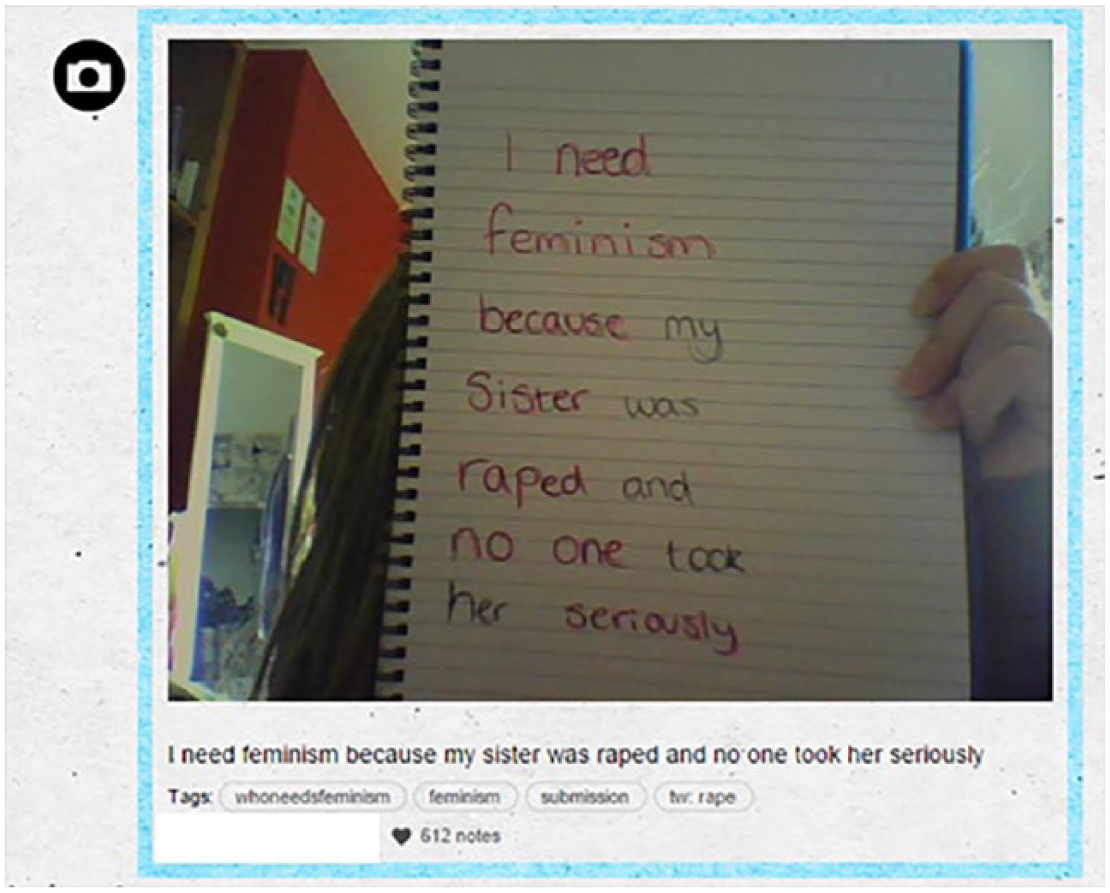
Who needs feminism? submission. Author screenshot.
Stylistically, this image is typical within the sample and is striking in its use of a common ring-bound note pad, which we may associate with school-aged youth who would likely use this type of stationary in class. This is further accentuated by the careful re-tracing of words using red-colored felt tip pens to emphasize and accentuate key words. In terms of the narrative, although it is not clear to whom the sister reported her rape, the key lesson here was the way she was disbelieved, and thus discouraged from taking her claim forward. Although the sign in Figure 1 does not indicate the extent to which the sister was slut-shamed or victim-blamed, this was a common narrative in many other submissions, such as with Figure 2, where a young man shares his girlfriend’s experience or reporting an attempted rape to the police.
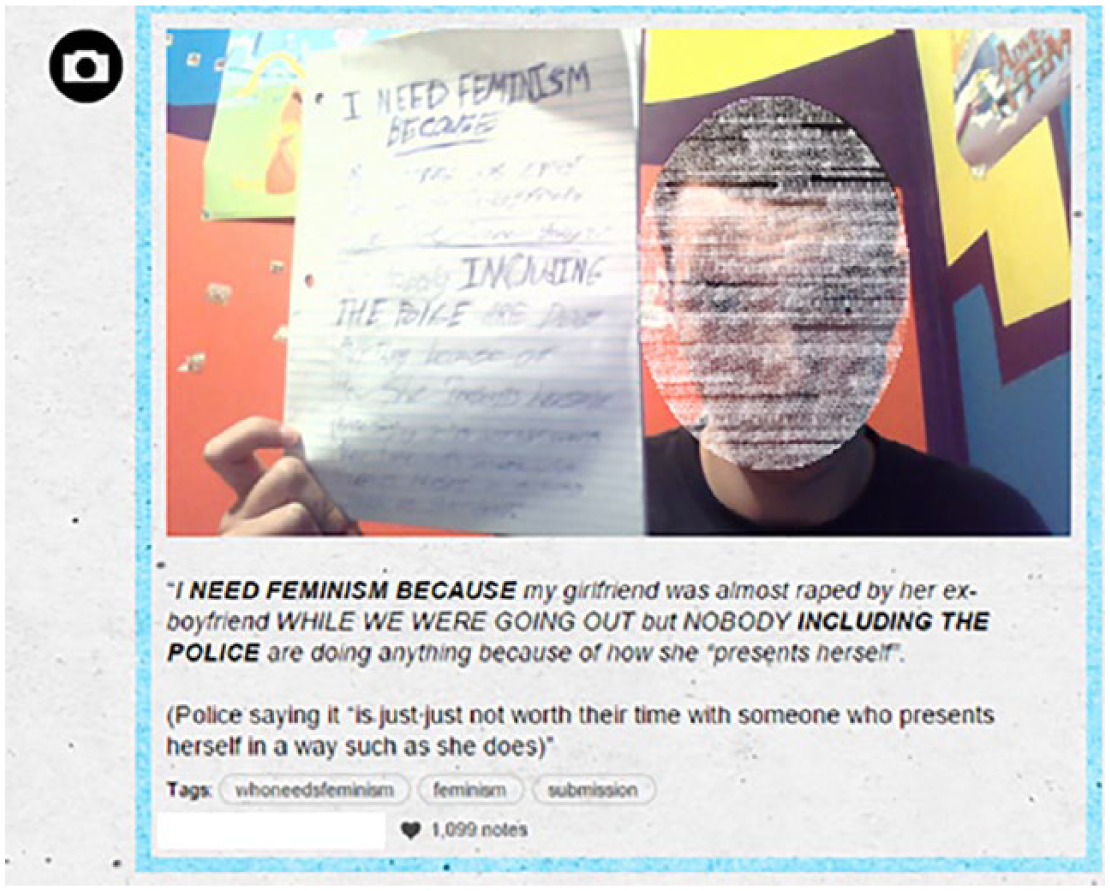
Who needs feminism? submission. Author screenshot.
This entry is unique because it is one of the few in which we can see the contributor’s full face. Although this was a vernacular practice in early submissions to the project, over time, contributors began to either “hide” behind their sign (45% of total) or photograph only the sign itself (41% of total). A full view of the contributor’s face was visible in only 20 submissions within our sample (14% of total), perhaps in response to the backlash and online abuse experienced by many contributors to this project (Mendes et al., 2019), but also as a means of providing a sense of anonymity as contributors shared highly personal and traumatic experiences.
Although we have blurred his face to protect his anonymity, the young man in Figure 2 sports a look of concern and seriousness in the photo. The fact the sign appears to have been ripped out of the notebook, and hastily written, with a mixture of capitalized letters adds to the material implications that his message is both urgent and alarming. The difficulty in reading the handwriting makes the accompanying typed out text below additionally important, as it ensures readers do not miss the message due to messy handwriting or poor photographic quality. The narrative presented here is important for directly challenging the police’s victim-blaming and slut-shaming of his girlfriend who disbelieved her story because of how “she presents herself.”
Because of hegemonic ideologies enforced by neoliberal frameworks, which condition women to take responsibility for guarding themselves against assault and accepting responsibility if assaulted (see Campbell, 2005; Loney-Howes, 2018; Moore, 2011; Stringer, 2014; Vera-Gray, 2018), it was not just the police who disbelieved victims, but family members as well. This is evident in Figure 3 which describes how a young woman’s family dismissed her experiences of sexual violence at the hands of her brother. Another notepad is featured here with densely written, hard-to-read prose in pencil. Pencil gives a different impression than pen, as it is erasable, softer, and more tenuous than some of the earlier examples. Age is used repeatedly here to show the time of assault (10), the time of discovery (13), and the ongoing implications of her family’s condoning of sexual violence from her brother. The age, innocence, and thus vulnerability of the participant is highlighted in the text (see also Littleton and Dodd, 2016), along with her anger toward her brother and family over his perceived entitlement to her body.
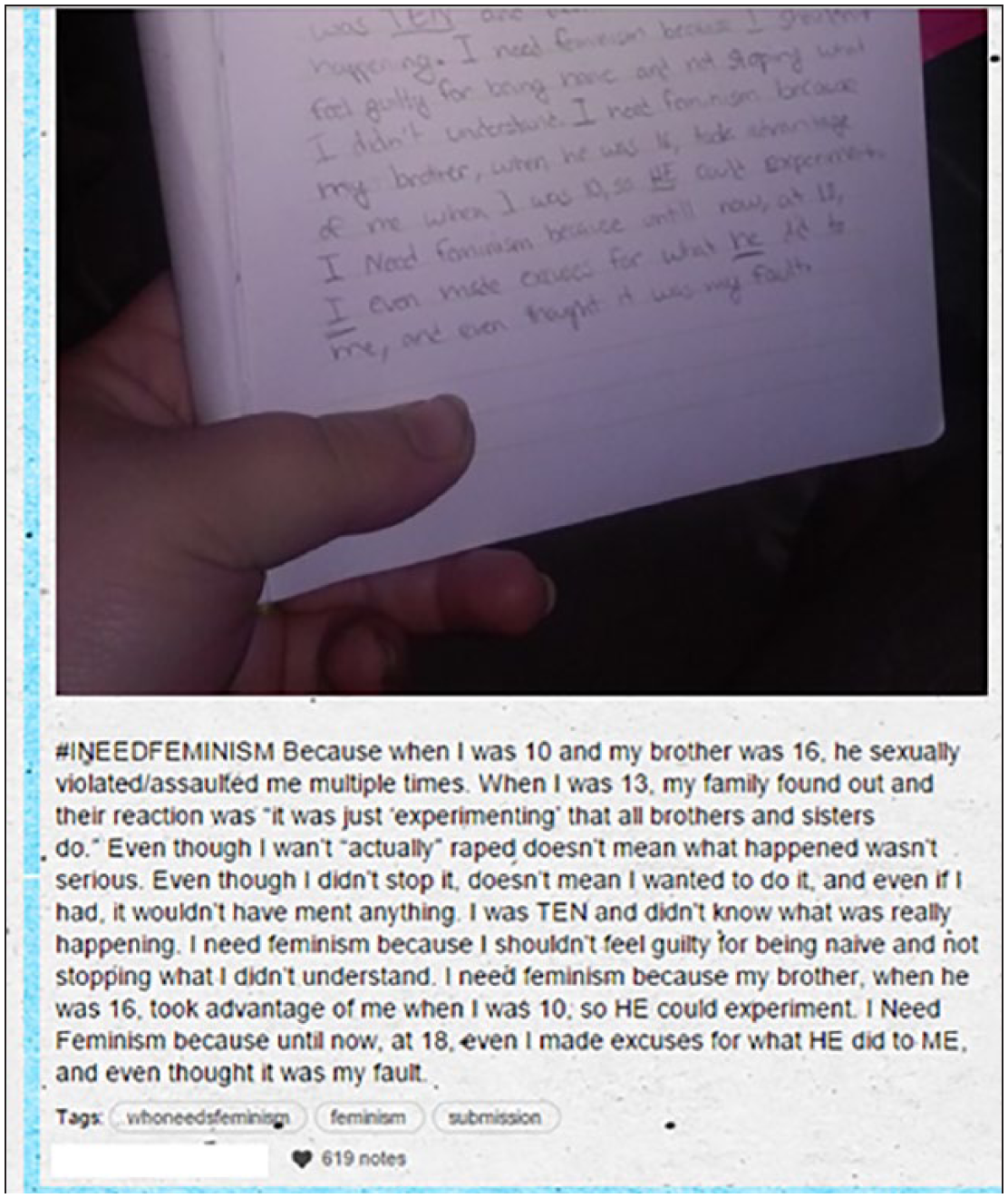
Who needs feminism? submission. Author screenshot.
What Figure 3 has in common with many other submissions is the range of latent and manifest emotions conveyed such as outrage, indignation, guilt, blame, and grief made evident through lexical choices and the stylized nature of the signs. In fact, when looking at the results from the content analysis, the most common latent tone in submissions was one of “anger” (55%), followed next by “resentment” (16%). These emotions were conveyed via the use of capitalized letters (an affective register to shout through print) as seen in Figure 3 but also through the underlining or bolding of words, exclamation marks, and use of vibrant colors to highlight key words. These carefully crafted hand-written signs we argue are not only used to make experiences of sexual assault known, but operate to direct the reader’s attention to particular parts of the narrative as a means of throwing an “affective punch” (Ahmed, 2017) through the screen.
We see this again in Figure 4 where the contributor shares the ways her rape was de-legitimized by her own mother as a “one-night stand,” supporting the rape myth that any assault in which the attack is not committed by a stranger, and where the victim does not put up a valiant fight, is easily categorized as “just sex” or “sex gone a bit wrong” (see Benedict, 1992; Gavey, 2005; Meyer, 2010; Moore, 2011). Written on a flash card typical of many pain memes (see Dobson, 2015), the message takes up the entire space on the article, giving the impression there is perhaps too much to say. Like the use of the felt pens in earlier examples, here we see that key messages such as “DO THE MATH” are both bolded and written in blue, with other critical information written in red and pink. “Do the Math” is both an appeal to a rational discourse of statistics around rape from known assailants, and an affective rhetorical strategy used to guide readers toward an “appropriate response” (Fileborn, 2019)—in this case belief that her story is true, and anger at the invalidation of her experience by her own mother. In this sense, affect takes on a stylized material form that works to not only attract the reader’s attention but bring about particular affective resonance that would not be generated through a typed note, for example.
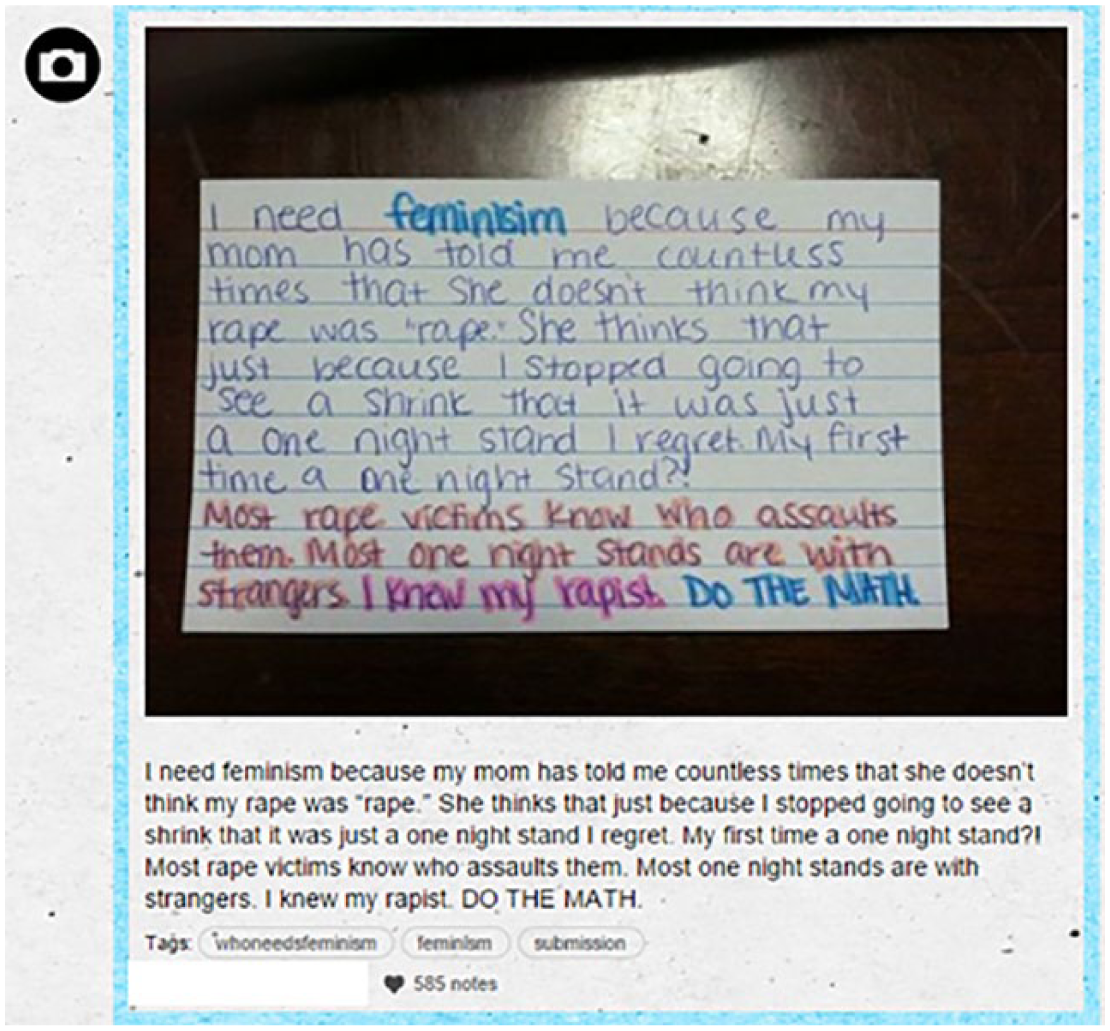
Who needs feminism? submission. Author screenshot.
When considering the vernaculars which develop around the sharing of scripts of coercion on Who Needs Feminism? and those on offline spaces, there are some clear similarities. In both, it is rare to see detailed “incident accounts” (Bletzer and Koss, 2004), of specific sexual acts, labeling the experience as “rape,” or even providing information such as their age at the time of the assault, the location of the assault, or how they attempted to stop it. In fact, a dominant vernacular which developed on this site was not simply the descriptive details of personal experiences of sexual violence, but a common theme to narrate both the residual effects and their attendant affects, specifically a sense of generalized fear of sexual violence in their everyday lives (see also Vera-Gray, 2018). This sense of dread and fear is not only part of the developing vernacular and shared literacy of the site, but is in fact a “performative condition of normative femininity” (Campbell, 2005: 119), where women learn to view themselves as vulnerable, weak, and indefensible. As a result, they are conditioned to engage in safety work—or a range of tools, strategies, actions, and behaviors intended to avoid, mitigate or escape sexual violence (Kelly, 1988; Loney-Howes, 2018; Vera-Gray, 2018).
Researchers further argue that fear of sexual violence is in fact almost universal among women, regardless of their background, ethnicity, or other markers of identity (see Brownmiller, 1975; Cliff, 1984; Stanko, 1987; Valenti, 2007; Vera-Gray, 2018).
3
By drawing narratively upon this common experience/emotion between women, we argue that contributors were able to forge new mediated connections around why feminism is necessary. This was evident, for example, when participants shared their fear of going out alone at night, even for seemingly harmless activities such as taking out the trash, or as seen below, exercising in public alone: I need feminism and equality between genders because my fiancé is free to do his jogging in public without fearing being assaulted. When I want to go running he comes with me so that no one attacks or violates me. I wish he wasn’t afraid for me. I wish I wasn’t afraid of every man that I cross in public.
While of course not all women live in constant fear of sexual violence, the potential of being sexually assaulted indeed causes many women to consider, if not alter routine behaviors and decisions (see also Campbell, 2005; Stanko, 1987; Vera-Gray, 2018). As evidenced above, in addition to fear, the participant demonstrates her longing to live in a different, better, and safer world, evident with the repetition of “I wish.” There is also evidence of resentment at the ways she has come to fear “every man that I cross in public.”
Outrage was also visceral in what was presumably well-meaning advice from others on how to avoid male violence: “I need feminism because I start college in two weeks and have been told to ‘try not to get raped,’ as if being raped would somehow be my fault” (italics original). Such submissions are designed to evoke responses like anger, not just about the prevalence of sexual violence, but about the way that women are constantly being taught to avoid rape, while men’s behavior remains unchallenged (see also Vera-Gray, 2018). The affective tenor created in the submission is one of an “intimate public” (Khoja-Moolji, 2015), where contributors appeal to common aspects like fear, contempt or outrage. As Lawrence and Ringrose (2017) argue, it is the potential harnessing of these affects, to create solidarity through a collective sense of outrage that is being generated and forms specific vernaculars, or ways of documenting and therefore understanding sexual violence on this platform (see also Ringrose and Lawrence, 2018).
It seems then that vernacular practices found in digitized narrative accounts of sexual violence on Who Needs Feminism? create new affective practices, including the creative use of hand-written signs, bolded, italicized, and underlined letters, to communicate the force of feeling; vernacular practices such as “hiding” behind their signs have become common practice which convey fear and shame about reporting sexual violence. As we have shown, these include feelings of being victim-blamed, resentful, angry, sad, and mistrustful of the wider rape culture in which they live. These practices we argue, while holding great potential for opening new ways of generating a shared sense of feminist belonging which may foster wider social and ideological change are simultaneously “problematic and limited” (Fileborn, 2017: 1485; Salter, 2013). This is because the “ability to harness the power of social media … is highly contingent upon the skills and social media skill of the victim/survivor.” In other words, these sites do not tell the stories of those survivors who lack the practical skills and/or knowledge of digital media culture to participate in social media campaigns such as Who Needs Feminism? As such, platform vernaculars ultimately render some stories invisible (e.g. older survivors, those with disabilities, or the poor) while amplifying others through circulatory practices like re-blogging.
While this article has begun the work of documenting many of the dominant “digitized narratives” of sexual violence, more can certainly be done to explore issues of access, power, and privilege in relation to the new practices and conventions that develop within specific platform contexts. This is an issue we keep in mind as we explore the very different vernaculars found on the hashtag #BeenRapedNeverReported, which are shaped we argue by the platform’s unique affordances and architecture.
#BeenRapedNeverReported: hashtagging digitalized rape narratives
As a narrative device for sharing experiences of sexual violence, hashtags we argue, work in three key ways. First, on a practical organizational level, hashtags allow the user to remain within the character limit while thematically link their tweets to others addressing the same topic. Nathan Rambukkana (2015) argues that this linking function threads together related conversations across media platforms, making broad connections possible. In this way, like signs and memes discussed above, hashtags work to create a collective account of the systemic and widespread nature of sexual violence. 4 As we have argued elsewhere (Mendes et al., 2019), participating in hashtags such as #BeenRapedNeverReported can “generate affective relations that are both personally healing, and which can also move participants to engage in initiatives” such as forming sexual assault survivor support groups, or reporting their assault to the police—a form of activism which we recognize is not equally available to all victims, particularly those from communities who have long been stigmatized and persecuted within criminal justice systems (Davis, 2003; Palacios, 2016; Powell, 2015).
Second, the hashtag itself provides a way for victims to speak about their experience without having to directly say they were raped or assaulted. In other words, hashtags work as a stand in or placeholder for those who may find articulating their script of coercion painful or even impossible and constitutes a discursive practice only made possible through the architecture and affordances of platforms that link hashtags. This function cannot be dismissed, as it may be what in fact allows for narratives of assault to be digitally rendered in such high numbers, as we saw with #BeenRapedNeverReported, or more contemporary hashtags such as #MeToo. Third, the linking is not only discursive and semiotic but generates public forms of “mediated” affect, jolts that travel through the connected hashtag creating a stream of stories that join together experiences victims felt unable to report but are being documented en mass through the repeated (re)use of the hashtag. This repetition creates new forms of dialogue, connectivity, and awareness, which although may be temporary and ephemeral are nonetheless real and powerful (see Loney-Howes, 2018; Mendes et al., 2019).
Hashtags as a placeholder
When studying the scripts of coercion on #BeenRapedNeverReported, it is noticeable that words such as “rape,” “assault,” “violated,” and “abused” are conspicuous in their absence. Instead, readers are often left to “read into” the meaning of these experiences based on the use of the hashtag itself. In this sense, the hashtag is an essential part of the digitized narrative, serving as a placeholder for sexual violence and functioning as an important narrative and connective device. For example, as one woman tweeted, “I was five years old the first time. Set me up for years of silence/shame, drug addiction, mental illness. #BeenRapedNeverReported.” Here, the Twitter user’s experience is mediated via her use of the #BeenRapedNeverReported hashtag, which allows the public to interpret what “the first time” means. Likewise, another user tweeted, “I asked him to stop. He did not. #beenrapedneverreported.” The hashtag does the painful work in explaining to the audience that what she asked him to stop doing was raping her. Although these tweets are on the surface unconnected, when read together, they build a powerful picture of the structural and systemic nature of sexual violence via repetition and accumulation of similarities in experience afforded through the hashtag and its sheer volume of usage.
Other tweets contain multiple hashtags, linking #BeenRapedNeverReported to other conversations happening on the social media platform. In our sample, 127 tweets (42%) included at least one other hashtag, of which around 20% were not always directly linked to sexual assault. 5 Results from the content analysis reveal that popular accompanying hashtags include #rape (3% of total), and #VAW (violence against women) (4% of total). For example, one user included the additional hashtag #sexualassault in her tweet: “his wife told me I ruined his life for telling what happened, instead he ruined mine #beenrapedneverreported #sexualassault.” Indeed, the mobilization of the hashtag as a narrative device is a strategy that uses the dominant Twitter vernacular of the hashtag yet subverts it to speak about often “unspeakable” experiences (Penny, 2013, see also Fileborn, 2019; Keller et al., 2018; Loney-Howes, 2018). The script of coercion here relies on the hashtag to make sense of the narrative, a unique example of how digitized narratives of sexual assault have been shaped by technological affordances of platform architecture.
Hyperlinking as narrative extension
Because of Twitter’s platform architecture which has a limited character restriction, it is simply not possible for contributors to provide detailed “incident accounts” (Bletzer and Koss, 2004) within a single tweet or without “threading” multiple tweets together. Instead, it was common for hashtag users to re-direct readers to external links providing a full account of violence experienced, reasons why they didn’t report it, and reflections upon their healing processes (see also Karlsson, 2019; O’Neil, 2018). For example, one woman tweeted a link to a local newspaper feature which detailed her experiences of sexual assault and why she did not report it. Rather than using the tweet to try to summarize her experiences, she instead writes, “My story. Out of the darkness” before including the hyperlink. While tweets need to be short and to the point, this creates new lexicons with qualitatively rich, carefully chosen phrases filled with metaphors, euphemisms, and implicit meanings. For example, by discussing the ways her story is now “out of the darkness,” this woman indicates the extent to which stories of sexual violence have long been hidden, but through the hashtag have been “outed” and “brought into the light.” Using the closeted metaphor so common in challenging injustice for sexual minorities (Halberstam, 2018), this form of “coming out” makes experiences of sexual violence legible. In this way digital platform’s offer the affordance of visibility (boyd, 2010) disrupting normative rape scripts (see also Loney-Howes, 2018).
This example also points to the ways in which hyperlinks were used to extend narratives beyond a singular tweet and even beyond the Twitter platform. As a common vernacular practice on Twitter, hyperlinking to other digital content is pertinent to consider when thinking about how digitized narratives of sexual violence take form. For the case described above, the hyperlink to the mainstream news offered more words to tell her story, while simultaneously connecting it to experiences not featured on major mainstream platforms. Most victims will never have news features written about their assaults so they use connective affordances to link detailed testimonies of similar assaults, statistics on sexual violence, or reports documenting institutional prejudices against women in the police and judicial systems. For example, one Twitter user in Figure 5 repeatedly asks, “Why didn’t she go to the police?” with an accompanying link to a New York Times story about how the New Orleans Police force “routinely ignored sex crimes.” Receiving over 900 re-tweets and 500 “likes,” extending one’s narrative in this way then can also be understood as a form of affect labor (Jarrett, 2015) which women must do to make their story “credible” and to be believed (Loney-Howes, 2018; Powell, 2015; Salter, 2013). As such, this labor highlights how digitized rape narratives remain constrained by historical rape myths that put the onus on the victim to prove they were assaulted (Ullman, 2010) while highlighting the ways victims of sexual violence are chronically disbelieved, particularly those from minority cultures (Alcoff, 2018).
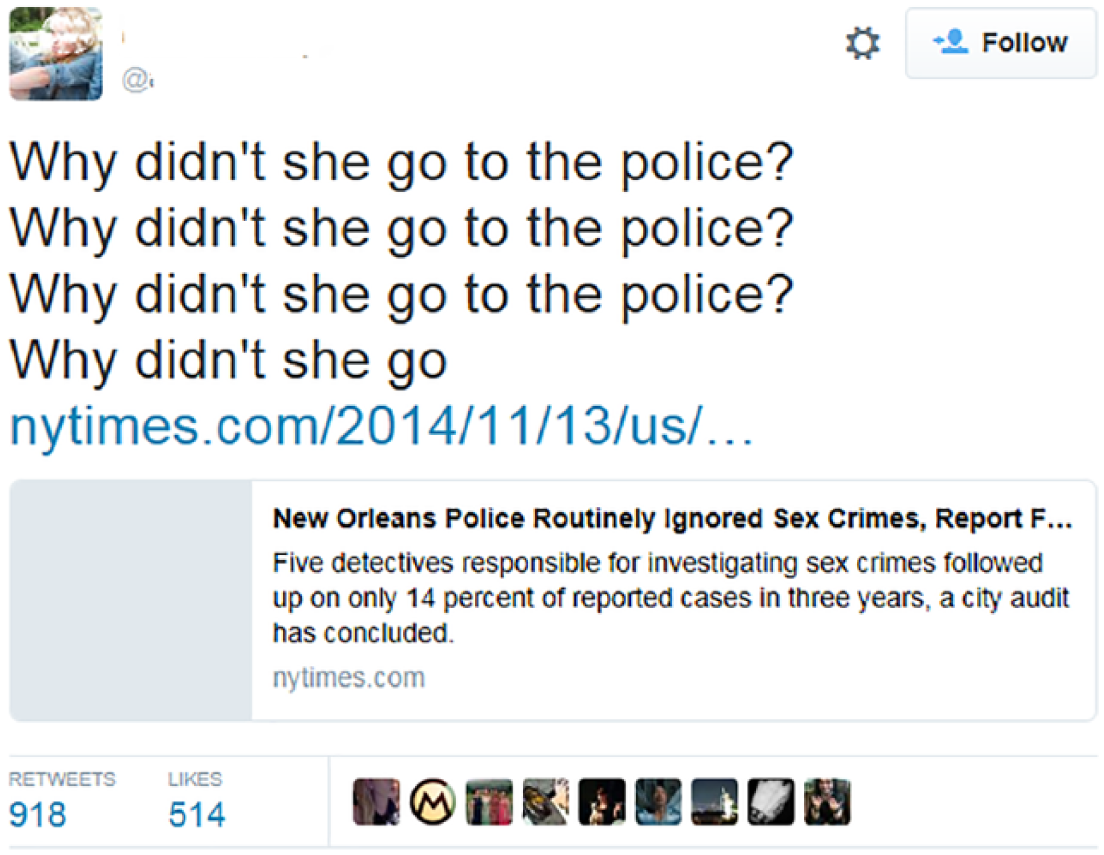
Tweet explaining why people do not report their assault. Author screenshot.
Conclusion
While scholars have long been interested in narrative accounts of rape and sexual violence, we argue that social media platforms such as Twitter and Tumblr offer new terrains for scholarship. By studying digitized narratives of sexual violence across the Tumblr campaign Who Needs Feminism? and the Twitter hashtag #BeenRapedNeverReported, we begin important work documenting unique affective vernacular practices. While some narrative conventions from offline disclosures have traversed to online spaces, this article points to the ways digitized narratives are shaped by the architectures, affordances, and conventions which emerge within and between the digital media platforms Tumblr and Twitter and highlights the ways some of these conventions are simply not possible within non-digitized spaces. These new digitized narratives not only shape what is disclosed and known about sexual violence, but what is felt and experienced, as they generate affective charges, for example, through the visceral creation of hand-crafted signs, or “intimate publics” between those who use hashtags to connect their stories of sexual violence.
Although we argue that Tumblr memes and Twitter hashtags are creating new means through which sexual violence is known and felt, what possibilities does it hold for preventing sexual violence, challenging conventional rape myths or narratives? While it is perhaps too soon to tell what impact the widespread circulation of digitized narratives of sexual violence may have for reducing incidences of violence, when it comes to challenging rape myths and opening new ways of narrating one’s experience, we are cautiously optimistic. Following on from scholars such as Rachel Loney-Howes (2015), we argue that digital platforms and storytelling conventions such as pain memes have “expanded the scope of for challenging the deeply entrenched myths and assumptions about rape through various modes of representation” (2). Although digital platforms can be spaces where victim-survivors feel supported and believed there is no doubt that many continue to receive, if not abusive messages and comments, then those of provocation or disbelief that perpetuate victim-blaming tropes (see also Loney-Howes, 2018). A recent case, where a closed Facebook group for survivors of sexual violence was hacked and the members harassed, remind us that digital spaces remain fraught with gendered violence (see Matsakis, 2018).
Finally, although it is beyond the scope of this article to investigate audience responses to digitized narratives of sexual violence in depth, our discussion of re-blogging, sharing, favoriting, retweeting, and liking showed the context-specific affective charges that were generated through various modes of response. For example, within our #BeenRapedNeverReported sample, the vast majority of tweets (58%) were re-tweeted between one and five times, while only 1% were favorited 40 times or more. Within Who Needs Feminism? only 3% of our sample received between 1 and 200 notes while the vast majority (88%) received between 400 and 1500. While this is encouraging, we recognize that some of these interactions constitute what Loney-Howes calls “negative witnessing” (p. 28), where their experiences are called into questioned, or they are abused, discredited, and disbelieved (see also Alcoff, 2018).
As scholars we have only began to consider and map the affective intensities generated through Twitter hashtags and pain memes via the interactions, being mindful of the ways these only tell part of the story. Although it is beyond the scope of this article, we know from our qualitative research that participants described deep emotional investments in these digital feminist campaigns as they made careful decisions about if and how to share their own experiences of violence (Mendes et al., 2019). In return, participants spoke of the ways they took comfort and solace in having their experiences shared, listened to, and “liked” (Mendes et al., 2019). Loney-Howes (2018) calls this “peer-to-peer witnessing” (p. 43) which provides an important system of recognition for victims. As she goes on to argue: “the affective work done in these online spaces constitutes important political work through the ways in which witnessing fosters a sense of solidarity as well as recognition” (p. 44).
Regardless of whether these digitized narratives of sexual violence lead to tangible policy or legal changes, recent scholarship demonstrates how on a personal level, participating in digital feminist campaigns such as #BeenRapedNeverReported or Who Needs Feminism? forges powerful affective solidarities (Hemmings, 2012) which were often hugely significant for participants, and were experienced as life changing in the micro-moments of connecting, dialoguing, and finding solidarity with others (Loney-Howes, 2018; Mendes et al., 2018; O’Neil, 2018; Wood et al., 2018). For many, disclosing painful personal experiences works as a form of personal healing. Indeed, the uptake of digital technologies have provided victims of sexual violence a way “to tell their stories in their own way, in a setting of their choice” (Herman, 2005: 574), making them feel heard, supported, and giving them some sense of comfort and justice, albeit outside structural legal frameworks (see also Fileborn, 2017; Gunnarsson, 2018; O’Neil, 2018; Powell, 2015; Salter, 2013; Wood et al., 2018). While it is unlikely that everyone who shares their experience of sexual violence considers this to be an activist, or even a feminist act, making oppression visible has always been a key tenant of feminism (Serisier, 2007). Thus, drawing on Sara Ahmed (2017), we may conceptualize this visibility of sexual violence via pain memes and Twitter streams as part of the work of feminist cataloging necessary for showing “that this incident is not isolated but part of a series of events: a series of structures” (p. 30). This new visibility made possible through the affective force of digital narratives of sexual violence is critical, we argue in dismantling and reconfiguring these structures of gendered and sexualized power.
Footnotes
Funding
The author(s) disclosed receipt of the following financial support for the research, authorship, and/or publication of this article: This work was supported by the Arts and Humanities Research Council grant AH/L009587/1.
