




Abstract
Mobile dating is more common with an increasing number of smartphone applications coming to market that aim to facilitate dating. In the current study, we investigated how dating app use and motivations related to demographic identity variables (i.e. gender and sexual orientation) and personality-based variables among young adults. Nearly half of the sample used dating apps regularly, with Tinder being the most popular. Non-users were more likely to be heterosexual, high in dating anxiety, and low in sexual permissiveness than dating app users. Among app users, dating app motivations, that is, relational goal motivations (love, casual sex), intrapersonal goal motivations (self-worth validation, ease of communication), and entertainment goal motivations (thrill of excitement, trendiness), were meaningfully related to identity features, for example, sexual permissiveness was related to the casual sex motive. Our study underlines that users’ identity drives their motivations for and engagement in mobile dating. However, more research is needed to study how sexual orientation influences mobile dating.
One of the primary goals of young adulthood is to establish a committed romantic relationship (e.g. Arnett, 2000). The process of building and maintaining a committed romantic relationship is characterized by trial-and-error (Stinson, 2010) and can be preceded by an explorative phase that involves casual sex adventures (Claxton and Van Dulmen, 2013). During the last decade, the Internet has become an important platform to initiate contact with potential romantic or sexual partners (e.g. Rosenfeld and Thomas, 2012). With the rise of smartphone use, dating websites have made way for dating applications specially designed for the smartphone, that is, mobile dating.
Following the success of the highly popular dating apps Tinder and Grindr, various new dating apps, such as Happn and Bumble, emerged. In addition, several traditional dating websites also developed their own apps (e.g. OKCupid). The primary users of these dating apps are young adults. Approximately one-third of young adults (i.e. 27% of the 18- to 24-year-old individuals in the study of Smith, 2016) reports to have engaged in mobile dating. The unique features of dating apps set mobile dating apart from online dating in general. More precisely, dating apps are likely to increase the salience of dating among users as users can receive “push notifications” informing them about new matches and/or conversations throughout the day. The geolocation functionality of dating apps also allows users to search for someone in close proximity, which may facilitate actual offline meetings with matches (and sexual encounters with these matches as found in the study of Van De Wiele and Tong, 2014).
While our understanding of mobile dating is growing, this body of research has at least three limitations. First, with the exception of the study of the Pew Internet Research Center (Smith, 2016) among 2001 US adults, the studies in this area have used convenience samples. Second, the majority of studies has not specifically looked at young adulthood as a key developmental stage to understand the appeal of dating apps (e.g. Ranzini and Lutz, 2017; Sevi et al., 2018). This may actually be an interesting age group to study, as dating apps can fulfill several needs (e.g. the need to find a romantic partner) that are key to the period of young adulthood (Arnett, 2000). However, the literature has neglected a developmental perspective to understand the use of dating apps by young adults. Third, existing studies largely focused on explaining the use of dating technology and often ignored the fact that people can differ in their reasons for using dating apps (e.g. Chan, 2017; Peter and Valkenburg, 2007).
For these reasons, we aim to investigate the relationships between dating app use and identity features including demographic and personality-related variables among a representative sample of young adults. In line with the Media Practice Model (MPM) (Shafer et al., 2013; Steele and Brown, 1995), we expect the identity features of young adults to influence (1) usage of and (2) motivations for using dating apps.
Who chooses to go mobile to date and for which reasons?
Interestingly, few studies have considered the level of association between identity characteristics and the use of and motivations for using dating apps among young adults. From an MPM perspective, media use is believed to enable individuals to express and shape their identity (Shafer et al., 2013; Steele and Brown, 1995). The MPM expects that users adopt, select, and use entertainment, but recently also social media in a way that it is congruent with their identity (Shafer et al., 2013; Steele and Brown, 1995). The MPM thus assumes that identity features can predict and explain why and how users interact with social media, including dating apps. As the MPM does not explain which identity features are relevant, additional literature needs to be consulted to inform us which identity features could potentially influence dating app use (Shafer et al., 2013). Prior research has, for instance, successfully combined the MPM with gender literature to predict how a hyper gender identity interacts with social media profiles (e.g. Van Oosten et al., 2017). For instance, adolescents with a hypergender identity (i.e. those with strong gender stereotypical role beliefs) were found to post more sexy selfies on social media than those with a low hypergender identity.
Because of the centrality of sexual relationships during young adulthood (Claxton and Van Dulmen, 2013), it is not surprising that a substantial proportion of young adults uses dating apps. However, it is clear that not all young adults opt for mobile dating and those who do engage in mobile dating, do so for different reasons (Smith, 2016). Research has linked the use of dating apps to a variety of gratifications ranging from fostering a sense of community (e.g. Blackwell et al., 2015) to recovering from a break-up (Timmermans and De Caluwé, 2017). A recent study identified six motivations for using the dating app Tinder (Sumter et al., 2017). These motivations included two relational goals, that is, engaging in a loving relationship (Love) and engaging in an uncommitted sexual relationship (Casual Sex); two intrapersonal goals, that is, feeling more comfortable communicating online than offline (Ease of Communication) and using the dating app to feel better about oneself and less lonely (Self-Worth Validation); and two entertainment goals, that is, being excited by the prospect of using a dating app (Thrill of Excitement) and using the dating app mainly because it is new and many people are using the app (Trendiness). Although the MPM (Shafer et al., 2013; Steele and Brown, 1995) suggests that these motivations are shaped by demographic and personality-based factors, research studying the congruency between motivations and individual differences is largely lacking.
Demographic antecedents of dating app use and motivations
The MPM (Shafer et al., 2013; Steele and Brown, 1995), combined with literature on gender socialization (Tolman et al., 2003) and sexual identity (e.g. Gobrogge et al., 2007), predicts that gender identity and sexual orientation can result in differences in the usage of dating apps, as well as users’ underlying motivations. We consider each below.
Gender
Men are generally socialized toward valuing, being involved in multiple sexual relationships, and playing an active role in sexual encounters, while women are expected to value a more passive sexual role and to invest in committed relationships (Tolman et al., 2003). In line with these identity differences, some prior studies showed that men use dating websites more often than women (Valkenburg and Peter, 2007) and are also more active in approaching women online (Kreager et al., 2014). Other research reported limited or no gender differences (Smith and Duggan, 2013). However, most research in this area did not specifically focus on young adults or dating apps. As such, it remains unclear whether gender differences observed for online dating can be generalized to mobile dating.
Gender differences might be more pronounced in motivations for using a dating app rather than whether a dating app is used, as such motivations may be more strongly driven by one’s identity. The conceptual congruency between gender-related characteristics and motivations may thus be stronger than with general use. With regard to the relational goals, at least three studies found that adult men reported a higher motivation to use Tinder for casual sex compared to women (i.e. Ranzini and Lutz, 2017; Sevi et al., 2018; Sumter et al., 2017). The findings for the Love motivation are less clear. Although Ranzini and Lutz (2017) found that men were more motivated to use Tinder for relationship seeking purposes than women, Sevi et al. (2018) and Sumter et al. (2017) both found no gender differences in the Love motivation.
With regard to intrapersonal goals, research has shown that women engage more often in offline dating to validate their self-worth compared to men (e.g. Bulcroft and O’Connor, 1986). Such a need for validation is in line with the gendered nature of uncertainty, that is, women experience more uncertainty than men (Tolman et al., 2003). However, research on self-worth validation on Tinder did not find any gender differences (see studies of Sevi et al., 2018, among adults and Sumter et al., 2017, among a convenience sample of young adults). Sumter et al. did find a difference in Ease of Communication: young men felt more strongly that it was easier to communicate via Tinder than offline as compared to their female counterparts. Potentially, the societal pressure on men to take up an active role in heterosexual dating situations (Tolman et al., 2003) may be stressful and motivate them to search for facilitating factors in reaching such (heterosexual) norms. Again, it should be noted that sample limitations and the focus on Tinder in the study of Sumter et al. prevent us from making such conclusions for young adults’ general dating app use.
With regard to entertainment goals, Sumter et al. (2017) found men used Tinder more frequently than women due to increased thrill-seeking. This reflects the general finding that men report a higher need for sensation compared to women (e.g. Shulman et al., 2015). Also, no gender differences emerged regarding Trendiness in the Sumter et al. (2017) study. Again sample limitations and the limited focus on Tinder need to be taken into account when interpreting these findings. Together, the literature seems to suggest that at least the casual sex, ease of communication, and thrill-seeking motivations differ between men and women. For the other motivations, no gender differences are suggested, though caution is warranted as systematic research among young adults is lacking.
Sexual orientation
Sexual orientation shapes individuals’ romantic relationship preferences and sexual behaviors, and consequently their (sexual) media use (e.g. Gobrogge et al., 2007; Rosenfeld and Thomas, 2012). Such sexual orientation differences especially become clear in young adulthood as most lesbian, gay, and bisexual (LGB) individuals embrace their sexual orientation during this period (Floyd and Stein, 2002). Interestingly, several studies have shown that Internet use rates, especially of social media, are significantly higher among people in LGB communities than among heterosexuals (e.g. Seidenberg et al., 2017). Being able to communicate online may be particularly appealing to LGB adults who are not open about their sexual orientation or who struggle to locate potential romantic partners (e.g. Rosenfeld and Thomas, 2012). A few studies have suggested that LGB adults’ lower levels of openness to communicate and their difficulty in locating partners influenced their online behaviors (e.g. Korchmaros et al., 2015; Lever et al., 2008; Rosenfeld and Thomas, 2012). For example, Lever et al. showed that LGB adults are more likely to create a profile on a dating website and to initiate romantic relationships online than their heterosexual counterparts do. Using a national representative American sample, Rosenfeld and Thomas (2012) found that LGB adults have a three times higher chance to have met online than heterosexual couples. Thus, we would expect higher dating app adoption rates among LGB young adults.
Sexual orientation may affect not only dating app use but also motivations. At least one study showed relational goals more strongly drive LGB adults’ online dating than heterosexual adults (Lever et al., 2008). Lever et al. found that LGB adults indicated more often than heterosexual adults that the creation of a dating profile had resulted in having more sexual encounters (i.e. casual sex goal) but also the finding of a romantic partner (i.e. romantic love goal).
With regard to the intrapersonal goals, heterosexual adolescents seem to be less in need of self-validation compared to non-heterosexual adolescents (Galliher et al., 2004; Meyer, 2003). Research further suggests that it is harder to communicate with potential romantic partners for LGB young adults, as they are not always sure whether their romantic interests are homosexual (Savin-Williams and Cohen, 2015). As such, LGB young adults may be more motivated to use dating apps to validate their self-worth and capitalize on the initial anonymity that mobile dating offers (Ease of Communication) than heterosexual youth do. Finally, regarding entertainment goals, research on how sexual orientation influences sensation seeking or the susceptibility to trendiness is lacking and thus no expectations can be formulated based on the existing literature.
Together, the literature hints at various relationships between gender, sexual orientation, and dating app usage and motivations: however, for several relationships, empirical evidence is missing. Thus, we asked,
RQ1. How do gender and sexual orientation relate to the usage and motivations of using dating apps?
Personality-based antecedents of dating app use and motivations
Next to gender and sexual orientation, personality-based antecedents may also drive media selection processes (Steele and Brown, 1995; Vandenbosch and Peter, 2016). In particular, the literature points at dating anxiety, sexual permissiveness, and sensation seeking.
Dating anxiety
Dating anxiety is described as “[the] worry, distress, and inhibition experienced during interactions with dating partners or members of the opposite sex (i.e., potential dating partners)” (Glickman and LaGreca, 2004: 567), and becomes more relevant during young adulthood when dating experiences increase (Arnett, 2000). Early research explored whether online dating was particularly attractive for people who suffer from offline dating anxiety, because the Internet may be considered as a safer, less threatening environment for dating than real-world, face-to-face situations. However, this expectation has been discredited by a number of studies (e.g. Korchmaros et al., 2015; Stevens and Morris, 2007). Notably, research has found the opposite to be true, such as the work of Valkenburg and Peter (2007), who showed that individuals who visited dating websites actually reported lower levels of offline dating anxiety. Consequently, we expect that offline dating anxiety will negatively predict dating app usage.
Regarding relational goals, empirical research has not supported a relationship between dating anxiety and using the Internet for casual sex (Peter and Valkenburg, 2007), nor with attitudes toward using the Internet to find a romantic partner (e.g. Poley and Luo, 2012).
As for intrapersonal goals, individuals with high levels of dating anxiety are typically characterized by a need for validation as well as increased shyness in social situations (Chorney and Morris, 2008). These identity features suggest that such dating-anxious individuals may show more Self-Worth Validation and Ease of Communication motivations for using dating apps than individuals low in anxiety. With regard to entertainment goals, no research yet examined differences in individuals according to dating anxiety and their levels of adaptation of new technology trends or thrill-seeking.
Sensation seeking
Sensation seeking can be conceptualized as “a trait defined by the need for varied, novel, and complex sensations and experiences and the willingness to take physical and social risks to gain such experiences” (Zuckerman, 2014: 10). The Internet allows people to more easily lie about who they are and what they look like. Thus, the resulting uncertainty of Internet matches has been described as risky (Buchanan and Whitty, 2014). Potentially, this aspect of mobile dating may draw high sensation seekers toward using dating apps, though it should be acknowledged that the risks of “fake” information are limited. Some apps are coupled with existing social media profiles (e.g. Tinder and Facebook) and the prospect of a face-to-face interaction may prevent users from lying about personal information (e.g. appearance features) (Ward, 2017). However, users still note being disappointed during face-to-face meetings because different expectations were developed based on the online information. Therefore, the risk of deceptive information seems to remain present (Ward, 2017).
Furthermore, high sensation seekers are more positive toward casual sex and engage more often in sexually oriented online behavior (e.g. Hendrick and Hendrick, 1987; Peter and Valkenburg, 2016; Roberti, 2004). Potentially, individuals’ general positive orientations toward casual sex may motivate them to use dating apps for Casual Sex rather than for Love motives (i.e. relational goals). However, a recent study (Chan, 2017) suggests that both motives may be stronger among high sensation seekers. Chan showed that sensation seeking among young adults was positively related to both the intention to use a dating app to find a romantic partner as well as to the intention to use a dating app to arrange a hook-up appointment. As for intrapersonal goals, little is known about how sensation seeking may affect individuals’ needs for self-validation or communication styles. However, for entertainment goals, literature clearly suggests a positive relationship with the Thrill-seeking motivation, as sensation seekers are known to search for exciting, “thrilling” activities (Arnett, 1994; Zuckerman, 2014). Sensation seekers are also generally more open to new experiences (Arnett, 1994; Zuckerman, 2014), which may potentially relate to the Trendiness motivation and thus the relative novelty of dating apps.
Sexual permissiveness
Sexual permissiveness is generally described as a liberal attitude toward sexual activities (Peter and Valkenburg, 2007). Such activities may include casual sex adventures and also the dating of multiple partners at the same time; both activities particularly occur during young adulthood (Claxton and Van Dulmen, 2013). People who score high on sexual permissiveness use the Internet more frequently to communicate with others about sex (Peter and Valkenburg, 2007). Potentially, their more liberal attitude toward sexual issues makes them also more willing to try out dating apps.
In addition, individuals scoring high on sexual permissiveness may use dating apps more because of the Casual Sex motive and less because of the Love motive (i.e. relational goals), as sexual permissiveness is positively related to cheating and negatively related to investing in long-term relationships (Feldman and Cauffman, 1999). No research has yet related sexual permissiveness with intrapersonal goals for dating apps. Finally, less is known about sexual permissiveness in relation to entertainment goals. We expect that sexual permissiveness relates to the Thrill of Excitement motivation, as we know that sexual permissiveness and sensation seeking are related constructs (Fielder et al., 2013).
Together, the literature suggests several relationships exist between personality-based factors and the use and motivations of dating apps. As such, we examined the following research question (RQ):
RQ2. How do dating anxiety, sensation seeking, and sexual permissiveness relate to the usage and motivations of using dating apps?
Gender and sexual orientation as moderators
Although gender (e.g. Sumter et al., 2017) and sexual orientation (e.g. Savin-Williams and Cohen, 2015) can be viewed as predictors of dating app use and motivations, media research has also signaled their importance in shaping the influence of personality-based antecedents in the use of sexual media (e.g. Vandenbosch and Peter, 2016). Thus, the influence of personality-based variables might differ for men and women, and by sexual orientation. Gender differences occur in sensation seeking and sexual permissiveness. Men report more sensation seeking (Arnett, 1994) and more sexual permissiveness (Peter and Valkenburg, 2007) than women in general. Similarly, sexual orientation has been related to self-esteem with LGB individuals scoring lower than their heterosexual peers (Galliher et al., 2004). Moreover, gay men were shown to be less comfortable with the way their bodies looked and were also more likely to report being influenced by the media (Carper et al., 2010). Due to these differences, the influence of personality on media usage patterns may differ according to gender and sexual orientation. As such, the current study proposes to examine the following question:
RQ3. Do gender and sexual orientation moderate the relationships between personality-based antecedents and young adults’ choice of using dating apps as well as motivations for using dating apps?
Method
Sample and procedure
We recruited respondents through the student pool of the University of Amsterdam (n = 171) and through the panel of the research agency PanelClix (n = 370), resulting in a sample of 541 respondents between 18 and 30 years of age, Myears = 23.71 (SD = 3.29). The gender distribution was somewhat unequal with 60.1% women and 39.9% men. In addition, 16.5% of the sample (n = 89) identified as not exclusively heterosexual; as such, this group will be referred to as non-heterosexuals. The majority of the sample, 92.4%, identified as Dutch. Finally, most respondents were highly educated with only 23% having completed a vocational education or less.
The instructions and administrating environment (Qualtrics) were identical for the two groups. Respondents were informed that their data would be treated confidentially and were allowed to end the survey without any further questions. The study was approved by the ethical committee of the University of Amsterdam. The PanelClix data were collected so that the study did not only draw on a convenience sample of college students, a practice that has rightfully been criticized when studying young adults. Students received research credits for participating, whereas the PanelClix respondents received a small monetary reward.
Measures
Dating app user status
Respondents indicated which dating app(s) they used. Tinder was presented first, followed by a list of other dating apps, including Grindr, Happn, and Scruff. To distinguish users from non-users, we adopted the procedure by Strubel and Petrie (2017). Dating app users are those users who use or have used the dating app “a couple of times a month” or more. On our 9-point scale ranging from 0 = never to 8 = I check(ed) the dating app continuously during the day, App Users scored 3–8, whereas Non-Users scored either 0, 1, or 2. Accordingly, the scores were dichotomized into 0 = Non-User (n = 260) and 1 = App User (n = 277).
Dating App Motivation Scale
The Dating App Motivation Scale (DAMS) is based on the Tinder Motivation Scale (Sumter et al., 2017) and contained 24 items. Respondents who were Dating App Users (n = 260) rated each item on a scale ranging between 1 = totally disagree and 5 = totally agree. In contrast to the original scale of Sumter et al. (2017), the DAMS assesses motivations for multiple dating apps. For Tinder users, the questions included Tinder; for other app users, the questions referred to dating application. Thus, an example question for this second group of respondents was “I use a dating application to find a romantic relationship.” To assess the factor structure of the DAMS, a confirmatory factor analysis was conducted. The model fit for the six-factor model was adequate after adding a covariance between two items of the Ease of Communication scale, comparative fit index (CFI) = .88, root mean square error approximation (RMSEA) = .089 (.081/.097), χ2(237) = 686.97, χ2/df = 2.90, p < .001.
Dating anxiety
Respondents indicated their level of offline dating anxiety using the five-item Dating Anxiety Scale by Peter and Valkenburg (2007). Each item reflected an offline dating situation for which the respondents indicated how difficult this situation would be for them and was rated on a scale ranging between 1 = very easy and 7 = very difficult. An example item was “ask somebody you find attractive to have a cup of coffee with you.” High scores reflect high levels of dating anxiety (α = .92).
Sensation seeking
To measure sensation seeking, we used five items from the Brief Sensation Seeking Scale (Hoyle et al., 2002). Respondents rated each item on a 7-point Likert-type scale ranging from 1 = completely incorrect to 7 = completely correct. An example item from the scale is “I enjoy wild parties.” High scores reflect high levels of sensation seeking (α = .92).
Sexual permissiveness
The Sexual Permissiveness Scale (e.g. Peter and Valkenburg, 2007) consists of six items, such as “It is okay to have ongoing sexual relationships with more than one person at a time.” Each item was rated on a scale ranging from 1 = totally disagree to 7 = totally agree. High scores reflect high levels of sexual permissiveness (α = .92).
Analytical strategy
First, characteristics of dating app users, that is, which apps do they use and how they differ from non-users, were reviewed. Second, logistic regression analyses tested the relationship between demographic and personality-based variables (i.e. predictors) and dating app usage (i.e. outcome variable) (part 1 of RQ1 and RQ2). Next, multiple regressions tested the relationships between demographic and personality-based variables (i.e. predictors) and dating app motivations (i.e. outcome variables) (part 2 of RQ1 and RQ2). In all regressions, the included demographic and personality-based predictors were gender, sexual orientation, dating anxiety, sensation seeking, and sexual permissiveness; the outcome variables were two relational goal motivations (love, casual sex), two intrapersonal goal motivations (self-worth validation, ease of communication), and two entertainment goal motivations (thrill of excitement, trendiness). Third, to investigate gender and sexual orientation as moderators (RQ3), we included the relevant interaction terms as additional predictors in the logistic and linear regressions mentioned above. All variables were centered. We corrected for multiple testing following the sequential procedure outlined by Gaetano (2013). Only significant effects are discussed.
Results
Dating app usage: profile of dating app users and non-users
Nearly half of the respondents (48%) reported using or having used dating apps on a regular basis, that is, at least multiple times a month. For the majority of these people (88%), Tinder was their dating app of choice. The second most popular dating app was Scruff (n = 12), and other apps, such as Happn, Grindr, and Badoo, were used by six people or less. The app Scruff, similar to Grindr, is a dating app for gay and bisexual men, whereas Happn and Badoo do not have a specific target group.
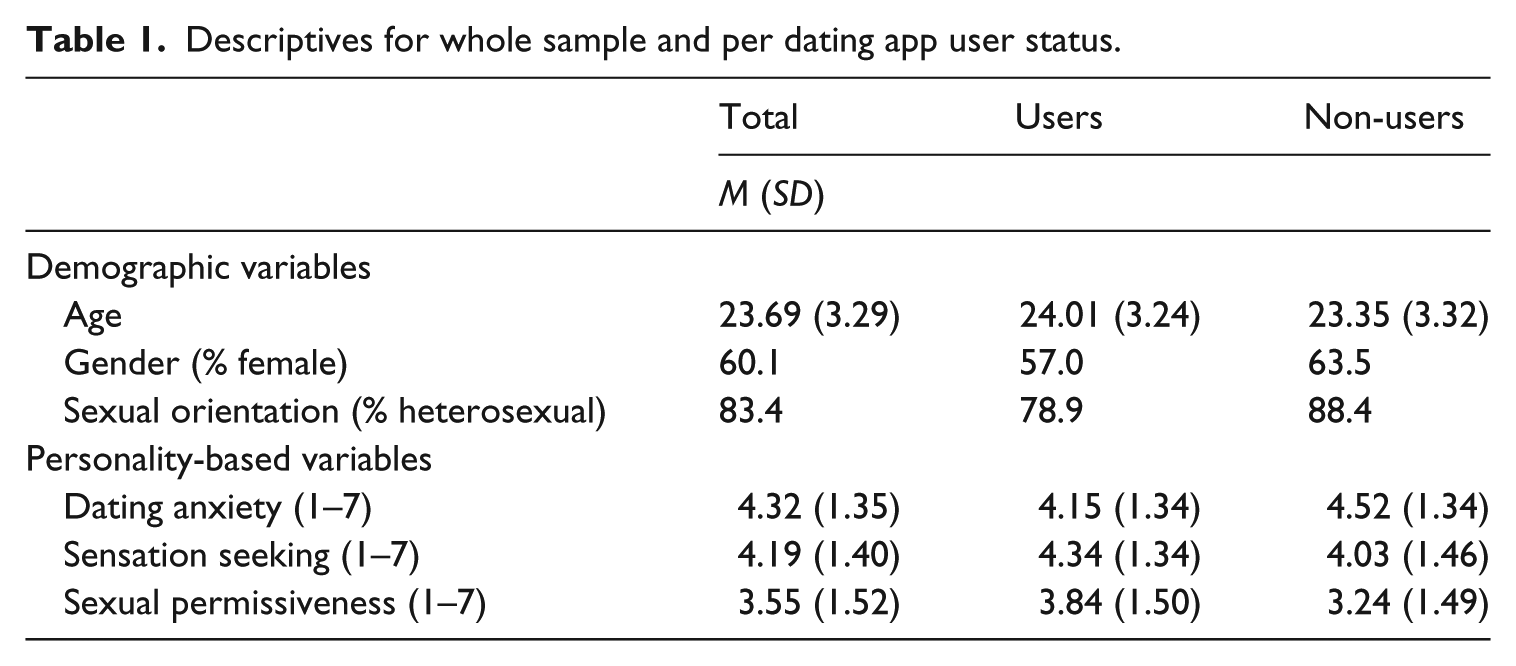
Means are presented for dating app users and non-users in Table 1. To predict individuals’ dating app user status (RQ1 and RQ2), we ran a logistic regression including the demographic and personality-based variables as predictors. The overall model was significant, χ2(5) = 32.90, p < 0.001, Cox and Snell R2 = .061, and Nagelkerke R2 = .082, and the model fit was good, Hosmer and Lemeshow test, χ2(8) = 5.66, p = .69. User status was predicted by sexual orientation but not by gender. The odds ratios for young adults’ likelihood to be dating app users increased by 1.92 for non-heterosexuals. Among the non-heterosexual group, more respondents were current or former dating app users compared to the heterosexual group, 65.9% versus 48.7%, respectively.
Descriptives for whole sample and per dating app user status.
With regard to the personality-based variables, dating anxiety and sexual permissiveness were also significant predictors (see Table 2). The odds of being an app user increased by 1.25 for every unit increase in sexual permissiveness, and the odds decreased for people higher in dating anxiety (odds ratio = 0.84). Sensation seeking did not predict dating app user status.
Summary of logistic regression analysis for variables predicting dating app user status.
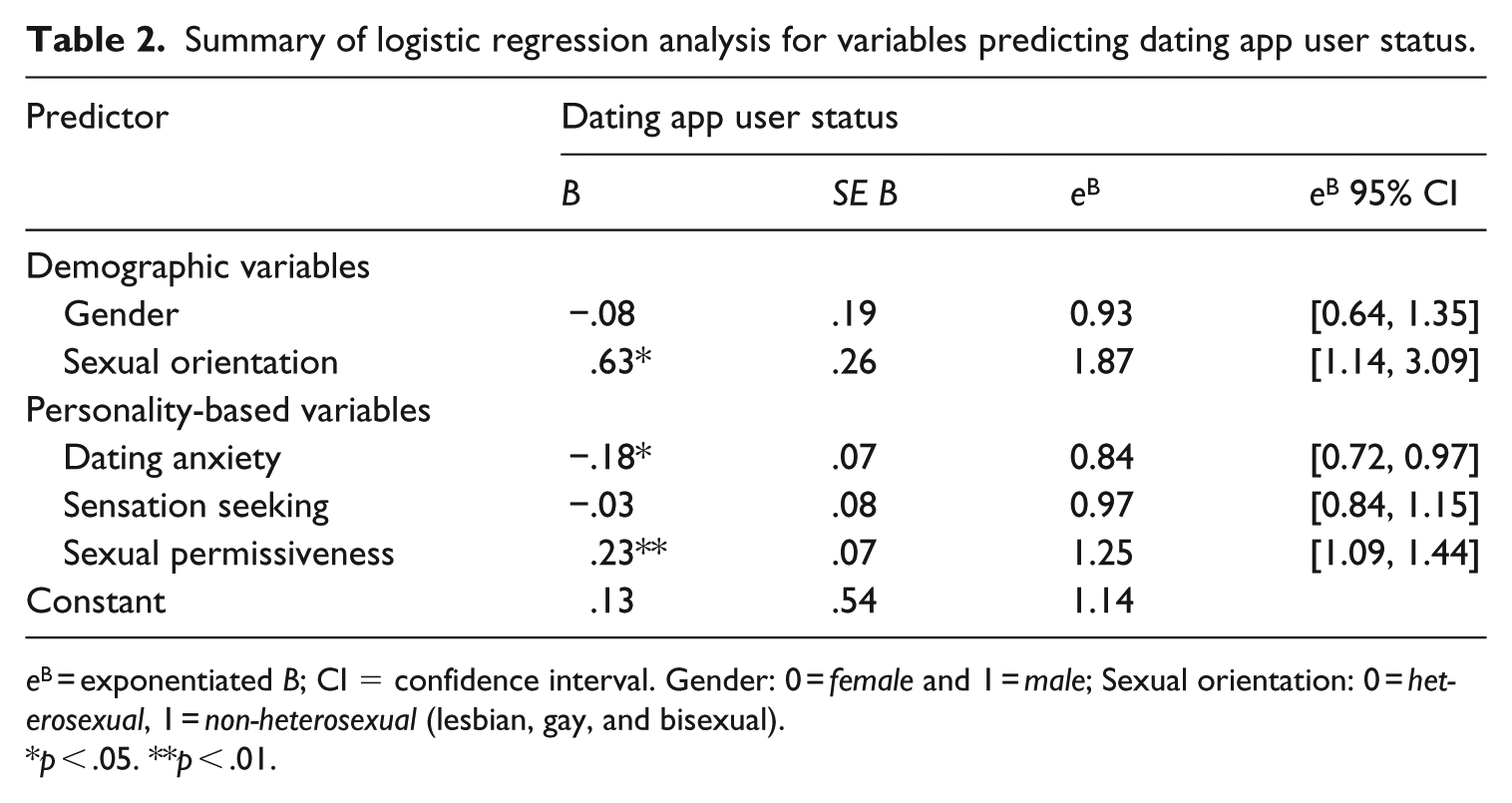
eB = exponentiated B; CI = confidence interval. Gender: 0 = female and 1 = male; Sexual orientation: 0 = heterosexual, 1 = non-heterosexual (lesbian, gay, and bisexual).
p < .05. **p < .01.
Finally, to assess whether gender and sexual orientation moderated the relationship between dating app user status and the three personality-based variables (RQ3), we included the six relevant interaction terms. There was no evidence of moderation, as all interactions were not significant, p-values > .19. Details of these results can be requested from the first author.
Dating app motivations
Six separate multiple regression analyses investigated the relationship between the six dating app motivations with the demographic (gender, sexual orientation) and personality-based variables (dating anxiety, sensation seeking, sexual permissiveness) (RQ1 and RQ2, see Table 3 and 4).
Linear regression analyses for demographic and personality-based variables predicting motivations among dating app users (n = 269).
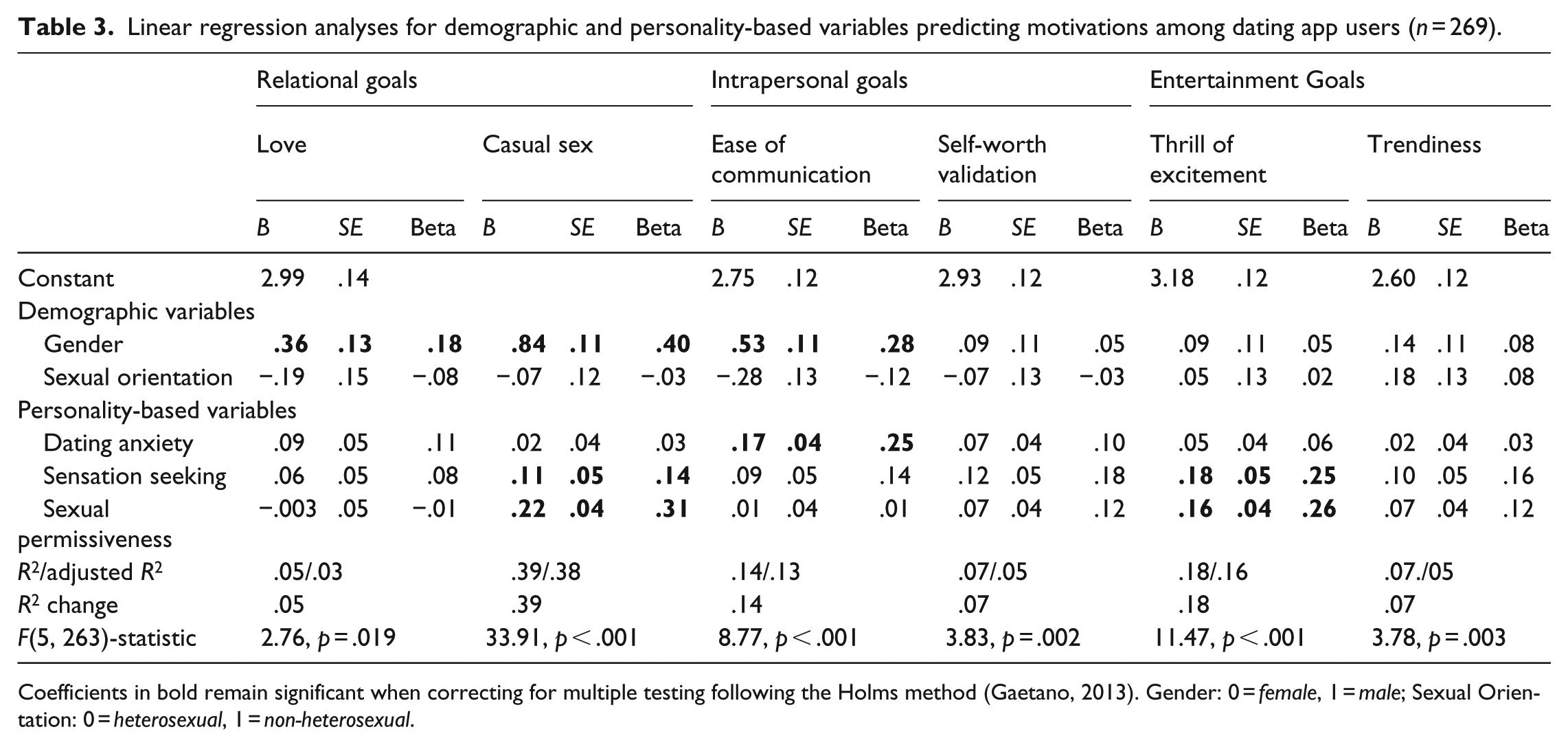
Coefficients in bold remain significant when correcting for multiple testing following the Holms method (Gaetano, 2013). Gender: 0 = female, 1 = male; Sexual Orientation: 0 = heterosexual, 1 = non-heterosexual.
Means and standard deviations of the Dating App Motivations Scale for the whole sample, by gender and by sexual orientation.
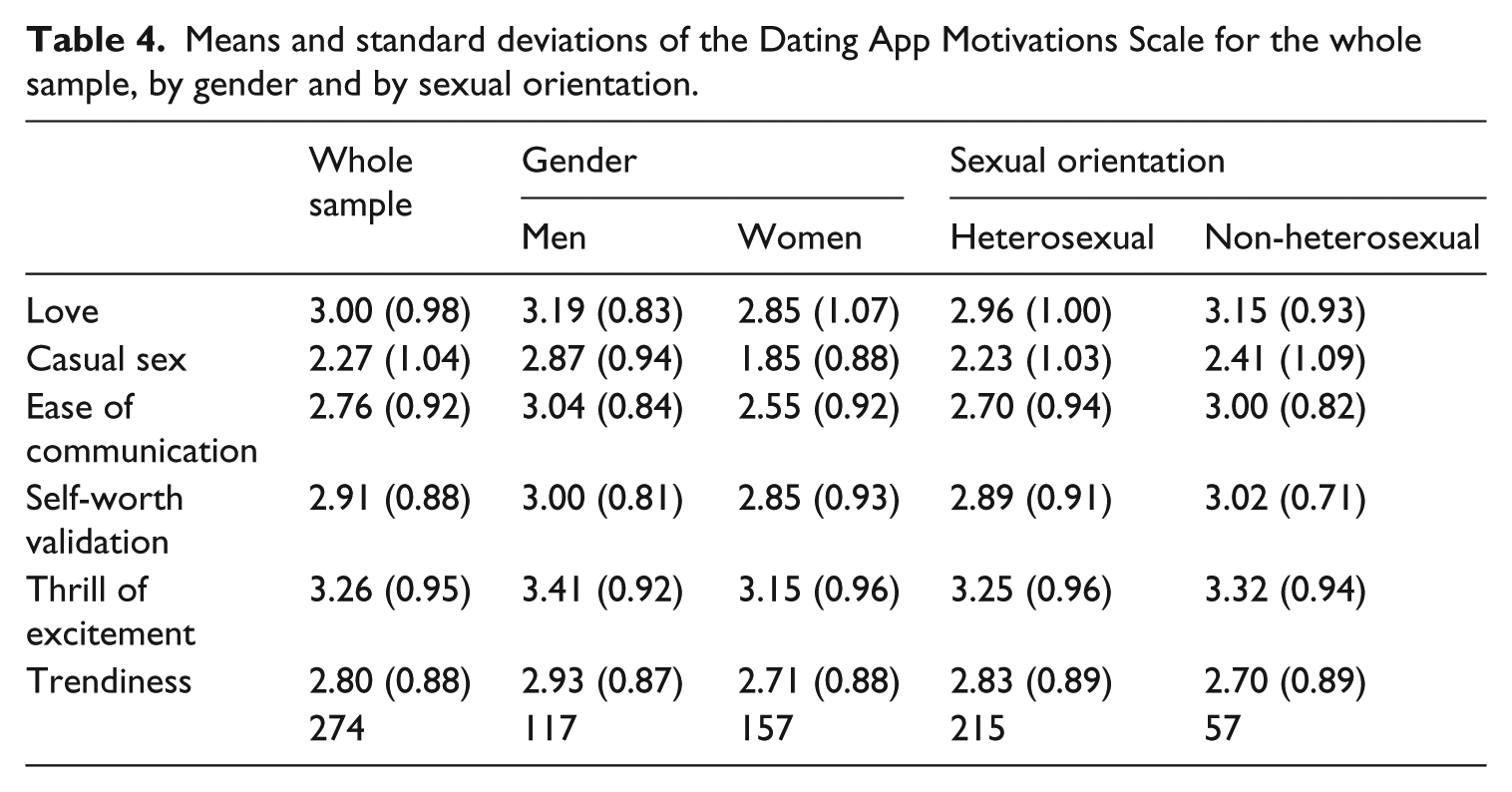
With regard to the demographic variables, gender did not predict the motivations self-worth validation, thrill of excitement, or trendiness. However, gender did predict the motivations of love (β = .18, p = .004), casual sex (β = .40, p < .001), and ease of communication (β = .28, p < .001). Men were more likely to report sex and casual sex as a motivation for using the app, and in addition, men reported higher levels of ease of communication for using the app. It should be noted that sexual orientation did not significantly predict any of the six motivations.
With regard to the personality-based correlates, the analyses showed several unique relationships between personality and motivations for using dating apps. Dating anxiety was significantly related to the motivation ease of communication (β = .25, p < .001), with high dating-anxious respondents being more likely to report to use dating apps because it was easier than communicating offline. Sexual permissiveness is related to the motivations of casual sex (β = .31, p < .001) and thrill of excitement (β = .16, p < .001). In both cases, people who were more sexually permissive were more likely to use dating apps to engage in casual sex encounters or for the excitement that mobile dating brings. Finally, the trait sensation seeking was positively related to the thrill of excitement which is offered by dating apps (β = .25, p < .001). Thus, the motivations love, self-worth validation, and trendiness were not related to any of the included personality characteristics.
Next, regression analyses that included the interactions between gender and sexual orientation by the personality-based variables were conducted (RQ3). Adding the interactions to the models only resulted in a significant amount of additional variance for the motivation love, R2-change = .052, p = .025; for all other motivations, R2-change values were below .05. However, with regard to love, none of the interactions were significant when correcting for multiple testing. Details of all results can be requested from the first author.
Discussion
This study aimed to better understand what role smartphone dating apps play in the lives of young adults. In line with the MPM (Shafer et al., 2013; Steele and Brown, 1995), young adults’ identity shaped their usage pattern of dating apps. Individuals who were non-heterosexual, low in dating anxiety, and held more sexually permissive attitudes had a higher likelihood to be dating app users. The Casual Sex motivation especially drove young adult males and those with high scores on sexual permissiveness to use dating apps. The ease of communication motivation appeared to be relevant for men and individuals high in dating anxiety. Self-worth validation motivated young adults who scored high on sensation seeking. Finally, the excitement of using dating apps was supporting individuals high in sexual permissiveness and sensation seeking to use smartphone dating applications. These findings have several implications for further research.
Dating app usage among young adults
Although young adults are the primary users of dating apps (Smith, 2016), not all young adults use dating applications. The dating apps that young adults are using ranged from the popular Tinder and Scruff to other niche apps that share a focus on pictures, rather than detailed background information of the person. All of these apps make use of smartphone GPS location sensors. Our results demonstrated that among dating app users (which constituted approximately half of the surveyed sample), particular identity traits relate to the usage of dating apps.
Which young adults use dating apps?
Dating app user status seems to be unrelated to gender or sensation seeking. Dating app users were more likely to be non-heterosexual, low in dating anxiety, and high in sexual permissiveness. The MPM (Shafer et al., 2013; Steele and Brown, 1995) together with literature on sexual orientation (e.g. Rosenfeld and Thomas, 2012), dating anxiety (e.g. Peter and Valkenburg, 2007), and sexual permissiveness (e.g. Peter and Valkenburg, 2007) suggest that these features signal certain preferences that make mobile dating apps more consistent with one’s beliefs, attitudes, and behaviors. More precisely, the relationship between sexual orientation and dating app usage supports earlier research, suggesting that people who do not identify as exclusively heterosexual are more likely to use Internet tools related to relational purposes (e.g. Lever et al., 2008). Although the Netherlands is a relatively progressive country with regard to gay rights, “LGB people do not enjoy complete acceptance in Dutch society” (Collier et al., 2015: 141). Thus, for Dutch young adults who are seeking for same-sex romantic partners, the anonymity that the Internet offers might still add to the appeal of mobile dating. Cross-cultural research is needed to test whether country-level variables can explain the relationship between sexual orientation and dating app use. It is expected that in countries where homosexuality is less accepted, sexual orientation might be an even stronger predictor of dating app use.
With regard to dating anxiety, our study findings are in line with prior research reporting that young adults who experienced anxiety and distress with regard to dating, that is, high dating anxious, were less likely to use dating apps. Thus, the fear they experience regarding offline dating (Glickman and LaGreca, 2004) seems to transfer to online dating, inhibiting them further from engaging in dating. Valkenburg and Peter (2007) found a similar finding regarding dating websites. The affordances of mobile dating applications as compared to online dating services are therefore still especially attractive for individuals low in dating anxiety. Future research may further consider whether the unique features of push notifications and GPS tracking technology of dating apps causes even more stress among dating-anxious individuals. A diary study may be especially interesting to study such effects as this design allows to track stress that is experienced recently due to a push notification.
The relationship between sensation seeking and dating app usage suggests that dating apps may still be seen as a somewhat risky activity. Future research may examine whether perceptions of the risks associated with mobile dating can explain why high sensation seekers use dating apps more frequently than low sensation seekers.
Finally, people who are sexually permissive are more open to new experiences when it comes to sexuality and relationships (Garcia et al., 2012). For this reason, they might also be drawn to novel ways of dating. Considering that the image of dating apps in the popular press is of a way to engage in casual sex (Sales, 2015), this might make dating apps especially attractive to sexually permissive people.
In sum, our findings support the idea that dating app users and non-users differ from each other on demographic and personality characteristics.
Can we predict young adults’ motivations for mobile dating?
Identity features did not only shape whether young adults used dating apps, but also why they used these dating apps. In line with earlier work on Tinder (Sumter et al., 2017), we distinguished six motivations for using dating apps and found that the theoretically selected set of demographic and personality-based variables were differently related to these six motivations. Our findings will be reviewed for each motivation separately.
Relational goals: love and casual sex
The love motivation was not significantly related to any of the predictors, whereas the casual sex motivation was related to gender and sexual permissiveness. For the love motivation, other individual difference variables might play a bigger role. For instance, Engel et al. (2002) showed that the need for intimacy and commitment in romantic relationships is predicted by individuals’ level of conscientiousness. They argue that “[p]ersons high in conscientiousness are reliable, persistent, and oriented to fulfilling their obligations, an orientation that would likely lead to greater commitment” (Engel et al., 2002: 848). Future research may consider including such personality factors.
The relationship between the Casual Sex motivation and gender is largely consistent with earlier work on Tinder motivations. In line with gender socialization theory (Tolman et al., 2003) and previous research (Sevi et al., 2018; Sumter et al., 2017), we found that men reported a stronger casual sex motivation than women. This might mean that when men and women meet through dating apps, they may have different expectations. Prior research suggests such different expectations may result in disappointment on the outcome of heterosexual dating interactions among both men and women (O’Sullivan and Gaines, 1998) and should be considered in future research. Finally, the relationship between sexual permissiveness and casual sex motivations clearly reflects the MPM’s reasoning: individuals high in sexual permissiveness are more attracted to casual sex adventures and accordingly seem to use dating apps more frequently to fulfill this need.
Intrapersonal goals: ease of communication and self-worth validation
Ease of communication was predicted by gender and dating anxiety. Similar to earlier research (Sumter et al., 2017), men were more likely to report engagement in mobile dating because it was deemed easier than offline communication. Typically, women are considered to have stronger communicative skills than men. At the same time, men are ought to take an active role in sexually approaching women (Tolman et al., 2003). As such, men may particularly appreciate how dating apps facilitate them to fulfill their traditionally expected active role in sexual relations.
Furthermore, young adults high in dating anxiety reported feeling more comfortable meeting other people through dating apps (Ease of Communication). Notably, dating app users in general reported lower dating anxiety than non-users. However, when individuals high in dating anxiety did use dating apps, they seemed to especially appreciate the affordances of dating apps to facilitate communication with a potential partner. Together, these findings mirror earlier studies on social anxiety and communication preferences. For example, Reid and Reid (2007) showed that socially anxious individuals preferred texting in comparison to calling, but did not necessarily text more often than non-socially anxious individuals. Thus, our findings further support the idea that dating-anxious individuals have specific communication preferences. For this group, online dating could be a safe way to prepare for offline dating. However, it does not mean that they actually use these apps more frequently. Interestingly, self-worth validation was not significantly related to any of the selected variables.
Entertainment goals: thrill of excitement and trendiness
Among young adults, the thrill of excitement motive was related to sexual permissiveness and sensation seeking. People who had higher levels of sexual permissiveness and sensation seeking were more likely to use dating apps for the excitement that mobile dating brings. Finally, trendiness was not significantly related to any of the demographic nor personality-based variables. Although dating apps are relatively new ways of meeting other people, by 2018, they have become more common to use. The novelty might have worn off these applications, and make it less likely that people use these apps because they are trendy. Hence, we suggest that future research on dating apps should focus on understanding the relational and intrapersonal goals.
Limitations and suggestions for future research
The current study findings need to be interpreted with caution considering at least three limitations. First, we used self-report data; thus, social desirability may have influenced our data. Such bias may especially be true for gender-related constructs. For instance, women may underreport their motivation to use dating apps for casual sex reasons, while men may be less likely to admit the search for a true romantic partner. Second, although efforts were undertaken to collect a representative sample of young adults, ethnic and sexual minorities, as well as adults with a low educational background were underrepresented. Also, somewhat more women participated than men; this gender unbalance is likely caused by the gender composition of the student population from which the student sample was drawn. Future research should consider additional sampling efforts to include such groups in their samples. Third, although we argue that the affordances of mobile online communication drive the use of dating apps, systematic comparative research is needed to understand how dating app use differs from online dating using websites. As we expect that one of the affordances of mobile dating over online dating is related to the ease of access, daily diary studies may be used to test which daily engagements patterns occur. Moreover, these studies will allow us to identify the underlying mechanisms of mobile dating and romantic experiences related to the unique affordances of dating apps more closely.
Conclusion
This study affirmed that young adults use dating apps with specific relational, intrapersonal, and entertainment goals. These goals were meaningfully related to several individual difference variables. The current study also hinted at the possible role of sexual orientation, as people who did not fully identify as heterosexual were more likely to use dating apps. Our results support ongoing research on computer-mediated-communication which has consistently shown that the offline/online bifurcation is collapsing. This means that researchers who are interested in understanding the role of dating apps among young adults will need to investigate how people’s identities drive and are affected by mobile dating.
Footnotes
Funding
The author(s) received no financial support for the research, authorship, and/or publication of this article.
