




Abstract
New forms of information and communications technology (ICT) form parts of contemporary communication. At large, connected presence (e.g. through mobile phones) is seen as something positive that facilitates social connectedness in family life. Yet, there are also instances of what we call contested connectedness. This article analyses courtroom proceedings in child custody disputes. The analyses (from 68 audio-recorded high-conflict trials) highlight how mobile phone connectedness reshapes boundaries of public/private in post-separation family life. A number of cases were chosen to illuminate different ways in which connectedness through mobile phone contacts was contested by the child or one of the parents. Three cases document recurring ways in which children’s rights and responsibilities were intertwined in complex ways in post-divorce life and how mobile phone connectedness would not offer the child new rights, yet make them more responsible for monitoring their parents’ unresolved problems.
Keywords
Introduction
In family life, the use of information and communications technology (ICT) in a broad sense – phoning, text messaging or various social media – can be understood as means for maintaining and monitoring intimacy between family members, when separated in space and time. Furthermore, information technology bridges distances and facilitates connectedness and the micro-management of family life. But, what is the role of technology in post-separation families with severe conflicts, that is, families who have chosen to be disconnected? What is the role of ICT in families rife with conflict, and how does this relate to broader ideas about children and childhood?
In social science, the family has traditionally been seen as a private haven, where benevolent parents tend to the needs of their dependent children. Recently, some scholars have challenged some of the dichotomies underlying this type of thinking (Wyness, 2014; see also Cradock, 2007; Prout, 2005; Smith, 2011), highlighting different ways in which traditional boundaries have become blurred. Specifically, in relation to communication technology, it is important to examine family relations, since new means of communication have had profound effects on parents, children and family life in general (Haunstrup Christensen, 2009).
According to Goffman (1971: 310–334), public life involves greater social vulnerabilities than private life, and this is relevant for hybrid forms of public/private as in the post-separation lives of families (Wyness, 2014). In this study, where courtroom talk during custody disputes is examined, we discuss how such disputes may highlight issues around what is public and private in post-separation life in relation to the use of mobile communication. Child custody and contact litigation recurrently involve allegations of maltreatment or risks to the child’s well-being that in turn involve reports of minute details of everyday life. This means that family life is illuminated in ways that expose sections of participants’ private lives, blurring normal boundaries between what can be discussed in terms of public and private territories (Goffman, 1971). Custody disputes involve the re-negotiation of private and public space, and a point of departure for this article is that these disputes also make relevant border work, including court-ordered rules for conversational exchanges, as well as disputing parties’ monitoring and surveillance of each other. The aim of this article is to examine how accounts of mobile phone use feature in courtroom custody disputes, focusing on how children’s rights and responsibilities become entangled in discussions of connectedness and territorial offences in a post-separation family life. Such problematic and disputed use of communication technology will here be called contested connectedness.
Information technology in family life and ‘connected presence’
The increasing use of modern information technologies in everyday life has had an effect on families, with information technology mediating more and more of family interaction. In the ideal case, mobile phone technology assists families in maintaining strong internal bonds and allows for monitoring of family members.
This is in line with broader trends towards greater individualisation in family life (Bauman, 2001; Beck and Beck-Gernsheim, 2002; Giddens, 1992; Haunstrup Christensen, 2009). In light of contemporary theorising on what is private/public in modernity (Beck, 1997; Giddens, 1992), it can be seen that information technologies may facilitate individuals’ autonomy in several ways. Yet, they also require that individuals take increased responsibility for their own well-being. In many Western societies all family members tend to have a phone of their own, including school-age children (for Swedish statistics, see Medierådet, 2017), allowing the child autonomy, while also facilitating communication and mutual monitoring within the family. Children’s access to mobile technology of course varies in different societies, as do the patterns of their use (cf. Livingstone and Bulger, 2014) and the cases presented here primarily serve to illuminate technology use in families in the Global North.
Drawing on parents’ and children’s interview reports about mobile phone usage, Licoppe (2004) has discussed how information technology is both something that allows for the dispersion of family members, and something that simultaneously brings the family closer together. It creates novel repertoires for the monitoring of connected relationships, through more extended phone or Skype conversations between family members or briefer and more rapid (at times continuous) interaction via, for example, mobile phone messaging.
Such connected relationships make possible the ‘micro-coordination’ of family life through brief, but more frequent, almost continuous calls that might create a sense of connected presence (Licoppe, 2004). According to Haunstrup Christensen (2009), ‘mobile phone use creates an experience of presence or closeness between family members, which transcends their physical separation’ (p. 446). Moreover, family bonds are maintained, not only through the practices of phone calls or text messaging but also through the very act of being connected, that is, through awareness of being within reach of other family members. Mobile phone technology may thus strengthen ties between family members (Haunstrup Christensen, 2009; Licoppe, 2004; Wei and Lo, 2006). However, connected presence could also constitute a ‘technology of power’:
The very possibility of the expectation of connected presence tipping over into control induces a dialectic of normative constraint and internalized discipline in which presence and absence, availability and unavailability, will be regulated in a game of expectations, obligations, and constraints practiced in this microphysics of the link. (Licoppe, 2004: 153)
While information technology can be used for increasing bonds within the family, it can also be used for surveillance of family members, including children. For example, Green (2002) discusses how mobile technologies ‘provide a site of negotiation for monitoring, regulation and mutual accountability’ (p. 39). Children and young adults are found to increase self-regulatory behaviour in the virtual presence of their parents provided by mobile technologies, leading to what Yu et al. (2017) call a ‘panoptic presence’. Several studies have discussed possibilities for adults to monitor and control their children by the use of cell phones, global positioning system (GPS) and other tracking devices (Dowty, 2008; Williams and Williams, 2005). In their paper on ‘space invaders’, Williams and Williams (2005) discuss how mobile phones can be deployed as parental resources for control but also as resources for youths to, for instance, argue for extended curfew time. Children use various strategies to negotiate and avoid adult surveillance via mobile phones (Barron, 2014; Williams and Williams, 2005). On a theoretical note, such research can be seen to foreground intricate inter-generational connections, challenging any simplistic notions of an autonomous child (Wyness, 2012). This goes against any idealised ideas about horizontal networked relations between the child/family and the external world (Wyness, 2012: 59). Similarly, Mandianou and Miller (2011: 467) have highlighted that research should be cautious of the ‘celebratory discourse’ of enhanced communication in family life. Although communication enhances connectedness and empowers parenting in geographically separated families, it is also laden with power asymmetries and with consequences for the trajectories of family relationships.
Information technology and divorce
While a few studies have examined the use of information technology in geographically dispersed families (e.g. Mandianou and Miller, 2011; Yu et al., 2017), research about information technologies in post-separation families is scarce. However, from a technology design perspective, Yarosh and Abowd (2013) discuss how even school-age children often have not developed communication routines or skills that allow for extended conversations without the support of a shared here and now.
In their monitoring of post-separation life, many parents engage in a delicate balancing act of trying to be informed about the child’s everyday life, on one hand, and trying not to impose on the ex-partner, on the other (Yarosh et al., 2009). Several problematic areas have been identified for non-resident parents, such as the scheduling of contacts and ways of taking part in or being informed about the child’s everyday life. Moreover, children are caught in delicate dilemmas, for example, through being positioned in the middle of their parents’ ongoing struggles, as shown by Yarosh et al. (2009). The parents in their study admitted that they would at times compete about the child, but most of them (mistakenly) thought that their children were not aware of this. Yet, many of the children adapted by trying to be very discrete about any contact with the other parent.
Children’s rights and responsibilities in ICT contexts
The increase of ICT has enabled and enlisted the general public to engage in different surveillance strategies (Andrejevic, 2005). Studies illuminate how adults engage in surveillance of each other – taking responsibility for their personal safety – using, for example, mobile phones to film ongoing assaults or suspected offenders, or putting up cameras in their own homes to supervise it when away (e.g. Reeves, 2012). Recently, Lupton and Williamson (2017) have invoked children’s rights in a critical discussion of ways in which data surveillance is part of the lives of contemporary children even in utero. Today, parents may, for instance, announce new pregnancies through sharing ultrasound images on social media sites, and as children grow, parents might closely monitor their lives with ‘Baby Monitor’ and other such apps (Lupton and Williamson, 2017: 783–784).
There is a risk that ‘children become ever more spoken for rather than speaking subjects’ (Livingstone and Third, 2017: 665).
Livingstone (2016) has pointed out that both the United Nations (UN) Convention on the Rights of the Child (1989) and the Internet have recently come of age, in celebrating their 25th year. Livingstone and Bulger (2014) have claimed that the ‘[…] media and communication environment is now integral to children’s rights’ (p. 320). This raises new questions about the Convention and its possibility to live up to the provision, protection and participation of children in digital life (Livingstone, 2016). Children are increasingly positioned as neoliberal subjects – as active and self-regulating agents. The recognition of children’s rights and agency in relation to ICT thus might ‘[…] burden them with an excessive responsibility – for self-protection, for peer responsibility, for acting ‘better’ than the adults around them […]’ (Livingstone and Third, 2017: 661). Indeed, children’s agency is often naïvely taken to be the possibility of children to act according to their volition, failing to recognise how such a possibility is also entangled in issues of power and governmentality (Valentine, 2011). It is perhaps time for the research community to engage in questions about whether, and in what ways, the digital age may enhance or, conversely, undermine children’s rights.
As yet there is not much research on how all of this works on the level of everyday life. Our study is a contribution to empirical work on the ways in which children and young people can be seen to be either hindered or empowered in their social lives through mobile phone usage. More specifically, it concerns whether mobile phones may increase or decrease children’s rights and the burden of children’s responsibilities in post-separation family life in high-conflict cases.
Focus and aims
In sum, mobile technology enables new forms of family communication and connectedness, while also providing means for monitoring and surveillance. Overall, there is as of yet very little work on how connected monitoring actually works, especially in the context of post-separation households where two parents legally contest and challenge each other’s rights to connectedness to the child.
This study explores child custody disputes in courtroom talk, and how information technology may fuel boundary disputes around public or private realms in post-separation family life, documenting how mobile phones and ICT
Can be seen as formative aspects of the regulation of connectedness
Regulate and blur borders between what is private and public
Have implications for children’s rights and responsibilities
Method and data
This article draws from a larger study that examines ways in which the child’s best interest is invoked by disputing parents in courtroom talk about child contact and custody. The data comprise audio-recorded courtroom talk –including examinations of both parents in the conflicts – in 68 trials from all of Sweden during 1 month.
Narration played a key role in that talk about troublesome events was elicited in a polar context where both parents were normally heard (by their own side, and by the opposite side attorney). In Swedish courts – as in many other countries – the children are normally not present in court during child custody proceedings. The analyses draw on participant-oriented methods (Ingrids and Aronsson, 2014), particularly on discursive methods for analysing contrasting versions (Drew, 1992), documenting divergent accounts of specific events by the two disputing parents; highlighting the ways in which courtroom narratives were the outcome of discursive contestations.
Our analytical units are episodes that involve what we have here called contested connectedness, that is, events where at least one party (the child and/or one or both parents) contests the ways in which mobile phone usage played a role in matters related to access to the child. Examples have been chosen that illustrate events in the data at large, where information technology was reported to play a role and where we have access to contrasting versions, that is, where both the father and the mother were examined in court about the ‘same’ event. Cases have thus been chosen that involve sets of two contrasting versions (Ingrids and Aronsson, 2014; Drew, 1992) and that reflect some of the complexities of the courtroom proceedings. For each case in this article, the two contrasting versions are presented, showing both sides.
All three cases were chosen because they involve problems related to children’s rights and responsibilities. One case documents how mobile phone contacts can be seen as encroachments on the child’s right to stay disconnected (Case I). Another case shows how the mobile phone can be seen to generate secret (or sly) communication between the child and one parent (Case II). A third case illustrates ways in which a mobile phone is deployed as a security measure when the child is to stay alone with a parent who is seen as irresponsible when drinking (Case III).
It should be noted that all names have been fictionalised and that the study has been approved by the Regional Ethics Committee.
Contested connectedness in courtroom proceedings
Information technologies might be beneficial in post-separation life in several ways, for instance, in that parents at times manage to avoid encounters that might refuel or revive past conflicts. In the present trials, the attorneys recurrently asked the parents about whether they had any problems communicating with each other or in getting information about the child from the other parent. Many parents spontaneously reported that they primarily contacted each other through text messaging, for example, when picking up the child at the ex-partner’s home or other arranged meeting places. In this article, though, the primary focus is on contested ways of deploying information technology.
Allegations of abusive communication (slander, name calling) or intrusions into privacy via the child and ICT technology appeared in several cases. These cases were marked by asymmetry in that one parent tried to achieve connectedness, whereas the other parent strived for distance. This article does not discuss all types of intrusions into an ex-partner’s private territory. The focus is, rather, on conflicts that specifically involve a child. Below, conflicts regarding privacy and distance (Giddens, 1992; Goffman, 1971) and issues related to the child’s rights and responsibilities will be explored through three cases where the child is part of a conflict, partly fueled by the use of information technology.
Case I: contested access to ex-spouse’s and child’s private territories
In a post-separation context, there may be divergent motivations for deploying technological solutions, and the non-resident parent is recurrently more motivated:
While the non-residential parent may be driven to upgrade the infra-structure, there is often little motivation for the residential parent to do so. The residential parent may see the introduction of a new communication technology as a violation of their autonomy in raising the child or as serving to increase the imbalance in social versus instrumental contact between the two parenting parties. (Yarosh et al., 2009: 200)
In a courtroom context, surveillance is one of the legal tools of the court: it is, for instance, possible to formulate a judgement where the child is only to meet one of his or her parents under the surveillance of a contact person. Such contacts are regularly also restricted in time and space, for instance, to a set number of hours, once or twice a week or in other ways that the court prescribes. Allegedly, several parents had spontaneously (and often surreptitiously) introduced surveillance-type arrangements of their own, for instance, through secretly recording the ex-partner’s phone conversations with the child.
In this case, there was a prior courtroom decision about where the child is to live and for what time periods, but the two parents had now moved on to a type of territorial warfare that covered both digital and physical space. In this dispute, the child could be seen to be positioned in-between her two parents, in the middle of a territorial fight about the two parents’ connectedness to the child in time and space:
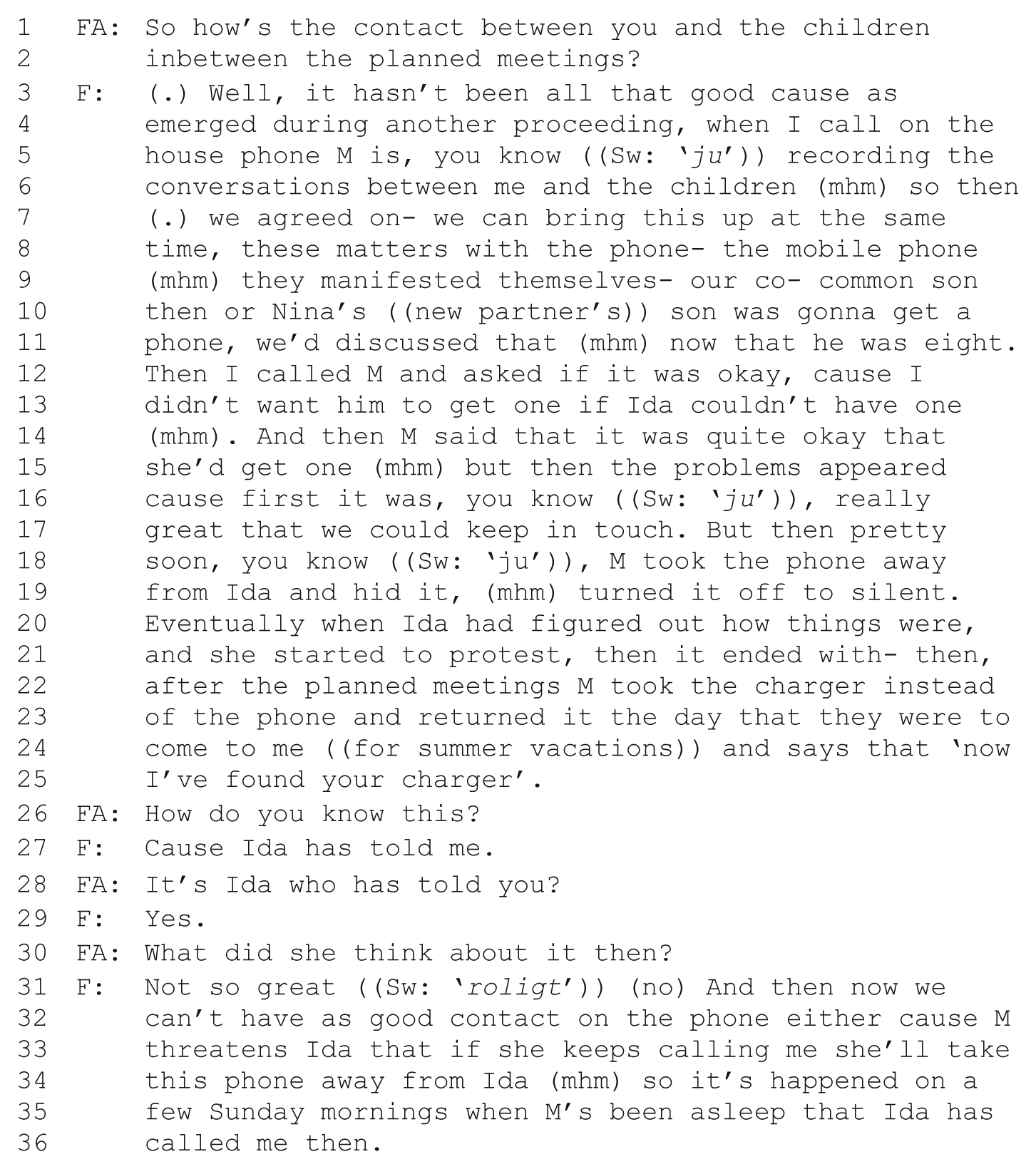
*All names are anonymised; F: father; FA: father’s attorney (normally, both parties have an attorney). Words in double parentheses are either clarifications or refer to the Swedish original. Words in single parentheses constitute feedback particles by the attorney. The notation (.) indicates a micropause.
The father issues several complaints. First, he introduces the issue of surveillance (and invasions of private space), as he claims that M has secretly recorded his conversations with Ida (lines 3–6). Such recordings are not uncommon in the present data at large. In a situation of acute distrust, recordings of the child’s encounters with the ex-partner are at times seen as a last resort in surveilling any risks involved (of slander, blame games, foul language, false promises, and so on).
Moreover, in collaboration with his attorney, F produces a narrative that is replete with blame implicatives, related to M and to digital connectedness. He has tried to be fair (offering Ida what he had given his step-child, namely a mobile phone). In his version, M agreed to this, but then she got engaged in various types of contact sabotage through the use of technological devices, as it were. Allegedly, M has hidden the charger for a long time (indirectly contesting the child’s right to be in contact with her father), and she has also threatened Ida that the phone will be taken away if she uses it to call her father. As a result, Ida has had to contact F secretly when M has been asleep (lines 34–36). In this example, the father can be seen to invoke the child’s right to communicate with both parents. However, it can also be seen that the child is made responsible for creating a privileged private space for contacting her father. In so doing, the child is put in charge of dealing with her parents’ unresolved problems.
As can be seen, F’s story about Ida’s mobile phone is dense with blame implicatives, suggesting that M is engaged in sabotage, lies and a kind of psychological warfare, for example, by silencing the phone or hiding the charger, only to coincidentally ‘find’ it again when the child is to go to her father for vacation (where the child instead could use the phone to stay in touch with her mother). This means that F insinuates that when the child stays with him, the mother no longer contests the child’s right to phone the other parent. The connectedness provided by the phone is thus far from neutral but negotiated and contested throughout the parents’ conflicts.
In the mother’s contrasting version, presented below, the father has – through his ambiguous or even poisonous gift (cf. the French expression, ‘un cadeau empoissoné’; here in the form of a mobile phone) – advanced his territorial space into her private territory. Her narrative is an account of what we have called contested connectedness:
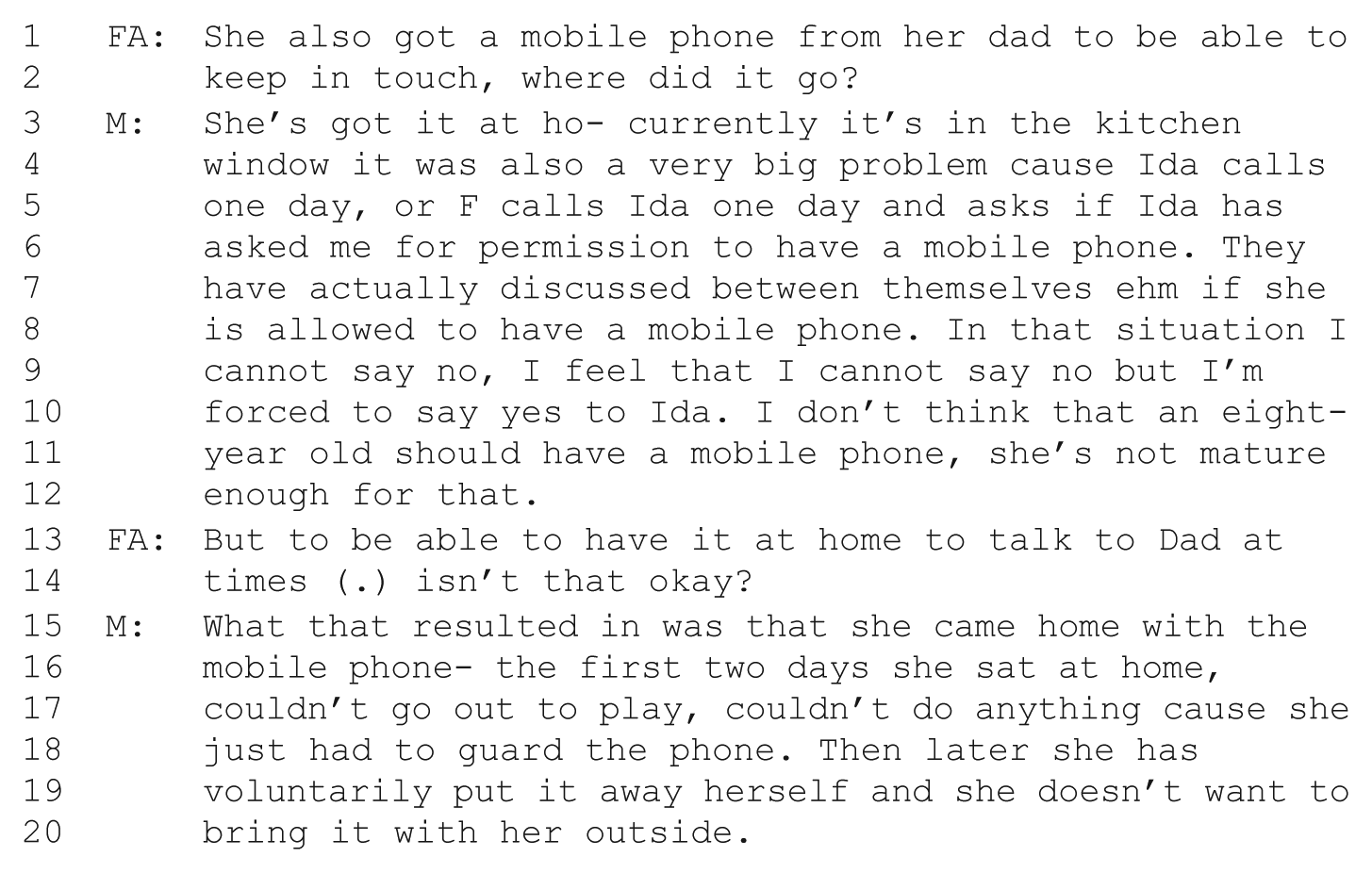
In M’s version, the mobile phone is an unwelcome intruder into family life: she indirectly complained that she had no agency, in that she could not deny her daughter a mobile phone (lines 5–10), even though it went against her own beliefs (that 8-year olds are ‘not mature enough’, lines 10–12). Ida was allegedly unable to do anything but stay at home, waiting for F’s call (lines 15–18). In M’s story, Ida’s father, via the mobile phone, could be seen to invade their home territory (Goffman, 1971), even though he did not visit them. In M’s account, the technology becomes like an extension of F’s body that can actually shape and reshape the private domain of her house, making it into a semi-public area where an ex-partner might intrude into everyday routines. As in the other cases in this article, information technology makes the child responsible for managing the contact with an absent parent, a connectedness that is directly or indirectly contested in the courtroom proceedings. In contrast to the father’s version, the mother also invokes a different aspect of children’s rights in relation to ICT, namely, that of the right to protection – she claims that the daughter is not mature enough to handle a mobile phone in a manner that is in her own best interest.
At large, the parties tend to respond quite strongly to various covert control measures. Here, the father complains about his ex-spouse’s secret recordings of his conversations with their child (which can be seen as an encroachment on his and their child’s right to privacy). Moreover, he claims that she hides the mobile phone from the child. The mother, in her turn, complains about how the child was almost immobilised when she first got the mobile phone: she did not go out to play, and she just sat by her phone, waiting for her father to call. The mobile phone is thus seen by the mother as an intrusion into her and her daughter’s lives.
Conversely, in F’s version, his daughter had to call him secretly. Arguably, the child thus also orients to delicate aspects of public/private in her parents’ territorial disputes in that she strategically calls her father early on weekend mornings (when her mother is asleep). While the mobile phone has made connected presence possible between the father and the daughter, this is not a relationship that is understood as neutral or unproblematic. Rather, the participants all orient to the mobile phone in terms of highly contested connectedness: the mother complains about negative effects on the daughters’ everyday life, the father complains about obstruction and intervention, and the daughter is required to manage her calls so that they are not detected by her mother. The child is thus made responsible for solving problems, not resolved by the parents and for partly doing so in secret.
Case II: contested connectedness in court enforced phone contacts
In our data, we recurrently find that the court formulates a disposition to the effect that the child is to talk to the non-resident parent on a scheduled (regular) basis, for instance, weekly or biweekly, in order to ‘get to know him or her’. This is apparently one of the court’s strategies for fostering some kind of ‘normal’ contact and for avoiding what might develop into a demonising of an absent parent. For instance, this occurs when the child is strongly fearful of a parent and when a contact person is not an option (because the non-resident parent is against such a contact or because of geographical distance).
There are thus situations where children might feel uncomfortable when talking to parents with whom they have little shared history. In Case II, the father, who has not seen his child (Emmy) since she was a toddler, has asked the court for scheduled weekly telephone contacts. Yet, the child has repeatedly reported that she is strongly against any contact with him (be it face-to-face or phone) and that she has been feeling anxious when asked to talk to him. It can be noted F has previously been incarcerated and that M has an unlisted phone number:
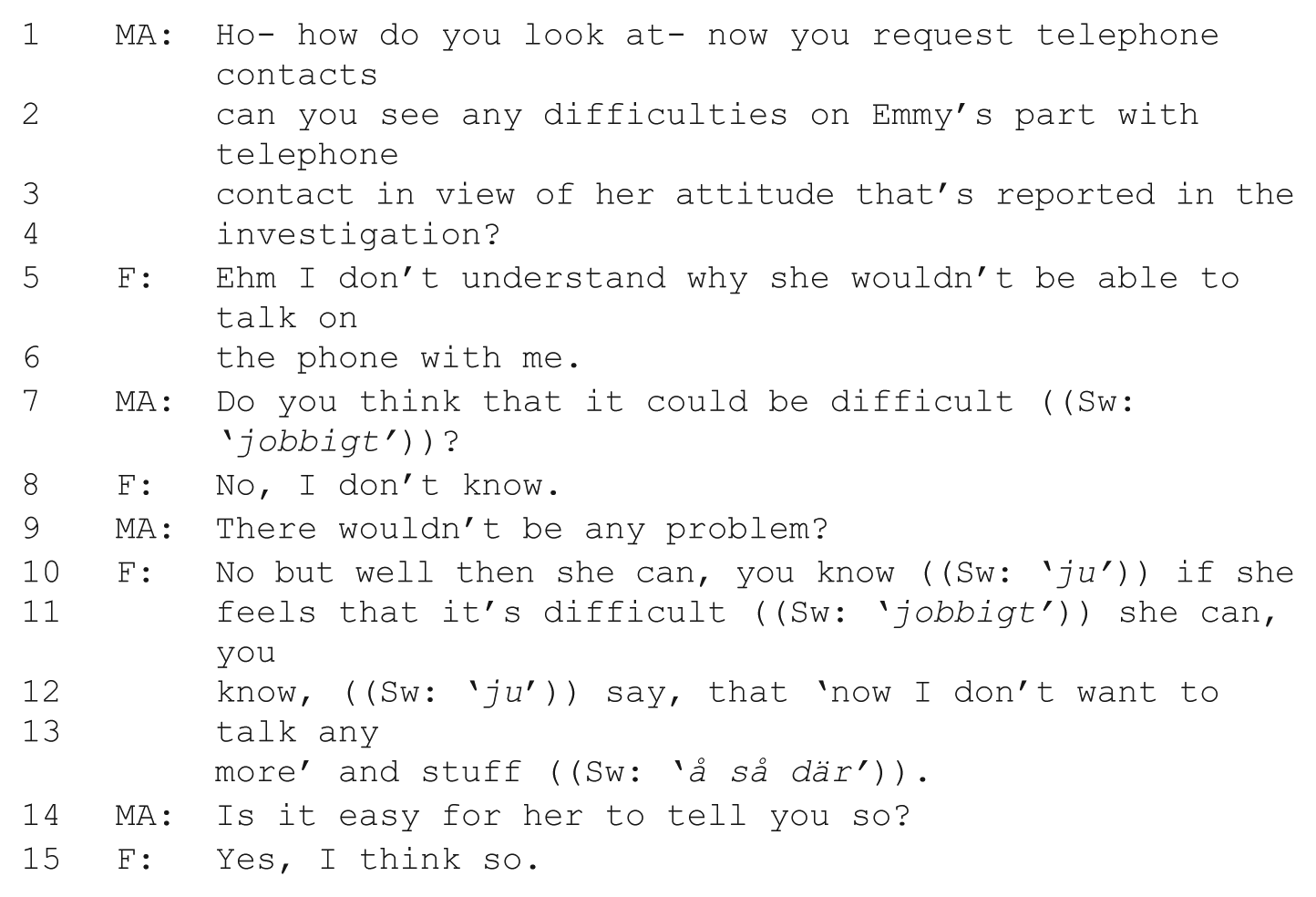
As can be seen, the father does not understand why his daughter would not be able to talk on the phone with him (line 5–6). His failure to see why is in line with the views of the court in that the non-resident parent’s attorneys (and ultimately the judgement) at times prescribe weekly phone contacts in cases where the child has said ‘no’ to other type of encounters. F downplays any reason for why his daughter might not want to talk to him. In his version, she is the one who should be responsible for terminating any painful contact (lines 10–13), and he maintains that this should be unproblematic for her (lines 14–15). It can thus be noted that F neither sees scheduled connectedness as a burden for the child nor as an intrusion into her privacy.
In contrast, the Mother describes regular phone contacts between Emmy and Father as something disruptive, as an intrusion into the child’s private space:
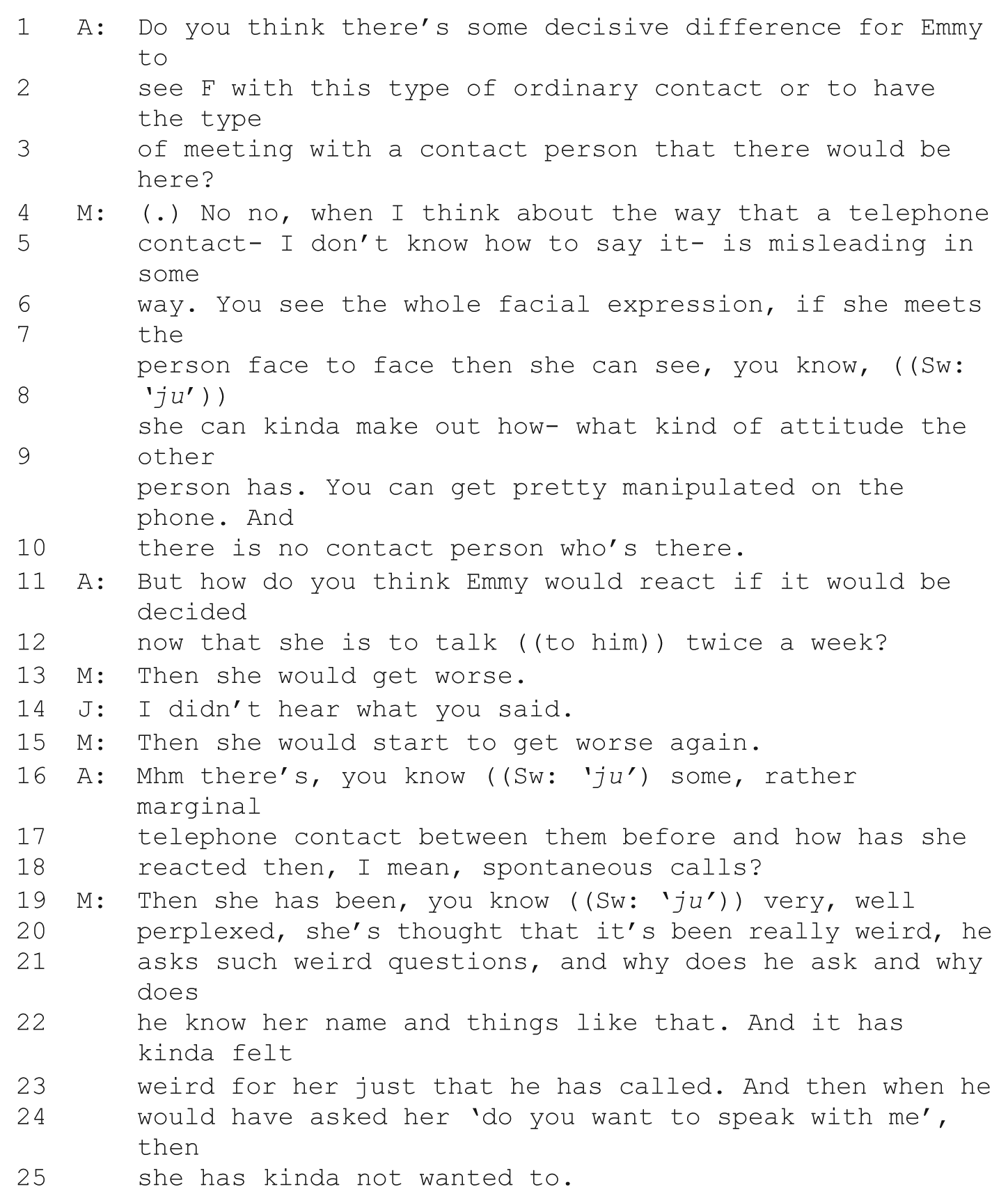
The two parents’ views about the child’s potential difficulties are apparently quite divergent. Mother offers a number of reasons for her worries about the father’s intrusions into the child’s private territory: (1) the child cannot see his facial expression on the phone, (2) the child risks getting manipulated, (3) there will not be a contact person around and finally, and most importantly, (4) the child would get worse again, referring to her history of anxiety when interacting with her father (Sw: må dåligt igen).
In several cases in the data (as in this case), the child has not lived with the father or only lived with him as a baby or very young child. The child in this case is reported to ask her mother why F asks such ‘weird questions’ (lines 20–21; Sw: konstiga frågor). He is not someone she remembers or knows, and he is apparently not aware of what might interest a child of her age. She is even perplexed about why he knows her name (lines 21–22). In the mother’s narrative, the father is thus construed as someone who is not quite in the know about the child’s private life, including her interests or friends. For the absent parent, it is then a formidable task to get to know his or her child via phone. On another note, the child (Emmy) can be seen to be made responsible in that she is asked to monitor (and to be available for) weekly phone contacts with her non-resident father. Again, a young child is thus made responsible for monitoring conflicts that neither her parents nor the court have been able to solve.
In relation both to children’s rights and the best interest of the child, the phone becomes an area of contestation – regardless of whether the risk of psychological harm to the daughter outweighs her right to be in contact with both parents. In Swedish practice, connectedness to both parents is often seen as a basic right, even in cases where one party has been violent to the other parent or to the child (Eriksson and Hester, 2001). This example illuminates questions about whether connected presence is something that the child in a post-separation context has a right to or a right to be protected from (cf. Livingstone and Bulger, 2014).
Case III: making children responsible for their own safety through ICT connectedness
This case documents children being made responsible for both their own and parent safety in post-separation family life, via mobile phone connectedness. In this case, two young siblings have at times had overnight stays with their father, who has had a drinking problem. The children’s safety was problematised in the courtroom argumentation, where their father’s capacity to take care of them was called into question. This family has (as many other families in the data) lived through various untoward events such as accidents, body injuries and domestic violence related to drinking. One of the father’s prior apartments burnt down, and the two children are acutely aware of potential risks associated with alcohol consumption.
Both children could be seen to be made responsible in different ways, and the analyses also reveal ways in which courtroom talk is oriented to different types of remedial work (Goffman, 1971). Fragment 5 comes from the father’s testimony with his own attorney. He is talking to his attorney about an incident where his son, Henrik, became anxious and wanted to leave because he (the father) had started to drink beer:
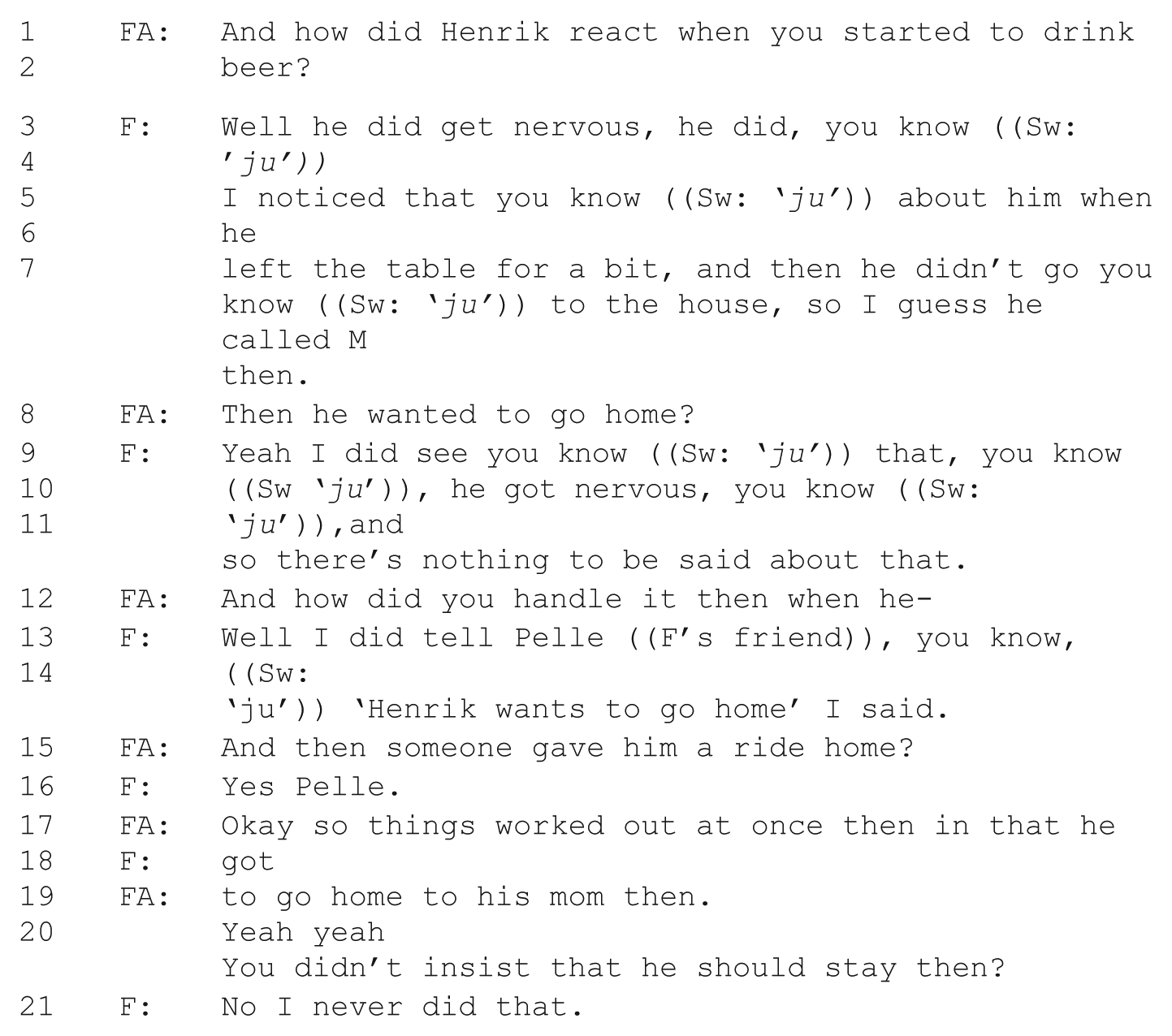
In F’s version, Henrik can be seen as taking responsibility in at least two ways: first, after identifying a potentially risky situation when the father began drinking beer, he uses his mobile phone to call M (lines 3–7); and second, he then actually leaves the situation, returning home (to his mother’s house, driven by F’s friend; lines 13–16). The incident is here being co-constructed as unproblematic by FA and F, at large, because Henrik was not hindered in his (responsible) way of taking over the situation. He was not hindered to call his mother when he got anxious, and he was not hindered when he decided that he wanted to leave for his mother’s house. It can thus be seen how he is made responsible in that he monitors the somewhat risky situation, seen in how he (1) leaves the table when F starts to drink, delicately orienting to the privacy of his call, (2) calls his mother and (3) returns home.
In his examination of the mother (the opposing party), the father’s attorney again tries to downplay risks, related to the children staying in F’s house (e.g. overnight stays):
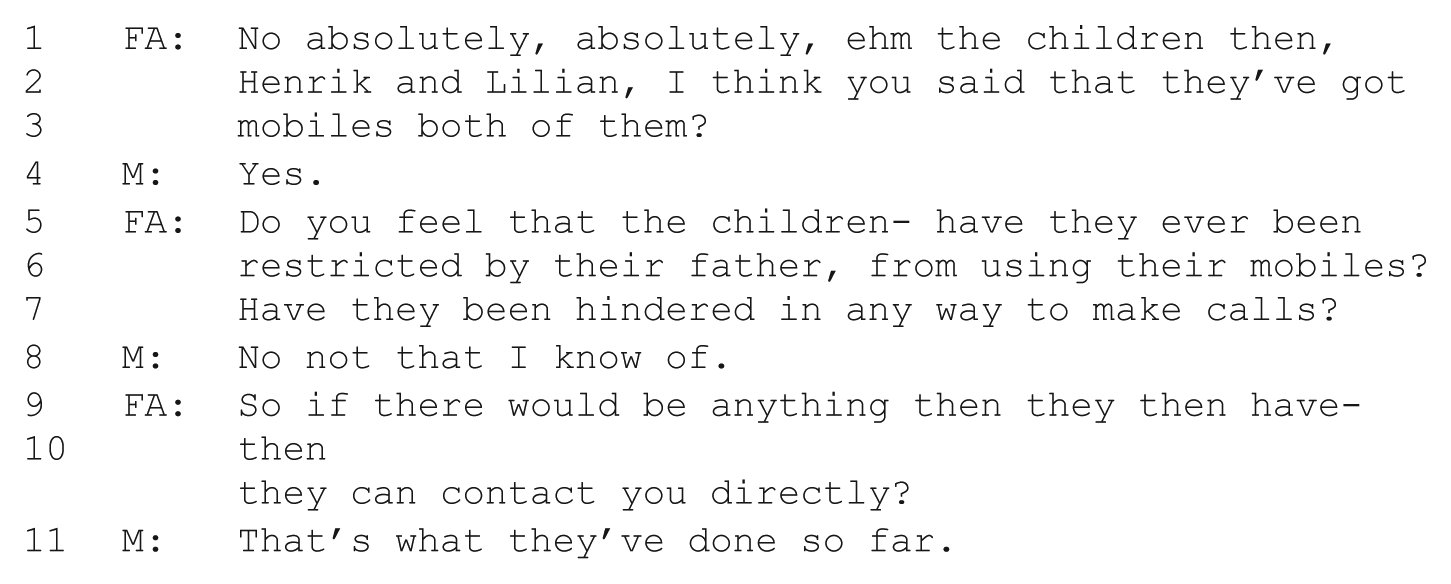
Again, through his questions and M’s invited response, the father’s attorney makes M co-construct an account where it is highlighted that (1) both children have mobiles and (2) are not hindered to use them. Also, F did not stop or obstruct the children’s phone calls to their mother (lines 5–7). Again, it can thus be seen how the arrangement (and ‘freedom to use the mobile phone’) demands/involves both children to take responsibility for the potentially risky situation by continuously evaluating the situation and the potential danger. However, in M’s response to his follow-up question (‘So if there would be anything then they then have – then they can contact you directly’, lines 9–10), M does not merely ratify that this is the case, she also introduces an important qualification: ‘That’s what they’ve done so far’ (our italics; line 11). Thereby, she makes it clear that there might still be reason to be worried, indirectly contesting the father’s attorney (and his potential over-reliance on technology).
In order to be responsible for their own (or their parents’) safety, children have to stay awake, and someone on the receiving end of the phone (here M) also has to respond. Mother can be seen to orient to this somewhat fragile arrangement, with the mobile phone as a safety line, in her guarded response in line 11.
In this case, the mobile phone facilitates connected presence between the children and their mother. Here, the phone functions as a safety line in a potentially risky situation. It is largely construed as unproblematic by F and his attorney. However, as is seen in the trial at large, M is not happy with the children’s overnight stays at F’s house, and she and her attorney contested the long-term viability of this safety arrangement. Unlike the two previous cases, it is not the phone contact per se that it contested. Instead, the issue is rather if the phone is an adequate measure for ensuring the children’s safety. The connected presence is part of this safety arrangement, but it is also one which places a large responsibility on the children themselves. Through the mobile phone, responsibility is shifted from parents to children. In terms of children’s rights and responsibilities these arrangements thus position the children as responsible for assessing and monitoring potentially risky situations. This simultaneously means that the children are required to make complex risk calculations.
This is in line with individualisation of the child, including the child’s increased autonomy through mobile technology. However, as is seen in the court proceedings of this case, it also causes anxiety in some of the children concerned. Thus, while mobile technology may be seen as an effective tool in granting unsupervised access and visitation rights to parents who may otherwise be unfit for such arrangements, at worst, a court’s over-reliance on mobile technology as a safety measure may also endanger children’s well-being and at worst also their safety. The mobile phone may, at best, guarantee the child’s right to be in contact with both parents. However, at times, this might place the child at risk, which is also implicitly acknowledged by the mother (see above). The connected presence made possible through the mobile phone thus highlights a dilemma in these sorts of disputes – that of granting a parent access to a child, even though it may increase the risks of physical or psychological harm to the child. As our analyses of the courtroom argumentation show, the use of ICT in these arrangements presupposes both agency and self-governance on the child’s part, which indicates that while child agency is a presumption, there are also concomitant responsibilities.
Conclusion
Information technology has notably complicated our ideas about privacy or intimacy in transcending old boundaries between public and private realms, locating the private within new cultural and social arenas (Wyness, 2014). Information technology and connected presence may at times facilitate or even enrich post-separation interaction, but they are not merely neutral resources: our analyses show that ICT recurrently involves contested connectedness in that one or both parties reports territorial offences of private zones in family life.
Child custody disputes and contact arrangements always involve the child as a third party, even if that is not always acknowledged in dispute rhetoric about the child’s best interest (Ingrids and Aronsson, 2014). The present findings show that information technology may play a role in complicating the child’s third party role in post-separation family life. First, mobile phone connectedness may at times involve greater risk-taking at the child’s expense (Cases II and III). Second, the very presence of a mobile phone may augment or increase unwanted intrusions into children’s private territory (Cases I and II). Technology can thus be seen to fuel boundary disputes about privacy and social distance.
The mobile phone becomes a nodal point in a network of complex and entangled disputes, both as something that the parents argue about, and as something that allows for potentially hazardous arrangements (as in Case III). The mobile phone becomes a tool through which the parents may continue a litigious relationship and where the child, as the proprietor of this tool, becomes responsible for making up for the parents’ lack of sustainable solutions for post-separation family life.
It is worth highlighting that mobile phones also facilitate post-separation connectedness and thereby the child’s right to contact with both parents – something which is often seen to be in the child’s best interest. In most custody disputes, the use of mobile technology would not be an issue or something that the parents would object to. What is shown here are some ways in which connectedness becomes something contested in high-conflict cases, where the role of technology is negotiated in relation to children’s rights, responsibilities and ‘the best interest of the child’.
Moreover, mobile phone connectedness is at times related to children’s complex monitoring of family life, where the children can be seen to be mobilised for novel responsibilities, without concomitant novel rights. It can be noted that intrusions into children’s privacy is again and again contested by one or both parents, as can be seen in our three sets of contrasting narratives. Mobile phone connectedness may thus both create new dilemmas and reduced rights in a situation where the child is already at a disadvantage. All three cases illuminate ways in which technology is linked to different types of increased responsibilities. A child’s mobile phone might be seen as a type of safety line which, for instance, makes it possible to stay overnight with a parent where there are risks involved (e.g. due to a parent’s drinking). Simultaneously the mobile phone becomes an instrument in placing the responsibility for risk management on the individuals involved: here primarily the child.
In brief, this study can be seen as a contribution to theorising on connectedness and information technology through discussing the delicate and complex nature of technology and privacy in the post-separation lives of families. Most importantly perhaps, the findings complicate any simplistic notions of an ‘autonomous’ child (for a related critique, see Cradock, 2007; Prout, 2005; Wyness, 2012, 2014) in that agency is ambiguous in the present instances of children’s skilful monitoring of post-separation life. However, the child is simultaneously positioned, both as a third party and as someone who has to navigate through and manage disputes, not solved by parents or through prior court decisions. As shown in this study, communication technology is an important aspect of a child’s position in post-separation family life, where the connectedness between the child and parents, made possible through such means, is recurrently negotiated, questioned and contested in severe disputes.
Footnotes
Acknowledgements
The authors wish to thank two anonymous reviewers for their insightful comments on this article. Thanks for helpful comments are also extended to members of the Discourse Seminar, Stockholm University, CLIP, Uppsala University, and to participants at the Sociolinguistics Symposium 21, Murcia, Spain.
Funding
The author(s) disclosed receipt of the following financial support for the research, authorship, and/or publication of this article: This work was supported by Forte: The Swedish Research Council for Health, Working Life and Welfare (grant number 2014-1554).
