




Abstract
This paper provides an in-depth exploration of the psychosocial factors and processes related to maintaining and losing control during internet gambling. It explores features of internet gambling leading to loss of control, control strategies used by internet gamblers, and the perceived utility of online responsible gambling measures. Interviews with 25 moderate risk and problem internet gamblers yielded rich first-person accounts analysed using interpretative phenomenological analysis. The most frequently identified aspects of internet gambling leading to impaired control were use of digital money, access to credit, lack of scrutiny and ready accessibility. Participants used a range of self-limiting strategies with variable success. Most considered that more comprehensive responsible gambling measures are required of internet gambling operators. The findings provide insights into the cognitive and behavioural processes that moderate problem gambling and are highly relevant in developing effective prevention and treatment programs for this new interactive mode of gambling.
Introduction
Ready access to internet-enabled devices and websites is fuelling exponential growth in internet gambling, evidenced by the 10–15% annual increase in internet gambling expenditure over the last 15 years (Gainsbury, 2012) across more than 2800 websites (Online Casino City, 2013). Data from British (N = 7756) (Wardle et al., 2011), Canadian (N = 8498) (Wood and Williams, 2009), Australian (N = 4185) (Gainsbury et al., 2013b) and international (N = 12,521) (Wood and Williams, 2009) surveys have prompted concerns that problem gambling rates amongst internet gamblers are higher than for land-based gamblers. However, although cross-sectional studies support a relationship between internet gambling and problem gambling, gaps in our knowledge persist about the nature, direction, and experience of that relationship.
Problem gambling is characterised by impaired control over money and/or time spent gambling, resulting in harm to the individual, family and/or community (Neal et al., 2005). Empirical evidence and seminal theoretical models consistently show loss of control as a key feature in progression from initial participation to persistence (Blaszczynski and Nower, 2002; Jacobs, 1986; Sharpe and Tarrier, 1993). Although more recent conceptualisations of the causes of problem gambling have proposed alternatives to these etiological models, diminished control over gambling remains a hallmark of the behaviour. For example, alternative models have placed greater emphasis on positive and negative feedback loops (Zangeneh and Haydon, 2004), dysfunctional impulsivity (Nower and Blaszczynski, 2006), cultural and social factors (Ajdahi and Wolgast, 2008; Bernhard, 2007) and genetics (Williams et al., 2008) in explaining problem gambling. However, these models have not been developed with consideration for internet gambling, and prevention and treatment programs specifically for this gambling mode are lacking. Thus, investigating whether certain features of internet gambling lead to or exacerbate impaired control is important.
Presently, the causal relationship between internet gambling and problem gambling remains unclear. Several studies have found that internet gamblers engage in more gambling activities than non-internet gamblers (Gainsbury et al., 2012b, 2013b; Wardle et al., 2011; Wood and Williams, 2009). Internet gambling in itself has not been shown to be predictive of problem gambling, which is most strongly predicted by the number of gambling activities engaged in (Gainsbury et al., 2013b; Philander and MacKay, 2013; Wood and Williams, 2009). Consequently, greater gambling involvement, rather than use of internet gambling per se, has been speculated to account for higher problem gambling rates amongst internet gamblers. However, longitudinal studies suggest that, while many problem gamblers gravitate to internet gambling, internet gambling more commonly precedes or co-occurs with problem gambling (Wood et al., 2012).
Numerous features of internet gambling may potentially undermine an individual’s ability to maintain control. These include extensive availability and 24/7 accessibility, capacity for underage or intoxicated gambling, use of electronic ‘cash’, enhanced privacy, its immersive, anonymous and solitary nature, and ability to engage in several games simultaneously (Gainsbury et al., 2012b; Griffiths, 1999, 2012; Williams et al., 2012a, 2012b; Wood et al., 2012). Surveys indicate that 19–28% of internet gamblers report it is easier to spend more money online (Gainsbury et al., 2012b; Wood and Williams, 2009), while 15% consider this form to be more addictive than land-based gambling (Gainsbury et al., 2012b). Problem compared to non-problem internet gamblers have reported spending more due to use of electronic funds, being more influenced by incentives, and perceiving availability, convenience, privacy, anonymity and better game experience as advantages (Gainsbury et al., 2012a).
Although researchers may speculate that certain features of internet gambling may facilitate expenditure, loss of control and propensity for problems, there is a persisting lack of confirmatory empirical evidence (Haefeli et al., 2011). Nevertheless, it is argued that responsible gambling measures designed to address the unique features of internet gambling are warranted (Haefeli et al., 2011). Widespread mandatory implementation of responsible gambling measures remains difficult to achieve given the proliferation and ease of access to unregulated internet gambling websites (Griffiths, 2012; Williams et al., 2012a; Wood et al., 2012). In Australia, only licensed wagering and lotteries can be legally provided online. Yet Australians can easily access unregulated offshore sites for other gambling forms. Thus, in partially regulated environments, eliciting and identifying internet gamblers’ attitudes, perspectives, and propensity to use any responsible gambling features is important.
Studies have shown that internet gamblers embrace various responsible gambling strategies, and perceive these as effective in controlling problematic gambling (e.g., monetary limits, pop-up messages) (Auer and Griffiths, 2013; Gainsbury et al., 2013a; Monaghan, 2009; Nelson et al., 2008; Wohl et al., 2013; Wood and Griffiths, 2008). However, few studies have examined self-control strategies used in the absence of operator-provided tools. One exception is Corney and Davis’s (2010) study of 25 British female internet gamblers who reported playing single rather than multiple games, determining financial limits and game strategies before commencement, staking small amounts, and not chasing losses.
The present study contributes to addressing the gaps identified above. It aimed to explore features of internet gambling that lead to loss of control amongst moderate risk and problem gamblers, control strategies used for internet gambling, and perceived utility of online responsible gambling measures. The study used qualitative methods to unravel the complexity of issues through eliciting richly layered, in-depth information about human behaviour. Qualitative research places more emphasis on understanding phenomena from the perspective of insiders and seeks to answer the ‘how’ and ‘why’ of decision-making rather than the ‘what’, ‘where’ and ‘when’ (Lapan et al., 2012; Patton, 2001).
Methods
Ethics committees of two Australian universities approved this research. The investigation was situated within an interpretive paradigm using a social constructivist approach that includes analysis of texts, events and human behaviour to find emerging meanings (Guba and Lincoln, 1989). The interpretive paradigm centres on an empathetic understanding of the reality of the human situation (Schwandt, 2003). Reality is created by people as they respond to, interpret and make sense of their lives and their contexts (Gubrium and Holstein, 2000).
Sampling
We purposefully sampled to recruit 25 Australian internet gamblers who were moderate risk or problem gamblers. A AUD$40 shopping voucher was offered as reimbursement. Of 488 respondents to previous surveys (by the authors) indicating willingness to participate in further research, 150 agreed to participate. Inclusion criteria included gambling at least once online in the previous 12 months, being of legal gambling age, scoring 3 or more on the Problem Gambling Severity Index (PGSI; Ferris and Wynne, 2001), and not currently seeking treatment for a gambling-related problem.
Five sub-samples were constructed based on main internet gambling activity indicated in the original survey responses: (1) lottery-type games/bingo/keno; (2) horse/dog wagering; (3) sports betting; (4) casino games/electronic gaming machines(EGMs); (5) poker.Within each sub-sample we attempted to include five respondents who scored 3 or more on the PGSI (Ferris and Wynne, 2001), again based on responses to the earlier survey.
However, given insufficient numbers of poker and casino games/EGMs for our purposes, we elected to sample from a ‘mixed gambling’ group who gambled on several online forms equally. This sample comprised individuals in the original surveys who gambled on poker or casino games/EGMs and on at least one other internet gambling activity equally often during the previous 12 months.
Because this was part of a larger study, we interviewed 53 participants; however, only interviews with 25 participants scoring 3+ on the PGSI were utilised for this paper.
Participants
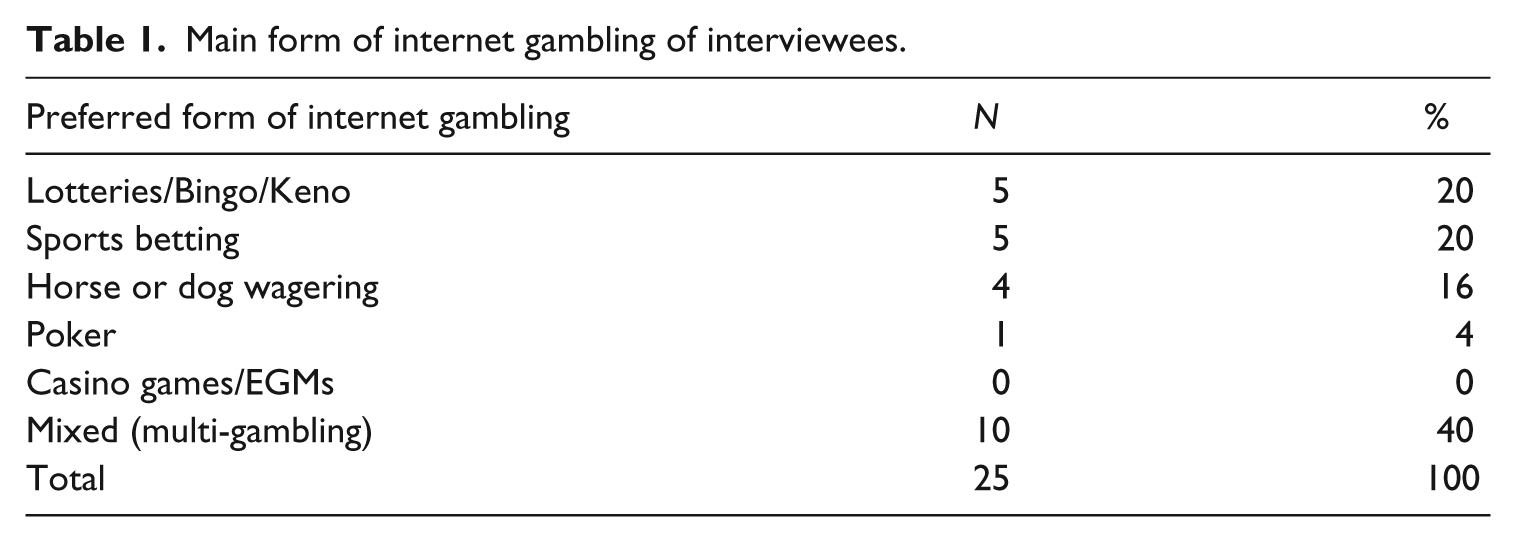
Table 1 shows the main internet gambling activities of the sample.
Main form of internet gambling of interviewees.
All 25 moderate risk and problem gamblers were male. While internet gamblers are predominantly male (Gainsbury et al., 2012b; Wood and Williams, 2009), recruiting no women is a limiting factor. Mean age amongst the 25 participants was 39.9 years and the median age was 37 years (range = 18–71 years, SD = 14.13). All Australian jurisdictions were represented except the Northern Territory.
Procedure
Interviewees were emailed a Participant Information Sheet and Informed Consent Form, and then contacted to schedule a telephone interview. Interviews lasted between 20 and 50 minutes and were conducted in late 2012 by one author. All interviews were digitally recorded with permission and professionally transcribed.
Interviews were semi-structured to ensure some consistency in data collection. Interview questions sought participants’ experiences relating to three broad themes relevant to the current paper: (1) features of internet gambling perceived to lead to loss of control; (2) control strategies internet gamblers use; (3) perceived utility of responsible gambling measures. Interview questions were purposely broad to encourage participants to talk freely about experiences of losing control when gambling online, features of internet gambling contributing to this, any control strategies used, and how control could be enhanced through responsible gambling measures. Thus, not all participants discussed all features, control strategies and responsible gambling measures presented in the paper. Instead, the results represent a composite of participant experiences and views as expressed through interviews.
Data analysis
Data were analysed using interpretative phenomenological analysis (IPA) (Smith et al., 2009), an approach to qualitative analysis with a psychological interest in how people make sense of their experience as revealed through detailed, reflective, first-person accounts (Larkin and Thompson, 2012). IPA is inductive, with no attempt to test hypotheses, with analyses driven by data rather than preconceived ideas or theories (Braun and Clarke, 2006). The analysis captures and gives voice to the main claims and concerns of participants, and then interprets this material, often in terms of psychological constructs (Larkin and Thompson, 2012).
Our analysis commenced with coding, an iterative interpretive process demarcating segments of data that are then labelled with a code; further analysis explored recurring patterns (themes) in codes, summarised their prevalence, identified similarities and differences in related codes, and compared the relationship between one or more codes (Saladana, 2012). Thus, interview data were progressively coded and allocated to various sub-themes that comprised the main themes. To maximise reliability and validity (Stiles, 1993), the analysis process was reviewed by two authors to check evidence links from interview transcripts to final master themes (Smith et al., 2009). NVivo software assisted organising, coding and analysis of interviews.
Features of internet gambling contributing to loss of control that emerged from the interviews included use of digital money, absence of scrutiny, easy accessibility, ability to gamble on credit, excessive and irresponsible promotions, poor identity verification, lower perceived value of online winnings and influence of alcohol. Participants also discussed various control strategies used and relevant responsible gambling strategies, including limits, removal of credit betting capabilities, responsible gambling and help service messages, identifying problem gamblers through their gambling behaviour, and restricting promotions and advertising. These themes are detailed below.
Features of internet gambling that contribute to loss of control
Digital money
Participants discussed how not handling cash whilst gambling online had a negative impact and made them gamble differently, compared to handling cash at land-based venues. They reported often losing track of expenditure during sessions, with losses only becoming apparent later when viewing bank statements or having limited available funds remaining. Participants also reported it was easier to chase losses when gambling with ‘digital money’.
It is absolutely, totally different. It’s unbelievably different… the last time I had a bet and it added up to $5 or $10 on a horse down at the pub… I’d probably have put on $50 or $100 on that if I was still betting over the internet because I’m telling you it doesn’t feel like money. It doesn’t feel like money until you lose it. (#14 Race Betting Male 58 yrs)
1
There’s very much the projection that it’s just numbers. Especially with online pokies. It’s not real money; it’s like a video game. You don’t see it until you get your bank statement next month and you go ‘oh shit, I actually bet more than I thought I had’. (#49 Mixed Male 31 yrs)
The preceding quotations suggest that use of digital money can lower the psychological value of money, dissociate electronic expenditure from reality and heighten perceptions that digital money equates to just numbers on a screen, play money or part of a fantasy game with no real consequences – until losses become apparent when reality sets in. This was contrasted to use of real cash in land-based venues that involved extracting physical cash from one’s pocket and inserting it into a gaming machine.
If you go to a venue you know when you’re pulling out notes and stuffing them into a machine… Whereas online gambling is just numbers on a computer screen. I’ve fallen into that trap before as well, because it wasn’t actual physical money, I felt like I was removed from it. You would jump on even though you know you shouldn’t. (#52 Mixed Male Age not recorded)
As such, use of digital money was said to lead to higher expenditure than if gambling using cash, gambling more than intended, and placing bets against one’s better judgement. These experiences reflect diminished control over internet gambling due to use of electronic payments.
Absence of scrutiny
Unlike land-based gambling where other gamblers and employees could scrutinise their gambling and ATM visits, lack of scrutiny was considered a contributing factor to longer gambling sessions and higher gambling expenditure. Participants discussed feeling anonymous online and lack of a ‘human element’ with no one looking out for them or advising when they were gambling too much.
[…] you’re not accountable or you’re not seen to be having a bet… there’s no one else there so you certainly don’t feel like you’re guilty about it. (#34 Mixed Male 34 yrs) It’s happened to me where I could sit here all day and place losing bet after losing bet after losing bet online… Whereas, if I’m at the TAB or a pub and the person saw me go to the ATM and walk back to the window and keep on putting losing bets they might say ‘Hey mate, you think you’ve had enough?’ (#49 Mixed Male 31 yrs)
The preceding quotes reflect absence of a social context during online gambling where heavy gamblers might otherwise experience self-consciousness, fear of stigma, guilt and a target for staff intervention due to long gambling sessions, continuous betting, repeated losses and high expenditure. This lack of accountability, scrutiny, expressed concern or criticism appears to loosen inhibitions where the hidden nature of internet gambling affords privacy, anonymity and secrecy that appear to facilitate heavier or more reckless gambling than in land-based venues.
Easy accessibility
Easy accessibility and 24 hour availability of internet gambling were perceived as overly facilitating chasing gambling losses, contributing to loss of control. Some participants who were widowed, had a disability or mental disorder noted that convenience of internet gambling, combined with isolation and boredom at home, were contributing factors to their problematic gambling. Some internet gamblers who gambled every day seemed particularly vulnerable to easy accessibility of online gambling, due to loneliness or disability.
My wife died six years ago… I’ve been living on my own ever since. I gamble practically, well, every day I would say I gamble because I’ve got nothing else to do now. (#41 Race Betting Male 71 yrs) I’m on a disability pension and I’m stuck at home all the time… I get up in the morning and I’ve got my computer and Foxtel out in my shed… It gives me something to do and it keeps my mind active. (#24 Mixed Male 54 yrs) I’m not a social type person. I don’t like to be gregarious and go to parties and mix with people too much. I am a Vietnam vet with PTSD. (#41 Race Betting Male 71 yrs)
The above participants gambled for something to do, to fill in time and as an interest or hobby, seemingly to compensate for the social barriers they faced due to their limited social connections, social opportunities and social adeptness. These moderate risk/problem gamblers gambled daily at home, which would not be possible without internet gambling, given their inability to access or aversion to accessing gambling in land-based, social settings. While not directly identified by these moderate risk/problem gamblers, accessibility of internet gambling appears to have led to a routine of daily gambling.
Credit
Participants discussed concerns about, and inappropriateness of, credit provision from gambling operators, ease of using credit cards, speed at which extra credit for gambling could be obtained and how credit cards were not allowed for land-based gambling. The following participants highlighted that using credit cards to gamble online was too easy. They could access large amounts of credit that facilitated continued betting and topping up this credit happened so quickly that it enabled continuous gambling with little break in play, which might otherwise have given them pause to reconsider their gambling decisions.
The ease of using your credit card. It’s easy to top up it. I think there’s a five grand limit out there a day or a month. It’s easy to keep pumping more money into it. (#23 Mixed Male 34 yrs) Online you just press a button and it’s there again because my credit card numbers are stored on there and it’s an instant. I hit submit and the account’s ready for the next race or the next hand of poker. It’s just instantaneous. (#49 Mixed Male 31 yrs)
Internet gamblers also highlighted that credit betting was not permitted when gambling at land-based venues, which offered some protection compared to the online environment. One participant contrasted the $1000 daily limit on ATM withdrawals with the very high balances on some credit cards that could be transferred to an online gambling account and potentially be lost, leaving a very large debt.
You go to the pub and you’ve got an account. You can get $1000 out per day or so out of an ATM… If I had a credit card with a $20,000 limit and there was no balance from it, I could put $20,000 into my betting account. (#14 Race Betting Male 58 yrs)
In contrast to quotes above that reflect opinions of potential dangers of credit availability, participants also recounted specific occasions where online credit gambling had negative consequences. The following example implicates credit in enabling gambling more than intended and chasing losses, both indicators of impaired control.
Again, if it’s a late night thing, if I’m ten foot and bullet proof I can bet plenty, putting more money in it than I could afford and then losing it… If you’ve got access to credit cards and cheque accounts that have money in them, you tend to put more in and try to chase your losses until you get it back, which can be very, very dangerous. (#14 Race Betting Male 58 yrs)
Another participant reported he was fortunate not to have a credit card because he would ‘spend it all’ on lottery tickets, implying that credit availability would be too tempting to resist in his efforts to win a large jackpot.
Availability of credit for online gambling was said to facilitate continuous gambling, gambling more than intended, spending more than was affordable and chasing losses, which could result in substantial debt.
Excessive and irresponsible promotions
Several negative aspects of advertisements and promotions for internet gambling were articulated. These marketing efforts were thought to prey on vulnerable people, irresponsibly encourage excessive gambling, and especially target and appeal to problem gamblers.
Beyond these opinions, internet gamblers also recounted specific promotions prompting them to gamble more than intended and to gamble when they otherwise would not have.
[…] every day they were sending out emails saying, ‘Have you got your ticket, have you got your ticket?’… I ended up buying seven tickets where I would normally just get the one… The emails prompted me to buy more tickets. (#46 Lottery Male 37 yrs) […] most of them would entice me to have a bet, certainly ones that offer you a free bet if you place a bet or if they offered to match your money with their money. (#34 Multiple Male 34 yrs)
While most interviewees had gambled offline before commencing internet gambling, advertisements for internet gambling had prompted some to to take up online gambling for the first time. This first experience was costly for the following interviewee.
I heard it advertised on a radio station as it came on about a sports bet. It was a no lose situation that was sure to break even. So I started to gamble on that… but then I started finding other bet sites that were offering free bets as well… I ended up losing $150, for me that’s half a week’s wage. It’s quite big… Actually, it’s terrible. (#53 Multiple Male 33 yrs)
Internet gamblers spoke about huge volumes of promotions received once they opened online gambling accounts. For some, the offers of free bets, matching deposits and ‘risk-free’ bets resulted in them gambling more than intended.
Poor identification verification
Some internet gamblers discussed ability to gamble online prior to identification verification, a loophole that needed closing to prevent underage gambling. Additionally, it was considered a double standard that identification verification was required to withdraw winnings but not for initial deposits.
You can deposit as much as you like without them verifying your account… without the hundred point check… but you need it to withdraw… I can join up to a site now, put $100 in, win an extra $100, try and pull it out in two minutes and they won’t let you do it. (#51 Mixed Male 18 yrs)
Thus, poor verification of identification was thought to increase risk of underage gambling, although no direct evidence of this behaviour was apparent in retrospective accounts of these adult internet gamblers.
Lower perceived ‘value’ of online winnings
Participants discussed the amount of winnings they would need before considering withdrawing and banking the money. One discussed gambling his lottery winnings instead of withdrawing them because the winnings were sitting in his internet gambling account. The value of the amount won appeared lower because he claimed he never would see it.
Maybe if it (winnings) was transferred immediately… and they automatically transfer it to your credit card, that would stop me from spending that. Like that $1350 I won, if they deposited that right back into my bank account I would not have spent it on the internet at all, no way. (#46 Lottery Male 37 yrs)
This participant estimated spending approximately $20,000 per year over the last four or five years playing online lottery and said he would need winnings of around $19,000 in order to withdraw the money. Thus, the dissociation discussed previously in relation to digital money can be experienced in relation to gambling winnings as well as expenditure. Further, internet gamblers discussed typical delays experienced in withdrawing winnings from online gambling accounts that facilitated their use for further gambling even though they had intended to use the money for non-gambling purposes.
Influence of alcohol
The negative influence of alcohol when gambling online was raised, with the following participant explaining how gambling online whilst intoxicated could lead to chasing losses.
If you’ve got enough grog on board and you bet and lose it to start with, then you take risks and try to get it back. (#14 Race Betting Male 58 yrs)
While alcohol is available in most land-based gambling venues, responsible service of alcohol requirements mean intoxication should not be permitted. In contrast, no limits on alcohol consumption exist in the online environment, with intoxication having the potential to lower inhibitions and increase risky behaviours when gambling online.
Control strategies used
Some interviewees reported having limits in place when gambling online, including exclusions or blocking from specific gambling sites, limiting amounts deposited or available in internet gambling accounts, and limiting amounts gambled per day or week to a dollar amount or percentage of overall funds available.
Participants described excluding or blocking themselves from several internet gambling sites as a strategy to stay within their limits, thereby using measures entailing external controls. The quotes below suggest these controls were effective in curtailing or limiting internet gambling amongst these moderate risk/problem gamblers.
I cannot gamble online now because I’ve black-banned myself on most of the major internet sites. (#14 Race Betting Male 58 yrs) […] I have installed software to block these sites… as I felt I was in stages of being addicted and so I sort of controlled myself and now I am not that much into it, and that’s good. (#9 Sports Betting Male Age not recorded)
Some interviewees created gambling limits based on a proportion of funds in their gambling account. This limit was 5% of available funds for the following participant who described himself as a professional gambler, one who reportedly took a strategic and measured approach to his gambling.
You just don’t go in and just play your whole bank balance on something. You’ve got to play within your limit. You’ve got to have your strategies… your next loss is just round the corner. I play about, what, 5%… I’ve got a strategy in place where I keep to my limit. (#7 Sports Betting Male 28 yrs)
While the above quoted participants had formal means of limiting their online gambling that appeared quite effective, most participants used informal approaches to establishing limits, including willpower and ‘common sense’ to determine amounts to gamble, restricting the amount of available money in gambling accounts, restricting bets to $1, or setting a weekly budget.
I limit myself to about 200 bucks a week win or lose… if you’ve got self-control, you stay within your budget… if I blaze up the first day, which is very seldom, I don’t bet for the week. (#37 Lottery Male 68 yrs)
However, participants also provided examples of when their self-imposed limits did not work. The following quotes describe occasions where internet gamblers chased losses when a favoured horse was racing and after a near win that created urges to try to recoup losses.
Sometimes you chase, sometimes I go okay there’s still a horse I’d like to have a go at so I’ll spend my money, I’ll put a little more in or I’ll go into it a little bit more. (#23 Mixed Male 34 yrs) There’ve been times where I’ve said I’m going to deposit $50 today and then whatever it is – you put money on a team they lose by a point – and then you try and get it back. So there’s definitely times when that happens. (#49 Mixed Male 31 yrs)
One interviewee described how his limits did not work when drinking and gambling and another described placing ‘stupid bets’. A further participant discussed how relentless advertising from a lottery company resulted in his limits not working. Some internet gamblers expressly discussed ‘losing control’ when exceeding their self-imposed limits.
I always do that (set a limit), but sometimes when you get so much into it you just lose control… Couple of times I set my limit to just say $50, but it will go up to $100, $150… ‘Cause it’s very easy… They ask for your credit card details and you can just keep continuing. (#45 Mixed Male 39 yrs)
Thus, participants used a range of limit-setting measures, including external controls that appeared quite effective, and less formal limits that seemed more open to breaching when they were immersed in the experience, had nearly won, when consuming alcohol, when tempted by advertising, when credit was available and when there was a favoured horse racing. These several features of online gambling undermined self-imposed control strategies for some internet gamblers.
Responsible gambling measures
Most of these moderate risk/problem internet gamblers considered that internet gambling requires more responsible gambling measures than land-based gambling as its distinctive features contribute to loss of control. Beliefs were expressed that internet sites do not do enough to protect players from harm and very few interviewees used any operator-provided tools, apart from deposit limits and self-exclusion, as discussed above. Only a few participants felt that internet gambling requires the same responsible gambling measures as land-based gambling, predominantly because land-based gambling can also be problematic, but also because it is an individual choice to gamble. No participants believed that internet gambling required fewer responsible gambling measures than land-based gambling. The following requirements were recommended for internet gambling operators.
Limits
One recommendation was for formal limits, including on deposit amounts, amount able to be lost in a gambling session and credit available to gamble online. However, participants acknowledged difficulties of imposing set limits due to personal choice and varying incomes and also because gamblers could circumvent limits by using multiple sites and making sequential deposits. Thus, while limit-setting was perceived as good in theory, the efficacy of its practical implementation was considered limited unless more foolproof methods could be found.
Even if most of them imposed a daily limit on the amount that could be deposited, that doesn’t mean that person can’t spend that same amount on every single site. (#52 Mixed Male Age not recorded) […] with [name of lottery operator]… we can’t have more than $300 in your virtual purse to buy lottery tickets, but that doesn’t stop anybody from spending $300 and then depositing more money. (#46 Lottery Male 37 yrs)
Removal of credit betting capabilities
Another recommendation was to prohibit credit betting as it enables people to gamble with money they do not have, with losses then naturally leading to debt. The following participant explained why he thought operators should not be allowed to offer credit as this practice is particularly tempting for problem gamblers and an irresponsible industry practice.
[…] their sites… say apply for credit. I mean there shouldn’t be any anything like that… You shouldn’t borrow money to gamble. Yes, that’s enticing someone with a problem, that’s not responsible by the website. They shouldn’t be allowed to do that. The last two sites I’ve been on had it. (#51 Mixed Male 18 yrs)
Responsible gambling and help service messages
A further recommendation was for responsible gambling and help-seeking messages to be advertised on internet gambling sites and communicated to account-holders in similar ways as to how gambling promotions are conveyed, such as through regular emails.
I think one thing the sites could do… when you do a login to the company website, basically they could just put like a warning… maybe a pop-up message, ‘gamble responsibly’ or something like that… I think even a regular email or something through to the users. (#7, Sports Betting Male 28 yrs)
Identifying problem gamblers through their gambling behaviour
Internet gamblers also recommended that the industry be responsible for identifying problem gamblers through scrutiny of internet gambling accounts. One explained that operators could use indicators such as reaching a credit limit, failure to pay for credit, or regularly gambling their account balance to zero.
I think once a gambler has reached a certain credit limit, they can’t pay or if their account is zero every week because they gamble away their pay cheques, their account should be closed. There should be some sort of accountability. There’s obviously problems. You can identify problem gamblers. (#32 Mixed Male 48 yrs)
Another suggestion was for exclusion or automatic cut-off when a predetermined amount was gambled. However, opinions were divided on whether this should be based on voluntary pre-commitment or amounts set and enforced by gambling operators.
Restricting promotions and advertising
Participants called for tighter restrictions on promotion of internet gambling, due to concerns about undue enticements to gamble, its uninvited intrusion into watching sports, and its potential effects on children. In justifying this recommendation, participants raised current lack of regulation, the strong enticement that promotions provide, dangers of exposing children to gambling advertising, and the potentially addictive nature of gambling which was seen as similar to other potentially addictive and harmful substances such as alcohol and tobacco.
[…] through [name of gambling operator], you open an account that will match your initial deposit. I think that’s an enticement. I think things like that should be banned. It’s the same way as alcoholic shots are banned after midnight in a nightclub, for example, because we’re talking about the same sort of addictive behaviours. (#2 Lottery Male Age not recorded)
Discussion
This study’s results support previous assumptions that internet gambling has several features conducive to loss of control (Gainsbury et al., 2012b; Griffiths, 1999, 2012; McCormack and Griffiths, 2012; Williams et al., 2012a; Wood et al., 2012). Those most frequently identified were use of digital money, access to credit, lack of scrutiny and its ready accessibility.
A major contributor to participants losing track of expenditure, spending more than intended and chasing losses was use of digital money, which to some did not feel like ‘real’ money they were spending on ‘real’ gambling. Griffiths (1999: 279) argued that the psychological value of electronic cash is likely to be less than ‘real’ cash, which may lead to ‘suspension of judgment’ by internet gamblers. Surveys have also revealed that 10–20% of internet gamblers agree that using digital money tends to increase their gambling (Gainsbury et al., 2012b; Wood and Williams, 2009). Player experiences in this study confirm that use of digital cash and the associated reduced psychological value of electronic money are problematic for some moderate risk/problem internet gamblers. In a qualitative study, McCormack and Griffiths (2012) found that digital money reduced the perceived authenticity of internet gambling and therefore deterred some gamblers from gambling online. However, similar to results of this study, other gamblers considered that use of electronic cash leads people to spend more when gambling online than offline. Studies have found that users of virtual worlds tend to follow similar patterns of economic consumption and expenditure as in real-world situations (Castronova et al., 2009). Further research is required to understand why for some people, virtual worlds and currencies are not used in the same way as real money would be.
Study participants also linked loss of control over digital expenditure to fast, easy access to large amounts of credit. In moments of excitement or to chase losses, some participants were tempted by instantaneous provision of credit, and tended to treat this credit as digital cash, which some already had difficulty equating to real cash. Credit provision for gambling directly contradicts public health messages to only bet what one can afford to lose, and undermines the primary objective of a responsible gambling framework (Blaszczynski et al., 2004). The ability to quickly accumulate large gambling debts undoubtedly leads to negative consequences, and contributes to problem gambling in terms of gambling-related harm.
Study participants also linked longer sessions and higher expenditure with privacy and lack of scrutiny afforded by the online environment, which provides fewer social controls compared to land-based gambling. This anonymity appeared to reduce guilt and embarrassment and, consistent with Griffiths (2003) and McCormack and Griffiths (2012), allowed gambling to persist without fear of stigma. Anonymity of internet gambling has been proposed as possibly increasing risk for problem gambling (Gainsbury et al., 2012b; McCormack and Griffiths, 2012; Williams et al., 2012b; Williams and Wood, 2007). Although this study cannot confirm any direction of causality of internet gambling problems, anonymity when gambling online certainly led some participants to reportedly continue gambling longer than in other settings. Further, previous research has found a preference for privacy and anonymity amongst problem gamblers for both internet (Gainsbury et al., 2013b) and land-based gambling (Delfabbro, 2012; Hing and Haw, 2010). McCormack and Griffiths (2012) found that all problem gamblers in their study preferred to gamble alone and that all internet gamblers they interviewed preferred gambling online because of anonymity.
A major contributor to regular, sometimes daily, internet gambling by some study participants was its easy accessibility, with ‘greater opportunity to gamble’ due to easy accessibility previously identified as the major motivator for online gambling (McCormack and Griffiths, 2012). In particular, some people in the current study who faced social constraints to land-based gambling spoke about internet gambling as integral to their daily routine. The combination of isolation, boredom and ready internet access was a key motivator for these moderate risk/problem gamblers. Gambling to escape boredom, loneliness and other concerns, along with poor social support, have been linked with problem gambling, while increased availability of gambling has a positive but complex relationship with problem gambling (Williams et al., 2012a). While not everyone accessing internet gambling to address a psychological need will experience gambling problems, its easy accessibility is likely to increase problem gambling, at least at the societal level (Griffiths, 2003). McCormack and Griffiths (2012) suggested that problem gamblers may be attracted to online gambling due to its anonymity, whereas non-problem gamblers may be more likely to gamble in land-based venues that enable the social interaction they prefer.
Participants made far greater use of self-limiting strategies than those available on gambling websites, such as deposit limits and self-exclusion. However, consistent with previous research, participants had variable success in adhering to their own limits. Exceeding limits appears a common experience amongst regular gamblers, with only 29% of regular EGM players and 36% of regular off-course punters reporting they had ‘never’ exceeded their gambling spend limit in the previous 12 months; further, problem gamblers were significantly more likely to exceed limits than lower-risk groups (Schottler Consulting, 2010). Thus, experiences of our study participants and the general tendency of regular gamblers to exceed self-imposed limits suggest that maintaining control over internet gambling would benefit from operator-assisted mechanisms to enforce self-limits. This notion is supported by findings that users of one site’s self-limit deposit feature tended to reduce their gambling activity overall (Nelson et al., 2008). Many participants in our study advocated for formal limits on deposit amounts, on amounts able to be lost per gambling session and on credit availability to gamble online, with some recommending prohibiting credit gambling altogether. This finding generally aligns with research on customer attitudes towards pre-commitment strategies for electronic gaming machines (Gainsbury et al., 2013a; Ladouceur et al., 2012) showing that most gamblers support the concept of pre-commitment, although many non-problem and low-risk gamblers perceive it as personally unnecessary. The current study, based on only moderate risk/problem gamblers, also found high support for pre-commitment strategies to help limit online gambling.
Overall, this study’s participants felt that more comprehensive responsible gambling measures are needed in the online environment than in physical gambling venues, consistent with previous studies showing positive consumer attitudes towards provision of responsible gambling measures (Gainsbury et al., 2013a; Ladouceur et al., 2012). Many have recognised the capacity of gambling websites to provide a suite of more sophisticated responsible gambling measures (Gainsbury, 2012; Haefeli et al., 2011). However, consistent with previous findings that most internet sites currently lack responsible gambling practices (Griffiths, 2012; Williams et al., 2012b; Wood et al., 2012), most study participants thought that gambling operators are not doing enough to protect internet gamblers.
Limitations
Our small purposeful sample of Australian moderate risk and problem internet gamblers limits the findings’ generalisability. However, the goal of qualitative research is not to generalise, but to provide meaningful insights into how something is understood in a given context and from a shared perspective. Qualitative data enable an understanding of the dynamics of the relationship in context, including the way that relationship is experienced and perpetuated over time by individual gamblers. Recruitment of no women was a further limitation, making it impossible to consider findings in relation to the broader population of female internet gamblers. Additionally, use of self-reported data relies on participants’ selective and perhaps biased memories; however, qualitative research focuses on interpretation of experiences in exploring how people make sense of their world. Thus, self-report data are considered appropriate to provide rich, multi-layered accounts of human experiences.
Conclusion
This study has identified some specific features of internet gambling that contribute to loss of control, self-limiting strategies used, and the need for improved responsible gambling measures to better protect internet gamblers. Its distinctive contribution is in providing qualitative, experiential accounts of how and why certain features of internet gambling can contribute to loss of control. This supplements previous quantitative findings on proportions and characteristics of internet gamblers who agree these features are problematic. This study has also highlighted combinations of features that can exacerbate loss of control. These include use of digital cash and access to credit, intoxication combined with easy accessibility, and lack of operator-assisted betting limits alongside credit betting. Further, this study has identified circumstances under which internet gamblers lose control, including when they incur gambling losses, when favoured horses or teams are competing, while intoxicated, and in response to advertising. Finally, this study has confirmed support amongst internet gamblers for better responsible gambling measures and types of measures they would find useful.
The challenge remains as to how to bring about more responsible internet gambling whilst it remains a partially regulated activity. Consumer education to use only regulated sites with responsible gambling measures, along with more stringent responsible gambling requirements for licensed sites, should assist. Additionally, further research is needed to more accurately determine the effect of various features of internet gambling on problem gambling, ideally using real player data from internet gambling operators. Equally, the efficacy of online responsible gambling measures in preventing and minimising gambling harm needs investigation.
Footnotes
Funding
This study was commissioned by Gambling Research Australia – a partnership between the Commonwealth, State and Territory Governments [tender number 107/10].