




Abstract
Third-party policing (TPP) partnerships provide police agencies with an opportunity to address underlying social issues, and allow for longer-term solutions to crime and the development of innovative crime-reduction strategies. A review of the multi-agency policing partnership literature identifies a range of formal and informal factors that impact on implementation and partnership engagement. However, the literature is limited in terms of how and why these factors facilitate or inhibit implementation, and/or how these factors interact. This article applies an international case study methodology involving 55 semi-structured interviews with police officers and representatives from partner agencies across three TPP partnerships, two in Queensland, Australia and one in the United Kingdom. The key findings highlight a range of factors that are important. Five of these are imperative to the successful implementation and sustainability of TPP partnerships and continued partner engagement: (a) clear and shared aims and objectives for the partnership; (b) commitment from management and all involved to partnership working and adequate resourcing; (c) trust, respect and open communication between the partners; (d) information-sharing protocols; and (e) measuring the performance of the partnership. This article further shows that these factors are interdependent and should be considered in the context of the others.
Keywords
Introduction
Multi-agency policing partnerships enable police agencies to address the underlying social issues that contribute to crime and allow for longer-term solutions to achieve crime reduction (Crawford and Evans, 2012; Meyer and Mazerolle, 2013; Rosenbaum, 2002). The benefits of forming partnerships are multiple. Often several agencies are involved with the same high-risk populations (Huey, 2008; Meyer and Mazerolle, 2013; Rosenbaum, 2002) and efficiencies as well as synergies can be gained by pooling limited individual agency resources, skills and intervention approaches to collectively tackle a shared problem (Rosenbaum, 2002) from a wide-angle perspective (Meyer and Mazerolle, 2013). One type of multi-agency policing partnership that attempts to harness all these benefits is third-party policing (TPP). TPP is a unique partnership because police and partner agencies extend their reach through the application of non-police legal levers (Mazerolle and Ransley, 2006; Van Felius et al., 2023). However, the success of these initiatives depends on how well police initiate and conduct these engagements (Scott, 2005; Van Felius et al., 2023). The concept of what makes police and partner agencies work together effectively is not well understood and under-theorised (Bjelland and Vestby, 2017; Cherney, 2004; Jacobs et al., 2007; Ransley et al., 2011; Van Steden, 2023; Webster et al., 2018; Wolff, 2018). Much of the TPP literature focuses on the outcomes of these partnerships, and whether they are effective in reducing crime problems (Bennett et al., 2017; Hoshino and Kamada, 2020; Lum et al., 2020; Mazerolle and Ransley, 2006; Telep and Weisburd, 2016). However, a better understanding of the process and system of engagement in these partnerships is also needed. Therefore, the research questions for this study are: (a) what are the key factors that are instrumental to the processes of conceptualising, forming and maintaining TPP partnerships; and (b) how do these factors interact?
Conceptual framework
This article uses a two-step approach to address this gap in the research. First, we develop a conceptual framework drawn from the theoretical and empirical literature (Figure 1); and second, this is then used to guide data collection and analysis.
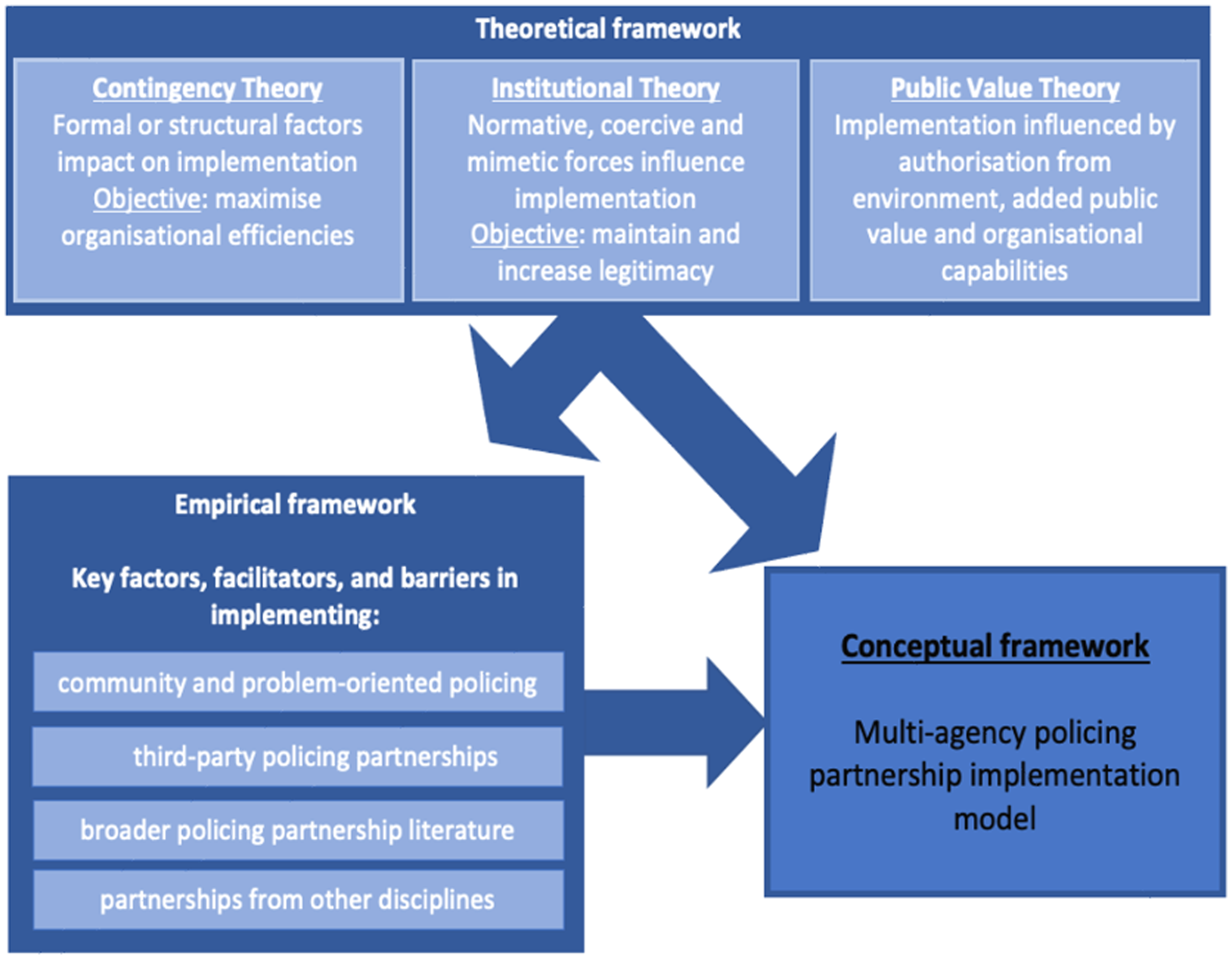
Development of conceptual framework.
Theoretical framework
No single organisational or criminological theory adequately explains partnership implementation and engagement by police agencies, and multiple theories can be applied (Birken et al., 2017). This research adopts three theories – structural contingency theory (Donaldson, 1995; Smith, 2019), institutional theory (Meyer and Rowan, 1977; Scott, 2004, 2005; Willis and Mastrofski, 2011; Worden and McLean, 2017) and public value theory (Benington and Moore, 2010; Moore, 1995) – each of which provides a different perspective and originates from different contexts, to help explain what impacts effective partnership engagement and is required for long-term sustainability.
Structural contingency theory, developed within the context of a profit-based organisation with quantifiable outcomes, explains the rational process of adopting new ideas (Donaldson, 1995). Institutional theory, which originated from studies of education as an institution, expands on purely rational processes and suggests that the implementation of partnerships is influenced by mimetic, coercive and normative forces (Donaldson, 2001; Meyer and Rowan, 1977; Mintzberg, 1983). Finally, public value theory, which originated in studies of the public sector, focuses on improving the working of public organisations, particularly in terms of their efficiency (Moore, 1995, 2013).
Structural contingency theory explains the rational or formal factors involved in partnership implementation, institutional theory adds to these by exploring social, cultural and environmental or informal factors, whereas public value theory examines partnerships through the lens of the legitimacy, ‘authorising environment’ and ‘added value’ of the partnership to the participating agencies and broader environment. Collectively, this theoretical framework suggests that for a public organisation, and partnership, to survive and continue to provide value to the community, it needs to embrace opportunities and adopt appropriate formal and informal factors (Donaldson, 1995; Meyer and Rowan, 1977; Moore, 1995; Scott, 2004; Van Felius, 2022; Willis and Mastrofski, 2011). In this research, structural contingency theory provides a guide to identifying formal aspects impacting on partnership implementations, such as organisational structure, including the level of centralisation or decentralisation, and policy and procedural frameworks (Donaldson, 2001; Koberg and Ungson, 2016; Maguire, 1997; Mintzberg, 1983; Zhao et al., 2010). Institutional theory assists in exploring informal aspects, such as expectations, beliefs, culture and ‘how’ things should be done (Ashworth et al., 2009; Scott, 2005). Public value theory extents both of these theories by recognising the importance of the environment ‘authorising’ implementation of the partnership; in particular, the rationale for conceptualisation and formation, and subsequent continued support to maintain the partnership (Skidmore, 2006).
Empirical framework
The theoretical framework was used as a starting point to identify formal and informal factors that impacted on the partnership and key elements in the environment that authorised the partnership. The key selection criteria for including empirical studies were the initiative itself and also documented operational issues related to conceptualisation of the partnership. Studies were sought from community and problem-oriented policing, and from health, child services and community justice group research involving partnerships (Van Felius, 2022). Community and problem-oriented policing were chosen because of their close relationship to TPP (Bullock et al., 2021; Eck, 2019; Ferrandino, 2014; Scheider et al., 2009; Skogan, 2019). Both problem-oriented policing and TPP emphasise the use of a systematic problem-solving process in much the same way (Eck, 2019; Eck and Spelman, 1987; Scheider et al., 2009), whereas TPP and community policing both engage others to assist with crime prevention and control (Mazerolle and Ransley, 2006, 2019; Skogan, 2019). Other partnership studies from health and social services were also reviewed to ensure that as many factors as possible were covered. Review of these broader empirical studies focused on exploring the formal and informal factors and ‘authorisation’ in the environment that impacted on the implementation and sustainability of the initiative under examination. Across the studies, all factors identified as being relevant to partnership success were listed, examined, compared and then consolidated (Figure 2).
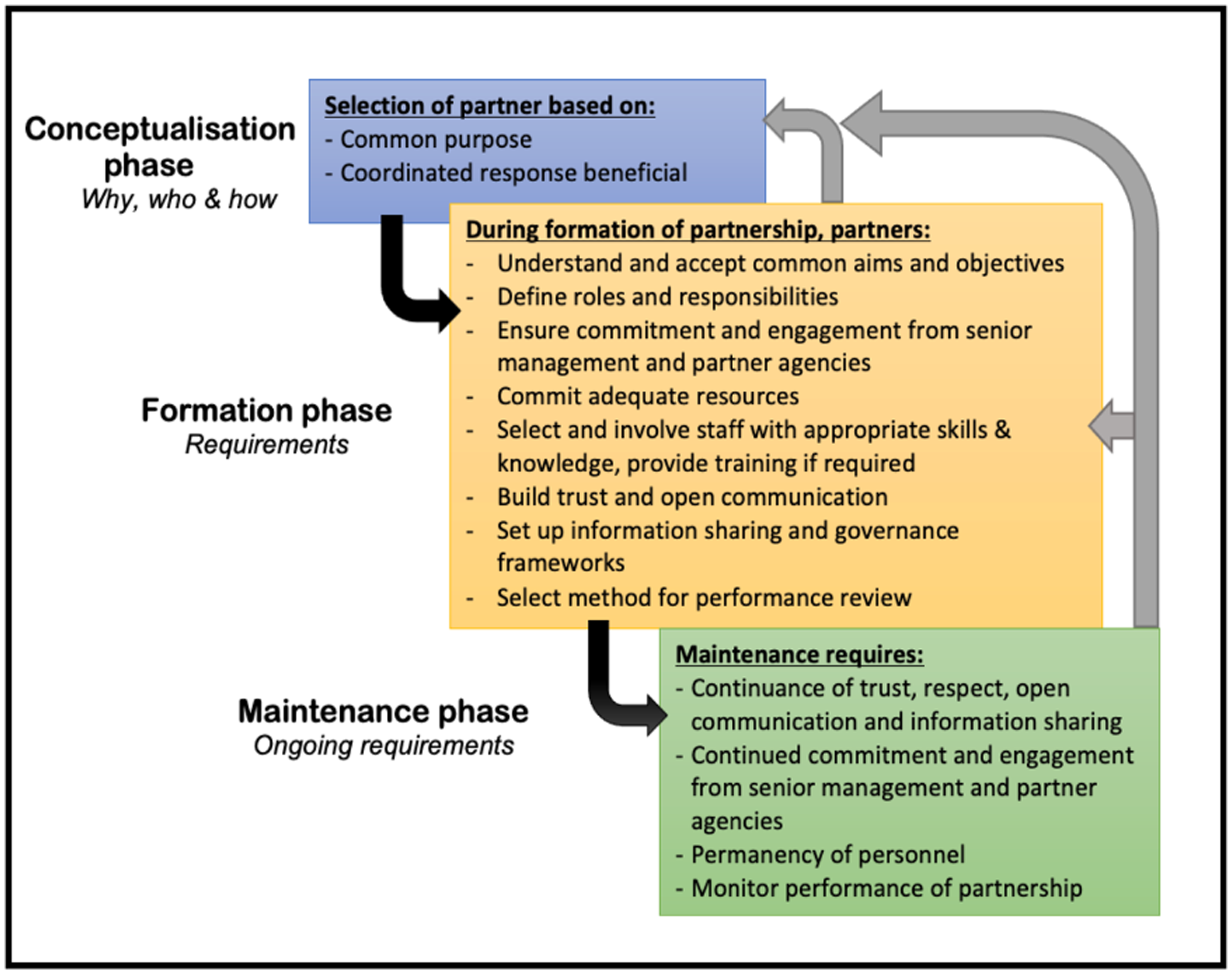
Conceptual partnership model. Source: Van Felius (2022).
Conceptual partnership model
Consolidating the learning from this review revealed three main phases of sustainable policing partnership implementation: (a) conceptualisation of the problem and the identification of suitable partners; (b) forming the partnership; and (c) continuance and maintenance of the partnership for the time needed to address the problem (Addison, 2015; Meyer and Mazerolle, 2013; Sloper, 2004; Van Felius, 2022). The phases are interdependent and the extent to which execution of one phase is successful has an impact the next phase (Figure 2).
Emphasis in the conceptualisation phase is on the analysis and articulation of a crime or social problem (Braga and Weisburd, 2019, Diamond et al., 2004; Goldstein, 2003; Van Staden et al., 2011) and the realisation that this issue cannot be addressed effectively by one agency (Rosenbaum, 2002). A coordinated response is necessary to address the underlying causes and provide a long-term solution to the crime problem (Gilling, 2005; Homel and Brown, 2017; Thom et al., 2013; Van Staden et al., 2011). This phase contains a second component: the identification of potential partners who can add value to the partnership (Addison, 2015; Meyer and Mazerolle, 2013; Sadd and Grinc, 1994; Skogan, 2006, 2019).
Once a conceptualised idea shifts to an actual partnership, coordination and integration are needed to ensure its success and longevity (Grone and Garcia-Barbero, 2001). The level of partner engagement is influenced by eight key factors, some of which are more ingrained than others. First, clear partnership aims and objectives are necessary to gain the interest and engagement of partner agencies (Gilling, 2005; Meyer and Mazerolle, 2013; Skogan, 2019). These aims and objectives should be realistic and achievable (Addison, 2015; Bond and Gittell, 2010; Sloper, 2004), and should be formulated jointly and fit the mission of each partner agency (Cherney, 2004; Lander, 2008; Van Staden et al., 2011).
Second, each partner agency needs to understand how it can contribute, and its role and responsibility in the partnership along with that of the other partners (Bond and Gittell, 2010; Criminal Justice Inspection Northern Ireland, 2014; Van Staden et al., 2011). In addition, partner agencies require understanding of the capacities and organisational boundaries of the other agencies to avoid misperception and over-expectation (Bond and Gittell, 2010; Meyer and Mazerolle, 2013).
Commitment was identified as a third factor. Partnerships require commitment from staff at different organisational levels. Commitment from senior management is necessary to ensure a fourth factor: the development of information-sharing and governance protocols (Cherney, 2004; Disley et al., 2009; Williams, 2009). In addition, agency commitment is required for a fifth factor of ensuring sufficient resourcing and the allocation of staff with the ‘right’ personalities, skills and expertise, and sufficient authority to make decisions (Gilling, 2005; Krogh, 2017; Shaftoe, 2004). Staff should have protected time for partnership work (Cheminais, 2009; Cooper et al., 2016; Sloper, 2004). Personal commitment is required for actual attendance and a willingness to communicate openly, listen to the suggestions of others and think outside the box (Gilling, 2005; Thwaites, 2013).
Trust in a partner agency and its representative was identified as a sixth factor that significantly impacts on partnership engagement (Gilling, 2005). Trust facilitates open communication and information-sharing (Bundred, 2006; Disley et al., 2009). Whereas sharing of information is often facilitated by protocols and understanding the rationale for needing the information and its application, trust is an important determining factor in whether information will be shared (Diamond et al., 2004; Disley et al., 2009; Van Felius et al., 2023; Van Staden et al., 2011). Information-sharing is the seventh essential factor and is required to identify and articulate the social or crime problem and find solutions (Kleemans and Huisman, 2015; Meyer and Mazerolle, 2013; Van Staden et al., 2011).
Finally, an eighth factor identified from the empirical review is performance measurement. The ability of partners to adequately measure their performance is necessary to ensure continued funding and support, and subsequent functioning of the partnership. However, performance measures for partnerships need to include suitable methods that may extend beyond traditional policing and measurement strategies. Specific metrics and data sets may be have to be developed for this purpose (Huisman and Kleemans, 2014; Loveday, 2005; Thwaites, 2013).
The last phase, the maintenance phase, focuses on continued engagement and the commitment of senior management and partner agencies. Continuance of trust, respect and open communication is imperative, as is the ongoing commitment of senior management and engagement of partner agencies. Trust, respect and open communication are impacted by staff turnover; therefore, the permanency of personnel committed to partnership work is preferable. Finally, performance requires monitoring to ensure partnership work is making a difference to the social or crime problem it is attempting to address. However, as Breckenridge et al. (2015) suggest, the last phase can only be entered into when the partnership is formalised by written agreements and protocols.
Methodology
This article uses a case study approach to examine TPP initiatives. Case studies were selected based on seven criteria: (a) the partnership was established to address a significant community or crime problem; (b) the focus of the multi-agency partnership was to reduce the risk of crime occurring; (c) legal levers were clearly available to partner agencies; (d) police played a significant role in the partnership; (e) the partnership consisted of multiple regulatory agencies or agencies that utilise other forms of legal levers; (f) the police agency was in a commonwealth jurisdiction; and (g) the police agency was in an English-speaking country. Following discussion with domestic and international policing scholars and various policing agencies, three case studies were selected from two policing agencies to which the research team had access and who were interested in participating in the study, met all criteria and all key stakeholders indicated a willingness to participate in the research. These partnerships were: the South Brisbane Coordinated Community Response (CCR) group, the North Brisbane Liquor Industry Accord Group (LIAG) and a multi-agency public protection arrangement (MAPPA) in one England and Wales police jurisdiction 1 .
The three case study examples differed in maturity and the extent to which they were supported by legislative and procedural frameworks. This allowed for cross-case comparison of factors impacting on continued partnership engagement (Yin, 2014). Fieldwork largely comprised interviews and was conducted between 2017 and 2018. The objective of the research was not to quantitively examine the strength of the partnership relationships or outcomes, but to qualitatively describe and explain the practical functioning of these TPP partnerships and explore key factors that impact on obtaining and maintaining partnership engagement in different contexts.
Given the explorative nature of this research, our aim was to gain insights into stakeholders’ experiences regarding partnership engagement. Central to this are the perceptions of a wide range of stakeholders (Table 1) regarding factors that impact partnership engagement and sustainability. Although the cases are located in different jurisdictions, comparisons are drawn through ‘reflections’ that were apparent in the different contexts.
Case study participants.
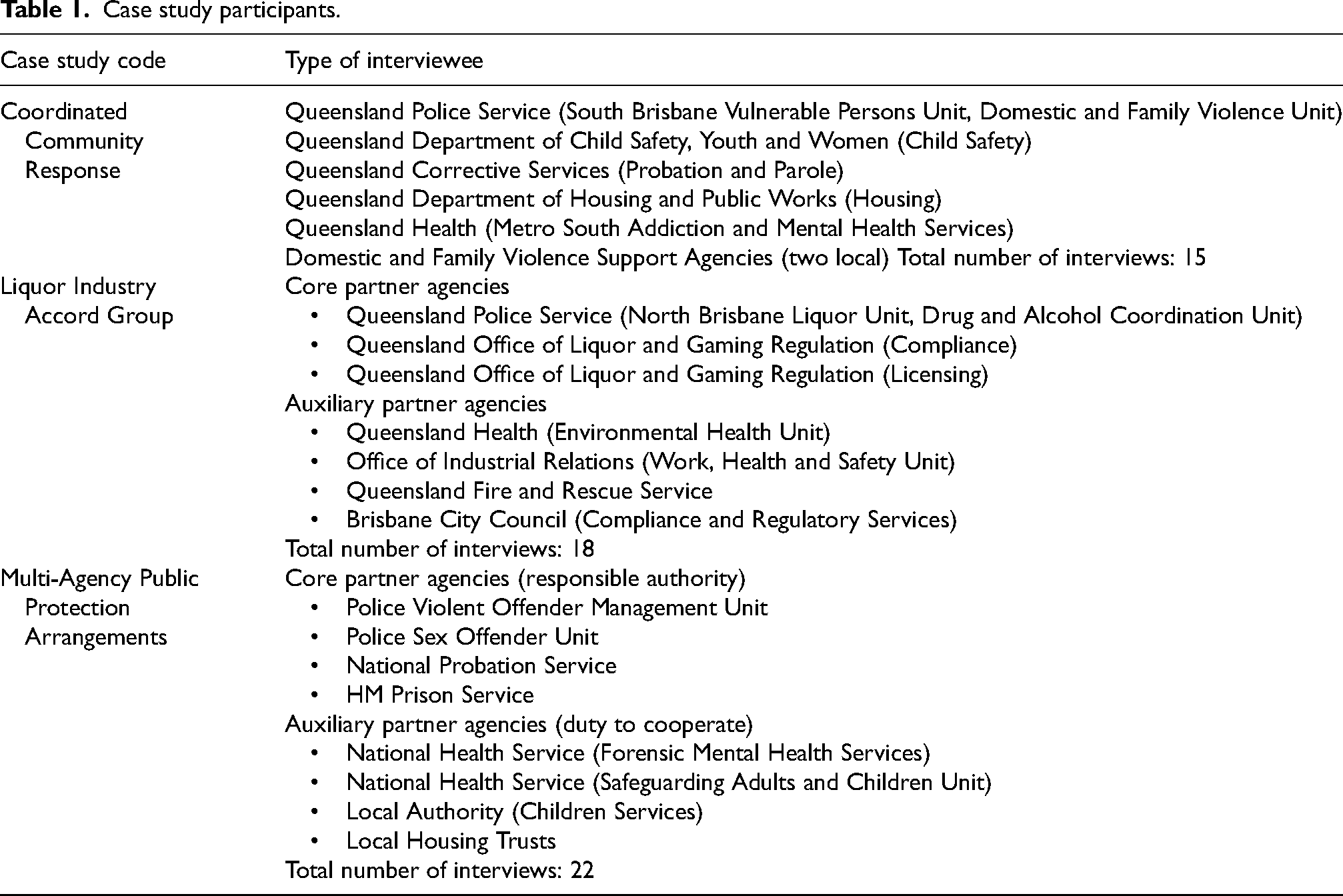
In total, 55 semi-structured interviews were conducted with police officers ranging in rank from assistant commissioner to senior constable, staff members and members of each of the other agencies involved in the three partnerships. Interviewees’ roles ranged from front-line workers and liaison officers to strategic positions, allowing for all-round perspectives on each case. Although primarily to provide context, legislative and procedural frameworks, and partnership agreements were also examined, some of these were publicly available and some were requested.
In all three cases, the liaison officer was a senior police officer actively involved in the partnership. The liaison officer was asked to provide a contact list of police officers, police staff and partner agency staff actively involved with the partnership. All but four of the invited participants from the police and actively participating partner agencies took part in the study. Interviews ranged from 45 to 75 minutes in duration.
The results were analysed using both inductive and deductive methods with the assistance of NVivo and were complemented with manual coding. The text was initially analysed deductively based on the themes derived from the conceptual framework. During this process, other themes were identified and inductive analysis was used (Braun and Clarke, 2006). The analysis was conducted in four stages: (a) understanding the data using broad coding derived from conceptual model; (b) identifying patterns in and between the themes and subthemes; (c) understanding what links and influences the themes and subthemes; and (d) formalising and systemising the data in a coherent set of explanations (Houghton et al., 2015; Miles et al., 1994; Morse, 1994).
Findings
The interviews and documents indicated that of the three partnerships only MAPPA was formalised and thus in the maintenance phase. The CCR group was in the process of completing formal arrangements; however, these were not completed at the time of the case study. LIAG had formal arrangements in place between two of multiple partner agencies. The results of the data analysis indicated that all factors outlined in the conceptual model were relevant. However, some factors were mentioned more often than others within each case study. Across the three cases, the analysis indicated that five factors were consistently identified as being important, namely the need for: (a) clear aims and objectives for the partnership; (b) commitment from management and all involved in partnership working and adequate resourcing; (c) trust, respect and open communication between the partners; (d) information-sharing; and (e) measuring the performance of the partnership. Each of these five factors, and how they interact, are discussed in greater depth below per case, prior to summarising the findings across all cases. The first case study discussed is the CCR group, followed by LIAG and finally MAPPA.
Case study 1: CCR group
Background
The CCR group was conceptualised by the Queensland Police Service (QPS) in 2016 in response to increases (in severity and volume) in reported domestic and family violence incidents. Agencies participating in the partnership were the Queensland Department of Child Safety, Youth and Women (Child Safety), Queensland Corrective Services (Probation and Parole), Queensland Department of Housing and Public Works, Queensland Health (Metro South Addiction and Mental Health Services) and two local domestic and family violence support agencies. Information-sharing was facilitated by the Domestic and Family Violence Protection (DFVP) Act (QLD) 2012 and the protocols of the individual agencies; however, no other formal arrangements had been implemented at the time of the case study. Partners came together once a week to discuss high-risk cases. A total of 15 semi-structured interviews were conducted across all partner agencies: 8 with police and 7 with partner agencies. Police participants in this case are identified as CP and partner agency participants as C. Participants are given a number in order of interviews.
Results
Aims and objectives
Interviewees commented that agencies had been invited to join the CCR group without a clearly documented partnership aim and objective. This impacted on obtaining engagement from potential partner agencies: [T]hey [partner agencies] were asking some questions as well, more along the lines of what they were doing, what objectives and how they thought it would fit in. (CP6) [W]e probably needed to document some of our strategic objectives a little bit better about what we were trying to achieve as a group, I think it was a bit of an afterthought in some respect … because I am sure some people came to the table who said, ‘I don’t know why I am here’. (CP8) [T]o check that the police response has been according to the legislation and was the appropriate response to the incident. (C7)
Commitment and resources
The lack of clear aims and objectives for the partnership impacted on commitment to it. Without clear aims and objectives, partner agencies found it difficult to determine the value of their contribution and whether it aligned with the aims and objectives of their own agencies.
QPS interviewees, however, had a different perspective on the need for alignment of each agency's aims and objectives with the partnership. Their perspective was that everyone's aims and objectives should be acknowledged and accepted, in addition to agreeing and committing to common aims and objectives for the CCR group: [E]veryone had to sort of step back and accept, this is where you are coming from, this is what your agenda is that you have to meet, but how do we discuss it so that everyone is trying to make the objectives and agendas they want to meet. (CP1) … the other challenge from the QPS perspective was number one getting the OICs [officer in charge] onboard, getting staff onboard, getting them to understand. For me, it was a really simple concept, but they didn’t seem to understand. (CP6)
In addition to the quantity of resources, the quality was also relevant. The partnership was perceived as working well because of the individuals involved; having the ‘right’ people with the right personalities, who were willing to contribute without having personal agendas. This in turn promoted trust, respect and open communication.
Trust, respect and open communication
Trust, respect and open communication were negatively impacted by participants not understanding the aims and objectives of the partnership, which affected what everyone was expecting and caused misunderstandings. However, as the partnership developed, and participants were communicating more, understanding of how everyone fitted in and what the partnership could achieve improved. This promoted trust, respect and open communication: … trust is the biggest thing: you can put ten people in a room and tell them they can talk about anything, and they won’t until they trust the other people with that. (CP2) [A]t the first meetings, they [partner agency participants] didn’t want to discuss cases or give too much information because they felt that would initiate action on behalf of the police or probation – they gave that sort of information. (CP1)
Others commented that having non-government agencies with different legislative and procedural frameworks in the partnership caused a barrier: … it wasn’t an issue for me and government sharing with police, because we can share with government partners, but it certainly was an issue with NGOs [non-government agencies] at the table. (C13)
Performance
Interviewees commented that resourcing was impacted by the difficulty of measuring performance. The ability to measure performance in a quantitative format giving a measurable outcome for the partnership was a key consideration for providing resources. Some interviewees suggested that the partnership’s performance was considered difficult to measure because of its preventative aim and objective: [W]e would not know how to measure performance. (CP2)
In summary, interviewees commented that the CCR group lacked clear aims and objectives and performance measures, impacting on gaining commitment and resourcing. At the same time, one of the rationales for conceptualising and forming the partnership was information-sharing and providing a coordinated response. However, without clear aims and objectives, trust, respect and open communication were impacted, which affected information-sharing.
Case study 2: LIAG
Background
The LIAG was conceptualised by the QPS as part of a government initiative after two young men were killed near licensed premises in alcohol-fuelled assaults in 2005. Other agencies involved were the Queensland Office of Liquor and Gaming Regulation (OLGR), Queensland Health (Environmental Health Unit), Office of Industrial Relations (Work, Health and Safety Unit), Queensland Fire and Rescue Service and Brisbane City Council (Compliance and Regulatory Services). The QPS and OLGR, both have compliance responsibilities under the Liquor Act (QLD) 1992 and have a long-running engagement, formalised in a memorandum of understanding (MOU) to cooperate. However, there are no formal arrangements with the other partner agencies, referred to as ‘auxiliary’ regulatory agencies in this study. Periodically, the LIAG runs a joint enforcement operation in which they visit several licensed premises. These visits often occur after business hours and when these premises are in full operation and at their busiest. A total of 18 semi-structured interviews were conducted with participants: 7 with QPS, 4 with OLGR and 7 with representatives of the other agencies. Participants were given a number in order of interviews. QPS participants in this case are identified as LP, OLGR participants as LO and auxiliary partner agency participants as L.
Results
Aims and objectives
Participants from the auxiliary partner agencies did not indicate much awareness of the overall aim and objective of the LIAG to prevent and control alcohol-fuelled violence near licensed premises through ensuring complete regulatory compliance. They provided a more self-focused obligation of fulfilling their own agencies’ aims and objectives for joining the LIAG. From the interviews it became clear that the LIAG was very much a group of individual agencies attending a venue together, not necessarily to achieve a common goal, but to achieve their own organisational aims and objectives.
In addition to not fully understanding the aims of the partnerships, some of the agencies, including the QPS and OLGR, had conflicting objectives or were not aligned with the partnership's aims. For example, within the liquor industry space, the QPS’s aim is to enforce the law, whereas OLGR has a dual aim of enforcing compliance under the Liquor Act and promoting the entertainment industry. To achieve the aims of both agencies was difficult and resulted in different approaches. Whereas the QPS would issue a fine on the spot, OLGR officers had less authority, had to seek approval, had a longer decision-making process and were often more lenient, causing inconsistent penalties across liquor licensees: [W]e clearly do have some barriers and frustrations, and I think that comes down to just having different priorities, different focuses. (LP4) [T]he fire service has an image of helping people, whereas when we go in en masse with the others, it kinds of detracts from that… if we are being seen as more of a police role, coming in the middle of the night with surprise … it may detract from them allowing us to carry out those local action plans… if they see us as more of an authority figure they may be more reluctant to let us do that. (L18)
Commitment and resources
The lack of awareness of LIAG’s aims and objectives impacted on partnership engagement and the commitment of the auxiliary agencies. They participated in the LIAG operations only when the list of target venues was beneficial for them, they had sufficient overtime available and there were no competing higher demands. This lack of full participation had an impact on achieving the overall aim and objective of the LIAG. The ‘auxiliary’ partner agencies participated in the LIAG operations because it provided them with an opportunity to attend outside their regular business hours when these venues were in full operation, while still complying with their work, health and safety regulations because of the ‘security’ the police provided: … the workplaces we visit with the LIAG are specific and normally they work at night; in our case we work from normally from 6.30 a.m. till 6 p.m. and we cannot reach these venues. But with the LIAG, our management team are happy to release us and give us the chance to reach these kinds of workplaces. (L9)
Other benefits included networking opportunities with other regulatory agencies, and the ability to access the QPS’s stronger powers of entry, especially when licensee holders refused entry or cooperation with the auxiliary agencies, as well as showing licensees that compliance was enforced 24/7.
Trust, respect and open communication
Partnership engagement between OLGR and the QPS was different from that with the auxiliary agencies. These three elements were deemed imperative between OLGR and the QPS because of the need to show a ‘united front’ to licensees, particularly because venue operators were sometimes unable to differentiate between the QPS and OLGR: … the trust and respect thing is an ongoing matter, we constantly have to keep doing it and every time our people don’t get what they want, they feel like they have been disrespected and that their skills are being disrespected. (LP4)
Similarly, the auxiliary agencies did not require any information-sharing, because they participated to enforce their own regulations. However, information-sharing between the QPS and OLGR was imperative. Even though information-sharing was formalised in the MOU, this was not without difficulties. QPS participants commented that sometimes information was not shared because of ongoing criminal investigations; however, this was not always understood. On other occasions, there appeared to be a lack of trust between OLGR and the QPS: [The] police will often have a reticence to share certain information with local OLGR officers because they simply don’t trust, they are not going to tell the industry. (LO1)
Performance
The performance of the LIAG was not measured. The QPS collated all the information and used it for internal purposes. Performance was difficult to measure because ‘a good outcome is when nil issues are found’ (LP8); however, some interviewees wondered whether this caused a lack of commitment and dedication of resources from senior management.
In summary, except for the two core agencies, the QPS and OLGR, the others were not really aware of the aims and objectives of the LIAG. They joined the target operation when it aligned with the objectives of their own agency. This affected commitment and resources. Individual trust, respect and open communication were also not seen as important by the auxiliary partners. However, they were deemed very important between the QPS and LIAG, impacting information-sharing. Performance was not measured, and some suggested that this had an impact on senior management’s commitment and resourcing.
Case study 3: MAPPA
Background
The MAPPP in this case study involved one territorial police force 2 in the England and Wales jurisdiction. MAPPA were initially developed in the 1990s across England and Wales as a partnership between police and probation services, against a background of increasing social and political concerns about violent and sexual offenders in the community (Yakeley and Taylor, 2018). Enactment of the Criminal Justice Act (UK) 2003 expanded MAPPA to include prison services and other agencies who were to work together in a two-tiered partnership with police and probation to proactively assess and manage future risk of harm posed by certain violent and sexual offenders (Bryan and Doyle, 2005; Yakeley and Taylor, 2018). Under the Act and related MAPPA guidance (Ministry of Justice National Offender Management Service, 2018), a first tier of agencies, involving a partnership between police, probation and prison services, referred to as the responsible authority (RA) can require a second tier of agencies to cooperate. This second tier consists of a range of government agencies and local authorities, referred to as duty to cooperate (DTC) agencies (Ministry of Justice, National Offender Management Service, and HM Prison Service, 2018; National Offender Management Service, 2016). In this case study, the other agencies involved were the National Health Service (NHS), local authorities and trusts. A total of 22 interviewees participated in this study: 7 police participants, 7 RA participants and 8 DTC agency participants. Similar to the other case studies, participants were given a number in order of interviews. Police participants are identified as MP, participants from the RA partner agencies as MR and the DTC partner agency participants as M.
Results
Aims and objectives
Most interviewees perceived the main objective of MAPPA as being to reduce the risk of harm through sharing information in a coherent and structured manner, and discussing and coordinating resources and expertise to enable a better response and management of high-risk offenders: [T]he aim and objective is collaborating on information that they [the RA] have, the lateral check and balances that need to be made, and that people have the right facts. (M14) [I]t's just trying to see the bigger picture rather than just looking at it with your police hat on. I suppose the overall objective has got to be to manage the risk and then whichever way we do that we try a number of different options. (MP7)
Although each of the participating agencies agreed on these common aims of MAPPA, the outcomes of achieving these aims of the partnership were not always congruent with the objectives of its own agencies. MAPPA was focused on reducing risk to the offender and the public; however, reducing risk was perceived differently by individual agencies, sometimes causing conflict. This was especially evident between the RA agencies in the ‘early days’. Police saw arrest and recalling an offender into custody as the only way to reduce the risk, whereas National Probation Service
3
interviewees saw their agency's aim and objective as almost the opposite: … from the police point of view, their role is to lock up people who commit offences and to keep them locked up. So, they are not a danger to the public. Whereas our job is very much to rehabilitate them and get them back out in the community. (MR3) [W]e [police] are more arrest focused as a whole; the more arrests we make, the better we look, probation the less re-calls they do, the better they look. (MP20)
Over time, perceptions of how to achieve the objectives of reducing the risk posed by an offender gradually changed. Although the police involved in MAPPA originally had a ‘lock them up and throw away the key’ attitude, they were moving more towards the National Probation Service ideology of reviewing all options to reduce the risk and manage offenders in the community first, before requesting a re-call into custody. Some interviewees even commented that the role of the police in the dedicated offender management units and probation was no longer that different: I’ve actually had police turn around and say don’t re-call this person yet, what else can we put in place. (MR18) [P]robation in the early MAPPA days was still very much social work-based, whereas the police potentially are more enforcement and punitive even, and I think probation has had to move closer to the police and the police have had to move closer to probation in order to have an effective alliance. You know there's definitely had to be a shift, I think a bit of a culture shock to be honest. (MR21)
Commitment and resources
Robust risk assessment was based on a sharing of all information and expertise during the MAPP meetings, making full attendance necessary. However, attendance at the meetings was influenced by agency commitment, which was subject to funding and an understanding of MAPPA’s role by senior management. Non-attendance impacted on the ability to obtain all information in a timely manner, which subsequently affected understanding of the risk the offender posed and completion of a risk management plan: … really difficult, especially Children's Services because if they don’t attend and you’ve got a case where there are children involved, there is nobody else around that table that can take that action, because you haven’t got access to their information. So, it literally ends up having to carry the action over for next time. (MP19)
The commitment of all agencies was also imperative for risk management of the offender, because each agency provided some form of stability to the individual, whether it was housing, medical assistance or some other service. Resourcing affected participation, and non-participation affected the understanding of some factors, impacting on appreciating the full risk posed by the offender. Overall risk was perceived as consisting of multiple factors making up that risk and each agency was responsible for one or more factors: [F]or probation, the bread and butter is protecting the public and preventing further victims, it is about risk assessment and risk management. For housing, they’re risk assessing in terms of accommodation, not necessarily offending, but when they come into MAPPA, they are part of that. (MR10)
However, agency commitment was affected because not all senior managers, across the agencies, understood the role of MAPPA, affecting ongoing allocation of sufficient resources at practitioner level: [Y]ou don’t always get the social worker attending, and I think that's pivotal … and if any agency, I think, is maybe not understanding of the MAPPA or not acknowledging the importance of MAPPA. (MR18)
Trust, respect and open communication
Trust, respect and open communication were considered imperative for proper functioning of the partnership; however, this was based on personal rather than organisational relationships. Once trust and personal relationships were established it was easier to discuss matters and share information, get things done, accept each other's professionalism and judgement, and acknowledge that nobody was perfect and mistakes sometimes occurred: … cases that had a very sad outcome have been where we haven’t shared information well, where the relationships haven’t been there or sometimes where the relationships were difficult because they were not locally based. So, you’re sharing information away from yourselves and you haven’t worked on that relationship, so for me it's very important that you have that trust of one another. (MP4)
However, trust and respect were impacted by several factors, such as having the ‘right’ staff participating, with the appropriate level of skills, expertise and motivation. In addition, for the DTC agencies, this included understanding the rationale behind the decisions being made, understanding where everyone fitted in, deliverance on promises and understanding and respecting the partnership itself: [Y]ou also need to respect the partnership and one another by delivering on any promises you’ve made. (M15)
Trust and respect between the agencies influenced information-sharing. Sharing of information was one of the rationales to conceptualise MAPPA. The MAPPA framework promoted information-sharing and everyone had a duty to share. It was only when all available relevant information was shared that the full risk an offender posed to the public could be understood.
[W]e may not see the big picture, but you’ve got to feed the information in, because when you are not feeding the information in, you could miss that vital part of that puzzle, which is not going to build that picture of that individual and it could be that vital part which causes another serious offence or a serious case review. (MR6)
[W]ithout the sharing of information, then the risk is not manageable. (MP8)
However, before every MAPPA meeting, a confidentiality waiver had to be signed by each individual participant. Unfortunately, this personalised information-sharing, impacting on the transferability of cases, and making the permanency of personnel an important factor. Not all information could be recorded, and when individuals did not attend or moved on this had an impact on any in-depth knowledge of offenders.
Performance
Some participants suggested that the lack of commitment was due to performance not being assessed, primarily because preventative work was difficult to measure. One participant suggested that the difficulty in measuring performance and each individual agency's contribution affected resourcing and protecting work time to dedicate to MAPPA: [A]lthough we are supported, it could be better, and I personally think it comes down to not being able to measure our performance. (MP20)
Discussion
This study used a cross-case methodology of three TPP partnerships to address the two research questions: (a) what are the key factors that are instrumental to the processes of conceptualising, forming and maintaining TPP partnerships; and (b) how do these factors interact? To answer these questions, a conceptual model was used to guide data collection and analysis. The conceptual model was based on a theoretical and empirical framework. Structural contingency, institutional theory and public value theory were chosen to guide the exploration of factors imperative to building sustainable partnerships in relevant empirical studies. These three theories were chosen because they complemented each other in recognising the importance of and interaction between formal factors (such as organisational structures, policies and procedures), informal factors (including culture, expectations and beliefs), the environment in which police agencies operate and the continued need to maintain or regain legitimacy.
The three chosen partnerships differed in terms of maturity, level of formalisation and structure, were across two jurisdictions and involved different partner agencies. The CCR group did not have any formalised agreements between its partner agencies; in the LIAG, two agencies had an MOU, but the second group did not, forming a loose coalition working together when it was in the benefit of an individual agency; whereas in MAPPA, the agencies were legislated to work together.
Despite, these differences, this study identified five key findings. Finding 1, all factors outlined in the conceptual framework (Figure 2) are important, but there are five interdependent key factors that impact most on partnership engagement and sustainability. These are: aims and objectives, resources and commitment, trust, respect and open communication, information-sharing and performance measuring.
Aims and objectives
The first key factor is setting clear and achievable aims and objectives. This was highlighted in both the CCR and MAPPA partnerships. Whereas in MAPPA these were well established and understood, this was not the case in the CCR group. Within the CCR group, planning and documenting objectives should have been done more clearly in the conceptualisation phase. This would have aided with obtaining internal organisational support and continued partnership engagement. A lack of understanding of the aims and objectives also affected the LIAG partnership. Each of the agencies focused on achieving their own aims and objectives; however, inversely, through their contribution, they achieved complete regulatory enforcement. In addition to understanding, the need for some alignment of the aims and objectives of the partner agencies and the partnerships is also necessary. This was evident in all three cases and especially in LIAG, where misalignment between organisational and LIAG's aims and objectives led to inconsistencies in regulatory approaches causing conflicts with the community. This finding, and previous research indicate that the aims and objectives of the partnership should be outlined and communicated clearly within each agency and across the partnership (Laycock 2005). This is necessary to identify relevant partners and gain internal and external stakeholder support at conceptualisation, and impacts positively on continued partnership engagement and internal and external commitment throughout the formation and maintenance phases. For continued partnership engagement and commitment, some alignment or overlap between the aims and objectives of the partnership and the partner agencies is necessary (Addison, 2015; Bond and Gittell, 2010; Cairns and Harris, 2011; Cheminais, 2009; Cooper et al., 2016; Sadd and Grinc, 1994; Skogan, 2008, 2019; Sloper, 2004). Finding 2, this study extents these previous findings, in that it is more important to understand the aims and objectives of the partnership and how each agency can achieve their own aim and objective within the broader goal of the partnership.
Resources and commitment
The three case studies further highlighted that resources and commitment to partnership working are interrelated. As others have suggested, partnership working requires leadership, engagement and commitment from senior level members (Disley et al., 2009; Thom et al., 2013). At the same time, this commitment must be followed through by the provision of appropriate resources and staff with sufficient time allocated for partnership working (Cairns and Harris, 2011; Cheminais, 2009; Cooper et al., 2016; Sloper, 2004), authority and decision-making powers (Cherney, 2004). In this study, we had similar findings: an insufficiency of senior management commitment resulted in a lack of funding and ‘protected’ time to undertake joint working activities, affecting long-term sustainability. Finding 3, this study further found that the quality of staff, particularly the necessity of having staff with the ‘right attitude’ was more important than expertise and training.
Trust, respect and open communication
The finding that having the ‘right staff’ influences the third key factor of building and maintaining trust, respect and open communication in the partnership and between the partnership and partner agencies coincides with previous findings (Bond and Gittell, 2010; Cairns and Harris, 2011; Cheminais, 2009; Gittell, 2011). Finding 4, in our study, there was a more pronounced difference between organisational and individual trust and respect. Organisational trust and respect were considered more important in LIAG, whereas in the CCR group and MAPPA engagement was built on individual trust and respect. The three case studies show that trust, respect and open communication are influenced by the type of relationship within the partnership. Partnership engagement in MAPPA and the CCR group was based on personal relationships; however, this was not the case in LIAG, where the individuals participating in each enforcement operation varied.
Information-sharing
If trust and respect are lacking between partners, this negatively impacts information-sharing (Gilling, 2005; Thwaites, 2013). Even if information-sharing is supported by legislative and procedural frameworks, as shown in these case studies, they are often perceived as complex and hindered by the risk-averse nature of agencies. The primary concern is not the sharing, but what happens with the information once it is shared. This was especially evident in the CCR group case study in which non-government agencies participated in the partnership. The complexity of sharing information is also raised in previous research. Informal factors such as trust and respect between participants, clear guidance on what can be shared (Disley et al., 2009; Van Staden et al., 2011) and understanding the context and relevance of the information (Meyer and Mazerolle, 2013) all impact on information sharing.
Performance
Measuring performance was difficult. The partnerships in the three case studies focused on preventing crime, which is difficult to measure. None of the case studies had quantifiable performance measurements in place to gauge outcomes or the effects of the partnerships on the crime they had partnered up to prevent and control. Indirect results were measured in the three case studies, because there was a lack of reliable data and assessment to ascertain the effects of the partnership. This difficulty in measuring performance was perceived to affect consistent and long-term executive commitment and resourcing in MAPPA. This coincides with the findings by other scholars, who note that measuring performance is necessary to monitor the effectiveness of the partnership and for continued funding (Loveday, 2005; Thwaites, 2013); however, this study extends these findings, in that measuring performance is necessary to secure long-term commitment from senior management (finding 5).
Structural contingency, institutional and public value theory all assisted in reaching these findings. Implementing sustainable partnerships requires structural contingency factors, particularly regarding information-sharing guidelines, amendment of organisational structures such as decentralisation, clear lines of communication, quantity of resourcing and allocation of dedicated time to partnership work. At the same time, continued partnership engagement is impacted by institutional factors that influence the acceptance of aims and objectives, the willingness of staff to work in partnerships, trust, respect and open communication, and a willingness to share information. Finally, public value theory assists in understanding the drivers required to conceptualise a partnership, the rationale for joining the partnership and the impact of these partnerships’ aims and objectives on continued engagement.
Limitations
Although this research has addressed an important gap in the literature by examining the key factors required to conceptualise and maintain engagement in TPP partnerships, there are some limitations. First, this research examined three different partnerships across two jurisdictions involving two police agencies. Both jurisdictions involved large police agencies with similar organisational structures. The findings of this research might not be generalisable to partnerships with smaller police agencies. Second, this research was conducted in highly developed countries and thus the findings of this research may not be generalisable to non-western countries.
Conclusion
There are benefits to using TPP partnerships to apply innovative crime-reduction strategies. However, this study adds to our understanding of this approach by examining the key factors that are critical in the conceptualisation, formation and maintenance of these partnerships. Conceptualisation, formation and continued partnership engagement require, as a minimum: (a) clear and achievable aims and objectives; (b) commitment from senior management to allocate adequate resources; (c) the allocation of appropriate staff to ensure trust, respect and open communication; as well as (d) information-sharing and (e) the development of a performance measure. The presence of these five factors should ensure a more effective multi-agency partnership policing approach. However, these factors are interactive and interdependent. The first key factor of clear and achievable aims and objectives should be clearly outlined and communicated within the police agency and across the partnership. This assists with the second key factor – obtaining internal agency commitment and support as well as improved engagement from partner agencies. Commitment drives resources; without sufficient commitment adequate resourcing is impacted negatively. Resourcing should be adequate in terms of both quantity and quality. A partnership without staff who have sufficient expertise, skill, the ‘right attitude’ and authority will not function optimally. Having the ‘right staff’ influences the third key factor of building and maintaining trust, respect and open communication in the partnership agencies and between the partnership and police agency. Information-sharing, the fourth key factor, even if supported by legislation and policies, is impacted by trust, respect and open communication, affecting performance. Measuring performance is the fifth key factor. The performance of partnerships is often difficult to assess, but quantifiable measurement should be attempted. If performance cannot be measured this affects commitment and resourcing long-term.
Footnotes
Declaration of conflicting interests
The authors declared no potential conflicts of interest with respect to the research, authorship, and/or publication of this article.
Funding
The authors received no financial support for the research, authorship, and/or publication of this article.
