



Abstract
This scoping study investigates the state of preparedness of the police and their partners for the potential consequences of the climate crisis in a United Kingdom (UK) context. The research engaged participants at strategic, tactical and operational levels of planning and operations, and conducted a thematic analysis of qualitative data to identify key themes: climate change impacts; why the police should care; prioritisation and preparation; and enabling and impeding factors. The results suggest that the police and their partners may be ill-prepared for the gamut of possible consequences. Preparedness appears hampered by a narrow focus on legislated requirements, short-term planning, lack of funding and resources, and limited prescience. Recommendations are made for redefining planning parameters, strengthening central government engagement, amplifying awareness and understanding of trend analyses, prioritisation of ‘futures’ thinking, ethical considerations and collaborative preparedness. The study has implications for law, public policy and professional practice in the UK, and other global jurisdictions seeking to develop risk assessment processes and preparedness for the consequences of climate change.
Keywords
Introduction
Beyond well-publicised threats to human safety and security from flooding, drought and extreme weather events, other consequences of climate change pose risks to life and human prosperity and threaten to overwhelm the preparedness of public authorities and their partners. These include, inter alia: public health crises; fuel and energy deficits; food insecurity; national security conflicts; organised crime; vulnerable populations; forced migration with climate ‘refugees’ fleeing environmental and societal decay in search of safety and stability; and key infrastructure degradation (College of Policing, 2020; Ministry of Defence, 2018). At the forefront of planning and response, the police and their partners will face acute and chronic challenges from the combined effects of these climate-related phenomena, referred to as ‘cascading’ risks (Mann et al., 2022), arising from the interdependencies, vulnerabilities, amplifications, secondary disasters and critical infrastructure failures that may follow (Pescaroli and Alexander, 2015, 2018).
The purpose of this scoping study is to investigate the state of preparedness of the police and their partners to deal with these potential consequences of the climate crisis in a United Kingdom (UK) context. In particular, the research seeks to identify how prepared the police and their partners are for the gamut of possible consequences of climate change. It engaged participants at strategic, tactical and operational levels of planning and operations, and presents a thematic analysis of qualitative data, identifying four key themes and findings. We aim to identify gaps and challenges in current preparedness efforts and to make recommendations for improving planning, coordination and collaboration among the key stakeholders. The research offers impact on law, public policy and professional practice in the UK, and other global jurisdictions seeking to develop risk assessment processes and preparedness for the consequences of climate change.
Although climate change is a global phenomenon with many causes beyond the control of ordinary citizens most affected, the impacts are localised, requiring coordinated planning, preparation and resilience by and from those responsible for protecting communities. At the UK national level, certain risks are documented in a restricted National Security Risk Assessment, adapted for public consumption as the National Risk Register (NRR) (Cabinet Office, 2023a). The NRR provides a UK government assessment of the likelihood and impact of ‘natural’ hazards, major accidents and incidents, societal risks and malicious attacks, which may directly affect the UK and its interests. Non-malicious risks are refreshed every 5 years and malicious risks every 2 years (Cabinet Office, 2023a). These are locally reflected in community and organisational risk registers, contingency, resilience and business continuity plans. However, the NRR is not without criticism (Mann et al., 2022) over the short-termism of the planning cycle and narrow focus on acute risks only, those seen as ‘discrete events’ requiring an emergency response (Cabinet Office, 2023a). Critically, chronic risks have been omitted and are now considered as matters of ‘policy and operational work’ (Cabinet Office, 2023a: 7); although there is an intention to develop a new process under the Integrated Review Refresh to identify and plan for them (Cabinet Office, 2023b) the specific details are pending. Consequently, this raises concerns about the scope and range of planning preparedness and focus across a plethora of climate-related risks and their potential consequences. Moreover, in setting out specific legal requirements for emergency responders, the unintended consequence of the Civil Contingencies Act 2004, together with resource and budgetary constraints, leads to a local partnership situation (in England and Wales) where the focus is on what must be done as a minimum, rather than what could or should be done over the longer term.
Policing, crime and climate change: The nexus of challenges and responses
The intersection of policing and climate change has two overlapping touchpoints. The first pertains to how climate change, directly and indirectly, stems from and results in unethical, harmful or outright criminal activities. The second concerns climate change as a risk to community safety and security more broadly, but perhaps specifically in terms of its contribution to ‘natural’ disasters and the role of the police and their partners in planning for and dealing with the resulting civil emergencies.
The crime/harm and climate change nexus (Crank and Jacoby, 2015; Hallenberg, 2021; White, 2020) can be examined from two perspectives: the actions contributing to climate change, either directly or indirectly, and the potentially criminogenic consequences of it. The research here stems from theoretical frameworks provided by several established criminological approaches: green criminology (Lynch et al., 2017) with its focus on ecological risks and harms; critical criminology (DeKeseredy, 2011) with attention to the unequal distribution and abuses of power, providing an understanding of how the political and economic systems operate to support the interests of the fossil fuel industry (Global Witness, 2021; Irwin et al., 2022; Liberty, 2023); zemiology with focus on broader social harms over legally defined crimes (Hillyard et al., 2004); and public criminology with attention on criminologists actively engaging in, and influencing public debate, policy and practice (Loader and Sparks, 2010).
Although both individual everyday (Agnew, 2011) and criminal activities (Skudder et al., 2017) contribute to climate change, the main ‘carbon criminals’ (Kramer, 2020) are state and corporate actors (Centre for Environmental Law, 2016; White, 2020). The increasing attention on harmful activities of the fossil fuel industry is reflected in the demographics of environmental protestors, spanning generations, and tending toward the well-educated (De Moor et al., 2020), the surge in climate change litigation (Setzer and Higham, 2022), and the global movement towards ‘ecocide’ having legal recognition (see Stop Ecocide International, 2023 and Ecocide Law, 2023). The UK College of Policing (2020) identifies activities such as enforcing environmental regulations and investigation of corruption and fraud in carbon trading, as among those that may occupy police time in the future.
Climate change may increase the risk of crime and disorder, not necessarily directly or immediately (although this is possible, e.g. in the aftermath of environmental disaster), but as the ‘consequences of consequences’ (Smith and Vivekananda, 2007). The impacts of ambient temperature rise (Ranson, 2014; Rotton and Cohn, 2003) and air pollution from carbon fuel combustion-reliant activities (Bondy et al., 2018; Burkhardt et al., 2019; Lynch et al., 2004; Mapou et al., 2017) on human behaviour are of significance here. There is some research evidence suggesting increased levels of aggression, violence (including sexual assaults) and property crimes associated with higher temperatures (Ranson, 2014). Lynch et al. (2022) emphasise the intricacies of the relationship between climate change and crime, asserting that it goes beyond mere temperature fluctuations; contextualising this relationship within broader socio-economic, environmental and ecological dimensions and suggesting adopting a long-term perspective. The social context of crime, including historical and existing conflicts and structural inequalities, as well as the level of climate change adaptation and mitigation activities, will mediate the outcomes (Buhaug, 2010; DEFRA, 2006; Mares, 2013; Rinderu et al., 2018).
Climate change may exacerbate existing resource scarcities and inequalities in access and distribution. The resulting strains, particularly where they are perceived as unfair and uncontrollable, may be alleviated through antisocial and criminal activities (Agnew, 2006, 2011), providing fertile ground for exploitation by criminal networks. Indeed, a recent Europol (2022) threat assessment details a multitude of complex links between climate change, environmental harm and organised crime. Another likely consequence is weakened social control, in terms of formal structures such as health, social care and criminal justice agencies coping with the impacts of climate change, and community and family bonds coming under duress from human displacement and poverty (Agnew, 2011). Research also suggests that extreme weather events and ‘natural’ disasters are often followed by increased disorder and crime, including organised crime (White, 2020), as well as severe disruption to criminal justice systems’ operations (Garrett and Tetlow, 2006).
Taking all this into account, there are expectations of policing at strategic, tactical and operational levels to respond to catastrophic events and climate-related disasters, ensuring that structures and activities are in place to provide preparedness and response (Brinser and King, 2016; Van Vliet, 2023). However, this should go beyond emergency response alone, to encompass ‘planning, preparation, enduring, restoration, and recovery to risk events’ (Mutongwizo et al., 2019: 610) and account for the significant organisational and socio-psychological impacts disaster policing brings (Adams and Anderson, 2019; Pollock and Augusto, 2023).
As a threat to human safety and security, climate change is acknowledged at a strategic level of policing in England and Wales. The College of Policing (2020) places it, environmental decline and competition for resources as trends driving and defining the context in which the police will operate over the next two decades. It features in a future operating environment characterised by fragility, widening inequalities, compounded shocks and weakened governance (College of Policing, 2020). Similarly, climate change appears in a Strategic Review of Policing for England and Wales (phase 1 and final reports), as a structural trend shaping the context of public safety and security provision (Police Foundation, 2020, 2022). Therefore, the police must have clarity about its state of preparedness, together with its key partners, and what, if anything needs to be done to develop it.
Aims of the research study
The focus of the research study was threefold: (1) to examine awareness and understanding of the potential consequences of the climate crisis; (2) to assess the value placed organisationally on them and the need to plan and prepare; and (3) to identify and report on what actions may be necessary for the police and their partners to respond to the challenges of planning and preparedness. In achieving these aims, the findings contribute towards the development of preparedness for the potential consequences of the climate crisis and the conceptualisation of the issues as community safety and environmental justice concerns.
Methodology
The study used a qualitative approach to gain in-depth insights into participants’ perspectives, experiences and interpretations of preparedness. Ethical approval was granted by Canterbury Christ Church University's research ethics regulations (ETH2122-0201). Initially, the researchers approached known contacts in police forces. Unfortunately, despite these efforts, securing a high number of police officer participants was unsuccessful. Positively, email contact with Local Resilience Forum (LRF) coordinators resulted in a more diverse cohort of participants with subject-matter expertise, competence and credibility in their fields of operation. To broaden the participant base, a ‘snowballing’ method for recruitment was used (Daniel, 2012).
The sample of 13 participants represented strategic, tactical and operational levels of risk assessment, planning, management, response and service delivery within the police (POL), local authorities (LA), specialist government contractors, Environment Agency (EA), Ministry of Defence (MOD) and the National Preparedness Commission (NPC). All participants (except those of the NPC) were actively engaged in LRFs, which are the statutory multi-agency partnerships formed under the Civil Contingencies Act 2004, responsible for planning and preparation for civil emergencies and incidents. They typically include emergency services, local authorities, the National Health Service, where applicable, and key private sector representatives, e.g. from the energy and utilities sectors. In England and Wales, there are 42 LRFs. The sample covers 31% of them, a mixture of urban, rural and coastal areas. However, because the participants come from strategic, tactical and operational levels, it means that many have experience and engagement with multiple LRFs and partnership practices simultaneously. The representation covers six police services (including one with national scope), two government agencies (one offering regional support and the other operating nationally), a private contractor (playing a national role), one local authority and parties previously engaged in a review of the Civil Contingencies Act 2004 (on a national scale). Although a small cohort, the demonstrable depth and breadth of knowledge and expertise carry considerable epistemic authority; adding to the dependability, transferability, credibility and conformability of the research study (Eriksson and Kovalainen, 2008; Guba and Lincoln, 1989).
Each participant was provided with an information sheet about the research topic and the interview process. Informed consent was gained before the interview in writing and was confirmed at the start of each. Participants took part in a semi-structured interview with a member of the research team. Physical restrictions in place because of the COVID-19 pandemic limited opportunities for in-person interviews (Lobe et al., 2022), requiring an online method to be used via MS Teams (a video-based platform that provides real-time audio and video imaging, digital recording and automatic transcription). All participants and data were anonymised, and information was stored confidentially in accordance with the approved research protocol. The live transcription tool provided a contemporaneous, verbatim record of the interviews, which facilitated later data handling.
Data analysis followed a structured framework for inductive thematic analysis (Braun and Clarke, 2006; Mihas, 2023). The NVivo data analysis software was used to conduct this process (K Jackson and Bazeley, 2019). All transcriptions were read and checked by the researchers, to become immersed in the data and note initial impressions. A line-by-line coding process was undertaken, identifying and tagging segments of text. The initial codes were collated and grouped into potential themes, considering how different codes might combine to form an overarching theme. Themes were refined, ensuring they had a coherent pattern based on their relevance to the research aims, defined and named. The inductive nature of the thematic analysis means that the themes were developed directly from the data without ‘fitting’ them into a pre-determined coding frame. To ensure the trustworthiness of the analysis multiple researchers were involved in the coding process, and regular team meetings were held to discuss coding and theme identification, results were shared with participants in the form of a research summary report to ensure that the findings resonated with them, and the opportunity given to report back to the research team; excerpts from participant narratives are provided below.
Findings and discussion
Four themes were identified by the thematic analysis, and evidence for them draws from the diverse range of participants’ roles and expertise: climate change impacts; why the police should care; prioritisation and preparation; and enabling and impeding factors. These are discussed below in detail and illustrated in Figure 1 which aims to visualise the likely intersections and interactions between the themes, reflecting the complexity of the climate change related issues, and the need for interagency preparation and response. Where appropriate, interview excerpts have been truncated to accommodate presentational restrictions while maintaining the integrity of the original data.
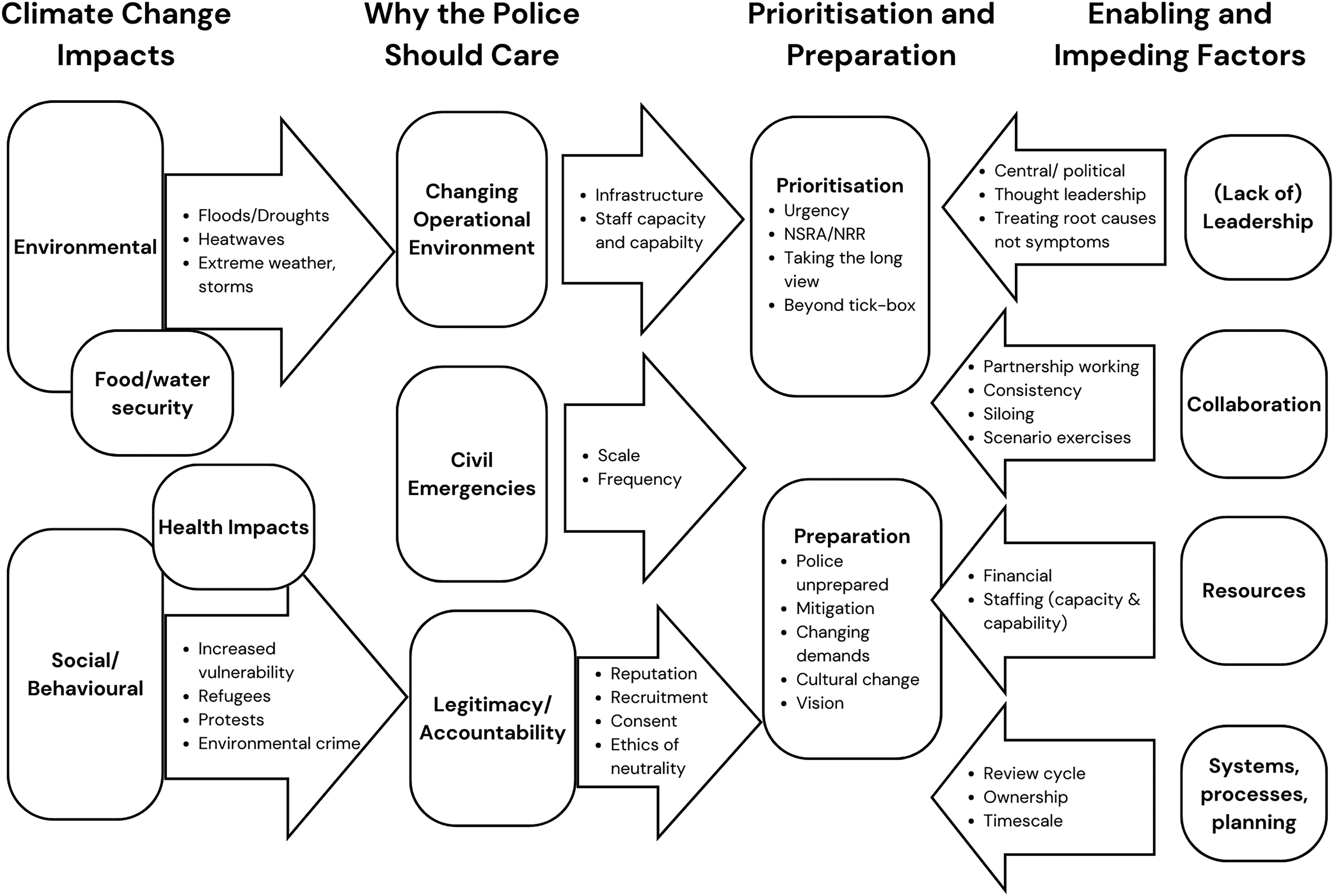
Planning and preparedness themes.
Climate change impacts
This theme concerns levels of awareness and understanding of potential climate change impacts. The immediate environmental effects of climate change were the most readily recognised, but there was limited appreciation of the broader cascade effects. Flooding, severe weather, you know, heatwave. Those ones, they aren’t named climate change, but they are a result of climate change. (Participant 13, POL)
The participants also demonstrated some awareness of the health, security, social and behavioural consequences of climate change. Reflecting Smith and Vivekananda's (2007) conceptualisation, one participant described potential consequences as ‘violent expressions of consequences of consequences’ (Participant 4, NPC), originating from outside the UK: a synergy of cascading risks triggering other events. These include, inter alia: public health crises; fuel and energy deficits; food insecurity; national security and conflict; competition for resources; increasingly vulnerable populations; habitats becoming uninhabitable; forced migration of climate ‘refugees’ fleeing environmental and societal decay in search of safety and stability; and degradation of key infrastructure (College of Policing, 2020; Ministry of Defence, 2018). All these transcend climate change and may impact community cohesion, contributing to community tensions via increased strains (Agnew, 2006, 2011; Millar, 2007). These were acknowledged: If the world's going to change in terms of the climate, are we going to see environmental refugees and migrants coming into the UK? And then what are the challenges for policing in relation to community tensions and community cohesion and understanding some of those? (Participant 9, POL) Vulnerability can come from the fact that road networks are all going to be cut off because of flooding, and therefore they can’t get to work. And that's going to be something as simple as that. And you miss your pay check. You can lose your home so quickly. So, it's those things I think there's going to be a lot more of a polarisation of society of those who can afford to adapt and those who can’t, and that's going to be quite tricky to manage in communities. (Participant 2, POL)
Participant 7 mentioned the potential consequences that climate change could have on matters of national security, such as terrorism: We [the police] love that nobody protests, or no terrorists come out to play in the winter. Well, if we don’t have a winter in the same way that we’ve had previously, does that increase the threat across a number of risk areas that we’ve traditionally put to bed at winter? (Participant 7, MOD)
The observation about ‘mild’ winters is supported by academic research into the effect of ambient temperature rise (Ranson, 2014; Rotton and Cohn, 2003), although the impact may not be limited to terrorism. However, there are more nuanced ways in which climate change and terrorism can be linked, especially when considering the broader socio-economic and geopolitical factors, making climate change a potential ‘macro-level driver of terrorism’ (Silke and Morrison, 2022). The underlying related causes may include, inter alia: competition for resources (e.g. food, water, fuel and services) breeding resentment or exacerbating international, national, regional and community-level tensions, which could escalate into violent conflict or provide a fertile ground for radicalisation; displaced populations who may become vulnerable to such radicalisation, particularly if they perceive discrimination and inequality in new locations; economic hardships fostering grievances, especially in regions where public authorities’ responses are inadequate, facilitating recruitment by extremist groups. Where state capacity diminishes, non-state actors, including terrorist groups, can exploit the ‘power vacuum’, leading to increased insurgency (College of Policing, 2020; Mavrakou et al., 2022; Ministry of Defence, 2018; Silke and Morrison, 2022). The combination of these potentialities creates a tension between investment and effort in dealing with climate change and its consequences, and counterterrorism strategies and activities, thereby stretching state and public authorities’ capacities. Malefactors may exploit deficits when attention is diverted. These nuances may impact the preparedness of the police and their multi-agency partners, in ways they have yet to understand. Terrorist attacks and counterterrorism appear at a national strategic level (e.g. within the NRR and Strategic Policing Requirement). However, based on the evidence from the current study, terrorism as a climate-related risk has not yet been integrated into the preparedness strategies of the police and their partners (beyond acute emergency response and addressing the aftermath of isolated incidents).
From the police participants’ perspective, dealing with protest and public order (related to environmental activism) features significantly. The challenge arises when rather than being limited to specific interest groups or the ‘usual suspects’, it becomes more socially widespread, enduring and supported by those usually considered as law-abiding citizens. The comments from Participant 9 reflect research findings about the demographic of so-called ‘environmental’ protestors (De Moor et al., 2020): It's law-abiding people like my mum and dad, for example, who care about the environment and are willing to put themselves into the fray, really, in relation to things they believe in. And that does make it really challenging because we’ve seen the images on bridges in London, with vicars and old ladies being carried off the bridge. Is that what policing wants to be seen to be doing? Ideally not. But of course, at the same time, we’ve got to enforce the law, we’ve got to prevent disruption. (Participant 9, POL)
The participants recognised that the burden of responsibility falls heavily on the police, particularly regarding civil unrest and disobedience: If communities are not happy because their environment is unpleasant, it's going to be the police go[ing] in and deal[ing] with the issues. (Participant 7, MOD)
Another shared: People are going to get desperate […] because they feel that they aren’t getting heard. (Participant 2, POL)
In England and Wales, a recent response to growing levels of protest was the introduction of the Public Order Act 2023, to prevent and respond to the types of activity increasingly seen in a climate crisis context (such as blockades, road obstructions, lock-ons and trespass). Although too soon to conclude its success or otherwise, its use imports an ethical dilemma of using what might be considered ‘draconian’ measures against low-level civil disobedience and non-violent direct action. As the consequences of the climate crisis impact peoples’ daily lives more severely in the future (and police officers will not be immune to them), public support for the use of the legislation may decline. The exercise of its powers is likely to challenge liberal democratic policing, impacting public trust and confidence, and perceived police legitimacy.
Why the police should care
This theme highlights reasons why the police should take note of the potential consequences of the climate crisis, in its preparedness and partnership working. Despite prevailing trends and analyses, there appears a lack of awareness of them within the police sector. The current UK policing model is considered unsuited for the challenges of the future operating environment, and requires reform, as emphasised in recent official reports (Casey, 2023; College of Policing, 2020; Police Foundation, 2020, 2022). Participants highlighted the lack of preparedness on multiple fronts, from infrastructural inadequacies to ensuring the welfare of personnel amid the climate crisis. There was minimal awareness and understanding among participants of UK national and global trends analyses, understandable in the non-police sector but surprising within the police service itself. This may have consequences for all concerned in the way that the challenges are conceptualised and planned for from a multi-agency partnership perspective. There is a sense that the police service operates an outdated model: Policing is a 200-year-old model dragging itself through the 21st century […] and not fit for the future. (Participant 8, POL)
The comment reflects views expressed in recent review reports (Casey, 2023; Police Foundation, 2020, 2022) calling for root and branch reform to address crises in public confidence and community relations, police culture, organisational skills and structures. One participant (when asked about why the police service might concern itself with the consequences of climate change) stated: If they don’t, they’re going to be in trouble. You know, if your operating environment is going to change, you need to be able to adapt to it. (Participant 7, MOD)
Interviewees were concerned about preparedness, from the inadequacy of the current infrastructure, such as buildings, estates and transport, to the skills and organisational structures needed to secure and maintain operational capacity, and workforce wellbeing: How are you coming to work to deal with something if you are food insecure? If you can’t fuel your car or you are displaced because the environment that you called home, even in the UK, is now somewhere that you cannot be stable and live in? (Participant 12, POL) PPE [personal protective equipment], working in warmer, wetter climates. They’re also going to have an impact on infrastructure. One of my police forces found out their police station, well in fact, one of their communication centres was in a flood zone and when it got flooded out, they lost half the comms [sic] to the police force. (Participant 7, MOD) Emergency response has been an area that could genuinely be given less priority within the police service than say, counterterrorism, just for the sake of argument. […] I’m afraid that non-terrorist civil emergencies are going to grow and be more of a topic for the police service, as well as individual forces to think about. Make sure they [sic] got the right skills, capabilities, [and] structures. (Participant 4, NPC)
Police responses to climate change may impact public perceptions of police legitimacy. This might not appear relevant to preparedness. However, if policing is to maintain a consensual model in the future operating environment, public trust and confidence in the police will be pivotal to its plans and operations. This extends not just from what the police do, but to how fair they are perceived to be in enforcing legislation and conducting their activities (particularly if they engage in environmental regulation and investigation). There is a substantial body of literature on organisational and procedural justice and its significance to police legitimacy and public cooperation and ‘compliance’ with the law and authority (Bottoms and Tankebe, 2012; Braithwaite, 2009, 2010, 2011; Hough et al., 2010; J Jackson et al., 2012; Mazerolle et al., 2013; Tankebe, 2009, 2013; Tyler, 1990, 2001, 2003, 2004, 2006, 2011a, 2011b).
Participant 9 highlighted the importance of organisational reputation to its legitimacy: Are there going to be performance indicators for policing around how ‘green’ it is and its environmental impact? So, if we want to have legitimacy and trust and confidence from the public, it's important to show that we are taking it [climate change] seriously. (Participant 9, POL)
And yet, responding to the climate crisis is not just about the practical considerations. When those who are the least responsible for climate change suffer the most harm, both globally and at a local level, what does it mean to deliver justice, protect the vulnerable and serve communities? How are questions of fairness resolved in the context of professional ethics and missions of protecting life and preventing crime, when the existential threat from climate change brings them into conflict? Preparedness poses not only practical challenges, such as ensuring operational capacity, but also introduces ethical dilemmas. As public perceptions of police legitimacy and accountability intertwine with their environmental concerns, the police will need to balance the ‘rule of law’ with protecting the vulnerable and desperate. The position that police leaders and practitioners’ ‘shouldn’t be arbiters of what's [ethically] right and wrong’ and ‘what the ethical test is, isn’t for us [the police]’ (Participant 8), may become an increasingly tendentious one, as public experiences of climate change consequences and their expectations intensify.
Prioritisation and preparation
This theme concerns participants’ assessment of areas and levels of priority and preparedness for the potential consequences of the climate crisis. Although some participants recognised the risks associated with climate change, mirroring global and UK assessments, there appears a clear deficiency in local planning and prioritisation. Many cite climate change planning, beyond that concerning flooding, drought and extreme weather as a ‘nice-to-do’ rather than a necessity. This discrepancy was not due to a lack of comprehension, but rather insufficient central leadership, strategic vision and adequate funding. The current planning cycle, focusing on short-term acute risks, lacks the foresight necessary to address the cascading effects of climate change, which requires multi-decadal strategies. Despite the urgency, strategic and political obstacles (including brief terms of office for senior police leaders and potential political influences) hamper a sustained, visionary approach to tackle the multifaceted challenges posed by climate change.
Risks acknowledged by the participants reflect those found in international and UK risk assessments (outlined earlier in the article). Yet beyond the acute risks, requiring emergency responses, a broader range receives little attention at the local planning level. One participant disclosed: At the moment [planning and preparing] for climate change is in the nice-to-do box. It is sat between the nice-to-do and the should-do, but it's not in the have-to-do box […] anything that's not statutory is pie in the sky, with the resources that we’ve got available, we focus on the bits that we absolutely have-to-do, that are legislated. (Participant 5, LA)
This inactivity is not synonymous with a lack of understanding of the issues or desire to act, but a combined result of perceived failures of visionary leadership, strategic direction, and support from central government: They [the government] could do more. And it could do more to prescribe around how we engage. Prescribe more consistency, that's one of the things you’ll find [from] Local Resilience Forums. (Participant 5, LA).
Another participant stated: Somebody in the centre needs to say, “this is the risk, these are the consequences, and this is what we’re doing about it”, ideally to try to prevent it or at least reduce its likelihood or impact. (Participant 4, NPC)
Beyond producing and issuing the NRR and legislative requirements (under the Civil Contingencies Act 2004), more could be done to support and drive activity on the array of risks faced by the agencies and organisations involved, at a local level. There is a perceived degree of disingenuity: [The UK] being the leading partner standing up globally and saying ‘we must all do this’, like at COP 26. And yet, at home not doing it. So, you’ve got other countries with good disaster risk reduction strategies at the national level, increasing at their local level. Here we just haven’t really got that. (Participant 3, NPC).
The participants recognised that there is reduced government focus on the chronic climate-related risks or the root causes, rather, attention is placed on the immediate risks such as flooding, drought and extreme weather events: It's down to poor leadership from central government. So, breaking that down into two parts, really, then what you’re describing is, in the jargon, the difference between the acute risks, the sudden shocks. Then the chronic risks, the things which are there, increasing over time until they reach a tipping point, where they become intolerable, which means ideally you tackle them early to try to stop them happening. (Participant 4, NPC) [I] think there is strategic appetite to manage the impact of severe weather and climate change related incidents, whether that is protest or whether that is just the wider experience itself. But what is missing is the appetite to go deeper and go back into a process and say ‘Right, we can treat symptoms, but how about let's treat the root causes, and let's engage with what groups we would need, to make sure that our response is not going to be perceived as lacking or as making something worse’. (Participant 12, POL)
There is supporting evidence that the UK government is ‘failing badly, even by its own standards’ when it comes to meaningful action on climate change (Somerville, 2021: 641) and is ‘off track’ to meet its aims and targets (Climate Change Committee, 2023). The reasons include domestic policy decisions that increase fossil fuel extraction and combustion through continued investment in and subsidies for the fossil fuel industry, walking back various mitigation interventions, poor coordination between central government departments, continued reliance on markets for problem-solving (evident in the degree of enmeshment between government and private industry) when it comes to policy setting, implementation and regulation (Climate Change Committee, 2023; Kuzemko, 2022; Somerville, 2021). Although currently, most of the activities contributing to climate change are legal, the public opinion on this appears to be changing as evidenced by the increase in related protests. Changing social attitudes over acceptable and unacceptable behaviours have triggered legal changes in the past and, as discussed above, the direction of travel seems similar with regards to climate change.
Significantly, the current planning cycle was considered ineffective in addressing the compound effects of cascading risks. Principally, this is because, at a UK national level, chronic risks are omitted from the NRR; acute non-malicious risks are now refreshed on a 5-yearly cycle (Cabinet Office, 2023a, 2023b). Although other climate change risk assessments exist, which is acknowledged (DEFRA, 2022), the reality is that local authorities and their police partners operate between 2- and 4-year planning cycles. This is nowhere near the level of long-termism required to plan and prepare for the possible consequences of climate change; commended as operating on 10-, 20- and 40-year cycles (UNFCCC, 2022). Beyond the well-publicised risks of flooding, drought and extreme weather events, others have yet to penetrate the planning and preparedness process, for example: It's [climate change] not on the strategic risk register, and that's not to say it shouldn’t be. For sure, climate change is something that is picked up in our horizon scanning work […] the potential impacts of it. So, we’re talking about it. (Participant 1, POL) I know the appetite is there to go to a 5-year view, and I think that change will be made imminently. I’m less confident that the government will move to a 20- or 25-year view [for chronic risks]. (Participant 4, NPC)
Enhancing preparedness for climate change requires immediate action. Yet, it may not be perceived as an urgent matter that necessitates a response. Participant 1 (POL) emphasised the need to act by stating, ‘People don’t see it [climate change] as a burning platform […]. They should be responding and doing things right now’.
The lack of urgency might be attributed to several factors, such as a mismatch of priorities at strategic levels, political leadership not giving it due importance, and a gap between individual values that align with climate action and their actual behaviours. Although an extensive review of social psychological research on this topic is beyond the scope of this article, it is essential to note certain cultural values that restrict behaviour choices relevant to climate change mitigation. Extrinsic and self-enhancing values centred on perceptions of others, pursuit of higher social status and prioritising wealth and power are linked with lower levels of concern over so-called ‘bigger-than-self problems’ (Crompton, 2010). These include issues like climate change, human rights, equality and poverty, where their intricacy, and the emotional, temporal and geographical distance involved make them difficult for people to comprehend. However, as the tangible effects of the climate crisis become more prevalent, this perception may change. The potential consequences will not be seen as distant issues but as immediate concerns. Political leaders, law enforcement and their affiliates will not be immune from the impacts of climate change.
Developing prioritisation and preparation beyond the short-term and limited planning processes highlighted here requires strategic vision and organisational cultural change. However, this is impeded by organisational and constitutional factors. At a strategic level of policing, prioritisation and preparedness are subject to influence by the National Police Chiefs’ Council (NPCC) in collaboration with the Association of Police and Crime Commissioners. Relatedly, the Police and Crime Commissioner role can be politically influenced (Lister and Rowe, 2014) and is limited to 4-yearly cycles (subject to re-election), providing nowhere near the level of continuity required for longer-term, visionary support for preparedness at local force and community levels. Moreover, the political priorities of the PCC may differ from national policing priorities and those of individual chief constables (Martin, 2022).
With senior police leaders in the UK having, on average, a term of office of three and a half years (NPCC, 2018), it is unsurprising that the levels of ‘thought leadership’ (Barry and Gironda, 2017; Brosseau, 2023; Harvey et al., 2020; McCrimmon, 2005; Neuhaus et al., 2022; Ryde, 2007) and sustained ‘grip’ required, appear short-lived and tenuous. Significantly, climate crisis is not specifically represented as one of the 12 NPCC coordination committees, with activities that might be critical to preparedness dispersed across subsidiary portfolios. The authors acknowledge that the NPCC's Science and Technology Strategy states that it will include ‘futures’ thinking within the ‘Explore’ thread of its ‘End-to-End Science System’ (NPCC, 2023: 13). However, mention of climate change, specifically in focusing police science and technology on preparing for its potential consequences is absent. These two omissions may prove problematic for the police service and its partners in future.
Enabling and impeding factors
This theme concerns the identification of factors that impede and enable planning and preparedness. Participants highlighted that a partnership between the police, subject matter experts and academic institutions could drive evidence-based practices and provide a holistic understanding of the intricate relationship between climate change and police and partnership preparedness. A multi-agency approach, anchored in consistent national planning templates, may help foster uniform approaches to climate-related risks. Scenario testing, though currently predominantly focused on flooding, drought and extreme weather events, offers opportunities to prepare for the gamut of consequences related to climate change. Resource constraints add another layer of complexity, potentially relegating long-term planning in favour of immediate concerns.
Participants perceived issues with government leadership on matters of risk assessment, direction, planning priorities and resourcing for the consequences of climate change at a local level. Central government also appears to lack the ‘thought leadership’ to inspire and innovate change and provide revolutionary thinking and problem-solving. It was recognised that there is merit in developing it, specific to preparedness for the consequences of the climate crisis: [There's] a lack of thought leadership, that strategic level, longer-term thinking, it's not there. It's not anywhere frankly. Certainly not there in government. (Participant 4, NPC)
Being able to respond then, requires leadership and vision, which may come from outside the police. A partnership of academic institutions with the police may enhance ‘evidence-based practices in policing agencies’ (Engel and Henderson, 2014), provide knowledge about the complex relationships between policing, crime, and climate change (Fyfe and Wilson, 2012), and provide the expertise to legitimise the decisions made by agencies (Boswell, 2009): It takes someone bold to stand and say this is the biggest factor for policing, it's not just about short-term crime trends or public confidence or things that we can do in a week of action. (Participant 12, POL)
Furthermore: There is merit in bringing in wider partners […] bringing in academia, bring in some global players, people with different viewpoints. (Participant 4, NPC) With more people with different backgrounds and experiences around the table […] who's not a closely involved expert and can just see things from a different perspective, it brings a whole different lens to the problem. (Participant 3, NPC)
It was recognised that the ‘net’ for such resources might be cast broadly because there may be those: in local authorities, who’ve got the expertise to bring or local charities who’ve got expertise’ and the police should only be used ‘if they were in that thought leadership space. (Participant 4)
Collaboration between agencies and partners could provide better responses to climate change through the sharing of information, and avoidance of ‘silo’ working: You inevitably start talking about other agencies, and I do think climate change spans multiple organisations and we need a more joined-up approach. (Participant 1, POL)
The need for national planning templates for preparedness, which would allow greater consistency was also suggested: A national or regional template, that everyone can do the same, use the same risk assessment and look at what others are doing, having that uniformity and approach. (Participant 13, POL).
It was suggested that it might be necessary to focus on defined areas of risk, initially on a trial basis, for example: Pick one or two risks and pilot some work around those. Which is a good way of just testing out does the concept work. Do people buy into the ways of doing it, which are better or worse? And it's also easier for people to say, ‘well I’ll sign up for a pilot’ because it's smaller in scale and nature, and it's not such an intensive commitment in terms of time or money. (Participant 4, NPC).
Similarly, multi-agency scenario exercises were highlighted as contributing to collaboration and relationship building: I try and do MAGIC [Multi-Agency Gold Incident Command] courses every so often to sort of test skills. To engage with people around the table, I think the relationships, particularly locally, that training together brings [sic]. (Participant 6, EA)
However, the current exercises were not focused proactively on the management of climate change, but rather on its symptoms: … multi-agency exercises normally in the Local Resilience Forum will be environmentally based, so, a severe weather or prolonged period of severe weather incidents […] it's not necessarily exercises that are for managing the climate emergency. Then again, I think going back to symptoms versus cause, we access and prepare for what we see as the main symptoms, you know a landslip or a huge flood, a large fire, as opposed to conceptually saying that we exercise for the impacts of climate emergency. (Participant 12, POL)
Such an approach to multi-agency exercises requires the government and strategic leaders to ‘take it a lot more seriously than they currently are’ (Participant 5, LA). Changes in exercising may occur only when central government identifies and treats the consequences of the climate crisis as chronic risks to community safety: If I’m being honest, until [they] become defined risk[s] at a higher, a very high level, no […] we only exercise the musts. (Participant 5, LA)
Finally, participants raised how a lack of resources impacts responses, these include budgets, staffing and capacity, especially for planning and training: There's more problems and less resource than there used to be, and well, that's because we’re aware of more risks and therefore we’re trying to manage them. That might be the case, but there are less people to manage things in emergency planning. The pool of practitioners is much smaller. (Participant 2, POL)
Another participant explained that resource limitations lead to: Less time and less capacity when you start adding in new things like horizon scanning for 10, 15, 20 years’ time, which starts to become a luxury, because actually, what we need to be thinking about is what's happening this year, what's happening next year. (Participant 5, LA)
Conclusion and recommendations
This scoping study highlights a deficit in the preparedness of the police and their partners concerning the potential impacts of the climate crisis (beyond flooding, drought, extreme weather events and acute risks identified in the NRR). The deficits appear to occur at strategic, tactical and operational levels. Although examples of best practices do exist, especially at the LRF level, in approaching acute risks, several challenges undermine readiness. These include limited resources, organisational ‘silos’, narrow risk focus, short-term planning and a lack of prescient thinking. Drawing from participants’ accounts and pertinent literature, six recommendations emerge for enhancing planning and preparedness.
The first concerns redefining planning parameters. Current local planning targets acute and legally mandated areas of risk (an unintended consequence of the Civil Contingencies Act 2004 requirements). Although this is understandable in the context of staffing and resource levels, and funding limitations, it falls short of the visionary long-termism required to prepare for the effects of chronic and cascading risks. However, a broader scope is essential to truly address the extent of climate change's consequences. Leaders and policymakers should review the planning cycle timescales and risk assessment processes. A multi-agency review focused on these areas could further bolster the existing insights from the Civil Contingencies Act 2004 review.
A second recommendation concerns strengthening central government engagement. This would involve adopting a more expansive view of the potential consequences of the climate crisis, than the existing NRR focus on acute risks. This entails offering strengthened guidance and support, increasing resources and expanding the remit of preparedness at the local level. Importantly, this will also require a meaningful commitment to deal with the root causes of climate change as well as its consequences.
A third recommendation involves amplifying awareness and understanding of strategic analyses (College of Policing, 2020; Police Foundation, 2020, 2022). Although strategic trend analyses have highlighted the potential impacts of the climate crisis and the future operating environment for policing, this knowledge needs broader dissemination within the police and partnership risk assessment and planning community, particularly at the tactical and operational levels.
A fourth recommendation is that police leaders and policymakers prioritise ‘futures’ thinking. Although the NPCC's inaugural Science and Technology Strategy recognises this type of thinking within its ‘End-to-End Science System’ (NPCC, 2023), the strategy lacks specific reference to climate change. There is a clear need to focus police science and technology on preparing for the potential consequences of climate change. Further, the NPCC should consider establishing a dedicated climate crisis coordination committee, instead of distributing focus on climate-related matters across subsidiary portfolios. Addressing both omissions would underline the critical importance of the situation and provide visible strategic direction to the service and its partners.
A fifth recommendation involves assessing ethical considerations. In a world in which the fabric of human existence and ways of life are at stake, it is essential to reflect organisationally on the ethics of policing, law enforcement and multi-agency activities. With vulnerable communities being disproportionately affected, police and partners will need to decide how best to distribute services and deliver community safety without reinforcing or exacerbating discrimination and inequality.
The sixth recommendation concerns collaborative preparedness. Preparedness may not be achievable by the police service or its partners in isolation, not every eventuality of climate change falls within single organisational remits; however, there are multifarious consequences, posing significant risks to the future safety and security of communities. The reality is that the present state of preparedness lacks the necessary scope and range to identify sufficiently and plan for them. Nurturing ‘thought leadership’ across all parties is crucial. A multifaceted approach to preparedness, blending diverse expertise from practitioners, academia, and public and private entities, may offer the depth of perspective needed effectively to identify, plan and prepare for the challenges ahead.
Although this study focuses on the UK context, the insights provided have relevance globally, underscoring the universal challenges posed by the potential consequences of the climate crisis and the need for unified, forward-thinking responses. The article concludes with a call for collaboration by researchers and practitioners. The authors invite those interested in tackling these challenges, to participate in stage 2 of an ongoing project (collaboration can be sought via the Canterbury Centre for Policing Research at ccpr.canterbury.ac.uk), which aims to develop on the themes discussed herein, and identify new and innovative approaches to planning and preparedness and conceptualising responses to the climate crisis as community safety and environmental justice.
Footnotes
Funding
The authors received no financial support for the research, authorship, and/or publication of this article.
