




Abstract
The behaviour of certain members of a profession can ‘taint’ other workers. In this qualitative study, we explore how police officers perceive media constructions of their profession. Participating police officers feel ridiculed by the media and are overwhelmed by instances of public disdain. They acknowledge moments of esteem, often as a result of self-sacrifice, yet lament that these are generally temporary and fleeting, and instead, their profession is tarnished by the heinous acts committed by some police officers, constructed as representative of the profession as a whole. We discuss police officers’ understanding of the stickiness of ‘taint’ within their occupation and how it can affect perceptions of the self.
Introduction
Media framings construct ‘collective understandings of reality’ (Ricciardelli et al., 2023) and play a crucial role in the positioning of professions as dirty or prestigious (Grandy and Mavin, 2012). Messner and Duncan (1998: 173) contend that the media ‘do not simply report news; they actively construct it by framing it: that is, by offering a context for viewing or understanding an event’ (emphasis in the original). For example, following the 2008 recession, media reporting of investment banking contributed to its loss of esteem in the public eye; what was once perceived to be a prestigious occupation was positioned as responsible for the economic chaos and, therefore, constructed to be tainted and dirty (Stanley et al., 2014).
Owing to the current climate of mediatisation of politics and social relations, policing is more a ‘matter of symbolism’ than ‘substance’, with public knowledge about policing being determined, less by policing's day-to-day realities, but by the media (Reiner, 2012). Graziano et al. (2010) evidenced in an experimental design that attitudes about police conduct were indeed susceptible to media constructions. Since then, several studies have researched media constructions of policing, including portrayals of police brutality (Lawrence, 2022), heroism (Terpstra and Salet, 2020) and racism (Fridkin et al., 2017). However, less is known about how police perceive these media constructions of their profession. Indeed, how police officers react to media portrayals is important because, as Ricciardelli et al. (2023) argued with correctional officers, these can influence how officers adapt their social practices (especially when these can be recorded), and their overall experiences on the job. This in turn, can dictate how far a ‘positive sense of self’ is constructed (Ashforth and Kreiner, 1999).
The COVID-19 pandemic brought new challenges to policing regarding image management. At the beginning of 2020, the mission of the police changed in England and Wales; officers were required to temporarily pause their crime-control strategies and dedicate all their resources to a situation that was changing rapidly. The police were required to enforce controversial regulations under the Coronavirus Act 2020 and questions were raised about public support, trust and legitimacy in authority figures. The frequently changing emergency regulations created by the government, but crucially, enforced by the police, made some decisions largely unpopular such as the proposed banning of Easter eggs, and pouring black dye into the Peak District's Blue Lagoon to discourage people visiting the known beauty spot (Giordano, 2020). Our study is especially timely given recent global events related to policing; while wider public support was wavering due in part to frequent media coverage of the over-zealous behaviour of some police officers in enforcing lockdown restrictions (De Camargo, 2022), other significant events took place at the same time; for example, George Floyd's murder in the United States (US) in May 2020, and here in the United Kingdom (UK), the kidnapping and murder of Sarah Everard by Metropolitan Police officer Wayne Couzens in March 2021.
The lead author interviewed 18 English police officers at two different time points (May/June 2020 and May 2022), resulting in 28 interviews overall; this made it possible to observe fluctuations in police officers’ perception of media coverage. In this article, we focus on officers’ perceptions of media constructions as the critical events noted above were unfolding globally. Data suggest that police felt marginalised by the public largely because of tarnishing media coverage, and resented that villainous acts committed by some police officers were being represented as typical of the profession as a whole, resulting in (at least temporarily) ‘spoiled identit[ies]’ (Goffman, 1963). Although they acknowledged that some reports could be positive, these often involved heroic self-sacrifice such as the death of an officer, and their impact was fleeting and short-lived. There are many nuanced understandings of the relationship between the police and the media, media representations and public perceptions, in addition to police responses to media representations; this article explores the latter to explore officers’ understanding of taint and how these perceptions affect morale and well-being.
The power of media constructions
Public perceptions are not static or fixed; they are developed through ongoing negotiation and dispute (Dick, 2005). These debates and negotiations are played out not only at the level of individual conversation and interactions between a police officer and a member of the public, but also at the level of public, media, political, economic and organisational discourses.
Media accounts can elevate or stigmatise occupations; for example, journalists’ storytelling of professional athletes can describe them as rising warriors who surmount trials and tribulations to achieve glory and status (Bonhomme et al., 2020). By contrast, the media can also engineer and perpetuate hostile stereotypes. For example, after the Chennai India floods in 2015, Mahalingam et al. (2019) found that the media marginalised Dalit janitors’ contributions to the clean-up effort by describing them as lazy, slow and unhelpful; instead, the media positioned film personalities and politicians as responsible for these cleaning efforts. Grandy and Mavin (2012) contend that the media is a very powerful tool in attributing positive or negative accounts. Wiesenfeld et al. (2008) also discussed how organisational failure (failure to act on complaints, for example) can lead to the stigmatisation of corporate elites (in this case ‘the police’ as one entity), and argue that judgements on stigma are constructed and propagated by those in the media who have a legitimate platform to ‘evaluate legal transgression’ and ‘assessments of individuals’ value’; in other words, the media has a powerful position in exposing both wrong-doing and heroic events of note.
Erving Goffman's important work Stigma (1963) explored the disapproval of certain characteristics of an individual or group by other members of society; in this case, their work in policing. As part of a ‘dirty’ occupation, in so far that workers often have to deal with demeaning or socially stigmatised tasks on the publics’ behalf (see Ashforth and Kreiner, 1999; De Camargo, 2019, 2021; De Camargo and Whiley, 2022; Hughes, 1951, 1962), police officers are then, in part, stigmatised by society and ‘disqualified from full social acceptance’ (Goffman, 1963). Furthermore, police workers often suffer from ‘courtesy stigma’; that is, stigma by association (in this case other officers that do heinous acts), and forces them into ‘discredited’ or ‘discreditable’ groups (Goffman, 1963), and society may then ‘treat [them], in some respects, as one’.
Policing and media constructions
Colbran (2022), an investigative journalist, reasoned that it was ‘almost impossible to generate interest in “good news” stories’. She said, ‘we give [the news media] so many stories – real human-interest stories of police officers committing acts of real heroism. If we’re lucky it might make a local paper. But if [the police] cock up, it's front-page news’. The relationship between the media and the police has, indeed, always been historically tainted – marred by high-profile stories. The socio-historical taint associated with police work helps explain why some argue it to have low moral prestige (Perrott, 2019). Recent high-profile scandals and amply publicised events of note have put forth attention on police; accountability and transparency are now imperative to the modern police profession, whereas previously, the police enjoyed a relatively protected position that distanced them from the general public and enabled clandestine activities to thrive without external oversight (e.g. the blue wall of silence 1 ). Chin and Wells (1998) argued that the likelihood of the blue wall of silence being used as a defensive strategy increases if officers feel they have or are being stigmatised by the public, policymakers, politicians, and the media.
Social media in particular, can act as a form of contagion among members of the public (Bejan et al., 2018; Schwaiger et al., 2022). By way of an example, a recent Twitter analysis of millions of tweets measured public sentiment in response to one high-profile event – the death of Freddie Gray in police custody in Baltimore in 2015 (Oglesby-Neal et al., 2019) – and highlighted how a police incident in one community in the US affected attitudes towards police across the entire country. The study found that police sentiment, throughout the US, became significantly more negative after Gray's death and during subsequent protests. Indeed, when the media ‘portray(s) a group [such as the police] in a negative light, they propagate prejudice and discrimination’ about the whole group (Corrigan et al., 2004). In May 2014, then-Home Secretary Theresa May addressed the Police Federation and demanded ‘root and branch’ change and contended that ‘platitudes about a few bad apples’ constituted an insufficient response to deeply entrenched, institutionalised unprofessional conduct (Dodd, 2014). The bad apples metaphor has been used to defend police organisations when individual police officers are criticised for misconduct, referring to the idea that a few criticised officers do not reflect the overall performance and behaviour of the police institution. Punch (2003) argued that the police themselves often employ the ‘rotten apple’ metaphor – the deviant officer who contaminates other essentially ‘good’ officers. However, evidence of systemic and entrenched corruption in the past few decades (Chan and Dixon, 2007; The Casey Report, 2023) has revealed the bad apple can become a rotten orchard (Griffin, 2020; Punch, 2003).
Since then, media reporting on police misconduct and malpractice has elevated policing as a ‘dirty occupation’ (Chatterjee and Ryan, 2020; De Camargo and Whiley, 2020, 2022), and again highlighted systemic problems that further damage public confidence in policing. Media attention on the police has not waned since. Last year, reports emerged that several UK police forces such as the Metropolitan Police, had been placed under ‘special measures’ due to their ‘litany of systemic failings […] chilling’ in their damage to public confidence (Dodd, 2021). In February 2023, Metropolitan Police officer David Carrick received 36 life sentences as one of the worst serial rapists in British history, despite nine allegations of sexual misconduct (including rape) being made to the Metropolitan Police and subsequently ignored – another blow to public confidence with then-Home Secretary Suella Braverman's quote ‘a scar on the police’ making headlines. Forces across England and Wales are now taking steps to regularly re-vet all serving officers and likely more scandals will emerge; 1000 officers 2 in the Met alone are currently under investigation for domestic abuse or sex offences (Dearden, 2023), with every misconduct hearing, [and] every court case [causing more] damage to public confidence. In March 2023, perhaps unsurprisingly following a turbulent few years, Baroness Casey, the Director General, published the Casey Report, which declared UK policing was in a state of emergency, and that trust and confidence in the police had plummeted.
Not all bad?
Although ‘the media’ have always reported widely on instances of police malpractice and misconduct, interestingly there is a considerable amount of seminal police research (see, for example, Chibnall, 1975a, 1975b, 1977, 1979, 1981, and later, Mawby, 1999, 2002a, 2002b, 2007, 2010a, 2010b, 2012, 2017) that shows how the police and the media have a generally positive and integral relationship. Both authors note that although there have been periods of hostility and strain between the police and the media, the relationship brings ‘informational and promotional benefits to both parties’ (Chibnall, 1977), but the police ultimately dominate the relationship because they hold and control information that the news media wants. Although police officers may generally understand the media as a tool to sully the reputation of ‘the police’ because of (perceived) persistent negative coverage, it has been documented widely through various surveys that the police actually enjoy widespread public support and trust. For example, despite various crises in both the US and the UK (the deaths of Rodney King, Freddie Gray, Eric Garner, George Floyd, Brianna Lopez, Breonna Taylor, etc. in the US, and the mishandling of the death of Stephen Lawrence, killings of Mark Duggan, Ian Tomlinson, Sarah Everard, rapist David Carrick etcetera in the UK), the police do, overall, have public support
3
. The phrase, ‘copaganda’, coined by writer Mark Anthony Neil, argued that police agendas foreground media coverage and this works to counter attempts to hold the police accountable for malfeasance, instead ‘reinforcing the idea that the police are generally fair and hardworking’ (Neal, 2021). Indeed, Higgins (2020) reasoned: The visibility that journalists afford to policing is both essential (in the reproduction of public consent) and threatening (as a potential force of accountability for wrongdoing), meaning that in the increasingly professionalised world of police ‘image management’ the press are simultaneously a feared watchdog and, crudely put, a valued PR department.
In the past, the police have benefitted from ‘the buffering effect of prior reputation’; that is, ‘the halo effect’ (Sohn and Lariscy, 2014) – where police have drawn deep on their ‘reserves of symbolic power’ (Mawby, 2017). Impacts on organisational reputations seems better managed when it concerns a failure of service delivery rather than a failure of integrity, of which the latter is unfortunately at the front and centre of these more recent scandals, and it is these that impact on trust the most (Mawby, 2017). Nevertheless, the police are at a ‘historical turning point’, with the UK's His Majesty's Chief Inspector of Constabulary and Fire & Rescue Services, Andy Cooke, warning there is ‘limited window of opportunity to repair public trust’ (His Majesty's Inspectorate of Constabulary & Fire and Rescue Services, 2023). The Institute for Government suggests that a ‘deterioration in attitudes to policing’ is likely to be linked to highly publicised cases of misconduct and illegal behaviour by officers, such as ‘Wayne Couzens and David Carrick’ (Tudor, 2023).
So, although it is pertinent to consider how media framing of events may affect personal perceptions of occupational reputation, the purpose of this article is to explore the perception of police officers on how their work is recognised. Public surveys detailing more-or-less consistent support, trust and confidence over the past few decades, 4 may help to alleviate perceptions of negativity, but ultimately, it may not be about judging whether officer perceptions are ‘correct’ (as seen below in the section ‘Every week is another story and police bashing…’), but more about how officers manage negative stigma associated with their work and how they use cultural mechanisms (infrequent outpourings of support following a fellow officer's death in the line of duty, for example) to strengthen a positive social identity, and reframe their ‘dirty work’ as heroic and prestigious (De Camargo, 2019; De Camargo and Whiley, 2021) in an attempt to avoid ‘courtesy stigma’ (Goffman, 1963) – after all, considering ‘how [dirty workers] retain a positive self-definition in the face of social assaults on the work they do?’ (Ashforth and Kreiner, 1999: 418) is important regarding police well-being more broadly. In this article, we analyse data collected over two years to extend our understanding of how police officers perceive media constructions of their profession.
Methodology
Data collection and sampling
Interview data were collected over a two-year period with participants in early 2020 (phase one) and two years later in 2022 (phase two). This period is a salient backdrop to exploring media constructions because ‘critical discourse moments’ (Chilton, 1987), such as crises, activate intense media attention therefore making the culture of an issue visible (Gamson and Modigliani, 1989). Officers were recruited via a ‘call for participants’ on Twitter asking for volunteers. Whilst there is little research available on how police use social media (Schneider, 2016), there has been a growing interest in Twitter since 2008 from UK police forces wanting to engage with the public (Crump, 2011), and Twitter seems a natural fit for police users because the creators of Twitter modelled its design after existent police emergency dispatch technologies (Schneider, 2016). Although police personal use of Twitter and other social media platforms is hard to measure, in part because some officers use a pseudonym/anonymous accounts and have, in the past, faced criticism in terms of indiscretion (Goldsmith, 2015), there are increasing numbers of police departments using Twitter because it encourages transparency and accountability (Bullock, 2018; Rosenbaum et al. 2011). Of the little research available, it is argued that police use Twitter almost exclusively for information reasons (Crump, 2011), and it was chosen for this study because of its potential to access a diverse range of participants and network connections, and is generally used as a platform for ‘widespread conversation and the sharing of ideas’, particularly as the police are a hard population to access without prior connections (Forgie et al., 2013). Recent research has shown that the police perceive Twitter to function as a ‘boundary object that transcends physical, geographical and cultural boundaries in order to develop relationships with various community groups’ (Coomber, 2018: 1). During the first few months of the pandemic, when it became clear that there were significant problems accessing personal protective equipment, mismanagement of police work and negative media coverage (De Camargo, 2021, 2022), the first author sought to understand the experiences of front-line officers. Twitter was used to attempt to bridge perceptual differences among the academic and police community by facilitating mutual understanding and sharing and transforming knowledge (Bresnen, 2010).
A type of digital snowballing took place (O’Connor et al., 2014) resulting in 131 retweets, 45,380 impressions and 2768 total engagements by the time of the first interview. Although these retweets helped reach a much wider audience than the original post, only 31 officers volunteered. Around one-third did not identify themselves as working for the police in their biographies, although positive working identities were established upon sending the forms to a requested official police email address before participation was officially agreed. Several officers withdrew and/or did not rearrange after setting up interviews because of the Black Lives Matter protests and they understandably had refocused priorities and shifts reallocated. Other officers advised they needed ‘the final go-ahead’ from their ‘research centres’ but there was no further communication. Of the 18 original officers, 11 were male, 7 were female, and they ranged from 22 to 54 years of age (average 35 years). Sixteen officers were married or in a relationship and 15 lived with their partner (1 lived with parents, 2 were single and lived alone); 11 officers lived with children/stepchildren. The officers’ experience ranged between 2 and 25 years (average 10 years), and the following roles were identified: 15 police constables/response/special/authorised firearms officer, and 3 sergeants/custody sergeants from 11 different forces. Ideally these interviews would provide some insight into an ethnically diverse group of officers, but this was not possible because the respondents self-identified as white British (n = 16), white Irish (n = 1) and Latin American (n = 1). The lack of diversity limits this study and we would hope to explore issues of diversity and intersectionality in any future work on this topic.
Similar to Bullock and Garland (2020), the officers who volunteered were self-selecting, but if they are active users of Twitter (in order to see the research request Tweet), it is important to acknowledge that social media can act ‘as a force multiplier for exacerbating our worst problems as society’, and is not an accurate reflection of reality (Aspen Institute, 2021). This research was not intended to assess the ‘accuracy’ of media portrayal of policing, but to showcase officer understanding of media perception on their sense of self and the stigmatising nature of it. These accounts are not intended to be representative of overall officer experience in a particular force, or of the police in general; after all, the value of the interviews lies in how officers personally make sense of events (Bullock and Garland, 2020).
Twitter experienced ‘considerable growth’ during the COVID-19 pandemic although it was also a time that vast amounts of misinformation was spread, with reportedly 25% of false coronavirus information being spread by ‘bots’ (Benson, 2020). Twitter was rebranded to ‘X’ in July 2023 after billionaire businessman Elon Musk acquired the platform and became CEO, and since the acquisition there have been numerous controversies, the details of which cannot be explored here owing to space restrictions, but there have been increasing concerns about the use of fake accounts, spreading of misinformation, and the rise of right-wing politics on the platform. Previous polls showed that most Twitter users skewed to the political left, Twitter was used by both men and women equally and mostly by 18–29-year-olds (Pew, 2019). According to The Guardian, ‘the right-wing takeover of Twitter is complete’ as ‘Twitter lurched to the right almost immediately after Musk acquired’ and ‘the use of racist language soared’ (Mahdawi, 2023). People have left the platform in droves, and forecasts predict that it will lose 32 million users in two years (Sweney, 2022). It is therefore pertinent to suggest that the police officers that used ‘X’ at the time, and saw the call for research, may not be a similar pool of participants for future work, and the access and exposure to the ‘media’, and subsequent ‘readings’ (perceptions) that are discussed at length in this paper may be very different (now and) in the future. The Guardian asks ‘why are news organisations still on it? What is anyone who considers themselves to have liberal values still on it?’. Indeed, police forces may start restraining usage both in an official and unofficial capacity or move to another platform to share information.
Data analysis
Our labouring with the data was guided by Braun and Clarke's (2022) reflexive thematic analysis. We began by reading the transcripts and highlighting units of meanings. Similarities were noted and grouped (Figure 1), and subsequently discussed between the two authors.
Grouping similarities across data.
Indeed, Braun and Clarke (2022) urge continuous reflection on ‘assumptions, expectations, choices and actions throughout the research process’ and this importantly involves ‘locating yourself’. We read and re-read participants’ accounts and organised shared meanings according to themes. The process was iterative, and groupings evolved as the article's conceptual framing developed; for example, the themes of evil and heroism were decided upon because our theorising of these two contrasting media narratives formed during conceptual discussions. Some of the themes were difficult to form owing to the scarcity of examples; in particular, we refer to the theme of media constructions of prestige. Examples in participants’ accounts were infrequent and, when mentioned, were brief, quickly replaced with contradictory examples. We had to trust the reflexive thematic analysis process (Braun and Clarke, 2022) and negotiate quantity versus quality of data, and we contend that the very fleeting nature of these accounts is data and evidence of the scarcity of lived experiences. In other words, participants’ accounts mirrored reality – media constructions of prestige were indeed rare and fragile. Although generalised officer perceptions of policing coverage did not change noticeably between the 2020 and 2022 interviews, the heinous events that did occur during that period gave space for officers to establish a frame on which to ‘hook’ their frustration (for example, ‘that officer that did that thing, made us look bad, our reputation is bad etc.’). When considering understanding of ‘fleeting moments’ versus perceived sustained feelings of disdain and hatred, it is pertinent to consider distortions of time.
Many studies suggest that we are more likely to remember negative experiences over positive experiences (in this case, through the media coverage and treatment from members of the public) and in general we tend to notice the negative more than the positive (Carstensen, 2018, cited in Caren, 2018). Speer et al. (2021) also found that cognitive regulation [reframing negatives to positives in policing; for example, Cahill (1996: 114) found that funeral directors challenged the stigma attached to their work by converting ‘the stigma of their chosen occupational identity into a mark of honour’ is an important positive regulation strategy [see also De Camargo, 2019] – this is vital for enhancing psychological well-being and informing treatment for depression, post-traumatic stress disorder and so on). Sources of police stress and burnout have attracted much attention over recent years and have concentrated on the negative impact on health and job performance, 5 and in addition, there has been increasing interest in psychological well-being with an emphasis on working with negative social situations such as crime and death (Henry, 2004), and being subject to occupational anxiety in the form of cough and spit attacks during COVID-19 as part of ‘dirty work’ (De Camargo, 2021).
We lastly categorised the data corpus from phases one and two into three units of meanings: (a) ‘Every week is another story and police bashing’: media ridicule; (b) ‘You can’t do right for doing wrong’: public hatred; and (c) ‘Unless someone dies’: media constructions of fleeting prestige. This process was not necessarily linear or chronological and the final categorisation resulted from an iterative and dynamic examination of participants’ accounts, reflexive discussions among co-authors and theoretical constructs as sense-making frameworks.
Findings
‘Every week is another story and police bashing’: media ridicule
Participants were cognisant that ‘nice people don’t talk to the police because they don’t need to’ (Mark) and that they largely interacted ‘with people that don’t like us anyway, and they’re never gonna like us regardless of what we do’ (Mark). James believed that ‘people have no idea about policing, everyone's an armchair expert’. Joel noted how they were too often aware of being constantly scrutinised: Whether we’re on duty or not, anything negative, it’ll be a headline in the paper ‘police officer does this’ – guaranteed. It's always ‘wow, it was a police officer, this police officer has done XYZ’.
This awarded the media with a significant amount of power because, as Brody explained, Most people don’t have that much interaction with us on a daily basis, we deal with a tiny proportion of the population time and time again, so your average Mr and Mrs Smith don’t really have any dealings with us, they only see stuff on the news.
The news and the media constructions therein were especially potent during the COVID-19 pandemic as police had to decipher complicated distinctions between rules, guidance and law. For example, Layla explicated that she and her colleagues sometimes empathised with public disagreements on these restrictions, but they had to enforce them nonetheless despite their actual sentiments: I mean a lot of the [rules] we didn’t agree with – we couldn’t see the reason or logic behind it – but yeah, our job is to enforce it anyway. And of course, the public were really frustrated with that, frustrated with the whole COVID restrictions. We were the easy people to target, it was our fault.
Layla discussed how police officers often see media constructions as falsely targeting the police with negative stigma – the management of this stigma was about framing media constructions as projections of discontent towards other institutions and the police were simply the easiest point of public-facing contact. This is also evident when the police are enforcing rules they did not necessarily agree with but that were created by the government (some key players were then seen to break their own rules, which further muddied the waters – see De Camargo, 2022 for further discussion).
Negotiations of what constituted breaking the law were fluid and ongoing – and often, controversial. For instance, ‘this was at a time when people were getting fined for sunbathing’ (Abigail). Police had no legal or experiential precedent, only their discretion to interpret confusing rules and enforce them. Participants admitted that they ‘lost a hell of a lot of support over our enforcement of lockdown’ (Abigail). For example, Joel recounted how they ‘had to go in and break up funerals, or if people were sat on a bench, I saw an article that they were getting told they had to leave and they refused, and the woman got handcuffed – those articles don’t help us at all’. Indeed, handcuffing people for simply sitting on a bench is ludicrous and the media accentuated the ridicule. Similarly, Francis shared how comments on social media were ‘taking the mick’ of police branches sharing their apparent victories of dealing with COVID-19 related incidents such as clandestine parties: We see loads of bad comments on Facebook and we try not to worry about it but it does give you a bad rep […] X have got into a routine of putting stuff on their stories about what they’ve dealt with that's COVID-related. And they set themselves up there, for people taking the mick […] and [the response] was just pathetic. If you read the comments on the Facebook post, it’d be like ‘have the police got nothing better to do’, ‘should be catching rapists’, ‘maybe concentrating on their own bad colleagues’, etc., but that's not changed really, [the public have] always been like that. (Francis)
At the same time, participants explained that ‘it's what the government decided’ (Joel) and ‘your hands are tied as an individual officer’ (Abigail). There was little appreciation in the media that these imperatives were passed down from government decision-makers and police officers had no choice: ‘the papers still hammered the police’ and ‘it was just really bad PR for the police’ (Joel). Alice explicated that the media, especially certain tabloids, take ‘more of an anti-police tone’ by ‘criticising police for most things at the moment especially during the pandemic’ (Alice). John echoed these perceptions by observing how, ‘it just seems like never ending, every week is another story and police bashing’.
‘You can’t do right for doing wrong’: public hatred
Participants alluded to the relationship between media constructions and public sentiment, attributing at least some of the public hatred to police bashing in the media. Sarah lamented on how even heroically managing a dangerous situation was often met with public ire and media ridicule. For example, in May 2020, a group of Metropolitan Police officers were verbally abused by the public for not wearing masks when they were, in fact, apprehending a criminal with a six-inch knife. The officers had been searching a man outside Walthamstow Central station in North London, when passers-by shouted at them for not wearing correct personal protective equipment. One of the officers was then forced to hold up a six-inch knife they had retrieved from the search and said, ‘Thank you for everyone's concern. This is what he had on him. This is why he doesn’t want to be searched.’ A woman in the crowd became defensive, shouting, ‘Don’t be rude. Don’t talk to people like that. All I’ve said to you is where's your mask. I didn’t say anything else. Put a mask on.’ The officer replies, ‘You’re worrying about a mask? He's got a Rambo knife. Do you not understand that?’ (Middleton, 2020). Media reports of this incident framed the heckling crowds as ‘concerned witnesses’ and the narrative reiterated the government's stance on wearing masks.
There was also a sense that ‘you can’t do right for doing wrong’ (Alice). While the officers in the anecdote above were chastised for not wearing masks, others might be criticised for doing just that. For example, Mark reflected on how ‘you can’t win’: It isn’t a normal job; like it's a time-critical job where you literally must go to things as fast as you can possibly can, because potentially people's lives are in danger. So at the same time those people will be kicking off that that guy's got a machete on, err, I don’t know the full circumstances around it, apart from what I saw on the news, but a case of if they were sat there and that guy's walking the street with a machete and then they’re recording in on their phones and then an officer's still sat in their car putting their gloves on and you know putting their masks on and stuff, they’d probably still be criticising saying, ‘Why have you sat in there for the last 30 seconds?’ You can’t win.
Albert shared that their local police force would try to share good news on social media with members of the public, but that often these posts were met with criticism: If our local force puts online ‘oh here is a police officer doing something good’, you just always get morons commenting on it going, ‘well they shouldn’t have done this – and then that wouldn’t have happened’, yeah okay then.
These, and other cases, contributed to participants’ shared sentiment that the public ‘hate’ the police: People just hate us. We certainly weren’t expecting people to clap for us. We are dealing with all these absolute scumbags spitting in your face […] we’re out here dealing with hundreds, no, thousands of people and we don’t have the correct gear, and they pull our masks off. We’re restraining them and they’re spitting in our face – every single day, 24 hours a day – and people don’t care. But no, they still just hate us. (Albert)
This apparent hatred was magnified by the pandemic and interspersed with villainous acts, and Layla shared how ‘some people were more horrible than usual, because normally it's “we hope you die of cancer”, that sort of thing we get all the time but that disappeared, and it was “we hope you die of COVID”’. Mia tried to hide the toll that it took on her behind bravado by claiming that police ‘become a bit immune’; she explained that: You do forget about it, sort of let comments wash over you a little bit and you’re just getting on with the job in hand and it's just one of those things.
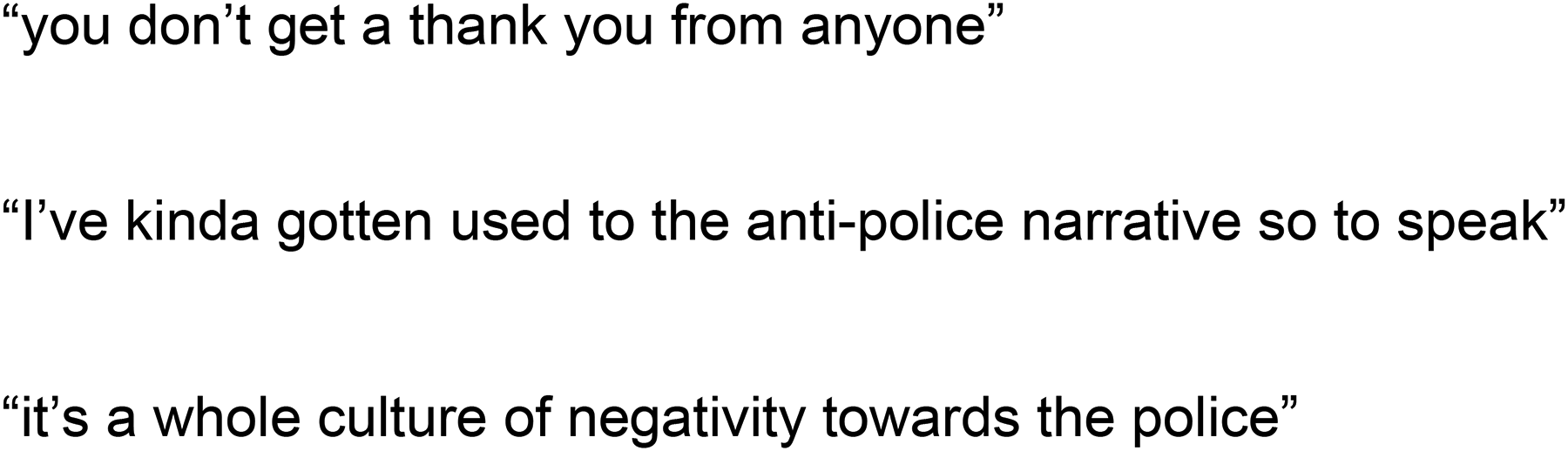
Gemma corroborated this further by sense-making how career longevity can act as a buffer: ‘I’ve been a police officer for a while, so I’ve kinda gotten used to the anti-police narrative so to speak.’ Yet, during moments of rapport, when the brave façade dropped, participants also confessed that, ‘it's horrible, to be honest’ (Bruce) and ‘nobody really cares about us’ (Mark).
‘Unless somebody dies’: media constructions of fleeting prestige
There were accounts in which participants felt that the media constructed policing as prestigious. However, these media coverages were transient and fleeting, and often involved self-sacrifice and acts of heroism as mechanisms through which to become prestigious. Mark explicates how ‘unless somebody dies or even then, unless there's a terrorist attack or something’. For example, John recounts how Keith Palmer's death in the line of duty resulted in heightened public support and described it as a ‘mega year’ for the profession: Yeah I think public support peaked in 2017 – that was like a mega year – I remember being on the RVs [armed response vehicles] and had massive public support because of Keith Palmer, bless him, five years ago London Bridge, Westminster Borough Market, the [terrorist bombing at the] MEN [Manchester Evening News] arena [the Ariana Grande concert], which was obviously an absolute atrocity, where kids had been blown up. I had counterterrorism friends up in Manchester and they were coming out of jobs at houses and the public were clapping as they came out. I also policed Pride, I remember doing that – and everyone was so thankful and pleased and really happy that police were there, and it felt great to be appreciated for once. (John)
John's account is especially harrowing because it suggests that policing extreme atrocities leads to prestige and feelings of appreciation. It is jarring to note how ‘everyone was thankful’ and ‘it felt great to be appreciated for once’ against the reason for this esteem – ‘absolute atrocity’. This juxtaposition shows just how much horror is required to, paradoxically, raise the prestige of policing.
Nevertheless, participants also lamented that these moments of recognition were fleeting – too fleeting. Although such accounts of policing extreme atrocities did absolve police and elevate them in the public eye, it only did so temporarily, suggesting that these positive framings were weaker than the more common negative ones generated by the media. For example, Sarah complained that even these significant acts of heroism were ‘written off within a month’ as the media moved onto the next negative coverage: Nothing will ever change, there is nothing that will ever change; you can have the most heroic acts caught on camera like you know London Bridge, something happened where a police officer died in the most selfless and heroic way and you maybe get an outpouring from the public saying ‘God, amazing, this is what these people do’, and it will be written off within a month because the media controls everything.
Indeed, the media was quick to move onto to next police scandal following a fleeting celebration of police. Sarah attributed this to a ‘whole culture of negativity towards the police’ and complained that ‘for the ten good things that the police might do in a day, the one bad thing they do will make it to the media and it's just basically what sells newspapers’. Mark went further and suggested that heinous acts committed by individual police officers were being presented as reflective of ‘the police’ as a whole as if they were a homogenous group. Mark's indignation was evident, and he could not understand why he was having to pay for heinous acts of others in his profession. In particular, he discussed the murders of George Floyd and Sarah Everard and how this affected the perception of all police officers: ‘we’re always under individual suspicion because some people have done these terrible things’ and complained that all officers’ phones could be searched as a result of some officers’ behaviour on social media.
Discussion
Fairclough (1995) argues that the media holds one of, if not the most, important position in the development of public opinion. Furthermore, Cohen (2011: 2) claimed that the media ‘informs us about right and wrong, about the boundaries which one should not venture, and about the shapes that the devil can assume’, and Smith (2007a) described the use of negative stories as vehicles of stigma communication for individuals within a profession. People are most likely to share stories that evoke feelings of fear, anger or disgust (Smith, 2007a) and people prefer to pass along bad news rather than good (Heath, 1996). McGregor (2021: 1847) argued that policing in democracies is a ‘heroic struggle’ because the overarching aim – protecting the public – is ‘impossible to achieve’, because there is ‘no realistic set of circumstances in which a police officer can ever please everyone’. Furthermore, other research has suggested that there are ‘no-win’ situations for the police, and ‘negative press fails to appreciate there are plenty of good cops’ (Nix and Wolfe, 2017: 103). Such negative framings do affect workers and influence their well-being and work experiences (Ricciardelli et al., 2023). Indeed, positive stories can go some way to ‘repairing’ trust (Chatterjee and Ryan, 2020) and reinforce the ‘status shield’ (Hochschild, 1940) inherent in some dirty occupations. Part of the issue is that the general public does not have regular or frequent direct contact with the police, and so, must rely on media constructions to form their perceptions. Hence, media narratives have immense power in determining the dirtiness of policing or, conversely, its prestige in the public arena.
It is pertinent to note at this point that ‘the media’ is often subject to the same monolithic descriptive properties that the police endure as one entity (becoming part of one unitary discredited group, see Goffman, 1963: ‘the police’ versus ‘the media’). It has become common vernacular to use ‘the media’ as a term that encompasses and conflates (perhaps arguably incorrectly) traditional types of media (broadsheets/ tabloids/ ‘the news on television’) and more modern types of media (social media platforms such as Facebook, Twitter and Instagram) Currently, social media's pervasive, participatory and networked character (in the way that the public can comment and react, sometimes anonymously) is transforming systems of knowledge and control, digital platforms can also unsettle police legitimacy and have been utilised to document, expose and contest official misconduct (Goldsmith, 2010). Often members of the public use social media (which has democratised our access to information more broadly) to voice their opinions as ‘armchair experts’ and the ‘focus’ of these opinions (the police) must manage their identity through mediatised opinions of ‘the police’ as one entity through all the different forms of ‘media’. In this study, police officers, when referring to ‘the media’ in their interviews flitted interchangeable between thoughts on ‘social media’ (‘Facebook’ as an example) and traditional forms of media (‘the BBC tribute’, and the radio), and were cognisant of the public's opinion being shaped by ‘the media’. When the first author sought clarification with one participant what he meant by ‘the media’ he waved his hand dismissively and said, ‘just all of it’.
Perceptions of negative media coverage are, however, a nuanced and contentious issue because some police officers do commit heinous acts. Police leaders may offer apologies for officer wrong-doing, essentially ‘blame-deflecting attributions’ (Wiesenfeld et al., 2008: 247) (e.g. we have arrested the bad apple officer and they will be punished accordingly) - but these only serve to expose the underbelly of the rotten orchard. Indeed, Bindel (2022) argues that it is time to examine the overarching police culture that ‘allowed Couzens to act with impunity’ and calling it ‘one bad apple […] masks the reality’ of the rotten orchard. Afterall, there is evidence of systemic issues rather than isolated incidents, and thus simply removing the bad apple does not alleviate the issue of the stigmatised profession (Caless, 2008). These all suggest that heinous acts are not solely the result of some ‘bad apples’ but that systemic institutional issues that need to be addressed do exist in policing and other ‘dirty’ occupations infused with power, for example, firefighters (e.g. Perrott, 2019; Syal, 2022). By police forces acting swiftly to punish transgressors (publicly arresting and charging), this may help to limit reputational damage (although it is hard to justify previous allegations a la Wayne Couzens and David Carrick that were dismissed/ignored through various failings) so damage limitation may not always be possible.
In this study, we observed how participants refuted the tarnishing of their profession in an attempt to avoid ‘courtesy stigma’ (Goffman, 1963). Group stigmatisation is easy for the police because it involves the recognition of a ‘person's categorisation into a group based on a distinguishing characteristic’ (Smith, 2007b: 466) (e.g. by wearing their police uniform). Chatterjee and Ryan (2020) argue that when police officers encounter stigmatisation from an event, there is a heightened tendency to ‘entitative’ – in other words, to engage in defensive strategies. Lewis and Sherman (2003) called this the ‘black sheep effect’, where members of a stigmatised group disassociate from condemned members; for example, in our data, Mark repudiated having his phone searched. Often, these types of ‘techniques of neutralisation’, such as condemning transgressors, ‘making selective social comparisons’ such as aligning themselves with identifiable heroes in their profession (e.g. Keith Palmer), can work to ‘draw more flattering inferences about themselves’ (Ashforth and Kreiner, 1999: 150).
The heinous acts that tarnish the occupation of policing can be contrasted with fleeting heroic acts that infuse policing with some prestige, albeit temporarily. In our data, participants alluded to acts of self-sacrifice and heroism by police peers, often involving their death, that lead to some positive media coverage and public expressions of gratitude that awarded them with some respite from police bashing. Most notably, we observe how the death of Keith Palmer was constructed as a special honour for the police in confronting the terrorist. Palmer was posthumously awarded the George Medal, the second highest award for gallantry, and he was granted the rare honour of lying-in rest in the Chapel of St Mary Undercroft, Palace of Westminster. During his funeral, thousands of mourners lined the streets of London including 5000 police officers (Collier and Chandler, 2017). McGregor (2021: 1849) contended that the ‘ultimate sacrifice – of one's own life in exchange for another’, although rare, is something that gets significant positive media attention, because it is acknowledged in this that the police ‘exchange their safety for those of others while on and off duty’. The public outpouring of gratitude for policing following Keith Palmer's death has been seen in a few other line-of-duty deaths; for example, the manslaughter of PC Andrew Harper in 2017, which led to the passing of ‘Harper's Law’ in 2020 that means mandatory life imprisonment for criminals whose actions result in the death of any police officer 6 , prompted a wave of support for police, with people across the UK turning up at their local stations with gifts.
A growing body of scholarship suggests that policing a crisis can see a rise in public support. As the threat erupts, such as a terrorist attack, citizens tend to unite against ‘the common enemy’ and support their leaders; a phenomenon known as ‘rally round the flag’. As an arm of the government, there is evidence to suggest that the police may benefit from this surge in public support and may be further strengthened because the police are viewed as highly relevant during a crisis (Perry et al., 2022). Experiencing gratitude is important because it can contribute significantly to healing, resilience and growth, particularly during ‘disasters’ (such as the pandemic) (Linley and Joseph, 2004). Gratitude has been found to be psychologically protective and is seen at its most intense in its support – most notably in the context of human-induced disasters such as 9/11 (Fredrickson Tugade et al., 2003). Unfortunately, the intensity of gratitude and empathy for policing remains short-lived. De Camargo and Whiley (2021) argued that even against this backdrop of the COVID-19 crisis, police did not enjoy the same increase in prestige as other key workers did. Indeed, former NATO secretary general George Robertson argued that ‘people do rally around [the flag in times of crisis], but it evaporates fast’ (Erlanger, 2020). The short-lived nature of this phenomenon is also noted in other literature (Brody and Shapiro, 1989; Parker, 1995).
Conclusion
The police may be constructed as one entity and reputational changes (and in turn, levels of occupational prestige) can ‘stick’ to any police officer; things that happen in London's Metropolitan Police can taint forces elsewhere in the country, but also internationally (e.g. Freddie Gray, George Floyd) – this is particularly pertinent when looking at how police brutality protests in the US can spill over into UK cities even though the policing styles of these countries are very different. The police are frequently depicted in a negative light by the media and this portrayal has become increasingly more common on both sides of the Atlantic. Officers in this study argued that that they get tarnished with the ‘same brush’ as ‘everyone else’; the ‘stickiness’ of taint when villainous or heroic acts can tarnish, or temporarily elevate the reputation of ‘the police’. Although officers detailed consensus that ‘the media/public hate them’, it is important to note there is understandably tremendous variation in terms of rural/urban, ethnic/racial and class-based views of the police, of which there is an already a large body of literature beyond the scope of our study. In addition, the social construction of policing through media coverage is multi-faceted – the types of crime that the media chooses to report are often the most ‘newsworthy’ (habitually the most violent and heinous) – the media is therefore responsible for reporting on the police's ‘competence’ (read: incompetence) in the process of solving more ‘headliner’ crimes. They routinely report on policing cuts, shortfalls, understaffing, the police being under-resourced and coupled with high-crime rates, public worry about ‘lawlessness’, which adds to the media portrayal of ‘problematic’ policing. Officers in this study acknowledged negative and positive press coverage, noting that the former seemed (read as problematic understandings of ‘perception’) much more frequent and that that this relentless tone of coverage tainted the profession. However, it may be less about an overwhelming sense of the media consistently painting the police in a negative light (as has been refuted for many years by Chibnall, Mawby and others), but rather vis-à-vis specific events and incidents that bring negative attention to the police in ways that cause frustration (and at times, horror) to colleagues and these bad recollections ‘stick’ more than others (Cartensen, 2018). This is perhaps more telling when officers are asked about it in research during the backdrop of uncertainty and anxiety that was policing COVID-19, in addition to a perceived lack of public support and periods of trying to enforce ‘unenforceable’ rules.
Officers also noted that the misconduct and malfeasance of a few ‘bad apples’ gave the media ammunition to sustain their ‘anti-police narrative’, unless an unusual event happened such as a police officer dying in the line of duty. Officer perceptions of press coverage conflated all types of media together as one; traditional media one-way controlled communication and two-way social media where the public can comment on police stories in real time often in an unfiltered, anonymous capacity with little to no repercussions for ‘trolling’ (Al-Quran, 2022). After all, it is not always the ‘official’ traditional outlets that get the news to the audience first – social media platforms allow live recording of heinous events with live comments (the recording of George Floyd's murder for instance, and general police brutality and misconduct), which allows the public to contribute and control the news, faster than any traditional news outlet has time to publish a story. Officer perception of how the public and media treat the police is important when constructing positive senses of self (Ashforth and Kreiner, 1999), the management of stigma in police ‘dirty work’ and managing their (perceived) ‘spoiled identity’ (Goffman, 1963). Exploring how the police navigate the feelings that they might only be able to garner social validation when they act as martyrs or in the face of extreme atrocities is pertinent during periods of fragility in public trust. The paradox discussed in this article of gaining positive temporary social identity only in situations with bad outcomes for themselves or unknown colleagues is arguably unique to the police (compared with more ‘obvious’ heroic jobs such as firefighters in which prestige is arguably more consistent), and is an important discussion point for understanding the ‘stickiness’ of taint, on the one hand, and heroism, on the other hand.
Bock (2022) recently discussed the role of visual media shaping public discourse about criminality, justice, and right and wrong. She posits that visual messages are ‘made’ through the media for a particular purpose, and that, Social actors struggle over the construction of visual messages in embodied and discursive ways, and that digitization has vastly expanded the encoding capabilities of everyday citizens, allowing them to add visibility to their expression of democratic voice, even as the ethical rules for visual expression are inchoate. (Bock, 2022: xi)
Bock refers to various embodied ‘gatekeepers’ that restrict visual expression and access to information, and how the information is used because ‘to control the image is to control the story’ (p. ix), and ‘we are all the media now, whether we like it or not’ (p. 25). As the police officers in this study acknowledge, it did not matter what they did, ‘the media’ creates their own narrative and depending on the type of media (and political lean/agenda) that is presenting a particular story about the police, it is important to understand justice ‘is an experience, not a photograph, and it cannot be achieved until everyone is acknowledged, heard, and respectfully seen’ (Bock, 2022: 233).
Indeed, the media's responsibility in all of this cannot be ignored – the symbolic dimension to their power of social construction of any occupation should not be underestimated – after all, journalistic storytelling has been historically complicit in reproducing the cultural conditions that help sustain police violence and malfeasance (Jackson, 2020). Police forces in the US have even gone so far as to hire public relations firms, such as ‘Cole Pro Media’. The company advertises that it helps police departments with their social media presence and enhance their crisis communications abilities, and former Seattle Police Chief Norm Stamper admitted the police have hired public relations consultants for decades to ‘help shape statements and respond to crises’ (Morris, 2021) 7 . Following the recent significant heinous acts by police officers discussed in this paper, and Baroness Casey's damning report in March 2023, perhaps image management (Mawby, 2002b) cannot loosen the stickiness of some taints and reputational damage may soon become irreparable.
Footnotes
Declaration of conflicting interests
The authors declared no potential conflicts of interest with respect to the research, authorship, and/or publication of this article.
Funding
The authors received no financial support for the research, authorship, and/or publication of this article.
