



Abstract
Producing evidence that can be used in court is a central goal of criminal investigations. Forensic science focuses with considerable success on the production of pieces of evidence from specific sources. However, less is known about how a team of investigating police officers progressively produces a body of evidence during the course of a criminal investigation. This literature review uses Weickian sensemaking to analyse what is known about this process in criminal investigations into organised crime. Focusing on the criminal investigation team, collective sensemaking is used as a lens through which to place the reasoning processes used in constructing evidence in a social context. In addition to describing three constituent parts of collective sensemaking relevant for criminal investigations, six factors are identified that influence the quality of collective sensemaking. Building on these results, nine focal points are presented for analysing the sensemaking processes in a criminal investigation team, aimed at advancing knowledge about the production of evidence in criminal investigations of organised crime. Furthermore, a definition of evidence is developed that is suitable for studying sensemaking in the context of an ongoing criminal investigation.
Introduction
Advancing our understanding of the production of evidence in criminal investigations makes improvements possible. This is necessary because investigations into organised crime are becoming more complex owing to increasing cooperation between criminal networks originating in different countries (van Uhm and Nijman, 2022), their adoption of new technologies to facilitate or commit crimes (Broadhurst et al., 2014) and opportunities to abuse internationally integrated logistical, communication and financial networks for illegal purposes (Schneider, 2013). Although recent research (Bjelland and Vestby, 2017; Brookman et al., 2022; Salet, 2017) focuses on the activities of police officers in ongoing investigations, there remains a general lack of knowledge about the social practice of actual criminal investigations (Brookman and Innes, 2013; Tong et al., 2010). This article aims to increase insight into criminal investigation practice and add tools for its study.
An investigation into organised crime, such as international cocaine trafficking, produces a large amount of data from a variety of sources. The amount and nature of the data are more than a single person can process and require a team of criminal investigators. This necessitates a sharing of analyses and interpretations of evidence between investigators to comprehend the crime under investigation and decide on investigative strategies. Completing a criminal investigation eventually requires that different hypotheses are merged into a single coherent narrative that is supported by the evidence (Anderson et al., 2005; Bennett and Feldman, 2016; Bex et al., 2007; Wagenaar, 2011). These team processes have an important social dimension.
Weickian sensemaking provides an interesting theoretical lens through which to study the social practice of reconstructing crimes and producing evidence during criminal investigations into organised crime. Weick (1988) defines ‘sensemaking’ as an ongoing process through which people try to reduce uncertainty and increase their understanding of their environment by actively probing it and reacting to its responses. The applicability of sensemaking to the criminal investigation process is easy to see because investigations start with an uncertain and incomplete picture of a crime. Criminal investigators interact with their environment to collect evidence that reduces this uncertainty to determine which crimes have been committed and to identify the people responsible.
Research questions
The subject of interest for this research is the production of evidence by a team of investigators who examine a case of organised crime. Using sensemaking as a theoretical lens provides the following primary research question: How does the collective sensemaking in a team of investigators unfold in criminal investigation processes geared to producing evidence of organised crime?
Further clarifying the scope and focus of the primary research question might be useful because sensemaking theory is quite extensive and a criminal investigation, even if restricted to the production of evidence, is a complex social process. For this purpose, three supporting research questions are part of this literature review.
The first concerns the changes a criminal investigation goes through over time. A criminal investigation of organised crime can take years to complete, and the nature of the investigation may change as it develops over time. Therefore, the first supporting research question is: What phases can be distinguished in a criminal investigation, and how can they be characterised?
A second subject for clarification concerns evidence, which in many jurisdictions has no clear and unambiguous definition. Criminal investigations, which are strongly regulated by criminal law, inherit ambiguities surrounding the legal concept of evidence (Anderson et al., 2005). Therefore, the second supporting research question is: What does evidence mean in the context of criminal investigations?
Third, when studying criminal investigation, different processes can be distinguished that are related to the production of evidence, such as team management and decision-making. To clarify the research focus, the third supporting research question is: What sensemaking processes in a criminal investigation are specifically focused on the production of evidence and not on supporting processes?
Method
Research applying Weickian sensemaking in the context of criminal investigation is fragmented and scarce despite the possibilities to connect sensemaking theory with criminal investigation practice. To understand how sensemaking in the context of criminal investigation unfolds over time, we consider a literature review an appropriate method to explore these possibilities.
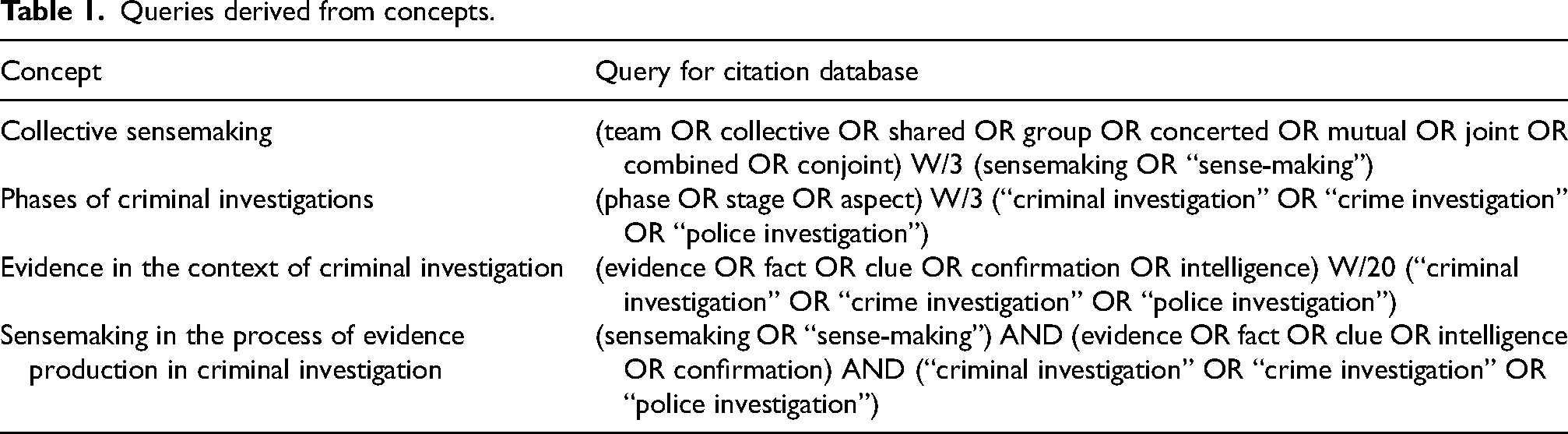
To bridge the gap between the research questions and actual queries that can be used to search citation databases, concepts were derived from the primary and supporting research questions. Keywords were then derived from these concepts to form actual queries, which were used to search citation databases for articles between January 2010 and December 2022. The most relevant articles from the search results were selected for further analysis. Google Scholar was used for a secondary search concerning topics that supported analysis of the relevant search results.
Below we provide working definitions of terms relevant to this study and describe how the articles in this literature review were collected.
Working definitions
The purpose of providing working definitions is to illustrate the practice-oriented context of this literature review. The working definitions concern subjects that are complex in themselves; economy of writing prevents us from discussing them in much detail.
The working definition of a criminal investigation is constructed from those provided by the United Nations Office on Drugs and Crime (2006), Orthmann and Hess (2012) and Stelfox (2009). A criminal investigation is one lawfully conducted by a criminal investigation team that, based on reasonable suspicion, collects evidence to determine whether a crime has been committed and, if that is the case, collects further evidence to determine who is responsible for it. For this literature review, the criminal investigation focuses on organised crime. Note that this definition focuses on a classical purpose of criminal investigations and excludes goals such as confiscating the proceeds of a crime.
A criminal investigation team is a group of police officers tasked with performing a criminal investigation into a suspected case of organised crime. Tasks that require knowledge from a specific domain (e.g. financial investigations or investigations of IT systems) can be performed by specialist investigators who are part of the team or can be provided as an investigative service to the team. Since 2012, many police teams in the Netherlands have only a small number of fixed staff and are temporary teams composed of available personnel. This adds to the challenge of investigating organised crime.
This literature review derives its definition of organised crime from Europol (2017). Organised crime is committed for financial or material benefit by a group of three or more persons acting in concert over time. This class of crimes should be distinguished from high-urgency, high-priority crimes (e.g. murder, rioting, acts of terrorism), investigation of which is beyond the intended scope of this literature review. Because the term organised crime is a mass noun with no defined quantity, a defined form of organised crime targeted by an investigation is here called an organised crime case. It consists of committed or ongoing crimes that fall under the definition of organised crime.
From research questions to queries
The first step in our review was to derive suitable concepts from the primary and supporting research questions. These concepts were subsequently used to construct appropriate queries for a search of citation databases.
From the primary research question it follows that sensemaking is a central part of this literature review. The organisational view on sensemaking originates in social psychology and has been developed by Weick (1995); see Glynn and Watkiss (2020) for its historical development. According to Weick, sensemaking can be seen as an ongoing, social and interactive process that develops over time. It concerns the effort to organise a chaotic stream of impressions and provide meaning to it (Weick et al., 2005). Because this study is concerned with the social context of a criminal investigation team, this literature review focus on collective sensemaking as a concept. It must be noted that other approaches to sensemaking have been developed that differ in their field of application, chosen level of analysis or theoretical base. Analysing sensemaking from the level of macrocognition, Klein et al. (2007) developed a data-frame theory of sensemaking, focusing on the mechanics of matching the relevant cognitive frame with perceived data to understand events. Dervin (2015) developed a set of methodological principles for studying communication and information-seeking that she called sensemaking. In information system research, sensemaking is used as a goal to be achieved by technical means, as described, for example, by Xu et al. (2015).
The first supporting research question focuses on the temporal dimension of a criminal investigation. For project-type endeavours such as criminal investigations, distinguishing different phases facilitates an analysis of changes in the project’s characteristics over time (Pinto and Prescott, 1988), which might influence sensemaking. Therefore, the phases of criminal investigations are used as a concept in this literature review.
The second supporting research question concerns the meaning of the term ‘evidence’ in criminal investigations. During a criminal investigation, the investigators collect various types of data, objects and impressions to determine the truth about a crime and criminal liability. In the following stage of the criminal justice process, the court trial, what investigators collect may receive the status of legal evidence. However, evidence in the context of a court trial is a specific concept that has different standards for acceptance (Anderson et al., 2005) from the clues that are collected during a criminal investigation, and which can serve more purposes than just providing legal evidence (Bitzer et al., 2016). Therefore, it is necessary to explore the concept of evidence in the context of criminal investigation.
The third supporting research question restricts sensemaking to the production of evidence. Sensemaking is a generic framework for understanding the construction of meaning in diverse contexts. In this literature review, sensemaking is aimed at the analysis of criminal investigation processes geared towards producing evidence. At the same time, sensemaking can be considered a meaningful achievement of the production of evidence. To capture this dual focus, this literature review explores the concept of sensemaking of the process and, as a result, of evidence production in criminal investigation.
To construct appropriate queries, keywords were derived from the concepts using synonyms from the Oxford Learner's Dictionary of Academic English and an online thesaurus (https://www.thesaurus.com). Although not a synonym, ‘intelligence’ was included as a keyword because it is closely related to the concept of evidence (Roux et al. 2015; Stelfox, 2009). To avoid search results containing combinations of keywords that are not directly related (e.g. when they occur in different sentences of an abstract) the W/n operator was used instead of the AND operator. This operator finds only results where keywords are within n words of each other. Because 20 words is a reasonable value for the average length of an English sentence (Sigurd et al., 2004) the operator W/20 was used to search for keywords that should occur in the same sentence. To search for closely related keywords, the operator W/3 was used.
Queries constructed to search for research on the four central concepts of interest for this literature review are given in Table 1.
Queries derived from concepts.
Citation database search
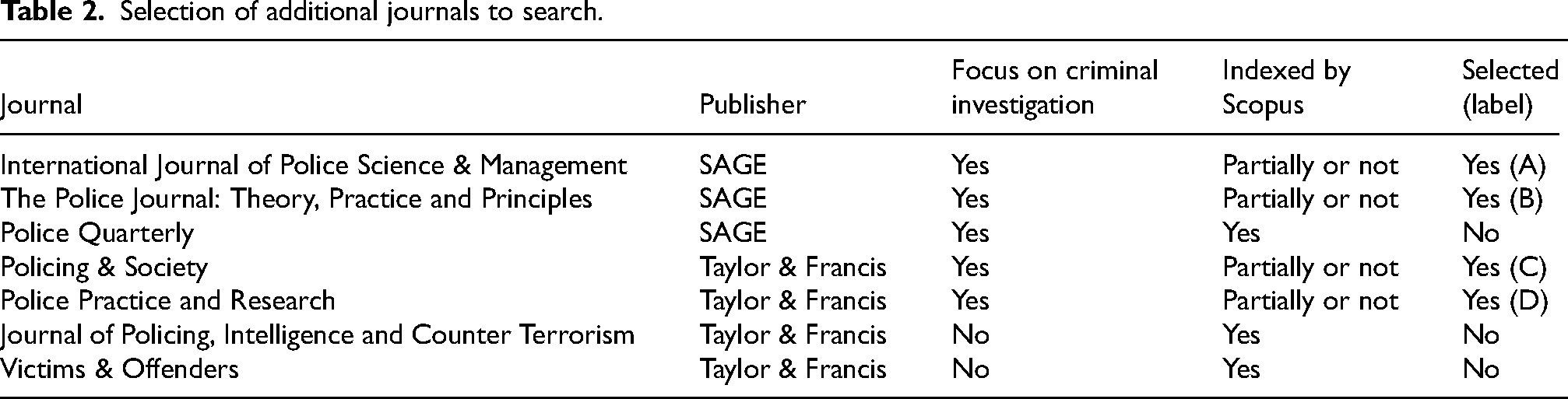
The search for peer-reviewed articles was done using the Scopus citation database, which covers a wide range of published research (Harzing and Alakangas, 2016). However, concerning the subject of criminal investigation, Scopus mostly produces results that do not focus on the work of a criminal investigation team, but rather on the biological, chemical, physical and digital analyses (different fields of forensic science) that contribute to criminal investigations.
To complement the Scopus search results, additional searches were performed in the databases of SAGE and Taylor & Francis, two publishers of journals related to law enforcement. Peer-reviewed journals related to criminal investigation that are not or are only partially indexed by Scopus were selected. The selected journals are listed in Table 2. Because the search capabilities of the publishers’ databases are more limited Scopus, the queries were simplified, with the W/n operator being replaced with the AND operator.
Selection of additional journals to search.
Finally, the databases of the Research Centre of the Dutch Ministry of Justice and Security (WODC) and the Police Academy of the Netherlands were searched. These are both more limited and focused than Scopus, and so a general search for the Dutch term for criminal investigation (‘opsporing’) was undertaken.
The procedure used to find and select relevant literature is illustrated in Figure 1, in which the numbers indicate the unique studies for each step in the procedure.
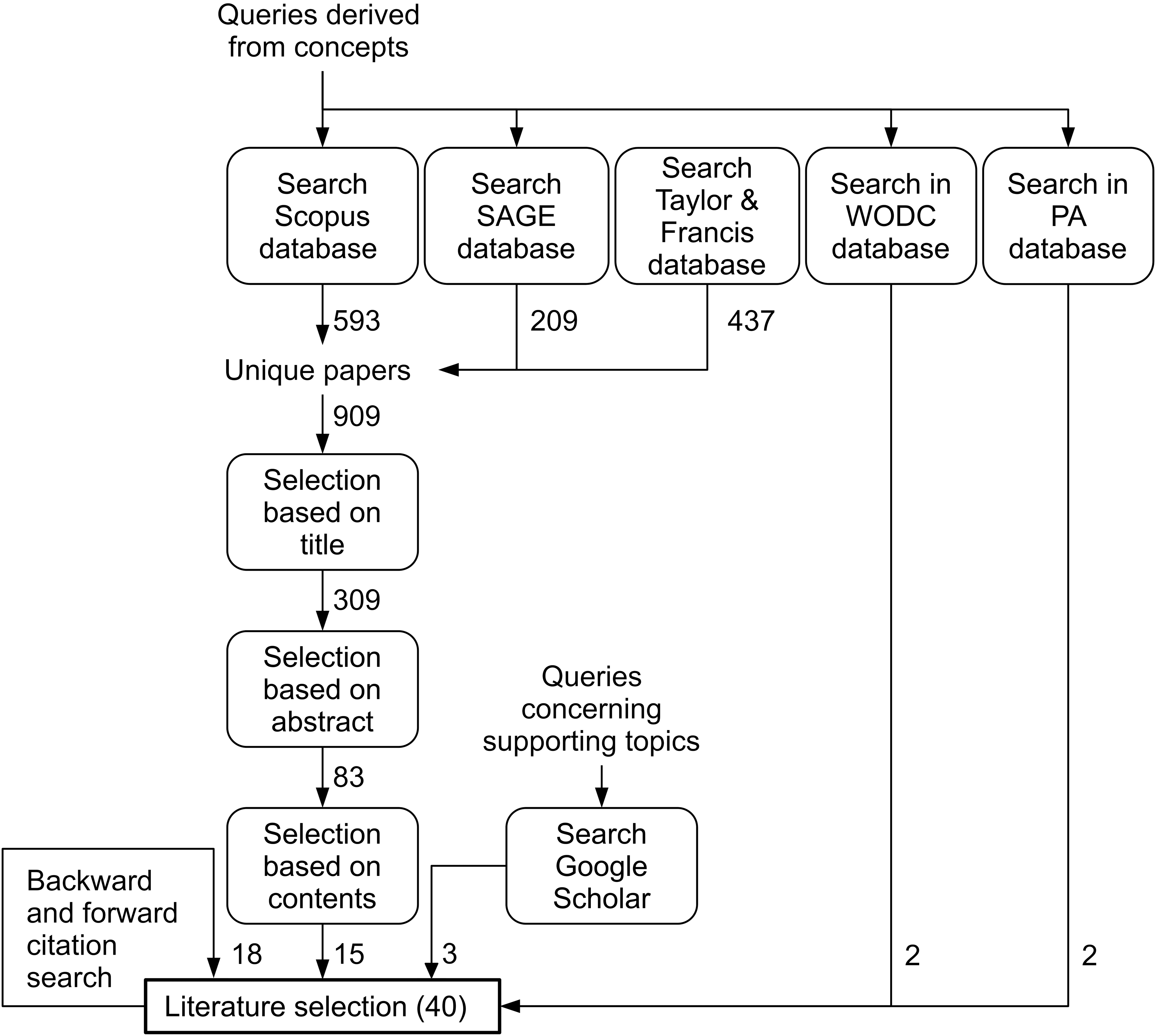
Procedure for selecting literature.
The final literature selection was analysed to clarify the four concepts and how collective sensemaking in a team of investigators unfolds during criminal investigation processes geared to producing evidence of organised crime.
Literature selection
Searching the Scopus citation database and the databases of the four journals for articles in English from 1 January 2010 to 7 December 2022 provided the results shown in Table 3.
Query results from Scopus and publishers’ databases.
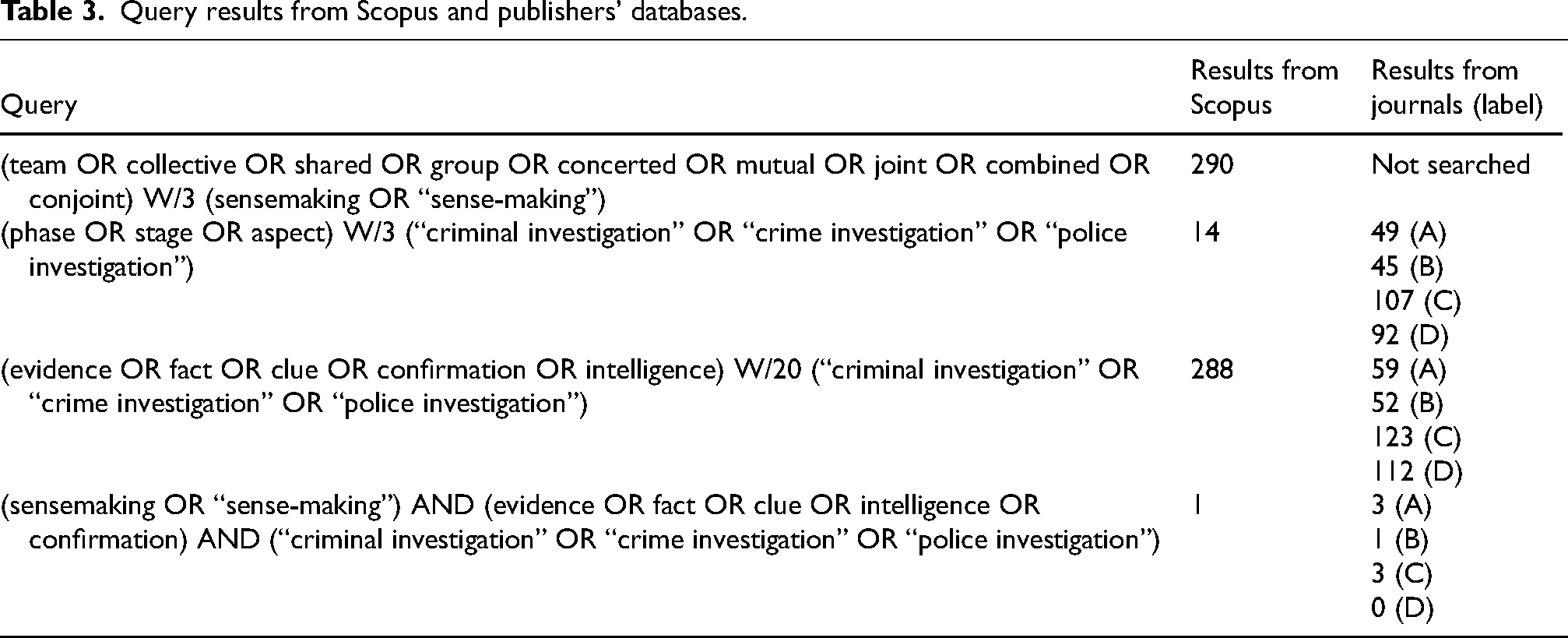
The resulting sets of articles were combined and any duplicates removed, leaving 909 unique articles. An article was removed from the selection if its title suggested that it:
was related to part of the criminal justice process other than the criminal investigation (e.g. prosecution or criminal trial); focused solely on the production of (forensic) evidence (e.g. development of latent fingerprints using specific chemicals) and not on the general use of evidence in criminal investigations; was concerned with technical or administrative management of evidence/intelligence; focused on sensemaking in communities, rather than groups or teams; was not directly related to teams, collective sensemaking or criminal investigation. sensemaking, sense-giving, making or sharing meaning in teams or work groups; sensemaking in contexts that are comparable with criminal investigations; the processes, phases or structure of criminal investigations; activities of criminal investigators related to producing evidence (excluding articles that focus on the usefulness of types of evidence to criminal investigations); criminal investigations of organised crime cases.
Following the removal of duplicates, 309 articles remained. A positive selection was made after studying the abstracts of these articles. An article was included if it was clear from the abstract that it could provide insight into:
The abstract review resulted in 83 articles, 15 of which were considered most relevant based on their contents. Backward and forward citation searches added another 18 articles to the selection.
In the WODC database, two results directly relevant to this literature review were found. The first, a book by de Poot et al. (2004), is a comprehensive study of criminal investigations in the Netherlands based on a quantitative study of the records of 1,827 criminal investigation cases, and a qualitative study of the records of 130 criminal investigation cases. The second study, by Bokhorst et al. (2011), focuses on the role of intelligence in initiating criminal investigations into organised crime. It is based on a study of policy documents, interviews and a study of 89 criminal investigation initial project documents.
A search of the database of the Police Academy of the Netherlands also provided two relevant results. The first is a handbook, edited by Kop et al. (2012), that is intended to educate criminal investigators in the Dutch police. It describes the different objectives of criminal investigations and strategies used when investigating organised crime. The second by Landman et al. (2020) is a based on an action research approach to investigation practices in criminal investigation teams in the Dutch police. The results from the WODC and the Police Academy of the Netherlands describe criminal investigations in the Dutch context. Because this literature review does not focus on the national legal framework that governs criminal investigations, the results are expected to be relevant for criminal investigations in countries other than the Netherlands.
In the selected literature concerning the production of evidence, the topics (inferential) abduction, deduction and induction had a central role. Therefore, an additional search for supporting articles was done by querying Google Scholar for “abduction deduction induction”. From the results, three articles were selected that aided analysis of the selected articles concerning the production of evidence.
Results
This section presents an analysis of the selected literature concerning the four concepts of interest: collective sensemaking; phases of criminal investigations; evidence in the context of a criminal investigation; and sensemaking of the process and as a result of evidence production during a criminal investigation. A diagram of the analytical framework, showing the relationship between the concepts, is given in Figure 2.
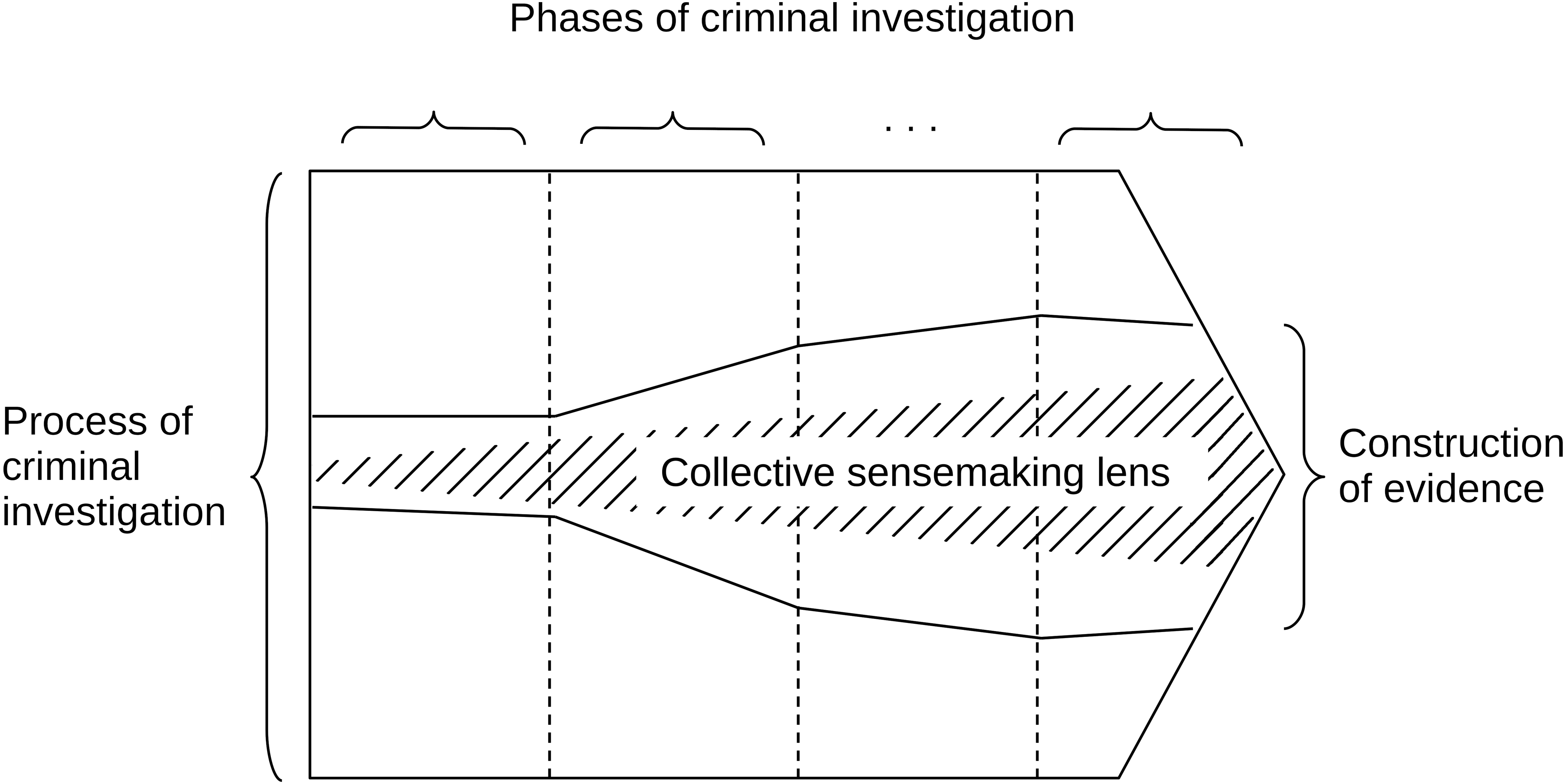
The analytical framework of this literature review.
Collective sensemaking
Sensemaking theory is used to explain how someone who is confronted with a situation that is out of the ordinary tries to build an understanding of that situation, to answer the question, ‘What's going on?’. A conceptualisation of sensemaking as a process, illustrated in Figure 3 (Weick et al., 2005: 414) shows how sensemaking works.
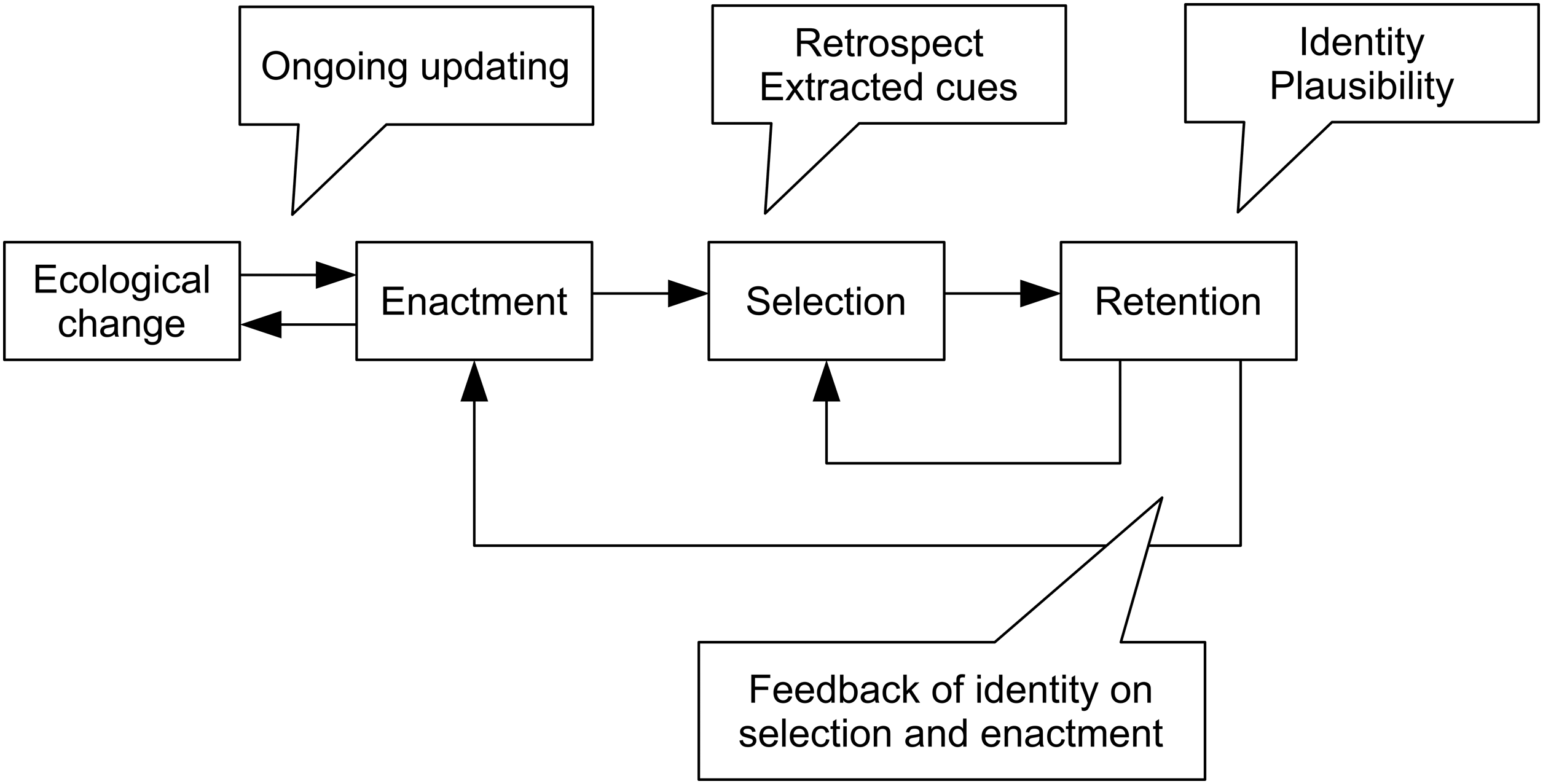
The relationship among enactment, organising and sensemaking. Adapted from Weick et al. (2005: 414). Copyright © 2005 INFORMS.
Through the ongoing process of sensemaking, people try to reconcile the unexpected (ecological changes) with their retained understanding of the world. Humans do this by fitting unexpected information into their current understanding or updating their insufficient understanding by retaining a plausible interpretation of events; or by actively influencing the world (through enactment) to make it more understandable. In this way, the process of sensemaking relates cognition with action to provide a ‘sense’ of a situation (Gacasan et al., 2016).
Weick (1995: 17) provides seven defining characteristics that distinguish sensemaking from other types of forming meaning. Sensemaking is:
Grounded in identity construction Retrospective Enactive of sensible environments Social Ongoing Focused on and by extracted cues Driven by plausibility rather than accuracy.
Someone's assumed identity determines what the environment means, whereas the environment influences someone's assumed identity (1). Sensemaking is retrospective in the sense that we can only analyse situations after we have experienced them (2). In sensemaking, enactment shapes the formless environment when someone projects labels, boundaries and structures onto it, whereas changes in the self-constructed environment also affect the sensemaker (3). Sensemaking is inherently social because it depends on labels, boundaries and structures that others have provided (4). Sensemaking is processing the ongoing flow of experiences and does not start or end (5). Because this ongoing flow is too large to process, only specific cues that we recognise as interesting are considered, whereas at the same time, our focus determines what is interesting (6). Finally, in sensemaking, Weick (1995) sees a stronger association between plausibility and the practice of creating and using sense than in the quest to find the most accurate label for a specific extracted cue (7).
Collective sensemaking emphasises what is mutual within a group of sensemakers. Its group nature adds to the defining characteristics of (personal) sensemaking. Stigliani and Ravasi (2012: 1232), studying a group of designers collaborating to create a product design, note that for their context ‘collective sensemaking occurs as individuals exchange provisional understandings and try to agree on consensual interpretations and a course of action’. At the start of their design project, the designers interacted with their customer ‘to build a common understanding of the goal of their project’ (Stigliani and Ravasi, 2012: 1235). These activities helped to create a purpose shared by group members. The next step was for designers to collect objects related to their project, interact with potential users and individually develop new interpretations of design attributes. They used artefacts as shared boards and sketches in discussions to converge on a ‘new concept [design] based on the integration of emerging understandings of various elements of the task’ (Stigliani and Ravasi, 2012: 1235).
The designers studied by Stigliani and Ravasi (2012) were able to create their own shared work environment that facilitated collective sensemaking. In a setting in which group members work while physically separated from each other, focusing on and by extracted cues is also distributed. This is shown in the study by Cornelissen et al. (2014) of a police operation that focused on a man suspected of being a terrorist who was in fact not involved in terrorism. During the operation, police officers were physically distributed, working in the streets of London and at the police command centre. Contact was organised along the main lines of communications that ran between specific officers representing their respective group (e.g. command and control, observation and firearms), and from them to and from their group members. During the operation, Ivor, a member of the police observation team was closely following the man suspected of being a terrorist ‘when he perceived a material cue … that violated the framing of [the suspect] as a terrorist bomber. Ivor was in doubt that he was this terrorist and asked, “Do you want this man lifted?”, meaning “to detain and arrest him”’ (Cornelissen et al., 2014: 721). This question was relayed down the line of communication to command and control, but any uncertainty about the identity of the suspect was not recognised or acted upon by those in command. The study illustrates the difficulties of effectively sharing provisional understandings of extracted cues and of recognising and resolving differences in interpretation in a physically distributed group when communication is also organised in a distributed way.
In the police operation studied by Cornelissen et al. (2014), officers worked on different interdependent projects at the same time; a situation in which they tried to make sense of their own context while they also managed multiple assumed identities. An example of the differences in projects was the pressure resulting from concerns about personal safety and continuity for the observation team compared with the pressure of decision-making for the operation commander. At a certain point in the operation, the observation team had been following a man who they thought bore a close resemblance to the available photograph of the suspected terrorist. The command centre pressured the police officer coordinating the observation team to ‘put a percentage on how sure they were that the man they were following was [the suspected terrorist]. [The coordinator of the observation teams], however, responded on the basis of his professional expertise that he thought it was a ridiculous question; he felt that identification was either fully positive or negative’ (Cornelissen et al., 2014: 716). After being pressed again for an answer to assist the commander in her decision-making, the officer replied without any new information: ‘for what it's worth, I think it's him’ (Cornelissen et al., 2014: 716). This illustrates how the pressure of authority can diminish the identity of a professional and augment that of a helpful subordinate, thereby influencing both individual and collective sensemaking.
The effect of identity construction on collective sensemaking is further illustrated by Merkus et al. (2017) who studied the process of collective sensemaking in a team of coordinators representing different railway organisations, before a winter storm. The changing ambiguity of reports from the weather agency about a developing winter storm was used by team members to influence the collective sensemaking. The initial high intrinsic ambiguity of the weather report made it difficult to determine the impact of the weather. This high intrinsic ambiguity resulted in low constructed ambiguity because apparently no team member publicly discussed the relevance of the potential storm for her or his own railway organisation. Team members found easy consensus not to take any action, and no group friction hindered collective sensemaking. In a follow-up report, the weather agency announced that the severity of the storm had increased and the area of impact had become clearer. As the situation of the coming storm became clearer, the intrinsic ambiguity fell. This led to higher constructed ambiguity because team members discussing possible options started to emphasise the difficulties of certain interventions (e.g. service cuts to be on the safe side compared with problems caused by the impossibility of cutting the service in orderly fashion at this late stage). This study demonstrates that individual members of a group can promote individual interests with which they identify more strongly at the expense of a joint project with a less favoured identity.
In a study by of collective sensemaking by Wolbers and Boersma (2013), officers from different organisations had to coordinate their operations during emergency response exercises. The officers represented different responsibilities, expertise and organisations (e.g. public order, hazard control and the healthcare system). Wolbers and Boersma (2013) use the metaphor of a trading zone to describe the practice of collective sensemaking in their setting because meaning did not develop in collaboration but rather had to be negotiated, illustrating the complexities of collectively constructing an enacted environment. The authors noted two risks to sensemaking in the trading zone. First, the actors represented organisations that had different requirements for sensemaking. The negotiated sensemaking was mostly focused on understanding the incident itself and did not automatically extend to understanding the needs of the different emergency response services. Therefore, the information needs of others were not recognised. Second, when a team was considered the most important in an exercise (e.g. the police in a hostage situation), the representative team member was able to construct a dominant narrative that excluded alternative interpretations or explanations of cues. This study shows that collective sensemaking may be restricted to understanding the collectively shared parts of a project, excluding related individual projects that need to contribute to it. Furthermore, setting up a trading place where understanding can be negotiated does not automatically lead to a collective result that balances the contributions and needs of all parties. The perceived priority of a specific party can still lead to construction of a single-sided dominant narrative.
Focusing on the social characteristic of sensemaking, ‘sensegiving’ is ‘the process of attempting to influence the sensemaking and meaning construction of others toward a preferred redefinition of organizational reality’ (Gioia and Chittipeddi, 1991: 442). The effects of deliberate sensegiving on collective sensemaking have been studied by van der Steen (2017) who compared strategy development sessions organised by two different branches of a Dutch bank. During the strategy sessions, management and selected mid- and lower-level employees participated in defining strategic issues for the branch. In one branch, sensegiving by the general director was part of preparing and organising the strategy development sessions, whereas in the other branch the management did not provide a specific direction to guide strategy development. Comparing the results of these two different ways of organising strategy development, van der Steen (2017) found that sensemaking in the first bank aligned with the scope and direction provided by the sensegiving. Collective sensemaking focused on resolving ambiguities that originated from the concept ‘entrepreneurship’ provided as part of the sense-giving and on further development of this concept. The other branch's sensemaking unfolded in a discussion between managers about the meaning of different cues for the branch, without shaping a narrative concerning strategic issues. This illustrates the effects of structured sensegiving on collective sensemaking. When structured and consistent, sensegiving helps to create a shared enacted environment, which supports more complete collective sensemaking, resulting in a stable outcome. By contrast, when sensegiving is absent, collective sensemaking may be limited to a distributed appreciation of cues, without leading to a shared understanding.
Sensegiving by group members can also have an important role in collective sensemaking as part of its social character. This is shown by Abolafia (2010) in his study of committee meetings at the United States central bank. Committee members discussed uncertain economic developments and their consequences for the central bank’s financial policy. Collective sensemaking took place through joint narrative construction. In this process, one committee member proposed an explanation for the uncertain economic situation, whereas others tried to gloss over the narrative and change its meaning. This interactive process was guided by the committee’s chairperson who periodically summarised their understanding of the central tendencies in the developing narrative. It concluded with the chairperson using their authority to craft a summary of the narrative that was acceptable to the committee members. This study shows how sense-giving can be used actively to bridge differences between the perspectives of experienced professionals in a similar role. However, this may require careful management of the interaction to lead to collective sensemaking.
Collective sensemaking can be seen as a process in which individuals process their personal experiences for the benefit of others. At the same time, they collectively exchange provisional understandings of their findings, and try to agree on consensual interpretations and a course of action. The overall quality of collective sensemaking depends on the extent to which some shared environment supports the effective exchange of provisional understandings, the negotiation of consensual interpretations and of a course of action. In a hierarchical setting, perceived pressure from those in command can influence the assumed identity of individuals to reach an implicitly perceived desired interpretation. When the interests of an individual group member are identified with more strongly than the group’s collective interests, the former might be prioritised at the expense of collective sensemaking. In a setting in which hierarchy does not dominate collective sensemaking, a shared enacted environment may be constructed in which collective narrative construction can be used to negotiate a consensual interpretation. Such negotiation may be overly restricted to understanding the collectively shared parts of a project, placing outside its scope related individual projects that need to contribute to it. Furthermore, the implicitly perceived priority of a specific party can still lead to a single-sided dominant narrative. A group of sensemakers can also be purposely guided towards a certain goal by consistent and structured sensegiving. Lacking purpose, the process of collective sensemaking may get stuck in exchanging provisional understandings.
The phases of a criminal investigation
Several studies of criminal investigations illustrate the different phases that can be distinguished (Bjelland and Vestby, 2017; Bokhorst et al., 2011; de Poot et al., 2004; Innes, 2002; Pajón and Walsh, 2020; Stelfox, 2009). Not all of these studies are concerned with criminal investigations into cases of organised crime. Furthermore, their decomposition of criminal investigation projects is not the same. Therefore, the description of the phases of a criminal investigation in a case of organised crime is a synthesis of those studies. For the purpose of this study, a phase signifies where the primary focus of attention lies at some point in a criminal investigation, it is not meant to define a separating boundary between processes.
To start a criminal investigation, there must be some indication that a crime has been or is being committed. Using the terminology of the British police, Stelfox (2009: 150) calls ‘the point when the police become aware that an offence may have been committed’ the instigation phase of a criminal investigation. An important part of the instigation phase is determining the goals of the investigation (Jansen, 2012; Landman et al., 2020).
After the decision is made to start a criminal investigation, what can be called the ‘team preparation phase’ is concerned with preparing criminal investigators to conduct the investigation. In their study of criminal investigations into human trafficking, Pajón and Walsh (2020) found that establishing a team is a large concern. Human resources are always constrained, and who should be part of the investigation is often up for debate.
The investigation phase is crucial to any criminal inquiry and focuses on two goals. The first is to clarify the circumstances of the crime, and the second is to identify the responsible suspect. Innes (2002), who studied different ongoing murder enquiries, refers to these two concerns as situation definition and suspect development/suspect targeting. A similar division of goals during the investigation phase was found in a study of criminal investigation in the Netherlands by de Poot et al. (2004). The authors identified two factors that influence the focus of a criminal investigation: the availability of a narrative of the circumstances of the crime, and the availability of the suspect’s identity.
In its concluding phase, a criminal investigation moves from gathering knowledge to transferring and communicating that knowledge (Brodeur and Ouellet, 2005). This phase is described by Innes (2002) as case construction, which deals with the challenge for criminal investigators to: ‘[organize] the mass of material they have collected into a coherent, explanatory account of the incident’ (Innes, 2002: 672).
Evidence in the context of criminal investigation
Because criminal investigations operate within a robust legal framework, the legal perspective on evidence is often dominant. However, using non-legal perspectives on evidence can add to an understanding of evidence in the context of criminal investigation (Carson, 2013). This section first provides insights into evidence from a legal perspective and then adds insights from a psychological perspective.
Legal scholars Anderson et al. (2005), noting the ambiguous use of the terms ‘fact’ and ‘evidence’ in criminal justice practice, reserve the term ‘evidential data’ for things that are directly perceived by the senses, such as physical objects and witness statements. They remark that a meaningful analysis of evidential data can take place only in relation to a hypothesis, expressing a question or assumption about what happened. Evidential data that is related to a hypothesis is considered evidence.
Evidential relationships are established using the three types of logical reasoning that all investigations require: abduction, deduction and induction (Anderson et al., 2005). The philosopher Peirce, who had an important role in developing the concept of abduction, considered the different types of logical reasoning as the three stages of inquiry (Pietarinen and Bellucci, 2014). Abduction combines an observation, such as evidential data, with experience or common sense to produce a reasonable explanation, such as a hypothesis or theory about that observation (Mantere and Ketokivi, 2013). Deduction determines the testable consequences of the hypothesis (e.g. additional evidential data we could find or generally accepted truths that should be present if the hypothesis is true). Through induction, these consequences are given a stronger empirical basis by relating new evidential data to the hypothesis, providing a degree of confirmation (Åsvoll, 2014). Managing the correct application of abductive, deductive and inductive reasoning during a criminal investigation can be a challenge because they each require different problem-solving styles (Fahsing and Ask, 2018).
To support proper legal reasoning in the context of a court trial, Anderson et al. (2005) created a method for the structural analysis of evidence that organises the presented evidence using a tree-like information structure (Knuth, 1997), called a chart. At the top of the chart is the ultimate hypothesis, which is derived from the legal definition of the crime with which the suspect is charged; for example, Mr Smith took (1) the purse (2) belonging in whole to Mrs Jones (3) with the intention of unlawfully (4) appropriating (5) it. 1 Penultimate hypotheses that must be proven are derived from the (in the example five) constituting elements of the ultimate hypothesis. A penultimate hypothesis can be further divided into smaller and more specific interim hypotheses. Eventually, an interim hypothesis is small enough to be directly confirmed by some evidential data in a deduction relationship with some general rule; for example, Mrs Jones provides a receipt for the purse from which we can conclude according to a generally accepted rule that she is its owner, satisfying penultimate hypotheses 2 and 3. This method can be used to verify whether evidential data completely covers the legal definition of a crime and whether sound logical reasoning is used to relate that evidential data to the legal definition of a crime.
Although using a legal perspective on evidence can prevent prosecution failures, such as presenting evidence that does not completely cover the legal definition of a crime, it does not fully explain how evidence is actually used in a court trial. Insights on this matter have been provided using a psychological perspective, which indicates that a successful criminal investigation produces a convincing narrative (Bennett and Feldman, 2016; Crombag et al., 2006). In their analysis of criminal investigations, de Poot et al. (2004) use a model developed from a legal psychology perspective called anchored narratives (Crombag et al., 2006; Wagenaar, 2011), the structure and elements of which are illustrated in Figure 4 (Wagenaar, 2011: 269).
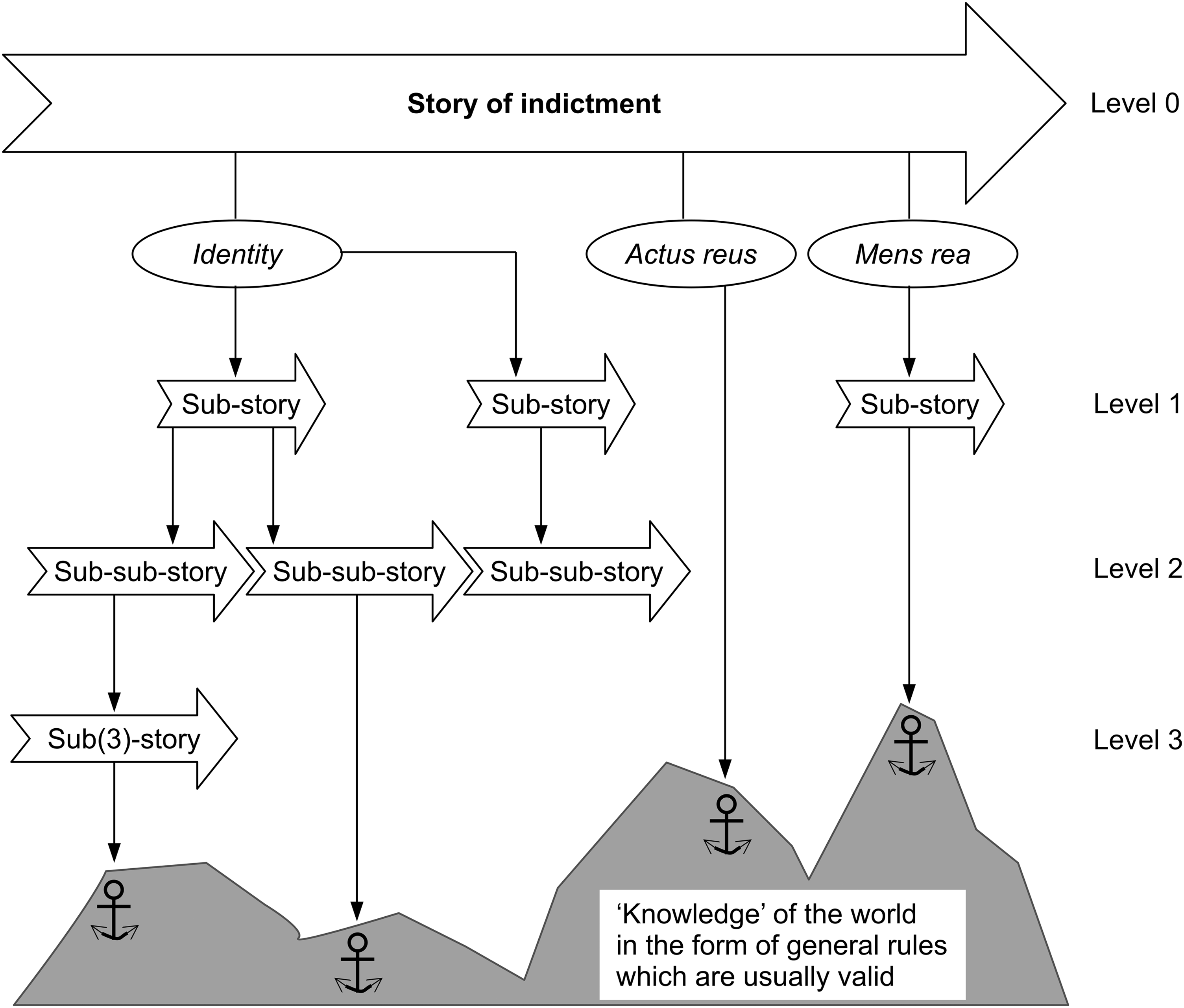
Theory of anchored narratives. Adapted from Wagenaar (2011: 269). Copyright © 2011 De Gruyter.
Instead of following the legal structure of a crime, this model focuses on belief in the narrative presentation of a crime. In Figure 4 (Wagenaar, 2011: 269) this crime narrative is centred on the themes of identity (who did it?), actus reus (what did the suspect do?) and mens rea (did the suspect do it intentionally?). The main story is supported by partial sub-stories that may be supported by other sub-sub-stories. Ultimately, a sub(n)-story must be anchored in evidential data and general rules that are usually valid. The premise of the model of anchored narratives is that accepting a criminal case as true depends on both a convincing narrative and the belief that it is correctly anchored in supporting evidential data and general rules about the world.
A legal as well as a psychological approach to evidence contains elements useful in criminal investigation. Anderson et al. (2005) present their chart model as an analytical tool to verify the legal logic of a court case. This is useful for criminal investigations into organised crime cases where the legal logic that must be considered during an investigation can be very complex. The model of anchored narratives developed by Crombag et al. (2006) trades off some of the structured legal reasoning for the flexibility narratives provide for representing social practice. A development that combines both approaches provides alternative ways to reason about legal evidence (Bex and Verheij, 2012).
For the purpose of this study, it is important to note that in a criminal trial, a complete narrative and all supporting evidential data are already available for analysis and are subject to evaluative inquiry (Kind, 1994). By contrast, a criminal investigation is exploratory in nature and starts with limited evidential data that are used to develop a narrative. For this study evidence is therefore defined as a developing narrative that: (a) incorporates the constituent elements of the legal definition of crime, (b) is (partially) supported by evidential data, and (c) has an investigation agenda to improve its plausibility. This definition of criminal investigation evidence is illustrated in Figure 5.
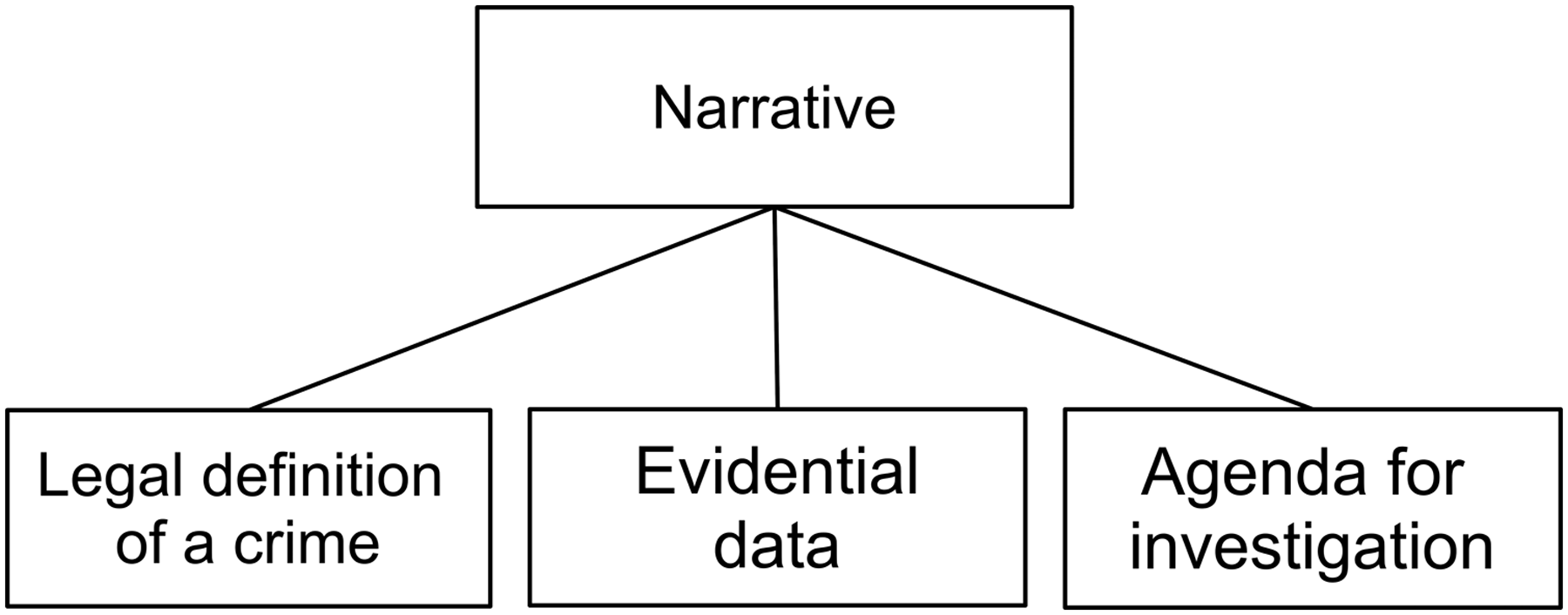
Definition of criminal investigation evidence.
Narratives have a central role as a means of communication in trials (Bennett and Feldman, 2016; Crombag et al., 2006) as well as in criminal investigations (Salet, 2017), where they are constructed, tested and modified (Brookman et al., 2022). Constructing a crime narrative requires incorporation of the constituent elements of the legal definition of crime (Anderson et al., 2005) and the actors involved. Relating evidential data to the narrative provides a framework for assessing the plausibility of claims about what happened and who did what (Crombag et al., 2006). The uncertainties and ambiguities of a narrative must be identified and addressed by an agenda for investigation. Adding this dynamic corresponds to the relationship that sensemaking creates between cognition and action (Weick et al., 2005).
Sensemaking of criminal investigation evidence and in its production process
Our literature sample contained only a few studies related to both sensemaking and criminal investigations, three of which were relevant for this literature review.
Wyatt (2014) studied the training and work of British crime scene investigators (CSIs), professionals who are trained to identify and collect traces (e.g. fingerprints marks, DNA) at crime scenes. Their sensemaking of traces is concerned with explaining the potential evidential utility of a trace to investigating police officers. Sensemaking of crime scenes enables CSIs in ‘defining the potentially meaningful from the meaningless and producing the forensic artefacts that they would take away from the scene and be used in the investigation of the crime’ (Wyatt, 2014: 451). Because CSIs are part of a separate support unit, their sensemaking depends on the procedural integration into the police investigation process for influencing and advising associated police officers.
Using data collected during an ethnographic study of British homicide investigations, Jones et al. (2021) explore the role of collaborative sensemaking by forensic experts, forensic scientists and police criminal investigators. Instead of sensemaking itself, the study focuses more on its preconditions. The authors found that face-to-face dialogue is the most important instrument to enable collaborative sensemaking, noting the importance of real-time interaction that is not available with other types of communication, such as email.
In an ethnographic study of the use of forensic sciences and technology in British homicide investigations, Innes et al. (2021) describe the challenge of combining evidential data from different sources (e.g. computers, interviews and CCTV). They introduce the term ‘mosaicking’ to describe interpretative and sensemaking processes that are concerned with the challenge of constructing a consistent narrative from different sources that sometimes contradict each other.
Discussion
This literature review provides different insights into the research question: How does the collective sensemaking in a team of investigators unfold in criminal investigation processes geared to producing evidence of organised crime?
A criminal investigation can be divided into four phases, each with a different focus of activities: instigation (to determine investigation goals), team preparation (to assemble and prepare the investigation team), investigation (to produce the evidence that defines a criminal situation and identifies the responsible person), and case construction (to provide a convincing presentation of the evidence). Of the four phases, the investigation phase is focused most directly on producing evidence (Bjelland and Vestby, 2017; Bokhorst et al., 2011; de Poot et al., 2004; Innes, 2002; Pajón and Walsh, 2020; Stelfox, 2009).
Focusing on the investigation phase, producing evidence is an inferential quest during which the understanding of a complex and initially unclear criminal event is gradually improved through abductive, deductive and inductive reasoning (Anderson et al., 2005; Åsvoll, 2014; Mantere and Ketokivi, 2013; Pietarinen and Bellucci, 2014). Understanding a criminal event focuses on defining the situation of the crime and determining the identity and criminal responsibility of the actors (de Poot et al., 2004; Innes, 2002).
The definition of evidence chosen for expressing this understanding is that of a developing narrative that includes the legal definition of a crime and the actors responsible, is supported by evidential data and has an investigation agenda to increase its plausibility (Crombag et al., 2006; Wagenaar, 2011; Weick, 1995).
Collective sensemaking (Stigliani and Ravasi, 2012; Weick, 2001) is an ongoing process in which individuals process personal experience for the benefit of others while they collectively exchange provisional understandings of their findings, and try to agree on consensual interpretations a course of action. Projecting this onto the process of evidence production in a criminal investigation, it follows that collective sensemaking takes place in a criminal investigation team when investigators individually carry out the investigative activities through which they produce evidential data, and subsequently: (a) exchange provisional understandings on the new evidential data; (b) try to agree on which of the new evidential data is relevant and used to support or improve the narrative describing the crime, its circumstances, and the role and identity of the responsible suspect; and (c) try to agree on what investigative activities are taken next to increase the plausibility of the narrative or to improve it.
The selected articles identify six factors that influence the quality of collective sensemaking. The first factor concerns the circumstances in which team members interact and how this interaction is mediated, influencing their exchanges of the understanding of extracted cues. The second factor concerns how the perception of hierarchical pressure influences the identity of team members. The third factor concerns how team members appreciate the priority or status of a team member, which can lead to an unbalanced enacted environment dominated by a single party. The fourth factor concerns the tension between identification with personal projects and identification with team goals; when unmanaged this can obstruct the process of collective sensemaking. The fifth factor concerns the inclusion of projects (e.g. forensic services) related to the criminal investigation. When this is insufficient, the enacted environment will not take account of the relevant concerns of all stakeholders. The sixth factor is concerned with sensegiving regarding investigation goals and the mediation of sensegiving in a team, absence of which may lead to hiccups in collective sensemaking and a possible inconclusive result (Abolafia, 2010; Cornelissen et al., 2014; Merkus et al., 2017; van der Steen, 2017; Wolbers and Boersma, 2013).
Conclusion
Collective sensemaking clarifies the social processes in which criminal investigators’ abductive, deductive and inductive reasoning takes place. Discussing evidential data and trying to agree on an improvement in the narrative can be considered a social form of abductive reasoning. Discussing the narrative and developing investigation opportunities are social expressions of deductive reasoning. Furthermore, sensemaking relates reasoning to action by connecting negotiation with performing investigation activities that produce new evidential data. In trying to agree on the relevance of newly acquired evidential data to support the narrative, group-wise expression of inductive reasoning can be found.
Implications for the study of criminal investigation
Four phases can be distinguished in a criminal investigation, with the investigation phase focusing mostly on the production of evidence. From collective sensemaking theory, this literature review derives nine focal points for studying this process of evidence production.
These focal points can be divided into the three constituent parts of collective sensemaking, and six factors that influence its quality. The first constituent part of collective sensemaking in the context of a criminal investigation comprises the discussion of new evidential data between team members. The second part concerns the team’s effort to agree on the implications of evidential data for the narrative. The third part is the team’s effort to agree on the way ahead in the investigation. Identifying the scope, participation in and results of these discussions and efforts are of particular interest.
Six factors have been found in the literature that influence the quality of collective sensemaking in a criminal investigation team. Studying these factors may provide valuable insights into the production of evidence in a criminal investigation. The first factor is concerned with the circumstances in which team members interact. A relevant point of attention is the extent to which opportunities and circumstances enable the effective exchange of provisional understandings, the negotiation of consensual interpretations and a course of action. The second and third factors are perceived hierarchical pressure and the perceived priority or status of a team member. Relevant points of attention are the effects of formal and informal authority or of its absence on mediation and the results of discussions. The fourth factor is the competition between personal projects and the team investigation. Relevant points of attention are transparency about personal projects and their influence on the criminal investigation. The fifth factor is the contribution of related projects (e.g. forensic services) to the criminal investigation. A relevant point of attention is recognition of the value of related projects to the criminal investigation and their inclusion in the collective sensemaking. The sixth factor is sensegiving concerning the goals of the investigation. A relevant point of attention is the nature and effect of such sensegiving.
Effectively studying criminal investigations can be a challenge because a lot is going on. The nine focal points provide a framework for systematically analysing how teams of criminal investigators produce evidence. They focus on the interaction between the social context of sensemaking and individual reasoning processes that are involved in producing evidence. Using this framework, more insight can be gained into criminal investigation practice.
Footnotes
Declaration of conflicting interests
The author(s) declared no potential conflicts of interest with respect to the research, authorship, and/or publication of this article.
Funding
The author(s) received no financial support for the research, authorship, and/or publication of this article.
