



Abstract
In this article we take two forensic technologies used to generate facial renditions of suspects, forensic DNA phenotyping (FDP) and facial composite drawing, to think through innovation in policing. Comparing more mundane, taken-for-granted approaches of facial composite drawing with ‘high-tech’ facial renditions generated using DNA traces, we complicate the value of technological innovation in the criminal investigation. Drawing on participant observations conducted with the Dutch police, forensic genetic laboratories and interviews with investigators and geneticists, we detail some of the technicalities behind the making of faces using these technologies, and show the differences in how the technologies are perceived and applied in policing. With our comparison, we show that although facial composite drawing is often quickly dismissed as being subjective and unreliable, the practice holds important lessons for FDP, in particular FDP's promise of producing a photographic likeness of a suspect. With that, we demonstrate that besides introducing ‘new’ things, innovation may also be located in more mundane and taken-for-granted technologies such as facial composite drawing. We conclude by suggesting that police and technology developers alike take existing technologies and practices more seriously, redirecting the focus of innovation towards the affordances of the mundane.
Introduction: What's new?
In this article, we aim to complicate the high currency of ‘innovation’, especially in terms of technological novelty, in policing. Conducting ethnographic fieldwork with the Dutch police, ‘What's new?’ was a question with which the second author was often confronted. She received emails promoting lectures about technological innovations, came across policy documents that urged the need for the police to innovate, attended meetings at which insights into novel technologies were shared, observed a range of pilot studies to research these technologies in practice, and often overheard chatter about new tech at the coffee machine. In other words, innovations, in particular technological ones, were a key point of discussion in and around the police station. The ‘new’ here, she noticed, was closely tied to the expectation of making the work of the police better, in the sense of more accurate, and more cost and time efficient.
As stressed in a report published by the Dutch Police Academy in 2021, technologies are developing at ‘enormous speeds’, with the societal relevance of technological innovation ever increasing (Ter Veen and Kop, 2021). Indeed, this document opens by stating that contemporary societies are heading towards no less than a ‘fourth revolution’ (Schwab, 2016) in which technologies will play an ever more important role in governance, economy and industry. To keep up with these developments, and adapt police work to ‘a changing world’, the report stresses the need to bring ‘new’, ‘advanced’ technologies to policing. It also notes that police organizations have increasingly been experimenting with introducing new tech in recent years, with ‘new’, referring to technologies such as computers and software, smart appliances, DNA analyses and unmanned drones.
As these excerpts from fieldwork and documents suggest, technological innovation, implying the optimization and acceleration of police practice, is a high priority within police organizations. 1 This innovation is sought after in all aspects of policing, whether that be the application of artificial intelligence in handling incoming charges, the digitization of operational processes or the use of body-worn cameras (Ter Veen and Kop, 2021). In this article, however, we focus our attention on the criminal investigation in particular. When it comes to innovation in investigatory practices, it is the implementation of novel DNA technologies that play a key role. DNA analyses are posited as promising a ‘goldmine’ (Meulenbroek and Aben, 2021) of leads, and as such are presented as contributing to the envisioned increase in effectiveness. It is no surprise, then, that a whole separate report published by the Dutch Police Academy was dedicated to the ‘future of DNA analyses’ 2 in the forensic investigation.
In this article, we examine one such innovation for investigations in particular, namely the prediction of physical characteristics from DNA traces, or forensic DNA phenotyping (hereafter FDP). This focus stems from the wider context in which the research informing this article was conducted: both authors worked as part of a broader social scientific project that studied the surfacing of race in forensic identification technologies. As part of this project, the authors each studied a different face-making technology: the first author (hereafter Roos) looked at FDP, whereas the second author (hereafter Ryanne) focused on facial composite drawing.
During our research, we noticed that when our interlocutors, both technology developers and police, argued for the utility and forensic relevance of phenotyping services, they often compared it with the established practice of facial composite drawing. In particular, FDP was seen as promising increased precision and detail in facial depictions of suspects, offering more reliable descriptions, hence resulting in a more efficient investigation. Composite drawing, by contrast, was often quickly dismissed as subjective and unreliable, and therefore as being of little value to an investigation. This is reflected in academic reports and the literature as well: eyewitness-informed approaches to facial composites are portrayed by geneticists in particular as ‘notoriously unreliable’ (Phillips, 2015; see also Kayser, 2015) and as ‘lacking accuracy’ (Maroñas et al., 2014) due to ‘limitations of human vision and memory’ (US National Research Council, 2014). As such, this face-making technology is attributed less value by researchers, technology developers and police alike.
Taking this promise of precision into account, here we use the forensic products offered by Parabon NanoLabs (hereafter Parabon) as an example, because they are marketed by tapping into the discourse on optimization and precision outlined above. A commercial provider based in the United States, Parabon offers their ‘Snapshot’ product, a service aimed at predicting facial composites from crime scene traces. Snapshot is presented as a ‘cutting-edge forensic DNA analysis service’, providing a photographic image of an unknown suspect. As professed by Parabon: ‘Solve Your Toughest Cases
In the following, we take the two face-making technologies introduced above, one considered high-tech and state-of-the-art, the other more established and mundane, to complicate innovation as technological novelty. Using our fieldwork we show that innovation is not necessarily a process of linear progress, but can also be more contingent and heterogeneous, involving mundane sociotechnical work and at times the re-introduction of techniques previously deemed redundant. Shifting the focus back and forth between these technologies, we problematize the idea that innovation has to mean looking ahead and introducing things that are ‘new’.
In our comparison of the two technologies, we build on participant observations conducted with the Dutch police and in two (forensic) genetic laboratories in the Netherlands. Between November 2018 and May 2019, Roos was a participant observer for two to four days a week in two labs, one focused on the development of FDP technologies and the other geared more towards the forensic application of DNA analyses. In addition, she attended international conferences where new forensic genetic technologies were presented and discussed, and interviewed two police officers in charge of informing police departments about FDP in the Netherlands. Ryanne was a participant observer at a forensic department in the Dutch police between February 2016 and May 2017. During her fieldwork she was able to observe the making of facial composites in practice, learning from forensic artists and criminal investigators. At the time of publication, she continues to work at the police as a researcher.
In the following, we first look towards analyses situated in science and technology studies that have taken issue with innovation and progress as linear time. We then move on to our cases. Starting with FDP, we sketch a brief history of each of the face-making technologies. We then move on to how the technologies have been presented by their developers, and perceived by the police actors applying them. We show how narratives around FDP center on the individualization of composites and the precision of methods, where for facial composites narratives gravitate around questions of reliability and subjectivity of both the witness and the composite artists’ drawing techniques. Having attended to the framing and perception of both FDP and facial composite drawing, we draw on our fieldnotes to unpack these technologies’ forensic utility in practice. With the complexities arising from our ethnographic descriptions, we demonstrate that what counts as innovative for one technology might not necessarily be innovative for the next, and make suggestions for police practice.
Theorizing innovation
Stemming from the Latin ‘novus’, innovation suggests the introduction of things that are novel. It implies making changes; doing things in new ways. In beginning to theorize innovation we want to take note of the work of sociologist Benoît Godin. Tracing the concept of innovation through time and (academic) disciplines, Godin has demonstrated historical usage of the term from as early as the 4th century CE. For the 20th century in particular, which saw a great increase in the usage of innovation, Godin delineated two ‘intellectual traditions’ that have sought to theorize the term. In the first (economical) tradition, emerging from the 1930s, innovation was taken as the invention of technologies that were used in industry. It focused on innovation as technical change, as a process (Godin, 2012). The second tradition, from the 1970s onwards, defined innovation as the commercialization of inventions, with innovation being closely connected with economic progress and commercial products (Godin, 2012). Besides showing that the concept of innovation is a highly historical one, Godin's analyses demonstrate how processes of innovation are deeply entangled with processes of commercialization and industrial production.
Bringing the notion of innovation to policing, it becomes clear that innovation is posited as something desirable. The narrative is that advances in technology are changing society, and for police to do their work effectively they need to get on board with innovation. In this article, we dispense with innovation as something purely technological. We do so by taking inspiration from the work of sociologist Andrew Barry. Writing on the relations between government, politics and technology in Europe, Barry (2001: 24) seeks to create distance from the idea that to be inventive is necessarily a technical endeavour: Certainly, in the popular imagination, in public-policy documents, and in much sociological and economic analysis, science and technology are often equated with what is new and with innovation. At the same time, invention is often taken to be synonymous with technological development; and technical invention is thought to be a part, if not a direct cause, of social change.
Barry goes on to problematize this equating of novelty with technology by stressing ‘a need to think of the ways in which innovative activity takes place outside of industry and outside of the laboratory and involves people who would not ordinarily be called technical specialists’ (2001: 24). In his analysis, Barry teases out less obvious innovation work, such as repair and maintenance, or the working out of protocols. Adding to this analysis and taking up the invitation to think of innovation and technical activity differently, we juxtapose more mundane, established practices of facial composite drawing with Parabon's ‘state-of-the-art’ FDP product to complicate the idea that innovation or the ‘betterment’ of policing has to stem from novel, ‘high-tech’ developments. Rather, we show that innovation can also be located in the highly adaptive and situated work done by composite drawers as they seek to tailor their methods to an ever-changing suspect population, the endless repertoire of drawing devices and reference materials available to them, and a particular eyewitness and criminal investigation.
In rethinking innovation, we furthermore take inspiration from the work of historian David Edgerton. In his book The Shock of the Old, Edgerton (2006) seeks to offer alternative accounts of technology by outlining a ‘use-based’ history of inventions. Focusing not so much on invention as coming up with something ‘new’, but rather on ‘the use of things’, he brings into view technologies that have remained largely invisible in narratives of invention in the 20th century. Particularly relevant to our analysis, Edgerton demonstrates that ‘in use-centred history technologies do not only appear, they also disappear and reappear, and mix and match across the centuries’ (2006: xii). In this article, we are not so much interested in making ‘invisible’ technologies visible, but like Edgerton are interested in shifting the focus away from the new and spectacular, thereby broadening the concept of innovation itself.
Our interest in innovation, in novelty, ties in more generally with scholarship in science and technology studies that has taken issue with temporality and progress. An important point of reference in that regard are the conversations between philosopher of science Michel Serres and philosopher Bruno Latour (1995). In their discussions of time, they debate among other things the notion of ‘progress’. Time as progress, they state, is time in the shape of a line, an irreversible arrow. It passes from one point to the next, always moving forward. Let me say a word on the idea of progress. We conceive of time as an irreversible line, whether interrupted or continuous, of acquisitions and inventions. We go from generalizations to discoveries, leaving behind us a trail of errors finally corrected—like a cloud of ink from a squid… so for time, through progress, we never cease to be at the summit, on the cutting edge, at the state-of-the-art of development. (Serres and Latour, 1995: 48)
As Serres and Latour convey here, progress in science is often taken as equal to leaving behind ‘inventions’ that came before. Time as progress moves beyond these, the past becomes ‘consumed’ (Latour, 1993), and with that irrelevant or ‘out of date’. Instead of considering time as flowing linearly from the past to the future, Serres and Latour propose a time that is more turbulent and unpredictable: a time that is folded or crumpled like a handkerchief (1995; see also M’charek, 2014). They propose that what we consider as the ‘past’ is never really left behind but continues to interfere in the present in unexpected ways. We show this to be the case in our forensic face-making technologies as well: rather than gradually ‘firming up’ (Bijker and Law, 1998) into one particular shape, we show that these technologies, facial composite drawing in particular, are continuously reworked, with methods previously deemed outdated being re-introduced into the practice. Progress, then, does not take the shape of a straight line, but rather is an iterative, always ongoing process.
Drawing on these authors who have complicated innovation as technological novelty, and progress as linear time, in what follows we question the distinction between ‘high’ and ‘low’ tech, between ‘new’ and ‘old’ in policing. Our aim, then, is not to make the case for either facial composite drawing or FDP as the ‘better’ or more useful method. Rather, focusing on how these technologies are developed and used for policing, we show that each of these face-making practices works by its own logic. What counts as innovative for these technologies then, should be allowed to emerge from the differing logics of the technologies themselves. We furthermore see this analysis as a means of reflecting on our own discipline. For the lack of attention to more mundane technologies in policing is not limited to police organizations themselves, but is reflected in social studies of science as well. Whereas ample attention has been paid to FDP (see Hopman, 2021; Hopman and M’charek, 2020; M’charek, 2016, 2020; Ossorio, 2006; Wienroth et al., 2014), facial composite drawings have received relatively little (for an exception see Nieves Delgado, 2020).
DNA phenotyping: Anticipating ‘life-like’ composites
From biogeographical ancestry inference to molecular photofitting
Having offered some theoretical reflections on innovation, we now want to introduce our first case: FDP. Because Roos' study focused more on sites of development than application, this is reflected in the following section's analyses. Yet with the imaginaries around FDP we encounter on the development side, we can gain valuable insight into the envisioned use of facial composites. FDP encompasses a variety of technologies that can be used to predict the appearance traits of an unknown suspect from DNA traces. Analyses can, for example, be requested that indicate whether it is more likely for a particular suspect to have blue or brown eyes, red or black hair, or give clues towards their biogeographical ancestry. This latter method is often referred to as ‘indirect phenotyping’ (Koops and Schellekens, 2008), because it does not predict appearance directly but rather hints at what a suspect might look like through reference to geographical distributions of genetic markers (Fujimura and Rajagopalan, 2011; Hopman and M’charek, 2020). Most of these analyses are based on research into particular mutations on the genome called single nucleotide polymorphisms, or SNPs.
Although FDP technologies are often staged as ‘new’ in the popular media, the possibility of predicting appearance traits from DNA materials was hinted at already in the early 1990s. For example, in 1993, Valverde and colleagues published their findings on correlations between variations on the MC1R gene and ‘red hair and fair skin’ in humans (Valverde et al., 1993). Furthermore, in 1997 a special issue of the American Journal of Human Genetics on the Y chromosome was published in which articles suggested estimating geographical ancestry or ‘ethnicity’ from DNA (Shriver et al., 1997), and with that elements of a suspect’s physical appearance.
The Snapshot product that Parabon offers is unique in its incorporation of different appearance prediction methods, combining the prediction of pigmentation, as well as biogeographical ancestry and aspects of facial form. Snapshot is not without controversy; because of the lack of transparency regarding the methods used to produce their composites, Parabon has been subject to criticism from the forensic genetics community (Wienroth, 2020). Despite this, the individuality they perform in their facial composites (Figure. 1) is central to the arguments made by developers trying to make FDP technologies forensically relevant. As, for example, stated by Manfred Kayser (2015), a leading figure in FDP research, and one of the scientists who developed kits for predicting pigmentary traits that are used in forensic investigations, among others in the Netherlands: ‘Clearly, being able to predict individual-specific faces from DNA would be the ultimate goal of FDP and the dream of police men and women’ (Kayser, 2015: 44). As this quote demonstrates, despite not yet having technologies that are advanced to that extent, the prediction of individual-specific faces is anticipated as the eventual goal of these technologies. As put more strongly in a lecture by a professor working on the development of FDP technologies: ‘The face is the holy grail of appearance prediction’. 3 With its Snapshot product, Parabon is tapping into this promise.
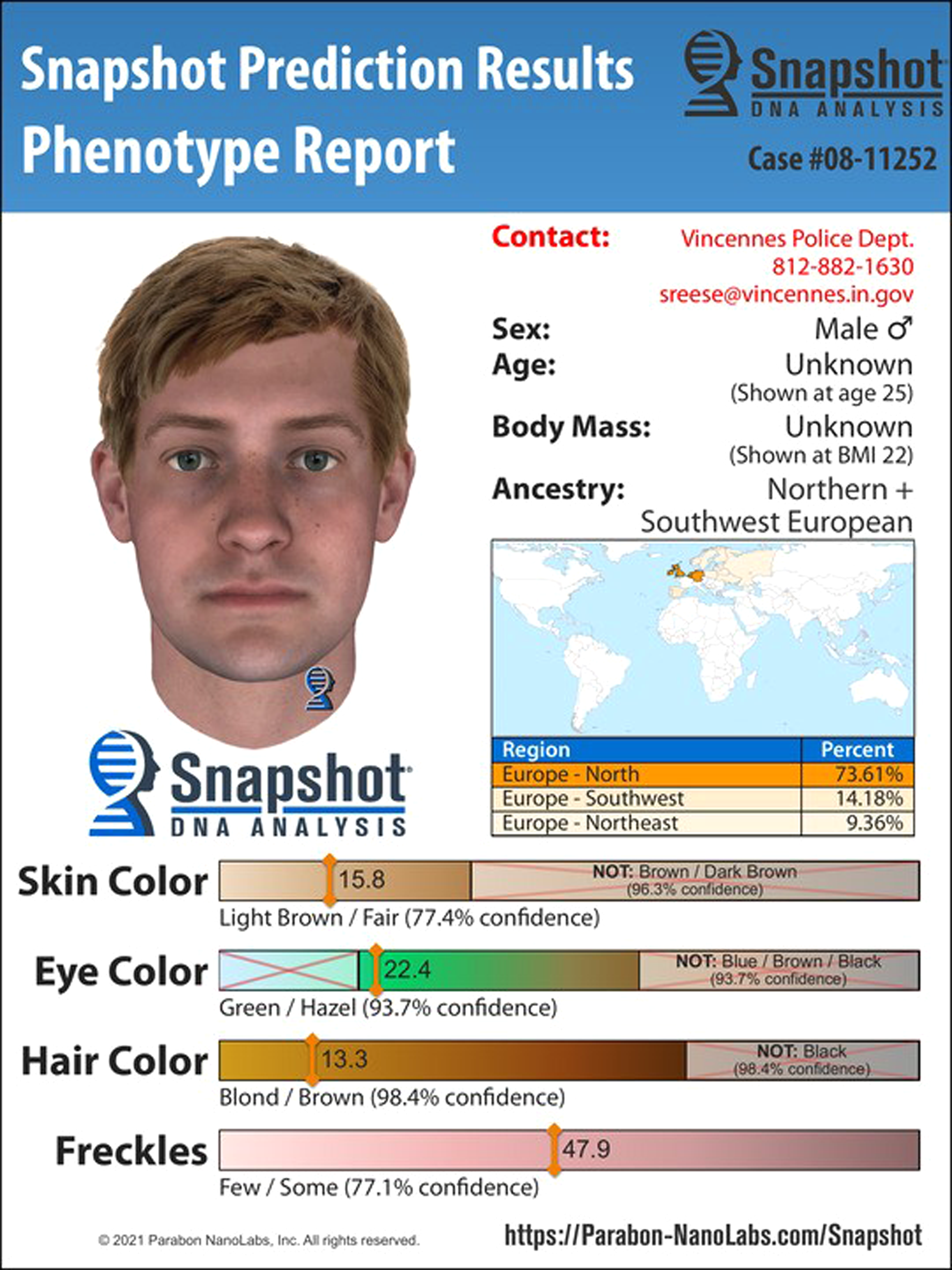
Facial composite produced by Parabon, released 13 January 2021. Available at: https://snapshot.parabonnanolabs.com/posters (accessed 21 February 2022).
Presenting FDP: Getting into detail
To begin to unpack the narrative of innovation surrounding FDP technologies, we first deal with the ways in which these technologies are presented by their developers. The phenotyping service provided by Parabon offers a good starting point. As the term ‘Snapshot’ suggests, the composites produced by Parabon ask to be taken as a mirror for the appearance of a suspect. The term suggests, as do the composites themselves, a photographic image (Wienroth, 2020). This not only applies to Parabon's composites, but also holds true for FDP more generally. In line with this reference to photography, FDP technologies have also been referred to as ‘molecular photofitting’ (Claes et al., 2014; Frudakis, 2008). Comparing FDP with taking a photograph implies providing an image of a particular suspect, an individual (M’charek, 2020).
The presentation of FDP as (ideally) providing a photographic image of the suspect is not limited to discourse around the technologies. Parabon performs this idea through the visualizations that it provides with its Snapshot product. To demonstrate this, we want to draw your attention to Figure 1. Looking over the image, the viewer is presented with a digital image of a face. The face on the left-hand side of the ‘snapshot’ is presented in great detail: it is produced in full color and includes details of the hairstyle, the shape of the eyebrows and ears. Furthermore, dark circles under the eyes and freckles on the cheeks suggest a life lived. Indeed, Parabon's Snapshot service presents composites that ask to be taken as ‘life-like’. 4 They perform the idea that this is a particular person, the suspect police are looking for (see also M’charek, 2016; Hopman and M’charek, 2020). Moving from this digital face to the diagrams at the bottom of the image, the viewer is furthermore given the impression that this is the result of statistical analyses. For underneath the digital image, predictions of physical traits are expressed in percentages, providing ‘an appearance of precision’ (Duster, 2015). Taken together, the elements presented through this digital composite invite the viewer to take the ‘snapshot’ as a precise representation of an individual suspect.
Indeed, researchers working on the development of FDP have referred to results produced using the technology as ‘outcomes [that] can serve as a “biological witness”,’ and ‘may potentially provide even more accurate information than human eyewitnesses do, who are known to be unreliable’ (Kayser, 2015: 34). Or as a police officer in the Netherlands stated, reflecting on the difference between composite drawings and DNA-informed composites, during an interview in 2017: You can wonder ‘what is more reliable’. And I know in that case, it is the DNA that is more reliable. And then you can say ‘what will police do with it in the investigation’, like my colleague said, saying something is one thing, applying is another… But it's going to happen. In the future we’ll be able to make a composite image based on DNA data.
As these quotes indicate, FDP is suggested to provide accounts that are based purely on genetic information, ‘unpolluted’ by human bias, tapping into ‘an idea (or ideal) of objective evidence that derives directly from nature, with human mediation being too trivial to mention’ (Lynch, 2013: 63). Note in particular how human eyewitnesses figure as a ground for comparison with FDP technologies here, are being used in different ways to argue for the permissibility and utility of FDP technologies. First, the permissibility of human eyewitness accounts is used to circumvent ethical concerns surrounding predicting physical traits from DNA (see Samuel and Prainsack, 2019: 123), because it ‘delivers the very same type of information as human eye witnesses do’ (Kayser, 2015: 45), whereas at the same time, FDP is marketed as more ‘accurate’ and ‘reliable’ than eyewitnesses, and as such as having more use (or value) to a criminal investigation.
Unpacking FDP
Parabon's Snapshot thus asks to be taken as a photographic image of a suspect. In the following we delve into the work behind the production of these Snapshot images, and complicate this presentation of individuality. Although striving for individual-specific composites was often articulated as the ultimate goal of FDP technologies by researchers encountered by Roos during fieldwork, in the analyses underlying prediction models, individuality posed a problem. Because human phenotypes are so variable, with each face presenting researchers with intricate particularities, making comparisons and coming to generalizations was complicated. Faces are, as argued elsewhere (Hopman, 2021), and borrowing words from historians of science Daston and Galison (1992: 85): ‘too plentiful and too various […] too quirkily particular to cooperate in generalizations and comparisons’. Geneticists were aware of this methodological problem. As a technician in the research laboratory explained: In the end all physical characteristics are on a continuum. But in reality a continuum would not be achievable, because then you would need enormous amounts of data: you can never know for everybody.
As this quote conveys, physical variation presents itself in gradations rather than separable categories. It would, therefore, be practically impossible to predict faces to the level of the individual. For that, you would need to sequence the genomes of every living person. To make the variability of faces ‘manageable’, complexity thus has to be reduced. This is done by grouping individual facial traits together into categories and classifications. Eye color can act as an example here. Whereas human eye color varies both in terms of color and textural elements, the FDP prediction kit HIrisPlex-s divides eye color into ‘blue’, ‘intermediate’ or ‘brown’. These categories, then, cannot account for mixed eye colors (brown–green, hazel, grey–brown) or variances in blue or brown eyes. They cannot account for pigmentation spots, or a yellow ring around the iris. As a professor presenting his findings on eye color prediction commented in a lecture attended by Roos during her fieldwork in 2017: ‘Eye color does not come in groups, but we need to categorize to do the research’.
In other words, FDP technologies rely to a great extent on categorization work. And it is exactly in this categorization work that individual particularities are filtered out (Hopman, 2021). In analyses, what matters is not how researchers can account for an individual facial characteristic that stands out, but how traits shared between individuals can be grouped to learn about the genetics behind those traits. It thus establishes similarities rather than differences between faces (M’charek, 2000). As a computer scientist warned during a workshop on facial shape analysis in late 2018 that Roos participated in: ‘The problem with the principal component 5 approach is that odd features are sometimes filtered out as noise. If it is a single occurrence in a whole dataset they will remove it’. To put it more strongly, unique facial traits are unproductive for analyses. This obviously has consequences for the results that are produced with these technologies. In the end, results do not necessarily tell of an individual and his or her particular facial traits, but rather provide broadly defined categories that a suspect is slotted into based on a selected set of genetic markers.
Giving life to faces, revitalizing cases
Taking this into account, we may look at FDP differently. With the above we have learnt that the images produced by Parabon are not exact renderings of a suspect's face, but do evoke the sense that they are presenting a particular person. This performance of individuality, we argue, can be taken as serving another purpose in the criminal investigation. For although they may not be photographically correct, presenting faces as such, in full color and including details such as glimmering eyes, wrinkles and a double chin, can be seen as a way of breathing new life into investigations that have gone cold. Their virtue, we suggest, might lie not in their individuality, but in their evoking of ‘liveliness’. In another interpretation of what anthropologist Rajan (2012) has termed ‘lively capital’, the composites produced by Parabon may be said to capitalize on life. Life, not in the sense of ‘cellular or molecular matter’ (Rajan, 2012), but in the performance of photographic precision and detail that hints at a life being lived. Indeed, it is this presentation of life, the virtue and forensic appeal of these composites in bringing about renewed attention to a case, that Parabon commodifies.
For it is these very photographic details that, although not informed by DNA analyses, help appeal to the public (Figure 2). They give the impression that this is a person living a life, walking around right now; they just need to be recognized. This, then, gives these composites added value in a forensic investigation because they might help to attract the interest of the public to a particular crime (M’charek, 2020). As demonstrated by Figure 2, these composite images are made to be circulated: to be presented by police officers in a press conference. Adding to M’charek's (2020) assertion that it is the ‘incompleteness’ of ‘DNA-based’ facial composites that gives them power to affect the public, we argue that by giving the face an air of liveliness, a criminal case can be brought back to life. As a police officer quoted on Parabon's website states: ‘When we have a case like this and have made no headway, this is a way of revitalizing that case, bringing it back to life’. 6 The point of these composites is not to be recognized as such, but to give new life to cases in the sense of drawing fresh attention to them (M'charek, 2020, 9). The appeal to the public, then, is not just to give renewed attention to a suspect and to potentially recognize them, but also to go back to when the crime occurred. As a newspaper article reported for one case in which Snapshot was applied: ‘Reese and Dunham asked the public to look at the composites and think back to what they were doing and where they were at when the assault took place. “Stop, take your time and think about what you were doing at that time”, Dunham said’. The face calls on the public to really pause with the image. Not just to consider the life of the suspect, but furthermore their own life at the time of the crime.
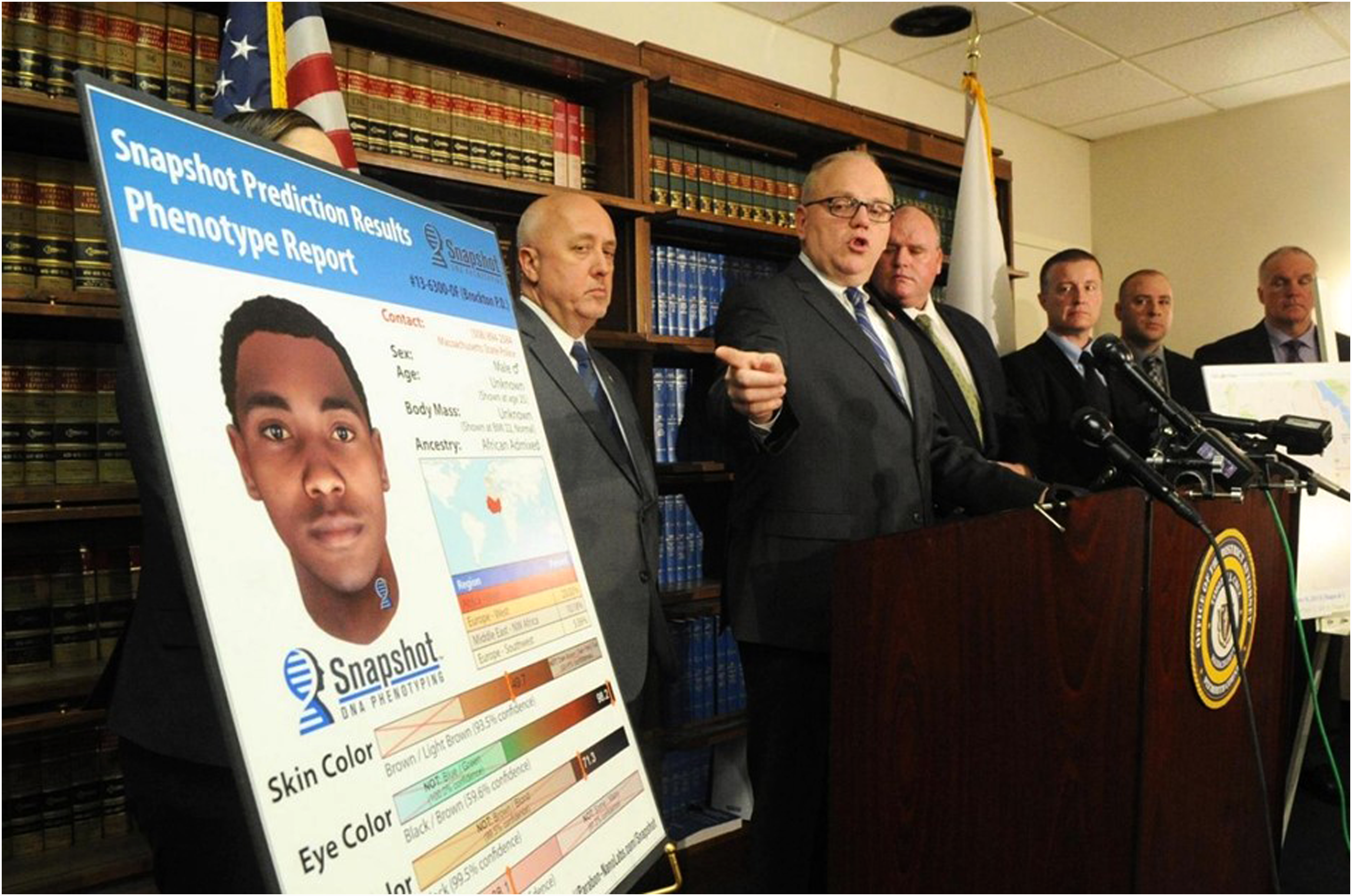
Plymouth County DA Timothy Cruz presents phenotyping sketch produced by Parabon NanoLabs. Photograph: Marc Vasconcellos/The Enterprise.
From the above we can learn that presenting photographic detail in composite images is seen as a virtue, as ‘the dream of police men and women’. We have seen that different actors, from developers to police officers, take DNA-based composites as the almost inevitable endpoint of forensic face-making technologies, promising to deliver an increase in detail and precision. Coming back to the issue of innovation introduced at the beginning of this article, in that sense ‘molecular photofitting’ is seen as a departure from, and an improvement on, the technology of facial composite drawing based on human eyewitness accounts. For seemingly providing individual-specific phenotypic information of the suspect, and being based on ‘purely the DNA’ of a suspect, FDP technologies are taken as more reliable and furthermore more useful to an investigation than facial composite drawings. In the following section, we zoom in on the latter technology. Sketching its development and its application in the Dutch police, we provide insight into the practical utility of facial composites in criminal investigations, and the added value of caricaturing.
The human eyewitness: Producing facial renditions
Background and history of facial composite drawing
A facial composite is a rendering of the face of an unknown suspect based on descriptions by eyewitnesses. 7 During an interview, often at a police station, forensic artists or police operators sit down with an eyewitness to a particular crime to help them actively remember, recall and verbalize the appearance of a suspect. To assist the eyewitness in this process, forensic artists often work with reference materials. These materials vary greatly: they can consist of photographic images of faces or parts of faces, be in color or black and white, or be cut out from magazines, presented in facial catalogues, embedded in facial imaging software or, as Ryanne learnt from forensic artists during her fieldwork, taken from the cover of a yearbook from a Dutch soccer club.
It is difficult to present a coherent overview of facial composite drawing in the Netherlands because it is not a standardized practice: police departments decide on their preferred techniques individually. It was only in 2019 that the first efforts to standardize the practice began. It was then that the National Police opened up two positions for skilled forensic artists who could draw by hand 8 , with a department dedicated to composite drawing in the making as well.
To give an idea of the different approaches to composite drawing, three methods can be broadly outlined. The first and oldest of these is drawing composites by hand, using different materials such as colored pastels or graphite pencils (Figure 3). Drawing can be done on paper or, more recently, on a digital tablet. A second type of method was introduced over the course of the 20th century. Mechanical hand-assembled facial composite systems such as Identi-Kit and Photofit (Penry, 1971) were presented as novel methods for the police to make facial composite images. These systems required eyewitnesses to compose a facial composite image by combining photographic slides of different facial parts into a single frame (Figure 4). The Dutch police owned several such kits, but because of a lack of historical documentation, how much these hand-assembled kits were actually used remains unclear. ‘Historical awareness has never been a key priority of the Dutch police’, as a volunteer at the police museum, himself a former police officer, told Ryanne.
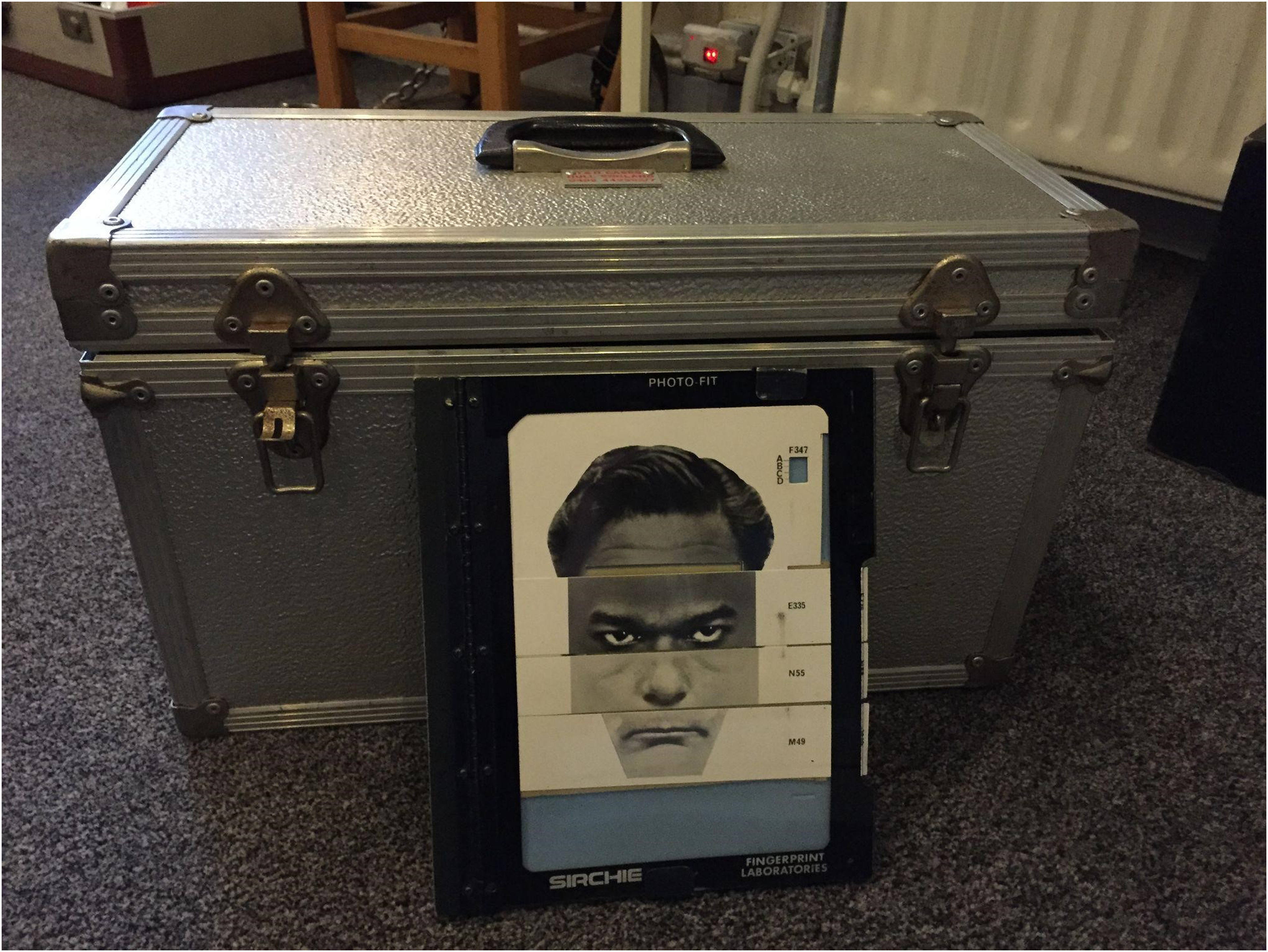
Photofit kit from 1971. The original Photofit case and the Photofit frame with different numbered photographic slides portraying different facial parts. Photograph taken by Ryanne Bleumink at a storage facility for a former Dutch police museum.
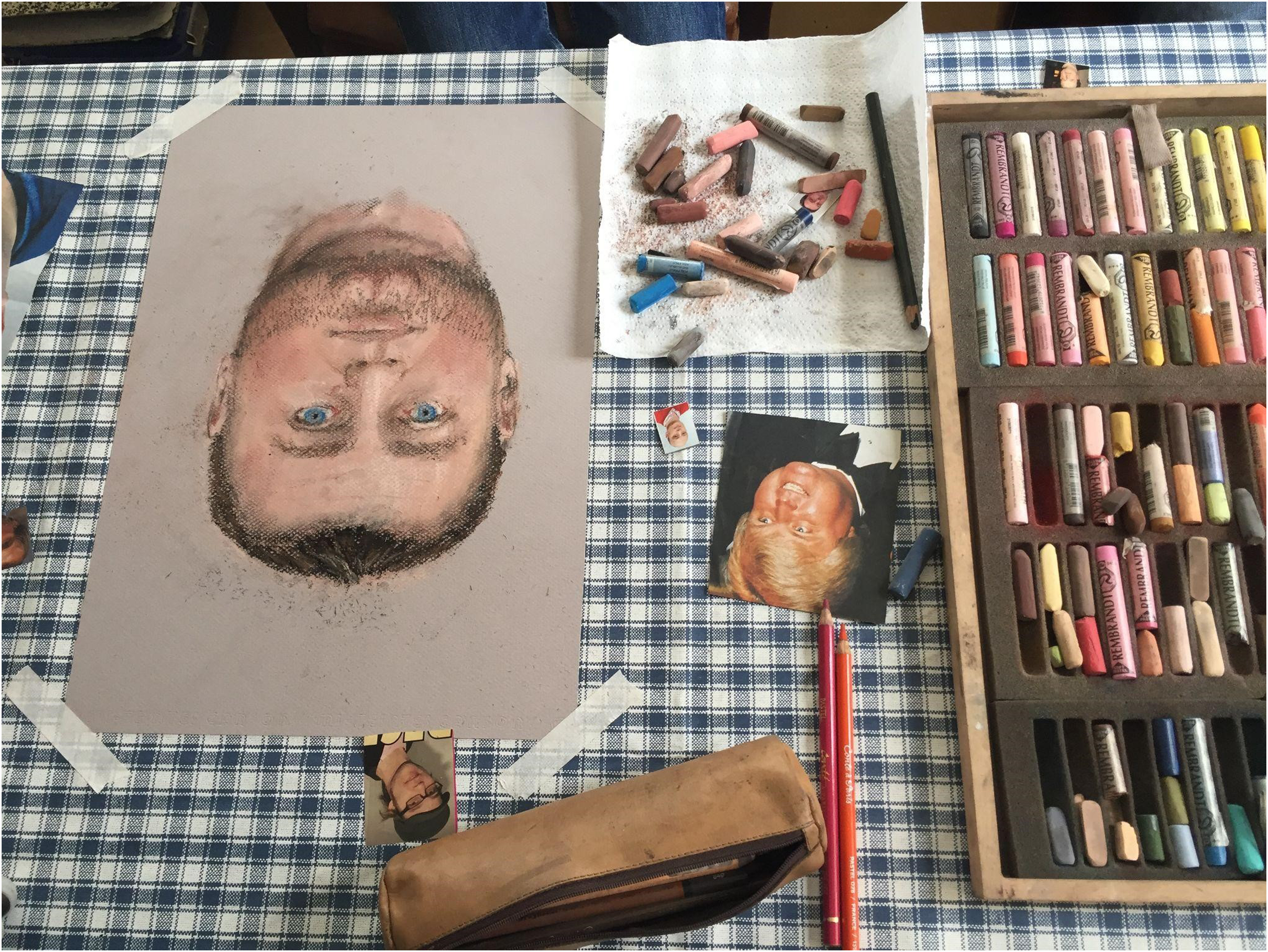
A facial composite drawing in color made by a forensic artist during an experiment (see also Bleumink et al., 2021).
By the end of the 20th century, a third type of method, based on facial imaging software, had largely replaced the hand-assembled composite systems. The Dutch police trained officers, as an ancillary task, to make facial composite images using computer software such as PROfit and Facette Face Design System (Figure 5). In addition to hand-drawing, these two systems were in use during Ryanne's fieldwork. Although the ‘old’, hand-assembled kits were no longer used, the Photofit kit never disappeared fully: Ryanne attended several facial composite sessions at the police during which the forensic artist used reference materials copied from an original Photofit kit. In addition, despite newer methods such as facial imaging software, most facial composite images published in the media remain hand-drawn.
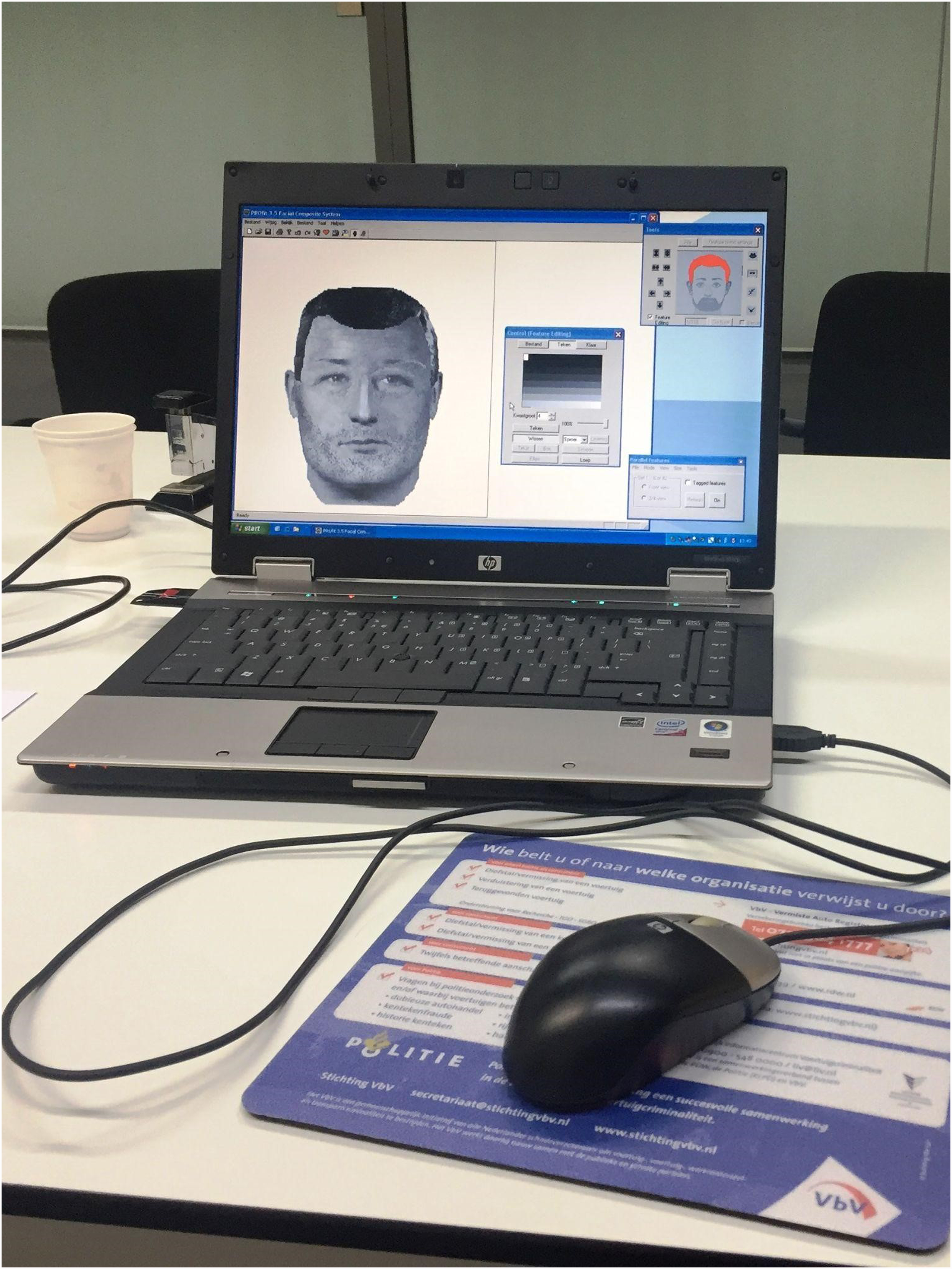
A facial composite image made by a police operator during a demonstration of the facial imaging software Facette Face Design System.
Perceptions of facial composite images: Centering human bias
Having sketched a short history of composite drawing in the Netherlands, we now turn to how this face-making technique is both presented and perceived by the Dutch police. When it comes to perceptions of composite drawing, the work of the forensic artist and especially the memory of the witness are brought center stage. As Ryanne learnt, facial composite images are often presented with caution. A facial composite image, as was stressed by a forensic artist working at the police, ‘portrays the face of a suspect as perceived by a particular eyewitness’. As such, it is stressed that it should not be taken as an exact representation of a suspect's face. Rather, it is seen as being subject to the memory of a witness, who has often seen the perpetrator under stressful circumstances. A manual used by the Dutch police therefore stresses that it is likely that the composite image differs from the suspect's ‘actual appearance’ (Van Amelsvoort and Rispens, 2017).
The caution with which composites are presented stems from the belief that eyewitness testimonies are unreliable and biased (see also Wessel and Wolters, 2010). Indeed, a lot of research has gone into scrutinizing eyewitness statements. A report on eyewitness testimonies by the US National Research Council of the National Academies of Sciences (2014: 15) sums this up: Human vision does not capture a perfect, error-free ‘trace’ of a witnessed event. What an individual actually perceives can be heavily influenced by bias and expectations derived from cultural factors, behavioral goals, emotions, and prior experiences with the world. For eyewitness identification to take place, perceived information must be encoded in memory, stored, and subsequently retrieved. As time passes, memories become less stable. In addition, suggestion and the exposure to new information may influence and distort what the individual believes she or he has seen.
On top of perceived problems with human vision and memory, difficulties are believed to be located in the materials and techniques with which forensic artists and operators work. To name a few: establishing rapport with the eyewitness, the importance of interviewing techniques and suggestibility, the technicalities of drawing, and limitations in working with reference photographs in facial imaging software. Challenges may also arise from seemingly simple routine acts such as forgetting to place the structured side of the drawing paper on top (see Bleumink et al., 2021: 11).
In contrast to results produced with FDP technologies, forensic artists and criminal investigators are thus careful not to present facial composites as photographic images of suspects.
Unpacking composite drawing: Emphasizing distinctive facial features
With such strong emphasis on eyewitness testimonies as unreliable and incomplete, one might start to wonder why these composites are still being made at all! Yet in the following we demonstrate that they have important virtues for a criminal investigation; because facial composite drawings leave space for characteristics that can catch the attention of the public, by highlighting distinctive features. Forensic artists are aware of this and have several tools at hand to make distinctive characteristics stand out. In fact, this is what a large part of their work revolves around.
First, the forensic artist may highlight certain facial features the eyewitness feels certain about and that may contribute to identification of the suspect, while backgrounding those the eyewitness cannot (fully) recall. One forensic artist explained how this works in practice. Pointing at her own nose, she explained that she encountered eyewitnesses having difficulties describing the nose of the suspect. Not drawing a nose in the facial image at all is not possible: a nose-less suspect, or the absence of a nose in any face, would have certainly caught the attention of the eyewitness, she explained. ‘Faces do come with a nose.’ That is why this forensic artist intentionally drew vague contours. As such, she hinted at the presence of a nose without giving too much away about its size and shape, leaving the interpretation to the viewer.
Another way to go about this is leaving out color. As one forensic artist explained: ‘color is too descriptive’. For eyewitnesses it may be very hard to tell whether a suspect has blue, green or brown eyes. Furthermore, another forensic artist reported, suggesting that the suspect had a particular eye color runs the risk of wrongly excluding potential suspects. Therefore, the artist explained, ‘Saying he had light eyes is better than saying he had blue eyes’. This leaves the composite more open to interpretation. This artist therefore omitted color from composites altogether, working only in black and white and with grey tones. ‘color information can only get you further away from a suspect’, she stressed. Another artist, however, pointed to the possibility of working with color to highlight outstanding features; for example, in a case where a suspect was said to have a ‘red alcoholic nose’.
An outstanding feature may prove enough to make the decision to circulate a composite image. The police, for example, once circulated a composite image portraying only the back of a suspect's head, which had a distinctive bulge.
Forensic artists thus play with backgrounding particular facial features while foregrounding others to enhance the recognizability of a particular suspect. This balance between foregrounding and backgrounding is delicate. During fieldwork, Ryanne encountered several criminal investigators receiving large amounts of leads because the facial composite image looked ‘too general’. As one investigator noted, ‘the image looked like every male with brown hair out there!’. Criminal investigators have to investigate every single lead, which may overburden the investigation. This applies, in particular, to cases with composite images made by operators because, as several investigators noted, operators are limited by the templates that come with the software, preventing them from adding distinctive features. Hand-drawings, by contrast, are not subject to these limitations because they allow for infinite possibilities in drawing shapes, colors and sizes.
The work of facial composite drawings in the investigation: Distinctive features
Incompleteness in the composite image is important for both the criminal investigators and forensic artists and operators. It is seen as reducing the margin of error in witness testimonies, but also offers handles to circulate the composite to the public with additional information at hand. The virtue of composite images is, therefore, not in evoking ‘liveliness’, as we observed with Parabon's snapshots, although this also might occasionally be the case. It is not the aim of a composite image to portray a ‘good-looking drawing’, because this may not be ‘an accurate representation of the perpetrator’ (Taylor, 2000). Instead, they seek to foreground a suspect’s outstanding or peculiar facial features, without pretending to portray that individual suspect. To arrive at that individual, as one police spokesperson explained, facial composite images are always circulated with ‘additional information’.
Indeed, the forensic artists encountered by Ryanne were careful to not add too much detail to a composite. It is believed that this could make the facial composite image less effective (see also Bailey, 2014; Mancusi, 2010; Streed, 2017; Taylor, 2000). In fact, ‘sketch quality’ is often preferred over ‘photographic quality’ (Taylor, 2000). As the forensic artist Bailey (2014: 6) explains: When people see an image we want them to know that it's an artist rendition, not a photograph. (…) An image that looks like an artist's interpretation has more ‘wiggle room’ in the viewer's mind than something that looks exactly like a photograph, and will result in more calls for detectives. Investigators would rather follow up on more leads that will result in an arrest, than fewer leads resulting in a dead end. So, just because we may be able to make an image look exactly like a photograph, it doesn’t mean we should.
This was confirmed during a meeting the authors had with a forensic artist in early 2022. This artist emphasized that having a composite appear like a drawing is actually an advantage when circulating it to the public: ‘With a drawing the public knows it cannot be a perfect likeness, like a photograph, to a suspect. And this prevents the public from losing interest in a case. If we would present a photographic image of a suspect, this makes people think we basically already have him’. A drawing, in other words, leaves space for the public to be interested in and interpret a composite in different ways. An image that is too specific would lead the public to quickly exclude potential suspects because there is not an exact likeness with the image.
In addition, eyewitnesses may not only describe the suspect's face, but provide all kinds of contextual information about the crime. This context is believed to be crucial for circulating composite images for criminal investigations (Van Amelsfoort and Rispens, 2017). Whereas in FDP it is mostly the face that is central to the practice (Hopman and M’charek, 2020), for composite practice attention extends beyond the face. Eyewitnesses may provide information about posture, the circumstances of a crime, particular behaviours, hairstyle, clothing, tone of voice, smell, tattoos, scars, dialect or language, pace, means of transportation, modus operandi or any other peculiarities that come with a crime. Context, in combination with the composite image, information about location and time, may prove pivotal for the crime scene investigation and criminal investigators. These clues on context and distinctive features, as we have learnt from the section on FDP, cannot be retrieved from DNA traces.
What face-making technologies can teach us about innovation
Having walked through both FDP and facial composite drawing, in this final section we want to use the cases introduced above to draw out what may be learnt about innovation and technology for social scientists, police, and technology developers alike.
Making technologies work (for police): Photographs and caricatures in practice
Working with and at the Dutch police, Ryanne experienced first-hand the practical constraints of police practices. Police operate under the temporal (and societal) pressures that come with working on a criminal investigation: a crime has been committed, and investigators face the responsibility of capturing the perpetrator as quickly as possible. Investigatory practices are pressed for time. Because of this, Ryanne observed, investigatory practices do not necessarily lend themselves to asking elaborate questions about technology. Although lengthy reports were written on the implementation and uses of technologies, these often disappeared into drawers, with executive summaries being read instead. When questions about technology were asked, criminal investigators were less interested in ‘how does this technology work?’, but instead wanted to know, ‘how can this technology work for us?’. The focus is thus less on understanding the exact technicalities and more on a technology's potential to do something for an investigation. As Samuel and Prainsack (2019: 128), who conducted interviews on FDP with actors including police officers, put it: ‘For those working at the coalface, expected utility in case work was the starting point’.
When it comes to questions around what technologies may do for a criminal investigation, our unpacking of the two face-making technologies offers a starting point. First of all, we have seen how FDP developers presented their technologies as striving for individual-specific images, in the sense of providing ‘photographic’ depictions of suspects. Parabon delivers a product that gives exactly that impression: it produces composites in full color and presents the faces in great detail. We learnt that although this did not necessarily produce the face of an actual suspect, it could assist in bringing a case ‘back to life’. Having looked at the use of facial composite drawings, we then learnt that photographic detail and color are avoided. Rather, faces are presented as ‘open to interpretation’ to keep the public engaged and produce more leads. In addition, facial composites that display distinctive or peculiar facial features can enhance the recognizability of a suspect. Here, a bulge on the back of the head, or a gap between the front teeth, may prove crucial in leading to a suspect. By centering distinctive features and leaving other facial characteristics blurred, composite drawings allow for all attention to focus on a particular trait.
Although Parabon advertises its ‘Snapshot’ images for their precision and detail, providing highly detailed renderings of suspects is not necessarily most helpful to an investigation. Instead, our analyses suggest that caricatures might be more effective than physically accurate faces. Developers of FDP technologies recognize this problem, ‘Indeed the caricature effect shows that the physically most accurate match is not always the best for recognition by humans’ (Claes et al., 2014: 215). As research in psychology has furthermore demonstrated, ‘distinctive or unusual faces are recognized more accurately than typical faces’ (Valentine and Ferrara, 1991: 87). The reason for this, as this research has shown, is the increased distinctiveness of these faces: ‘Caricature studies have consistently found that caricaturing, despite distorting the original image, does not hinder and may even enhance identification … caricatures enhance performance because they are more distinctive’ (Lee et al., 2000: 379). Caricatures are not exact replicas of an individual's face, but rather depict features that stand out, that make a face uniquely memorable.
Having looked both at the technicalities of producing composite drawings and their application in practice, in this paper we have demonstrated that for police to innovate, lessons should be drawn from how technologies are actually used in policing (Toom et al., 2016). There we may find that precision as a photographic likeness, the ‘molecular photofitting’ that developers of FDP technologies strive for, is not necessarily productive when it comes to composite faces and recognition (see also Hopman, 2020).
Rethinking innovation
At the beginning of this article we showed that concerns around technological innovation are central to police departments in the Netherlands. With the introduction of new technologies and procedures the police hoped to become more efficient, which for criminal investigations mainly implies that perpetrators will be captured more quickly and, as a result, social safety can be ensured. In other words, innovation was equated with technological progress. This focus on novel technologies, however, runs the risk of losing sight of the benefits of existing investigatory methods. Our analysis shows that much is to be gained from taking these seriously.
As a second lesson to be drawn from this article, we invite police to pause and take seriously the established technologies, rather than looking ahead, scouting the horizon for novel technologies. What are the technologies they might already have in place? And most importantly: what are the practical affordances of these existing technologies in the criminal investigation? Going back to Barry's (2001: 24) suggestion to address ‘a need to think of the ways in which innovative activity takes place outside of industry and outside of the laboratory’, we thus ask police to question equating innovation with technological change. Having attended to the practice of composite drawing in the Netherlands, we have shown that being ‘innovative’ cannot be taken as an exclusively technological endeavour, but should rather be characterized as sociotechnical, with progress coming in the shape of adaptability to the changing demands of investigations and a return to ‘outdated’ methods.
Although we have compared and contrasted FDP and composite drawings here for the sake of our argument, our analyses have demonstrated that there is no neat distinction to be made between ‘low-tech’ and ‘high-tech’ approaches to policing. Indeed, as a practice in its own right, we have shown that facial composite drawing has undergone various technological changes. Over the years, police have experimented with a wide range of kits, software and materials, the most recent development being the introduction of drawing on digital tablets. This entailed a return to hand-drawing, considered a ‘low-tech’ technology, making most computerized software that was used in practice redundant. This is to emphasize that composite drawing has not been static, but rather has been constantly reworked and refigured, with police actors continuously looking for ways to improve the practice. This is to say that technological innovation is thus not necessarily to be found in what is presented as ‘cutting edge’, but rather is a constant and experimental process of trying out and reworking existing technologies.
At present, the way that FDP and facial composite drawing are related to each other by police officers and geneticists alike is by way of comparison. Composite drawings are used to argue for the benefits of FDP, which is stressed to provide the reliability that a human eyewitness cannot. At the same time, drawings are put forward as an argument for the permissibility of composites produced using DNA materials, because DNA is said to reveal the same visible traits that a human witness does. Instead of comparing the two technologies using the same standard, where FDP counts as the benchmark technology, we suggest that each technology be valued according to its own logic. Doing so, we would then encourage police and developers of phenotyping technologies to bring them into the conversation, actively allowing the rich history and practical lessons of composite drawing to interfere with envisioned DNA-informed innovations. This may, for example, lead them to question individual-specificity as the ultimate development goal of these technologies. We hope to have made a start with that here.
Conclusion: The promise of the mundane
In this article we aimed to complicate the high currency of ‘innovation’, especially in terms of technological novelty, in policing. Starting from participant observations with the Dutch police in particular, we drew attention to innovation as something desirable, and as something that can be obtained through looking out for novel technologies. Through descriptions of Parabon's Snapshot and facial composite drawing practices, we aimed to complicate this take on innovation. Building in particular on the work of sociologist Andrew Barry, who has called for a broadening of the concept of innovation to include work outside research, we drew out differences and similarities between these investigatory technologies to demonstrate that although innovation is seen as the betterment of policing through the introduction of novel technologies, much is actually to be learnt from established and mundane technologies.
Seeking to learn from practices of composite drawing in particular, innovation then becomes something different from a straightforward process of finding new technologies. Instead, it can be located in the highly adaptive and situated work of composite drawers as they tailor their methods to both an ever-changing suspect population, the endless repertoire of drawing devices and reference materials available to them, and a particular eyewitness and criminal investigation. This is not to say that such work is not important to the development of DNA technologies (see Hopman et al., 2022), but rather helps open up the conversation on innovation as technological progress. To innovate then, does not necessarily mean leaving the past behind, but equally entails sticking to established, mundane technologies and putting these to work in different ways. Although these technologies may not be novel in themselves, their contribution to the criminal investigation may very well be. As our analyses have shown, facial composite drawing is often considered an outdated and unreliable method, with DNA-based technologies presented as the prospected future of facial composites. Yet, when we move beyond comparison and consider facial composite drawing as a practice in its own right, we come to see that a lot of innovative work is done there, too.
Our analysis also made thinkable the development goal of FDP technologies: namely the promise of face; the ‘holy grail’ of appearance prediction. With composite drawing in particular, we were able to complicate the usefulness of such photographic images in an investigation, and drew attention to issues around the evoking of liveliness in depictions of suspects. We have shown how photographic detail was taken both as desirable (for FDP) and risky (in composite drawing). We expect this tension to raise further questions as technological developments continue to be introduced in policing. Even if the products of Parabon, the case we have used here, may not end up being applied in investigations in the Netherlands, Dutch officers still anticipated FDP technologies to develop inevitably in the direction of full facial composites based on DNA traces. This shows how closely innovation is entangled with the promises of new technologies: increased precision, more reliability, a more efficient criminal investigation and hence increased social safety. But whereas promise in scientific fields is often taken as a future-oriented matter of ‘excess’, an ‘always-going-beyond’ (Fortun, 2005), here we have shifted attention towards the promise of the mundane in the study of innovation. By taking the mundane seriously we gain the opportunity to look at technologies differently, and to imagine alternatives to a linear, progress-oriented trajectory.
Footnotes
Acknowledgements
We are grateful to Matthias Wienroth, Editor of the Special Issue "Technology in Policing", for his guidance and support throughout writing this paper, as well as for comments and suggestions provided by two anonymous reviewers. We also want to thank the members of the RaceFaceID project for their feedback and thinking along with us on this paper. Finally, we thank our interlocutors at the police and forensic laboratories for being open and sharing their ideas and concerns with us. We learnt a lot from you.
Declaration of conflicting interests
The author(s) declared no potential conflicts of interest with respect to the research, authorship, and/or publication of this article.
Funding
The author(s) disclosed receipt of the following financial support for the research, authorship, and/or publication of this article: This work was supported by the European Research Council under Grant FP7-617451-RaceFaceID-Race Matter: On the Absent Presence of Race in Forensic Identification, and the Berlin University Alliance, Grand Challenge Initiative Social Cohesion project "Museums and Society - Mapping the Social".

Supplemental material
Supplemental material for this article is available online.