



Abstract
Sexual harassment is multifaceted and complicated, creating a hostile environment dominated by sexually motivated behaviours. It is experienced by many, particularly in the workplace. For example, many police officers experience sexual harassment from a colleague. Despite this, sexual harassment remains under-researched, with limited exploration into victims’ experiences first-hand. As such, the current study aimed to research female police officers’ experiences of sexual harassment by colleagues to investigate risk factors of sexual harassment and barriers to reporting. Seven transcripts were collected using semi-structured interviews, both in-person and online. Despite the assurance of anonymity, officers feared coming forward for research owing to identification concerns. Interpretative phenomenological analysis was used for the analysis to extract in-depth accounts from participants. Results showed that police culture contributed significantly to facilitating sexual harassment. For example, a male-dominant force, a hierarchical structure and the blue wall of silence. In addition, participants faced barriers to reporting sexual harassment. For example, a rumour mill culture and oppositional reactions from colleagues. Furthermore, the sexual harassment that the participants faced negatively affected their attitudes to work, and their physical and mental health.
Introduction
There is no universal definition for sexual harassment because defining it can be challenging owing to the ambiguity of the behaviour. The majority of definitions include ‘unwanted or unwelcome sexual advances, which have the purpose and/or effect of being intimidating, hostile, degrading, humiliating, or offensive’ (Quick and McFadyen, 2017, p. 286). Such behaviours include, but are not limited to, sexual remarks, sexual gestures, inappropriate touching and sexual coercion (Quick and McFayden, 2017). All of which degrade and devalue the individual. Sexual harassment has been classified into three categories, each containing three to four subcategories (J.E. Gruber, 1992). These are: verbal demands for sexual intimacy, including sexual bribery and unwanted sexual advances; verbal comments, such as personal remarks and sexual objectification; and non-verbal behaviours, such as sexual touching and sexual posturing. Other research has made comparable distinctions (Fitzgerald et al., 1988, 1995; Gelfand et al., 1995).
Most definitions have been written using gender-neutral language and it is crucially important to acknowledge that men can be victims of sexual harassment too. However, when exploring research and statistics, sexual harassment is predominantly committed by men against women (Bagilhole and Woodward, 1995). In addition, the forms of sexual harassment against women tend to be more serious (de Haas and Timmerman, 2010). UN Women (2021) reported that in the United Kingdom, 71% of women of all ages have experienced sexual harassment at least once. Research has shown that some victims are unaware that they have been sexually harassed; this may be due to difficulties in determining what sexual harassment is (UNISON, 2020). Therefore, some cases may go unacknowledged, and the true percentage could be higher. This percentage increases to 86% of women between 18 and 24 years old; 96% of these women noted that reporting the sexual harassment would not have changed anything (World Health Organization, 2021).
Sexual harassment is a problem faced almost exclusively by women in all areas of life (de Haas and Timmerman, 2010). It is a continuous occupational and public health concern that impacts the psychological, physical and social welfare of victims (Quick and McFayden, 2017). In the workplace, hierarchical power relations underpin sexual harassment (McDonald, 2011). Sociosexual theorists believe that gendered stereotypes contribute to sexual harassment, men are sexual agents and women are sexual objects (McDonald, 2011). According to this theory, sexual harassment occurs more in male-dominated workplaces because for a woman, her singular most distinct feature is her gender, whereas for men, there is increased value on masculine qualities such as dominance and aggression (Bergman and Henning, 2008). When women enter male-dominated sectors, they are ‘organisational interlopers’, meaning they are intruding in an organisation where they are unwanted and interfering in jobs ‘not suitable’ for them (McDonald, 2011). Therefore, sexual harassment is used to belittle females and reinforce the male hierarchy (McDonald, 2011). If women are in superior positions to men, it creates an unequal power dynamic favouring women. This compromises the idea of male dominance by challenging gender stereotypes (Samuels, 2003). As a result, men feel vulnerable and use sexual harassment to reinstate the power (McLaughlin et al., 2012).
Occupations that see the highest levels of sexual harassment are uniformed services (Grube-Farrell, 2002). Illustrative of this, the Ministry of Defence (2015) revealed that 90% of those serving in the army have heard sexualised stories and jokes. In civil uniformed services, namely the police, sexual harassment is a growing concern at a national level, and it is experienced by many. Indicative of this is the increasing number of reports of sexual harassment filed by female officers against their male counterparts (Carter Collins, 2004). A survey of policewomen from 35 countries uncovered that 77% of officers have been a victim of sexual harassment by a male colleague at least once (Brown et al., 2000).
In policing, the reluctance to report colleagues has been termed ‘the blue wall of silence’ (Kleinig, 2001). This unofficial code expects officers to refrain from reporting the mistakes, inappropriate behaviour or misconduct of colleagues to senior officers or governing authorities (Perry and Benoît, 2021). The ‘blue wall of silence’ is underpinned by faithfulness and allegiance (Wieslander, 2018). Reporting another officer is a serious betrayal of trust and loyalty of the ‘police family’ code. Officers repeatedly use their power to cover up or fail to report their colleagues’ misconduct. For example, disposing of or manipulating incriminating evidence (Hobbs, 2017; Stinson et al., 2019; Westmarland and Conway, 2020). Colbert (1999) highlighted that the blue wall of silence extends to courtrooms; officers must refuse to give testimonies that would adversely impact a colleague. Officers will go to the extent of perjuring themselves to protect another (Perry and Benoît, 2021). This illustrates the significant weight of the ‘blue wall of silence’. In addition, maintaining a level of secrecy within the police is rewarded, over and over again. Such rewards include bribes, which aim to reinforce silence, such as an ‘I owe you’, personal gain, such as monetary incentives, or supporting career goals including promotions or recognition (Carter, 1990).
Despite the growing acknowledgement of sexual harassment, it is still ongoing, with many people afraid to report it. When officers speak out, they are punished and ostracised by their colleagues, which only strengthens the blue wall (S.E.V. Brown and Battle, 2019). Officers face retaliation, bullying or unjustifiable dismissal (Kleinig, 2001). When another officer witnesses this, it reiterates their obligation to remain silent (Wieslander, 2018). Furthermore, officers who have experienced sexual harassment refrain from reporting the behaviour because they believe that the police force will be ineffective when dealing with it (J. Brown et al., 2017). When officers have reported sexual harassment, they expressed feelings of being let down by their employers, deeming any action taken as unsuitable and inappropriate, leaving them with no choice but to transfer departments or leave their job entirely (Carter Collins, 2004).
There are norms within police culture that contribute and facilitate aggressive behaviour. Owing to the nature of policing, officers are given a higher degree of authority than the average person (Sweeting et al., 2022). For example, the ability to use excessive force to prevent crime or to assist in arrests. The boundaries of when it is appropriate to use increased power and aggression can become blurred or distorted. Consequently, the behaviours appropriate for work amalgamate to form officers’ everyday behaviours (Paoline et al., 2000). This results in an abuse of power, sometimes in the manner of sexual harassment. Furthermore, officers are expected to be impervious to distressing events (Basinska and Dåderman, 2019; Sweeting and Cole, 2022). To achieve this resistance, officers use humour, such as sexualised banter, as a mechanism to deal with the demands of the job. This can create an entertaining and jovial environment that defuses the stress of the working environment (J. Brown et al., 2017). However, some forms of sexualised banter are at the expense of another, which can be classified as sexual harassment (Charman, 2013).
Considering all the research examined, it is unfortunately unsurprising that sexual harassment is prevalent in policing. This growing awareness has facilitated in the development of laws, guidelines and policies surrounding sexual harassment in the workplace (McDonald, 2011). Nevertheless, there are still increasing numbers of sexual harassment reports. This indicates that the current structure is not functioning effectively. Van der Lippe et al. (2004) argued that despite the introduction of gender equality policies, this will not facilitate organisational change unless cultural and structural changes are made first To achieve this, the current study aims to develop a deeper understanding of female officers’ experiences of sexual harassment and the difficulties they faced when reporting it. Although there is previous research, this is limited and provides a surface-level understanding of such a complex topic. It neglects to uncover the depth of what it feels like to experience sexual harassment. Coupling this with the experiences of being a police officer in today's society, this study aims to research these two factors in tandem. It is hoped this will provide a better understanding of sexual harassment in policing and aid in policy formation on how to identify sexual harassment and how to improve the reporting process.
Methodology
Research design
This research used interpretative phenomenological analysis (IPA). This qualitative approach allows for a rigorous investigation into people's personal experiences (Biggerstaff and Thompson, 2008). It accounts for individuals’ lived experiences rather than explaining them through the literature or theoretical concepts (Biggerstaff and Thompson, 2008; J.A. Smith and Osborn, 2015). IPA allows for a phenomenological investigation into areas that lack research or have limited backgrounds (Shinebourne, 2011). Because there is limited previous research, IPA was an appropriate method for this study as sexual harassment is multifaceted, sensitive and complex. Furthermore, IPA recognises that the researcher interacts with the data and acknowledges the interpretative element that other methods do not (Biggerstaff and Thompson, 2008).
In keeping with the use of IPA, semi-structured interviews were chosen because they allow for deeper and more positive interaction to take place between the researcher and the participant (Kallio et al., 2016). Having a good rapport between both parties increases trust allowing participants to share more information and detail (Abbe and Brandon, 2013).
An initial question plan was developed but this remained flexible to ensure that follow-up questions and prompts could be used where necessary to achieve a deeper understanding that structured interviews may not offer (Dearnley, 2005; Roberts, 2020). This allowed for new topics to be uncovered, ones perhaps not considered by the researcher (Pietkiewicz and Smith, 2014). The questions surrounded the following topics, but with an emphasis on flexibility and adaptability: the nature of the sexual harassment, barriers participants faced when reporting it, the impact it had on the participants, and the reaction and response from the police if/when they filed a report.
Participants and sample size
Participants were recruited purposively, enabling data collection from individuals with insight into a specific experience (J.A. Smith et al., 2009). First, the researchers placed posts on the social media platforms LinkedIn and Twitter asking for female police officers who have experienced sexual harassment by a colleague(s) to make direct contact with the researchers. Second, a senior police officer from an English police force contacted the researchers to advise that there were officers within that force who had heard about the research and wanted to take part. This officer acted as a gatekeeper and forwarded information and consent forms pertaining to the research to these potential participants who were then able to contact the researchers directly. A total of seven participants were interviewed: five were interviewed online via video interviews; one was interviewed over the phone; and one requested, via the gatekeeper, that she submit answers to the interview questions anonymously by providing written responses.
Participants were offered the choice between in-person and online interviews because the majority were conducted when there were restrictions in place during the COVID-19 pandemic. In recognition that rapport-building and participant comfort are easier to achieve and monitor in face-to-face interviews, the researchers engaged in a general conversation with the participants before commencing the questions. They also made additional participant comfort checks during the participant interviews.
Data collection
Although both participant recruitment approaches generated a lot of interest and contact, the researchers found that many officers ultimately felt unable to take part in the interviews. This was mainly owing to concerns that they might be identified – even though the majority had left the police. The option to submit written responses in an entirely anonymous way was for many, still not a method with which they felt comfortable. However, IPA studies have a recommended sample size of between 2 and 25 participants and this was achieved here with the 7 participants (Alase, 2017; J.A. Smith et al., 2009). The video and phone interviews were audio-recorded and transcribed verbatim. Any personal or identifiable details including names of police personnel, family and geographical locations, such as police stations, were redacted during transcription. The original audio files were deleted after being transcribed.
Reflexivity
The first three authors are not from a police background and each had a limited knowledge of sexual harassment within policing before conducting this research. However, their understanding evolved from conversations with the fourth and fifth authors one of whom is a former police officer and the other a clinical psychologist who has worked with the police. The first three authors felt that their limited prior knowledge reduced the chance of their own views impacting the research, but throughout the study they remained aware of any biases that may impact their interpretation of the findings and negated these by ensuring that the participants were the experts offering their own personal experiences. Furthermore, they remained open to all findings, whether similar to or contrasting with previous literature.
The fourth author is a former police officer who had both witnessed and experienced sexual harassment within the police workplace. She was aware that these experiences might lead to bias in her interpretations of participant accounts and for this reason, the first three authors took the lead in analysis of the transcripts. In the interests of transparency, participants were made aware that one of the authors working on the project was a former police officer. Furthermore, the fourth did not speak about her own experiences during the interviews at which she was present.
Ethical considerations
The research strictly followed the British Psychological Code of Human Research Ethics to ensure the highest ethical standards (The British Psychological Society, 2021). Before the interview, the participant was provided with an information sheet detailing the research and giving a list of support systems. The information sheet was also included in the online version. Participants completed an informed consent form and were told of their right to withdraw at any point until transcription without any consequence. This was because once transcription took place, all participants would be unidentifiable as personal information was removed or anonymised. Online participants were able to stop at any point by closing the browser window.
At the beginning of the interview, the researchers introduced themselves and discussed general topics to build rapport. Before the main discussion surrounding sexual harassment, participants were offered a break and reminded of their right to withdraw at any point. If they preferred not to answer a question, no question was compulsory, they were not required to provide a reason why. Afterwards, the participants were thanked and redirected to the support available, including access to an independent clinical psychologist.
Results
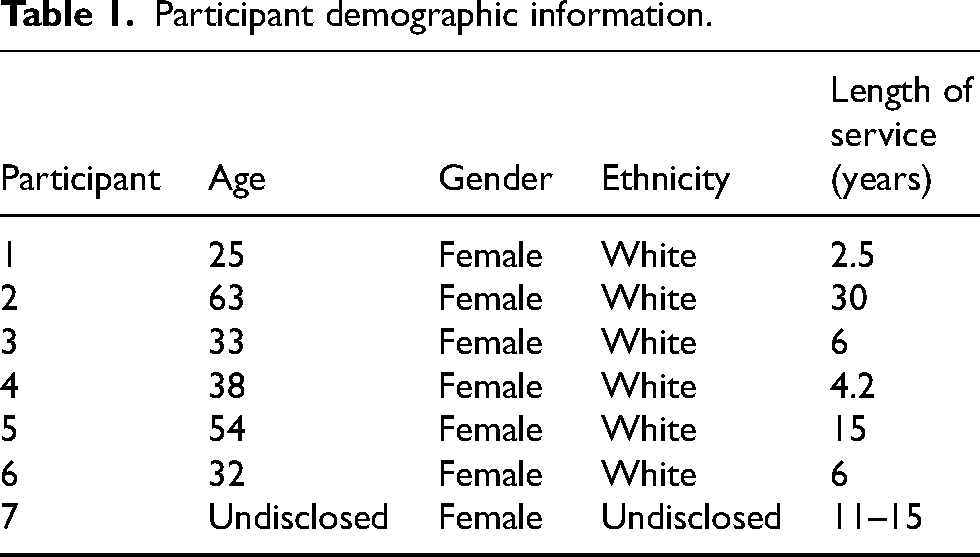
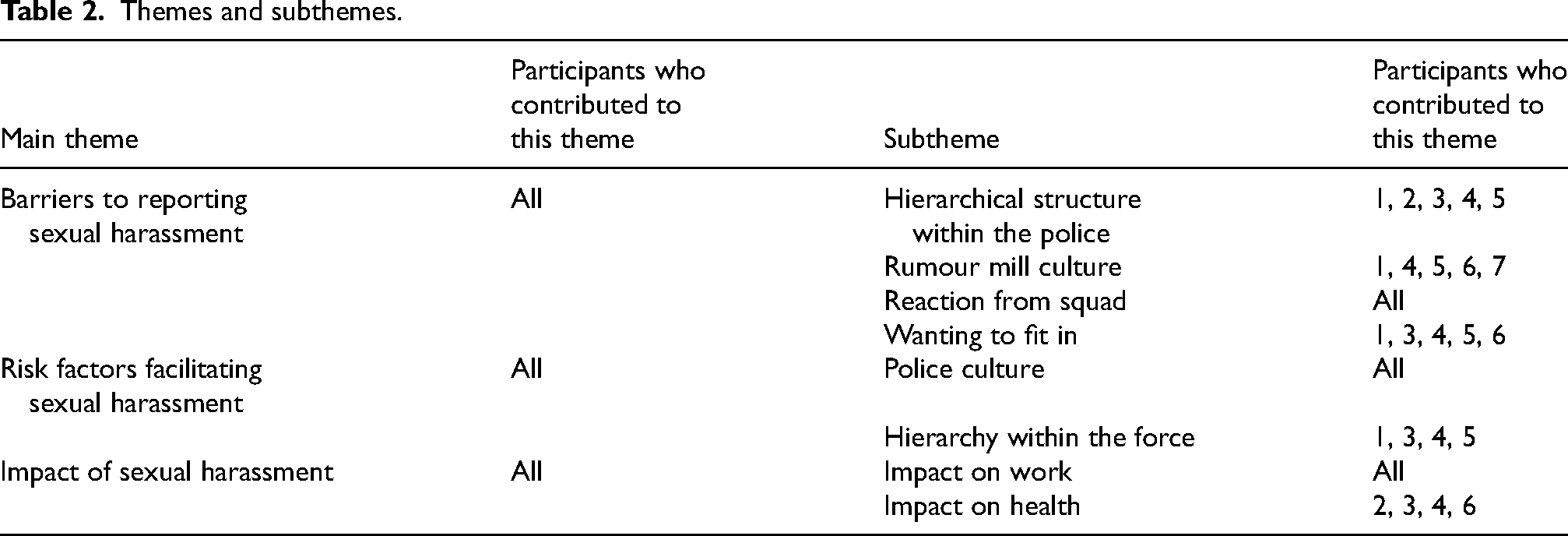
Seven transcripts were used in the final data analysis. All the participants were white females who self-reported sexual harassment by another officer while working. The interviews ranged in length from 38 min to 1 h and 17 min (mean = 56.5 min). The interviews began by collecting demographic information and general information on the participants’ policing careers (Tables 1 and 2).
Participant demographic information.
Themes and subthemes.
Barriers to reporting
Hierarchical structure within the police
Younger officers felt they could not stand up to higher-ranking officers owing to a fear of being rude, disrespectful or not believed. Participant 3 said, ‘they won't believe me’ because ‘he was acting sergeant’. Similarly, Participant 4 reported ‘it was his word against mine’ because she was a probationer and he was a chief inspector. Participant 5 did not report the sexual harassment because her perpetrator was given a promotion, so she did not believe reporting was ‘worth it’.
When Participant 7 challenged the sexual harassment, she was isolated leading to an argument: ‘my sergeant and I fell out as I challenged comments he made […] he ignored me for 2 weeks’.
Rumour mill culture
Officers must be cautious of what they say within the police because ‘you can't do anything in that organisation without people knowing’ (Participant 6). Colleagues would ‘[spread] untrue rumours amongst police friends’ (Participant 7). When participant four reported misconduct, the rumour mill culture increased her experience of general bullying. [Redacted] was spreading untrue rumours […] resulting in me feeling uncomfortable going to other police stations and working with new colleagues. (Participant 7)
Reaction from the squad
Female officers were repeatedly sexualised at work, which was regularly dismissed. The ‘banter was sexist, and sexualised and inappropriate’ (Participant 3). These types of jokes were ‘batted off’ (Participant 2) or ‘brushed off as part of the police culture’ (Participant 1). Officers tended to develop a ‘black humour’ (Participant 2) as a ‘coping mechanism’ (Participant 3), particularly after attending traumatic events. However, these jokes were often at the expense of the female officers where they became the ‘laughing point’ (Participant 1).
Upon reporting, Participant 4 felt the whole squad turn against her: ‘it turned into […] a big bully fest’. Participant 7 said ‘male colleagues […] no longer [wanted] to engage with me’. When Participant 1 told another colleague about the sexual harassment, they asked if she could ‘put up with it for another seven days’. Similarly, after a senior officer witnessed Participant 2 being sexually assaulted, he commented on her reaction asking, ‘Do you think you overreacted?’. Thus, diminishing the sexual harassment leading participants to believe reporting it ‘would be making a big deal out of nothing’ (Participant 7). When participants expressed discomfort, they were told ‘it's a joke’ or it ‘didn't mean any offence’ (Participant 2). I told my sergeant that I was feeling unsafe at work, he responded by saying ‘I think it is embarrassing that people feel unsafe at work’ […] I had to keep my feelings to myself. (Participant 7)
Wanting to fit in
Participants were afraid to ‘stand out as someone who […] can't really take a joke or join in with the banter’ (Participant 1), which prevented them from reporting the behaviour. Participant 1 did not want people to ‘tread on eggshells’ around her, and Participant 6 wanted to ‘be accepted’. If someone found out a colleague had filed a report, she was perceived as ‘a dirty little rat’ (Participant 5) and ‘really ostracised’ (Participant 6). Those who reported inappropriate behaviours would be bullied by ‘one big bully club’ (Participant 3) because ‘no one likes a grass’ (Participant 6). An occupational health nurse said to Participant 4, ‘If I was you, I would just keep your mouth shut […] I’ve seen people who have spoken out […] their lives were made far worse […] don't speak out as a police officer’. Officers got a phone call saying, ‘You shut your mouth and don't say anymore […] you’re not to have any contact with [participant 3]’. (Participant 3)
Female officers are ‘expected to fit in’ (Participant 5) and receive ‘a good grilling’ (Participant 5) because they should anticipate ‘innuendos and dirty talk’ (Participant 5). Participants were told not to be offended by these jokes. The reality is that female officers were likely to ‘receive male attention at some point’ (Participant 3) and ‘expected to take part in it and accept the […] sexual innuendos’ (Participant 5). If anyone chose to report these behaviours, they were perceived as ‘overreacting’ (Participant 7) or ‘making a mountain out of a molehill’ (Participant 1).
Risk factors
Police culture
Police culture has been described as ‘male-dominated, very macho, very beat the chest’ (Participant 2) where women are ‘seen as competition or a threat’ (Participant 2) or as ‘second class citizens’ (Participant 3). ‘Big organisations are male-dominated’ (Participant 2).
Those ‘very few women police officers’ were seen as a ‘tokens’ (Participant 2). Subsequently, some male officers viewed being a female as ‘a weakness’ (Participant 4). It was common for female officers to ‘go on their own onto an all-male shift’ (Participant 3), which enabled the sexual harassment to take place. Participants 3, 6 and 7 reported that they were sexually assaulted while crewed alone at night with a male colleague. On the rare occasion that it was ‘two females on response […] everyone would refer to it as the bra car’ or ‘Sheila's Wheels’ (Participant 1). We went into one car park, […] he removed my stab vest and my fleece jacket […] he sexually assaulted me. (Participant 3)
We pulled up in this car park […] he showed me the photo of his penis […] he was […] like so now I’ve shown you mine, you can show me yours. (Participant 6)
[Redacted] had attempted to inappropriately touch her numerous times whilst in the police car. (Participant 7)
This behaviour was not just directed to female officers, but also towards the public. This is indicative of the degree of sexism within the police force. We’d drive around […] so that they can look at, and talk about the girls […] that were coming out of the pubs and the clubs and what they were wearing and what they’d do to them. (Participant 3)
The senior officers said, ‘My god, that's last night's rape victim, who the hell would want to go with that’. (Participant 2)
Hierarchy within the force
The hierarchy within the police force repeatedly appeared to contribute to general bullying and sexual harassment. Participant 5 reported that her sergeant was ‘very much a bully’ and there were ‘a number of bullying accusations made about him’. If you were a probationer, you were scum, you were low down. (Participant 3)
Higher-ranking officers ‘should be […] setting an example’ as ‘a figure of respect’ (Participant 1). However, almost all participants reported that the perpetrator of the sexual harassment was a sergeant or someone of higher ranking. Participant 4 reported that some officers want to ‘make the probation officers life hell’. Furthermore, all participants experienced hostility from a superior at least once. Being a probationary, you look up to someone who's been in the police a bit longer […] you think oh, he's taking me under his wing […] then you realise that they’re just trying to get into your knickers. (Participant 4)
When Participant 3 reported sexual harassment, she was ‘utterly bombarded by senior, male officers, in very high-ranking positions’. Participant 5 had a similar experience in which, as a younger officer, she was made to ‘feel like an idiot’. There was no belief […] there was no compassion or empathy or understanding. (Participant 4)
Impact of sexual harassment
Impact on work
All participants reported that the sexual harassment they endured impacted their work. The repetitive nature of the comments directed to the female officers ‘distracted [them] from work’ (Participant 1). There were references made towards women's genitals: ‘lady parts were referred to as tangerine slices’ (Participant 5) or their bodies: ‘her bum looks good; do you reckon she would let me do anal sex with her?’ (Participant 7).
One participant felt she was being micromanaged, and her work was being heavily scrutinised as a result of her report. Participant 4 repeatedly ‘begged and begged […] to move squads to get out of that situation’. Another was unexpectedly moved overnight to a different location in light of her sexual harassment report, this left her with a commute of around 2 h.
For Participant 3, the impact of the sexual harassment did not stop when she left the police: ‘something long term still sits on my record […] I knew there was something against my name’. Despite beginning their careers in policing with excitement and passion, three participants lost their drive and enthusiasm. Four participants made the decision to quit, as one stated ‘these men have destroyed my career’ (Participant 4).
Impact on health
Five participants described lowered self-esteem, loss of confidence and anger following the sexual harassment. Participant 3 has been left with long-lasting trauma, anxiety and obsessive compulsive disorder, which manifested in self-harm, suicidal thoughts and one suicide attempt. This was due to feeling ‘no way out’ (Participant 4). Not only did it impact the mental health of participants, but also their physical health: ‘I was underweight, pale, I couldn't function, my migraines were every day’ (Participant 3). Participant 6 lost four stone in three months owing to work-related stress.
Three participants took time off work or were put on restrictive duties because of their poor health. Instead of disclosing health issues, Participant 3 made excuses to avoid potential backlash: ‘I can't take my sergeant and the rest of my team having a go at me about my sickness, I can't do it, so I’m gonna lie’. Similarly, Participant 4 did not disclose her depression diagnosis: ‘I asked my GP to keep that under wraps […] the police weren't aware that I was suffering […] they thought it was just a physical injury’.
Discussion
This study revealed further details of the current issues surrounding sexual harassment within the police. The findings support the previous literature and what is already understood about the blue wall of silence and police culture. However, this study allowed for a deeper investigation into participants’ own experiences of workplace sexual harassment by giving them a voice. It specifically highlighted how sexual harassment manifests, how victims perceive it and the barriers to reporting.
Barriers to reporting sexual harassment
Participants reported that the perpetrators of sexual harassment were often higher-ranking officers, namely sergeants. As a result, this acted as a barrier to reporting sexual harassment because, as one participant highlighted, higher-ranking officers were seen as the top of the policing hierarchy. There is a symbiotic power dynamic between senior officers and new joiners in which senior officers have full authority, while junior officers are passive recipients of the power (Waring and Weisburd, 2002). There is a recognised understanding that ‘rank knows best’ and to ‘know your place’ (Silvestri, 2012). Research highlighted the significance of this because officers repeatedly expressed the importance of their rank and ensuring it is maintained (Davis, 2018). When organisational structure is contested, this is termed ‘undoing of rank’. Officers do not want to be seen undoing the rank by questioning and challenging superiors (Davis, 2018). Consequently, the social pressures within the police force prevent officers from reporting misconduct because they are reluctant to challenge their seniors and do not want to appear to be ‘stepping out of line’ (Davis, 2018). The research by Davis (2018) focused on the benefits of the rank structure. However, when coupling those findings with the current study, attempts can be made to understand how the hierarchical structure can be damaging as it acted as a barrier to reporting sexual harassment.
The blue wall of silence is deeply instilled and entrenched throughout policing. The idea that officers should protect another is paramount (Perry and Benoît, 2021). Sergeants are able to maintain the ‘blue wall of silence’ by using specific management styles. Burns (1978) argued that effective leadership stems from the notion that individuals can be influenced and motivated by their organisational leaders. Transactional management is based on this and relies heavily on rewards and punishments to motivate workers and achieve optimal job performance (Vito et al., 2014). This style of management is frequently used in policing. Some senior officers have been observed taking advantage of this management style, using it to silence officers who have experienced misconduct at the hands of another officer (Mills et al., 2018; Vito et al., 2014). They use rewards, such as promotions, for those who maintain the blue wall of silence, and punishments as a penalty for who speak out (Westmarland, 2005), this includes demotions or unfair dismissal. These tactics are successful in silencing victims of sexual harassment because they devalue and minimise the behaviour while threatening victims with punishments. (McDonald, 2011).
Despite the frequency of higher-ranking officers carrying out sexual harassment, participants reported that colleagues from all ranks would attempt to minimise and justify sexual harassment. If sexual harassment is witnessed, the behaviour is overlooked or validated because of the blue wall of silence. The current study supports previous research by Scott and Martin (2006), who developed a model called the ‘outrage management model’. This model explains how witnesses of sexual harassment use different strategies to justify defiant behaviours and reduce the outrage. These strategies include cover-ups, devaluation of the victim, misinterpretation and intimidation. The current study echoed previous findings as witnesses of the sexual harassment attempted to justify and defend the behaviours of the perpetrators.
Participants expressed that a rumour mill culture operated throughout the force, which acted as a barrier to reporting sexual harassment. Participants stated that false rumours would spread among colleagues as a result of reporting misconduct, leading to an increase in bullying and isolation. To the authors’ knowledge, the presence of the rumour mill culture in policing is a novel finding that has not previously been explored in depth. On the whole, researchers have largely disregarded rumour spreading in the workplace because it is viewed as a natural process in social organisations (Kniffin and Sloan Wilson, 2010).
Research by Ferrari (2015) presents workplace gossip as harmless and advantageous, with a positive function. It benefits the workplace by developing positive working relationships between colleagues (Ferrari, 2015). This does not consider situations in which gossip and rumours are at the expense of another colleague, as shown in the current study. Rumours that are spread with specific agendas to negatively change the perceptions of others can be classified as occupational bullying (Hallberg and Strandmark, 2006). Hallberg and Strandmark (2006) found that when individuals experience rumour spreading in the workplace, it lowers self-esteem, self-confidence and job satisfaction, while increasing anxiety. Whereas Hallberg and Strandmark study used nurses and teachers as participants, the current study replicated these findings with police officers. This may explain why the rumour mill acted as a barrier to reporting sexual harassment. Participants did not want to risk any rumours spreading at their expense, thus avoiding the negative effects associated with the rumour mill culture.
One theory states that when people hear rumours, they feel compelled to seek out more information to better understand it. As a result, accounts become fabricated, which contributes to the rumour mill culture (Manaf et al., 2013). In addition, some people deliberately convey unverified information to provide a level of entertainment, particularly in mundane jobs (Manaf et al., 2013). However, policing is not described as mundane, but as a demanding profession that is stimulating and exciting (Carlan, 2007). Therefore, this theory may not accurately reflect the intentions behind spreading rumours in policing. Nevertheless, another piece of research has shown that some aspects of policing are monotonous because they involve considerable amounts of downtime, namely administrative tasks (Phillips, 2016). Taking this into account, this theory may have more weight than initially considered. However, further investigation into the rumour mill culture in relation to policing should be conducted to better understand this phenomenon.
Wanting to fit into the squad and squad reactions are both barriers to reporting sexual harassment. Some participants tolerated sexual harassment because they did not want to face further bullying or exclusion. However, it may be possible that refraining from reporting sexual misconduct is more complex than simply trying to avoid general bullying. Those who report misconduct are perceived as traitorous and disloyal (Weislander, 2018). Working in policing frequently requires officers to go into complicated and potentially life-threatening situations (Conway and Westmarland, 2021). In these circumstances, officers may require peer support and assistance, and thus do not want to risk being shunned or abandoned in dangerous situations (Ivković et al., 2016; Liu, 2020). This perpetuates a ‘them versus us’ attitude, whereby those who are non-compliant are excluded from the force and those who are compliant are accepted (Conway and Westmarland, 2021).
Risk factors for sexual harassment
Women in male-dominated workplaces experience far more instances of sexual harassment than those in gender-balanced workplaces (J. Gruber and Morgan, 2005). This may be because of the assumed male hierarchy. This assumption allows men to exploit and coerce women in a sexual manner. Begany and Milburn (2002) classified the motives behind sexual harassment into two different typologies: hostile harassment and benevolent harassment. Hostile harassment is characterised by a core belief that women are inferior to men. Subsequently, men utilise sexual harassment as a method to control and dominate women. Hostile harassment can be used to explain the findings of the current study because female officers can be perceived as encroaching on a male-dominated environment. Alternatively, benevolent harassment stems from an assumed desire that women hold for intimacy. According to this theory, women are always open to sexual advances, so it is a man's job to satisfy these need. This may result in sexual harassment because women are not always receptive to sexual advances. This implies that sexual harassment can be unintentional, which contradicts many of the definitions. Numerous definitions suggest that one motive behind sexual harassment is to purposefully induce discomfort and distress. However, according to this theory, the perpetrator may believe they are merely fulfilling a woman's desires (Begany and Milburn, 2002). Again, this illustrates the complexity of sexual harassment. According to this theory, both hostile and benevolent harassment act as catalysts for workplace sexual harassment.
One cognitive theory suggests that female offices may experience a gender–work identity conflict because the prototypical police officer does not match the prototypical female. Police culture emphasises characteristics associated with masculinity, namely aggressiveness and competitiveness (J. Brown et al., 2017). These do not align with stereotypical feminine values like sensitivity and softness. Therefore, female officers must adopt one identity, a female or a police officer. If women decide to identify with their femininity, they are at an increased risk of sexual harassment because females are often sexually objectified. Similarly, this links to the belief that women should always be sexually receptive (Rabe-Hemp and Braithwaite, 2012; Veldman et al., 2017). Furthermore, the machismo culture encourages sexual boasting (Reiner, 2010, as cited in J. Brown et al., 2017). As a result, men become desensitised to sexual harassment because conversations of a sexual nature are customary (Kessler et al., 2021). Akin to this, distinguishing between what is harmless sexual banter and what is sexual harassment is challenging, making it hard to recognise (Page et al., 2015). However, if sexual harassment is acknowledged, it is often accepted as part of the masculine culture.
Participants described how dark humour culture facilitates sexual harassment. This humour is frequently directed towards female officers and regularly has an undercurrent of sexualisation. Sexual banter has been recognised as a distinct feature of dark humour (Plester, 2016). Although some officers claim the banter is tame and harmless, participants reported that this behaviour often acted as a precursor to sexual harassment (Beggan, 2021). Current literature has identified four categories of coping strategies, one of which is ‘positive cognitive restructuring’. This involves using humour to mediate the stress that comes with policing (Horan et al., 2012; Pillow et al., 1996; Shuster, 2014). In addition, dark humour has been found to strengthen relationships between colleagues in policing after witnessing traumatic events (Charman, 2013). Other research focuses on how people use humorous storytelling to portray self-deprecating narratives to build resistance against disturbing events (R. Smith et al., 2014). However, the majority of research on dark humour is mainly focused on emergency service workers, such as firefighters or paramedics (R. Smith et al., 2014; Tangherlini, 2000). Therefore, further research should be conducted to better understand the sardonic police culture and its link to sexual harassment.
Previous research data on dark humour is not sex-disaggregated, meaning no gender difference has been identified. Therefore, assumptions can be made that female officers are also engaging in dark humour because they also attend traumatic incidents. The current study shows this is not the case. Female officers are significantly more likely to endure sexualised jokes at their expense, which repeatedly ostracises them (Horan et al., 2012). Future directions for research should focus on identifying and distinguishing between gendered experiences of sexual banter.
Impact of sexual harassment
All participants reported that the sexual harassment they endured impacted their attitude towards work, as well as their physical and mental health. This supports previous findings that sexual harassment resulted in both physical and mental illness, such as unexplained pain, fatigue and mental distress (Hendrikx et al., 2021). When the participants expressed discomfort, their feelings were diminished, and some were criticised to the point where they resorted to leaving policing. This is significant because participants reported their passion for policing before the sexual harassment occurred. The impact of sexual harassment on the participants resulted in both short-term and long-term physical and psychological effects.
Sexual harassment has been positively associated with post-traumatic stress disorder (Hendrikx et al., 2021), as demonstrated by one participant who has suffered from long-term trauma since the incident. One factor that negates whether victims are impacted by sexual harassment is whether they feel bothered by it. Those who were not affected by sexual harassment did not report negative health consequences (de Haas et al., 2009). However, research has shown that owing to the ambiguity of sexual harassment, some victims are not aware they have been sexually harassed and thus, will not experience the negative feelings associated with it (UNISON, 2020). In addition, previous research has identified age as a moderating factor. Officers older than 30 years were significantly more likely to anticipate poorer health in relation to sexual harassment compared with younger officers (Goodman-Delahunty et al., 2016). The age range for the current study was 25–63 years. Therefore, future research should aim to recruit participants within a wider range of ages to further investigate this factor.
All participants reported that they did not receive adequate support and were unable to discuss concerns with the force. Some participants were punished, i.e. removed from the squad or assigned reduced roles, while the perpetrator was not disciplined. One report was disregarded, and the perpetrator was given a promotion. Research suggests this may be linked to an underlying bias against female officers where there are higher dismissal rates for female officers and fewer women in senior positions (Sweeting et al., 2022). Furthermore, mental health issues have been associated with weakness and perceived as stereotypically female (Lippel, 2005). Female officers have shown significantly higher rates of mental illness than their male counterparts (Jetelina et al., 2020). As a result, female officers are less likely to report mental health struggles owing to concerns of living up to these stereotypes. This creates an environment in which mental health issues are minimised or overlooked. If female officers do report mental health concerns, it is unlikely they will be met with adequate support.
The current study was conducted with white British participants. However, African American female officers are at a significantly higher risk of workplace stress-related illnesses (Clancy et al., 2017; McCarty et al., 2007). Therefore, further research should be conducted to explore this difference. In addition, because there is no consensus on a definition of sexual harassment, the study relied on self-reporting sexual harassment. As shown, sexual harassment behaviours can be ambiguous, meaning it is possible that some officers have been sexually harassed without knowing it. Therefore, participant recruitment may have been restricted. Future research can build on this limitation and use the Sexual Experience Questionnaire (Fitzgerald et al., 1999; Gutek et al., 2004; Spencer et al., 2021), which attempts to assess the prevalence of sexual harassment using psychometric measures.
Previous research has looked at identifying predictors for sexual harassment. However, the current study has uncovered a range of unique findings that have not been found previously. It has revealed the true impact of sexual harassment on female police officers. In time, it is hoped that these novel findings will increase understanding and awareness of issues within the police and facilitate in transforming the harmful police culture to a healthier one. Hopefully, further education, policies and in-depth training programme can be developed to assist police forces in preventing and identifying sexual harassment while improving the reporting process.
Police forces can use previous research alongside the current study to improve the reporting process. For example, developing an anonymous reporting forum to ensure full confidentiality for victims with the objective of removing barriers to reporting. In addition, reports should be handled by an alternative force and remain anonymous. External discussions about the report should be prohibited to maintain confidentiality to protect police officers. Supporting this, female police officers were increasingly more open to receiving help with mental illness if key concerns surrounding confidentiality were addressed (Jetelina et al., 2020). Proposals for mandated routine mental health screenings for all those in policing has been suggested with a focus on identifying sexual harassment risk factors (Jetelina et al., 2020). This would systematically recognise and refer all officers to support networks if required, reducing the requirement for officers to report sexual harassment and mental health struggles directly.
To conclude, exploring the reality of female police officers’ own experiences of policing and sexual harassment has allowed us to identify the ways in which policewomen have been subjected to sexual harassment while providing an understanding of the barriers to reporting. Further research directions have been suggested to gain an even deeper insight. Implementing workshops on the importance of workplace language and providing officers with healthy coping mechanisms are recommended. Furthermore, benchmarks of what constitutes sexual harassment should be determined and officers should receive frequent training on this. Reporting sexual harassment should be encouraged with a guarantee of no repercussions. Also, further awareness of mental health issues as a result of sexual harassment should be increased to open lines of communication. All of this is based on officers’ own experiences of sexual harassment and should be acknowledged. This study has revealed that improving attitudes towards sexual harassment is vital in reducing the its occurrence. Reductions in sexual harassment reports can begin if awareness and understanding are gained with training and policy development.
Footnotes
Acknowledgements
The authors would like to thank the seven participants for taking part in this research. We acknowledge that this might not have been an easy decision for you, and we have nothing but admiration for your courage. We hope we have allowed your voice to heard through this research.
Ethics
This research received ethical approval from Bournemouth University's ethics board under reference number 25490.
Declaration of Conflicting Interests
The author(s) declared no potential conflicts of interest with respect to the research, authorship, and/or publication of this article.
Funding
The author(s) received no financial support for the research, authorship, and/or publication of this article
