



Abstract
Empirical research conducted in the USA, UK, Australia, New Zealand and parts of Europe has accumulated over the last 50 years and has identified links between mainstream crime (e.g. violence and acquisitive crime) and driving offences (e.g. dangerous driving, drink driving, driving while disqualified). Put simply, international evidence reveals that a driver's willingness to commit driving offences tends to be associated with a willingness to commit other types of offence. Unlike the Anglophone countries and Europe, no peer-reviewed published research in Greater China has considered this matter empirically. Our article uses data from a data set (n = 368) of those convicted of causing death by dangerous driving over a 4-year period (2014 − 2018) in Taipei City, capital of Taiwan, to examine associations with prior criminal history and criminal versatility in this sample of convicted drivers. Our analysis indicates the following results: the Taiwanese sample of serious driving offenders had a somewhat low prevalence of prior conviction – over 70% had no prior conviction record. None of the measures used provides evidence for any significant ‘versatility’ on the part of drivers convicted of serious driving offences. Further studies in Taiwan scrutinizing patterns in driving and mainstream criminal offences are needed, as are more nuanced analyses of the versatility of offending. Our article makes recommendations for further research in Taiwan.
Introduction
There exists a growing literature concerned with what one may colloquially term ‘criminals on the road’. The published empirical studies draw upon research by three groups: transport policy researchers seeking to advance knowledge on road safety prevention (Broughton, 2007), criminologists seeking to extend our understanding of the criminal careers of those with serious driving convictions (Junger and Tremblay, 1999; Junger et al., 2001) and those in the applied field of self-selection policing – an approach by which serious offenders are identified by the more minor offences they commit; in essence, where the commission of a driving offence can be used by police to identify other crime in which the driver is involved (Roach and Pease, 2016). By way of introduction to our study, we briefly summarize this literature; we first consider research from the UK, then summarize the empirical weight of evidence from international sources on the associations between driving-related offences, mainstream crime and versatility in such offending.
Literature review
In the UK, possible empirical links between those who commit driving offences and those who commit non-traffic crimes have been acknowledged for some time. In parliamentary debates on disqualified drivers in the 1960s, government ministers pointed out a probable ‘connection between many disqualified drivers and people who commit non-traffic offences’. (HC Deb 8 May 1967 vol 746 cc1229; and see Willett, 1964). In 2003, parliamentarians considering traffic law and its enforcement were directed by government officials to the extent of empirical research on the links between motoring and other offences: specifically, a Home Office Research Study from 2000, The Criminal Histories of Serious Traffic Offenders (Rose, 2000); a published Briefing Note from 1999, Illegal Parking in Disabled Bays: a Means of Offender Targeting (Chenery et al., 1999); and a 2003 TRL Ltd report by Jeremy Broughton, The Number of Motoring and Non-motoring Offences (see House of Commons, 2004: Written evidence, Supplementary memorandum by the Home Office (TLE 45A)). Chenery et al.'s (1999) study in England examined illegal parking in disabled parking bays (when other parking spaces were available), and found that around one-third of those parking illegally had a criminal record (compared with only 2% of the keepers of vehicles parking legally) and one in five of these ‘illegal parkers’ had outstanding arrest warrants or was otherwise subject to police action.
In Rose's (2000) pathbreaking study of the criminal histories of driving offenders for the UK Home Office, a large sample of serious driving offenders was divided into three groups based on current convictions and incidents: drunk drivers, disqualified drivers and dangerous drivers. All were compared with a control group of non–driving-related offenders. Serious driving offenders were found to be predominantly White males, with the age profiles of dangerous drivers and disqualified drivers similar to those of more mainstream offenders. Disqualified drivers had criminal histories similar to those of mainstream offenders, had a similar number of previous convictions, and their likelihood of subsequent conviction within a year was the same. The reconviction patterns for the banned drivers showed a tendency to repeat disqualified driving within a context of general criminal offending. Dangerous drivers showed less involvement with crime than disqualified drivers, but more than drink drivers. Half of those in the dangerous drivers group had a prior conviction and the time to conviction for a reoffence was within a year of the driving offence in one-quarter of the sample. Rose opined that there may be two groups of dangerous drivers: approximately one-third had prior convictions that included car theft, and were otherwise similar to recidivist mainstream offenders and disqualified drivers; the other two-thirds showed a prior record more similar to that of drink drivers. A key conclusion drawn by Rose's analyses is that drivers in his sample did not specialize in their offending, and those convicted of driving while disqualified tended to be the most highly offence versatile (Rose, 2000).
In his analyses of the link between those who commit driving offences and those who commit non–traffic-related crime in the UK over a 5-year period (1995−1999), Broughton (2003) found that 25% (men) and 3% (women) of driving offences were committed by drivers who also committed non-traffic criminal offences during the same period. His results showed that drivers who were convicted of several non-driving offences were far more likely than those with no prior criminal record to also commit the offences of drink driving and dangerous driving. In a further study, this time looking at the driving offences of those who commit other types of crime, Broughton (2007) found that men who had committed between four and eight non-motoring offences between 1999 and 2003 had also committed, on average, 21 times as many serious driving offences as those who had not, but only 3.9 times as many other driving offences. Again, the strongest relationship was found for the offence of driving while disqualified.
Jason Roach conducted two intriguing studies on this topic. First, Roach (2007a) examined non-compliance with Home Office Transport Form RT1: police officers in England and Wales are permitted to order drivers to stop if they suspect an offence is being committed. After being stopped, police are entitled to see the driver's documents (e.g. driver's licence); if these cannot be shown at the time, police can issue the driver with a Home Office Road Traffic 1 form (HO/RT1). The driver of the vehicle is then legally required to present his or her documents at a convenient police station within a 28-day period. Failure to produce the documents to the police within a 28-day period can thus be classed as a ‘no-show’. Roach found a statistically significant difference between the ‘show’ and ‘no-show’ groups with regard to specific offence types. The ‘no-show’ group had committed significantly more offences against property, theft, fraud and deception, driving while disqualified, and weapons offences. Such ‘no shows’ were more likely to have a prior record, had offence histories comprising two or more offences – significantly more than offending the ‘shows’ – had offended more recently than offending ‘shows’ and were found to have an offence history including serious offences.
In a further piece of research drawing on a pilot sample of 50 disqualified drivers registered in one town in the UK, Roach (2019) found that those who continue to drive while disqualified tend to be frequent and versatile offenders; results supportive of the conclusions in Rose (2000) and Broughton (2007). Although previous studies had shown disqualified drivers as likely to be versatile in their offending, Roach's study highlights just how offence versatile this group are, with diversity at levels at least comparable with, if not higher than, those found in the mainstream offending population. Roach's concluding assessment on disqualified drivers is clear and stark, Those who continue to drive while banned are mainstream offenders, often ensconced in a criminal career which includes serious criminality such as violence, carrying an offensive weapon (including guns), burglary and drugs offences, alongside various types of theft, public order and other serious driving offences. (Roach, 2019: 308 − 309)
With respect to international evidence, Junger et al. (2001) undertook a Dutch study that sought to examine the associations of around 1500 people involved in traffic accidents in 1994 in The Hague who had a previous criminal record for a range of crimes, including violence and property offences. In general, the authors concluded that traffic-related crime was related to participation in other types of crime, and that risky behaviour in traffic is positively related to both violent crime and property offending.
Moller et al. (2015), in their Danish profiling study of drink driving recidivists over the period 2008 − 2012, conclude: With regard to violations of laws not related to traffic, 38.8% of recidivists had at least one prior conviction, in contrast to 27.8% of non-recidivists and only 3.5% of non-drunk drivers. While recidivists had, on average, one other offence within the study period, for people with one drunk driving incident, this average was 0.7 and for people with no incidents, it was only 0.07. The difference in offences unrelated to traffic laws was thus even more evident than the difference for traffic law violations, which indicates that the behaviour of drunk driving recidivists is generally more law offending than the behaviour of other persons. (Moller et al., 2015: 129)
Furthermore, Australian research in the state of Queensland revealed that when comparing serious and occasional speeders, repeat high-range speeding offenders are more likely to have been involved in traffic accidents, committed other driving offences and also committed non-traffic criminal offences (Watson et al., 2015). More recent work by researchers in Australia examined a decade of crime data for all first-time serious traffic offenders in Western Australia (2004 and 2014) and found that this group are more likely than the average Western Australian to have committed a previous or future initial non-traffic criminal offence (Crosetta et al., 2021). Using panel data for the 28 countries of the European Union, over the period 1999–2010, Castillo-Manzano et al. (2015) examined the association between criminal behaviour and per capita traffic fatalities. They tested the hypothesis that crime rates (specifically motor vehicle-related crimes) can be considered predictors of fatal road traffic accidents. Their results support previous studies that have shown that involvement in a fatal accident might be predicted by an individual's prior criminal record, even after controlling for other confounding factors. However, unlike earlier studies based on single within-country analyses (Brace et al., 2010; Junger et al., 2001; Porterfield, 1960), Castillo-Manzano et al. (2015) show that the significant predictors are motor vehicle theft and drug trafficking offences.
From our considered assessment above, it is clear that this small set of published empirical studies provides thought-provoking evidence for the associations between traffic offending, harm on the road, mainstream criminality and versatility in offending. On this latter point of versatility/diversity in offending, the general criminology literature points to several conceptual, methodological and data-related issues regarding how diversity (or specialization) in criminal offending is defined and measured, including choice of data source, whether self-report or official records (Lynam et al., 2004), as well as issues related to timing and temporal periods (Eker and Mus, 2016; Humphrey and van Brunschot, 2017). Essentially, diversity (or specialization) may be evidenced differently. One way of calculating specialization is the specialization threshold, which counts the proportions of offences that fall within certain types of offence categories (Harris et al., 2009; Miethe et al., 2006). When a greater proportion of their offences falls within a certain category than could be expected by chance, offenders are classified as ‘specialists’. Other researchers have used the ‘diversity index’ (DI) to calculate diversity scores typically ranging from 0 to 1, with scores closer to 1 indicating greater diversity. The DI is a way of measuring offence specialization over a fixed period, ‘[B]y which the proportion of each offence type committed is determined’ (Greenhall and Wright, 2015: 247; see also Soothill et al., 2009). The diversity score is calculated using the formula (k − 1)/k, where k is the number of offence categories. A minimum score of 0 indicates no offence versatility (i.e. total offence specialization), but the maximum score is dependent on the number of offence categories used. Arguably both measures are ‘static’, unable to meaningfully address change over time, and thus have the same limitations when a single score is allocated to a person's entire ‘lifetime’ criminal history.
Current study
Our study, using a non-Western sample from Taiwan, makes an original contribution to the existing literature on associations between non-traffic criminal offending and driving offences. There are only two previous studies in Taiwan traceable by us, both published only in Chinese. Tsai and Chou (1999) sampled 5275 traffic violators in New Taipei City for 1998, matched them against previous records (data from the local police department) and found that almost one-quarter of traffic violators had a prior criminal record, with three-quarters having no record. Chen (2008), using self-reported problem behaviours, compared a sample of the general public (n = 294 as a control group) with a sample (n = 318) convicted of drunk driving (data drawn from the local department of transport) and found that compared with the control group, the traffic offenders had significantly more self-reported problem behaviours (e.g. substance misuse, school problems, suicidal thoughts and sexual misconduct). Our study sample focuses on those convicted of causing death by dangerous driving, and we recognize that many governments across the world are committed to ensuring that action is taken to reduce deaths and serious injury (Parliamentary Advisory Council for Transport Safety, 2020). Part of such prevention is a recognition of the need for enhanced collaboration between the police and other agencies, and that information needs to be shared between agencies. Interlinking of data is widely recognized across the world as key to understanding and enhancing road safety (see, e.g. Brace et al., 2010, chapter 4). Although our study is not focused directly on prevention or road safety in Taiwan, it does consider death by dangerous driving within the context of prior convictions for non-motoring crime, and is the first study in Taiwan to make use of data from two sources of information that are not normally shared.
Our data, covering a 4-year period (2014−2018), was drawn from two Taipei City government databases (Taipei is Taiwan's capital city with a population of more than 2.5 million). The first database contained prior conviction records from the local police department. The second comprised death by dangerous driving offence records from the local traffic and transportation department. This serious driving offence is defined by Criminal Code §276 in Taiwan as ‘“negligent homicide”: the killing of another person through gross negligence or without malice’. It carries a maximum sentence on conviction of 2 years' imprisonment or a fine of up to 2,000 NT dollars. Apart from driving offences and prior criminal record, only limited demographic data are available via local government, such as gender, age, and the time and location of the driving offence. It is important to note that the information in each of these databases is not routinely shared among government agencies. However, one of the authors, in their role as a consultant to the Taipei City government, had permission to undertake analysis using information from the two databases.
Method
Sample
The study sample consisted of 368 driving offenders convicted of causing death by dangerous driving over a 4-year period (2014−2018) in Taipei City; 263 (71.5%) had no prior criminal record and 106 (28.5%) had a combined total of 368 prior convictions. Of these 106 individuals, 104 were male (98%) and only 2 were female. The average age of the sample was 45.45 years, which is older than that in previous research in the UK (Roach, 2019, where average age was 30.72; Rose, 2000).
Measures of specialization and versatility
Roach (2019) attempted to measure offence specialization and versatility (or diversity) by crime category. In doing so, he created 12 crime categories, namely, theft, burglary property (damage), violent offences, police, courts and prisons, fraud, sexual offences, public order, weapons offences, drug offences, driving offences and taking a vehicle without the owner's consent. Roach's versatility/diversity measure was therefore calculated as the number of crime categories minus 1 divided by 12 (total categories used). In Roach's use of the DI (see the formula below), a minimum score of 0 indicates no offence versatility (total offence specialization) and the maximum score is 0.91 (total versatility) depending on the number offence categories used (n = 12).

The official data sets allowed us to categorize 12 offences, including driving under influence (DUI) with drugs, DUI with alcohol and other serious driving offences. The 12 offences selected were the most frequent categories in the data. Table 1 sets out the categorization alongside that of Roach's UK study.
Offence categories used by the current study and Roach (2019).
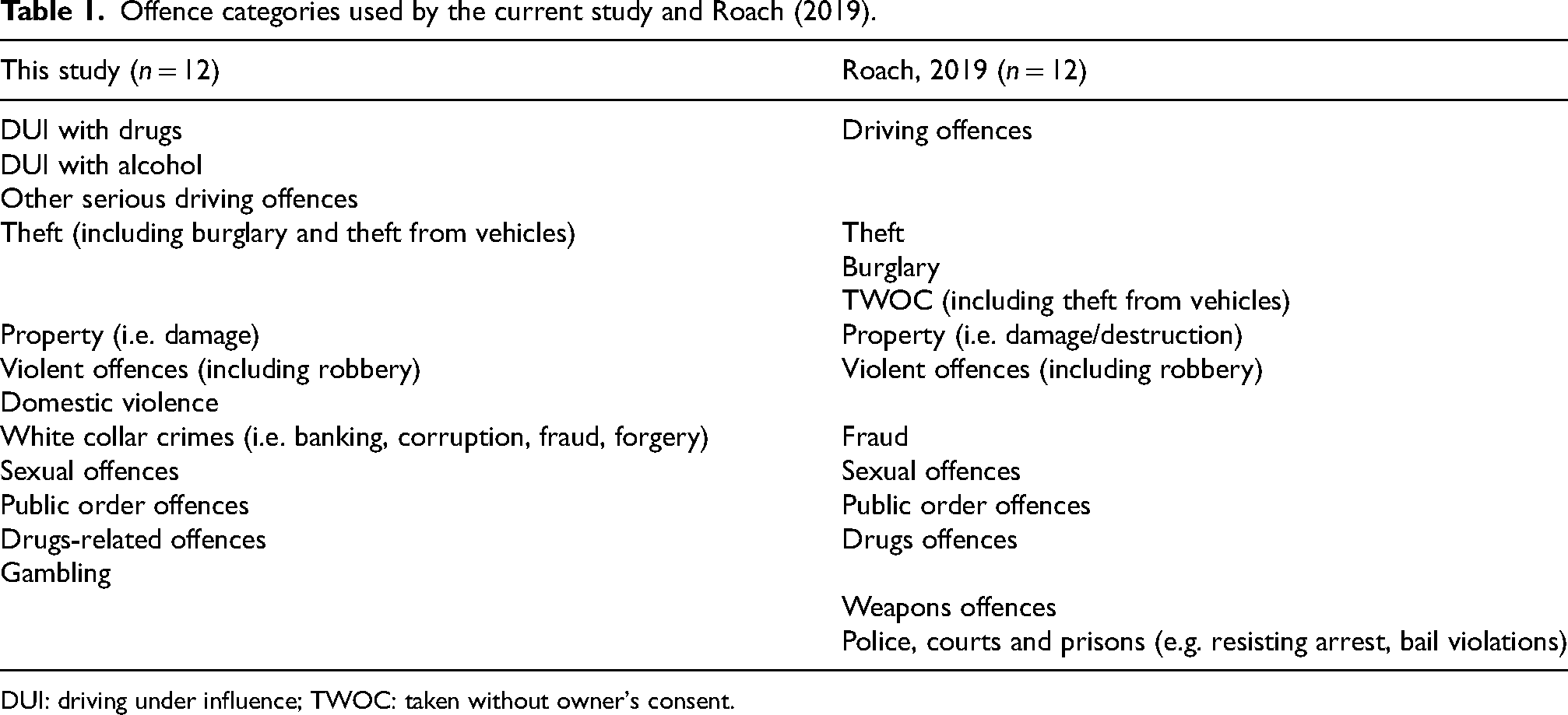
DUI: driving under influence; TWOC: taken without owner's consent.
Before turning to the results of our analyses, it is important to outline the rationale for our analytic approach. Here, we find it helpful to contrast our approach to that of Roach (2019), which focused on disqualified drivers, only a small number of whom had been disqualified for dangerous driving. Roach's DI calculation does not consider the relative number of crime categories for each individual. To rectify this, we chose to code the previous crime record and calculate the specialization index (SI) and versatility index (VI) using the following formulas:
VI = (Number of prior crime categories − 1) / Number of total prior crimes × 100 ≥ 50%
SI = (Number of prior crime categories − 1) / Number of total prior crimes × 100 < 50%
In other words, our denominator is the total number of prior crimes and the numerator is the total number of categories in the prior record. Thus our measure and that of Roach are distinct in two ways: Roach's measure seeks to compare an individual driver with the total crime categories as defined by the researcher; our chosen approach is to measure the individual's crime category with his or her own total number of prior convictions. Consequently, our measure is arguably more sensitive to ‘versatility’. If, for example, a person had four prior convictions across four crime categories, his or her Roach's diversity index would be (4 − 1)/12 = 0.25 (‘low’ versatility), the VI in our study would be (4 − 1)/4 = 0.75 (‘high’ versatility). Both methods would reach similar conclusions about this person's low DI or VI if the number of crime categories are low; however, the differences increase when the number of crime categories is high. In our view, another limitation in adopting Roach's method is that it is highly dependent on the number of crime categories (which are of course ultimately researcher determined). The more crime categories created, the more difficult it is to be categorized as ‘versatile’ using Roach's adopted measure.
Results
This study included 368 serious driving offenders (2014−2018) who between them had accumulated 561 recorded convictions over their lifetimes, with an average of 1.5 recorded offences per driver. Of the 368 offenders, 71.5% (n = 263) had no prior record and 28.5% (n = 106) had at least one prior record, ranging from 1 to 23 previous convictions. The range of offence categories for the 106 serious driving offenders is between one and seven (Figure 1). As can be seen in Figure 1, whereas 16 of the 106 offenders (15%) have only one type of prior record, the vast majority (85%) encompass two or more different crime types, indicating that those with a prior record for a serious driving offence tended to be somewhat versatile within the 4-year period.
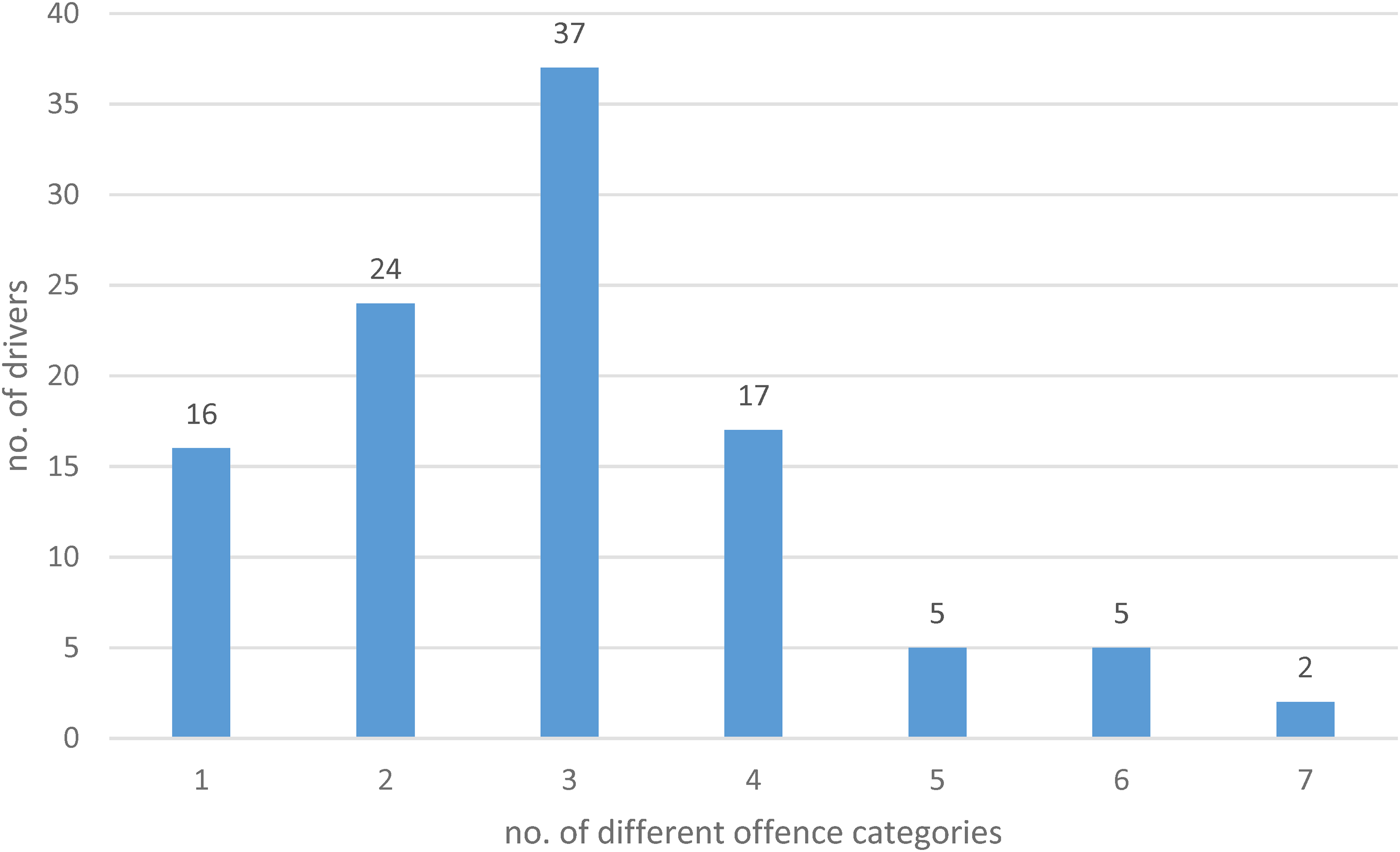
Number of offence categories in the criminal career of serious driving offenders, n = 106.
Figure 2 presents the different prior offence categories found in our sample of 106 drivers who had a prior record; DUI offences, property, public order and drug-related offences were the most frequent.
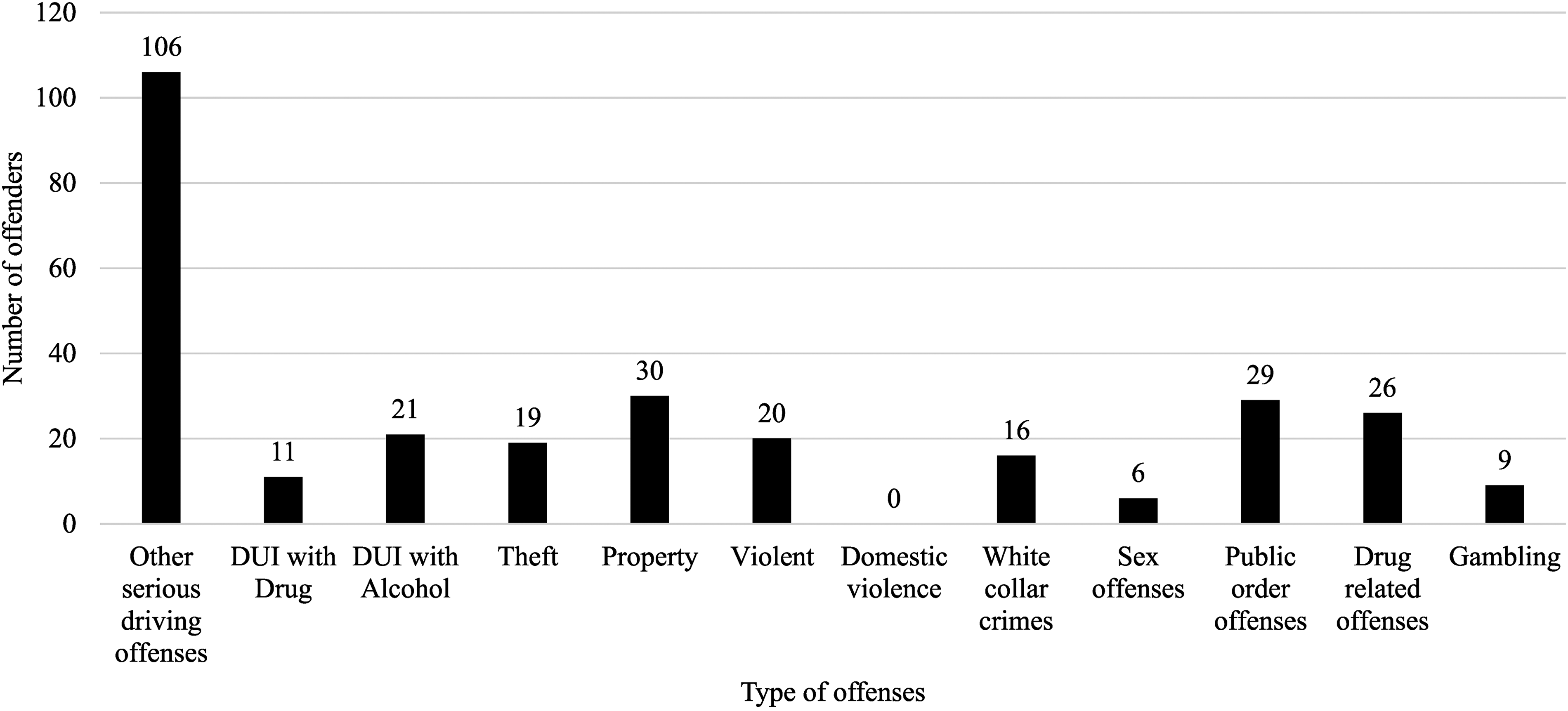
Number of serious driving offenders per category (n = 106).
We then used both Roach's DI and VI measures to test whether these serious driving offenders were specialized or versatile. As shown in Figure 3, approximately 15% (n = 16) of the offenders had an DI score of 0, indicating that their offending was specialized rather than diversified; furthermore, the data also indicated that no individual criminal record had a DI score of more than 0.50. Roach set a cut-off point of 0–0.2 for low versatility, 0.3–0.5 for medium versatility and 0.6–0.9 for high versatility. Using his DI method, 88.6% (n = 94) of our sample showed low versatility and 12.4% (n = 12) showed medium versatility, with none showing high versatility. Overall, 88.9% of offenders displayed low offence versatility within their prior record in the current sample.
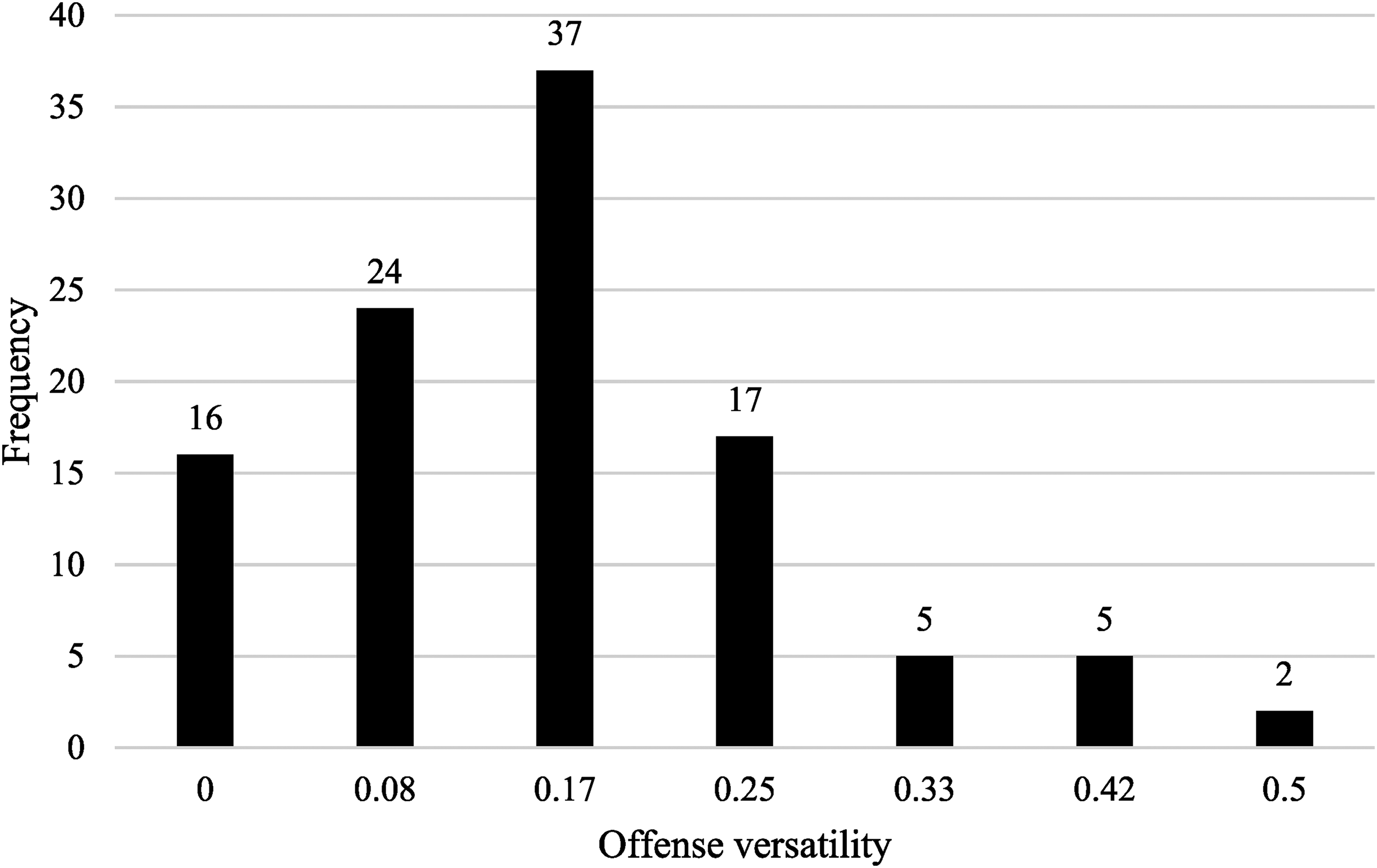
Using Roach's Diversity Index for serious driving offenders.
If the VI measure was employed, as seen in Table 2, 60% of the serious driving offenders are more specialized than versatile, with over 52% of offenders related to another driving offence. However, the level does not reach accepted statistical significance.
The versatility index measure for serious driving offenders (n = 106).
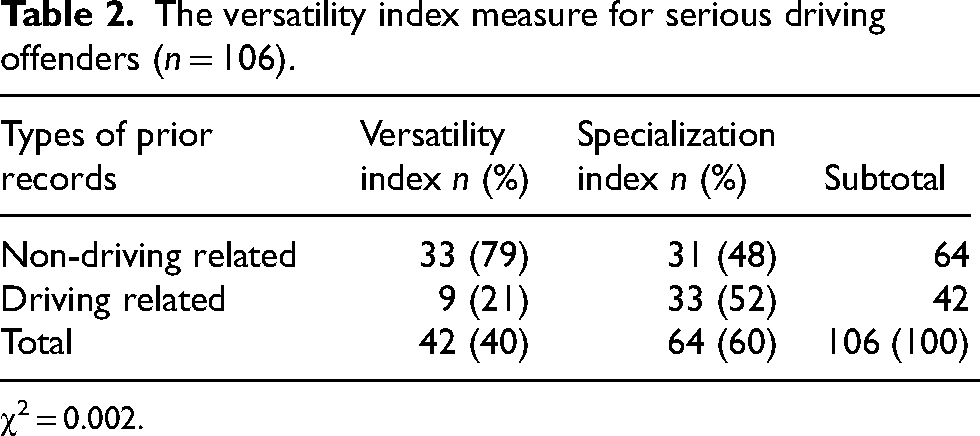
χ2 = 0.002.
To conclude, in the current study, our sample of serious driving offenders are more likely to be seen as ‘specialists’ using the DI measure, whereas using the VI measure, the group of offenders could not be statistically classified as ‘specialist’.
Discussion
As with all empirical research, method follows purpose, but the method chosen also has consequences. As some have noted previously in relation to the choice of data sources ‘conclusions drawn from studying specialization may vary across self-report and official records’ (Lynam et al., 2004: 226). Indeed Lynam et al. found evidence that the type of data used may influence whether a picture of offending specialization emerges, even among individuals in the same sample. More generally, the specialization/versatility research literature also highlights the possible likely impact of time and measurement aggregation biases (see Osgood and Schreck, 2007 and Sullivan et al., 2006 for a useful assessment). It needs to be acknowledged that this is the context within which our own methodological choices could be said to have implications for the production of our findings and indeed their interpretation. We had no possibility to access to self-report data (for discussion of inherent limitations of such data see Junger-Tas and Marshall, 1999) and were reliant on data sources, as described earlier. Although self-reports arguably capture more offending activity, they are also less likely to assist in understanding the sequence and time ordering of events. Of course, inferring from official data carries its own problems of an under-representation of the degree of total offending, and over-representation of more serious offences that are probably cleared at higher rates (Farrington, 1998). Furthermore, it should be acknowledged that our methodological approach used distributional specialization, and thus was concerned with the degree of dependence within an individual's offence distribution rather than across temporally adjacent offences.
Returning to the versatility of offending in our own results, from our analyses of alternative measures, none of the measures used provided evidence of any significant ‘versatility’ on the part of those drivers convicted of death by dangerous driving. According to Taiwan's Department of Transportation Statistics, there are an average of 14 million motorcycles and 8 million cars in Taiwan (Department of Transportation, 2020). In other words, there are roughly six motorcycles for every ten people, one the highest motorcycle densities in the world, and in this context our data are somewhat unique in that 37% of the offender sample were motorcycle riders – a much greater proportion than is found in other studies of offence specialization and serious driving offences. As pointed out by one of the journal reviewers, this may itself indicate that car drivers are more offence diverse (i.e. less specialized) than their motorcyclist counterparts. We also note from our data that there are a number of bus, taxi cab and commercial vehicle drivers. Given the comparative uniqueness of Taiwan in this regard, it would be interesting to consider VI or DI for these specific driving groups.
As we noted earlier, findings and conclusions drawn from studying specialization may vary across self-report and official records. Osgood and Schreck (2007) advocate the use of more than one data source to establish specialization, and research is needed in Taiwan that specifically asks serious driving offenders what other offences they have committed to gain a more-rounded estimation of offence specialization and versatility.
Although our study focused on the very serious driving offender, one applied aspect of seeking to link mainstream crime and driving offending more generally is that of self-selection policing – an approach by which serious offenders are identified by the more minor offences they commit – and this is worthy of some attention in the remainder of our discussion. Essentially the self-selection policing approach seeks to provide a data-sourced technique in which commission of a driving offence can be used by police to identify other crime in which the driver is involved (see generally Roach 2007b; Roach and Pease, 2016). In committing minor offences, the criminal is, as it were, ‘offering him or herself up’ for further legitimate scrutiny by the police acting on behalf of the community. This technique is complementary to other policing strategies, such as focusing on ‘known persistent’ criminals. The promise of identifying ‘trigger’ offences that would assist the police in identifying much rarer serious mainstream active criminal offending is worthy of research effort. Several of the studies reviewed above have produced findings that link driving offences to more serious criminal behaviour (see also Roach, 2007; Wellsmith and Guille, 2005).
Our Taiwanese sample of serious driving offenders showed a somewhat low prevalence of prior conviction, with almost 30% having at least one prior record and over 70% having no prior record. This is broadly similar to Willett's 1964 UK study Criminal on the Road, in which the sample comprised offenders across six types of driving offence – DUI alcohol or drugs, causing death by dangerous driving, driving dangerously or recklessly, failing to stop or report an accident, failing to insure against third-party risks and driving while disqualified. Willetts’ found that 77% of his sample of 653 offenders had no police record for non-driving offences. Also in the UK, research by Rose (2000) found that 60% of drink drivers, 50% of dangerous drivers and 21% of disqualified drivers had no prior conviction (see figure 4.3 in Rose, 2000). Thus there seems to be a higher likelihood of a prior record for ‘disqualified’ drivers. This is evidenced in Roach's (2019) small-scale UK pilot study of banned drivers. His group of 50 ‘disqualified’ drivers had 704 recorded convictions between them, an average of 14 recorded offences per disqualified driver (5-year data set). Of the 50 disqualified drivers, only 14% had no prior record, with 86% having at least one prior record. Arguably, the best triggers will merit intervention in their own right, have the highest information value for active criminality and be minimally intrusive for those targeted (Crosetta et al., 2021; Wellsmith and Guille, 2005). Although our study considered those convicted of causing death by dangerous driving, international evidence on self-selection, which we noted above, would suggest that future research in Taiwan should look specifically at lower level ‘trigger’ offences – such as those convicted of driving while disqualified and any associated prior criminal record. This will also no doubt contribute to a better comparative understanding of the nature of VI or DI between Taiwan and Western studies.
In Taiwan, the potential in taking forward offender self-selection policing research lies in the identification and empirical justification of triggers. Although our own study was not of a minor ‘trigger’, it is worth noting that one limitation of our own findings is that we cannot determine whether our dangerous drivers’ prior conviction rates are higher or lower than those for the general population. In other words, whether the almost 30% of those with a prior record is much more than you would expect by chance. Unlike UK studies, Taiwan's officially published statistics do not permit estimation of the prevalence of conviction in the general population (by prevalence we mean the proportion of an age group convicted at some time in their lives, see Farrington, 1981). Taiwan has some limited and scattered insights into prior conviction data at the population level: 70%−80% of inmates admitted to prison between 2014 and 2018 had at least one prior conviction (Ministry of Justice, 2018). Tsai and Chou (1999) estimated 32% of traffic violators had at least one prior conviction compared with 8% of the general population in 1998. However, Tsai and Chou used the prosecution records as a proxy indicator to estimate the conviction rates for the general population. It is recognized that the best approach to estimating the prevalence of convictions is longitudinal follow-up of a sample (Farrington, 1981). In Taiwan's only longitudinal study, the authors found that after 22 years, 61 (14%) of 451 non-criminal teenagers in 1996 had at least one police arrest record in 2018 (Yeh et al., 2019). Thus Taiwan currently provides a data-poor environment for criminologists wishing to understand and compare findings with some Western countries.
The potential for fruitful future study in this area is also largely dependent on data linking. As in most other jurisdictions, Taiwan currently has legal and system barriers and limitations to linking crime and road safety data, mainly around privacy and data protection, technical systems matching of data, cost and resource issues. The Road Traffic Management and Penalty Act of Taiwan, is relevant here. It identifies two central agencies in charge of executing traffic violations – the traffic police division of the Ministry of Interior and the Ministry of Transportation and Communications. These two agencies house national traffic-related violation record data bases. Prior conviction records in Taiwan are managed by the police at the local and national levels. Currently, each database is managed independently between and within agencies (i.e. traffic police and criminal police sections). Developing meaningful research on driving-related ‘trigger’ offences (those with the highest information value for active criminality) would require access to the databases to analyse the relationship between crime and traffic violations. The fact that these two databases are not usually combined suggests, as noted more generally by Roach and Pease (2016), that the police and public overestimate offence homogeneity, and thus see no value in combining the databases. Yet, interlinking of data is widely recognized across the world as key to both understanding and enhancing road safety, and preventive work in general, and a failure to create such links risks losing valuable information that might guide policy action.
Footnotes
Declaration of conflicting interests
The author(s) declared no potential conflicts of interest with respect to the research, authorship, and/or publication of this article.
Funding
The author(s) received no financial support for the research, authorship, and/or publication of this article
