




Abstract
This article investigates senses of belonging and the interrelation between belonging and identity in policing. We use Snap Log images and text of police leaders’ own interpretations of belonging at work. Belonging is relational, cultural, material and embedded in collective engagement, and is about being equals where everyone contributes. Engagement creates a strong emotional attachment to an idea of ‘us’ and of being part of something bigger than oneself. Belonging represents imaginations of the police mission and being proud to be part of that. It is about the ‘here and now’ and about taking care of each other when things are tough. The link between belonging and identifying with policing is further amplified through materiality and symbols, as commonly used in police leaders’ images. The sense of belonging to the police when wearing the same uniform and using the same artefacts and symbols becomes important for a person’s identity as a police officer.
Introduction
The police undertake a social mission of providing public safety. Several studies of police culture have argued that the police service’s sense of mission strongly influences police identities (Chan, 1997; Cockcroft, 2013, 2019; Loftus, 2009), and consequently that identity has an important role in policing (Hoggett et al., 2014, 2019; Van Maanen, 1978a, 1978b). Also, the argument that police culture develops ‘bottom-up’ from operative practice (Waddington et al., 2013) indicates that belonging (or not belonging) is embedded in what constitutes practice and how police identities are developed.
Police employees define their identity in terms of social and cultural relations (as social identity) to create meaning and engagement with goals, interests, values and performances (Wenger, 1998, 2003; Wenger et al., 2002). Belonging is the foundation of social identity, in which the extent of a person’s perceived belonging to a group comprises cognitive, emotional and evaluative elements (Ashforth and Mael, 1989; Brewer, 2007; Tajfel, 1972). Creating a sense of belonging to a community is therefore reinforced when it incorporates a person's understanding of his or her identity: ‘Who am I?’ or ‘Who do I want to be?’ (Child and Rodriques, 2011; Gherardi and Nicolini, 2002). Social identification with others or the sense of belonging to a group shows that individuals identify socially with a particular group when it allows for belonging and uniqueness (Ashforth and Mael, 1989; Pickett et al., 2002).
By developing a shared sense of belonging, the collective and representative ‘us’ (Haslam et al., 2001; Platow and van Knippenberg, 2001), leaders are more likely to inspire followers through embodiment of what the collective is and who is involved (Ellemers et al., 2004; Haslam et al., 2011; Steffens et al., 2014). The importance of identification is evident; followers regard leaders as more trustworthy, fair and charismatic to the extent that they are seen to represent, understand and advance the interests of a common in-group in a way that followers identify with (Haslam et al., 2001; Platow et al., 2003). For instance, frontline officers place great value on being led by senior officers who have considerable direct experience of street-level police work (Rowe, 2006), leaders they strongly identify with and their hard-learned and hard-earned knowledge (Caless, 2011), which officers respect, trust and consequently follow (Hoggett et al., 2019).
The title of this article, ‘If I’m not police, then who am I?’, is a quote from our empirical studies, in which police leaders argue that they not only work in the police, they are the police. Hence, their identity is based on the fundamental human need to belong as a relational phenomenon, and of being valued by being part of a community with a sense of identification with one's social, cultural, relational and material surroundings (Baumeister, 2012; Brewer, 2007; Brown and Duguid, 2001; De Cremer, 2002; May, 2011). Belonging is linked to creating meaning for personal investment, representation and growth (Child and Rodriques, 2011; Filstad et al., 2019; Twenge et al., 2007). In what constitutes police practice, belonging is also about negotiation and positioning. Belonging is therefore critical to understanding how individuals contribute to the workplace and which actions take place and why (Elkjaer and Mossfeldt Nickelsen, 2016; Fenwick and Nerland, 2014; Gherardi, 2009; Gherardi and Nicolini, 2002; Hopwood, 2014).
The purpose of this article is, without any predefinition of belonging by the researchers, to explore what belonging might be for our informants. Our informants were all police leaders in the Norwegian police services (from first line managers to top management) who provided us with pictures as illustrations of their own subjective interpretation of belonging at work. In addition, our informants also provided us with a short text on why the picture illustrated belonging for them.
Methods
To investigate what belonging is at work, we used inductive methods and explored informants’ own interpretations of belonging or not belonging at work, keeping an open mind about what belonging is for them. Snap Log is a qualitative technique that asks participants to take their own photographs (snap) and write short texts (log) about them (Bramming et al., 2012). Snap Logs are a type of participant-only photographic production that requires organisational members to take pictures in a field setting (Ray and Smith, 2010). Given that we were investigating belonging, Snap Log enabled us to tap into perceptions of the performative aspects of belonging that are not necessarily part of the participants’ awareness or are not easily articulated verbally. Ray and Smith (2010) contend that photographic research has the potential to capture aspects of organisational reality in real time without the distortion caused by other methods (e.g. questionnaires or interviews). Using photographs in organisational research allows participants to include actions, emotions and aesthetics (Vince and Warren, 2011), and multiple co-existing elements (such as actions, places, spaces and material artefacts).
The participants voluntarily produced their own pictures and texts. The authors did not provide any guidelines, except asking participants to use their smartphones to take only one photograph that illustrates what belonging at work means to them and asking them to write a short text explaining why they think their pictures illustrate belonging. The authors emphasised that there were no right or wrong pictures or texts, nor any definition of belonging, and simply asked for participants’ pictures of belonging at work.
The author used samples from police leaders in 2018 and 2021; giving a total of 44 informants. In total, 63% of participants were women and 37% were men. Participants’ ages ranged from 38 to 55 years. Most participants took only one picture; however, four participants took more than one picture, using either a collage or a series of pictures. Texts ranged from 22 to 300 words; some contributors used bullet points, whereas others provided detailed explanations.
The data came from two sources:
visual information (what was captured in the photographs and images); and written information (what was written by the participants in the texts).
The first step of our analysis was to examine the texts and photographs, summarise the texts and analyse the text/picture relationships and the contents of the photographs. Pictures and texts were explored by the author inspecting the picture content and then using thematic analysis for both pictures and texts. First, the author examined the pictures individually, looking for what was in the foreground and background, the presence of people, objects or places, and then noted the findings. Texts were all translated into English, and the author then explored the text and noted key words and phrases. The results are discussed to identify some themes and common ground for when participants belong, what belonging is, why participants belong and how their sense of belonging influences their social identity and work performance as police leaders.
Belonging at work
Similar to social identity, belonging refers to a human need for, and the importance of, feeling valued and being part of something bigger. Creating a sense of belonging to a community is therefore reinforced when it incorporates a person's understanding of his or her identity: ‘Who am I?’ or ‘Who do I want to be?’ (Child and Rodriques, 2011; Gherardi and Nicolini 2002). Social psychologists demonstrate reduced prosocial behaviour and increased engagement in interpersonally harmful behaviours when people do not experience belonging (Baumeister, 2012; De Cremer, 2002; Thau et al., 2007; Twenge et al., 2007). People also build their own informal communities of practice at work, which create a sense of belonging and uniqueness (Brown and Duguid, 2001; Wenger, 1998). Communities of practice focus on the importance of shared practice, interests and knowledge, as well as common repertoires, face-to-face interactions, frequent and mutual engagement, and the informality and self-organising character of communities of practice (Agterberg et al., 2011; Mork et al., 2010; Van Baalen et al., 2005; Wenger, 1998). In other words, a virtuous cycle of participation exists in which the more people participate, the more they learn, and the more they identify with and belong to the group (Filstad, 2014; Thompson, 2005).
Belonging is a social and relational phenomenon that influences a person’s cognition, emotions and behaviour (Hagerty et al., 1992; Malone et al., 2012). A sense of belonging, whether formal or informal, is essential for social identity when it comes to people, practices, groups or an organisation and, accordingly, is also essential for whether one identifies with those people, practices, groups and organisations (May, 2011). However, the sense of belonging is subjective. It reflects one's subjective feeling of whether one belongs to a community, and therefore one's own perception of reality. It revolves around a perceived sense of belonging to something unique (Pickett et al., 2002). Wenger (1998) argues for three modes of belonging. The first is engagement, which is the active negotiation of meaning to sustain social identification with the group/community. The second is alignment, which coordinates energies and activities so that a person’s behaviour is in line with the perceived collective enterprise and shared goals. People do what they need to do to become part of something bigger, as a process of becoming. The third mode, imagination, is about constructing an image of oneself, one's community and something bigger (Belle et al., 2015; Wenger, 2003) – for instance, the police.
Belonging relates to gaining acceptance and avoiding rejection by being part of interpersonal events and one's environment (Hagerty et al., 1992; Hofmann et al., 2012). Filstad et al. (2019) find that belonging is multifaceted, derived from multiple sources such as social relationships, common activities, symbols, artefacts, professions, spaces and places as a result of negotiation of meaning among participants. In leadership practices, investments by leaders and employees provide various forms of belonging that influence the negotiation of desired meaning (Masika and Jones, 2016; Mork et al., 2010; Weick et al., 2005). This means that social identity formation is not only about who an individual identifies with, but is a two-sided process: on the one hand, it is a question of who an individual identifies with and on the other hand, and just as important, whether that individual wants to invest in a leadership practice to create senses of belonging that reflect who the person and the practice want to be (Child and Rodriques, 2011; Easterby-Smith and Lyles, 2003; Filstad, 2020). This involves negotiating the desired positioning and, if it is worth the effort, whether one is motivated to put in the required effort. Hence, belonging is twofold – it comprises both positioning and belonging. This creates strong senses of belonging and identification within a person’s leadership practice and distinguishes their unique practice from other leadership practices (Filstad and Karp, 2020). A person’s practice is characterised by the dynamics of social relationships that encourage and strengthen the sense of belonging (Child and Rodrigues, 2011), but where incongruent identities might result in less social interaction and engagement (Delahunty et al., 2014).
Results
The social mission of the police services, uniforms, artefacts, symbols, etc., and how police students are socialised at the police university college (not lawyers and civilians) all provide opportunities to develop a common sense of ‘us’ within the police. Participants are motivated by the police mission that, moreover, provides some sort of common ground that characterises police culture. Two police leaders explain: I do care about the society we work in, about the mission we undertake as police. I feel engaged, I really care, and I think it is interesting.
We have focused on the social mission, our role, what the public view of the police will be. We have to understand the society around us and form a proper decision-making basis in order to conduct intelligence processes. It's an engaging process.
Police identity is important. All police leaders talk about being police and not working in the police. One of the informants goes so far as to say: ‘If I am not a police officer, then what am I?’. Among the professions who are not police educated, lawyers form the largest group within the police services, and they also wear police uniforms. The Norwegian police service also employs many civilians, who do not wear uniforms. So, in the same way that the police uniform creates a sense of belonging, the lack of uniform might result in not belonging. However, civilian informants in our data sample provided us with the image of a state visit presented here, another example is an image from a civilian in a Norwegian documentary about policing. So, civilians not feeling a sense of belonging is not represented in our data.
Belonging is often about the ‘here and now’, collectively completing tasks, having common goals and achieving something together. It is important that everyone contributes and is valued for who they are, regardless of their place in the organisational hierarchy. There were no descriptions or photographs of individual leaders in our original study based on 44 informants. The informants themselves as leaders or other leaders were included in photographs only as ‘equals’ rather than as leaders. Informants referred to feeling themselves to be unique and part of a community, often emphasising informal communities.
Participants’ sense of belonging gives them a feeling of pride, and revolves around shared values, taking care of each other and the positive aspects of hard work aimed at achieving common goals. The photographs and texts below are examples of belonging to the Norwegian police services (Figure 1).
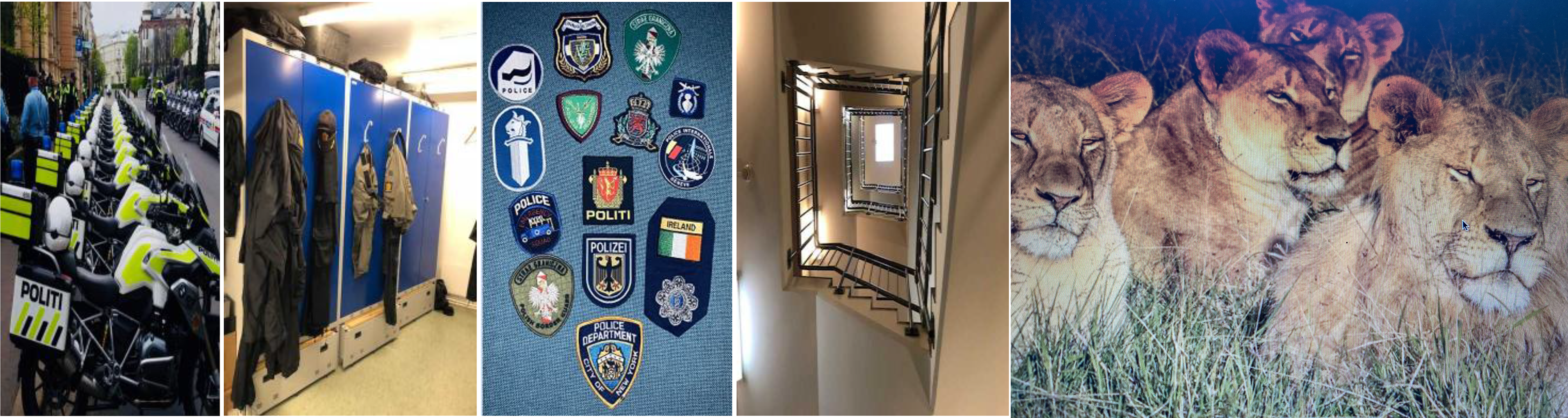
Belonging as imagination.
State visit
‘Although this is not the unit I mainly work for, this photo represents belonging for me. It is taken in connection with an official state visit and convoy management. As a leader, you must get the best out of a group who need to work together to complete the task. We are no stronger than our weakest link, so it is up to every individual person to encourage and support each other. The photo represents what it means to be part of something bigger and to have the opportunity to lead a group who want to perform and are motivated by mastering the task. This gives a sense of joy, belonging, and makes me proud to be part of such a group.’
Locker room
‘The photo shows my personal locker. It is one of the first and last things you see at the start of the day and before you leave work. In addition to framing the everyday at work, the locker for me is also an illustration of equality and a flat structure – one locker for everyone regardless of your level or function. I work in a uniformed organisation. When I put on my uniform, the transition from private life to being a police officer becomes even more evident. I think this photo represents an arena where organisational belonging is reinforced by this role change. Stability and solidarity are what distinguish my workplace. The start of a career and “entry” into the unit are usually described as “getting assigned a locker”. Similarly, “emptying the locker” means the end of a career. For me, this metaphor amplifies the intuitive relevance of this photo to the concept of belonging.’
Patches
‘This is a collection of my husband's patches. He is also police. It symbolises belonging to the police across country borders. Even though the police do not have the same status in all countries or represent the same values as us, I feel belonging to colleagues who face many of the same challenges. In the police we have a strong troop spirit and internal unity, which is special for our profession. It might be the same for others such as the defence or health sector, but besides them, what you find in the police is unique. The troop spirit has a number of positive sides, but can also be the opposite if we are averse to criticism that we can learn from. It is important that we are aware of that.’
Stairs
‘My initial thought was to take a photo of our section, but then I realised that my sense of belonging applies to the entire police station. That's why my photo had to include all the floors in the building. I couldn't take a picture from the outside because then it would look just like another building, but taken from the inside, it's more about us, the people who work here.’
Pride of lions
‘The pride of lions symbolises belonging for me. We are social individuals who rely on being part of a community where we are looked out for and accepted. The pride of lions moves in the same direction, they have the same goals, and are dependent on each individual.’
These examples represent a substantial domination of images and text of belonging as imagination. They create an image of belonging as being part of something bigger, something meaningful, the police, the police mission, and where uniforms, patches, locker room, the group feeling (of lions) all point to belonging being presented to participants as symbols, images of the greater good of policing and of their feelings of pride at being part of the policing community. How materiality as an important part of how police create an imagination of what belonging is to them becomes evident in our data. We next present other images of belonging in which informants provide us with symbolic acts that represent belonging to them (Figure 2).

Belonging through symbolic acts.
The troop
‘This is perhaps a slightly pompous picture. My belonging is connected to our nation Norway and my local belonging is to the district. Belonging is also about leading the way; being in front.’
The funeral
‘My picture is from a funeral last fall. During the last six months we have lost two good colleagues after short illnesses. The picture illustrates unity and respect all in the last phases of life. This is dedication that I’m proud of being part of.’
Award
‘Here I’m a proud leader in the middle. The picture is from the airport, where I greeted my team with a flag and flowers when they arrived from a prize-giving ceremony in Dubrovnik. My gang won an international prize for being the best emergency reception. They saved a Canadian citizen after a critical fall in the mountains in Norway. They did a fantastic job of locating him and calming him down on the mobile phone as the battery was about to run out. The man was saved at the last minute after hanging on to a rock and not falling further. This describes the important work that is done at the emergency reception every day. I’m super proud!!!’
Here, the symbolic acts also symbolise being part of something bigger, and with ceremonies including the Norwegian flag. The first picture is from the Norwegian National Day, where the Norwegian police celebrate and march together with the Norwegian public. The collective, shared enterprise and values are outlined as important for belonging and are about alignment for the ‘greater good’.
The final example is mostly related to engagement. Images of engagement dominate our data as pictures of colleagues posing and smiling, working together and or/practising together; or in the example of the tree, images that used text to come to the same sense of belonging through collective engagement among colleagues and the appreciation of a positive working environment (Figure 3).
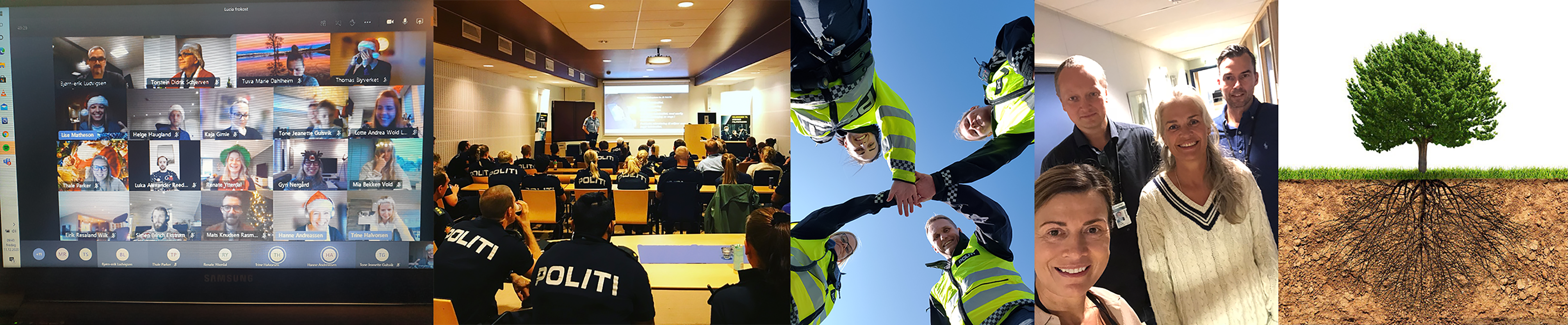
Belonging as engagement.
Meeting on Zoom
‘My picture is of a meeting with my department before Christmas. We used half a day to meet socially on Zoom, a mixture of Christmas breakfast, closure before the holidays and Lucia celebration. The result was a good day of spending time together without focusing on assignments in a normally busy schedule, and where we don't meet at the office anymore. We were in breakout rooms in smaller groups and all together, so that all of us were both seen and heard. We have a strongly connected work environment that is important for us to stimulate in these corona times. And for me it is very nice just to be part of the community for a few hours too.’
Briefing room
‘This photo symbolises belonging for me. When I walk into the briefing room and everyone is there, I can feel a positive atmosphere all around. There is smiling, small talk, some laughter and great colleagues who bring about a sense of belonging. This makes me proud and happy, and the fact that they are there motivates me as a leader. We are a great team of motivated employees who are hungry for knowledge, and who help each other out. They help me do a good job as a leader. An amazing team I’m very proud of and feel I belong to. I’m lucky to have this, and I appreciate it as often as I can.’
Out in the field
‘For me, the photo symbolises solidarity, belonging and strength in the department I work at. “A single twig breaks, but the bundle of twigs is strong” (Chief Tecumseh of the Shawnee Tribe, 1812). This photo also shows pride, joy, competence, enthusiasm and determination, as well as the sense of belonging we feel towards the organisation, work tasks and each other.’
At the office
‘This photo illustrates belonging to both my organisation and unit. These nice people are 4 of the 15 members of my group, but they represent the entire group. They spend much time in the districts solving cases, but they still manage to give me a sense of both professional and social belonging by being engaged, thoughtful, available and motivated. Well done, and as you can see in the picture, there are very few people in the hallway where we are sitting.’
The tree
‘This picture symbolises belonging to me. The tree can describe different organisations and units. The police force as a whole. The section. The department. The teams to which I belong. The three illustrate a vison to me, a hope for growth and development – in a positive direction (like a lush and green tree). Through relations, unity and different branching we are all connected together, we are all important in our own way – and are part of something bigger. The tree symbolises mutual interdependence. All of us are contributing in their own way independently on what tasks they are responsible of. Towards a common goal.’
Belonging as engagement refers to reaching common goals, working together towards the same goals, where everyone contributes on equal terms, independent of their formal position in the hierarchy. Respondents report that their colleagues are important for their sense of belonging, and they acknowledge the positive atmosphere, small talk, laughter and enthusiasm, with many mentioning how proud and motivated they are to be part of their teams of colleagues at work.
Discussion
When police leaders illustrate and express their own subjective interpretations of what belonging is, it is generally about belonging to the police force and being proud of it. The mode of belonging as imagination (Wenger, 1998) becomes relevant, where we find that police leaders construct an image of what the police mission means to them and the importance of belonging to something bigger (Belle et al., 2015). It is an image of being part of the common goals and mission of policing, and therefore ‘making a difference to people’, as several of the police leaders explain, that motivates them. Their social mission and common purpose make sense to them to the extent that they identify with their colleagues and their work, and are proud on behalf of their colleagues as well as themselves. We therefore argue that police leaders’ images and texts of belonging are linked to feelings, emotions, learning, participating, connecting and being included (as predicted by McClure and Brown, 2008).
The Norwegian police enjoy a high level of trust within the Norwegian population, and this has increased consistently over time, with 77% in 2018, 79% in 2019 and 82% in 2020 (87% in the capital of Oslo) of the population responding that their level of trust in the police is quite high or very high (The Police Directorate, 21 January 2021). This is despite negative media coverage related to police reform (2016–2020). Consequently, belonging for police leaders is associated with being proud of working in the police force. Helping others involves a strong sense of belonging, and the social mission is perceived as meaningful, and creates associations with a strong fundamental need to belong to interpersonal events and one's environment (Hagerty et al., 1992; Hofmann et al., 2012). All police leaders perceive that they belong (as opposed to not belonging) and strongly acknowledge that their belonging in the police is about who they want to be, which researchers have argued is crucial for their identity at work (Child and Rodriques, 2011; Gherardi and Nicolini, 2002).
First and foremost, respondents connect their sense of belonging to accomplishments or who they are together with their colleagues. As Wenger (1998) argues, another important mode of belonging is engagement. Respondents talk about what they have achieved collectively as a community, growth and the collective tasks in which everyone participates as equals. Their role as a police leader is related to being part of the team and the collective, and not the individual leader. Or as one respondent explained: ‘We are social individuals who rely on being part of a community where we are looked out for and accepted’. They talk about the internal unity of the group, the troop spirit, the collective move in the same direction, and an appreciation of being part of practices shared by motivated, skilful, caring and knowledgeable colleagues. Belonging is therefore about belonging to and identifying with communities through shared practice, interests and knowledge, and the social and cultural interactions, mutual engagement and informality of self-organising that are in the best interests of this particular practice (Agterberg et al., 2011; Mork et al., 2010; Van Baalen et al., 2005). Respondents also argue that there is a sense of belonging to the police, to the organisation, to Norway and internationally (for instance, in the ‘out in the field’, ‘the troop’ and the ‘patchers’ images). The materialisation of belonging through objects such as police uniforms, cars and logos simultaneously symbols being part of smaller units and of belonging to the larger police family along with other countries that the Norwegian police identify with. The material and relationship dimensions represent interconnected, and therefore integrated, dynamics of belonging (Elkjaer and Mossfeldt Nickelsen, 2016; Gherardi, 2017; Hopwood, 2014).
Belonging is about being invited to learn, participate, connect and be included (McClure and Brown, 2008). The collective and representative ‘us’ (Haslam et al., 2001; Platow and van Knippenberg, 2001) is evident in the socialisation of new police officers, first at the police university college and later in the police services. The collective of who they are and who is involved (Ellemers et al., 2004; Steffens et al., 2014) is reinforced by cultural artefacts such as police uniforms that symbolise authority and assignments in policing, markers of rank and language, and is organised as a quasi-military organisation (the line-up, the organisation of troops and the marching are symbolic performances that reinforces the ‘us’; see Filstad, 2020). Police leaders also illustrate belonging to a particular profession within the police. They belong to, for example, law enforcement, investigations, intelligence or crime prevention, and to the part of the country where they work. Belonging results in solidarity when everyone contributes. The sense of belonging is achieved by being there for each other, getting a pat on the back, completing work tasks together and being equal, which is emphasised as essential. In stark contrast to most other organisations, police work often involves tragic lives, accidents, victims, the injured and aggrieved. Work tasks are often unpredictable and associated with powerful experiences. Owing to emotional coping, a high workload and tasks that require shared effort, colleagues have to trust each other when it comes to their own safety and task completion. This is why, compared with most other organisations, there is an additional dimension to the sense of belonging in the policing profession that reinforces belonging through exercising and engaging in physical activities together, through the 24/7 shifts and experiencing the same police education, continuing and further education/training, or duty assignment at the Norwegian police university college.
The strong sense of belonging to the police in general, and to smaller units in the police in particular, creates what police leaders explain as a sense of who they are and who they want to be. The same relational, social, emotional, material and cultural dimensions that are important for developing senses (Child and Rodriques, 2011; Malone et al., 2012; May, 2011) of belonging can also be exclusionary and result in negotiation and the formation of silos based on the type of police work, profession (lawyer, police officer or civilian employee) or geography. This is the challenge of negotiating belonging among participants in communities of practice (Filstad, 2014; Mork et al., 2010), because strong identity with the notion of ‘us’ is reinforced by treating those who are outside the leadership practice as ‘others’; hence, the out-groups. Irving L. Janis’ (1982) well-known groupthink theory (game theory) provides a good explanation for this phenomenon. Janis argues that groups which are pressed into a strong cultural community tend to protect their collective ‘truths’ and stereotype their opponents (out-groups) as ‘stupid’ because they threaten the group's existence.
Conclusion
We investigated police leaders’ sense of belonging and demonstrated the important relationship between belonging and identity in policing. Using images and texts of belonging we found that the relational and collective engagement of common accomplishments creates strong emotional attachments to colleagues as being we and us in the police. The ‘we’ and ‘us’ can sometimes be the police, but more often refers to being part of the police although in smaller practices such as investigations, street patrols, preventing crime, etc. In smaller practices, belonging is about taking care of each other and literally ‘covering each other's back’ on high-risk assignments. The more specialised the officer, the stronger the link between belonging and identifying with fellow police colleagues. The link between belonging and identity is about socialisation, the social mission and an officer’s motivation for joining the police force in the first place to ‘make a difference to people’. Hence, all informants in our study argue that they are police (as opposed to just working in the police).
Belonging as emotional and the foundation of longing to belong are illustrated by the fact that informants imagined the police mission and the role of being part of the police troop as a matter of being part of something bigger than yourself. We find this when respondents describe being proud of being police and being proud of the accomplishments of their police colleagues. Here, we also find the somewhat strong engagement that motivates them, where strong engagement is defined as being equals, and where everyone contributes and has a say independent of their leaders. Belonging is about the ‘here and now’ where belonging is relational but also material. The link between belonging and identifying with policing is further amplified through materiality and the symbols commonly used in the images. The sense of belonging to the police when wearing the same uniform, using the same artefacts, being visible as police when meeting the public and sharing the same stories of policing, all become an important part of respondents’ belonging to the police and of their identity as police
Footnotes
Declaration of conflicting interests
The author(s) declared no potential conflicts of interest with respect to the research, authorship, and/or publication of this article.
Funding
The author(s) received no financial support for the research, authorship, and/or publication of this article.
