



Abstract
A small body of research suggests that the use of police tactical officers has become normalized in that they now commonly respond to “routine” calls rather than being restricted to high-risk situations. However, this research has tended to rely on crude data (i.e., call type), which fails to account for the context of the calls (e.g., the presence of potential risk factors that might warrant tactical resources). In this brief research note, we sought to expand upon previous literature by examining the risk factors associated with tactical calls in a Canadian police service. We found that various risk factors were present in many of the calls that tactical officers responded to, some of which might be classified as “routine” (suicide threats, well-being checks, domestic disturbances, etc.). The presence of such risk factors highlights the need to consider context when attempting to understand the use (and consequences) of tactical officers. More rigorous tracking of these factors by police services will facilitate such research and inform policies around the use of tactical resources.
Keywords
Introduction
The use of police tactical teams in North America has increased over time (Alvaro, 2000; Kraska and Cubellis, 1997; Kraska and Kappeler, 1997). For example, between the 1980s and early 2000s, the use of tactical teams substantially increased in the United States, with the number of estimated deployments rising from 3,000 to 45,000 nationally (Kraska, 2001). Along with a rise in the use of tactical teams, there also appears to be an expansion of their mandate such that tactical teams are no longer reserved for “high-risk” calls such as hostage takings, but instead are frequently used for tasks like warrant executions and proactive patrol (Alvaro, 2000; Kraska and Cubellis, 1997; Kraska and Kappeler, 1997). Of particular concern is the fact that these activities seem to disproportionately target members of racialized communities, particularly Black individuals (American Civil Liberties Union, 2014; Nunn, 2002). 1
Using Freedom of Information (FOI) requests to gain access to operational records for the use of tactical officers in Canada, Roziere and Walby (2017, 2018, 2019) similarly suggest that Canadian tactical units are being used more frequently and are routinely being used outside of their originally intended function. These authors caution that deploying tactical officers to calls for service involving domestic disturbances, suicide threats, and well-being checks are likely to traumatize individuals, unnecessarily aggravate situations, and increase the probability of force, in particular lethal force, being used by the police. As a result, Roziere and Walby (2018) suggest this practice should be “scaled back immediately”.
Instead of relying on detailed data and analysis to determine how tactical officers are used in Canada, previous researchers have relied on the call type of the original call for service to make this determination (Roziere and Walby, 2017, 2018, 2019). In our view, using original calls for service to determine how tactical resources are being used presents numerous challenges and can potentially lead to erroneous conclusions. Most obviously, a call for service may be categorized as “routine”, including warrant executions, traffic incidents, and domestic disturbances, without recognizing that these types of calls can be very dangerous.
Using the original call for service neglects the qualitative differences that exist within common call categories and provides limited insight into the context of the situations in which tactical officers are used (den Heyer, 2013; Neusteter et al., 2019; Ratcliffe, 2021). Although calls may appear relatively benign on the surface (e.g., a domestic disturbance), there may be numerous risk factors present that elevate the likelihood the individual will display violence towards the officer, themselves, or the public, thus making the call more dangerous (potentially warranting the use of tactical officers). These risk factors can include the history of the individual (e.g., known to be violent and resist arrest; Johnson, 2001), situational factors (e.g., intoxication; Covington et al., 2014), and the presence of weapons (Bierie et al., 2016).
Interviews with tactical officers have indicated that they respond primarily to high-risk calls as indicated by the presence of these types of risk-factors (Jenkins et al., 2020; Rojek, 2005). However, we are not aware of studies that have relied on other sources of data to determine whether this is true. Considering the limitations inherent in previous research on tactical team use in Canada, in particular the use of the original call type to determine the nature of incidents that tactical officers are responding to, the current project sought to analyze more detailed contextual data to examine the following research question: To what extent are potential risk factors identified in the calls that Canadian tactical units respond to?
Method
Data
To examine this issue we attempted to analyze the same data that was released to Roziere and Walby (2017, 2018) through their FOI requests. The Ottawa Police Service, Vancouver Police Department, and Winnipeg Police Service (WPS) agreed to release the same operational data to us that Roziere and Walby used to assert that tactical units have become normalized. Unfortunately, the data released by Ottawa and Vancouver did not provide sufficient contextual information to allow analysis to proceed and therefore data from these services is not discussed further. However, the WPS daily occurrence reports generally provided sufficient data. 2 The daily occurrence reports included the original call type generated prior to police response (usually determined by the call taker; Simpson, 2020). Occasassionly, the files also included information provided to the responding officers (e.g., that a firearm was believed to be present), as well as information determined after the officers were on scene (e.g., the individual had fled the area and was not found).
Materials
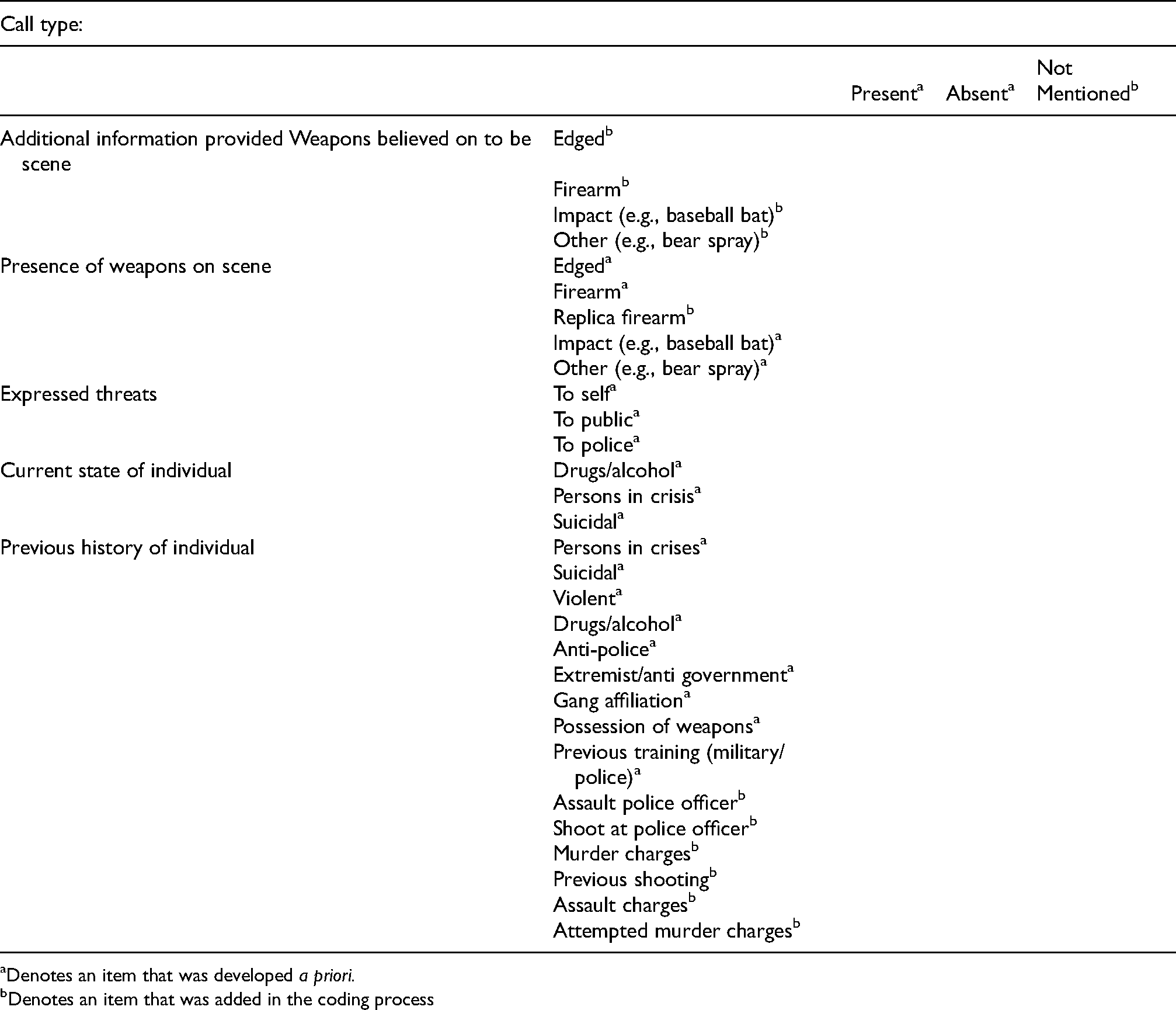
A coding scheme for possible risk factors was generated from relevant literature in combination with the factors that officers may consider when conducting a risk assessment (Canadian Association of Chiefs of Police, 2000; see Appendix A). Risk factors were defined as characteristics that may elevate the likelihood an individual will display violence towards themselves, the public, or responding officers. Risk factors pertained to four domains: the history of the individual (e.g., known to be violent towards police), the state of the individual (e.g., intoxication), the individual making threats to their own or others’ safety, and the belief that weapons were present. The coding scheme allowed the coder to indicate whether each risk factor was present, not present, or unknown, and whether additional information was provided by the responding police service (e.g., the situational factors and context of the incident).
Procedure
The available descriptions for each tactical officer response were reviewed by the first author, who applied the coding scheme to the data. Hierarchical coding was used during coding of the call type when there were numerous call types present (e.g., a robbery and a stabbing) such that the call would be coded as whichever was higher risk (e.g., the previously mentioned call would be noted as a stabbing). Files were considered to have additional information if sufficient data was available to understand the basic context of the situation (e.g., assisted with a warrant execution and the individual is believed to have a handgun). Data from the coding scheme was input into version 25 of the Statistical Package for the Social Sciences (SPSS, IBM Corporation, 2013).
To ensure the coding was applied in a reliable manner, 25% of the operational data was randomly selected and coded by a trained coder (the second author) so that measures of inter-rater reliability (IRR) could be calculated. Cohen's kappa was used as a measure of IRR. When the base-rate of certain outcomes was not evenly distributed (e.g., there was low prevalence of threats), the prevalence-adjusted bias-adjusted kappa (PABAK) was used to more accurately reflect reliability (Sim and Wright, 2005). Cohen's kappa for items without prevalence issues ranged from 0.7 to 1.00, while items where the PABAK was applied ranged between 0.8 and 0.9. Therefore, all items were associated with, at minimum, moderate agreement, and the majority of items had near perfect reliability (Landis and Koch, 1977).
Results
Calls for service
Our analysis of WPS daily occurrence reports revealed that tactical officers responded to 3,216 incidents with a total of 3,231 responses (n = 474 in 2013 and n = 2,757 in 2016). 3 The significant increase in the use of tactical resources was due to a change in reporting as opposed to an actual change in their use (Griffiths and Pollard, 2013). Overall, tactical officers reported responding to 78 different types of calls. The vast majority of responses were reactive in nature (n = 2,617, 81.0%), whereas the remaining calls were planned operations. However, there was a higher percentage of planned calls in 2016 (n = 2,363, 85.7%) than 2013 (n = 254, 53.6%). The breakdown of call types, by year, can be seen in Table 1.
The most common call types for Winnipeg Police Service responses.
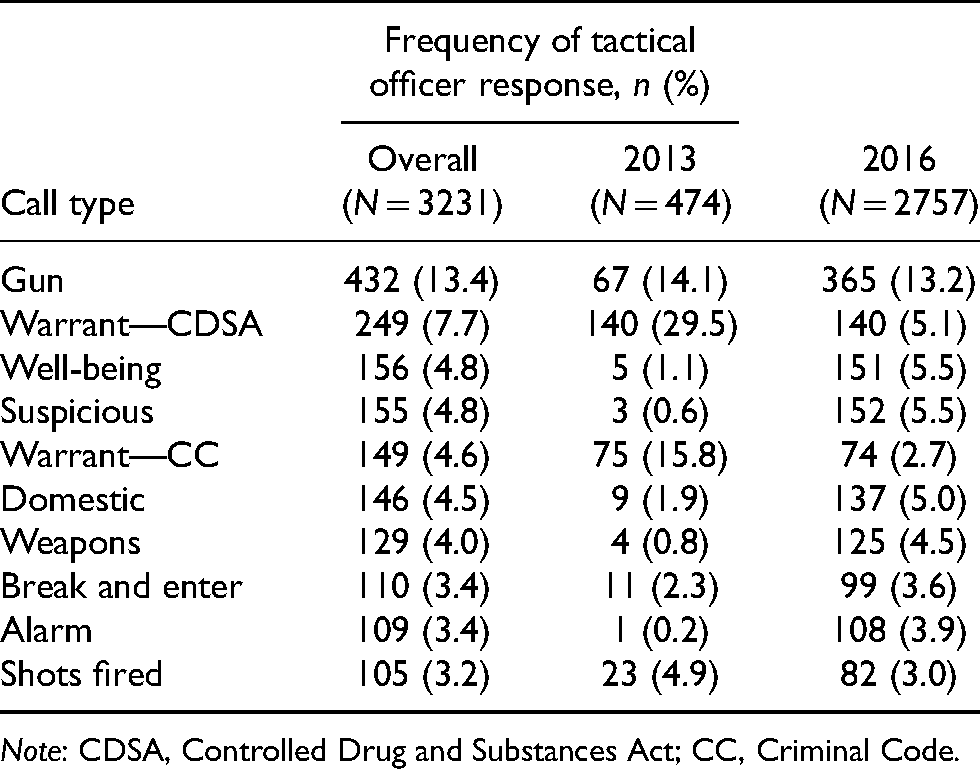
Note: CDSA, Controlled Drug and Substances Act; CC, Criminal Code.
Presence of risk factors in initial dispatch information
In total, 1,019 (31.5%) files included additional information; 4 nearly all the 2013 files provided a description (n = 470, 99.2%), whereas only a quarter of files in 2016 included sufficient context (n = 549, 24.9%).
Weapons believed to be on scene
Despite the considerable variation in types of calls WPS tactical officers responded to, at least one weapon was believed to be on scene prior to police arrival in the majority of calls where additional information was provided (n = 610, 59.9%). This finding seems to be relatively stable over time, although weapons were believed to be present in a higher percentage of calls in 2016 (n = 363, 66.1%) than in 2013 (n = 247, 52.6%). Of the weapons believed to be present, firearms were most commonly reported in both 2013 (n = 197, 41.9%) and 2016 (n = 263, 47.9%). In comparison, other categories of weapons were relatively uncommon. For example, edged weapons were believed to be on scene in 10% of cases (n = 47) in 2013 and 12.6% (n = 69) in 2016. Similarly, during 4.3% (n = 20) of 2013 calls and 4.9% (n = 27) of 2016 calls, it was believed that other weapons (e.g., incapacitant such as bear spray) were on scene.
Within the calls that included additional information, call types that indicated a firearm was likely on scene (i.e., gun call, shots fired, and gunshot wound) comprised approximately half of the occurrences where firearms were thought to be present. Of the 460 calls in which a firearm was believed to be present, 270 (58.7%) were not firearms-related calls. 5 This finding suggests that the call type is not a reliable indication of the presence of weapons and speaks to the variability of situations within call type categories. Further, it appears that weapons are frequently believed to be on scene in seemingly benign call types (warrant executions, traffic incidents, domestic disturbances, etc.).
Given concerns that have been raised regarding tactical officers responding to “routine” calls, such as domestic disturbances and mental health calls, we sought to examine how frequently firearms were believed to be present during these calls specifically (insufficient information was available to examine other types of risk factors). 6 Firearms were believed to be present in approximately 45% of calls dispatched as a suicide threat (n = 19/42) or well-being check (n = 7/16). Similarly, firearms were believed to be present in about half of warrant executions (n = 62/121) and domestic disturbances (n = 16/32). These findings suggest that tactical officers are often not responding to low-risk routine calls but calls where significant risk may be posed to the individual, the public, or the officers.
Additional risk factors
In addition to the presence of weapons believed to be on scene, the history of the individual may also influence the risk associated with a call (e.g., the likelihood that the individual will display violence towards officers). Not surprisingly, reactive calls (n = 31, 28.2%) provided information regarding the individual's history less often than planned operations (e.g., warrant executions; n = 79, 71.8%). The most frequently reported history was possession of weapons (n = 74, 7.8%), gang affiliations (n = 14, 1.4%), and previous murder or attempted murder charges (n = 12, 1.2%). Additionally, a subset of calls (n = 60, 5.9%) noted that the individual had made explicit threats. Most commonly these threats were directed towards themselves (n = 32, 3.1%), towards the public (n = 21, 2.1%), or towards the police (n = 7, 0.7%).
Role of tactical officers
The daily occurrence reports occasionally included the role that the tactical officers fulfilled within a particular response. Most of the information related to the tactical officers’ role was included for warrant executions. In these cases, the tactical officers most frequently used various types of entries including no-knock entries (n = 73), knock and announce (n = 46), surround and call out (n = 32), or knock and talk (n = 20). Tactical officers also reported engaging in a takedown of an individual (n = 32) and conducting surveillance (n = 46). Based on these findings it appears that dynamic or no-knock entries were utilized in approximately one-third (36%) of all warrant executions where information was provided.
Given current interest on the topic (Trinh, 2020; Trinh et al., 2021), we conducted an exploratory analysis to determine whether there is a relationship between the role of the tactical unit and the belief that weapons were on scene. Using Pearson's chi-square test of independence on available calls (n = 203), we found a significant association between the tactics used and the belief that weapons were present, χ2(4) = 97.46, p < 0.001. Specifically, tactics such as the knock and talk and knock and announce approach were used more frequently when there was no indication weapons were present (n = 16 and n = 40, respectively) compared with situations in which weapons were believed to be present (n = 4 and n = 6, respectively). Surround and call out and high-risk takedowns were used more often when weapons were perceived to be on scene (n = 27 and n = 22, respectively) than when this was not the case (n = 5 and n = 10, respectively). Finally, no-knock entries were used more commonly when weapons were not believed to be present (n = 70) than when they were (n = 3), suggesting that other factors (e.g., likelihood of the individual destroying evidence) contributed to the decision to use this entry method. This appears to be the case given that Controlled Drug and Substances Act warrants comprised nearly all no-knock entries (n = 71/73).
Discussion
Despite claims made by some researchers (e.g., Roziere and Walby, 2018: 46) that the use of tactical teams in “routine” policing and warrant executions “should be declared a failed public policy and scaled back immediately”, it appears that these calls may not always be as benign as they appear on the surface. When contextual information was available for calls that WPS tactical officers responded to, we found that risk factors (especially the presence of weapons) were thought to be present during the majority of the calls. We also found that the call type was generally not indicative of the level of risk posed to public or officer safety. For example, weapons were sometimes thought to be present in calls that were not specifically weapons calls, including warrant executions, mental health calls, and domestic disturbances. Therefore, the assertion that tactical officers (or tactical teams more generally) are responding to “routine” calls with little risk may not be supported when additional context is considered.
Given the limits of our study, particularly the lack of contextual information for many calls included in the WPS data, we are unable to provide any policy recommendations regarding the use of tactical officers. However, the point of our study was not to propose such recommendations. Instead, our primary objective was simply to illustrate why a deeper understanding of contextual factors related to the use of tactical resources is important before policy recommendations of the type proposed by Roziere and Walby (2018) are seriously considered. Given the likelihood that risk factors are masked when using crude data (i.e., original call type), it would be prudent to use a coding manual similar to the one developed for this project to (re-)examine specific incidents where tactical units attend. Engaging in this type of research would allow for a more informed understanding of how tactical units are used by police services, and the potential consequences of their use.
This will of course require police services to capture, record, and release higher-quality data related to the use of tactical resources. This is particularly true regarding contextual information. Some of this information (e.g., weapon presence) will provide useful insights into how tactical units are used, whereas other information (e.g., individual race, whether force was used) will speak to the consequences of their use. Considering current variation in reporting standards both within and across services (Griffiths and Pollard, 2013; Roziere and Walby, 2018), it will be important for police services to use a standardized approach to capturing the use of their tactical officers, the nature and outcomes of the situations they respond to, and the demographics of who they interact with. Without this type of data, analyses that take into account important contextual information will be impossible. Without such detailed analyses, practices and policies related to the use of tactical resources may potentially be misguided.
Footnotes
Acknowledgements
We would like to thank the anonymous reviewers whose insightful comments greatly improved the scope and quality of this manuscript.
Declaration of conflicting interests
The author(s) declared no potential conflicts of interest with respect to the research, authorship, and/or publication of this article.
Funding
The author(s) received no financial support for the research, authorship and/or publication of this article.

Notes
Author biographies
Risk Factor Coding Scheme
| Call type: | ||||
|---|---|---|---|---|
| Present a | Absent a | Not Mentioned b | ||
| Additional information provided Weapons believed on to be scene | Edged b | |||
| Firearm b | ||||
| Impact (e.g., baseball bat) b | ||||
| Other (e.g., bear spray) b | ||||
| Presence of weapons on scene | Edged a | |||
| Firearm a | ||||
| Replica firearm b | ||||
| Impact (e.g., baseball bat) a | ||||
| Other (e.g., bear spray) a | ||||
| Expressed threats | To self a | |||
| To public a | ||||
| To police a | ||||
| Current state of individual | Drugs/alcohol a | |||
| Persons in crisis a | ||||
| Suicidal a | ||||
| Previous history of individual | Persons in crises a | |||
| Suicidal a | ||||
| Violent a | ||||
| Drugs/alcohol a | ||||
| Anti-police a | ||||
| Extremist/anti government a | ||||
| Gang affiliation a | ||||
| Possession of weapons a | ||||
| Previous training (military/police) a | ||||
| Assault police officer b | ||||
| Shoot at police officer b | ||||
| Murder charges b | ||||
| Previous shooting b | ||||
| Assault charges b | ||||
| Attempted murder charges b | ||||
Denotes an item that was developed a priori.
Denotes an item that was added in the coding process