




Abstract
One of the current and visible controversies in UK policing that challenges the heart and foundation of the principle of law is arguably the apparent disproportionate use of stop and search powers involving ethnic minority communities. Prior research found that differential exposure by the police to certain types of suspected offenders led to the development of cognitive scripts that operate as stereotypes and which may play a role in informing suspicions concerning police stops and searches. Focusing on whether police officers use negative stereotypes to inform suspicions when conducting stops and searches, this study examined more than 2,100 stop and search records held by a police force in England, in addition to conducting 20 semi-structured interviews with frontline serving police officers from the same force. It was found that the use of stop and search powers is consistent with: (a) the use of stereotypes with respect to age, appearance, and social class; and (b) the disproportionate recorded use of stop and search powers involving Black, Asian and Mixed communities. The implications of these findings are discussed.
Introduction
The use of stop and search powers by the police is one of the most controversial issues in debates concerning policing ethnic minority communities (Weber and Bowling, 2011; Bradford, 2017; Phillips and Bowling, 2012; Quinton, 2011; Shiner and Delsol, 2015). In the UK, several research studies have reported findings apparently showing disparities in police treatment between ethnic minority citizens and White citizens (Graham and Lowery, 2004; Parmar, 2011). Studies of stop and search indicate that the required reasonable grounds for suspicion were seldom adhered to by the police (Bowling and Phillips, 2007; Jefferson and Walker, 1993), with stereotypes possibly playing a role in informing their suspicions (Quinton and Packham, 2016; Smith and Gray, 1985). Previous research studies have also found that certain stereotypes are commonly used by police officers to classify people based on their ethnic origin and social class (Bowling and Phillips, 2007; Graef, 1989; Jefferson and Walker, 1993; Quinton, 2011; Young 1994).
Although, there is a significant volume of literature on the formation of racial and prejudicial stereotypes (Graham and Lowery, 2004), there remains a negligible amount of research concerning the relationship between prejudicial stereotypes and police officers’ decision-making processes when informing their suspicions to initiate a stop and search encounter. Therefore, this study focuses on whether police officers use stereotypes to inform suspicions when conducting stop and search procedures (rather than examining the broader debates concerning the matter of policing Black, Asian and minority ethnic communities in the UK). Drawing upon strands of literature from cognitive social psychology, this study examines how officers: (a) may develop suspicions of people; and (b) decide whether to initiate a stop and search encounter.
Background
Following the Home Office 1 Action Plan (1999) in response to the Macpherson Report (1999), a number of studies were conducted to examine police use of stop and search powers (Bland et al., 2000; Bowling and Phillips, 2007; Delsol and Shiner, 2006; HMIC, 2013, 2015; Home Office, 2003, 2006; Miller, 2010). Each subsequent study indicated that aggregate disparities showed no improvements following reforms (HMIC, 2013). However, the police have tended to explain the question of disproportionality away with reference to a number of possible suggestions, such as biased police recording and differential offending rates (Shiner and Delsol, 2015). The Equality and Human Rights Commission (EHRC) (2010) report found that stop and search powers had been used in a discriminatory manner. This report argued that various explanations had been put forward for why the police use stop and search powers disproportionately against certain ethnic groups. These explanations included: (a) Black, Asian and minority ethnic people may be more often involved in crime; (b) stop and searches play a role in preventing and detecting crime; and (c) certain ethnic minorities’ greater presence on the streets. The EHRC (2010) report emphasised that the evidence points to racial discrimination being a significant factor in why Black and Asian people are more likely to be stopped and searched than White people. Further, this report maintained that stop and search powers might well be used in a discriminatory and unlawful way.
Another criterion, when comparing numbers of stop and searches, is that of the population among different ethnic groups “available” to be stopped. It is acknowledged that some demographic groups are “unavailable” to be stopped by the police (or less likely, because they spend most of their time at home, at work or are otherwise in private spaces). Other people, however, may be more likely to be “available” by virtue of their demographic characteristics and lifestyle, which involves more social activity. However, MVA and Miller (2000) investigating this comparator concluded that resident populations give a poor indication of the populations available to be searched. Even taken together, all these explanations have been argued not to provide justification for the extent and persistence of the problem of why some demographic groups are more likely than others to be stopped by the police (Weber and Bowling, 2011).
Studies of stop and search practice, conducted after the introduction of the PACE Act 2 (1984), indicate that the reasonable grounds for suspicion were only occasionally regarded (Quinton et al., 2000; Quinton, 2011), with negative stereotypes potentially playing more of a role to inform suspicions (Brown, 1997; Dixon et al., 1989; Smith and Gray, 1985; Quinton, 2011; Young, 1994). Such stereotypes can be activated in the officers’ decision-making process. Once activated, these stereotypes influence relevant decisions concerning a suspect’s perceived culpability (Minhas and Walsh, 2018). Thus, such prejudicial stereotypes activation does not appear to require a perceiver to overtly endorse the stereotype.
Dixon et al. (1989) noted, a man who fits a stereotype just ends up noticeably suspicious in a stop and search context. Quinton (2011: 364) quoted a statement by an officer, who revealed that the connotation of young people wearing tracksuits and hooded tops were not respectable: “you develop the stereotypes through experience, the people you see are involved in crime. In this area, its people in sports gear”. Quinton also cites a statement from another officer, who said, “whenever a robbery comes in, 90% you will be thinking it’s a Black male because of the description and because you know who does a robbery in the past” (Quinton, 2011: 364). Arguably, it may be inescapable that such focus on particular groups of a community would have resulted in youngsters from deprived backgrounds and ethnic minorities being targeted.
PACE (1984; Home Office, 2013) states that reasonable grounds of suspicion cannot be based on stereotypes or individual qualities (including previous criminal record). However, Dixon et al. (1989) noted that the formation of reasonable suspicion is viewed as a rational process which includes officers looking over the material facts around them and weighing-up the probability of finding a prohibited item. Kleinig (1996: 83) observed that police discretion was deemed to be “a permission, privilege or prerogative to use one’s own judgment about how to make a practical determination”. However, “the absence of a clear statutory penalty for unlawful stops and searches allows the police discretion to act without adequate accountability” (Bowling and Phillips, 2007: 939). As such, unrestricted practices regarding stop and search might provide the opportunity for police officers to exercise their discretionary powers based more upon their prejudices than justified suspicions (Kleinig, 1996).
The police are aware of the general trends in street crime. From this awareness, officers tend to form impressions of the likelihood that individuals belonging to specific racial groups will perpetuate certain types of crimes. Such perceptions may lead to officers undertaking racial profiling, which has the effect of creating a cycle of profiling of suspected offenders (irrespective of the accuracy of these negative perceptions) (Delsol, 2015). These cycles of profiling are results of negative stereotypes (Minhas and Walsh, 2018). Research studies have found that negative stereotypes (based on a suspect’s race) may influence officers’ investigative decision-making, which could contribute to a different outcome of a criminal investigation when investigating a similar crime (when suspects are from different ethnic groups) (Minhas and Walsh, 2018). This finding suggests that negative stereotypes might well be a potential key contributing factor in the overall disproportionate number of Black, Asian and minority ethnic communities involved in being stopped and searched (and in turn those charged, convicted and imprisoned). As such, a review published by the UK Ministry of Justice found that Black, Asian and minority ethnic communities make up 14% of the population of England and Wales, but 25% of adult prisoners and 41% of under 18s in custody (The Lammy Review, 2017).
The impact of negative stereotypes, as such, is to mark out the limits among “them” and “us” (Tajfel, 2010). Social identity theory offers a powerful explanation for the social foundation of in-group and out-group biases. Social identity theory asserts that group membership serves to bolster self-esteem, and thus, individuals have an incentive to favour in-group members over out-group members (Tajfel and Turner, 1979). The use of negative stereotypes may have adverse effects on criminal investigative processes as these stereotypes could have a more negative effect when investigating suspects from out-group communities (Tajfel, 2010). In the context of the criminal justice system, certain ethnic minorities are frequently negatively stereotyped to have characteristics that make them more inclined to take part in criminal behaviour. For example, Ware (2007) argues that the stereotyping of young Black men as dangerous criminals is embedded within police culture.
The roots of prejudicial stereotypes are deeply embedded in the police culture (Yesufu, 2013). The disproportional use of stop and search powers reflects a collective pattern of police culture and practice. The use of prejudicial stereotypes against certain ethnic groups can be seen in processes, attitudes and beliefs within the police culture (Yesufu, 2013). Such negative stereotypes operate unwittingly and can be directives of actions because they work at the level of discernment and desire (Hall et al., 1998). Hall et al. (1998) found that stereotypes were remarkably stable over time, being transmitted and maintained through informal work routines. If police officers maintain negative stereotypes towards specific groups, this can shape how they behave towards those groups, resulting in officers displaying a discriminatory and hostile behaviour towards suspects (Minhas et al., 2017). It appears that police subcultures can be problematic if they reinforce the view that certain groups are involved in specific crimes, as these findings suggest, which may hamper effective police interpersonal and communication skills used to develop suspicion and conduct a stop and search.
Minhas et al. (2017) found that if a police officer has any perceived prejudicial stereotypes towards the suspects (based on their ethnicity or social class), this could result in guilt presumption and self-fulfilling prophecies. Consequently, any prejudicial stereotypes may lead to the police officer demonstrating hostility toward suspects. Research conducted on stop and search has consistently found that the long-observed ethnic disproportionality can be partially attributed to racialisation and discrimination by individual police officers on the streets (Phillips, 2011) and the decisions to conduct stop and searches are carried out guided by prejudicial stereotypes. It is, therefore, essential to improve our understanding of the processes by which police officers inform suspicion or anticipate wrong-doing and decide to conduct a stop and search (Quinton, 2011). As such, in this study, we hypothesised that officers use stereotypes to inform suspicions and initiate a stop and search encounter. Further, we hypothesised that stereotypes based on a suspect’s race, ethnicity or social class could be contributing factors in negative searches and disproportionality.
Methods
The present study used a mixed-methods approach. It has consisted of two phases: (a) an examination of 2118 individual search records provided by an English police force (a shire force that covers both urban and rural areas); and (b) a thematic analysis of 20 semi-structured interviews, which were conducted with serving patrol officers of the same force. This sequential method was devised first to determine what might be the possible factors that may lead an officer to stop and search encounter followed by the exploration and explanation of the findings from the search records analysis by conducting interviews with serving police officers. This purpose of this approach was to explore whether the factors identified by officers in the data set to develop suspicion and initiate a stop and search encounter triangulate with factors they identified during the semi-structured interviews.
Phase I
Phase I of analysis examines What are the grounds for searches reported by the police officers to inform suspicion? Whether a relationship exists between those belonging to Black, Asian and Mixed ethnicity group and the greater rate of their being searched?
Data collection and procedures
Following the completion of the first author’s Non-Police Personnel (NPP) Level One 3 vetting procedure (the police constabulary carried out checks on National Police Computer systems, local systems and requests checks from forces that cover any addresses quoted in the author’s application), and ethical approval by the police force and authors’ then home university, a data set was sent to the first author via a secure email within an Excel spreadsheet containing a record of 2,118 searches. This data set included information regarding who was searched, when, what powers were used to search and on what grounds. The data set also contained information concerning the gender, ethnicity and age of the individual when he or she was searched, whether that person was arrested or not and (if so) the reasons for their arrest. The database was compiled from documentary records of searches which were conducted from the period 1 July 2014 to 31 December 2014 covering the whole area of a single police force in England and Wales.
Results
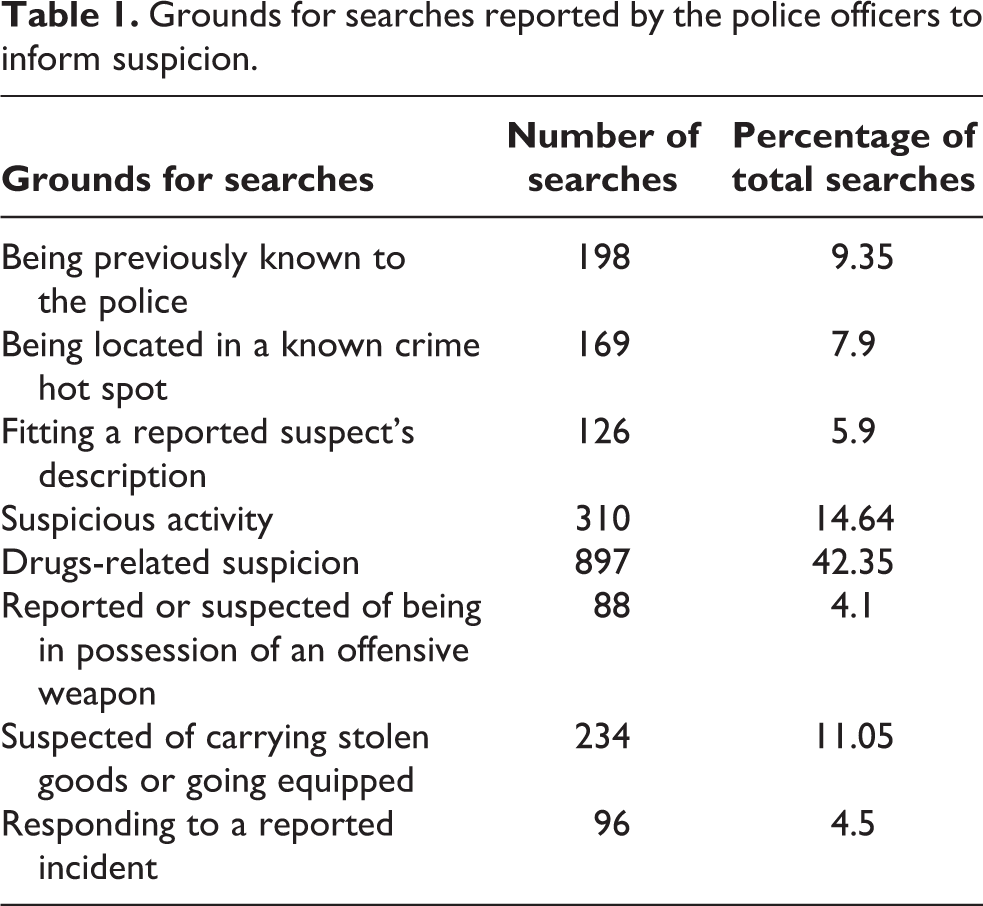
The first stage involved examination of these data to identify what factors might have aroused officers’ suspicions. Thus, “grounds of search” were examined for each recorded search using thematic analysis (Braun and Clarke, 2006; see phase two for further details on thematic analysis). As a result, eight common factors were identified by which officers inform suspicions about people and decide whether or not a formal stop and search is necessary (for details see Results section Phase I). Following this, the data set was coded on the basis of: (a) grounds of search; (b) what powers were exercised by police officer; (c) gender; (d) age; (e) ethnicity; (f) whether arrest was made following a search; and (g) reasons for arrest. As such, the “grounds of search” were examined of each recorded search, which provided information about the officers’ origins of suspicion. As a result of thematic analysis of the stop and search records data set, eight common factors (see Table 1) were found. The coded data were then imported into SPSS software to conduct statistical analyses.
Grounds for searches reported by the police officers to inform suspicion.
It was found that nearly half (49.6%) of the searches were conducted with individuals aged between 18 and 30 years – 20.3% with individuals aged between 12 and 17, 22.5% with individuals aged between 31 and 40, and 7.5% with individuals aged between 41 and 70. As a result of the 2118 searches, 288 (13.6%) arrests were made. Where arrests took place, the data set did not provide any subsequent details of the outcomes of these arrests (such as the number resulting in charges, cautions or no further action).
To determine whether a relationship exists between those belonging to the Black, Asian and Mixed ethnicity group and the greater rate of their being searched, we examined the coefficient of the confidence level (both the lower and upper bound value) and the F-test (Wald test) as presented in Table 2. Starting from the confidence interval (CI) coefficient, the ethnicity values (0.48:3.04) revealed that ethnicity has a considerable influence on stop and search exercises. Overall, using the Wald (F-test), as seen in Table 2, to determine whether gender, age, grounds of search and ethnicity jointly predict whether an individual can be stopped and searched, it was revealed that these variables jointly have a substantial influence on the exercises of stop and search, which implies that Black, Asian and minority ethnic individuals have the tendencies of being stopped and searched when compared with White people.
Influence of ethnicity on the likelihood of an individual being stopped and searched.
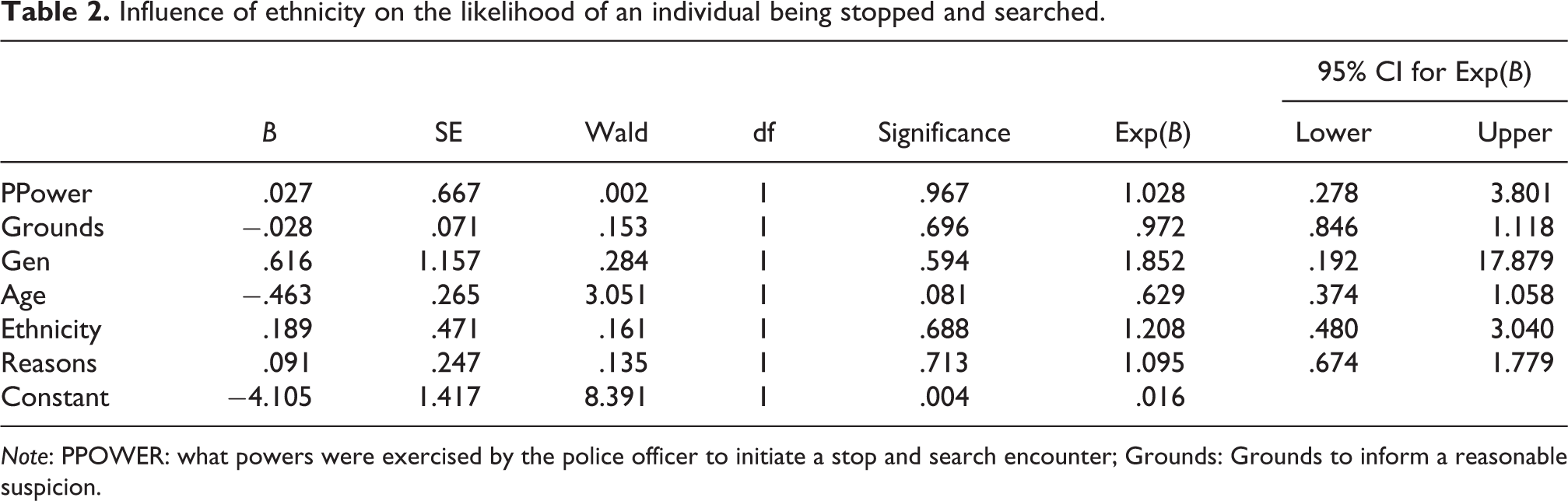
Note: PPOWER: what powers were exercised by the police officer to initiate a stop and search encounter; Grounds: Grounds to inform a reasonable suspicion.
Further, to test whether ethnicity has any influence on the likelihood of an individual being stopped and searched a chi-square test of independence was performed, to see whether there is a statistically significant association between (a) being a member of the Black, Asians and Mixed communities and (b) being searched by police. Where the degree of freedom was 1 with α = 0.01, the null hypothesis is that search rates are independent of race and the alternative hypothesis is that search rates are not independent of race. As seen in Table 3, it was revealed that p < 0.05 indicating there is a relationship between belonging to the Black, Asian, and Mixed communities and the likelihood of their being searched.
Chi-square tests.
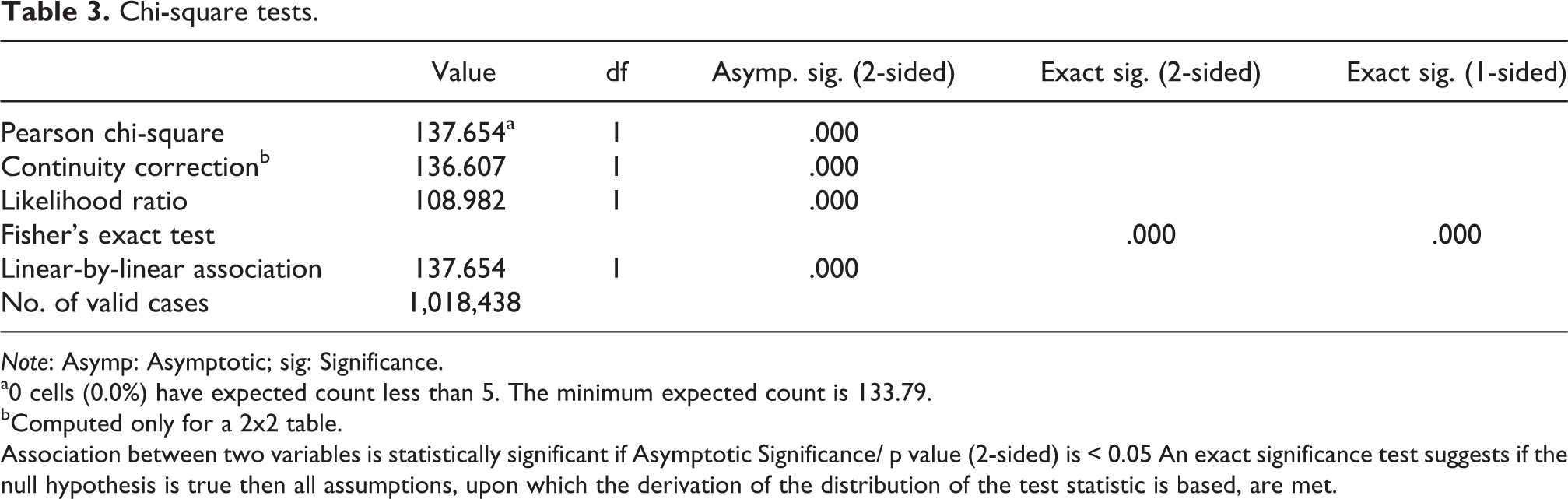
Note: Asymp: Asymptotic; sig: Significance.
a0 cells (0.0%) have expected count less than 5. The minimum expected count is 133.79.
bComputed only for a 2x2 table.
Association between two variables is statistically significant if Asymptotic Significance/ p value (2-sided) is < 0.05 An exact significance test suggests if the null hypothesis is true then all assumptions, upon which the derivation of the distribution of the test statistic is based, are met.
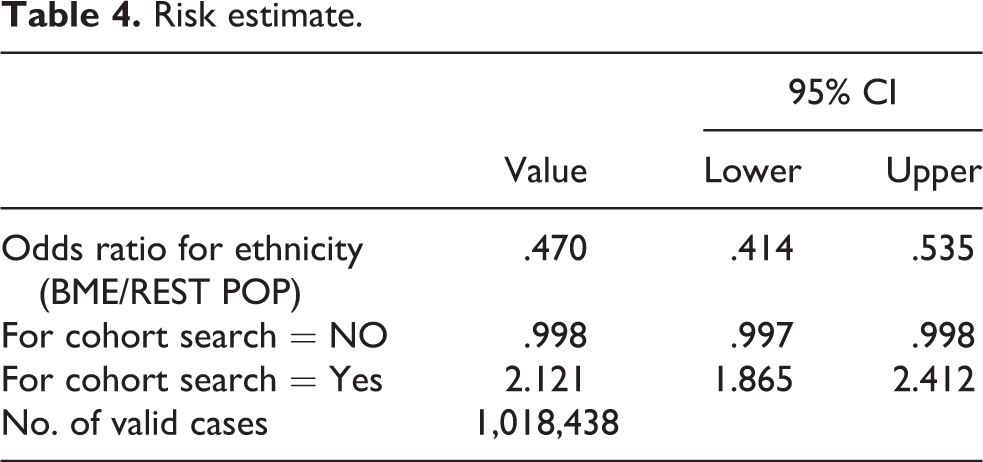
Further, the search rates were compared with population statistics (obtained via the Office for National Statistics, 2011). Table 4 shows that those belonging to Black, Asian and Mixed communities were 2.12 times more likely to be searched compared with the rest of the population of the area covered by the constabulary.
Risk estimate.
Phase II
The purpose of phase II was to explore the officers’ views to answer the following questions: What constitutes an effective stop and search encounter? What is the basis for suspicion and factors that make officers decide who to stop and search? To what extent do officers use stereotypes to develop suspicion in stops and searches decision-making?
Participants and procedures
In the present study, the researcher employed semi-structured interviews that allowed the officers to develop and qualify their ideas. The open-ended nature of the questions allowed officers to discuss issues and provide information both directly relevant and tangential to the questions asked. The first author interviewed a range of police officers from each division of the police force, concentrating mainly on patrol officers. These interviews include a wide variety of ages, backgrounds, and lengths of service, to cover a variety of police tasks and experience. During September to December 2015, the researcher undertook interviews with 20 officers (17 of whom were male). The police designated responsibility for providing officers for our interviews to sergeants. The sergeant had randomly pre-selected police officers from all the divisions across the police force and provided a timetable for them to be interviewed. All participants were frontline patrolling officers and had experience in conducting stops and searches. Their experience ranged from 1 to 22 years (M=8.88 years, SD = 4.96 years). Participants’ ages ranged from 23 to 56 years (M = 36.47, SD = 8.68).
The interviews were conducted in the most private available space in the police station. Each interview lasted approximately 40 minutes. The researcher began all interviews by asking demographic information such as age, sex, self-defined ethnicity, rank and length of time in the force. Each officer was asked the same standard set of questions, although where necessary, elaboration and clarification were provided. The anonymity of all the participants was protected by numerically coding each interview and responses were always kept confidential. The officers’ names and badge numbers were not taken to maintain anonymity. The researcher also provided written information concerning the purpose of the study. All the officers provided consent to record interviews. Transcripts were prepared for each interview, and these formed the basis for examination and analysis of the data.
Qualitative data analysis
To examine the semi-structured interviews, the study employed a thematic analysis of the interview transcripts. Thematic analysis also gives a platform for the clear and straightforward definition of the theoretical position a study adopts in its approach to analysing its data (Braun and Clarke, 2006). The method of analysis chosen for the study was inductive thematic analysis (data-driven) (Boyatzis, 1998). Inductive analysis is a procedure of coding the data without trying to fit it into a pre-existing coding frame (Boyatiz, 1998). In the present study, the codes were accordingly inductive, originating from the participants’ understandings concerning stop and search practices (Miles and Huberman, 1994). By conducting inductive thematic analysis, the authors were not only able to determine what constitutes an effective stop and search encounter, but also what factors may have influenced officers’ decisions to stop and search. Accordingly, in the present research, inductive analysis took a semantic or explicit approach (Boyatzis, 1998). That is, the themes were identified from the “explicit or surface meaning of data” (Braun and Clarke, 2006: 84).
Following Braun and Clarke (2006) guidelines after reading and familiarising with the data, we generated an initial list of ideas about what is in the data concerning the research questions. Braun and Clarke (2006) suggest that this phase should be used to produce initial codes from the data. Codes identify a feature of the data (semantic content) that appears interesting to the authors and refers to “the most basic segment, or element, of the raw data or information that can be assessed in a meaningful way regarding the phenomenon” (Boyatzis, 1998: 63).
The process of coding is part of the analysis (Miles and Huberman, 1994), as this step helps to organise the data into meaningful groups. However, coded data differs from the “units of analysis” (themes) which are (often) broader. Boyatzis (1998) suggested that interpretative analysis of the data occurs when researchers merge the codes (that appear similar in meaning) into “larger units” (themes). In the data-driven approach (used in this study) the themes depend on the data. When all data have been coded and collated, and we have a full list of the potential themes and sub-themes. We then considered the validity of individual themes in relation to the data set, whether our themes accurately reflect the meanings evident in the data set as a whole. Finally, we “define and refine” the themes. That is, identifying the essence of what each theme is about (as well as the themes overall), and determining what aspect of the data each theme captures (Braun and Clarke, 2006).
Limitations
The police acted as gatekeepers for this convenience sample of police officers. Nevertheless, the interviews were conducted with police officers from across this police force, providing a useful snapshot of their decision-making when they conduct stop and search (and also of the contexts in which these decisions take place). The findings from both the force’s data set and the interviews may also be affected by the researcher’s unconscious biases. In turn, police officers’ responses during the interviews may have been affected by their training and their awareness regarding the highly sensitive issue of disproportionality in stop and search figures. As a result, their responses might well be a case of their attempting either “impression management” (Schoderbek and Deshpande, 1996) or providing socially desirable answers (Zerbe and Paulhus, 1987).
Results
Thematic analysis of the 20 interview transcripts was conducted to identify themes emerging from the answers to questions and subsequent contributions made by officers. The findings are discussed and presented under these main themes: what constitutes an effective stop and search encounter; the basis for suspicion; the use of stereotypes (generalisations) in stop and search decision-making; and possible factors playing any role in disproportionality.
An analytical narrative was constructed and extracts from the transcripts are now presented to illustrate each of the four themes.
What constitutes an effective stop and search encounter?
Participants were asked what an effective stop and search encounter is in light of their experience. According to their views, a stop and search encounter is effective when it meets the following criteria:
Definable suspicious behaviour. Ninety per cent of participants (n=18) reported that their decision to stop and search is more effective when based on definable suspicious behaviour, as outlined in the PACE Act (1984) Code A.
Guided by up-to-date operational intelligence (e.g. focused on active and more serious offenders, local crime trends and specific crime hot spots). Ninety per cent of participants (n=18) reported up-to-date operational intelligence as their grounds for a stop and search encounter.
Carried out in a respectable manner. All 20 participants reported that a stop and search encounter that is carried out in a respectable manner with a clear explanation of the reason for a stop and search would enhance public confidence.
Carried out in the context of police–community relations and cooperation. Eighty-five per cent of participants (n=17) reported that an effective stop and search encounter is one that is carried out in the context of police–community relations and cooperation.
The basis for suspicion
Officers stated they generally stop and search someone whom they suspect of committing or being likely to commit a crime. In this regard, three factors were identified by the police officers as those that would arouse their suspicion and may lead to a stop and search encounter. These factors are: (a) appearance; (b) behaviour; and (c) time and place. Each of these factors is now be examined.
Appearance
During the interviews, 15 participants (75%) stated that their suspicion might be prompted if a person appears to be of a young (adult) age. For example, Participant 20 stated, I would say its white males from 17 to 30-ish. I would say 99% are in that age group because they’re the ones that are committing, from where I work, the drug offences, the shoplifting offences. I have had instances before where you’ve got youths, about 16, 17-year-olds that are wearing two sets of clothing one over the other, dark clothes, dead at night, the only reason why they are doing that is so they can discard that top clothing and having different clothing underneath. Previously known to me…if it’s a drug hot spot then it gives me more grounds to actually go and speak to the person and also carry out a search to see whether that person is actually carrying drugs… Previously known to me or police wouldn’t make any difference to me, just because they’re known and they’re on a crime hot spot that wouldn’t be enough for me to have reasonable grounds to suspect. I would need more information than that.
Behaviour
During the interviews, 14 participants stated that the behaviour of an individual is the primary reason in their decision-making to stop and search someone. These participants stated that they might stop and search people who are seen “loitering” “looking into cars”, “looking into gardens”, or “checking locks”. Participant 11 stated, [I]f they are like going up and down people’s driveways at that time in the morning or they are looking in people’s cars, or they are going along trying car door handles and that sort of thing to me that’s suspicious. If I was to see somebody loitering, looking like they were doing something and they were hiding something as they see me approach, you know, then that could arouse my suspicions. Turning their back towards me could arouse my suspicions. If you looked away why would I consider that to be suspicious because you may not like police, you know, you may be looking round to catch the bus. I wouldn’t say that’s suspicious. I wouldn’t stop someone on such basis. Part of our issue is we have a very small form to write the details on…When you have got two lines you can literally write seen acting suspiciously.
Time and place
Fifteen participants (75%) relied on their knowledge of a particular location and what activities should or should not be expected there, after a particular time to form a suspicion. For instance, Participant 13 stated, If it’s a notorious place in the city that it’s just known for drug use or drug possession, somebody’s there, three o’clock in the morning on their own to me, yes, I’ve got reasonable suspicion that you may have something on you and to me, I would search you. I think if it was somebody that was known and they weren’t near to their home address at three o’clock in the morning I think they would be at the very least asked to account for why they were where… No, not because of a particular time or location, because he’s not doing anything, you know, unfortunately, people do walk around…I wouldn’t feel comfortable to search him. It’s quite difficult because I tend to find reasonable suspicion to be quite a high threshold test.
Use of stereotypes in stop and search decision-making
Thirteen participants (65%) described a number of generalisations (stereotypes) they use when making the decision who to stop and search such as dress, age, known unemployed and located in a known crime hot spot. For example, Participant 19 described, They are usually the ones that really…because they are the ones that will come in or they are the ones that will try and float it a bit because they have got this sort of mentality that they can get away with anything. The older you get the more, sort of, cautious you are being and stuff like that. So, yes, I would say 16 to 20. The main people that I would stop and searching out at night are going to probably be white, the early twenties, early thirties, unemployed, usually people of substance abuse that are out stealing for a reason, to fund their other problems. If you are looking at people that are unemployed, sort of, career criminals, the ones that are known to us, the ones that may potentially be stopped more often because they are out there.
Possible factors playing a role in disproportionality
Twelve participants indicated that a description of a suspected offender should not be treated as a straightforward form of information. More importantly, four of these participants stated that poor or vague information concerning an offender’s description could be attributed to the possible causes of disproportionality, as these communicated descriptions tended to focus on their ethnicity and clothing. Participant 07 stated, Yes, it’s a very, very, very white area and so, for example, if I have a report where they say a Black male has burgled a property or a Black male has drugs on him and I, for example, two minutes later find a Black person around the corner I’m going to search that Black person and I’ll tell him why he’s being searched and what have you. Whereas, obviously if it’s a white person and that’s all I’ve got it’s more difficult for me to pinpoint the white person and it’s almost like a…whether it’s right or wrong it’s almost like scale, the scale of the population if you know what I mean in the area, so…. [F]or example, if it was reported it was a large white male and I drive past three large white males I’m less likely to stop those three large white males before I get to the home address. If I see a large Black male, they’ve reported a large Black male and it’s the only one I see I’m likely to stop him. That might be why they are disproportionately stopped, particularly if they’re in sort of predominantly white areas. I would suggest that predominantly drug use and drug dealing is part of the Black minority. It’s just how…it’s how it’s perceived in society. I would say so, yes, because like I say it’s predominantly Black ethnic minorities that will be drug dealers…I think that just gets into your mind. It gets into other people’s minds as well.
Discussion
The present study sought to examine whether police officers use stereotypes to inform suspicions when conducting stop and searches. The analyses of recorded stop and search data sets revealed that stop and search powers are disproportionality weighted against Black, Asian and Mixed communities. Further, it was revealed in the data set of stop and search records that officers use generalisations to inform their suspicions (e.g. their being previously known to the police, or their being in a known crime hot spot). The analyses of research interviews indicated that people’s age, appearance, being know to the police, location and social class play a role when officers make decisions whom to stop and search. The generalisations identified in the analysis of the interviews we conducted triangulated with the grounds for searches reported in the data set by officers (see Table 1). These findings suggest a relationship between specific stereotypes (i.e. young people on the street in deprived areas as potential criminals) and the formation of suspicion (being seen in a particular location at a particular time). These findings are consistent with the previous research (Quinton, 2011), where it was found that stereotypes are central to decision-making which results in police focusing more towards those socially marginalised.
In the interviews we undertook in Phase II of the present study, a quarter of our participants indicated that they would need reasonable suspicions before stopping anyone (such as having observed offending or possessing up-to-date intelligence on the individual, rather than relying on stereotypes based, say, on someone’s age, employment status or location). This implies that among these officers reasonable suspicion requires a high threshold test (which is also in line with the PACE legislation in England and Wales, concerning when to conduct stop and searches). Nevertheless, in instances in which officers were found to rely heavily on stereotypes to inform suspicions, they appeared to be using their powers under this legislation in ways that could be deemed unlawful and discriminatory. That is, according to PACE (Code of Practice A, 1984), individual officers and their supervisors are legally obliged to base their decision to stop and search on a reasonable suspicion that the concerned individual has committed or is about to commit, a particular offence. Hence, it is unlawful to target people based on officers’ generalised beliefs alone. In the data set of documented records, 367 searches appeared to be conducted on the grounds of “an individual being previously known to the police” (n = 198) or “being in a known crime hot spot” (n = 169) (Table 1). This was consistent with the officers’ views during the interviews in which they professed that such generalisations are vital to their decision-making concerning whom to stop and search. Although stereotypes that link crime with age, location, time and appearance may sometimes provide useful grounds to stop someone, there is a potential risk that people will also be identified by the police as suspicious when they do not warrant such police attention. This can be a major cause of public resentment towards the police (Quinton, 2011).
By contrast, one-quarter of police officers stated that suspicious behaviour or elusive behaviour is irrelevant in their decision to stop and search someone. These officers reported that they would need a reasonable suspicion (such as observed offending) to initiate a stop, rather than just perceived suspicious behaviour. This finding suggests that these officers are making decisions to inform suspicions as outlined in the PACE guidelines. Conversely, three-quarters of those police officer said that “suspicious behaviour” was grounds to conduct a stop and search. More than two-thirds of these officers described such behaviour in a number of different ways (e.g. running away or hiding their face after seeing officers). These findings are also triangulated with the data set of documented records of stop and search, 310 searches were stated as being conducted when a “suspicious activity” appeared to have been observed. Similarly, once an officer developed cues of suspicion on the basis of “schemas” about actions or people they do not believe fit the environment or situation, they may act upon them and stop the individual. Although in many circumstances such cues may well be reasonable, they have been often found to be tied to issues of ethnicity (Alpert et al., 2005). As such, suspicions developed from a cognitive schema may be more ones of supposition, but not necessarily ones concerning the actual behaviours or actions of people. Such perceptions may lead to officers undertaking racial profiling, which has the effect of creating a cycle of profiling of suspected offenders (irrespective of the accuracy of these negative perceptions) (Delsol, 2015).
Further, it was found that the recorded grounds for stop and search in the documentary records we examined were lacking in detail concerning information that would have been known to police officers. For instance, more than 75% of police officers reported that that the place of stop (being known as a crime hot spot) the time of day or night it occurred, or the age of the person stopped as their justification for grounds of search, but these criteria were only found cited in 9% of the documentary data set. Similarly, 75% of police officers advised us that a person’s suspicious behaviour would prompt a stop and search, yet these reasons were cited in just 15% of responses as grounds for searches in the documented data set.
This latter finding suggests that officers might well be using stereotypes to a greater extent than they realise. Such a situation may well mean that the searches conducted by the police were either based on insufficient grounds (where grounds are limited and questionable in legal terms), or there is a tendency to record fewer details concerning the grounds for the stop and search than were actually present at the time (which indicates that an inadequate explanation of the reasons for a search is being recorded). Either explanation reflects a most unsatisfactory situation. When we asked for clarity concerning the documentary data lacking details of stop and search grounds during the interviews we undertook in Phase II of the study, more than half of the officers highlighted that the stop and search form (which needs to be manually completed at the time of the stop and search) is too small and does not allow adequate space to detail fully the grounds for the search. Nevertheless, officers did not offer (what is thought as) rather simple solutions to this problem, such as turning the form over to record full details on its other (blank) side (or entering the information in their pocketbooks). This might reflect a malaise concerning a lack of necessary attention to maintaining comprehensive records. Regardless, failure to record specific details and refer to all the available direct and indirect evidence poses risks to legality (PACE Code A, 1984), the effectiveness of searches and, in turn, to public confidence in policing (Quinton et al., 2000). Furthermore, these findings suggest that reasonable grounds for suspicion were often not adhered to with evidence pointing towards an over-reliance on the use of stereotypes (that has been previously found in the literature; Quinton, 2001; Quinton et al., 2000).
The analyses of both the documentary data sets and the interviews revealed that officers also relied on their knowledge of specific locations (what activities should or should not be expected there, at a particular time of day) to form their suspicions. Officers’ perceptions concerning crime hot spots may lead them to believe that people in that particular area are engaged in criminal activity, which may pose a threat to police–community relations (Weisburd et al., 2011). By deploying police resources in crime hot spots, criminal activity can be disrupted to a certain extent. However, such deployments may affect how police officers interact with the people who live in that area, threatening police–community relations and thus the effectiveness of community policing strategies (Quinton, 2011). Chainey and Macdonald (2012) found that stop and searches conducted in crime hot spots made police officers more suspicious of people in that area generally, while also prompting police officers to take action (such as stop and search). At the same time, a benefit that emerges from the policing of crime hot spots is that it can provide the police with important contextual information that might help them develop enhanced justifications for a search. Further, by continuously reminding the officers at daily briefings that hot-spot policing must not affect how they behave and interact with the members of that particular area may well help to reduce negative stop and searches.
One of the interesting findings of this study was police officers’ perceptions concerning the association between the issue of disproportionality and the descriptions of reported offenders. Officers highlighted that the issue of disproportionality might be related to insufficient and inaccurate information concerning such descriptions because these details focused mainly on ethnicity and clothing. The majority of officers suggested that they felt a need to clarify the necessary elements of a description of “suspected offender” for operational use. A description fitting that of a reported offender can inform direct evidence (Quinton, 2011). However, if the suspected offender’s description is vague or inaccurate or has come from an unreliable source, suspicions may be based on tenuous grounds (which may result in the stop and search of innocent people) (Bowling and Phillips, 2007). For example, when there is insufficient and inaccurate information concerning the description of a reported offender, which mainly focused on ethnicity and clothing (when combined with an officer’s pre-existing cues of suspicion on the basis of generalised beliefs), this may arguably result in people being stopped and searched on the basis of their social class and ethnicity. During the interviews, officers reported that when they receive insufficient information concerning a reported offender, they indeed combine such information with their pre-existing cues on the basis of suspect’s ethnicity and genialised beliefs. Such generalised beliefs (based on suspect’s ethnicity) can be activated in officers’ decision-making process. Once activated, these stereotypes influence relevant decisions concerning suspects’ perceived culpability (Minhas and Walsh, 2018). This finding suggests it may be inescapable that such focus on ethnicity, when combined with pre-exiting generalised beliefs, results in young people both from deprived backgrounds and ethnic minority communities are more likely to be stopped and searched. Future studies should be conducted to examine whether vague or inaccurate descriptions of a reported person play a role in disproportionality in stop and search figures.
These negative stereotypes were found to be present within the stop and search data set and also during our interviews when officers carry out searches. Previous research studies (Hall et al., 1998) found that stereotypes (suspicion on the basis of age, location, social class) were transmitted and maintained through informal work routines, which can be problematic as they reinforce the view that certain groups are involved in specific crimes. Only those stereotypes that are associated with a suspect’s race, however, have been consistently mentioned in all prior studies within the context of stop and search (Bowling and Phillips, 2007; Bradford, 2017; Quinton, 2011; Shiner and Delsol, 2015; Young, 1994). If such stereotypes are accepted as consistent indicators of disproportionality in stop and search figures, racial stereotypes may only need to be present to influence officer’s decision-making process.
The use of prejudicial stereotypes by police officers is undoubtedly of concern because this may lead police officers to believe that people from a particular area or a certain ethnicity are engaged in a particular criminal activity, which may pose a threat to police–community relations (Weisburd et al., 2011). The impact of stereotypes, as such, is to mark out the limits among “them” and “us” (Tajfel, 2010). The present study identifies that the use of prejudicial stereotypes to inform suspicion could be seen in processes, attitudes and beliefs within police culture. As such, these negative stereotypes operate unwittingly, yet remain stable over time, being transmitted and maintained through informal work routines (Hall et al., 1998). Research studies (Graham and Lowery, 2004; Minhas and Walsh, 2018) have found that negative stereotypes (based on a suspect’s ethnicity or social class) may influence officers’ investigative decision-making, which could contribute to a different outcome for a criminal investigation when looking into a similar crime (when suspects are from different ethnic groups). The findings from both this study and previous ones (Bowling and Phillips, 2007; Bradford, 2017; Quinton, 2011; Shiner and Delsol, 2015; Young, 1994) suggest that negative stereotypes might well be a potential key contributing factor in overall disproportionate number of Black, Asian and Mixed communities in stop and search figures.
In conclusion, the present study found that officers use stereotypes to inform their suspicions, suggesting a relationship between prejudicial stereotyping and the formation of suspicion. In analyses of the recorded data set, we found that stop and search powers are disproportionality weighted against Black, Asian and minority ethnic communities. In analyses of the research interviews, we found that officers use generalisations to inform their suspicions, such as people’s age, appearance, employed status, location and social class. These collective findings suggest that young people from socio-economically less well-off backgrounds and deprived areas are more likely to be stopped and searched. Black, Asian and minority ethnic communities (predominantly Bangladeshi, Pakistani and Black ethnic groups) are more likely to live in deprived neighbourhoods than to White groups (Office for National Statistics, 2020). These findings could help us to improve our understanding concerning the disproportionate use of stop and search powers involving ethnic minority communities. Further findings imply that there is still much work to be done in ensuring fairness and reducing disproportionality in stop and search practices. Recognising the influence of prejudicial stereotyping within the context of deprived neighbourhoods and disproportionality in stop and searches might well be a starting point for more transparent and effective police practices.
Supplemental Material
Supplemental Material, sj-pdf-1-psm-10.1177_14613557211016499 - The role of prejudicial stereotypes in the formation of suspicion: An examination of operational procedures in stop and search practices
Supplemental Material, sj-pdf-1-psm-10.1177_14613557211016499 for The role of prejudicial stereotypes in the formation of suspicion: An examination of operational procedures in stop and search practices by Rashid Minhas and Dave Walsh in International Journal of Police Science & Management
Footnotes
Declaration of conflicting interests
The author(s) declared no potential conflicts of interest with respect to the research, authorship, and/or publication of this article.
Funding
The author(s) received no financial support for the research, authorship, and/or publication of this article.

Supplemental Material
Supplemental material for this article is available online.
Notes
References
Supplementary Material
Please find the following supplemental material available below.
For Open Access articles published under a Creative Commons License, all supplemental material carries the same license as the article it is associated with.
For non-Open Access articles published, all supplemental material carries a non-exclusive license, and permission requests for re-use of supplemental material or any part of supplemental material shall be sent directly to the copyright owner as specified in the copyright notice associated with the article.
