



Abstract
Research has undoubtedly led to a number of important changes to the way police obtain eyewitness identification evidence in a number of countries. However, despite these successes and the significant effort made by researchers to communicate key findings to public agencies, policy-makers and influential law enforcement personnel using a broad range of evidence, relevant policy and practice have either been very slow to respond or have not changed to incorporate the suggestions at all. In this article we employed an online survey to explore the knowledge and opinions of front-line policing practitioners in the UK regarding eyewitness research and practice. This was undertaken to determine how familiar less-senior, operational staff were with key research findings, what their opinions of current practice were and crucially, their views on how identification procedures should be improved compared with the recommendations made by researchers. The results revealed a fundamental mismatch between research and practice, with practitioners indicating a need to increase the rate of positive identifications and research tending to focus on methods of reducing false identifications. This result suggests that an approach driven by the need for the police to produce convictions may be an important factor that is blocking the translation of eyewitness identification research into practice.
Keywords
Introduction
Forensic and police psychology are expanding fields of research, and often used to demonstrate the impact that psychology has had on policy and practice (see, for example, Academy of Social Sciences, 2011). Studies focusing on police psychology and evidence account for a large proportion of research within this area of psychology, and even in the 1970s approximately one-third of research in the area focused on eyewitness memory (Snook et al., 2009). Undoubtedly, this psychological research has, in some areas, been able to influence legislation and police procedures relevant to eyewitness memory, such as the introduction of sequentially presented line-ups in some US states and video parades in the UK (Pike and Clark, 2018; Valentine et al., 2009), and often offers advice for improving line-up procedures and increasing eyewitness accuracy, such as the use of the ‘mystery man’ procedure (Havard, 2014; Havard and Memon 2013; Horry et al., 2013). However, although there has been some success and despite researchers making a significant effort to communicate key findings and recommendations to policy-makers and senior law enforcement personnel, large numbers of the recommendations have not been translated into practice or policy (Pike and Clark, 2018). Here, we explore this lack of translation by surveying front-line, operational policing practitioners to: (1) see whether research findings and recommendations have penetrated police organizations beyond more senior levels; and (2) explore how the attitudes and goals of practitioners compare with the approach generally taken in eyewitness research.
Many of the recommendations arising from eyewitness research have been aimed at reducing misidentifications, and thereby also reducing subsequent miscarriages of justice; an aim arising from evidence that eyewitness testimony is associated with more miscarriages of justice than any other factor (West and Meterko, 2015). Perhaps the most important recommendation arising from research that has not been widely adopted by policing practitioners around the world is the double-blind procedure, whereby the identity of the suspect is unknown to the person conducting the identification procedure. The use of a double-blind procedure prevents the officer either explicitly telling the witness who the suspect is or providing unconscious verbal and non-verbal cues as to their identity. This is likely to occur if an eyewitness is unsure, or is looking for confirmation of a decision, and looks towards the line-up operator for cues. Research has found this to be a significant phenomenon (Kovera and Evelo, 2017; Wells et al., 1998).
Much of the key research on double-blind procedures has been conducted in the United States, and a number of states in the United States now have laws requiring double-blind administration as a direct result of eyewitness research (Wells and Quigley-McBride, 2016). Based on this research, The International Association of Chiefs of Police (IACP, 2013) has also recommended that line-ups should be administered double-blind, as have a number of research-based organizations, but the use of double-blind procedures is still the exception rather than the rule for the world’s law enforcement agencies. This includes the UK, which to date does not employ the double-blind procedure even though the use of video parades might facilitate this, as they do not have to be constructed by the same person that administers the line-up, and in most cases would require a simple, cost-free alteration to existing procedures.
That double-blind procedures have not been adopted in the UK despite the introduction of video parades is an interesting issue, and points to the problems of translating even the most basic and fundamental research findings into practice. The introduction of video parades was based, in part, on research that demonstrated that video procedures were much fairer than live procedures (Valentine and Heaton, 1999) and had a far greater chance of producing evidence (Pike et al., 2002). Although the same researchers also recommended that the double-blind procedure be adopted as a standard part of the administration of video parades, this suggestion has not been implemented.
Recording confidence ratings of the witness’ decision at the time of making an identification is another recommendation that has been suggested by researchers (Wells et al., 1998), but the degree to which police agencies implement this varies considerably at the international and national level (for example, across different forces in the UK; Horry et al., 2013). A number of studies have suggested that there is a positive correlation with more confident answers being more likely to be accurate, especially where a person is chosen from the line-up (for a review see Sauer and Brewer, 2015).
However, although this relationship has been observed in adults, the same is not always true of children, who can be overconfident while not always accurate (Brewer and Day, 2005). Children are also more likely to choose from line-ups compared with adults (Havard, et al., 2012). This can result in similar percentages of correct identifications made by children and adults for target present (TP) line-ups, where the perpetrator is seen in the line-up, but when faced with a target absent (TA) line-up, in which the perpetrator is not seen (mimicking the scenario of the police investigating an innocent suspect), children are more likely to make a misidentification (for a review please see Havard, 2014). Currently, two methods are employed that have been found to reduce the false choosing rates made by children, without reducing correct identifications. The first, the elimination line-up, asks the witness to remove all the line-up members that are definitely not the culprit, and then if any remain, decide if they are the culprit (Pozzulo et al., 2016). Although this method has proven effective for children viewing static photo line-ups (Pozzulo and Balfour, 2006; Pozzulo et al., 2009), it has been less effective when used with video line-ups (Beresford and Blades, 2006; Humphries et al., 2012), suggesting it is more beneficial in the United States than in the UK. The second method is to include a head-and-shoulders silhouette (Mystery Man) in a line-up that presents children with an alternative choice option. This method has been found to be effective for photo line-ups (Zajac and Karageorge, 2009) and video line-ups (Havard and Memon, 2013). Thus, a further recommendation made by researchers in the UK, and which is not currently used in practice, is to include the silhouette in any line-ups given to child witnesses.
As well as the above, additional recommendations have been made by academic and research organizations in many countries, perhaps most notably by the American Psychology/Law Society (AP/LS). The AP/LS recommends employing double-blind procedures and recording witness confidence at the time of the identification, but also using standard, non-biasing instructions (stating explicitly that the perpetrator may not be present, a measure required in the UK) and that the line-up be constructed in a way that ensures that the suspect does not stand out (Wells et al., 1998). The AP/LS also included two ‘non-core’ recommendations that the procedure be videotaped and use a sequential presentation method (in which photos are presented one at a time rather than simultaneously) based on relevant research findings (Steblay et al., 2011; Wells et al., 2011). Similarly, the US National Research Council (2014) recommended that best practice would include double-blind procedures, standardized instructions, documenting witness confidence, videotaping procedures and also that officers should receive training in eyewitness identification.
There are a number of possible reasons why these, relatively straightforward, findings and recommendations have not been widely implemented, including that the police may not be aware of the relevant research evidence and recommendations (Wise et al., 2011). This could be a result of poor communication between researchers and practitioners, a situation that could be made worse if the police do not think that there are significant problems with current eyewitness identification procedures that need to be addressed (Wise et al., 2011). A survey of judges in the United States found that they knew no more about eyewitness factors than undergraduate students, and that both groups knew less than law students. The study suggested that increasing judges’ knowledge of eyewitness factors could help to reduce wrongful convictions (Wise and Safer, 2010). However, judges (unlike the police) seldom see eyewitnesses make errors (such as picking foils from a line-up) and this could mean that the police are more aware of the errors eyewitnesses can make.
Wise et al. (2011) conducted a survey with 532 US law enforcers and found that not only did the majority of them have very little knowledge of eyewitness literature, but also many were not implementing eyewitness reform procedures. It was suggested that officers were generally suspicious of eyewitness researchers as they were seen as supporting the defence and inflicting reforms that have not proven to be effective, such as sequential line-ups. Furthermore, officers were reluctant to adopt new practices as they believed that current eyewitness procedures are adequate and that eyewitness procedures only require ‘common sense’. An alternative explanation for the police not engaging with eyewitness research could, therefore, be that the police feel that psychological research is not relevant to them due to the way data are often collected, using artificial laboratory settings, films of mock crimes and samples of undergraduate psychology participant-witnesses (Henrich et al., 2010).
For recommendations from researchers to be taken seriously by the police, policing practitioners should be involved in the development and implementation of eyewitness reforms (Wise et al., 2011). Through their experiences, the police may have their own ideas of how identification procedures can be improved. For example, findings from field studies have shown that, on average, suspects are only identified from police video line-ups 40% of the time (Horry et al., 2013; Memon et al., 2011), meaning that the modal line-up does not produce an identification. In addition, field studies have reported that delays between witnessing an event and seeing a line-up can significantly impact upon identification, with longer delays leading to fewer suspect identifications (Horry et al., 2013; Memon et al., 2011), an issue that is likely to be apparent to a practitioner. Gaining the views of practitioners about what the problems with identification procedures might be is useful in its own right but may also highlight issues with the translation of research evidence if the suggestions of practitioners are different to those of researchers.
The current study aimed to explore why many of the recommendations arising from eyewitness identification research have not been implemented in policing practice, and also to identify possible solutions to this issue. To achieve this, a survey of policing practitioners was carried out, which sought to: (1) ascertain police awareness of eyewitness research, and the recommendations made by researchers in this field; (2) identify potential barriers preventing the implementation of research evidence; (3) determine whether research findings are being communicated effectively; and (4) investigate the extent to which the research itself is deemed to be effective by police practitioners.
Methods
Ethical approval was gained from the relevant institutional body prior to commencing the research.
Participants
The online survey was completed by policing practitioners (N = 153) in the UK. Demographic information was not collected because it may have allowed participants to have been identified (given the relatively small pool being recruited from). All participants currently worked for a UK police force at the time of completing the survey. In terms of career longevity: 4.6% of participants had worked for up to 5 years; 13.7% for 6–10 years; 17.6% for 11–15 years; 24.8% for 16–20 years; 11.8% for 21–25 years; and 27.5% for over 25 years. Of these participants, 27 (17.6%) currently worked in an identification suite and a further five (total = 20.9%) had worked in identification at some point in their career. However, even police without experience of working in an identification suite have some involvement with eyewitness identification evidence (Figure 1 illustrates the frequency with which participants worked with this type of evidence).
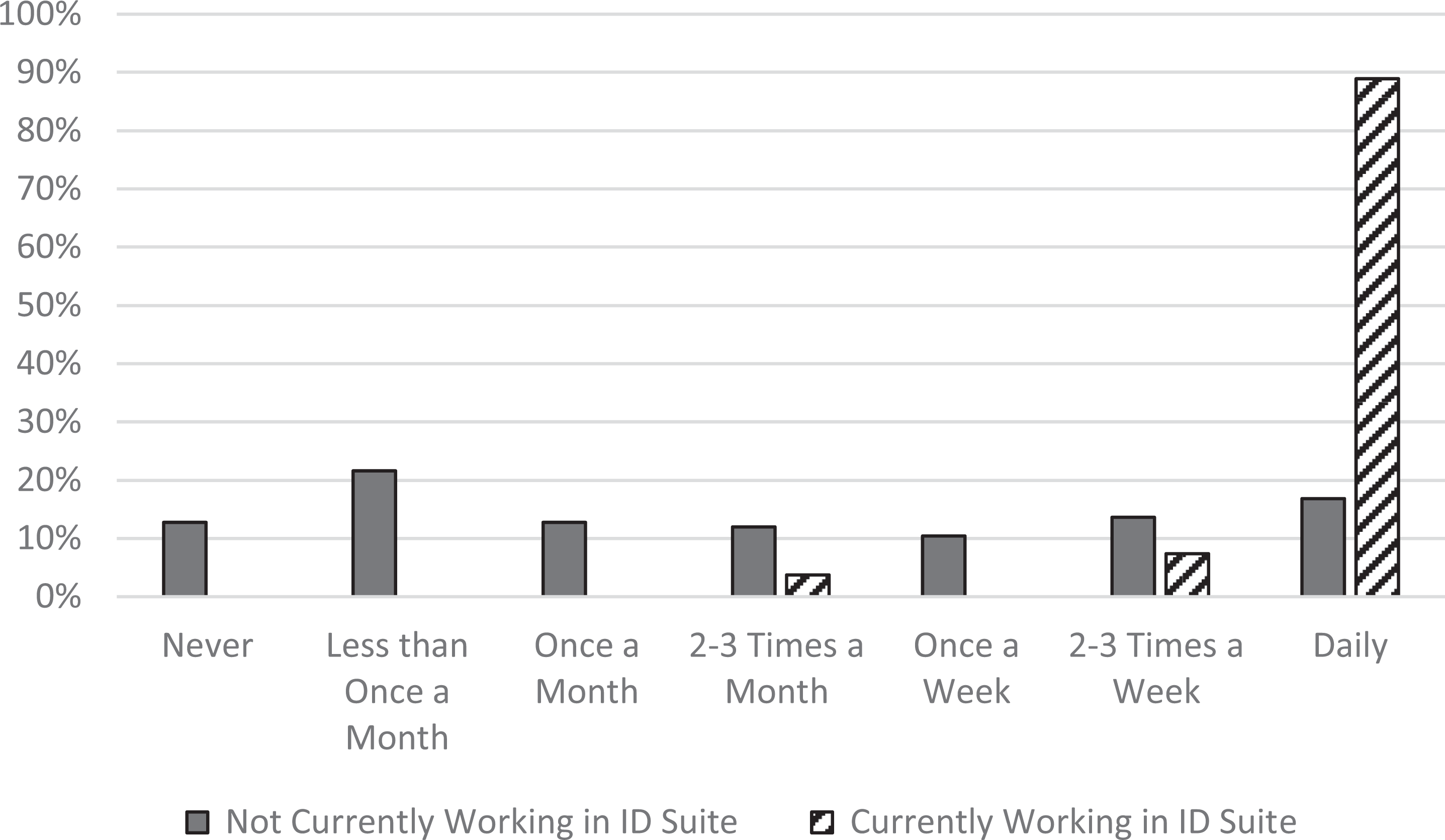
How often police work with identification (ID) evidence by whether they currently work in an ID suite.
Survey
The questions in the survey were largely constructed to encompass many of the generic problems that occur in translating research into practice in any domain (e.g. practitioners’ access to, and understanding of, research papers), and those problems more specific to eyewitness identification (such as knowledge of the recommendations made by relevant research societies). Potential questions, and areas for exploration, were discussed with representatives from five UK police forces/agencies, so that the resulting survey addressed the concerns of practitioners as well as researchers. A combination of question types were used: open-ended, text-response questions (e.g. ‘If you think changes are needed to the current procedures, please describe the changes below’) were employed in more exploratory areas, whereas multiple choice (e.g. ‘In your opinion, what should any changes to current identification procedures aim to do?’ – try to increase positive identifications; try to reduce the rate of misidentifications; try to increase positive identifications, but not if the rate of misidentifications also increases; try to reduce the rate of misidentification, but not if the rate of positive identifications also decreases) and Likert scale questions, were used for more focused areas with known, existing issues, such as when exploring the recommendations made by Horry et al. (2013) and Wells et al. (1998). Likert scale questions employed a five-point scale, with a neutral mid-point, two positive elements and two negative elements. The one exception to this was the question that asked, ‘In your view, how effective is the current relationship between researchers and the police?’, which employed a seven-point scale (very effective, effective, somewhat effective, neither effective nor ineffective, somewhat ineffective, ineffective, very ineffective) to allow for a finer gradation of response.
The survey was made up of five different sections to explore: (1) police opinions on current identification procedures; (2) their awareness of research in this area; (3) their opinions about different aspects of the research procedure; (4) their view on the relationship between researchers and police; and (5) their access to research findings.
After indicating their job role, their involvement with identification procedures and their length of time in service, participants were asked to give their opinion of current identification procedures. Using two multiple-choice questions, they were asked to indicate whether they believed current procedures could be improved, and this was followed up with an open-ended question asking participants to describe any specific changes that they would like to see implemented. To explore participants’ knowledge of the current effectiveness of eyewitness identification procedures, they were asked to indicate whether they knew: (1) the proportion of identification procedures where a witness positively identifies a suspect; and (2) the percentage of line-ups when the suspect is not, in fact, the perpetrator.
The next set of questions used multiple-choice responses to establish participants’ knowledge of eyewitness identification research and recommendations that research has made to inform policy and practice. Participants were then asked to indicate their knowledge and opinions about methodological procedures and the importance of different aspects of research in informing change.
Following this, participants completed multiple-choice questions reflecting their opinions of the researcher–practitioner relationship and were asked to specify any previous involvement they had in research.
The final set of questions explored how much access the participants currently have to eyewitness research findings, and whether improvements could be made regarding the modality of dissemination to increase potential uptake of evidence-based practice.
Procedure
The survey was built and distributed online using Qualtrics (www.qualtrics.com). The survey was advertised through the Centre for Policing Research and Learning, which is based on a formal partnership between The Open University and police forces and agencies from across the UK.
Results
Quantitative analysis
Police opinions on current identification procedures
One of the primary aims of this study was to gain insight into police perceptions of current identification procedures, and they were asked to indicate this using a five-point ordinal scale. Only 14.8% of participants thought current identification procedures ‘work very well’. However, 46.1% believed they ‘work well and don’t need much improvement’. A further 30.4% indicated that ‘some aspects work well, but changes are needed’, while the remaining 8.7% believed significant changes, or a complete overhaul to the system is necessary. Chi-square analysis revealed no significant difference in the pattern of responses for those who had experience of working in identification and those who did not (χ2(4)= 9.32, p >.05, V=.29), suggesting that regardless of occupational exposure to identification procedures, most police were satisfied with current processes.
Participants were also asked to indicate what the primary driving factor should be for any identification procedure changes: (1) increasing positive identifications; (2) reducing misidentifications; (3) increasing positive identifications, but not at the cost of increasing misidentifications; or (4) reducing misidentifications, but not at cost of reducing positive identifications. Most responses were split between option 1 (39.3%) and option 3 (43%), with very little consideration given to the reduction of misidentifications (the main aim of many research studies in the area) suggesting a potential mismatch between practitioner and researcher priorities. Again, there was no difference in the pattern of responses for those who worked in identification and those who did not (χ2(3)= 2.57, p =.46, V=.16).
One explanation of the different priorities held by researchers and practitioners could be a mismatch in the perception of the ratio of misidentifications to positive identifications. In other words, if practitioners do not believe that misidentifications occur that often, it is not surprising that they do not see this as a priority for potential changes to procedure. To gain some insight into this potential driver of prioritization, participants were asked to estimate the proportion of identification procedures in which the witness makes a positive identification (mean = 40.56, sd = 16.53). In addition, they were asked how often they believed the suspect included in line-up procedures is not actually the perpetrator (mean = 20.76, sd = 19.07). Interestingly, these mean proportion estimations were very similar to the research in this area, which suggests witnesses make a positive identification around 36–48% of the time (Behrman and Davey, 2001; Pike et al., 2002; Slater, 1994), despite the perpetrator not being present in around 20% of parades (Clark and Godfrey, 2009).
Independent t-tests showed that these estimates did not differ significantly between participants who had worked in identification suites and those who had not (positive ID: t(73.56)=1.66, p=.10, d=.33; perpetrator not present: t(105)=−1.24, p=.22, d=−.28); nor between those who believed changes should prioritize increasing positive identifications and those who prioritized misidentification reduction (positive ID: t(98)=.51, p=.61, d=.13; perpetrator not present: t(97)=.90, p=.37, d=.21). There was also no significant difference between participants who reported having (at least some) knowledge of the identification research literature and those who did not (positive ID: t(102)=1.42, p=.16, d=.29; perpetrator not present: t(64.26)= −1.75, p=.08, d=−.37).
Knowledge about eyewitness research and recommendations
Another aim of this study was to identify how much the police engaged with eyewitness research. Results showed that although 36.7% of the police who had experienced working in identification suites read research first-hand, the most common source of research information (for 53.3% of these participants) was gained through second-hand sources (primarily police publications or magazines, but also from colleagues). By contrast, for police who had no identification experience, only 12% had engaged with primary research sources and 36% with secondary sources, with the majority (52%) having no knowledge of eyewitness research (see Table 1 for a more comprehensive breakdown of frequency data). A chi-square test revealed the difference between those with and without identification experience to be significant with a medium to large effect size (χ2(4) = 19.01, p =.001, V = .43).
Knowledge of eyewitness research and recommendations.
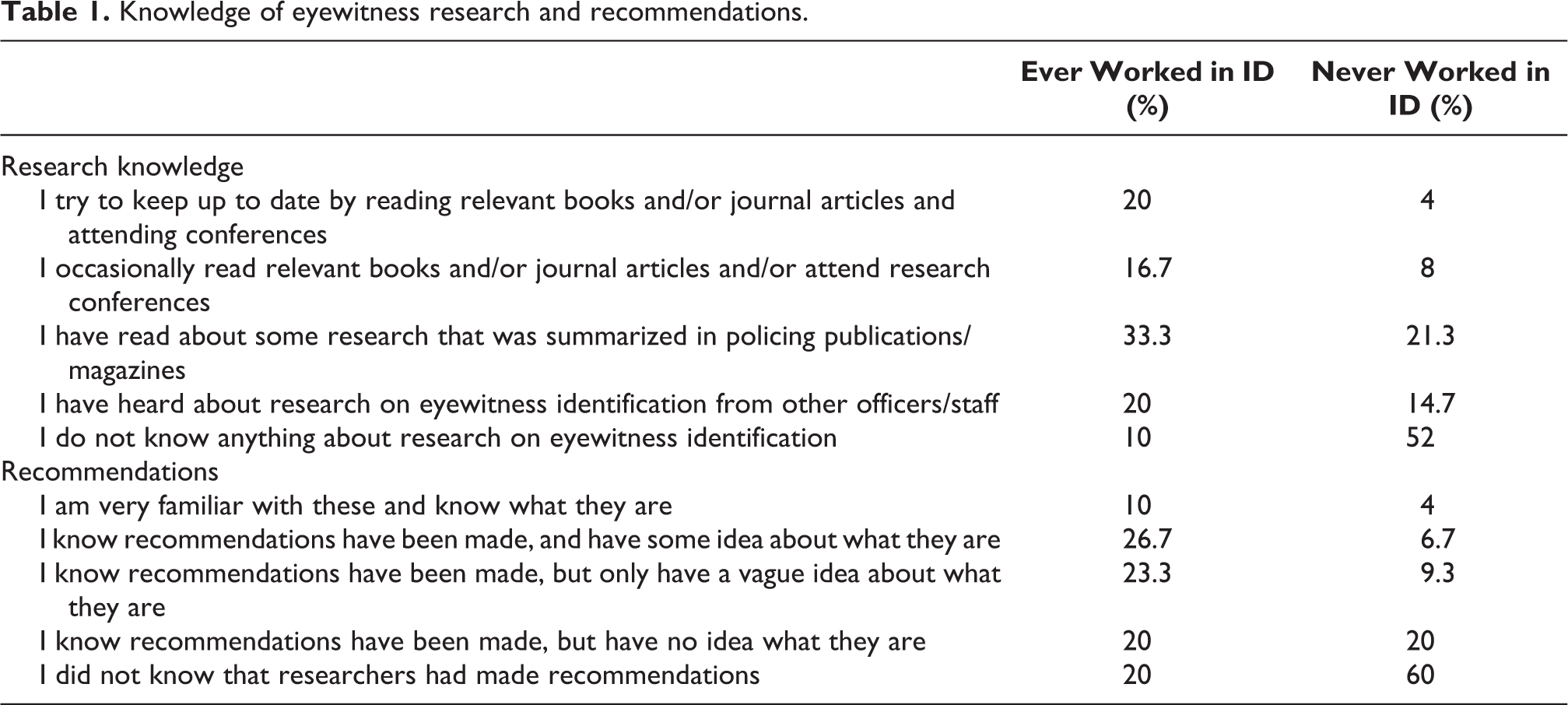
Participants were also asked to indicate on a five-point scale how familiar they were with recommendations researchers have made about eyewitness identification procedures. While familiarity with research recommendations was generally lacking, the majority of police (60%) who had worked in identification suites indicated that they had at least some knowledge. This contrasts with the 60% of participants without identification experience who indicated that they were unaware that researchers had even made recommendations. Again, a chi-square test revealed this difference to be significant with a medium to large effect size (χ2(4) = 18.48, p = .001, V = .42).
Follow-up questions explored participants’ familiarity with specific techniques suggested by researchers to improve the accuracy of eyewitness identification (double-blind testing, sequential presentation, confidence ratings, elimination line-ups and the mystery man technique). Participants indicated their familiarity with these techniques using an ordinal five-point scale, where a score of 1 indicated that they were very familiar with the recommendations that had been made, and 5 indicated that they had no knowledge of them. In almost all cases, participants claimed extremely poor knowledge of these recommendations, with the majority of participants with and without identification experience claiming no knowledge of the named techniques (mean response range in these instances: 4.13–4.81). The two exceptions were for ID-experienced participants, over 50% of whom had at least some knowledge of the sequential presentation technique (mean = 3.67, sd = 1.24) and elimination line-ups (mean = 3.97, sd = 1.24).
Appreciation of research factors and design
Participants were asked to indicate how important different aspects of research outcomes and design might be in terms of influencing their decision to implement any changes the research might suggest. Descriptive statistics showed that participants regarded appropriate control conditions as the most important factor (mean = 1.83, sd = 1.41), with 53% of participants rating this as ‘extremely important’. Factors such as a large number of participants used in the study, a replicated result, statistical significance and a large effect size were all most commonly deemed to be ‘important’ (according to modal responses; mean range: 2.08–2.83), whereas publication in a peer-reviewed journal was generally seen as ‘neither important nor unimportant’.
Participants were also asked how different methodological issues might influence their opinion of the research they were reading. Responses were given on a Likert-type scale from 1 (indicating the issue would have a very positive effect on their opinion) to 5 (indicating a very negative effect), with the mid-point indicating no effect at all. Participants indicated that their opinion of a study would be uninfluenced by whether it was conducted outside the UK, took place in a laboratory, was run by graduate students, had undergraduate participants or if the stimuli comprised videos of a staged crime (mean range: 2.82–3.38). However, the most common response (endorsed by 33% of participants) to situations in which participants took part in an identification procedure immediately after seeing a staged crime (and therefore not accurately reflecting real world procedures) was that this would have ‘a generally negative effect’ on their opinion of the study (although mean = 3.01, sd = 1.3). In addition, 47.7% participants felt that they would have a very negative opinion of studies that use instructions and procedures that do not comply with PACE guidelines (mean = 4.13, sd = 1.04).
By contrast, participants indicated that studies which involved the police in some way would generally have a positive impact on their opinion of how useful it might be in terms of informing practice. For example, using a research question that came from the police, or having police involved in the study design, or in conducting the study were all rated as generally positive factors (mean range: 1.86–2.06). Police involvement in the dissemination of research findings was seen as less impactful (mean = 2.35, sd = .92).
The relationship between researchers and the police
Participants were asked to indicate how effective they believed the current relationship between researcher and police was on a Likert-type scale ranging from 1 (very effective) to 7 (very ineffective). The majority of participants (48.2%) suggested that the current relationship was ‘neither effective nor ineffective’, which is also reflected in the descriptive statistics (mean = 4.20, sd = 1.08). Independent t-tests showed that this view was not affected by identification experience (t(81) = .37, p = .71, d = .15); and there was no difference between participants who had indicated they had knowledge of identification research, and those who did not (t(83) = .51, p = .61, d = .11).
Of the participants who took part in this study, 11.8% (n = 10) had previously been involved in research investigating identification issues. Of these participants, however, 70% indicated that the research had not led to any practical outcomes for the police, such as a change to procedure or guidelines. These participants were also asked to indicate the extent to which the research they took part in addressed issues they believed were relevant to policing practice on a scale of 1 (not relevant at all) to 10 (very relevant). On average, they seemed to think that the research was somewhat relevant (mean = 6.80, sd = 3.08), with only 30% of participants describing it as ‘very relevant’.
These participants were also asked to indicate how different aspects of the research they were involved in may have acted as barriers to implementing procedural changes. They rated five statements on a 10-point scale from 1 not problematic at all) to 10 (very problematic). Descriptive statistics can be seen in Table 2.
Factors affecting practical outcomes.
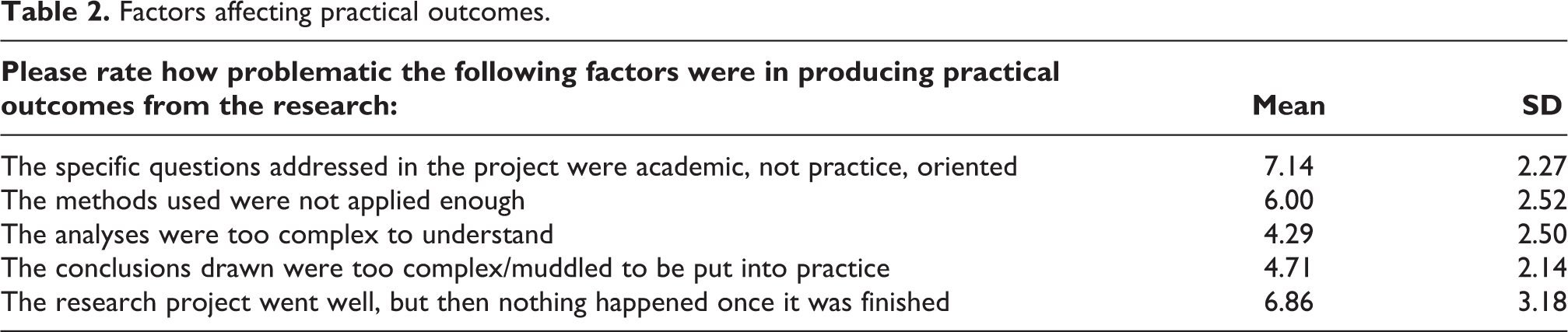
Although participants did not think that complex analyses or conclusions were barriers to implementation of procedural change, they believed that research that lacks obvious application (and is too academic) may be problematic. The majority of participants also commented that, while the research went well, they often saw no obvious outcomes.
Access to research
Participants were asked to indicate their current access to research findings. The majority of participants said that they either had no access to research findings (37.8%) or that their access was poor (30.5%). These rates were similar for police both with and without identification suite experience.
To establish what methods the police would find most helpful in terms of increasing access to research findings, participants were asked about how useful they would find different modalities of dissemination on a scale of 1 to 5 (with scores below 3 indicating poor usefulness and scores above indicating the opposite). On average, participants suggested subscriptions to paper-based journals (mean = 2.65, sd = 1.24), social media/blogs (mean = 2.69, sd = 1.13) and online discussion forms (mean = 2.79, sd = 1.06) were least useful in terms of accessing research findings. Online access to journal articles was most commonly seen as ‘somewhat useful’ (mean = 3.22, sd = 1,21). However, the most appealing modality for dissemination was online access to summaries of research written in plain English (mean = 3.92, sd = 1.11), with the majority of participants rating this as either ‘useful’ (37.2%) or ‘extremely useful’ (35.9%).
Qualitative analysis
In addition to asking closed questions for quantitative analysis, participants were given an open-ended question asking what changes (if any) they would like to see made to the current system (in terms of identification procedures). Of the 153 participants who took part in the study, 57 provided answers to this question. In total, these answers comprised 61 distinct comments that were coded using content analysis. Percentages outlined below are calculated using total number of comments as the denominator. Although four participants provided more than one comment for analysis, in each case these comments were related to different themes (i.e. no participant contributed more than one comment per theme).
A content analytic approach was chosen because it allows for both quantitative and qualitative analysis of data, allowing quantification of frequently occurring responses in the data, as well as the identification of descriptive themes to further qualify emerging trends (Vaismoradi et al., 2016). Responses to the qualitative survey question acted as the raw data, and unit of analysis. Each response was coded according to the manifest content on the responses, through the identification of descriptive terms relating to the survey question. We adopted a two-pronged approach to coding, using both inductive and deductive codes (Crowe et al., 2015). Responses were read several times (as part of data familiarization) and, where appropriate, a priori codes (derived from expectations of issues that might arise, based on the research team’s knowledge of current procedures and conversations with the police) were applied. In parallel, additional inductive codes were elicited from the data on each reading and were applied iteratively. The final codes were then explored to identify patterns (or thematic categories) that emerged across the data. Unlike in thematic analysis, this process did not involve deeper interpretation, but rather a description of the responses made by the participants (as in Crowe et al., 2015). All responses were independently coded by VH and GP. Cohen’s kappa was calculated to assess the reliability of these codes and revealed ‘almost perfect agreement’ between the ratings (κ = .90; Landis and Koch, 1977).
Four key themes were identified from the data and are detailed below.
Speed and ease
By far the most salient theme that emerged from the data (amassing 23 individual comments; 37.7%) was the notion that current identification procedures need to be made faster and easier to complete, reducing the time between the crime and the line-up. For example: I think the process time between offence and ID procedure is too long. When the offence happens the victim should be able to view witness albums straight away whilst the offence is fresh in their mind. (ID120) Extended hours of working so that the unit is available 24/7. Simplify the process in custody re Insp involvement. (ID37) We need to be able to take a video clip for ID purposes more easily while the person is in custody rather than having to bail so speeding up the process. (ID84) They need to be delivered in a more-timely fashion. At present i feel the administration of the process is overly bureaucratic. (ID27)
Identification currently too hard/in suspect’s favour
Another salient theme (comprising eight comments; 13.1%), suggested that current procedures protect the suspects/perpetrators too much, making their identification too difficult. Foils being too similar to the suspect and the elimination of distinctive facial features were highlighted as particularly problematic. For example: Still image ID is too difficult for a witness/victim. Solicitors are allowed to choose people who look almost identical. The way we word the viewing…and when a witness says ‘I think it is number…’ It give[s] the defence too much ammo. (ID5) The ‘line up’ is usually chosen by the solicitor and made up of people who look extremely similar to the suspect. The ‘covering up’ of distinctive marks/scars is frankly crazy. (ID9)
Database improvements
A further theme (also comprising eight comments; 13.1%) focused on limitations of the databases used to construct line-ups, and improvements that could be made. Several comments insinuated that relying only on facial images was problematic, and that including full bodies or vocal cues could improve the current procedures. Others suggested that the faces in the databases were not diverse or up to date enough. At current, our identification procedure is based upon a suspect’s facial features. I feel that clothing is a key element in identification and could be utilized in this procedure. (ID78) Witnesses often request to see height and build in order to make a positive identification. (ID67) More diverse foils [needed] on database. (ID92) The availability of suitable images on the database is limited and does not reflect the current population not modern hair styles and clothing. (ID61)
Changes needed to PACE (or other) regulations
Finally, five comments (8.2%) were made that referred to specific PACE guidelines, suggesting that they may be unnecessary or hindering identification outcomes; or that they may need further clarification in order to improve procedures. Clarity of PACE as interpretation can vary between forces or individuals. (ID35) Para 11 of Annexe A to the Codes of Practice needs to be rewritten removing the word ‘positive’ from it. This tends to confuse witnesses and make them reluctant to make an identification. (ID23) Occasionally witnesses reveal after the procedure that they believed they recognized the offender but were reluctant to make an identification in case they were wrong. (ID86) Not sure why we need to find persons not involved in the case, just to escort witnesses. This is an insult to an officer’s integrity. (ID80)
Discussion
The aim of this study was to investigate reasons for, and potential solutions to, translational barriers to research recommendations from eyewitness research. Results largely confirmed that police practitioners have little knowledge of recommendations that have been suggested by researchers, although those with identification experience did appear to be more informed than those without. This in itself presents a fundamental barrier to the translation of findings into practice. One reason for this lack of knowledge may be the poor access to research that participants reported. Making research findings more visible through more accessible avenues (e.g. through lay research summaries online, which was highlighted as a preferred route of dissemination) may assist with overcoming this issue.
Despite a lack of knowledge about research recommendations in this area, participants were by no means ignorant of the research process in general, with many indicating an appreciation of the importance of different aspects of the research design process, despite the often-necessary artificiality. However, the main exceptions to this may prove to be further barriers to translation with police reporting a very negative view of studies that implement identification procedures unrealistically close (temporally) to viewing a staged crime (perhaps the most common design in the literature), and those that do not comply with policing instructions and regulations. Thus, future research should aim for increased realism and better reflection of identification procedures to promote translation of findings.
Overall, the study found that police practitioners are satisfied with the current state of identification procedures, meaning that eyewitness identification research could be seen as relatively low priority. As this was the case for both those working in identification suites and other staff, this suggests that greater exposure to identification procedures does not lead to an increased awareness of potential procedural problems. Again, this may serve as a barrier to translation of research; while researchers are convinced that changes are needed, practitioners are not.
Further evidence of a mismatch between researcher and practitioner priorities was also evident from the finding that practitioners were not overly concerned with reducing misidentifications, instead focusing more on increasing positive identification rates. By contrast, the primary focus of much eyewitness research has been on reducing misidentifications because of the significant role they play in miscarriages of justice. This disparity could be critical to understanding not only why there might be poor police engagement with the findings of eyewitness research, but also in assisting the translation of research into practice in the future. The issue is that if police practitioners believe that any changes to existing procedure should aim to increase the number of positive identifications, then they are unlikely to pay attention to research aimed at reducing misidentifications, and certainly not if this research would likely result in a reduction in positive identifications.
This difference in the aims of researchers and practitioners has been described before, for example, in the paper describing the recommendations of the AP/LS, Wells et al. (1998: 29) stated, ‘We have taken great care to recommend procedures that do not serve to reduce the chances that the guilty party will be identified’. Moreover, research has since re-examined the AP/LS recommendations, including suggestions that they are likely to negatively impact positive identification (Clark, 2012), demonstrating the awareness of researchers to this issue. Nonetheless, there is an appreciable and important difference between research aimed at reducing misidentifications while minimizing the impact on positive identifications, and research that has the primary goal of increasing positive identifications. Our results show that this is what practitioners are looking for and is undoubtedly an issue that continues to disrupt translation.
Interestingly, it seems unlikely that this mismatch in priorities between researchers and practitioners is related to a differential understanding of the ratio of misidentifications to positive identifications. Indeed, estimates made by police in this study were very similar to those identified in the literature (Behrman and Davey, 2001; Clark and Godfrey, 2009; Pike et al., 2002; Slater, 1994). However, whereas researchers interpret this as a need to reduce the rate of misidentifications, practitioners see a need to increase positive identifications. Understanding this difference, and the reasons underlying it, is likely to be an important step in improving the relationship between research and practice.
We suggest that it is incumbent on researchers to understand the context and cultures that result in the police wanting more positive identifications, as research that is not contextualized in this fashion is likely to fall on deaf ears. Pike et al. (2014) conducted focus groups with police staff to explore the broader policing context of line-up procedures and found that staff reported being driven by quantitative performance measures aimed at achieving successful arrests and prosecutions (in this instance, the number of positive identifications). In this context, misidentifications were often seen as errors that would be dealt with by checks and balances in other parts of the criminal justice system, particularly the courts. Although performance cultures play an important role here, and researchers need to bear in mind the pressures that police are under to meet performance targets, the adversarial justice systems used in the UK (and United States) also have a part to play, by casting the police and prosecutorial teams in the role of investigators finding evidence of guilt, whereas it is up to the defence to prove innocence (Sanders et al., 2010). In this light, it is hardly surprising that the police are concerned with increasing positive identifications and far less concerned with misidentifications.
This view is also supported by our qualitative findings in which practitioners expressed concern that line-up procedures are too hard and thus unlikely to result in a positive identification, restricting their ability to find evidence of guilt. This is incompatible with the view expressed by many researchers that line-ups should be similar to an experiment, where the memory of the witness is tested objectively. Reconciling the differences in the approaches of researchers and policing practitioners is essential if more research is to be reflected in practice.
Given the above, to maximize the practical utility of research conducted in this area it may be beneficial for researchers to work with the police at each stage of the research process to understand better the context in which they are working, their related priorities for investigation and change, and to ultimately facilitate better alignment between practitioner and researcher objectives, while maintaining research integrity. The potential positive impact of a more balanced collaboration was also highlighted by our findings. For example, participants indicated that they would view research conducted in conjunction with the police favourably, thus a functional and balanced relationship between researchers and the police is likely to represent a crucial step in terms of promoting evidence-led practice.
As a first step, our qualitative findings identified some of the priorities police practitioners have in terms of targets for both research and change. For example, increasing the timeliness and efficiency of identification procedures was identified as a key area of interest. Interestingly, as speeding up the identification procedure would generally also improve the accuracy of eyewitness identification, it would act to both increase the number of positive identifications and decrease the number of misidentifications, meeting both researcher and practitioner priorities. Although, to some extent, delays result because of the need to investigate the crime to the point that a legitimate suspect can be identified, the police in this study were able to identify other possible improvements to the rapidity of the process, which may help to guide future research. In particular, while research in this domain has been primarily psychological in nature, it could be that shifting the focus of research to tackle more procedural and economic inefficiencies might result in important psychological benefits, addressing the fundamental issue that memories tend to deteriorate over time (Pike and Clark, 2018).
Additional priorities identified by the police included exploring possible improvements to line-up databases and procedures and investigating specific guidelines that may be inappropriate or ineffective. Again, the view of national guidelines and procedures as being problematic could constitute evidence that practitioners see the system as being biased against them. However, many of the comments made in relation to these themes were not reflective of system-bias. Indeed, some of the issues identified, such as the suggestion that the instructions included in the PACE codes of practice may be difficult for witnesses to understand and remember, have also been reported in the literature (Rose et al., 2003, 2005).
On a broader note, some of the comments made by police in this study point to an additional consideration that may act as a barrier to translation. Research outcomes that suggest tighter controls may be met with resistance due to possible implicit implications about police integrity. For example, it is possible that policing practitioners have been reluctant to engage with recommendations regarding double-blind line-ups, because they see the suggestion that they may provide the witness with even unconscious and non-verbal cues as an affront to their professionalism. This may lead practitioners to challenge the basis of, and need for, the research conducted. Building more positive links with the police, including them in the research, and finding more sympathetic ways to discuss these issues is therefore likely to be a useful step forward.
Conclusions
The results reported here describe front-line policing practitioners that are largely unaware of eyewitness identification research, and the resulting recommendations. The results also suggest several possible issues that have acted as barriers to the translation of research into practice in this area. In addition to an obvious problem in communicating the results of research, it seems clear that there is a fundamental discrepancy in the goals of researchers and practitioners, with the former concentrating on reducing misidentifications and the latter wishing to increase the number of positive identifications. Other problems include that practitioners do not generally view existing procedures as requiring significant changes.
Despite some successes, the majority of recommendations arising from eyewitness research have yet to be implemented. To help improve this situation, researchers may need to take more account of the systems and pressures that govern policing practice and work with practitioners throughout the research process. Moreover, there seems a need to further educate and adapt policing culture, and future research could usefully explore possibilities for understanding, and enhancing, practitioner culture, including to support collaborations with researchers and make greater use of the results of relevant research.
Footnotes
Declaration of conflicting interests
The author(s) declared no potential conflicts of interest with respect to the research, authorship, and/or publication of this article.
Funding
This research was supported by a grant from the College of Policing, titled ‘Collaborative advantage: Innovation and evidence use between policing organizations and higher education’.
