




Abstract
In this article, we contribute to the knowledge on police detectives’ work practices, and report how police detectives make sense of casework in a social manner. As our research question, we address the ways in which detective work can be understood as a social process. To target this question, we conducted an ethnographic study that examines how detectives who work with domestic violence and high-volume crimes strive to frame and understand events in everyday investigative practice. The data consist of approximately 200 hours of ethnographic data and interviews from two departments in a Swedish police station. The results indicate that detectives’ sensemaking of casework took place through two principal practices: a concluding practice and a supporting practice. Furthermore, the findings show that detectives’ work is highly social and procedural. This suggests that detectives’ work practice is of a social nature and that contacts between investigators are important to take into account in the organization of an investigative department.
This article is an ethnographic study of Swedish crime investigation in two areas: high-volume and domestic crime. We show how detective work is embedded in sensemaking activities that involve multiple actors and a web of interactions, and we advance the knowledge of detective work and crime investigation work practice by showing how detectives collectively make sense of their investigative work. Using this approach, our study follows research by Innes and Brookman (2013), Salet (2017) and Westmarland (2013), who described how the lived realities and day-to-day work of police detectives can be characterized as complex social systems in which the investigative process entails a variety of roles and responsibilities among investigators and specialists within the police. These researchers examined how decisions and interpretative work regarding investigations emanate from negotiations within units and teams, and also between investigators and actors outside the police authority, thus making investigations an inherently social accomplishment (Brookman et al., 2018; Salet, 2017). Although this body of research has shown convincingly how the social context informs detectives’ sensemaking and decision-making in high-profile major investigations, an existing open question is how a social system of actors is mobilized for detectives’ sensemaking of casework in less high-profile, common investigations, such as those involving volume crime and domestic crime.
These types of investigations represent a significant proportion of reported crimes in Sweden (Swedish National Council for Crime Prevention, 2018) and globally (United Nations Office on Drugs and Crime, 2010; World Health Organization, 2017). However, in the literature on crime investigation, these types of investigations have received less attention than high-profile crimes (e.g. homicides; Brodeur, 2010). Brodeur (2010) even suggested that the research ‘centrality of homicides’ skews the image of the nature of investigative police work. Arguably, some important differences can be identified in the fact that domestic crime and volume crime generally have lower status in comparison with the investigation of serious crimes. Consequently, these investigations are conducted with fewer resources, and detectives handle a substantial workload and mixture of cases on a day-to-day basis (Tilley et al., 2007). Furthermore, investigations of domestic crime and child abuse are often described as mentally taxing, and the clearance rate is low in comparison with other types of crimes. Thus, reflections about this work are of the utmost importance.
Furthermore, focusing on detectives’ social activities complements the current actor-centric and cognitively oriented research discourse of detective work (see Brodeur, 2010; Innes, 2003). Thinking styles and investigator traits are important; nonetheless, they are only part of a social context in which multiple actors are involved at different stages. The compelling image of a mystery or puzzle to be solved – one that is cracked by sharp detective brains – might still overshadow our understanding of the actual nature of detective work. As Innes (2003) argued, the work is less about ‘whodunnit’ and more about assembling and compiling information. Tong and Bowling (2010: 323) stated ‘the apparent mystery surrounding what detectives actually do and how they do it, reinforced by fictional representations of detectives guided by “instinct”, leaves a distinct lack of transparency’.
In this article, we explore this lack of transparency. Specifically, drawing upon sensemaking theory (Weick, 1995), the research question we aim to examine is: In what ways can detectives’ investigative work be understood as a social process? The sensemaking lens assumes a socially embedded practice that is triggered by cues and interpreted into plausible accounts that detectives enact accordingly. The sensemaking lens is important for an understanding of how detectives create meaning, as it takes into account the social and contextually embedded aspects of work. The purpose of this article is therefore to analyse how detectives make sense in their work when interacting with others. To do this, we turn to an ethnography of two departments in a Swedish police station.
The social nature of detective work
Investigations are at the heart of police work. Research on criminal investigations, particularly homicide investigations, is extensive (Newburn et al., 2007), but research is still needed in this domain (Innes and Brookman, 2013). One stream, dating back to the RAND study (Greenwood et al., 1977; Horvath et al., 2001), examined how investigators allocate time on casework activities such as documentation, victim interviewing and reviewing of reports, often with the aim of identifying determinants of productivity in the investigative process (Liederbach et al., 2011). Similarly, in a seminal study of detective work, Ericson (1993) showed how investigations are routinized and adhere to bureaucratic rules, constructing casework into a matter of information processing that makes the activities themselves less visible. With a similar aim to explore the preconditions and structures of crime investigation, Brookman et al. (2018) studied murder investigators’ views on the determinants for solving a case in Great Britain and the United States. The researchers identified several organizational success factors, such as an experienced workforce, access to resources and, specifically, sufficiently staffed teams.
Other, mainly psychologically oriented research has employed actor-centric perspectives to understand the capacities and skills of detectives as well as detectives’ decision-making (Fahsing, 2016; Fahsing and Gottschalk, 2008; O’Neill, 2011). Naturally, in this research, we paid attention to how detectives’ reasoning and cognitive biases can impact the investigative process. Experimental research findings, for instance, show that emotional stress impacts investigative judgements (Ask and Granhag, 2007) and that mutual influence between detectives may lead to phenomena such as goal contagion (Ask et al., 2011) or groupthink (for a discussion, see Fahsing and Ask, 2016).
Although these perspectives focused on the organizational landscape surrounding investigations as well as the challenges investigators face in their professional decision-making, there have also been calls to examine criminal investigation from the perspective of detectives’ social worlds (Innes, 2003), viewing police work as a social accomplishment with frequent intra- and interorganizational collaborations (see Manning, 1977; Schaveling et al., 2017; Tong and Bowling, 2006). Salet’s (2017) study of framing in temporary investigation teams employs such a perspective because the author showed how sensemaking and the establishment of consensus regarding various cases are largely related to interactions and social relations within the team. Similarly, Innes and Brookman (2013: 288) described investigative work as dependent on a ‘complex web of negotiations that take place within the team, but also between team members and those from the outside’. Naturally, input and information from others are important facets of criminal investigation as detectives rely on interviews and interrogations to proceed successfully with investigative work (Walsh et al., 2017). The capacity to take action and investigators’ social skills are thus important in gaining key information (Fahsing and Gottschalk, 2008). Put differently, detectives’ work is complex; detectives piece together information from and with multiple actors to arrive at an account of an incident (Innes, 2003).
Sensemaking
Sensemaking is ‘a process, prompted by violated expectations, that involves attending to and bracketing cues in the environment, creating intersubjective meaning through cycles of interpretation and action, and thereby enacting a more ordered environment from which further cues can be drawn’ (Maitlis and Christianson, 2014: 67). Sensemaking is thus a social process in which individuals interpret novel, unexpected or confusing events and construct plausible accounts (Maitlis, 2005; Weick, 1995). In this context, such plausible accounts start with, for example, detectives encountering a puzzling situation from which they construct intersubjective accounts (Brown and Humphreys, 2003). Consequently, there are multiple interpretations, and it is the detectives’ job to construct the most plausible account of the events in a case.
Three theoretical concepts are central to the sensemaking literature: triggers, frames and enactment. Triggers initiate sensemaking and emerge when incidents in an ongoing flow of events violate expectations. Thus, triggers ‘call for sensemaking’ (Maitlis and Christianson, 2014). During the ongoing flow of events, frames are consistently used for comparisons and bringing order to confusing situations (Cornelissen and Werner, 2014; Weick, 1995). Framing has accordingly been theorized to include the process by which events are put into context and related to experience and future expectations (Bruner, 1990; Goffman, 1974). When frames are unable to bring order to a situation, a detective acts to develop a plausible explanation (Salet, 2017). Enactment is the process by which individuals strive to make sense, triggering further sensemaking cycles. Sandberg and Tsoukas (2015: 9) described enactment as follows: By undertaking action, which is necessarily grounded on hitherto taken-for-granted beliefs, individuals enact their reality, which they then retrospectively seek to make sense of and, on the basis of the provisional sense made, individuals act again, retrospectively making sense of their new action, and so on.
Research on the cognitive aspects of sensemaking has hitherto dominated the literature. Although such research has made important contributions to the literature on sensemaking, later work has emphasized the social aspect of the doings and sayings (Maitlis and Christianson, 2014; Sandberg and Tsoukas, 2015). In addition, studies on sensemaking in the police have generally focused on the spectacular rather than the mundane (Colville et al., 2013; Cornelissen et al., 2014; Schakel et al., 2016). Additional research on the mundane would provide a more complex understanding of what detectives do on a day-to-day basis. Other less sensational strands of sensemaking research within the police have focused on how police officers cope with, adjust to and understand organizational change (Lindberg et al., 2017; Chan, 2007) or how police newcomers construct accounts of future work practice through storytelling (Rantatalo et al., 2018). This would be closer to describing detectives as situated within a process of enquiry to negotiate and assemble accounts of an incident (Innes, 2003).
Methods
Here, we are interested in the work performed and the sense made by detectives. As part of one coherent project focused on police sensemaking under rural conditions, data were collected by three researchers at two departments in a police station in Sweden: minor-volume crimes and domestic crimes. The domestic crime department (literal translation: crime in close relationships) is responsible for crimes in families, including but not restricted to children, abuse and child pornography. The volume crime department deals with a mixture of crimes such as petty theft and minor assault (O’Neill, 2011). Prior research has informed us about the working practices of police in the northern region of Sweden (Rantatalo et al., 2020). We therefore deliberately chose these departments because there was a practical need for research in this area and there has been little research on the work of these detectives (cf. Brodeur, 2010), even though minor and domestic crimes are the types most citizens encounter. As shown by Liederbach et al. (2011), detective work varies significantly across different types of investigative units, but we found mostly structural differences between the nature of work in these departments. For example, the domestic crime unit is used to working in teams, and the minor-crime unit is not. This would suggest that the former is more social than the latter, but we found no such differences. We concluded that examining (at least) two different departments was necessary to understand more general aspects of detective work. Therefore, we do not make a classic compare-and-contrast analysis of the departments’ structures, but rather focus on the activities they have in common. The minor-crime department employs approximately 25 investigators, and their work is led by four managers who also function as principal detectives. The domestic crime department employs approximately 12 detectives led by a single manager. According to the anthropologist Clifford Geertz (1973: 5), ‘if you want to understand what [police work] is, you should look in its first instance not at its theories or its findings, and certainly not at what its apologists say about it: you should look at what the practitioners of it do’. Accordingly, to reveal what detectives do, ethnography is the logical choice, because ethnography seeks a deeper immersion in others’ worlds to describe what they experience as meaningful and important. With immersion, the field researcher has access to data on how people live their lives, how they carry out their daily rounds of activities, what they find meaningful and how they do so (Emerson et al., 2011). Others who have examined police work have also found the details provided by ethnography useful – for instance, uniformed police officers (Gordon et al., 2009; Punch, 1979; Van Maanen, 1973) and homicide detectives (Brookman, 2016; Jackall, 2005).
Data collection
Our ethnographic approach entailed a general strategy of following one detective per day, as well as observing and making detailed notes about their workflow and contacts. We chose who to observe depending on who volunteered to have a researcher following them for the day (usually decided at the daily morning briefing) – but also depending on the work tasks assigned to the detectives. We reasoned that someone who had individual paperwork in the office all day was less likely to give us information on the sociality of detectives’ sensemaking than a pair of detectives conducting interviews and preparing a case. Consequently, we tried to strike a balance between being intrusive and being able to observe a wide variety of detective activities. Therefore, some detectives were followed on several occasions, whereas others who did not volunteer were not followed. We followed nine different detectives in the volume crime department and five in the domestic crime department.
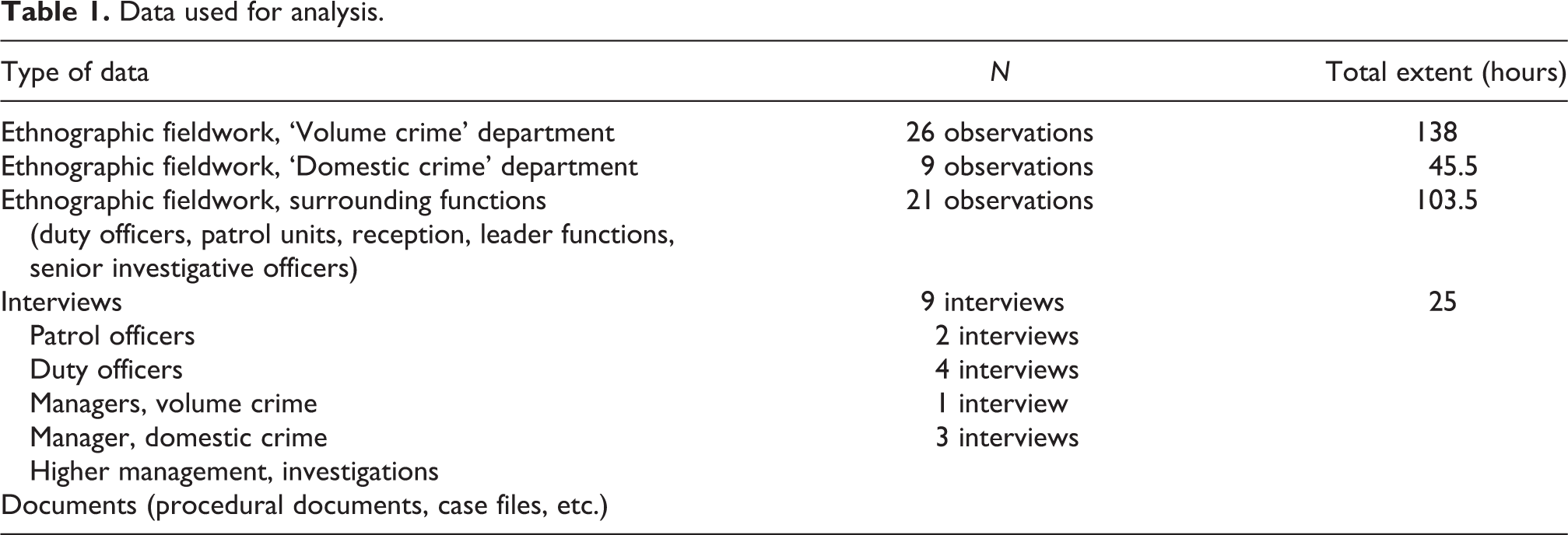
To deepen our understanding of the functions surrounding the departments, we also observed patrol officers and those undertaking administrative functions. In total, we conducted 287 hours of observations between September 2014 and April 2017. Most observations on detectives were undertaken between April 2016 and April 2017. These observations were very important for our focus on what detectives actually do and say (c.f. Geertz, 1973). Following the best practice of ethnographic research, we transcribed the notes no later than 24 hours after observation (Spradley, 1980). In addition, we conducted ethnographic interviews (Spradley, 1979/2016) whenever we had the opportunity – contextual inquiry on what the detectives were doing and why. These interviews provided our observations with additional details about work processes, possible interfaces and current events. Other data sources included documentation and interviews with individuals representing functions that were involved with the detectives. The interviews followed an interview protocol with pre-set questions that was developed together with a police officer working as a research assistant in the project to gain specific information about the work procedure and situations in which interactions are likely to happen. The protocol included questions about detectives’ experience, their organization, working practices, colleagues and how to approach case work. In total, we undertook 19 interviews with a total length of 25 hours (average 80 min per interview). The documentation includes procedural descriptions of detective work and collaboration between units (see Table 1 for an overview).
Data used for analysis.
Analysis
Our analysis followed an abductive approach (Langley, 1999). To guide and structure our analysis, we used the qualitative analysis software NVivo 10. First, we carefully read all field notes and interviews, from which we developed a rough process chart of how a crime investigation is generally conducted. This allowed us to identify functions (e.g. of patrol officers) with which the detectives interacted (see Langley, 1999). Second, we mobilized the sensemaking literature as a basis for further analysis. In this step of the analysis, we specifically drew on the key concepts of: triggers – the violation of expectation that prompts sensemaking (Maitlis and Christianson, 2014); framing – referring to previous experiences and future expectations (Weick, 1995); and enactment – actions taken to deepen understanding or resolve the situation (Sandberg and Tsoukas, 2015). Table 2 shows the concepts we borrowed from the literature and how we translated them into analytical units for the purpose of this article.
Theoretical concepts.
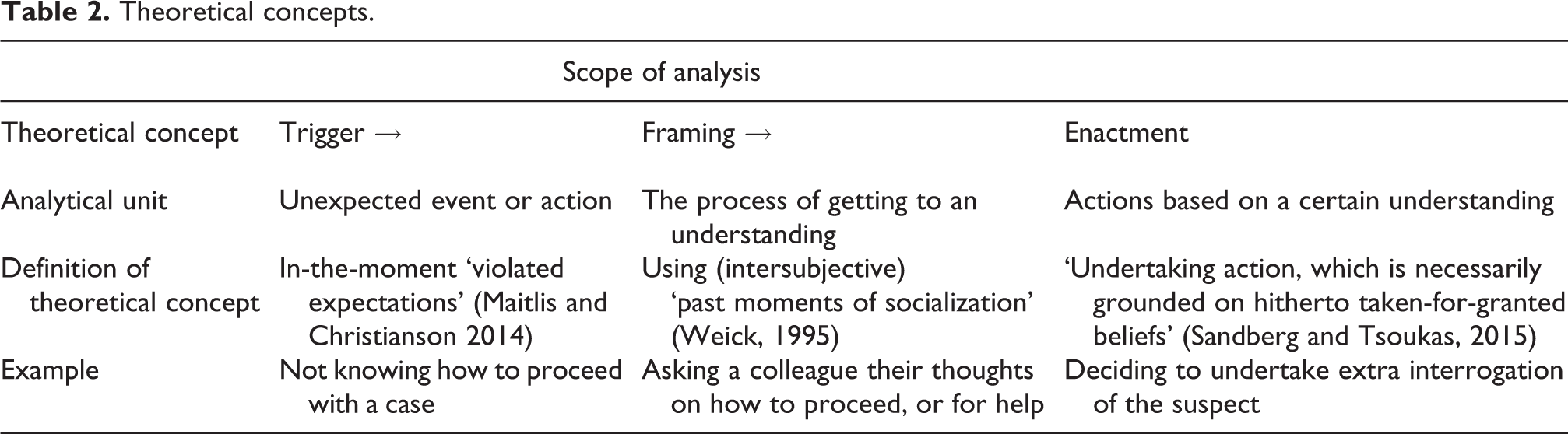
Using these concepts as a basis, we coded the empirical material, looking for passages that exemplified practical investigative work and social interactions according to a structure of cues, frames and enactments. Following recommendations by Gioia et al. (2012), we constructed a data structure to organize codes into emerging categories and later into more theoretical dimensions that we used to explain the phenomena under study. Note that the first-level concepts are examples of observations, with increasing theoretical aggregation until third-level coding. The purpose of this analysis step was to discern types of cues, frames and enactments. Figure 1 shows our data structure and how the analysis progressed from data to theorizing.
The last step of our analysis focused on how major themes and concepts identified in previous analysis steps were dynamically interrelated. In other words, this analysis was aimed at constructing an empirically grounded process model of sensemaking out of the more static data structure. Figure 2 shows a model focused on how detectives’ social sensemaking processes are structured into various types of cues and frames.
In terms of the coding procedure, all authors were involved in constructing the theoretically informed coding structure (see Table 2), coding the transcripts into a data structure (see Figure 1), and compiling the process model (see Figure 2). When we encountered ambiguities in the material, we discussed potential interpretations until we reached an agreement.
Findings
In the following, we first provide a background to the work in the two observed departments. Next, we describe the triggers for the detectives’ sensemaking and the social aspects of such triggers, followed by the detectives’ framing processes. Finally, we answer what detectives do when they make sense in their investigative work.
In Sweden, basic training for police personnel takes 2.5 years, including approximately 6 months of field training and baseline investigation training. After training, newly appointed police officers in some districts serve a few months as volume crime detectives before taking on patrol duties as part of their organizational onboarding. In the volume crime unit under study, approximately 10% of detectives had less than 2 years in the job, whereas all detectives in the domestic crime unit had at least 2 years of service experience. Generally, the investigation of domestic crime requires more specialization (e.g. interviewing children) and continuous professional development in comparison with the investigation of volume crime.
With these characteristics, we focused mainly on experienced staff working permanently as detectives but with varying degrees of specialization in their training. The detectives we observed during our fieldwork usually sat alone in a 4×4 m office. In some cases, two detectives shared an office. Naturally, detectives who shared an office had easier access to the other officer’s input, but we observed ongoing and continuous interaction between detectives regardless of their seating arrangements. More often than not, offices were empty for long periods as the detectives travelled to wherever their cases took them for the day.
Our observations and interviews show that the departments usually meet every day at 8:30 a.m. In the minor crime department, they meet to divide cases among themselves and to check up on each other. Detectives in the domestic violence department do not always have cases to divide, but they still meet to discuss the current situation and update each other on their cases, which are divided among themselves depending on workload, level of experience and availability. In the course of their work, detectives have to make sense of the cases that arrive on their desks. A case may arrive in many different ways. For example, a case might arrive through written reports from patrol officers who use a software system to report activities, findings and measures. In minor crime, initial activities are crucial if an investigation is to be successful and avoid being cancelled due to a generic lack of evidence. Activities include, but are not limited to listening to suspects and witnesses, securing evidence at the scene, and giving detectives a view of how they understood a situation. The importance of these activities is underlined by the fact that the organization encourages patrol officers to take care of first-hand investigative measures before cases even arrive at the investigation department. The police also make sure that new patrol officers work as detectives for 6 months so that they learn investigative thinking before going out onto the streets. A case reaches a detective’s desk through the following ways: via the front desk, where the public and other authorities (e.g. social care services) file reports in person or by phone; by a current case branching out to become another case; by reclassification of the nature of a case; or from the public prosecution authority.
Once detectives receive a case, they have some discretion on how to proceed. More often than not, a case is lowered in priority and added to a pile of open cases. This practice adds to a growing frustration among detectives and the public alike. It became clear early on that a detective performs an investigation through a multitude of social interactions – for example, with colleagues in the department, other functions within the police force, prosecutors, officials outside the police (e.g. social services or municipality housing), and witnesses and suspected perpetrators. These social interactions are the focus for the next step of the analysis – that is, the one that targets what triggers detectives’ social practice and how these triggers frame sensemaking of a case. Following the recommendations of Gioia et al. (2012), Figure 1 summarizes the triggers and frames that we identified in a data structure.
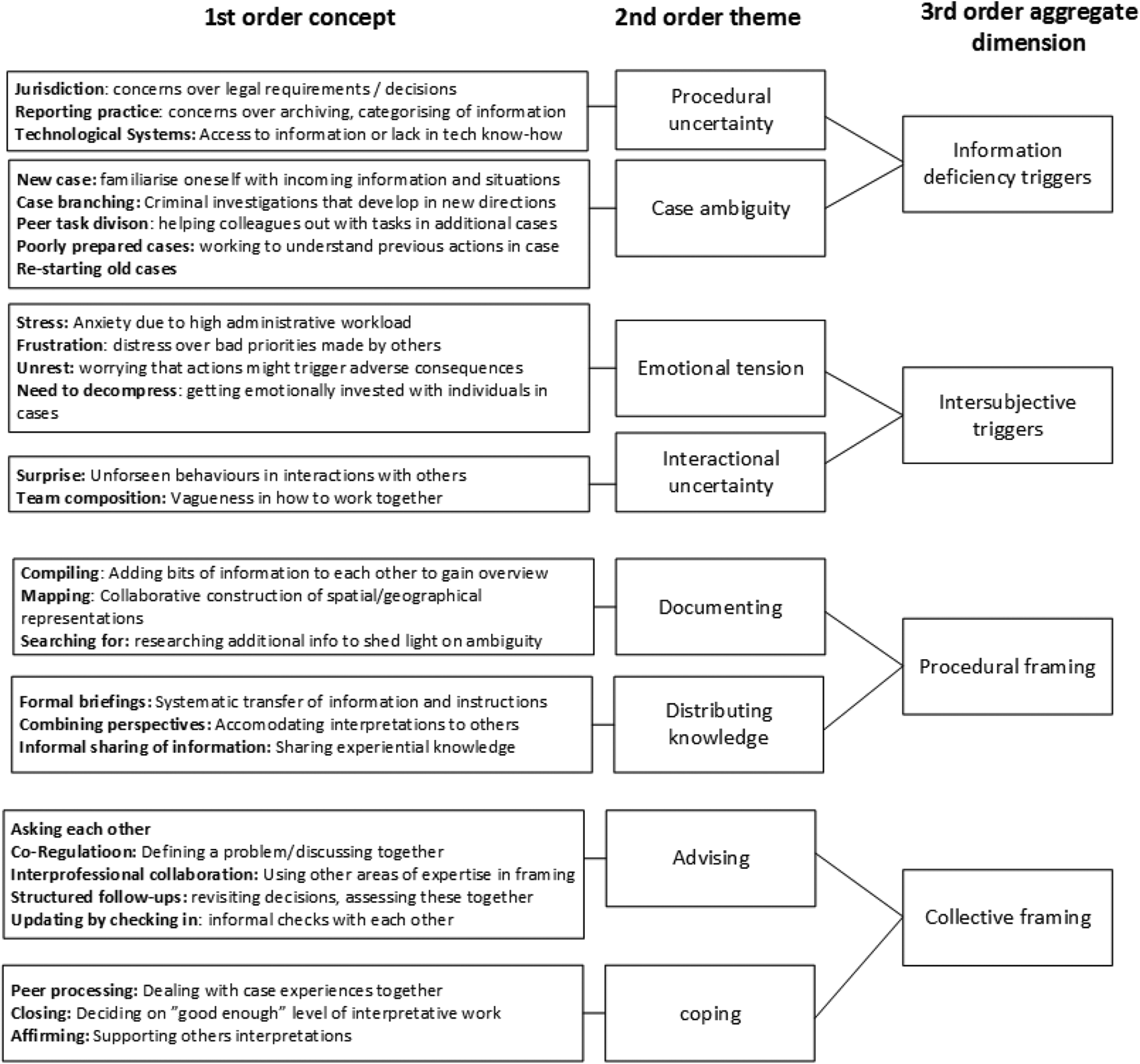
Data structure.
As shown in Figure 1, we identified two types of triggers for detectives’ sensemaking: (a) information deficiency triggers that relate to procedural uncertainty and case ambiguity; and (b) intersubjective triggers that relate to emotional tensions and interactional uncertainty as second-order themes. Furthermore, we identified two types of framing in detectives’ sensemaking processes: (a) procedural framing that relates to documenting knowledge and distributing knowledge; and (b) supportive framing that relates to the themes advising and coping. Next, we discuss the particularities of these triggers and framing processes in more detail.
Information deficiency triggers
A trigger is a ‘violated expectation’ (Maitlis and Christianson, 2014) that interrupts the ongoing flow of a process. Information deficiency refers to a perceived lack of, or inability to neatly order the current situation into a plausible interpretation that allows subsequent action. The perceived deficiency prompts the detective to engage with others in two ways to develop a plausible narrative. We note that the deficiency is closer to the sensemaking in everyday life, to which Garfinkel (1967) referred, than it is to the distinct interruptions associated with, for example, a shooting (Cornelissen et al., 2014). However, sensemaking does not only follow from interruptions (Introna, 2018). We found two types of information deficiency – procedural uncertainty or case ambiguity – that triggered different types of sensemaking.
Procedural uncertainty refers to instances in which the detective does not know how to proceed with an investigation due to a limited understanding of the procedures involved. Uncertainty is ‘the difference between the amount of information required to perform the task and the amount of information already possessed by the organization’ (Galbraith, 1973: 5) – in other words, a limited understanding of the next appropriate step to take in the case. This lack of understanding could relate to technical systems or systems of classifying, documenting and cataloguing information. Examples regarding procedural ambiguity often involved specific challenges that investigators were not used to, such as how to go about correctly billing a veterinarian to put down an animal that was involved in a case; how to register information relating to specific types of cases in the internal systems (e.g. when domestic crime investigators dealt with traffic information); or how to correctly deal with (and file) unusual incoming documents, such as a personal letter from an sentenced criminal offender addressed to the department. Although mundane in character, these types of procedural uncertainties took time and often prompted investigators to ask colleagues, commanders or individuals outside the police for specialist information.
Case ambiguity is a trigger that can pertain to both new and old cases. New cases have never been investigated before, and therefore detectives need to familiarize themselves with new information. A special situation occurs when the new case is poorly prepared in other parts of the organization (e.g. the uniformed police). Bad preparations mean that there is a lack of information or that the information is inconsistent, which makes the next step less obvious. A variation in new cases includes branching from an old one, where a case takes a new direction for detectives to follow. In either of these variations, it is the detective’s sensemaking that triggers contact with others (e.g. plaintiffs or attorneys). The following is an example of a case that suddenly branches: Patricia comes in through Vera’s door and says that she and Leonard have held an interrogation with the person suspected of a hate crime. Patricia says that he is very special to interrogate, as he seems to have a condition that makes him unable to lie. He told everything about how he grows cannabis at home and even that he has special equipment to raise the plants. Patricia says: ‘if you don’t have anything to do, you get something to do…how should we proceed now regarding this equipment of his? Maybe we have to go and get it, then…’. She sighs. (Fieldnotes)
Intersubjective triggers
Intersubjective triggers are associated with the ambiguity that follows from the relation between individuals within or outside the police authority. Some tensions are about specific cases, and others are about the work situation in general. In both cases, the tensions are rather abstract and difficult to address and interpret directly. As a trigger, relative to the information deficiency trigger, intersubjective triggers are thus closer to the ambiguity that Weick (1995) originally discussed. The intersubjective tensions arise in one of two ways: emotional tensions or interactional tensions.
Emotional tensions, we find, are often triggered by workplace stress associated with a high workload. In particular, the detectives express that it becomes a problem when cases are piled on top of each other, without their being able to prioritize them effectively. Some sensemaking is also triggered by frustration over priorities established by others. Sometimes, priorities made by others are found to be wrong, but in other cases, differing priorities simply caused delays that affected a detective’s workload. There is thus a spillover effect; a high workload makes it hard to prioritize other colleagues’ work, leading to emotional tensions on an individual level as well as on a team/organizational level. However, one way in which detectives may feel emotional tension is the experience of unrest that follows if they cannot foresee the consequences of their actions. For example, a detective was very concerned that starting an investigation against a suspect who suffered from severe depression would potentially lead to suicide. The final way detectives’ sensemaking can be triggered is by cases that are emotionally heavy. The emotional response triggers a need for detectives to decompress and discuss the case, thereby collectively building a narrative of the situation. In sum, much of the sensemaking triggered by emotional tensions are about handling the situation, rather than the work itself: She tells me that she is currently working on a rape case together with Erica. She thinks that this case makes a lot of the current debate on sexual assault come to mind. The assailant had, in addition to raping the victim, recorded and photographed it all. This had affected both her and Erica. ‘He was in much worse condition last time we interrogated him.’ They start discussing how they should proceed now, and whether they should and are allowed to take a DNA sample. A short phone call to the district attorney and they have the decision to take his DNA.
Framing detectives’ sensemaking
The framing of detectives’ sensemaking is initiated by previously mentioned triggers, and represents instances of ‘past moments of socialization’ (Weick, 1995). When individuals use specific words as part of their sensemaking, these do not strictly encode or determine meaning. Instead, words prompt larger background frames, or cognitive schemas, that guide interpretations and actions. This means that in ongoing interaction, individuals need to detect the changing background assumptions, or schemas, necessary for continued interpretation (Cornelissen et al., 2014) Frames are thus retrospective, interactional and reliant on experiences with others.
Procedural framing
Procedural framing concerns the ability to navigate the legal system, and keep concerned stakeholders (mainly internal) updated on the status of a case. Many activities are intended to make the case fit the process, rather than the opposite, and this can occur in one of two ways: documenting knowledge or distributing knowledge.
Documenting refers to the common process of documenting what happens in an ongoing case, which starts when a case is opened and ends when it is closed. The work of the detective represents part, but not all, of this process. For example, uniformed police or front desk personnel may be involved initially, and in the later stages, prosecutors and representatives of the legal system assume responsibility. Detectives’ framing regularly negotiates with these interfaces, as when they seek to fulfil their own need for documentation, which they do in three different ways: compiling – putting together known information pertaining to the case; mapping – consequences of geographical space; and searching – researching currently unknown information to add to the case.
Distribution of knowledge is achieved in one of three ways, sometimes in combination. Briefings are systematic, formalized modes of distributing information among colleagues, for the purpose of updating each other on the ongoing case. In the fieldwork, we noted the importance of framing the case coherently, as fellow detectives are dependent on the ‘right’ understanding of a current case. Another way that knowledge is distributed is by sharing information acquired through experience, which is seen as pivotal in detectives’ work: ‘There is a lot in this computer’, she says and points to her head. ‘And there’s a lot in our common knowledge and experience.’ She goes on to tell a story about apprehending two shady persons in a car. Found some narcotics, but nothing else, and was about to settle on those charges. But then they found some tools in the car with distinct markings. And then someone remembered a burglary where the thief had forgotten a tool with that exact marking […] ‘So we started to untangle things, and it got bigger. In the end we could prosecute for a lot of stuff’.
Supportive framing
Supportive framing relates to a human-to-human interface, rather than the procedural human-to-system interface. Activities include making it possible to cope with the situations at work by showing and giving support to each other by expressing familiarity, providing reflections about one’s own insights, etc. Reflecting the intersubjective nature of supportive framing, the second-order themes are advising and coping.
One of the most important aspects of framing is coping, in which cases that are particularly emotionally heavy are processed with peers who have direct experience of either the particular case or of similar ones. By sharing emotional responses among themselves, detectives’ coping becomes a much-needed informal safety valve. We also noted some instances in which dark humour was applied in situations where it would be quite inappropriate outside the context of the safety valve. As in the quote from fieldwork notes below, there is sometimes also a need for formal intervention. ‘You can’t talk about this anywhere but at work’, she says. ‘And that might mean you talk about it a lot at work.’ They had talked so much about the case that the group manager had said they should go to counselling. ‘And we do that now.’
Advising is not restricted to giving advice, but includes asking for advice as well. In either case, there are unclear situations in which a colleague is asked for input. Some of these situations include defining the problem together, and others require one-way input. Another way that advising happens is through interpersonal collaboration. These situations include expertise in other areas and thus the involvement of people from outside the team, rather than within the group of detectives. In contrast to briefings, where information is provided, structured follow-ups are historical. Such follow-ups review past decisions and activities to determine whether they had the intended effect. Like briefings, they involve formalized procedures. Finally, we frequently observed detectives informally checking on each other and their cases to show support and affirm the situation. In sum, framing is considering the past as well as the future, while navigating what should be accomplished in a myriad of ways.
Sensemaking by detectives
From our fieldwork in the investigative departments, we conclude that detective work, in contrast to popularized images, is not done by a lone, heroic individual. The lone individual perspective is rather associated with mundane activities, such as adding information to a document. On the contrary, we observed that every case included complex relations with colleagues and other stakeholders in the legal system. The social nature of the detective’s world thus played out in numerous and complex ways, as highlighted above. We identified two main practices: a concluding practice and a supporting practice. The practices originate in either specific cases or working conditions in general. Concluding practices aim to resolve issues related to working procedure or a case. By resolving the matter, a case is concluded and the detectives can move forward. This practice is initiated by a perceived information deficiency that, with the involvement of others, gets a procedural framing, suggesting that this part of detective work is inherently a matter of sensemaking – not necessarily a matter of making sense of what happened, but rather of how to represent the legal case in a plausible way. Supporting practices are instead initiated by intersubjective triggers that receive a supportive framing among colleagues in reference to specific cases and to the conditions of work. We find that the framing is very important to handle the pressures associated with working conditions. We note that emotional tensions trigger coping behaviours among colleagues rather than involve support functions. We also find that detectives working in the domestic violence unit discuss specific cases to a greater extent than those who work in minor crime. This makes sense, as the former deal with emotionally heavy cases that predominantly include vulnerable individuals. Both units discuss the workload, generally by giving advice to each other. During a workday or a case, for that matter, a detective is involved in both practices multiple times. Based on the framing, the detectives take iterative action until a case moves to the next step in the legal process (see Figure 2).
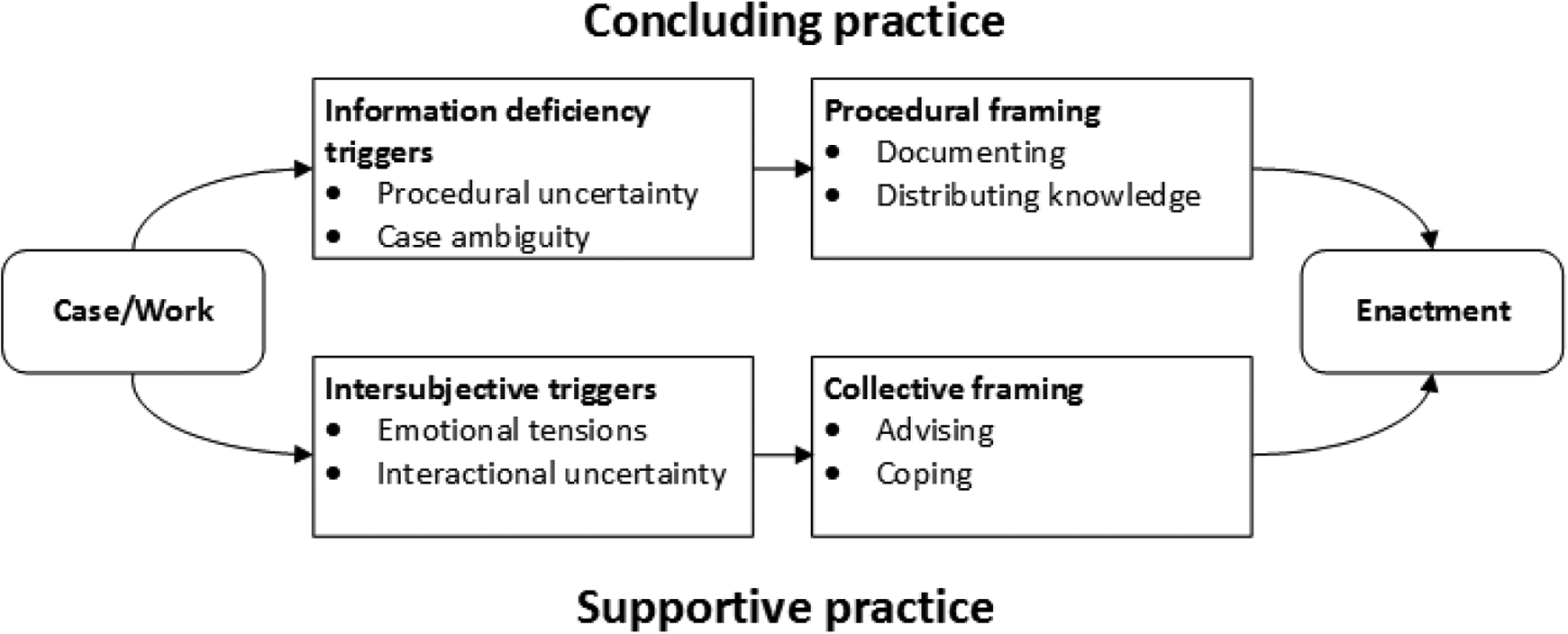
Detectives’ sensemaking practices.
Discussion
We draw upon research on crime detectives’ daily work practice (Innes and Brookman, 2013; Salet, 2017) to shed some light on the mystery that surrounds what detectives actually do and how they do it (Tong and Bowling, 2006). Thereby, we add some transparency to our understanding of detectives’ work as we explore how detectives make sense in their work. To accomplish this, we have collected ethnographic data at two departments in a Swedish police station. Following the recommendation of Geertz (1973) to focus on doings and sayings, and using a sensemaking framework (Maitlis and Christianson, 2014; Weick, 1995), we examined how situational cues trigger sensemaking and frame detectives’ experience as they strive to make sense in everyday investigative practice. In contrast to a tradition of focusing on uniformed policing or homicide investigations (Brodeur, 2010; Jackall, 2005; Van Maanen, 1973), we examined the work of detectives who focus on domestic and minor crime. Investigative work naturally involves detectives navigating within multiple interfaces in a process of ongoing negotiations (Innes and Brookman, 2013). Owing to a scarcity of research related to domestic and minor crimes, which represent the majority of investigative work, there is a significant need for theoretical development in this area. The findings of this article provide a starting point by exploring formation of the triggers and frames of sensemaking in investigative practice related to domestic and minor crimes. This theorization provides an understanding that can be used for further exploration and specifications of the challenges of modern police work, and how to structure it.
We know from prior research that sensemaking is a natural part of the detectives’ work, characterized as a complex social system (Salet, 2017; Westmarland, 2013). We find that this social system of collective sensemaking is triggered by case ambiguity, emotional tension and uncertainty, which function as stepping stones that lead detectives to get involved with others. We note that these triggers are all case-related, but only two sensemaking triggers are clearly solution-oriented. Emotional tension is the result of a need to manage the feelings of the situation rather than the case. These triggers, in isolation or convergence, become a social point of reference that carry the image of modern police work. The common way to secure bureaucratic accountability in casework is to assign responsibility to individual detectives, who work closely with senior investigative officers or prosecutors. This has probably contributed to the common focus on cognitive capabilities that gives such work its image of being solitary in nature (Brodeur, 2010; Innes and Brookman, 2013). Our findings complement these insights by ‘bringing work back in’ (Barley and Kunda, 2001). Consistent with the social nature of sensemaking (Maitlis and Christianson, 2014; Weick, 1995), our findings indicate that detective work in our studied departments is a highly social endeavour, in which peer practitioners function as an important resource when detectives are facing the ambiguity generated by a confusing turn of events. We demonstrate that individual detectives’ decision-making regarding domestic and minor crimes is largely socially grounded and based on ongoing, informal and collective sensemaking in the local context of work. This suggests that the detective’s social environment, not just their individual capabilities, is of utmost importance for successful investigations.
The supportive practices in which the domestic and minor-crime detectives were involved indicate that much of their work is emotional work. Their working conditions and individual cases cause frustration and emotional turmoil that provide the basis for the supportive practice. We find that the social environment is important, not only for concluding a case in the short term, but also for the support that helps detectives cope with their job situation in the long term (cf. Schabram and Maitlis, 2016). Our findings suggest that the need to deal with tension through emotion-focused strategies is a constant and continual cue for sensemaking. We posit that sensemaking among the studied detectives becomes a source of information, and a safety vent that hitherto has been underdeveloped in the theory.
In our studied cases, we find that framing practices, in which sense is made, are less about violated expectations tied to cases, and more about obstacles confronted in the process of working with cases (cf. Garfinkel, 1967; Introna, 2018). The various incidents on which detectives work are generally ambiguous until the detective develops an overview and is able to frame the situation. After this, the work of sensemaking and need for framing shifts, and to a larger extent is directed toward an ongoing stream of triggers in which the specifics of the case are fitted to the procedures in the organizational context. This is what Brodeur (2010) calls ‘post-case’ work, which is geared towards preparing already-investigated cases so they are suitable for prosecution. We posit that considerable effort is devoted to this phase, in which the detective presents a plausible explanation for a scenario. Note that this plausible explanation is not, at first, prepared for the detective, but for the legal system – a difference comparable to the sensemaking lens that focuses on the individual (Weick, 1995). In constructing such explanations, the interaction with departmental colleagues, senior investigating officers, data systems and prosecutors is central. This is a plausible explanation of why it may seem as if modern police detective work is about assembling information and making the case fit the legal system, rather than solving a mystery (Innes, 2003; Tong and Bowling, 2006).
These findings show how formal and informal social interactions are vital for investigators making sense of cases, and as such, complement previous research on organizational determinants for successful investigative practice. This research highlights the importance of individual aspects, such as experience and know-how, as well as material aspects, such as access to technology, as success factors in casework (Brookman et al., 2018).
Sensemaking has been described as ‘a process, prompted by violated expectations, that involves attending to and bracketing cues in the environment, creating intersubjective meaning through cycles of interpretation and action, and thereby enacting a more ordered environment from which further cues can be drawn’ (Maitlis and Christianson, 2014: 67). High-profile events have attracted plenty of interest from sensemaking scholars (Colville et al., 2013; Cornelissen et al., 2014), but we do not find that the urgency and the magnitude of the consequences associated with these events are in any way similar to the conditions faced by detectives. Instead, sensemaking holds explanatory value in an attempt to describe the social and organizational setting of detective work.
We also wish to expand on the limitations that our sensemaking lens imposes on the present analysis. First, we do not (naturally) observe types of sensemaking that are not overt and part of observable interactions. Thus, the cognitive dimensions on which earlier research focused extensively is downplayed in our analysis. Second, the analysis departs from the theoretical assumption that sense is made socially, and we therefore do not account for work that is done individually. Although our analysis aims at describing how this sociality supports investigative work (not if), it is still important to note these limitations in our study.
Future research
This research is based on an in-depth exploration of the work procedures of detectives in two police departments in Sweden. Different countries are characterized by specific legal systems, police organizations and institutional settings. For example, the way police detectives are introduced to their job and gain experience differs from country to country. Regarding crime investigation, Sweden (and the Scandinavian countries) differs from, for instance, Great Britain, which commissioned the ‘Professionalising Investigation Programme’ to enhance training and certification. By contrast, Swedish crime investigators undergo less training and specialization (Fahsing and Ask, 2016). It is, however, beyond the scope of this article to make any comparisons or observations about the potential impact of different systems.
With these differences in mind, however, the crimes, divisional organization (high volume and domestic crime departments) and need for detectives to make sense of what they are investigating are not empirically unique to Sweden. This suggests that the transferability of our exploration has value for its ability to inform research on policing, and, conversely, allows for research on the context of policing to inform theories of sensemaking. Based on our findings and the scope of the article, future research should look further into everyday procedures within the police organization, particularly among detectives who are not involved in high-profile crimes. On a related note, it would be interesting to explore the similarities and differences in work procedures among different types of detective work (see, for example, Brookman et al., 2018).
Conclusions
Through an in-depth ethnographic exploration of the work of detectives at two departments at a police station in Sweden on minor crime and domestic crime, this article contributes a sensemaking perspective to the work practice of these detectives. We identified two types of triggers (information deficiency and intersubjective triggers) and two types of framing (procedural framing and collective framing) related to the detectives’ work. We find that information deficiency triggers seem to lead to procedural framing, in what we call ‘concluding practice’, and intersubjective triggers seem to lead to supporting framing, in what we call ‘supportive practice’. Thus, our studied detectives made sense of their work through ongoing and iterative sensemaking processes that involve their broader social setting. Our findings also show that the sensemaking process is largely triggered by procedures surrounding the preparation for prosecution, rather than by the goal of finding out ‘whodunnit’ and making sense of the reported crime itself. These triggers give rise to framing practices that fit the case to the legal system and allow the detective to arrive at a plausible explanation that fits ‘the system’, rather than a personal view of what occurred. Importantly, this conclusion does not suggest that such explanations are false, as ‘fitting’ refers to the ability to make a plausible argument. In sum, our findings suggest that the social nature of detective work in minor and domestic crime is important, and the way the organizational structure supports such practices should not be underestimated.
Footnotes
Declaration of conflicting interests
The author(s) declared no potential conflicts of interest with respect to the research, authorship, and/or publication of this article.
Funding
The author(s) disclosed receipt of the following financial support for the research, authorship, and/or publication of this article: We want to acknowledge the financial support of the Forte grant on “A police in change: Everyday sensemaking and sensegiving in the largest organisational change in Sweden through all times” (REF:2015-00700). We appreciate the police personell's service and we are forever indebted to the police personnel that allowed us to observe them. The paper benefited from the discussions in the “Extreme Environments - Everyday Decisions” ( ) research community. Finally, we would like to thank the editor Michael Rowe for his support and the three anonymous reviewers for helpful, inspiring, and challenging comments. The usual disclaimers apply.
Author biographies