




Abstract
This article examines the epistemological and institutional configuration of police science. Our results indicate that although police science fulfills the epistemological prerequisites for a scientific discipline, the corresponding institutionalization, which is a necessary condition of its consolidation, has taken place only partially and in a few Western countries. Institutional establishment of police science fails primarily because of the lack of a collective definition of the field, but also because of deficits in the density of interorganizational contacts and the flow of information. This has several theoretical, but also practical implications, mainly on the issue of institutional legitimacy, which are discussed at the end of this article.
Keywords
Introduction
“Police Science is the scientific study of the police as an institution and of policing as a process. As an applied discipline, it combines methods and subjects of other neighboring disciplines within the field of policing. It includes all of what the police do and all aspects from outside that have an impact on policing and public order. Currently it is a working term to describe police studies on the way to an accepted and established discipline. Police Science tries to explain facts and acquire knowledge about the reality of policing in order to generalize and to be able to predict possible scenarios.” (Jaschke et al., 2007: 23)
This definition, which emerged from a conference organized by the former European Police College CEPOL (now the European Union Agency for Law Enforcement Training) in 2007 on the theme Police Science Perspectives: Towards a European Approach, assumes the existence of such a scientific discipline, but also points out that it is not yet fully established. In fact, research activities on a certain institution or process do not automatically constitute a scientific discipline. Furthermore, scientific disciplines are not eternal: they can emerge, evolve, grow, shrink, split up, and even disappear; and aside from this temporal dimension, scientific disciplines have spatial scope as the abovementioned conference theme illustrates. Some fields, such as health science, have made significant progress in becoming established scientific disciplines in past decades, whereas others, such as information science, have been less successful. Hence, this article investigates the emergence of police science as a scientific discipline.
Epistemological discourse on the emergence of new scientific disciplines has been conducted for many years with little return. In fact, in the majority of cases, it has not yet gone beyond the scope of explanatory sketches (Stock, 1989) or “first ordering schemes” (Lemaine et al., 1976). In the following, we revise some of these explanatory sketches, bring them to an adequate heuristic and apply them to police research activities, thereby enabling us to answer our first research question: Does police science meet the epistemological requirements of a scientific discipline?
In addition to these epistemological requisites, emergence of a new scientific discipline also has an institutional dimension. Hence, we complement the philosophy of science approach to police science with the much more practice-oriented perspective of sociological institutionalism (DiMaggio and Powell, 1983; Meyer and Rowan, 1977). By developing the concept of the organizational field, this theoretical approach has created a useful instrument for framing scientific disciplines beyond abstract notions such as hypotheses, theories, research programs, or paradigms (Kuhn, 2002; Lakatos, 1970; Popper 2005). This leads to our second research question: Does police science meet the institutional requirements of a scientific discipline? As the corresponding institutional structures vary in different countries, a comprehensive analysis that includes all countries is certainly not possible within the scope of this article. Consequently, we confine ourselves to some observations in the Anglo-American and European context, and in particular to Germany. Besides being the home country of the authors, the case of Germany is especially interesting as the existence of such a discipline appears to be far more uncertain than in, for instance, Anglo-American countries (Kreissl, 1991).
In this article, we first elaborate an epistemological and institutionalist approach to assessing the state of development of a scientific discipline, and then apply it to police research. Finally, we discuss the theoretical and practical implications of the institutionalization of police science.
The emergence of new scientific disciplines
A review of the rare studies investigating the emergence of new scientific disciplines shows that the majority of these approaches concentrate on the natural sciences (Hallonsten and Heinze, 2015; Krohn and Schäfer, 1976; Mulkay, 1976). This bias towards natural science is also evident in the “classics” of the philosophy of science, which rely primarily on examples from disciplines like chemistry or physics (Kuhn, 2002). Transfer of these insights to social science disciplines is, however, problematic. The reason for this lies in Kuhn’s (2002) distinction between normal science and scientific revolutions. Following an evolutionary–biological logic, scientific niches form only after scientific revolutions, that is, new scientific fields with their corresponding academic institutions, professional communities, and specialist journals require a sudden, drastic and fundamental transformation in scientific ideas (Kuhn, 2002), such as the development from Aristotelian to Newtonian and finally to Einsteinian physics. However, such scientific revolutions are scarce in the social sciences. Even recent technological advances, which enabled analysis of large sociological data sets (big data) and thus had a massive impact on the discipline, led to a more incremental rather than radical transformation of the social sciences. Consequently, postulating scientific revolutions for the emergence of new social science disciplines is not adequate.
One particularly useful approach that is most applicable to the development of social science disciplines is the explanatory sketch on the genesis of disciplines provided by Stock (1989), which was only published in German and therefore largely ignored outside the German-speaking academic world. Stock specifies three essential types of requirements that must be met by a new scientific discipline: formal, content-related, and social conditions. Formal conditions derive from the analytical theory of science and require the formulation of formal rules or sentences that are unambiguous, verifiable, and supported by rational arguments in order to ensure the intersubjectivity of research findings. Content-related conditions comprise common research goals, research subjects, and research methods. And social conditions include the generation of meaningful and useful findings, and institutionalization of the discipline, that is, the development of research and teaching facilities. Instead of building on Kuhn (2002) and Lakatos (1970) to analyze the emergence of a scientific discipline, Stock (1989) uses Guntau’s (1987) historical approach, which distinguishes three lines or stages of development: prehistory, emancipation, and consolidation. Stock describes various conditions or prerequisites that are necessary to move from one stage to the next.
The prehistory of a scientific discipline is marked by the generation of research findings on a certain subject by scientists from other disciplines. The outcomes of these interdisciplinary research activities accumulate to form the new scientific discipline. The “new” thus emerges from the interdisciplinarity of the “existing” (Lemaine et al., 1976; Stock, 1989; Van den Daele and Weingart, 1976). Stabilization of the new discipline in the sense of its emancipation is then conditioned by using a common theoretical framework and exhibiting both “productive” and “activating” creativity (Stock, 1989). Whereas the former provides solutions to problems, the latter initiates further research in the field. These considerations are thus based on the idea that both inductive, theory-generating and deductive, hypothesis-testing research are required for a new scientific discipline to develop. Typical of this stage of development is the so-called “fear of the new”, which manifests itself in established researchers simply ignoring the new discipline or finding reasons why its emergence is unnecessary or even detrimental (Lemaine et al., 1976). It is therefore crucial for the formation of a new discipline that the academic and professional communities of related disciplines accept or at least do not impede its development (Stock, 1989).
Whereas the prehistory and emancipation of a new scientific discipline pertain to the epistemological level of analysis, its final consolidation takes place at the much more tangible institutional level and leads us to Lakatos’ (1970) distinction between degenerative and progressive research programs (Stock, 1989). A progressive research program explains more phenomena in the respective area than the established one. Only if activities in the new research field are considered progressive in this sense, will they be useful and consequently lead to institutionalization of a new scientific discipline (Lemaine et al., 1976; Stock, 1989). Final consolidation of a new discipline therefore depends essentially on the development of an institutional structure.
The epistemological perspective: Prehistory and emancipation of police science
According to Reiner (2010: 1) the “academic study of policing is just about fifty years old”, and therefore “still fairly young by comparison with most disciplines”. According to Jaschke et al. (2007), research on the police began with Westley’s (1953) study on police violence. Hence, the 1950s or 1960s represent a plausible period for the prehistory of police science (Jaschke et al., 2007). Of course, there is earlier evidence of police-specific research activities, such as the publication of the first issue of The Police Journal in January 1928, “a quarterly journal devoted to the work, organization, history and development, scientific, legal and sociological, of the police forces of the British Empire” (p. 2). Nevertheless, it was not until the 1960s or even 1970s that these activities reached a threshold that justified speaking of police science, for instance, in Sullivan’s (1966) textbook Introduction to Police Science, or in the title of the Journal of Police Science and Administration, whose first issue was published in 1973. Police science in this sense meant—and still means—the scientific study of police and policing, and must not be confounded with the Marxist critical understanding of police science as an instrument of state power (Dubber and Valverde, 2007; Neocleous, 2014) that became prominent in the following decades. The interdisciplinary character of the corresponding research activities becomes particularly clear in Reiner’s (2010: 9) statement that “(f)rom the 1960s to the 1980s most police research was carried out by academics, in a variety of disciplines including criminology, sociology, social policy, law history, psychology, and economics”.
The transition from the prehistory of police science to its emancipation stage began in the early 1970s and continued in the 1980s, as the growing use of common theoretical frameworks and the sharp increase in both theory-generating and hypothesis-testing research activities in the field of policing suggest. According to Reiner (2010), it is in these two decades that a growing number of academic researchers applied theoretical concepts such as symbolic interactionism, the labelling approach or Marxist theory to policing, and developed conceptual and empirical studies that were mostly quite critical of the police. In the 1990s, momentum switched from grand theory to policy-oriented and managerialist approaches focused on crime control, and the production of scientific knowledge on policing further accelerated. One important consequence of these developments was the emergence of crime science, “a distinct approach to crime control, which merges prevention and detection under a scientific umbrella” (Laycock, 2012: 3), based on methodologies that “embrace the standards and values of the natural sciences” (Laycock, 2012: 7), and also claims to be a scientific discipline. Crime science deliberately positions itself as a field distinct from criminology, and has obvious overlaps with police science. The scope of police science, however, goes far beyond studying, understanding and controlling crime, and therefore beyond criminology and crime science. Debates around these distinctions illustrate that the study of policing sits at the intersection of multiple fields of analysis, thus emphasizing the inter- and transdisciplinary character of police science.
As of today, these research activities have created a vast corpus of literature on policing, including “classics” such as Banton’s (1964) The Policeman in the Community, Bittner’s (1973) The Functions of the Police in Modern Society or Manning’s (1977) Police Work: The Social Organization of Policing, as well as a plethora of theoretical and empirical studies on concepts such as community policing, broken-windows policing, problem-oriented policing, hot-spots policing, or evidence-based policing (Weisburd and Braga, 2006). Overall, it is beyond dispute that from a purely epistemological perspective, police science represents a scientific discipline. Nevertheless, there is still certain resistance to police science from both policing scientists (Lange and Wendekamm, 2017) and police practitioners (Mouhanna, 2017), which could be understood as an example of Lemaine et al.’s “fear of the new”; a characteristic of the still ongoing emancipation of new a scientific discipline.
The abovementioned development of research in the field of policing reflects primarily Anglo-American academia (Reiner, 2010), but in principle also applies to Germany. However, the development was clearly slower. According to Kreissl (1991), the beginning of police research activities in Germany can also be traced back to the early 1960s, although much of this research was criminological in nature. In the following decades, generation of new knowledge on policing by German scholars accelerated (Jaschke et al., 2007) but it was not until the beginning of the 1990s that a quantitatively significant and qualitatively relevant interdisciplinary analysis of the police began (Mensching, 2008). However, in spite of sporadic research studies of outstanding quality (Behr, 2008; Funk, 1986), the research output of German scholars in the field of policing has been scant (Kersten and Burchard, 2013). From an epistemological perspective, this underdevelopment in the prehistory and emancipation stages of German police science is not relevant though, as new scientific knowledge on policing created by Anglo-American researchers was published in English and hence quickly disseminated worldwide. In spite of the important differences in police systems (e.g., centralized vs. decentralized) and law traditions (common vs. civil law), and the corresponding difficulties in applying some findings of Anglo-American police research to European, African or Asian police forces (Kersten and Burchard, 2013), a country-specific differentiation of police research findings seems inappropriate with regards to the epistemological emergence of police science. This does not apply, however, to the subsequent consolidation stage, which depends on the creation of adequate country-specific institutional structures.
The institutionalist perspective: Consolidation of police science
Despite the obvious fit between the concepts of institutionalism and policing institutions (Crank, 2003), only a few studies theoretically or empirically apply this perspective in a police context (Burruss and Giblin, 2009; Dreimann, 2017; Worden and McLean, 2017 Cockcroft, 2019). Regarding the institutionalization of police science, the institutionalist concept of organizational fields (DiMaggo and Powell, 1983), which focuses on the need for the legitimacy of new practices, seems particularly fruitful. It has, however, been applied only very rarely to the emergence of new scientific disciplines (e.g. Zapp & Powell, 2016). Although there is plenty of research investigating the effects of established organizational fields (Wooten and Hoffman, 2008) most institutional studies are based on the assumption that institutions are already fully developed (Greenwood et al., 2008) and little attention has been paid to the construction and expansion of those fields (DiMaggio, 1991; Hallonsten and Heinze, 2015).
Based on the assumption that the adoption of organizational forms cannot be explained conclusively by technical efficiency, but rather as the result of processes that homogenize organizational structures without necessarily making them more technically efficient, in their much-cited article about organizational fields, DiMaggio and Powell (1983) investigate “why there is such startling homogeneity of organizational forms and practices”. An organizational field is thereby defined as “(…) those organizations that, in the aggregate, constitute a recognized area of institutional life (…)” (p. 148). According to DiMaggio and Powell, the institutional structure results from four conditions: (a) an increase in interactions between organizations in the field; (b) the emergence of sharply defined interorganizational structures of domination and patterns of coalition; (c) an increase in the information load the organizations in the field have to cope with; and finally (d) the formation of a common system of meaning in the sense of a mutual awareness of the organizations to be involved in a field. These four conditions provide excellent guidelines for an investigation of the emergence of a new scientific discipline such as police science.
An interesting example of the operationalization of these conditions is DiMaggio’s (1991) analysis of the structuration of the field of U.S. art museums. Although the differences between police science and art museums are more than striking, the processes of structuration of both organizational fields are quite similar from an institutionalist perspective. In order to explain patterns of structuration of art museums, DiMaggio (1991) used the following examples to operationalize the four aforementioned conditions: Increasing density of interorganizational contacts: national and international conferences, advisory activities, convocation of professionals. Institutionalization of a center–periphery structure: allocation of funds by a central committee or principal actor. Increasing flow of information: research findings, educational programs for professionals, publication of books, periodicals and directories. Collective definition of a field: organization of professional associations.
Several of the conditions described above, such as own journals, conferences and associations, are also found in approaches that explicitly examine the structuring of scientific disciplines (Van den Daele and Weingart, 1976), and underline the appropriateness of the institutionalist concept of organizational fields in this context. In the following, we apply these four conditions to police science to examine its degree of institutionalization. As the relevant institutional factors are largely country-specific and a worldwide analysis would exceed the scope of this paper, we focus on the case of Germany.
Increasing density of interorganizational contacts
The most common forms of interorganizational contacts in the field of science and research are conferences, congresses or symposia that offer participants the opportunity to present and discuss their own and others’ research findings. Such events are prevalent in all established academic disciplines, and in the globalized environment of the 21st century usually go beyond national borders by including scientists from many countries. Typical examples are the annual conferences of the Academy of Management or the International Research Society for Public Management in their respective disciplines with hundreds or even thousands of participants from all over the world. However, regarding police science, such events are quite rare and organized on a much smaller scale. Events such as the annual conferences of the International Association of Chiefs of Police or the Scottish Institute for Policing Research are obviously not comparable to the international research conferences in established academic disciplines, and the large-scale conferences in the field of criminology cannot be assigned to the field of police science. Only the CEPOL Research and Science Conferences organized by the European Union Agency for Law Enforcement Training and perhaps the Policing and Society Conferences of the University of Akureyri in Iceland seem to deserve the status as international police science conferences, although their European focus—at least for the CEPOL conferences—and limited number of participants challenge this assessment.
The situation is similar in Germany. Conferences, congresses or symposia with a more or less scientific character exist, but include a very limited group of participants and most take place only sporadically. The only regular events with a clear academic focus are the annual conferences of the Working Group for Empirical Police Research (Arbeitskreis für empirische Polizeiforschung). They have taken place on a regular basis since 1999 in various locations in Germany and Austria, and consist of approximately 10 presentations of recent research studies on policing issues given by researchers employed in the academic institutions of the German police forces, in particular police academies and universities of applied sciences, but also in “regular” German universities. Furthermore, the German Police University founded in 2006 and located in Muenster has recently begun to organize similar conferences with a clear academic focus but this development is still quite immature and uncertain.
Summarizing, we can state that the density of interorganizational contacts in the field of police science in general is quite low compared with established, but also most young academic disciplines. There is still much to be done regarding cross-border cooperation between police researchers (Den Boer, 2017). This is particularly true regarding the situation in Germany, thereby challenging the status of police science as a scientific discipline.
Institutionalization of a center–periphery structure
That patterns of domination and coalition exist in and between policing institutions is undisputed, but with regard to policing research institutions, the case is less clear. Nevertheless, over the past decades, corresponding center–periphery structures have emerged in most developed countries, although in very different forms and extents. For instance, in Great Britain, United Kingdom the Home Office disposes of large financial resources, sponsors a significant share of police research activities, and hence plays a more or less dominant role in this field. The Office of Justice Programs in the USA and the civil security research programs of the Federal Ministry of Education and Research in Germany play a similar role. At the European level, the European Union with its multi-million “Secure Societies” section of the Horizon 2020 program or the growing activities of the European Union Agency for Law Enforcement Training CEPOL has definitely become a dominant protagonist in the field of police research.
In Germany, the emergence of a center–periphery structure regarding police science became particularly visible in 2006, when the German Police University was founded. As a specialized university funded by the interior ministries of all federal and state governments it offers a two-year master’s program in Public Administration—Police Management to police officers from all over Germany, who are promoted to the higher police service after successfully completing their degree. As such, the German Police University is the only institution in the decentralized, federal German police system that cannot be attributed to one of the 19 independent police forces, but belongs to and is used by all of them equally. The mission statement of this university underlines not only its role as central hub in the abovementioned center–periphery structure, but also explicitly its importance for the development of police science in Germany. The following statement can be found on the university’s website: We are (…) the most important forum between science and practice for the discussion of police issues in Germany. We play a decisive role in the systematic development of police science in research, teaching and studies (…).
Increasing flow of information
The most evident medium reflecting the flow of information in a scientific context is certainly the academic journal. Journals not only publish scientific studies and thereby contribute to disseminating research findings, but also review the submitted manuscripts to ensure their quality and compliance with academic standards. Such specialist journals that focus on policing issues exist in all developed countries; their scientific character, however, varies and is by no means certain. Important indicators of scholarliness could be using a double-blind peer review process in which the reviewers are policing academics and the authors’ and reviewers’ identities are concealed from each other, and explicitly including terms such as police science, police studies or police research in the journal title or aims and scope. Another important instrument reflecting the flow of information in a scientific context is probably academic degree programs that stimulate the transfer of knowledge from academia to practice, but also between academic institutions. Again, the scientific character of these programs may vary, but accreditation systems and the reputation of the corresponding academic institutions should allow for an assessment of scholarliness.
Regarding police science, a vast number of academic degree programs focusing on policing and explicitly including terms such as police science or police studies in their curricula or even their denomination exist, particularly in Anglo-American countries, although most prefer the denomination “Criminal Justice”, which is not synonymous with police science (Cordner, 2016). Prominent examples are the Police Studies major in the Bachelor of Science program at John Jay College of Criminal Justice, New York, USA, the Master of Philosophy and Doctor of Philosophy programs in Advanced Policing Studies at Liverpool John Moores University, UK, but also the Master of Police Science at the Norwegian Police University College, as well as the Bachelor of Arts program in Police Science at the University of Akureyri. In England and Wales, central government established the College of Policing in 2012. It acts as a professional association of police forces and has established the Police Qualifications Education Framework (PQEF)—an educational initiative related to the planned professionalization of the police (Neyroud, 2017). Furthermore, a large number of journals with a long tradition spanning decades and fulfilling these conditions exist, for instance the International Journal of Police Science and Management, Policing: A Journal of Policy and Practice, the European Journal of Policing Studies or The Police Journal: Theory, Practice and Principles. Because they are available online, published in English and include papers from authors from many countries, the geographic location or origin of these journals becomes widely irrelevant. The existence of these journals and of the aforementioned academic degree programs hence underlines the status of police science as a scientific discipline.
The situation regarding police science in Germany, however, is different. Apart from several practice-oriented policing journals that include research articles only sporadically, there are only two journals that more or less deserve the denomination scientific: Die Polizei (The Police) and Polizei und Wissenschaft (Police and Science). They regularly publish research papers on policing issues, some of which of outstanding quality, written by scholars from different academic disciplines. However, neither uses a double-blind peer review process, fostering doubts about their scientific character. Furthermore, only the University of Bochum offers a master’s degree at university level that explicitly mentions police science (Criminology, Criminalistics and Police Science), and it does not allow for a career in the German police forces. The abovementioned German Police University also offers a master’s program, but its denomination is “Public Administration—Police Management”, and its curriculum barely mentions the terms “police science” or “police studies”. Hence, we have to conclude that the flow on information in the field of police science is clearly restricted in Germany compared with many developed and particularly the Anglo-American countries, thereby challenging the status of police science as a scientific discipline in Germany.
Collective definition of the field
The abovementioned, peculiar absence of the term “police science” in the denominations of academic degree programs points to the final and probably most important obstacle to police science becoming a scientific discipline: the lack of a common system of meaning in the sense of a mutual awareness of the organizations and persons to be involved in this scientific field. In established scientific disciplines, the name of the discipline is used in the denomination of study programs, academic departments, professorships, etc. In mathematics, for instance, students get a degree in mathematics, become mathematicians, may become members of the International Mathematical Union or the American Mathematical Society or the Deutsche Mathematiker-Vereinigung (German Mathematical Union), and can visit the International Congress of Mathematicians to catch up on the latest developments in this scientific field. The same applies even to younger, less-established disciplines, such as public management, where students get a degree in public management or public administration, can opt for an academic career to become a professor of public management, and visit the annual Public Management Research Conference that is organized by the Public Management Research Association.
In the field of policing, it is possible to get a degree in police science, but almost only in Anglo-American countries, and even there most prestigious universities prefer other denominations, such as “Criminal Justice” (Cordner, 2016). Some academic institutions employ professors of police science, for example, John Jay College of Criminal Justice in the USA, Cardiff University in the UK or the Norwegian Police University College, but the vast majority of researchers in the field of policing work in criminology, criminal justice, or public management departments. In Germany, there is only one professorship for police science at university level (at the University of Bochum), and the denomination is “Criminology and Police Science”. Furthermore, to our knowledge, there are no significant professional associations at a national or international level that explicitly focus on police science and use a corresponding denomination: no American Police Science Association, no German Police Science Union, and no International Police Research Society. In view of the need for such an institution at the international level, an Egyptian professor of criminal justice management founded the International Police Science Association in 2013 and organized two conferences in 2014 and 2016. However, neither included “police science” in their theme, and since 2016 no more activities of this association are traceable, suggesting that it has failed.
Summarizing, we conclude that there are significant deficits regarding the collective definition of police science in the sense of a mutual awareness of the organizations and persons to be involved in this scientific field. Jaschke et al.’s (2007: 170) conclusion that “there is hardly anything that could be called a scientific community in Police Science” is still true, and argues against the status of police science as a scientific discipline.
Discussion and conclusion
In this study, we examined the epistemological and institutional configuration of police science in general and German police science in particular. Our results indicate that although police science fulfills the epistemological prerequisites for a scientific discipline, the corresponding institutionalization, which is a necessary condition of its consolidation, has taken place only partially and in a few Western countries, which do not include Germany. Institutional establishment of police science fails primarily because of the lack of a collective definition of the field, but also because of deficits regarding the density of interorganizational contacts and the flow of information. These findings have meaningful theoretical and practical implications.
First and most importantly, our study applies a philosophy of science perspective to police science and thereby adds to the literature on the epistemological and institutional foundations of this research field. Academic discourse on this topic is characterized by the absence of a sound, substantiated and acknowledged theoretical foundation. Kersten and Burchard (2013), for instance, provide an insightful analysis into the history and perspectives of police science in Germany, but they neither explain what “police science” is, nor discuss if this scientific discipline really exists. Even the extensive study of Jaschke et al. (2007) with a separate chapter entitled “Police science—A philosophy of science approach” only touches upon the philosophy of science literature and avoids making clear statements on the conditions to be met by the policing research field in order to constitute a scientific discipline. And the more recent 2017 Special Issue of the European Police Science and Research Bulletin on the topic “Police science and practice in Europe” (Boer, Nogala, Jaschke, & Fehérváry, 2017) also remains silent on the epistemological foundations of police science and only occasionally addresses institutional aspects, like for instance, the lack of appropriate research environments (Boer, 2017), the need for European police research journals or an annual police research forum (Fijnaut, 2017).
Consequently, the existing assessments on whether police science is a scientific discipline (Feltes, 2015) or “on the way to an accepted and established discipline” (Jaschke et al., 2007: 24) or an “outsider discipline of too little significance” (Kersten and Burchard, 2013: 37) or only a subdiscipline of public administration (Lange and Wendekamm, 2017) always contain a certain arbitrariness. Reliable assessment should not rely on the opulent rhetoric so common in the social sciences, but requires disclosure of the criteria used in the assessment. Furthermore, these criteria need an adequate theoretical foundation, preferably from philosophy of science and history of science as the relevant scientific disciplines in this context. Developing such a theoretical model, which is not restricted to policing research, but is also applicable to other research fields, was one central aim and the main theoretical contribution of this study. Figure 1 illustrates the corresponding model.
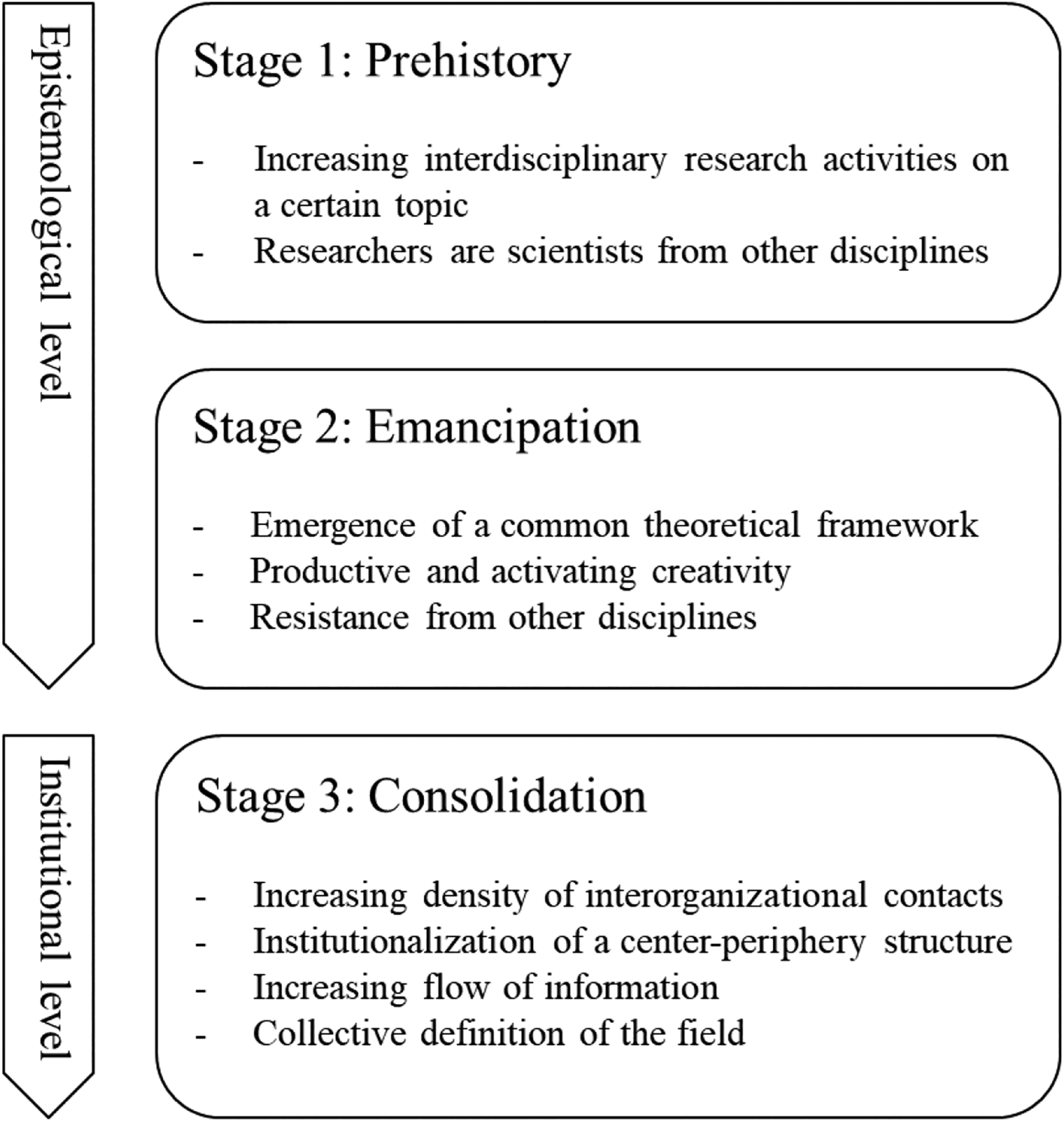
Emergence of new scientific disciplines. Illustration based on Stock (1989) and DiMaggio and Powell (1983).
If we apply this model to police research, we conclude that police science is currently located between the second and third stages and, therefore, not a full scientific discipline. The reasons for this “underdevelopment” do not belong to the epistemological level of analysis. As mentioned above, it is beyond dispute that from an epistemological perspective, police science fulfills the prerequisites for a scientific discipline. The development of adequate institutional structures, however, is still incomplete. Even in Anglo-American countries, which certainly have the longest tradition of policing research and the best-developed academic institutions in this field, police science represents only an immature scientific discipline. The relatively low density of interorganizational contacts in the field of police science, as reflected by the absence of large conferences or congresses on policing aspects with a clearly scientific profile, but essentially the deficits regarding the collective definition of this field are the main reasons that police science has not completed the consolidation stage. This diagnosis is particularly true for most non-Anglo-American countries, for example Germany, where in addition there are certain shortcomings regarding the flow of information, that is, the dissemination of police-related research findings from academia to police practice, but also among policing researchers.
This diagnosis, that is, the underdevelopment of police science, must not be confounded with a “disease”, which harms the “patient” and requires a “therapy”. Although the abovementioned deficits regarding the dissemination of research findings certainly suggest detrimental effects, we cannot rule out that the scientific analysis of policing in the institutional frame of several different scientific disciplines such as criminology, sociology, public administration, etc. might be more productive than the establishment of an independent police science. Such an idea corresponds not only to the principles of functional differentiation (Luhmann, 1977), but also to Kuhn’s (2002) idea of diversity, according to which a high degree of differentiation is what determines the performance of the science system. It could be argued, however, that the development of police science as a stand-alone discipline might facilitate the access of police practitioners and policy-makers to scientific research, as they would not need to scour a range of academic disciplines for relevant work anymore. Furthermore, the stronger focus on the field of policing might encourage police scientists to write their publications using a more appropriate, more understandable language to improve dissemination of their research findings. Currently, much research on policing is written in academic language not intended to facilitate access by police practitioners and policy-makers.
In addition, institutional theory points to one important adverse effect of the underdevelopment of police science: loss of legitimacy. Organizational (or institutional) legitimacy represents a central category of analysis in sociological institutionalism (Meyer and Rowan, 1977). That in many cases police institutions pursue purely technical goals, such as maintaining the social order in society, cannot detract from the fact that the maintenance of a legitimate facade of the institution “police” is of enormous importance. Although a large part of modern police research refers to a social–psychological understanding of the construct “legitimacy”, the notion of organizational legitimacy is increasingly gaining a foothold in police science studies (Worden and McLean, 2017). By organizational legitimacy we mean “[…] a generalized perception or assumption that the actions of an entity are desirable, proper, or appropriate within some socially constructed system of norms, values, beliefs and definitions” (Suchman, 1995: 574). Organizational legitimacy refers not only to the public perception of the police, but also to its recognition in international and interinstitutional comparisons. Since the institutionalization of an organizational field goes hand in hand with its professionalization (DiMaggio, 1991), we argue that the establishment of an independent police science serves to improve the organizational legitimacy of police as an institution. A prominent illustration of this effect is Meyer and Rowan’s (1977) argument how research departments can increase belief in the rationality of an organization, and how econometric analyses can increase the legitimacy of an organization even though they may not even be understood properly. Apart from technical utility, rhetoric and word play an important role in maintaining legitimacy (Meyer and Rowan, 1977; Phillips et al., 2004; Suddaby and Greenwood, 2005).
Therefore, the institutional function of an independent scientific discipline that is actually called “police science” should contribute to fostering and maintaining the image of a modern, professionalized, transparent police force—or a self-confirming “logic of confidence” (Meyer and Rowan, 1977)—much better than a discipline that is, for instance, only a subdiscipline of public administration, as suggested by Lange and Wendekamm (2017). Hence, further developing police science to become a fully established scientific discipline seems convenient and therefore a plausible goal for police leaders, public administrators and policy-makers. In this case, our above analyses point to the next steps that need to be taken to achieve this aim: creating academic institutions (e.g., graduate schools, departments, professorships) with a clear focus on police science, and establishing academic study programs with such a denomination. Accordingly, Weisburd and Neyroud (2013) argue that universities must become an important part of police infrastructure and call for university policing centers. The formation of professional associations that organize conferences and congresses on policing issues with a clearly scientific profile also seems to be advisable. In non-Anglo-American countries, establishing scientific journals using a double-blind peer review process is necessary. But the most important step is, of course, increasing the mutual awareness of the organizations and persons involved in policing research, in particular by ending the abovementioned, peculiar rareness of the term “police science” in the denominations of academic institutions and degree programs.
In this context, the case of Germany is particularly interesting as it follows a not only a different, but rather the opposite path. Furthermore, there is ongoing academic discourse about whether police science should have the status of a scientific discipline in Germany (Feltes, 2015; Lange and Wendekamm, 2017), and the existence of such controversies is as an important indication of the institutionalization of an organizational field (Hoffman, 1999). The catalyst for the discourse was foundation of the German Police University 2006 as an academic teaching and research institution with the explicit objective to “foster and develop police science”, which is documented in not only its mission statement, but also the corresponding law adopted by all German federal states and the federal government. The president of the university at that time emphasized the importance of this objective in several articles, which unambiguously argued for the institutionalization of police science as a scientific discipline in Germany (Neidhardt, 2007). Consequently, in 2007, the German Police University established the first and only professorship with the denomination “Police Science”. However, after the retirement of both the professor of police science and the president of the university in 2013, the university decided to replace it by a professorship for public administration. Interestingly, this measure was not taken for organizational, financial or didactical reasons, but to revise the previous strategy that aimed at establishing police science as in independent scientific discipline. As the new president of the German Police University elaborated in several articles (Lange and Wendekamm, 2017), the development of such a scientific discipline in Germany was doomed to failure. The main argument was that in Germany researchers in the field of policing are not prepared to abandon their original academic disciplines in favor of the new scientific field due to the limited career opportunities in German police universities. Hence, the most promising way to foster and develop police science was to regard it as a subdiscipline of public administration. The expedience of replacing the professorship of police science, which amounts to a capitulation before the challenge to institutionalize the discipline in Germany, is yet to be proven. After all, we cannot rule out that the scientific analysis of policing is indeed more productive if carried out within the framework of one or several other established scientific disciplines, and the fact that even in the Anglo-American countries police science has not reached the status as an established, fully accepted scientific discipline illustrates that the corresponding challenges are tremendous.
Nevertheless, in terms of legitimacy and professionalization of the police (Neyroud, 2017), the further development of police science as an independent scientific discipline is clearly preferable. Such an understanding of police science also supports the path towards evidence-based policing (Bedford and Neyroud, 2018; Sherman, 2013; Weisburd and Neyroud, 2013; Brown et al., 2018) as a way of embedding a particular form of science into the study of policing that is defined largely on methodological terms and focused on the use of randomized controlled trials.
However, answering the question whether police science should or should not be a fully established scientific discipline goes beyond the scope of this article. Hence, we call for follow-up research applying the theoretical model developed in this paper to different regional contexts, exploring the consequences of different levels and forms of institutionalization of police science, providing in-depth analyses of police science in one country or comparing the situation in different countries. Studies pursuing either of these avenues, we believe, can further advance our understanding of the complex relationship between policing research and police practice, which is so fundamentally important.
Footnotes
Declaration of conflicting interests
The author(s) declared no potential conflicts of interest with respect to the research, authorship, and/or publication of this article.
Funding
The author(s) received no financial support for the research, authorship, and/or publication of this article.
