




Abstract
Cranes with distributed-mass payload (DMP) have complex sway dynamics, and they are largely affected by changes in the DMP parameters. Although an input shaping technique has been utilised for sway control, it has low robustness to parameter uncertainties and mainly applied to cranes carrying a point mass payload. This paper proposes a robust shaper for efficient swing control of an underactuated overhead crane with a DMP under parameter uncertainties by using an output-based reference command shaping approach. The method has an advantage as it avoids the requirement for accurate measurements and estimations of the systems sway frequencies and damping ratios, which are difficult for DMP. In addition, the approach eliminates the need for controller re-design in cases of parameter changes. The effectiveness of the shaper is investigated using simulations and experiments under several scenarios involving varying cable lengths, changes up to 25% in the DMP masses and lengths, and different input profiles. The superiority and robustness of the shaper is confirmed with the highest hook and payload sway reductions in comparison to another multimode robust shapers. Under a robustness test with a different set of DMP parameters, and with experiments, the proposed shaper reduces the total sway by 46% and 24% as compared to the robust Zero Vibration Derivative (ZVD) and Equal Shaping-Time and Magnitude (ETM) shapers respectively. Interestingly, these are achieved by using only a single design and with a similar speed of trolley position response.
Keywords
1. Introduction
Overhead cranes are widely used in various industries for transportations of heavy and hazardous materials from one location to the other. 1 Crane control objectives are to attain a faster trolley position response and low payload sway, as these are translated into higher productivity and safety. Although extensive work exists on crane’s dynamics and control, a majority of them considered a point-mass-payload (PMP) in which the crane’s payload is lumped and modelled as a point.2,3 However, in industries, cranes are used to carry payloads of various sizes and shapes. In this case, to obtain an accurate model representing the actual scenarios, cranes with a distributed-mass-payload (DMP) should be considered.
In the literature, only limited works have been reported on control of a crane with DMP. In contrast to PMP, this crane requires two rigging cables to hold and carry the distributed payload. Therefore, the crane possesses double-pendulum dynamics with significant hook and payload sways during trolley motion. 4 Moreover, previous studies have shown that this type of crane oscillates with two distinct frequencies correspond to the hook and payload, and the crane is considered as a multimode system. Modelling and dynamic characterisations of an overhead crane carrying DMP under payload hoisting were recently reported. 5 The work was validated through experimental results and has shown that the crane sway responses were significantly affected by varying cable lengths and differences in the payload parameters. Therefore, control of a crane with DMP is very challenging, especially under the presence of crane parameter uncertainties.
Control of the crane can be categorised into feedback and feedforward control strategies. The feedback control which enables both trolley positioning and payload swing control have received more research focus. The control approaches include wave-based control that does not depend on system model accuracy, 6 trajectory planning based on an equivalent rope length, 7 adaptive control for precise positioning and swing reduction, 8 adaptive fuzzy tracking control systems, 9 time optimal control using low-pass filters, 10 non-linear sliding mode control (SMC),11,12 non-linear control13,14 and deep reinforcement learning-based control. 15 Alternatively, feedforward control can also be used for swing control and the techniques provide the benefits of ease of implementation and reduced costs, making them an attractive option as compared to its counterpart. For cranes with DMP, the feedforward control methods that have been applied include command smoothing using low-pass and multi-notch filters, 3 command smoothing based on modelled damped oscillation periods, 16 extra insensitive (EI) and modified EI shapers for a planar dual crane, 17 discontinuous and hybrid piecewise smoothers, 4 and artificial neural network-based optimal command smoother. 18 Both control approaches can also be combined where the feedback controller provides precise trolley positioning with high robustness, and the feedforward controller handles the DMP’s sway. This current work focuses on effective design and implementation of feedforward controller, as such a controller can significantly help in reducing the complexity of feedback controllers. This is the main motivation of this work.
However, most of the input shaping control designs including command smoother, input shaping and Equal Shaping-Time and Magnitude (ETM) 19 require prior knowledge of natural frequencies and damping ratios of the system. These were normally obtained by measurement using several sensors or estimation using multiple techniques. Nonetheless, obtaining exact system parameters is a difficult task to achieve, and this difficulty increases for a crane with DMP and multimode system. Several recent articles have investigated techniques to handle this issue. An analytical frequency modulation technique 20 was proposed for an overhead crane. In addition, input shaping techniques which were independent of the crane parameters have also been proposed.21,22 However, all these controllers were implemented only on crane systems carrying PMP, and it was found that only a limited work investigated this approach for cranes carrying DMP. Recently, a robust input shaping was designed for an overhead crane with a suspended beam, 23 but calculations of the system parameters are still required.
This paper designs and evaluates a shaper for swing control of a double-pendulum overhead crane (DPOC) with DMP. A controller known as an output-based reference command shaper (ORCS) that does not require measurement or estimation of the sway frequencies and damping ratios is designed. Simulations and experiments are conducted to evaluate the robustness performance of the shaper under several scenarios of crane parameter uncertainties involving payload hoisting, changing payload lengths and masses, and different input profiles. In addition, two multimode robust shapers namely Zero Vibration Derivative (ZVD) and Equal Shaping-Time and Magnitude with five impulses (ETM5) are developed and implemented for performance comparisons in terms of the trolley position response, maximum and overall sways of hook and payload.
The contributions and advantages of the proposed shaper in comparison to the existing input and command shapers are as follows. (a) This is among the earliest shaper designed for efficient swing control of a crane carrying DMP under parameter uncertainties. (b) In contrasts to the existing input shapers, the proposed shaper can be designed without requiring prior knowledge of crane’s natural frequencies and damping ratios. This avoids the need for measurement or estimation of both parameters. (c) The proposed controller provides the highest robustness while eliminates the need for controller re-design in cases of system parameter uncertainties. (d) The speed of trolley position response can be maintained while achieving higher robustness.
2. Dynamic modelling of a DPOC with DMP
In this section, dynamic models of the crane using a DMP, without and with payload hoisting obtained using the application of the Lagrangian technique are provided. Details of the modelling process can be obtained. 5
2.1. Model of a fixed length
Figures 1 and 2 illustrate schematic diagrams of a DPOC carrying a DMP with constant and varying cable lengths during payload hoisting respectively. The crane system has three independent generalized coordinates: trolley position ( A DPOC with DMP. A DPOC with DMP hoisting.

The nonlinear dynamic equations of the crane with a fixed cable length can be derived as
5
:



Conversely, the dynamic equations governing a DPOC under payload hoisting conditions are given by
5
:


An external force acting upon the system initiates the motion of the trolley, and subsequently inducing oscillations in both the hook and DMP. As reported, 5 the dynamics of the oscillation were significantly affected by using different DMP masses and lengths, and during payload hoisting. It is desirable to design a robust shaper that can provide a uniform performance under several cases of parameter uncertainties.
3. Control schemes
This section describes the proposed approach for control of sways of DPOC system carrying DMP. Design and implementation of multimode ZVD and ETM5 shapers are also presented for performance comparisons. The main differences between the shapers are as follows. • The proposed shaper is based on a reference model and thus avoiding the requirement of using the crane’s sway frequencies and damping ratios. • The ZVD shaper is designed based on three impulses determined using the sway frequencies and damping ratios. • The ETM5 shaper involves five impulse vectors with the same shaping time and magnitude. Similar to the ZVD shaper, the crane’s parameters are required for calculation of the impulse vectors.
3.1. Output-based reference command shaper (ORCS)
The main concept of ORCS approach is to ensure that the actual output of a system follows a desired response given by a reference model. Figure 3 shows a block diagram of the control approach in which the task is to find an optimal ORCS so that ORCS control block diagram.


As the approach works based on the reference model, it must be carefully selected to achieve a desired response. A critically-damped system that can provide a suitable response without overshoot was selected in this case. The transfer function can be written as:


As a transfer function can only represent a linear system, a linear model of the DPOC carrying DMP is required. With a constant cable length, the linear model was attained using the system identification technique based on data collected through simulation of the nonlinear models in Equations (1) - (3). In this case, a crane with nominal parameters of

Analysing the characteristic equation in Equation (14) reveals that the system is type one with a pole at the origin. Therefore, the coefficient of


The computation process starts by assigning an initial value of one to all variables. The outputs, Decomposition of ORCS.
Using a sampling time of 0.001 s and for a simulation period of 10 s, the output responses were collected and used to find the coefficients of the numerator of

Optimal values of the coefficients

The least-squares approach can be used to determine the minimum value of




If the values of

Based on the output responses as described in Figure 4, the representation in Equation (23) can be obtained. Thus, the ORCS variables can be solved after inversion of the square matrix. If the inverse of the matrix does not exist, a pseudoinverse is utilized.
3.2. ZVD shaper
The most basic configuration of an input shaper featuring two impulses is known as a zero vibration (ZV) shaper. However, as an open-loop control, the ZV shaper has low robustness. Improving the robustness of the shaper can be achieved through setting the derivative of residual vibration to zero in relation to the frequency of residual vibration. This leads to the development of a ZVD shaper designed with three impulses as shown in Figure 5. The amplitudes, ZVD shaper.


The time for the first impulse is always at ZVD shaping procedure with: (a) Impulse sequence, (b) Gain and delay.
3.3. Equal shaping-time and magnitude (ETM) shaper
Another approach in designing an input shaper is based on an impulse vector. Singhose et al.24,25 was the first to develop the idea of using the vector for design. Consider a vector representing an impulse as shown in Figure 7, where Impulse vector diagram.
ETM shapers are type of shapers possessing identical magnitudes of impulse vectors and maintaining consistent angles between them.
25
The ETMn shaper adheres to these specified conditions. For n number of vectors, the angles can be calculated as


Figure 8 shows two types of ETM shapers with different number of impulses. The ETMn shaper ensures that the sum of its impulse vectors is consistently zero for all Impulse vector diagram of (a) ETM4 shaper, (b) ETM5 shaper.
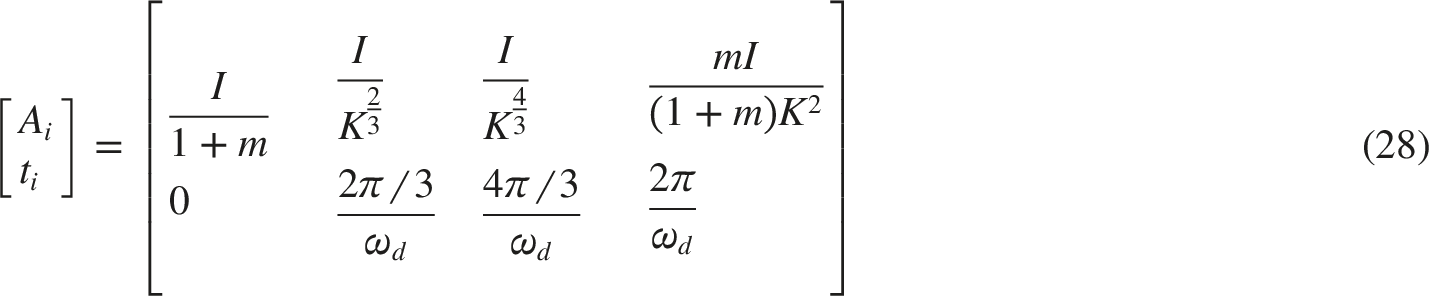


The optimal values m opt for ETM4 and ETM5 shapers.

4. Implementation and results
This section discusses the design and implementation of the controllers and their performance evaluations with simulation and experimental results. The controllers were implemented in an open-loop configuration as shown in Figure 9. A block diagram with OCRS and input shapers.
In this work, trapezoidal input was considered as it is commonly used in industries. The velocity input profile in the trapezoidal form comprises of distinct phases. The crane initiates acceleration from zero to a maximum velocity steadily, sustains this velocity consistently for a predetermined duration or distance, and subsequently decelerates back to zero at a constant rate.
Design, implementation and performance evaluations of the controllers were done according to the following steps. a) Simulation and experiments of the DPOC with nominal parameters ( b) Design of the ZVD and ETM5 shapers by solving Equations (24) and (30) respectively, using the system parameters obtain in (a). As the cable length, c) Design of ORCS based on the block diagram in Figure 4 and Equation (23). The designed parameters d) Implementation of the ZVD, ETM5 and ORCS shapers with nominal crane parameters under fixed and varying cable lengths. e) Investigation of robustness of the controllers under two scenarios: (i) Two cases of payload mass and length. (ii) A different input profile with a faster trolley motion.
The ZVD and ETM5 shapers with three and five impulses respectively, were chosen as comparative controllers as they can provide a similar speed of trolley response as the proposed shaper. Moreover, they are robust shapers designed under a multi-mode configuration and with ATL approach to handle changes in the cable length during hoisting. Using shapers with higher number of impulses results in a longer delay and slower trolley position response. It is worth mentioning that since system parameters change during the robustness tests, the ZVD and ETM5 shapers need to be re-designed according to new frequencies to ensure optimal performance. Nevertheless, a single ORCS design is applicable for all scenarios, as it is independent of the system frequencies. For the simulation work, the nonlinear models of the DPOC with DMP given in Equations (1) - (3) and (4) - (7) were simulated in Matlab and Simulink.
Figure 10 shows the trapezoidal input (unshaped input) and the trapezoidal shaped inputs obtained using the ORCS, ZVD and ETM5 shapers. The effectiveness of all the shapers was evaluated based on the following performance indexes and system responses. a) Time responses of the trolley position, hook and payload sways. b) Maximum Transient Sway (MTS): This value is important as the maximum sway happens while the trolley is in transient motion. c) Mean Average Error (MAE): This value provides the overall sway in term of the average sway throughout the observation period. Shaped torque inputs obtained using the shapers.

As both MTS and MAE indicate the amount of sway, it is desirable to have a small value of the indexes.
4.1. Experimental set-up
Figure 11 depicts the laboratory DPOC with dimensions of 1 m x 1 m x 1 m uses for several experimental exercises. A suspension cable connects the hook to the trolleys, whereas the rigging cable is used to attach the DMP to the hook. The trolley displacement and hook sway angle are measured using encoders, while the DMP sway angle is measured using the C170 camera which is attached to the trolley. Two DC motors are utilised to separately drive the trolley and hoisting movements. Communication between the computer and the crane is done through an RT-DAC board while real-time implementations of controllers were performed using Matlab/Simulink Real-Time Toolbox. A torque to move the trolley will be generated in Matlab/Simulink and converted to a corresponding input voltage. The control signal is then transmitted from a computer to a DC motor through a power interface amplifier. The laboratory crane parameters are given in Table 2, where the damping coefficients were obtained from the manufacturer and the other parameters by measurements. The same parameters are also used in the simulation work for validation purposes. The laboratory DPOC with DMP. The DPOC parameters.

4.2. Response with unshaped input
Figure 12 shows the simulated and experimental trolley position responses of the DPOC with the trapezoidal input force. The trolley eventually reached a final distance of 0.29 s within 2 s. Both results exhibit the same behaviour in the transient and steady-state responses. Figures 13(a) and 13(b) depict the hook and payload sways during the investigation period, while the trolley is in motion. It can be noted that significant sways occur, which will affect the time to complete the pick and place operation. With simulation, the MTS and MAE values of the payload sway were obtained as 3.19 deg and 1.17 deg respectively, whereas in the experiment, they were 3.25 deg and 1.22 deg. On the other hand, the sway frequencies were obtained as 3.23 rad/s and 3.31 rad/s with simulation and experiment respectively. The overall results are summarised in Table 3. Trolley position response. Sway response of the DPOC with a fixed cable length, (a) Hook (b) Payload. Performance indices measurement for the simulation and experiment. H: Hook, P: Payload.


Concurrent trolley motion and payload hoisting is an important operation to place a payload at a desired position within a short time. Figures 14(a) and 14(b) show the hook and payload sways respectively considering payload lowering from 0.2 m to 0.4 m. With payload hoisting, magnitudes of the sways increased together with the MTS and MAE values. It is also noted that the sway frequencies decreased, which concurs with the theory that the frequency is inversely proportional to the cable length. Sway responses of the DPOC under payload hoisting, (a) Hook (b) Payload.
Table 3 presents the performance index values and the sway frequencies under payload hoisting. Comparisons with the case of a fixed cable length show that with experiments, the MAE and MTS of payload sway increased by 21% and 9.7% respectively, whereas the sway frequency reduced by 7.3%. Further comparisons with the simulation and experiment show that a similar pattern of responses with closed results of MTS, MAE and frequencies were obtained. The results with fixed and varying cable lengths demonstrate the good accuracy of the nonlinear models, which will subsequently be used for controller designs and performance comparison.
4.3. System response with input shapers

Shapers parameters for both simulation and experiment.


A block diagram for design and implementation of a multimode shaper.
Figure 16 shows the trolley position responses with all the shapers. The same final position of 0.29 m as the unshaped input (See Figure 12) was obtained. However, as predicted, this was achieved with a delay of about 1 s as compared to the unshaped input. Nevertheless, one important observation with the ORCS shaper was that it can maintain almost a similar settling time and speed of response as the other shapers. Shaped trolley motion.
Figure 17 highlights the effectiveness of three controllers (ZVD, ETM5, and ORCS) in mitigating hook and payload sways in a DPOC with a fixed cable length for both simulation and experiment. The results demonstrate that all the shapers were able to suppress the sways, and the proposed ORCS outperformed the other shapers. Table 5 summarises the MTS and MAE values with the three shapers for the crane without hoisting. The results show that the lowest values of MTS and MAE were obtained with the ORCS. Shaped input response of the DPOC under a fixed cable length (a) Hook sway simulation, (b) Payload sway simulation, (c) Hook sway experiment, (d) Payload sway experiment. Performance comparison for a DPOC with a fixed cable length.

Figure 18 shows the simulation and experimental sway responses under concurrent trolley motion and payload hoisting. The results clearly demonstrate that the proposed ORCS provided the best performance in mitigating the sways. With ORCS, the MTS and MAE values for the payload sway were found to be the lowest with 1.07 deg and 0.31 deg, and 1.02 deg and 0.30 deg with simulation and experiment respectively. Table 6 presents the performance index values obtained using the three shapers. The superiority of the ORCS over the ATL-ZVD and ATL-ETM5 shapers is further demonstrated in Figure 19 with the highest percentage of improvements in the MTS and MAE values as compared to the unshaped input. For example, with experiments and for the case of payload hoisting, the ORCS achieved the highest improvements with 72% and 81% in the MTS and MAE values respectively. Sway response of DPOC under payload hoisting and with shape inputs (a) Hook simulation, (b) Payload simulation, (c) Hook experiment, (d) Payload experiment. Performance comparison for a DPOC under payload hoisting. Performance improvements of the shapers as compared to the unshaped input (a) MTS, (b) MAE. Sim – Simulation; Exp – Experiment.


5. Robustness study
It is essential to investigate the robustness level of input shapers to parameter uncertainties as they are applied in an open-loop configuration. In this work, two scenarios involving different DMP parameters and different input profiles were considered.
5.1. Changes in the DMP parameters
This section investigates the controller performance with two cases of different DMP parameters as compared to the nominal case. • Case 1: • Case 2:
By using the unshaped trapezoidal input force, the hook and payload sways were investigated, and the sway frequencies were obtained. These values were then used to re-design new ATL-ZVD and ATL-ETM5 shapers for optimal performance. Interestingly, the same ORCS can be applied without the need for re-design.
Figures 20 and 21 show the simulation and experimental results respectively with the shapers for both cases under concurrent trolley motion and payload hoisting. All the responses demonstrate that the ORCS resulted in the lowest hook and payload sways in comparison to the ATL-ZVD and ATL-ETM5 shapers. Despite using a single ORCS for all conditions, the shaper still provided the highest robustness to DMP parameter uncertainties. Figure 22 shows the percentage of improvement in the payload sway achieved with the ORCS as compared to the ATL-ZVD and ATL-ETM5 shapers. For example, experimental results of Case 2 show that the ORCS improved the MTS by 38% and 21% as compared to the ATL-ZVD and ATL-ETM5 shapers respectively. For MAE, the improvements were 46% and 24%. Similar to the other cases, the ATL-ETM5 shaper performed better than the ATL-ZVD shaper. Simulated sway responses of the DPOC with different DMPs using shaped inputs (a) Hook (Case 1), (b) Payload (Case 1), (c) Hook (Case 2), (d) Payload (Case 2). Experimental sway responses of the DPOC with different DMPs using shaped inputs (a) Hook (Case 1), (b) Payload (Case 1), (c) Hook (Case 2), (d) Payload (Case 2). Improvements achieved with the ORCS as compared to ATL-ZVD and ATL-ETM5 shapers.


5.2. Pulse input profile
The robustness of all the shapers was further examined with a pulse input profile that excited the crane motion with a higher velocity. A pulse input with a magnitude of 0.6 N and a period of 2 s as shown in Figure 23 was utilised. This input force provides a sudden change from rest to motion and a sudden stop while in motion. This scenario is also similar to the case of stopping due to the emergency stop. In these conditions, higher sways of the hook and payload occur, which need to be suppressed. Pulse input force signal.
Initially, simulations and experiments with an unshaped pulse input force were performed to observe the sways and to obtain important parameters for controller design. In this case, nominal crane parameters were used. As expected, it was found that the MTS and MAE values were higher than the previous case presented in Table 3. Figure 24 shows the hook and DMP sway responses under concurrent trolley motion and payload hoisting. It was noted that despite using the same shaper parameters, the ORCS provided the best performance compared to the other shapers. This is an advantage, as the other shapers need to be re-designed. The ORCS provided the lowest MTS values for the payload sway response as 1.05 deg and 1.02 deg for simulation and experiment respectively, and the lowest MAE values of 0.55 deg and 0.34 deg. The highest robustness of the ORCS is further shown in Figure 25 with the percentage of improvements in the payload sway with ORCS as compared to the other robust shapers. With experiment, the ORCS improved the MTS by 49% and 31% as compared to the ATL-ZVD and ATL-ETM5 shapers respectively. The MAE values were improved by 42% and 28%. Sway responses of the DPOC using pulse shaped inputs (a) Hook simulation, (b) Payload simulation, (c) Hook experiment, (d) Payload experiment. Improvements achieved with the ORCS as compared to ATL-ZVD and ATL-ETM5 shapers with a pulse input profile.

5.3. Challenges and limitations
The following issues are among potential limitations and challenges of the proposed ORCS shaper. (a) As the approach is based on a linear system and linearisation process is required, inaccurate linear model might affect the performance of the controller. (b) As compared to the other comparative input shapers that calculate their parameters only by solving Equations (24) and (30), the proposed technique involved more complex mathematical equations together with inversion of matrix given in Equation (23). Therefore, it is expected that its computational burden is higher. In addition, choosing a higher order reference model will increase the matrix size and also the computational time. In this case, more investigations are required to study the trade-off between the level of crane’s sway reductions and the computational complexity in implementing the controller. (c) Similar to other input shapers, this approach is not able to handle external disturbances such as wind.
6. Conclusion
In this paper, an output-based reference command shaper (ORCS) was designed for swing control of a DPOC carrying DMP. The shaper was successfully implemented in simulation and experiment on a laboratory crane. The effectiveness and robustness of the shaper was examined under several scenarios involving payload hoisting, changes up to 25% in the payload masses and lengths and different input profiles. Without the requirement for measurement or estimation of system dynamics and the need for controller re-design, the ORCS provided the best performance in the reduction of hook and payload sways in comparison to the robust multimode ATL-ZVD and ATL-ETM5 shapers in all testing scenarios. Furthermore, the speed of the trolley position response can be maintained similar to the other shapers. Future works will investigate the application of this controller on rotational cranes carrying a distributed-mass payload. In addition, the computational complexity in implementing the controller and the amount of energy saving achieved will also be investigated.
Footnotes

Funding
The authors received no financial support for the research, authorship, and/or publication of this article.
Declaration of conflicting interests
The authors declared no potential conflicts of interest with respect to the research, authorship, and/or publication of this article.