




Abstract
The power turbine disk within the secondary air system of aero-engines operates under high-speed conditions and is subjected to severe vibrations, which pose significant safety risks to the engine system. To address this issue while meeting the high thrust-to-weight ratio requirements of modern engine designs, this study explores the application of body center cubic (BCC) lattice sandwich structures for light weighting the turbine disk while maintaining its structural integrity and dynamic performance. Focusing on the free vibration behavior of rotating annular plates, this paper presents a theoretical model grounded in three-dimensional elasticity theory and equivalent plate theory. In this model, the annular plate structure adopts a BCC lattice sandwich configuration to accommodate structural lightweighting requirements. The system’s energy formulations are mathematically established. The development of the governing equations is predicated on the utilization of a modified Fourier series, a methodological framework that facilitates the delineation of the vibrational characteristics of annular plates. Convergence analysis was performed to verify the efficacy of the series solution, with comparative validation against finite element software results confirmed model accuracy. Additionally, a parametric investigation was conducted to examine the influence of lattice parameters, geometric dimensions, and rotational speed on natural frequencies and critical speeds in the BCC lattice sandwich annular plate model. The findings offer valuable references for engineering design and future research.
Introduction
Within the secondary air system of aero-engines, the power turbine disk is a critical component, functioning under high-speed operating conditions.1–3 The severe operational environment induces turbine disk vibrations that compromise engine safety. Thus, the dynamic characteristics of power turbine disk is an essential evaluation criterion for designing engine system. At present, high thrust-to-weight ratio is a core development direction for engine system, which places higher demands on the engine’s lightweight design. Material and manufacturing advances now enable lattice sandwich structures to be incorporated into turbine disk designs.
Owing to the intricate internal structure of lattice structures, their fabrication process demands high precision.4,5 In recent years, additive manufacturing technology has advanced rapidly, with laser powder bed fusion (LPBF) in particular providing an effective means for the fabrication of lattice structures. This technology enables more accurate forming of complex lattice structures, while simultaneously shortening processing time and reducing material waste. Although lattice structures exhibit broad application prospects in the aerospace field (e.g., in the manufacturing of turbine engines), they still confront several key technical challenges in practical applications. These include limitations in cost and efficiency for large-scale manufacturing, the trade-off dilemma between mechanical properties and lightweight design, and difficulties in structural accuracy and consistency control.
Lattices represent multifunctional materials with exceptional properties and design flexibility. 6 Common lattice core structures include pyramid,7–9 tetrahedral,10–12 3D-Kagome-type configurations,13,14 and body center cubic (BCC).6,15,16 As a periodic porous architecture, the BCC lattice offers significant advantages including lightweight characteristics, high specific stiffness/strength, and vibration/noise damping capabilities, leading to its extensive aerospace applications. To expand the design potential of BCC lattices, researchers have extensively investigated their mechanical properties. Kokil-Shah et al. 17 conducts a comparative analysis of mechanical properties among diverse BCC lattice structures, establishing a foundation for subsequent investigations into cellular architecture mechanics under varied loading scenarios. Gao et al. 18 propose an analytical model to simulate BCC lattice stiffness during compression. Through systematic investigation of cellular geometry effects on key parameters including Poisson’s ratio, energy absorption efficiency, and deformation modes in cubic lattices, Li et al. 19 establish a fundamental framework for understanding advanced BCC lattice material mechanics. Zhao et al. 20 propose for a theory for modeling BBC lattice structure to optimize the mechanical properties.
Significant research efforts have been devoted to investigating the vibration properties of lattice structures, as evidenced by the extensive literature in this field.21–23 Kohsaka et al. 24 propose an approach for predicting the equivalent physical properties and accounts the natural frequency that consistent with the Finite Element Method (FEM) result. Monkova et al. 25 examined the impact of unit cell size and volume ratio on the compressive strength and mechanical vibration attenuation of a BCC lattice structure. Sheng et al. 26 develop an innovative 3D lightweight lattice structure incorporating acoustic black hole elements, which simultaneously achieves exceptional load-bearing capacity and low-frequency vibration suppression, demonstrating significant potential for micro-vibration isolation in high-precision instrumentation. The optimized BCC lattice proposed by Cheng et al. 27 utilize a body-centered ball element to redistribute stress concentrations, resulting in enhanced load capacity for engineering applications. Azmi et al. 28 investigate the vibrational behavior of a novel BCC lattice structure incorporating quatrefoil nodal connections, fabricated through fused deposition modeling additive manufacturing technology.
Current research on turbine disk systems primarily concentrates on two key aspects: developing dynamic modeling methodologies for bearing-supported rotating assemblies, and characterizing the influence of turbine disk geometric parameters on vibration phenomena.29–32 Compared to other isotropy materials, there are few studies on the application of BCC lattices in power turbine disk. Tsai 33 provides the critical influence of blade grouping configurations on the vibration characteristics of disk systems, provides essential theoretical foundations for the optimized design of aeroengine blade assemblies. Lee et al. 34 investigated coupled vibration phenomena in a 500 MW fossil power plant’s low-pressure turbine bladed-disk system to verify operational reliability. Yang et al. 35 develop a coupled dynamic model to investigate the steady-state vibration mechanisms of cracked blade-disk-shaft systems, establishing fundamental relationships between crack propagation and system vibration characteristics. Yang et al. 36 study the vibration of the rotor system under disk unbalance forces and bearing pulse displacement excitation. Wang et al. 37 develop a novel numerical framework for functionally graded disk rotor systems, incorporating both flexible shaft elements and variable-thickness disk components to accurately capture the system’s dynamic behavior. Zhang et al. 38 develop a novel dynamic modeling approach for rub-impact analysis in multi-disk bolted rotor systems, incorporating both gas turbine structural specifications and characteristic fault signatures.
Summarizing the existing literature, the following conclusions can be obtained: Firstly, the research on power turbine disks primarily focuses on the modeling methods for dynamic models, with material parameters typically assumed to be homogeneous. Although geometric parameter effects on coupled vibration characteristics have been extensively investigated, limited parametric analyses have incorporated material parameters. Second, studies examining vibration characteristics of BCC lattice structures have focused on simple geometries, whereas the free vibration behavior of BCC power turbine disks remains unexplored.
To address these gaps, it is important to acknowledge the limitations and assumptions of the proposed approach. The model relies on simplifications such as the equivalent plate theory, which homogenizes the BCC lattice, and assumes linear elasticity and material isotropy. These assumptions may not fully capture anisotropic effects or local stresses in additive manufacturing. Furthermore, the method is tailored for rotating annular plates, whereas general-purpose FEM can handle broader geometries but is computationally expensive for parametric studies. Alternatively, machine learning methods like the Deep Energy Method39–41 offer discretization-free solutions but require extensive data. Thus, our approach balances efficiency and physical interpretability for targeted applications.
To address these limitations, this study establishes a theoretical framework, based on three-dimensional elasticity theory and equivalent plate theory, to analyze free vibration in rotating annular plates. In this model, the annular plate structure adopts a BCC lattice sandwich configuration to accommodate structural lightweighting requirements. System energy formulations are mathematically established. Subsequently, modified Fourier series formulate governing equations to determine annular plate vibrational characteristics. A convergence study ensures the effectiveness of the series solution, and comparative analysis with results generated by benchmark finite element software validates model accuracy. Building upon this foundation, parametric investigation undertakes assessment of lattice parameters, geometric dimensions, and rotational speed on the natural frequencies and critical speeds of the BCC lattice sandwich annular plates model. These findings provide practical insights for engineering design and future investigations.
Theoretical model
Figure 1 depicts the schematic configuration of the BCC lattice unit cell, with width/length dimensions d
c
and height h
c
. The rod length is designated l
c
, the radius of the rod is r
c
, and rod inclination angle β
c
. It is important to note that the unit cell of the BCC lattice, a Cartesian coordinate system (O
l
x
l
y
l
z
l
) is adopted for description. As shown in Figure 2, the present equivalent BCC lattice structural layer as a homogeneous layer possessing the same structural dimensions through the equivalent plate theory. Sandwich annular plate inner/outer diameters are defined as R1 and R0, respectively, with the total thickness H. Lattice layer and skin layer thickness are denoted as h
c
and h
f
, respectively. Schematic diagram of the dimensions of BCC lattice structure. Equivalent schematic of the BCC lattice sandwich annular plates model.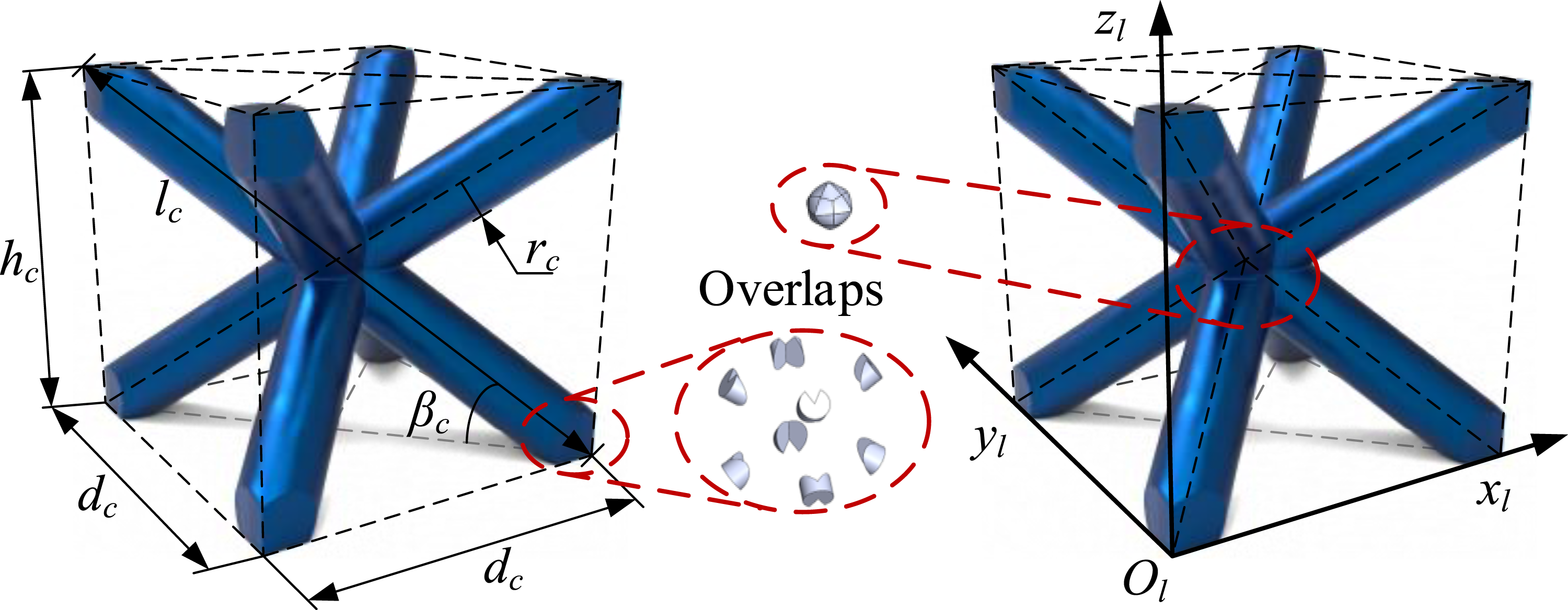
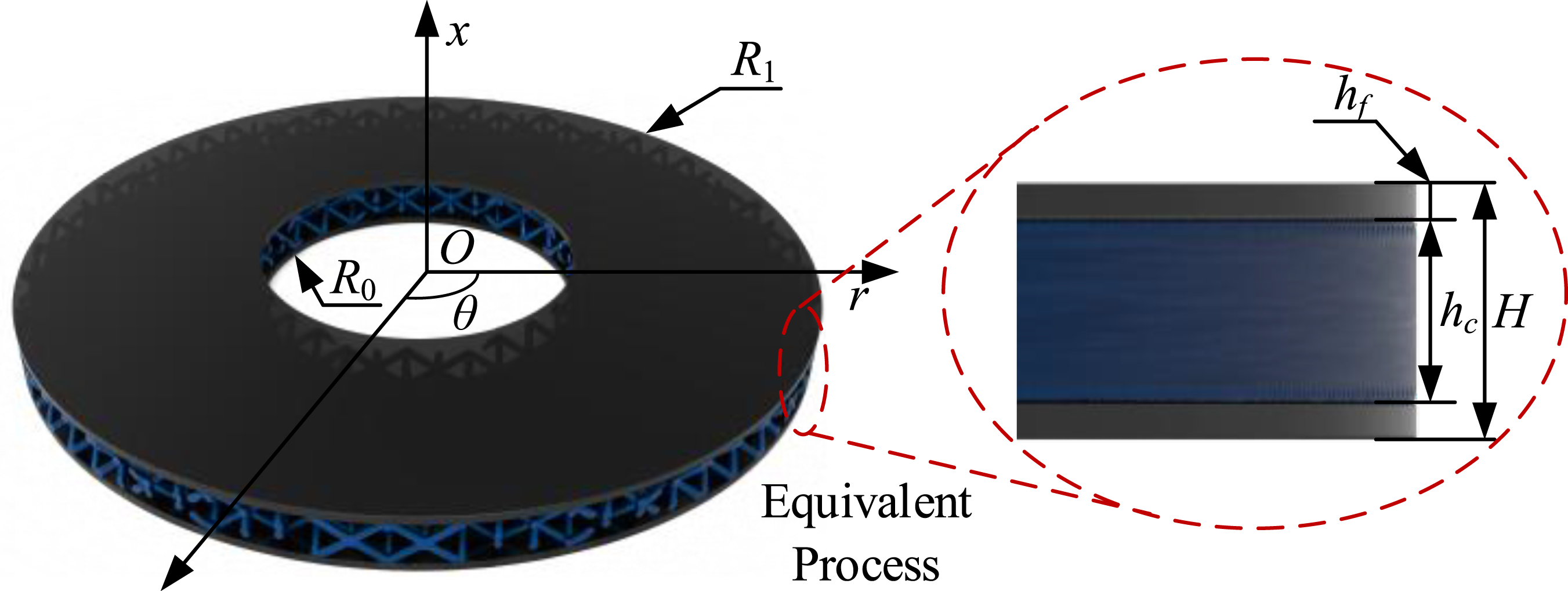
In order to accurately represent the positional relationship of the model, the coordinate system O rθz located in the midplane of the model is established in the present, and the displacement component along the direction of the localized rectangular coordinate system of the annular plates is set to be denoted by (u, v, w).
Material properties
The BCC lattice structure is a complex three-dimensional lightweight structure for which there is no direct analytical solution. Nevertheless, when observed from a macro perspective, the BCC lattice structure is defined as a periodic arrangement of individual lattice structures. Consequently, it can be considered analogous to a continuous homogeneous material of equivalent thickness and size. The equivalent density’s ratio to the raw material density can be defined by comparing two volumes. Specifically, the volume occupied by the four trusses is compared to the volume of the equivalent rectangular body. This relationship is mathematically represented as

However, Figure 1 demonstrates that partial volume overlap occurs in the BCC lattice’s four trusses. This overlap appears at both end regions and the central area. Specifically, the truss radius determines the extent of the overlapping area. Polynomial fitting can be applied to characterize this relationship. Consequently, the equivalent density equation can be rewritten as follows


Young’s modulus and the equivalent shear modulus are both derived in Ref. 42. Their mathematical expressions are given below


Energy relation of BCC sandwich plate
To broaden the applicability of this research, a three-dimensional elasticity theory model will be utilized. This model serves to examine annular plate structure dynamics. For the annular plates, their displacement field equation is obtained as follows
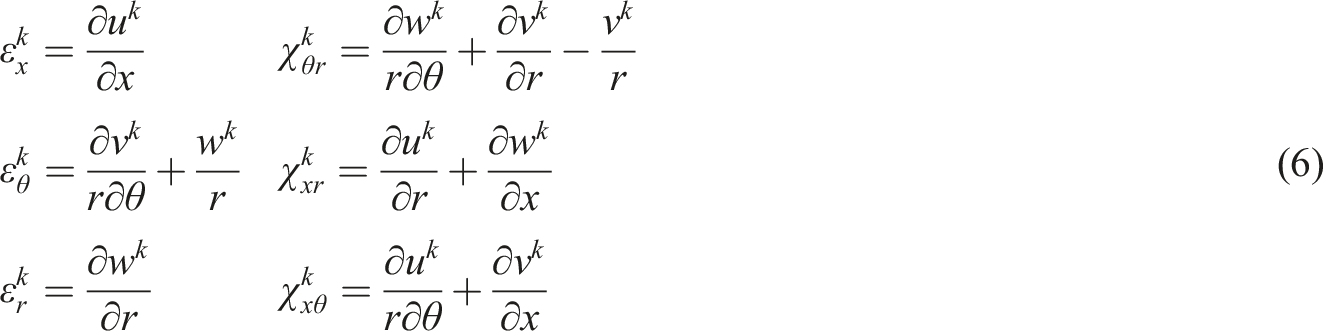
Isotropic linear elastic materials obey specific constitutive relationships.43–45 These relations can be expressed as
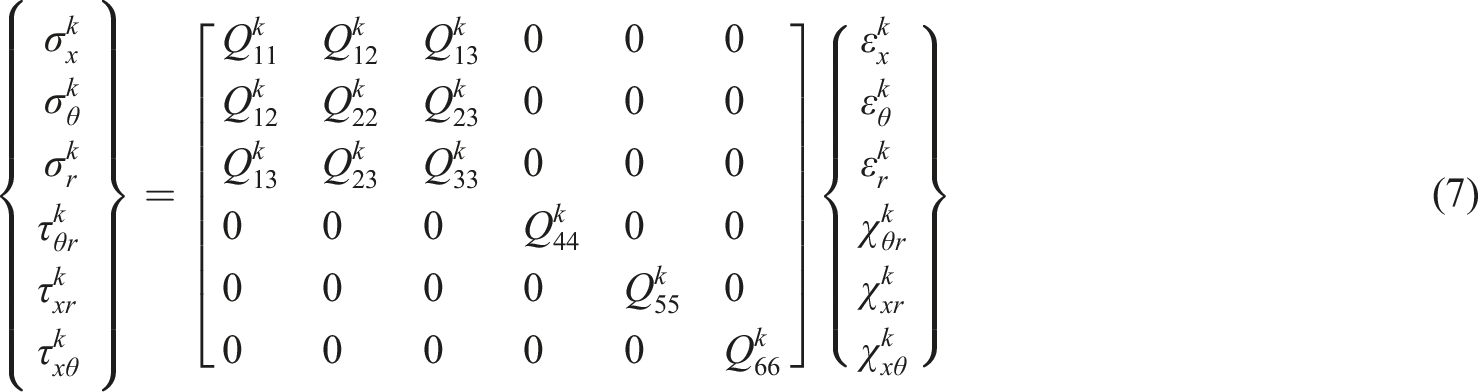



Derivation from the energy equation reveals strain energy characteristics in the kth layer. Specifically, this energy component of the BCC lattice sandwich annular plates is mathematically described by46–49

The simulation of distinct boundary scenarios is facilitated by the employment of virtual spring technology, wherein the stiffness of the virtual spring is modulated to exert varying boundary conditions. In accordance with the aforementioned principle, the virtual spring’s contained elastic potential energy is formulated as follows


In order to ensure the coordination condition of the displacement between layers, the penalty function method implements this conversion, transforming displacement coordination between layers into a coupling potential. Mathematically, the converted relationship takes the following form

The expression for the kinetic energy of a BCC lattice sandwich annular plates, accounting for translational inertia, rotational inertia, and gyroscopic terms, can be expressed as follows

In summary, for BCC lattice sandwich annular plates, the Lagrange energy equation is derived through energy expression summation. The resultant formulation yields
50

Admissible functions
To derive discrete motion equations for rotating BCC lattice sandwich annular plates, displacement components undergo expansion. This expansion utilizes generalized coordinate variables and displacement tolerance functions. In order to reduce the computation, the circumferential displacement is expanded into wave numbers by the improved Fourier series method, which transforms the three-dimensional problem into a two-dimensional one. The Modified Fourier series has been demonstrated to possess superior adaptive analyzing capabilities, exhibiting optimal convergence and computational stability. According to the aforementioned information, the displacement component of the annular plates can be expressed as follows




Employing the Rayleigh-Ritz approach, variation of unknown Lagrangian function coefficients yields the motion equation. This derivation specifically applies to BCC lattice sandwich annular plates


Result and discussions
Numerical validation
The convergence behavior of the current method concerning the truncation numbers within the Modified Fourier series is examined in this section. According to the displacement function’s expansion principle, an increase in the truncation number enhances result accuracy. However, a rise in computational cost is inevitable. Consequently, to balance computational efficiency satisfactorily while ensuring accuracy, the smallest feasible truncation number is selected.
Figure 3 illustrates how the natural frequency of annular plates varies with changes in the truncation numbers P and Q. The annular plates possess the following geometrical parameters: R1 = 0.25 m, R0 = 0.03 m, h
f
= 2 mm, h
c
= 8 mm, d
c
= 8 mm, and r
c
= 2 mm. Each layer of these plates is constructed from identical isotropic material. The material properties are defined as: Elastic modulus E = 110 GPa, Poisson’s ratio μ = 0.34, and density ρ = 4510 kg/m3. Convergence of natural frequency on truncation numbers (P, Q) of Modified Fourier series.
Observation of Figure 3 reveals that the first natural frequency exhibits rapid convergence. This holds true across different circumferential wave numbers and various boundary conditions. Furthermore, beyond the point where P and Q reach or exceed 8, the dimensionless frequency remains virtually unchanged. Thus, the selection of P = Q = 10 for the numerical examples presented in this paper is justified and demonstrates sufficient convergence.
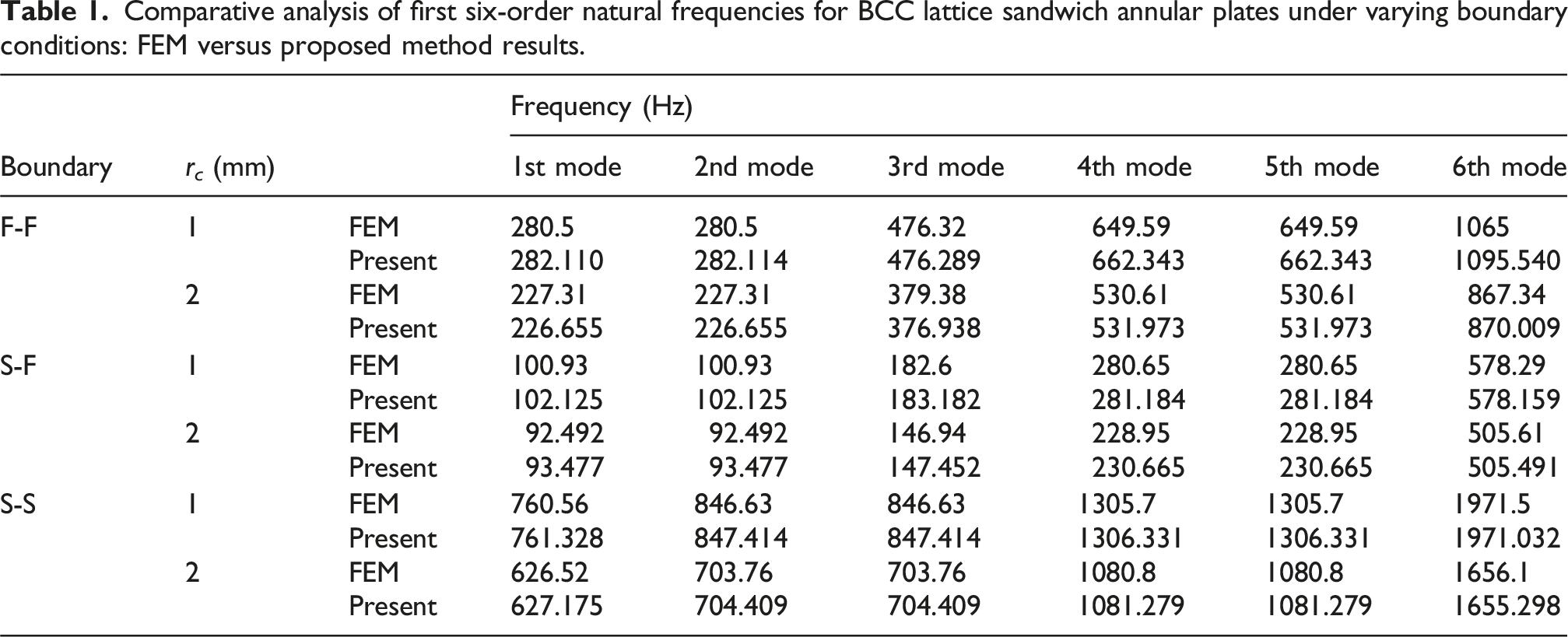
Comparative analysis of first six-order natural frequencies for BCC lattice sandwich annular plates under varying boundary conditions: FEM versus proposed method results.
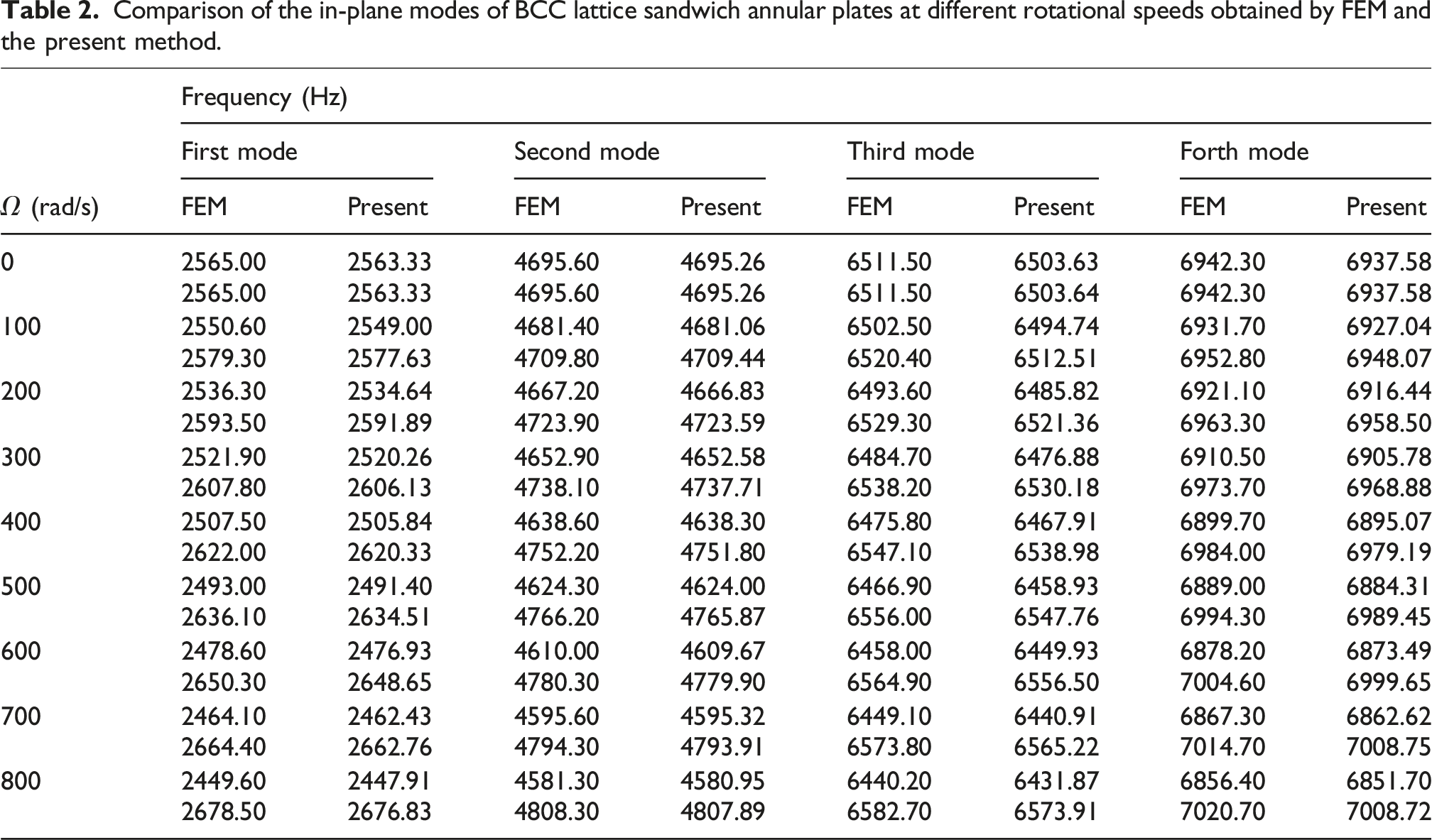
Comparison of the in-plane modes of BCC lattice sandwich annular plates at different rotational speeds obtained by FEM and the present method.
The effect of the BCC lattice structure on the annular plates in-plane modes in the rotating state is illustrated in Figure 4. It is evident that the BCC lattice structure significantly reduces the annular plates density and synchronously reduces its fundamental frequency. In the process of rotational speed change, the rate of change of the modal frequency in the face of the structure remains essentially unchanged. This indicates that its critical rotational speed is reduced accordingly. However, for conventional solid annular plates with large thicknesses, the inherent critical speed is usually much higher than that required for practical applications, resulting in unnecessary safety margins. Consequently, the implementation of the BCC lattice structure emerges as an effective lightweighting strategy, ensuring that the critical speed is met while adhering to the safety operation requirements, thereby achieving a substantial reduction in the structural mass. Effect of BCC lattice structure on the turntable modes under S-F boundary condition.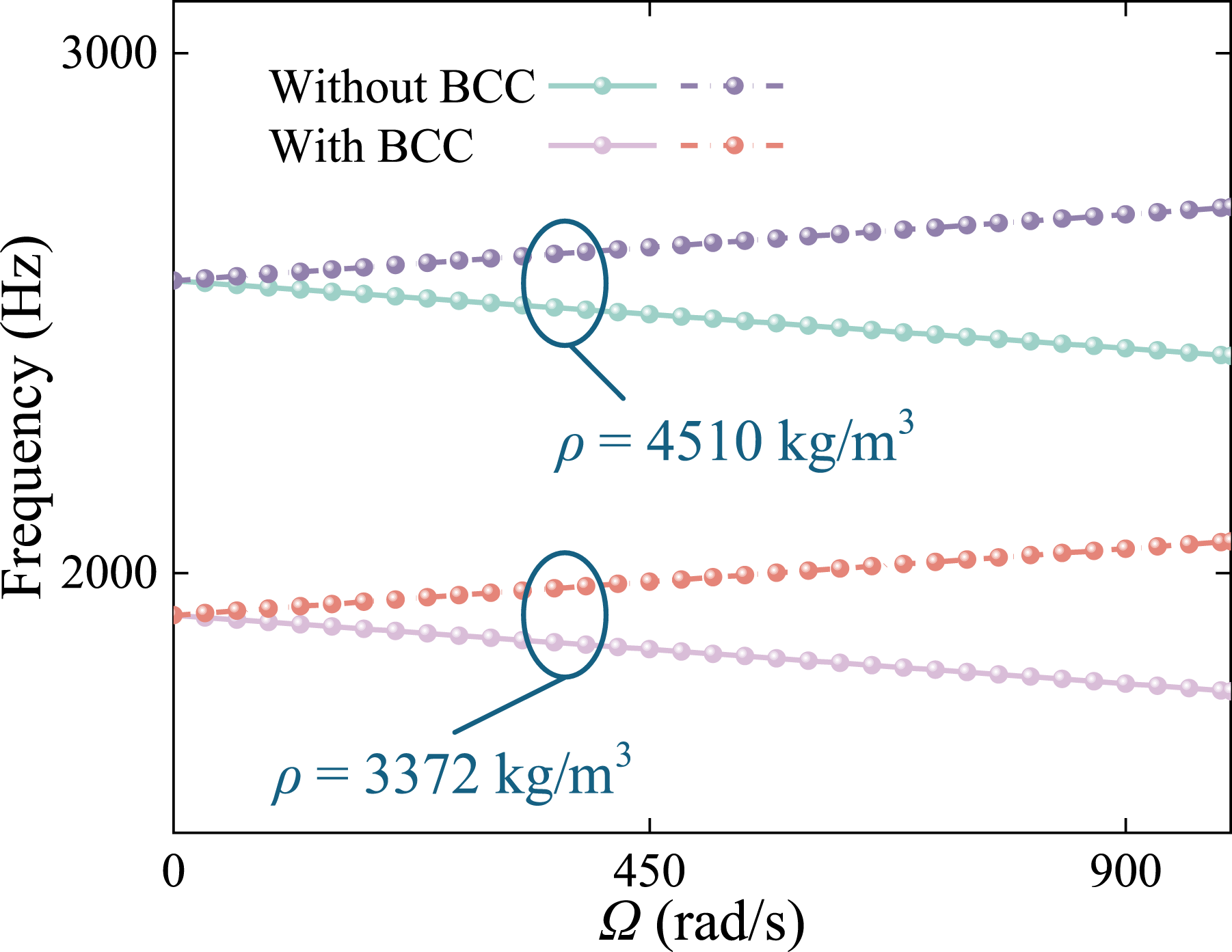
Parametric analysis
A comprehensive parametric analysis of the rotational frequency of the BCC lattice annular plates under varying rotational speeds was systematically conducted, focusing on parametric dependencies affecting the coupled natural frequency. These parameters include the lattice dimensions d c , rod radius r c , lattice height h c , skin thickness h f , and rotation speed Ω of the wheel. Unless otherwise indicated, the parameters of the system are set to R1 = 0.25 m, R0 = 0.03 m, h f = 2 mm, h c = 8 mm, d c = 8 mm, r c = 2 mm, E = 110 GPa, ρ = 4510 kg/m3, μ = 0.34, Ω = 500 rad/s. The coupled natural frequency of the system is determined using the following parameters.
The variation of the natural frequency of the BCC lattice sandwich annular plates is presented for various boundary conditions and rotational speeds (Ω = 0 rad/s) with different annular plates outer and inner diameters. As illustrated in Figure 5, distinct trends emerge when the inner annular plates boundary is varied. When the inner annular boundary condition is free, natural frequency reduction occurs in annular plates as their outer diameters expand. Consequently, the inner annular radius exerts minimal influence on the natural frequency and appears to be reduced locally. When the inner annular boundary condition is simply supported, the effect of inner annular radius on the natural frequency increases significantly, and the smaller the outer diameter is, the more significant the effect is, which is mainly presented as the larger the inner diameter is, the larger the frequency is. Effect of radius of BCC lattice sandwich annular plates on the first natural frequency under different boundary conditions.
The variation of the natural frequency of the BCC lattice annular plates for different lattice unit cell sizes and different lattice heights, with different boundary conditions, and at a rotational speed Ω = 0 rad/s is illustrated in Figure 6. A demonstrable proportional relationship emerges: the annular plates’ natural frequency escalates concurrently with enlargements in both lattice unit cell size and lattice unit cell height. The effect of increasing the height of the lattice unit cell is particularly pronounced, resulting in a substantial increase in the natural frequency. This frequency augmentation phenomenon originates fundamentally from the simultaneous expansion of unit cell dimensions, which measurably diminishes the structure’s equivalent density. Consequently, this leads to an increase in the natural frequency. On the other hand, when the unit cell height is decreased, the equivalent density of the BCC lattice is reduced while the thickness of the structure is increased. Consequently, this density reduction mechanism triggers a compounded decrease in the system’s overall structural density. As a result, the natural frequency increases at a faster rate. Effect of BCC lattice parameters on the first natural frequency under different boundary conditions.
The three-dimensional variation of the natural frequency parameters of the first four orders of BCC lattice sandwich annular plates at a fixed rotational speed of the wheel is given with different unit cell sizes d
c
and different rod radius r
c
. As shown in Figure 7 that the natural frequency of the BCC lattice sandwich annular plates increases as the rod radius increases. This frequency augmentation stems directly from concurrent enlargements in unit cell size dc and rod radius r
c
, which elevate both equivalent density and equivalent Young’s modulus. These elevated material properties collectively induce sustained natural frequency escalation in sandwich annular plates. Reducing the unit cell radius r
c
simultaneously decreases both the equivalent density and the equivalent Young’s modulus. A decrease in the annular plates’ natural frequency is caused by the reduction in equivalent density. Conversely, an increase in the natural frequency of these plates is brought about by the diminishment of the equivalent Young’s modulus. Three-dimensional variation of the natural frequency parameter of the first-fourth-order BCC lattice sandwich annular plates at a fixed rotational speed of the disk under S-F boundary condition.
The behavior observed in the figure, where the natural frequency first decreases and then increases as r c is reduced, confirms this shift phenomenon. This shift reflects the changing dominance of the key parameters governing the natural frequency’s variation. Both in the determination of the size d c state, there is a unit cell radius r c equilibrium value, in reaching the equilibrium value when the equivalent Young’s modulus and the equivalent density of the structure of the effect of the natural frequency to reach equilibrium, greater than the value of the equivalent density dominated by the change in natural frequency, less than the value of the equivalent Young’s modulus dominated by the change in the natural frequency. This should be emphasized in the actual engineering design.
Figure 8 gives the trend of the modal changes with different rotational speeds in the first order in-plane modes of the BCC lattice sandwich annular plates under different unit cell parameters. It is clearly seen that there is almost no difference in the effect of rotational speed on the modal state for different unit cell parameters, so it can be judged that the unit cell parameters can only affect the fundamental frequency of the structure and have no effect on the frequency change after applying rotational speed. However, changing the fundamental frequency can still change the critical speed of the annular plates significantly, so the study of the variation of these parameters is still of practical significance to engineering. Variation of first order in-plane modes with rotational speed under different structural parameters under S-F boundary condition.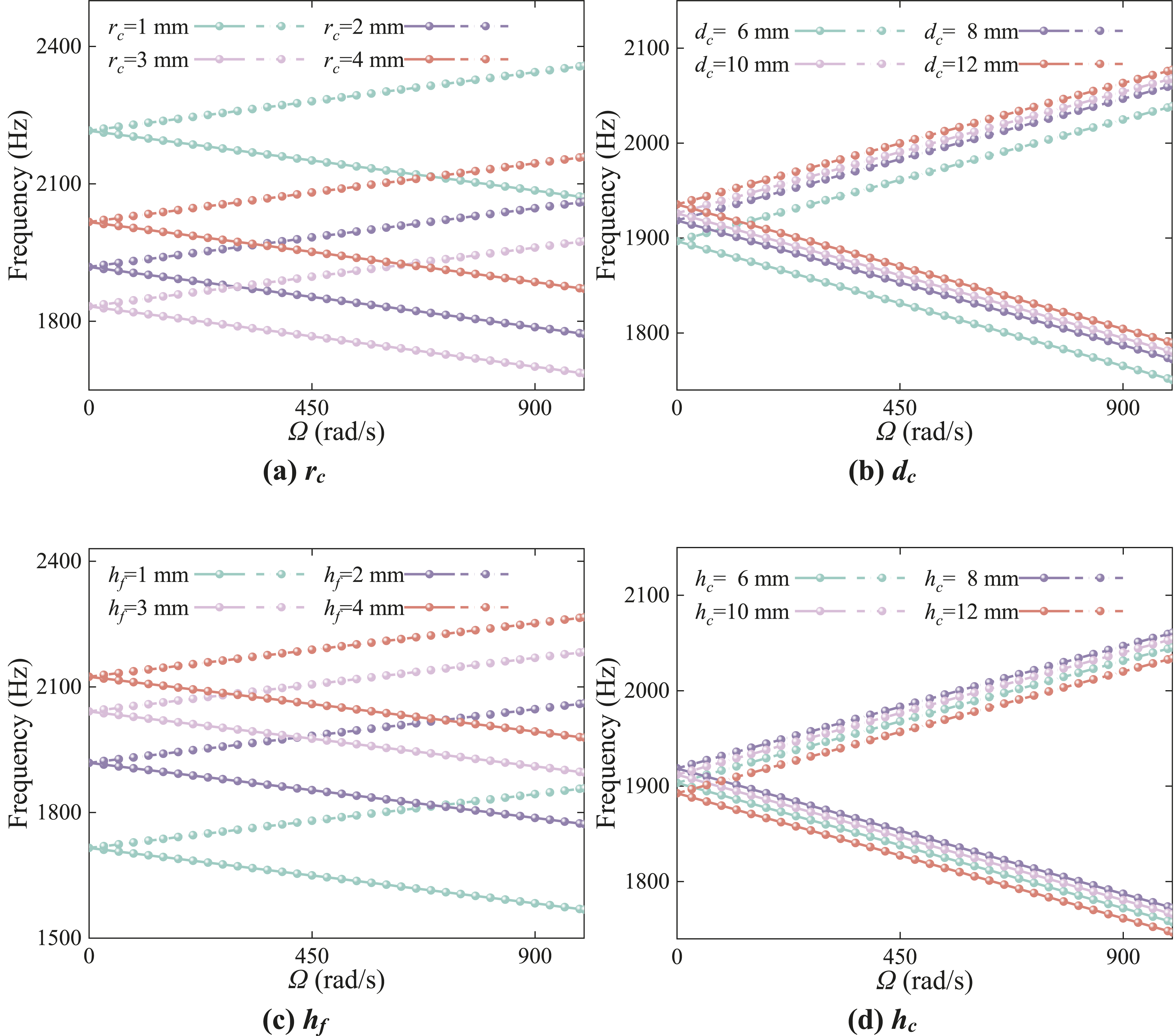
From the figure, it can be seen that although the unit cell rod radius r c , unit cell size d c , skin thickness h f and unit cell height h c all have an effect on the base frequency of the annular plates, however, the unit cell size d c and unit cell height h c have a smaller effect on the base frequency, so the adjustment should be mainly based on the two parameters of the unit cell radius r c and skin thickness h f . This is due to the fact that both the unit cell radius r c and surface thickness h f can significantly influence the equivalent density and overall stiffness of the structure, thereby affecting its natural frequency. Under the premise that the rotational speed has a negligible impact on the modal state, any change in the natural frequency will substantially affect the critical rotational speed of the structure. As the unit cell radius r c increases, the fundamental frequency decreases and then increases, and the corresponding critical speed also decreases and then increases. As the thickness of the skin h f increases, the fundamental frequency continues to increase, and the corresponding critical speed also continues to increase, however, this increase will change the thickness of the structure. Therefore, the unit cell radius r c or the thickness of the skin h f should be considered according to the demand in the actual engineering application.
Conclusions and outlooks
The theoretical model of free vibration of BCC lattice sandwich annular plates under rotational motion is established based on three-dimensional elasticity theory and the equivalent plate theory. The control equations that can solve the vibration characteristics of the annular plates are derived using the modified Fourier series. The veracity of the model is substantiated through a comparison with the calculation results generated by finite element software. A series of parametric analyses were conducted to draw conclusions and offer suggestions for the design of BCC lattice sandwich annular plates in engineering applications: (1) The BCC lattice structure is confirmed as an effective lightweighting strategy, significantly reducing structural mass while maintaining critical speeds within safe operational limits, as demonstrated by the parametric analysis; (2) There exists an equilibrium point between the influence of Young’s modulus and density when the unit cell rod diameter varies, greater than the equilibrium point by the equivalent density dominates the change of structural modes, and on the contrary by the Young’s modulus dominates the change of structural modes, and the determination of this equilibrium point is crucial for the engineering application of BCC lattice structures; (3) Parametric studies reveal that critical speed can be effectively tuned by adjusting the skin thickness and rod diameter. However, the changes and the impacts are different, and it is necessary to choose the appropriate method according to the needs of the actual engineering applications.
Despite the insights provided by this study, certain limitations should be acknowledged. Firstly, the present model lacks experimental validation, which is crucial for confirming its practical predictive accuracy. Secondly, the analysis neglects the potential influences of thermal gradients and complex aerodynamic loads, which are inherent in real-world aero-engine operating environments. Lastly, the assumption of material isotropy in the equivalent model, while simplifying the analysis, may not fully capture the anisotropic characteristics of certain additively manufactured lattice structures.
Future work will be undertaken to address these limitations, with experimental validation being the foremost priority. One key research direction involves integrating current vibration models with thermomechanical analysis to investigate performance under combined thermal and dynamic loading conditions. To substantially enhance the persuasiveness of the research findings, a comprehensive experimental campaign will be implemented, employing advanced non-contact measurement techniques such as laser Doppler vibrometry to validate the numerical predictions under both static and rotational states. This systematic validation approach will establish a robust correlation between theoretical models and empirical data, thereby significantly strengthening the practical credibility and reliability of the proposed methodology for engineering applications.
Footnotes
Acknowledgments
The authors would like to thank the anonymous reviewers for their very valuable comments.

Funding
The authors disclosed receipt of the following financial support for the research, authorship, and/or publication of this article: This work was supported by the National Natural Science Foundation of China (Grant No. 52475145), the Science and Technology Innovation Program of Hunan Province (Grant No. 2023RC3029) and Central South University Innovation-Driven Research Program, China (Grant No. 2023CXQD049), the Postdoctoral Fellowship Program of CPSF (Grant No. GZC20250921), the China Postdoctoral Science Foundation-Hunan Joint Support Program (Grant No. 2025T005HN).
Declaration of conflicting interests
The authors declared no potential conflicts of interest with respect to the research, authorship, and/or publication of this article.