




Abstract
The total mass matrix cannot satisfy the requirement of orthogonality for linearly damped systems with added mass. Traditional modal superposition method will be not be directly used for calculating time-domain responses. In order to calculate the responses, a real domain modal superposition method based on simplified damping matrix and a complex domain modal superposition method based on state space method are constructed, respectively. The numerical examples show that the calculation results of these two methods are approximately equal. Then the dynamic responses of the linearly damped system with different distributions of added mass are analyzed. As the number of storey with added mass decreases, the lateral resistance of the structure increases. The added mass should be prioritized at the bottom storey.
Introduction
In order to meet the functional requirements of the structure, it is necessary to add some equipment or materials to the in-service structure. The added mass can affect the dynamic characteristics of the structure.1,2 Zhang and Xu 1 studied that the vertical and torsional added mass effects the mechanical frequency and damping ratio of vibrating bridge decks. Jančar et al. 3 studied the seismic resistance of structures with different number of added light timber structure storeys. Garcia and Bernitsas 4 analyzed the influence of variable added-mass on damped natural frequency and determined the relationship between variable added-mass and nonlinear damping. Osman and Willden 5 studied the influence of added mass on natural frequency and damping force for the floating tidal turbines. Zeng et al. 6 analyzed that the added mass affects the structural acceleration and hydrodynamic damping characteristics for a hydrofoil. The added mass does not change the absolute stiffness of the main structure. However, the relative stiffness of the new linearly damped systems with added mass will be changed. The damping systems will be transformed into non classically damped systems. 7 Traditional real mode superposition method will not be applied. The damped factor and mass-stiffness distribution are important for the linearly damped systems with added mass, which will affect the dynamic responses of the structures.
In this paper, in order to calculate the dynamic responses of linearly damped systems with added mass, two time-domain modal superposition methods are constructed. One is a real domain modal superposition method based on simplified damping matrix. The other is a complex domain modal superposition method based on state space method. Then the two methods are compared and analyzed. The numerical examples show that the distribution of added mass effects the dynamic analysis of the linearly damped system.
The modal superposition methods of linearly damped systems with added mass
Based on the viscous damping model, the time-domain equation for a multi degree of freedom system is

The damping model of systems are selected as Rayleigh damping model.
8
The damping matrix is proportional to mass matrix and stiffness matrix,
9
namely

Based on the Rayleigh damping model, the modal damping ratio of the j-th vibration mode is obtained as

Equation (3) shows that the modal damping ratio depends on the Rayleigh damping coefficients α and β. Therefore, the determining of Rayleigh damping coefficients directly affect the rationality of the calculation results.
When the system adds additional mass, the time-domain equation is rewritten as

Based on

Then

Equation (6) shows that the total mass matrix cannot satisfy the requirement of orthogonality. Therefore, the traditional modal superposition method will be not be used to solve equation (4).
In order to solve the problem, the two modal superposition methods are constructed. The first method is a real domain modal superposition method, which assumes that the added mass affects the damping matrix and the new damping matrix can satisfy orthogonality. The second method is a complex domain modal superposition method by aid of state space method, which does not change the damping matrix of the original system. The two methods are applied for small damping structures in the linear elastic stage, which cannot be directly applied to the big damping and the nonlinear damping structures. However, the proposed methods are important basis.
Real domain modal superposition method
The damping model of system with added mass is selected as Rayleigh damping model. The new damping matrix is proportional to total mass matrix and stiffness matrix, which is expressed as


The determination of Rayleigh damping coefficients depends on the selection of natural frequencies. Here ω m and ω n are selected as the natural frequencies of the first and second vibration modes. 10
Then the time-domain equation can be rewritten as

Based on

The displacement vector can be expressed as

Equation (11) is substituted into equation (9). Based on the orthogonality of modal vectors, equation (9) is decoupled into





Solving equation (12), pj(t) can be obtained. pj(t) is substituted into equation (11), and
Complex domain modal superposition method
In order to solve equation (4), the state space method is adopted. The auxiliary equation is introduced, namely

Combining equation (4) with equation (17), the new equation is expressed as





The complex eigenvalues of equation (18) can be obtained as

The complex eigenvectors of equation (18) can be obtained as

It is assumed that


Based on equation (23), (25), and (26), they are obtained as


Equation (28) is substituted into equation (18), which is obtained as


The standard equation of single degree of freedom system is

Based on equations (29) and (31), it is obtained as

Equation (32) is substituted into equation (28), which is obtained as


Solving equation (31), q
j
(t) can be obtained. q
j
(t) is substituted into equation (33), and
Numerical example
The surgical building structure of a certain hospital is taken as an example. The surgical building structure can be simplified into a multi-layer framework structure, as shown in Figure 1(a). The equipment layer is added at the top, middle, and bottom storeys, respectively. The corresponding schematic diagrams are shown in Figures 1(b)–(d). The mass and stiffness distributions of numerical models are shown in Figure 1. The material is reinforced concrete and the damping ratio is 0.05. The natural frequencies of numerical models are shown in Table 1. The diagrams of different models with added mass. (a) Model A; (b) Model B; (c) Model C; (d) Model D. Note: m is mass of storey; m0 is added mass; k is stiffness of storey. The natural frequencies of numerical models (unit: rad/s).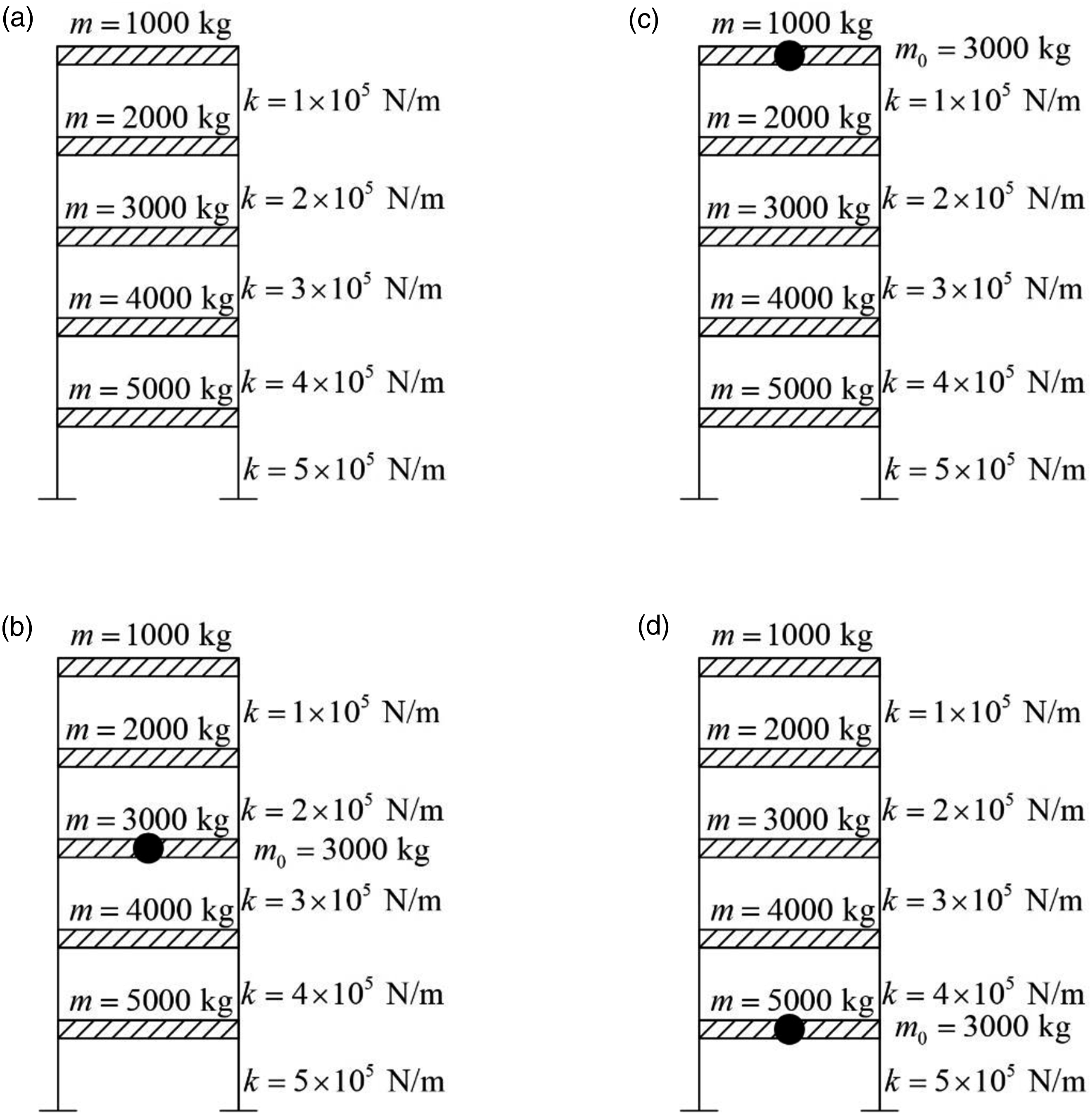

The damping matrix of main structure is constructed based on Rayleigh damping matrix and the first and second vibration modes are selected. Due to El Centro earthquake wave, the real domain modal superposition method (RMSM) and complex domain modal superposition method (CMSM) are used to calculate the time-domain dynamic responses of a multi-layer framework structure with added mass. Here the first and second vibration modes are also selected for RMSM. The top time-history displacements of Model A, B, C, and D are shown in Figures 2 and 3. The top time-history displacements with RMSM for different models under El Centro earthquake wave. The top time-history displacements with CMSM for different models under El Centro earthquake wave.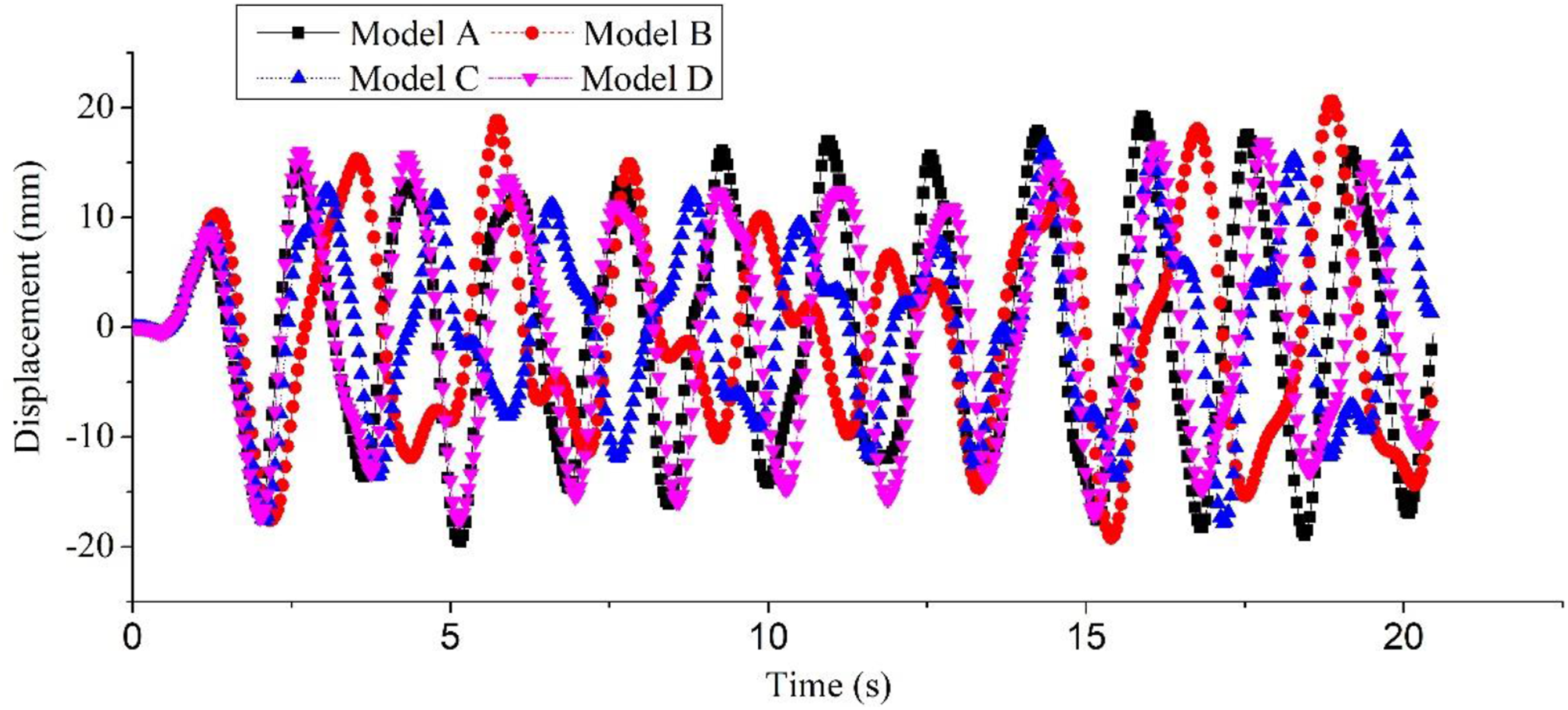
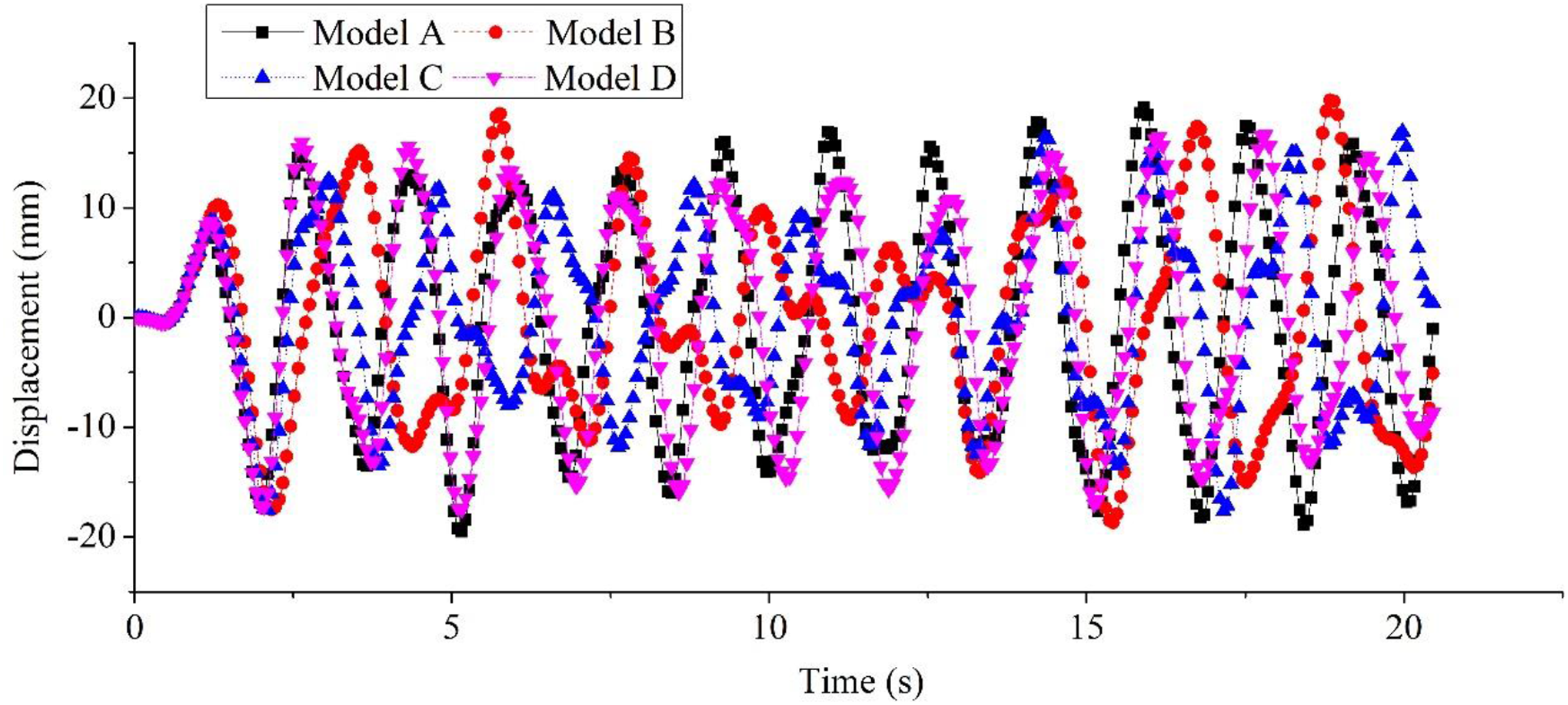
Comparisons of calculation results based on the two methods under El Centro earthquake wave.
Comparisons of peak displacements for different models under El Centro earthquake wave (unit: mm).

RMSM and CMSM are used to calculate the time-domain dynamic responses of Model B, Model C, and Model D by aid of personal computer (CPU: AMD Ryzen 78845H, RAM: 32.0 GB), respectively. The computing time of RMSM is 0.5 s. The computing time of CMSM is 3.2 s. The results show that the computational efficiency of RMSM is higher. The reason is that CMSM includes the decoupling process of complex modes, and the dimension of the calculation matrix is larger.
Due to Tianjin earthquake wave, RMSM and CMSM are used to calculate the time-domain dynamic responses of a multi-layer framework structure with added mass. The top time-history displacements of Model A, B, C, and D are shown in Figures 4 and 5. The comparisons of RMSM and CMSM are compared, as shown in Table 4. The peak displacements of Model A, B, C, and D are shown in Table 5. The top time-history displacements with RMSM for different models under Tianjin earthquake wave. The top time-history displacements with CMSM for different models under Tianjin earthquake wave. Comparisons of calculation results based on the two methods under Tianjin earthquake wave. Comparisons of peak displacements for different models under Tianjin earthquake wave (unit: mm).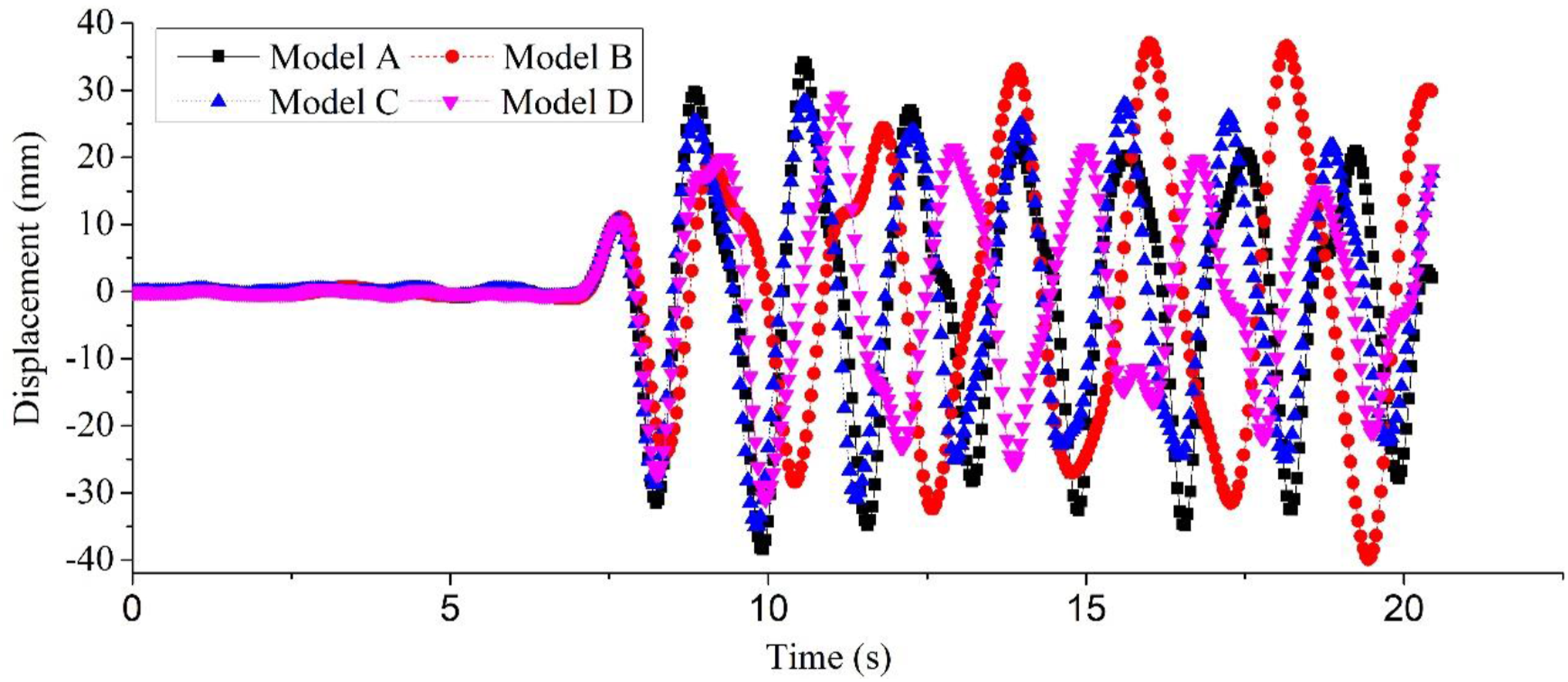
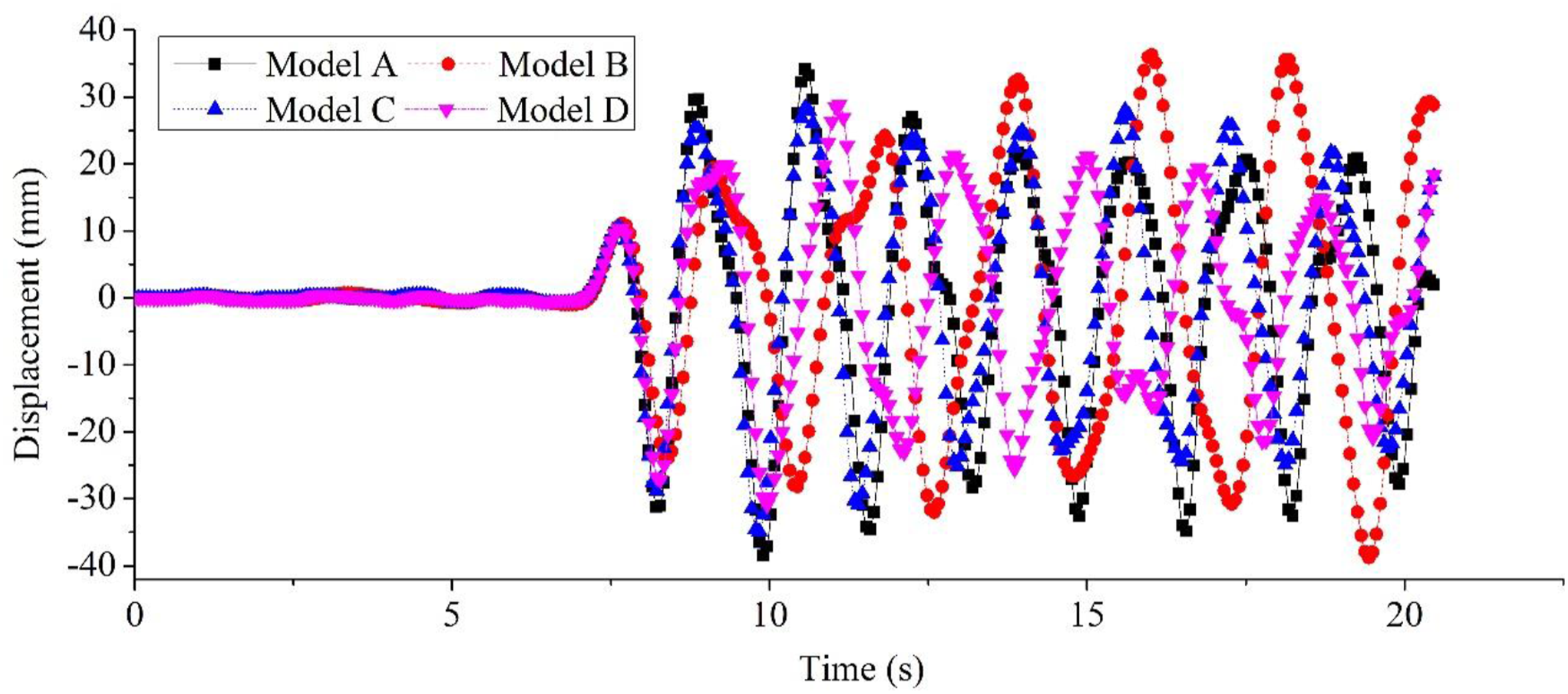
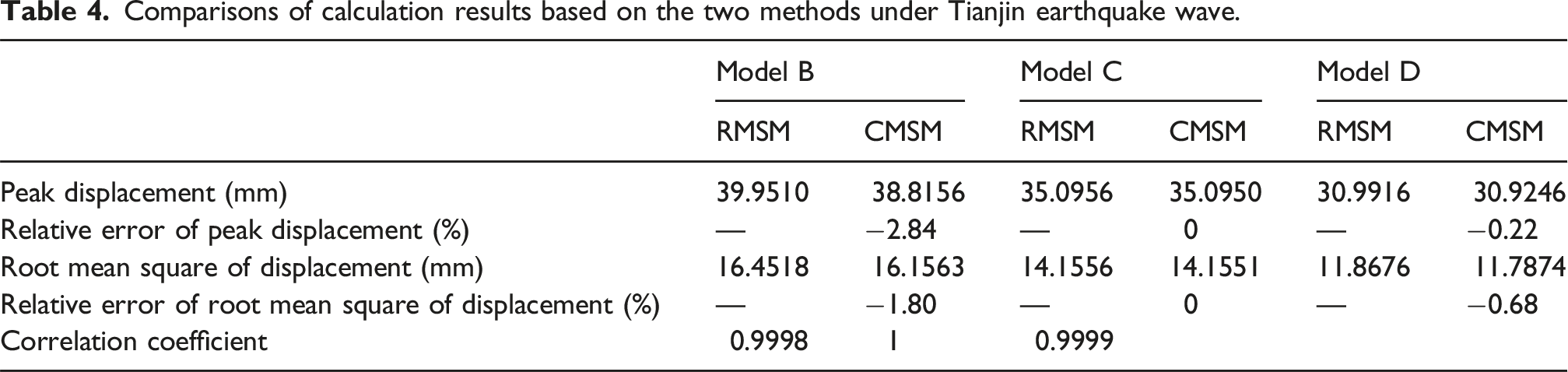

The maximum relative difference of the two methods is 2.84% and the minimum correlation coefficient is 0.9999. Therefore, the calculated results of RMSM are approximately equal to those of CMSM. The peak displacement at the top of Model B is greater than that of Model A. The peak displacements at the top of Model C and D are less than that of Model A. The vibration law of structural responses under Tianjin earthquake wave is similar to that of structural responses under El Centro earthquake wave.
Conclusions
In this paper, in order to calculate the time-domain dynamic responses of linearly damped systems with added mass, real domain modal superposition method and complex domain modal superposition method are constructed. The numerical examples with the different distributions of added mass are analyzed. Some conclusions are as follows. (1) The calculated results of the real domain modal superposition method are approximately equal to those of the complex domain modal superposition method. The real domain modal superposition method is a simplified calculation method and the computational process is simpler. (2) The complex domain modal superposition method is an accurate calculation method, which does not change the damping matrix of the main structure. However, the calculation process depends on the state place and the computational efficiency is lower. (3) The distribution of added mass effects the dynamic analysis of the linearly damped system. When the added mass is located at the top storey, the lateral resistance of the structures is weakened. When the added mass is located at the middle or bottom storey, the lateral resistance of the structures is strengthened. The added mass should be prioritized at the bottom storey.
Footnotes

Funding
The work was supported by the Natural Science Foundation of Henan Province (Grant No. 252300421816) and Key Research Project of Henan Higher Education Institutions (Grant No. 25A430032).
Declaration of conflicting interests
The authors declared no potential conflicts of interest with respect to the research, authorship, and/or publication of this article.