




Abstract
The railway elastic strip fastener system is heavily used in the laying of seamless lines, where the buckle pressure of elastic strip fasteners is an important part of railway safety inspection. This paper investigates and analyzes the eigenfrequency measurement method of the buckle pressure of the rail elastic strip fastener based on the modal theory, and analyzes the relationship between the first two orders of characteristic frequency and the buckle pressure using COMSOL Multiphysics simulation. Meanwhile, based on the relationship between the axial load of the spiral stud and the buckle pressure of the sling, the buckle pressure of the railway fastener can also be obtained by measuring the propagation time of the transverse and longitudinal waves in the spiral stud. Through experiments, the second-order characteristic frequency of the elastic strip vibration, the relationship between the buckle pressure and the preload torque of the fastener, and the relationship between the horizontal and vertical wave acoustic time difference and the buckle pressure of the elastic strip are measured, which provides an effective solution for accurately measuring the buckle pressure of the elastic strip.
Introduction
The rail elastic strip fastener system is an important part of the railway structure. This kind of fastener system can provide the required buckle pressure for the rail, 1 so that the rail and the sleeper form a reliable connection. The system is applied to the track load distribution of the concrete sleeper and track substructure 2 to avoid excessive deformation of the rail and other effects.
Due to the harsh and variable working environment of outdoor lines, the stress state of the rail is particularly complex. The fastener system is mainly subjected to the load caused by passing trains and temperature changes of the rail 3 ; after a long period of service, this load will inevitably produce fatigue loosening and, more seriously, breakage and rupture, affecting the safety of railway transportation. 4 Therefore, it is particularly important to quickly and accurately assess changes in elastic strip buckle pressure from data.
Some scholars have carried out analytical studies on railway fastener systems. Matthew et al. 5 proved through experiments that the stiffness and damping of railway fasteners are important factors affecting the dynamic characteristics of railways. Thompson et al. 6 proved through experiments that the fastener load of railway fasteners has a significant effect on their high-frequency vibration. Gao et al. 7 investigated the relationship between the parameters of fastener wear, fastener dynamic frequency response, and fastener dynamic stress in high-speed railroads, and revealed the dynamic failure mechanism of fastener damage in high-speed railroads caused by high-frequency excitation. Yang 8 optimized the simulation model of the W1-type elastic strip fastener system with nonlinear contact theory, and derived the relationship between the buckle pressure of the elastic strip and the applied load. Wang et al. 9 arranged force sensors for ω-type elastic strip fastener, and obtained the buckling pressure of the elastic strip by monitoring and recording the torque data and the force sensor data, this kind of measurement method is detached from the overall structure of the elastic strip fastener system, and cannot reflect the actual working conditions of the fastener. Rustamovich. 10 analyzed the elastic characteristics of a variety of fasteners and designed a cylinder lifting device for a certain type of railroad fastener in Uzbekistan, thus achieving the purpose of fastening pressure measurement. However, the disadvantage of using such a mechanical measuring device is that the device must be arranged at the appropriate position before measuring each fastener, and the workload becomes heavy with the increase of measurement work.
In terms of ultrasonic stress measurement, Janusz et al. 11 established a mathematical model for several parameters such as acoustic elasticity coefficient and ultrasonic acoustic time, and finally verified the correctness of the model by combining with finite element simulation and test. Nehu Kim et al. 12 analyzed the law of the influence of axial stress on ultrasonic velocity in screws, and deduced linear acoustic elasticity equations, and through the measurement of ultrasonic propagation time of carbon steel bolts test, which proved the effectiveness of the theoretical ray analysis method. Xu et al. 13 proposed a measurement method combining ultrasonic transverse wave and ultrasonic longitudinal wave, deduced the theoretical equation, and solved the problem of tensile deformation and other factors affecting stress measurement. Jia Xue et al. 14 studied the ultrasonic longitudinal wave axial force detection method, built a bolt axial force measurement device, combined with wavelet noise reduction algorithm proved that the bolt axial stress and its internal ultrasonic wave propagation time difference is obviously linear relationship.
For the current research on the measurement of the buckle pressure of elastic strip fastener, the measurement methods and devices have obvious drawbacks in terms of accuracy and detection speed, and at the same time, for the measurement of the buckle pressure of elastic strip fastener in service, there is a blind spot in the research. Therefore, this paper proposes the combination of modal method and ultrasonic method, taking the type II railway elastic strip fastener as the research object and carries out a theoretical analysis of the vibration mode of the elastic strip, as well as the finite element calculation of the vibration characteristics of the elastic strip in service. The first two orders of the modal characteristics of the elastic strip are obtained, as is the relationship between the characteristic frequency and the buckle pressure of the elastic strip, and the feasibility of the modal method of measuring the buckle pressure. At the same time, the relationship between the preload force, axial load, and buckle pressure of the spiral stud is studied and analyzed, and then the propagation time of transverse and longitudinal waves in the spiral stud is measured using the ultrasonic method to obtain the buckle pressure of the spike. The analytical study of the buckle pressure measurement results of two kinds of spikes is reflected in the paper.
Finite element simulation calculation of elastic strip fastener systems
Vibration modal theory
The vibration differential equation of the service elastic strip can be obtained according to relevant elastic mechanics theory15–17:

The vibration of the elastic strip is simplified to a simple harmonic vibration, and its vibration displacement versus time can be expressed as a sinusoidal function:


Using the finite element method to solve equation (3), the n values of the characteristic values
Ultrasonic measurement theory
Elastic strip buckle pressure can be equated with the fastener buckle pressure; however, the buckle pressure of elastic strip fasteners is generated by the preload of the spiral spikes, so it can be measured by the axial load of the spiral spikes, and then get the elastic strip buckle pressure. The ultrasonic method of measuring the buckle pressure of the elastic strip is expanded from the ultrasonic method of measuring the bolt stress, when the longitudinal wave in the liquid or gas medium enters the solid medium, the acoustic wave will not only be refracted and reflected at the interface, but will also be transformed from the longitudinal polarized wave into a polarized transverse wave and other waveforms, a phenomenon known as the ultrasonic mode conversion. 18
Combined with the acoustoelastic effect of the solid, considering the material is uniformly distributed, when it is subjected to the force consistent with the direction of the stress, the relationship between the ultrasonic sound velocity and the material stress is given by
19
:
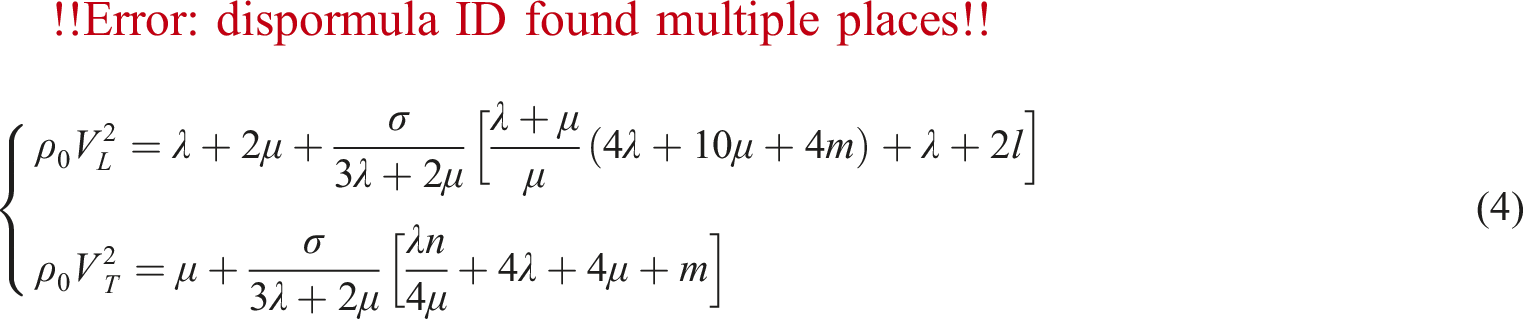
The propagating sound velocity of longitudinal and transverse waves in the unstressed state can be obtained from equation (4), which can be deduced by combining it with the sound velocity under stress:

Longitudinal wave acoustic elasticity coefficient:
Transverse wave acoustic elasticity coefficient:
The effect of the elongation of the spiral spike can be eliminated by dividing the two equations in equation (5) using the sound velocity ratio method.
20
Since the speed of sound of ultrasonic waves is difficult to obtain and the length of the spiral spikes measurable, the propagation time of ultrasonic waves in the spiral spikes used instead of the speed of sound, and the relationship between the stress and the propagation time is obtained as:

The following relationship exists between the preload force of the spike and its internal average stress:


Simulation results and analysis
Modal analysis in service condition
Jaroslav21,22 developed a method using time and frequency-dependent conversion for SKL14 type elastic strip to analyze the vibration response of the elastic strip, and then combined with the literature, 23 it can be seen that most of the fatigue damages occurring in the elastic strip are due to the resonance phenomenon in the frequency range of 500–700 Hz. Therefore, in this paper, from the consideration of the actual working conditions of the railroad, the vibration excitation generated by the train passing by, its frequency is generally not more than 1500 Hz, so choose to study the modal characteristics of the elastic strip in the frequency range of 500–1500 Hz.
In this paper, the finite element analysis (FEA) method is used for solving the characteristic frequencies of elastic strips, and the supplementary stiffness matrix Service elastic strip modal vibration simulation results.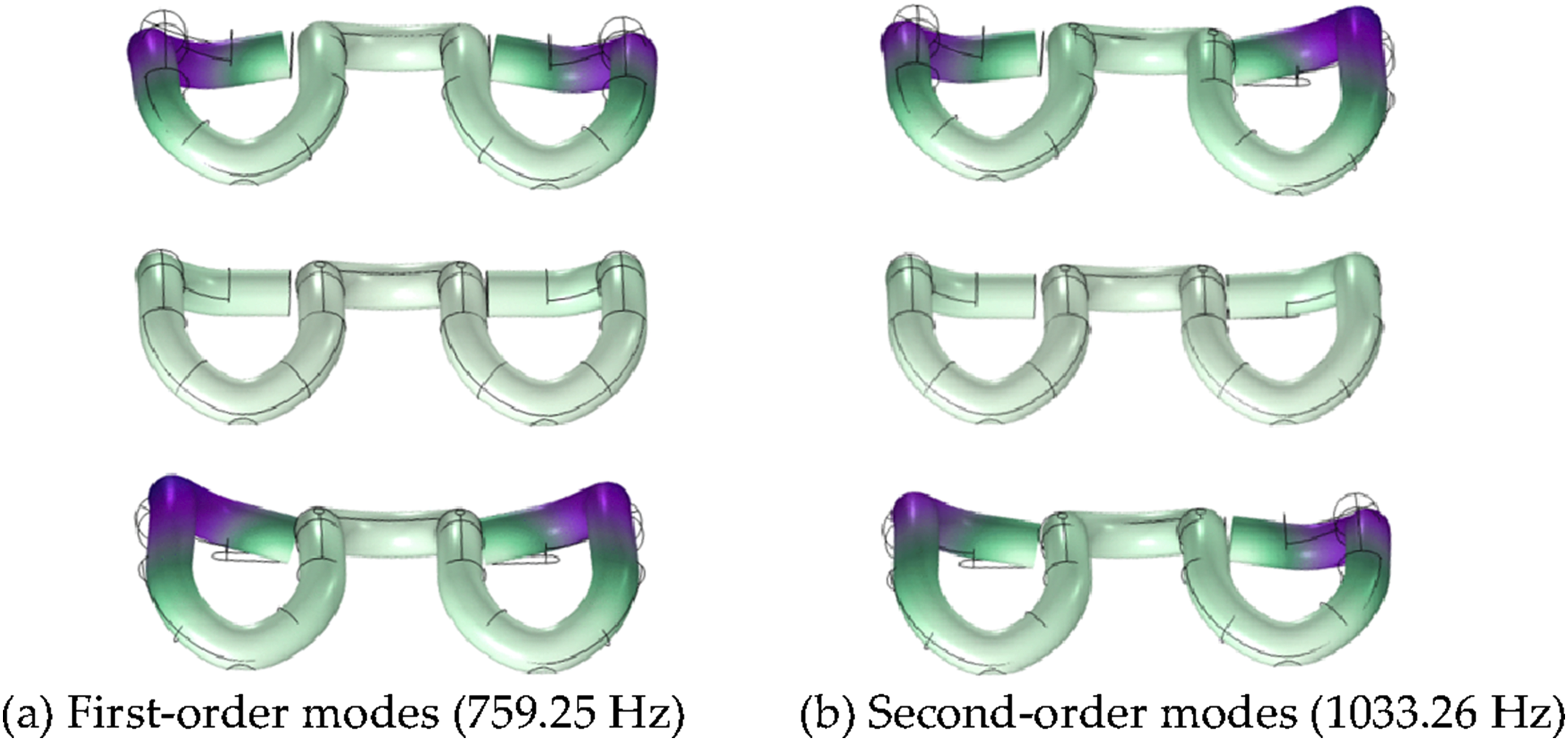
As seen in Figure 1, the characteristic frequency of the first-order mode is 759.25 Hz, and the vibration pattern is the symmetric torsion of the two limbs of the elastic strip, with either obliquely upward inward buckling vibration or obliquely downward outward turning vibration. The characteristic frequency of the second-order mode is 1033.26 Hz, and the vibration pattern is that the side limbs of the elastic strip are twisted; when the left limb experiences obliquely downward flipping vibration, the right limb undergoes obliquely upward internal buckling vibration; and when the left limb experiences obliquely upward internal buckling vibration, the right limb undergoes obliquely downward flipping vibration.
Analyzing equation (3), it can be seen that when the elastic strip itself is unchanged, the mass matrix Relationship between characteristic frequency and buckle pressure of elastic strip.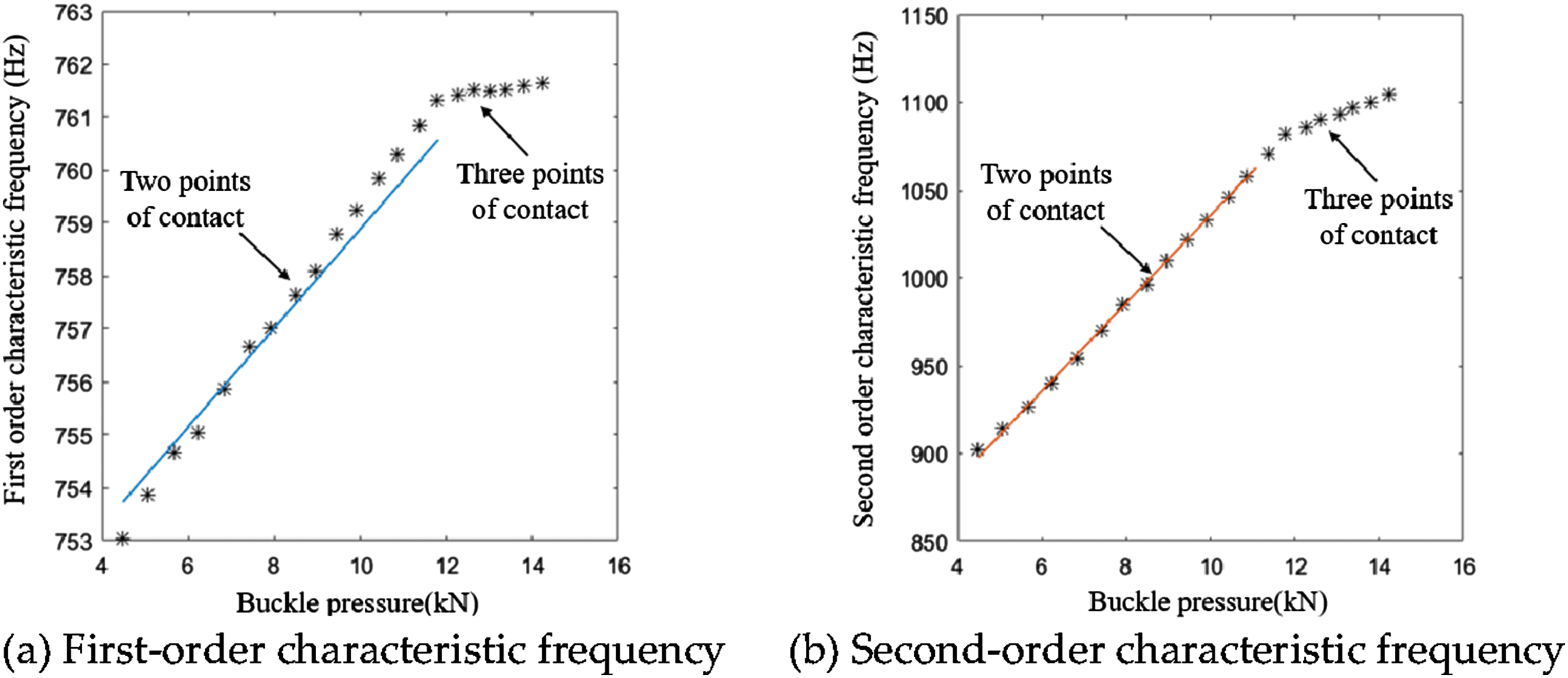
According to Figure 2, when the load of the elastic strip is < 11.78 kN, the first- and second-order characteristic frequencies of the elastic strip change linearly with the load of the elastic strip, and the changing trend is stable. When the buckle pressure of the elastic strip is > 11.78 kN, the lower edge of the middle limb of the elastic strip starts to contact with the gauge baffle plate; meanwhile, the front and middle limbs of the two side limbs of the elastic strip form a vibration obstruction, which changes the linear relationship between the characteristic frequency and the buckle pressure.
Comparing the characteristic frequencies within the same variation range of the buckle pressure, the second-order characteristic frequency is more obvious with the variation of the buckle pressure, and the variation trend is more stable. Equation (4) represents the relationship between the second-order characteristic frequency

Simulation analysis of ultrasonic method
Ultrasonic waves are injected at the top of the spiral stud and propagate inside the structure, reflecting through the lower face of the stud until the sound wave returns to the upper face to be received by the transducer to complete the detection process. The spiral stud model has a round table and a large number of threaded structures, to reduce the influence of clutter on the waveform; the stud threaded position is set as a low-reflection boundary. Take the half-sine wave with a frequency of 5 MHz as an example, the simulated propagation process is shown in Figure 3. Propagation process of the acoustic wave in the spike.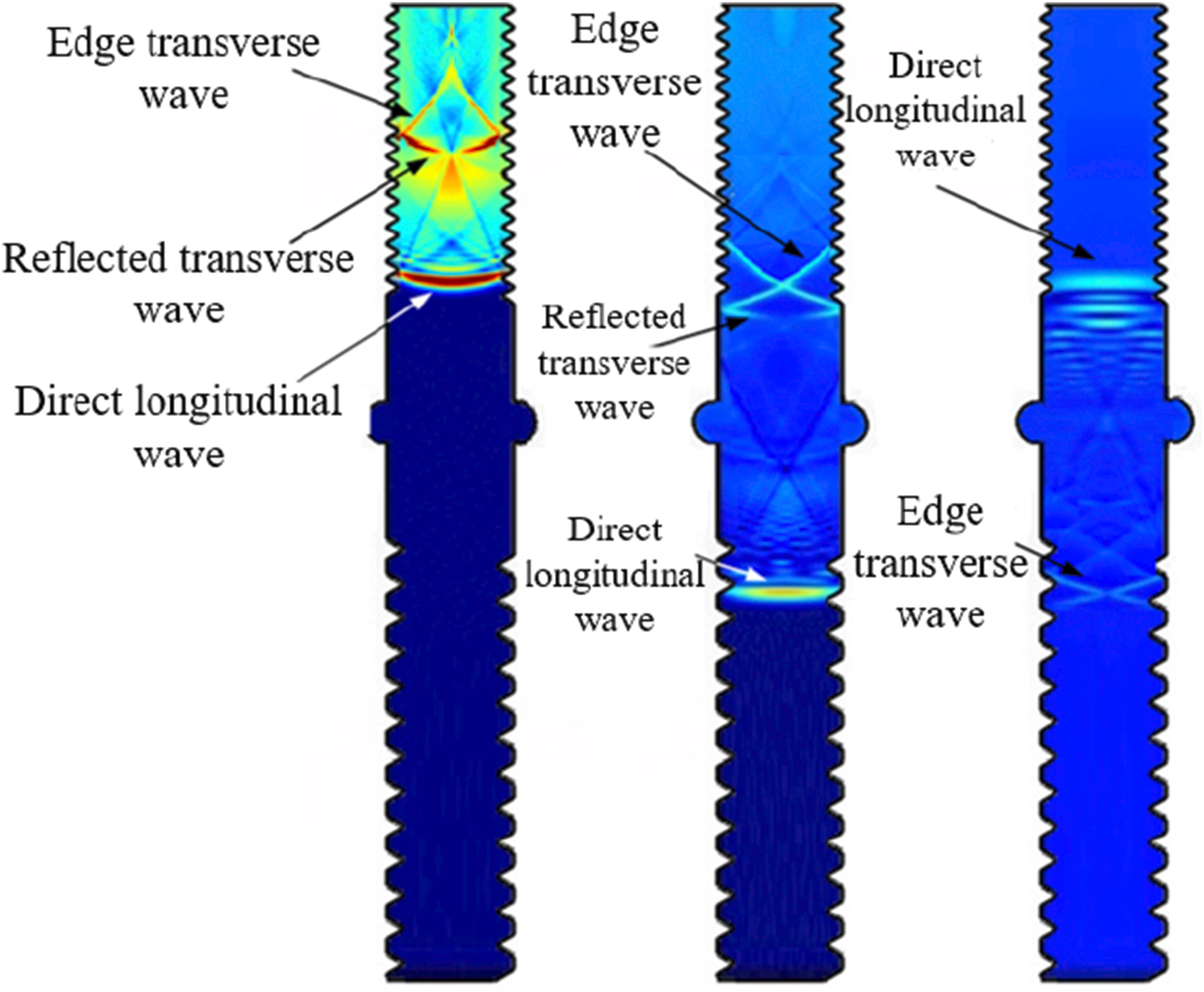
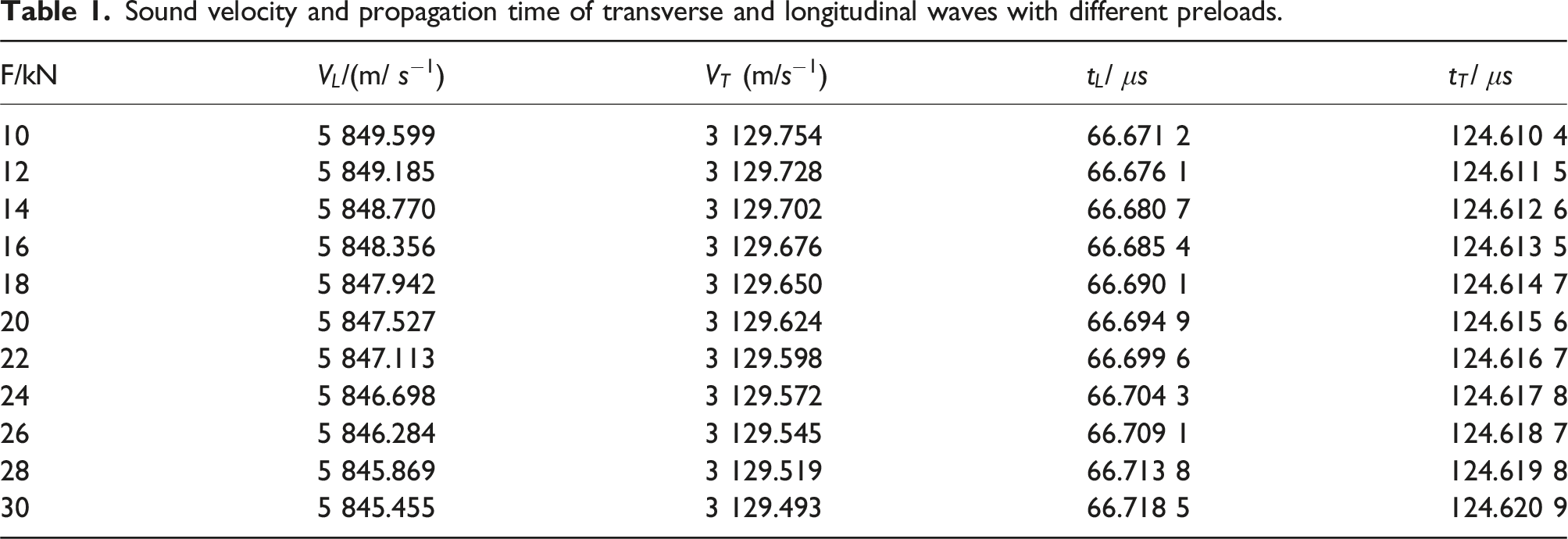
Spiral spikes work in the state of preload force 10–30 kN. Load setting as shown in Figure 4, the top of the spiral spike sets ultrasonic excitation sound pressure, the upper thread position takes the width of the nut to set upward tensile load, the value is the same as the preload, and the lower thread position to set a fixed constraint to restore the embedded portion of the sleeper. Spike simulation load schematic.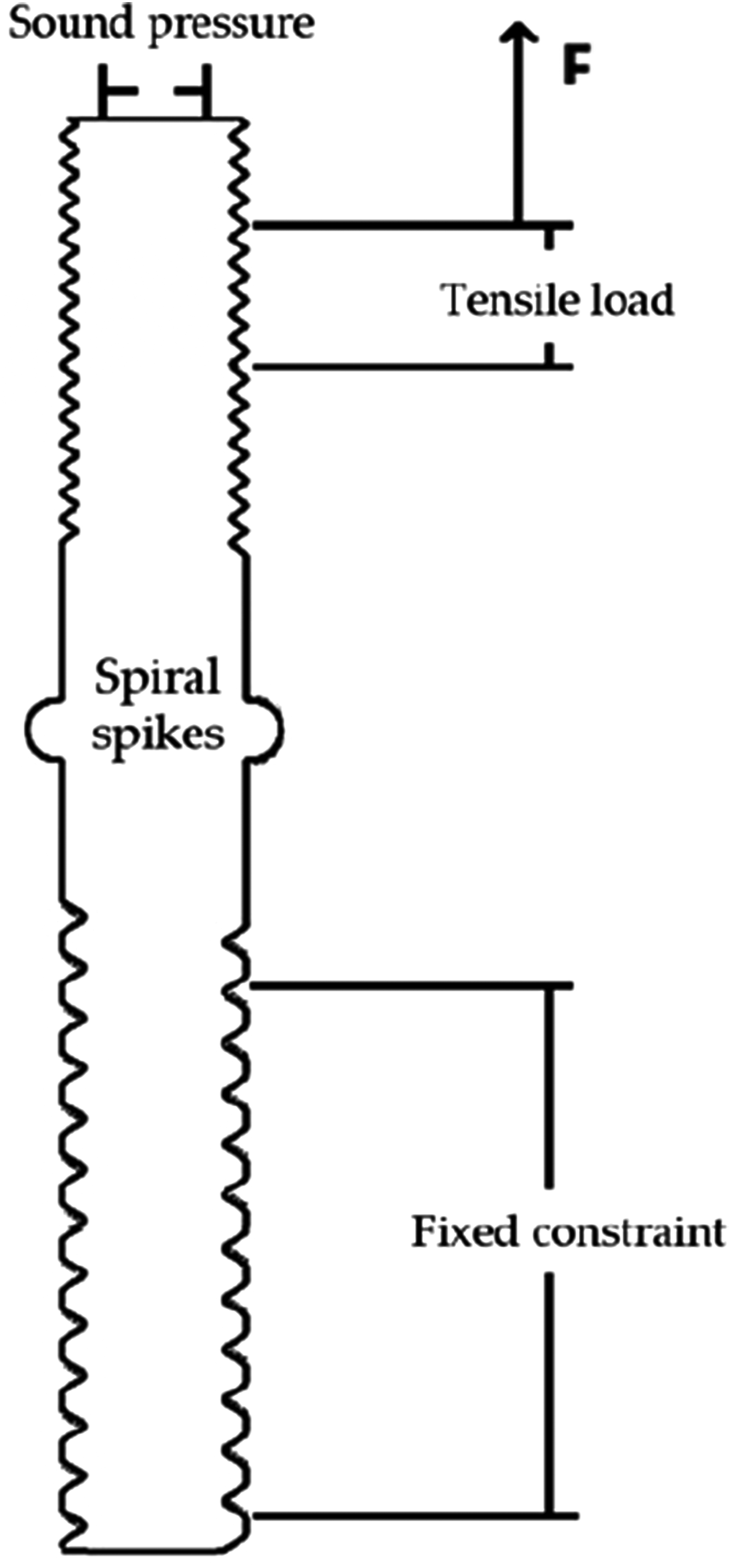
Sound velocity and propagation time of transverse and longitudinal waves with different preloads.
Elastic fastener buckle pressure under different preload forces.
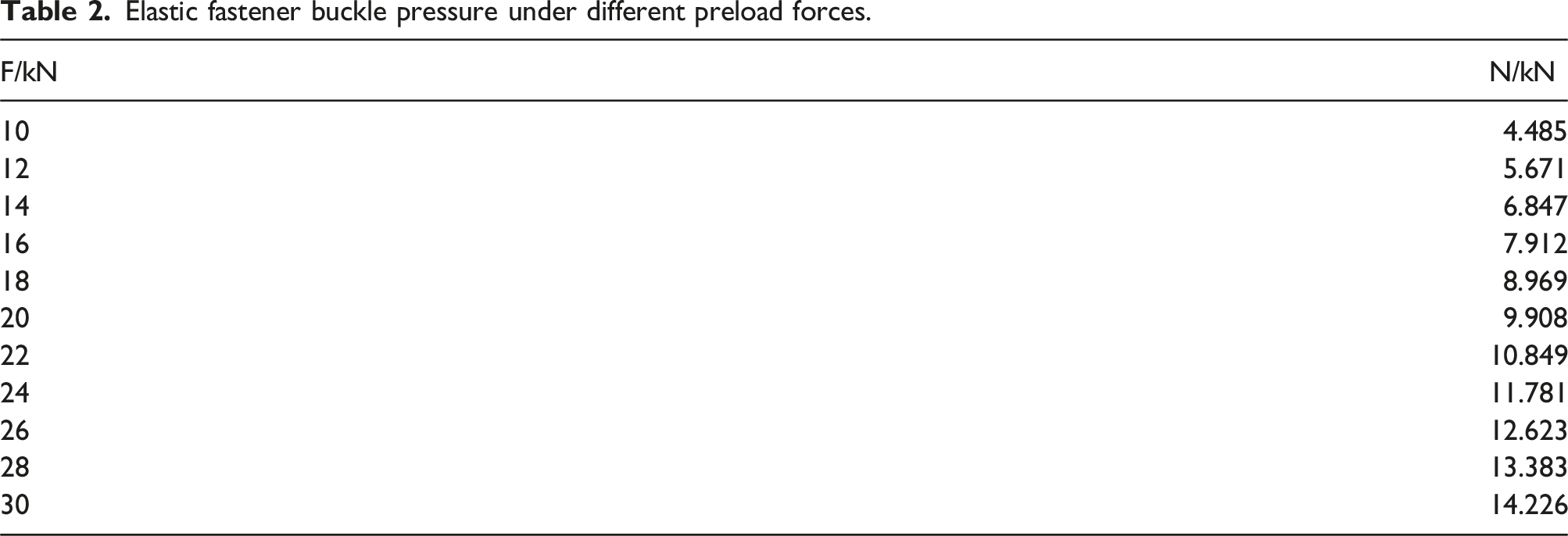
Combining the data from ultrasonic transmission and reception simulation and elastic strip fastener mechanics simulation, the relationship between the propagation time of ultrasonic waves in the spiral spikes and the elastic strip fastener buckle pressure can be obtained, as shown in Figure 5. From the analysis of the figure, the propagation time of the longitudinal and shear waves is approximately proportional to the withholding pressure of the elastic strip. Therefore, the withholding pressure of the elastic strip can be measured by measuring the propagation time of ultrasonic waves. Relationship between ultrasonic propagation time and buckle pressure.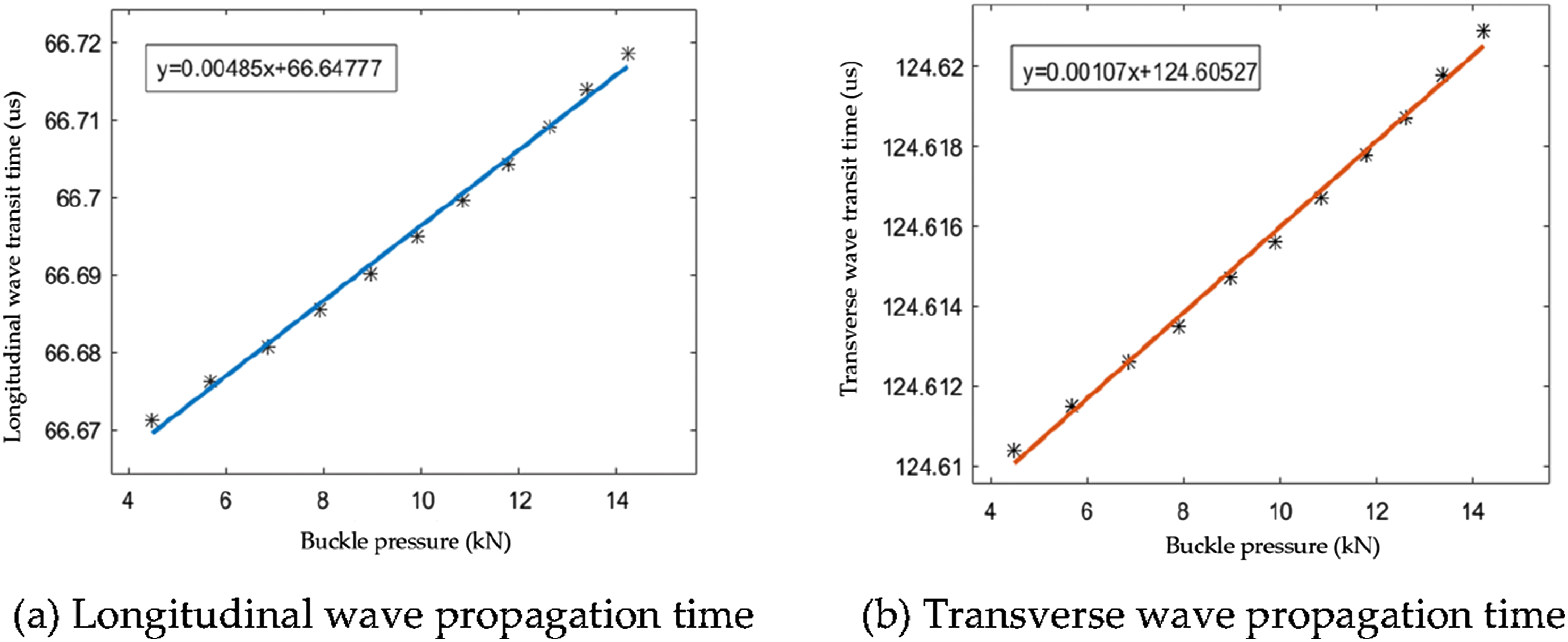
Verification of elastic strip buckle pressure measurement test
Test purpose and method
To verify the relationship between the buckle pressure and the second-order characteristic frequency, an elastic strip fastener test rig was designed and fabricated, whose structure is shown in Figure 6. Design drawing of elastic strip fastener test bench.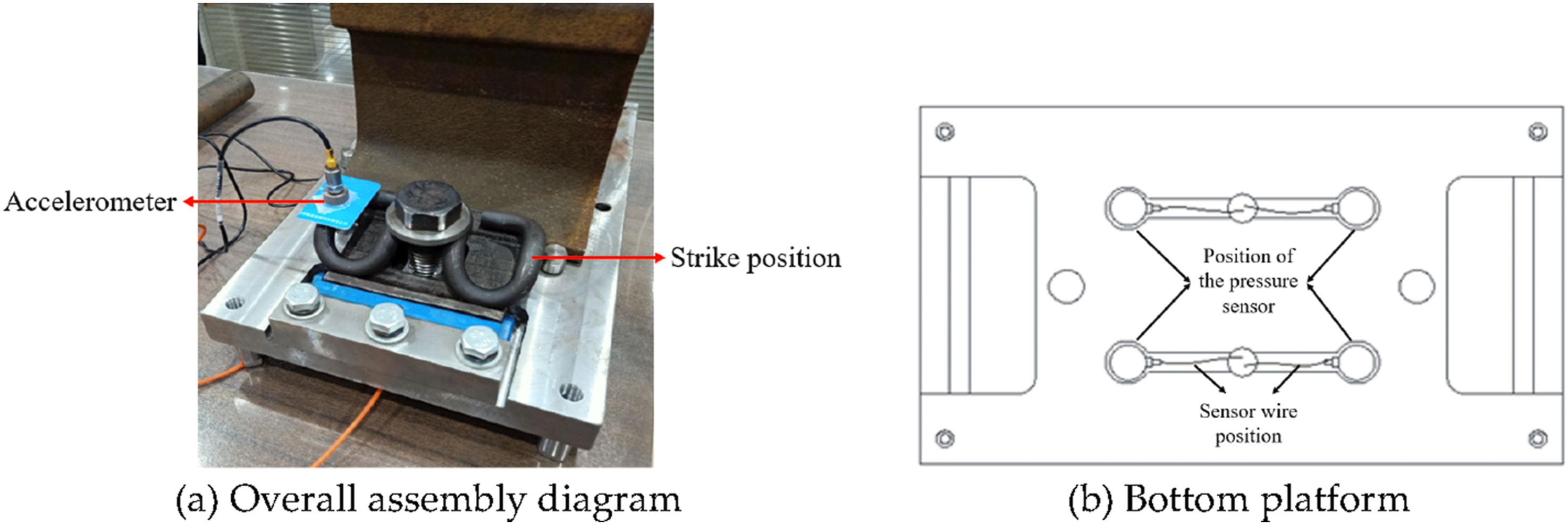
In the test, the percussion is used as the excitation source, and the mechanical sensor in the head collects the vibration waveform and peak strength of the hammer strike; the data obtained are used as the excitation signal for the calculation system to analyze. A micro-electronic dynamometer arranged under the rail is used to collect the acceleration information of the elastic strip vibration, and a computer is used to analyze the spectral image of the signal.
The test was conducted with a preload force of 4 kN as the starting value, which was gradually increased to 30 kN in increments of 2 kN. Every increase in the preload force of the tested fastener was used to knock on the elastic strip, and, at the same time, the vibration signals of the elastic strip were extracted. Record the sum of the pressure values from the electronic dynamometer on the same side of the rail below the rail for each preload gradient, and record it as the fastener pressure for that side of the fastener.
The average data of several tests are chosen to plot the relationship between the elastic strip’s buckle pressure and second-order characteristic frequency, as shown in Figure 7. It can be seen that there is a certain linear relationship between the two, and an inflection point occurs at the position where the buckle pressure increases to 12 kN. Relationship between buckle pressure and the second-order characteristic frequency.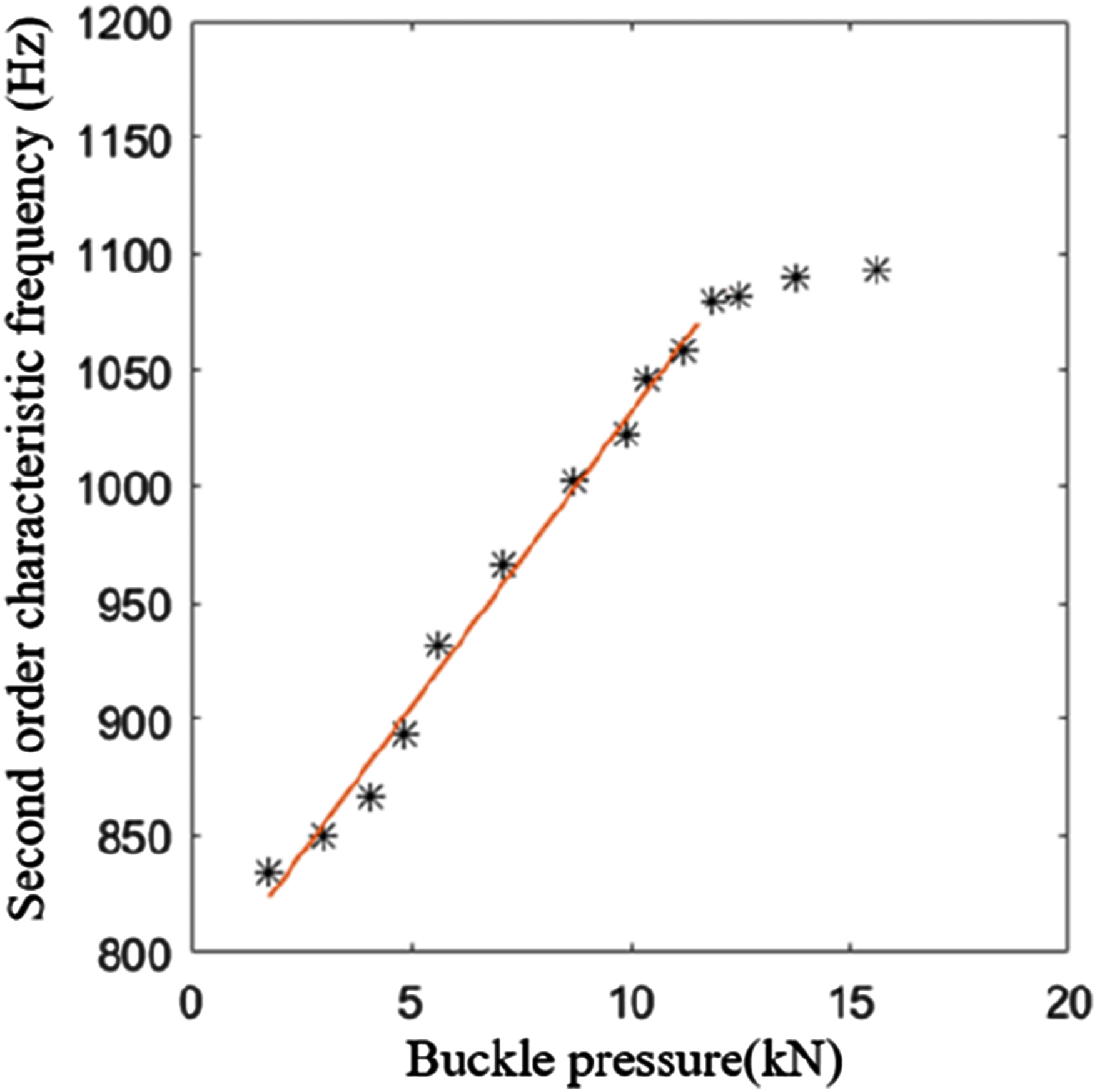
Equation (8) was used for linear fitting of the test data with a buckle pressure of <12 kN.
The relationship between the experimentally obtained buckle pressure and the second-order characteristic frequency is very close to the results obtained by simulation, thus proving the accuracy of the characteristic frequency measurement method.
Measurement of buckle pressure by transverse and longitudinal wave method
The test of the transverse longitudinal wave method for measuring the buckle pressure of the elastic strip is shown in Figure 8. The test started from 0 and gradually increased the preloading torque to 140 N·m in gradient increments of 10 N·m, and the opposite side fasteners maintained a preloading torque of 120 N·m during this process. The length of the spike needs to be recorded after each preload, and the ultrasonic propagation time is measured using a longitudinal wave probe and a transverse wave probe, respectively. Ultrasonic measurement test bench.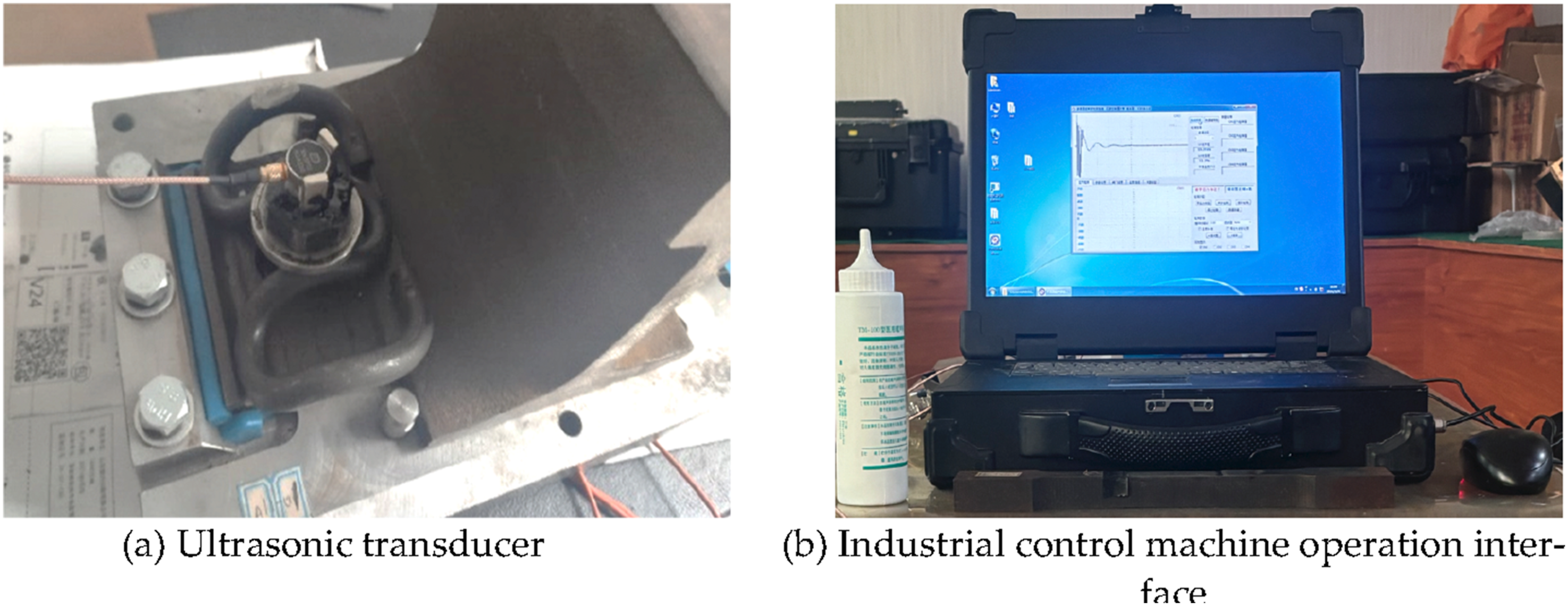
Using the optimized design of the magnetic suction probe, the propagation time of the transverse and longitudinal waves was measured on the ultrasonic measurement test bench, and the measurement results were analyzed in conjunction with the readings of the elastic strip torque wrench and the dynamometer. Some of the test data were selected to plot the relationship between the buckle pressure of the strips and the acoustic time difference, as shown in Figure 9. From the figure, it can be seen that there is an obvious linear relationship between the acoustic time difference of both longitudinal and transverse waves and the slat buckle pressure. Relationship between buckle pressure and acoustic time difference.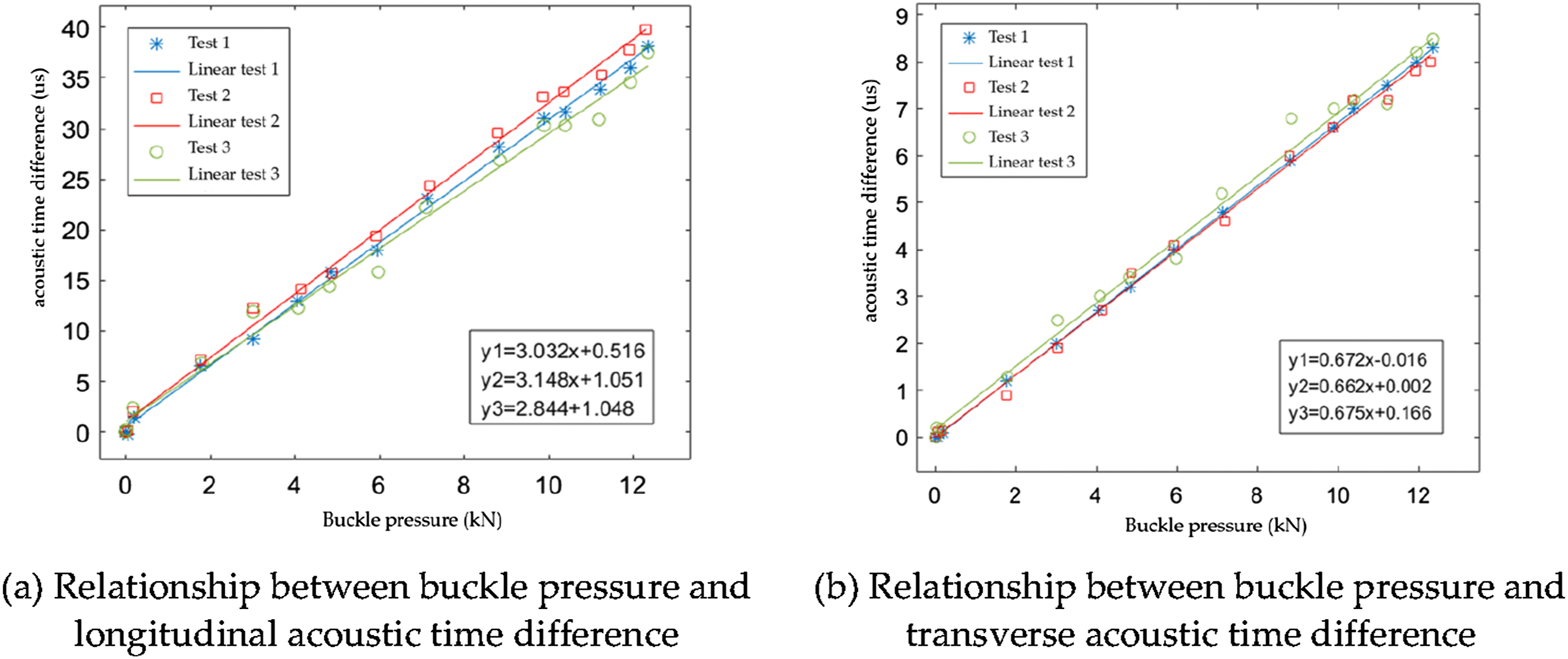
In this paper, the relationship between the tension force and ultrasonic propagation time of standardized spiral spikes is further investigated. A hydraulic tensioning machine is chosen as the stress loading device to provide stable tension for the spiral spikes and at the same time read the tension value accurately, and the test setup is shown in Figure 10. Spike tensile test schematic diagram.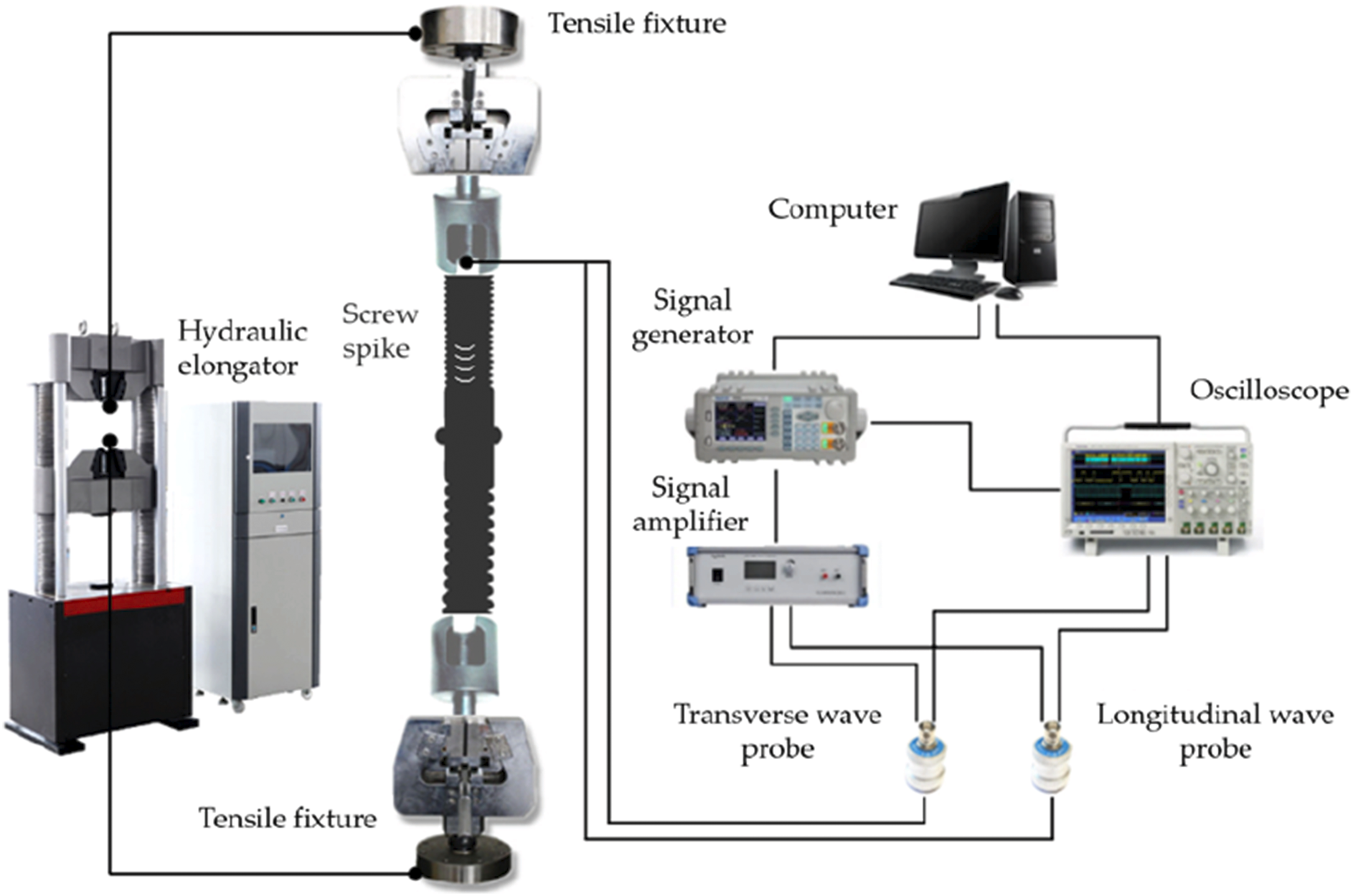
Timetable of transverse and longitudinal wave propagation.
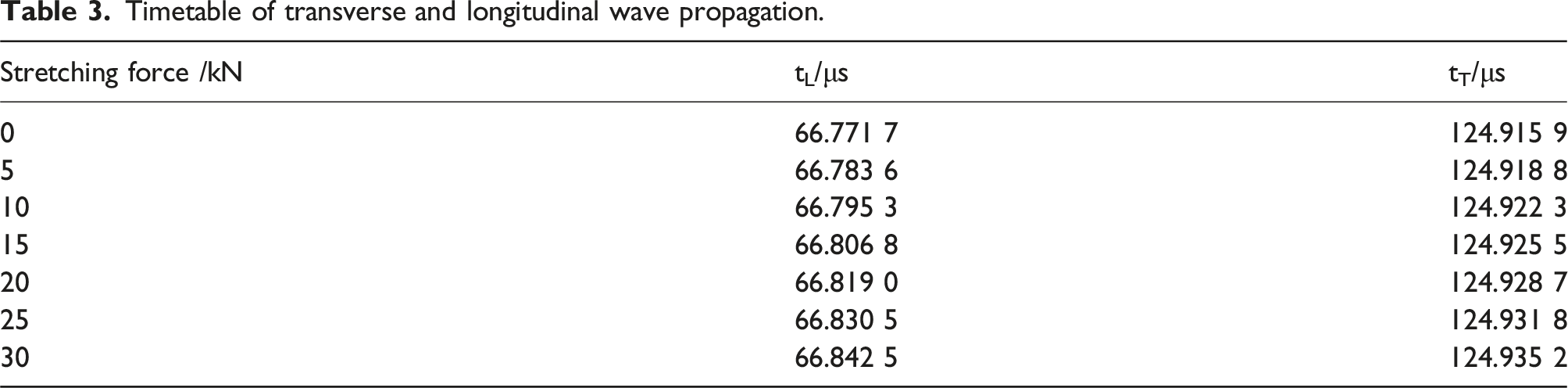
Referring to the test data in Table 3, the relationship between the acoustic time difference of the transverse and longitudinal waves and the buckle pressure of the elastic strip can be obtained, as shown in Figure 11. In the figure, the acoustic time difference of the transverse and longitudinal waves is the independent variable, and the buckle pressure in the vertical coordinate is the calculation result. Normally the acoustic time difference of ultrasonic transverse and longitudinal waves increases and decreases at the same time, so the values of the slat buckle pressure measurements are mainly distributed around the main diagonal line in the figure. The relationship between acoustic time difference and buckle pressure.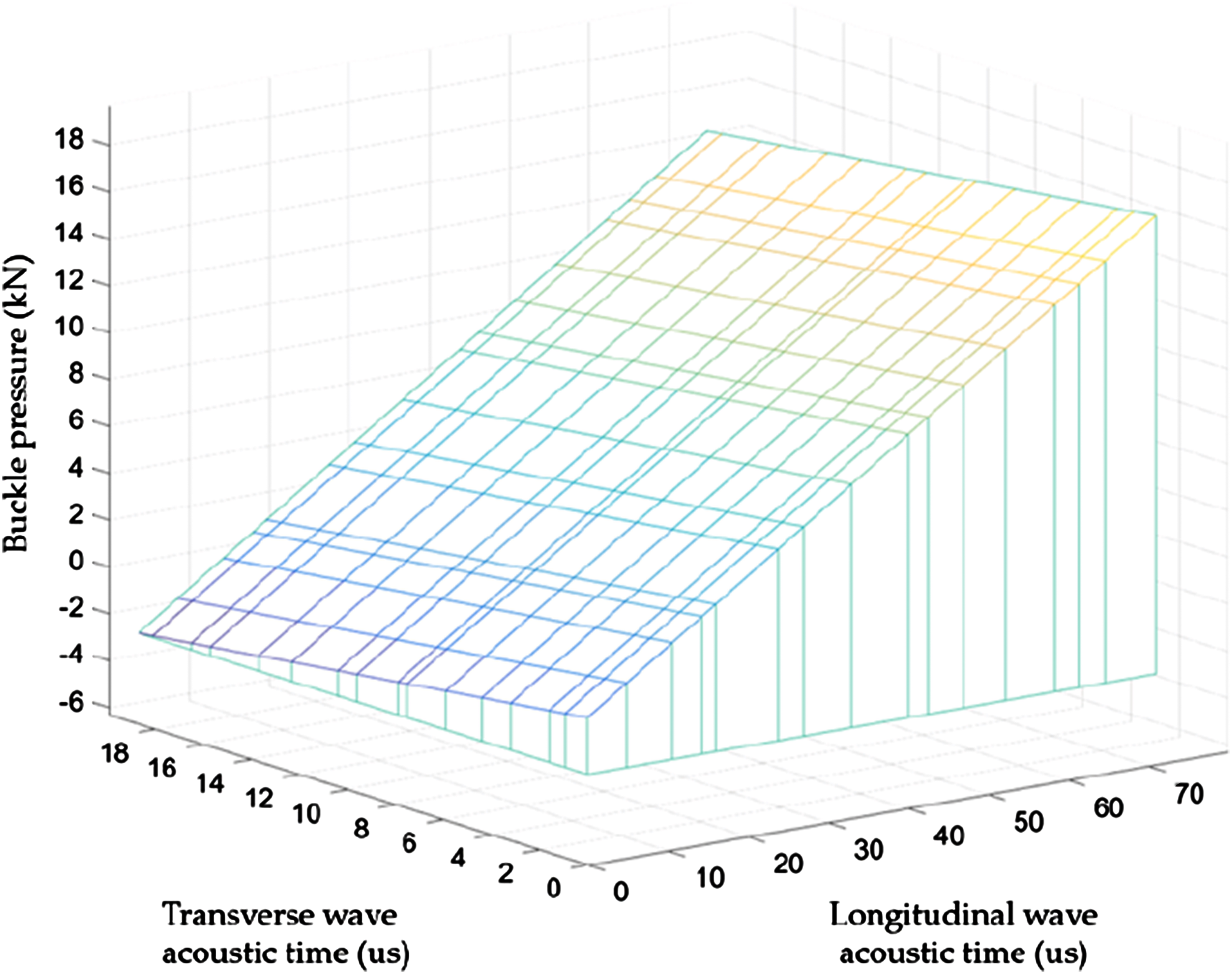
Elastic strip fastener system as a key component of the railroad structure, nowadays, the railroad engineering section on the service elastic strip fastening pressure measurement of the most widely used detection method is still the torque wrench method, the time and manpower consumed is large and the measurement accuracy is limited. This paper uses the modal method to get the relationship between the characteristic frequency of elastic strip and the buckle pressure, and at the same time uses the ultrasonic method to get the relationship between the transverse and longitudinal wave transit time and the elastic strip buckle pressure. The combination of the two measurement methods can realize the fast and accurate measurement of the buckle pressure of the elastic strip fastener system of the railroad, and it is of great significance for the maintenance and overhaul of the railroad system.
Conclusion
(1) The characteristic frequency of elastic strip vibration in service is not only related to the mass and stiffness of the elastic strip itself but also to the buckle pressure of the elastic strip. The buckling force of elastic strip fasteners in normal service conditions can be measured by tapping using the modal method. (2) Under service conditions, the characteristic frequency of the first-order mode of the elastic strip is 759.25 Hz, and that of the second-order mode is 1033.26 Hz; the rate of change and stability of the second-order characteristic frequency are better than those of the first-order characteristic frequency. (3) Spiral spikes generate axial load due to preload, and the buckling force of the spike fastener is obtained by measuring the axial load of the stud, and the three are interconnected. (4) The buckle pressure of the spiral spikes can be obtained by measuring the propagation time of transverse and longitudinal waves in the spiral spikes using the ultrasonic method. (5) The characteristic frequency of the modal method and the propagation time of the transverse and longitudinal waves of the ultrasonic method can establish a good linear relationship with the buckle pressure, which provides an effective scheme for accurately measuring the buckle pressure of the service elastic strip.
Footnotes
Declaration of conflicting interests
The author(s) declared no potential conflicts of interest with respect to the research, authorship, and/or publication of this article.
Funding
The author(s) disclosed receipt of the following financial support for the research, authorship, and/or publication of this article: This work was supported by the Natural Science Foundation of Hebei Province; E2019210309; S&T Program of Hebei; 21567622H. The research project of China Railway Beijing Bureau Group Corporation; 2021BG02.
