




Abstract
As energy and environmental issues continue to increase, wind power is being promoted worldwide as a sustainable energy source. As more wind farms are designed and put into operation, the impact of wind power on individuals is beginning to become a matter of concern, especially in terms of acoustics. Thus, research into the soundscape of wind farms and wind turbines has recently begun to develop. This article presents a review of wind power soundscape research. The main objective of this review is to investigate the current scope of soundscape research in the field of wind turbines. Hopefully, more attention will be given to the soundscape of wind power environments, which in turn will contribute to the design and management of wind power environments and surrounding habitats. The criteria for the selection of articles were as follows: first, the studies were in line with the theme of wind farm acoustics research; second, the authors conducted laboratory experiments or community survey and recorded relevant subjective evaluation data. Some of the studies, although fitting the theme of soundscape research, focused mainly on ‘noise' and did not mention ‘soundscape'. Thus, two separate strings were used in the search process through the Scopus database and Web of science database, one of which used ‘noise'/ ‘sound' and ‘perception'/ ‘annoyance' instead of ‘soundscape'. Of the 826 results obtained, 31 studies were selected based on article content and selection criteria. By reviewing these articles, this review found that current research related to the soundscape study of wind farms is still lacking, with more researchers focussing on wind power noise and its effects on the physical and psychological health of residents rather than on the influence of the integrated acoustic environment and context of wind farms on residents' perception. The questionnaire is the most commonly used method for collecting subjective acoustic perceptions in existing research. A-weighted SPL and Lden are widely used to describe the loudness of wind power noise, but no studies have yet identified the acoustic indicators that have the most significant impact on subjective emotional perceptions. Meanwhile, according to existing literature, objective factors of the environment, such as the topography of the wind farm, weather and time of day, influence human acoustic perception through vision and hearing to some degree. Moreover, based on the current status and major research methods, this review proposed suggestions in terms of participant selection and data collection methods and emphasised the importance of laboratory experiments and the development of wind power acoustics research on a global scale.
Introduction
The energy crisis and climate problems are now immense global environmental challenges. The dependence of modern industry on fossil fuels is the source of both problems. 1 Therefore, to address these challenges and mitigate crises, the application of clean energy sources instead of traditional fossil fuels has become an important trend. Wind energy is one of the major renewable clean energy sources. 2 Wind power converts wind energy from nature into usable electricity through the use of wind turbines. As an environmentally friendly industry, wind power stations enable the sustainable use of wind energy and help reduce greenhouse gas emissions and mitigate the current climate change crisis while ensuring energy supply and diversity, thereby fulfilling a vital function in the global task of achieving sustainable energy development. The deployment of wind turbines in urban environments has therefore become a new trend in recent years. 3 When deploying wind farms, it is necessary to take full account of the constraints of factors related to environmental management, with the protection of the health of the residents as one of the top priorities.
Wind power can have an impact on the surrounding population, flora and fauna,4,5 as the selection of a wind farm and the installation of wind turbines will inevitably require modifications to the existing land plot and environment, as well as the continuous operation of the wind turbines. Wind power is usually divided into onshore and offshore wind farms depending on the location. Offshore wind farms have a low impact on human life and health because they are located far from residential areas. Meanwhile, they may have more significant ecological effects, particularly on marine organisms. 6 This paper will specifically examine the impact of wind farms on human soundscape. On the other hand, onshore wind farms are mostly set up in rural, suburban areas away from urban agglomerations, but the presence of wind farms can still be clearly seen and even have a physiological and psychological impact on people, especially those who live nearby.7–9 Although wind farms make a positive contribution to the energy crisis, they also pose potential environmental and social risks in sensitive areas, such as visual unpleasantness and acoustic impacts in tourist areas or natural and residential areas.
Wind power generates both inaudible low-frequency and perceptible sounds,10,11 which usually come from the rotation of the blades during operation and from the continuous vibration of motor functioning. 12 As a renewable energy system, wind power generation is distinguished from other clean energy systems, such as photovoltaic systems, by its associated acoustic impact. Other renewable energy sources typically produce little to no noise. However, social acceptance is a necessary condition for the development of a renewable energy industry.13–15 As an important process in the transition to renewable energy technologies, an increasing number of countries are planning to scale up the amount of land-based wind energy.16,17 Moreover, an increasing number of projects are moving closer to residential areas, as sitting close to users can effectively reduce energy losses and network costs. 18 The development of integrated large wind turbines, as well as small domestic turbines, is gradually gaining increased attention in terms of the impact of noise on residents. Therefore, a deeper understanding of the subjective human perception of the acoustic impact caused by wind farms is necessary to develop constructive improvement measures to increase the public acceptance of wind power. 13
The soundscape is defined by the International Organisation for Standardisation (ISO) as ‘‘the acoustic environment perceived or experienced and/or understood by a person in context'.
19
It focuses on subjective human perception and integrates the environmental context while also conducting measurements and assessments of the acoustic characteristics of a given environment and thus analysing the factors that influence human perception. Therefore, a soundscape-based approach could have benefits for research into human responses to wind farm noise. In previous research, many experiments and surveys did not mention the concept of ‘soundscape' but were designed to fit within the scope of soundscape research; these experiments research involved measuring the acoustic environment of wind power generation, subjectively evaluating human participants' perceptions and analysing the contextual environment. Limited studies have also begun to focus on the soundscape of wind farms. Therefore, in this review, the aim is to provide a review of studies on wind power soundscape with the main objective of analysing the following four questions. (1) What is the current scope and status of research on soundscape for wind power generation? (2) What are the most commonly used methods for collecting subjective evaluation data in existing wind power studies? What are the advantages and disadvantages of each method? (3) What methods are most widely used in these studies to describe and document the acoustic environment of wind farms? How applicable are these acoustic description methods to wind farms? (4) What types of contexts are involved in the current study? How do the different contexts affect the sound propagation and human perception of wind farms?
Moreover, based on the analysis of the above mentioned issues in accordance with existing research, this review also discusses the inadequacies and potential of the current investigation and proposes reasonable suggestions and directions for future wind power soundscape research and wind power environment management.
Material and methods
Due to the exploratory nature of this review, there was no predefined protocol for this review. The basic process of data extraction and collection was based on preferred reporting items for reviews and meta-analyses (PRISMA) guidance and was defined prior to the review process. 20 As a generic framework for reporting systematic evaluations and meta-analyses, PRISMA is evidence-based.
Search strategy and eligibility criteria
A literature search was conducted for studies on the effects of the soundscape of wind power on the acoustic perception of wind turbines. The general criteria for inclusion were that the case study area needed to be of the wind power type in renewable energy and that the research and evaluation were directed towards sound perception, with specific selection criteria including. (1) Focused on acoustic research in wind farms or wind turbines; (2) Relevant experiments, including field studies or those carried out in the laboratory, were designed and conducted; (3) Data on participants' subjective evaluations of the soundscape were collected through face-to-face interviews, telephone surveys, or online questionnaires. The study was based on database searches and scanning of the reference lists of articles; screening for starting points was performed as part of this literature review, followed by subsequent identification and screening. Only peer-reviewed journal articles and conference published in English were considered in the screening process. Additionally, conference abstracts, reviews, conceptual articles, and non-peer-reviewed conference papers were excluded from this study. As wind power-related soundscape research is still in its infancy, some of the studies that were searched did not identify themselves as ‘soundscape' research, but their research focus, research methods and results obtained were consistent with the concept of the soundscape. The concept of the ‘soundscape' was therefore extended to ‘perceptions of or attitudes towards sound or noise' in the searching state. The search was applied to Scopus and Web of Science, and the last search was performed on 13 August 2024. Two strings were created and used to query the Scopus database and Web of Science database: the first string Q1 [‘TITLE-ABS-KEY((wind AND (turbine OR farm OR Park)) AND soundscape)'] and the second string Q2 [‘TITLE-ABS-KEY((turbine OR farm OR park)) AND (sound OR noise OR acoustic OR audio) AND (perception OR attitude OR annoyance))']. Searches were not set for a time limit. Evidence extracted was conducted by one reviewer, and the conformity assessment was strengthened by involving a second reviewer to verify the results. Any discrepancies were resolved through consensus among all authors. The PRISMA flow chart used in this review are shown in Figure 1. Flow chart of the paper search and skimming/selection process.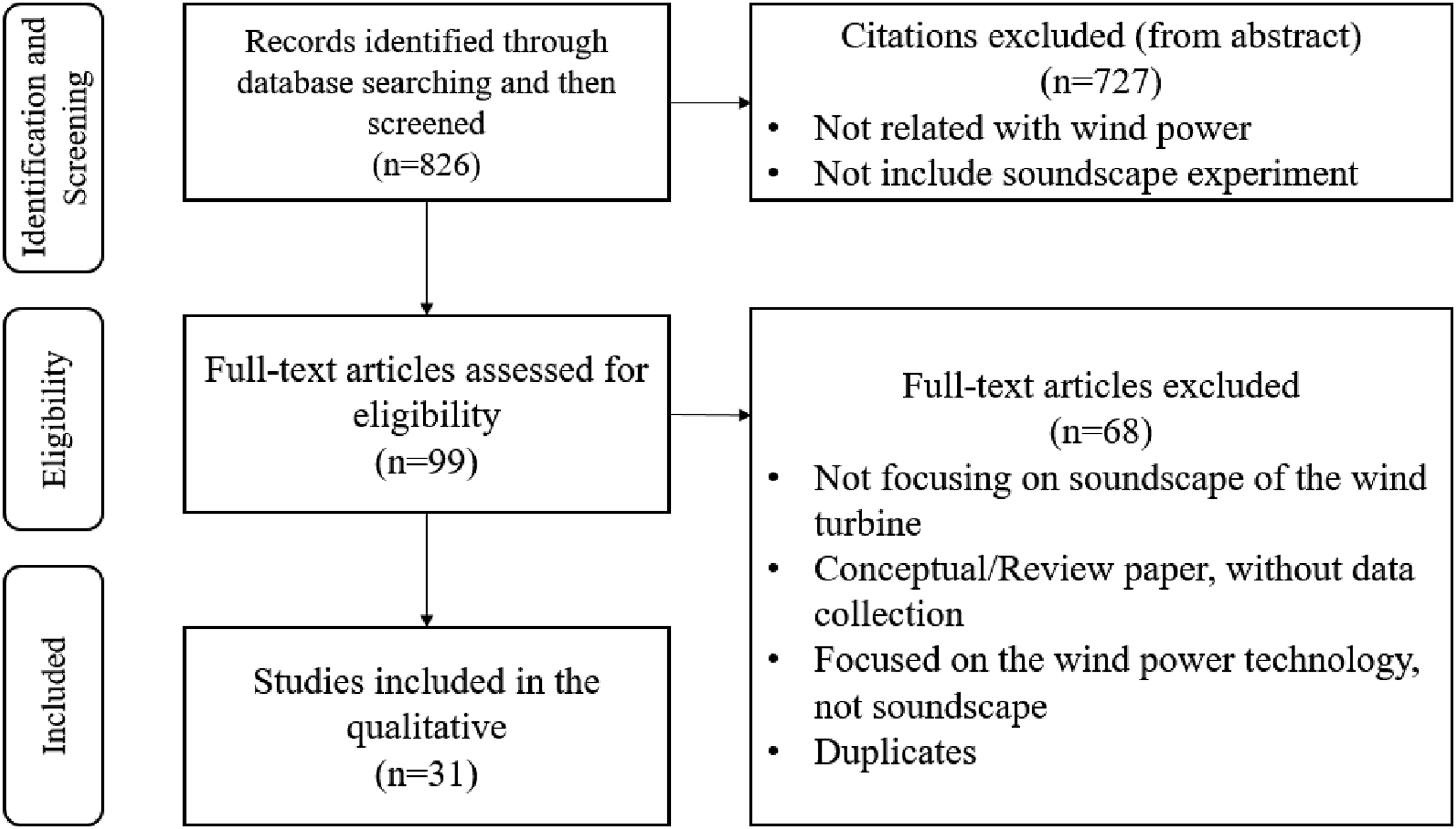
Data extraction
The following relevant information was extracted from the selected studies: (1) The year when the study was conducted/designed; (2) The country where the study was conducted/designed; (3) The research focus of the study; (4) The study design (i.e. a laboratory experiment or community survey); (5) The acoustic measures; (6) The type of space involved in the study (indoor or outdoor); (7) The type of location of the investigation (urban, rural or peri-urban; etc.); (8) The number of participants and response rate; (9) Subjective perception data collection methods (i.e. questionnaires, interviews).
Based on the inclusion criteria, only the aspects relevant to the above questions were extracted from the selected studies and then discussed. Considering that there may be differences between the indicators chosen for different studies that do not facilitate the synthesis of data through mass effect modelling and quantitative meta-analysis, a qualitative approach was chosen for this review to summarise the findings and answer the research questions.
Results
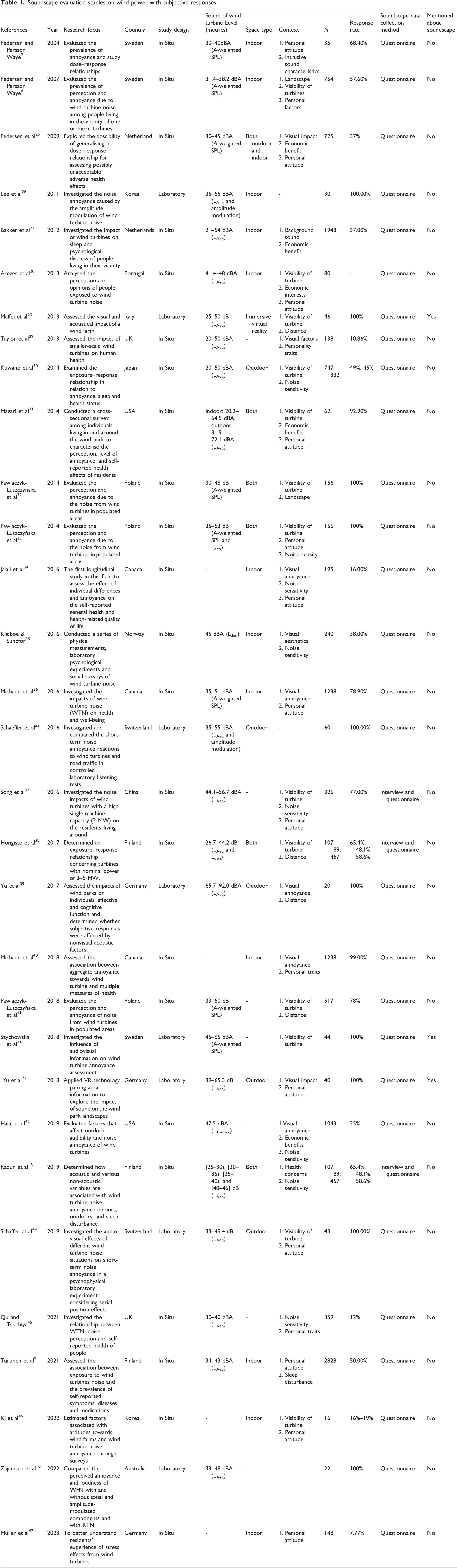
Soundscape evaluation studies on wind power with subjective responses.
Scope of the current soundscape study on wind farms
Through the screening process of all selected articles, a more comprehensive analysis of the current development and application of soundscape research in the field of wind turbines was conducted. The review results indicate that soundscape research on wind farms remains primarily in the theoretical analysis stage, with practical applications and empirical methods yet to be implemented. Notably, of the 31 publications reviewed, only three mentioned the concept of ‘soundscape' in either the title or the full text, a proportion of less than 10%. Three publications simply mentioned the concept without exploring it in depth.21–23 Subjective evaluation, objective physical measurement of the acoustic environment and context are the three elements that constitute the definition of a soundscape. 24 In current studies, it is more common to focus on the changes in human subjective perceptions triggered by wind power noise rather than on the soundscape of the wind farm as a whole.7–9,25–49 Moreover, the publications reviewed here span the period 2004–2023, with one article dealing with ‘soundscapes' in the 2004–2014 time period 23 and two articles mentioning ‘soundscapes’ in the 2015–2023 period.21,22 This shows that the study of soundscapes for wind power generation is gradually receiving attention, but it is still neglected and needs further investigation. 22
Moreover, several soundscape studies on wind farms were screened out during the search and selection process. In these studies, the subjects were not humans but rather living creatures, as was the case for the impact of dolphins on offshore wind farms 6 and the effect of wind turbines on the courtship of great roosters. 50 Another group of publications focused on the theories and techniques of soundscape research and did not include subjective human perception; for instance, methods of reducing noise from wind power generation or effective measurements of underwater noise during wind turbine operation.46,51,52
Subjective data collection methods
Of the 31 publications reviewed, all of the laboratory experiments and community surveys used questionnaires or combined with interviews to collect data on subjective perceptions. Among them, eight community surveys collected feedback by postal mail,7–9,23,25,27,29,34 thirteen by face-to-face on-site interviews with questionnaires,28,30–33,35–38,40,41,43,46,48 eight were conducted and collected in the laboratory,21–23,26,39,44,49,53 one survey used a telephone survey, 47 and another survey used a combination of telephone interviews, mail and website surveys for data collection. 42 A comparison of the response rates of the different methods revealed that for the experiments conducted in the laboratory, where the participants were voluntary, all had a 100% response rate and a higher validity of the data obtained, despite the relatively limited number of participants.21–23,26,39,44,49,53 The lowest response rate was obtained using the telephone interview collection method, with the lowest response rate being 7.77%. 47 Face-to-face on-site interviews and emails' response rates have a large span, reaching 13%–100%.7,8,25,28–33,35–38,40–43,45,46,48 Compared with laboratory experiments, other approaches involve a wider range of populations and have the possibility to compile a more comprehensive dataset.7–9,25,27–38,40–43,45–48
In terms of questionnaire content, all the laboratory experiments and community surveys involved targeted questions about the physical health or mental health caused by the noise generated by the wind turbines, including the level and frequency of annoyance. The study conducted by Pedersen et al. in Sweden was the first of the studies reviewed in this study, 7 and the questionnaire they designed has been widely drawn upon and used in subsequent experiments and studies.8,29,36,41,42,48,49,53 The questionnaire consisted of three main sections: first, in relation to satisfaction with the house and its surroundings, as well as perceived sources of annoyance indoors and outdoors and personal sensitivity to sound; second, focussing on the feelings brought about by wind turbines and the impact on emotional perceptions; and third, in relation to health, whether chronic illnesses exist or whether sleep qualities are affected. 7 These three questions provide a more comprehensive evaluation of the effects of wind farms on acoustics and health from the subjective point of view of the inhabitants and serve to mask the purpose of the study. However, some of the experiments conducted in the laboratory additionally involved hearing tests on participants26,44,49,53 or investigated mental health status using the 12-item Goldberg test to ensure accurate and valid results.32,33,41 Of the studies reviewed, the questionnaire format designed by Yu most closely resembled the questionnaire format of the soundscape study, in which 10 pairs of bipolar semantics were used for participants to evaluate emotional perception. 22
Regarding the design of the questionnaire, several of the research used scales, such as Likert scales,22,23,27,29,34,35 the International Commission on Biological Effects of Noise (ICBEN) scale,21,48 or verbal rating scales, to investigate the degree of exposure to wind power. Others used ‘yes or no' and sentences to describe the degree and feelings. 41
Acoustic indicators
Several of the referenced studies indicated that the sound emitted by wind turbines is lapping, described as swishing or whistling, and a significant portion of the research focuses on the impact of loudness on the perception of wind turbine noise.7–9,21–23,25,27–40,42,43,45,48,49 In these studies, the acoustic environment at the selected sites was characterized by measuring sound pressure levels (SPL) in accordance with environmental noise regulations from different countries and regions. The A-weighted sound pressure level (LAeq) is frequently used to assess human perception of noise, as it emphasizes the frequencies most relevant to human hearing. 26 As a result, it is widely used. However, different regions employ varying A-weighted sound pressure level calculation models, including those proposed by the Swedish Environmental Protection Agency, the Dutch regulatory model, the New Zealand standard, and ISO 9613-2.29,31,36,42 In addition, several studies have assessed the effect of sound pressure level metrics on noise perception and annoyance by performing dose‒response modelling tests on several steps of sound pressure levels.7,8,21,25,42,45,48,49 Most of the research was conducted with short-term sound measurements from wind farms rather than long-term monitoring.32,36,48 However, noise from wind power is not present in stages but is often continuous and present variably from day to night.25,42 Therefore, on the basis of the A-weighted sound pressure level, Lden, as an average over the year, can be used to represent the mean value of a wind farm during both day and night. The calibration of Lden typically requires the addition of 4.7 ± 1.5 dB to the already obtained A-weighted sound pressure level. 25 Meanwhile, Lden serves as a metric for comparing different sources of noise.25,32
Based on the results of these studies, the sound pressure level of a wind turbine is a reliable predictor of its audibility, and predictions of audibility can be made with an accuracy of 80%.31,42 However, early studies suggested that the relationship between annoyance levels and sound pressure levels in wind farms is weak. Some research even argued that sound pressure levels, as a measure of energy, should not be used as an indicator in the field of acoustics.7,23 In existing studies, however, most research has focused on whether subjects are disturbed by wind farm noise; therefore, the audibility and identification of wind generation noise have been essential metrics.21,31,32,42 Many other psychoacoustic parameters, including sharpness, fluctuation strength and roughness, have also been proposed in the studies reviewed.21,22,26,39 Additionally, one-third of octave frequency analysis and amplitude modulation have been performed.26,29,31,44,53 There are also some articles, although not included in this review for not fitting with the topic, specifically investigate the relationship between amplitude modulation and the increase in noise annoyance. 54 The results of Yu et al.'s experiments indicated that the evaluations of ‘calm and relaxed' and ‘natural and pleasant' are related to the psychoacoustic indicators ‘loudness' and ‘fluctuation strength'. 22 Although this publication, along with other publications included in this review, demonstrates a certain correlation between acoustic or psychoacoustic characteristics (such as loudness, sound pressure level, and amplitude modulation) and noise perception, it remains unclear which specific characteristic of wind power generation has the most significant impact on the emotional state of individuals exposed to such environments over the long term. Consequently, it is still no consensus on which characteristic can serve as an accurate predictor of annoyance has been reached.
The influences of the wind farm context
Based on the 31 publications discussed, some of the field surveys settings were rural, peri-urban and away from urban areas,7–9,25,29–32,34,36–38,41–43,45–48 depending to some extent on the characteristics of the wind farm site selection. Laboratory experiments involved simulating various outdoor scenarios, including the use of immersive virtual reality, to replicate real-world environments.21–23,26,39,44,49 Six studies explicitly reported that the surveys were conducted in indoor environments,7,8,36,38,46,47 examining the perception of acoustics indoors; three studies considered both indoor and outdoor environments.22,25,30–33,38,39,43,44,48
The influence of context on participants' subjective perceptual evaluations stems from two main aspects. The first aspect is the differences in acoustics due to the context. For instance, the type of territory, topographical features, human activity, etc., cause the sound to be influenced and change during transmission, thus affecting the receiver's perception. The second aspect is the difference in visual aspects due to the context. For example, changes in the weather, visibility of wind turbines, and colour of blades lead to subjective perceptual evaluations by respondents due to changes in visual perception that do not stem directly from acoustic factors.
Some of the publications reviewed focused on the influence of visual factors on acoustic evaluation, specifically targeting visual factors for comparison.8,21–23,25,28,31,37,39,44 A further part of the research identified potential changes in the acoustic characteristics of wind farms, partly due to context during the interviews.22,31 Pedersen et al. found that residents in rural areas with more complex terrain, where background noise is somewhat diminished by the topography, are more likely to perceive wind power noise propagating from high radiation angles compared to areas with flatter terrain. 8 Moreover, both the visibility of the wind turbines, as fed back by the participants, and the objective factor of the vertical visual angle contributed to the increased annoyance level. Pedersen et al. further corroborated this opinion in a study published in 2009, that of the three variables of noise sensitivity, general attitude and visual attitude, the visual attitude was the most strongly correlated with the level of annoyance. 25 In 2013, Maffei et al. reported that the main annoyance in rural areas was due to visual factors by setting up controlled experiments with virtual reality (VR) technology to control for variables. 23 It was also found that the use of green and white colours for the blades of wind turbines reduced the level of annoyance compared to the use of red and brown blades. The results of Magari et al.'s investigation showed that most people feel that wind turbine noise is clearer downwind and that the proportion of people annoyed by the sound of a wind turbine increases significantly if the turbine can be seen from home. 31 However, unlike Pedersen et al.'s findings, by conducting laboratory experiments, Yu et al. found that individuals were more sensitive to noise annoyance than to visual annoyance, especially when subjects were closer to the wind farm, where noise was one of the most common distractions. 39 A community survey conducted in Poland also revealed that hilly or mountainous terrain, compared to flat terrain, and the absence or low intensity of road traffic increased the risk of annoyance. 41 Differences in subjective perceptual evaluations due to visual factors were attributed to aesthetics, which results from the incongruity of the wind turbine and the environment. 21 Another VR experiment, conducted in Germany, revealed that participants were relatively receptive to rural wind farms but that increased human activity will then reduce the receptivity. 22
Individual contextual factors
One of the criteria for this review was the inclusion of studies designed with human participants. Therefore, individual variability is also a key factor influencing experimental outcomes. In all the publications reviewed, basic demographic information, primarily age and gender, was collected.7–10,21–23,25–47,53 For participant selection, most field surveys targeted residents within a specific radius of wind turbines,9,43 while laboratory experiments employed more randomized methods, such as email invitations or sampling.26,39
In field studies, some research indicated that individuals who financially benefit from wind turbines are more likely to report satisfaction with their living environment and are less likely to be annoyed by the noise generated by wind power.25,31 Additionally, the duration of residency should be considered when collecting participant information. Some studies found that residents who moved near wind farms after their development reported lower levels of annoyance with turbine noise compared to long-term residents, 42 highlighting the impact of individuals' expectations of their living environment on the experimental outcomes. Furthermore, there is a notable lack of studies that include surveys of individuals who relocated due to noise disturbances from wind farms.
In laboratory experiments, whether participants had prior exposure to or knowledge of wind turbines is one of the crucial information. Two studies addressed this issue.10,44 In a 2019 experiment, 67% of participants had previously heard wind turbine noise, 44 whereas, in another study in 2022, none of the participants had prior exposure to wind turbines. 10 This discrepancy may lead to differences in participants' psychological expectations, yet the reviewed studies did not provide detailed comparisons between these two kinds of sample groups.
Discussion
Based on the results of the above review, current research on the noise caused by wind turbines is beginning to yield results, but research on the soundscape of wind power is still needed. Soundscape research emphasizes human-centred perception, situating the research subject within a more comprehensive context that considers the interplay of multiple factors. 55 This aligns with the current trend among researchers and governments to focus on residents' actual experiences and to pursue holistic synergy in environmental design.56–58 The specific research status, subjective perception evaluation collection methods, objective acoustic environment, acoustic indicator measurements and influence of context on the research results were extracted and discussed in the previous sections. It indicates that although soundscape research methods exist, there remains a lack of tests of these methods in current studies focused on wind farm environments. Additionally, some general considerations that arise during the laboratory experiment or community survey design process and can easily be overlooked, such as participant selection, are discussed in this section. In this section, the challenges and shortcomings of current research on wind power soundscape are analysed in the following areas, with the aim of providing valid recommendations and an agenda for future research.
Importance of participant selection
The choice of participants requires more comprehensive consideration, including individual differences in noise tolerance and the context of their living background. According to the results mentioned above, participants are selected according to the area covered by the wind turbines within a fixed radius in most of the reviewed field surveys. To a certain extent, this group of people is the direct audience for the impact of wind farms, and their lives are closely linked to wind power. However, it is conceivable that some of the original residents may have chosen to leave their homes due to noise from the wind farms, and, in that event, they would likely be the ones most sensitive to and affected by the sound of wind power among the residents. Moreover, those who remain near wind turbines and stay for an extended period may have become desensitized or accustomed to the noise. The lack of data on individuals who may not have been able to tolerate the noise could, to some extent, reduce the broader representativeness of the findings. Therefore, given that cross-sectional studies currently dominate the research landscape, it is recommended to consider adopting a longitudinal research approach, similar to the one designed by Jalali et al., 34 and to include population migration as a critical factor for consideration. In laboratory experiments, as participants select, students or staff members who are close to the laboratory are mostly chosen to conduct the experiments; thus, there is a lack of knowledge about the individual context of most participants. Controlled experiments examining participants' prior exposure to wind turbines hold significant potential for further exploration.
Existing research indicates that factors such as whether residents benefit from wind farms, as well as their attitudes towards environmental protection and wind farm development, significantly influence their subjective affective responses. In future research, it is important to carefully select participants based on the experimental objectives, thoroughly understand their individual context, and control for relevant variables.
Standardised data collection method
The use of standardised data collection indicators is of critical significance. In previous studies, the questionnaire format used to conduct subjective perception evaluations varied from study to study. While this allows for good elaboration and interpretation of the corresponding study content and themes within acceptable boundaries, it also creates an impediment to replicability and comparison of analysis between studies. The ISO 12913 states that a completed soundscape survey should cover overall acoustic evaluation, sound perceptibility, sound preference, soundscape descriptors and controls. 19 Based on current research, experience in soundscape studies, employing ISO 12913 standardized experimental procedures not only facilitates the comparison of data and communication of findings across different experiments but also ensures reliability and reference value, as ISO 12913 methods have undergone rigorous testing and continual updates.59,60 In future research on wind turbine soundscape, it is recommended to employ ISO 12913 or other similarly comprehensive and practical soundscape research methodologies.
It is not yet clear which acoustic indicators of wind farm noise influence annoyance perception. The extensive use of sound pressure levels in existing studies likely stems from the focus on noise perception and identification. While loudness, often represented by A-weighted sound pressure levels, can predict noise annoyance to some extent, its predictive capacity remains limited. Loudness alone cannot fully explain the variability in annoyance responses to wind turbine noise. Identifying acoustic metrics that are suitable for describing the soundscape of wind farms is an important task for future experimental studies.
Making the most of laboratory experiments
The potential of laboratory experiments in wind power soundscape research should be considered. Although several researchers have attempted to transfer wind power experiments to the laboratory, a review of the ecological validity and feasibility of these laboratory experiments has not yet been performed. Based on existing research, it is evident that laboratory experiments have great advantages in terms of controlling variables and setting controls. Current research has shown that context influences subjective evaluations from both visual and acoustic perspectives. However, in field surveys, it is difficult to change existing variables such as topography, weather and leaf colour, but in the laboratory, it is possible to achieve controlled experimental purposes through methodology design, thus solving practical problems conveniently and efficiently.
Moreover, additional topics may focus on reducing wind power noise and protecting the physical and psychological health of the population. The solutions and related measures that may be proposed in future projects can also be validated by making full use of laboratory simulations before implementation.
Concern about global wind power soundscape research
There is a need for additional national and regional attention to the soundscape of wind power. According to the 31 papers reviewed, nearly all the current research on the soundscape of wind power is concentrated in developed countries. However, wind power generation in developing countries has also been promoted in recent years. At the same time, developing countries are likely more densely populated and have a higher energy demand than developed countries. 61 The potential for developing countries to be affected by the acoustic environment of wind turbines is therefore greater than that of developing countries and requires additional attention.
Evidence review limitations
This is the first state-of-the-art review to examine whether soundscape research methods have been applied in studies of noise annoyance caused by wind power generation. Given the exploratory nature of the review, certain limitations may be present. The study relied on only two databases during the screening process and excluded non-peer-reviewed conference papers, book chapters, and non-English research according to the screening criteria. Consequently, only a limited number of clearly defined studies were included in this review, which may somewhat restrict the scope of a more comprehensive search and analysis of wind turbine noise using soundscape research methods. Additionally, the research and synthesis truly presented in this review especially the fact that soundscape approach is still lacking in wind farm studies, might be able to encourage the future practical application of soundscape methods in wind farm studies and provide a foundation for subsequent reviews focused on wind farm soundscape. Meanwhile, this study focuses on human subjects, and future research should consider incorporating the study of soundscape perception in more non-human organisms in the context of wind farms.
Conclusions
Studying wind turbine soundscape is important for the protection of public health, the rational construction of wind power projects and the optimisation of environmental management. This study reviewed the methodologies and current status of research on soundscape technology for wind farms. Also reviewed the current state of research on soundscape technology around onshore wind farms and qualitatively summarises the 31 studies selected that fit the theme of this review in terms of three essential elements of soundscape research: subjective evaluation by participants, objective physical measurements of the acoustic environment and the context of the wind farm. Above all, the main conclusions of this review are as follows. (1) Current research on the acoustic perception of wind farms focuses on the impact of wind farm noise on humans, especially surrounding residents, but there is still a lack of research on the subjective emotional evaluation of respondents based on the soundscape perspective of wind farms as a whole. (2) Current research on the acoustic perception of wind farms relies mainly on questionnaires for subjective perception data collection, but the design of questionnaires varies from study to study and does not use a uniform and standardised data collection method that suitable for soundscape research and is not convenient for intercomparison. (3) In current measurements concerning the acoustic environment of wind power generation, two main types of metrics are used to describe the A-weighted SPL and Lden. While evidence suggests that sound pressure level is a strong predictor of both the perception of wind farm noise and the resulting annoyance, it remains to be shown which combinations of acoustic and psychoacoustic metrics provide the strong evidence for observed annoyance. (4) The context of the wind farms involved in the current study consists mainly of rural, peri-urban areas. The context can influence the results of subjective evaluation from both a visual perspective and an auditory perspective. Among these factors, the type of territory, topography and weather can have more pronounced effects on the subjective evaluation of wind turbine noise.
Moreover, this review highlights the shortcomings and potential of the current phase of research and offers constructive suggestions and an agenda for future research. First, based on the review of previous research, which revealed inadequate consideration of participant screening condition restrictions, more discretion should be applied to the selection of participants, such as accounting for population mobility due to discomfort with noise and the adaptation of long-term residents to their environment's noise levels. Depending on the specific objectives of the study, preliminary investigations into participants' residential situations should be conducted in advance. Second, the current research methodology is not yet systematic and has limitations in terms of replicability and comparability. By applying soundscape approaches, studies might be able to more comprehensively capture the complex interactions between sound and the environment, leading to more accurate assessments of noise impact. This might not only foster a more nuanced understanding of how wind turbine noise affects human perception and well-being, but also support the development of more effective noise mitigation strategies. The broader adoption of the soundscape method could ultimately lead to better community relations and a more informed public discourse on the environmental and social implications of wind energy. In addition, the importance of fully exploiting the role of laboratory experiments in wind power soundscape research is also proposed, which includes the implementation of advanced digital techniques, thus contributing to the realisation of control variables and simulation of interventions. Finally, this review highlights that current research on the acoustic environment of wind power is limited to developed countries and emphasises the potential of wind power soundscape research in developing countries, given the full consideration of the advantages and characteristics of different regions to draw more objective, reliable and comprehensive conclusions.
Footnotes
Declaration of conflicting interests
The author(s) declared no potential conflicts of interest with respect to the research, authorship, and/or publication of this article.
Funding
The author(s) disclosed receipt of the following financial support for the research, authorship, and/or publication of this article: The authors would like to acknowledge the supports from “National Natural Science Foundation of China (No. 52308060)”, “Guangdong Philosophy and Social Sciences Project (No. GD23XSH20)”, “Shenzhen Science and Technology Program (No. RCBS20231211090747080)”.