




Abstract
The present study investigates the performance of a semi-active spring (SAS) in the mitigation of the seismic response of base-isolated structures. Initially, under stationary filtered white-noise earthquake excitation, the response of the multi-floor flexible base-isolated structure with SAS is examined to observe the response control effects. The equivalent linearization technique is used to obtain the stochastic response, as the force-deformation behaviour of SAS is non-linear. The performance of SAS in terms of added stiffness, damping, and response mitigation to the isolated structure is also investigated. It is found that the SAS controls the isolator displacement effectively. Furthermore, it was noted that there is an optimum stiffness value for the SAS devices for a particular system and excitation, at which point the RMS top floor acceleration reaches a minimum value. Next, approximate formulas are proposed for the RMS isolator displacement, the top floor absolute acceleration, and the optimum stiffness of the SAS. It is observed that these formulas accurately predict the expected response and can be applied to the initial design of base-isolated structures using SAS. Finally, using the non-linear model of the SAS, the seismic response of flexible base-isolated structures is determined for actual near-fault earthquakes, considering different values of the isolation periods and stiffness of the SAS device. The SAS was effective in controlling the isolator displacement under near-fault motions. The trends of the results of isolated structures with SAS devices under near-fault earthquake motions were also in good agreement with those under stochastic excitation.
Keywords
Introduction
Seismic base isolation is a useful technique for safeguarding structures and their contents during strong earthquakes. Over the past 40 years, various types of base isolation devices have been developed to mitigate the harm that earthquakes cause to civil engineering structures. The new construction and strengthening of important buildings, such as barracks, hospitals, fire stations, and emergency management headquarters, have made full use of some of the isolation systems. 1 One of the major concerns in base-isolated structures is reducing the isolator displacement to ensure their safety and stability during strong seismic events. To control the isolator displacement, supplemental devices such as viscous, visco-elastic, friction, magnetorheological, negative stiffness, shape memory alloys, tuned mass dampers, tuned mass damper-inerter, tuned inerter damper, fluid inerter damper, electromagnetic inertial mass damper, clutched inerter damper, and negative stiffness inerter-based damper, along with the base isolation system, have been proposed and studied.2–13 These supplemental devices are found to be effective in controlling the seismic response of base-isolated structures. Apart from studying supplementary control devices for isolated structures, the researchers have also explored new vibration absorbers and advanced seismic analysis technologies.14–18
In addition to the supplementary devices mentioned above, semi-active control devices in particular have also drawn a lot of attention in the past because of their advantages, which include low power requirements, maintaining the adaptability of active control systems, and providing reliability comparable to passive control devices. As an alternative to passive systems, hybrid systems that combine semi-active systems with base-isolated structures have been put forward and investigated.19–22 Typical semi-active devices that are taken into consideration in these circumstances are magnetorheological and fluid viscous dampers.23–26 Oliveira et al. 27 presented a comparative analytical analysis of various control strategies for semi-active devices installed in buildings isolated from the base with the goal of minimizing vibrations caused by earthquakes. Through experiments, Gu et al. 28 have demonstrated that the magnetorheological elastomer base isolation system can effectively suppress the structural responses, and the general regression neural network inverse model can accurately reproduce the desired control force. Based on numerical simulations, it is demonstrated that the adaptive fractional-order fuzzy proportional-integral-derivative controller is more effective in reducing the seismic responses of a structure that is isolated from its base and is excited by a variety of real-data earthquakes. 29 A semi-active electromagnetic friction damper is capable of reducing the seismic response of multi-story base-isolated buildings. 30 The distributed tunable friction pendulum system can mitigate the displacement of the isolation layer without significantly increasing floor acceleration. 31 The multi-objective modified clipped optimal controller and passive-on mode represent fewer failure probabilities of structures under earthquakes than the uncontrolled and passive-off modes. 32 The transmissibility-based semi-active controller adds the requisite damping to structures under long as well as short-period ground motion. 33 A semi-active tuned mass damper with variable stiffness and damping can improve the displacement and acceleration performances of base-isolated structures. 34 A variable-orifice damper for a smart base-isolation system results in optimal control of structures under earthquakes with different frequency characteristics. 35 Li et al. 36 have shown that the semi-active control method using frequency-dependent variable damping can provide optimal control of the structure under various types of ground motions. An excellent review of the development and current knowledge of semi-active devices for base-isolated structures was recently presented by Sheikh et al. 37 The above review of research work indicates the popularity of semi-active devices for base-isolated structures. However, the performance of a semi-active spring (SAS) as a supplemental device for the base-isolated structures has not yet been studied.
Herein, the seismic response and behaviour of the base-isolated structure with a supplemental SAS device are investigated. The specific objectives of the study are summarized as follows: (i) investigate the effectiveness of SAS in controlling the seismic response of the base-isolated structures subjected to stationary earthquake excitation; (ii) compare the performance of the SAS device with the corresponding simple spring for the base-isolated structures; (iii) propose empirical equations for the approximate response and optimal stiffness of the SAS device for the base-isolated structures; and (iv) investigate the effectiveness of the SAS devices for base-isolated buildings under near-fault earthquakes.
Base-isolated structure with SAS
An N-floor shear-type building with base isolation and SAS is chosen as a structural model, as shown in Figure 1. The following assumptions are made for the structural system under consideration: (i) the selected building is symmetric with no torsional effects and no impact on the adjacent structures,
38
(ii) each story of the superstructure is assumed to have rigid floors with linear force-deformation behaviour and viscous damping, and (iii) the isolation system is modelled by the stiffness, k
b
, and damping, c
b
representing the equivalent stiffness and damping of the isolation system, respectively. The two parameters can be used to characterize the isolation system in the selected structural model, namely the isolation period (T
b
) and the isolation damping ratio ( Structural model of the flexible base-isolated structure with supplemental SAS.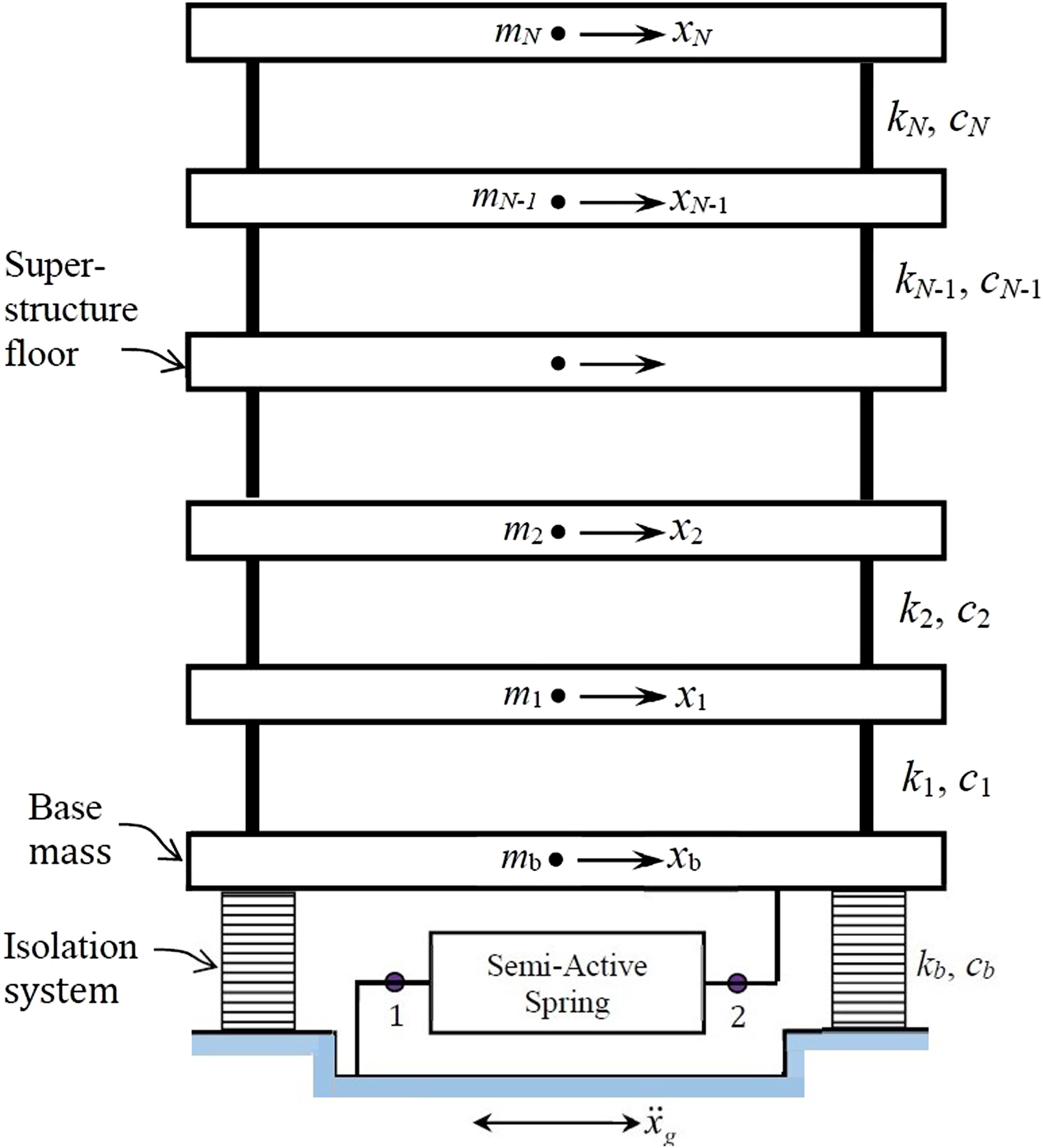

Mathematical modelling of SAS
The SAS applies the required resisting force to the structure when it moves away from its initial position (i.e. displacement,

The stiffness of the SAS is normalized to the isolator stiffness by

Governing equations of motion
The chosen base-isolated building’s governing equations of motion are

The mass of each floor, including the isolation floor, is kept constant, as is the stiffness of all floors, which is expressed by the parameter k = k i (i = 1 to N). The value of k is chosen so that the fundamental period of the superstructure as a fixed base is N/10. The damping matrix of the superstructure is not known explicitly, and it is built by assuming a modal damping ratio of 2% in all modes of vibration. With the above-assumed values of parameters, the model of the base-isolated structure with the SAS considered in the present study requires the specifications of N, T b , ξ b , and α.
Response under filtered white-noise earthquake excitation
Unpredictable and multi-dimensional ground motions are always present during earthquakes. If the frequency content evolution is disregarded, the ground motion can be represented by a power spectral density function (PSDF). The Kanai-Tajimi40,41 model of the stationary PSDF is considered in the present study and defined as

Let the model of the flexible base-isolated structure with SAS considered in Figure 1 be excited by an earthquake having the power spectrum as specified by Equation (5). Considering that Equation (2) illustrates the non-linear characteristics of the resisting force of the SAS, it needs to be converted into the equivalent linear system for the spectral stochastic response analysis. The equivalent linearized model is used to replace the non-linear behaviour of the SAS, expressed as

According to the procedure developed by Roberts and Spanos,
42
the values of the equivalent constants

Let represent the harmonic acceleration of an earthquake at time t, where

The stationary mean square displacement and velocity of the base mass of the isolated structure with SAS are determined by solving Equation (8) in an iterative manner. After each iteration, the equivalent constant
To assess the performance of the SAS for the base-isolated structures, the FRF and RMS responses were calculated for various response quantities. The selected response quantities of interest are: (i) the relative displacement in the isolation system (x
b
), (ii) the top floor absolute acceleration (i.e.
The FRF of top floor absolute acceleration (i.e. Variation of FRF of top floor absolute acceleration and bearing displacement of a base-isolated structure with supplemental SAS (T
b
= 3 s, ξ
b
= 0.1, and 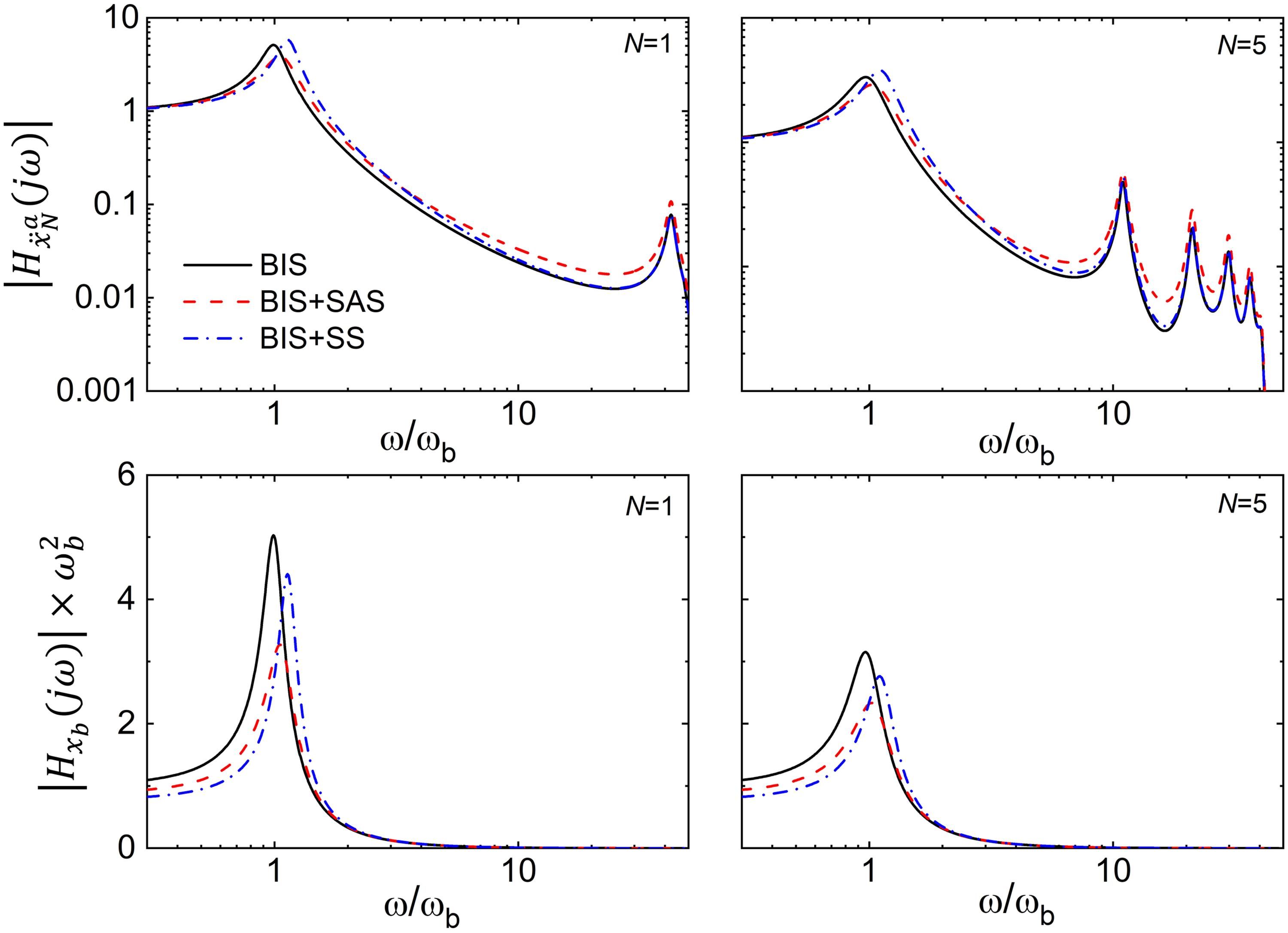
The values of the equivalent damping constant of the SAS (i.e. Variation of the equivalent damping constant, 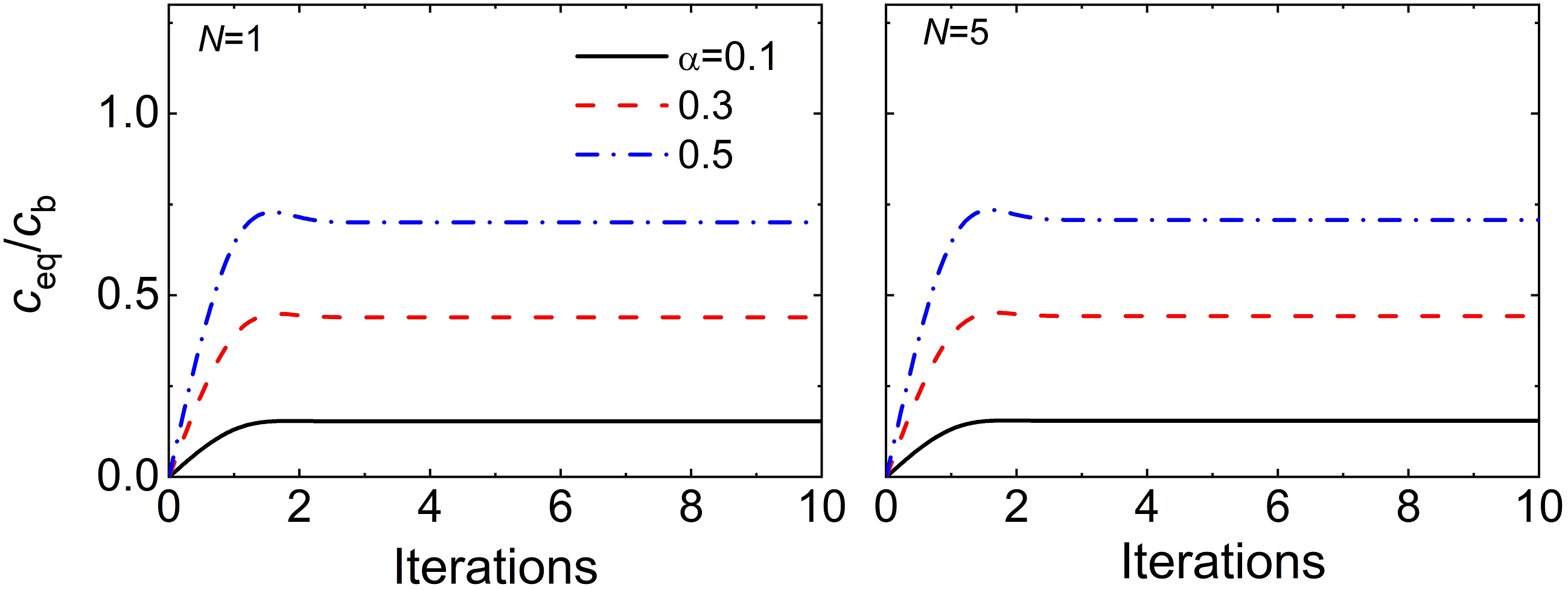
Figure 4 depicts the effects of the stiffness of the SAS on RMS top floor acceleration in one- and five-story structures for various isolation periods and damping ratios. The figure shows that as the stiffness of SAS increases, the RMS top floor acceleration decreases at first and reaches a minimum value before increasing as the stiffness of SAS increases further. This indicates that the SAS has an optimum stiffness for which the top floor acceleration of the superstructure is at its lowest. Further, the optimum value of the stiffness of the SAS decreases with an increase in the isolation period or flexibility and damping of the isolation system. When the optimal value of the stiffness of the SAS device is compared with the one- and five-story isolated structures, it is lower for the structures with a higher number of floors. It will be worth noting here that the effects of the stiffness of the SAS on the structural accelerations of the isolated structure are quite similar to the effects of viscous damping in elastomeric bearings.
37
Influence of the stiffness of the supplemental SAS on the RMS top floor acceleration of the base-isolated structures.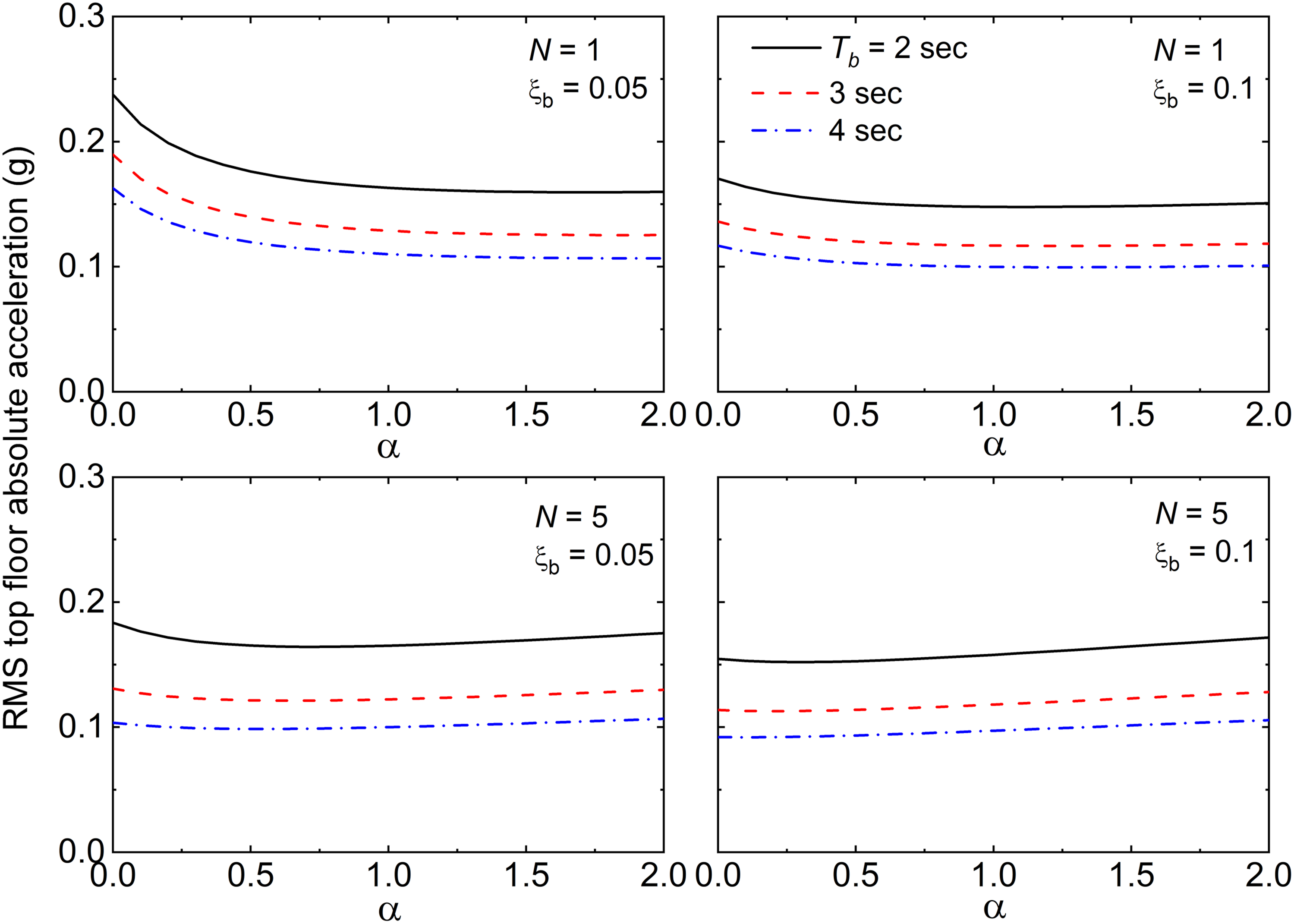
Figure 5 depicts the effects of the stiffness of the SAS on the RMS bearing displacement in one- and five-story structures for various isolation periods and damping ratios. It is observed that the bearing displacement decreases with the increase in stiffness of the SAS for all values of the isolation periods and damping ratios considered. Influence of the stiffness of the supplemental SAS on the RMS bearing displacement of the base-isolated structures.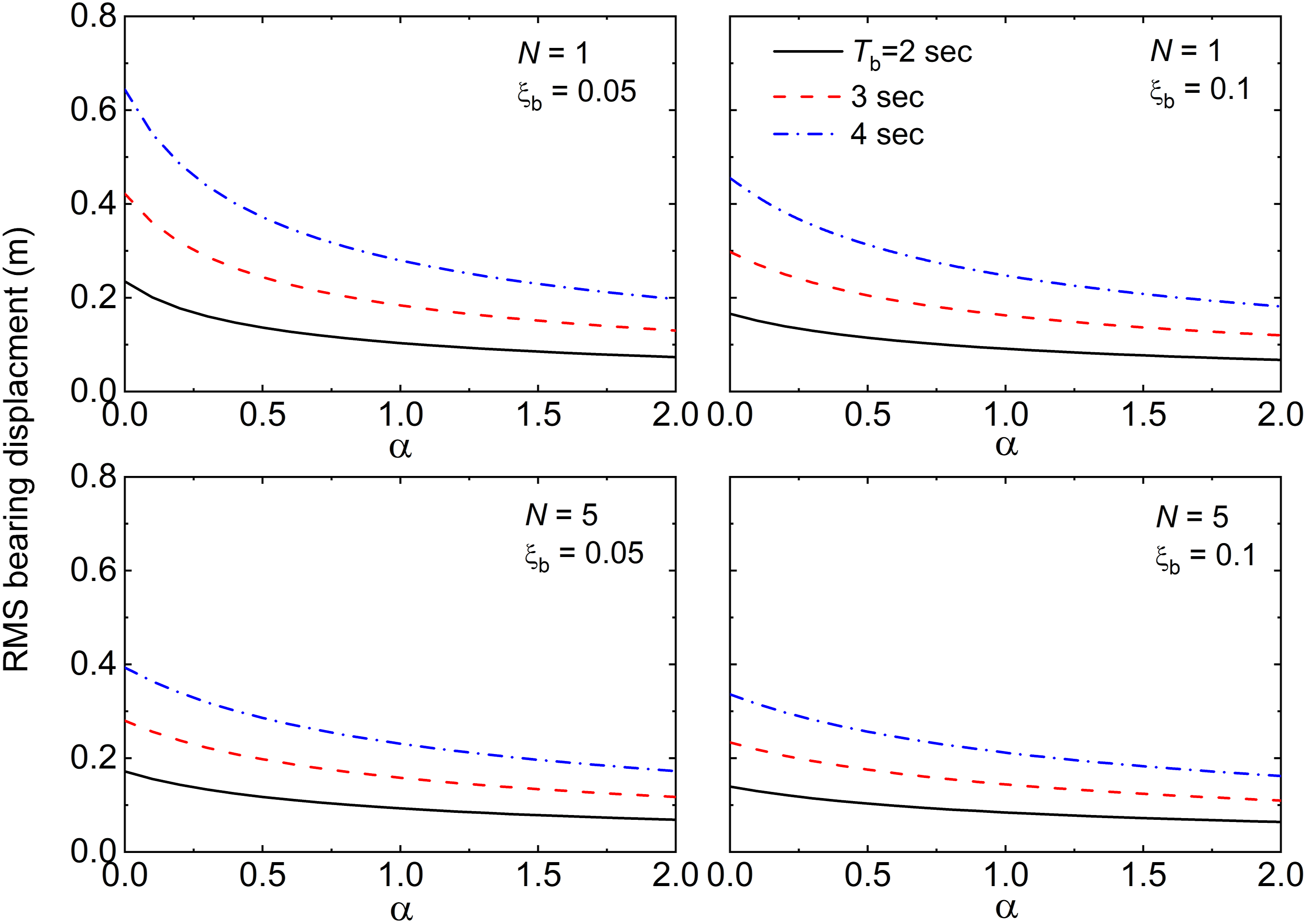
From Figures 4 and 5, the RMS top floor acceleration of the base-isolated structures with supplemental SAS decreases as the isolation period gets longer. Bearing displacement, on the other hand, increases as the isolation period elongates. Thus, the earthquake forces transmitted to the structure can be reduced while the bearings’ relative displacement increases. The relative base displacement, on the other hand, has a practical limit. As a result, a compromise between transmitted earthquake forces and relative bearing displacements must be made when designing the seismic isolation system.
Figure 6 depicts the effects of the stiffness of SAS on the variation of RMS force in the isolation system, the force in SAS, and the entire base shear. With an increase in the stiffness of the SAS, the force in the isolation system decreases, and the force in the SAS increases, as expected. The force in the SAS is greater than that of the isolation system at higher values of the stiffness of the SAS. The entire base shear initially decreases with the increase in stiffness of the SAS, and after that, it remains almost constant. Influence of the stiffness of the supplemental SAS on the RMS force in the isolation system, force in the SAS device, and entire base shear of the base-isolated structure.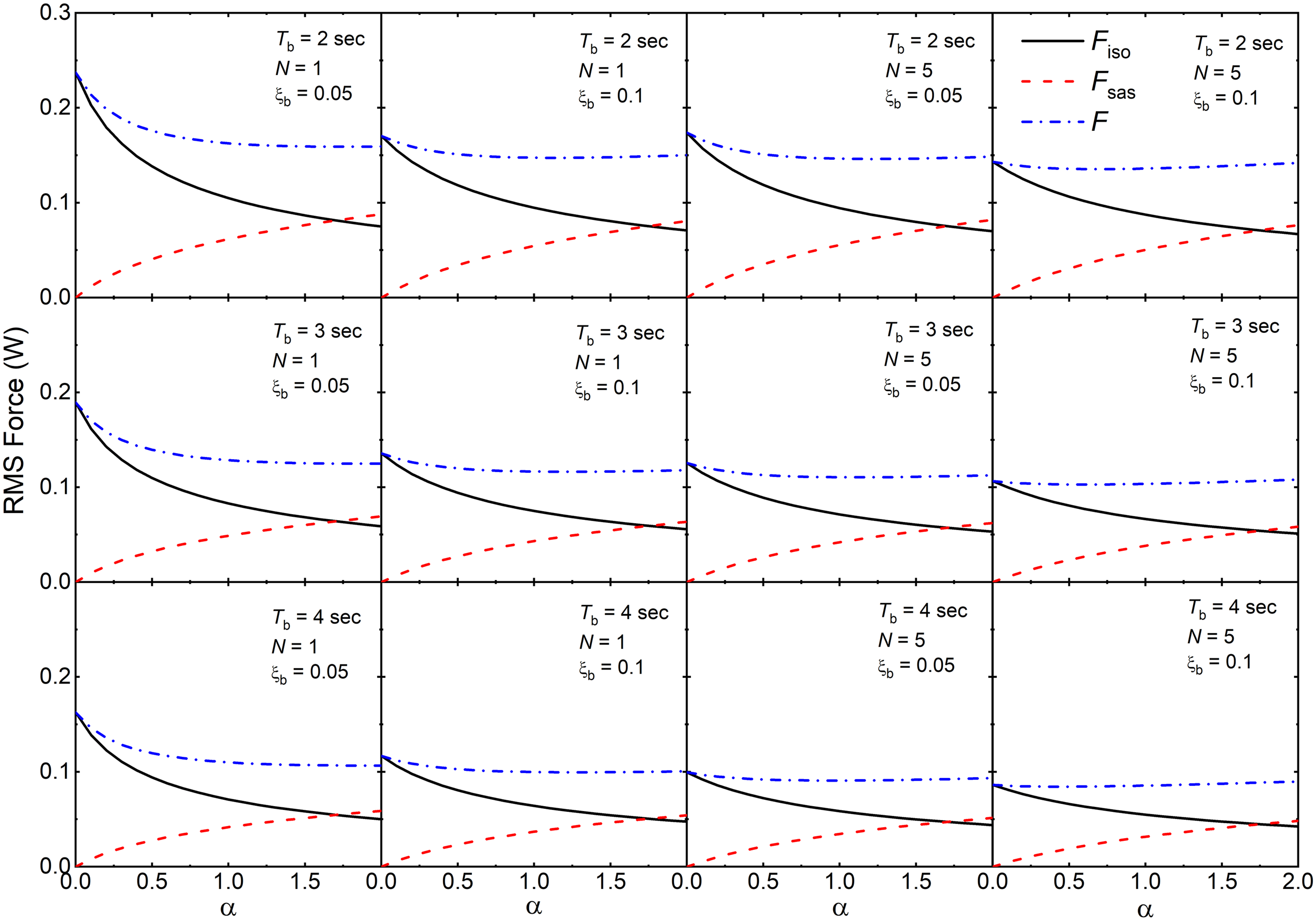
Approximate response and optimum stiffness of SAS
It is difficult to find the exact solution to the integral Equation (8) for the mean square response of the flexible base-isolated structure with the supplemental SAS subjected to filtered white-noise excitation. However, some approximate closed-form expressions can be presented by considering (a) the superstructure as rigid in comparison to the isolation system, and its flexibility is disregarded, though the superstructure flexibility has some effects on the seismic performance of isolated buildings,
43
and (b) the earthquake acceleration in the vicinity of the isolation frequency as local white-noise idealization. The later consideration implies that the amplitude of the power spectrum of the local white-noise process will be




Figure 7 shows a comparison of the RMS top floor absolute acceleration and bearing displacement of the base-isolated structures with the SAS as determined by stochastic analysis versus that predicted by the proposed approximate equation (i.e. refer to Equations (9) and (11)). It has been discovered that the responses to the two approaches are very similar and accurate for a one-story base-isolated structure. However, there is some difference in the results predicted by the two approaches for the five-story base-isolated structure. Hence, the proposed equations for the mean square displacement and absolute acceleration of the base-isolated structure predict the expected response with reasonable accuracy, and they can be utilized in the preliminary design of the base-isolated structures with supplemental SAS. Comparison of RMS top floor absolute acceleration and bearing displacement of the base-isolated structures with supplemental SAS by the approximate closed-form expressions (T
b
= 3 s and ξ
b
= 0.1).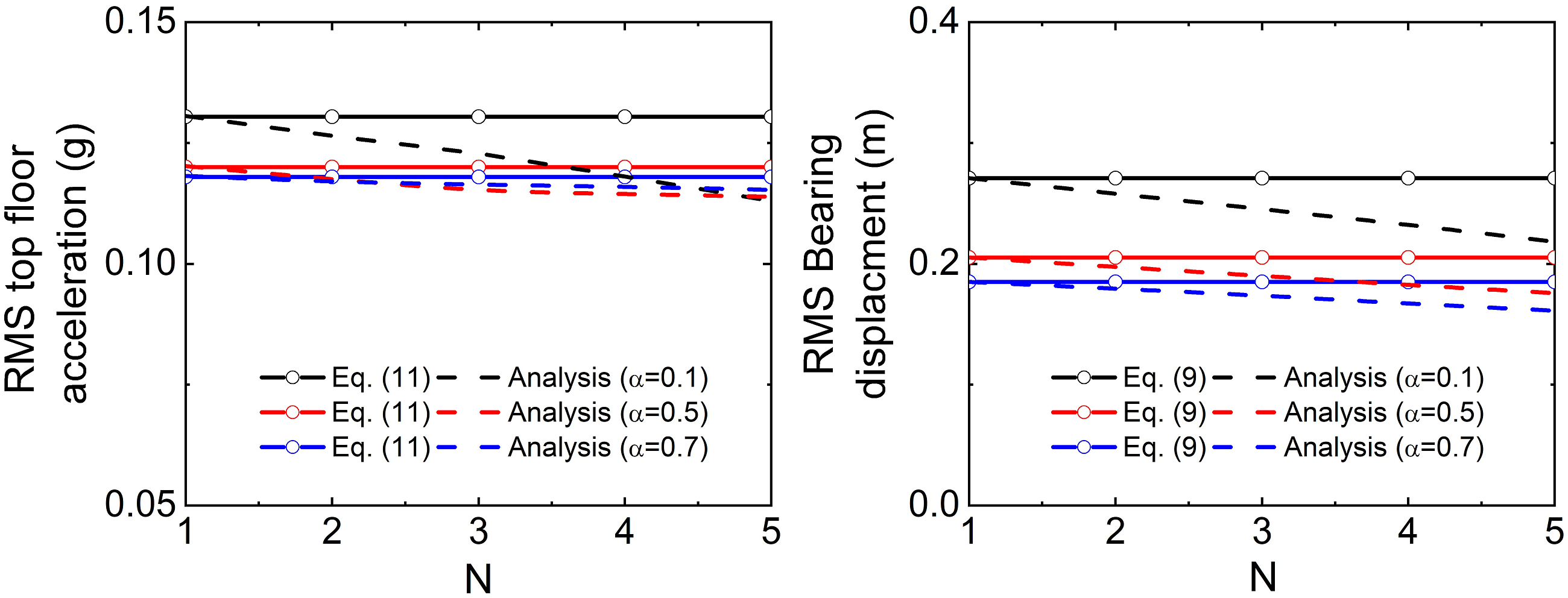
As observed in Figure 4, there exists an optimum value of the stiffness of the SAS device for which the RMS absolute acceleration attains the minimum values. This can be obtained by differentiating the equation (11) and setting it to zero for the minimum value. By following this, the expression for the optimum values of the stiffness of the SAS will be

Flexible isolated structure under near-fault earthquakes
Details of the selected NF earthquake ground motions.

The time variation of the highest floor total acceleration, isolator displacement, the force in the isolation system, the force in the supplemental SAS device, and the entire base shear are depicted in Figure 8. The response is shown for the Northridge (Sylmar Olive), 1994 NF earthquake ground motion, and compared with the corresponding response of an isolated structure without supplemental SAS (referred to as BIS). The figure shows that the peak value of the highest floor acceleration for isolated structures with the SAS device is slightly increased in comparison to that of BIS, implying that these supplemental devices are increasing the highest floor acceleration. However, the increase in acceleration is insignificant when compared to the corresponding peak-highest floor acceleration of the fixed base structure. Additionally, it has been found that for isolated structures with the SAS device, the highest floor acceleration is associated with high-frequency amplitudes. These structural accelerations could severely affect certain types of equipment that are sensitive to high frequencies. There is a reduction in isolator displacement by the SAS device. It is observed to have decreased by 13%, respectively, as compared to the corresponding BIS. The variation of force in the isolation system is similar to that of the isolator displacement. The peak value of the force in the SAS device for the isolated structure is almost equal to the Time history of the highest floor total acceleration, isolator displacement, force in the isolation system, force in the SAS, and entire base shear of a five-story base-isolated building subjected to the Northridge (Sylmar Olive), 1994 earthquake (T
b
= 3 s, ξ
b
= 0.1, and 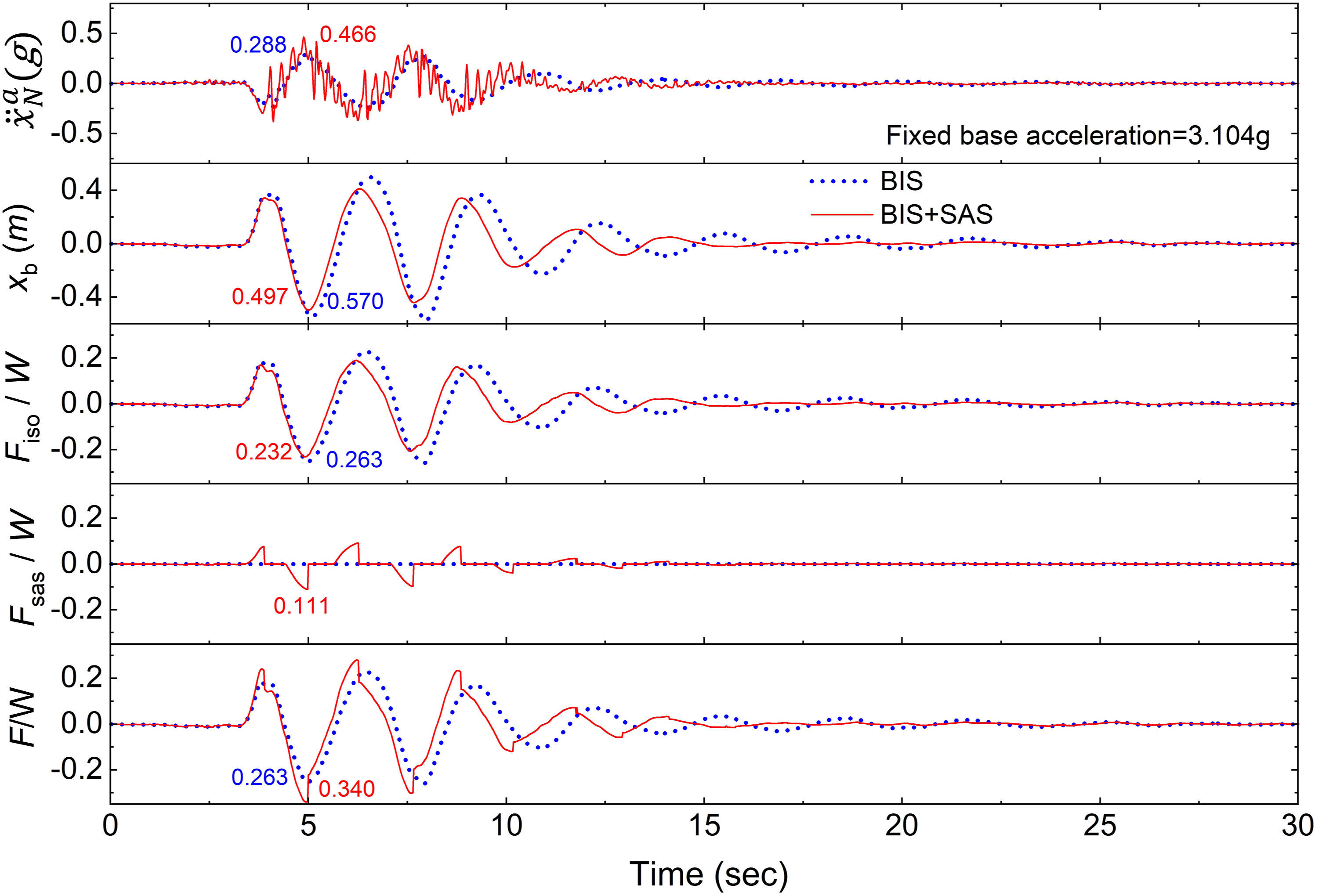
Figure 9 displays the plots of the corresponding resisting forces in the isolation system and SAS device against the isolator displacement. The force, as well as displacement, are reduced in the isolation system because of the SAS device. In addition, the force-deformation behaviour of the SAS is taken into account in Equation (2) is also supported by the plot. The plot of the restoring forces of the isolation system and SAS against the isolator displacement of a five-story base-isolated building subjected to the Northridge (Sylmar Olive), 1994 earthquake (T
b
= 3 s, ξ
b
= 0.1, and 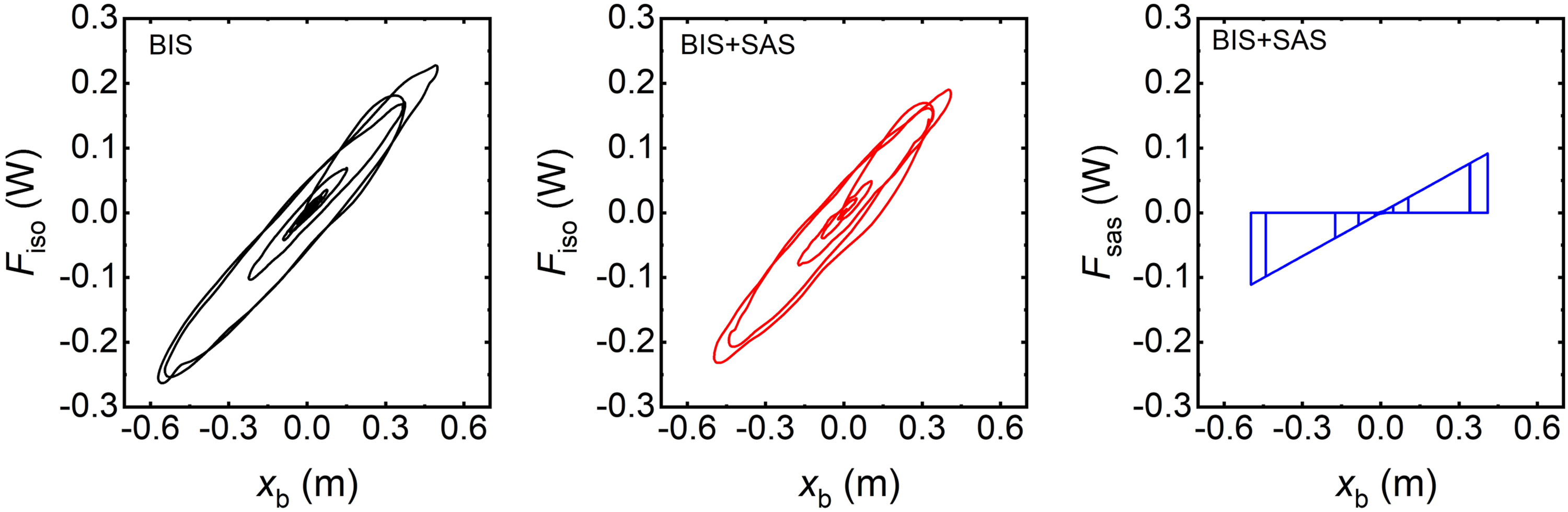
The effects of the stiffness ratio α on the peak-highest floor total acceleration and isolator displacement of the base-isolated structures with the SAS are shown in Figure 10. The figure indicates that the peak absolute acceleration increases marginally for the structure with SAS. On the other hand, the peak bearing displacement of base-isolated structures with SAS decreases with an increase in α. By comparing the acceleration and isolator displacement responses of the base isolated structure equipped with supplemental SAS, it can be concluded that the SAS device with a stiffness ratio up to 0.5 is effective in controlling the isolator displacement with a decrease in the absolute acceleration or its marginal increase. Effect of the stiffness of the SAS on the peak-highest floor absolute acceleration and bearing displacement of the five-floor isolated structure under various earthquakes (ξ
b
= 0.1).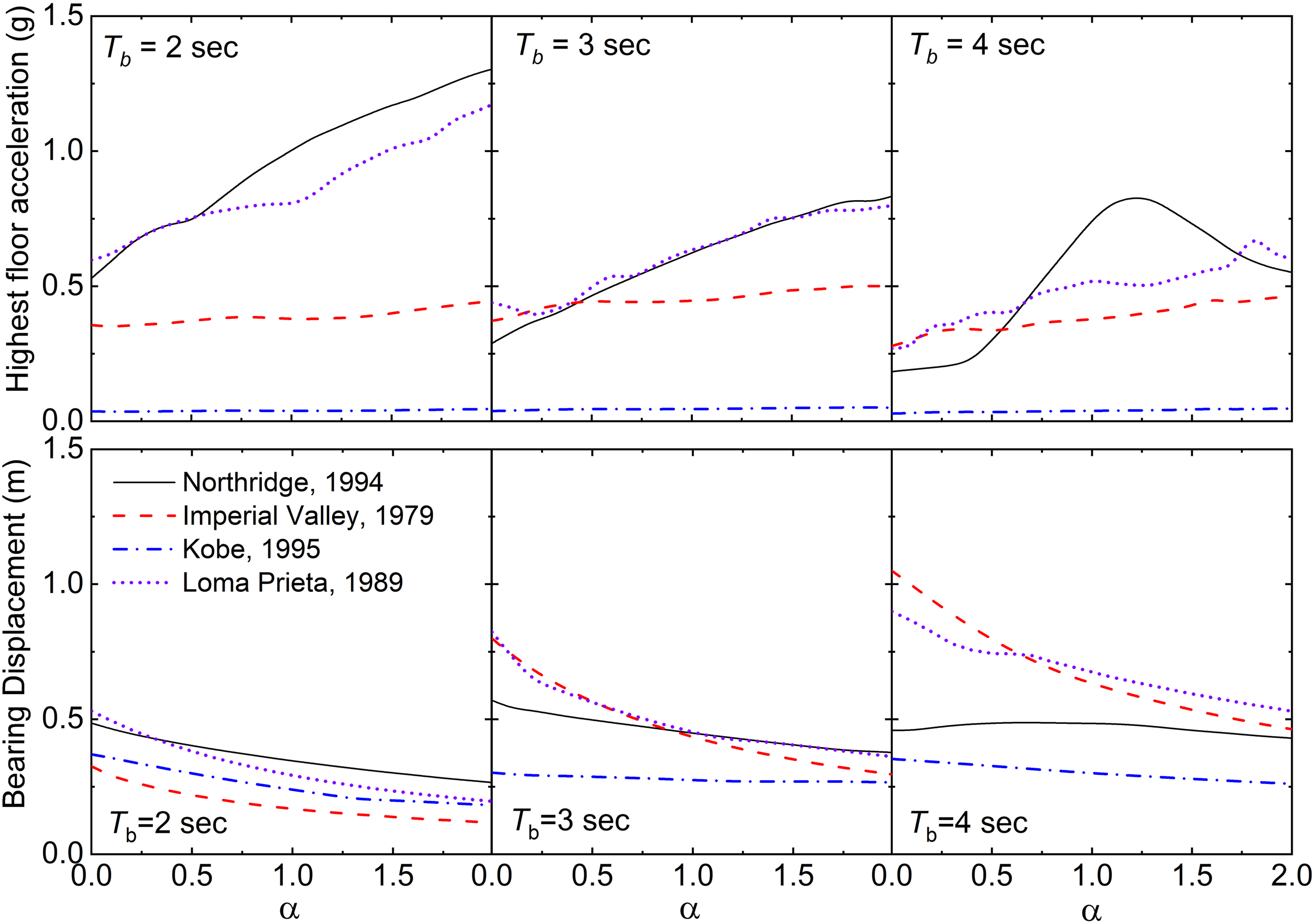
Figure 11 shows the variation of the associated peak force in the isolator, the force in the SAS, and the entire base shear of the base-isolated structure against the stiffness ratio α. As expected, an increase in the values of a causes the isolator force to decrease and the force in the SAS to increase. The entire base shear increases as the α rises. However, the increase in the entire base shear is substantial for the Northridge 1994 earthquake excitation compared to the other NF motions. Effect of the stiffness of the SAS on the peak force in the isolation system, force in the supplemental devices, and entire base shear of the five-floor isolated structure under NF earthquakes (T
b
= 3 s and ξ
b
= 0.1).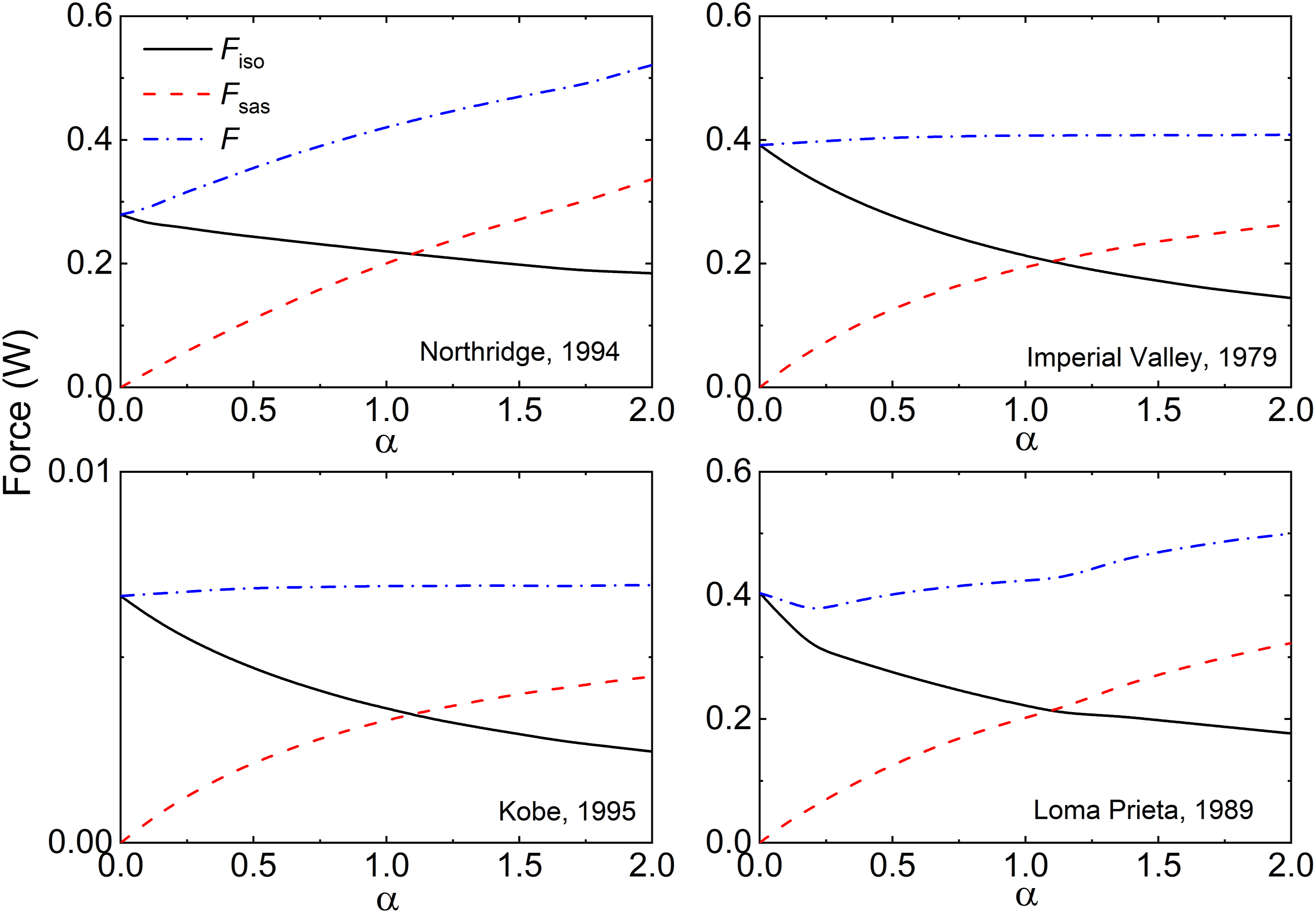
A comparison of the effects of the stiffness of the SAS in response control of isolated structures under stochastic earthquake excitation with that under recorded NF earthquake motions indicates the same trends in the variation of the highest floor absolute acceleration, the bearing displacement, the force in the isolator, the force in the SAS, and the entire base shear (refer to Figures 4–6 and Figures 10 and 11). The pattern of the isolated structure’s isolator displacement when supplemented with the SAS under actual near-fault earthquake records and the outcomes from stochastic earthquake excitation were found to be highly correlated.
Comparison of the linear and non-linear response
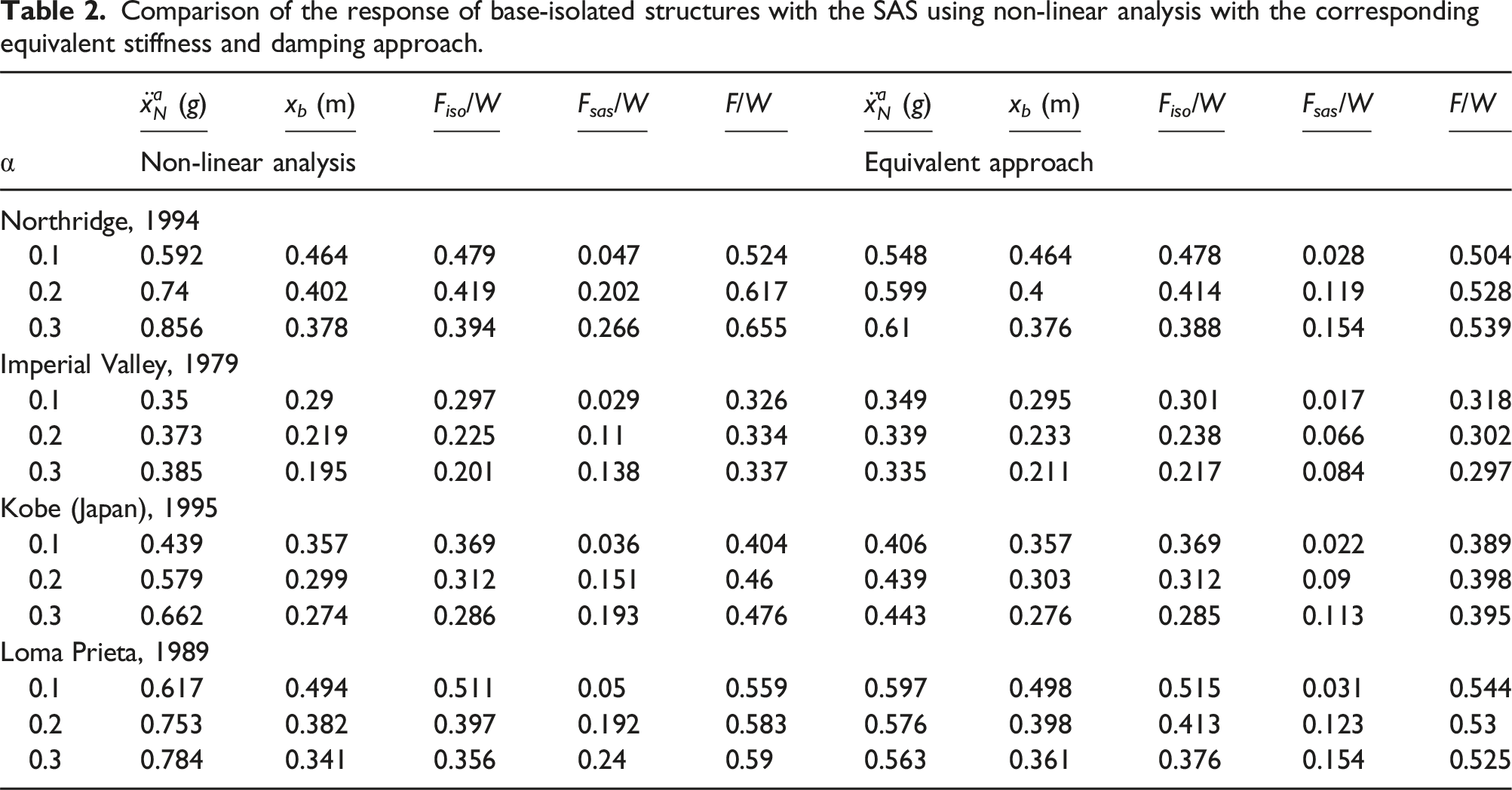
The non-linear analysis of the base-isolated structures subjected to earthquake time history is quite cumbersome, involving the engaged and disengaged conditions of the SAS device. To overcome this, it is explored to use the equivalent linear model of the SAS device. The equivalent linear model used here is the same as that proposed by equation (6) and the associated values of the equivalent constants given by equation (7). The equivalent stiffness coefficient is a constant quantity (i.e. equal to half of the stiffness of the SAS); however, the equivalent damping coefficient is dependent on the statistical response of the isolated structure. When the superstructure of the isolated structure is relatively rigid and subjected to broad-band earthquake excitation, the statistical responses can be approximated using equations (10) and (11) and will provide the value of the equivalent damping constant as
Comparison of the response of base-isolated structures with the SAS using non-linear analysis with the corresponding equivalent stiffness and damping approach.
Conclusions
The investigation into the behaviour of base-isolated structures with supplemental SAS (Seismic Absorption Systems) has yielded the following key findings: 1. SAS is a more effective supplemental device for base-isolated structures than the SS (Seismic Supplementary) device. It significantly reduces both floor accelerations and isolator displacements. 2. Under stochastic broad-band earthquake excitations, there is an optimal stiffness value for the supplemental SAS devices at which the RMS (Root Mean Square) absolute acceleration reaches its minimum. 3. This optimal stiffness value for the SAS decreases as the isolation period and damping of the isolation system increase. 4. The proposed equations for predicting the RMS isolator displacement, top floor absolute acceleration, and optimal stiffness of the SAS accurately estimate the expected response. These equations can be effectively used in the preliminary design of base-isolated structures with SAS devices. 5. The pattern of isolator displacement in base-isolated structures supplemented with SAS devices under actual near-fault earthquake records shows a high correlation with the outcomes from stochastic earthquake excitation analyses. 6. The equivalent stiffness and damping approach for base-isolated structures with SAS devices used in earthquake time history analysis accurately predicts the maximum floor accelerations, isolator displacements, forces within the isolation system, and total base shear. However, it should be noted that the predicted force within the SAS device is approximately half of that obtained from a non-linear analysis.
This study has demonstrated the potential of SAS devices to enhance the seismic performance of base-isolated structures by optimizing key parameters such as stiffness, which can be critical for minimizing accelerations and displacements during seismic events. Additionally, the SAS outperforms a simple spring in mitigating the dynamic response of isolated structures. However, these findings need to be validated through experimental testing. Furthermore, the performance of the SAS should be evaluated considering the non-linear behaviour of isolated structures and compared with classical dampers such as viscous and friction dampers. The effectiveness of the SAS in reducing the seismic response should also be examined, taking into account the effects of soil-structure interaction.
Footnotes
Declaration of conflicting interests
The author(s) declared no potential conflicts of interest with respect to the research, authorship, and/or publication of this article.
Funding
The author(s) received no financial support for the research, authorship, and/or publication of this article.
