




Abstract
Development of novel risk and reliability assessment methods is intended to support safer construction of offshore structures, subjected to environmental wave loads. Current study investigated 10-MW FWT (i.e., Floating Wind Turbine), operating under realistic environmental conditions. While increasing operating safety, enhanced risk and reliability assessment methods may eventually help reduce manufacturing and maintenance costs. Excessive structural dynamics being usually caused by environmental stressors, acting on structural system. Environmental loads resulting from ambient wind and wave motions are typical for offshore structures. Current work advocates a novel risk and reliability assessment methodology that allows for reliable forecasting of failure/damage risks, arising from excessive FWT structural dynamics. Recently developed Gaidai multivariate reliability methodology along with state-of-the-art deconvolution method had been employed. Unlike existing reliability approaches such as Weibull-type, GP (i.e., Generalized Pareto), POT (i.e., Peaks Over the Threshold), etc., the recommended methodology does not rely on any pre-assumed functional class, when extrapolating failure probability functional tail. Practical advantages of the suggested multivariate reliability methodology combined with deconvolution scheme over, that is, 4-parameter Weibull’s extrapolation method had been demonstrated. Suggested methodology makes effective use of even limited underlying datasets, enabling robust and accurate projections of multidimensional structural system failure/damage risks. Overall methodological performance suggests that numerically stable and accurate extreme dynamics forecasts for FWT structural bending moments might be obtained, utilizing suggested multivariate reliability methodology. Deconvolution extrapolation approach being more numerically stable than parametric extrapolation techniques, due to its non-parametric nature.
Introduction
Modern FWT systems assist reaching 2050 net-zero emissions targets.
1
The International Electrotechnical Commission (IEC) has released guidelines stating that FWTs have to be robustly constructed to safely function for at least 10 years under in situ ambient wind-wave conditions.
2
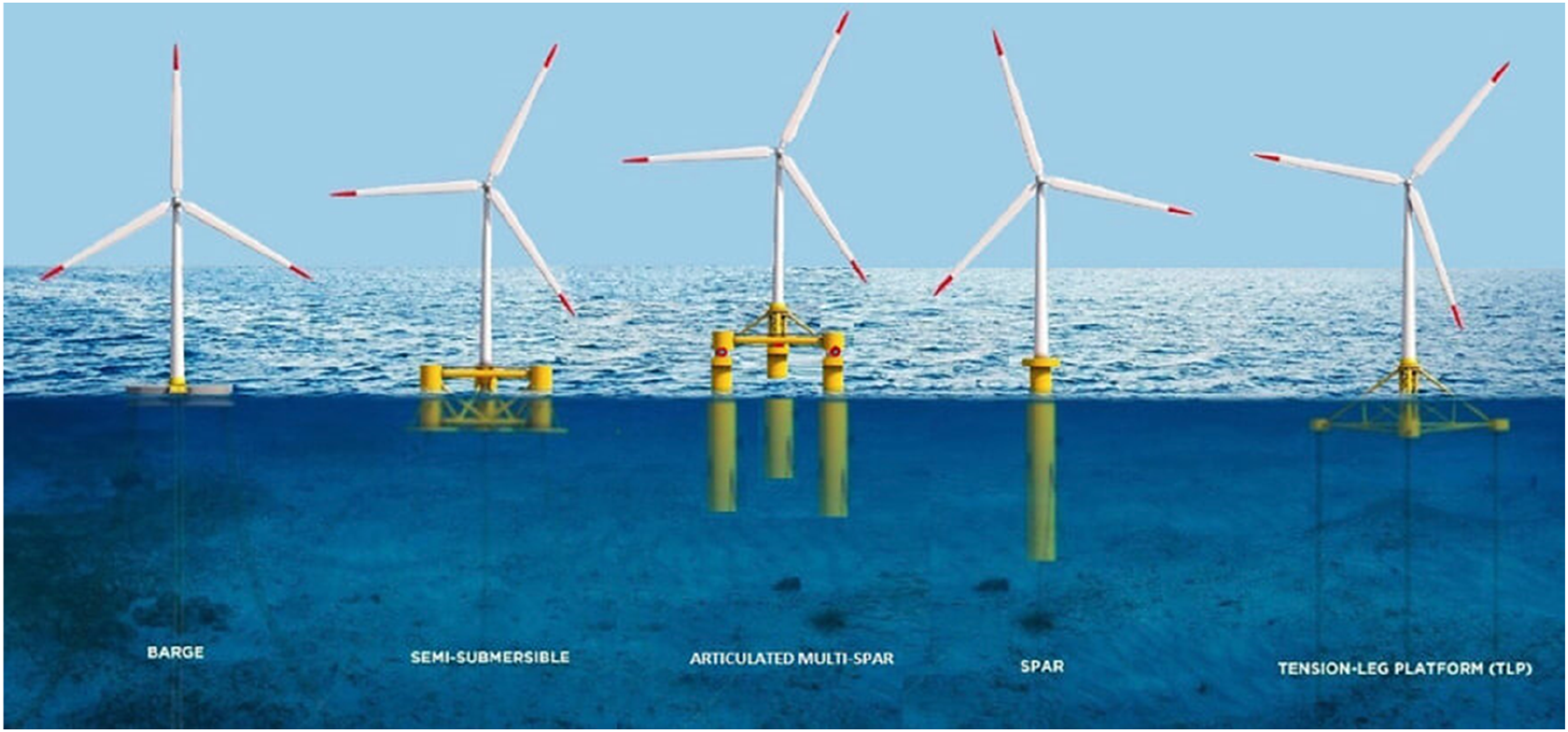
Five distinct types of operational FWTs are shown in Figure 1. State of the art deconvolution extrapolation scheme has been presented in the current work, suitable for nonlinear structural extreme dynamic analysis. For 10 MW FWT, the recommended multivariate reliability methodology, coupled with deconvolution scheme allows for the reliable yet efficient estimates of excessive structural loadings/responses, given in situ environmental conditions. Utilizing measured or MC (i.e., Monte Carlo) numerically simulated datasets, deconvolution enables precise structural dynamics PDF (i.e., Probability Density Function) tail extrapolation, offering a novel non-parametric method to evaluate design/characteristic values.4–15 Deconvolution approach does not rely on any asymptotic-type PDF class, as it does not assume that the underlying distribution is of the GEV (or Generalized Extreme Value) type. When structural dynamic FWT system is not yet at the asymptotic level, the suggested deconvolution technique might outperform. For examination of offshore wind turbines, fastened to the seabed, see Refs 16–21. For using probabilistic approaches to extrapolate extreme and fatigue loads, see Refs 22–27. For modified Weibull-type extrapolation technique, see Refs 28–33. Different FWT types. Only semi-submersible (second from the left) type is considered.
3
Due to FWT structural failures/damages risks, caused by excessive in situ environmental loadings, DNV (Det Norske Veritas) safety standards have being introduced. 34 Areal/sectional extremes can be modeled using, for example, MSP (Max-Stable Processes) theory. 35 If data are gathered within a specific geographic or structural geometrical domain, MSP models can be fitted to estimate areal exceedances, while taking into consideration spatial interdependence of the extremes. MSP being theoretically based on the Extreme Value Theory (EVT) paradigm. The deconvolution technique that has been recommended here can be successfully incorporated into MSP, by replacing the EVT part with the sub-asymptotic distribution functional class.
Figure 2 schematically illustrates suggested long-term multivariate reliability workflow. Long-term multivariate reliability diagram.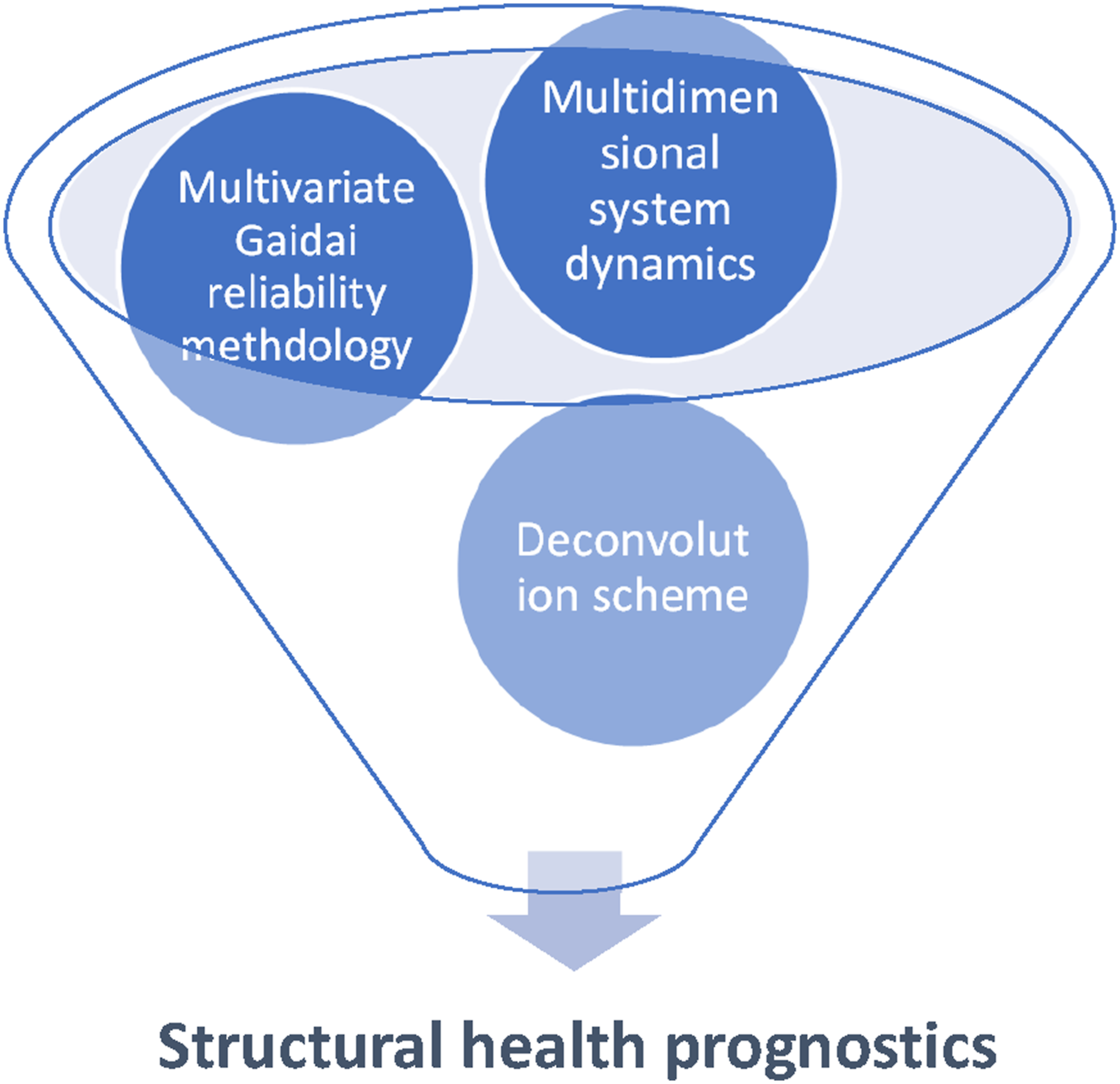
Structural description and environmental conditions
The main FWT structural characteristics and the environmental modeling methodology are described in this Section.
FWT system’s description
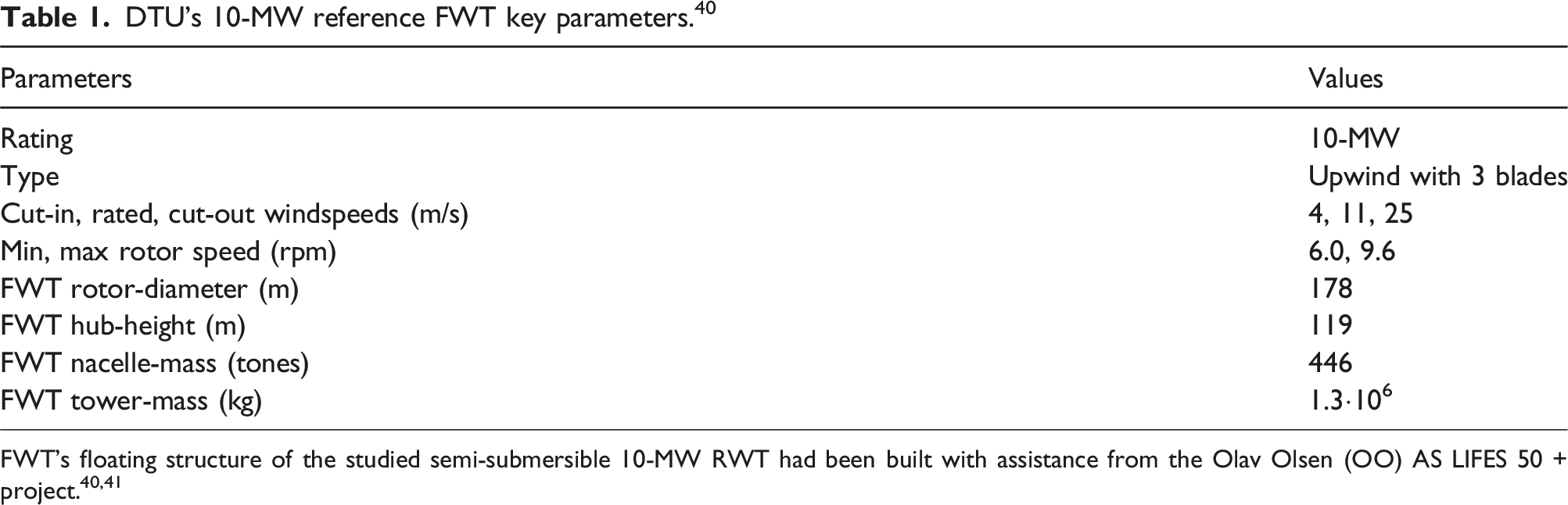
DTU’s 10-MW reference FWT key parameters. 40
FWT dynamic parts
FWT structural loadings at the 2 selected measurement sites, shown in Figure 3, to be analyzed. Those are: A) Left: 10-MW OO-Star FWT. Right: locations of selected FWT bending moments are marked with 2 stars.
40
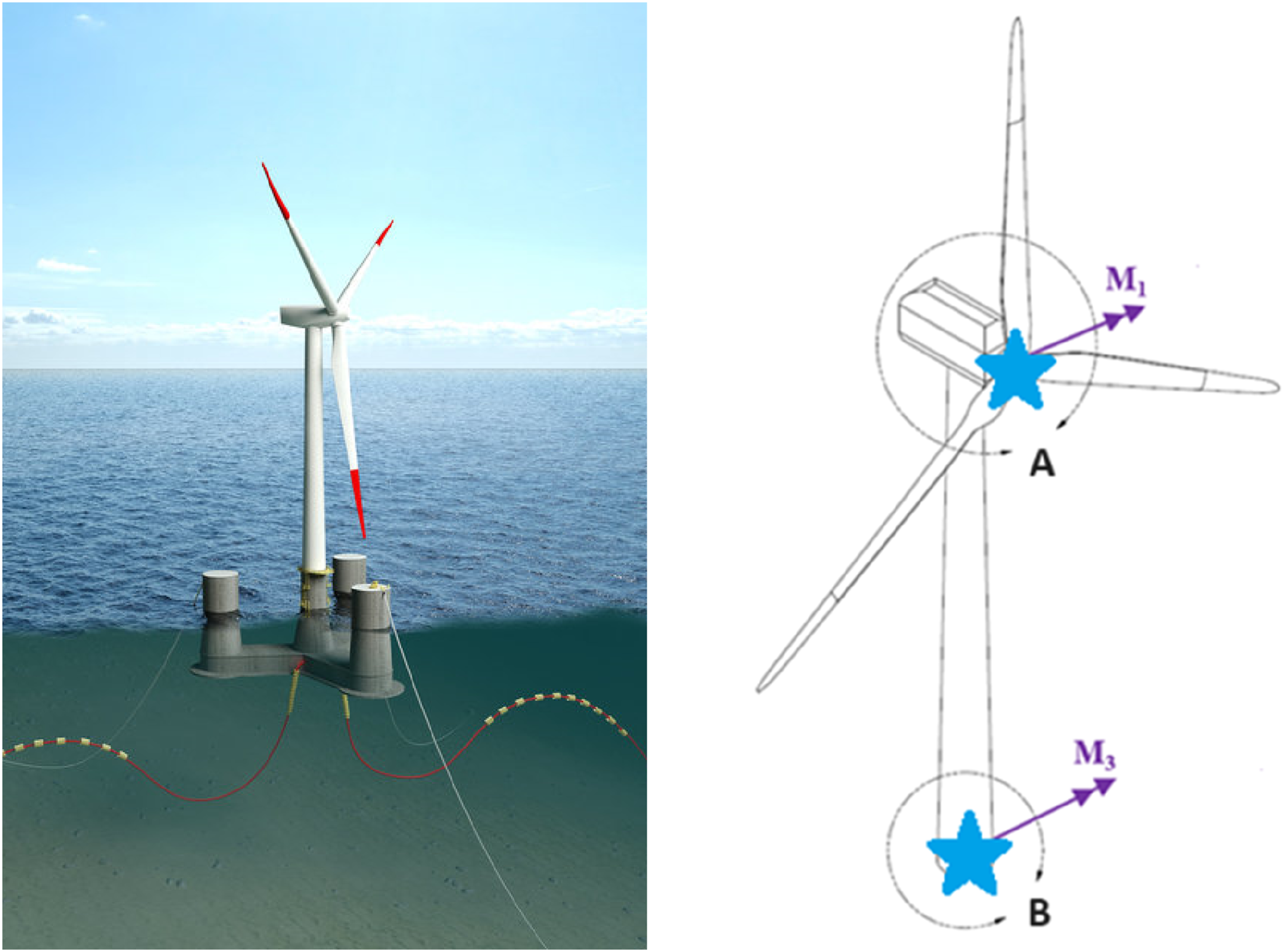
Figure 3 left schematically presents 10-MW FWT analyzed in the current investigation.
Load cases, environmental conditions
The current study made use of ambient winds and waves, measured at in situ offshore sites in the North Sea, throughout the recent decade of 2010–2020. The joint wind-wave PDF,
42
includes 1-hour mean windspeed U10, measured at 10 m above Mean Sea Level (MSL), wave spectral peak-period T
p
, and significant wave-height H
s
. Joint PDF of U10, H
s
, and T
p
is given by

Selected LCs (Load Cases) for MC simulation.

Reliability methodology for series-type multidimensional structural system
Current section to present theoretical details of advocated state-of-the-art reliability methodology.
Gaidai multivariate reliability methodology for series-systems
Let’s take into consideration structural dynamic MDOF (i.e., Multi-Degree Of Freedom) FWT system’s critical/key components (i.e., response/load components), composed into vector 
Being target probability of dynamic system’s survival, and 
Making all dynamic FWT system’s critical/key components non-dimensional, having same target hazard/failure/risk limits
Deconvolution scheme
Current section provides a brief overview of the MC-based numerical method, used to evaluate FWT structural risks and reliability. Recently, a novel deconvolution technique has been successfully proven.68,73,76 Assessment of excessive system dynamics is frequently a difficult design and engineering endeavor, especially when the underlying dataset is small.33–41,43,45–48 Therefore, from the standpoint of practical design, it is essential to create state-of-the-art, accurate, and efficient extrapolation methods. 
Due to the generic character of advocated methodology, a wide range of naval, marine, subsea, and offshore structures may well benefit from its use, when evaluating extreme values for pertinent structural dynamic reactions and related stresses.49–56 Two different approaches to treating the stochastic process of interest A) Deconvolution: straightforward deconvolution, assessing B) Convolution: separate sub-process component’s
Target PDF 
Convolution of two vectors, 
Summation performed over all legal subscripts for 






Equation (8) highlights gradually reduced extraction of the
Results
Deconvolution scheme to be demonstrated “in action” in the current Section, by means of damage/failure risks assessment for FWT excessive dynamic bending moments, see Figure 3. A total of 20 1-hour MC simulations had been run. The suggested methodology had been effectively utilized for available limited underlying dataset, to forecast extreme/design values with predetermined return periods. Results have indicated that the deconvolution scheme well handles nonlinear, non-stationary process dynamics, producing reliable yet accurate predictions.89–91 For a thorough explanation of the modified 4-parameter Weibull-type extrapolation method, see
58
. Figure 4 illustrates 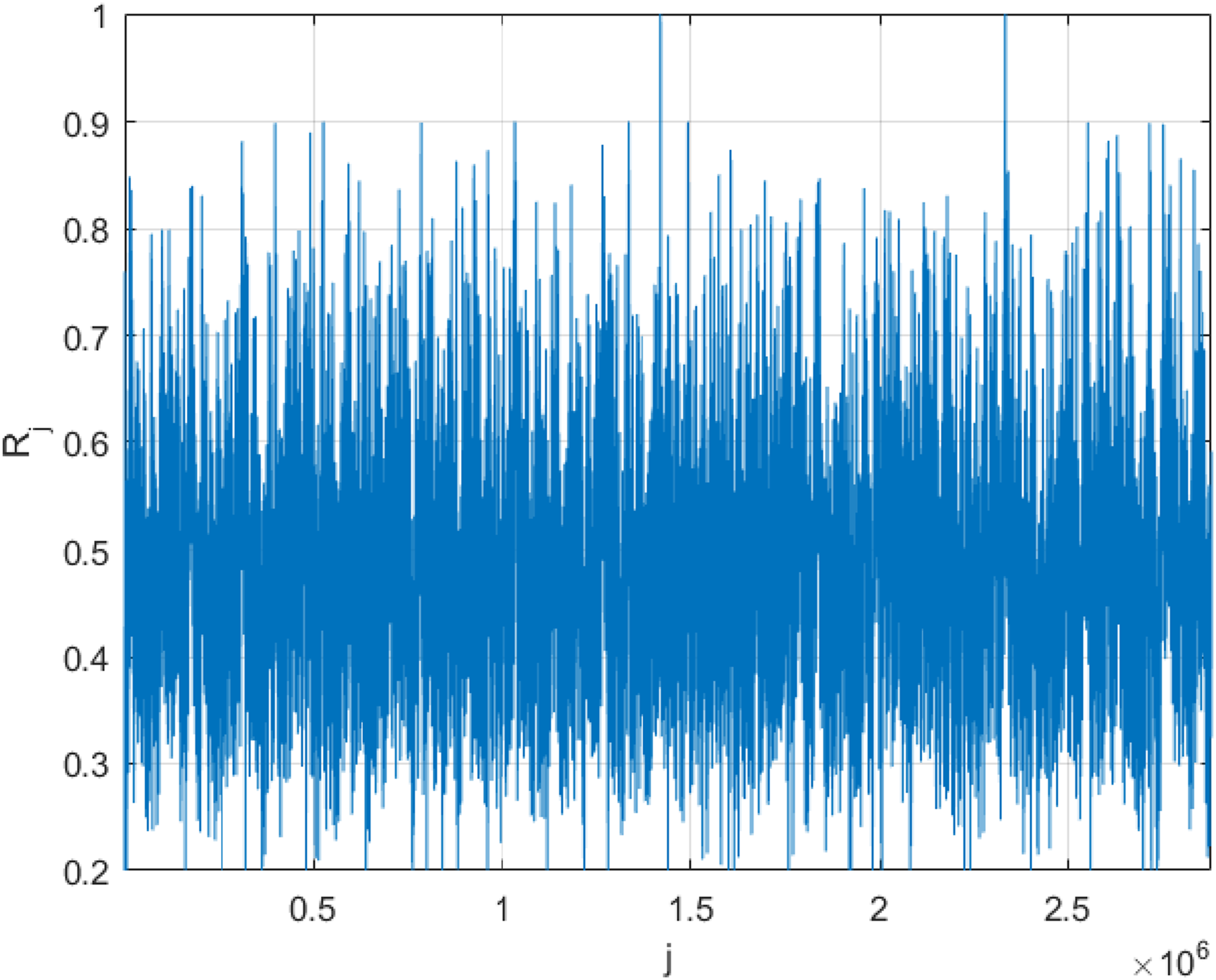
Note that
Figure 5 (b)) displays the final, unscaled results, which are based on the deconvolution technique (blue line), along with extrapolation by modified (the 4-parameter) Weibull-type extrapolation (cyan line).92–98 The modified 4-parameter Weibull-type extrapolation is compared with novel deconvolution scheme, as shown in Figure 5 (b))—it is seen that deconvolution scheme delivered more accurate and conservative FWT failure probability forecast (indicated by star), while 4-parameter Weibull predicted non-conservative value, lying outside 95% CI. Presented results serve as a benchmark and cross-validation for the novel deconvolution approach.99–106 Primary benefit of deconvolution methodology over parametric extrapolation techniques is its non-parametric nature, which allows for more numerically stable extrapolation
107
. Forecasts for FWT combined bending moments: (a) Linear extrapolation of 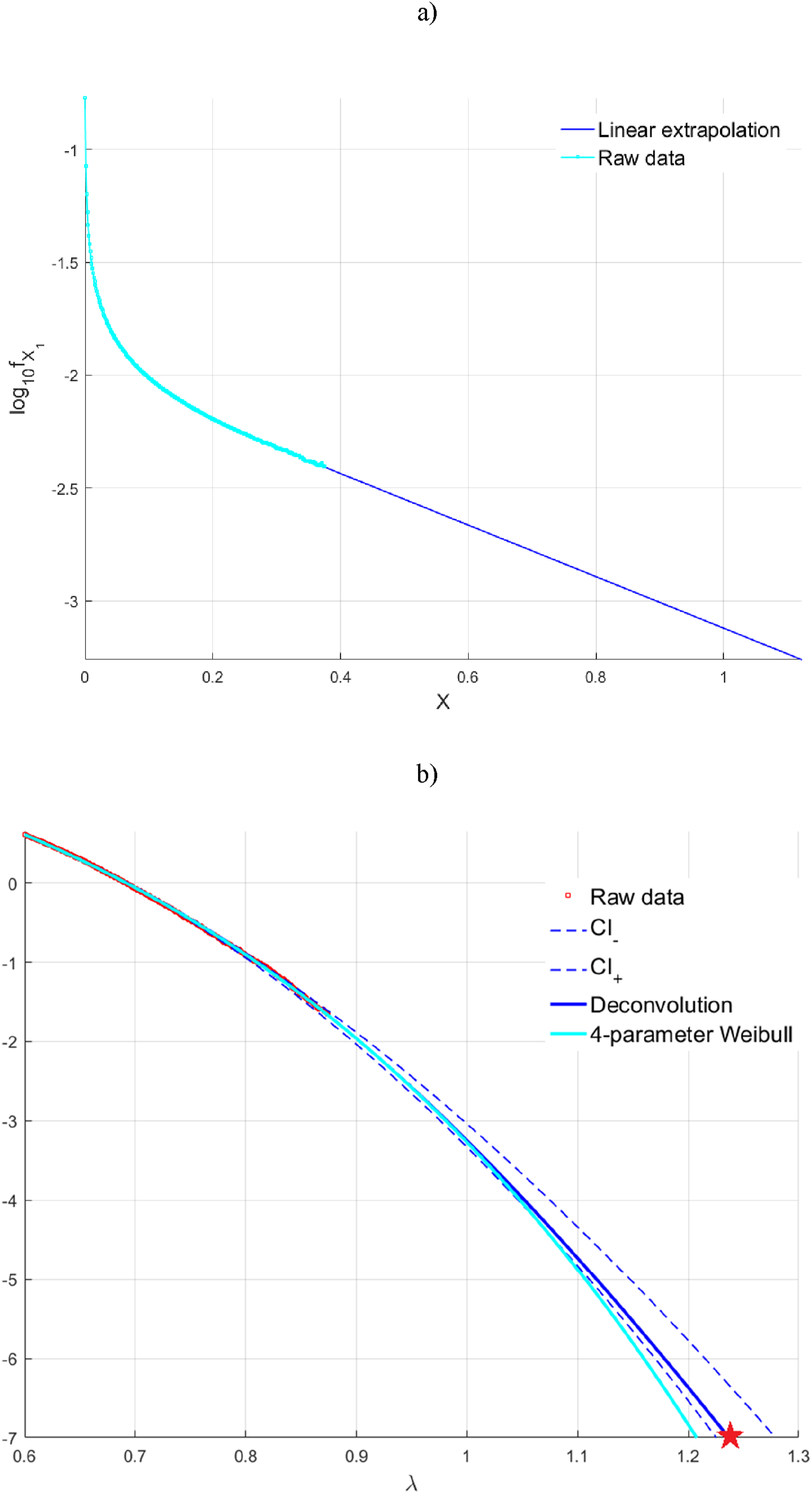
Discussion
Gaidai multivariate risk evaluation prognostics/design benefits.

The following are the suggested methodology’s benefits and drawbacks: ▪ The suggested structural risk assessment methodology has an advantage over existing reliability methods, as it can handle high-dimensional dynamic systems; ▪ Challenges, associated with predicting an underlying system’s trend may be seen as certain limitations of the advocated approach—however, this is common challenge for any reliability method.
The primary aim of this research has been to provide a reliable, user-friendly, multi-dimensional approach for assessing the risk of wide range of dynamic systems.
Conclusions
A novel deconvolution technique has been introduced and employed to assess target design/characteristic values of the FWT. The blade-root along with tower-bottom bending moments of FWT had been examined, under realistic in situ environmental circumstances. Various load situations had been accounted for to describe ambient wind-wave loads. A realistic illustration of the long-term multivariate reliability strategy had been provided. The advantages of the applied multivariate reliability coupled with deconvolution scheme are: • State-of-the-art Gaidai multivariate reliability methodology has no limit on the number of structural system dimensions/components, while existing reliability methods are limited to 2D. • Novel deconvolution extrapolation scheme being stable and independent of the distribution tail marker choice, that is, being non-parametric. • Unlike IFORM/SORM, the novel deconvolution scheme does not discard model nonlinearities and it does not rely on EVT-assumption. • In contrast to existing extrapolation methods, that is, Weibull-type, GP, Gumbel-type, POT, the suggested methodology does not depend on any presumptive asymptotic functional (parametric) class, to carry out PDF tail’s extrapolation.
The proposed methodology being not restricted only to the examined FWT example, hence having broad variety of potential design/engineering applications.
Footnotes
Acknowledgments
The authors declare no financial interests. This study advocates a similar methodology as already had been presented by authors in, 82 however, floating wind turbine dynamic components, analyzed in this study are different.
Author’s contributions
All authors had contributed equally.
Declaration of conflicting interests
The author(s) declared no potential conflicts of interest with respect to the research, authorship, and/or publication of this article.
Funding
The author(s) received no financial support for the research, authorship, and/or publication of this article.
Ethical Statement

Data availability statement
Data will be made available on request from the corresponding author.