




Abstract
This study aims to examine the properties of the nonplanar (cylindrical and spherical) ion-acoustic solitary waves (SWs) and cnoidal waves (CWs) in a collisionless, unmagnetized electron-ion (EI) plasma having a Cairns–Tsallis distribution for the electrons. This study is structured around two main lines. The first trend involves deriving the nonplanar Korteweg-de Vries (KdV) equation by utilizing the method of reductive perturbation (MRP). This equation describes small-amplitude (non)planar acoustic waves (AWs). Furthermore, the nonplanar Kawahara equation (KE) is formulated to examine the significant magnitude of planar and nonplanar SWs and CWs. The current plasma model supports compressive and rarefactive IA solitary and cnoidal structures, depending upon the associated physical factors such as the nonextensive parameter (nonextensivity) and nonthermal parameter (nonthermality). When the plasma compositions reach some critical values, such as the critical value of nonthermality, the coefficient of the quadratic nonlinear term vanishes. Hence, both nonplanar modified KdV (mKdV) equation and modified KE (mKE) with cubic nonlinearity are derived to accurately depict the dynamics of both small and large amplitudes of nonplanar SWs and CWs and any other structures related to this family of evolution equations. The influences of the nonextensivity and nonthermality on the profile of (non)planar KdV soliton and the (non)planar Kawahara SWs and CWs are numerically examined using some semi-analytical and numerical approximations. Also, the impact of the nonextensivity on the profile of (non)planar mKdV soliton and the (non)planar modified Kawahara SWs and CWs is reported. It is tracked down that the variety of different plasma parameters significantly alters the characteristic properties of the small and large amplitude ion-acoustic waves (IAWs) discussed by the nonplanar KdV-type equations.
Keywords
Introduction
The investigation of (non)linear structures in typical plasmas has content of significant interest for many researchers. A wide variety of evolution equations may be given to explain various linear and nonlinear phenomena in several contexts, such as shallow water, plasma physics, and nonlinear optics.1–6 Nonlinear waves in plasma and some other dissipative environments have received great attentiveness due to their applications in various areas of physics, such as nonlinear ion transportation. Solitary waves (SWs)/solitons are one of the most famous nonlinear phenomena that can arise and propagate widely in a nonlinear and dispersive system, such as plasma physics, nonlinear optics, seas, oceans, and many others. This type of localized wave was discussed and interpreted by studies of numerical simulation of the Korteweg-de Vries (KdV) equation.
7
Washimi and Taniuti
8
explored the ion-acoustic (IA) solitons theoretically by using the reductive perturbation technique (RPT) to derive the KdV equation while the experimental proof of the soliton was carried out by Ikezi et al.
9
Many researchers illustrated the dynamics of SWs that can exist and propagate in several mediums in the frame of the KdV equation10–12 and its family of third-order dispersion such as a modified KdV (mKdV) equation with cubic nonlinearity,13,14 Schamel KdV equation with fractal nonlinearity,15,16 extended KdV equation with quadratic and cubic nonlinearities, and so on.1,2 On the other side, there is another family for the KdV equation but with fifth-order dispersion, known as Kawahara-type equations. The Kawahara family is distinguished by the combination of the third- and fifth-order dispersion, which makes it often more expansive and accurate in describing nonlinear structures (e.g., SWs and cnoidal waves [CWs]) of large amplitude, as many researchers have proven in their publications. Many studies have been conducted on this family to find some analytical and numerical solutions to use them in modeling and understanding the nature of several nonlinear structures that arise and propagate in nature.17–21 Moreover, if many physical effects are taken into account, especially those that appear in many different plasma systems, such as the collisional force between charged particles with each other or with some neutral particles, in addition to the geometrical effect, here we cannot find exact analytical solutions to this family. Therefore, some researchers have devoted significant efforts to analyzing and finding approximate analytical solutions for this family with some complex physical effects. For instance, El-Tantawy group used the ansatz method to derive for the first time many semi-analytical solutions for the following family of Kawahara-type equations:22–32 (1) Damped Kawahara equation (KE) that arises as a result of taking the collisional force between the charged/or neutral particles into account22–24 (2) Nonplanar (cylindrical and spherical) KE that arises as a result of taking the geometrical effect into account
25
(3) Damped nonplanar KE that arises as a result of taking both the collisional force between the charged/or neutral particles and the geometrical effect into account
26
(4) Damped modified KE (mKE) that is derived at some critical values to plasma parameters and arises as a result of taking the collisional force between the charged/or neutral particles into account
27
(5) Nonplanar mKE that is derived at some critical values to plasma parameters and arises as a result of taking the geometrical effect into account
28





It is known that the allocation of inertialess space particles and astrophysics plasmas deviates from the Maxwellian distribution. 33 Therefore, there were many successful attempts to come up with many distributions that differ from the Maxwellian distribution. At the same time, their findings are in agreement with the outcome of the observations. One of these distributions is the Cairns–Tsallis (C–T) distribution, which has become widespread in recent years in many studies due to the agreement of its theoretical results with the observed results. 34 Also, a greater variety of circumstances involving high-energy non-Maxwellian tails might be covered by the product C–T distribution. 35 This distribution was proposed earlier by Tribeche et al. 34 to investigate the ion-acoustic SWs in the framework of the KdV equation and the Sagdeev potential 36 in electron-ion (EI) plasmas having C–T distribution of electrons and inertial cold ions. The numerical analysis ensures that the current plasma system under consideration supports both compressive and rarefactive solitons for small (by analyzing the KdV equation) and large (by analyzing the Sagdeev potential) amplitudes. Williams et al. 35 explored the properties of IA solitary waves with C–T electron distribution. After careful study of this distribution, the authors 35 found that there are many restrictions on using this distribution for describing nonlinear structures in a plasma. One of these restrictions is the limited range of the nonextensive parameter q, which the nonextensivity q must satisfy 0.6 < q < 1. However, the C–T distribution displays a thermal cutoff for q > 1, making it inappropriate to analyze plasmas with enhanced non-Maxwellian tails. Recently, Khalid et al. 37 examined the electron-acoustic (EA) SWs in a collisionless unmagnetized plasma consisting of inertial cold electrons, inertialess non-Maxwellian electrons obey C–T distribution, as well as stable positively charged ions. Also, small amplitude IA solitons in a multicomponent magnetoplasma having a modified C–T electron distribution had been investigated in the framework of KdV and modified KdV equations. 38 The dust-acoustic (DA) SWs in variably sized dust grains non-Maxwellian plasma with Maxwellian ions and hybridized C–T distribution of electrons had been investigated. 39 The authors found that their plasma model supports only rarefactive/negative potential solitons. The impact of nonthermal parameters of the C–T-distributed particles (electrons and positrons [EP]) on the properties of IA soliton in EPI magnetoplasma has been investigated. 40 The nonplanar EA negative solitons were studied in a collisionless and unmagnetized plasma composed of inertial cold fluent electrons and C–T-distributed electrons as well as stationary positive ions. 41 Also, in the framework of a nonlinear Schrödinger (NLS) equation, Merriche and Tribeche 42 studied the modulated instabilities (MIs) of EA-modulated plasma waves which contain inertial cold electrons and inertialess C–T distribution of electrons as well as stable ions. Additionally, Farhadkiyaei 43 reduced the fundamental equations of EPI plasma having inertialess Maxwellian positrons and C–T-distributed electrons to a KdV-like equation for exploring the distinguishing characteristics of the compressive IA cnoidal waves (IACWs).
Studying the characteristics of CWs in a plasma and other mediums under diverse circumstances has always interested plasma physicists. It is ensured that the CWs carry a distinguishing role in nonlinear transportation phenomena in plasmas. 44 This type of periodic wave was reported in various modes of plasmas in the framework of the family of the KdV equations. 43 For instance, Choudhury et al. 45 investigated the possibility of the formation and proliferation of IACWs in a weaker relativistic plasma with cold ions and dual-temperature electrons. Chawla and Mishra 46 discussed the characteristic behavior of the IACWs in EPI Maxwellian cold plasma having inertial cold ions and inertialess Maxwellian species (electrons and positrons) and explored the influence of different plasma parameters on their profile. The nonlinear periodic drift waves were studied on the basis of a perturbation scheme for either the amplitude and inverse frequency. 47 Kauschke and Schlüter 47 gave the explanation of single-mode drift wave spectrum at the edge of plasma in their previously executed experiment 48 based on CWs. Yadav 49 discussed the IACWs in two-temperature Maxwellian electron plasma in the frame of a KdV-like equation and modified a KdV-like equation. Also, in the frame of a KdV-like equation, Yadav and Sayal 50 studied the oblique propagation of the nonlinear dust-acoustic CWs in a magnetized complex plasma with varying dust charge and Maxwellian electrons and ions. The amplitude of the negative potential dust-acoustic CWs was found to be significantly influenced by plasma parameters like obliqueness. Gurevich and Stenflo 51 predicted that when a powerful radio wave beam passes through the defocusing region of the ionospheric plasma, nonlinear periodic waves like CWs or Cn waves are produced. Also, the IA cnoidal wave (CW) solution to the KdV equation in electron-ion plasma was discussed by Konno et al. 44
The investigation of nonlinear periodic waves in typical plasma is of great importance to many researchers at both the theoretical and scientific levels.52–58 Schamel 57 explored the nonlinear periodic waves for less amplitude Langmuir waves. Yadav et al. 56 studied oblique propagation of IACWs in the frame of both the KdV-like equation and the mKdV-like equation in a magnetic plasma with two Maxwellian electrons and warm adiabatic ions. The experimental observation of the CWs in a complex plasma is the impetus for our research. 58 According to our insight, no one investigated the large amplitude localized waves (SWs) and periodic waves (CWs) in the framework of KE and mKE in a collisionless unmagnetized EI plasma having C–T-distributed electrons. Thus, examining the influence of C–T-distributed electrons on the fundamental properties of large amplitude IA nonlinear SWs and CWs in a non-Maxwellian plasma is considered one of the aims of the current investigation. In the present investigation, we constrain q (nonextensivity) and α (nonthermality) within the acceptable range of the nonextensivity 0.6 < q < 1. 35 Employing the RPT, the family of the KdV equation, including the third dispersive KdV equation, the third dispersive mKdV equation with cubic nonlinearity, the third- and fifth-order dispersive KdV (Kawahara) equation, and finally, the third- and fifth-order dispersive mKdV (modified Kawahara) equation are derived. Also, the localized waves (SWs) and periodic waves (CWs) solutions to the mentioned family are evaluated and discussed numerically. Moreover, the soliton energies for all the mentioned evolution equations are estimated analytically. It would be ensured that the family of fifth-order dispersion equations, say, KE and mKE, has been used for the interpretation and explanation of the propagation mechanism of the large amplitude localized and periodic waves that can be excited by external perturbations and noises in many different plasma systems.22–30 Therefore, we will follow the same approach in the literature22–30 to discuss the effect of C–T-distributed electrons on the formation and propagation of large amplitude localized waves (SWs) and periodic waves (CWs) in non-Maxwellian plasmas.
Fluid model and evolution equations
We regard inertial cold ions and inertialess non-Maxwellian electrons as the components of an unmagnetized normal plasma. To study the IAWs in the current model, the ions are considered to be mobile, whereas the non-Maxwellian electrons are considered to obey the C–T distribution.34,35 The following dimensionless fluid equations can describe the dynamics of IAWs:

The dimensionless/normalized number density of C–T electron reads

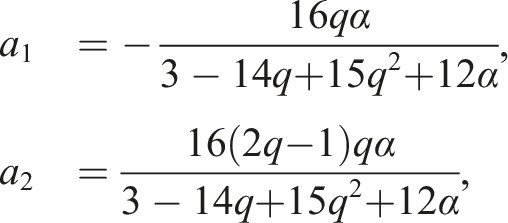
For small but finite amplitude, we assume that ϕ ≪ 1, thus, equation (3) can be written as

Here, the RPT is applied to derive the KdV equation, which is used for characterizing the nonlinear structures that could form and propagate in the current plasma mode.
According to this technique, the independent variables


Substituting equations (5) and (6) into system (2), we obtain a set of simplified equations where the lower-order of ϵ gives


Comparing equation (7) with equation (8), we get the PhV λ of the linear wave

The highest-order of ϵ yields








The planar (s = 0) KdV soliton energy to equation (15) reads

Sometimes, the (non)planar KdV equation (12) fails to describe the SWs even if A ≠ 0, and such a case occurs when there are some external perturbations and noises, which in turn may lead to an imbalance between the nonlinearity and dispersion, and thus this equation fails to describe the SWs. In such a case, many researchers have dealt with this topic by adding the fifth derivative to the KdV equation to compensate for the lack of balance between nonlinearity and dispersion, which are the two factors responsible for the emergence of the soliton. This results in the higher-order dispersion nonplanar KE being derived

The planar (s = 0) Kawahara equation (19) supports a hierarchy of localized (SWs) and periodic (CWs) wave solutions.
61
The solitary wave (SW) solution to the planar (s = 0) equation (19) reads
61



Also, the CW solution to the planar (s = 0) Kawahara equation (19) reads
61

However, the nonplanar Kawahara equation (19) does not support exact analytical solution. Consequently, El-Tantawy group has developed several general analytical approximations for this equation,
25
one of which is as follows




Evolution equations for the critical case
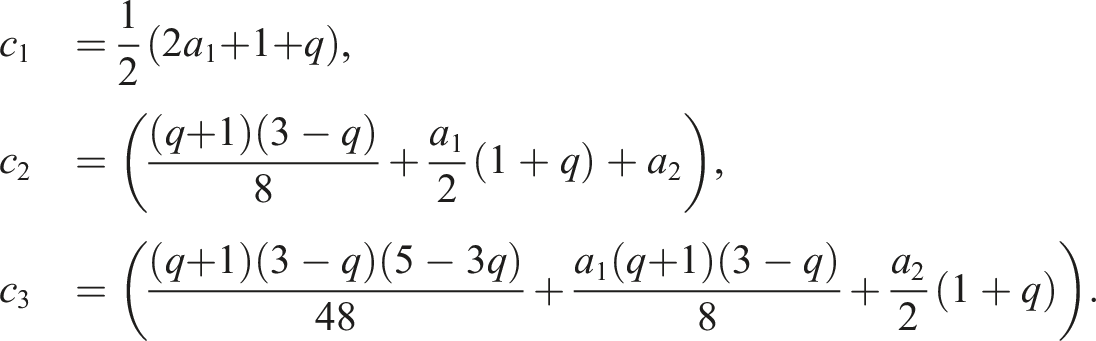
As shown in Figure1, the nonlinear structures cannot be described by the KdV equation (15) at A = 0. For this reason, we should find a higher-order nonlinear wave equation to describe the dynamics of nonlinear waves at A = 0. By employing the RPT, once more in this context and introducing the following modified stretching of coordinates Coefficient A of the quadratic nonlinearity is plotted in 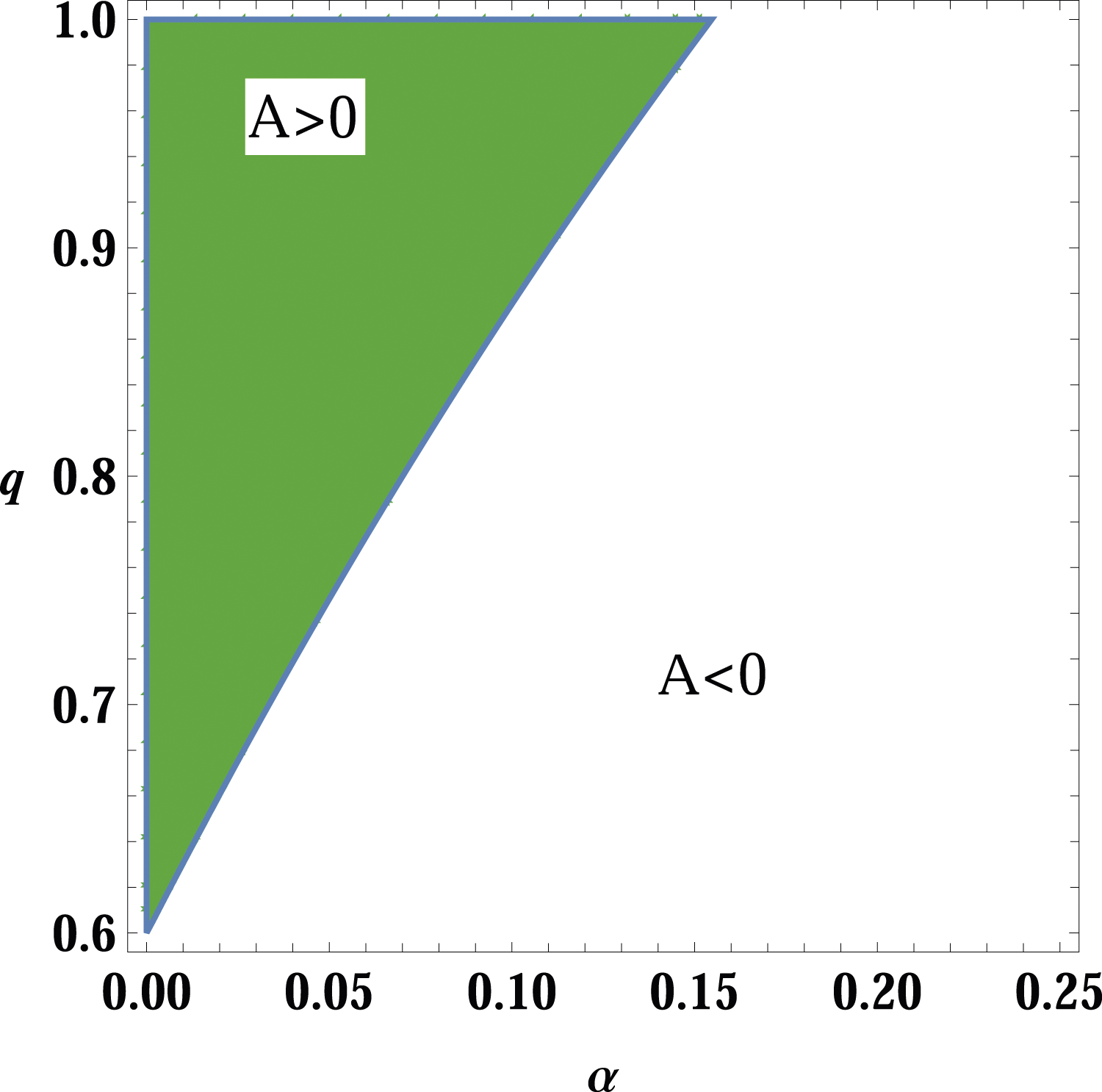

Putting equations (6) and (26) into systems (2), and by following the same abovementioned procedure, the following nonplanar mKdV equation is obtained


Again, in the nonplanar mKdV equation (27), ϕ1 ≡ ψ and
The one-soliton solution to the planar (s = 0) mKdV equation (27) reads

Additionally, the balance between the dispersion and nonlinearity of the nonplanar mKdV equation (27) may be upset due to the smallness or demise of the dispersion term

The one-soliton solution to the planar (s = 0) mKE (30) reads
29


The soliton energy of the planar (s = 0) mKE (30) reads
27

Also, the CW solution to the planar (s = 0) mKE (30) reads
29

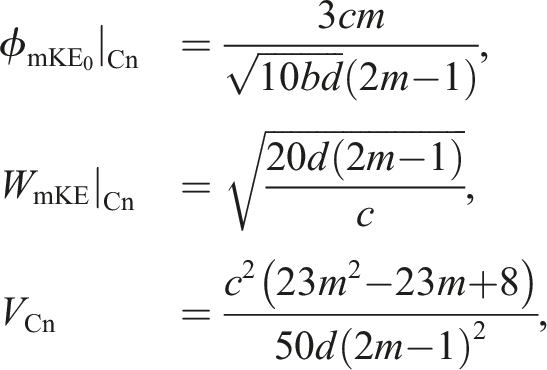
The general analytical approximation to the nonplanar mKE (30) reads
28

The solution (34) represents a general analytical approximation that is applicable for the modeling of various nonlinear structures (e.g., SWs and CWs), which can be characterized by the given equation. For instance, by inserting the planar solutions (31) and (33) into formula (34), we get the following nonplanar modified Kawahara solitary wave solution
28


The approximations (35) and (36) are used for understanding the properties of nonplanar modified Kawahara SWs and CWs, respectively. In the following discussion section, we will undertake a comparative analysis between the analytical approximations (35) and (36), as well as certain numerical approximations implemented via a finite difference scheme (FDS). This analysis aims to substantiate the superior precision of the aforementioned analytical approximations (35) and (36).
Parametric study
Here, we divide the discussion section into two parts: in part (A), we discuss the impact of the nonthermality α and the nonextensivity q on the profile of planar positive/compressive and negative/rarefactive SWs and CWs that can be described by the planar (s = 0) KdV equation (15) and planar (s = 0) KE (19). In part (B), we will study the effect of the nonextensivity q on the profile of planar SWs and CWs that can be described by planar (s = 0) mKdV equation (27) and planar (s = 0) mKE (30). Furthermore, the geometrical effect on the profile of nonplanar SWs and CWs to the nonplanar mKE (30) will be investigated.
Firstly, we check the polarity of the nonlinear waves that can propagate in the current model by checking the sign of the coefficient A against (q, α). As shown in Figure 1, the current model supports both positive/compressive structures and negative/rarefactive structures. Based on this result, there will be a critical value to the nonthermality α or for the nonextensivity q that makes A = 0, which leads us to derive the nonplanar mKdV equation to describe the nonplanar waves at this point. It should be mentioned here that the current model does not support shocks because the sign of the coefficient of A1 of the cubic nonlinearity is always positive with all acceptable values of the parameter q.
Nonlinear structures to nonplanar KdV and Kawahara equations
Figure 2(a) and (b) depict the graphical representation of the positive and negative planar (s = 0) KdV soliton profile ϕKdV as a function of the nonthermal parameter α. In contrast, the other parameters (q, u) are constant. Additionally, Figure 2(c) and (d), respectively, present the depiction of the positive and negative planar (s = 0) Kawahara soliton profile ϕKE against the nonthermality α. It is shown that both amplitude and width of the positive (negative) IASWs to both planar (s = 0) KdV solitons and planar (s = 0) Kawahara solitons increase (decrease) with increasing the nonthermality α. This result is utterly consistent with Ref. 55 for the planar (s = 0) KdV soliton. From a physical standpoint, the observed outcome can be understood as a consequence of altering the nonthermality α, which causes the system to move away from the Maxwellian scenario. Consequently, the energy pumping rate into the system increases (decreases) for positive (negative) IASWs, which leads to an increase (decrease) of the nonlinearity, which in turn increases (decreases) the wave amplitude. Furthermore, upon comparing the planar (s = 0) soliton profiles of the KdV and Kawahara equations, it becomes evident that the amplitude of the planar (s = 0) Kawahara soliton surpasses that of the planar (s = 0) KdV soliton. This difference can be attributed to including a correction term in the Kawahara equation, which brings it closer to the observed soliton behavior, as opposed to the solution provided by the planar (s = 0) KdV soliton. Profile of the planar (s = 0) KdV soliton ϕKdV and Kawahara soliton ϕKE is plotted against the nonthermality α with 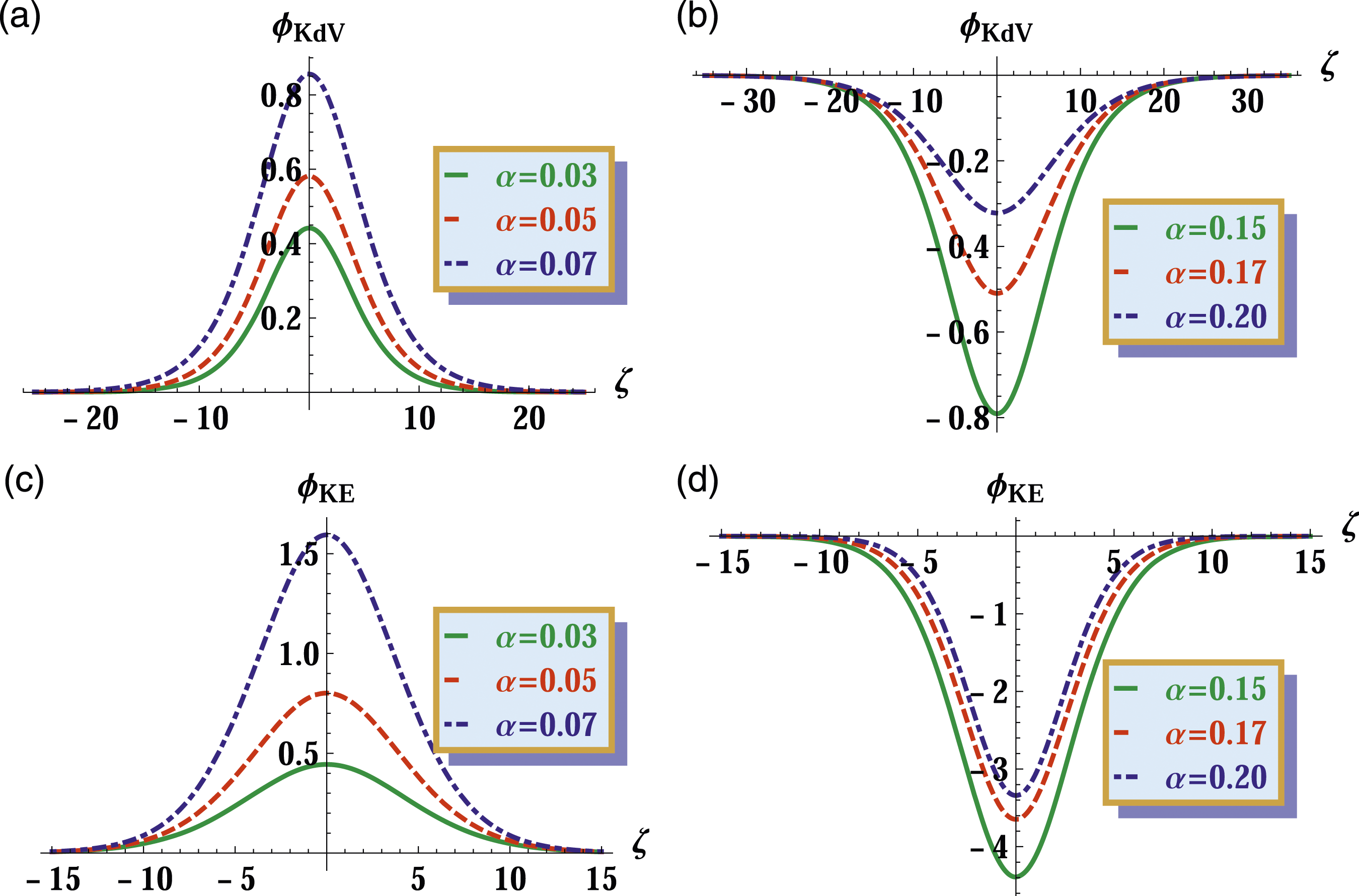
In Figure 3, we studied the impact of the nonextensivity q on the profile of the planar (s = 0) IASWs of both the planar (s = 0) KdV equation (15) and the planar (s = 0) KE (19) by plotting the soliton solutions ϕKdV and ϕKE versus ξ. In contrast, the other parameters should be considered unaltered. It is clear that the nonextensivity q affects the soliton profiles oppositely as compared to the nonthermality α, that is, both the soliton amplitude and width of the positive (negative) IAWs decrease (increase) with increasing q as illustrated in Figure 3. The obtained results are in agreement with Ref. 62 for the KdV soliton. Also, as expected, we note that the Kawahara soliton’s amplitude is characterized by a greater amplitude than the KdV soliton’s amplitude due to the correction term. Profile of the planar (s = 0) KdV soliton ϕKdV and Kawahara soliton ϕKE is plotted against the nonextensivity q with 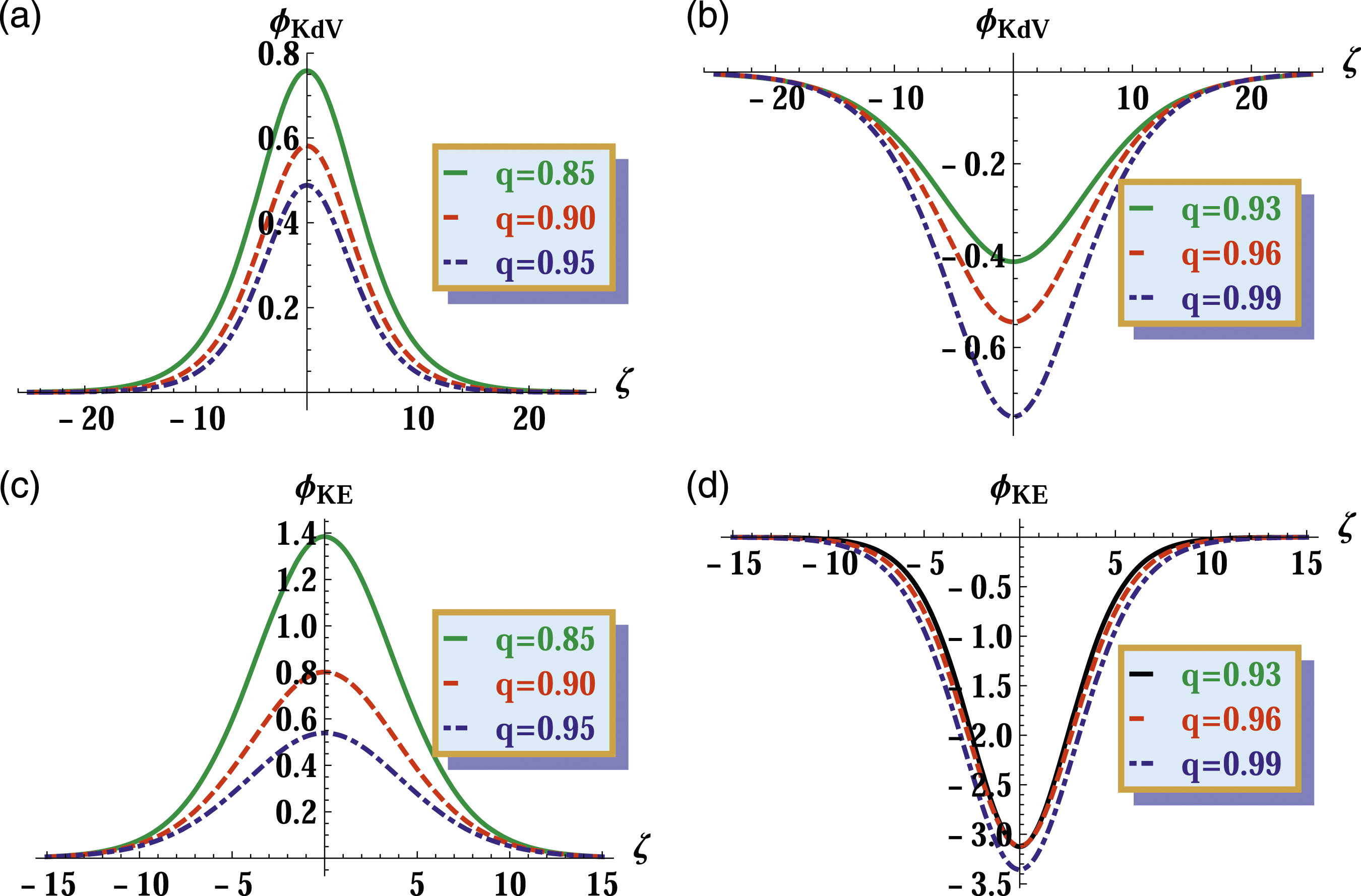
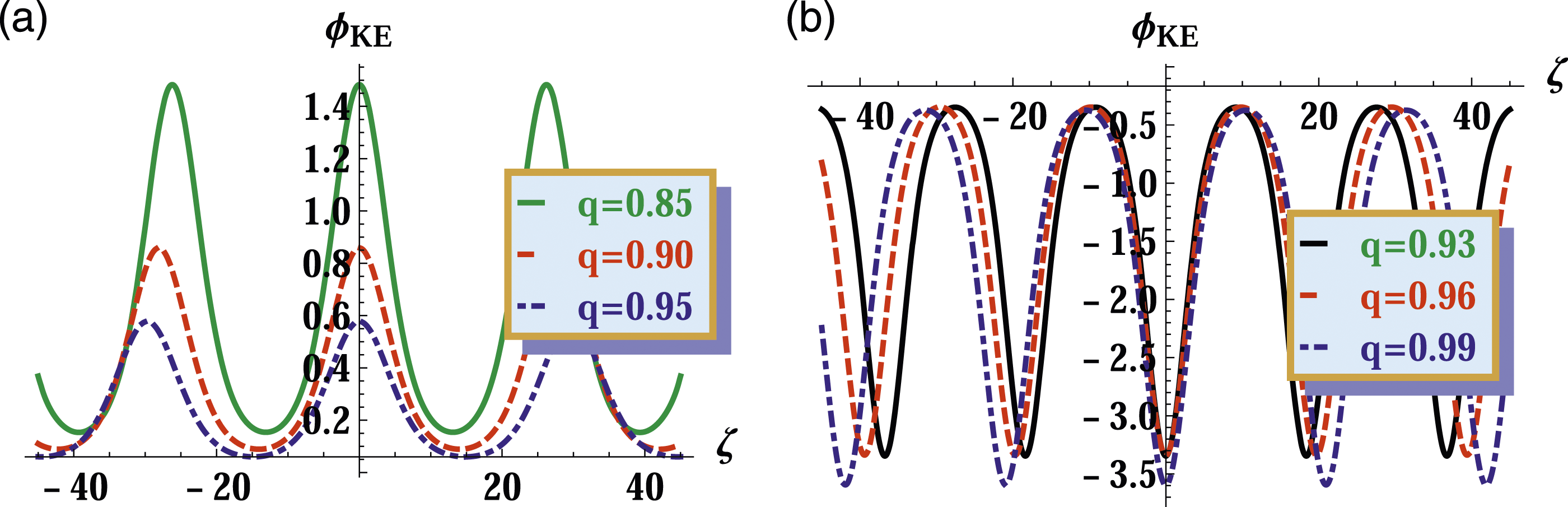
Similarly, the impact of Profile of planar (s = 0) Kawahara CW ϕCn is plotted against nonthermality α with Profile of planar (s = 0) Kawahara CW ϕCn is plotted against nonextensivity q and with 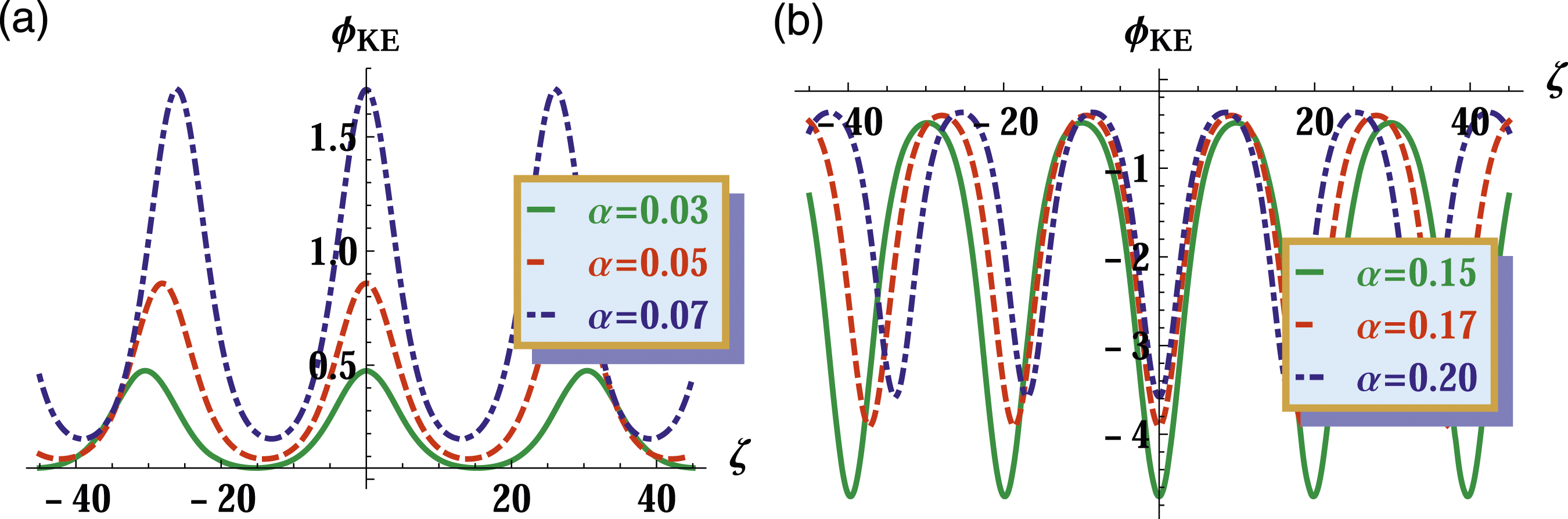
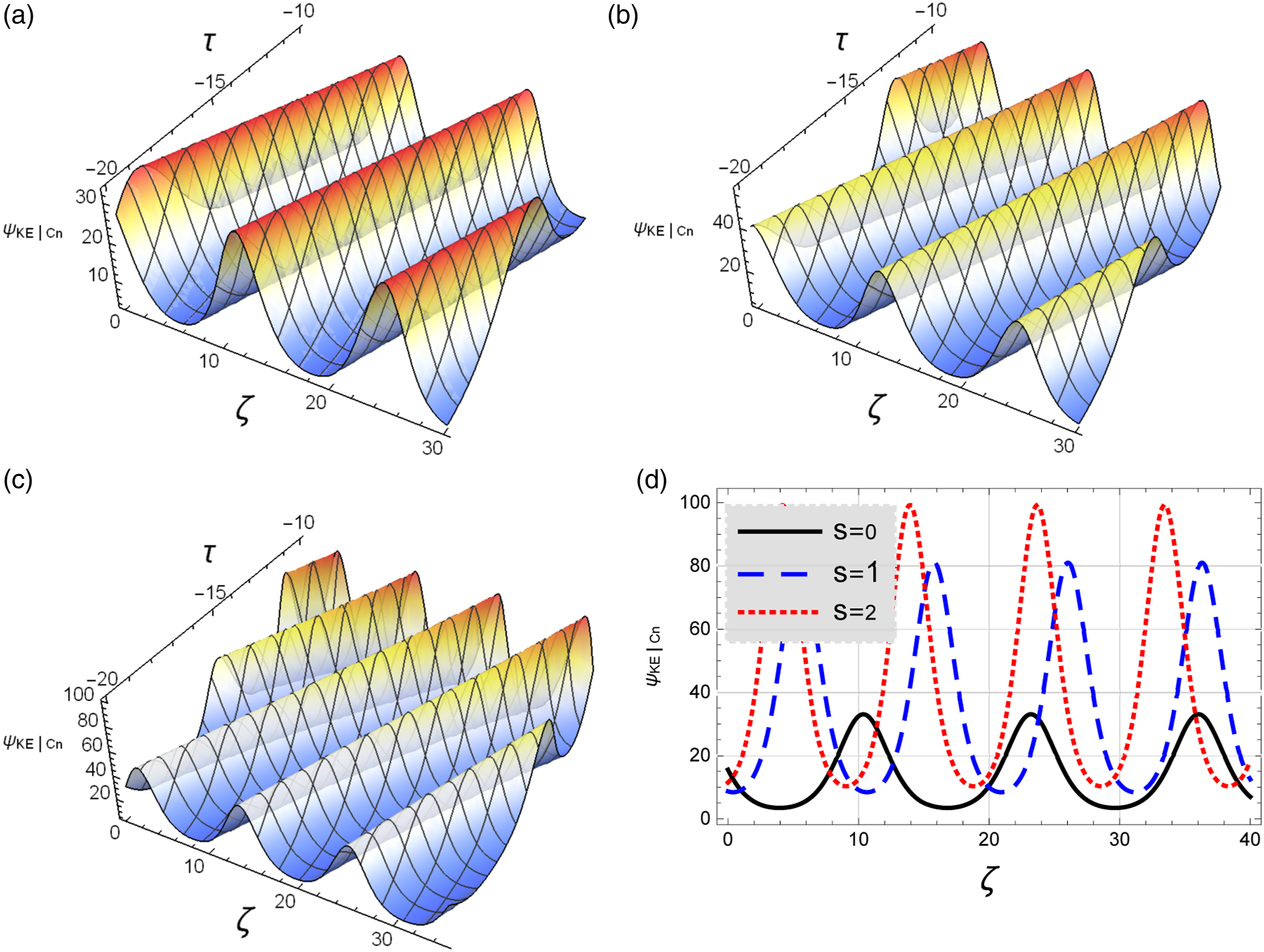
At a glance, it is possible to study the geometric effect on the profiles of both nonplanar SWs and CWs. For this reason, both analytical approximations (23) and (24) for nonplanar SWs and CWs are, respectively, analyzed numerically, as depicted in Figures 6 and 7. Upon initial observation, it is evident that both SWs and CWs exhibit a progressive decrease over time. Furthermore, it can be observed that the amplitude of cylindrical waves is smaller than that of spherical waves yet more significant than that of planar waves. It can be inferred that cylindrical waves have a higher velocity than planar waves, yet a lesser velocity than spherical waves. Profile of (non)planar Kawahara soliton ψKE|sol. according to solution (24) is plotted in Profile of (non)planar Kawahara CW ψKE|Cn according to solution (36) is plotted in 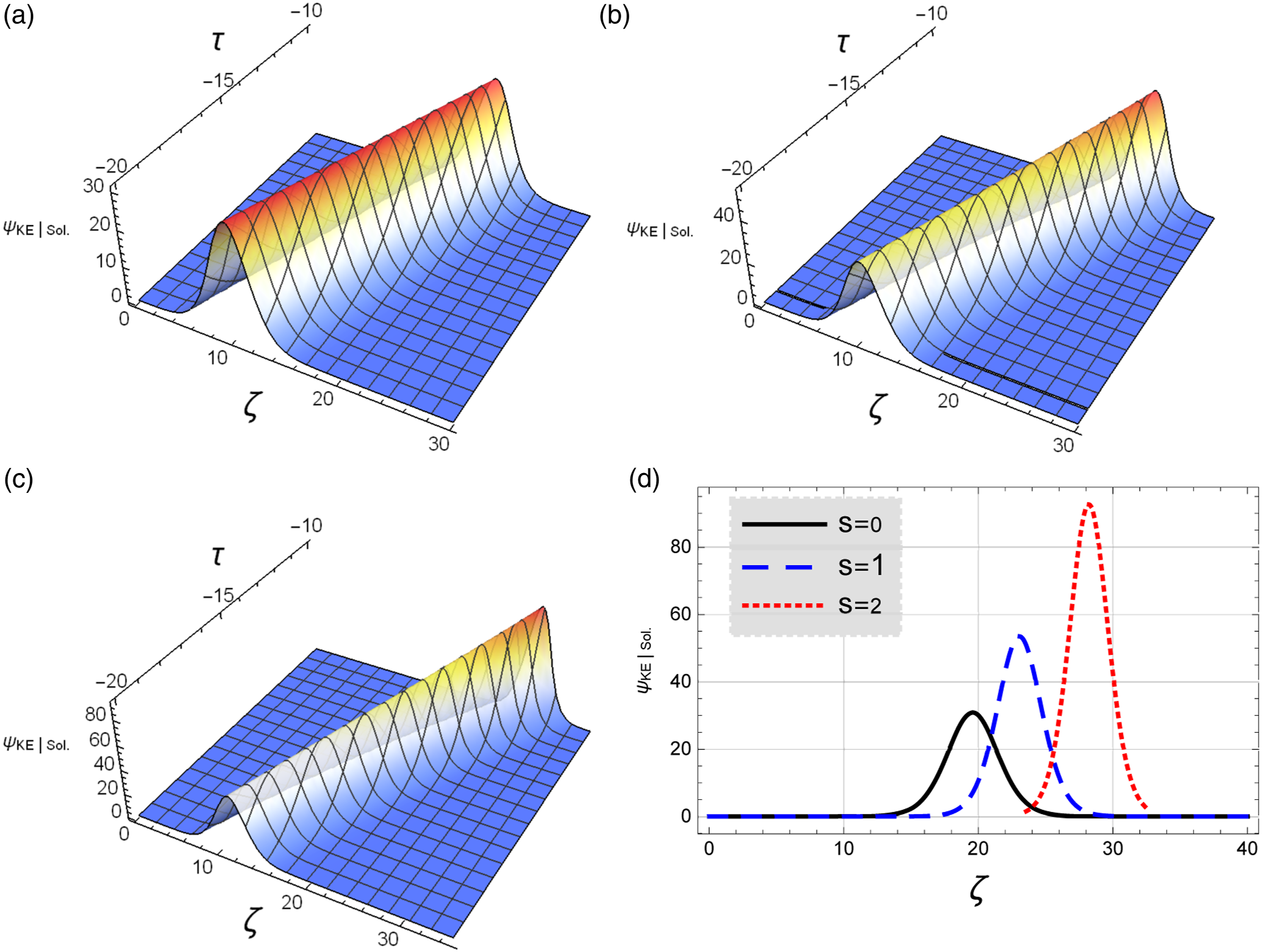
Nonlinear structures to both nonplanar mKdV and modified Kawahara equations
In this section, the influence of the nonextensivity q on the profile of the planar (s = 0) mKdV soliton solution given in equation (29) as well as the profiles of the planar (s = 0) modified Kawahara soliton and CW solutions is reported. First, we should determine the critical value of the nonthermality α
c
. For this, we solve A = 0, to obtain the following value of the critical nonthermality α
c
:

Both the planar (s = 0) mKdV soliton solution (29) and the planar (s = 0) modified Kawahara soliton solution (31) are, respectively, plotted against Profile of planar (s = 0) mKdV soliton ϕmKdV and modified Kawahara soliton ϕmKE is plotted against the nonextensivity q. Here, (a) for positive planar mKdV soliton and (b) for positive planar modified Kawahara soliton. Profile of planar (s = 0) modified Kawahara CW ϕCn is plotted against the nonextensivity q.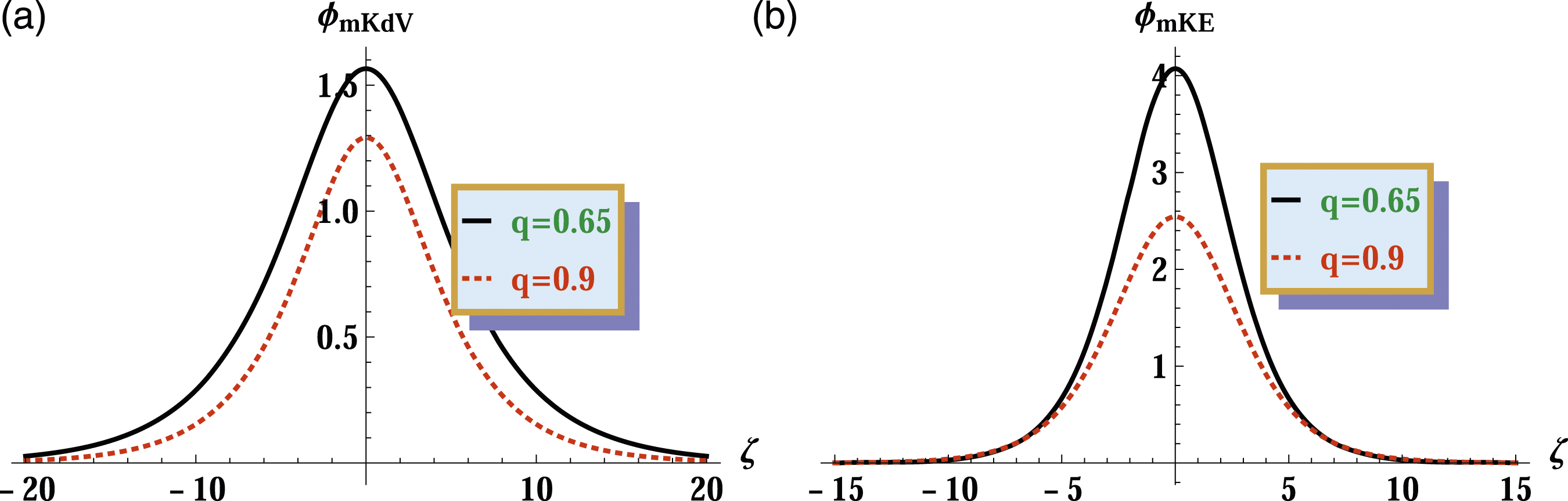
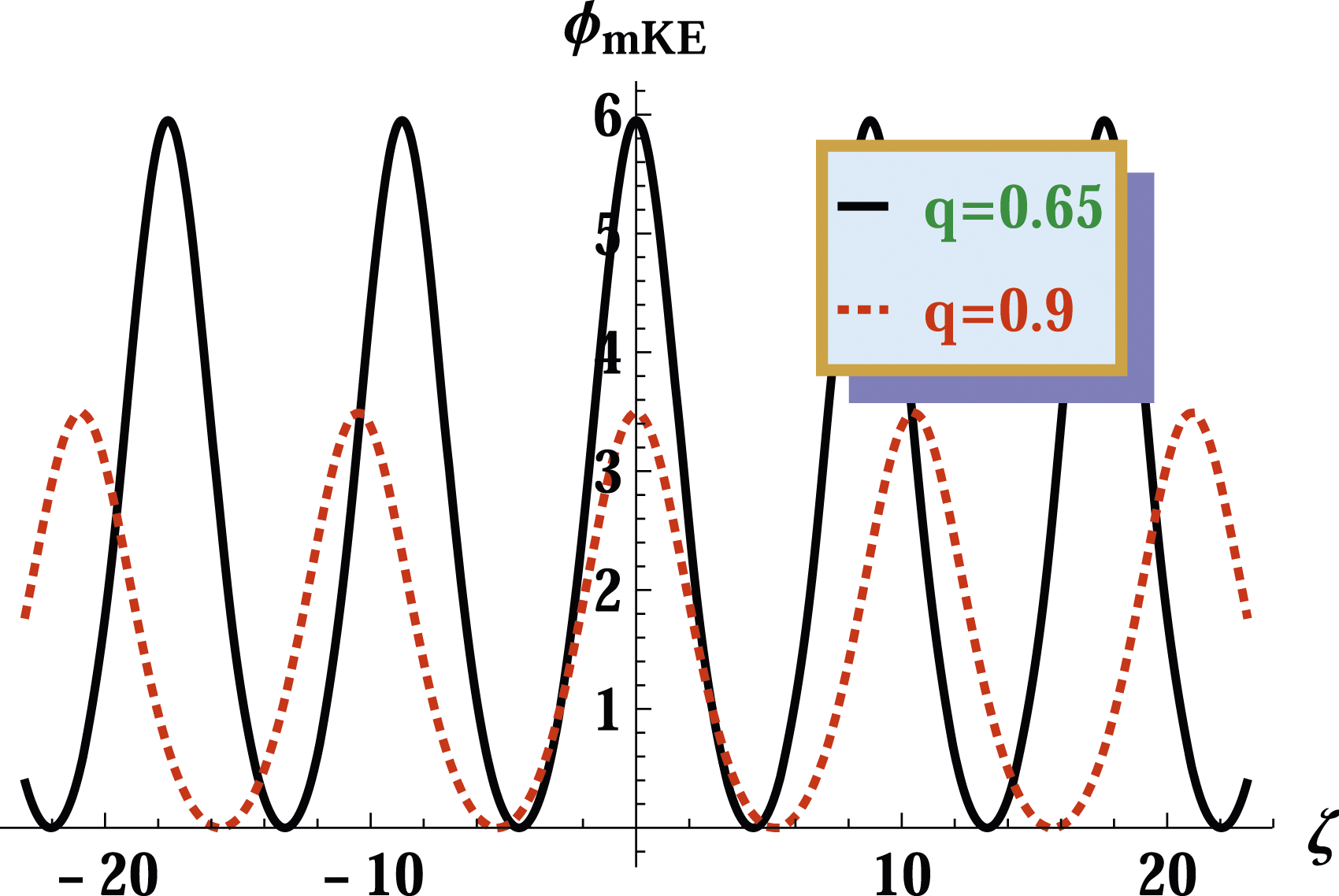
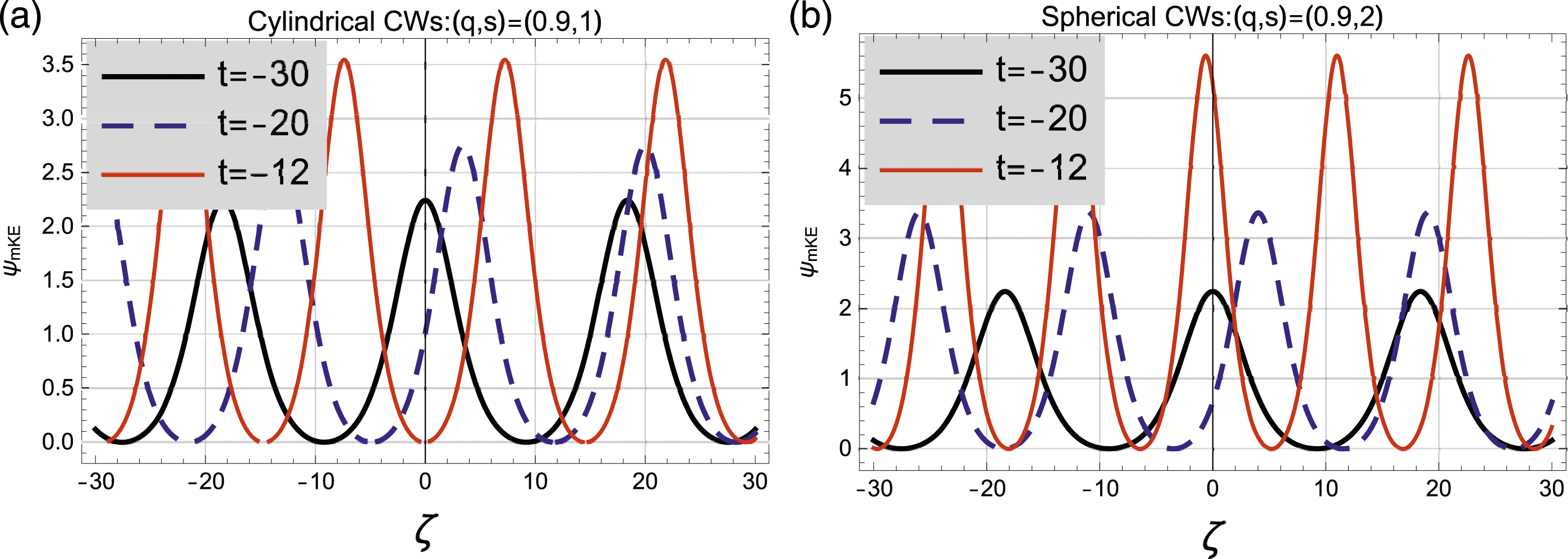
Now, let’s examine the geometric impact on the profile of nonplanar modified Kawahara soliton and CWs. To do that, we present a numerical discussion for the profile of both nonplanar (cylindrical and spherical) solitons and CWs, as shown in Figures 10 and 11, respectively. It is evident that the amplitude of the nonplanar modified Kawahara SWs and CWs diminishes as time increases. Profile of nonplanar (s ≠ 0) modified Kawahara soliton ψmKE|Sol. is plotted against “τ.” Here, (a) for positive cylindrical modified Kawahara soliton and (b) for positive spherical modified Kawahara soliton. Profile of nonplanar (s ≠ 0) modified Kawahara CW ψmKE|Cn is plotted against “τ.” Here, (a) for positive cylindrical modified Kawahara CW and (b) for positive spherical modified Kawahara CW.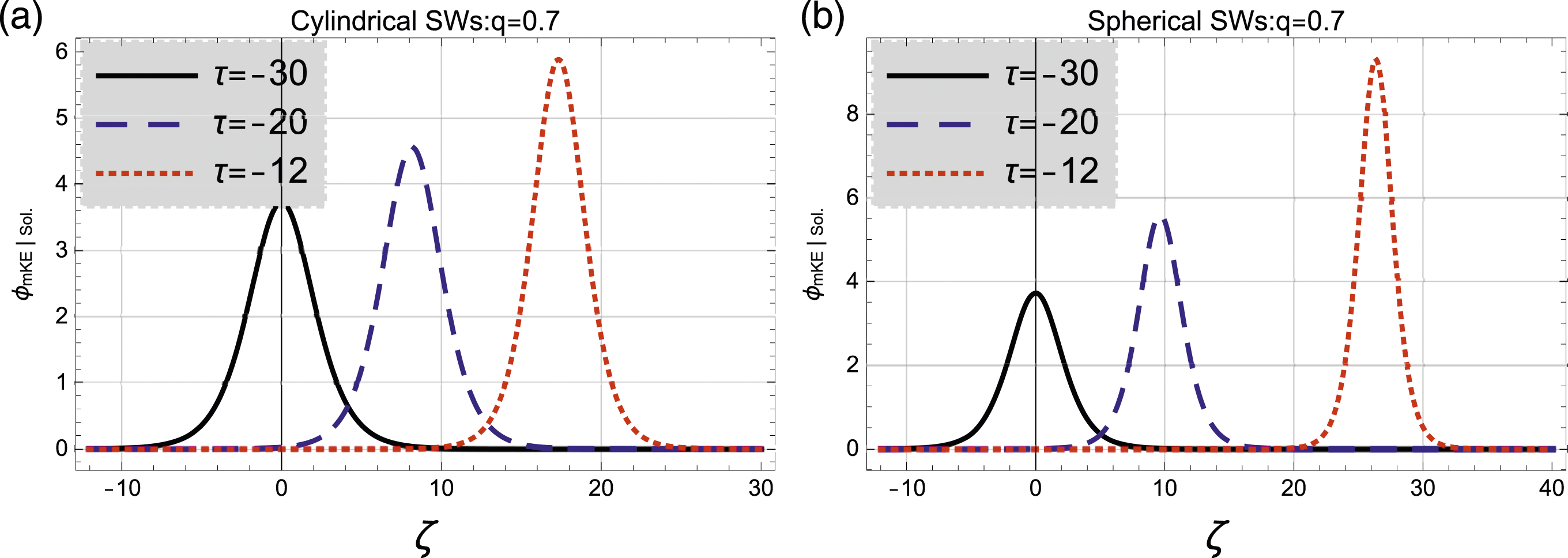
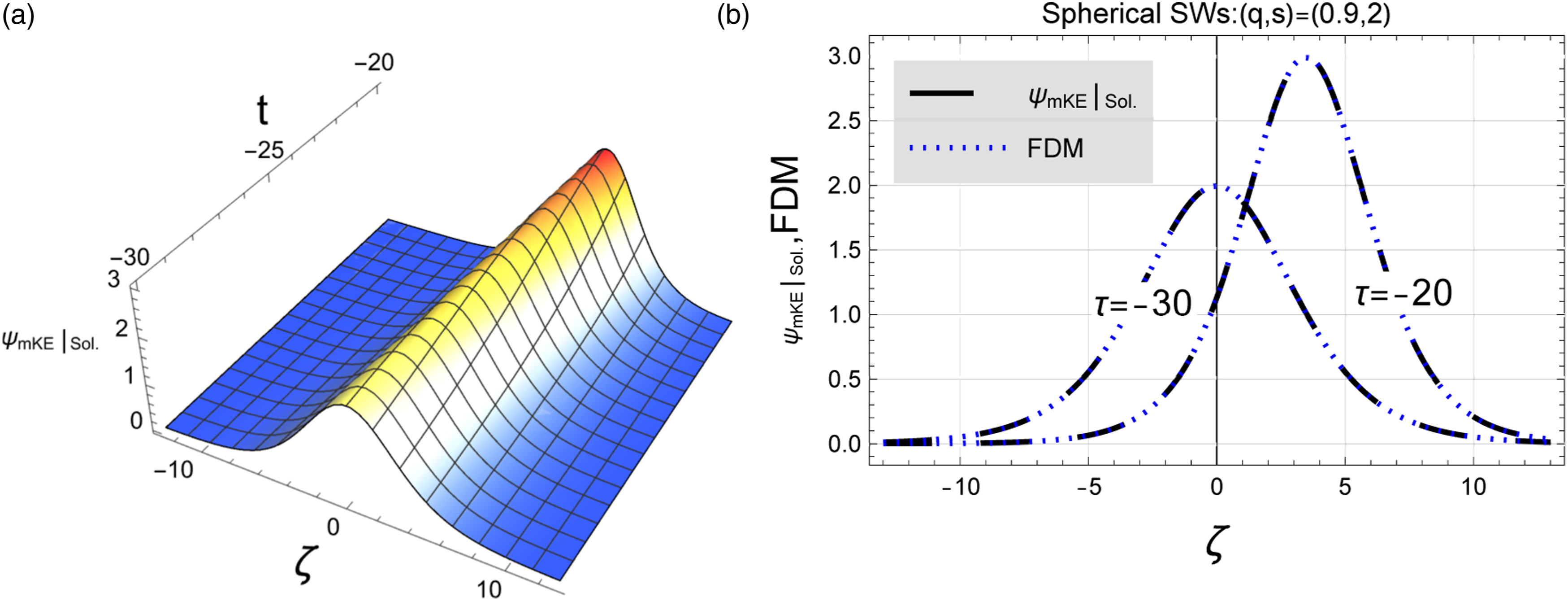
In addition, the nonplanar mKE (30) is analyzed numerically using one of the popular numerical methods called the finite difference method (FDM). To verify the accuracy of our findings using analytical approximations (35) and (36), we conducted a comparison between the outcomes derived from the FDM and the semi-analytical solutions (35) and (36). It is observed from the numerical results that there is excellent agreement between the analytical and numerical approximations, as is evident in Figures 12 and 13 for cylindrical and spherical solitons, respectively. This confirms the accuracy and effectiveness of the analytical approximations (35) and (36). It is essential to acknowledge that the precision of the semi-analytical solutions (35) and (36), or the general analytical approximation (34), is contingent upon the specific solution employed and the numerical values assigned to the physical parameters. Additionally, it can be observed that the velocity of spherical-modified Kawahara solitons/CWs exceeds that of cylindrical solitons/CWs, resulting in a greater amplitude for the former than the latter. Profile of cylindrical (s = 1) modified Kawahara soliton ψmKE|Sol. according to the analytical approximation (36) and numerical approximation using FDM is considered. Here, (a) the three-dimensional cylindrical modified Kawahara soliton ψmKE|Sol. and (b) the two-dimensional cylindrical modified Kawahara soliton ψmKE|Sol. Profile of spherical (s = 2) modified Kawahara soliton ψmKE|Sol. according to the analytical approximation (36) and numerical approximation using FDM is considered. Here, (a) the three-dimensional spherical modified Kawahara soliton ψmKE|Sol. and (b) the two-dimensional spherical modified Kawahara soliton ψmKE|Sol.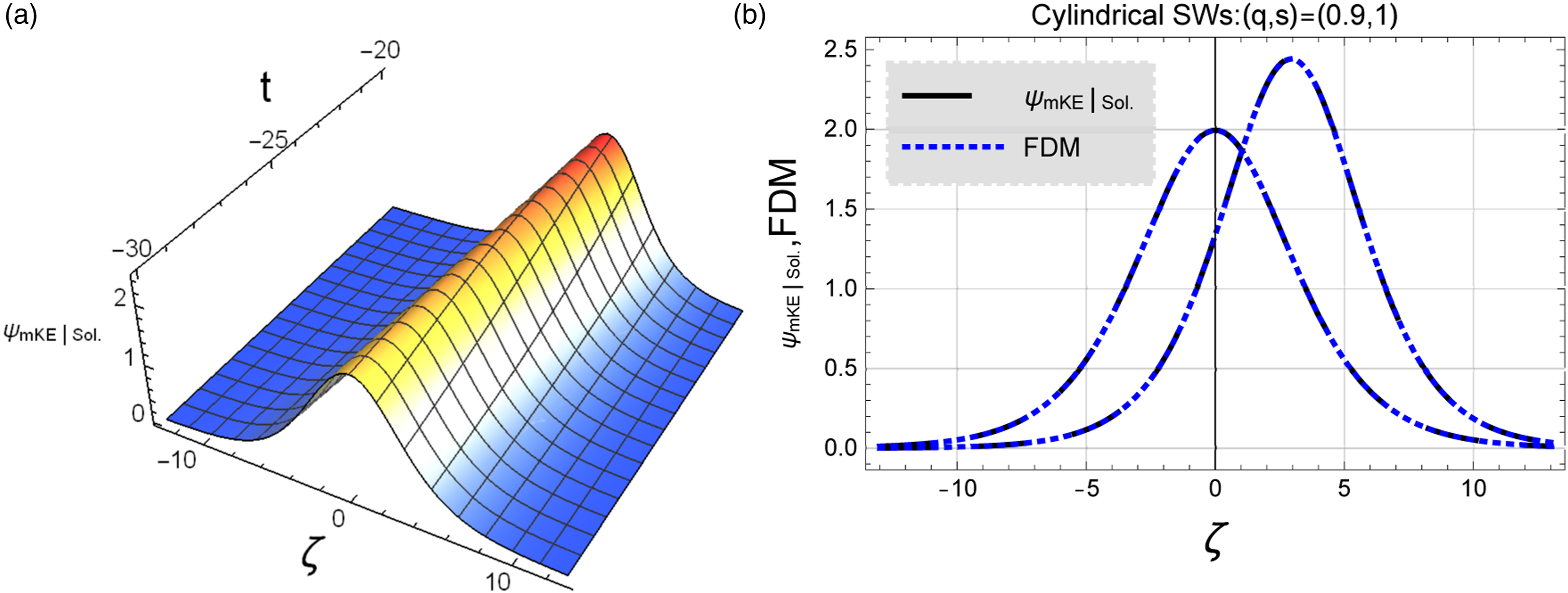
Conclusions
In conclusion, our investigation has focused on the analysis of the characteristics of nonplanar (cylindrical and spherical) ion-acoustic (IA) solitary waves (SWs) and cnoidal waves (CWs) in a collisionless electron-ion plasma that lacks magnetic fields and consists of electrons following the Cairns–Tsallis (C–T) distribution. In order to achieve this objective, the reductive perturbation approach was utilized to derive the evolution equations. First, the nonplanar KdV equation with the quadratic nonlinear term has been derived for studying the properties of the (non)planar IA solitary waves (IASWs). Moreover, the nonplanar Kawahara equation, which incorporates both third and fifth dispersion terms, has been obtained for studying the behavior of massive amplitude. The numerical analysis of the soliton solutions to both (non)planar Korteweg-de Vries (KdV) and Kawahara equations, as well as the (non)planar Kawahara cnoidal wave (CW) solution, has been conducted utilizing a specific set of plasma parameters, namely, the nonextensivity (q) and the nonthermality (α). The study revealed that the parameters of the nonextensivity (q) and the nonthermality (α) substantially impact the distinctive characteristics of both (non)planar KdV and (non)planar Kawahara nonlinear structures. The study revealed that both nonextensivity q and nonthermality α have an opposite effect on the profile of both positive and negative (non)planar KdV and (non)planar Kawahara SWs and CWs. Additionally, it has been discovered that the amplitude of cylindrical waves is comparatively smaller than that of spherical waves but bigger than that of planar waves. It may be deduced that cylindrical waves exhibit a more incredible velocity than planar waves while demonstrating a lower velocity than spherical waves.
Furthermore, an examination has been conducted on the properties of the (non)planar modified KdV (mKdV) solitons, as well as (non)planar Kawahara SWs and CWs, at the critical of nonthermality α c . In the critical case, it was shown that the augmentation of nonextensivity q results in a decrease in the amplitude and width of the soliton for both mKdV soliton and modified Kawahara soliton, regardless of whether they are planar or nonplanar. Moreover, the parameter q, which characterizes the nonextensivity, exerts a similar influence on the characteristics of the (non)planar modified Kawahara CWs. Furthermore, the velocity of spherical-modified Kawahara solitons/CWs was observed to surpass that of cylindrical solitons/CWs, leading to a higher amplitude for the former than the latter. Subsequently, the final segment of this work focused on the numerical analysis of the nonplanar modified Kawahara equation using the finite difference approach, aiming to establish a comparison with the semi-analytical findings. The comparative results demonstrated a perfect concurrence between the analytical and numerical findings, substantiating the precision of the semi-analytical solutions employed in this investigation.
This study contributes to the comprehension of the propagation mechanisms of small and large amplitude localized waves (SWs) and periodic waves (CWs) in various plasma models, fluids, and optical fibers, as well as in an LiNbO3 (SiO film) structure. 63 Furthermore, the ongoing investigation enhances our comprehension of the essential characteristics exhibited by various types of acoustic waves that propagate within astrophysical plasmas. These plasmas encompass environments such as cometary surroundings, as well as the F-ring and G-ring of Saturn.34,64–67 Additionally, experimental plasmas are examined, where the presence of C–T-distributed electrons assumes a significant role.34,64–67 We have put up a distribution similar to the C–T distribution, which has the potential to offer a more optimal match for the observations made in space.
Future work
One of the crucial areas that requires investigation is the study of solitons colliding, particularly when modified Kawahara solitons and Kawahara solitons collide. However, this topic is outside the purview of the present study. Additionally, the investigation of nonlinear dynamics and fractional form for differential equations has emerged as a prominent area of research in recent years, owing to their efficacy in elucidating the intricacies underlying various natural phenomena.68,69 Researchers frequently direct their attention towards investigating fractional integrable differential equations, employing various approaches as documented in the existing literature. However, equations (19) and (30) that have been derived in this study, whether in their current form or fractional form, are classified as nonintegrable differential equations. The examination of fractional expressions of these equations is regarded as a prominent subject and innovative concept, but it falls outside the purview of the current study.
Footnotes
Acknowledgments
The authors extend their appreciation to the Deanship of Scientific Research at Saudi Electronic University for funding this research (8262).
Author contributions
All authors contributed equally and approved the final version of the manuscript.
Declaration of conflicting interests
The author(s) declared no potential conflicts of interest with respect to the research, authorship, and/or publication of this article.
Funding
The author(s) disclosed receipt of the following financial support for the research, authorship, and/or publication of this article: The authors extend their appreciation to the Deanship of Scientific Research at Saudi Electronic University for funding this research (8262).

Data availability statement
Data sharing is not applicable to this article as no new data were created or analyzed in this study.