




Abstract
A flexible rotor supported by two journal bearings under nonlinear suspension and the lubricating oil is assumed to be temperature dependent in this study. Analytical tools were inclusive of bifurcation diagrams, dynamic trajectories, power spectra, Poincaré map, fractal dimension, and Lyapunov exponent are used to verify the dynamic characteristics of the rotor-bearing system, and abundant periodic, subharmonic, quasi-periodic, and even chaotic motions are found in this study. From the simulation results, the higher operating temperature will also cause the dynamic trajectory of the system to become non-periodic vibration. The rotor-bearing system operating in a non-periodic motion state may lead to possible broadband vibration with large amplitude and increase the possibility of fatigue or failure of the system. Such simulation analysis will help engineers avoid unnecessary trial and error when designing and applying rotor-bearing systems.
Introduction
Turbo-machineries play a vital role in modern industrial applications, whether in vehicles, machine tools, or other industrial technology applications. Therefore, the stable operating and long service life of turbo-machineries will enable the continuous development of these industrial applications. It is well known that as the operating speed of rotating machinery increases, the system’s operating temperature will also increase. However, the viscosity of the lubricating fluid in the turbo-machineries is quite sensitive to the temperature. When the temperature is too low, the turbo-machineries may fail to rotate, and when the temperature is too high, the lubrication may fail. Therefore, to gain a more comprehensive understanding of the dynamic characteristics of the systems, it will be helpful to consider temperature effects in the dynamic characteristic analysis of turbo-machineries. Jain et al. 1 analyze and compare the performance of the laminar and turbulent regimes in circular bearings considering viscosity variation. The pressure–viscosity coefficients are the focus of their analysis. Clarke et al. 2 propose a model to simulate the floating ring-bearing system considering the thermal effect. The steady-state model is established to analyze in their study. San et al. 3 introduced a thermo-hydrodynamic model to analyze the performance characteristics of cryogenic liquid annular seals in the turbulent flow regime. They prove that the temperature effect is undoubtedly significant in the study of the performance analysis of those systems, especially at very high rotating speeds. Taylor 4 present the short-bearing approximation model, including lubricant shear thinning, that is, the non-Newtonian model. He also mentions that modern automotive lubricants are multigrade oils containing polymeric additives at treatment rates of several percent, and it will lead to the lubricant viscosity having a significant dependence on the shear rate. San et al. 5 provide a helpful physical model and fast computational programs to improve the design and performance of rotodynamic. The simulation results agree well with the measurements, and the dynamic stability analysis is also studied. Bukovnik et al. 6 propose a modified thermal-elasto-hydrodynamic lubrication model for journal bearing, considering shear rate-dependent viscosity. Kadam et al. 7 perform an analysis of thermal hydrodynamic analysis of plain journal bearing with modified viscosity–temperature. They specify that thermal effects should be considered when the bearing is highly loaded. Torgal et al. 8 present a modified model to analyze the thermo-hydrodynamic of journal bearing to find out the equivalent temperature. Bagul et al. 9 use CFD software to simulate the performance of the journal bearing considering with temperature effect. They validate the situation in which the temperature rise will cause instability in the system’s operation.
It is said that the viscosity coefficient in the lubricating fluid is not only a function of pressure but also a function of temperature. However, in the general study of the dynamic characteristics of the rotor-bearing system, they assume that the viscosity coefficient is a constant value, so there is a possibility of underestimating the effect of the viscosity coefficient. This study takes that a rigid rotor supported by two journal bearings under nonlinear suspension, nonlinear oil film force, and lubricating oil is temperature dependent. Analytical tools, including bifurcation diagrams, dynamic trajectories, power spectra, Poincaré map, fractal dimension, and Lyapunov exponent, are used to verify the dynamic characteristics of the rotor-bearing system.
Mathematical modeling
Figure 1 shows a rigid rotor supported by journal bearing under nonlinear suspension and the lubricating oil is assumed to be temperature dependent in this study. According to Newton’s second law, the dynamic equations considering with nonlinear suspension (i.e., hard spring) for the bearing geometric center O
b
can be presented Rotor-bearing system supported by nonlinear suspension and considering temperature-dependent viscosity.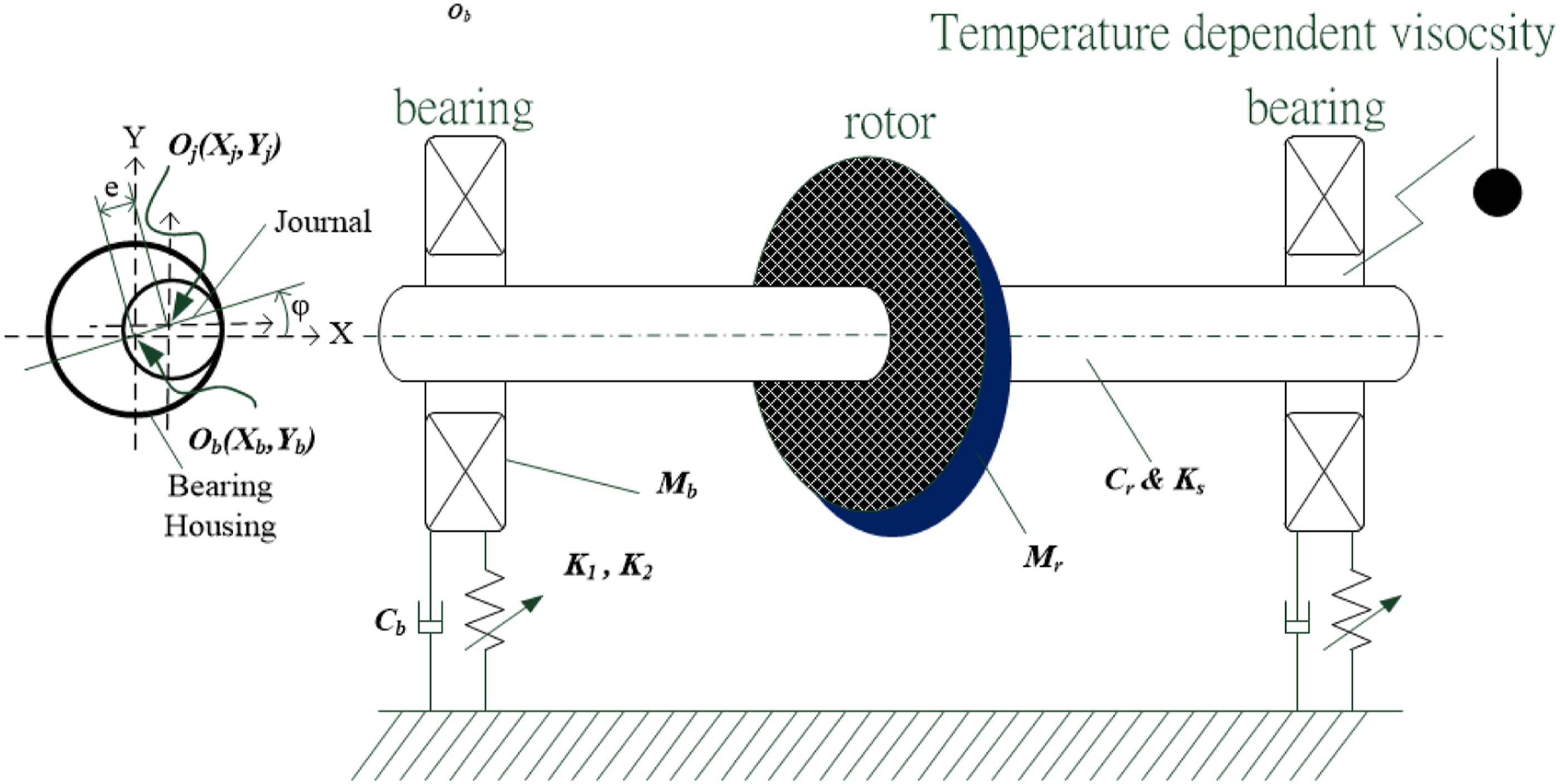

Dynamic equations used to illustrate the geometric center of the rotor O
r
can be performed

O
j
is defined as the journal geometric center, and then the nonlinear oil film forces in the horizontal and vertical directions can be expressed from the force equilibrium in each direction

The temperature-dependent viscosity could be performed as
4


The temperature-dependent viscosity can be introduced by getting equation (5) into equation (4), as shown below

Apparently, we could find that the viscosity is not only a function of temperature but also a function of
The modified Reynolds equation with the short-bearing approximation (i.e., L/D < 0.25、∂p/∂θ << ∂p/∂z, and then we can set ∂p/∂θ = 0.) could be performed as

The pressure distribution with the boundary conditions

The oil film force in the radial and tangential direction could be presented by integrating the function


Substituting equation (10) into equation (3) and rearranging equations for the oil film forces by considering temperature effect in the horizontal and vertical direction. Meanwhile, let


Equations (1), (2), and (12) are the nonlinear dynamic equations used to simulate the dynamic responses of the rotor-bearing system considering temperature-dependent viscosity in this study and then integrating them to be the following dimensionless equations



Results and discussions
The fourth-order Runge–Kutta method is a valuable tool for solving autonomous differential equations, and we use it to simulate dimensionless nonlinear dynamic equations for this reason. The time step for the calculation is π/300, and the error tolerance is less than 0.0001. The time series data of the first 800 revolutions are not used for dynamic behavior investigation to guarantee that the data used are for a steady state. Also, 30000 data points from the bearing and rotor geometric center displacement time series are used to generate the attractors in embedding space. These data generate the dynamic orbit, power spectrum, Poincaré map, and bifurcation diagram. The bifurcation analysis including supercritical or subcritical bifurcations are well studied by some researchers. Some excellent studies such as Li et al.
10
studied coherence resonance and stochastic bifurcation behaviors of simplified standing-wave thermoacoustic systems. Sun et al.
11
analyzed lean premixed swirling combustion systems. Due to the fluid flow-acoustics-combustion interaction in this system, such combustion systems are more susceptible to nonlinear combustion instability. Li and his team also presented experimental and theoretical bifurcation study of a nonlinear standing-wave thermoacoustic system.
12
Therefore, related supercritical or subcritical bifurcation analysis and application may refer the above literatures. The fractal dimension and maximum Lyapunov exponent are also used to identify nonlinear emotional responses, and according to Nayfeh,
13
the optimum delay time was found by the autocorrelation function to be about one-third of a revolution of the rotor. Thus, the fractal dimension of the system can be determined by using the plot of the log value of the correlation function versus the log value of the radius of an N-dimensional hyper-sphere, that is, (log c(r)) versus (log r).
14
As for the fractal dimension, Smith
15
defined the greatest integer M, which is less than the fractal dimension of the attracting set, and the number of points used to estimate the size should be less than 42M. In this study, we take the dimensionless rotational speed ratio s, unbalanced parameter β, and the dimensionless damping ratio c
1
as the bifurcation control parameters. The following values are the non-dimensional parameters used in this study:
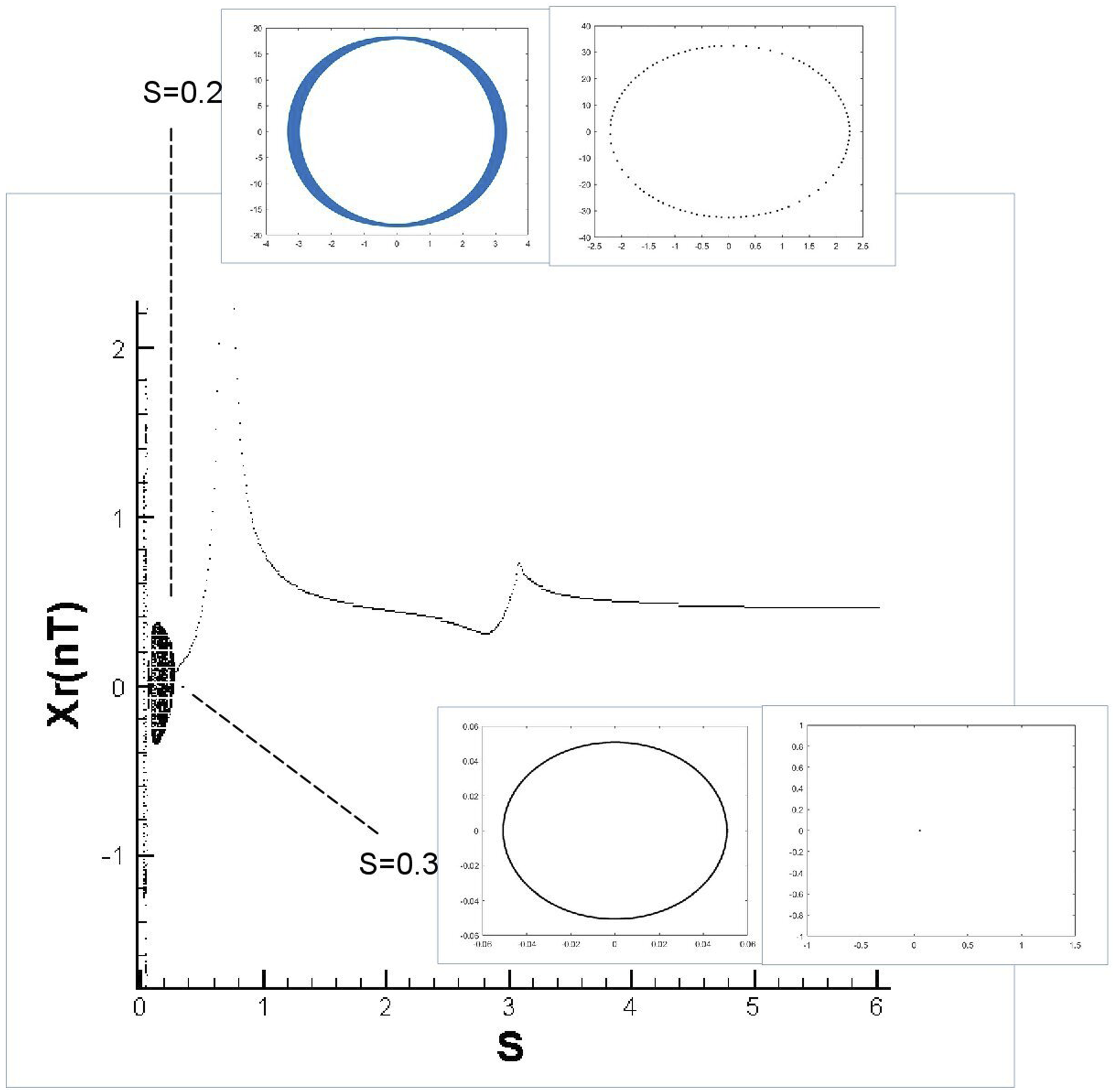
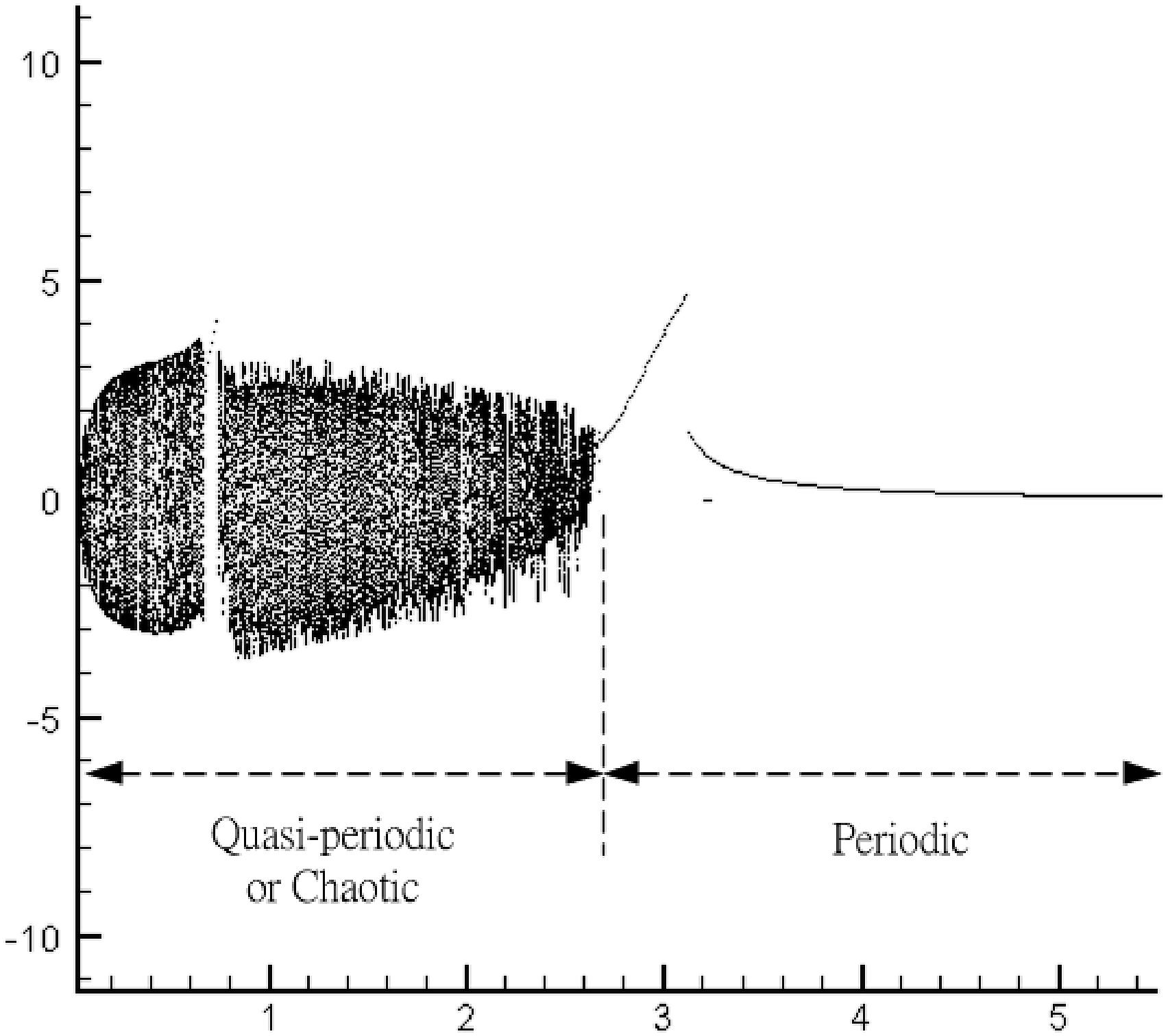
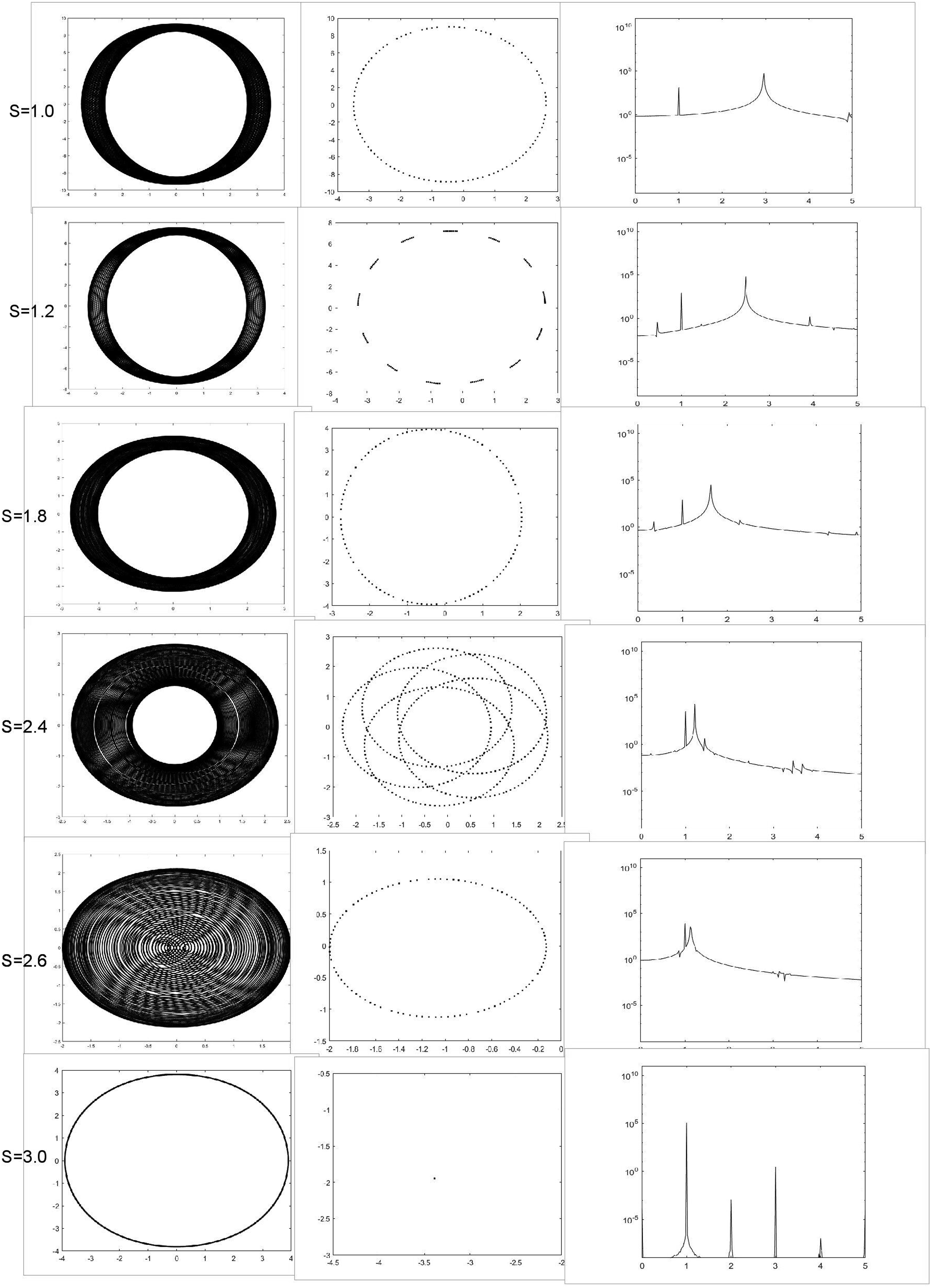
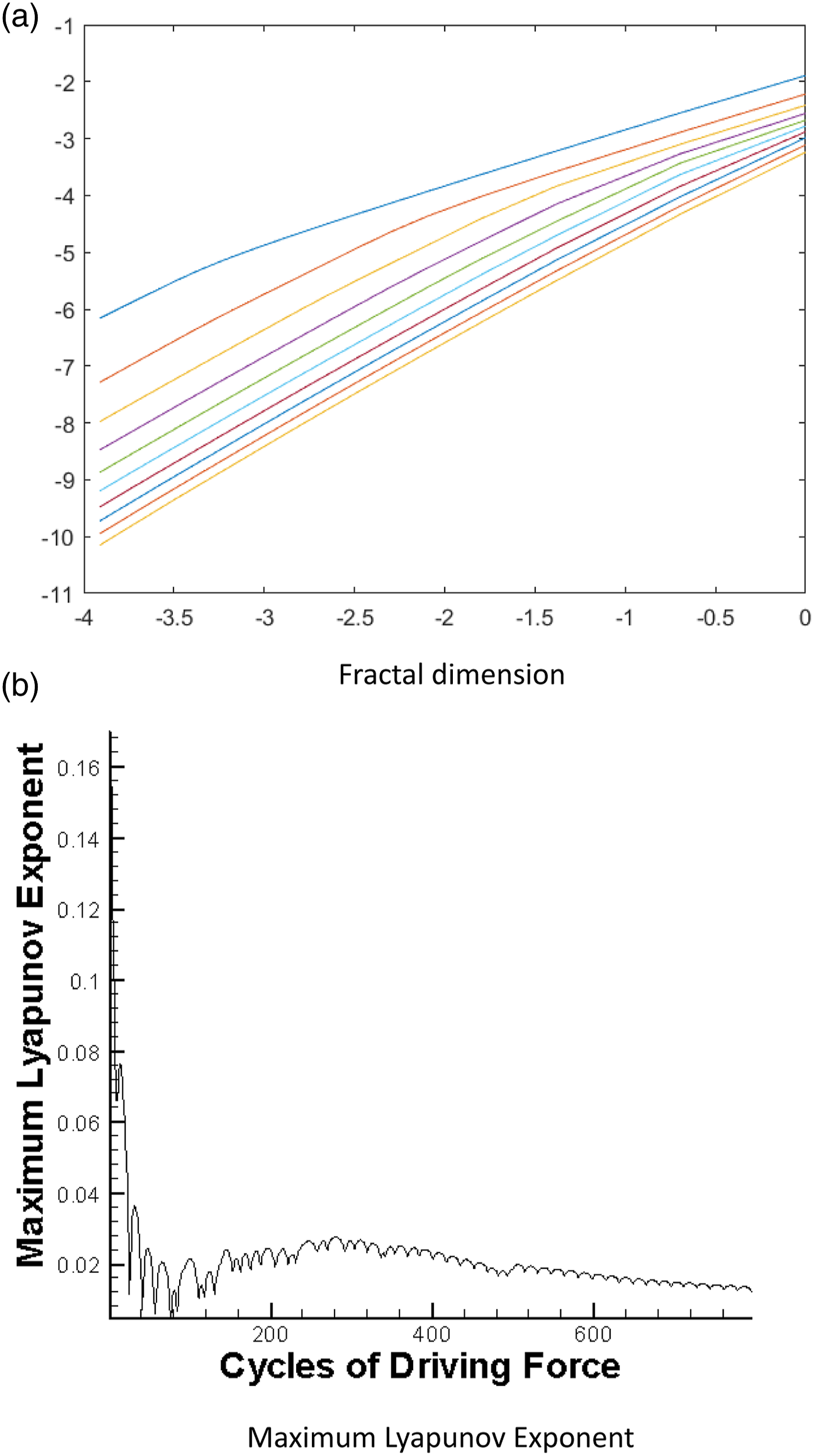
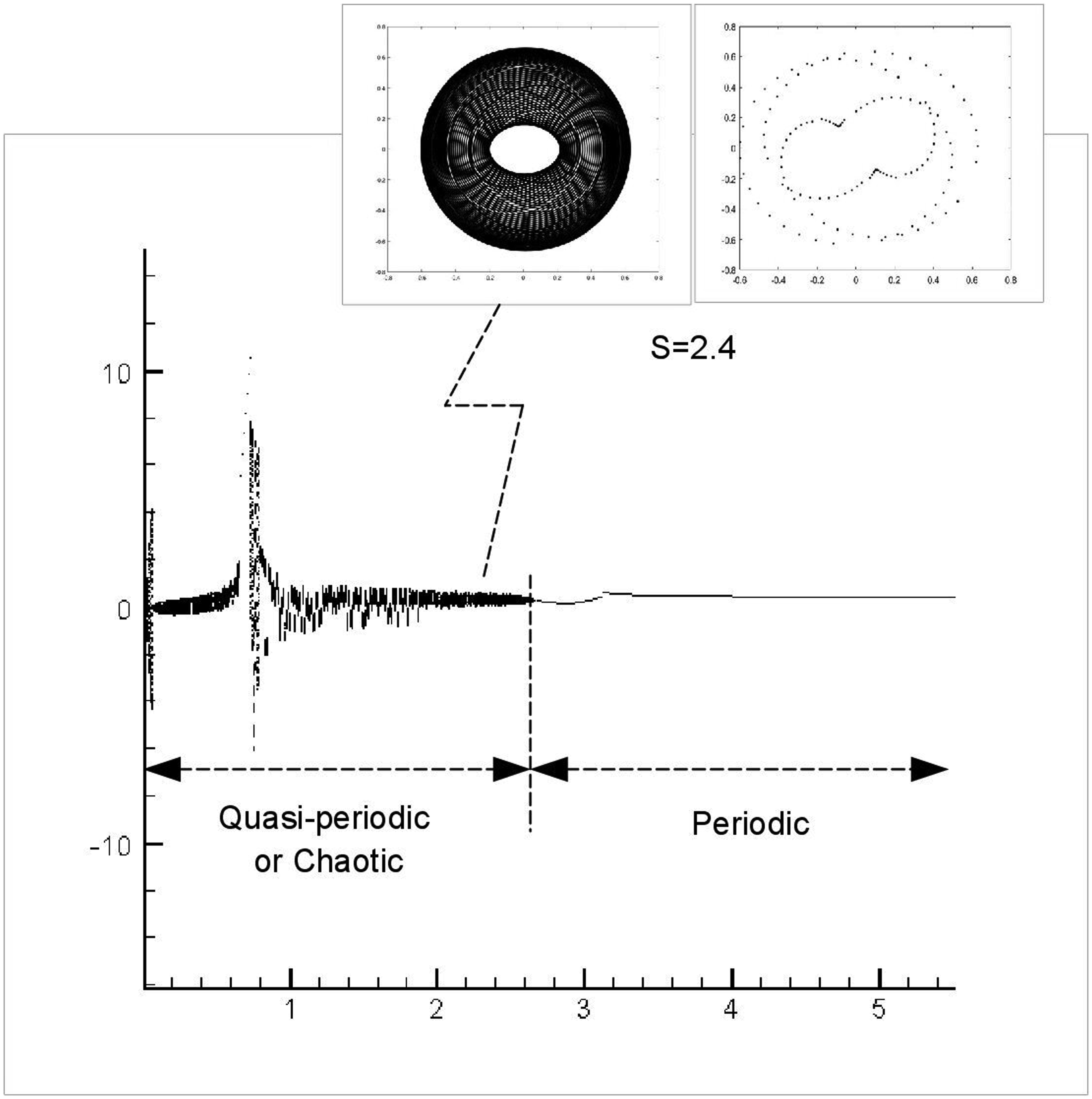
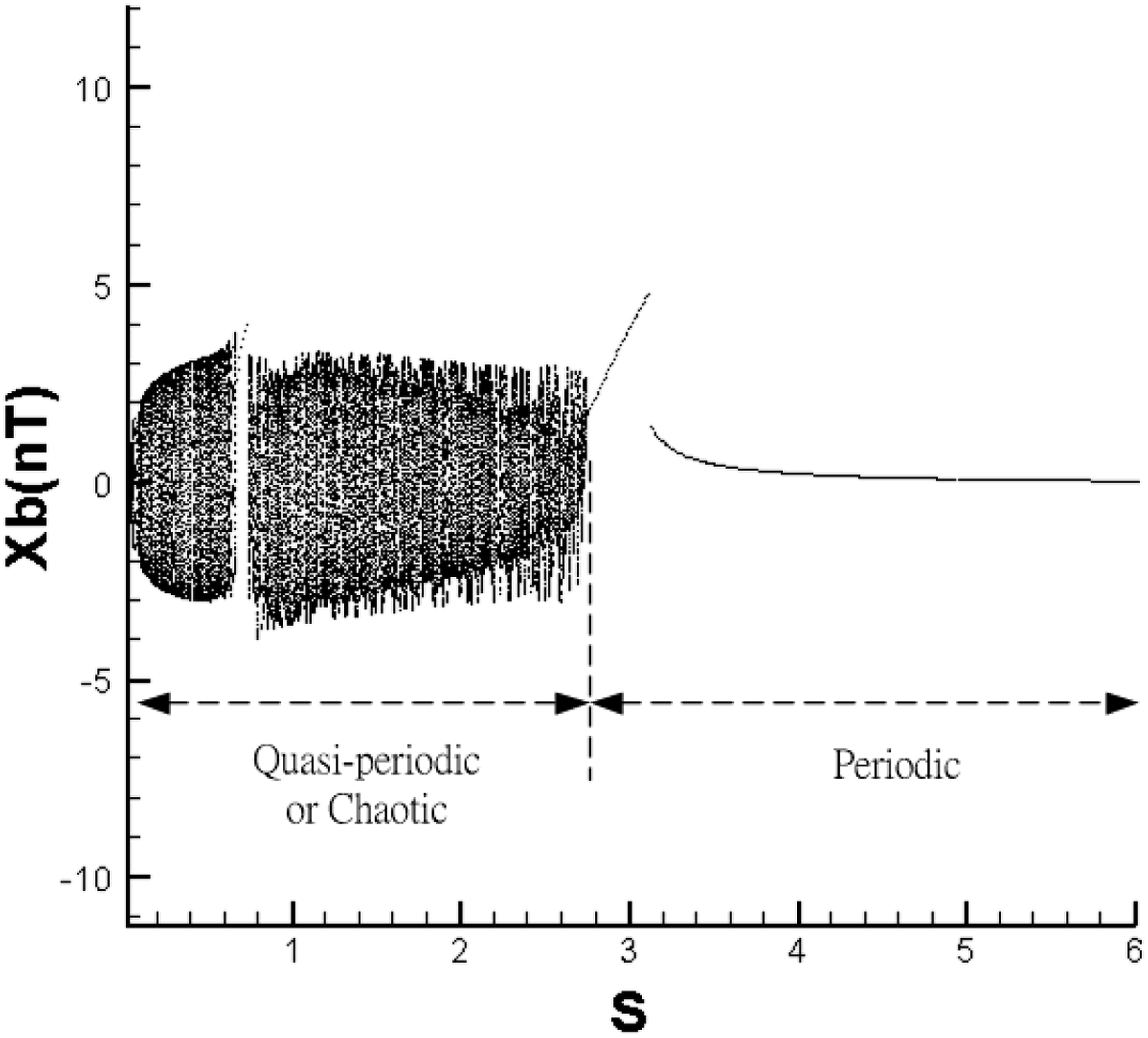
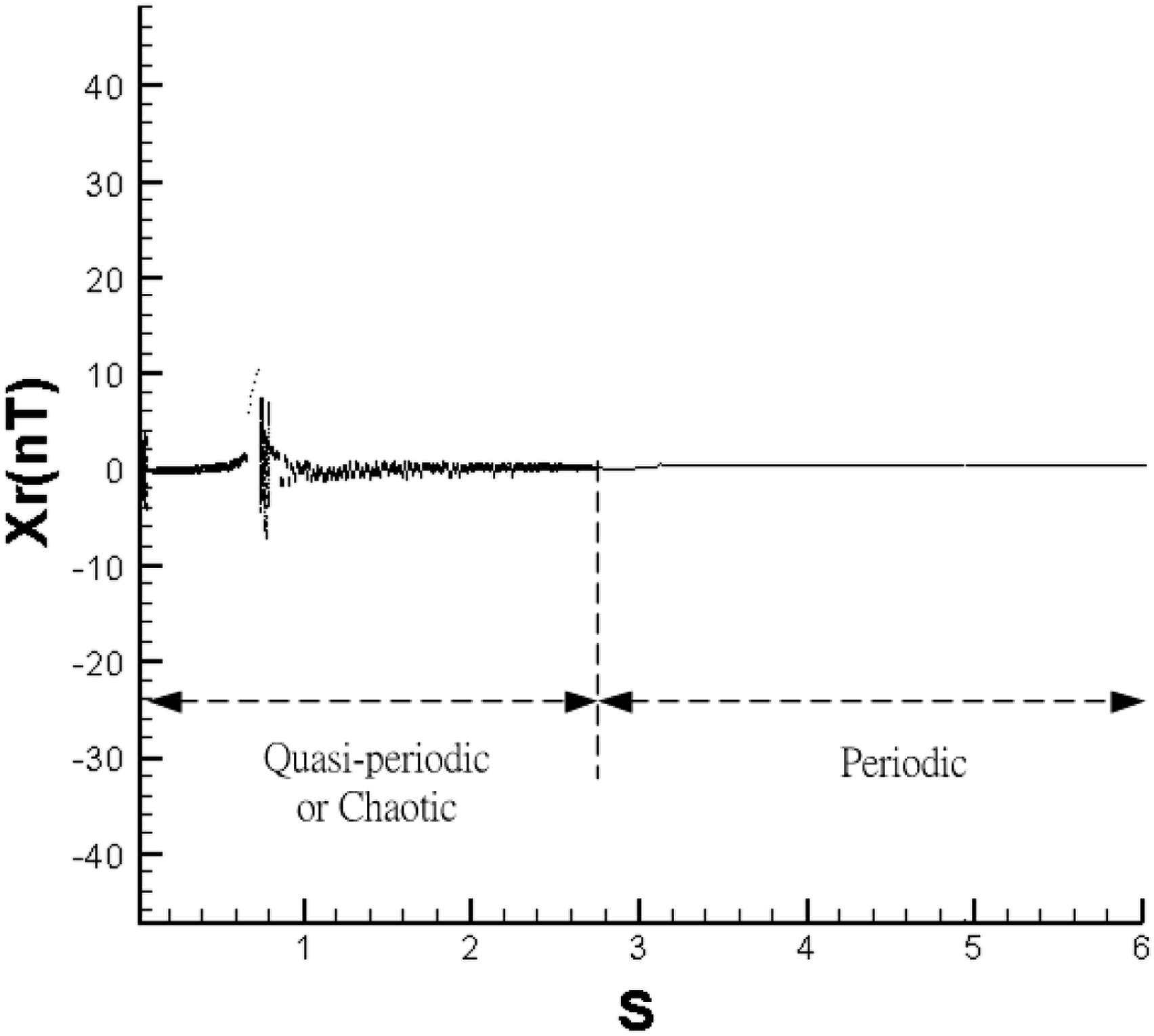
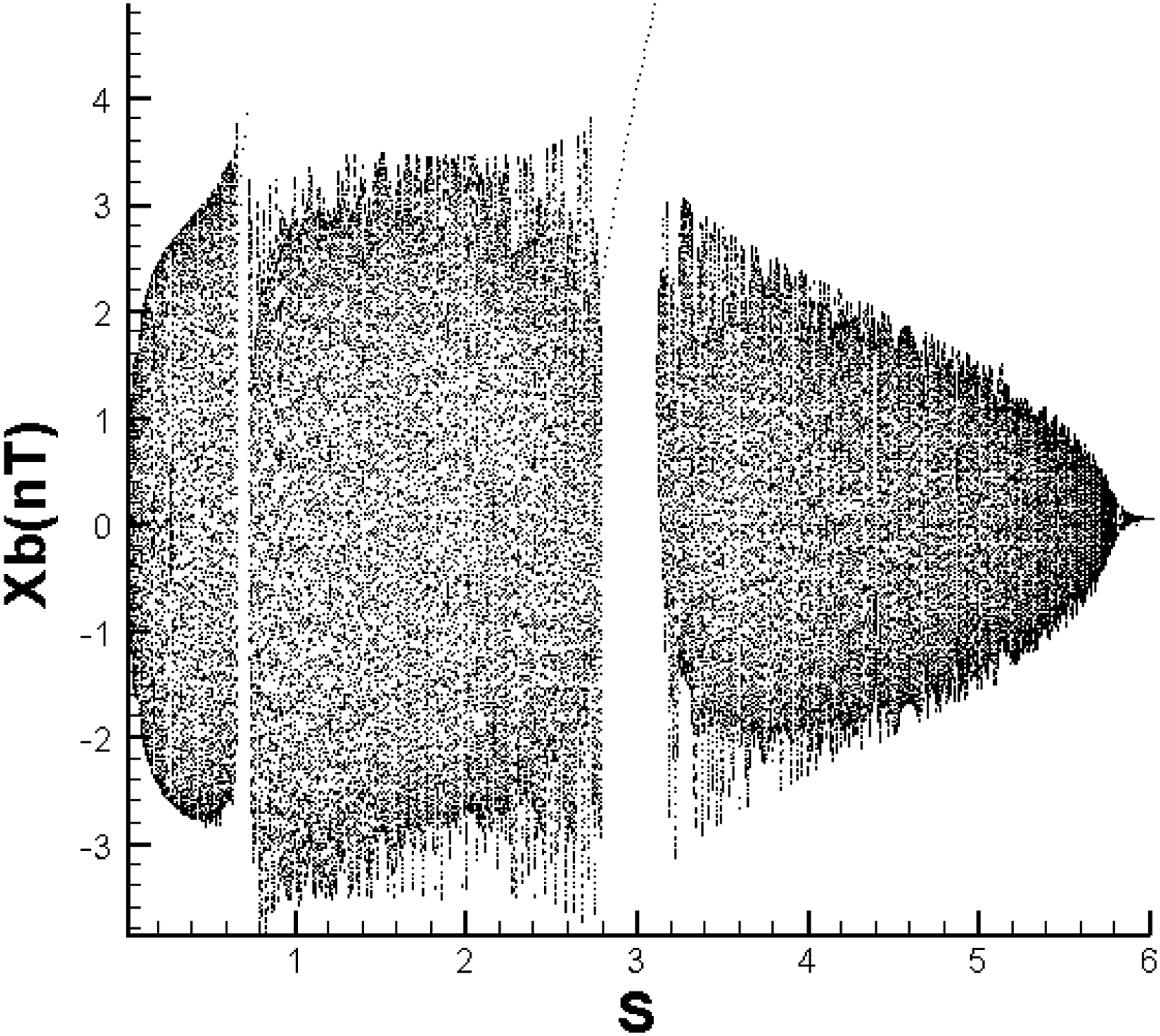
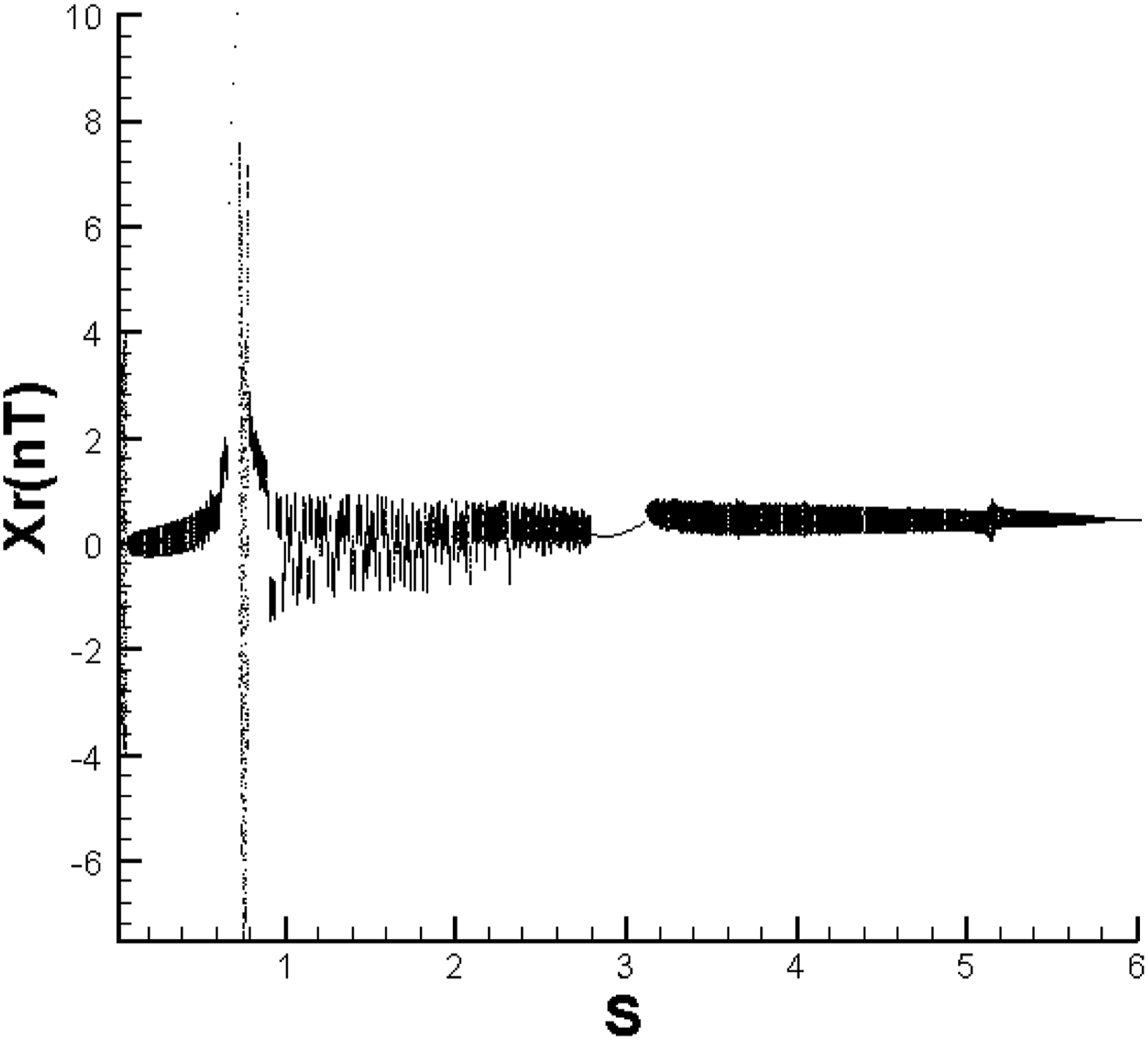
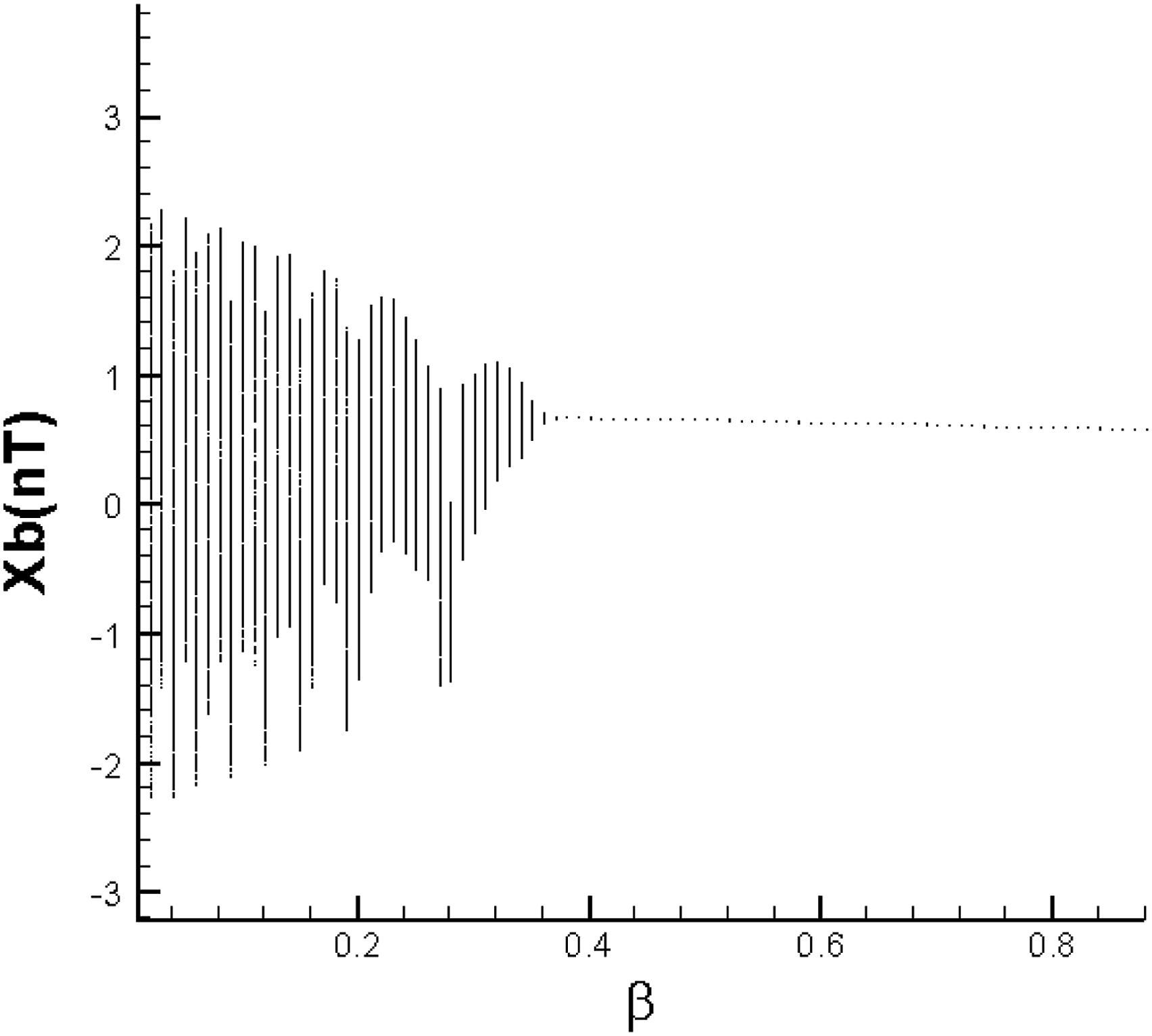
In Figure 2, the bifurcation diagram is for the bearing geometric center with dimensionless rotational speed ratio s (s=0.01∼6.00) at temperature T=25°C. We found that the bearing geometric center performs aperiodic motions with large amplitude at low rotating speeds, that is, Bifurcation diagram of the bearing geometric center using dimensionless rotational speed ratio s (s = 0.01∼6.00) for temperature T = 25°C. Bifurcation diagram of the rotor geometric center using dimensionless rotational speed ratio s (s = 0.01∼6.00) for temperature T = 25°C Bifurcation diagram of the bearing geometric center using dimensionless rotational speed ratio s (s = 0.01∼5.50) for temperature T = 90°C. Dynamic orbit, Poincaré map, and power spectrum of the bearing geometric at dimensionless rotational speed ratio s = 1.0, 1.2, 1.8, 2.4, 2.6, and 3.0 for temperature T = 90°C. Fractal dimension and Maximum Lyapunov Exponent of the bearing geometric at dimensionless rotational speed ratio s = 2.4 for temperature T = 90°C. Bifurcation diagram of the rotor geometric center using dimensionless rotational speed ratio s (s=0.01∼5.50) for temperature T=90°C. Bifurcation diagram of the bearing geometric center using dimensionless rotational speed ratio s (s=0.01∼6.00) for temperature T=100°C. Bifurcation diagram of the rotor geometric center using dimensionless rotational speed ratio s (s = 0.01∼6.00) for temperature T = 100°C. Bifurcation diagram of the bearing geometric center using dimensionless rotational speed ratio s (s = 0.01∼6.00) for temperature T = 120°C. Bifurcation diagram of the rotor geometric center using dimensionless rotational speed ratio s (s = 0.01∼6.00) for temperature T = 120°C. Bifurcation diagram of the bearing geometric center using unbalanced parameter β as the bifurcation control parameter (β = 0.01∼0.88) for s = 2.4 and temperature T = 90°C. Bifurcation diagram of the rotor geometric center using unbalanced parameter β as the bifurcation control parameter (β = 0.01∼0.88) for s = 2.4 and temperature T = 90°C. Bifurcation diagram of the bearing geometric center using dimensionless damping ratio c1 as the bifurcation control parameter (c
1
= 0.01∼1.00) for s = 0.2 and temperature T = 25°C. Bifurcation diagram of the rotor geometric center using dimensionless damping ratio c1 as the bifurcation control parameter (c
1
= 0.01∼1.00) for s = 0.2 and temperature T = 25°C. Bifurcation diagram of the bearing geometric center using dimensionless damping ratio c1 as the bifurcation control parameter (c
1
= 0.01∼1.00) for s = 0.2 and temperature T = 80°C. Bifurcation diagram of the rotor geometric center using dimensionless damping ratio c1 as the bifurcation control parameter (c
1
= 0.01∼1.00) for s = 0.2 and temperature T = 80°C.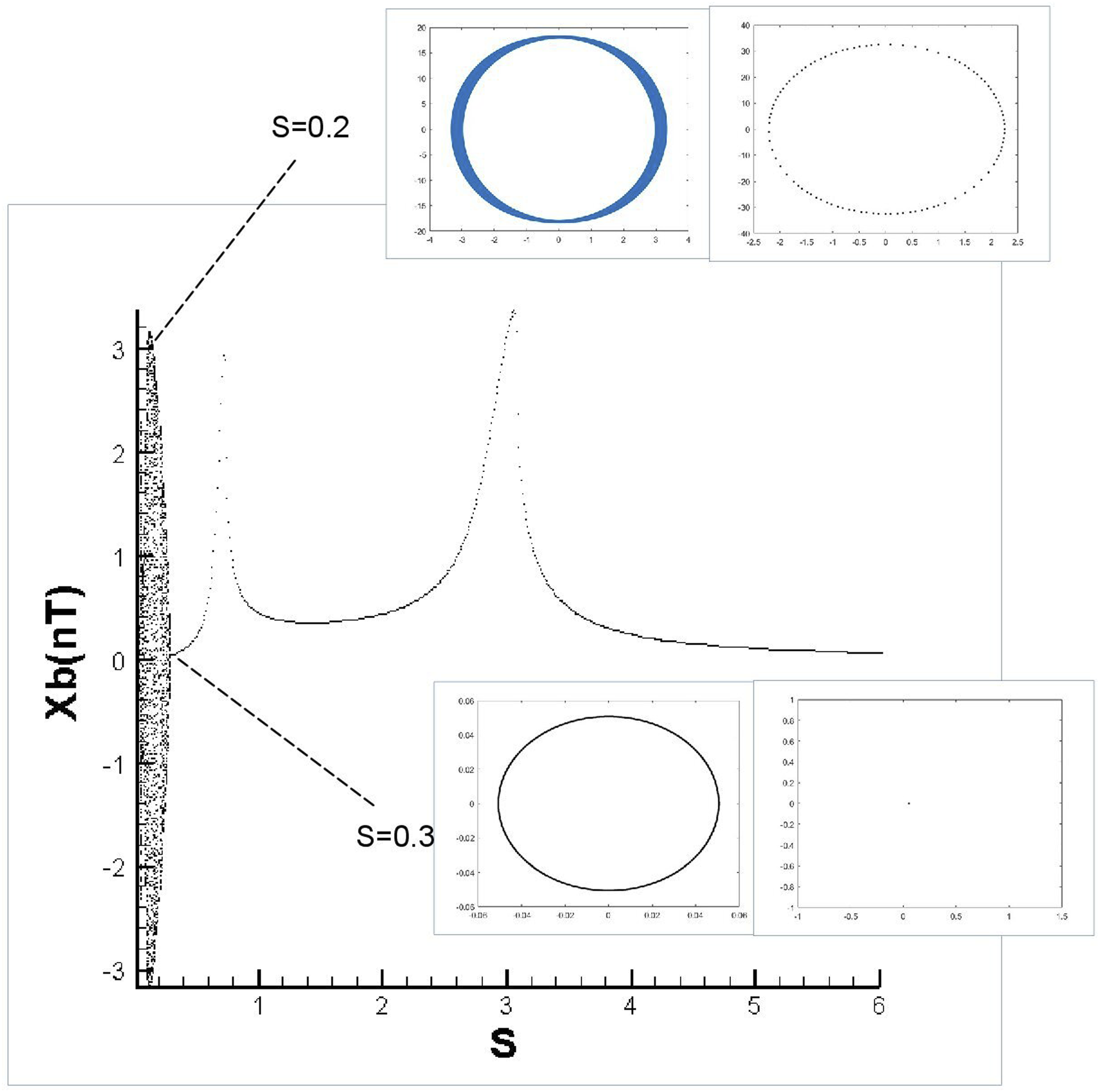
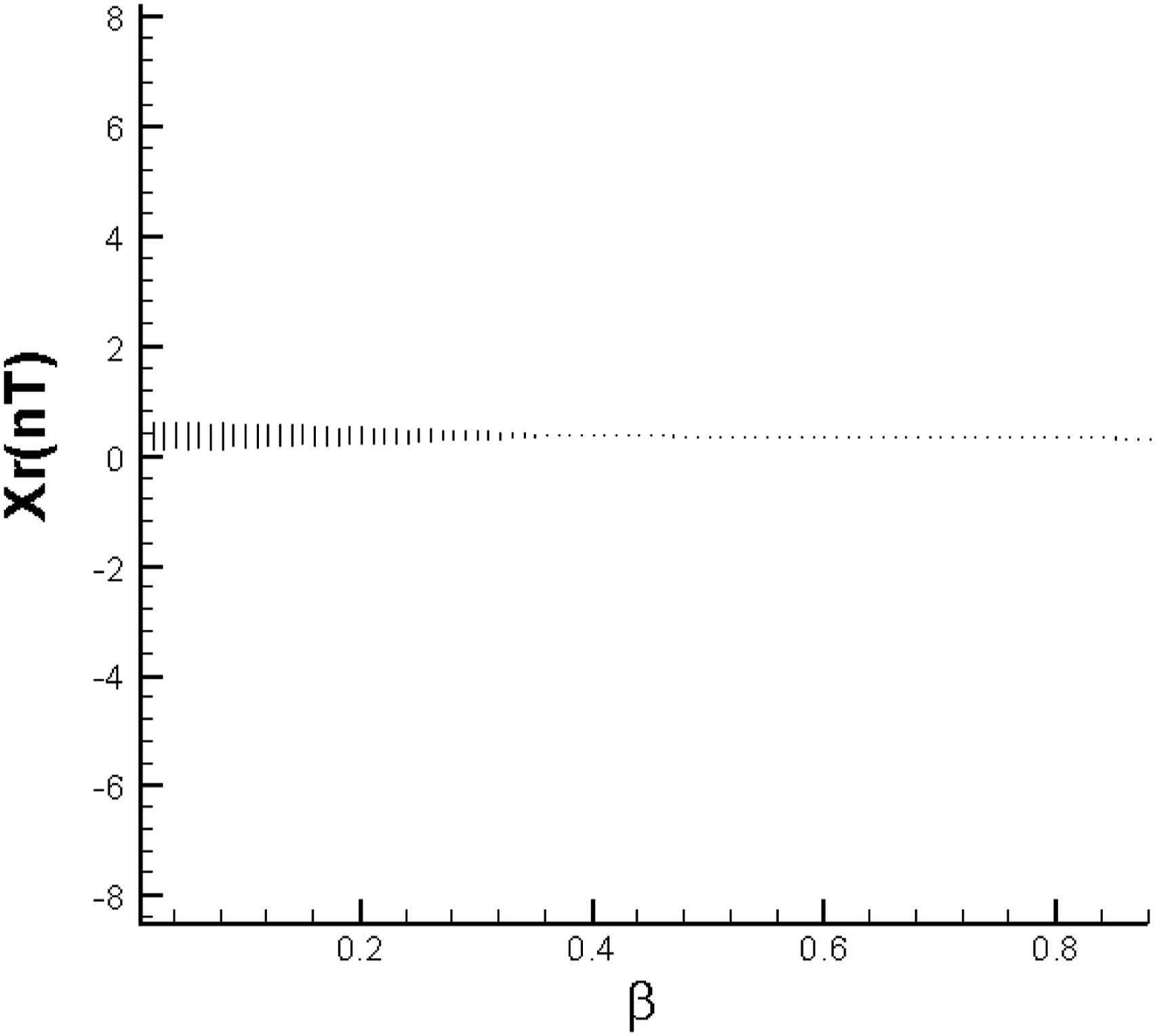
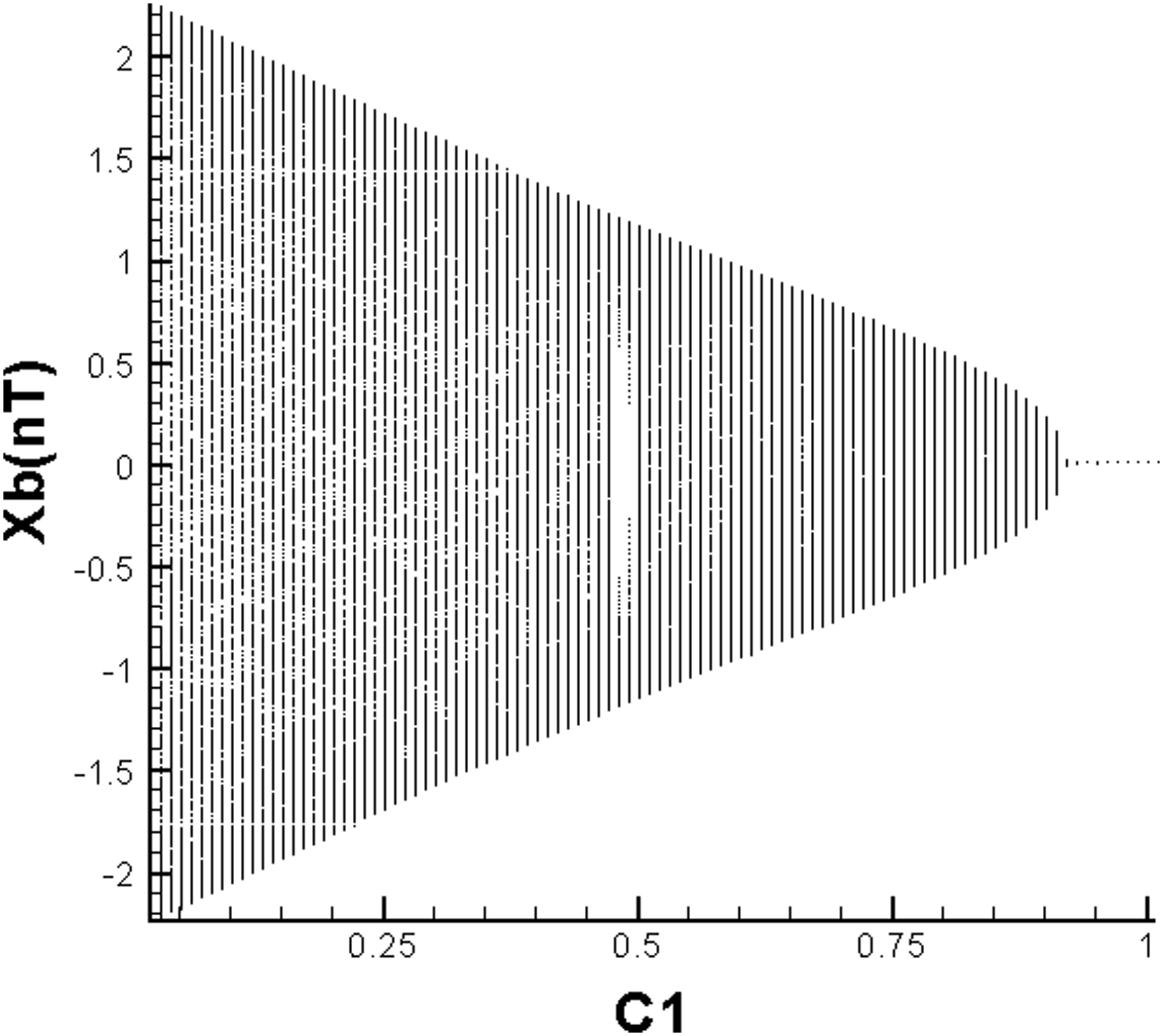
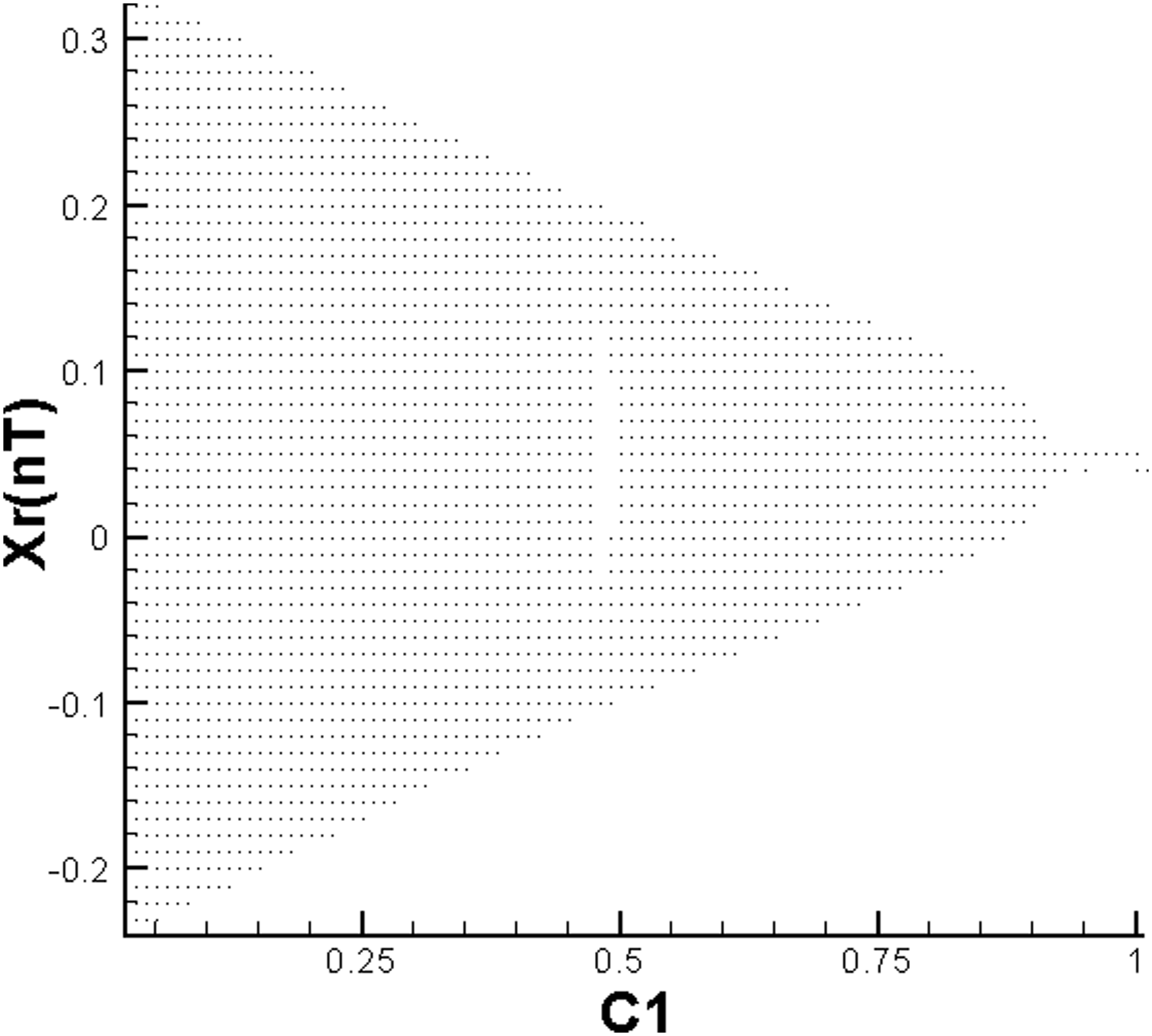
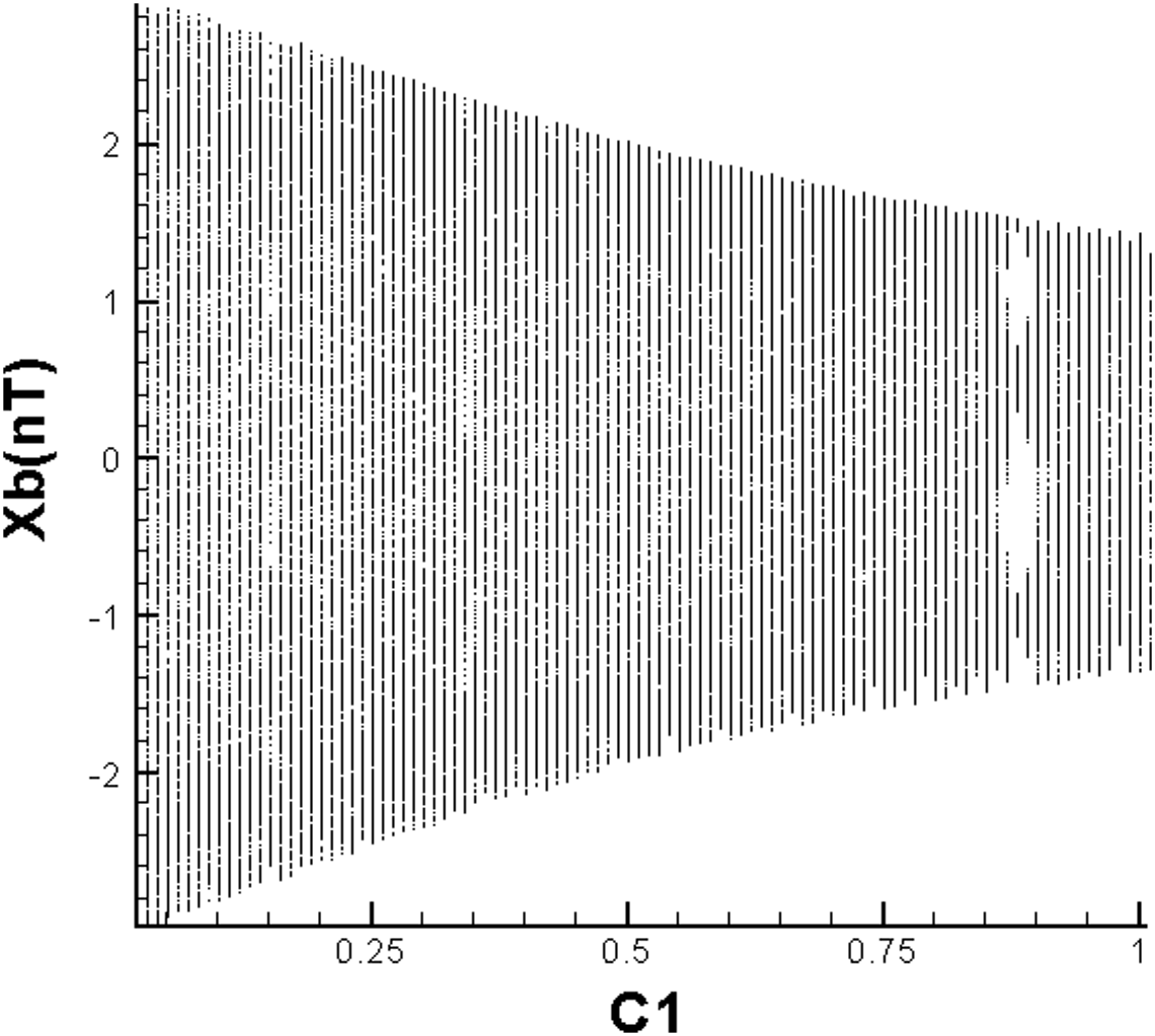
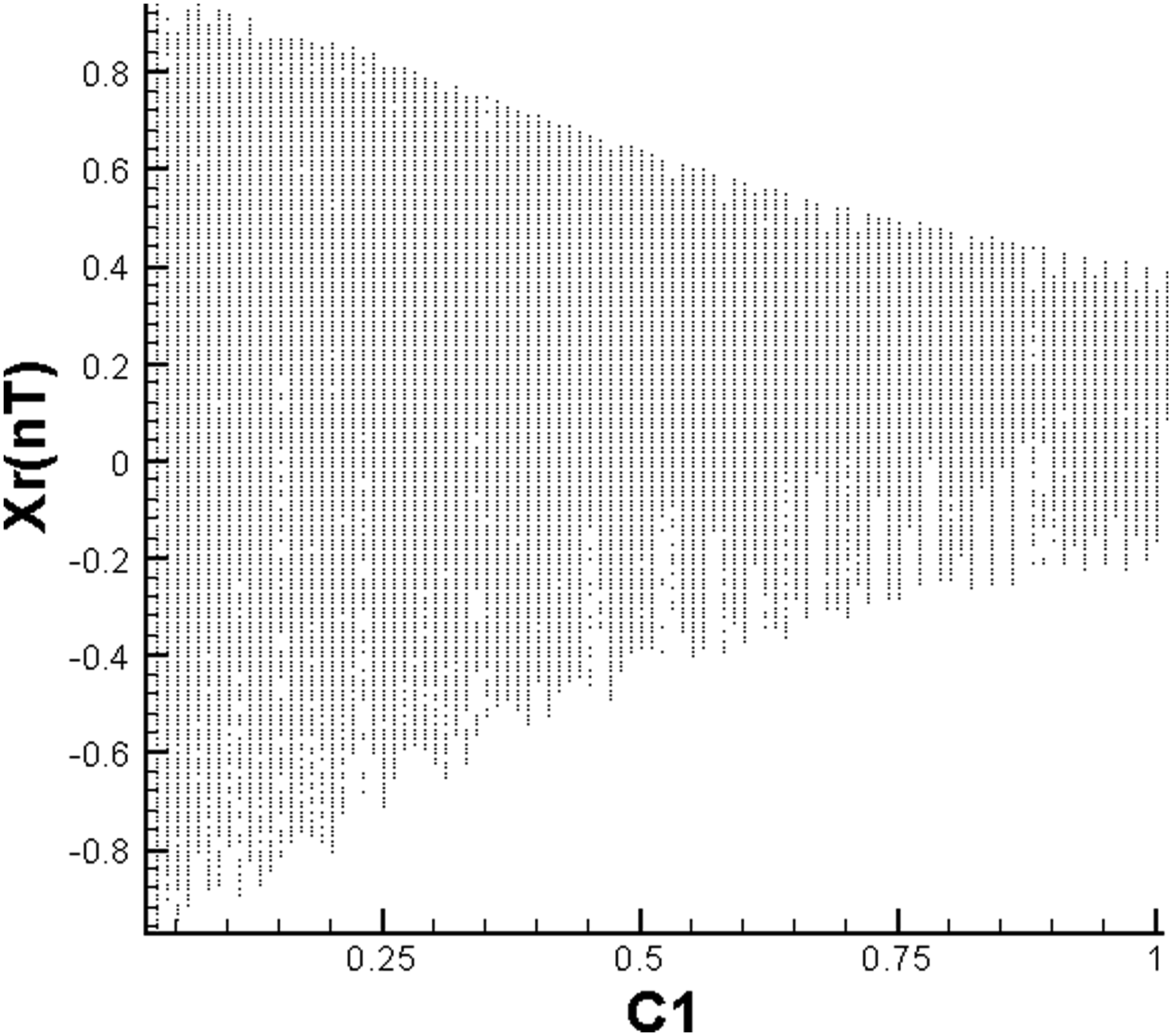
Discussion and conclusions
As we all know, the viscosity coefficient in lubricating fluid is not only a function of pressure but also a function of temperature. However, in the general study of the dynamic characteristics of the rotor-bearing system, they assume that the viscosity coefficient is a constant value, so there is a possibility of underestimating the effect of the viscosity coefficient. In this study, a rigid rotor supported by two journal bearings under nonlinear suspension and the lubricating oil is assumed to be temperature dependent in this study. Analytical tools inclusive of bifurcation diagrams, dynamic trajectories, power spectra, Poincaré map, fractal dimension, and Lyapunov exponent are used to verify the dynamic characteristics of the rotor-bearing system, and abundant periodic, subharmonic, quasi-periodic, and even chaotic motions are found in this study.
We hope that the rotor-bearing system operates in a predictable periodic motion state, because when the rotor-bearing system operates in a non-periodic motion state, the possible broadband vibration with large amplitude will increase the possibility of the fatigue or failure of the system. However, as the speed increases, the operating temperature of the rotor-bearing system will also increase, which may cause lubrication failure. From the simulation results, the higher operating temperature will also cause the dynamic trajectory of the system to become non-periodic vibration.
Footnotes
Declaration of conflicting interests
The author(s) declared no potential conflicts of interest with respect to the research, authorship, and/or publication of this article.
Funding
The author(s) received no financial support for the research, authorship, and/or publication of this article.
