




Abstract
Metro systems provide an efficient, convenient, and expeditious way to travel around crowded routes. Because these systems are established in cities, residential buildings close to metro viaducts are significantly affected by structure-borne noise (SBN). Although most previous studies developed SBN prediction with a focus on the accuracy and computational efficiency of a specific bridge type, only limited studies on parameters for the SBN on bridges were carried out. Thus, eliminating SBN is still a challenging task for both the design and operation phases of bridge design. Therefore, this study integrates simplified experiments with numerical analyses to evaluate the influential parameters on the structure-borne noise level (SBNL) for two types of bridge girders, that is, the double-box pre-stressed concrete girder and the double-box steel girder. The present study also proposes an optimization method for reducing the SBNL in the bridge design and operation phases and identifies the sources of SBN for these two types of bridges. In this paper, the solutions to mitigating SBN are first reviewed and briefly introduced. Theories associated with SBN are then derived and experimentally verified using a concrete or steel plate with a unit area. A hybrid evaluation method is developed to integrate transient finite-element simulation with experimental results, and the main sources (e.g., plate thickness, train speed, fastener stiffness, and track irregularity) that induce SBN are examined by this hybrid method. Consequently, the approach to resolving the SBN problem can be optimally determined. As demonstrated in the results from the hybrid evaluation method, the track condition dominates the SBNL for both types of bridges, and the relationship between train speed and plate eigenfrequency should be carefully investigated to avoid the effect of plate resonance. The pre-stressed concrete box girder is the recommended bridge type for use in urban areas from the viewpoint of minimizing the SBNL.
Introduction
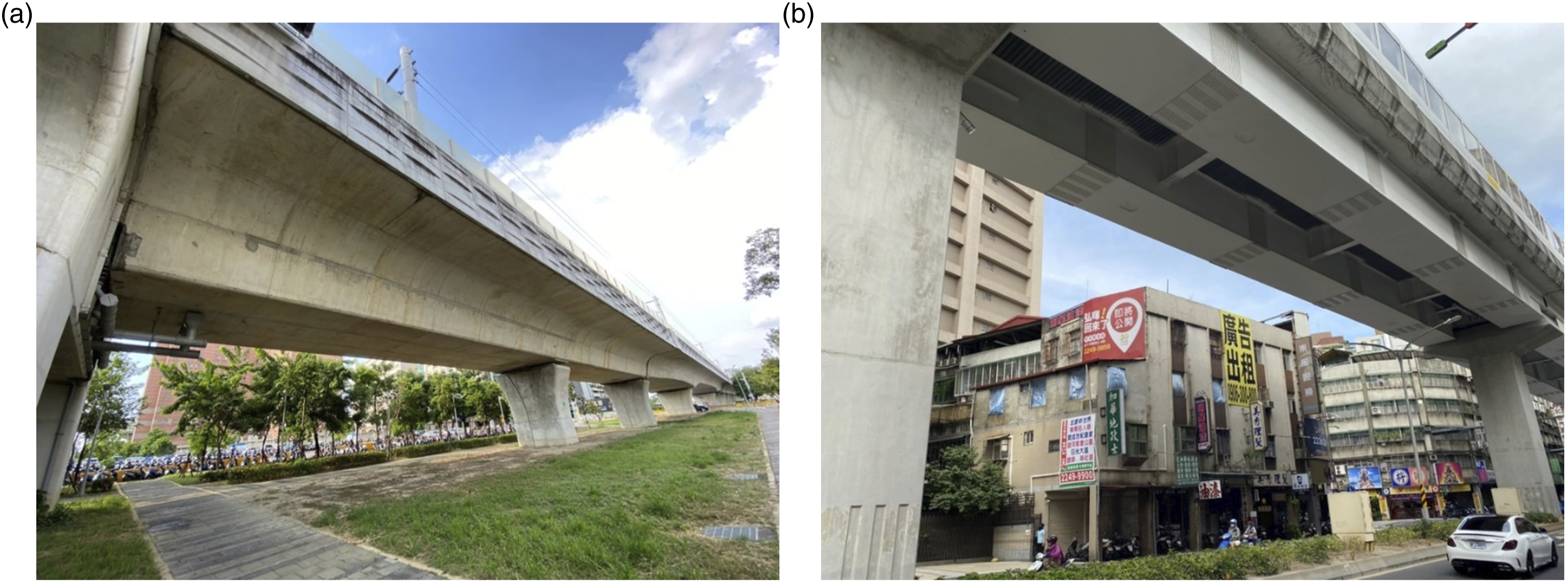
Metro systems, a valid symbol of the progressive urban environment, provide an efficient, convenient, and fast method of travel along crowded routes. For example, Taipei in Taiwan is home to a metro system 146 km in length, of which approximately 56% is composed of bridge structures. Over the coming decade, this length is expected to double within the Taipei metropolitan area. However, noise and vibration pollution problems also increase in tandem with the expansion of the metro system and its network of viaducts. The metro corridors (especially medium-capacity rapid transit and trams) are located in close proximity to residential areas, as shown in Figure 1, with residential buildings too near viaducts being seriously affected by structure-borne noise. The energy of structural vibration is transmitted via solid components, and the vibration energy can be enlarged by specific structural components that cause the air to vibrate, resulting in so-called structure-borne noise (SBN). SBN is different from squealing noise, traction noise, etc., which can be resolved by lubrication and/or noise barrier walls, and it is low frequency and radiates throughout a vibrating solid structure, making it difficult to eliminate after a structure has been completed. Urban metro viaduct with adjacent buildings: (a) aerial view and (b) view above the track.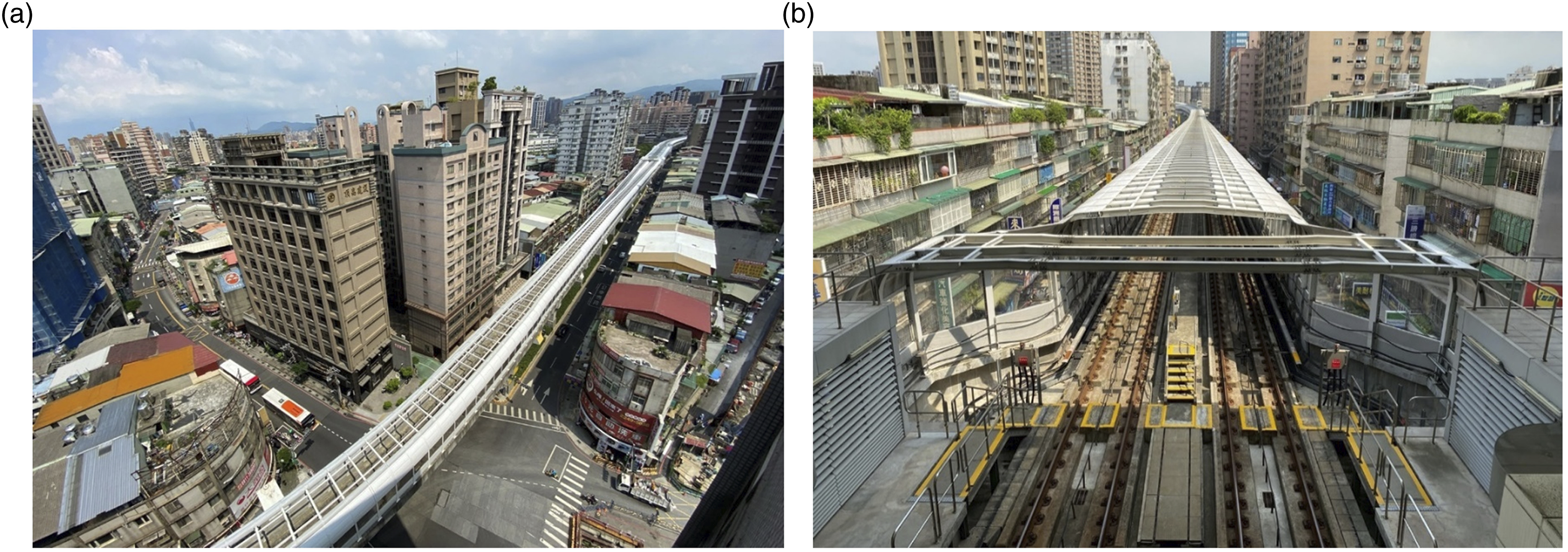
For this reason, several railway-related SBN prediction models are described in the literature. Li et al. 1 used a finite-element method (FEM) to solve the transient train–track–bridge dynamic interaction problem, and they used a boundary element method (BEM) to determine the sound pressure in the frequency domain. They concluded based on their numerical and field measurement results that the sound pressure was approximately 32–100 Hz for train speeds in the range 50–80 km/h on a U-shaped concrete bridge. Li et al. 2 and Song et al. 3 both used 2.5D BEM to improve computing efficiency. Li et al. 4 also investigated the characteristics of SBN generated by steel–concrete composite bridges through numerical analysis, which combined FEM and statistical energy analysis (SEA) to obtain a higher structure mode. They found that the noise generated by the steel girders was dominant in the high-frequency range above 315 Hz, whereas the noise generated by the concrete deck was dominant in the low-frequency range of 80–160 Hz. Zhang et al. 5 used FEM to examine the vibration spectra of a steel–concrete composite girder structure and, via a comparison with the experimental results, showed that adding a concrete deck to the steel girders could effectively reduce the deck vibration. The aforementioned studies predicted SBN via the combined advantages of FE and BEM/SEA modeling to deal with near-field structure vibration and far-field noise propagation, respectively.
However, these studies focused on SBN prediction accuracy and computing efficiency improvement for a single bridge type. Examinations of how specific parameters affect the SBN of bridges are rare in the literature, despite the elimination of SBN generation proving to be a troublesome problem in both the design and operation stages of bridge design. Therefore, to suggest an optimal metro bridge type from the SBN point of view, this study proposes a reliable method to evaluate the influence of specified parameters on the structure-borne noise level (SBNL) for two of the most common bridge types, that is, double-box pre-stressed concrete girder (DBPC) and double-box steel girder (DBSG). Moreover, the present study also proposes an optimized method to reduce the SBNL during the design and operation stages of bridge development. First, the main factors influencing bridge SBN and mitigation methods are summarized. The relationship between structural plate vibration and radiation noise is theoretically derived and discussed. The phenomenon of concrete and steel plate sound radiations is also experimentally observed using unit-area plate specimens, and the mesh size of the FEM is validated experimentally. A transient FEM is applied to model the train–track–bridge dynamic interaction problem and analyze the structural vibration. Unit-area plate specimens are used to validate the modeling of plate sound radiation, and the results are used in conjunction with the transient FEM results. Therefore, a hybrid evaluation method is proposed. A parametric study of SBN is conducted to identify the source of SBN and determine more efficient methods for reducing SBN. Finally, the solution to reducing SBN can be investigated and optimally determined.
Factors influencing bridge structure-borne noise and mitigation methods
Thompson 6 categorized railway noise as rolling noise, curve squeal noise, bridge noise, aerodynamic noise, traction noise, warning signals, etc.; however, in general, the primary noise sources of a metro system comprise the first three items. The dominant frequency of the first two items is above 800 Hz and can thus be resolved by the application of lubrication and/or provision of noise barrier walls. The primary source of SBN, however, is the wheel–rail interaction and vibration of the whole bridge structure. 7 This occurs at a low frequency and radiates throughout the solid structure as a bending wave. 8 Ban and Miyamoto 9 determined that SBN is generated when trains interact with a structure. The frequencies they measured were dominant below 500 Hz for a ballasted concrete structure and 1000 Hz for a non-ballasted steel box girder. As reported in the literature review, the vibration energy in metro systems is generated by an unsprung mass bouncing on the combined wheel–rail roughness, which propagates through a structure as vibrational energy and finally radiates from it as audible noise into the surrounding air.
A structure’s bending wave is the only type of structural wave that contribute directly to noise radiation;
8
thus, the radiation efficiency is related to the plate bending wavelength and corresponding frequency. The relationship between the length of a plate and the wavelength also affects the radiation efficiency ratio, and the relationship between a vibrating flat plate and its sound radiation power can be expressed as follows:
8

Regarding the SBN mitigation method, Wang et al. 11 measured the vibration level of a steel bridge after the resilient baseplate had been replaced, finding a reduction of 10 dB in the vertical direction and a reduction in the wayside noise of approximately 6 dB(A). Ban and Miyamoto 9 measured the noise level under a bridge deck and found that the noise level for a concrete bridge with a ballasted track was approximately 87 dB(A), while noise levels of up to 110 dB(A) were recorded for a steel bridge with a non-ballasted track. The application of ballasted mats, sound-absorbing ballast, bridge cover plaster plates, etc., has also been proposed to reduce SBN. Li et al. 12 used numerical simulations and field tests to investigate the vibration and noise of concrete box girders. They found that the track types significantly affected the vibration and SBN, and the steel spring floating slab track was the most effective for vibration and noise reduction, reducing sound pressure levels by 20–23 dB. Cooper et al. 13 showed that optimized cross-sections of PC concrete bridges could reduce the SBNL by at least 8 dB(A).
These studies suggest that the main factors influencing bridge SBN can be categorized as source side, for example, train speed, track irregularity, and track stiffness on the vibration transmission path, and receptor side, for example, bridge type, plate material, dimensions, etc. Thus, bridge SBN can be effectively modified by appropriately adjusting these parameters.
Bridge structure-borne noise characteristics
Relationship between plate bending wavelength and critical frequency
Bridge SBN is emitted as a result of the local vibration of a bridge. One of the main components of a bridge structure to be considered in this study is the plate, and the bending wave through a plate is the primary source of SBN. Thus, this study employs bridge plate vibrations to evaluate the SBNL. Given that the bending wave velocity in a plate is dispersive, however, the relationship between bending wave velocity, wavelength, and frequency for different plate thicknesses must first be determined before addressing the SBN issue.
The plate bending velocity can be expressed by
8


Figure 2 illustrates the relationship between a wavelength and the corresponding frequency for different plate thicknesses derived from equation (3). It can be easily seen that the vibration energy resulting from a relatively thicker, softer plate, such as a concrete plate, has a longer wavelength and matches the same wavelength of air at a lower frequency. Conversely, the vibration energy resulting from thinner, stiffer plates has a shorter wavelength and matches the same wavelength of air at a higher frequency. Moreover, the frequency at which a plate wavelength is equal to an equivalent wavelength in air is referred to as the critical frequency. It can be obtained from equation (2) and expressed as Relationship between wavelength and frequency for different plate thicknesses.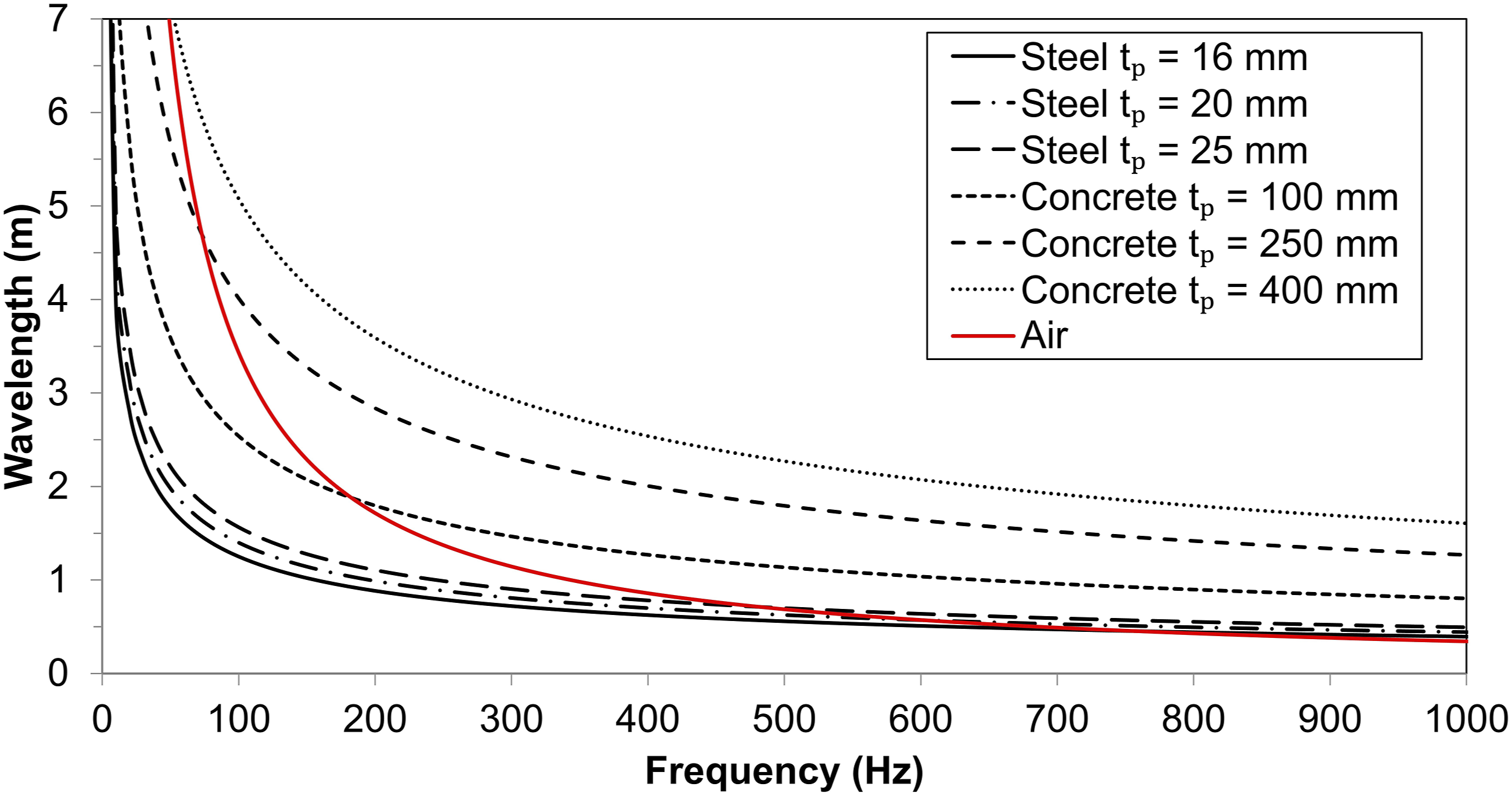

The critical frequency is the divisor of sound radiation efficiency, which can be realized by deriving the relational equation between a vibrating bendable plate and the sound pressure of the surrounding air. The sound radiation of a plate bending wave is depicted in Figure 3, and this bendable plate that is vibrating as a function of Sound radiation from an infinite plate.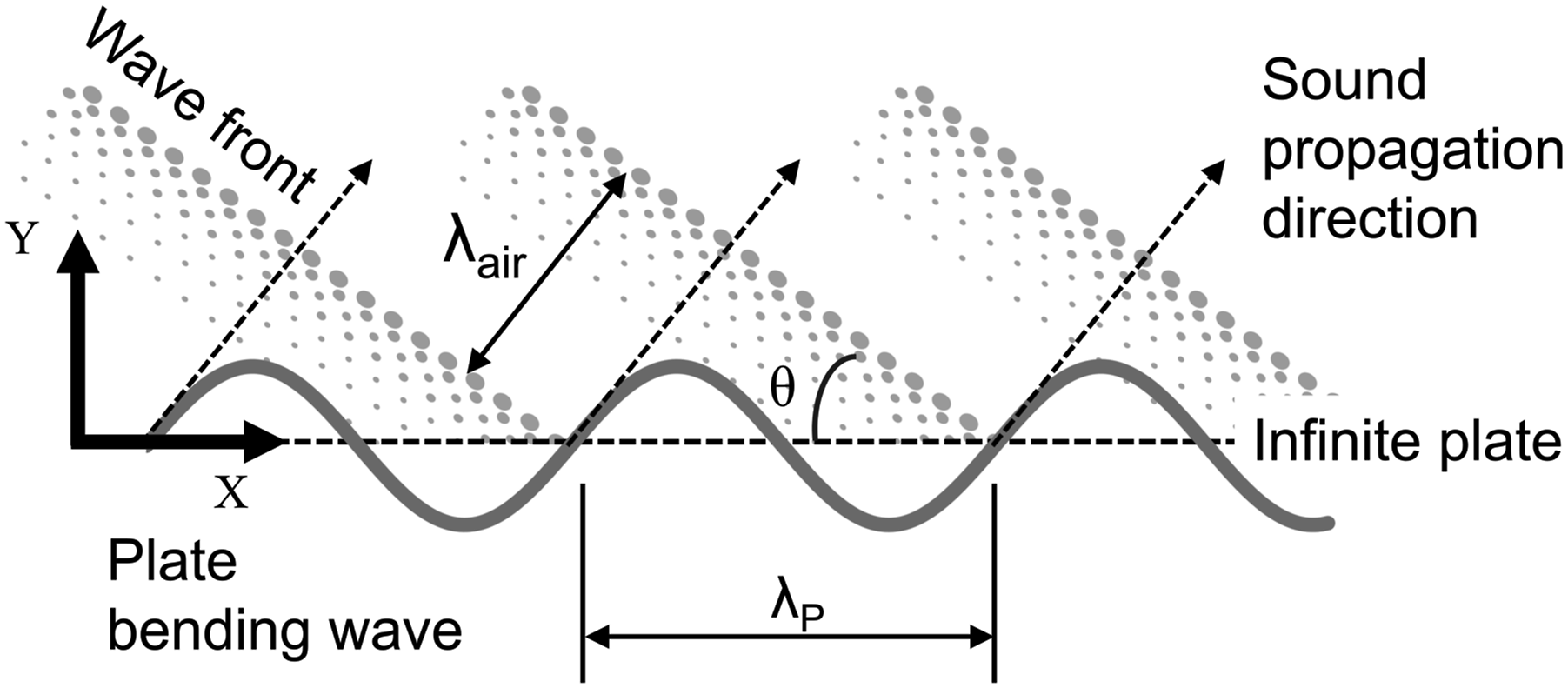



In equation (7), the relationship between the wavenumber of plate k p and air ka determines the radiation efficiency. When k p is smaller than k a , the sound pressure in equation (7) is positive, and, on the contrary, the sound pressure decays rapidly according to the exponential term in the y-direction. When vibrating at the critical frequency, f c , the plate and air wavelengths are equal, and the sound pressure radiation efficiency is extremely high. Therefore, when the plate bending vibration frequency is equal to or greater than the critical frequency, the sound pressure will efficiently transmit to the environment; otherwise, the sound pressure will decay in proportion to its proximity to the bridge plate.
Sound radiation and mesh size validation experiment
Transient FEM was utilized to model the train–track–bridge dynamic interaction problem and evaluate the structural vibration. Concrete and steel specimens of unit surface area (shown in Figure 4) were used to validate the plate sound radiation, and an appropriate mesh size for the finite-element (FE) model to accurately describe the plate vibration was determined experimentally. The accelerometers were positioned along the normal direction, perpendicular to the plate surface, to obtain the velocity Unit-area plate specimens and the accelerometer arrangement: (a) experimental layout, (b) concrete plate and (c) steel plate.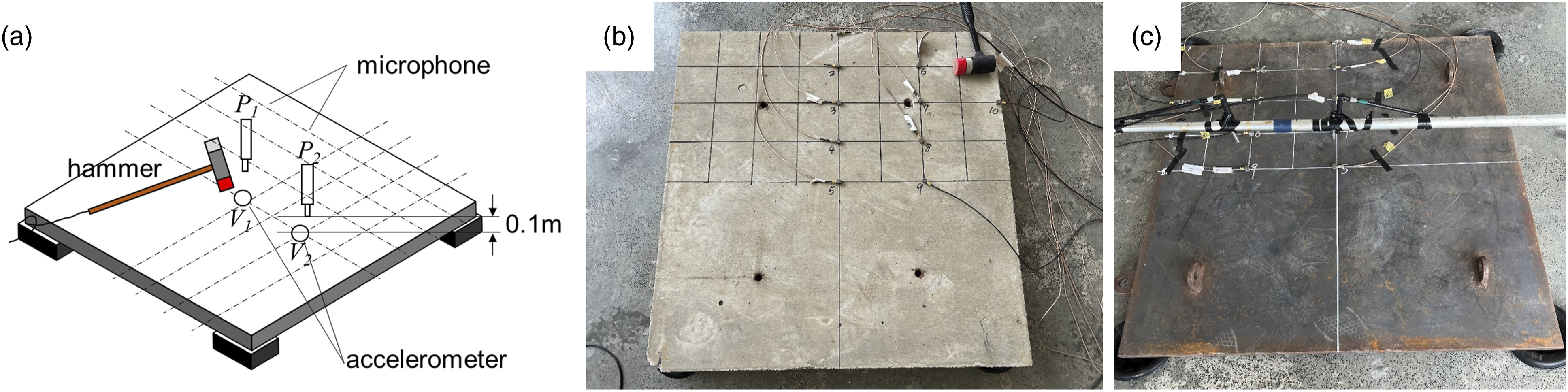
The first objective of the experiment was to verify the modeling of the sound radiation phenomenon, shown in Figure 5, by experimentally investigating the vibration velocity and radiation sound pressure level of the one-third octave band. Figure 5(a) depicts the results for the 10-cm-thick concrete plate, showing that the critical frequency f
c
occurs at 182.5 Hz; the black lines represent the vibration spectrum, and the sound pressure spectrum is plotted using red lines for different locations on the plate. The first concrete plate mode (392 Hz) is observed to be above the critical frequency, and the sound pressure radiation is also observed to be more efficient compared to at frequencies below the critical frequency. Figure 5(b) shows the radiation results for a 2-cm-thick steel plate, with a critical frequency f
c
of 600.8 Hz and greater sound radiation efficiency when the frequency is above the critical frequency. The first mode of the steel plate occurred at 121 Hz, below the critical frequency; however, the sound radiation was still efficient, which differs from the concrete plate. These results indicate that a local vibration mode below the critical frequency but above the first local vibration also radiates SBN to a certain degree. To conclude, after combining FEM modal analysis and the experiment results, the lower of the first local eigenfrequency and critical frequency will be considered as the beginning sound radiation frequency in the following estimations. Vibration velocity and radiation sound pressure levels for a unit-area plate: (a) concrete plate and (b) steel plate.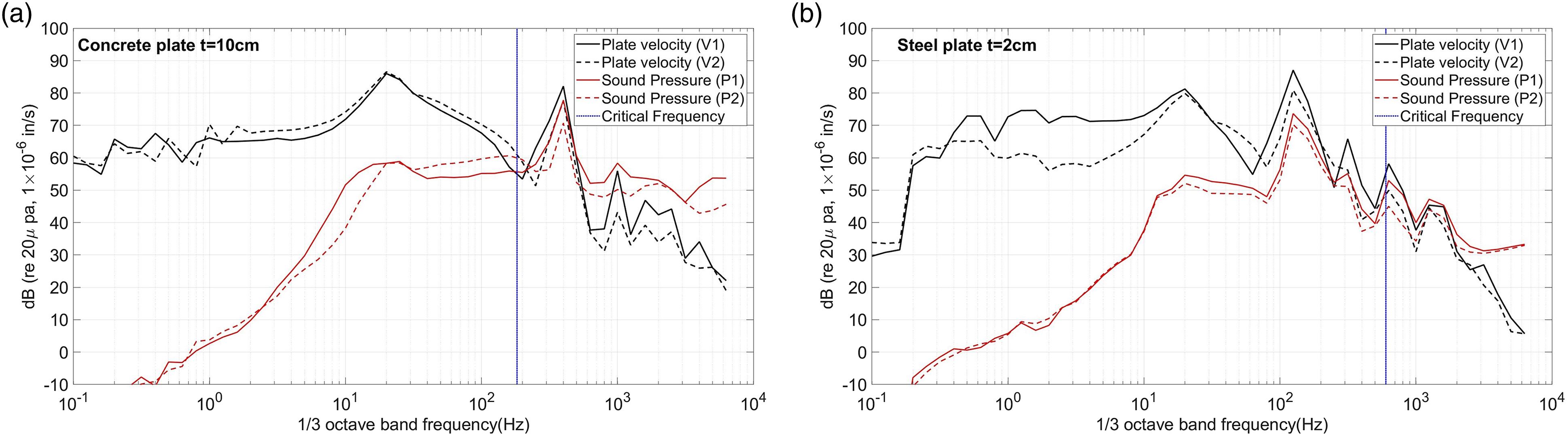
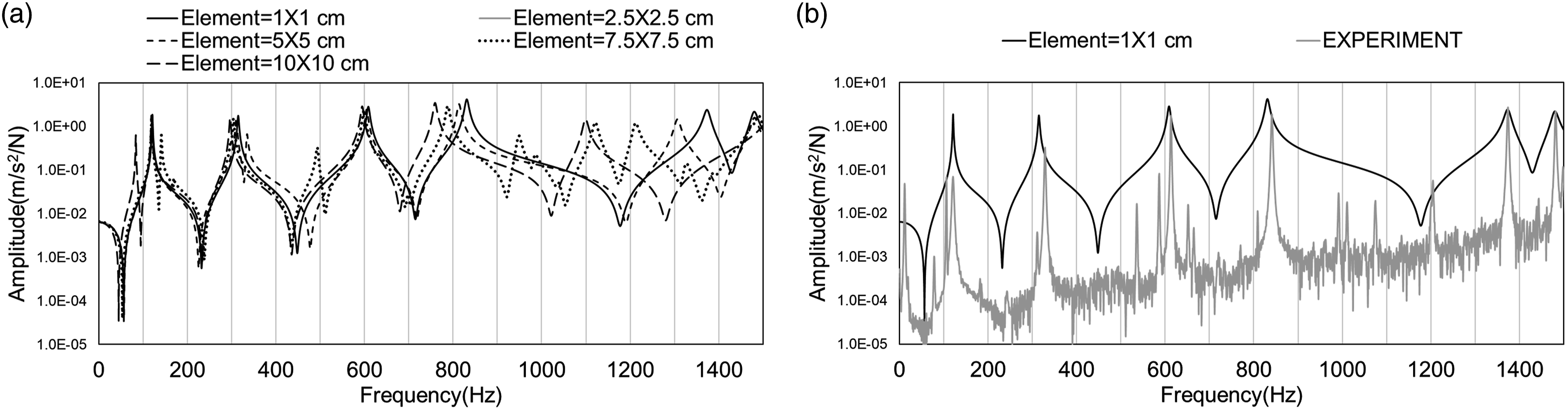
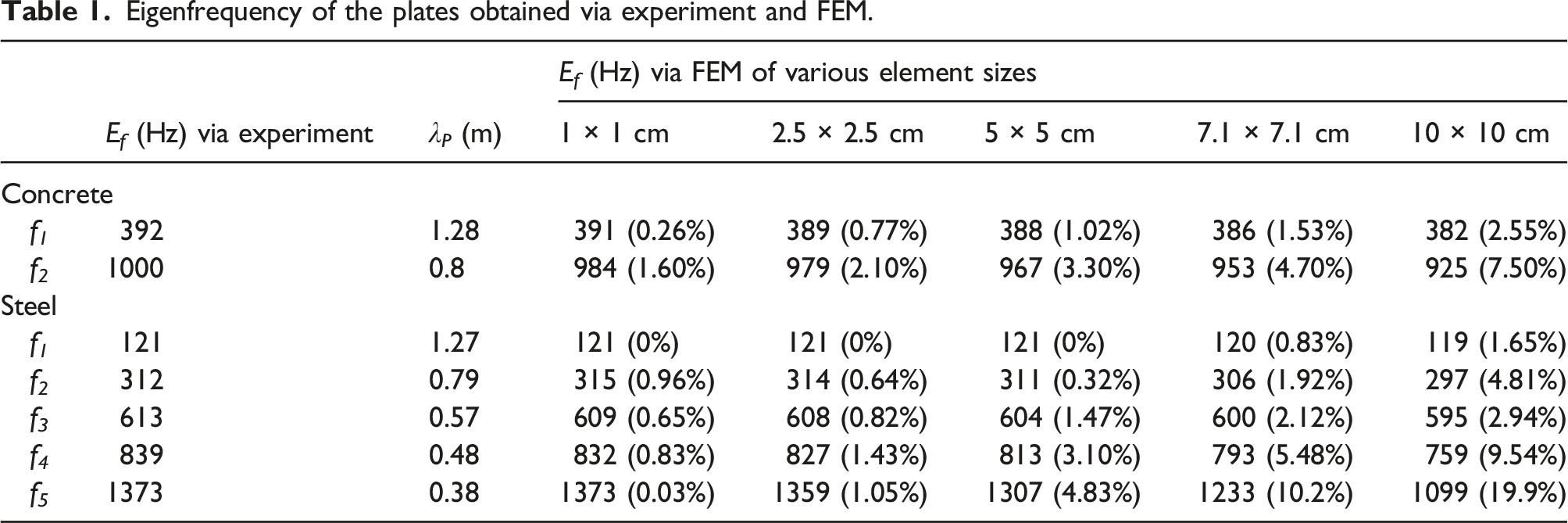
The second objective was to control the analysis error within a specified range. The analysis error concerning the relationship between FE model mesh size, plate vibration frequency, and wavelength is validated here. In the FE model, the lengths of the sides of the square shell elements were 1 cm, 2.5 cm, 5 cm, 7.5 cm, and 10 cm. The eigenfrequency (E
f
) of the concrete and steel plates was experimentally obtained as shown in Figures 6 and 7, respectively. The corresponding wavelength λ
P
derived from equations. (2-3) is shown in Table 1. In general, higher modes accompany shorter wavelengths and need more detailed elements to describe the wave motion, which can be observed in Figures 6 and 7, and a larger element size will lead to a higher eigenfrequency deviation. Using poorly considered elements to describe high-frequency modes tends to cause more significant errors, for example, the fifth eigenfrequency of the steel plate with a corresponding wavelength of 0.38 m can only accommodate 3.8 elements within the wavelength at an element length of 10 cm. Such an element size is inadequate to describe a wave physically and far below the required six elements per wave dictated by practical experience.
15
The eigenfrequency of the plates obtained via experiment and deviating FE element size are displayed in Table 1 to quantify the elements by the error range. The highest frequency of interest considers both a metro bridge’s SBN and an acceptable deviation, leading to the maximum element size for modeling. The following section will discuss the bridge plate mesh size in the train and rail–bridge models. Frequency response functions of the concrete plate obtained from analysis and experiment: (a) FE analysis of mesh sizes and (b) experimental and FE analysis. Frequency response functions of the steel plate obtained from analysis and experiment: (a) FE analysis of mesh sizes and (b) experimental and FE analysis. Eigenfrequency of the plates obtained via experiment and FEM.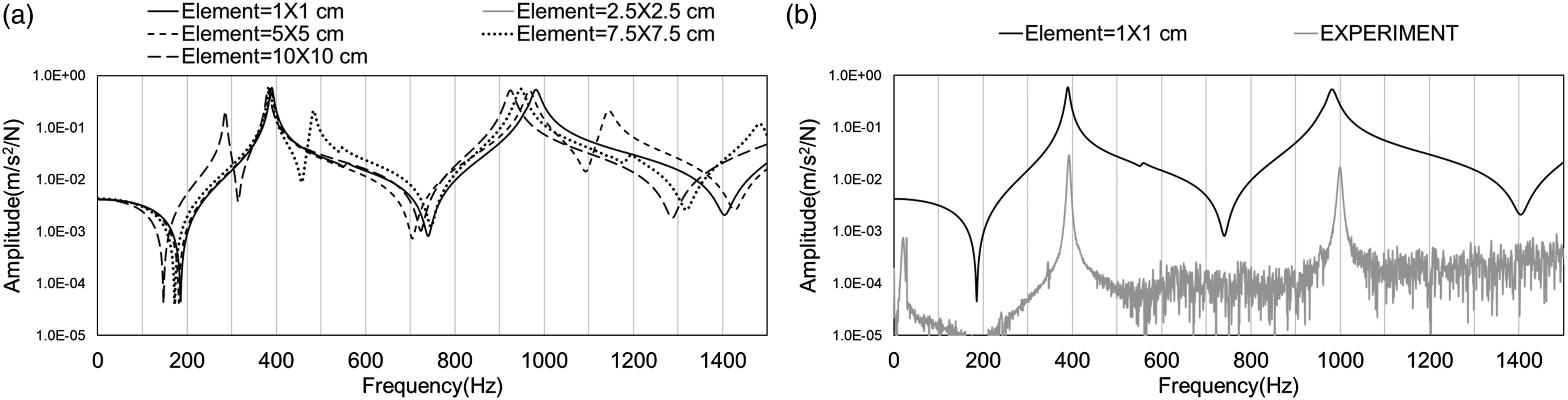
Numerical analysis model
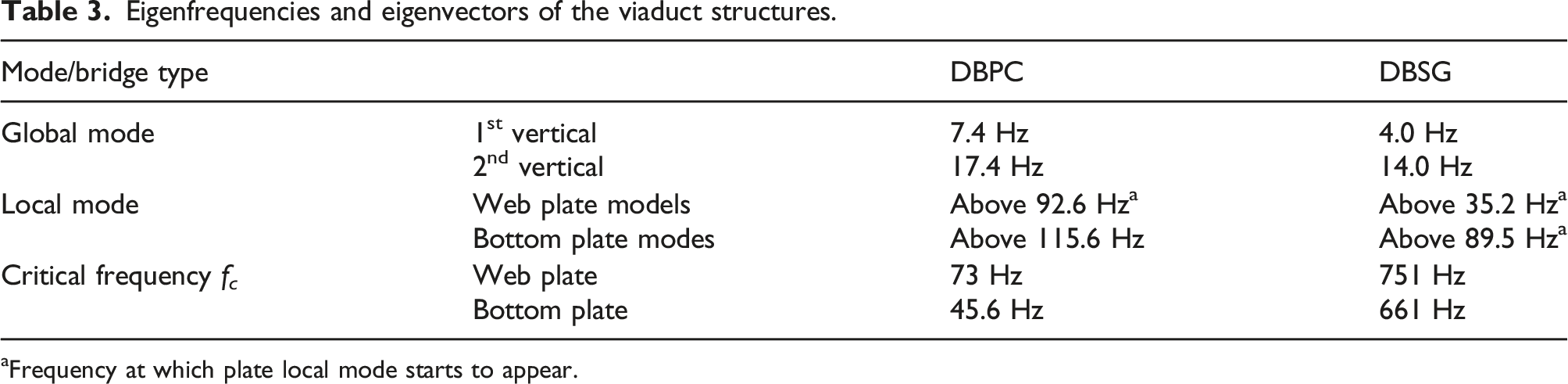
The SBNL was evaluated for two of the most commonly used metro bridge types, namely, the double-box PC girder (DBPC) and the double-box steel girder (DBSG), as shown in Figure 8. The DBPC is made of concrete material, and the DBSG is made of steel. Each girder had a 30 m span and fixed support on both edges. The track system was the UIC60 rail fastened onto a baseplate of stiffness 15.76 kN/mm, and the roadbed was a concrete plinth to be fixed onto the bridge deck. The model parameters of the train, track, and bridge structure are listed in Table 2. Table 3 lists the natural frequencies of the bridge without considering car bodies in the analysis, and the local modes obtained are considered features of interest. For the PC box girder, the first eigenfrequencies of the web plate and bottom plate were 92.6 Hz and 115.6 Hz, respectively. For the steel box girder, the first eigenfrequencies of the web plate and bottom plate were 35.2 Hz and 89.5 Hz, respectively. Bridge types: (a) double-box PC girder and (b) double-box steel girder. Train, track, and bridge structure FE model parameters. aSampling rate of the transient FEM results output was 2000 Hz. Eigenfrequencies and eigenvectors of the viaduct structures. aFrequency at which plate local mode starts to appear.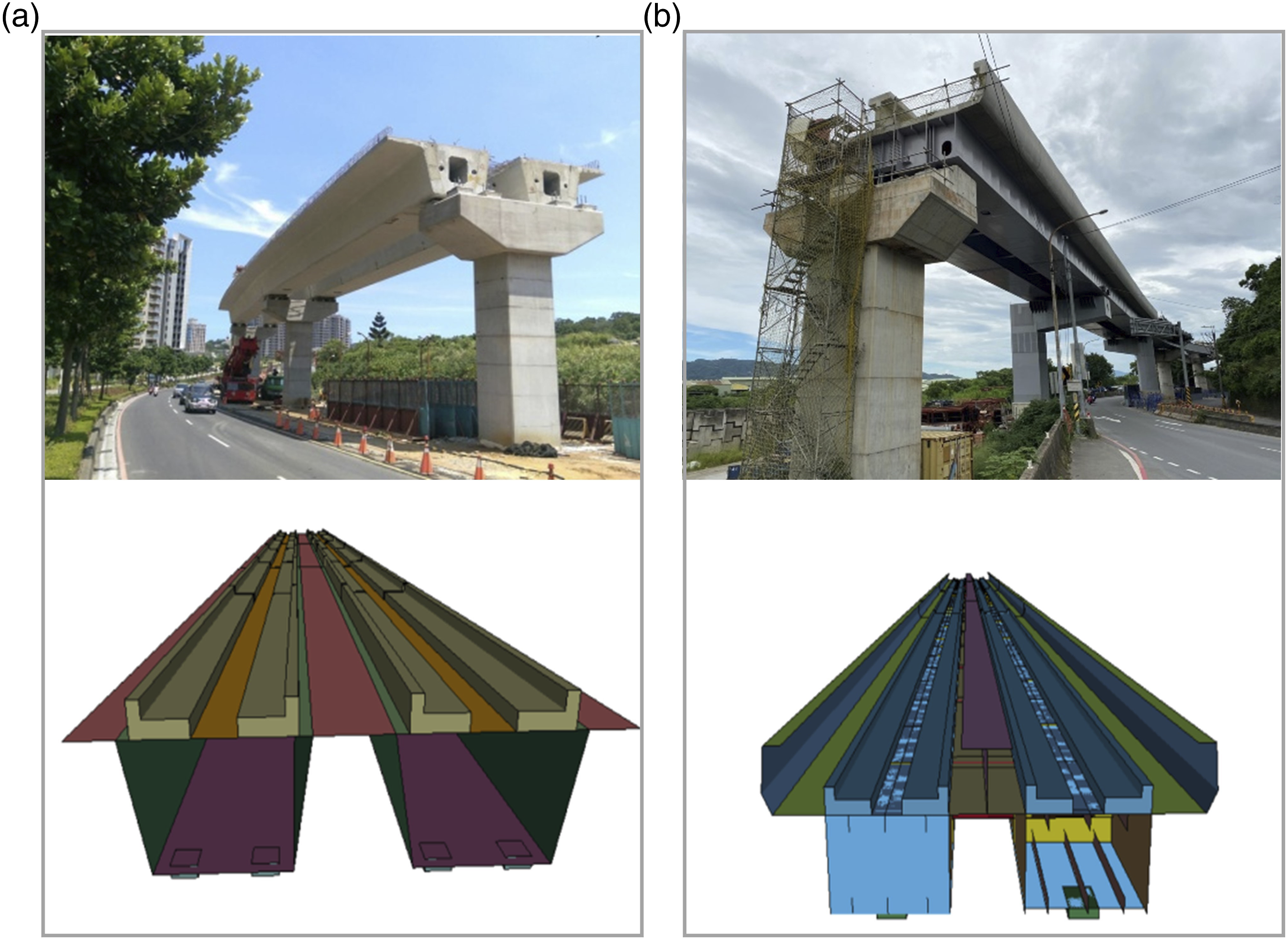
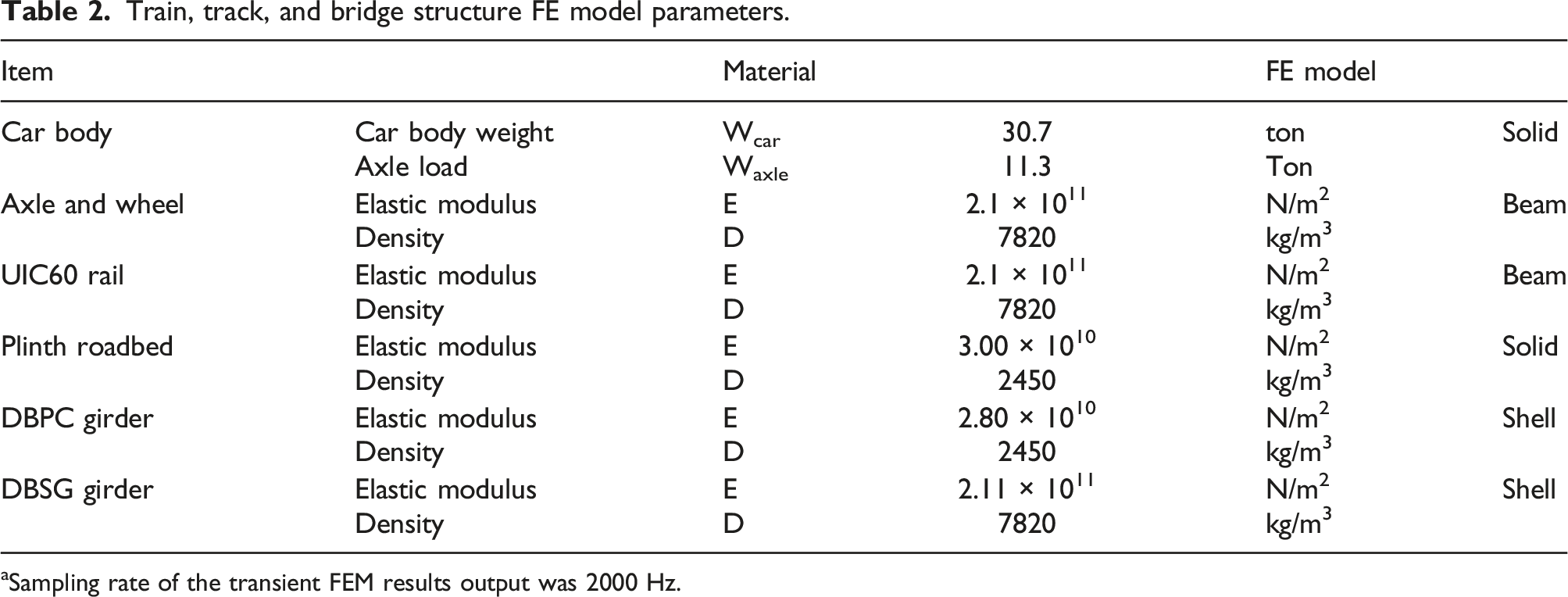
To control the numerical modeling results within an acceptable level of deviation, the maximum element size used for modeling must be defined by identifying the highest frequency of interest of the metro bridge’s SBN. Concerning concrete bridges, the literature review revealed that the SBN of a high-speed rail PC box girder is approximately 75–78 Hz. 16 Li et al. 17 indicated that SBN is mainly due to the vibration resonance of a concrete bridge, and the dominant frequency of both PC U-shaped and PC box girders is below 100 Hz. Investigations of the U-shaped PC girder 1 indicated that the dominant frequencies of the acceleration peak is at 64 Hz, whereas the noise peak occurs in the range of 32–100 Hz. Regarding steel bridges, site acceleration and sound pressure measurements of the H-section steel girder of a high-speed line showed that the dominant frequencies were below 100 Hz. 4 Poisson et al. 18 indicated that a steel truss bridge’s sound pressure level peaks were approximately 40 Hz and 400–630 Hz.
Figure 9 illustrates the measured velocity root-mean-square (RMS) level of the single-box PC girder and steel box girder, where the 30 m single-box PC girder measurement (Figure 10(a)) involved a conventional rail over which a train with a maximum axle load of 15 tons passed at a speed of approximately 70 km/h. The 35 m steel girder (Figure 10(b)) measurement involved a girder similar to the typical girder used in metro systems, subjected to the passing of trains with a maximum axle load of 12 tons at a speed of approximately 50 km/h. The bridge plate vibration velocities for the one-third octave band spectrum of both bridges displayed in Figure 9 represent the averaged values for five passing trains, the peak frequency of the PC web was 31.5–50 Hz, and the bottom plate had a frequency of approximately 40 Hz. The peak frequency of the steel box girder web was approximately 63 Hz and that of the bottom plate was 31.5–63 Hz. The frequency ranges of interest for both bridge components will be determined here. Measured bridge plate velocity level: (a) single-box PC girder web, (b) single-box PC girder bottom, (c) double-box steel girder web, and (d) double-box steel girder bottom. Measured bridges: (a) single-box PC girder and (b) double-box steel girder.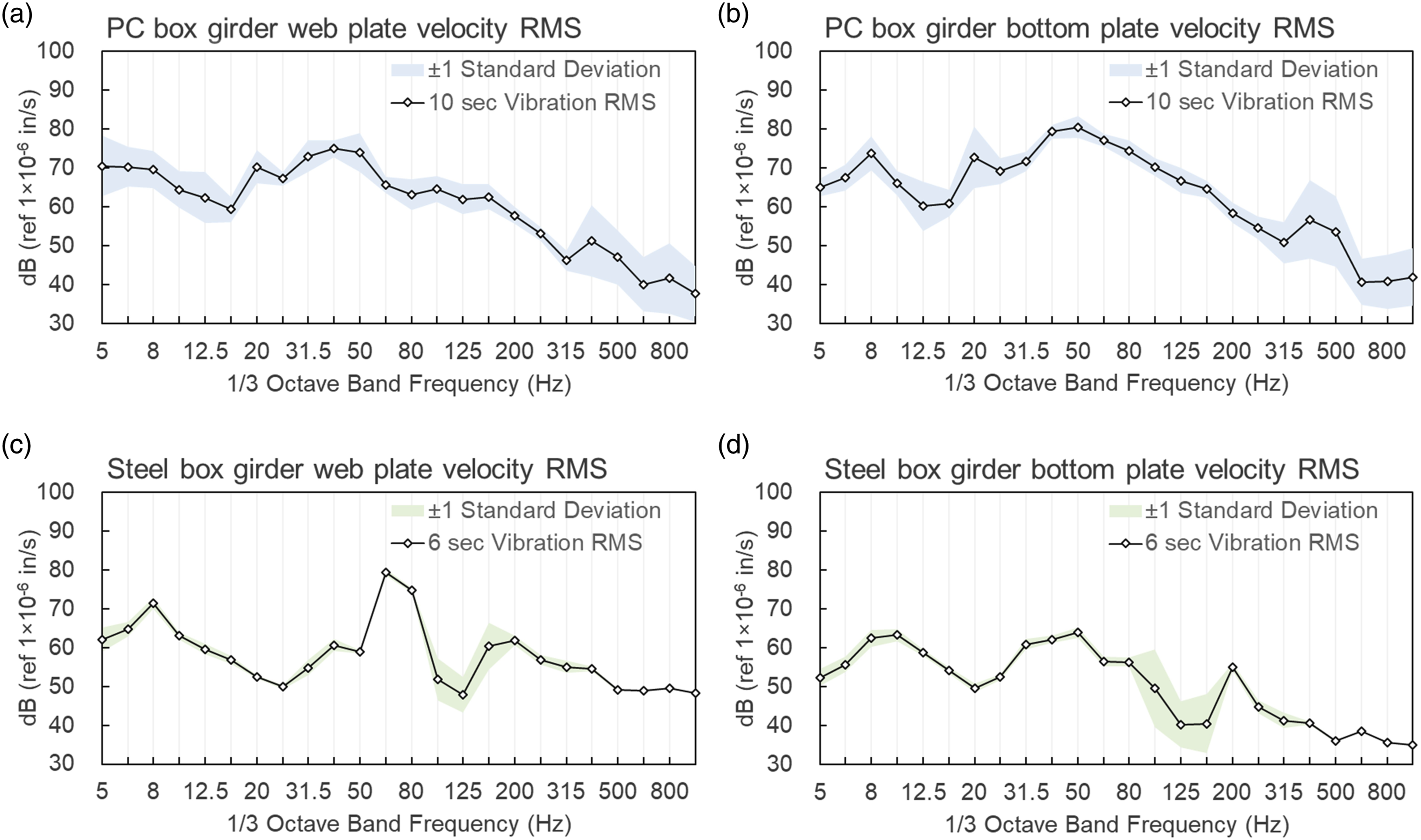
Based on the literature and measured results, the investigated frequencies for concrete bridge vibration below 300 Hz and steel bridge vibration below 600 Hz are sufficient to represent the SBNL of both bridge types. The corresponding concrete plate wavelength of the 250 mm plate (the thinnest plate in the DBPC model) is 2.31 m at 300 Hz. The corresponding steel plate wavelength of the 16 mm plate (the thinnest plate in the DBSG model) is 0.51 m at 600 Hz. Table 1 indicates that the element size affects the deviation of the determined plate bending frequency. Therefore, to control the error of the numerical modeling within 2% of the frequency ranges of interest, one wavelength of the concrete plate must accommodate at least 17 elements and one wavelength of the steel plate must accommodate at least 13 elements; that is, the element size must not be larger than 13.5 cm in the DBPC model and 6.3 cm in the DBSG model.
Parametric study of bridge structure-borne noise level
The main factors influencing the bridge SBNL are summarized in the previous section. The case studies will consider the effects of plate thickness, trackpad stiffness, train speed, and track irregularity on bridge plate vibration. Moreover, the relationship between plate vibration and SBNL in close proximity to the plate is developed based on equation (7) and the modification of previous studies.19,20 In engineering practice, the SBN radiation relationship with plate vibration has been derived assuming a radiation factor of one for all frequencies, and the sound pressure represented in decibels by the reference sound pressure 20 μ·Pa is assumed equal to the plate vibration velocity represented in decibels by the reference vibration velocity 2.54E-8 m/s (1 μ in/s);19,20 these were primarily used for indoor sound radiation evaluation. However, it is desirable to apply this method for the evaluation of the outdoor bridge SBNL while avoiding the consideration of inefficient radiation frequency. Therefore, the radiating sound pressure level in close proximity to bridge plates is examined using the FE bridge plate vibration and transform described above, which considers an efficient radiation frequency range defined by the specimen hammering experiment.
The SBNL evaluation method adopted is a hybrid method that combines the plate vibration velocity obtained using transient FEM with the specimen hammering experimental results to generate superior SBNL results for the DBPC and DBSG bridges. The critical frequency, f c, of the DBPC was previously calculated as 73 Hz for the web plates and 45.6 Hz for the bottom plate, which means that the first local eigenfrequencies are both above the critical frequency, and the vibration velocity will therefore efficiently transmit the sound pressure. Therefore, a plate vibration frequency above 73 Hz for the DBPC web plate and above 45.6 Hz for the bottom plate will be considered efficient radiation and applied in the following evaluation. Similarly, the critical frequency of the DBSG plates at the web and bottom plates were calculated as 751 Hz and 661 Hz, respectively. These experimental results indicate that a local vibration mode below the critical frequency but above the first local vibration also radiates SBN to a certain degree. Thus, the sound radiation frequency of the DBSG web plate above its first local eigenfrequency is considered in the following section. To conclude, combining FEM analysis and the experimental results, the lower of the first local eigenfrequency and critical frequency will be considered as the beginning sound radiation frequency in the following estimations.
Bridge plate thickness
Case study parameters for baffle thickness.
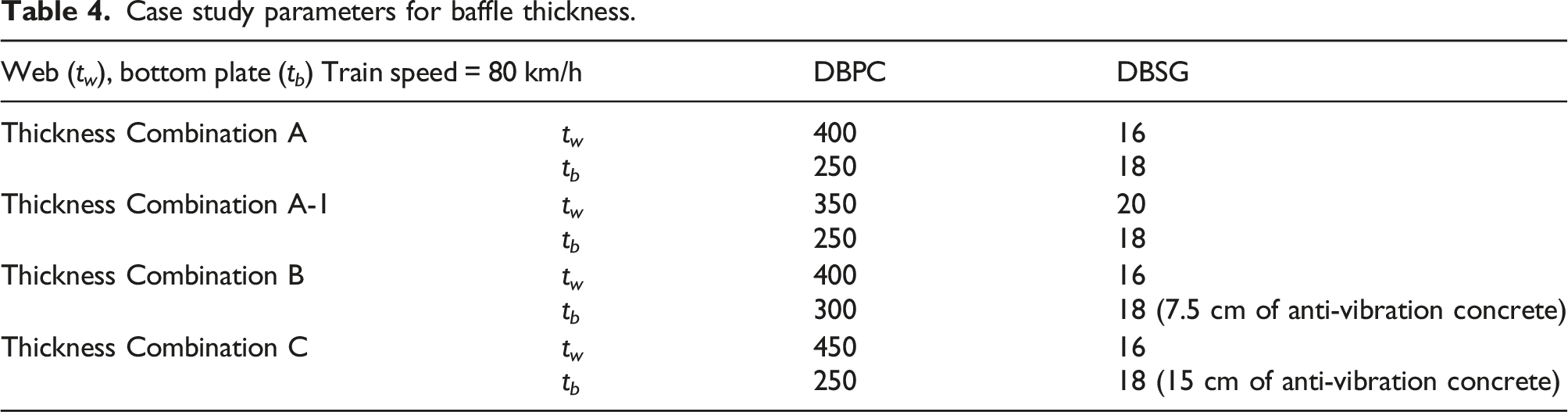
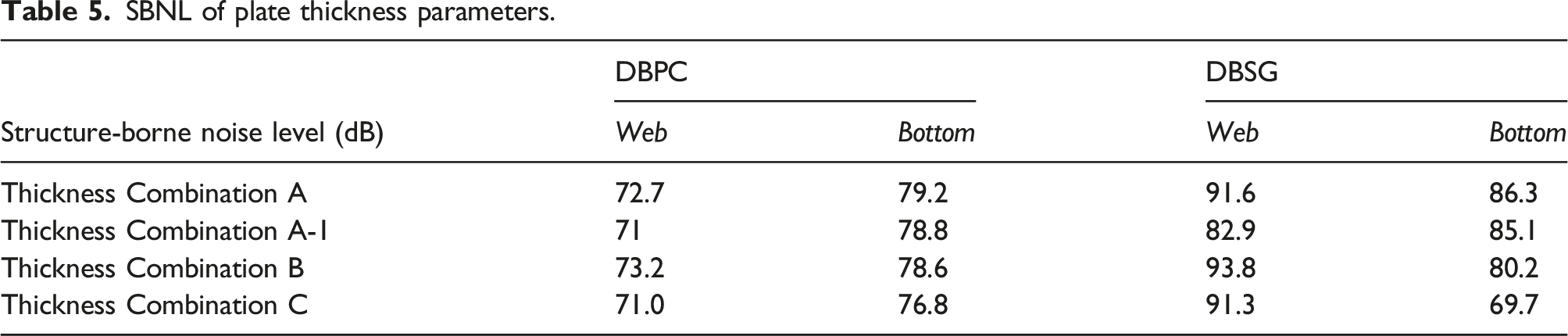
Combinations A and A-1 in Figures 11 and 12 explore the SBNL of the bridge’s web and bottom plates for different web plate thicknesses. It can be seen that a thicker web reduces the SBNL of the web and bottom plates for both bridge types, owing to the web plate’s provision of primary stiffness to the whole box girder, and this phenomenon is noticeable for the DBSG web plate. The influence of the bottom plate thickness of a bridge can be seen in Combinations A, B, and C in Figures 11 and 12. The SBNL of the web plate is observed to occur primarily at the center of the DBPC, but at the middle points of each section for the DBSG. Moreover, from Figures 11(b) and 12(b), the anti-vibration concrete on the DBSG can be seen to efficiently reduce the SBNL of the bottom plate, and both plates of the DBSG show a sudden decrease in the SBNL at the plate near the steel box rib due to the fixed boundary. It can be observed in both Figures 11 and 12 that the maximum SBNL does not always occur at the center of each bridge; on the contrary, it tends to occur at a quarter of the span length. Therefore, it can be concluded that the bridge plate’s local model influences the SBNL significantly.
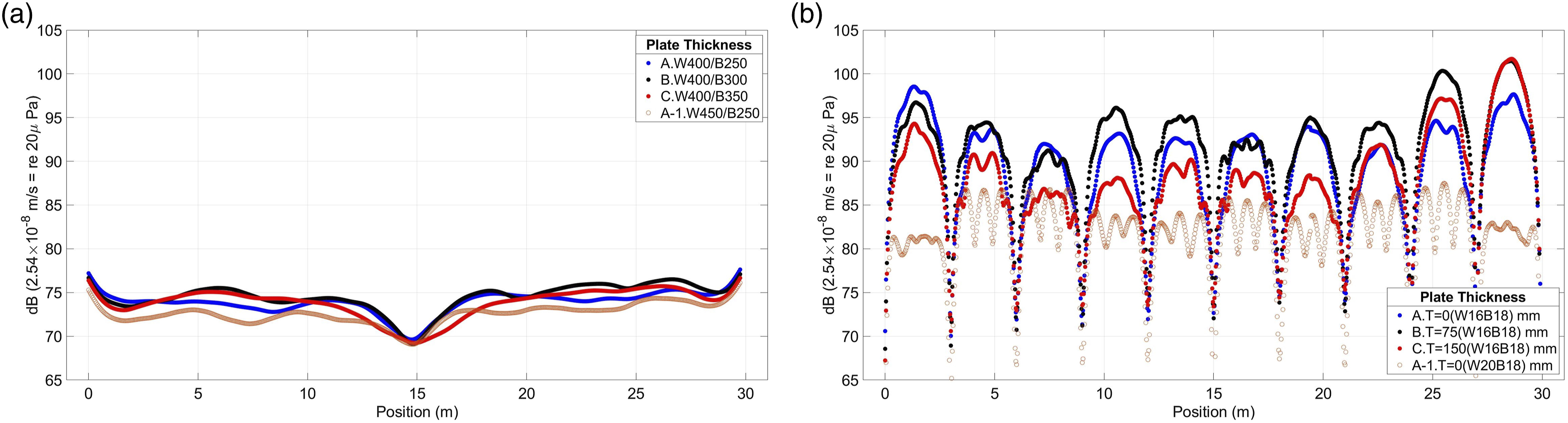
SBNL for a bridge’s web plate for different bottom plate thicknesses: (a) DBPC and (b) DBSG.
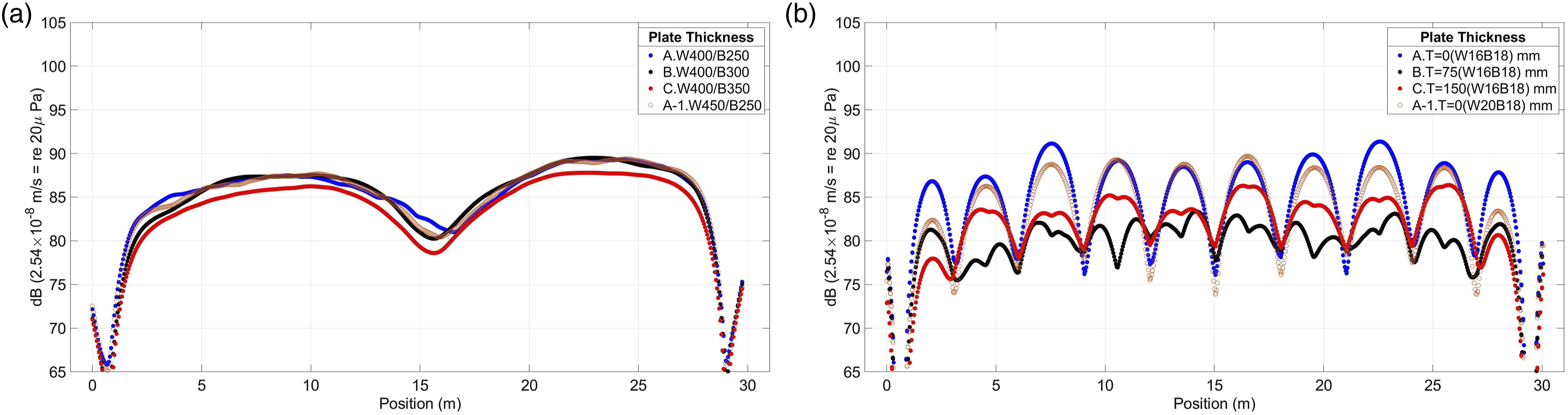
SBNL for a bridge’s bottom plate for different bottom plate thicknesses: (a) DBPC and (b) DBSG.
SBNL of plate thickness parameters.
Rail fastener system stiffness
Case study parameters for the rail fastener system.

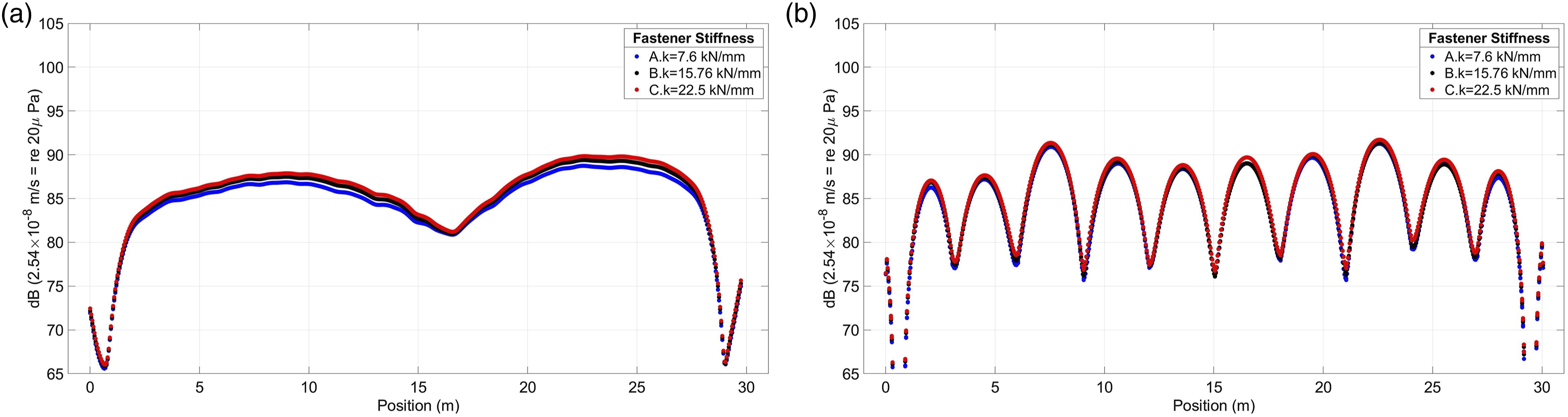
Figures 13 and 14 show the SBNL of the bridge web and bottom plates for different track stiffness values when a train passes by at 80 km/h. The figures and Table 7 indicate that a softer rail fastener baseplate only reduces the SBNL in the web plate of the DBSG, and it can be clearly observed that only the DBSG web plate is more sensitive to variation in track stiffness than the other plates. When the stiffness was reduced from 22.5 kN/mm to 7.6 kN/mm, the SBNL of the web was reduced by 2 dB, whereas that of the bottom plate was reduced by only 0.5 dB. The track stiffness did not have a noticeable effect on the DBPC, owing to its relatively high mass. Figures 13 and 14 indicate that when a train passes at 80 km/h, the track stiffness does not have a noticeable effect on the SBNL. The graphical curve of the SBNL of this case is the same as that of the bridge plate thickness case described above; that is, it is dominated by the bridge plate’s local model. SBNL of a bridge’s web plate for different fastener stiffness values: (a) DBPC and (b) DBSG. SBNL of a bridge’s bottom plate for different fastener stiffness values: (a) DBPC and (b) DBSG. SBNL of rail fastener system stiffness parameters.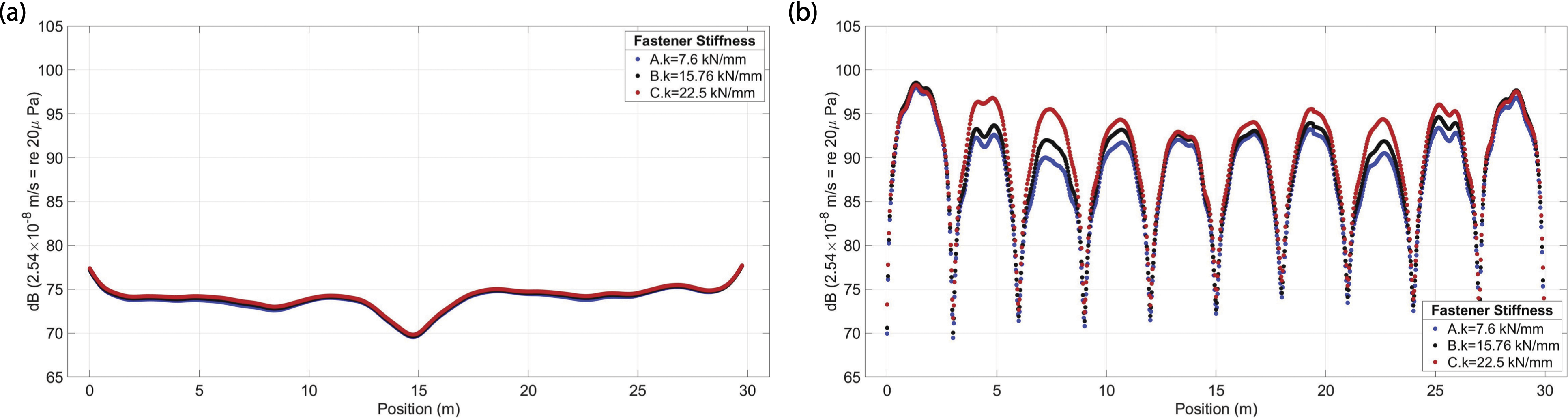

Train speed
Case study parameters for train speed.

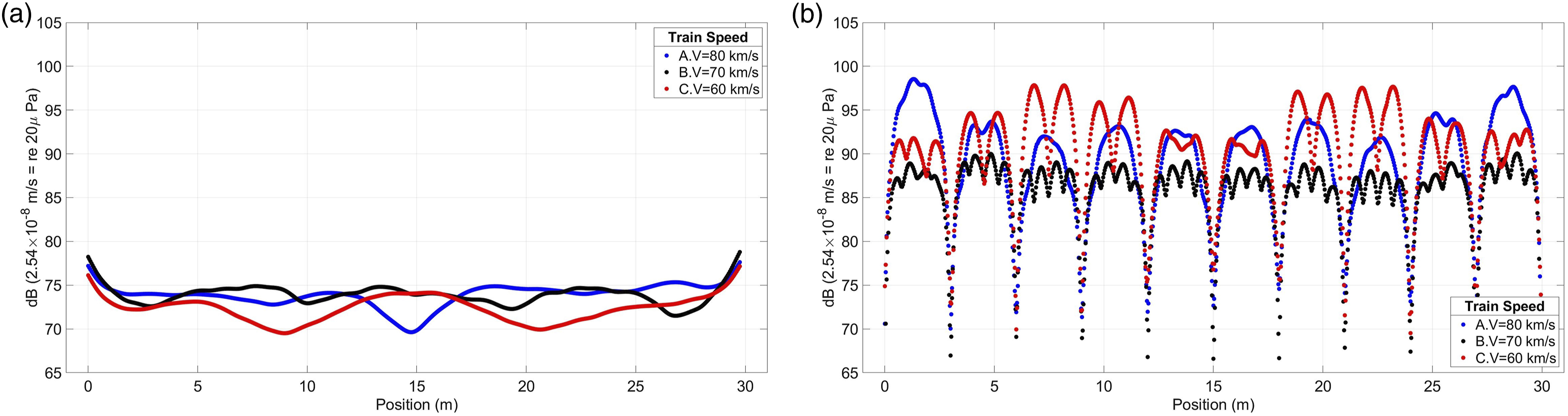
SBNL of a bridge’s web plate for different train speeds: (a) DBPC and (b) DBSG.
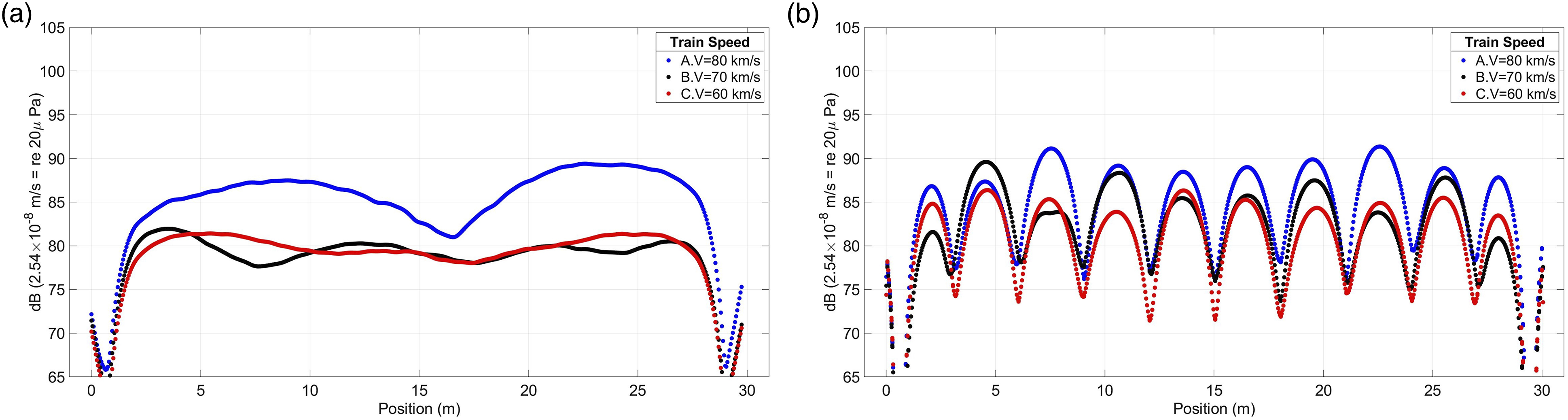
SBNL of a bridge’s bottom plate for different train speeds: (a) DBPC and (b) DBSG.
SBNL of different train speeds.

Relationship between track irregularity and SBNL
Case study parameters for track irregularity.

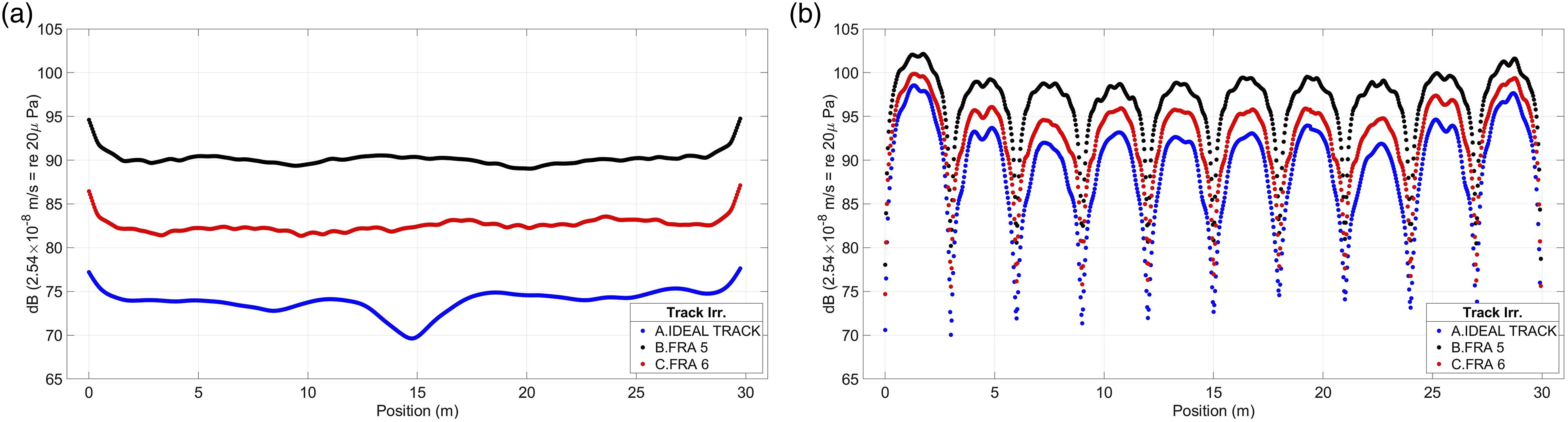
SBNL of a bridge’s web plate under different track irregularity conditions: (a) DBPC and (b) DBSG.
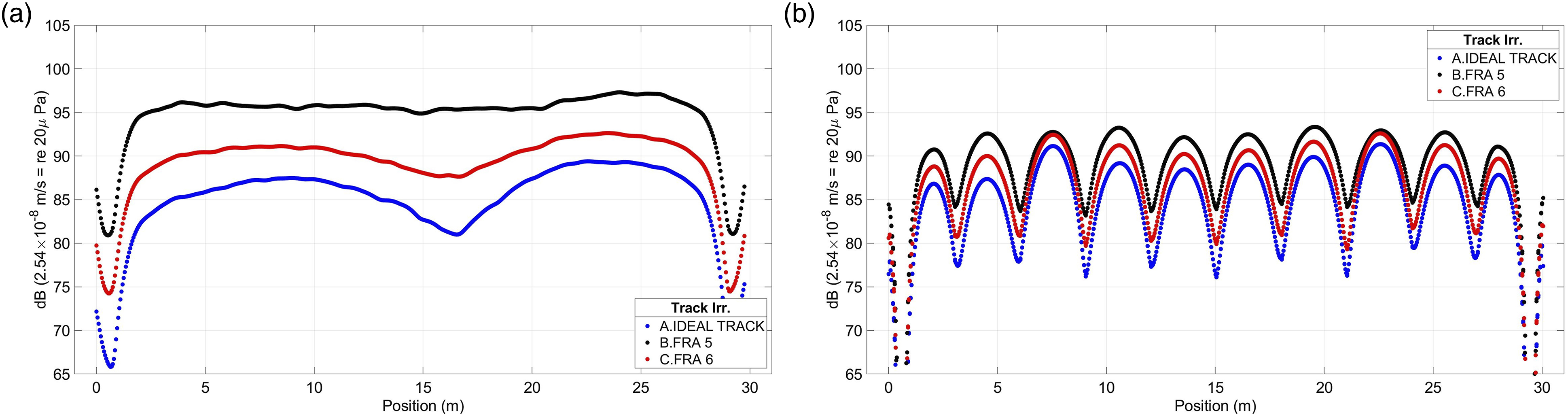
SBNL of a bridge’s bottom plate under different track irregularity conditions: (a) DBPC and (b) DBSG.
SBNL of different track irregularity conditions.

Discussion of SBNL mitigation
An SBNL hybrid evaluation method was proposed and the parametric study results are comprehensively discussed here to identify the most significant parameters that determine the SBNL. Moreover, an assessment of the strengths and weaknesses of both bridge types from the viewpoint of SBN generation will also be conducted. The SBNL of both bridge types for the different parameters are shown in Figures 19 and 20, and the dominant parameter is observed to differ by case. Effect of various factors on the structure-borne vibration of the DBPC: (a) web and (b) bottom plate. Effect of various factors on the structure-borne vibration of the DBSG: (a) web and (b) bottom plate.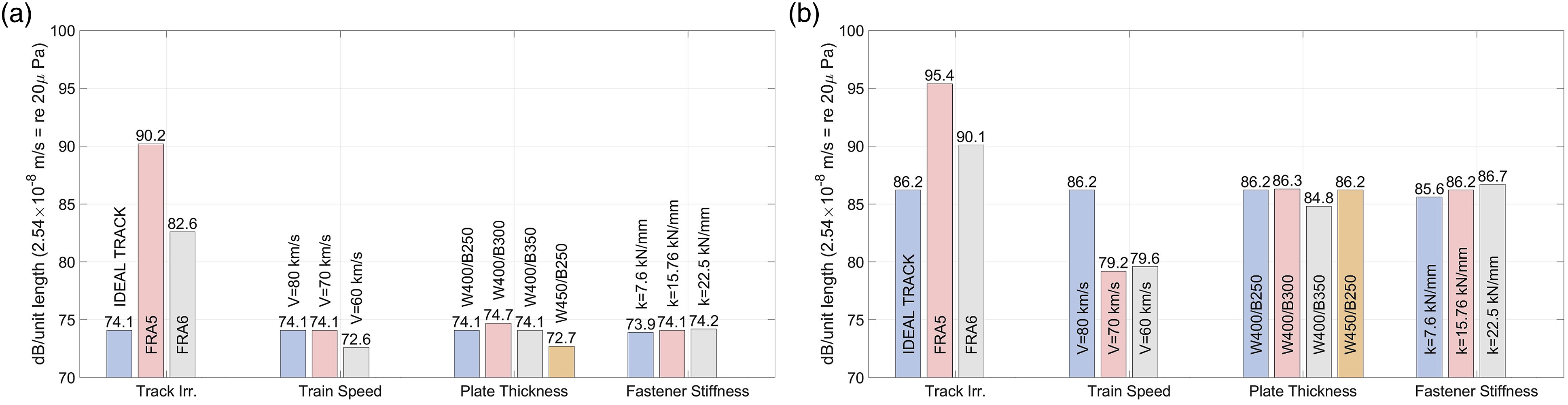
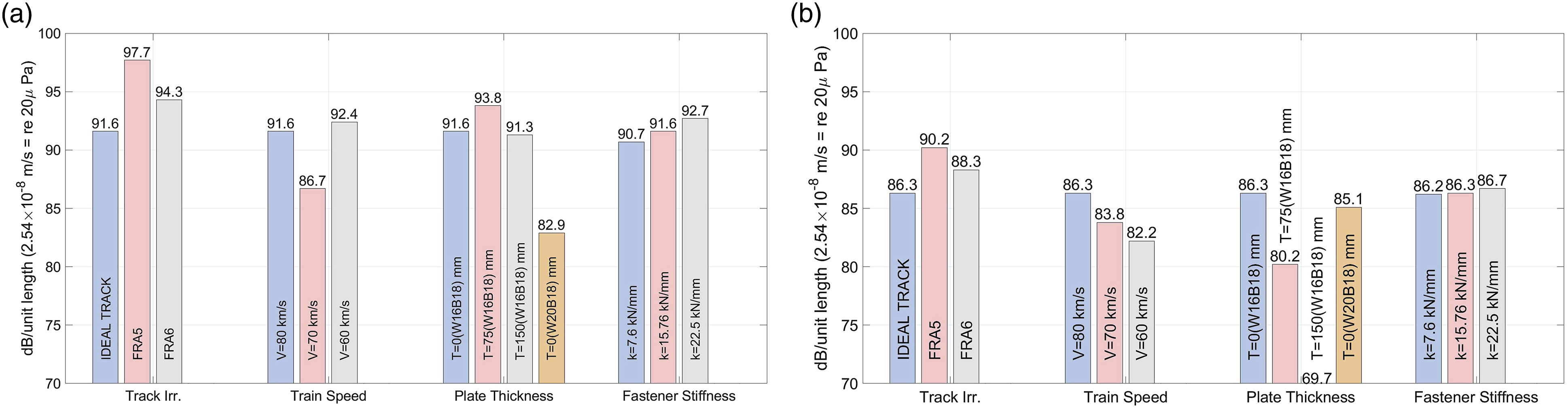
First, the track condition parameter had the dominant influence on the SBNL for both bridge types. The SBNL increased significantly for worse track conditions, especially for the web plate of the DBPC, which was 16 dB higher for the poor track case than for the ideal condition. Second, the train speed variation cases revealed that the SBNL did not vary linearly with train speed and highlighted the importance of the bridge plate’s local model. For example, at the specific train speed of 80 km/h, the fundamental excitation frequency generated by the wheelset was approximately 8.8 Hz, which matched the first global vibration eigenfrequency of the DBPC. For more insight into this phenomenon, the one-third octave band spectrum is shown in Figure 21. The SBNL significantly increased at specific frequencies around the spectrum band at 40 Hz, approaching close to five times the fundamental excitation frequency. This phenomenon was also observed for the DBSG at train speeds of 60 and 70 km/h (as shown in Figure 22). For the DBSG at a specific speed of 70 km/h, the local vibration level decreased to nearly half that of the web plate; however, this phenomenon was not observed in the bottom plate because of the anti-vibration concrete providing mass and stiffness, thereby reducing its local vibration level. This means that speed and SBNL do not have a simple positive correlative relationship; more precisely, when the train speed matches the bridge plate’s local vibration mode’s multiple-frequency, the SBNL will be significantly amplified. DBPC bottom plate vibration velocity for the 1/3 octave band spectrum: (a) V = 80 km/h and (b) V = 60 km/h. DBSG web plate vibration velocity for the 1/3 octave band spectrum: (a) V = 70 km/h and (b) V = 60 km/h.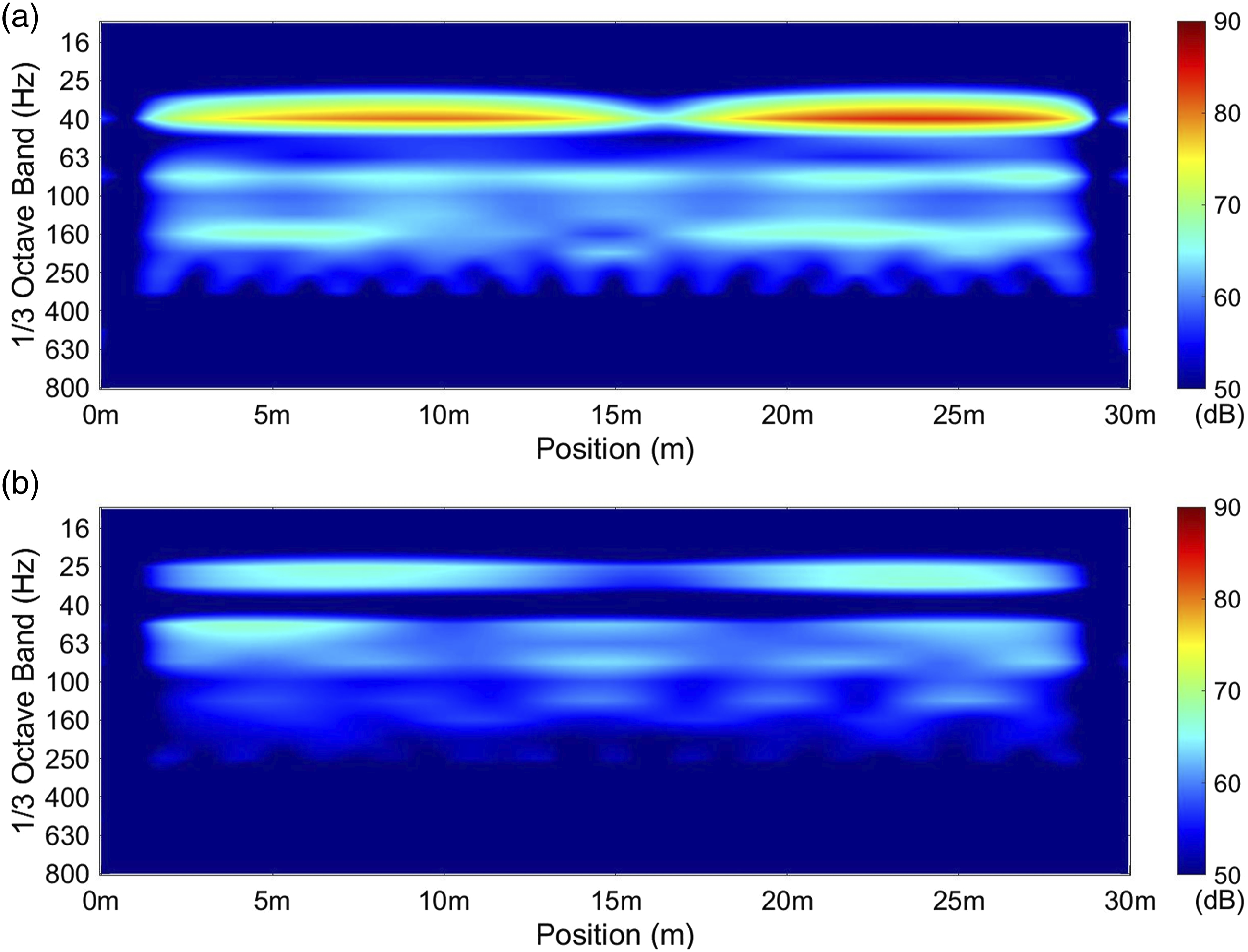
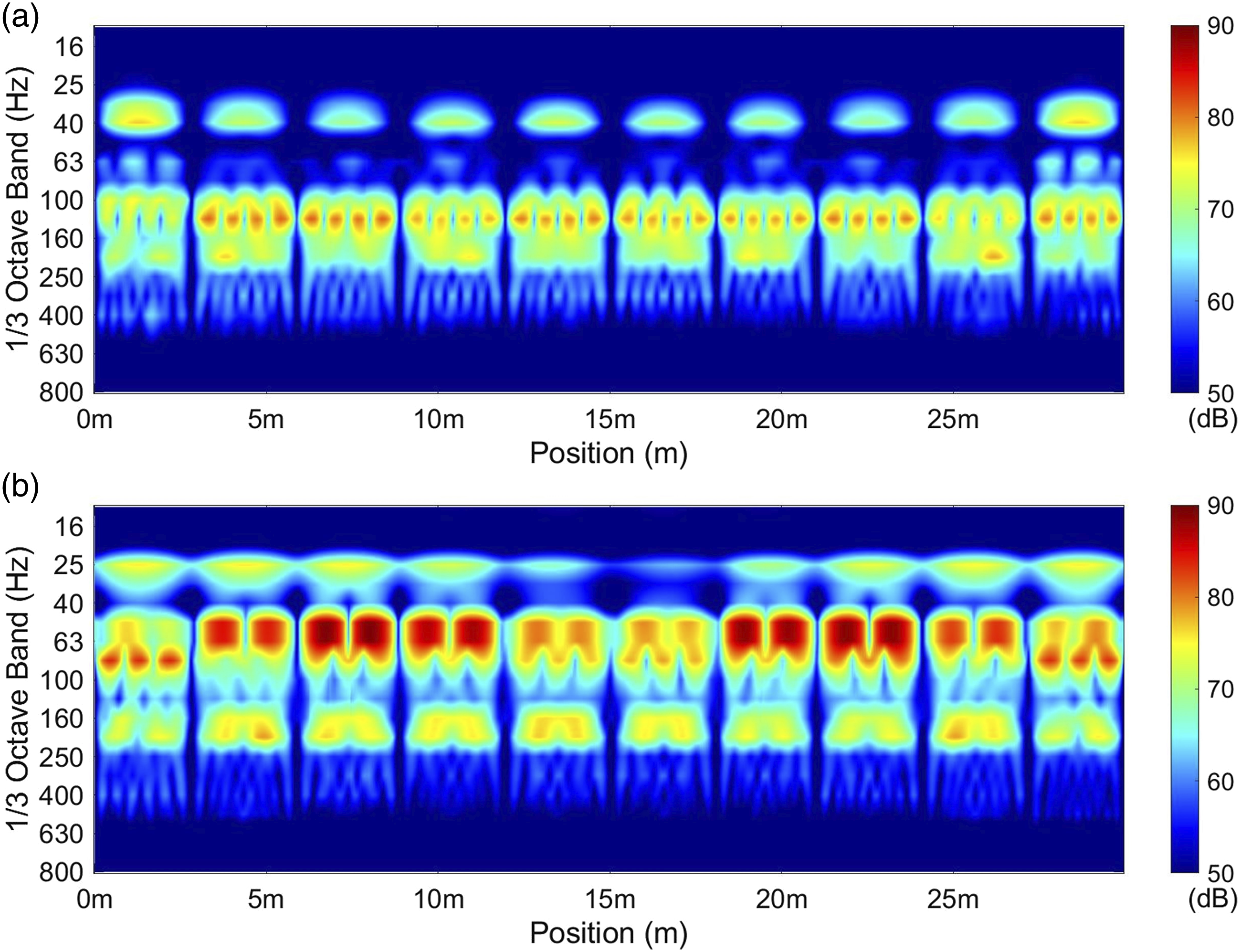
Similar to the effect of train speed, the plate thickness also influenced the SBNL. When the DBPC web plate thickness was modified, there was an apparent variation in the SBNL; however, the same did not occur when varying the bottom plate thickness. This is because the DBPC web plate is the key contributor to the bridge’s stiffness, which is sensitive to its thickness and thus has a strong effect on the SBNL. Moreover, the SBNL did not respond so sensitively to increasing thickness of the bottom plate because the weight ratio actually changed to only a small degree. The addition of anti-vibration concrete to the bottom plate of the DBSG efficiently reduced its SBNL owing to the consequent significant increase of the weight ratio. The plate thickness case shows that under a fixed train speed, adjusting the local vibration eigenfrequency of the plates, that is, their weight and thickness, is another viable method to optimize the SBNL.
Finally, the track stiffness only slightly impacted the SBNL for both bridge types compared to the other parameters. The softest (7.6 kN/mm) baseplate reduced the SBNL more than the stiffest (22.5 kN/mm), though achieving a maximum reduction of only 2 dB. The ratios of the excitation frequency for a train passing to the eigenfrequency of each bridge were both higher than one. From the viewpoint of the dynamic amplification factor, this meant that the mass dominated the local vibration level, that is, the SBNL. This relationship could also explain why the anti-vibration concrete was observed to efficiently reduce the SBNL of the bottom DBSG under the specific speed of 80 km/h. However, only a single train speed was considered in the cases of track stiffness and further studies are required to confirm the effect of track stiffness under other speeds.
In summary, both bridge types were found to have a specific vibration and SBN features for the same bridge length under each parameter combination. From the parametric study considering a fixed bridge length, it was concluded that the SBNL of the DBSG was higher than that of the DBPC for each parameter combination. The SBNL of the DBPC bottom plate was more significant than the web plate. On the contrary, the SBNL of the DBSG web plate was more significant than the bottom plate, both with and without the addition of anti-vibration concrete to the bottom plate. The overall recommendations derived from the results are as follows: (a) During the bridge design stage, the parameters to adjust to reduce SBN are the plate thickness and the addition of anti-vibration concrete for the DBSG. (b) During the operation stage, it is suggested to smoothen the running surface of the rail (by grinding or another appropriate method) and carefully adjust the train speed to avoid resonance with the bridge plates.
Conclusions
In this research, a hybrid evaluation method of the SBNL was proposed to carry out a parametric study of steel and concrete box girders. First, the relationship between plate bending wavelength, critical frequency, and structural vibration radiation noise was theoretically discussed and derived for the SBNL of these two girders. A hammer test using unit-area plate specimens was conducted to validate the plate sound radiation phenomenon. The experimental results were integrated into the transient FEM results as the proposed hybrid evaluation method. The optimal mesh size of the FE models were determined experimentally to ensure an appropriate mesh size for the whole train–track–bridge interaction models. The local vibration of the bridge structure and the main frequency band were exploited from those in previous studies and in-situ measurements. Finally, the transient FEM was used to evaluate local vibrations, and parametric studies of the SBNL for two bridge types were conducted. The critical concluding remarks are listed in the following. 1. In concrete bridges such as those with PC girders, the radiated SBN is concentrated mainly in the low-frequency range because they have low critical frequencies and their components are thicker and less dense than steel plates. 2. The frequency response function results of the specimen hammering test for both plates agreed with the results of the FEM analysis. The error deviation of each eigenfrequency was determined. For a 16-mm-thick steel bridge plate, at least 13 elements were needed to obtain a 2% error deviation when the target frequency was 600 Hz (critical wavelength 0.51 m) and the suggested mesh size for the entire steel bridge structure FE model was below 13.5 cm. For a 250-mm-thick concrete bridge plate, at least 17 elements were needed to obtain a 2% error deviation when the target frequency was 300 Hz (critical wavelength 2.31 m), and the mesh size was under 6.3 cm when the target frequency was below 300 Hz. 3. The SBNL of the DBSG was larger than that of the DBPC for each parameter combination. The SBNL of the DBPC bottom plate was larger than that of its web plate. On the contrary, the SBNL of the DBSG web plate was higher than that of its bottom plate. The PC box girder is the recommended bridge type for use in urban areas from the viewpoint of minimizing the SBNL. 4. The parameters that most influence the SBNL are track irregularity, train speed, plate thickness, and track stiffness in order of highest to lowest. 5. The track condition dominated the SBNL of both bridge types. The SBNL was significantly higher for worse track conditions, especially for the web plate of the DBPC, which was 16 dB higher for the poor track case compared to the ideal track case. 6. The impact frequency of the input force (i.e., train speed) and output vibration eigenfrequency (i.e., eigenfrequency of the plate vibration) are two of the main SBNL influence parameters. This can be more precisely stated as follows: (a) On the source side, the SBNL did not vary linearly with train speed and in relation to the bridge plate’s local model influences. However, at particular train speeds, the bridge plates did resonate with the passing train and excite specific frequencies, for example, 80 km/h for the DBPC bottom plate and 60 km/h for the DBSG web plate. Despite reducing train speed being the easiest way to reduce noise and vibration during operation, the train speed has to be carefully adjusted to an appropriate speed to avoid resonance with the bridge plates. (b) On the receptor side, the plate thickness also influenced the SBNL. Regarding the DBPC, there was an apparent variation in the web SBNL when its web thickness was modified. For the DBSG, the addition of the anti-vibration concrete was efficacious at reducing the SBNL of its bottom plate by 6.1 and 16.6 dB for thicknesses of 7.5 cm and 15 cm, respectively. 7. During the bridge design stage, plate thickness modification is recommended as the ideal parameter to adjust to reduce the SBNL. During the operation stage, making the running surface of the rail smoother (by grinding, etc.) is recommended as the ideal method to reduce the SNBL.
Footnotes
Acknowledgments
The author would like to thank the National Taiwan Ocean University Center of Sound and Vibration Research for their support.
Declaration of conflicting interests
The author(s) declared no potential conflicts of interest with respect to the research, authorship, and/or publication of this article.
Funding
The author(s) disclosed receipt of the following financial support for the research, authorship, and/or publication of this article: This work was supported by the National Science and Technology Council (MOST 110-2222-E-019-004).
