




Abstract
Machine foundations are subjected to significant dynamic impacts. These impacts could spread to the surrounding regions, affecting workers, sensitive equipment in the same institution, or nearby areas. This study analyzes the response of machine-supporting foundations to harmonic and explosive loads under operational conditions and provides closed-form solutions for predicting responses in terms of displacement, velocity, and acceleration time-histories to two common types of blast loads: a more accurate typical profile and simplified triangular profile. The soil-machine foundation system is regarded as a single-degree-of-freedom (SDOF) system that exhibits elastic–perfectly flexible resistance behavior. For the analysis of the SDOF system, two cases are considered: one assumes that the supporting soil keeps elastic during the explosion, and the peak displacement is less than the elastic one, while the other assumes that the blast occurs in an elastic state, and the peak displacement occurs in a plastic state. By using the closed-form analytical solutions, a detailed parametric analysis is carried out to evaluate the impacts of significant soil-foundation system characteristics such as mass, stiffness, and damping ratio on the response-time history of machine foundations. The findings are compared to those reported in the literature, and relevant conclusions are derived. Obtained results demonstrated that, despite its simplicity and usage of only positive phase to simulate blast loads, the simplified model’s response behavior differs significantly from the typical one. Furthermore, the derived solutions are utilized to design the foundations supporting vibrating machines for both harmonic and blast loads in a variety of conceivable scenarios depending on the blast magnitude.
Introduction
In most modern industrial facilities, there are machines of varying forms, sizes, and capacities that frequently result in excessive vibrations, which can affect the functionality of the machine as well as generate disruptions in the surrounding area. As a result, their functioning and upkeep have become a concern. The fundamental goal of a machine foundation design is to limit the ensuing vibrations to the point where the machine runs successfully while causing no inconvenience to those operating in the close vicinity of the machine. Several research works have been developed over the last 40–50 years to assess the dynamic response of a vibrating foundation erected on soils.
Gazetas 1 is credited with establishing the core concepts of the dynamic response of machine foundations. The author illustrated how to use data to estimate the foundation’s translation and rotational motions, as well as dynamic stiffness and damping characteristics for soil springs. In addition, the response of circular foundations supported by half-elastic soil was examined. In addition to pile groups and flexible rafts, he emphasized the importance of multi-isolated footing foundations. Novak 2 specifies the main criteria for the design of hammer foundations. This study also covers the methods for determining stiffness and damping constants for shallow foundations and pile foundations. In addition, he developed an analytical method for predicting damped vibration. Hifnawy and Novak 3 used a method based on the concept of complex Eigenvalues to analyze hammer foundations subjected to various types of pulse loadings. Damping was rigorously incorporated into the design, making it particularly suitable for more complicated forms of hammer foundations with multiple degrees of freedom. Numerous studies have investigated the effect of modifying the soil profile on the foundations' dynamic response.4–6 According to the findings of these investigations, the presence of a stiff layer closer to the surface footing can considerably improve the stiffness and natural frequency of the foundation soil system. Using variational concepts, Aşik 7 developed equations describing the dynamic behavior of machine foundations while taking into consideration the inhomogeneity of elastic foundations, particularly for the Gibson type of soil. Based on a variational concept and Hamilton’s theory of energy minimization, Ask and Vallabhan 8 presented a mathematical model of a bar and circular dynamic mechanical basis. Flexible circular foundation oscillations were investigated analytically by Gucunski and Peek 9 using modal superposition. By sandwiching a spring cushioning system between the machine base and its footing block, Kumar and Reddy 10 evaluated the response of a machine foundation subjected to vertical vibration experimentally. Additionally, Kumar and Boora 11 studied the effects of two distinct combinations of a spring mounting base and elastic pad placed between the base of the machine and the concrete footing block. The dynamic responses of high-speed presses have been researched by a number of researchers. Chehab and El Naggar12,13 investigated the dynamic responses of single-DOF and two-DOF mathematical models based on the working state of a press and established closed-form solutions for their dynamic responses to common practical forms of numerous impact loads. The study sought to investigate how pulse form and duration affect the hammer foundation system’s dynamic response. Chen and Liu 14 conducted theoretical research on foundation vibration and noise in high-speed presses due to the initial abrupt pressure and the subsequent sudden loss of load when high-speed press punches through, using the two-DOF mathematical model of the punch. Heidari and El Naggar, 15 Sreedhar and Abhishek, 16 and Clement et al. 17 examined the influence of soil reinforcement by geogrid and geotextile on controlling the amplitude of machine-induced vibration for various configurations of shock-absorbing foundations. The results demonstrated that soil reinforcement can enhance impact-loaded foundation efficiency.
Clearly, all of these studies are concerned with the vibrational behavior of foundations supporting machines with one or more degrees of freedom that are subjected to a variety of dynamic loads. If an unexpected blast occurs during a machine’s operational phase, whether caused by adjacent mining activities, an explosion caused by a chemical reaction, a fire explosion, or an explosion caused by terrorist activity, etc., the entire system is impacted, with damage varying according to the magnitude and distance of the blast.
The combination of harmonic loading caused by machine operation with the additional accidental pulse loading will result in nonlinearity, which will result in the system responding in a highly nonlinear manner. Many simulations have been carried out to examine the effect of blast loading on foundations and buried structures.
Wang et al.18,19 and Lu et al. 20 used their model to simulate subsurface explosions on buried concrete structures. They used the smooth particle hydrodynamics (SPH) technique to simulate the explosive charge and the close-in zones, while the remaining soil region and the buried structure were modelled using traditional FEM. The findings revealed that a two-dimensional model may predict the crater’s size, blast loading on the structure, and critical response in the front wall with reasonable accuracy. Using the principle of superposition, El Naggar 21 studied the dynamic behavior of a power plant to blast-induced vibrations from a neighboring quarry. The proposed foundation system was found to work satisfactorily under such loading circumstances. Furthermore, as a result of the blast, the displacements surpassed the allowable limitations.
Jangid 22 developed close-form expressions for a time-varying frequency response function in order to investigate the response of a SDOF system to non-stationary earthquake motion for various modulating function shapes. Various modulating functions—such as exponential, box-car, triangular, and Amin and Ang types—were considered for the purpose of modelling earthquake ground acceleration. It should be noted that the simplified triangular blast loading model may directly benefit from the triangular modulating functions.
The most essential issue, according to a critical examination of numerous features in the literature, is the analysis of foundations subjected to harmonic and blast loads, with a simplified triangular model for blast loads to simplify modelling and computational efforts. It is only the positive phase that is taken into consideration in this simplified model, and the suction phase is ignored. To address these challenges, the response of machine foundations subjected simultaneously to sinusoidal harmonic loading due to their operating conditions and another pulse loading in the event of an explosion is analyzed using a more exact exponential distribution of blast load expressed by modified Friedlander’s equation with both positive and negative phases. The goal of this study is to use appropriate initial conditions to derive the analytical solutions of dynamic equations of motion governing the machine foundation-soil system under harmonic and blast loads for two different blast load configurations: a more accurate exponential configuration and a simplified triangular configuration.
Modelling and idealization
The soil-machine foundation system under consideration can be modeled as a SDOF system represented by a mass-spring-dashpot for the purpose of predicting the dynamic response of a machine foundation when subjected to sinusoidal harmonic and blast loads, as seen in Figure 1. The blast loads are distinguished by two forms of force configurations: an exponential distribution of the blast load that is more precise, and a simpler triangular distribution of the blast load, as illustrated in Figure 2. Vertical vibrations of a machine foundation (a) Actual system, (b) Idealized machine-foundation-soil system. Blast force-time history of an air explosion (a) typical and (b) simplified blast load profile.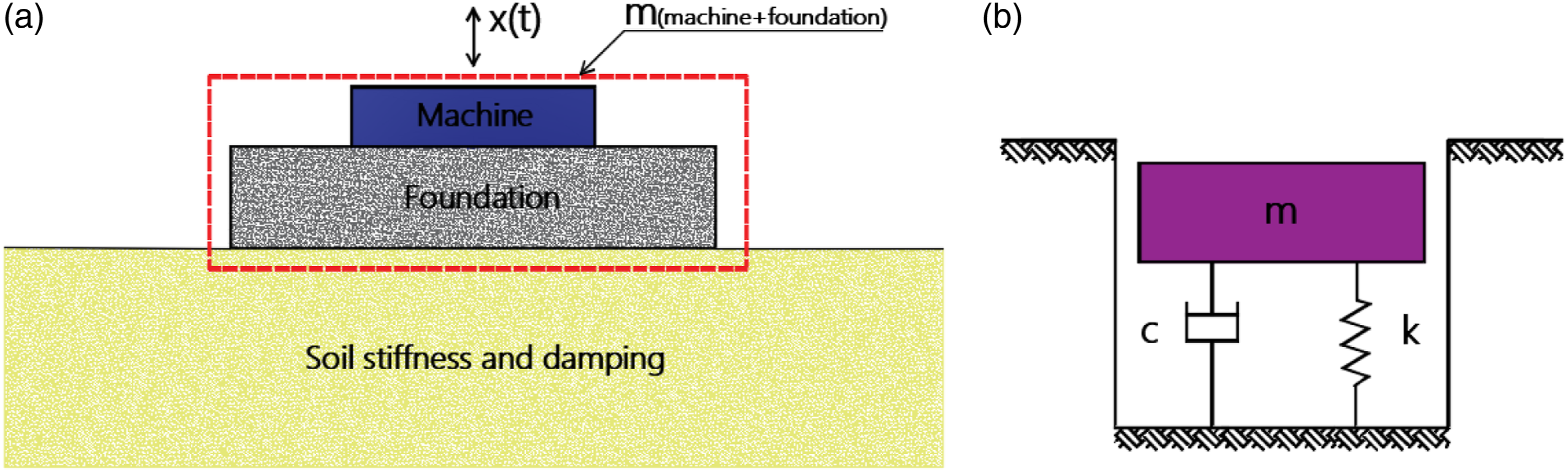
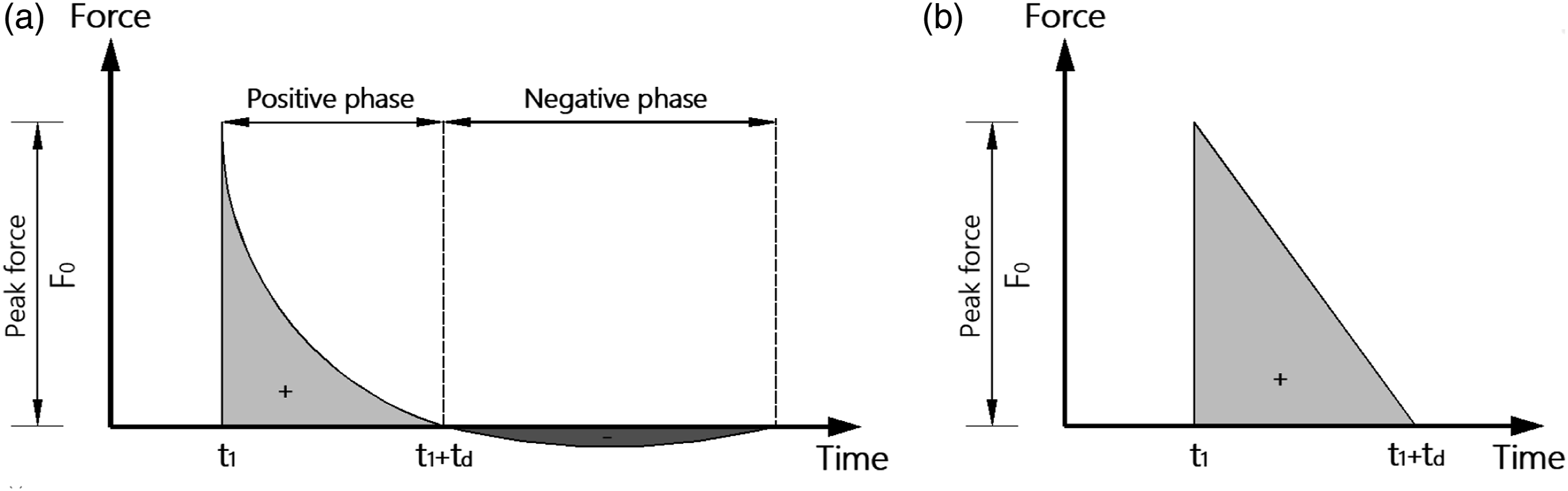
The equation of motion of the idealized SDOF system presented in Figure 1 and subjected to a sinusoidal and blast load F(t) can represented as


Or the simplified form (Figure 2(b))


Nonlinear analysis of single-degree-of-freedom system
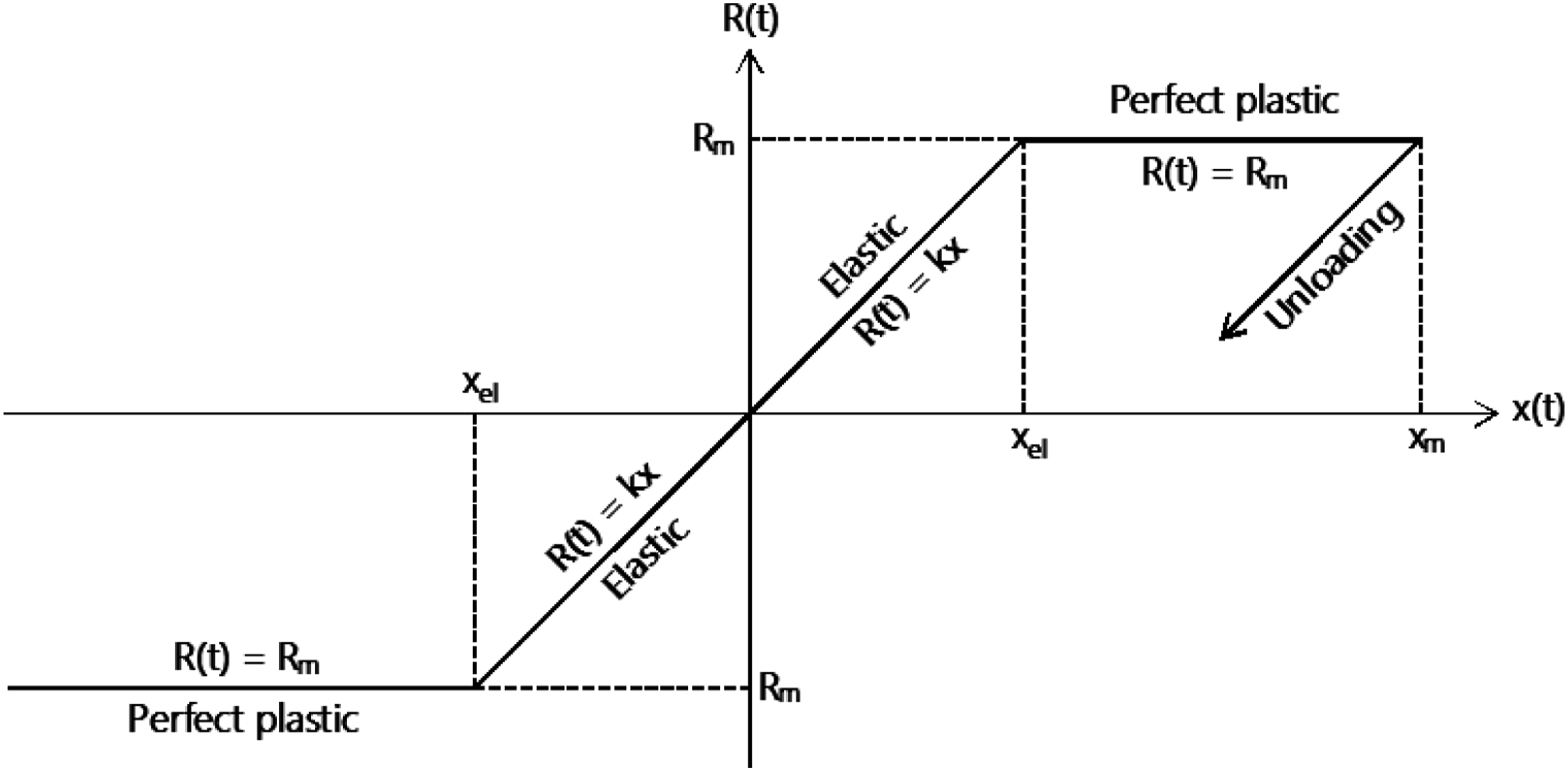
The primary aim of this paper is to analyze the machine foundations as a SDOF system that only experiences vertical oscillations under the action of harmonic and explosive loads. The SDOF system’s measured structural responses are utilized to examine the impact of such a blast on the machine foundations' operation. When machine foundations are subjected to unexpected extreme loads, such as blast loads, they invariably behave nonlinearly, and the soil-foundation system’s dynamic response enters an inelastic region. As a result, the nonlinear analysis offers a better approach for evaluating the real behavior of these systems under blast loads by combining geometrical and material nonlinearities. As illustrated in Figure 3, the SDOF system has been considered to be elastic-perfectly plastic, with elastic unloading. The relationship between the SDOF system’s resistance, R, and its vertical degree of freedom, x, can be divided into three parts, as depicted in this figure. During the elastic phase, resistance is expressed as Idealized elastic-perfectly plastic behavior of SDOF system.
23
The maximum displacement may be within the elastic range depending on the blast’s magnitude and stand-off distance. This means that the machine will shake during the blast and will afterward resume operation. However, if the SDOF system’s response enters a plastic state as a result of a blast, the machine is presumed to stop working. As a result, two scenarios have been selected for the analysis. As specified in Case 1, during a blast, the SDOF system’s response remains elastic, and the maximum displacement Two different cases for a SDOF system considered for analysis.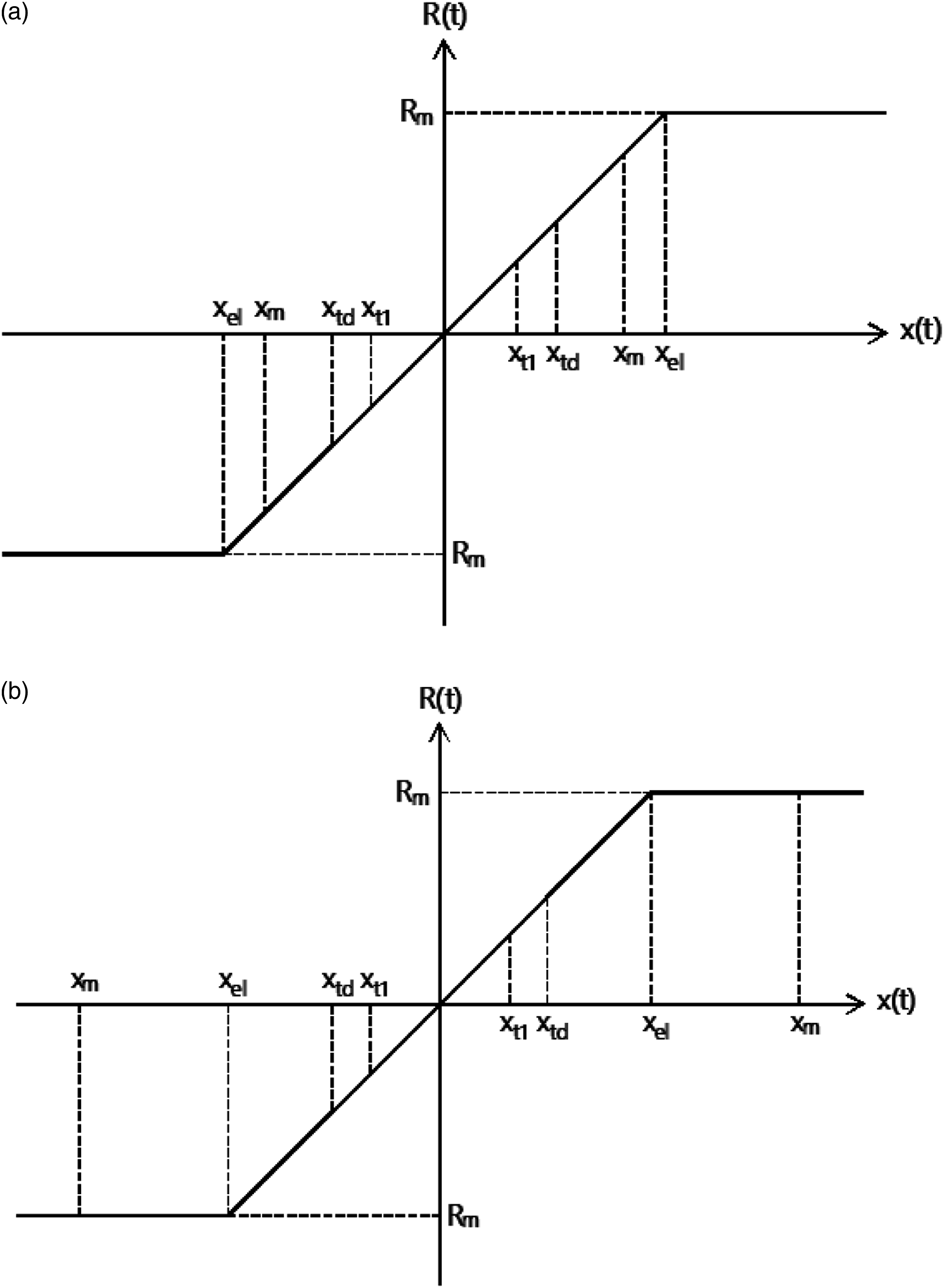
Closed form solution
The soil foundation system responds in two ways during an explosion: first, the SDOF system’s response is elastic, with maximum responses in the elastic state; second, the SDOF system’s response is elastic, but with maximum responses in the plastic state. Exact solutions are obtained for the SDOF’s displacement, velocity, and acceleration in each case.
Blast load in the form of a typical model
According to equations (1) and (2), the SDOF system’s equation of motion under harmonic and typical blast load is as follows

The SDOF system’s response is still elastic during the blast, and the peak displacement is less than the elastic one
In this case, the machine is running, and the blast is expected to occur after time



Initial conditions.

Equation (6) may be solved analytically using the initial conditions specified in Table 1 at time t = 0 to determine the time-dependent displacement, velocity, and acceleration of the SDOF system.
25
This equation’s general solution is as follows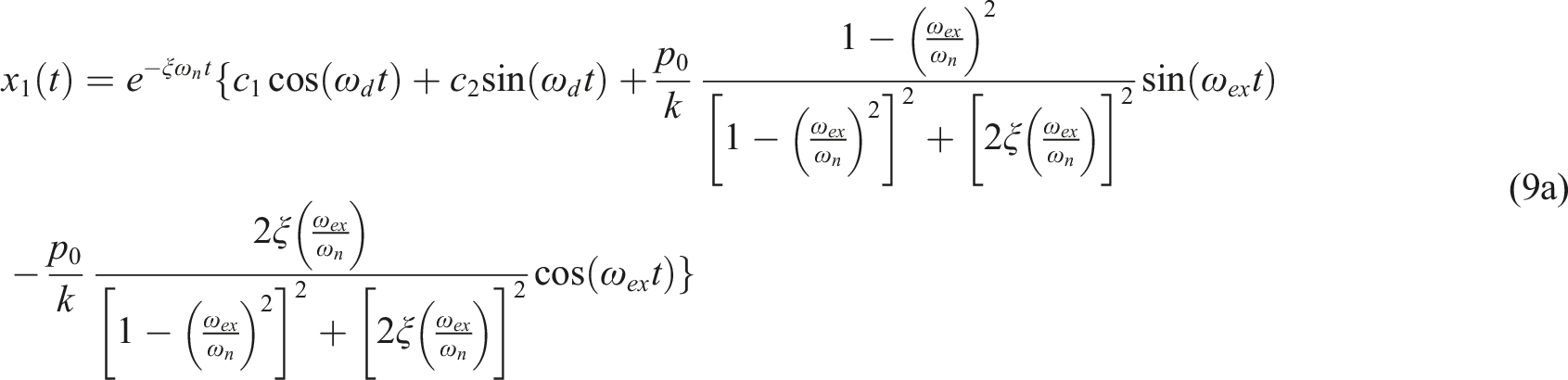
The velocity of the system at any time can be obtained by differentiating x (t) with respect to time as
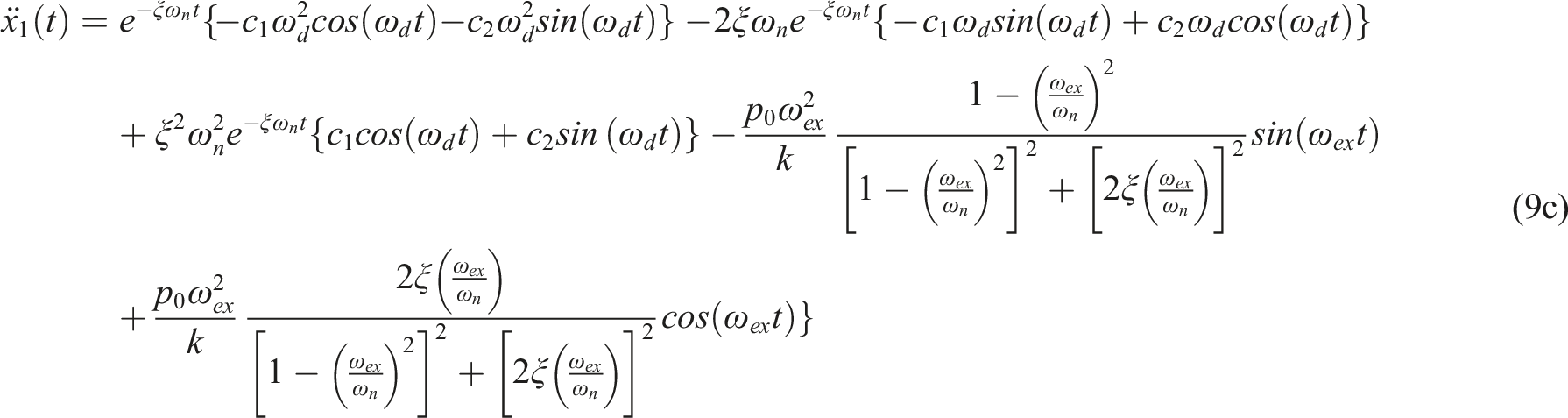
The constants of integration, 

Immediately following time 






Furthermore, to determine the integration constants 

The expressions for 

It is assumed that once the explosion is ended, the displacement is within the elastic limit, and the SDOF system’s response is governed by equation (8). This equation’s general solution is the same as equation (6), and it is as follows
The velocity of the system at any time can be obtained by differentiating x (t) with respect to time as

The integration constants 

The expressions for L and M have been derived as given below

Equations ((9a)–(9c)), ((12a)–(12c)), and ((21a)–(21c)) represent the complete solutions for an SDOF system’s response to harmonic and typical blast loads when the maximum displacement is smaller than the elastic one.
The SDOF system’s response is elastic during the blast, and the maximum displacement occurs in plastic state
When the SDOF system’s response turns into a plastic, it is anticipated that the machine will stop working and that no external force will be applied in this condition. The governing equations of motion can be expressed in the following way




Initial conditions.

The solutions of equations (26)–(28) in terms of displacement, velocity, and acceleration of SDOF system can be found in equations ((9a)–(9c)), ((12a)–(12c)), and ((21a)–(21c)), respectively. The time of occurrence of elastic displacement,
Equation (29) has a generic solution that is as follows
The derivative of 
The acceleration is obtained by differentiating the velocity, that is
To determine the integration constants 

Equation (30) has a general solution that is expressed as follows
The velocity of the system at any time can be obtained by differentiating x (t) with respect to time as

The integration constants 

The maximum displacement time,
Blast load in the form of a simplified model
In accordance with equations (1) and (3), the SDOF system’s equation of motion under harmonic simplified blast load is as follows
The SDOF system’s response is still elastic during the blast, and the peak displacement is less than the elastic one
In this case, the machine is running, and the blast is expected to occur after time 


The solutions for equation (38) can be obtained from equations (9a)–(9c). The general solution to equation (39) is




The expressions for E and H have been derived as given below

Similarly, the solutions for equation (40) can be obtained from equations (21a)–(21c).
The SDOF system’s response is elastic during the blast, and the maximum displacement occurs in plastic state
In this case, the governing equations of motion can be expressed in the following way




The solutions to equations (46)–(48) are obtained in the same method that the solutions to equations ((9a)–(9c)), ((21a)–(12c)), and ((41a)–(41c)). Likewise, the solutions to equations (49) and (50) can be obtained from equations ((31a)–(31c)) and ((34a)–(34c)).
For many conceivable scenarios depending on the amount of the blast, the aforementioned equations can be used to determine a machine foundation’s response in terms of displacement, velocity, and acceleration-time history under harmonic and typical/simplified blast loads.
Results and discussion
Validation
Based on the analytical solutions presented in the previous sections, a MATLAB code is developed for the two possible cases of analysis. In order to check the credibility of results from the proposed methodology, the proposed analytical solutions are validated by comparing the obtained findings from the proposed methodology with those found in previous studies.
First, the results are compared to those of Abd-Elhamed and Mahmoud
26
for numerical system parameters in terms of mass, m = 25 × 103 kg, fundamental time period,
As illustrated in Figure 5, the present exact solutions of the dynamic response of SDOF system in terms of displacement, velocity, and acceleration time histories under blast loads is consistent with the solution proposed by Abd-Elhamed and Mahmoud.
26
Validation employing study by Abd-Elhamed and Mahmoud
26
for (a) displacement, (b) velocity, and (c) acceleration responses of the SDOF system under the given blast load.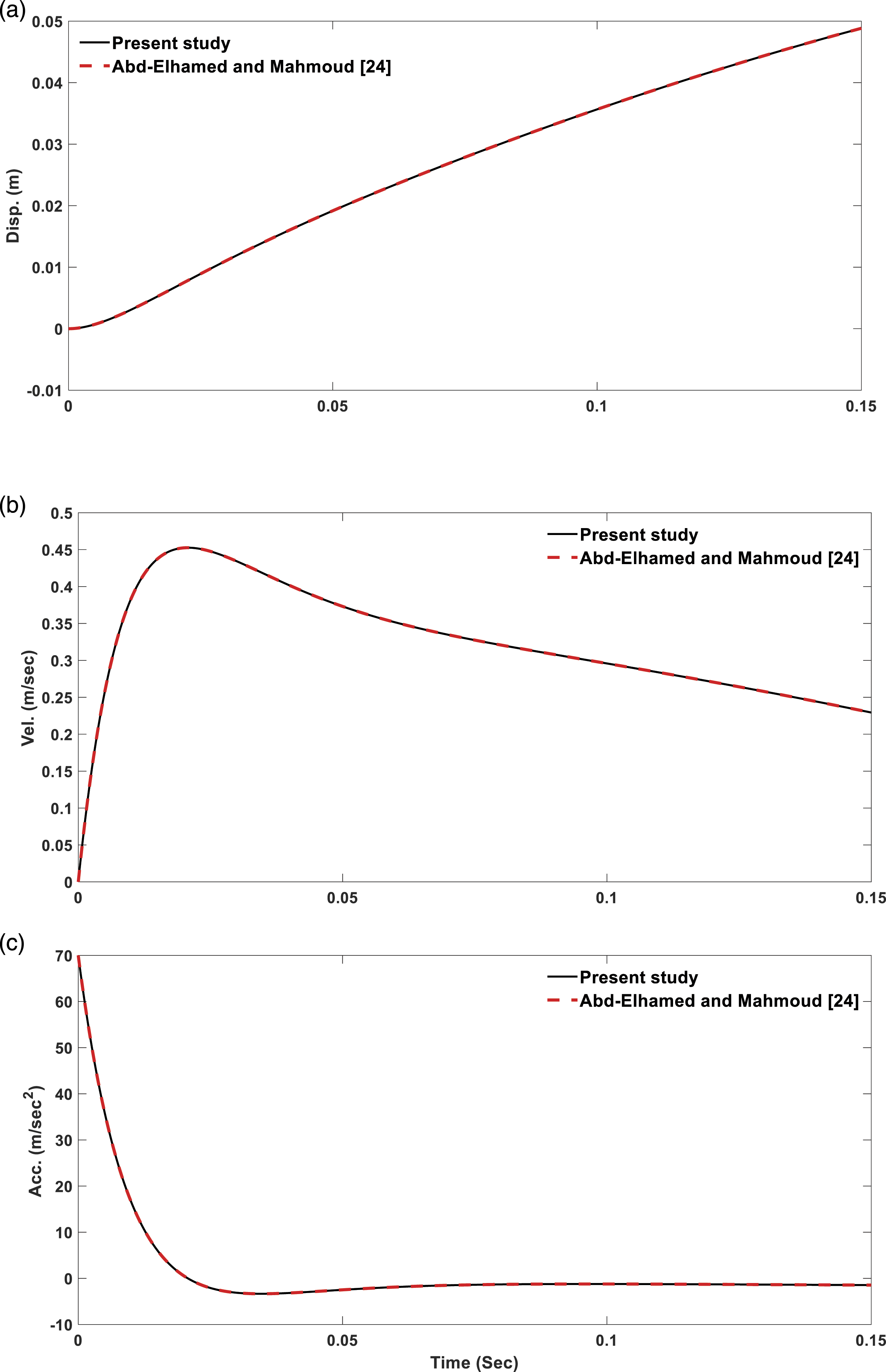
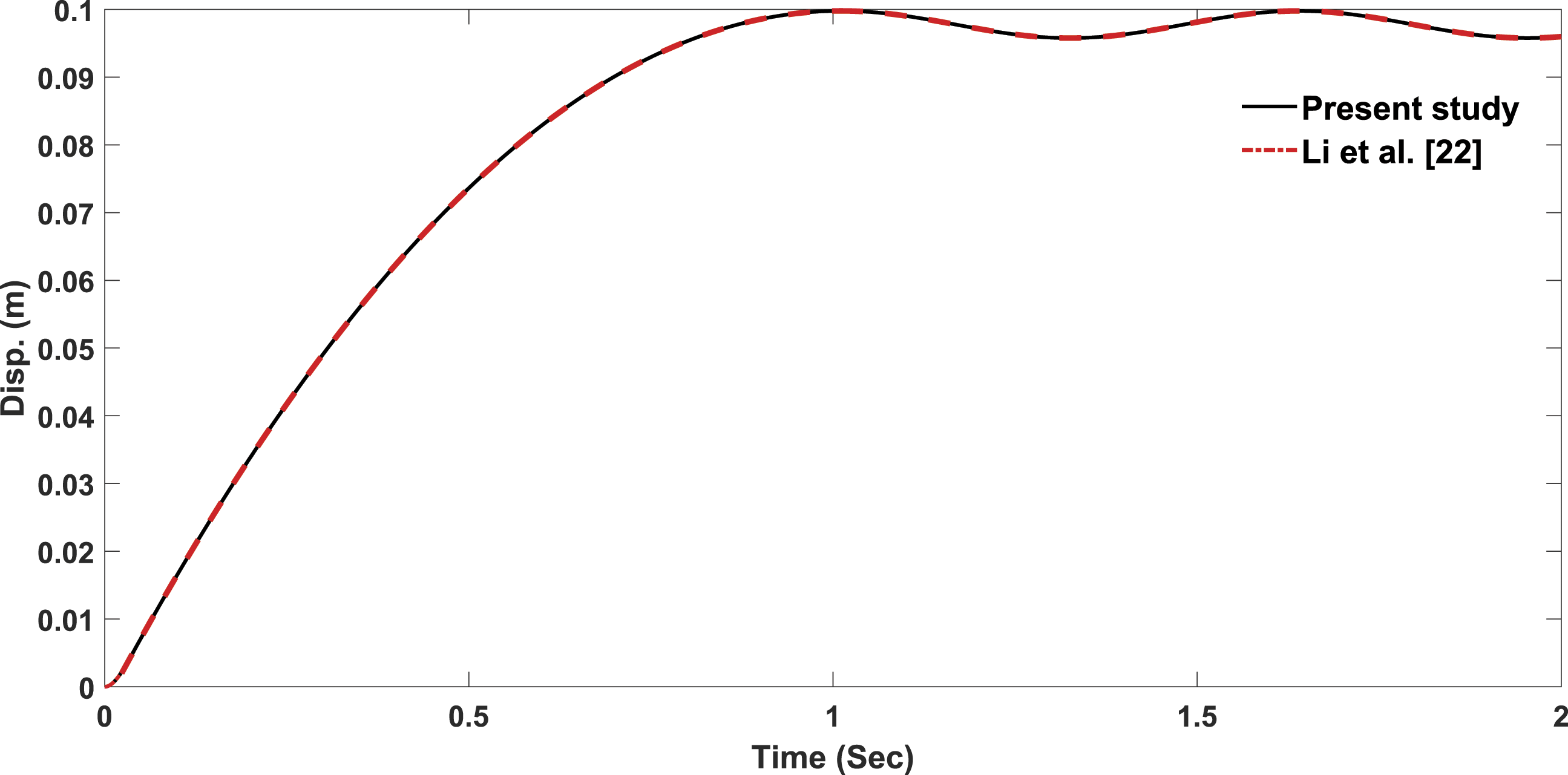
For further validation, the analytical results from the proposed study are also compared to Li et al.
24
as shown in Figure 6 for numerical undamped system parameters in terms of mass, m = 100 kg, stiffness, k = 10000 N/m, peak explosive load, F
0
= 1000 N, duration of the blast, t
d
= 0.04 s and maximum resistance, R
m
= 20.042 N. Observedly, the results from the current solutions generally demonstrate good agreement with Li et al.
24
solution and it is also clear that the two results are completely identical. Validation employing study by Li et al.
22
It should be mentioned that the simplified model, despite its simplicity, cannot simulate explosive loads more realistically compared to the typical model.
Comparison between the typical and simplified models
The results from the closed-form solutions for machine foundations under blast loads as a forcing term modelled either typical or simplified models are presented in a comparative form in Figures 7 and 8 for two cases namely: case - 1: elastic response of SDOF system during the blast with maximum responses occur in the elastic state, case - 2: elastic response of SDOF system during the blast but maximum responses occur in the plastic state. The stiffness and damping ratios for foundations embedded in homogenous strata were determined using values from Chehab and El Naggar,
13
based on equations reported by Beredugo and Novak
27
and Novak.
28
According to the Code of practise for the design and construction of machine foundations, IS: 2974,
29
it has been well established that the values of damping ratio in soils can be up to 25%. Consequently, a range between 0% and 15% has been adopted.
30
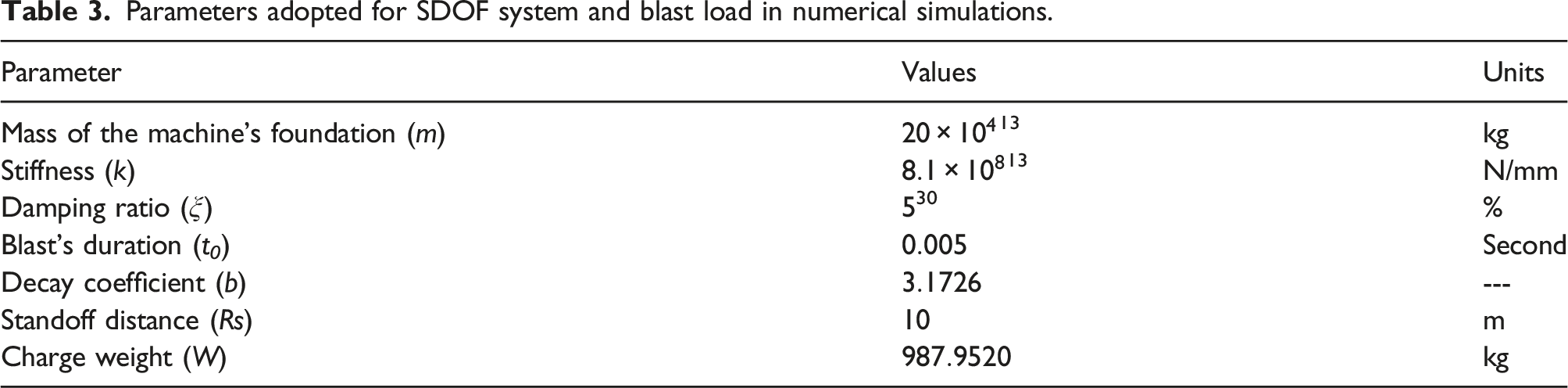
The considered dynamic parameters of SDOF system have been chosen for the comparison purpose as mentioned in Table 3. Induced displacement, velocity, and acceleration time-histories of SDOF system with respect to case 1 using typical and simplified blast models. Induced displacement, velocity, and acceleration time-histories of SDOF system with respect to case 2 using typical and simplified blast models. Parameters adopted for SDOF system and blast load in numerical simulations.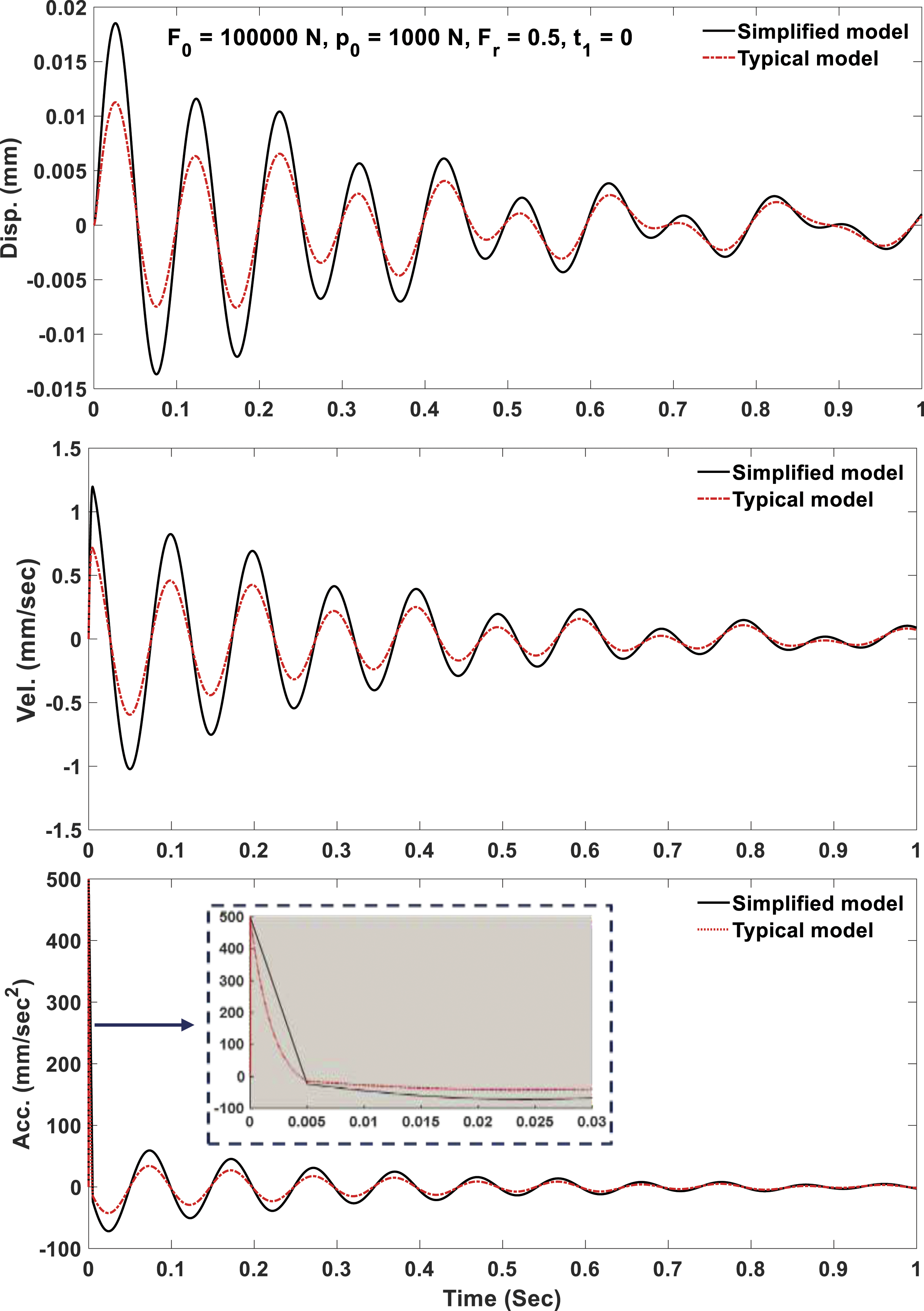
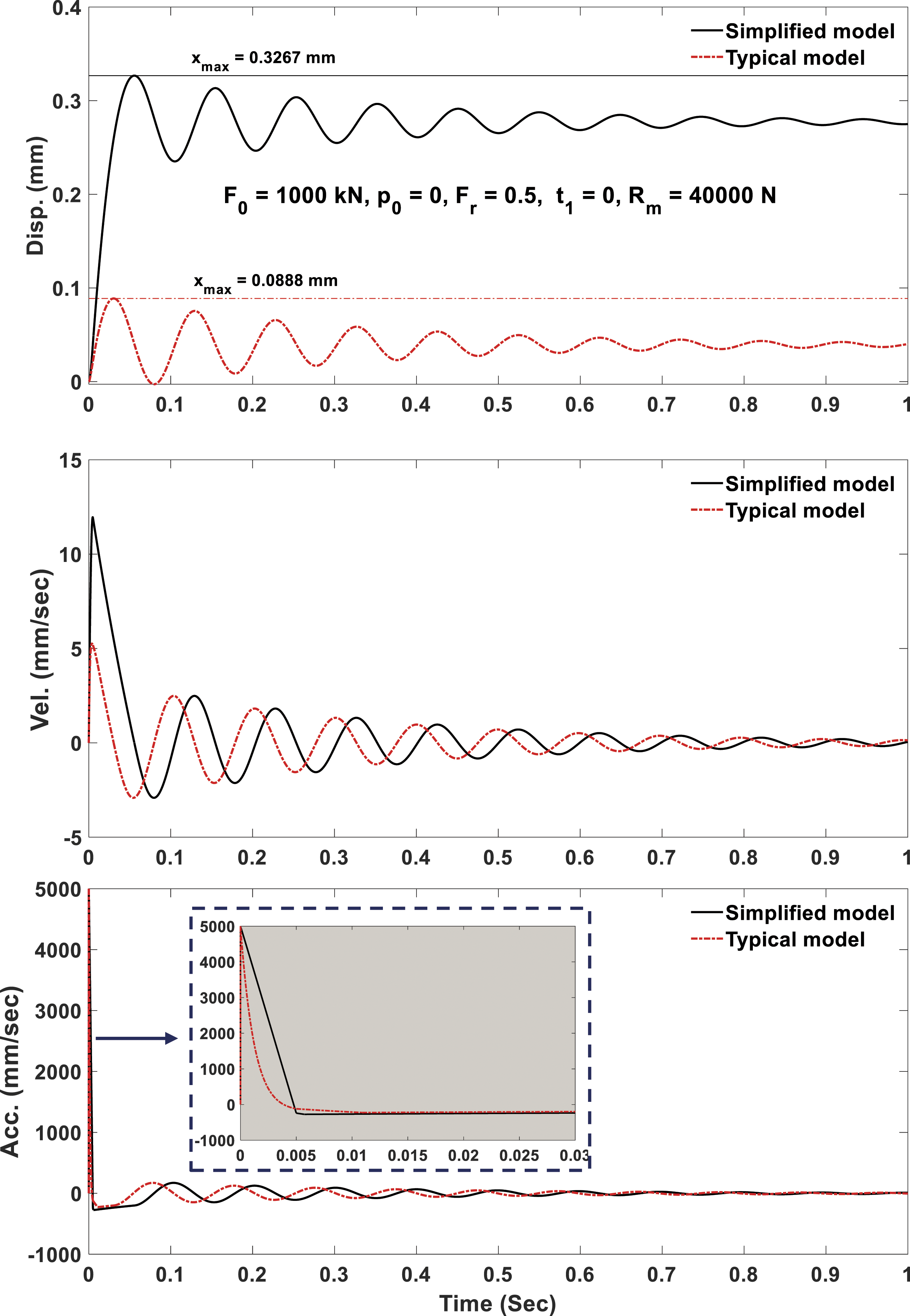
Figures 7 and 8 present a comparison between the captured displacement, velocity, and acceleration time-histories developed in the machine foundation system under the considered blast load for two types of blast force configuration, more accurate typical blast load and simplified triangle blast load, with respect to case 1 and case 2, respectively.
The input parameters such magnitude of blast force, F 0 ; amplitude of external load, P 0 ; frequency ratio, Fr; maximum resistance, R m ; and the time at which the blast has been considered to take place have been mentioned in the plotted figures.
It has been found from Figures 7 and 8 that the simplified model results in an unreasonable increase of displacement and velocity responses of the SDOF system for the two cases 1 and 2 of loading as compared to the typical model. It is evident that the displacement response of the SDOF system rises to its peak after the explosion is over. In addition, it is observed that the variation between captured displacement using typical and simplified blast models decreases with increasing time. Furthermore, a rapid increase in the velocity time-histories of machine foundation has been observed at the initial time reached its maximum value near the end of the positive phase duration of blast load td, as well the corresponding absolute error has reached maximum at the end of positive phase duration, after which it starts decreasing. It can also be seen obviously from the figure that the values of maximal accelerations start instantly at the occurrence of the explosion followed by a sudden drop to zero for the residual time duration. Consequently, the acceleration response appears to be the most important only at the start of the detonation causing sudden increase in the machine foundation accelerations. It is further seen that the captured peak values of acceleration response obtained by means of a simplified triangle model are almost identical to those obtained by means of a more accurate typical model. It is evident from the presented figures that the predicted displacement and velocity responses obtained from case 2 appear a noticeable error as compared with error obtained from case 1. Quantitively, when the responses remain in elastic state, case 1, the maximum recorded displacement and velocity for the machine foundation system under consideration exposed to the typical blast load are 0.0113 mm, and 0.7172 mm/s, respectively, while the corresponding values obtained from simplified blast load are 0.0185 mm and 1.1974 mm/s, respectively. When machine foundation system enters plastic state, case 2, the values of peak displacement and velocity subjected to typical blast load are as follows: 0.0888 mm, and 5.2574 mm/s, respectively, while the corresponding values obtained from simplified blast load are 0.3267 mm and 11.9559 mm/s, respectively. It can be concluded from Figures 7 and 8 that the simplified model displays notably different response behavior when compared to the typical model, despite the fact that it is simpler and just positive phase is used to simulate the explosive loads.
Parametric study
Parameters and value ranges utilized in simulations of the SDOF system.

During the explosion, the SDOF system responds in an elastic manner, and the maximum displacement is less than the elastic one.
Figure 9 demonstrates that the mass of the SDOF system considerably affects the time history of the SDOF system’s displacement, velocity, and acceleration responses for typical blast load of 0.005 s duration. Each of the additional input parameters is depicted in the same figure. The results for three mass values, 0.5 m, 1 m, and 1.5 m, have been changed with respect to m = 200,000 kg are shown in this figure. As can be seen from the figure, when just harmonic loads are applied, the displacement variation is not noticeable when the mass changes. However, the phase difference is plainly obvious. In contrast, increasing the mass of an SDOF system reduces the velocity response when only harmonic load is applied. The findings show that the mass of the SDOF system has a substantial influence on the acceleration-time history prior to the application of the blast. The disparities in the three plots of acceleration-time histories depicted in the figure, each representing a different mass, are enormous. On the other hand, the figure indicates that the responses jump abruptly during the explosion, and after a short period of time, the system returns to vibrating in an elastic state. Quantitively, the SDOF system’s peak displacement, velocity, and acceleration responses of mass 0.5 m are 0.0051 mm, 0.392 mm/sec, and 249.4864 mm/sec2, respectively. The captured values decrease to 0.0047 mm, 0.2348 mm/sec, and 123.4857 mm/sec2 for the SDOF system of mass 1.0 m. The captured peak responses for the system of mass 1.5 m are further reduced to 0.0038 mm, 0.1525 mm/sec, and 82.6491 mm/sec2. Due to the machine’s maximum displacement being in the elastic range, it experiences a jerk during the blast and then returns to its pre-blast state after some time. It’s worth noting that, while the maximum negative displacement for the SDOF system of mass 1.5 m kg is higher than that of the corresponding system of mass 1.0 m kg, the maximum positive displacement for 1.5 m kg is lower. It can be concluded from the results that the maximum response of an SDOF system decreases as mass increases. Effect of mass on the response time histories of SDOF system.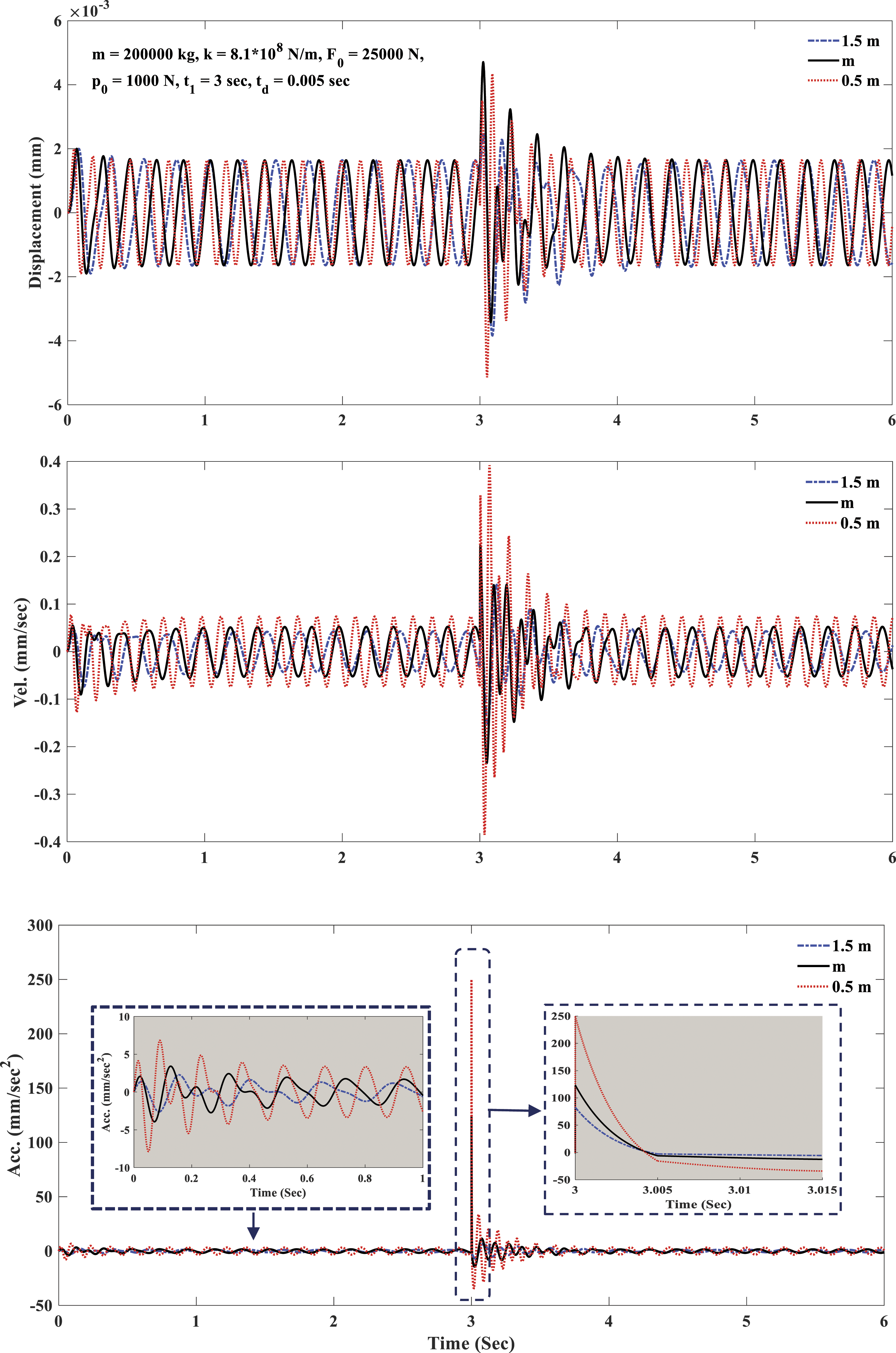
Figure 10 presents the response time histories of the SDOF system for three different soil stiffnesses, 0.5 k, 1 k, and 1.5 k, with respect to k Effect of soil stiffness on SDOF system response time histories.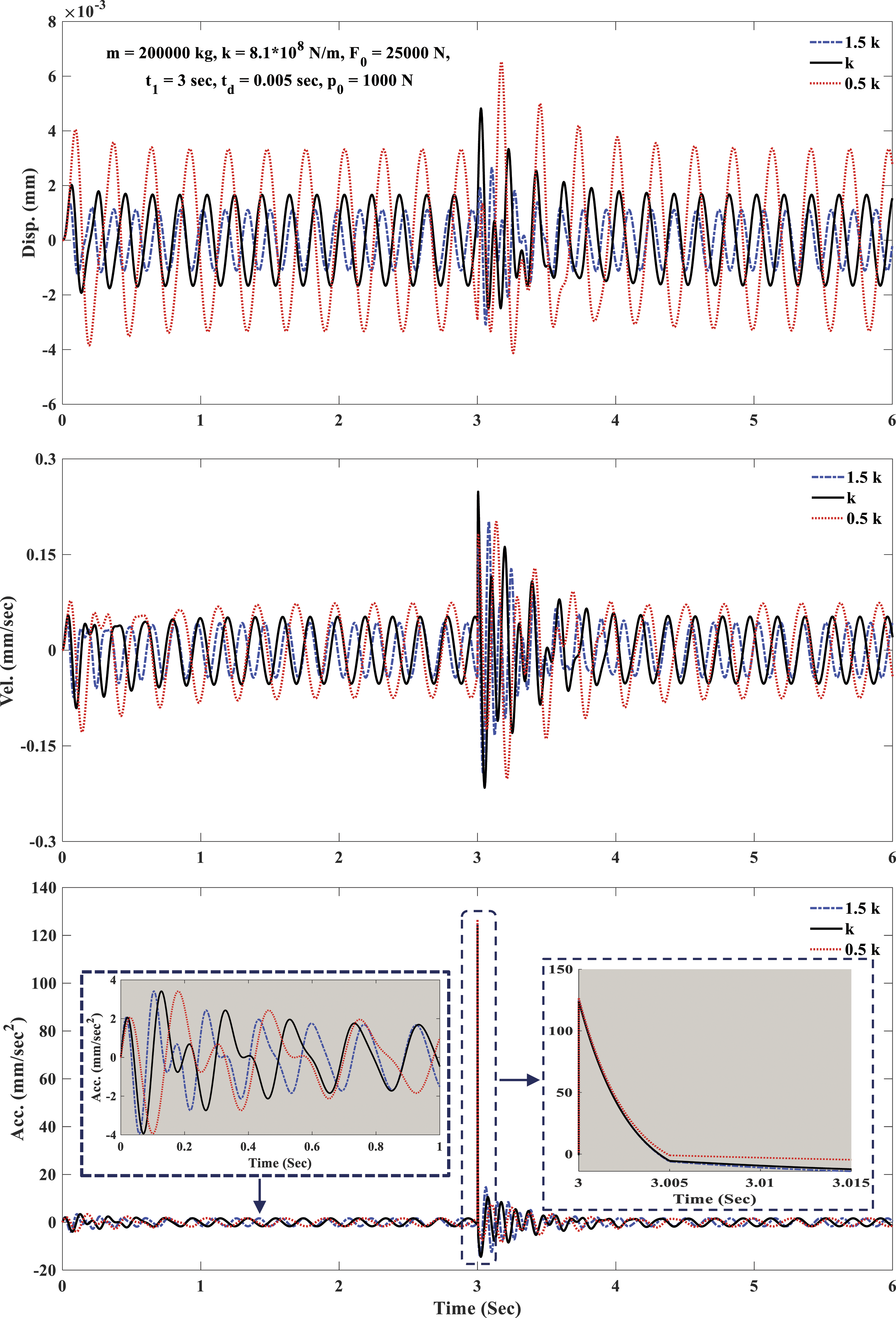
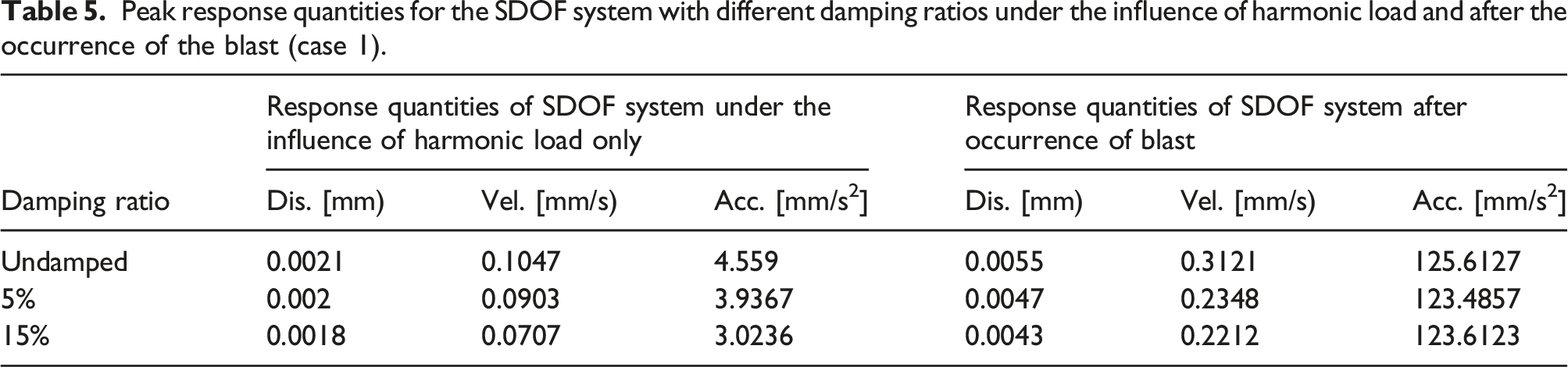
Figure 11 depicts the response time-histories of an SDOF system with different damping ratios. As an additional feature, the obtained peak response quantities for the machine foundation system with different damping under the influence of harmonic load only and immediately after the occurrence of the blast are presented in Table 5. As can be seen from the plotted curves, increasing damping of the soil-foundation system reduces the displacement, velocity, and acceleration responses compared to the responses of the undamped system for all the considered loads. The presented peak response values in Table 5 for the displacement, velocity, and acceleration under the influence of harmonic load only clearly indicate that increasing damping ratio from 0% to 15% causes a percentage decrease in displacement, velocity, and acceleration as 14%, 32%, and 34%, respectively. For the same system but immediately after the blast, increasing damping ratio decreases the aforementioned percentages as 22%, 30%, and 2% for displacement, velocity, and acceleration, respectively. Additionally, as illustrated in Figure 11, increasing the damping ratio of the soil-foundation system to 15% causes the system to return to its elastic condition faster and recover from blast load effects earlier than a system with a low damping ratio. Effect of soil damping on the response time histories of SDOF system. Peak response quantities for the SDOF system with different damping ratios under the influence of harmonic load and after the occurrence of the blast (case 1).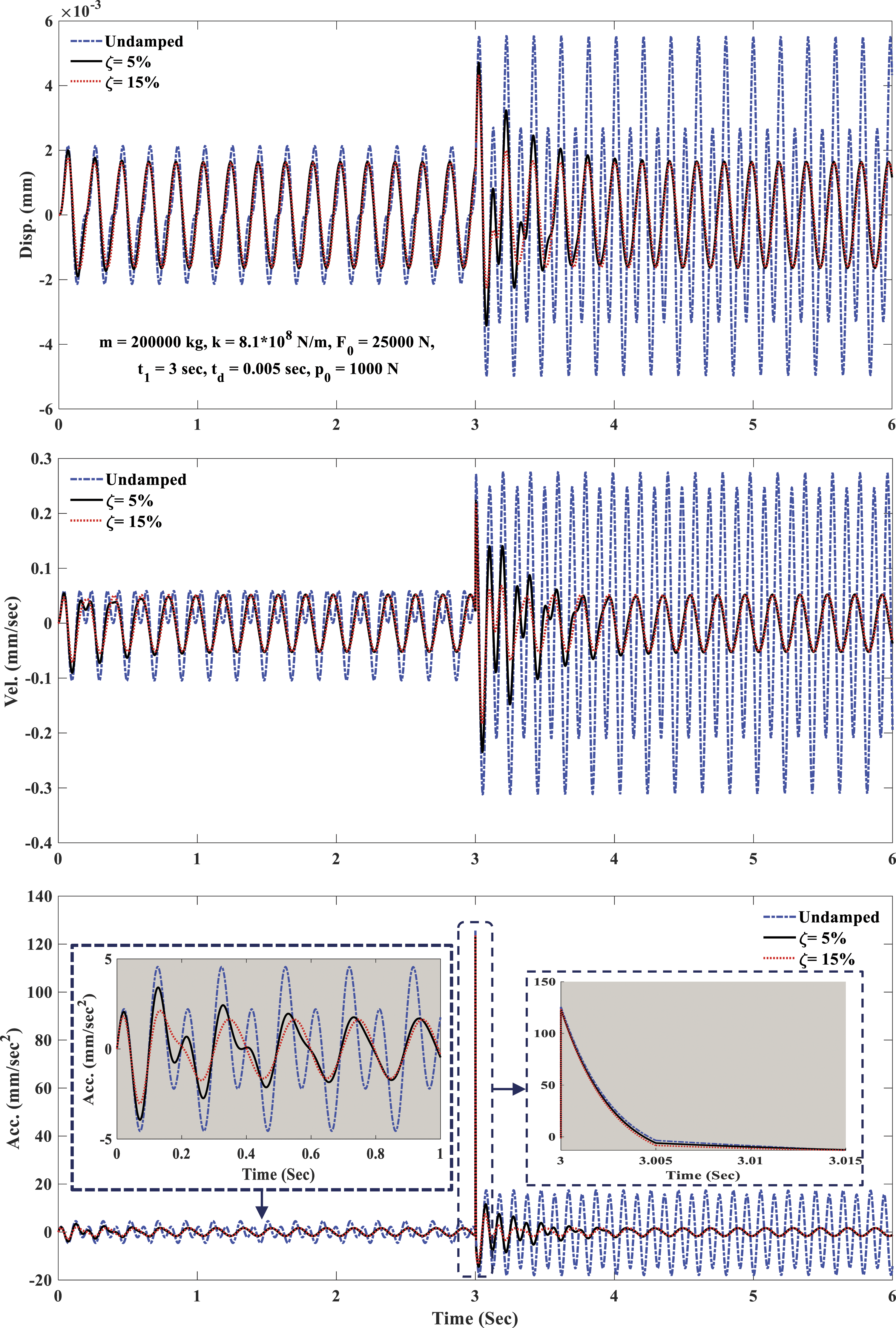
During the explosion, the SDOF system responds in an elastic manner, and the maximum displacement occurs in the plastic state.
A similar parametric analysis is conducted for the scenario in which the explosion occurs in an elastic state; however, the maximum response takes place in the plastic state. Figure 12 illustrates the effect of mass on the time history response of the SDOF system under the impact of harmonic and blast loads. From the figure, it is inferred that there is little variance in the magnitude of displacement, velocity, and acceleration during an SDOF system’s elastic stage, due to its mass changing. On the other hand, the phase difference is readily discernible. The abrupt jump in all responses around time t = 3 s is due to blast loading applied 3 s after the machine started up. It is obvious that there will be no harmonic load acting on the SDOF system when it enters the plastic state. Furthermore, vibrations diminish over time. Quantitively, the captured peak values of displacement, velocity, and acceleration response for the SDOF system of mass 1.5 m are 0.0674 mm, 3.4862 mm/sec, and 3332.3 mm/sec2, respectively. The captured values increase to 0.0047 mm, 0.2348 mm/sec, and 123.4857 mm/sec2 for the SDOF system of mass 1.0 m. The captured peak responses for the system of mass 0.5 m are further increase to 0.1469 mm, 10.1541 mm/sec, and 9999.2 mm/sec2. A decrease in mass of the SDOF system leads to an increase in dynamic response to blasting loads, as seen by numerical results. The effect of mass of machine foundation on the response time histories of the SDOF system studied in Case 2.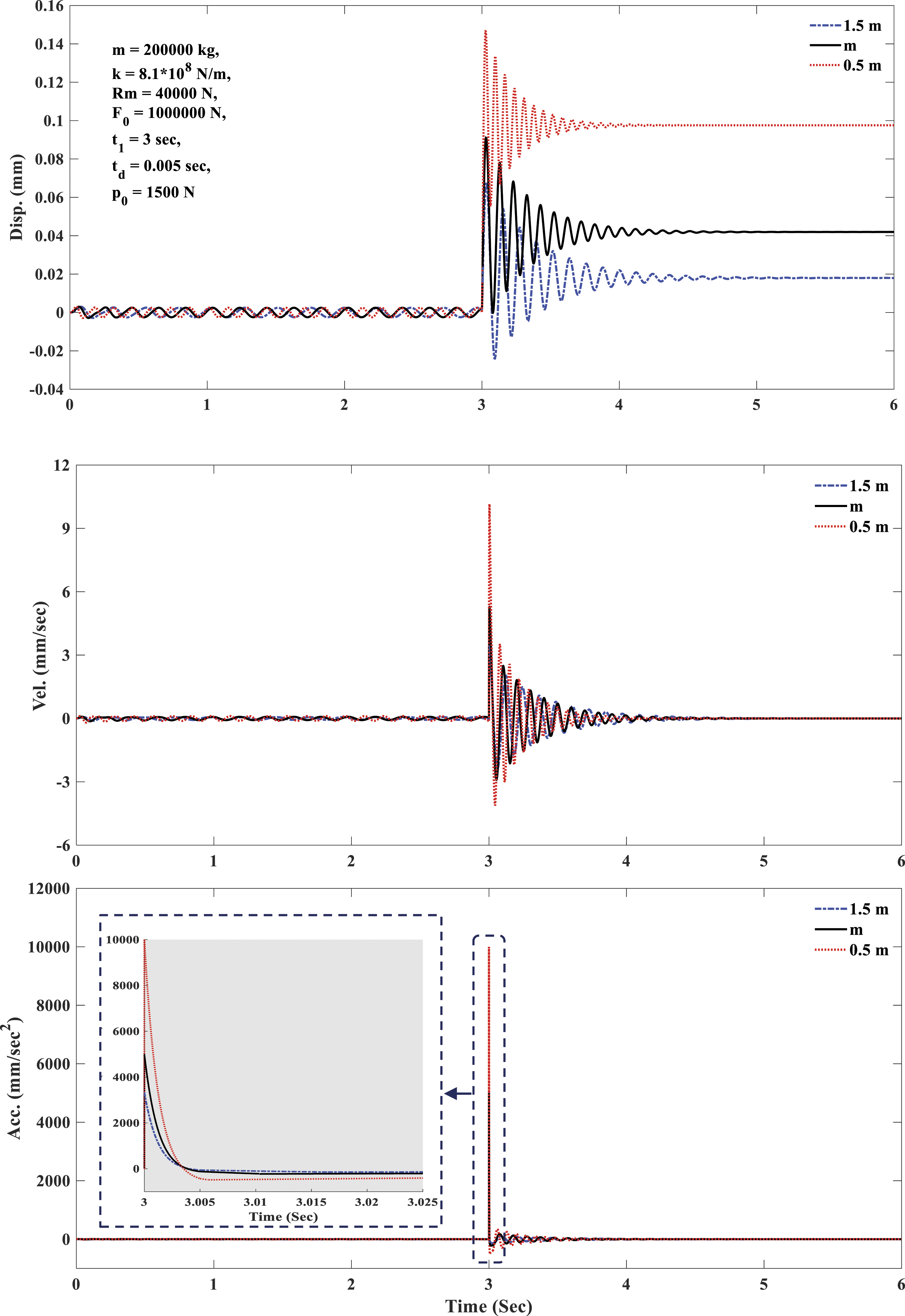
Figure 13 depicts the effect of soil stiffness, The effect of soil stiffness on the response time histories of the SDOF system studied in Case 2.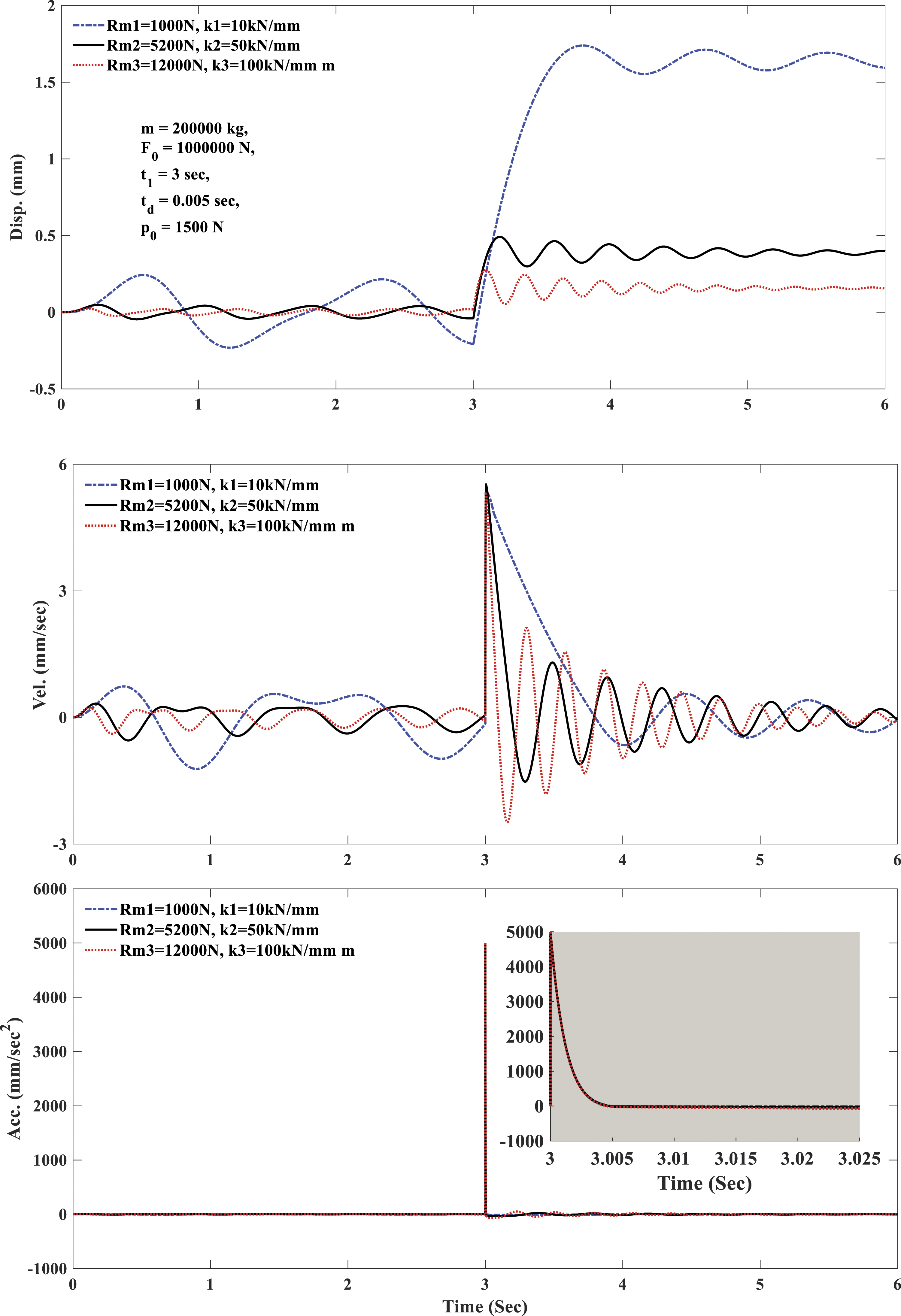
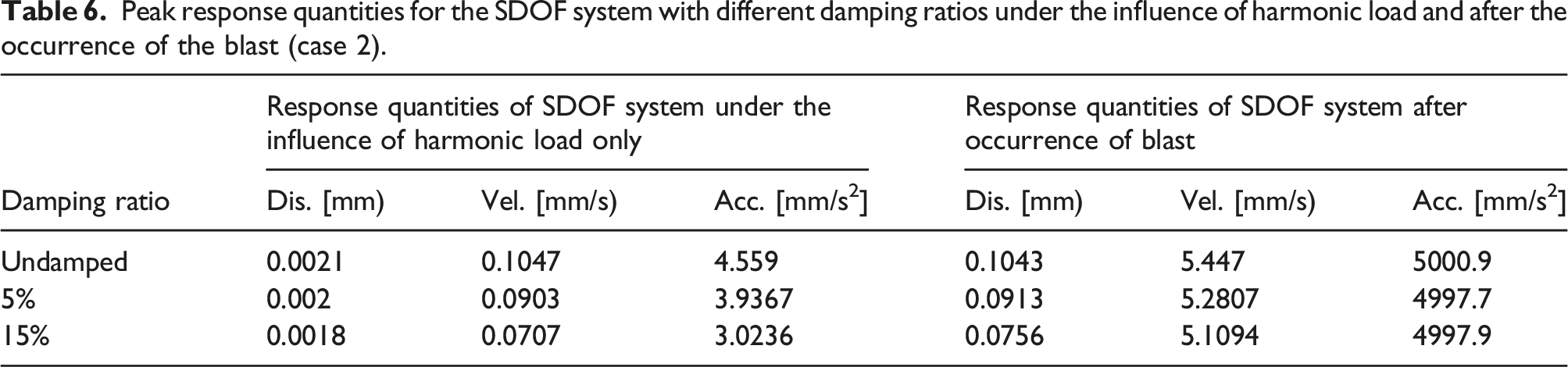
Figure 14 show the displacement, velocity, and acceleration time-histories of SDOF system founded on soil with different values of damping ratios. The presented plots clearly show significant differences between the induced response quantities of SDOF system under the influence of harmonic load only, elastic stage, due to increasing damping of the soil-foundation system and the responses of the undamped system for all the considered loads. On the other hand, due to increased damping ration, there are substantial variations in the SDOF system’s induced displacement response values after the occurrence of the blast, plastic stage, whereas the velocity and acceleration response quantities remain relatively constant during that stage. The presented peak response values in Table 6 for the displacement, velocity, and acceleration under the influence of harmonic load only demonstrate unequivocally that increasing the damping ratio from 0% to 15% yields a percentage decrease to remain the same as the case 1. For the same system but immediately after the blast, increasing damping ratio causes a percentage decrease in Permanent displacement, velocity, and acceleration as 27%, 6%, and 0.1%, respectively. It is observed from the figure that, undamped vibrations have a sinusoidal nature, whereas damped vibrations will decay over time, and this decay period decreases as the damping ratio increases. The effect of damping on the response time histories of the SDOF system studied in Case 2. Peak response quantities for the SDOF system with different damping ratios under the influence of harmonic load and after the occurrence of the blast (case 2).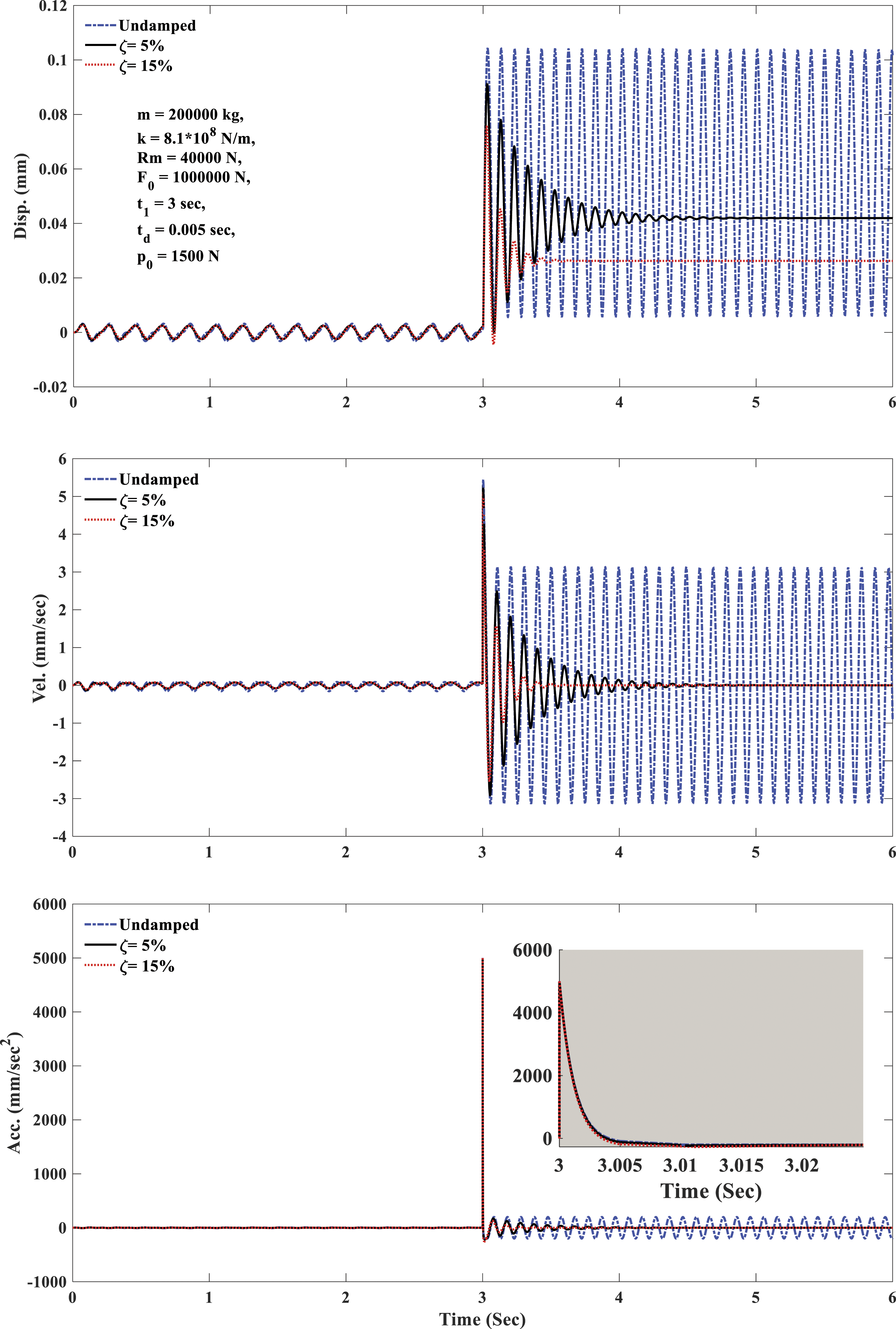
Conclusions
In this study, analytical formulations for equations of motion have been derived in order to anticipate the dynamic responses of machine foundations under the combined effect of harmonic and explosive excitations. The soil-machine foundation system has been treated as an SDOF system that has elastic-perfectly plastic constitutive properties. The mass of the machine and the foundation are integrated into a single rigid mass, m, in this configuration. A spring with a constant, k, represents soil resistance, while a dashpot with a constant, c, represents soil energy absorption. The incidental explosive load acting on the SDOF system during machine operation has been represented using both more accurate typical and simplified triangular models. Two cases of soil-foundation systems have been examined: one case assumes that the supporting soil retains its elasticity, and the maximum displacement takes place in the elastic state, while the other case assumes that the explosion takes place in the elastic state but that the maximum response takes place in the plastic state. The SDOF system has been exposed to a typical blast load profile without consideration for the impacts of blast-induced wave propagation. The proposed solution’s accuracy has been validated by comparing the results obtained for the response of the SDOF system with those obtained from earlier studies. The comparison revealed that the proposed solution produced results that were extremely close to those published in the literature. Parametric analyses have been performed by varying the important parameters, which include the mass of the machine-foundation system, as well as the stiffness and damping ratio of the soil.
On the basis of the obtained results, the following inferences are made: 1. A comparison of two distinct types of pulse loading revealed that idealizing such loading by employing a simplified triangle model results in unreasonably large estimations of machine foundation responses, which in turn causes the system to be overdesigned. 2. The more accurate exponential pulse loading was found to result in a 39% and 73% reduction, respectively, in the machine foundation’s peak displacement response when compared to the results obtained from the triangular pulse. This was observed for the two cases that were taken into consideration during the analysis: case 1 and case 2. For those cases, utilizing exponential pulse loading resulted in a 40% and 56% reduction in peak velocity response, respectively. Since exponential loading decays more quickly than triangular loading, the latter has a greater effect in the elastic-plastic cases, and this is why the latter has a smaller reaction. 3. The simplified triangle model for explosive loads produces unrealistic estimates of machine foundation responses when compared to the more accurate exponential typical model, where a considerable difference was observed between the induced responses of the SDOF systems. 4. Prior to the explosion, when the foundation-supporting machine is running solely under harmonic exciting loads, the increase in mass of the SDOF system results in a considerable reduction in the induced velocity and acceleration-time histories. Conversely, the displacement variation is not noticeable when the mass changes. Further, the responses jump abruptly during the explosion, and after a short period of time, the system returns to vibrating in an elastic state. 5. When soil stiffness increases, the soil begins to rebuild its resistance, providing strength to the soil-foundation system and resulting in a considerable reduction in displacement and velocity responses. The reduction in the system responses occurs as a result of an excessive increase in the frequency of the system’s operation. On the contrary, there is a negligible change in the induced peak acceleration of the machine for different soil stiffnesses at the time of the blast. 6. The undamped vibrations of the machine-foundation system are sinusoidal, whereas the system’s damped vibrations diminish over time. Furthermore, as the damping of the soil-foundation system is increased, the decay period decreases. 7. After the occurrence of the explosion, there is a sudden jump in all responses as soon as the SDOF system goes into the plastic state, then the system’s vibrations die down over time. On the other hand, the magnitude of displacement, velocity, and acceleration change only slightly throughout the elastic stage of an SDOF system, owing to changes in the system’s mass.
The analytical solutions provided are of a public nature. They can be used to anticipate the response of any soil-foundation system subjected to harmonic loads, blast loads, or both.
Supplemental Material
Supplemental Material - Closed-form solutions to investigate the nonlinear response of foundations supporting operating machines under blast loads
Supplemental Material for Closed-form solutions to investigate the nonlinear response of foundations supporting operating machines under blast loads by Ayman Abd-Elhamed, Soliman Alkhatib and Mohamed A. Dagher in Journal of Low Frequency Noise, Vibration and Active Control
Footnotes
Declaration of conflicting interests
The author(s) declared no potential conflicts of interest with respect to the research, authorship, and/or publication of this article.
Funding
The author(s) received no financial support for the research, authorship, and/or publication of this article.

Supplemental Material
Supplementary material for this article is available on the online.
Appendix
References
Supplementary Material
Please find the following supplemental material available below.
For Open Access articles published under a Creative Commons License, all supplemental material carries the same license as the article it is associated with.
For non-Open Access articles published, all supplemental material carries a non-exclusive license, and permission requests for re-use of supplemental material or any part of supplemental material shall be sent directly to the copyright owner as specified in the copyright notice associated with the article.
