




Abstract
A nonlocal Dynamic Stiffness Model (DSM) for free vibration analysis of Functionally Graded Material (FGM) nanobeams on a Winkler elastic foundation based on the Nonlocal Elastic Theory (NET) is proposed. The NET model considers the length scale parameter, which can capture the small scale effect of nanostructures considering the interactions of non-adjacent atoms and molecules. Material characteristics of FGM nanobeams are considered nonlinearly varying throughout the thickness. The nanobeams are modelled according to the Timoshenko beam theory and its equations of motion are derived using Hamilton’s principle. The DSM is used to obtain an exact solution of the equation of motion taking into account the neutral axis position. This nonlocal DSM proposed has overcome the stiffening phenomena of the cantilever beam fundamental frequency and validated by comparing the obtained results with published results. Afterwards the proposed model is applied to investigate free vibrations of stepped FGM nanobeams. Numerical results are presented to show the influence of the material distribution profile, geometry, nonlocal, elastic foundation and boundary conditions on the free vibration of stepped FGM nanobeams. It is shown that the proposed nonlocal DSM can be applied to more complex stepped nanostructures.
Introduction
Functionally Graded Materials (FGMs)1,2 are a new generation composite material that is made up of two or more component materials with a continuous variation in the ratio of components in one or more directions. FGMs are employed in micro/nano electro-mechanical systems (MEMS/NEMS) to archive high sensitivity and desired performance. Nano-sized structures as plates, sheets, beams and framed structures are widely used in NEMS devices. Steps in nanostructures are considered as abrupt changes in cross-sectional area such as carbon nanotube (CNT) heterojunctions or two connected nanobeam portions with different material properties. 3 Steps in nanostructures may be manufactured on the purpose of attaining desired frequencies in some applications such as a piezoelectric energy harvester4,5 or building blocks of nanoelectromechanical and micro-electromechanical systems.6–8 However, steps in structures may occur as a manufacturing defect.9–11 For this reason, stepped nanostructures are especially attracting more and more attention due to their various potential applications.12–14
Because of the size effect, classical elasticity theory cannot fully and accurately investigate the mechanical behaviours of nanostructures. Therefore, Nonlocal Elasticity Theory (NET) was first proposed by Eringen 15 assuming that the stress tensor at one point is not only a function of deformation but also includes all surrounding ones. Currently, NET is widely used to formulate differential equations of motion of nanostructures using homogeneous materials16–18 and functionally graded materials. 19 Reddy 20 established the equations of vibration and stability of homogeneous nanobeams according to the NET for Euler–Bernoulli, Timoshenko Reddy and Levinson beam theories. Many other authors have developed analytical methods,21–24 Rayleight–Ritz method, 25 Finite Element Method (FEM),26–31 differential transform method, 32 differential quadrature method 33 and so on to consider the bending, stability and free vibration problems of nanobeams from homogeneous materials.
For the FGM nanobeams, Simsek and Yurtcu, 34 Rahmani and Pedram 35 simultaneously studied bending and buckling of Timoshenko FGM nanobeams using analytical methods. In addition, Mechab et al. 36 studied free vibration, while Uymaz 37 researched on forced vibration of nanobeams, both using the higher-order shear deformation theory. Ebrahimi and Salari 38 exploited a semi-analytical method to study the vibrational and buckling analysis of Euler–Bernoulli FGM nanobeams considering the physical neutral axis position. A spectral finite element formulation was indicated by Narendar and Gopalakrishnan 39 to investigate the vibration of nonlocal continuum beams. The analytical solutions found above are all in Navier’s series, thus, they are limited to simply supported beams. For other boundary conditions, the authors applied FEM to analyze the free vibration and buckling of FGM nanobeams according to Euler–Bernoulli beam theory,40,41 and Timoshenko theory.42–44 Recently, the authors of Ref.[45] found the solution for natural frequencies and mode shapes of microbeams under various boundary conditions using the state-space concepts.
It is shown that the NET can make nonlocal paradoxes in bending and vibration behaviour of nanobeams and nanoplates.26,46 In the vibration problems, an unexpected stiffening phenomena occurred for a first frequency of cantilever beams.47,48 The reason for the existence of these paradoxes resides in the inconsistency of forming the natural and essential nonlocal boundary conditions. To overcome this phenomena, Challamel et al. 49 proposed a discrete microstructured beam model that accurately approximated to Eringen’s nonlocal elasticity. Khodabakhshi and Reddy 50 developed a unified integro-differential nonlocal model as a generalization of NET and suggested a general FEM to analyse bending behaviour of Euler–Bernoulli. Yan et al. 51 employed the Galerkin method to obtain nonlocal bending deflections of nanobeams and nanoplates. Xu et al. 52 proposed the weighted residual approaches (WRA) to derive the variational-consistent nonclassical boundary conditions of nonlocal beam models. Aria and Friswell 44 proposed the weak form of equations and the corresponding boundary conditions and suggested the finite element with five nodes and ten degrees of freedom for buckling and vibration analysis of FG nanobeams.
As the FEM is formulated on the base of frequency-independent polynomial shape function, it could not be used to capture all necessary high frequencies and mode shapes of interest. An alternative approach called Dynamic Stiffness Model (DSM) fulfilled the gap of FEM by using frequency-dependent shape functions that are considered as an exact solution of the vibration problem in the frequency domain.53–56 The result from the DSM does not depend on the number of elements. The DSM ensures much better accuracy and computation efficiency. Although exact solutions of the vibration problem are not easily constructed for complete structures, but they, if available, enable to study the exact response of the structure in an arbitrary frequency range. Adhikari et al. 16 obtained the dynamic stiffness matrix of a nonlocal rod in closed form. The frequency response function obtained using the proposed DSM shows an extremely high modal density near the maximum frequency. Using the dynamic finite element approach, Adhikari et al. analysed vibration of damped nanorods, 57 nanorods embedded in an elastic medium, 58 and damped nanobeam on elastic foundation. 59 Recently, Taima et al. 14 studied free vibration analysis of multi-stepped Bernoulli–Euler nanobeams made of homogenous material using the DSM.
To the best of the authors’ knowledge, the DSM-based approach to the nonlocal FGM nanostructures is a gap that has to be fulfilled. In the present work, a nonlocal DSM is proposed to investigate the free vibration of FGM nanobeams on a Winkler elastic foundation on the basis of NET and Timoshenko beam theory. This nonlocal DSM has overcome the stiffening phenomena of the cantilever beam fundamental frequency by using the weighted residual approaches. Comparison between obtained results and published results shows the reliability of the method. Afterwards the nonlocal DSM is applied to investigate free vibrations of stepped FGM nanobeams on the elastic foundation. The influence of nonlocal, material distribution profile, elastic foundation and geometry parameters on the vibration frequency and mode shapes of stepped nanobeams with different boundary conditions has been studied in detail.
Nonlocal dynamic stiffness model of a FGM beam
Consider an FGM nanobeam of the length L and rectangular cross-section b × h (Figure 1) on the Winkler elastic foundation. It is assumed that the material properties vary along the thickness direction following the power law distribution as follows
1
A FGM nanobeam on a Winkler elastic foundation.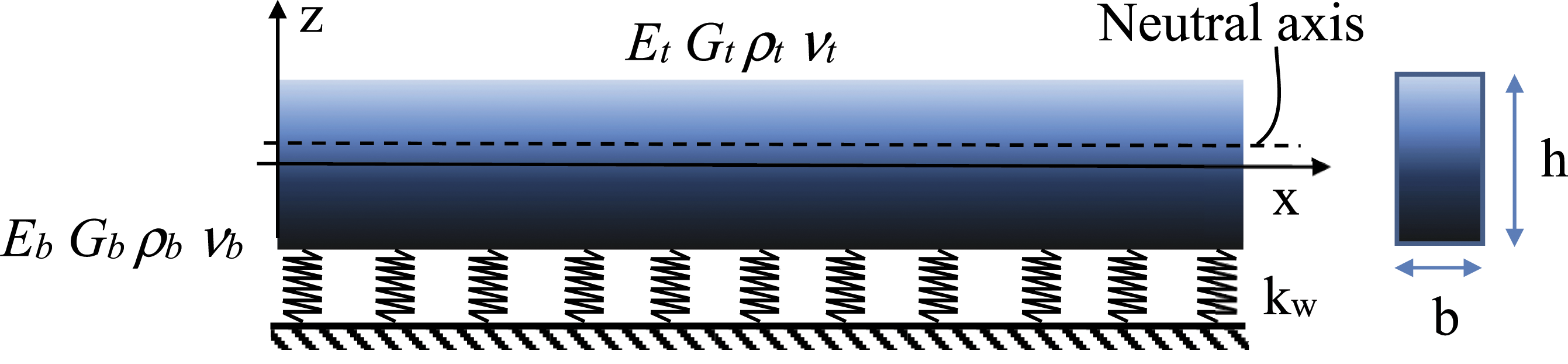



Based on Hamilton’s principle

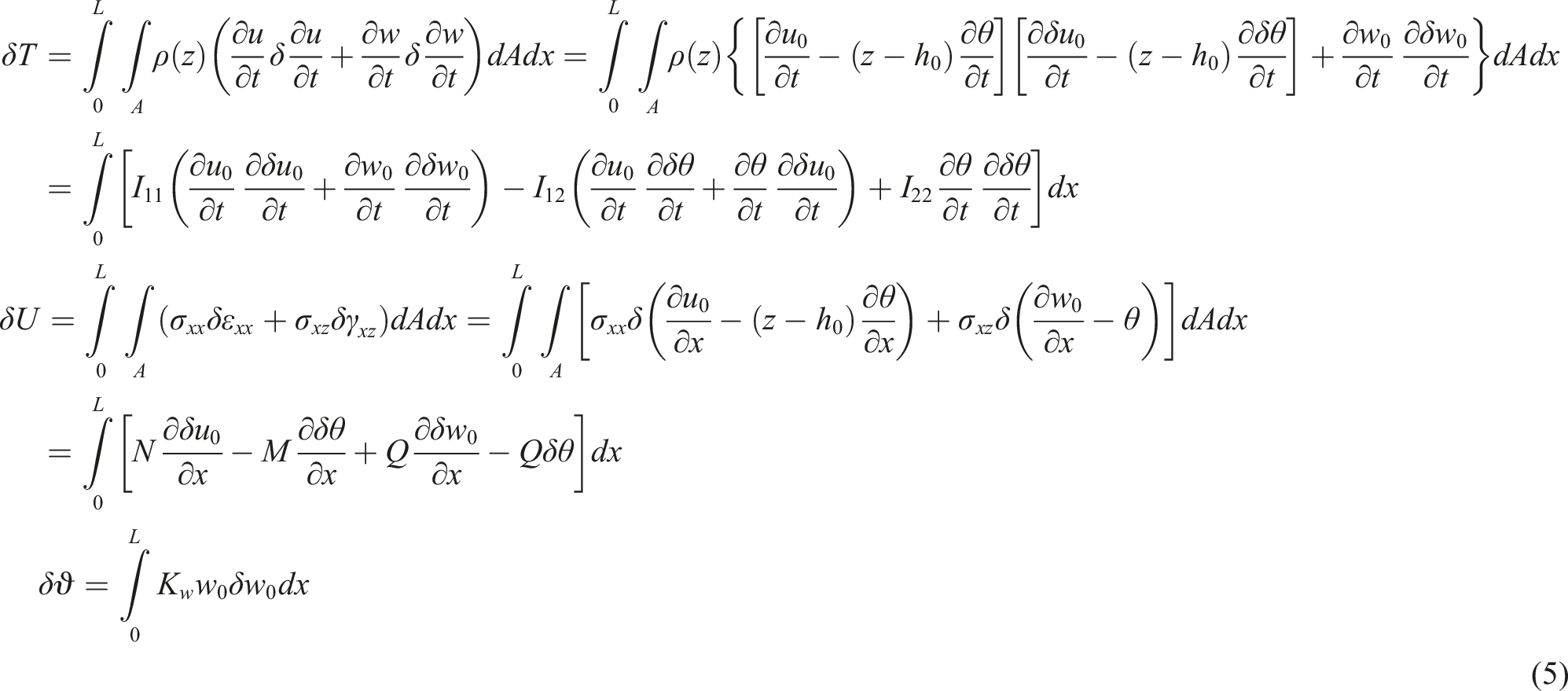

N, M, Q are the axial normal force, the bending moment and the shear force, respectively

K
w
is the stiffness of the Winkler elastic foundation. The position of the neutral axis h
0
and I
12
can be written by
40

The Lagrange equations can be obtained as below

The boundary conditions are: u 0 = 0 or N = 0; w 0 = 0 or Q = 0; θ = 0 or M = 0. The natural boundary conditions at x = 0 have the opposite sign to the one at x = L.
The nonlocal constitute equations for nanobeams can be written in the form
15


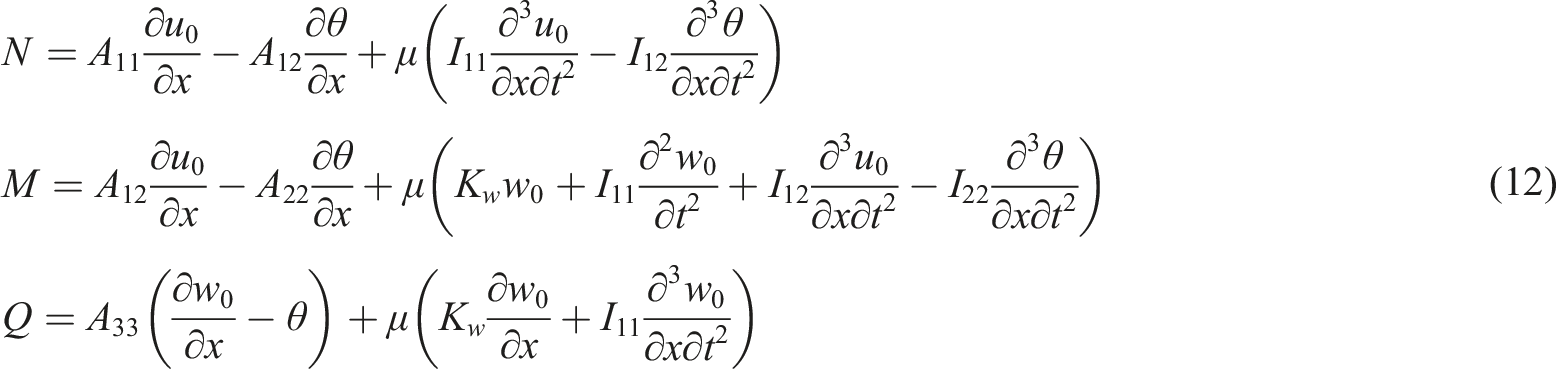

η is the shear correction factor, η = 5/6 for a rectangular cross-section.
Substituting (12) into (9) leads to the equations of free vibration
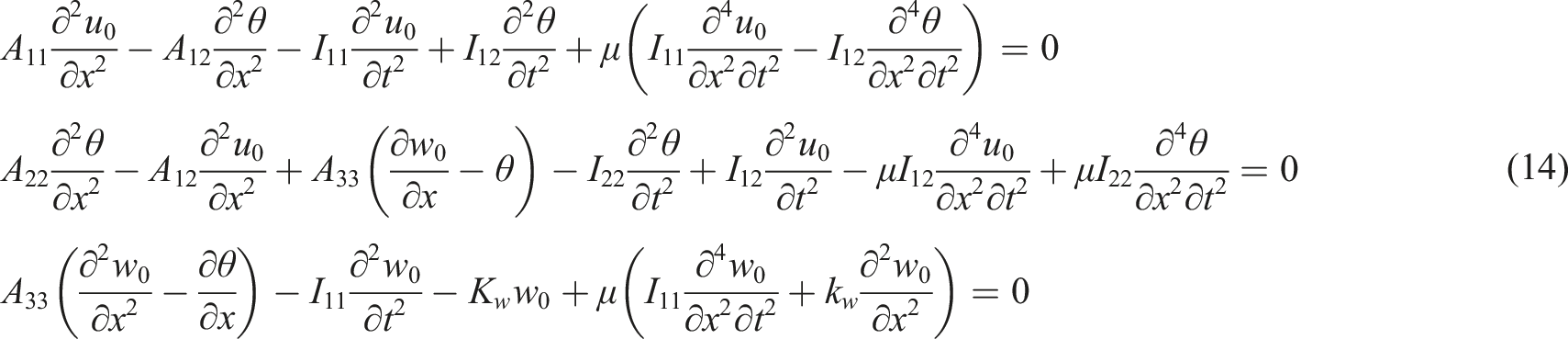
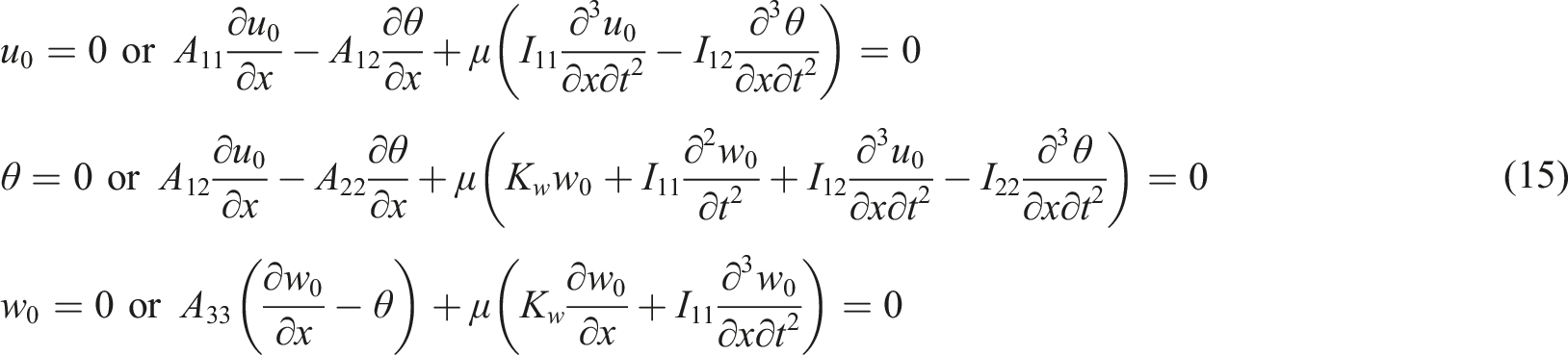
To overcome the unexpected nonlocal paradox for a first frequency of cantilever beams, the variational-consistent boundary conditions are derived by multiplying equation (14) by δu, δw0 and δθ, respectively, and integrating over the beam length
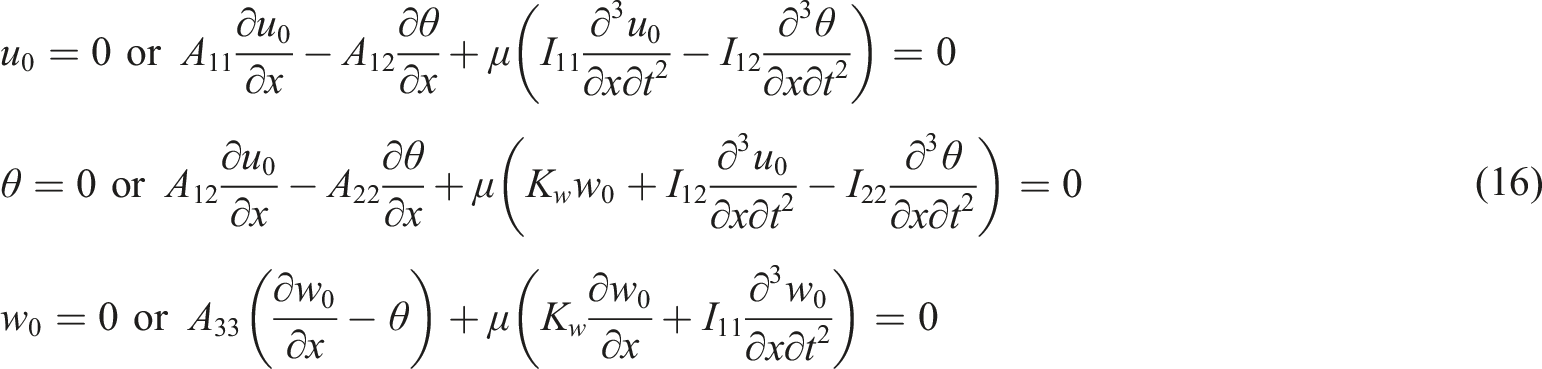
The variational-consistent boundary conditions (16) are different from the exact nonself-adjoint boundary conditions (15) in this term
Setting

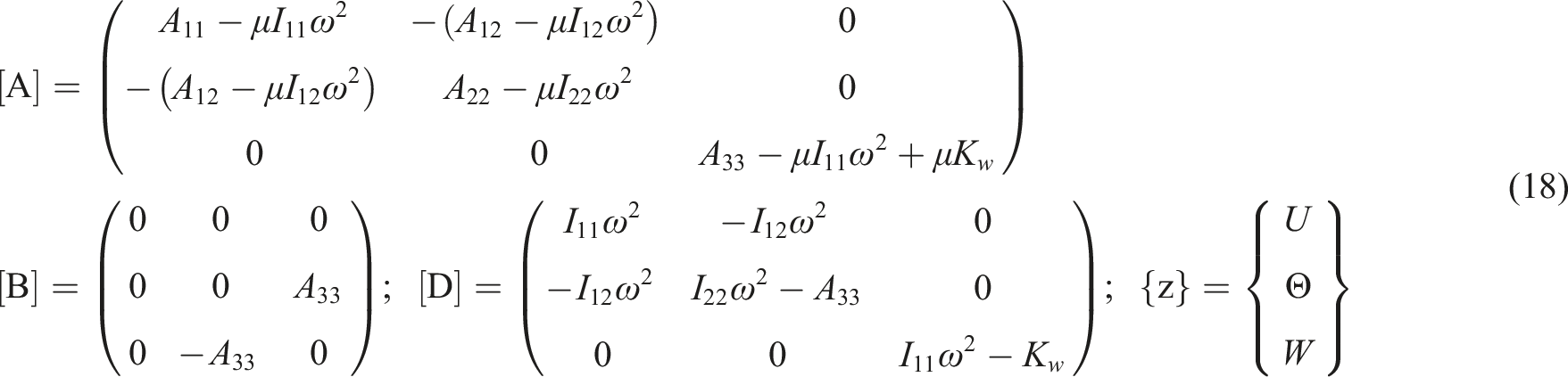
Equation (14) in the frequency domain now can be obtained as

Choosing the solutions of equation (19) in the form of

Equation (20) has non-trivial solutions when

We receive cubic algebraic equations of η = λ
2
:

Then the general solutions of equation (19) are in the form as




Let’s consider a two-dimensional FGM nanobeam element as shown in Figure 2. Using variational-consistent boundary conditions (16), nodal displacements and forces of the element are introduced as Nodal displacements and forces.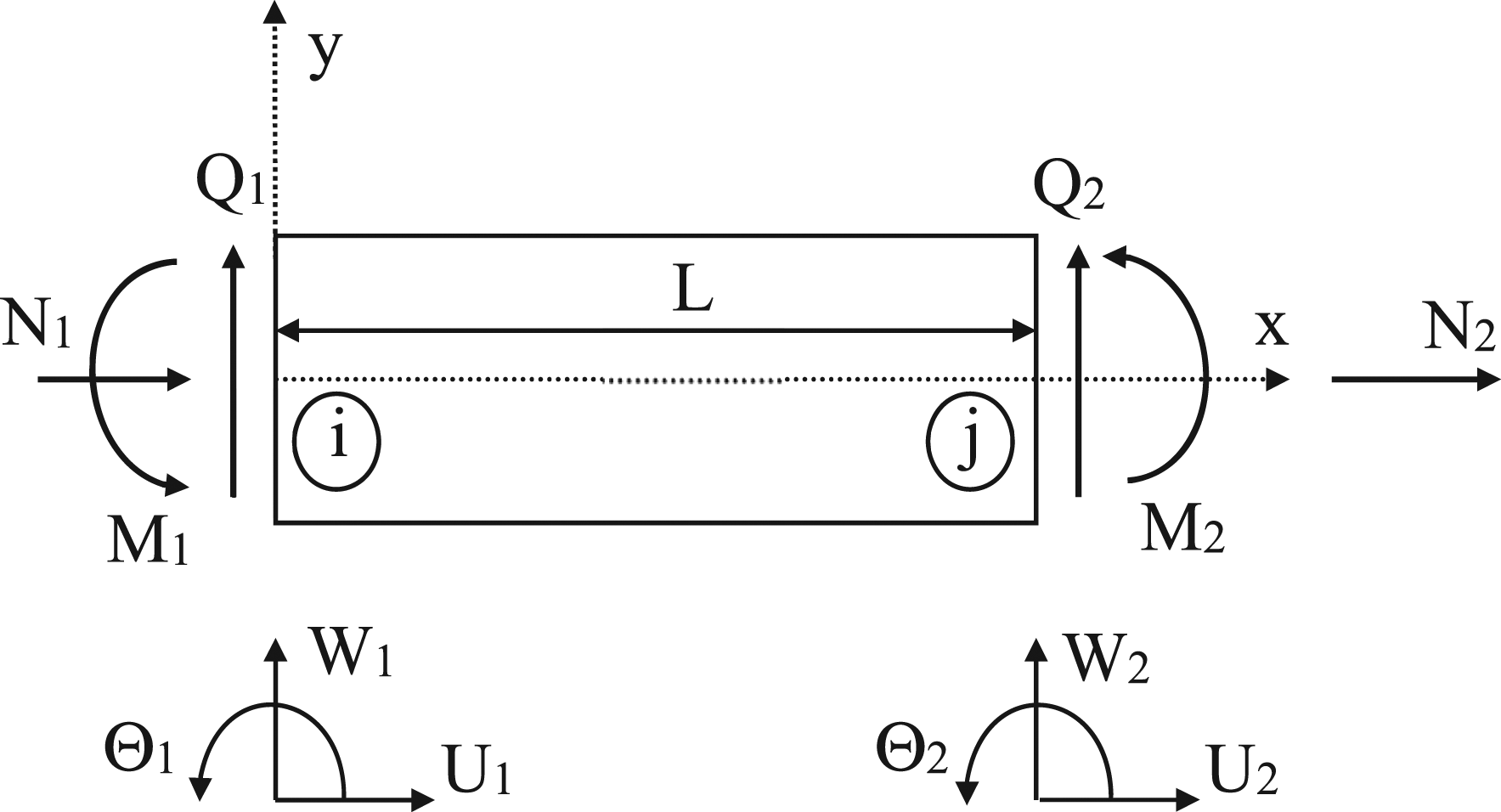


Substituting expression (25) into (28), we get


Eliminating constant vector

For a given structure that consists of a number of FGM nanobeam elements like the above, by means of balancing all the internal forces at every node of the structure, there will be obtained a total dynamic stiffness matrix




Numerical results and discussion
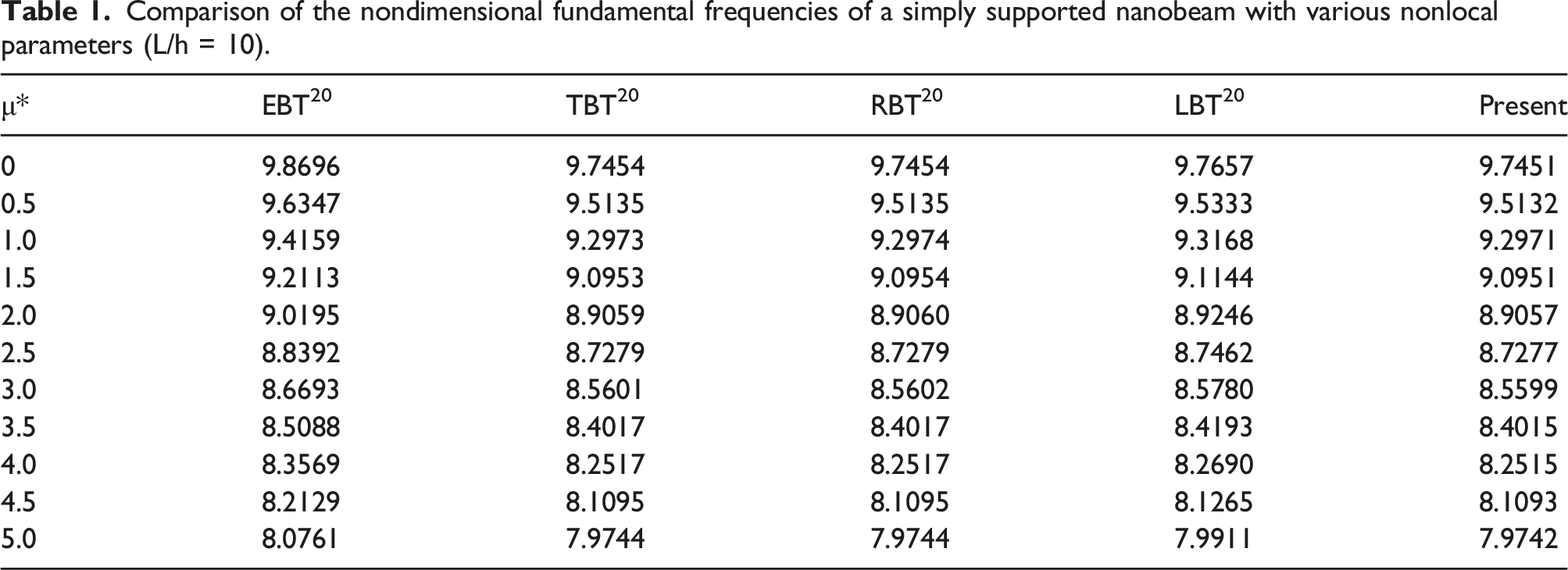
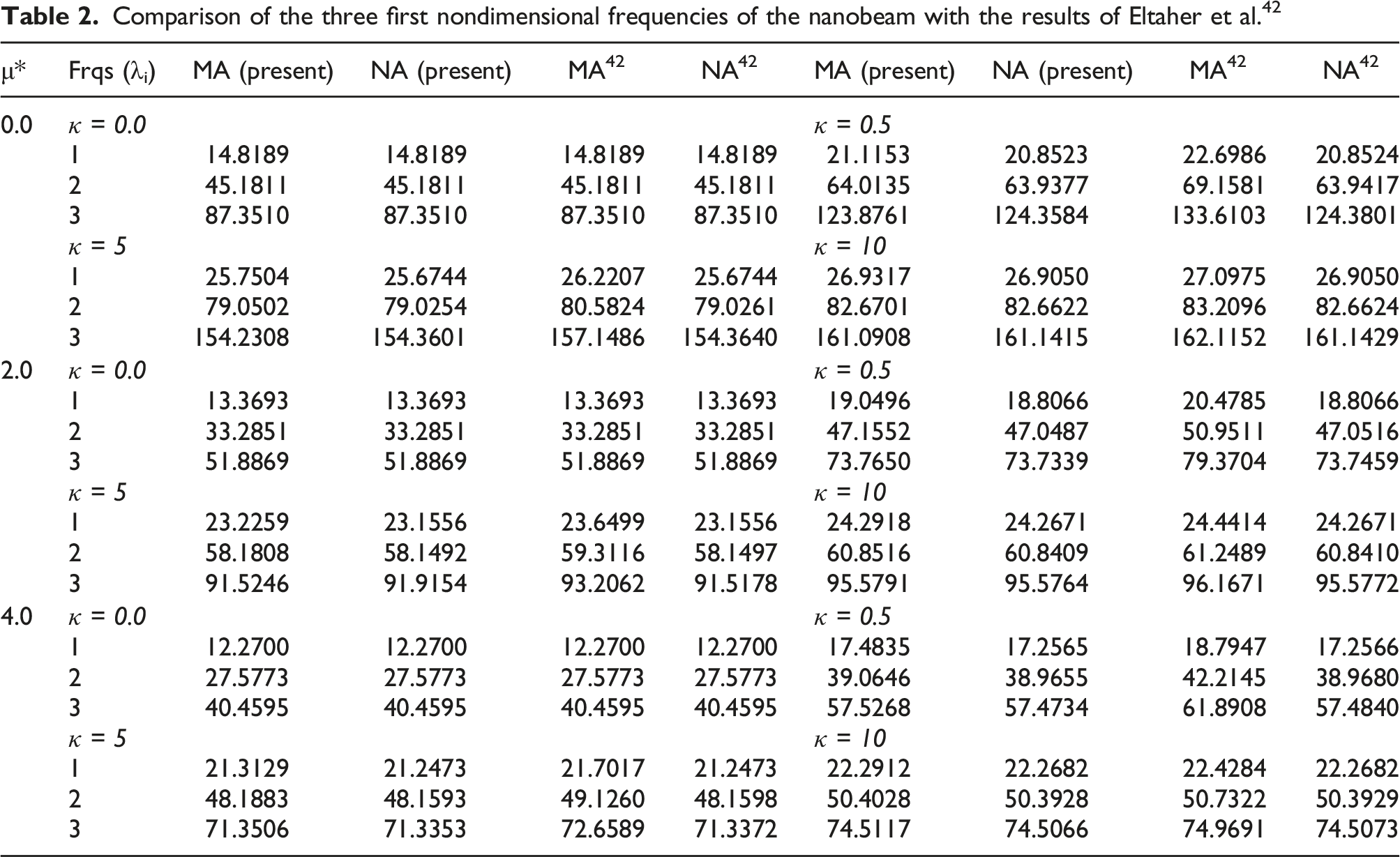
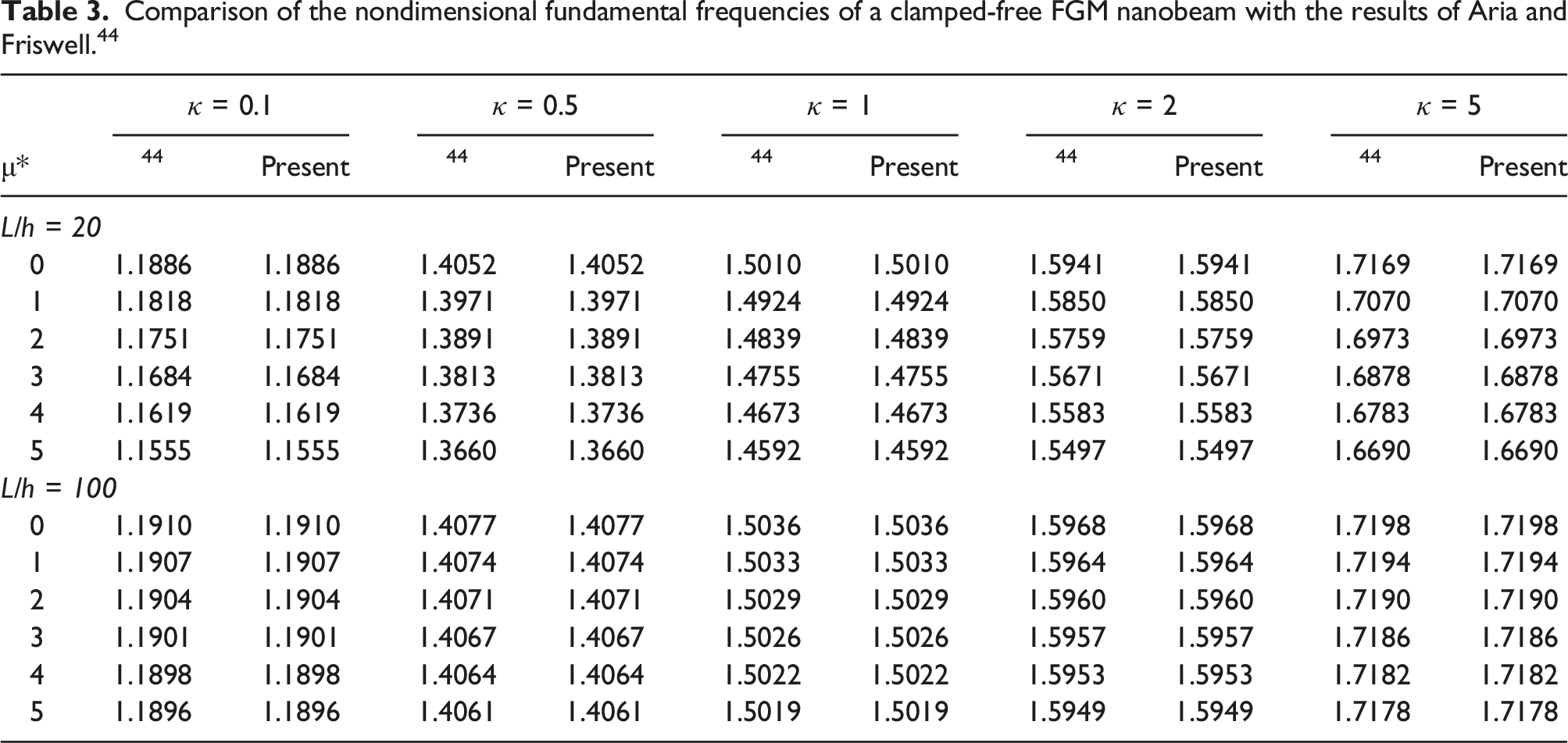
In this section, firstly, the numerical results are compared with the published results to validate the proposed DSM. Afterwards the proposed DSM is applied to show the influence of the material distribution profile, geometry, nonlocal, elastic foundation and boundary conditions on the free vibration of stepped FGM nanobeams.
Validation
Comparison of the nondimensional fundamental frequencies of a simply supported nanobeam with various nonlocal parameters (L/h = 10).
Comparison of the three first nondimensional frequencies of the nanobeam with the results of Eltaher et al. 42
Comparison of the nondimensional fundamental frequencies of a clamped-free FGM nanobeam with the results of Aria and Friswell. 44
Case study
In this subsection, the stepped FGM nanobeam with geometric and material parameters as follows: L = 10 nm, b = h = 1 nm, E
t
= 70 Gpa, ρ
t
= 2700 kg/m
3
; E
b
= 393 Gpa, ρ
b
= 3960 kg/m
3
, v
t
= v
b
= 0.3, κ = 0.5
42
will be discussed (Figure 3). Using 2 elements connected at the stepped locations, the calculated results for the three first nondimensional frequencies An FGM nanobeam with stepped height (a) and width (b).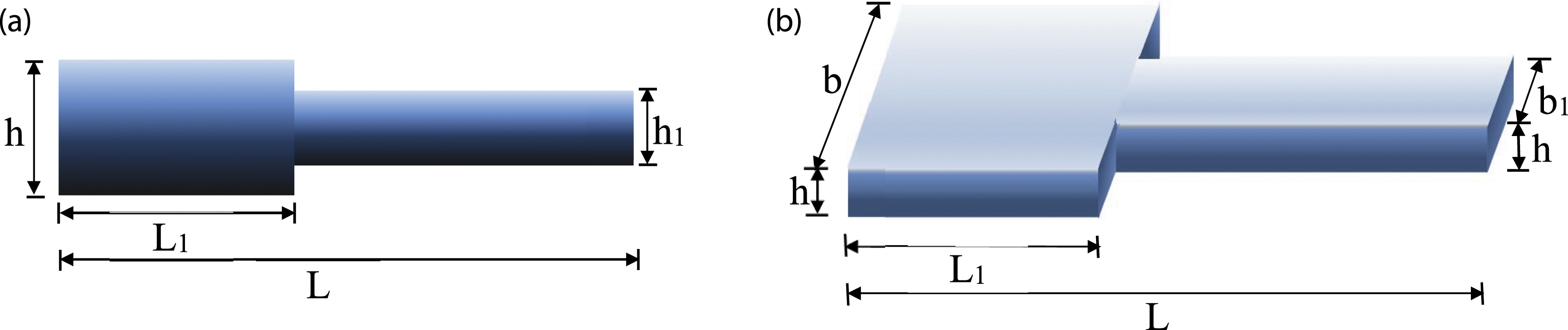
The change of nondimensional three first frequencies of stepped height and width nanobeams
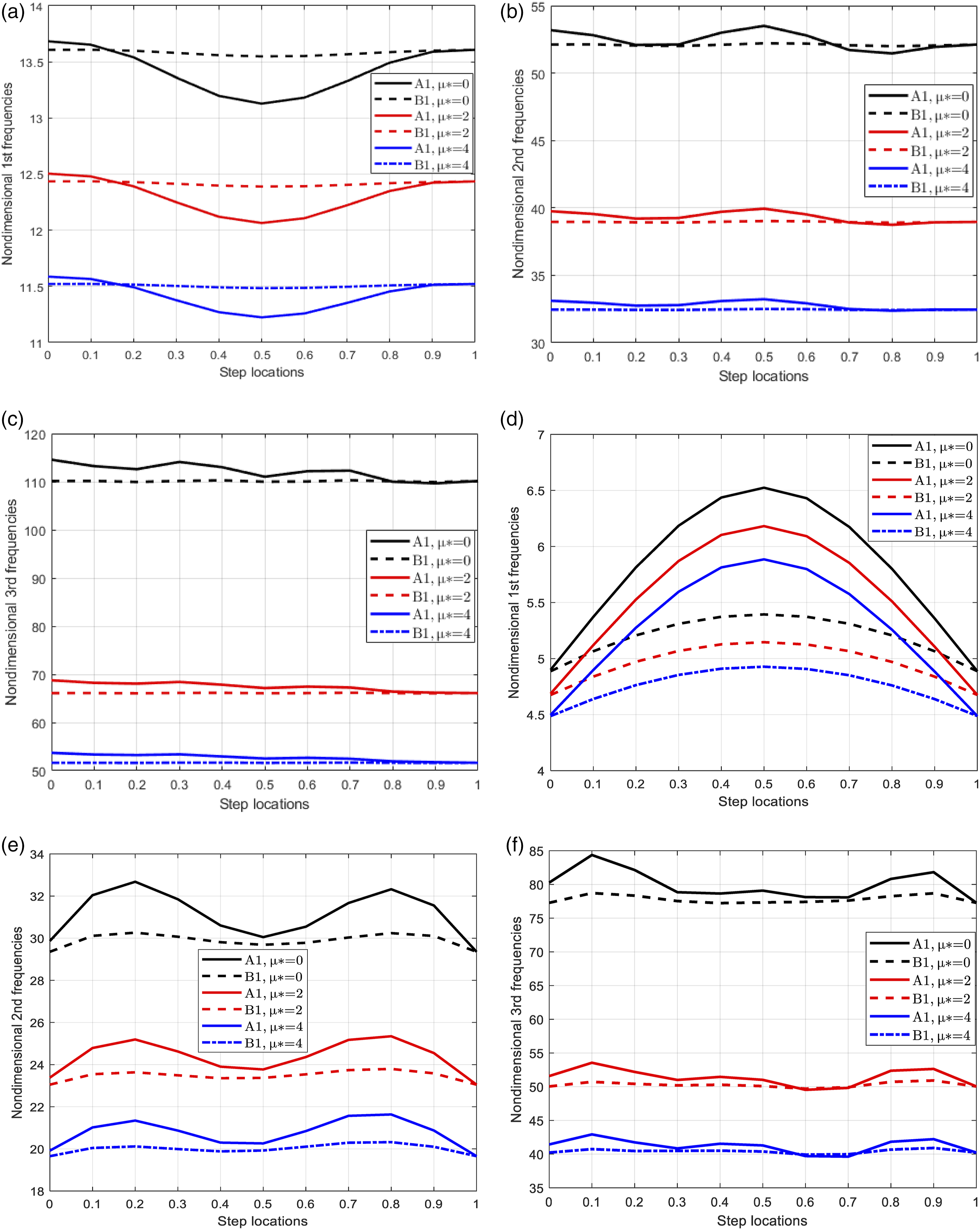
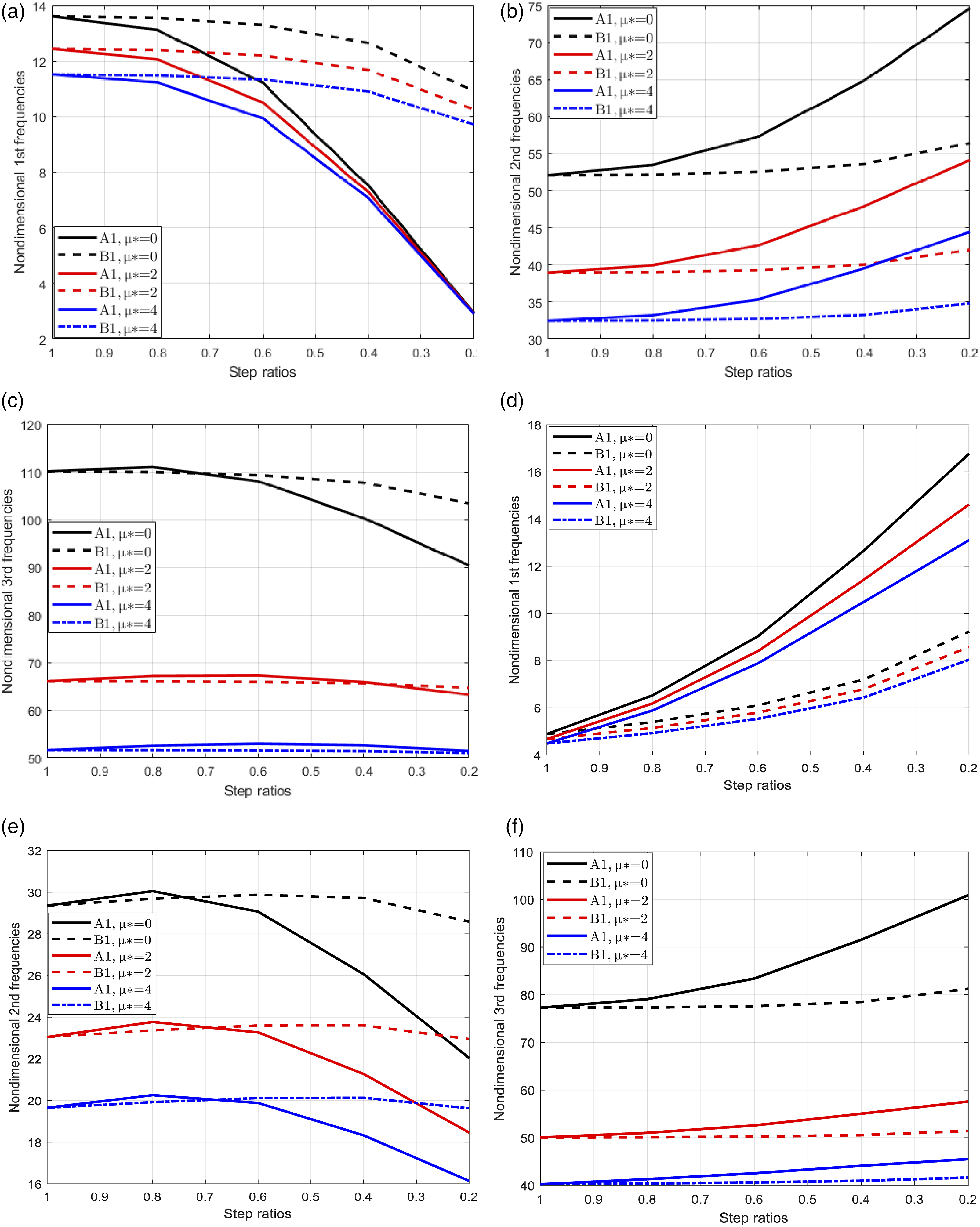
Four scenarios are studied: (A1) The nanobeam is stepped height (h1/h = 0.8) at different locations: L1/L = 0, 0.1,…, 1.0 where L1/L = 0 corresponding h1 = 0.8h on the whole beam, L1/L = 1 corresponding h1 = h along the beam. (B1) The nanobeam is stepped width (b1/b = 0.8) at different locations: L1/L = 0, 0.1,…, 1.0 where b1/b = 0 corresponding b1 = 0.8b on the whole beam, b1/b = 1 corresponding b1 = b along the beam. (A2) The nanobeam is stepped height at the location L1/L = 0.5 with different ratios: h1/h = 1, 0, 0.8,…, 0.2; (B2) The nanobeam is stepped width at the location L1/L = 0.5 with different ratios: b1/b = 1.0, 0.8,…, 0.2.
Figure 4 shows the change of nondimensional three first frequencies of stepped FGM beams with different step locations, nonlocal parameters and boundary conditions: S-S (Figure 4(a)–(c)) and C-F (Figure 4(d)–(f)). Figure 5 shows the change of nondimensional three first frequencies of stepped FGM beams at the location L1/L = 0.5 with different step ratios, nonlocal parameter and boundary conditions: S-S (Figure 5(a)–(c)) and C-F (Figure 5(d)–(f)). For all plots, the stiffness of the Winkler elastic foundation kw is equal to 0 and the volume fraction index is equal to 0.5. Observing graphs given in Figures 4 and 5 allows one to make the following remarks: (a) There exist positions on the FGM beam, step locations appeared at which makes a distinct effect on certain nondimensional frequencies. Such positions are called here critical points for a given frequency. The critical point positions from the left end of the beam are 0.5L for the first frequency with the boundary conditions S-S (Figure 4(a)) and C-F (Figure 4(d)); 0.2L and 0.8L for the second frequency with the boundary condition C-F (Figure 4(e)). (b) The first frequency of stepped FGM beams is most sensitive to the step locations, step ratios and boundary conditions. The biggest deviation of the first frequency is 3.5% (Figure 4(a)) and 78.4% (Figure 5(a)) for the boundary condition S-S, and up to 33.14% (Figure 4(d)) and 343.1% (Figure 5(d)) for the boundary condition C-F. (c) The gap between every two consecutive graphs decreases with the increasing nonlocal parameter. (d) When step ratios increase, the nondimensional fundamental frequencies in S-S boundary conditions follow the same increasing trend (Figure 5(a)) while ones in C-F boundary conditions decrease (Figure 5(d)). These changes in cases of step ratios close to 1 for the S-S boundary condition (or small step ratios for the C-F boundary condition) are more distinct from ones in cases of small step ratios (or step ratios close to 1 for the C-F boundary condition). Nondimensional three first frequencies of stepped FGM beams with different step locations, the nonlocal parameter and boundary conditions: S-S (a–c) and C-F (d–f). Nondimensional three first frequencies of stepped FGM beams at the location L1/L = 0.5 with different step ratios, the nonlocal parameter and boundary conditions: S-S (a–c) and C-F (d–f).
Because the changes of nondimensional frequencies, especially the fundamental frequency, caused by the stepped height at different locations are similar but more distinct than ones caused by stepped width, in the next, only the changes of the fundamental frequency with the stepped height are studied.
The change of nondimensional fundamental frequency of stepped height nanobeams
Figure 6 shows the changes of nondimensional fundamental frequency of stepped FGM beams with different step locations, the nonlocal parameter and the volume fraction index for the S-S (Figure 6(a)) and the C-F (Figure 6(b)) boundary conditions when the stiffness of the Winkler elastic foundation kw is equal to 0. Figure 7 shows the changes of nondimensional fundamental frequency of stepped FGM beams with different step locations, the nonlocal parameter and the nondimensional elastic foundation stiffness (a) It is shown that nondimensional fundamental frequency of the stepped nanobeam increases when the volume fraction index and the elastic foundation stiffness increases and the nonlocal parameter decreases. The changes of nondimensional fundamental frequency caused by the volume fraction index are more distinct than ones caused by the nonlocal parameter. (b) The changes of nondimensional fundamental frequency caused by the elastic foundation stiffness are more distinct than ones caused by the volume fraction index, especially for the C-F boundary condition. (c) The graphs between the nondimensional fundamental frequency and step locations with elastic foundation stiffness (or the volume fraction index) have not two parts that are the same in size and shape like ones without the elastic foundation stiffness. When step locations close to 1, the fundamental frequency decreases considerably while the nonlocal parameter increases. The changes of nondimensional fundamental frequency of stepped FGM beams with different step locations, the nonlocal parameter and the volume fraction index for boundary conditions: (a) S-S, (b) C-F. For all plots, the stiffness of the Winkler elastic foundation kw is equal to 0. The changes of nondimensional fundamental frequency of the stepped FGM nanobeam with different step locations, the nonlocal parameters and the nondimensional elastic foundation stiffness for boundary conditions: (a) S-S, (b) C-F. For all plots, the volume fraction index is equal to 0.5. The changes of nondimensional fundamental frequency of the stepped FGM nanobeam with different step locations, the volume fraction index and elastic foundation stiffness for boundary conditions: (a): S-S, (b): C-F. For all plots, the nonlocal parameter is equal to 2. The changes of nondimensional fundamental frequency of stepped FGM beams with different step ratios, the nonlocal parameter and the volume fraction index for boundary conditions (a) S-S, (b) C-F. For all plots, the stiffness of the Winkler elastic foundation kw is equal to 0.
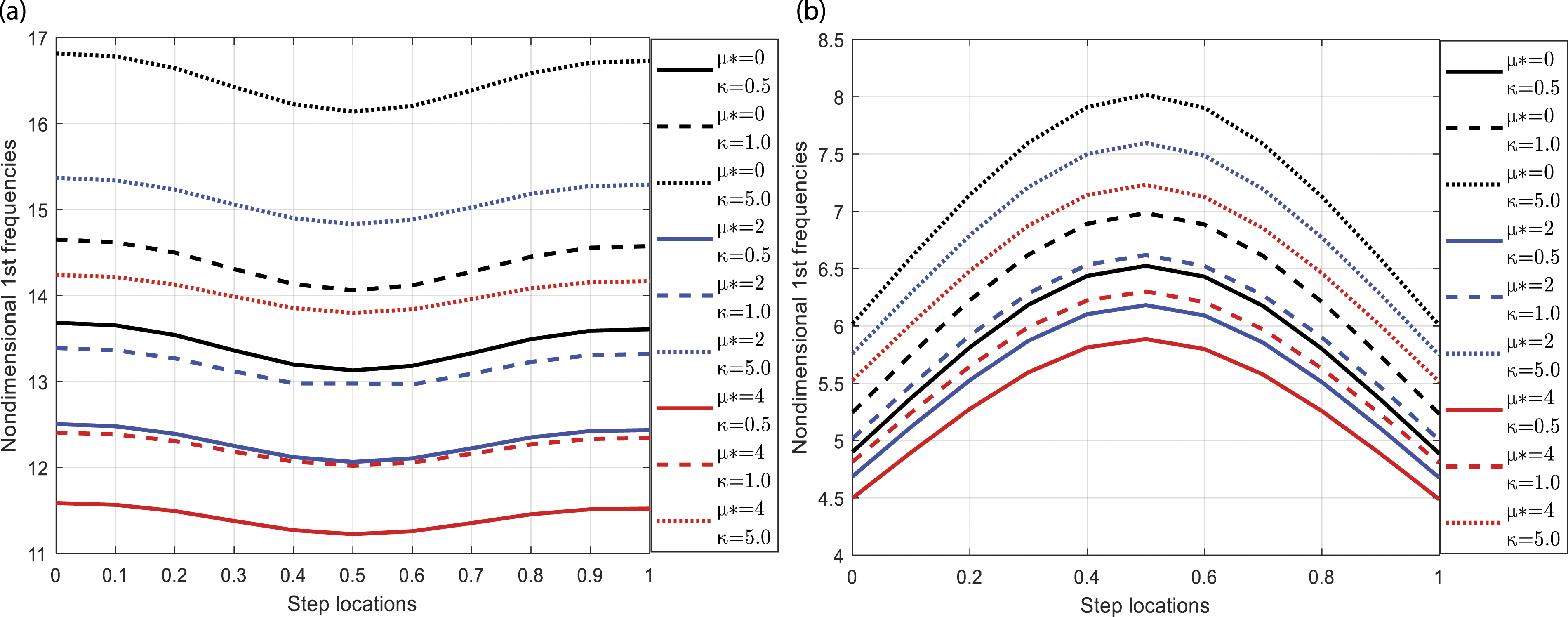
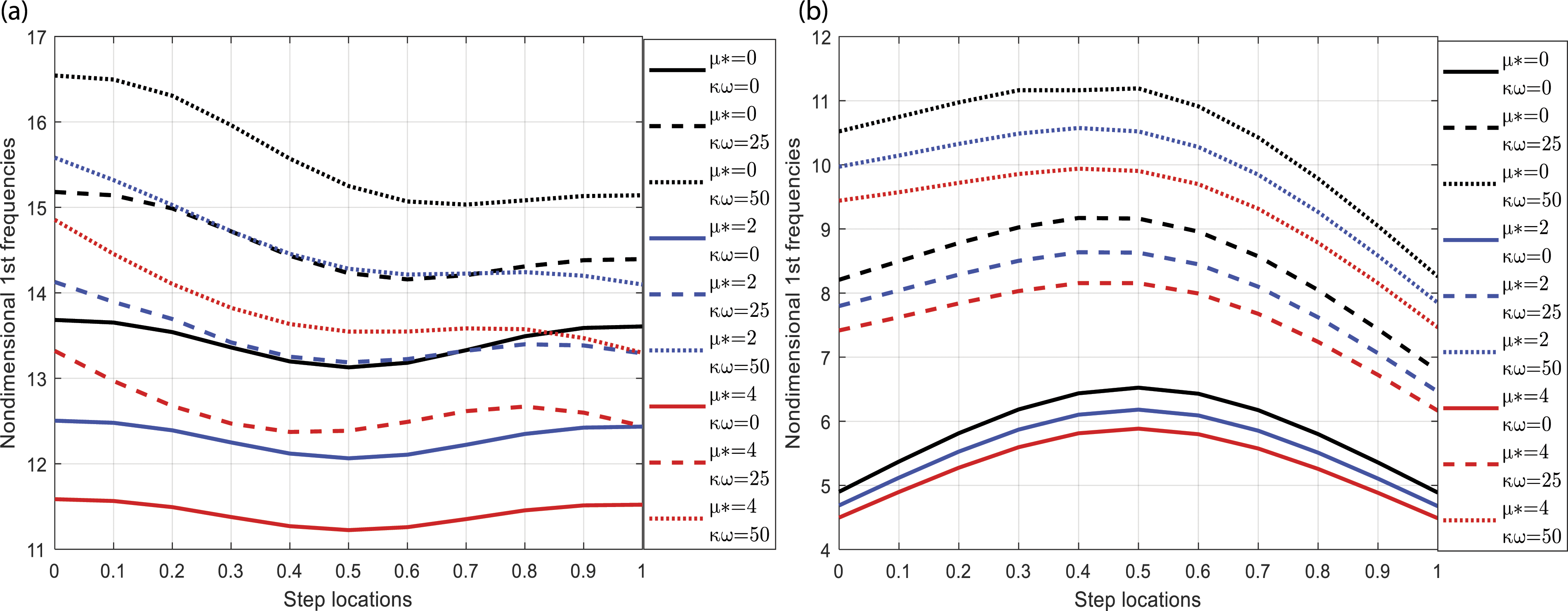
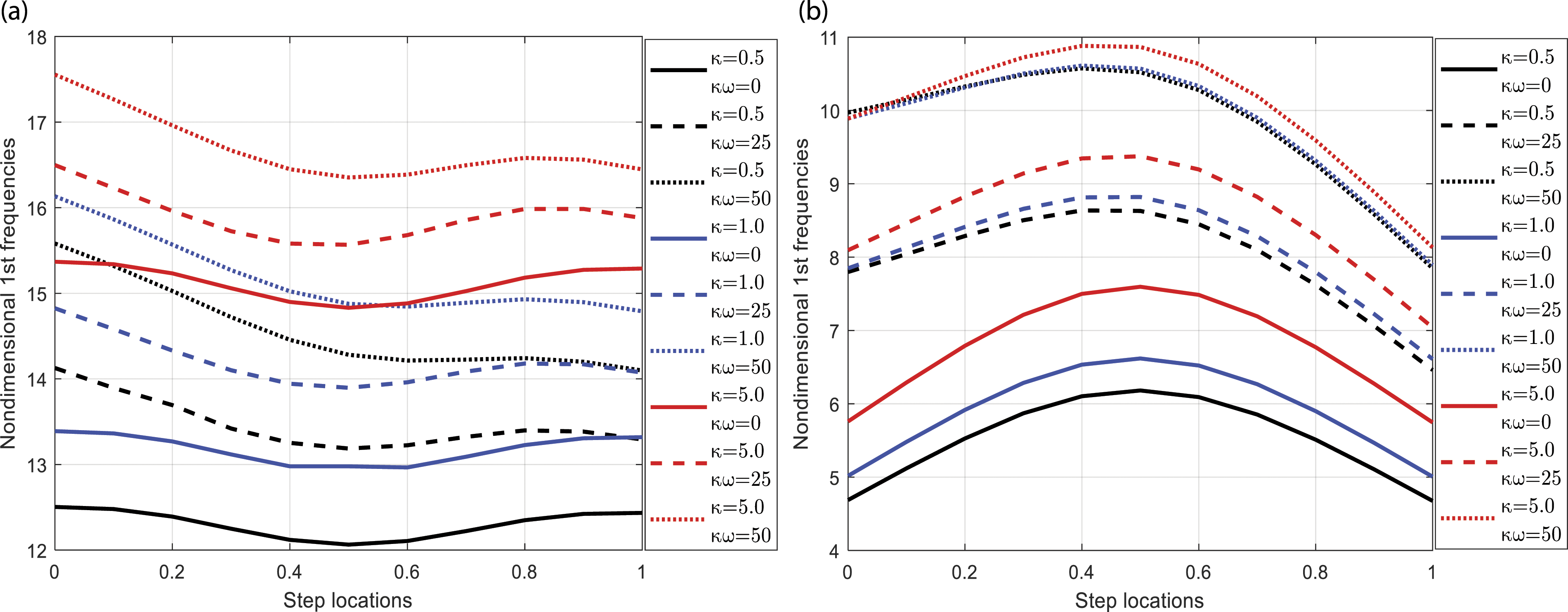
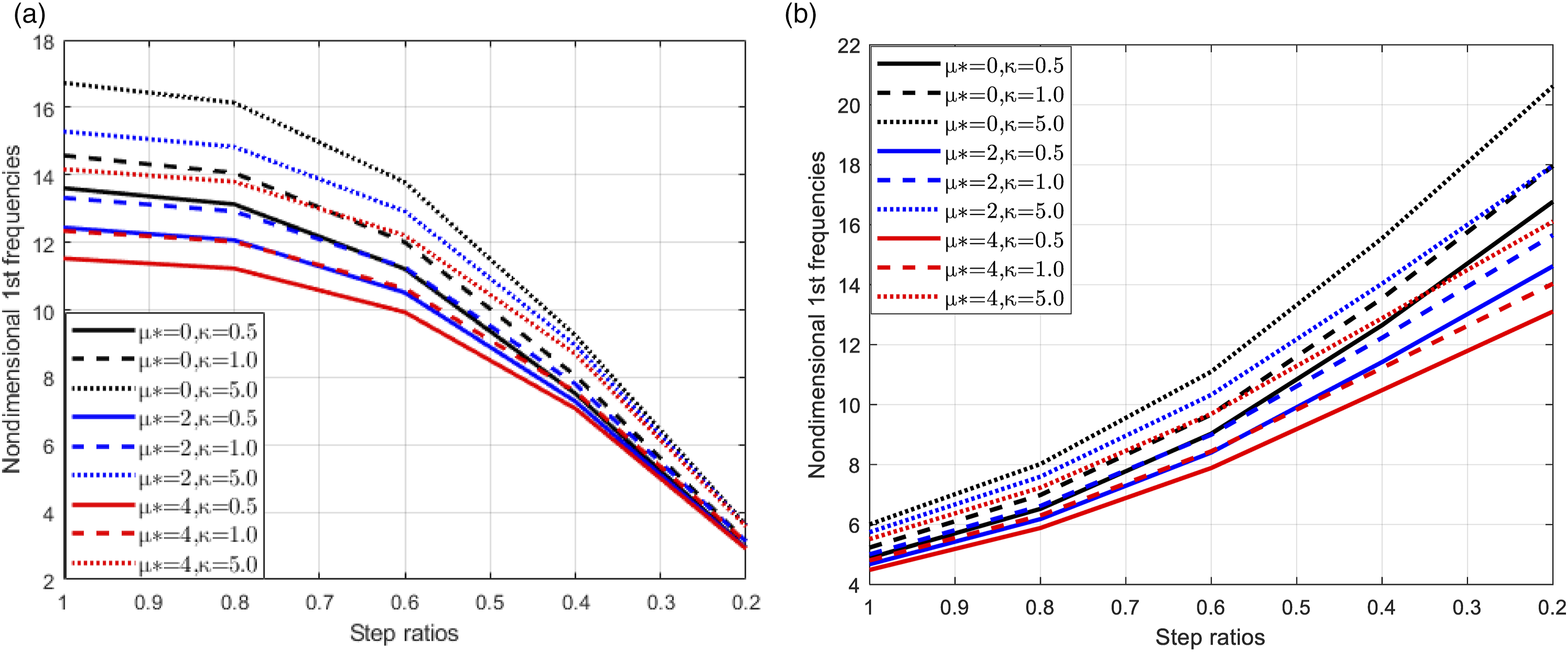
Figure 9 shows the changes of nondimensional fundamental frequency of stepped FGM beams at the location L1/L = 0.5 with different step ratios, the nonlocal parameter and the volume fraction index for the S-S (Figure 9(a)) and the C-F (Figure 9(b)) boundary conditions when the stiffness of the Winkler elastic foundation kw is equal to 0. Figure 10 shows the change of nondimensional fundamental frequency of stepped FGM beams at the location L1/L = 0.5 with different step ratios, the nonlocal parameter and nondimensional elastic foundation stiffness for the S-S (Figure 10(a)) and the C-F (Figure 10(b)) boundary conditions when the volume fraction index is equal to 0.5. Figure 11 shows the change of nondimensional fundamental frequencies of stepped FGM beams at the location L1/L = 0.5 with different step ratios, volume fraction index and nondimensional elastic foundation stiffness for the S-S (Figure 11(a)) and C-F (Figure 11(b)) boundary conditions when the nonlocal parameter is equal to 2. Observing graphs given in Figures 9, 10 and 11 allows one to make the following remarks: (a) When step ratios increase, the nondimensional fundamental frequency for the S-S boundary condition follows the same increasing trend while ones for the C-F boundary condition decrease. These changes in cases of step ratios close to 1 for the S-S boundary condition (or small step ratios for the C-F boundary condition) are more distinct from ones in cases of small step ratios (or step ratios close to 1 for the C-F boundary condition). (b) In case of small step ratios, the changes of nondimensional fundamental frequency caused by the nonlocal parameter are more distinct than ones caused by the elastic foundation stiffness and the volume fraction index, especially for the S-S boundary condition (Figures 10(a)–11(a)). Moreover, considering the stiffness of elastic foundations, the nondimensional fundamental frequency of the cantilever beam gradually decreases when step ratios are less than 0.3 (Figures 10(b)–11(b)). The changes of nondimensional fundamental frequency of stepped FGM beams with different step ratios, the nonlocal parameter and the nondimensional elastic foundation stiffness for boundary conditions: (a) S-S, (b) C-F. For all plots, the volume fraction index is equal to 0.5. The changes of nondimensional fundamental frequency of stepped FGM beams with different step ratios, the nonlocal parameter and the volume fraction index for boundary conditions (a) S-S, (b) C-F. For all plots, the nonlocal parameter is equal to 2.
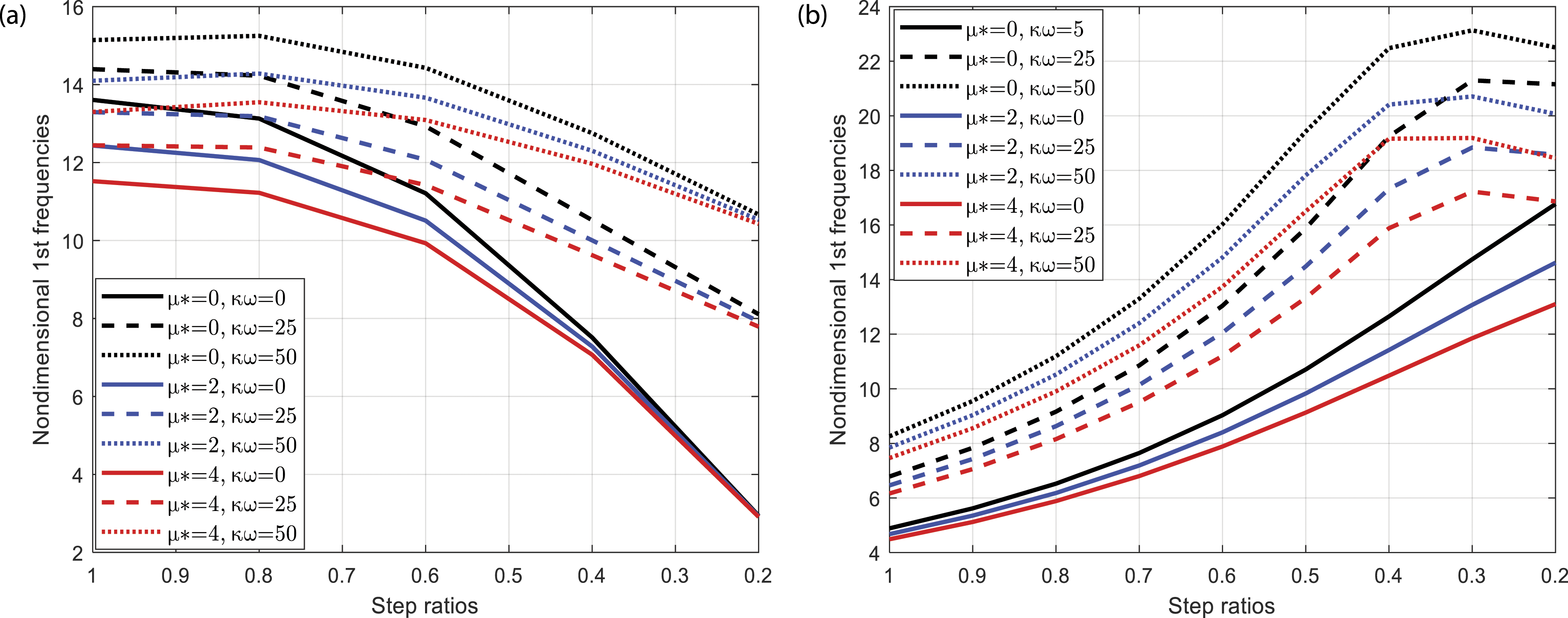
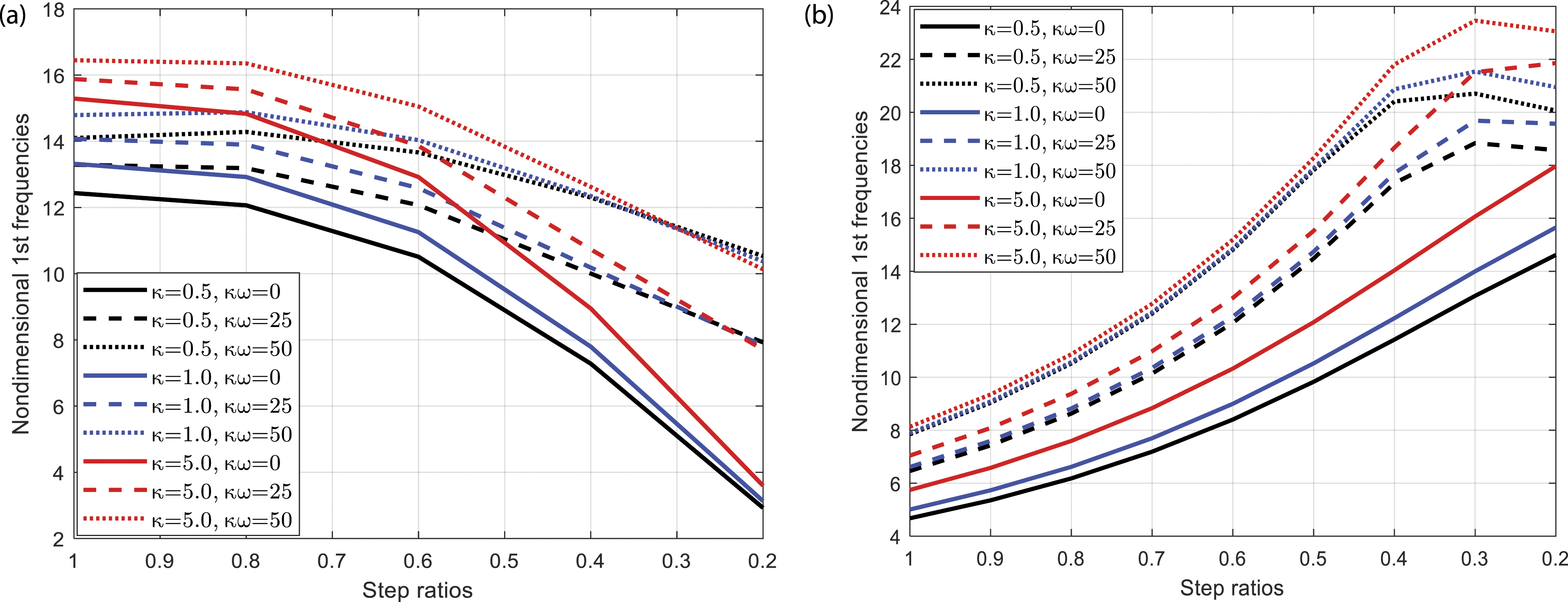
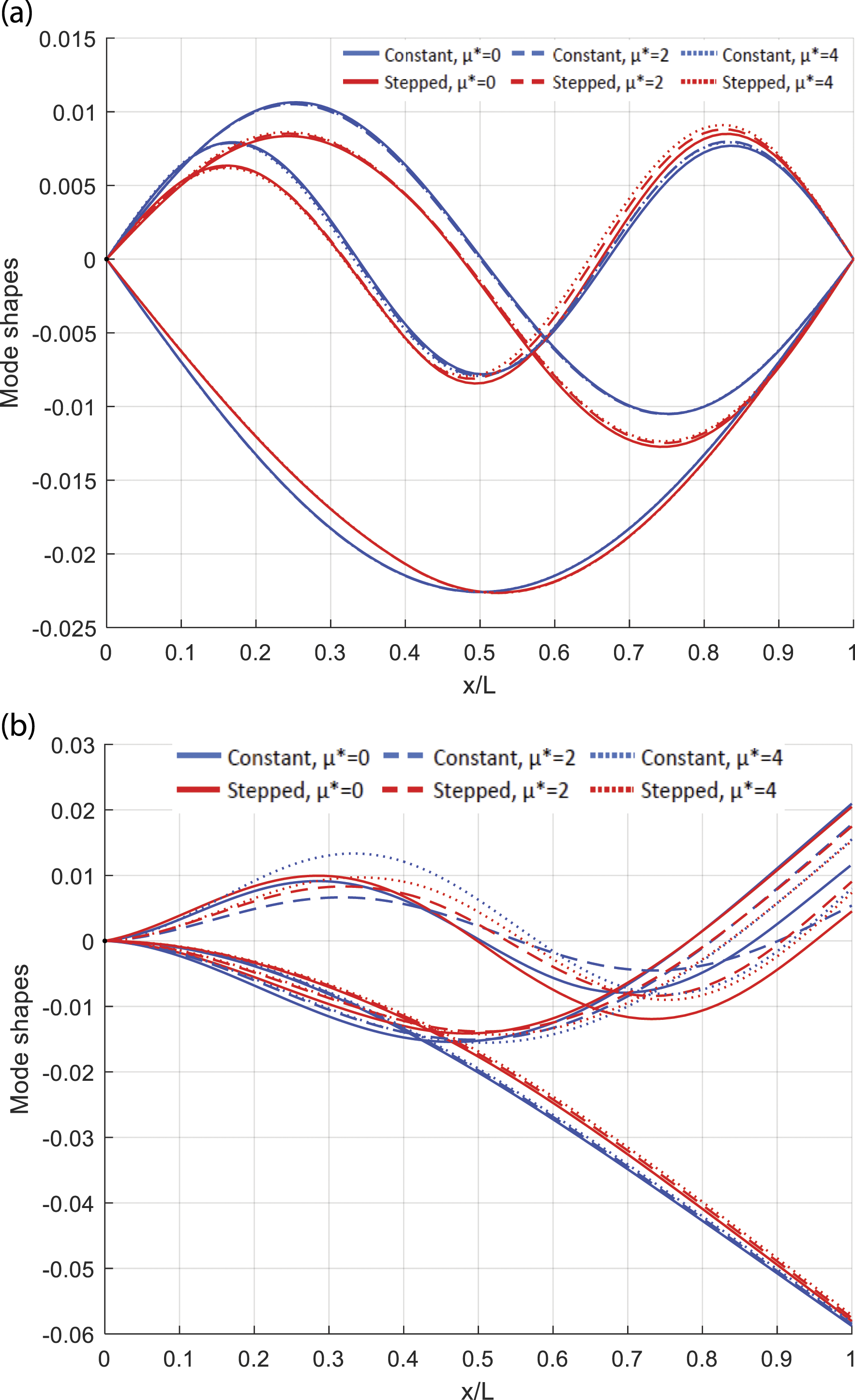
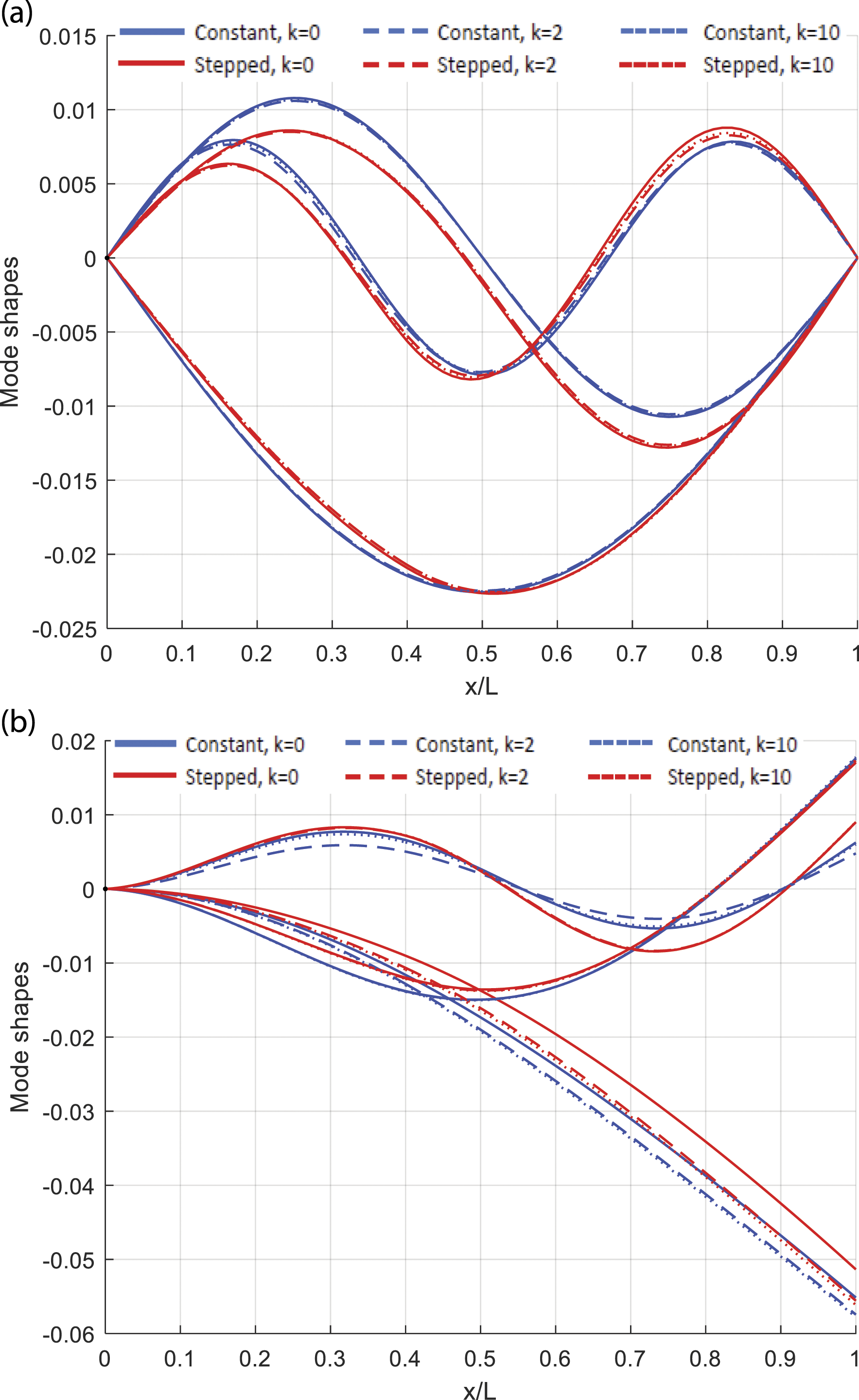
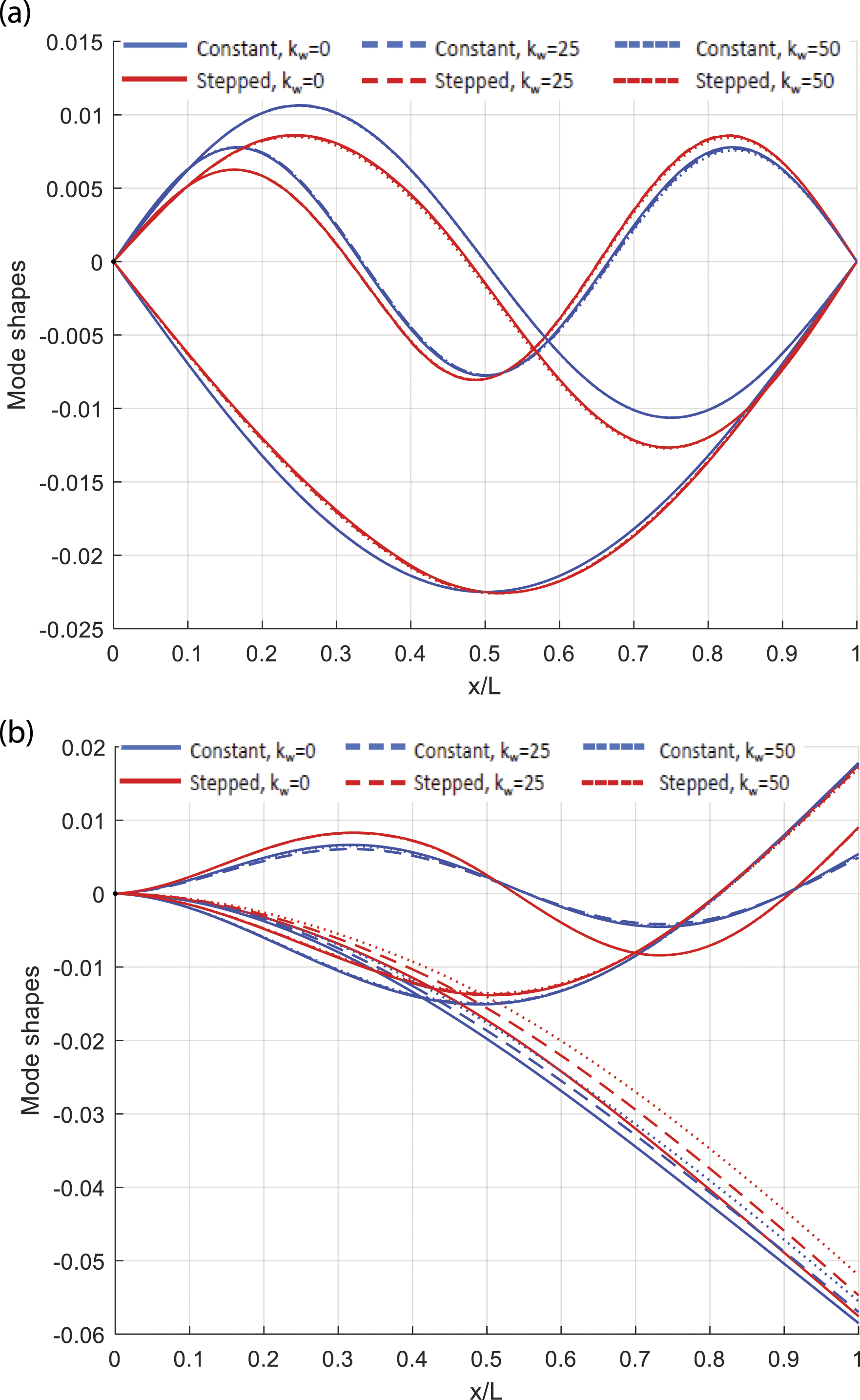
Figure 12 shows the three first mode shapes of the FGM nanobeam with non-stepped (constant) cross-section (blue lines) and with stepped cross-section at x = 0.5 L (red lines) considering different nonlocal parameters and boundary conditions S-S (Figure 12(a)), C-F (Figure 12(b)) when the nondimensional stiffness of the elastic foundation kw is equal to 0 and the volume fraction index is equal to 0.5. Figure 13 shows the three first mode shapes of the FGM nanobeam with non-stepped (constant) cross-section (blue lines) and with stepped cross-section at x = 0.5 L (red lines) considering with different volume fraction indexes and boundary conditions S-S (Figure 13(a)), C-F (Figure 13(b)) when the nonlocal parameter is equal to 2 and the nondimensional stiffness of the elastic foundation kw is equal to 25. Figure 14 shows the three first mode shapes of the FGM nanobeam with non-stepped (constant) cross-section (blue lines) and with stepped cross-section at x = 0.5 L (red lines) considering with different elastic foundation stiffness and boundary conditions S-S (Figure 14(a)), C-F (Figure 14(b)) when the nonlocal parameter is equal to 2 and the volume fraction index is equal to 0.5. Observing graphs given in the Figures 12, 13 and 14 allows one to make the following remarks: (a) For the S – S boundary condition, the changes of mode shapes of the non-stepped and stepped nanobeams caused by the nonlocal parameter, the volume fraction index and the elastic foundation stiffness are small changes. So in the first approximation, mode shapes of homogeneous nanobeams can be used to study free vibrations of FGM nanobeams. (b) Conversely, for the C-F boundary condition, the changes of mode shapes, especially for higher mode shapes, of the non-stepped and stepped nanobeams caused by the nonlocal parameter, the volume fraction index and the elastic foundation stiffness are more distinct. (c) In addition, the changes of mode shapes of the stepped and non-stepped cantilevers caused by nonlocal parameters are more distinct than ones caused by the volume fraction index and the elastic foundation stiffness, especially for higher mode shapes. (d) And for the C-F boundary condition, the changes of the mode shapes of the stepped nanobeams caused by nonlocal parameters are clearer than the changes of the non-stepped nanobeams, especially for higher mode shapes. The three first mode shapes of the FGM nanobeam with different nonlocal parameters and boundary conditions S-S (a), C-F (b). For all plots, the nondimensional stiffness of the Winkler elastic foundation kw is equal to 0 and the volume fraction index is equal to 0.5. The three first mode shapes of the FGM nanobeam with different volume fraction indexes and boundary conditions S-S (a), C-F (b). For all plots, the nonlocal parameter is equal to 2 and the nondimensional stiffness of the Winkler elastic foundation kw is equal to 25. The three first mode shapes of the FGM nanobeam with different foundation stiffness and boundary conditions S-S (a), C-F (b). For all plots, the nonlocal parameter is equal to 2 and the volume fraction index is equal to 0.5.
Conclusion
In the present article, a nonlocal DSM is developed to investigate the free vibration of stepped FGM nanobeams on a Winkler foundation based on NET and Timoshenko beam theory. The DSM fulfilled the gap of FEM by using frequency-dependent shape functions that are found as an exact solution of the vibration problem in the frequency domain and can capture all necessary high frequencies and mode shapes of interest. This nonlocal DSM has overcome the stiffening phenomena of the cantilever beam fundamental frequency by using the variational-consistent boundary conditions. Comparison with published results of other authors shows the reliability of the proposed nonlocal DSM.
On that basis, the influence of nonlocal parameters, materials, geometric parameters, boundary conditions and the stiffness of elastic foundations on the vibration frequencies and mode shapes of stepped FGM nanobeams is investigated. The results obtained from this paper show that there exist critical points, step location at which makes distinct effect on a given frequency. The nondimensional fundamental frequency of stepped FGM nanobeams is most sensitive to the step locations, step ratios and boundary conditions. Also, the changes of the fundamental frequency of the stepped nanobeams caused by the elastic foundation stiffness and the volume fraction index are more distinct than ones caused by nonlocal parameters. The changes of nondimensional frequencies caused by the stepped height at different locations are more distinct than ones caused by the stepped width.
It is shown that the changes of mode shapes of the non-stepped and stepped nanobeams with the simply supported at two ends caused by the nonlocal parameter, the volume fraction index and the elastic foundation stiffness are small changes. So in the first approximation mode shapes of homogeneous nanobeams can be used to study free vibrations of FGM nanobeams. Conversely, the changes of mode shapes, especially for higher mode shapes, of the non-stepped and stepped cantilever nanobeams caused by the nonlocal parameter, the volume fraction index and the elastic foundation stiffness are more distinct. In addition, the changes of mode shapes of the stepped and non-stepped cantilevers caused by nonlocal parameters are more distinct than ones caused by the volume fraction index and the elastic foundation stiffness, especially for higher mode shapes. And the changes of the mode shapes of the stepped cantilever nanobeams caused by nonlocal parameters are clearer than the changes of the non-stepped nanobeams.
All the mentioned notices are useful indication for vibration analysis in FGM nanostructures. The study can be applied to more complex multiple stepped nanostructures.
Footnotes
Declaration of conflicting interests
The author(s) declared no potential conflicts of interest with respect to the research, authorship, and/or publication of this article.
Funding
The author(s) disclosed receipt of the following financial support for the research, authorship, and/or publication of this article: This research is funded by Hanoi University of Civil Engineering under grant number 32-2022/KHXD-TĐ.
