




Abstract
In the current paper, the problem of sextic anharmonic oscillators is investigated. There are three integrable cases of this problem. Emphasis is placed on two integrable cases, and a full description of each one is provided. The separated functions of the first and second integrability cases are transformed from a higher degree to the third and fourth degrees. Respectively, the periodic solution is obtained using Jacobi’s elliptic functions. The topology of phase space and Liouville tori’s bifurcations are discussed. The phase portrait is studied to determine singular points and classify their types in addition to the graphic representation for each of them. Finally, the numerical illustrations are introduced using the Poincaré surface section to emphasize the problem’s integrability.
Keywords
Introduction
It is known that the
Periodic solutions for the rigid body (RB) problem utilizing the small parameter method of Poincaré (SPMP), averaging method (AM), and other approaches had shed the attention of researchers during the recent decades.5–23 The SPMP and its modifications are utilized in Refs. 5–11 to reduce the EOM for the EOM of the regulating system and their first-integrals into a suitable system of two second-order equations and only one integral. When the system’s frequency has integer values or their inverses, it is possible to construct approximate solutions for the latter system; however, these solutions comprise different singular points.5–7 When the gyro moment (GM) around the third major axis is used, these singularities are dealt with in Ref. 8, as well as in Ref. 9, in accordance with the instance of Kovalevskaya. This method was most recently applied in Ref. 10 to investigate the movement of the RB in accordance with Bobylev–Steklov requirements when the body was impacted by the GM and various attracting fields. Furthermore, the authors of Ref. 11 proposed that the body’s center of mass is somewhat shifted from the axis of dynamic symmetry and that it is affected by the electromagnetic field and the general magnetic field. It is important to note that the obtained solutions have no singular points at all and can be adjusted to any value of the body’s frequency. On the flip side, one can look at Refs. 12–17 to investigate how the strategy of this approach might be applied to address various SB’s issues.
The AT, which has seen a lot of application over the last three decades, was employed in Refs. 18–23 to find the solutions for a symmetric RB spinning around a fixed point. This motion is studied in three specific circumstances: a uniform gravity field,18,19 an external attracting center,20,21 and in the presence of GM.22,23 When the perturbing moments are assumed to be acting along the axes of inertia of the primary body, these situations are investigated. Based on some of the initial conditions, a small parameter is introduced to the EOM. The averaging systems of the various EOM are recognized and solved to achieve the desired solutions. In Ref. 24, the authors proposed a Hamiltonian formulation of a conservative oscillator to determine the frequency property. The theory of fractal variational is used in Ref. 25 to establish the fractal Toda oscillator, and the non-perturbative method is employed to obtain the appropriate analytical solution.
The problem of an anharmonic oscillator plays a significant role in different fields of applied mechanics. For example, in quantum mechanics, Dutt and Lakshmanan 26 studied the classical nonlinear quantum oscillator in chemical physics. However, Lakshmanan and Prabhakaran 27 found the energy levels of the sextic anharmonic oscillator. At the same time, many articles regarding galaxies dynamics have been examined in astrophysics for quartic, quantic, and sextic anharmonic oscillators. In Ref. 28, the authors introduced AM of first order in order to obtain the existence of four periodic solutions of the generalization of (FRW) potential. In Ref. 29, the Hamiltonian function of fifth degree with two real parameters has been studied to obtain the conditions on the two parameters and to determine the periodic solutions with the help of AM, while in Ref. 30, the authors discussed the Hamiltonian function of fifth degree with three real parameters using the same method of second order and proved the existence of periodic solutions. In Ref. 31, the authors studied the periodic orbits for the sextic anharmonic oscillator function using two different methods.
The main objective of this paper is to get a full description of the sextic coupled anharmonic oscillator,
32
which is a model of elliptic galaxies motion, defined as

The integrability and the second invariant
The EOM associated with the potential function

By using the ARS conjecture, in which the above equations possess the P-property,
32
the necessary integrability conditions are

To claim the integrability, it is required to get an additional integral (invariant integral) which is independent of the energy integral.
In the first case (i) and by using the transformations

The Hamiltonian function becomes

Therefore, the problem becomes separable, and the integrals of motion are


Adding the two equations (5) and (6), to get

Hence, from Hamiltonian equations
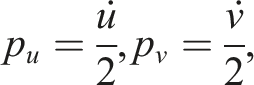
we get

It should be noted that from (3), we have

Thus, from equation (9), the second invariant integral becomes

In the second case (ii), and by using the polar coordinates

The Hamiltonian function of equation (1) takes the form

As is well known, the variable

With the help of equation (11), the invariant integral becomes

Finally, for the last case of Lakshmanan and Sahadevan,
32
which is denoted previously by (iii), the corresponding potential function is

The parabolic coordinates that make the system of the case (iii) separable are

Therefore, the Hamiltonian function becomes

It is easy to obtain the integrals of motion in the following way


The second integral

Furthermore, with the help of equation (15), the second invariant integral can be written in the form

The first case of integrability
This section aims to discuss the integrability of case (i) in the previous section. The separation of the problem is explained, and the periodic solution is studied using Jacobi’s elliptic function. As well as the topological analysis of the problem, the singular points of the separated functions are specified through the study of the phase portrait.
Integration of the problem
In this subsection, we are going to find the periodic solution of the Hamiltonian system (4) using Jacobi’s elliptic function. Returning to equations (5) and (6), which can be reformulated as


An inspection of the previous equation shows that it is of the sixth degree, in which its solution can be found by reducing its degree.
34
In order to achieve this aim, we consider

Therefore, equation (22) becomes


Hence, integrals (21) become

Let us consider the following relations
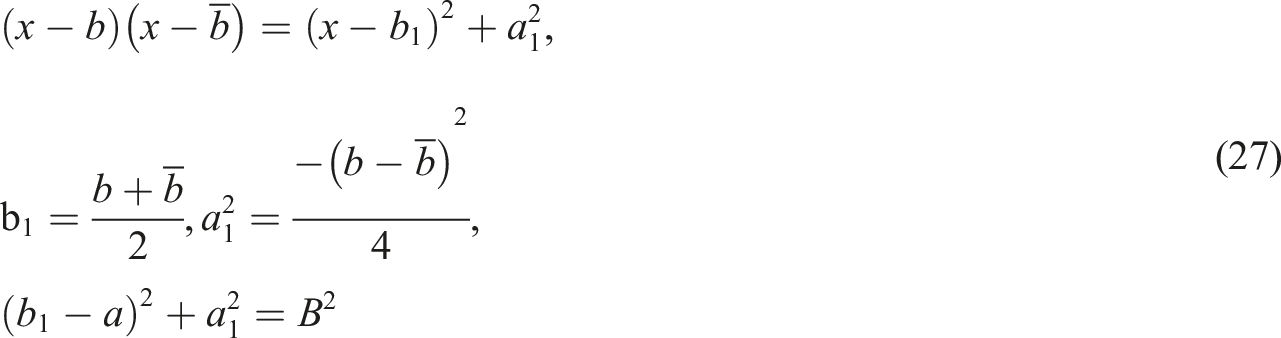
Then,

Taking into account the above equation, we can consider that

Referring to equations (28) and (29), equation (26) becomes

Therefore, the solution of (30) can be expressed in the following form


Making use of equations (23) and (31), to get


with the period

Topological analysis
In the current section, we examine the topological analysis of the real invariant manifold utilizing the theory of Fomenko. 33 The Fomenko classification had been investigated in several areas in mechanics: in Celestial Mechanics, El-Sabaa et al. 35 studied the bifurcation of the problem of two fixed centers. The bifurcation set was constructed by Vozmischeva36–38 in which the domain of possible motion on the configurational space was classified, while Waalkens et al. 39 studied the bifurcation in the topology of energy surfaces for the motion in three dimensions. In El-Sabaa et al., 40 the bifurcation of AGK galactic potential was analyzed. In Refs. 41 and 42, the authors studied the bifurcation of invariant manifolds in the GHH system and discussed the bifurcation of the common level set of the first integral of Kovalevskaya’s case for the problem of a RB. In addition, the bifurcation of Liouville tori for the different cases of the RB rotation around one fixed point of its configuration is studied. 43
The common level set of the first integral is investigated with a view to the phase space analysis. Fomenko classification is used to describe all generic bifurcation of Liouville tori. Therefore, the definitions below are introduced.
44
1. The function 2. When the rank 3. The bifurcation diagram is the set 4. The set of all critical points of the momentum mapping
In our problem, the level sets have the topology

The energy-momentum diagram can be estimated according to the set of critical points

If

The topological sort of Shows the bifurcation portraits 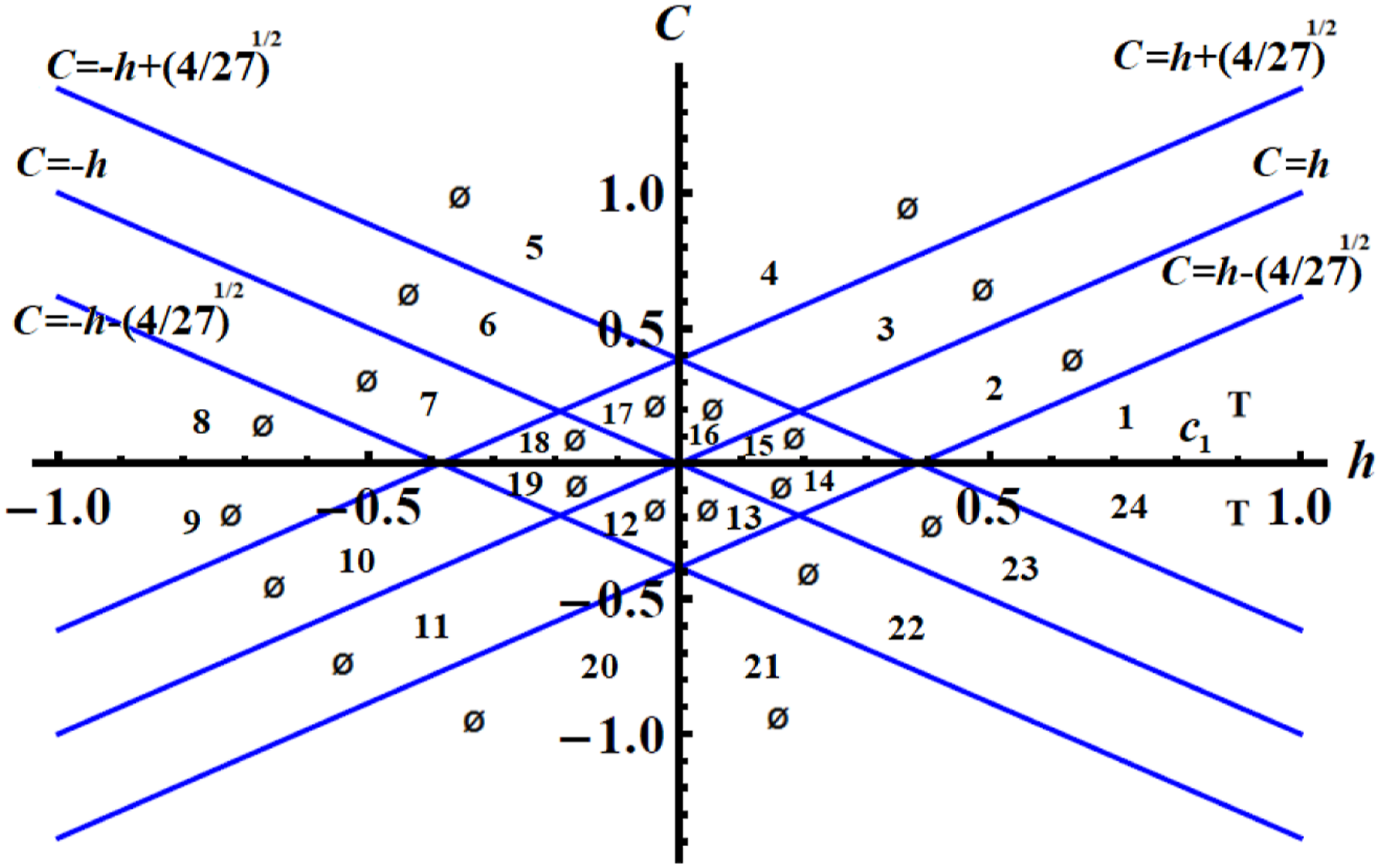

Topological type of
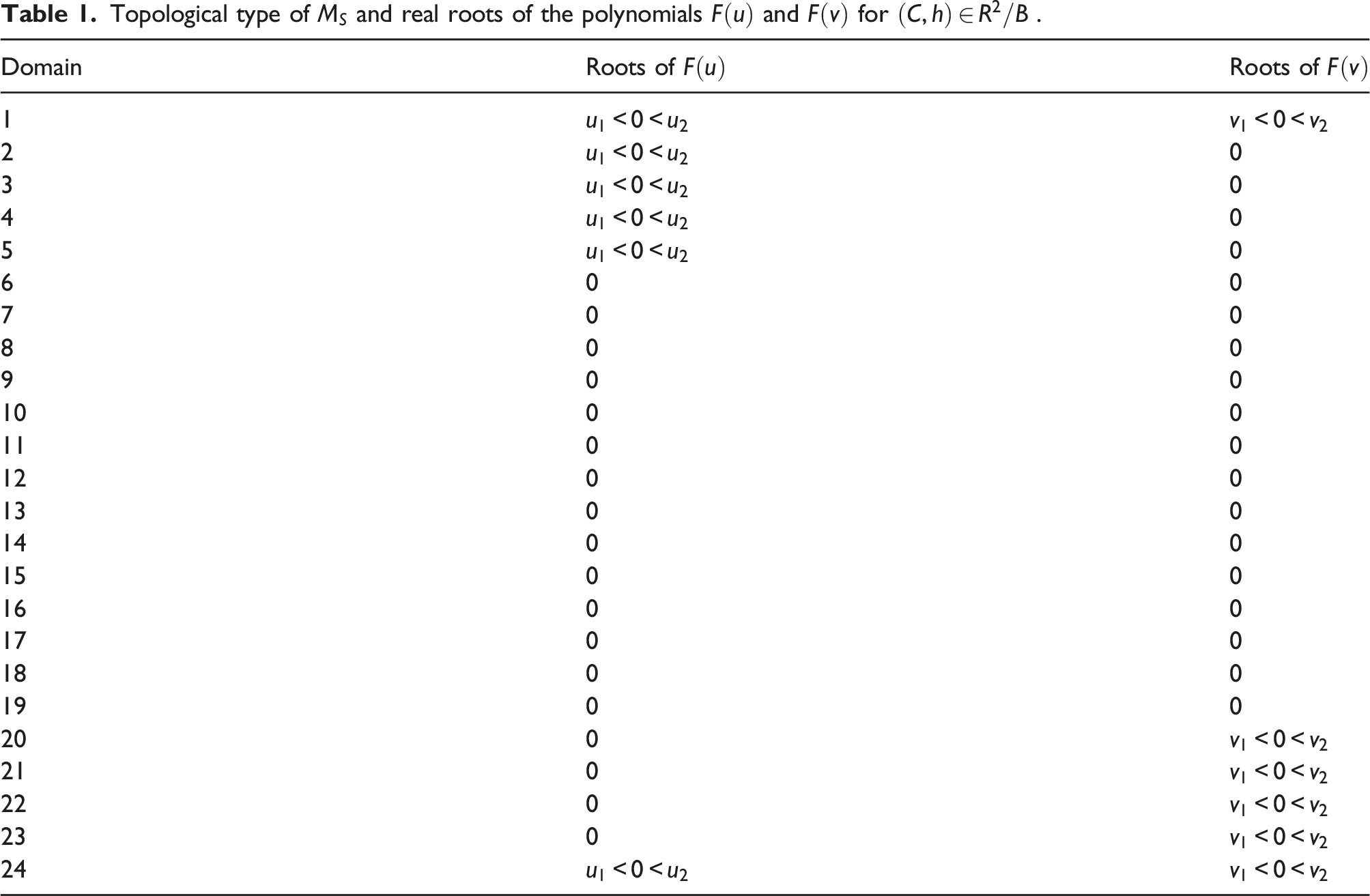
Presents allowable ovals and topological sort of
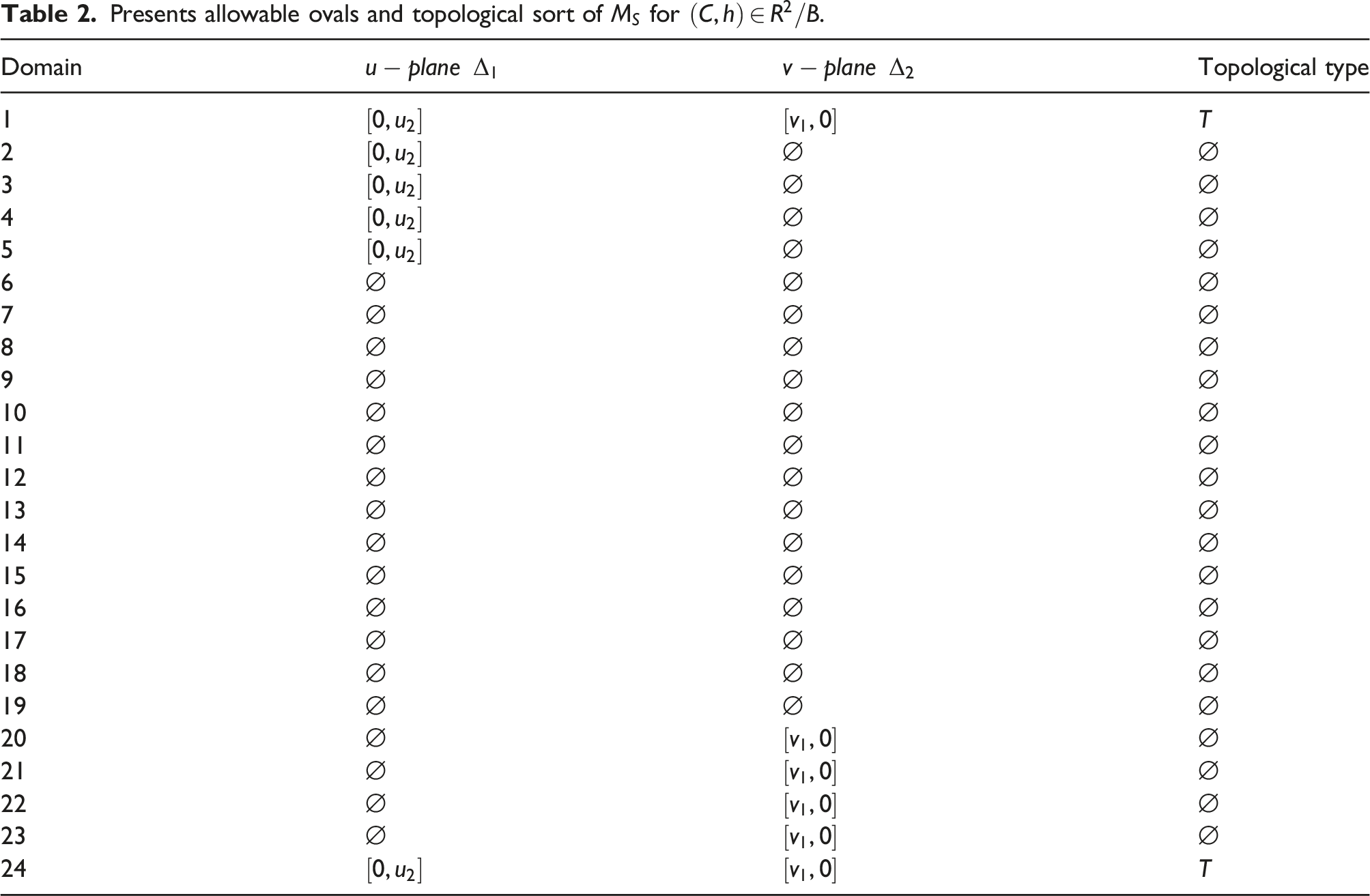
It is worth noticing that the intersection of the discriminants of the separated functions, which contain the energy and separated constants, produces twenty-four domains, as mentioned before and displayed in Figure 1. Therefore, we select the roots of the equation in each domain. For the imaginary roots, we write zero as in Table 1, while we write the real ones to determine the kind of topology in each domain as mentioned in Table 2. For the columns of
Reveals the generic bifurcations of

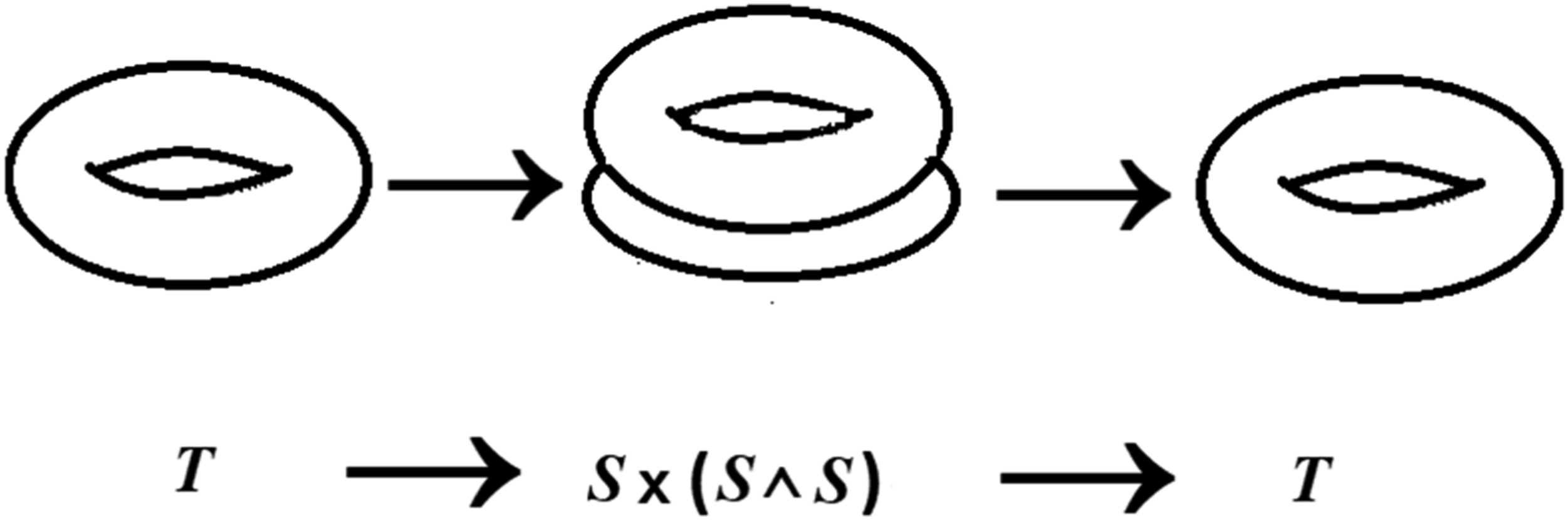
Displays bifurcation of Liouville tori, where

Illustrates the correspondence between bifurcations of invariant Liouville tori and bifurcations of
Separated function and its phase portrait
This section aims to explain the topological translation of the path by applying the phase portrait as examined in Ref. 46. For this purpose, let us consider
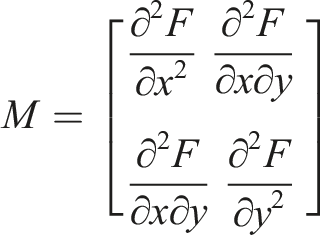
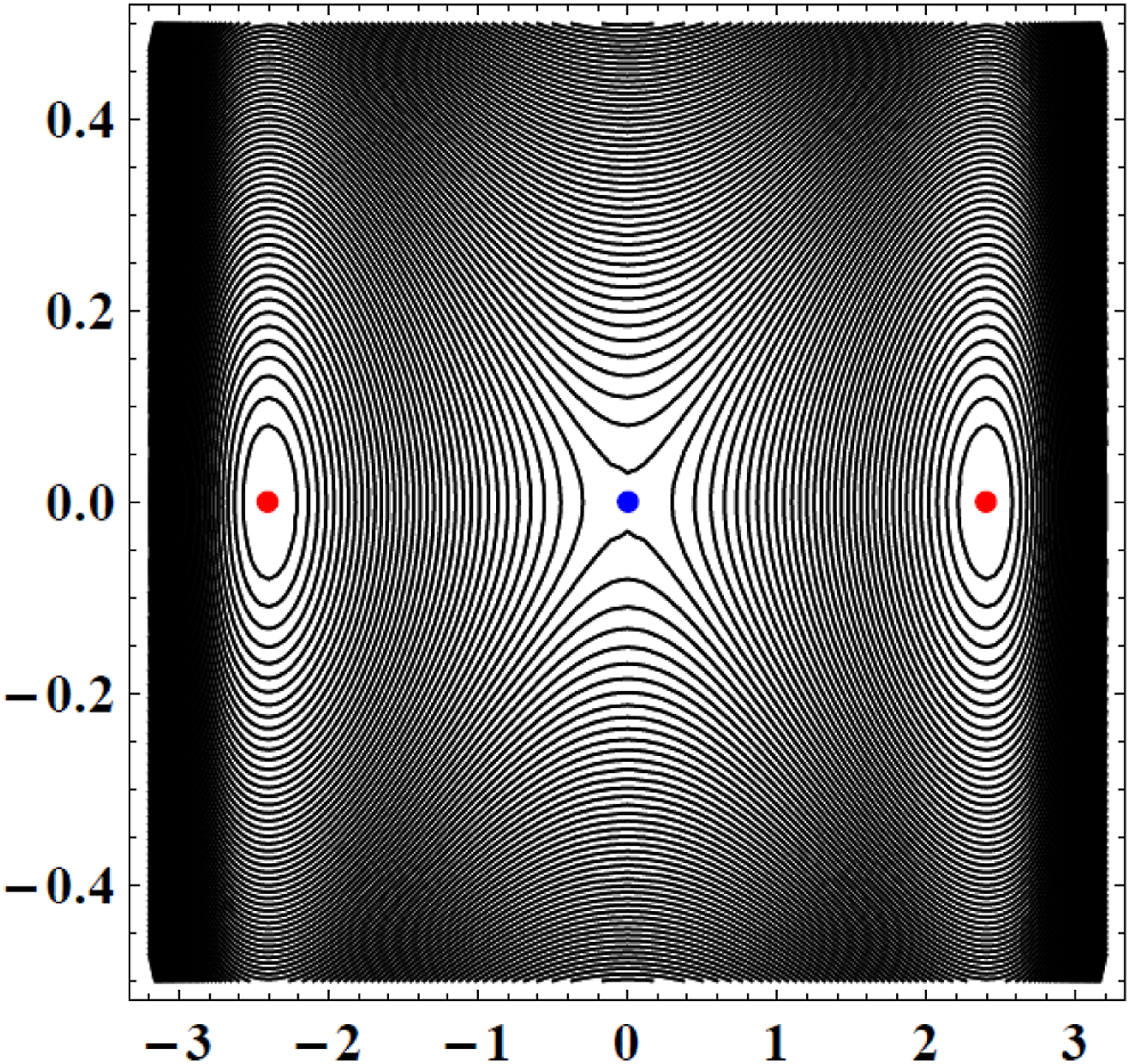
The singular points of the function 
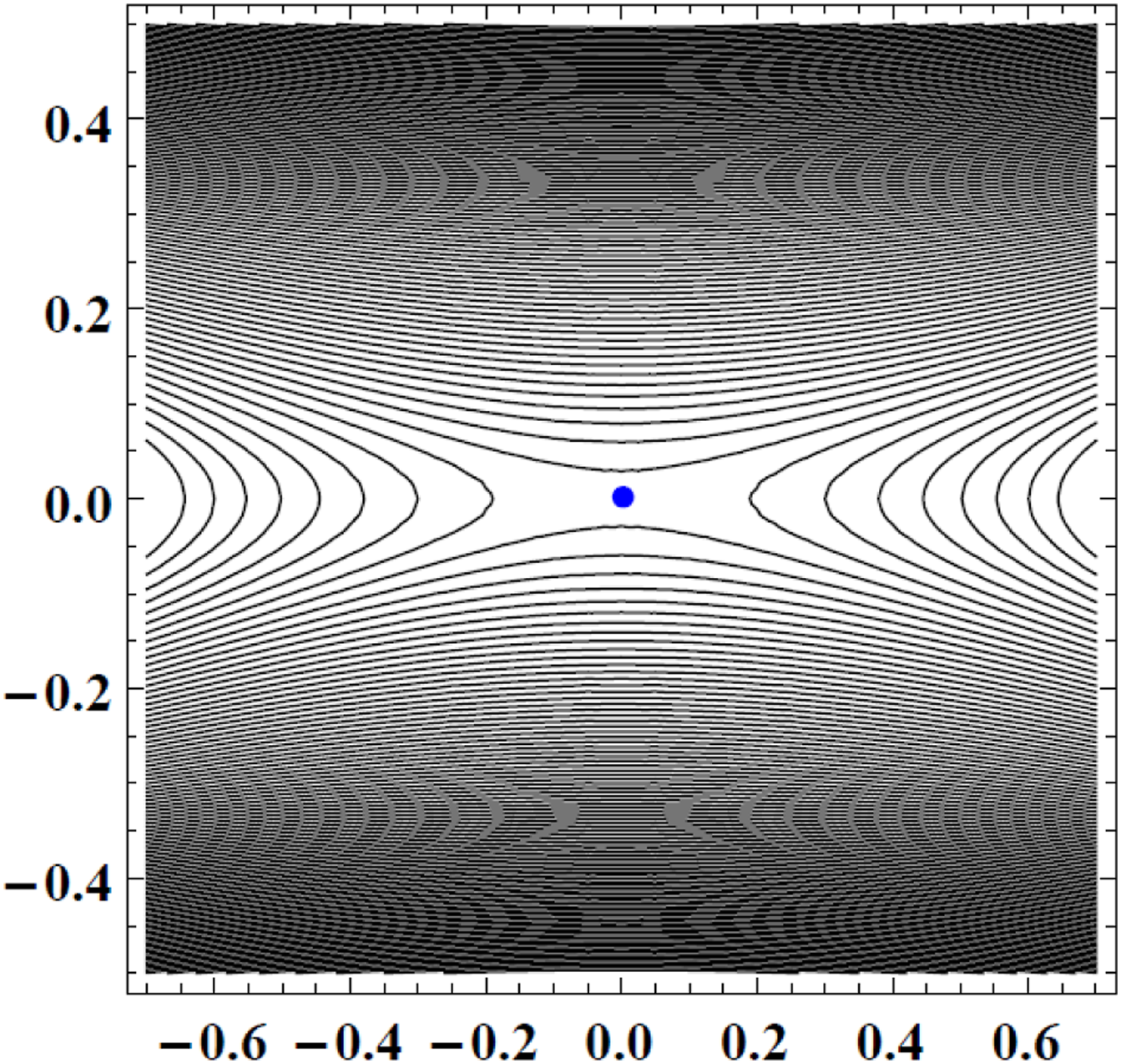
Then, we have three distinct points 1. Take the point 2. Based on the same method, we can find that the points Shows the hyperbolic point Reveals two elliptic points

The second case of integrability
This section aims to analyze the second case (ii) of integrability. The separation of the problem is explained, and the topological analysis of the problem is discussed. Moreover, the periodic solution is obtained through the use of Jacobi’s elliptic function. The phase portrait is introduced, and the singular points of the separated functions are determined.
Separation of the problem
As mentioned above, the Hamiltonian function (12) for case (ii) can be written as follows



Bifurcation of the problem
In order to study the bifurcation diagram of this case, we are going to reduce the degree of the equation (41) through substitution 
By following up the study using the same mentioned previous method in subsection (3.2). Therefore, let 
The set Represents the bifurcation diagram Topological category of Represents admissible ovals and topological type of 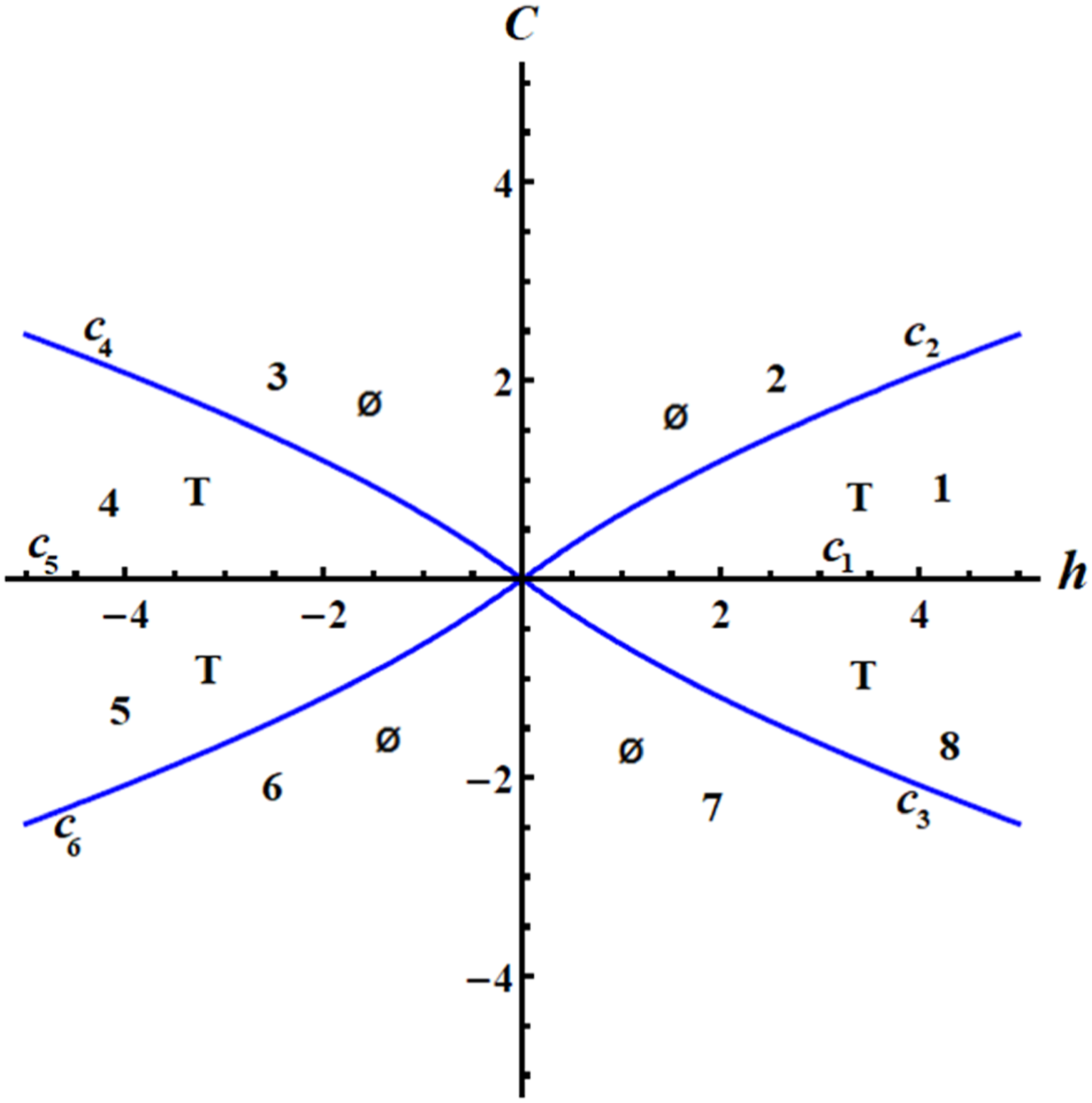
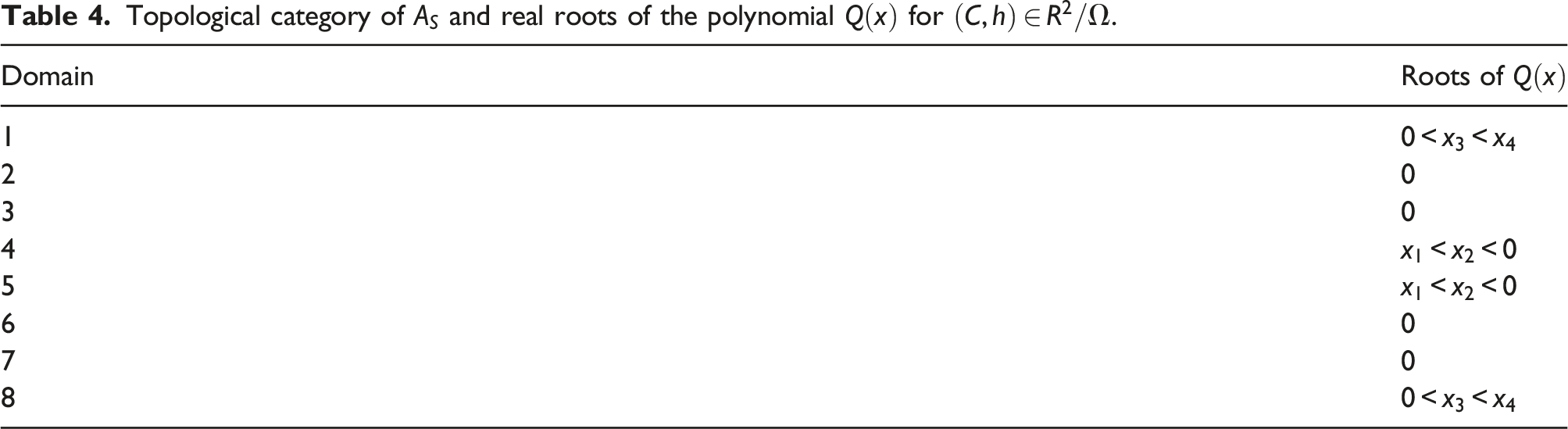
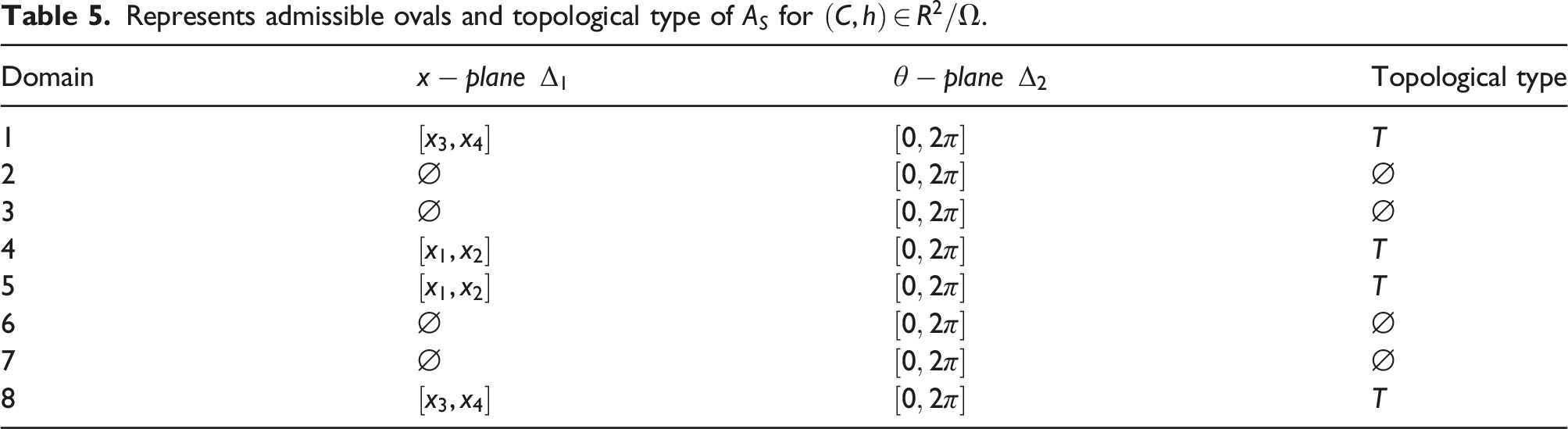
In other words, Table 4 represents the case of one only separated function
Shows the generic bifurcations of

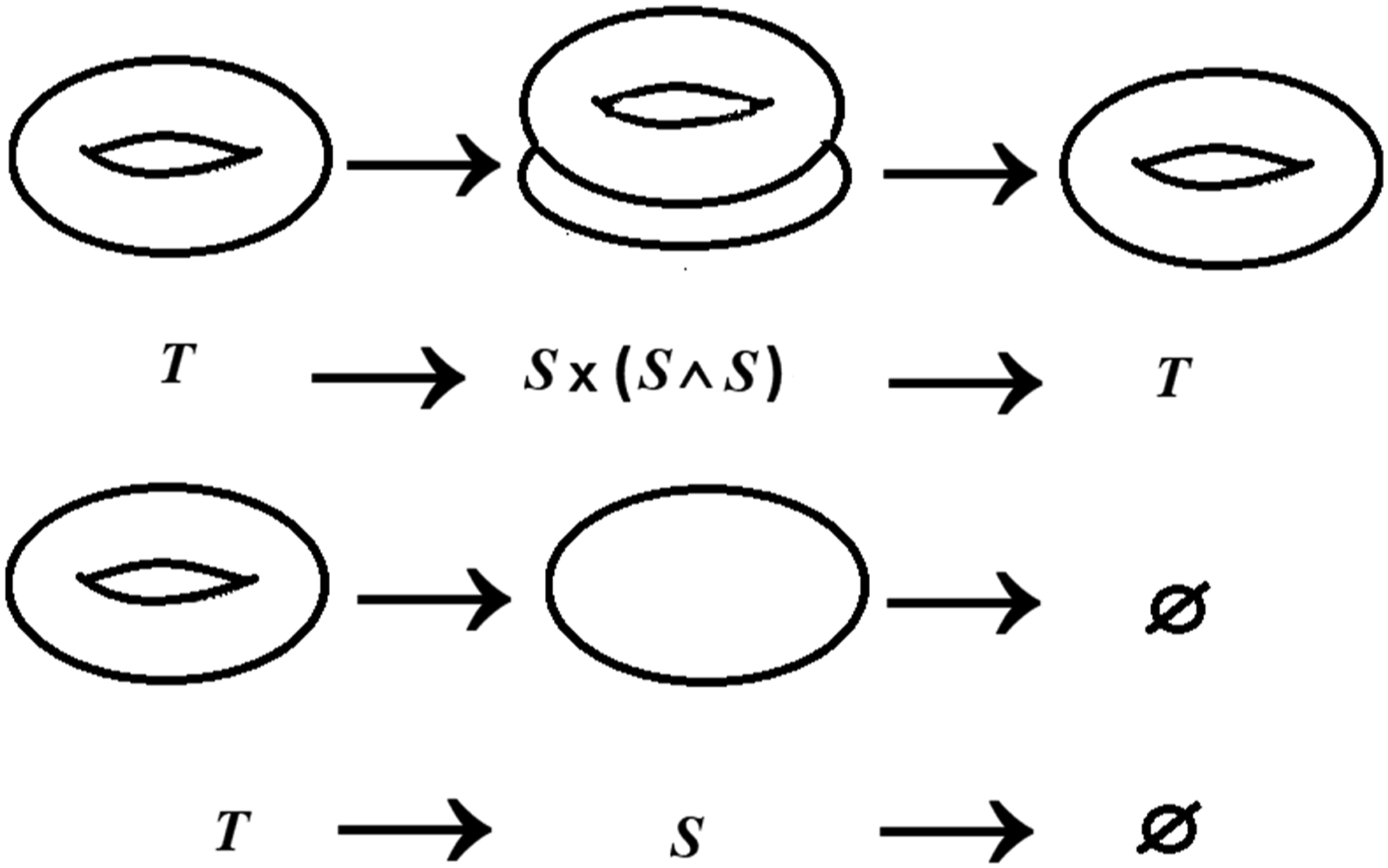
Shows bifurcation of Liouville tori.
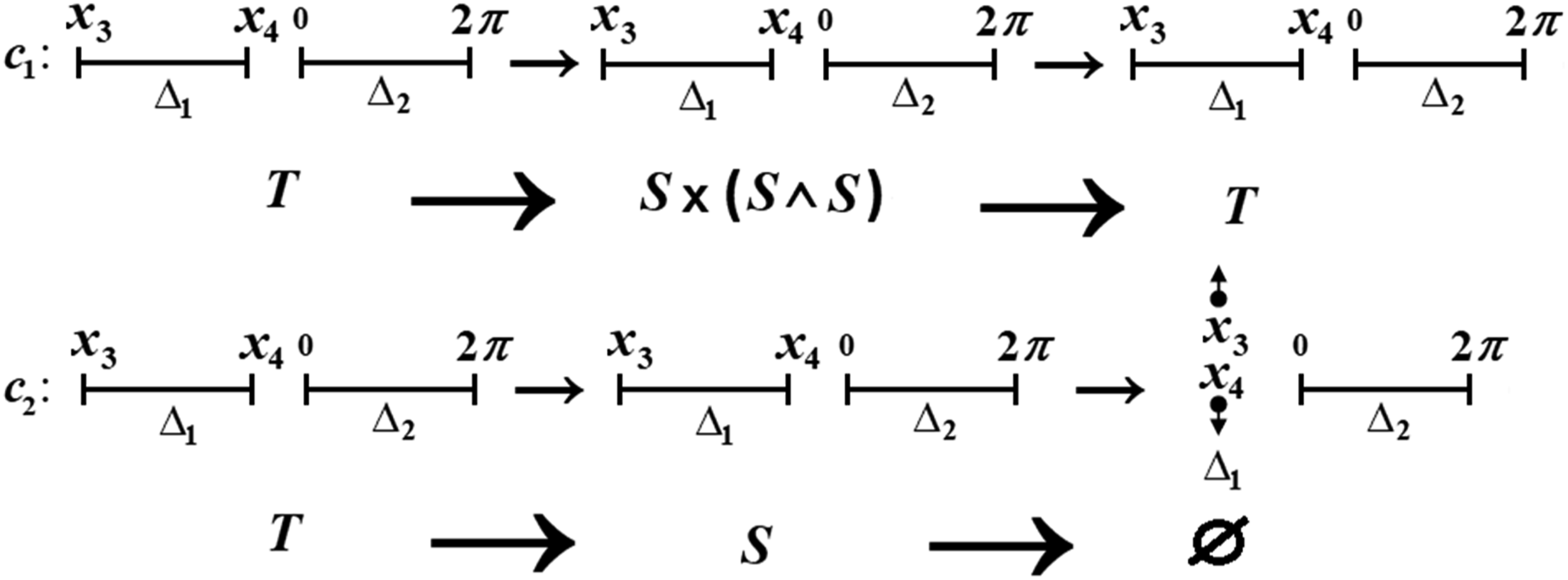
Shows the correspondence between bifurcations of invariant Liouville tori and bifurcations of roots of polynomial
Periodic solution


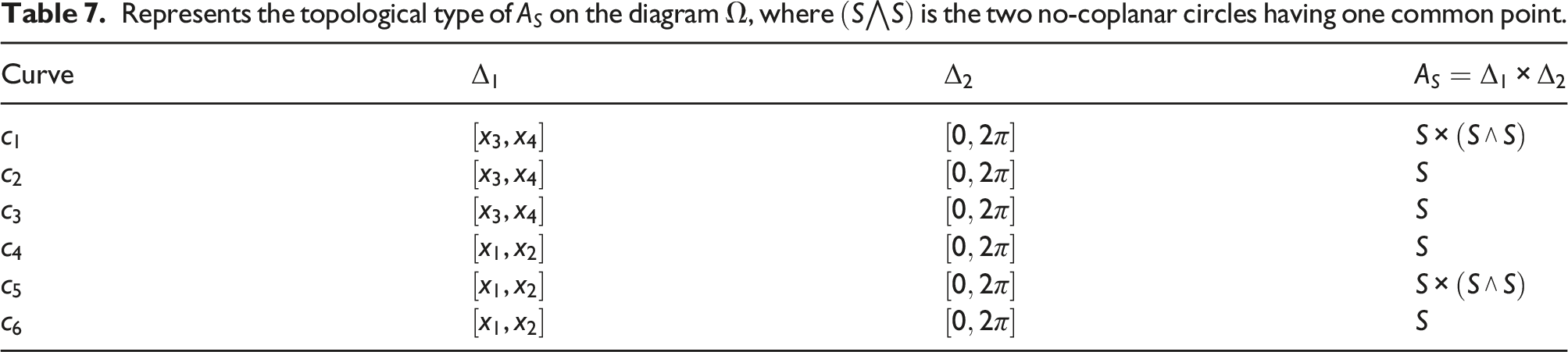
Represents the topological type of
According to the 1. If

Let us use the following substitution
34


Referring to our substitution in the previous section 2. If 

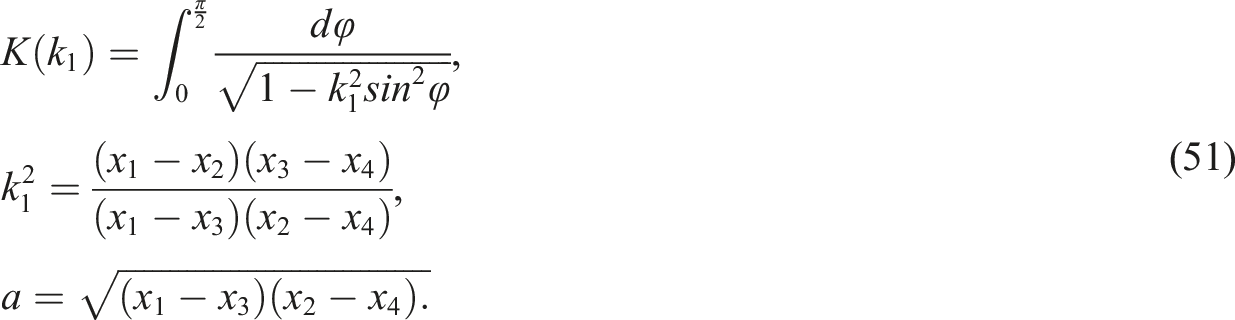
Using the same procedure described in case (i), we can get the following solution



Phase portrait of the problem
Consider the function
The singular points of the previous function 
From first equation of (57), we have
Similarly, from the second equation of (57), one obtains
Therefore, at 
Hence, we have two real roots 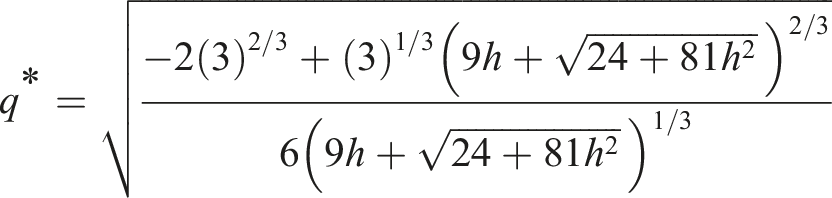
At
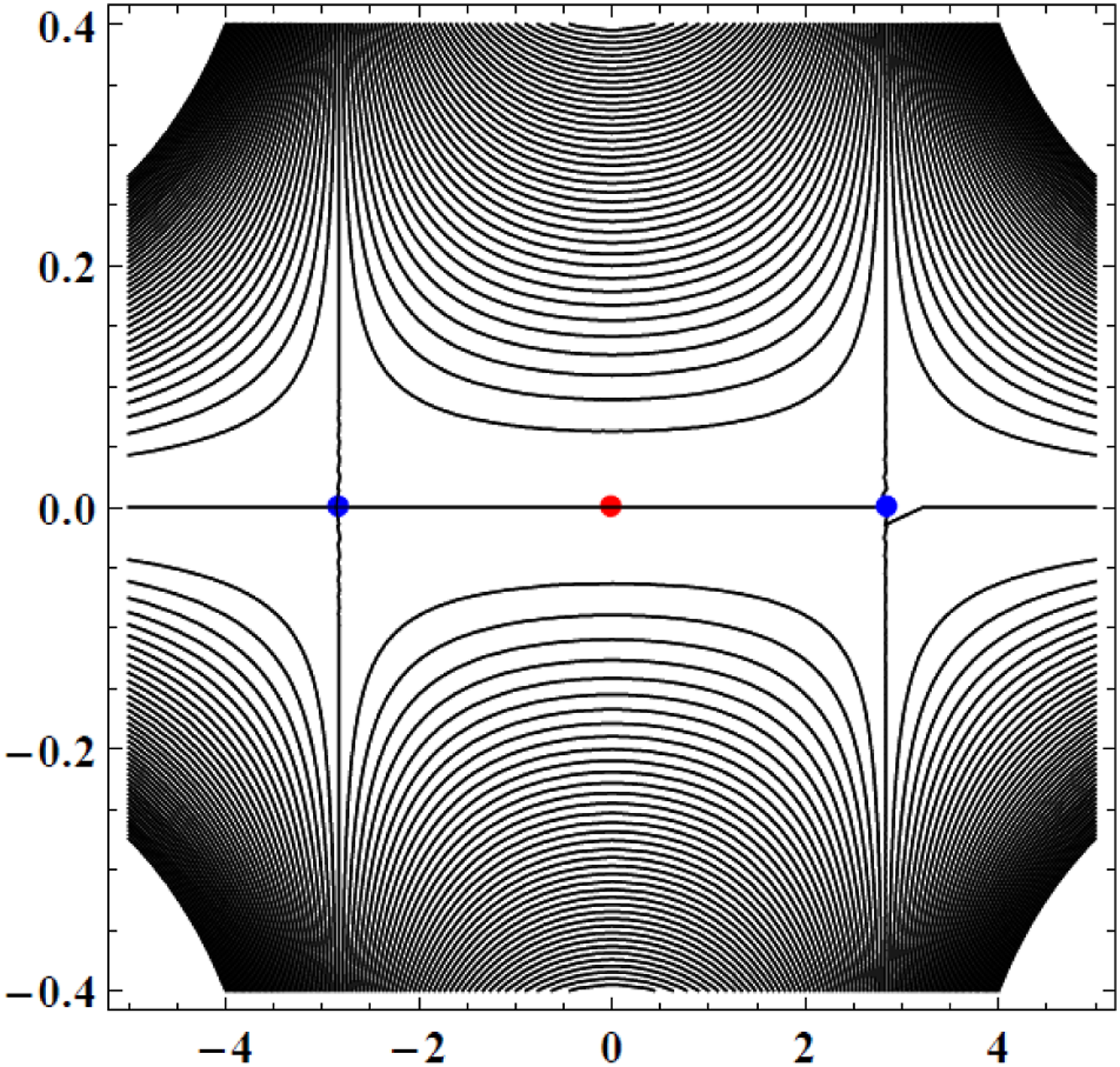
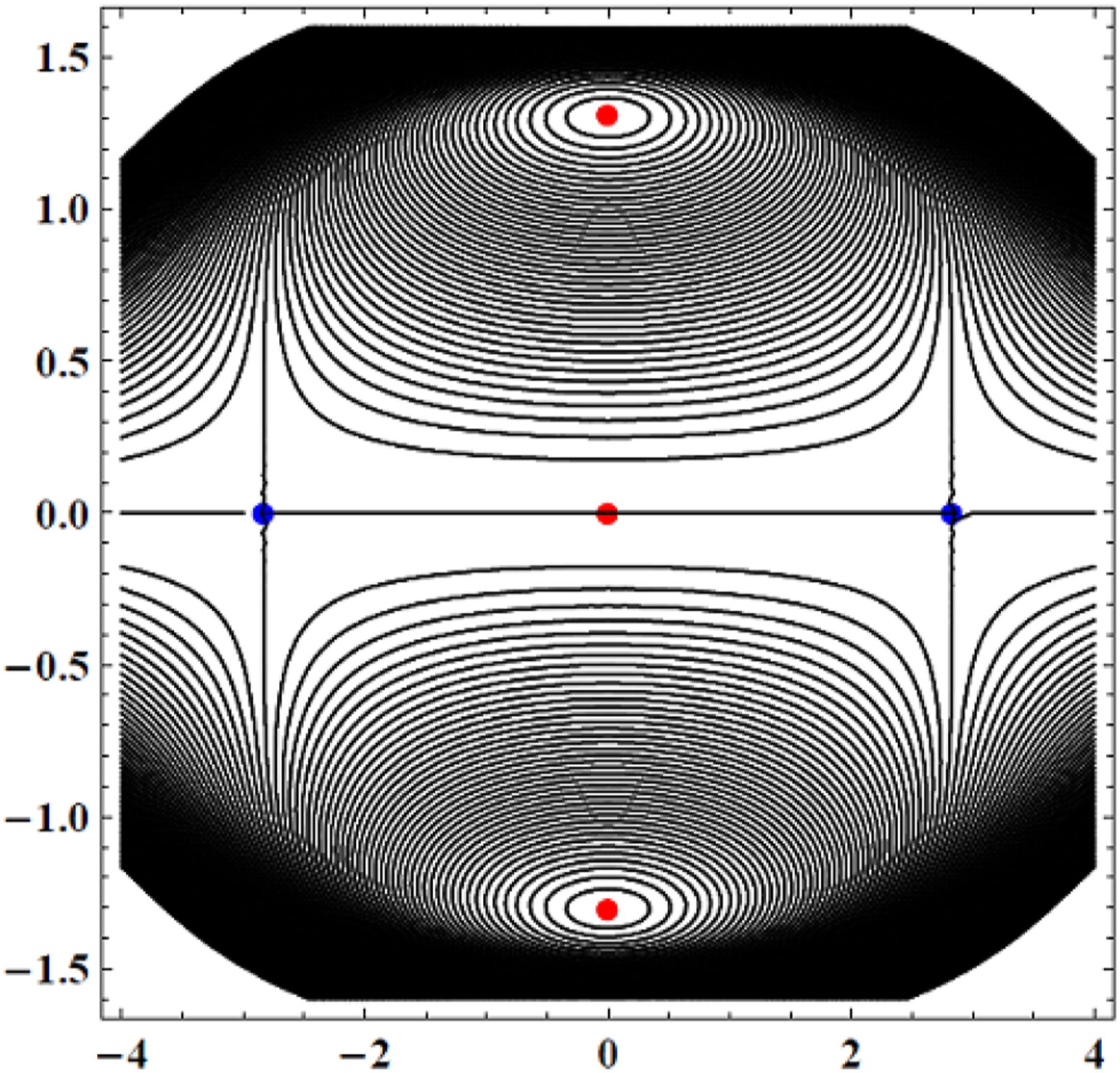
According to the above, we have five singular points
To know the types of points, we follow the same method mentioned in subsection (3.3) and the following results are obtained 1. Points 2. Points Shows the parabolic points Represents two elliptic points
Numerical illustrations
In this section, the Poincaré surface section (PSS) is investigated numerically for the given invariant curves of the considered problem. The solution of the problem reveals a trajectory in the phase space
It is known that the energy integral has the form

Consider 
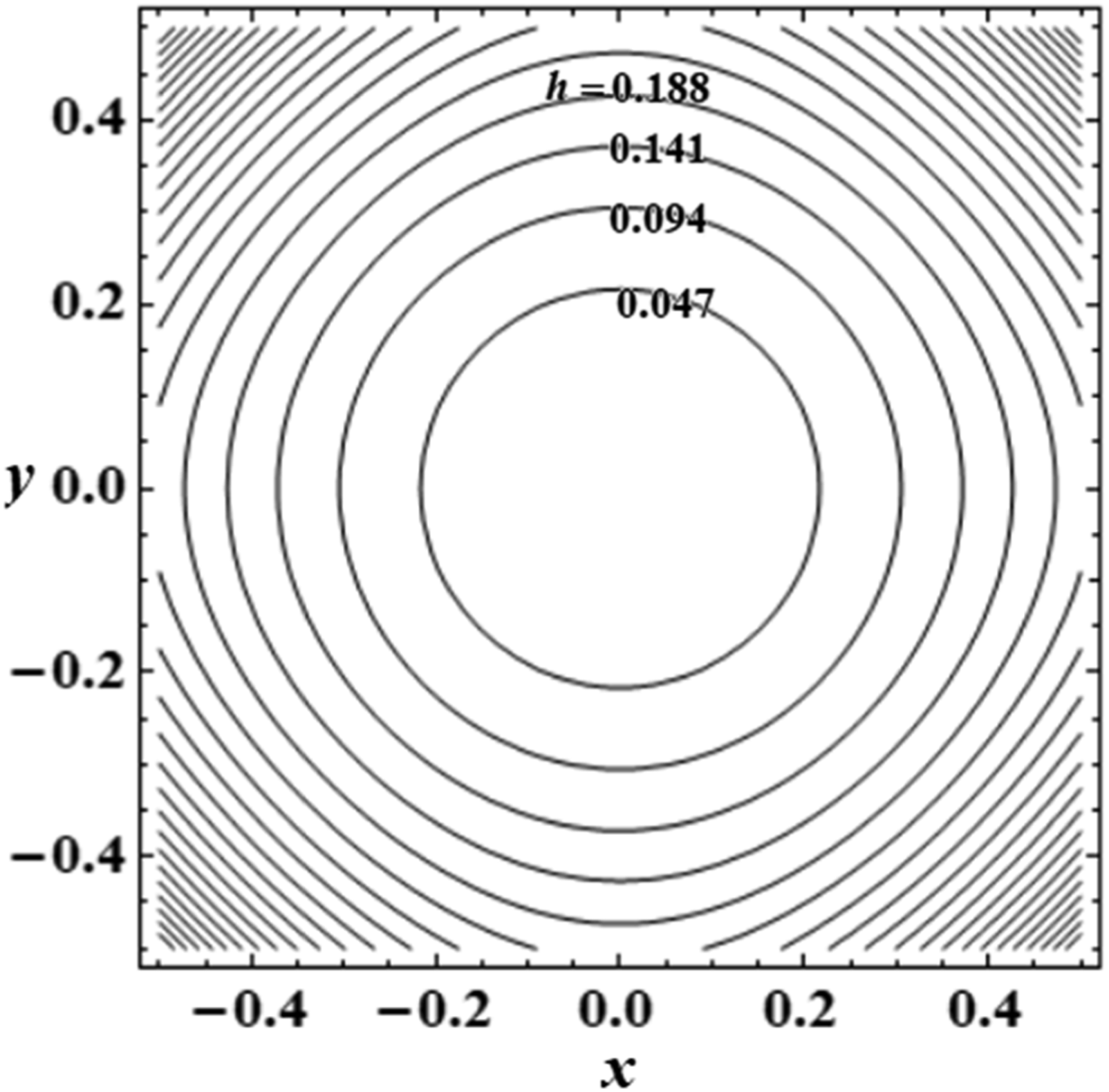
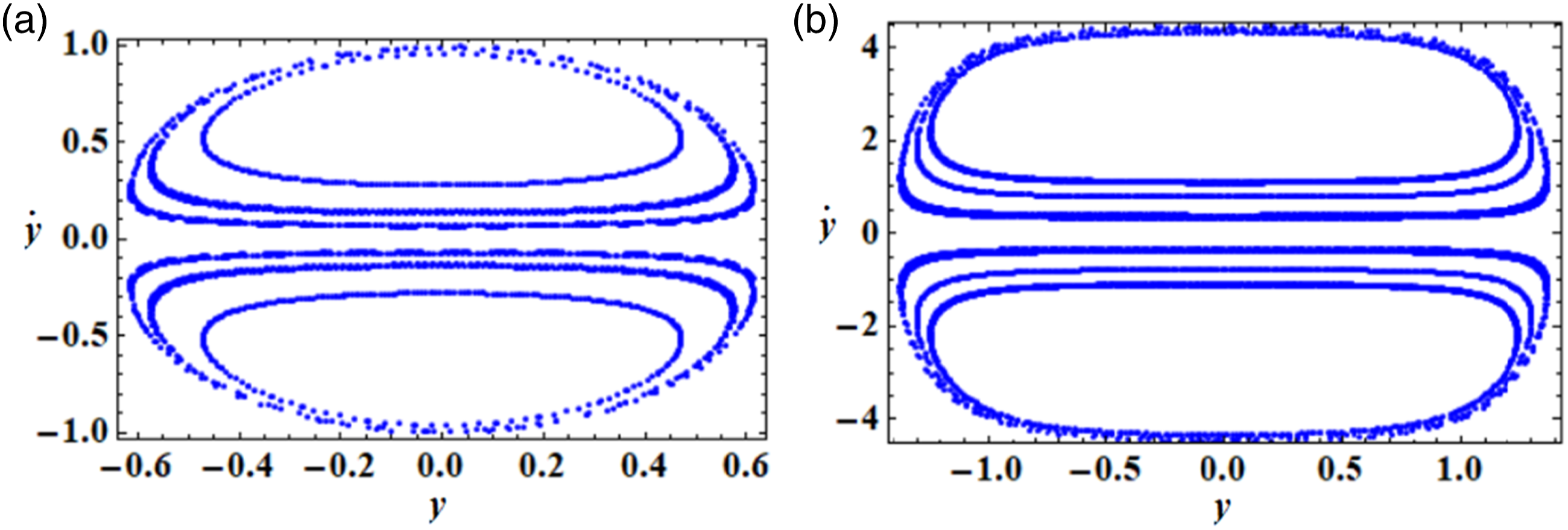
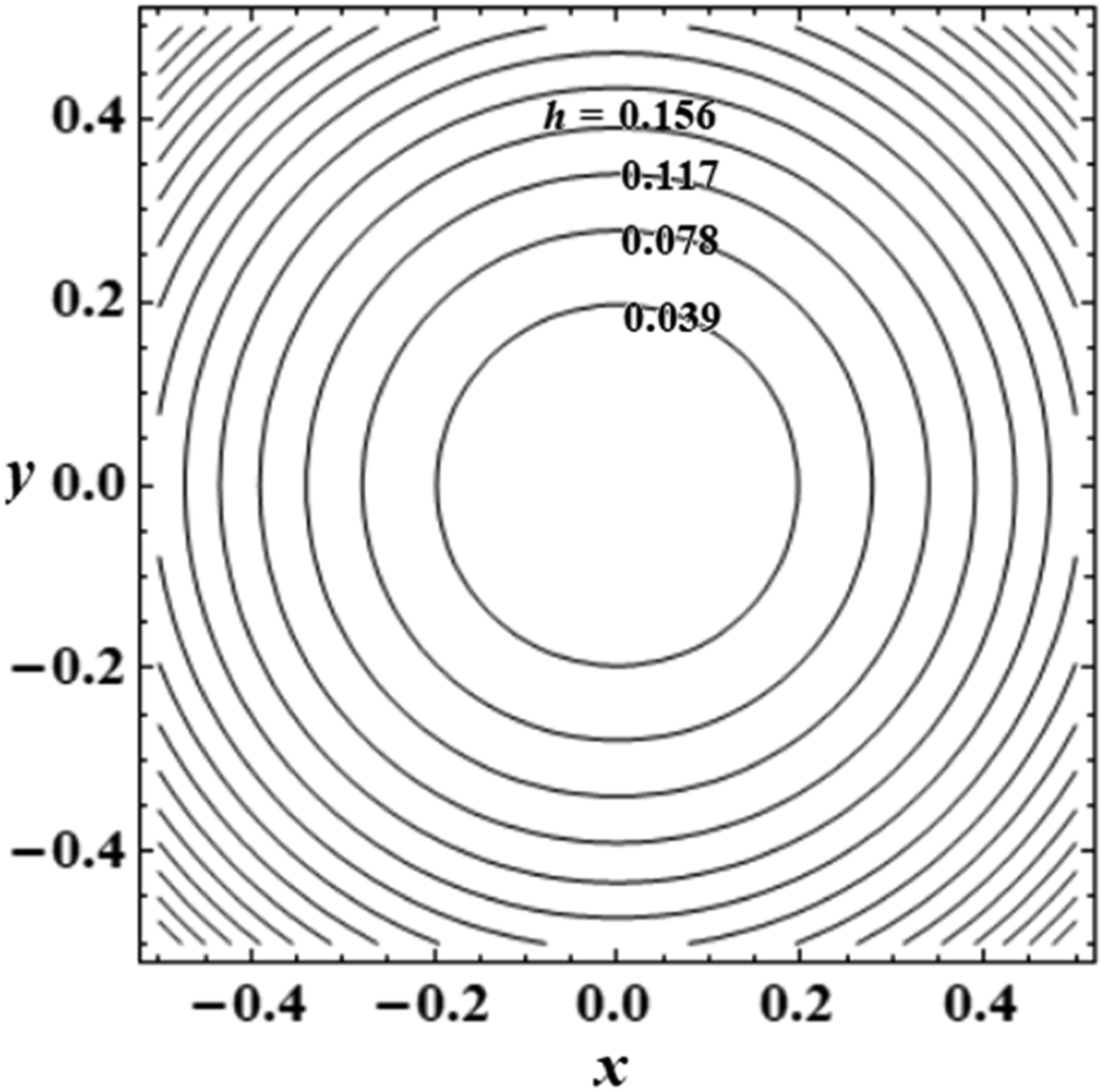
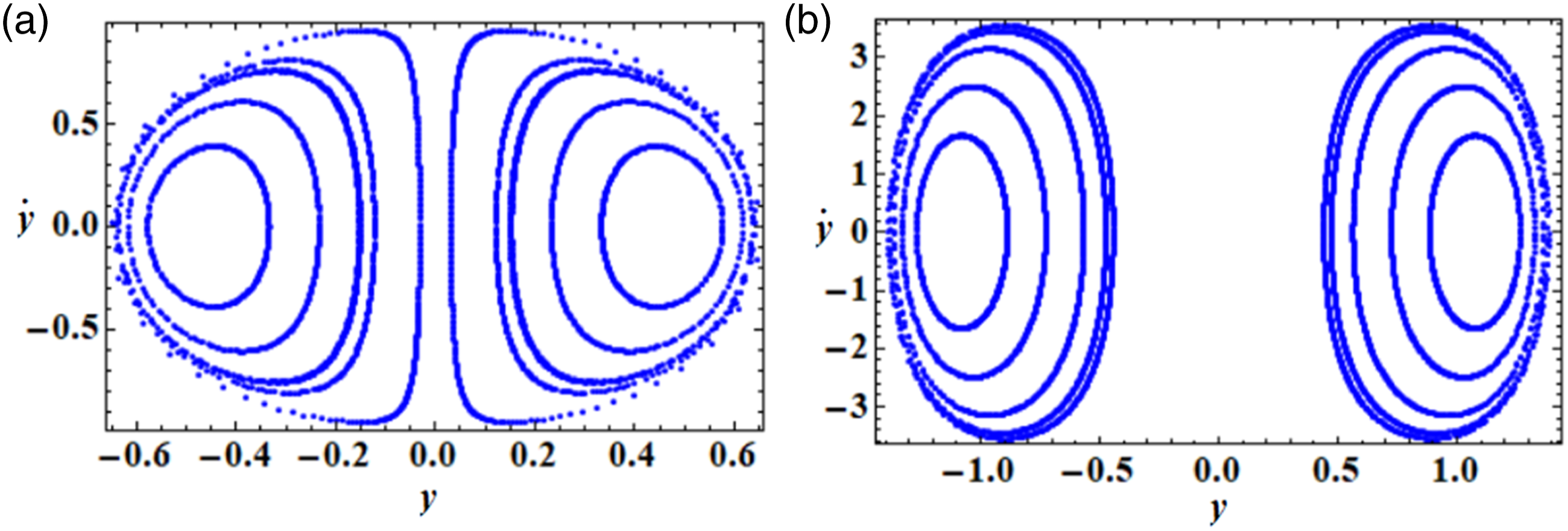
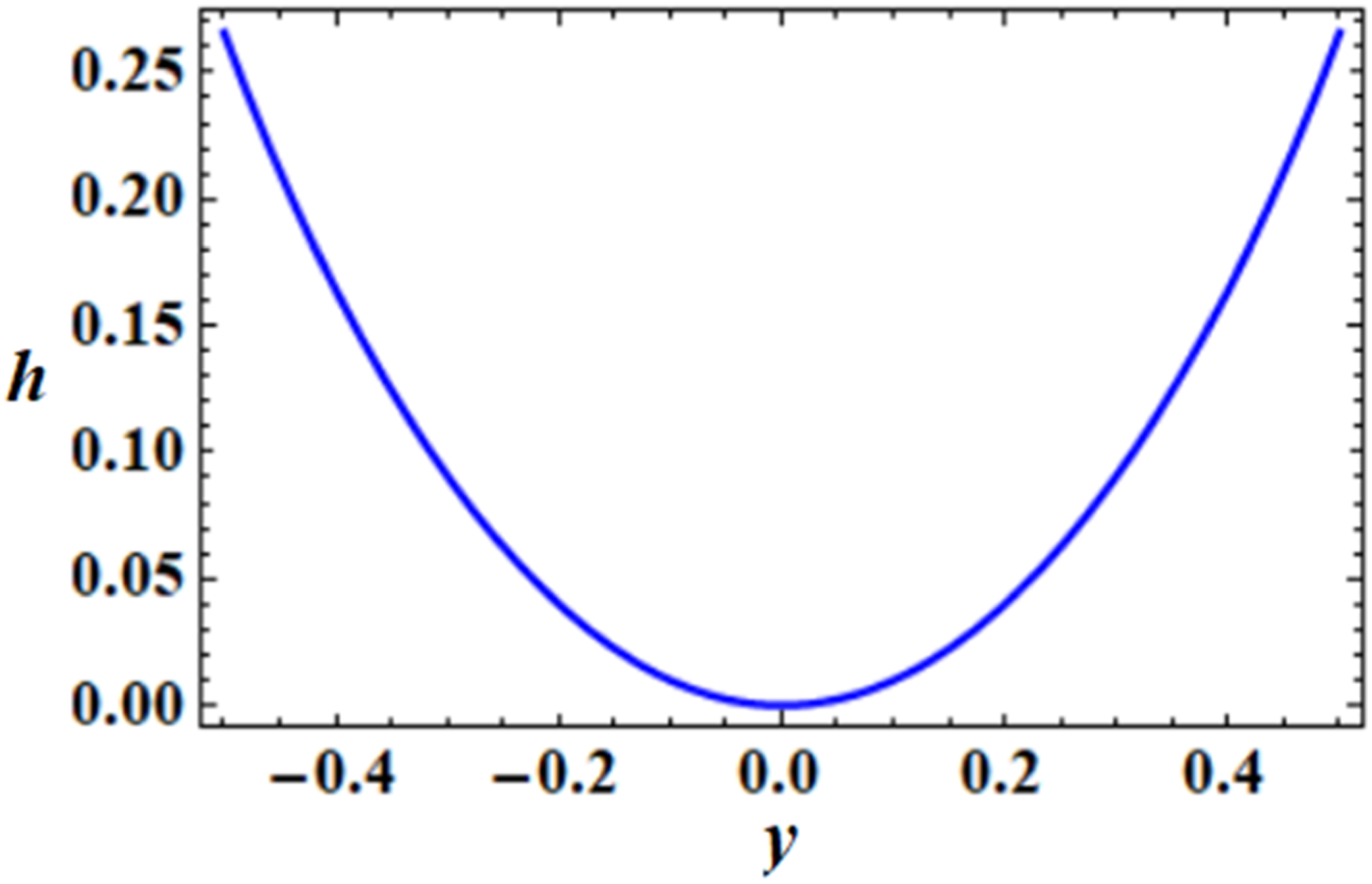
Now, we have the following figures: • For the first case (i), Figure 11 represents the equipotential lines for distinct values of • For the second case (ii), Figure 13 describes the equipotential lines for distinct values of • Figure 15 displays the zero velocity curve for the two integrable cases. • Figures 16 and 17 explain the solution of Shows equipotential lines of the first case for the different values of Represents invariant curves for the case (i) where (a) Displays the equipotential lines of the case (ii) for the different values of Shows the invariant curves for the case (ii) where (a) Describes curve of zero velocities of the two integrable cases. Portraits the solution of Portraits the solution of
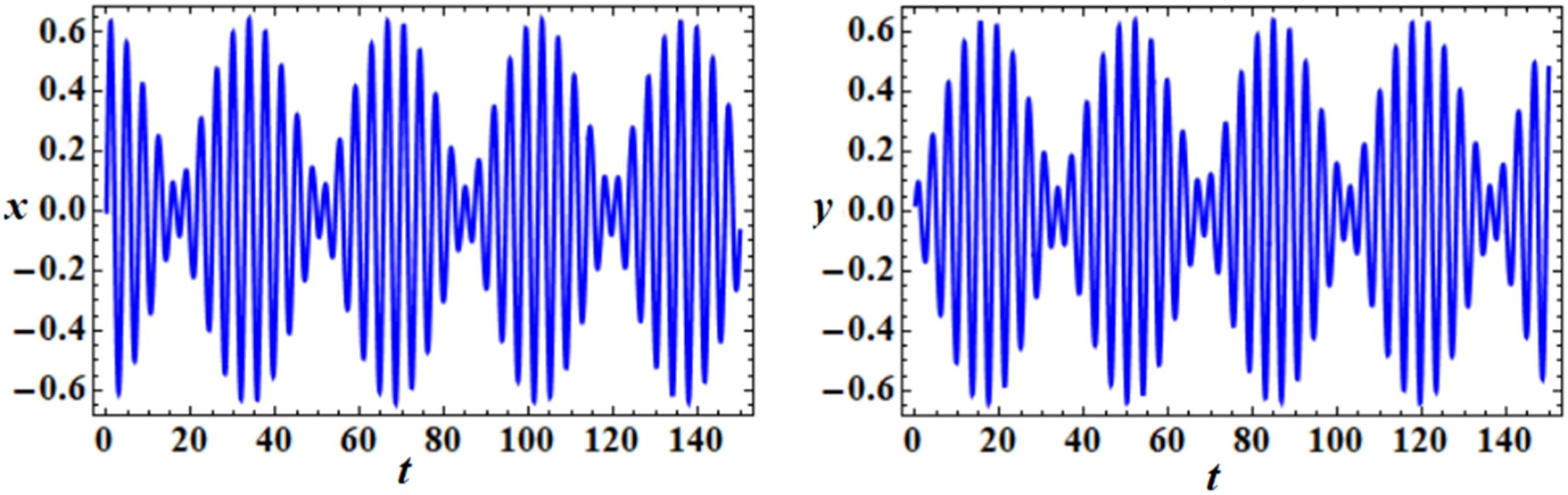
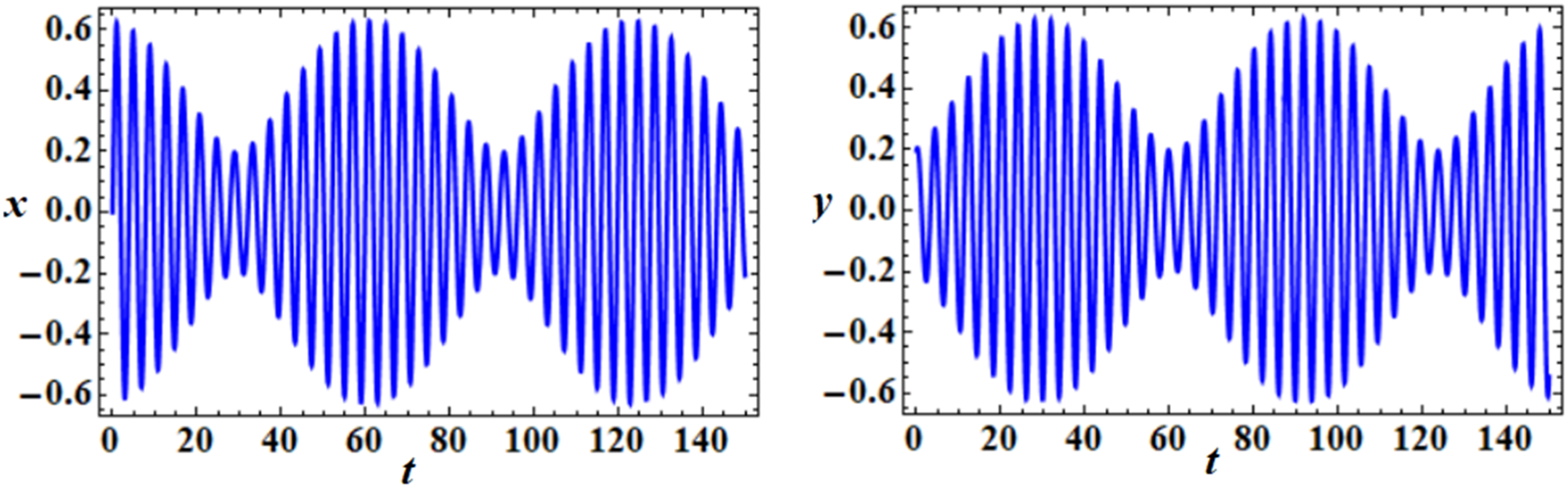
Finally, Figure 18 explains the trajectory on the energy surface Displays the trajectory on the energy surface 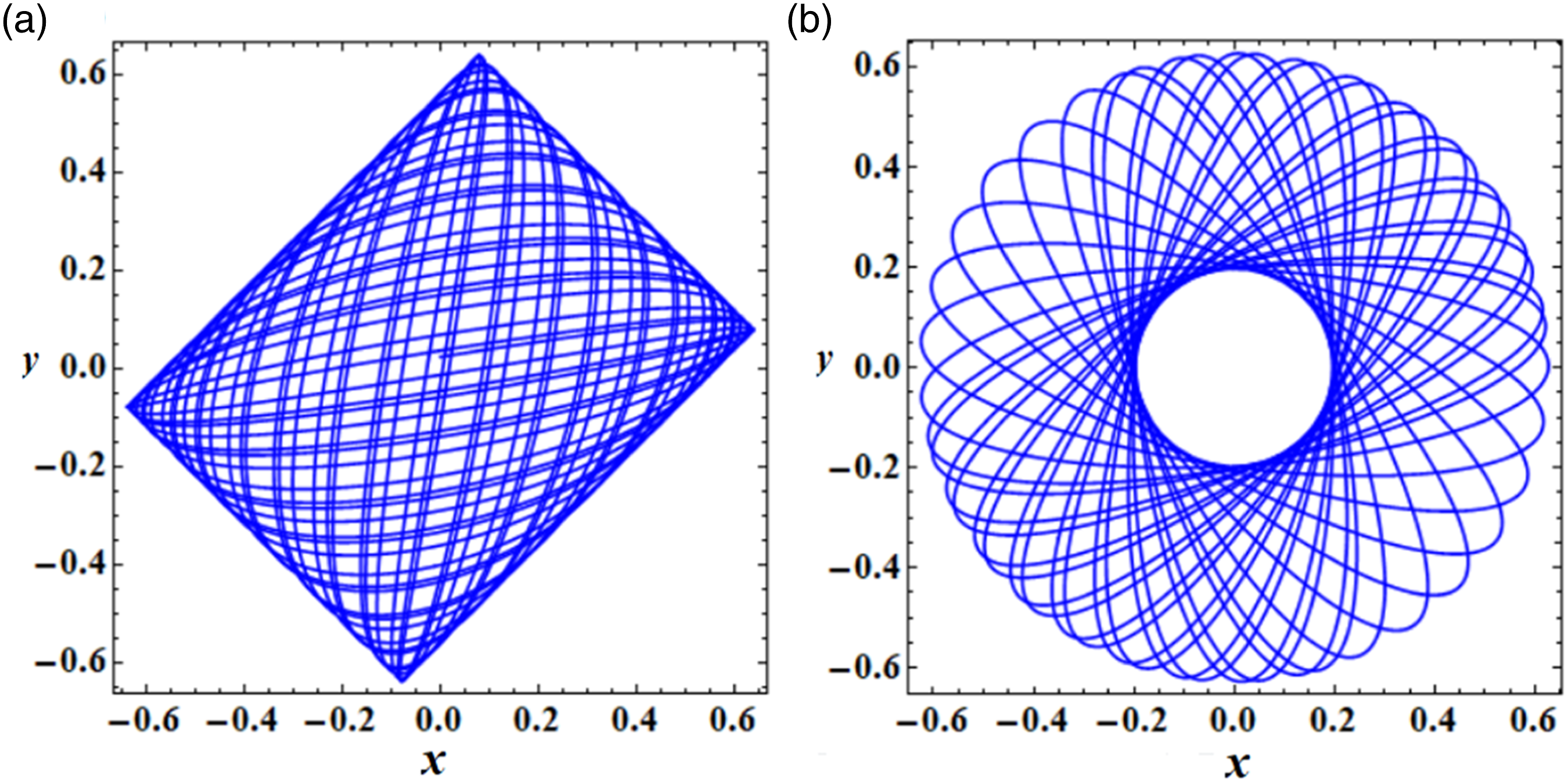
Therefore, the numerical illustrations are introduced using PSS to confirm the integrability of the two cases (i) and (ii), where PSS are plotted in the
Conclusions
In the current paper, the complete picture of our problem has been studied: The topological type of the level set is a torus, or empty set, where we constructed the topological translation of the trajectory by applying the phase portrait. The singular points of the separated functions, which are elliptic and hyperbolic points, allow us to understand the trajectories and the behaviors of these points. The elliptic points are stable, and the others are unstable. It can be seen that the separated functions in the first case are transformed from the sixth degree to the third one, and the separated functions in the second case are transformed from the eighth degree to the fourth one, where the quadrature can be integrated through the elliptic integral. The first and second cases are calculated numerically using the Poincaré surface section to confirm our work, where the trajectories lie on the closed curves for different values of the energy constant, which are called invariant curves.It must be noted that the original system (2) can be solved using non- perturbative method.47,48 Therefore we can obtain this solution in future.
Footnotes
Author contributions
FM El-Sabaa: Supervision, Methodology, Validation, Data curation, Visualization, Reviewing; TS Amer: Supervision, Methodology, Conceptualization, Visualization, Writing, Reviewing.; HM Gad: Writing - original draft, Investigation, Data curation, Editing; MA Bek: Supervision, Methodology, Validation, Reviewing.
Declaration of conflicting interests
The author(s) declared no potential conflicts of interest with respect to the research, authorship, and/or publication of this article.
Funding
The author(s) received no financial support for the research, authorship, and/or publication of this article.
