




Abstract
An improved time-domain spectral element method (ITSEM) is developed for seismic analysis of I-sectioned steel structures in this paper. The developed method considers the effect of section type on spectral stiffness using shear correction coefficient. In the calculation process of the time-domain spectral stiffness and mass matrices, the invariant integral operations of the element matrices are extracted and saved in advance. Thus, the global mass and stiffness matrices of the structures can be obtained only by simple addition, subtraction, multiplication and division operations, which greatly improves computational efficiency. Next, the natural frequencies of a I-sectioned beam are computed and compared with the finite element method (FEM) and analytical results to validate the ITSEM. Then, the seismic responses of a ten-story steel frame using ITSEM are obtained and compared with those by FEM, which proves the effectiveness, accuracy and high efficiency of ITSEM in elastic seismic analysis.
Keywords
Introduction
In the process of structural numerical analysis, the key is usually to choose the appropriate solution method between the balance of computational time and complexity. 1 To satisfy the calculation precision in practical engineering, a large number of elements are needed to be divided when the finite element method (FEM) is used to analyze the actual structure, which leads to a great increase in computational costs. 2 Patera first proposed the time-domain spectral element method (TSEM) in 1984 to solve the fluid dynamic problems. 3 TSEM is a calculation method based on FEM and spectral method. It fully combines the high-order convergence of spectral method, namely the p convergence property, with the h convergence property of FEM, which is easy to adapt to complex geometric region and converges with element encryption. This combination makes TSEM not only have the high precision and convergence characteristics of the spectral method, but also have the good adaptability of FEM in the complex geometric region. It also adjusts the shortcoming that finite element calculated amount is too large due to dense space-time discretization. The method defines shape functions on specific nodes of basic structural elements and describes the distribution of physical properties in the elements and at the boundaries. The main difference between TSEM and FEM is that the former uses Chebyshev-Gauss-Lobatto (CGL) points as the element nodes, whose coordinate set is equivalent to the zero coordinate of the first derivative of the N-order Chebyshev polynomial adding the coordinates of the two endpoints of the element. In this way, the significant shortcoming of the high-order FEM with uniform distribution of nodes in solving vibration problems, namely Runge phenomenon, 4 can be effectively suppressed, high precision numerical interpolation can be realized, and convergence speed can be accelerated.
Since the TSEM was proposed, it has aroused the research interest of many researchers. So far, TSEM has successfully simulated wave propagation in one-dimensional, two-dimensional and three-dimensional structures.5–8 Zak and Krawczuk studied TSEM for one-dimensional rod structures in combination with the well-known rod theory in the field of material strength. They compared the different rod theories used in TSEM, and studied the influence of the appropriate theory choice on the reliability of the results, 9 and discussed the precision of wave propagation analysis using TSEM. 10 Wang et al. developed a spectral element for the concrete-steel contact surface to study the propagation of guided waves along the steel bar in concrete. 11 Bonfiglio et al. used the spectral FEM to study the dynamic response of the vibrating structure and predicted the transmission acceleration of a steel beam and two sandwich plates, which was compared with the measured data in the laboratory test. 12 Rucka established the time-domain spectral element of frame structure based on the Mindlin-Herrmann rod and Timoshenko beam theory, which was used for experimental and numerical research on damage detection of L-shaped steel joints. 13 To find a feasible method for damage identification of steel structures, Wang and Hao developed a spectral element modeling method that could simulate both wave propagation and structural vibration characteristics. 14 Rekatsinas et al. 15 improved the numerical simulation efficiency of guided waves in laminated composite strips by TSEM. Raja and Gopalakrishnan 16 proposed a new time-domain spectral element of 9 degrees of freedom per node based on the high-order sandwich plate theory and combined with the flexible behavior of composite panel cores. The damping effects of different core types were studied in detail, which could be effectively applied to the design of sandwich beams. Yeung and Ng 17 proposed a TSEM with high computational efficiency and a crack model considering the propagation, scattering and mode transformation of guided waves in the pipeline. The proposed TSEM coupling the torsional and bending motions of guided waves can accurately predict the propagation, scattering, and mode transformation of torsional guided waves. Yu et al. 18 proposed an effective TSEM to simulate wave propagation in crack structures and adopted spectral gap element to model respiratory cracks. Compared with the traditional FEM, the TSEM proposed by them has higher accuracy and efficiency.
At present, although there are a lot of researches on spectral element method,19–26 most of them are applied to high-frequency dynamic researches on one-dimensional axial stress rods, two-dimensional plates and shells, and three-dimensional solid structures. These researches mostly aim at the basic members with rectangular section and are focused on their high-frequency dynamics, and few researches on the seismic analysis of actual steel structures in low frequency range were addressed using TSEM. Therefore, it is very necessary to extend TSEM to actual steel structures to improve the accuracy and efficiency of seismic analysis of steel structures commonly used in civil engineering.
Beam components in actual steel structures are seldom rectangular cross-sections, mostly I-section or T-section, which are medium thin long beams. The influence of shear deformation of the structure cannot be ignored, and the Euler-Bernouli beam theory is no longer applicable. Therefore, this paper proposes an improved time-domain spectral element method (ITSEM) for I-sectioned steel structures based on Timoshenko beam theory. In this method, the CGL points are taken as the element nodes of the Timoshenko beam, and Lagrange interpolation is used to expand the spectral element approximation of the displacement functions of the vertical and rotational displacements of beam, and the corresponding displacement shape functions are obtained. Based on the displacement shape functions obtained, the stiffness and mass matrices of the time-domain spectral elements in the I-sectioned beam are derived by using a method similar to FEM, considering the inertial action of the transverse displacement and the rotational inertial action of the rotation angle. Combined with the time-domain spectral element matrix of the rod, the seismic analysis of plane I-sectioned steel frame structure suffered from different earthquake excitations are carried out to verify the effectiveness, accuracy, and high efficiency of ITSEM. In the process of seismic analysis, the invariant integral operations of the element matrices are extracted and saved in advance. Thus, the global mass and stiffness matrices of the structures can be obtained only by simple addition, subtraction, multiplication, and division operations, which greatly improves the computational efficiency of ITSEM.
ITSEM
Spectral element approximation
Assuming that p
n
is an orthogonal polynomial function on [c, d] with t as the independent variable, then

Divide the computational domain V into N
e
non-overlapping elements V
e
, that is,

The displacement function is expanded by spectrum on each element V
e
, in which the unknown function is approximately expanded to a linear combination of orthogonal function system. The original domain of function spectral expansion is the standard element V
st
. The definition domain of the unknown function can be transformed from the general element V
e
to the standard element V
st
by the transformation of the function definition domain, so that the unknown function on any element can be approximately expanded by spectrum, and then the shape function on any element can be constructed. By interpolating the nodal basis functions, the spectral element approximation of the displacement function can be expressed in a form similar to the finite element. These nodal basis functions depend on their nodal values, and the functions that describe the distribution of the internal physical properties of the spectral finite element are some orthogonal polynomials, so the non-uniform distribution of the nodes in the element is determined by the distance between the zeros of some orthogonal polynomials, which avoids the Runge phenomenon. These orthogonal polynomials are usually Lobatto, Chebyshev or Laguerre polynomials. Because of the uniqueness of the interpolation polynomial of the unknown function, as long as the values of the nodes are the same, whether the orthogonal polynomial or the Lagrange interpolation basis function is regarded as the shape function, the spectral element approximation expansion polynomial of the unknown function formed by their linear combination is the same. Here, the interpolation node basis function on the element is regarded as the shape function, and the CGL node is taken as the interpolation node. The spectral element approximation

Axial rod time-domain spectral element
The n-1th order Chebyshev polynomial is


It is also the zeros of

A I-sectioned axial rod time-domain spectral element is shown in Figure 1, the axial displacement u(x) of the rod on the general element coordinate system A I-sectioned axial rod time-domain spectral element.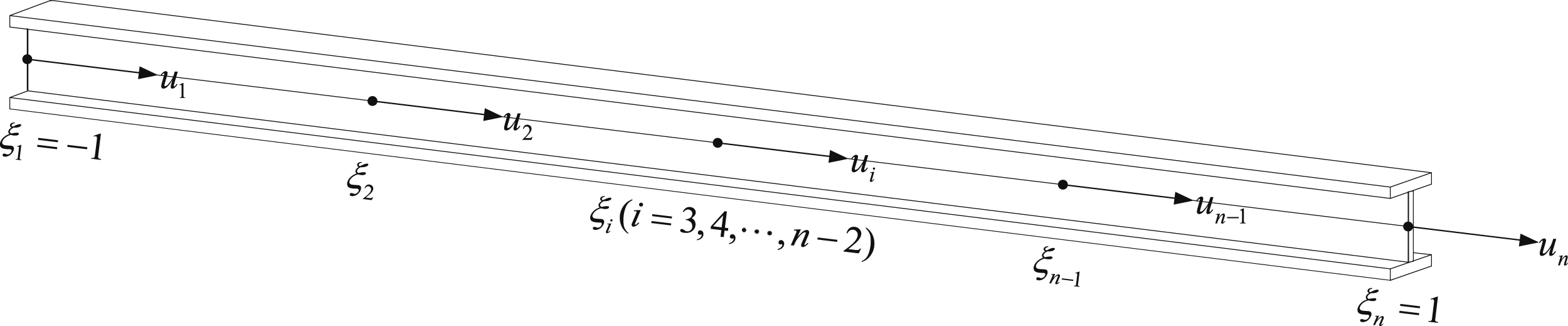



The axial strain of the axial deformed rod element is

Then, its strain matrix is

The stiffness matrix and mass matrix of axial rod element could be derived according to the principle of minimum potential energy and D' Alembert principle, written as


After, the global stiffness matrix and mass matrix of the structure can be assembled through the element stiffness matrix and mass matrix. Finally, the vibration governing equation of TDSEM can be written as

I-sectioned beam time-domain spectral element
Based on the generalized displacement theory of Timoshenko beam, considering the shear deformation of the structure, the CGL point is used as the element node of the I-sectioned beam. According to the Hughes element model, the spectral element approximation of the displacement function of the vertical displacement and the rotational displacement of the beam is expanded by Lagrange interpolation, and the corresponding displacement shape functions were obtained. Finally, the stiffness and mass matrices of the time-domain spectral elements in the I-sectioned beam are derived by using a method similar to FEM, considering the inertial action of the transverse displacement and the rotational inertial action of the rotation angle.
The displacement and rotation angle of any point in the I-sectioned beam along the x and y axis are

A I-sectioned beam time-domain spectral element is shown in Figure 2. The transverse displacement v(x) and rotation angle φ(x) in the general element coordinate system A I-sectioned beam time-domain spectral element.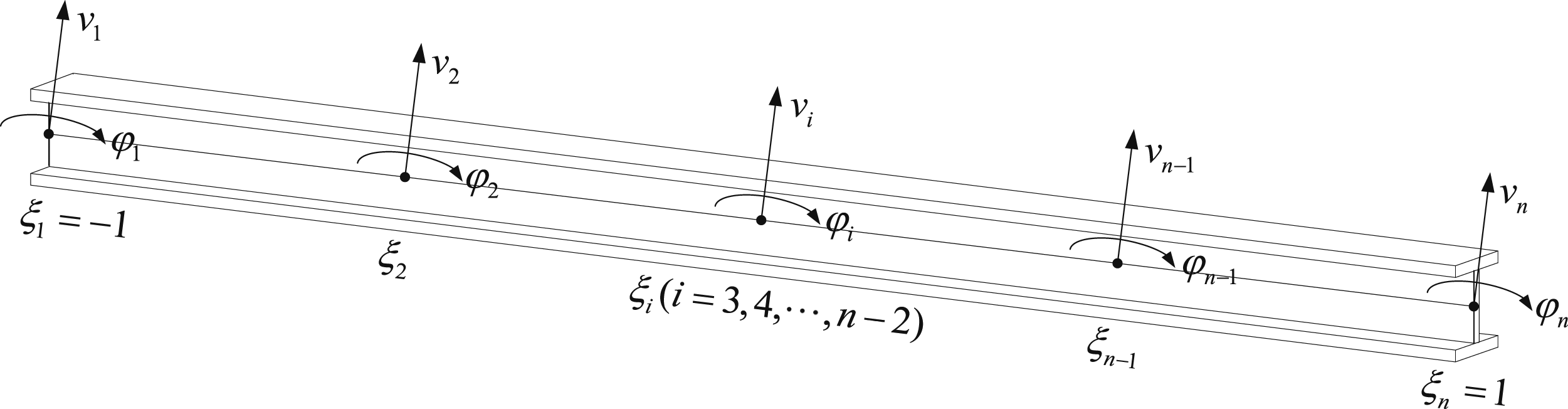



Correspondingly, the bending strain and shear strain corresponding to the bending deformation and shear deformation of the I-sectioned beam element are as follows


Their strain matrices are, respectively


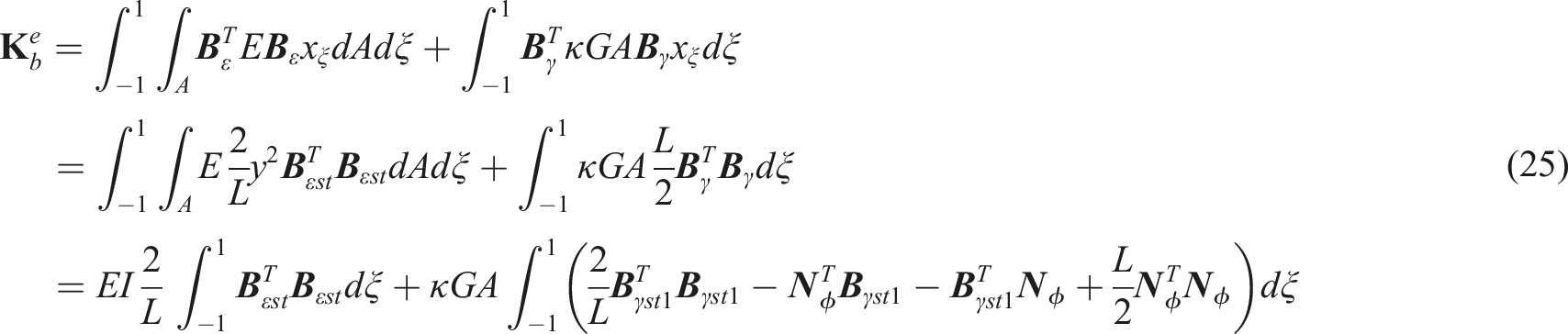
So that, the stiffness matrix of I-sectioned beam element could be derived according to the principle of minimum potential energy, written as

The element mass matrix of I-sectioned Timoshenko beam takes into account not only the inertial action of transverse displacement but also the rotational inertial action of rotation angle. The element mass matrix of I-sectioned beam could be obtained according to D'Alembert principle, which are presented as follows: (1) Inertial action of transverse displacement
The transverse acceleration of the element is

The element equivalent node force of the transverse inertia force is (2) Rotational inertia action of the angle

The rotational acceleration of the element is

The element equivalent node force of the rotational inertia force is

So that, the element mass matrix of I-sectioned beam is obtained, written as

After
I-sectioned plane frame time-domain spectral element
The plane frame time-domain spectral element has axial deformation and bending deformation at the same time, and these two deformations are independent of each other, as shown in Figure 3. Therefore, the dynamic responses of the I-sectioned plane frame cannot be analyzed only by using the time-domain spectral beam element. The time-domain spectral elements of the plane frame can be assembled from the time-domain spectral elements of the beam and the rod in the same way as FEM. The nodal displacement A I-sectioned plane frame time-domain spectral element.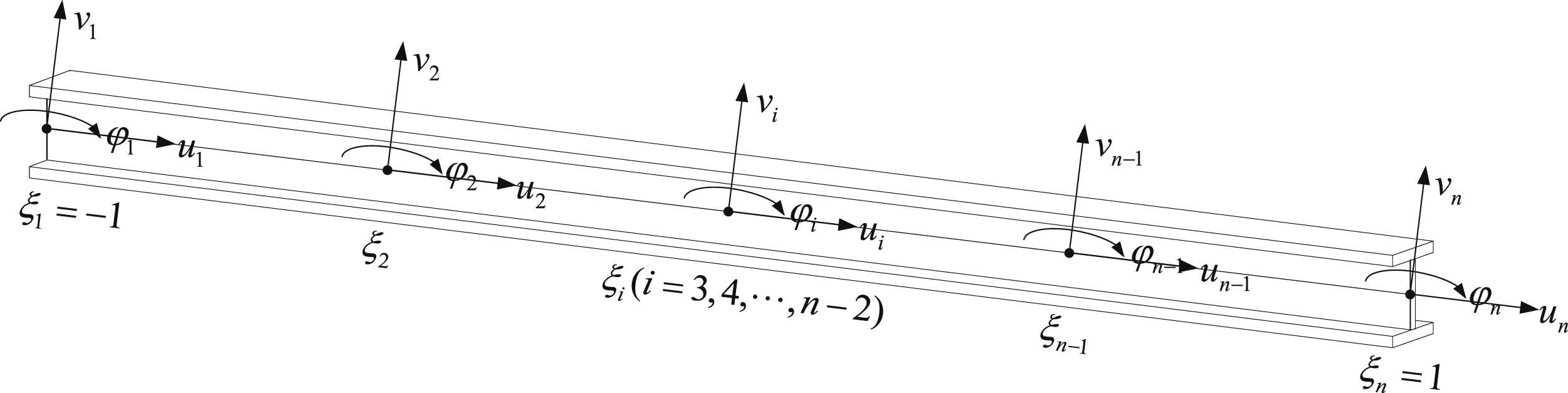

According to the assembly order of nodal displacements, the stiffness matrix, mass matrix, and nodal force vector of the time-domain spectral element of the I-sectioned plane frame can be assembled by the stiffness matrix, mass matrix, and nodal force vector of the time-domain spectral elements of the beam and rod, respectively. Finally, the global stiffness and mass matrixes and nodal force vector of the plane frame structure are obtained, respectively.
Structural damping
Structural damping is divided into classical damping and non-classical damping.
28
In this paper, the damping of steel structures is considered by Rayleigh damping, one of classical damping, and its element damping matrix


Fast calculation process of stiffness and mass matrix
To improve the computational efficiency of ITSEM, the invariant integral operation part of the element matrix can be extracted from the element mass and stiffness matrices, since they can be calculated and saved in advance. The global mass and stiffness matrices of the structure can be obtained by simple addition, subtraction, multiplication, and division operations, which greatly improves the computational efficiency of ITSEM. When the number of CGL nodes n+1 is constant, the matrix variable expressions









Substituting equations (35) and (41) into (12) and (13) to obtain the time-domain spectral element mass and stiffness matrices of the rod


Substituting equations (36)–(40) into (25) to obtain the time-domain spectral element stiffness matrix of I-sectioned beam

Substituting equations (42) and (43) into (31) to obtain the time-domain spectral element mass matrix of I-sectioned beam

The stiffness matrices and mass matrices of the time-domain spectral element of the I-sectioned plane frame can be assembled by
Method validation
Dynamic characteristic analysis of an I-sectioned simply supported beam
Applying the principle of minimum complementary energy to obtain the theoretical calculation formula of the natural frequency of the Timoshenko simply supported beam29,30

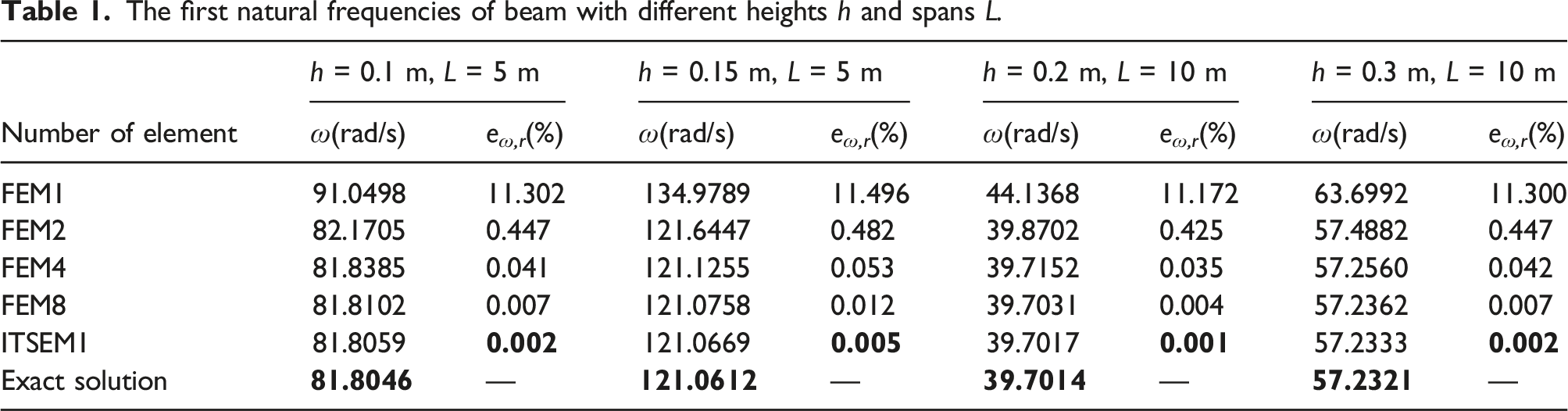
To verify the correctness of the developed method in this paper, the ITSEM program calculating natural frequency is compiled. The number of spectral element is set as 1, and each spectral element has seven nodes. The natural frequency of the I-sectioned simply supported beam is calculated and compared with the FEM calculation results with different division of elements and its exact solution. The simply supported beam model and its cross-section dimensions are shown in Figure 4. Q235 steel is employed, and its elastic modulus E = 210 GPa, density ρ = 7800 kg/m3, Poisson’s ratio μ = 0.3, I-sectioned width B = 100 mm, and wall thickness is 10 mm. Shear correction coefficient κ is calculated according to equation (28). With the changed beam height h and span L, the natural frequencies of the beam are calculated by ITSEM, FEM, and theoretical formula (48), respectively. In addition, an error function is also defined in equation (49) to reflect the computational accuracy of ITSEM and FEM A I-sectioned simply supported steel beam (Unit: mm).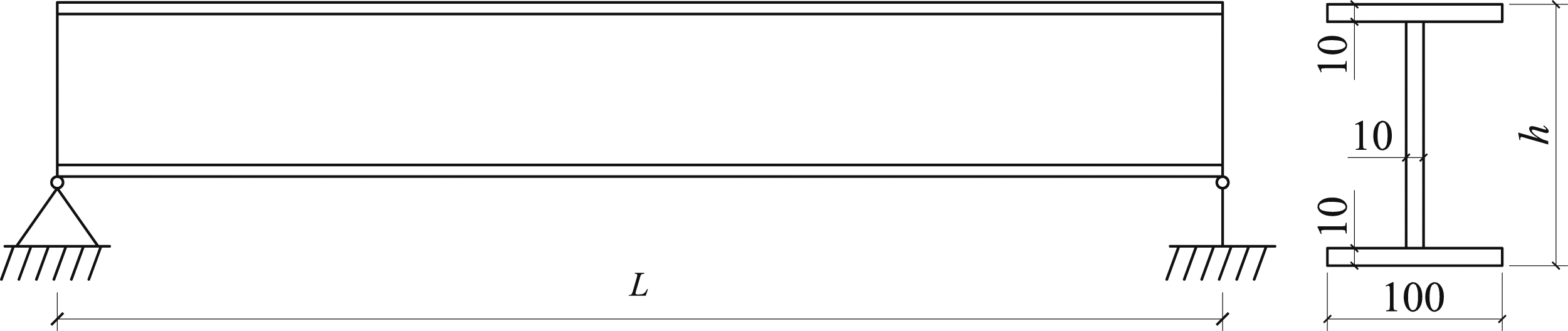

The first natural frequencies of beam with different heights h and spans L.
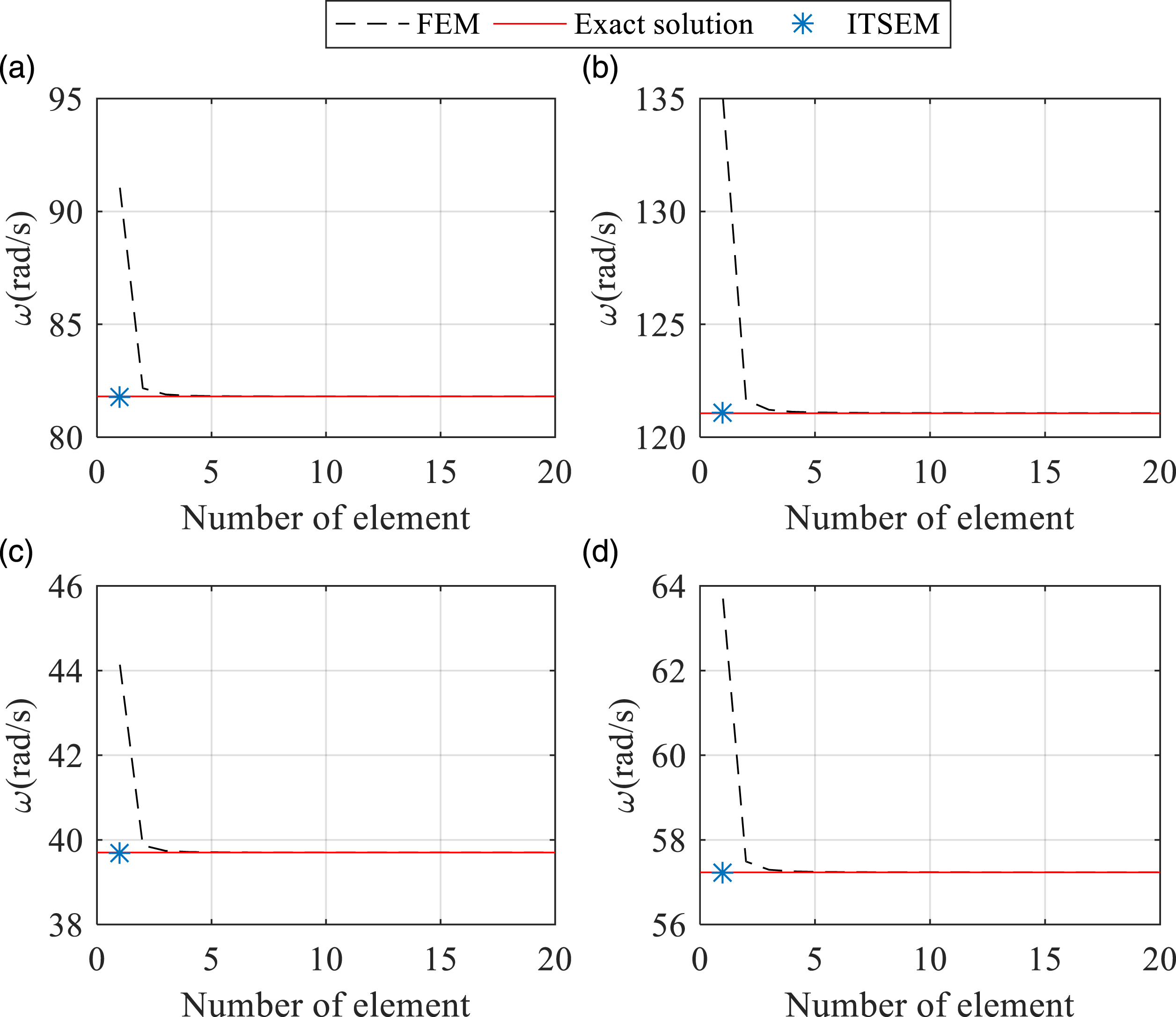
Convergence of the first natural frequency to the number of the elements considered in the finite element method. (a) h = 0.1 m, L = 5 m, (b) h = 0.15 m, L = 5 m, (c) h = 0.2 m, L = 10 m, and (d) h = 0.3 m, L = 10 m.
Seismic analysis of a ten-story I-type steel frame
Descriptions of steel frame model
To validate ITSEM in steel structure for multi-story buildings, we implement the seismic response analysis of a ten-story steel frame model under different seismic excitations and validate its feasibility and computational efficiency. The ten-story steel frame model is shown in Figure 6. Q235 steel is employed, and its elastic modulus, density, and Poisson’s ratio are same as the previous section, the damping ration is 0.03. The I-shape section is employed, and the sectional dimensions of the lower 5th story columns, the upper 5th story columns and all beams are I500 mm × 300 mm × 12 mm × 15 mm, I300 mm × 300 mm × 10 mm × 15 mm and I350 mm × 175 mm × 8 mm × 12 mm, respectively, and their yield moments are 595.2527 kN·m, 312.2798 kN·m and 192.1682 kN·m, respectively. The beam length is 5 m, and height for each story is 4 m. Each beam or column component was taken as one spectral element by the ITSEM, and each time-domain spectral element has five nodes. A ten-story steel frame with I-sectioned (Unit: mm).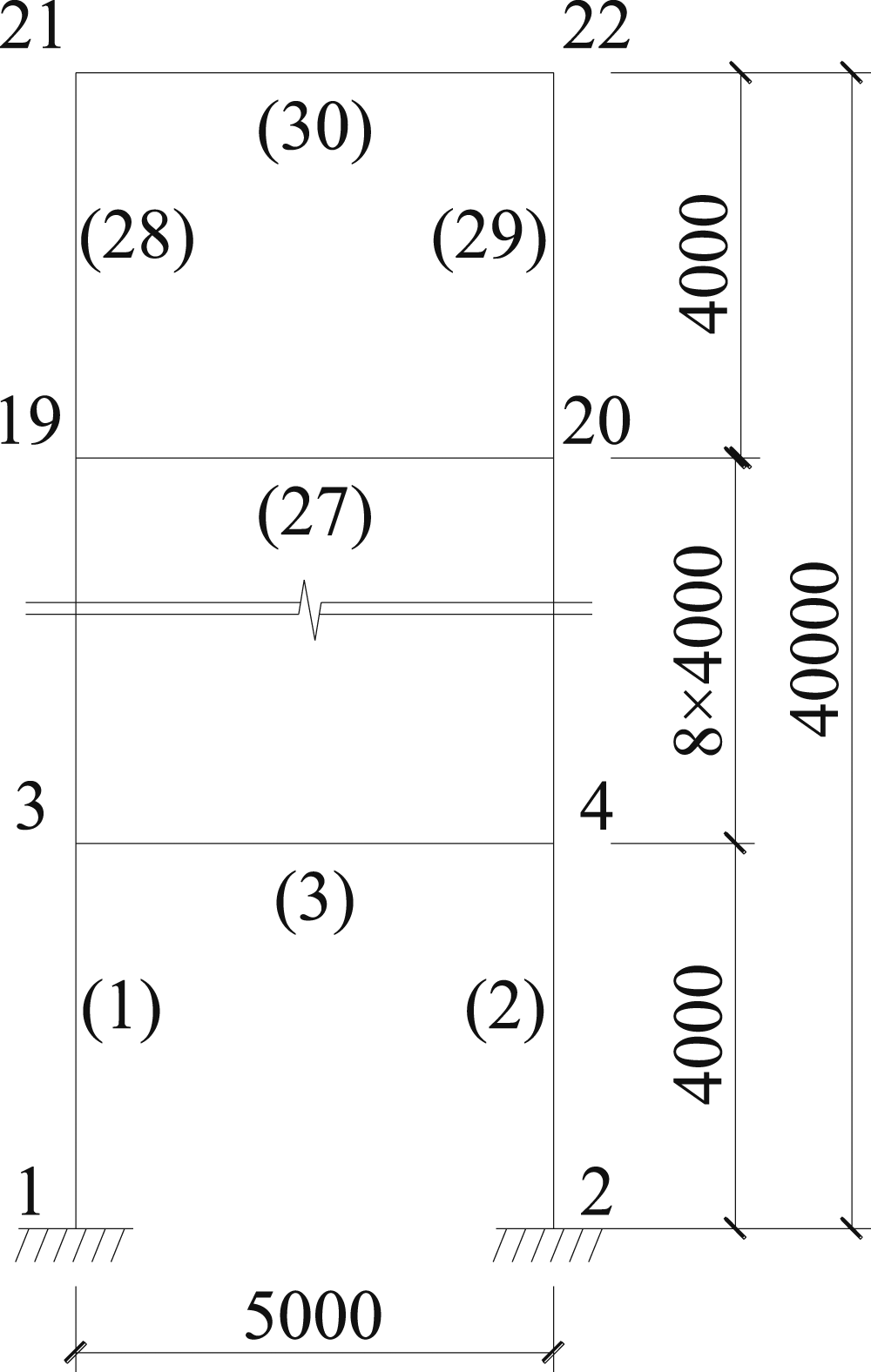
Seismic response analysis and results
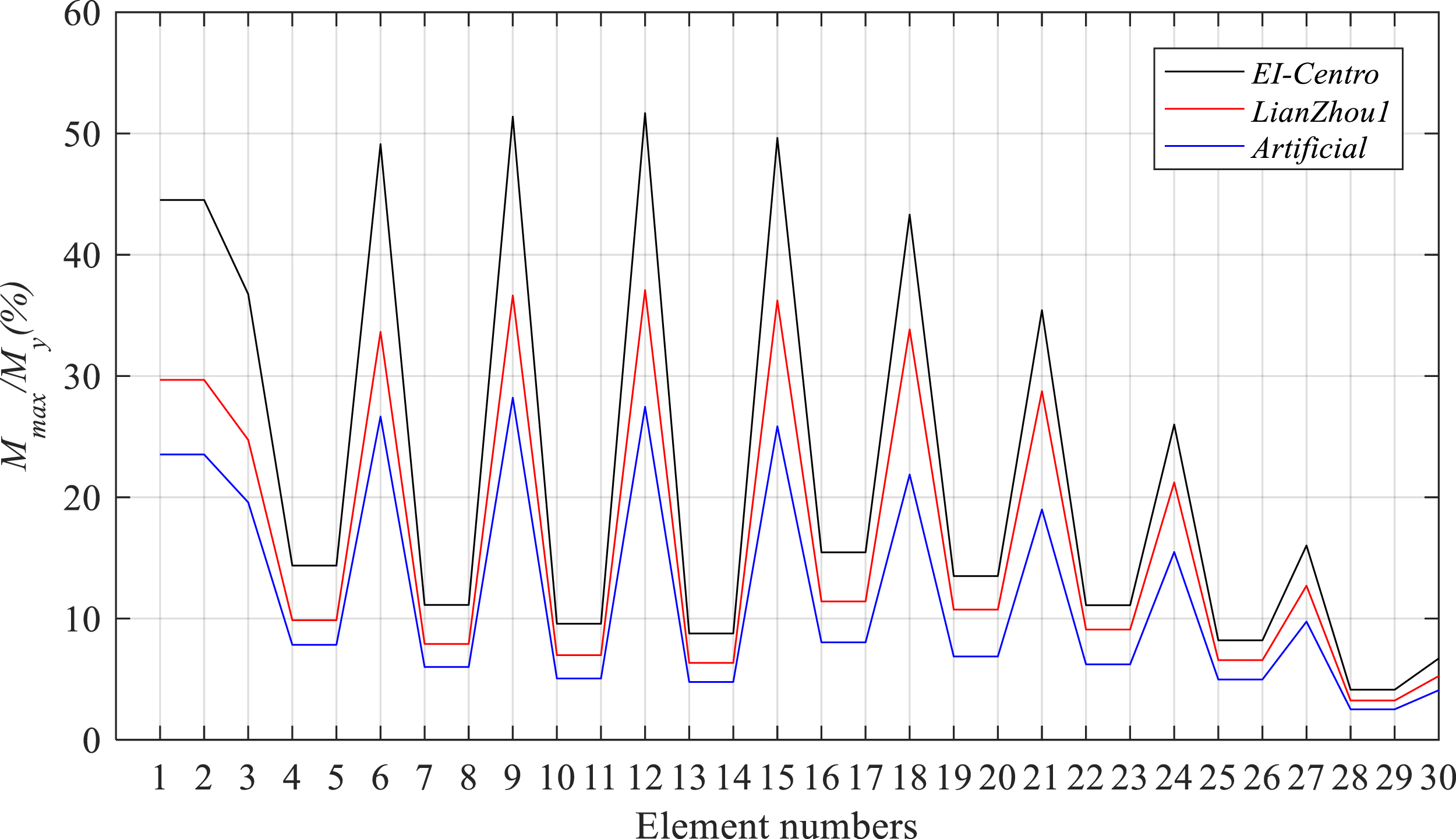
Different seismic waves are selected31,32 as shown in Figure 7, where, El-Centro (Imperial Valley Earthquake of 1940) and LianZhou1 (Lanzhou Earthquake of 1995) are seismic waves applicable to class II sites, and their PAG is adjusted to 0.35 g. In addition, in order to reflect the randomness of seismic waves, white noise was selected as the artificial wave with a PAG of 0.35 g and a maximum frequency of 10 Hz. These three different seismic excitations are horizontally imposed on the column foot of the ten-story steel frame, respectively. ITSEM and FEM are used to calculate the dynamic responses of the ten-story steel frame by Newmark method, the time step is set to 0.02 s. The maximum bending moment of each element of the structure under different horizontal seismic excitations is calculated by ITSEM, and then the ratio of the maximum bending moment of each element to the yield bending moment is calculated and shown in Figure 8. Three different seismic waves with a peak value of 0.35 g. The ratio of the maximum bending moment of each element to the yield bending moment.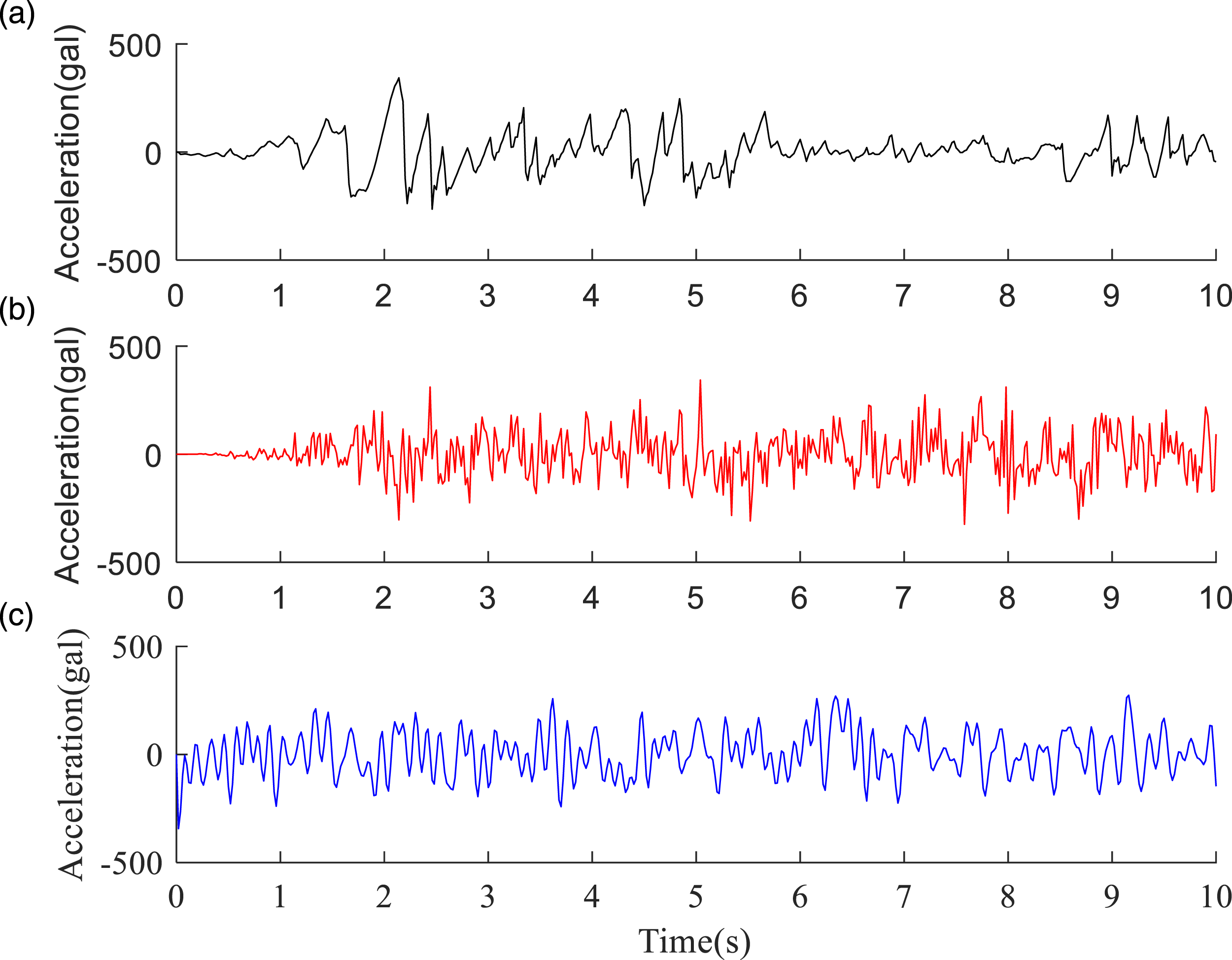
Calculation results of FEM and ITSEM and their relative errors for ten-story steel frame.
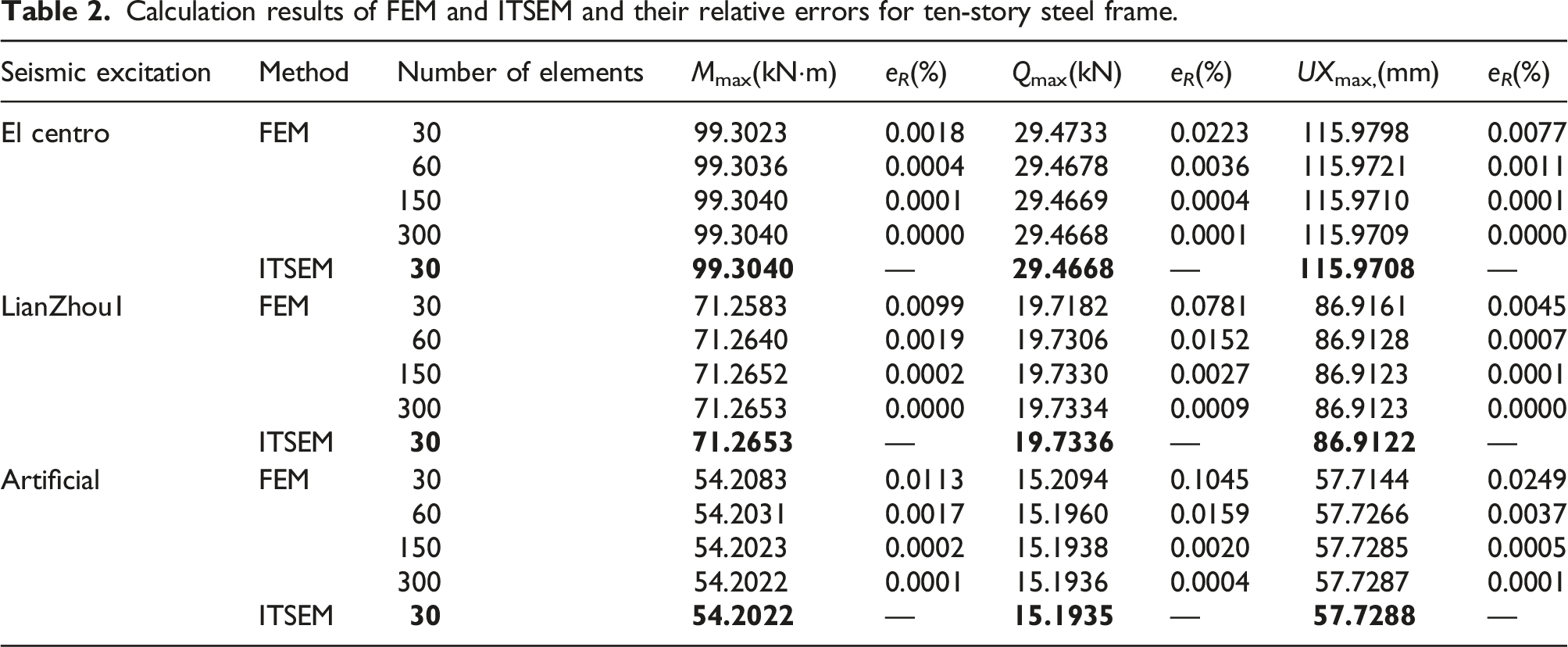
It can be seen from Table 2 that as the number of finite elements increases, the results of Mmax, Qmax, and UXmax calculated by FEM will be approaching those calculated by ITSEM. When the structure is divide into 300 finite elements, the calculation results of FEM are the closest to those of ITSEM. At this time, in the case of El-Centro wave excitation, the relative errors of Mmax, Qmax, and UXmax calculated by FEM and ITSEM are 0.0000%, 0.0001%, and 0.0000%, respectively. In the case of LianZhou1 wave excitation, the relative errors of Mmax, Qmax, and UXmax calculated by FEM and ITSEM are 0.0000%, 0.0009%, and 0.0000%, respectively. In the case of Artificial wave excitation, the relative errors of Mmax, Qmax, and UXmax calculated by FEM and ITSEM are 0.0001%, 0.0004%, and 0.0001%, respectively.
In order to compare the structural time history response results calculated by FEM and ITSEM, Figure 9 shows the displacement time history diagram at the top node 22 of the ten-story steel frame under El-Centro ground motion. Table 3 lists the root-mean-square index (RMSD)
33
values of displacements of the top node 22 of the frame under different seismic excitations calculated by FEM while displacements calculated by ITSEM as baseline. The explicit expression for RMSD is as follows: Displacements at node 22 of the ten-story steel frame under El-Centro ground motion. Computing time of FEM and ITSEM, and RMSD of FEM displacements of the ten-story frame under three different seismic excitations.
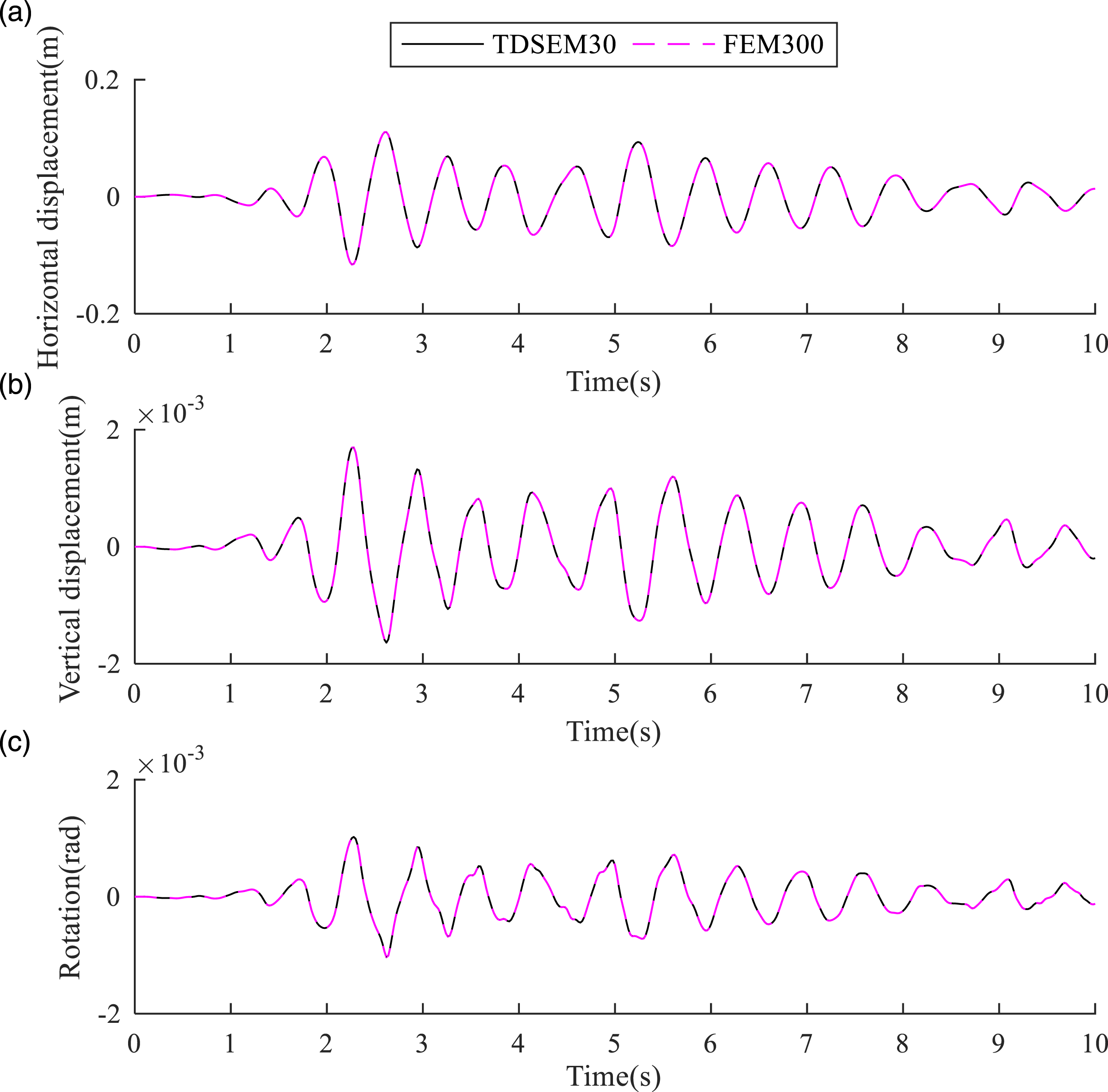
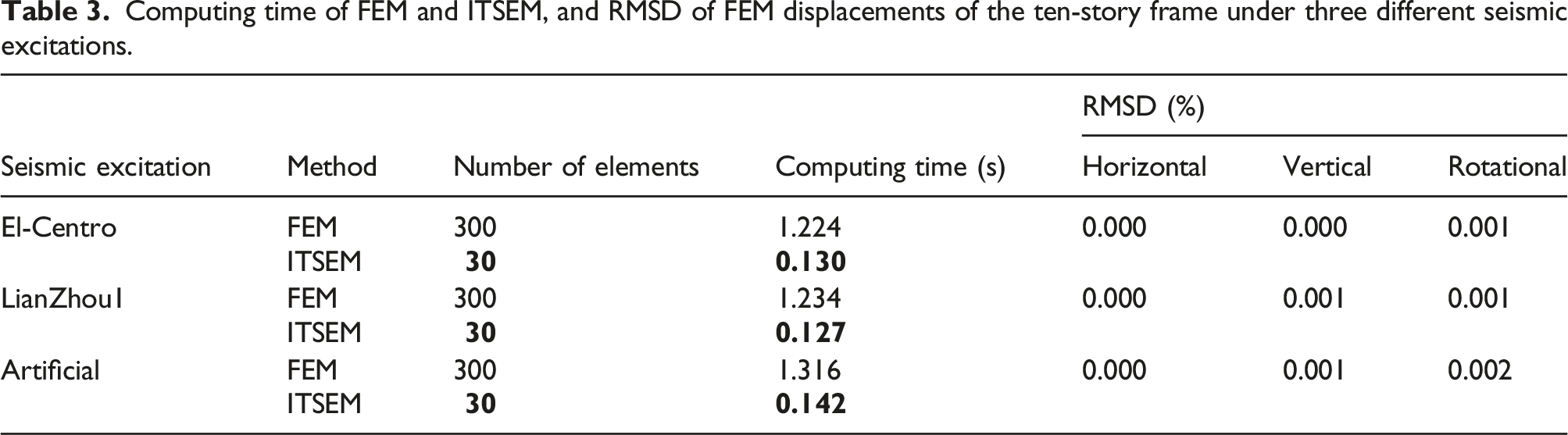
It can be found that when FEM divides the ten-story steel frame into 300 elements, the displacement curves agree well with those calculated by ITSEM. In the three cases of horizontal seismic excitations of El-Centro, LianZhou1, and Artificial waves, the RMSD values of horizontal displacements are 0.000%, 0.000%, and 0.000%, respectively, the RMSD values of vertical displacements are 0.000%, 0.001%, and 0.001%, respectively, and the RMSD values of rotational displacements are 0.001%, 0.001%, and 0.002%, respectively. This shows that ITSEM only needs 30 spectral elements to achieve the calculation accuracy of FEM using 300 elements.
The computing time for FEM and ITSEM in the same computer is also collected and listed in Table 3. In the three cases of horizontal seismic excitation, the computing time of ITSEM with 30 spectral elements are 0.130 s, 0.127 s, and 0.142 s, respectively, but those of FEM are 1.224 s, 1.234 s, and 1.316 s, respectively. The computing time of ITSEM in each case is about 1/10 to 1/9 of FEM. It not only proves the effectiveness of ITSEM in the calculation of dynamic response of I-sectioned multi-story steel frame subjected to seismic excitation, but also indicates that ITSEM has much higher computational efficiency than FEM in the seismic response analysis.
Conclusion
This paper proposes an ITSEM for seismic analysis of I-sectioned steel frame structures. The developed method is based on Timoshenko beam theory, the CGL points are taken as the element nodes of the Timoshenko beam, and Lagrange interpolation was used to expand the spectral element approximation of the displacement functions of the vertical and rotational displacements of the beam. Based on the displacement shape function obtained, the stiffness and mass matrices of time-domain spectral elements for I-sectioned beam are derived by using a method similar to FEM, considering the inertial action of the transverse displacement and the rotational inertial action of the rotation angle.
The dynamic characteristics of an I-sectioned simply supported beam are computed and compared with the FEM and analytical results to validate the ITSEM. Then, combined with the time-domain spectral element matrix of the rod, the seismic response analysis is carried out for a ten-story steel frame under three different earthquake excitations, respectively. In the process of calculation, the invariant integral operation part, which calculating the element mass matrix and element stiffness matrix, is extracted and the integral operation part is calculated and saved in advance. Thus, the global mass matrix and stiffness matrix of the structure can be obtained by simple addition, subtraction, multiplication and division operations, which greatly improves the computational efficiency of ITSEM. The calculation results by ITSEM are compared with those of FEM, which proves the effectiveness, accuracy, and high efficiency of ITSEM in elastic seismic analysis for plane steel frame structures. The developed ITSEM displays potential to apply to the seismic analysis of actual steel structures. In the future, we will further focus on the steel structural dynamic analysis considering the variable cross-section component spectral element and incomplete rigidity joint connect.
Footnotes
Declaration of conflicting interests
The author(s) declared no potential conflicts of interest with respect to the research, authorship, and/or publication of this article.
Funding
The author(s) received no financial support for the research, authorship, and/or publication of this article.
