




Abstract
The Mega-Sub Controlled Structure Systems (MSCSS) with lead rubber bearings (LRBs) is an innovative and attractive vibration control system. This study proposes a method for obtaining the optimal member sizes of the MSCSS with LRBs under non-stationary stochastic ground motions. Based on the structural characteristics of the MSCSS with LRBs, this study puts forward the “optimal criteria method with two-stage equal reliability.” The probability density evolution theory is used for the dynamic reliability analysis of the MSCSS with LRBs, and a MATLAB program is written for the member size optimization. A finite element model with four mega-floors and 32 sub-floors is studied as an example. The reliability and seismic response of the model before and after optimization are compared. The optimization eliminates the “weak floors” in the structure so that the reliability distribution after optimization is more uniform than before, and the seismic performance of the structure is also improved.
Keywords
Introduction
Earthquakes often release vast amounts of energy on high-rise buildings in a short period, and their occurrence is highly random, often causing catastrophic damage to property and human lives. With the increase in the number and height of high-rise buildings in cities, the safety of high-rise buildings has attracted more and more attention. Commonly used vibration control strategies include but are not limited to isolation, the use of tuned mass dampers (TMD), or the use of hybrid controllers.1–6 The Mega-Sub Controlled Structure System (MSCSS) is an innovative seismic control solution for high-rise buildings. It takes advantage of the sub-structures in the so-called Mega-Sub Structures (MSS) and uses those sub-structures as tuned masses in TMDs. The MSCSS has been proven to have extraordinary vibration control performance.7–12 Fan et al. 13 and Abdulhadi et al. 14 modified the MSCSS by adding lead rubber bearings (LRB) to the additional columns. LRBs in MSCSS do not isolate the structure from the earthquake, but they can increase the relative displacement between the sub-structures and the mega-structure, thus increasing the energy dissipation of dampers and further improving the seismic performance of the system.
As a new structural form, the MSCSS with LRBs still needs further improvements and optimizations. Abdulhadi et al. studied different damper parameters and positions. They found that the damper parameters and their placement positions significantly impacted the control effect of MSCSS with LRBs. 14 Later, they evaluated the fragility of the structure system under earthquakes. 15 They further studied the effects of different relative stiffness ratios and mass ratios on the acceleration and displacement of the sub-structures in the structure system during earthquakes and found the optimal range of relative stiffness ratio and mass ratio. 16 Fan et al. used genetic algorithms to optimize the distribution and dynamic parameters of dampers and LRBs. 13 However, there is no research involving the optimization of the member size of MSCSS with LRBs. Moreover, previous studies have treated ground motions as a deterministic process and have not analyzed the structure based on reliability. To improve the overall reliability and seismic performance of MSCSS with LRBs, this study explored methods for optimizing the member size in the structure system based on reliability analysis.
When structures are subjected to random earthquake loads, the commonly used optimization methods cannot take into account the randomness of the loads. The optimization design of the structure shall be conducted based on reliability. The traditional probability density evolution equations for calculating structural reliability include the Liouville equation, 17 the FPK equation, and the Dostupov–Pugachev equation. 18 For high-dimensional non-linear structures such as MSCSS with LRBs, these partial differential equations cannot be solved with existing methods. We introduce the probability density evolution theory developed by Li and Chen and use the generalized density probability evolution equation to solve the probability density function (PDF) of the structure.18–20 Structural optimization methods include mathematical programming methods, intelligent algorithms, and optimal criterion methods. Mathematical programming and intelligent algorithms are computationally expensive when dealing with optimization problems that involve many design variables. Due to the complexity of the structural system and the reliability calculation, the use of mathematical programming methods and intelligent algorithms will result in a large number of iterations and an extended computing time. The optimal criteria method with two-stage equal reliability proposed in this paper has fewer iterations and is fast convergent to an accurate result.
This paper is organized as follows: Section 2 describes the problem formulation. The objectives, design variables, and constraints of the optimization problem are clarified. The inter-story drift of each floor of MSCSS with LRBs is defined as the limit state control variable and the first excursion failure criterion. 12 natural ground motions and forty-eight non-stationary artificial ground motions are used for the time history analysis, and the reliability of each floor of MSCSS with LRBs is calculated based on the probability density evolution theory. Based on the results of reliability analysis, a MATLAB program is used to optimize the structure system. Section 3 describes the example models used for optimization in this study. The detailed numerical solutions of models are provided. Three different structural systems before and after optimization are compared in terms of reliability and seismic response. Section 4 presents the conclusions of this work.
Optimal criteria method with two-stage equal reliability
Background
The numerical structural optimization methods can be categorized into mathematical programming, intelligent algorithm, and optimal criteria method. The mathematical programming 21 is a long existed method that is applicable for most structures. A significant disadvantage of the method is that the number of iterations required usually increases significantly with the number of design variables, so it is not suitable for optimizing models with a large number of design variables. Intelligent algorithms have become popular in recent years. The commonly used algorithms include the genetic algorithm, the immune algorithm, the annealing algorithm, the particle swarm algorithm, the fish swarm algorithm, the ant colony algorithm, and the neural network algorithm. Intelligent algorithms have broad applicability and can be used on almost all optimization problems; however, they are computationally expensive, and the convergence of these algorithms lacks mathematical verification. The optimal criteria method defines criteria to be met when the structure reaches the optimal design and then uses an iterative method to find solutions based on the criteria. The optimal criteria method is mainly applicable to the structures with defined layouts and geometries. It converges fast, and the number of iterations is not directly related to the number of design variables. When the accuracy requirement is low, the optimal criteria method is preferred.
According to the characteristics of design variables, structural optimization problems can be divided into three levels: topology optimization, shape optimization, and size optimization. Structural size optimization is often used to design the cross-sectional area of the trusses, the cross-sectional moment of inertia of the beams, the thickness of the plates, or the floor thickness of composite members. Compared with topology or shape optimization, size optimization is simple. There is no need to re-grid the structure in the optimization process, and the relationship between the design variables and the stiffness matrix is generally linear or simple non-linear.
The structure form and geometry of MSCSS with LRBs are determined, but the structure is complex and involves many design variables, so it is suitable to use the optimal criteria method to optimize the member size.
Description of the optimization problem
The mathematical model of the optimization problem can be described by three components: optimization criteria, design variables, and constraints. For multi-floor frame structures with determined load conditions, the fully stressed criterion is commonly used to make the best use of the materials on each floor. The idea is to adjust the section sizes of the members so that the load-carrying capacity of members is fully used and the member sizes are considered optimal. 22 Because earthquake loads are random; it is necessary to extend the idea of fully stressed criterion to the field of reliability. When the reliability of each floor reaches a specific design standard at the same time, that is to say, the reliability of each floor is approximately equal, then the design of the member sizes can be considered optimal. This method can be called the equal reliability criterion method.
In engineering practice, it is neither possible nor necessary to make the reliability of each floor exactly the same. As long as the reliability
In MSS or MSCSS, each sub-structure is attached to the mega-structure, and different sub-structures are independent of each other. The failure of one sub-structure will not necessarily lead to the failure of the other sub-structures or the mega-structure, while the failure of the mega-structure will undoubtedly cause the failure of all sub-structures attached to it. Therefore, the importance of the mega-structure is greater than any of the sub-structures. The protection for sub-structures can be considered the first line of defense, and the protection for the mega-structure be considered the second. Mega-structure shall not fail before any of the sub-structures, so the reliability of the mega-structure shall be higher than that of sub-structures. Therefore, we propose the “two-stage equal reliability criterion” as the optimization method, which can be expressed as (1) The reliability of each mega-floor (2) The reliability of each sub-floor (3) The reliability of the mega-structure should be higher than that of all sub-structures:


The proper intervals of reliabilities are determined by adding or subtracting the fluctuation p from the mean values of reliabilities


This paper uses the column section widths as design variables. It is assumed that all the columns are square box sections and have the same section dimensions on the same floor. Wall thicknesses of the box sections are not subjected to change so that each floor has only one design variable. For a building with n floors, the design variable vector is

The reliability increase shall not be achieved at the expense of increasing the amount of material used in the structure, so keeping the total mass of the structural steel unchanged is set as a constraint. The design vector is located on the boundary of the total mass constraint, and the total mass constraint is a linear function of the design variables, which can be expressed as

Reliability calculation
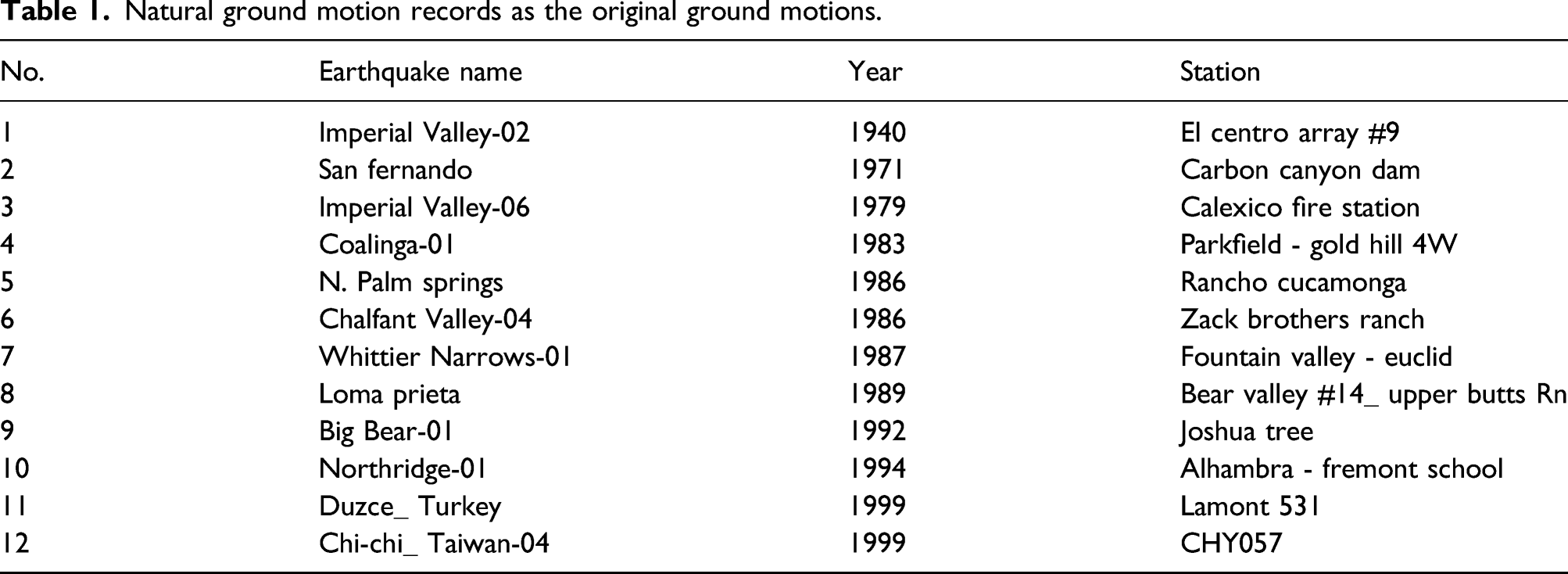
Natural ground motion records as the original ground motions.
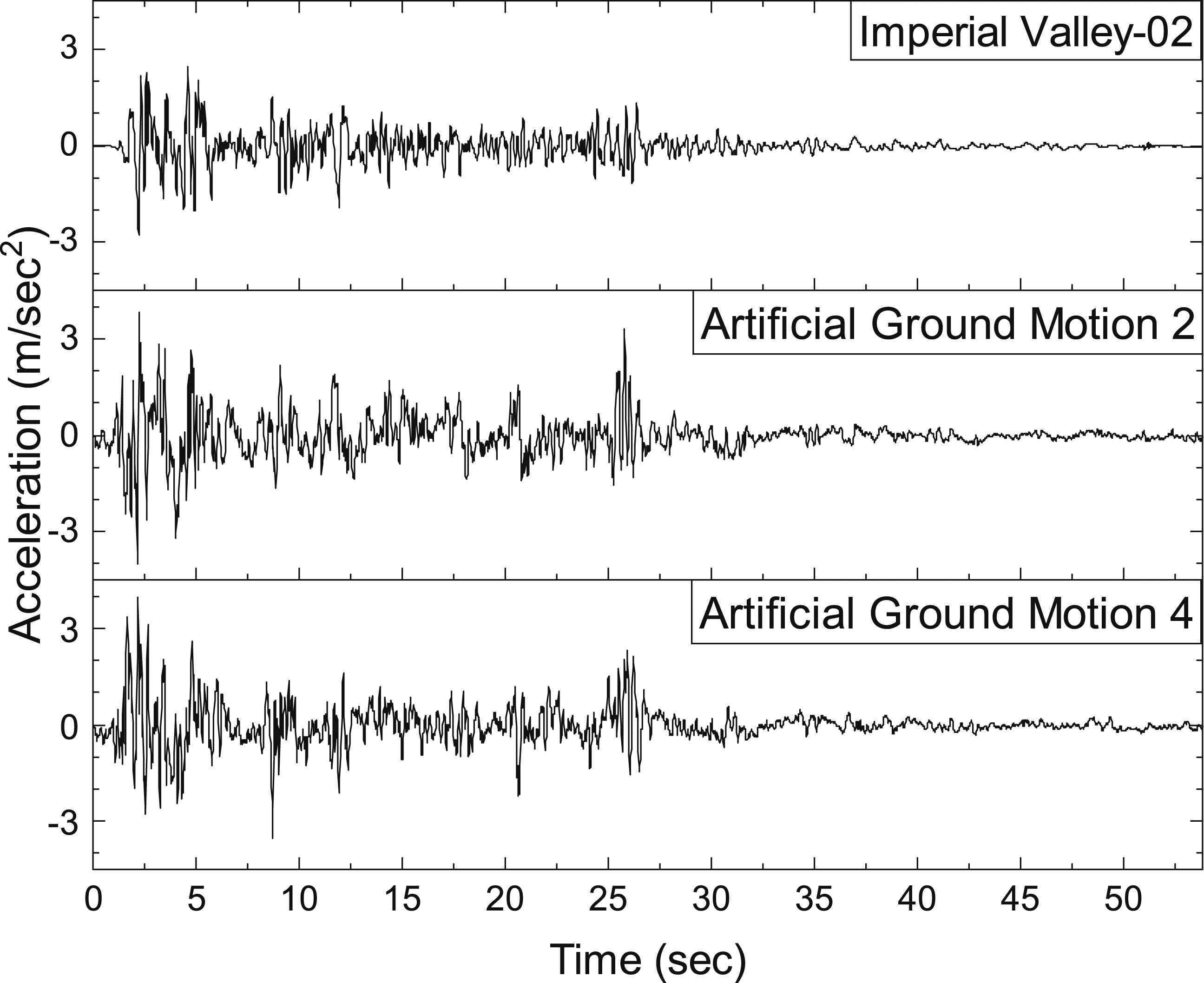
Acceleration time history of El. Centro NS, artificial ground motion No. 2, and artificial ground motion No. 4.
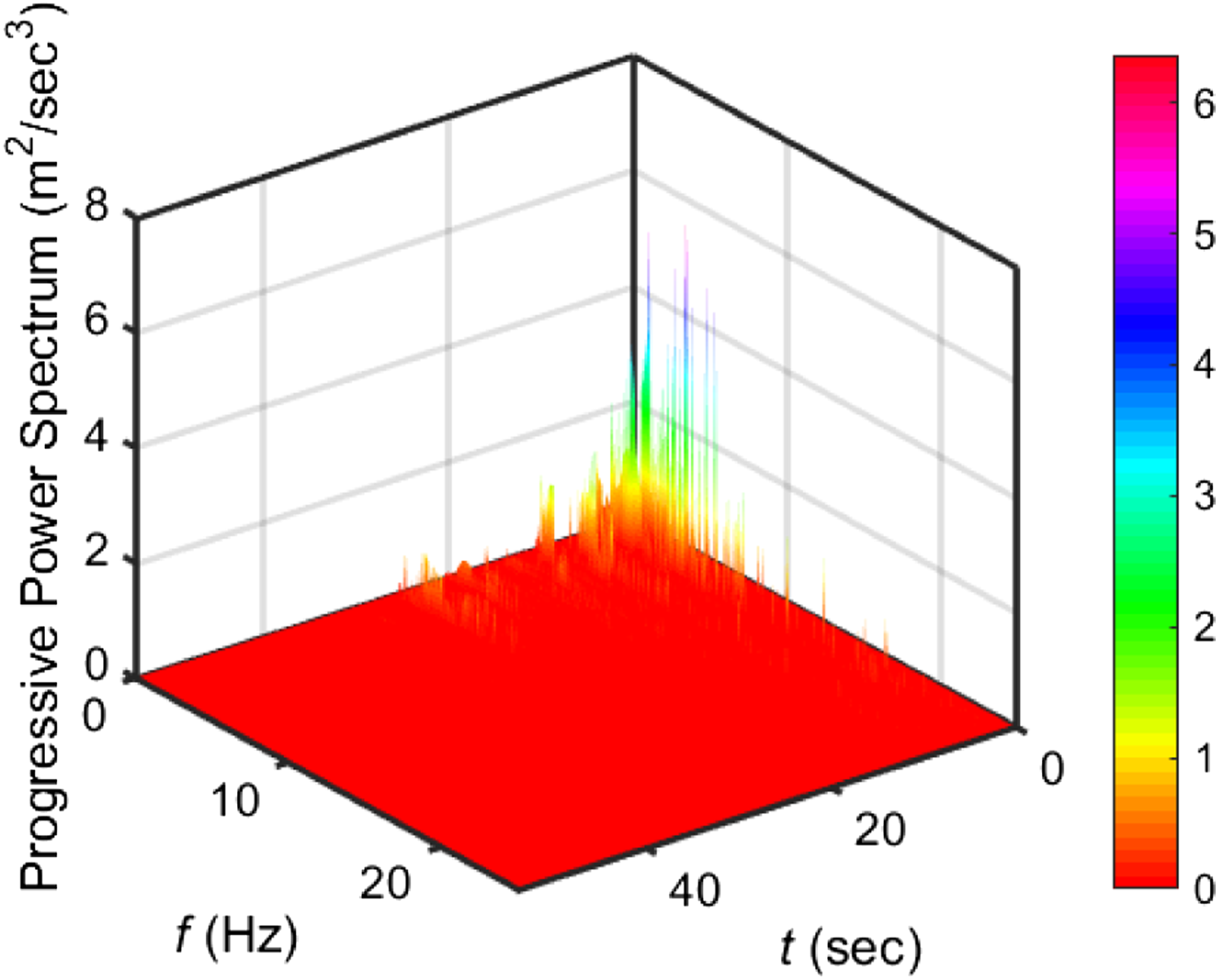
Progressive power spectrum of El. Centro NS.
The response time history of each floor can be obtained by analyzing the structure system under the generated ground motions. After substituting the response into the probability density evolution equation, the reliability of each floor can be obtained. The Liouville equation, FPK equation, and Dostupov–Pugachev equation are commonly used to calculate the probability density evolution of a random system. However, when describing a complex system such as the MSCSS with LRBs, these equations will become high-order partial differential equations. Despite the efforts of many researchers,25–27 the available solutions to these equations are still limited. To calculate the probability density evolution for complex engineering problems, Chen and Li put forward the probability density evolution theory and derived the generalized probability density evolution equation based on the conservation of probability. 18
This paper studies the vibration of deterministic structures under random earthquakes, so the randomness only exists in the excitation. For a system with n degrees of freedom, its motion equation can be expressed as

The initial conditions of equation (8) is.
The analytical solution of
After the joint PDF 
This paper uses the inter-story drift of MSCSS with LRBs as the limit state control variable. The inter-story drift is required to meet the conditions 

This is an “absorbing boundary condition.” 28 Once the probability enters the failure zone, the part of the probability will no longer return to the reliable zone, that is, the probability is absorbed by the boundaries.
Optimization Algorithm
The idea of the optimization algorithm is to gradually transfer materials from floors with higher than average reliability to floors with lower than average reliability; so that the reliability of each floor tends to be equal, while the total material usage remains unchanged. In each iteration, the mass and stiffness matrices of the structure are built according to the design variable vector
For mega-structure: if 
For sub-structure: if 
In the formula, a and b are the number of floors with reliabilities above the average. a is for the mega-floors, and b is for the sub-floors. The number of floors with reliabilities less or equal to the average can then be easily calculated, and we denote them as c and d for the mega-floors and the sub-floors, respectively.
To move the material within mega-floors, we denote design variables of the floors included in a and c as 


Equation (15) to equation (17) describe how the design variables are adjusted within the mega-floors. The equations for sub-floors are similar, just replace a and c in equation (15) and equation (17) with b and d.
The amount of material between the mega-structure and the sub-structures may also need to be adjusted. If the reliability of mega-structure is less than that of sub-structures, then move the material from sub-structures to mega-structure. The design variables of the mega-structure and sub-structures can be written as 

The value of
The optimization algorithm based on the two-stage equal reliability criteria can be summarized in the following flowchart:Figure 3 Flow chart for the two-stage equal reliability optimization.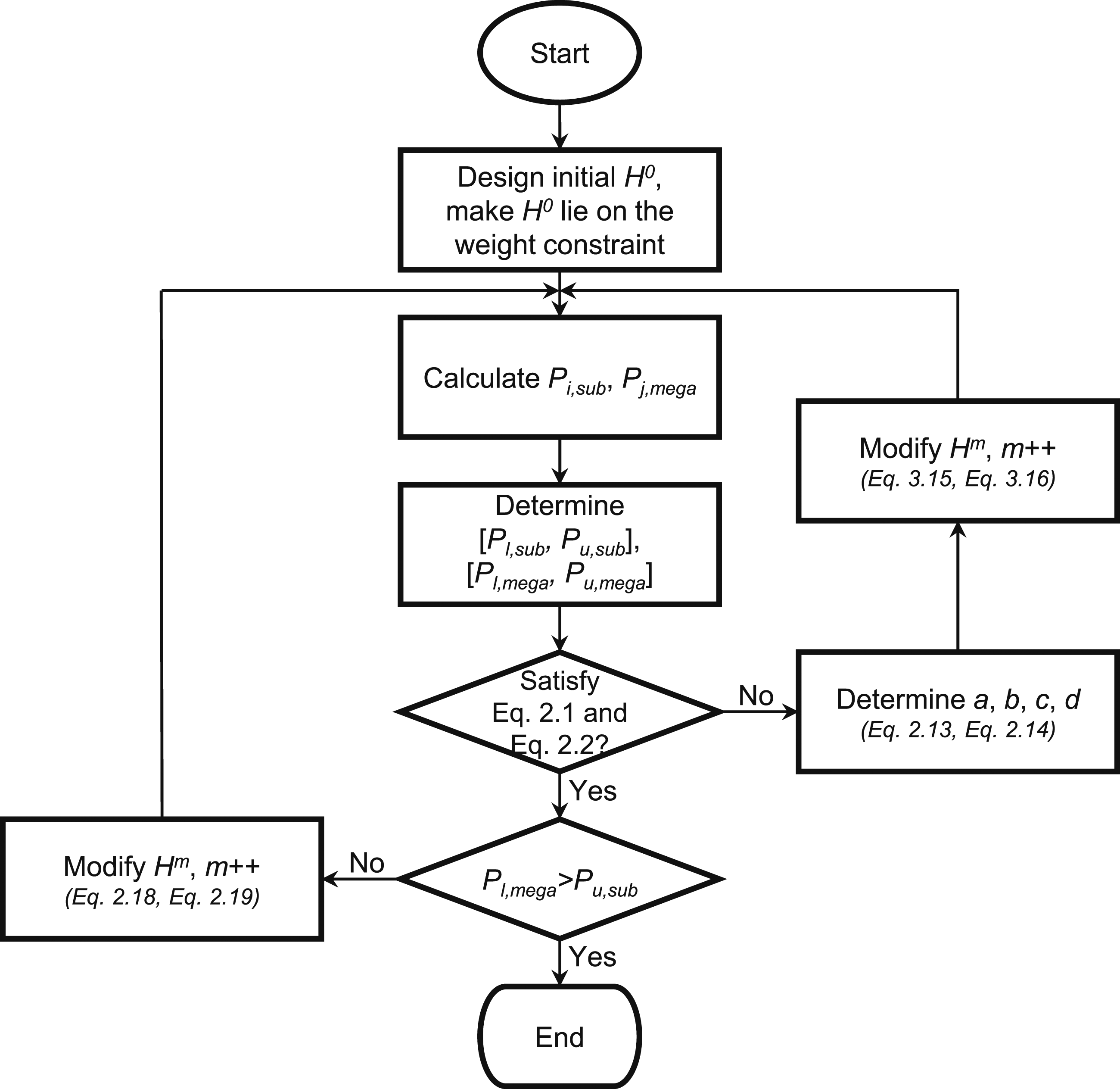
Case Study
Optimization models
To test the optimization procedure, we established a four-mega-floor MSCSS with LRBs, and its façade drawing is shown in Figure 4(a). Thick lines represent the mega-structures, and thin lines represent the sub-structures. There is one sub-structure on each mega-floor, and each sub-structure contains eight sub-floors. The sub-structure on the ground mega-floor is fix-connected to the mega-structure. The sub-structures on the other mega-floors are only fix-connected at the bottom; the top and sides are only connected to the mega-structure with LRBs and dampers. The layout and parameters of the dampers and LRBs are optimized by Fan et al.
13
Maxwell viscoelastic model is used for dampers. The damping coefficient and damping exponent are 4.5 kNs/cm and 1.4, respectively. The Bouc-Wen model is used to describe the horizontal deformation of LRBs. The stiffness of an LRB is 24 kN/m before yield and 2.4 kN/m after yield. The yield force of the LRB is 2 kN. All frame beam-column nodes are moment connections, and the supports on the ground are fixed. Heights for mega-floors and sub-floors are 32m and 4m. The width of the structure is 26m, the side spans of the sub-beams of the released sub-structures are 4.7 m, and the two middle spans are both 5.6 m. The lateral design load of the structure only considers the seismic load, and the peak values of all ground motions are adjusted to 800gal. All beams and columns are made of Q345 steel, and the sections of the members are shown in Figure 4. The direct integration method is used for the non-linear dynamic time history analysis. In the analysis, the damping ratio of the structure adopts the classic Rayleigh damping, and it is taken as 0.05. Models of different structure systems (a. Mega-Sub Controlled Structure Systems with lead rubber bearings; b. Traditional MSCSS without LRBs; c. Mega-Sub Structures without vibration control).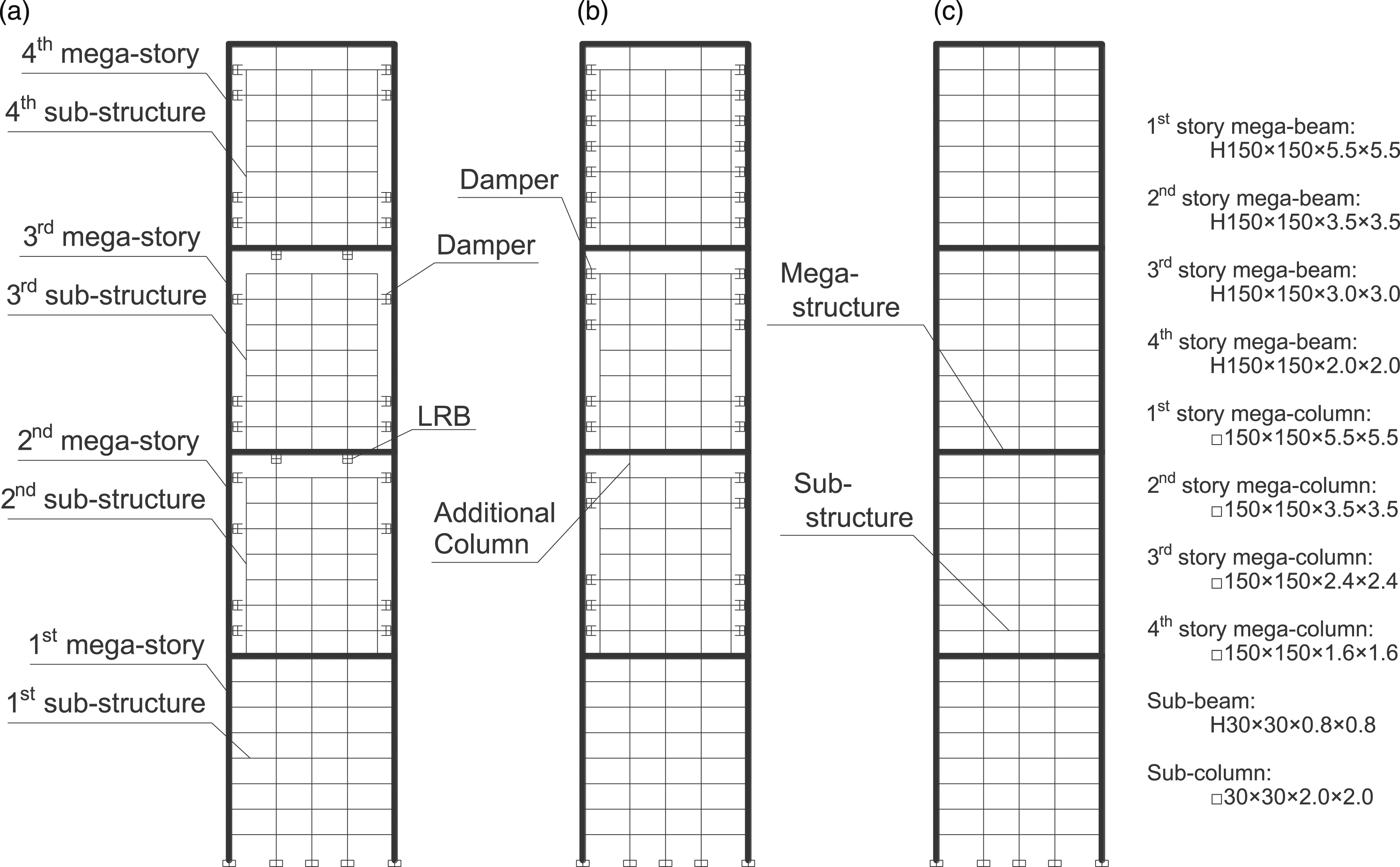
To verify the seismic performance of MSCSS with LRBs from the reliability perspective, we also established models for the traditional MSCSS without LRBs (Figure 4(b)) and the MSS without the seismic control system (Figure 4(c)). The two models are almost identical to the model in Figure 4(a), except the connections between the sub-structures and the mega-structure are different. There is no LRB at the top of the sub-structures for the model in Figure 4(b), and sub-structures are directly connected to the mega-structure with additional columns. Two sides of sub-structures are also connected to the mega-structure with dampers, and the layout and parameters of the dampers also refer to the optimization results of Fan et al. 13 The model in Figure 4(c) has neither LRBs nor dampers. The sub-structures and the mega-structure are directly connected by steel beams and columns with moment connections.
Results and discussion
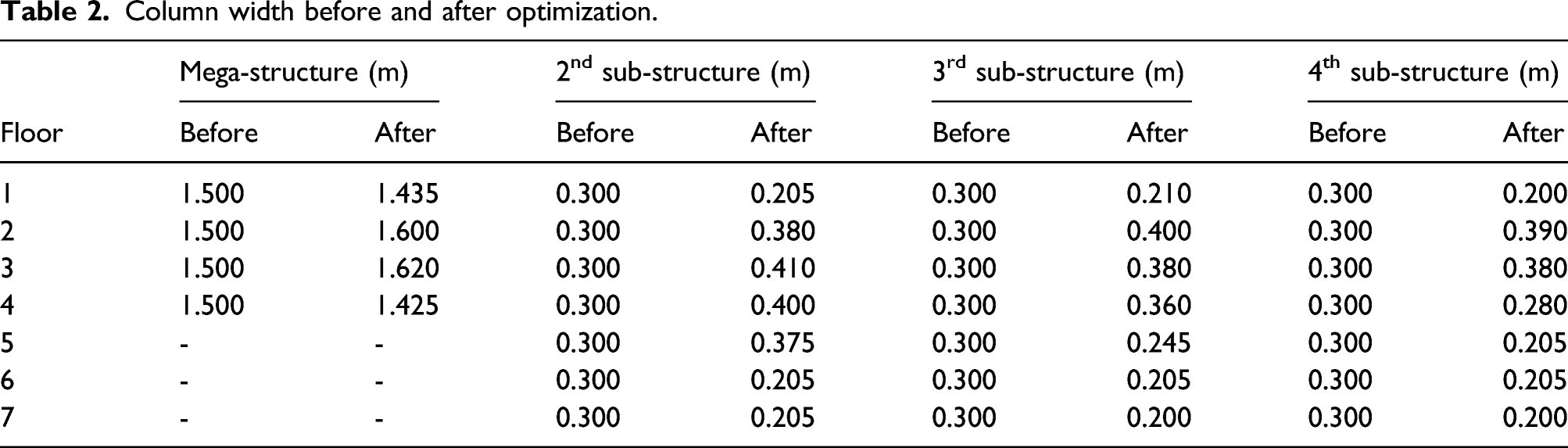
Column width before and after optimization.
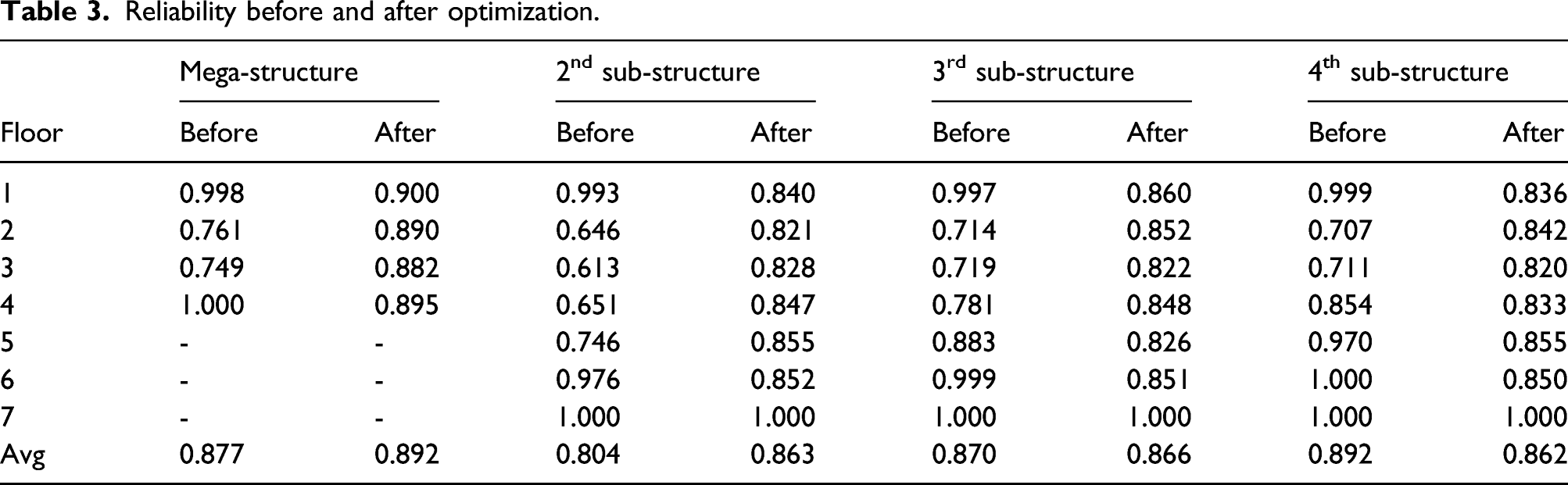
Reliability before and after optimization.
From the data in Table 2, it can be calculated that the optimized structure is 0.009% lighter than before, and it can be considered that the total mass of the structure is unchanged. The reliability of the structure, however, has been dramatically improved. For the mega-structure and each sub-structure, the mass is moved from columns on the top and bottom floors to those on the middle floors. Between the sub-structures and the mega-structure, some of the mass in the sub-structures is moved to the mega-structure.
It can be seen from Table 3 that before optimization, the variances of the reliability of the mega-structure and sub-structures were 1.99×10−02 and 2.18×10−02, respectively. For the four mega-floors, the reliabilities are high for the top and bottom floors and low for the middle two floors. The reliabilities for the middle two floors are even lower than the average reliability of some sub-structures. For each sub-structure, reliabilities are higher on the second and third floors and lower on the bottom and top floors. Among the three released sub-structures, the average reliability of the 2nd sub-structure is the lowest, only 0.804, and there are several weak floors with reliabilities below 0.7. After optimization, the reliabilities of mega-floors are larger than the average reliabilities of sub-structures, which meets the two-stage protection requirement; that is, the reliability of the mega-structure shall be higher than that of sub-structures. The reliability variances of the optimized mega-structure and sub-structures are 5.94×10−05 and 3.40×10−03, respectively. The reliability is more uniformly distributed. The optimization eliminates the weak floor in sub-structures, and at the same time, increases the average reliability of the 2nd sub-structure from 0.804 to 0.863. The reliability of the 3rd and 4th sub-structures has been slightly reduced. It is worth noting that because the top floor of each sub-structure is equipped with LRBs, the inter-story drifts for top floors are small, and the reliability is high even with small columns.
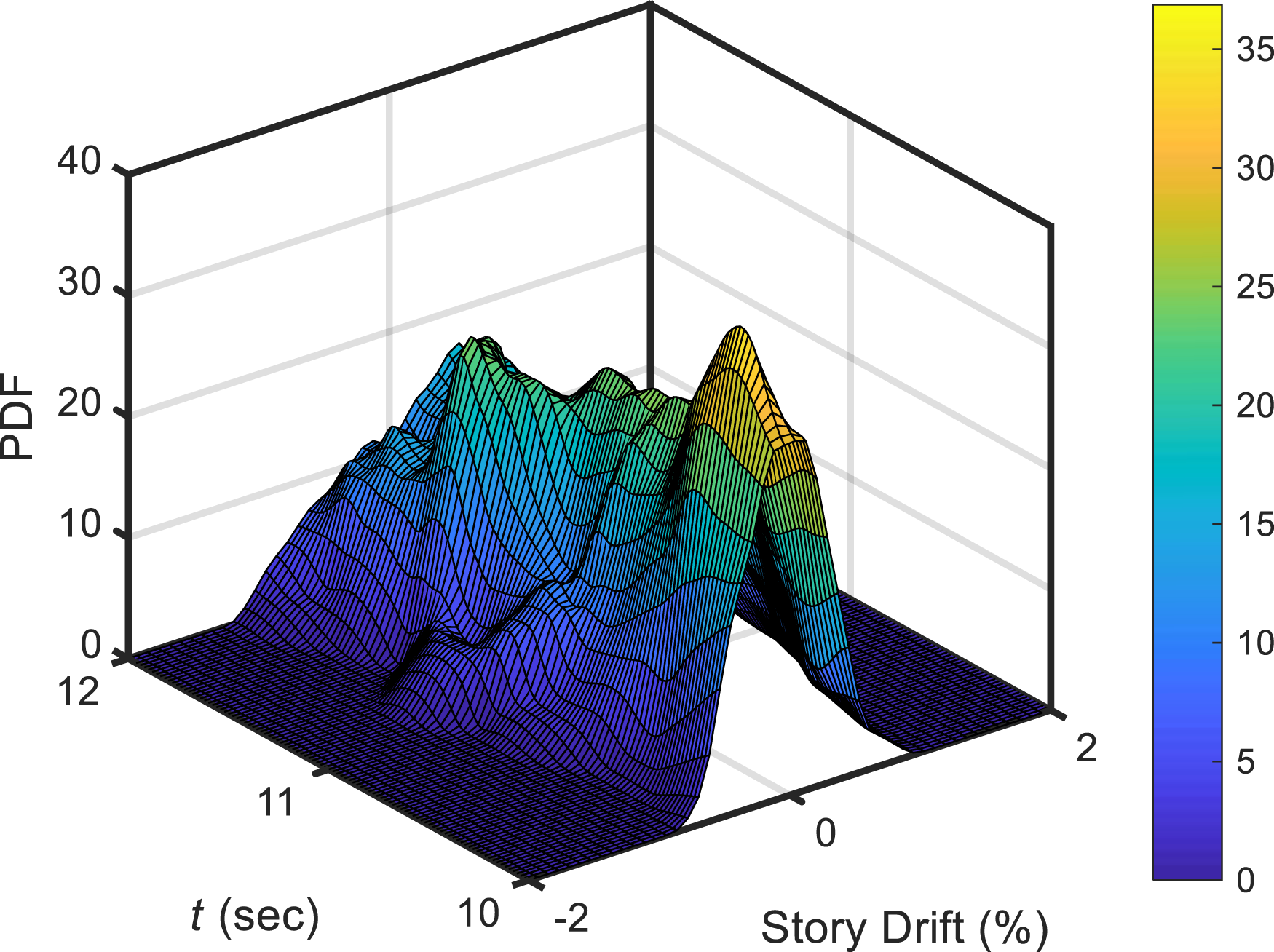
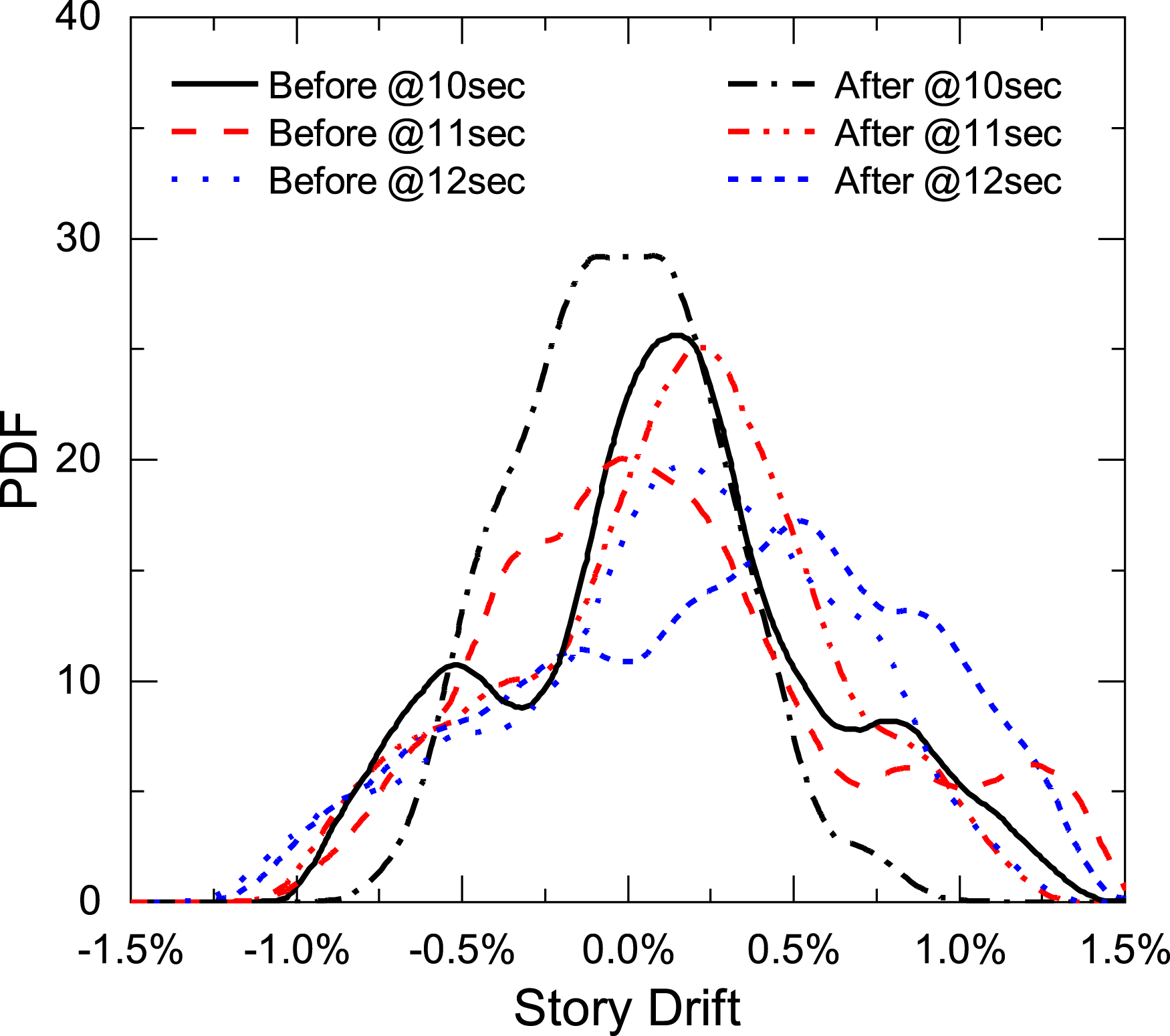
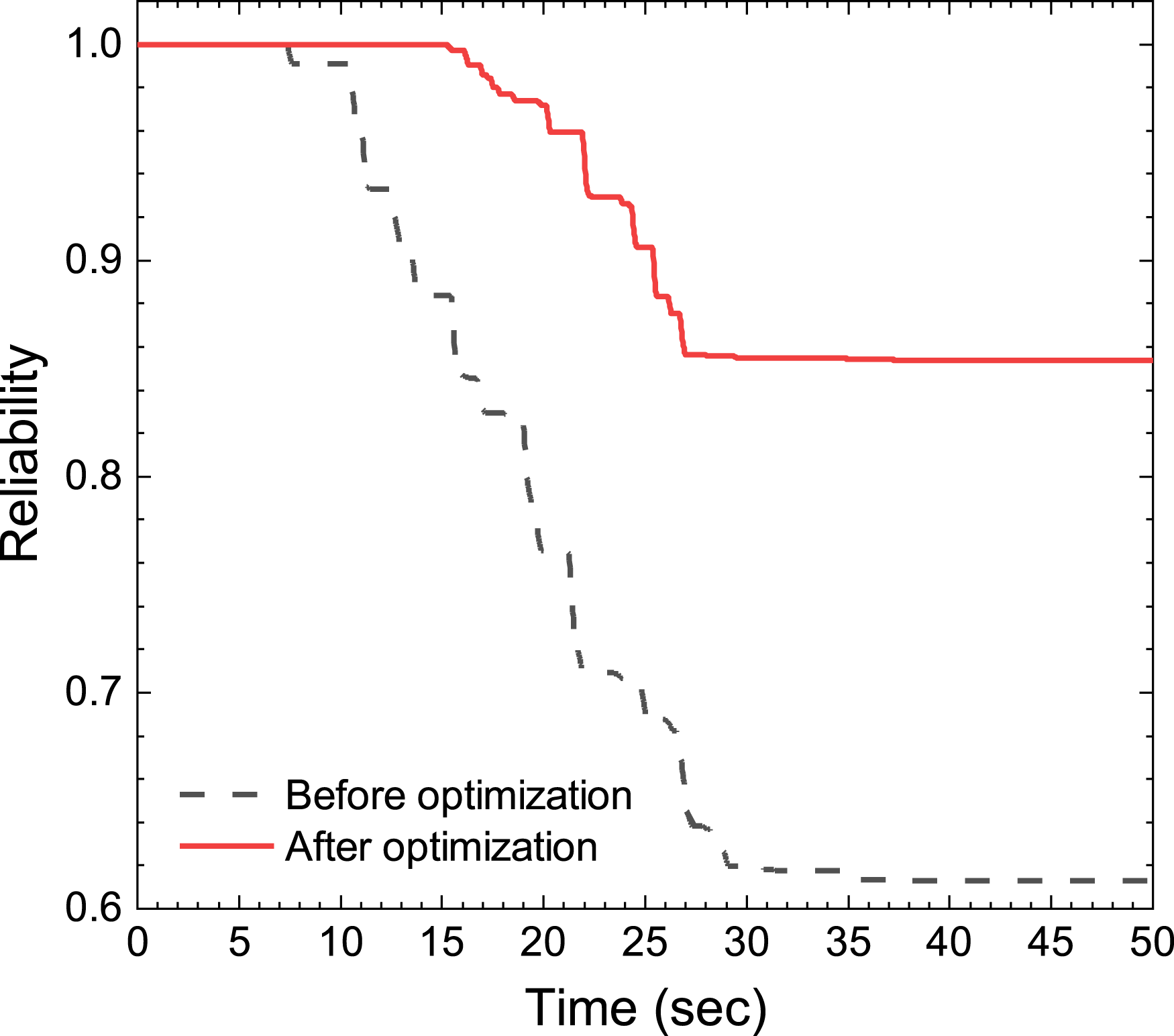
Figure 5 and Figure 6 show the PDF evolution surfaces for the 3rd floor in the 2nd sub-structure, before and after optimization. It can be seen from the figures that the probability distributions evolve with time. Figure 7 shows the PDFs before and after optimization at the 10th, 11th, and 12th seconds from the beginning of the earthquake. As expected, the PDF curves are normally distributed because the structure investigated is symmetric, and the probability of ground movements to the left and right is also equal. As a result, the probability distribution of inter-story drift in both directions is also symmetric. It can be seen that the range of the probability distribution after optimization is narrower than before, and boundaries absorb less probability; the probability is more concentrated in the middle part of the horizontal axis, indicating smaller inter-story drift. Figure 8 shows the time history curves of reliability for the floor before and after optimization. It can be seen that reliabilities decrease monotonously with time. This is because the absorbing boundary condition is applied when solving the probability density evolution equation, and the total probability of the system is continuously decreasing. Reliabilities before and after optimization both decrease sharply in the 7th to 30th second and remain unchanged afterward, which corresponds to the time when peaks of natural ground motions and artificial ground motions occur. The reliability after optimization is larger than that before optimization after the 7th second. PDF evolution surface for the inter-story drift of the third floor on the second sub-structure before optimization. PDF evolution surface for the inter-story drift of the third floor on the second sub-structure after optimization. PDFs of inter-story drift of the third floor on the second sub-structure before and after optimization at the 9th, 10th, and 11th seconds. Reliability of the third floor on the second sub-structure before and after optimization.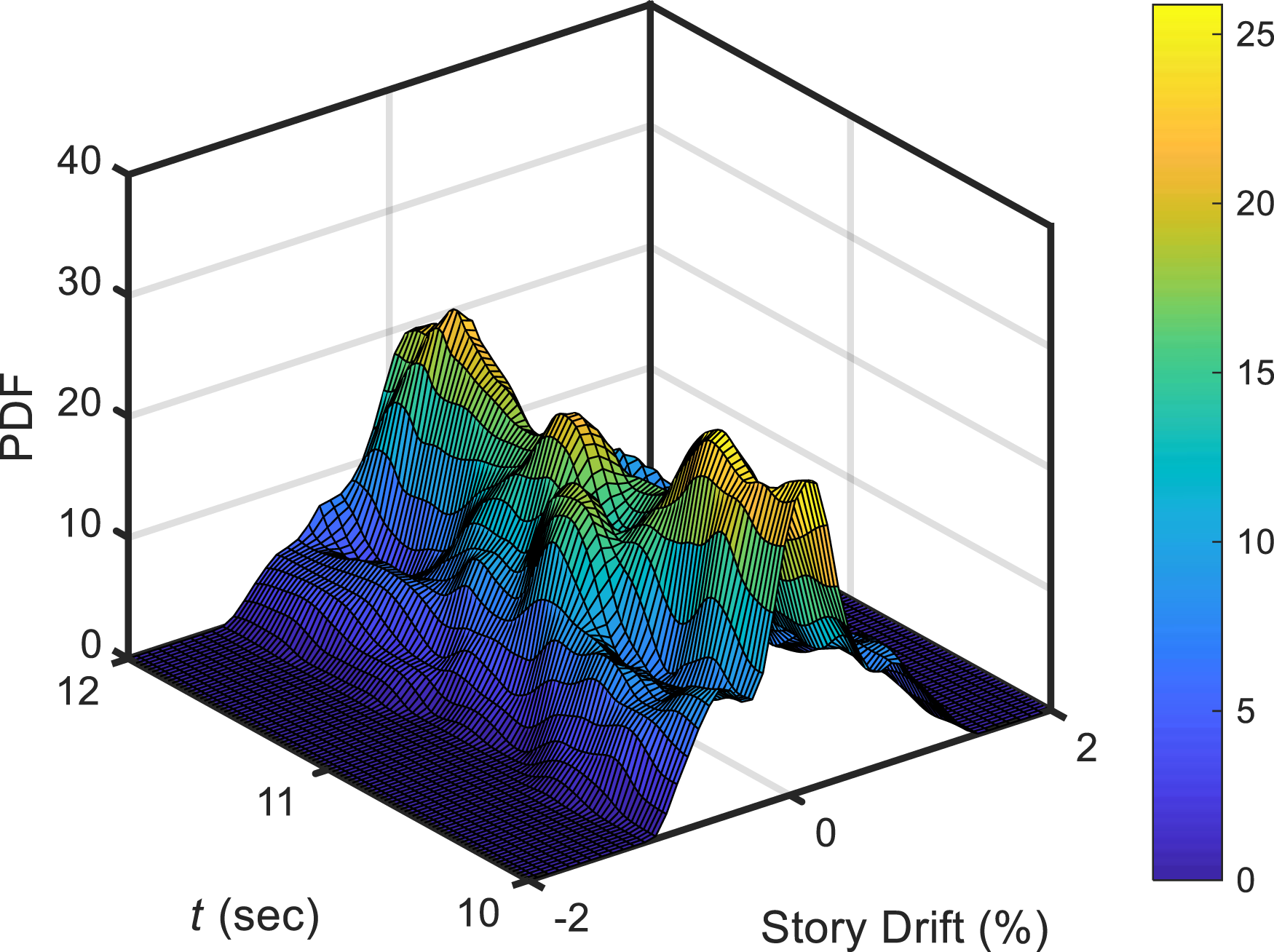
After optimization, the inter-story drifts of weak floors are greatly improved. Figure 9 and Figure 10 show the mean and variance of inter-story drifts of the 3rd floor in the 2nd sub-structure. After optimization, the average and the variance of inter-story drifts of the weak floor in the 60 ground motions are smaller than those before optimization. The optimization eliminates weak floors. The mean value of the inter-story drift of the third floor of the first sub-structure before and after optimization. Variance of the inter-story drift of the third floor of the first sub-structure before and after optimization.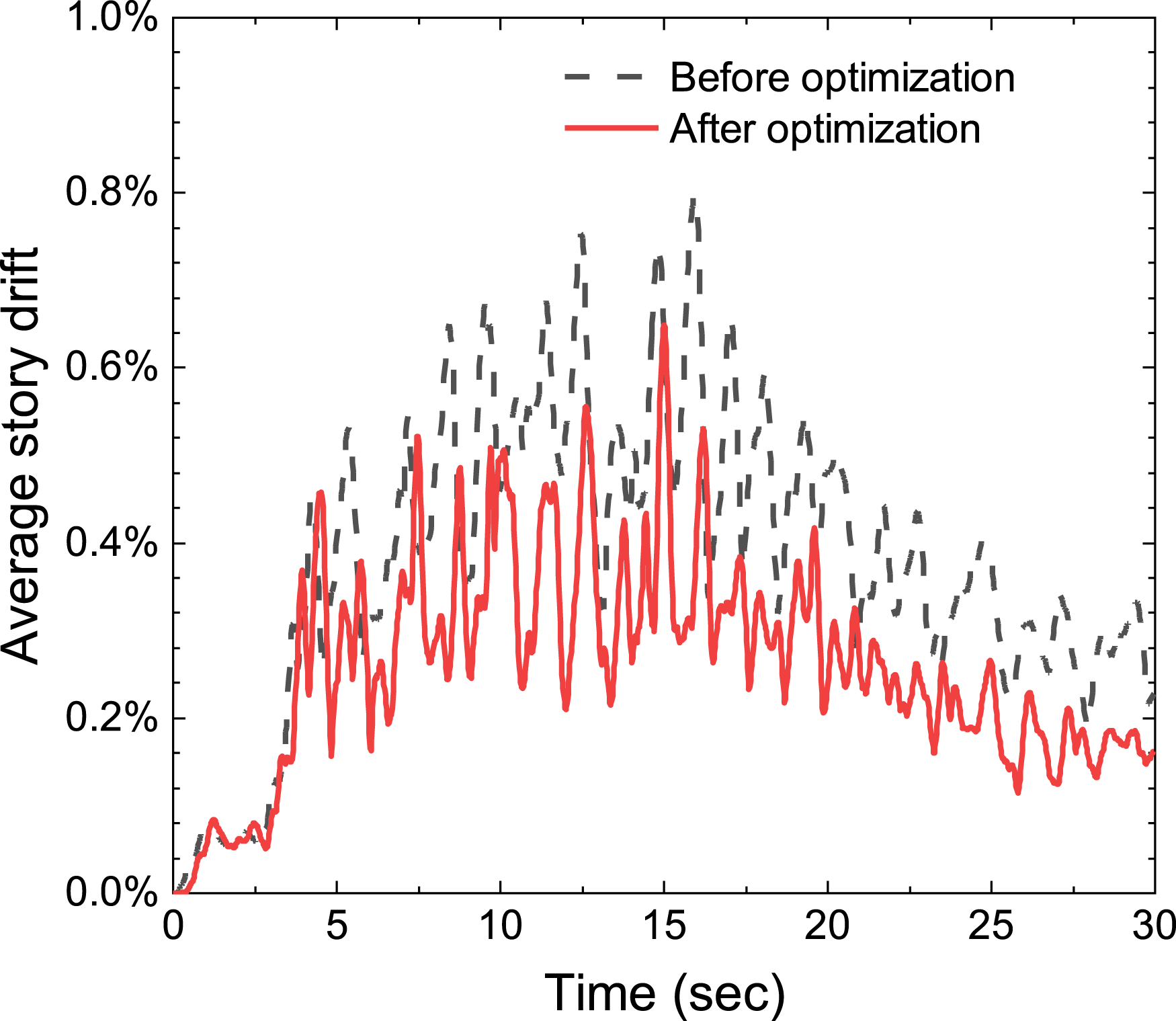
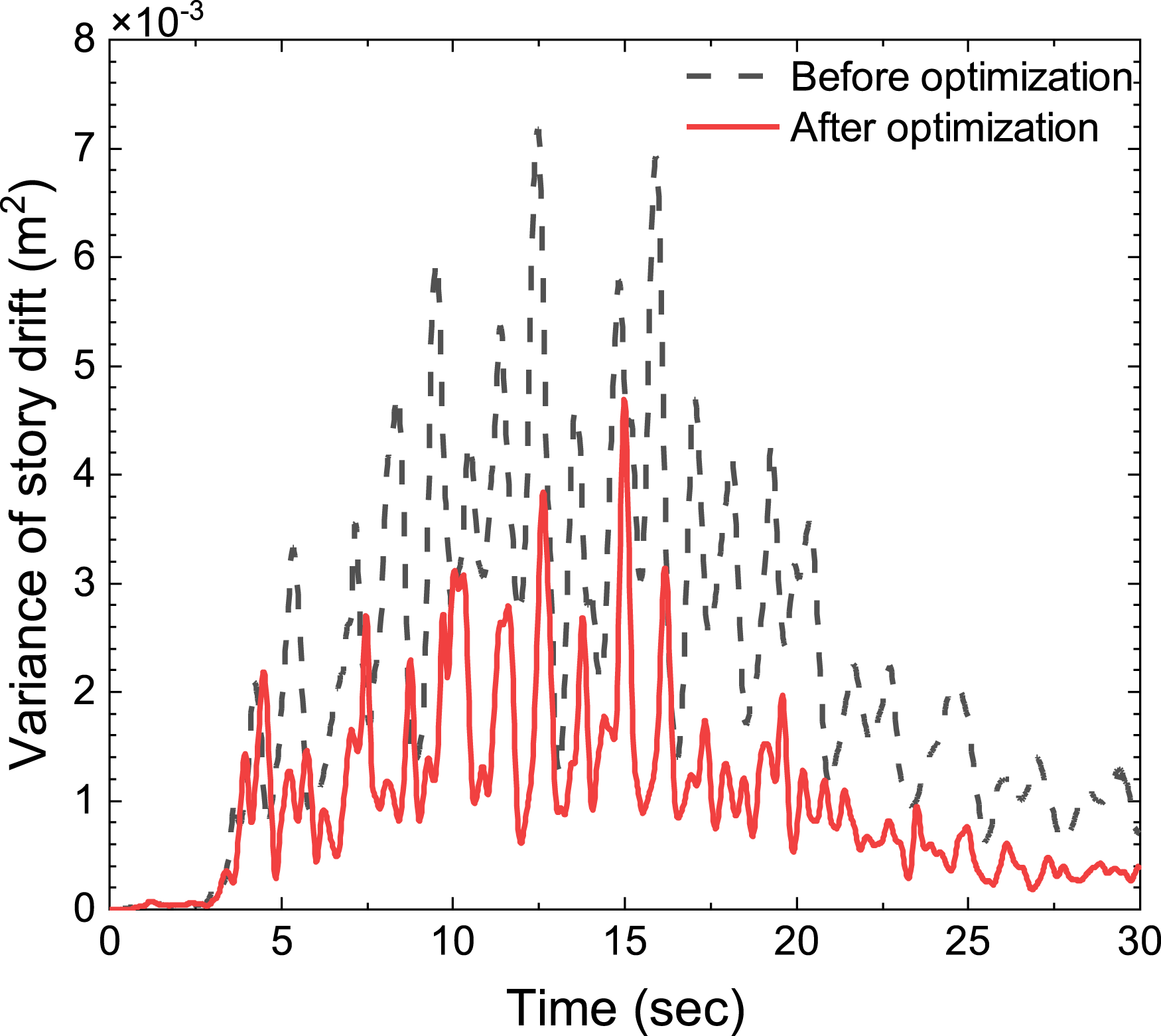
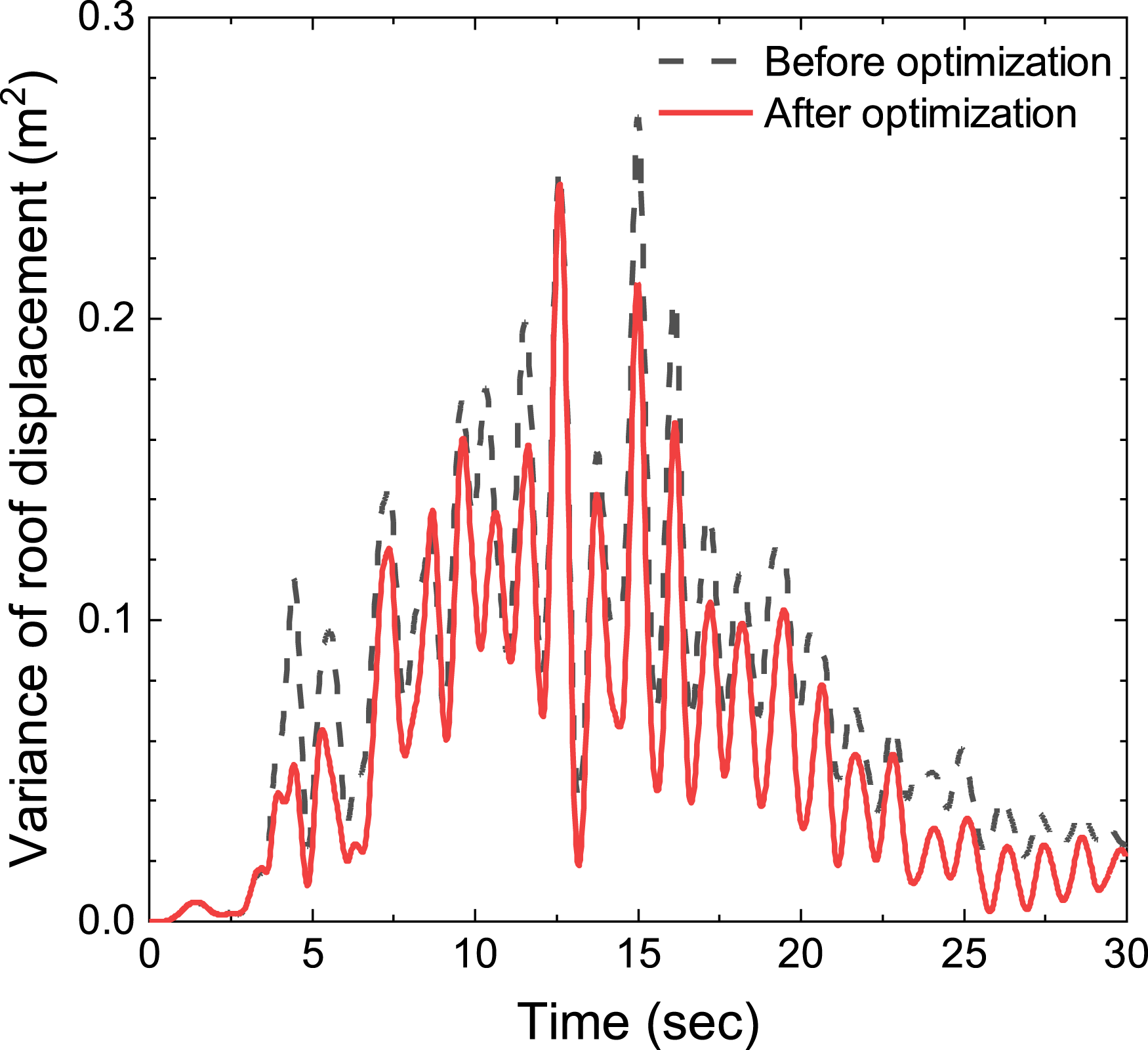
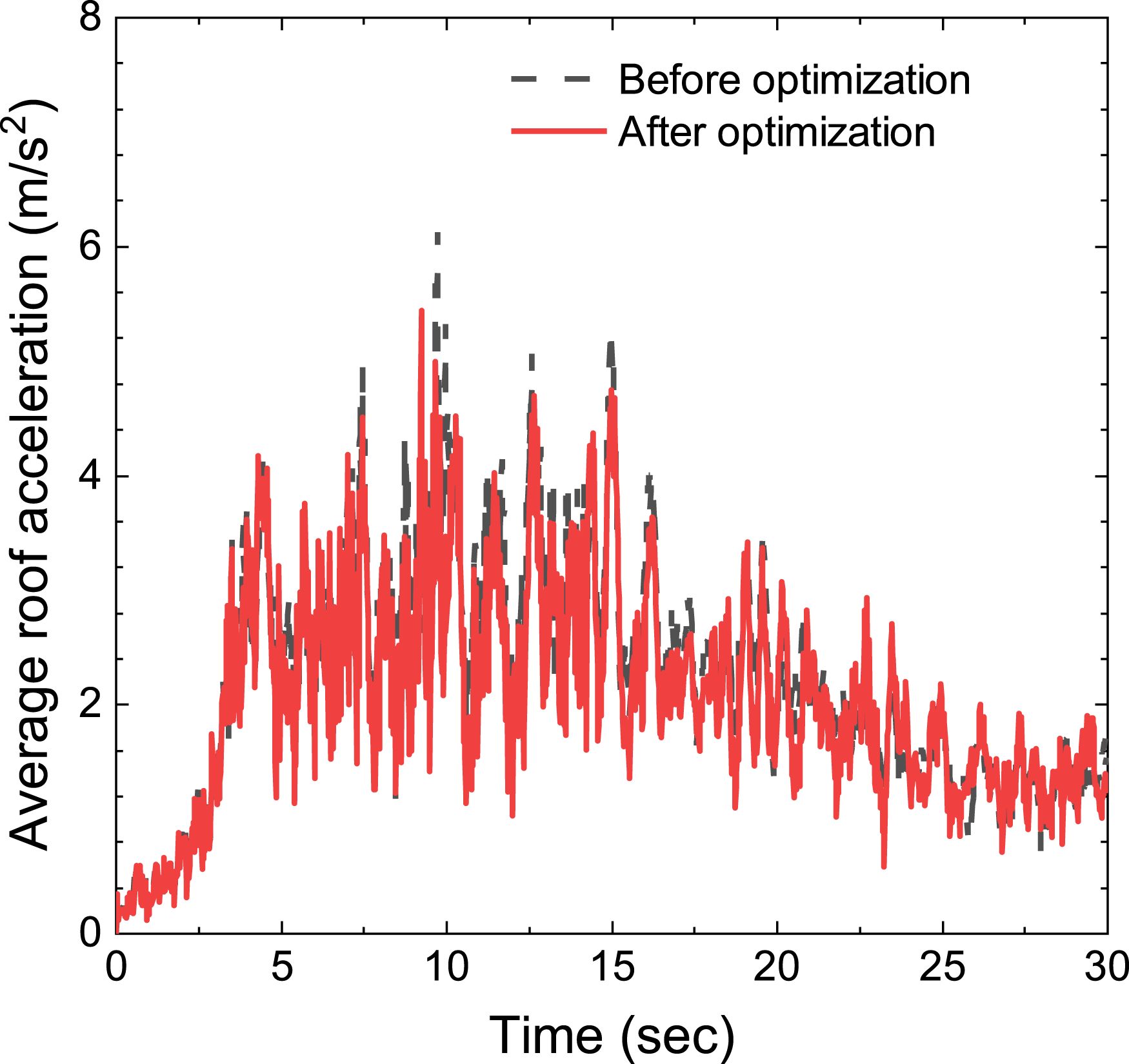
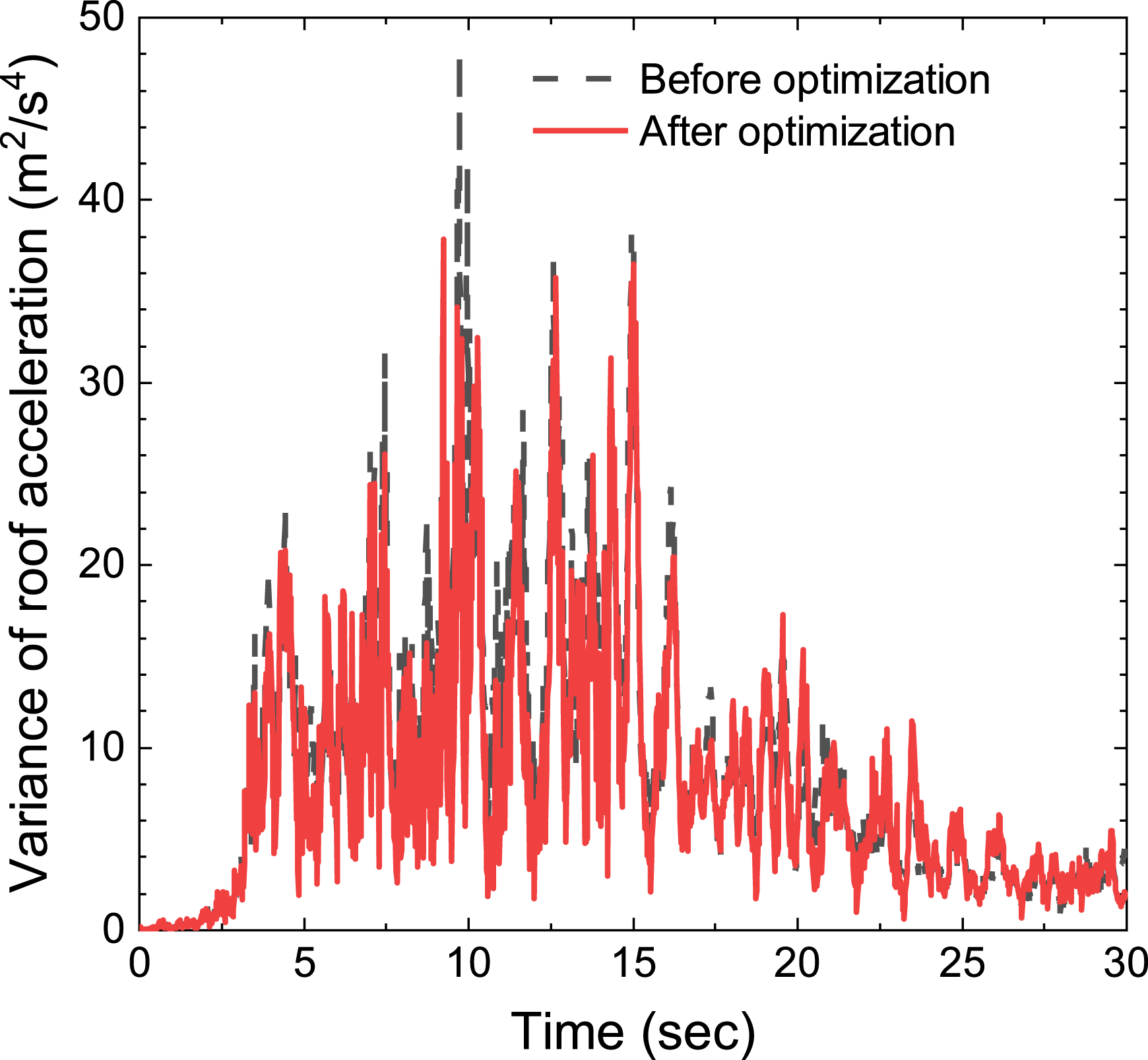
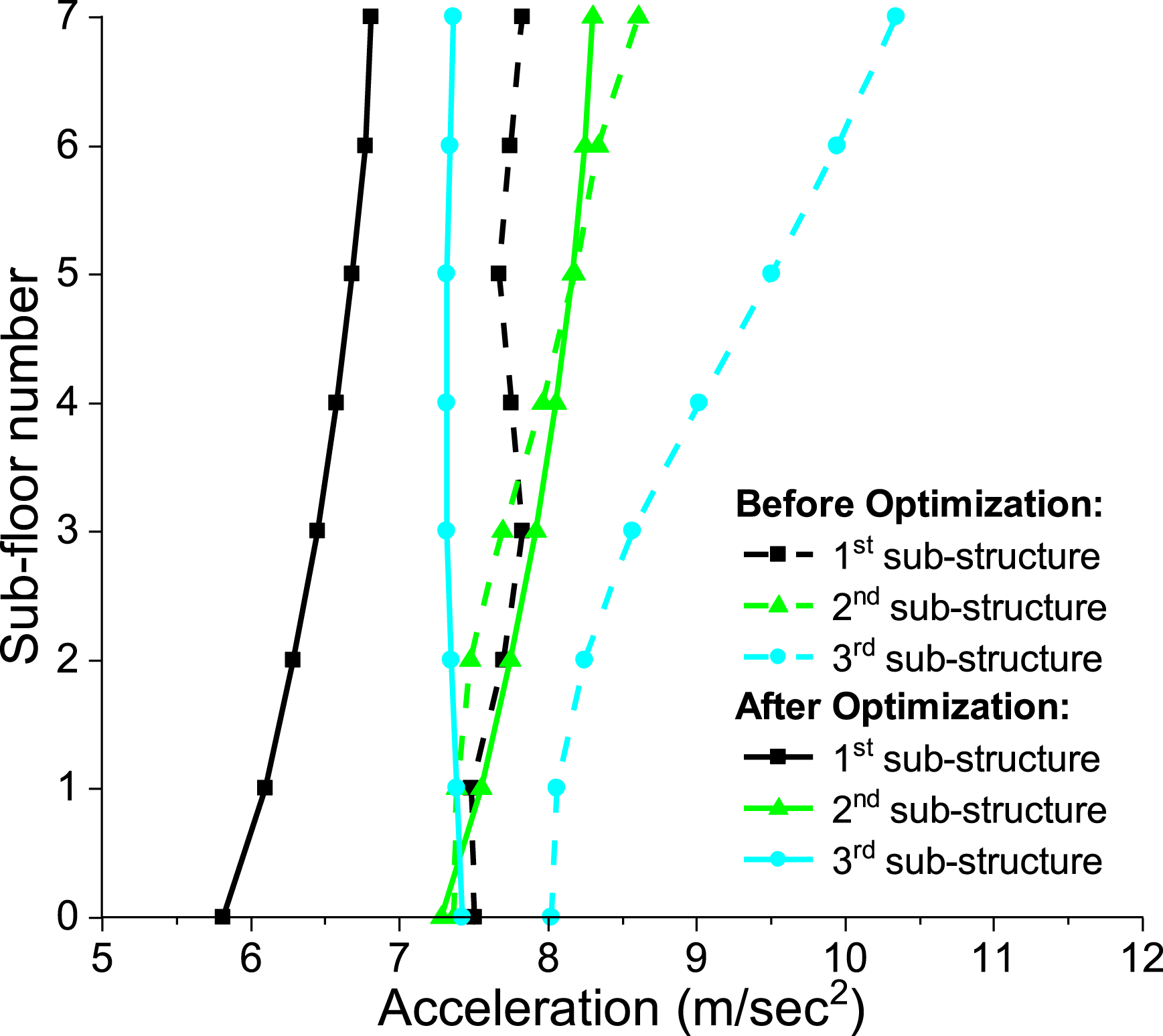
In addition to making the reliability distribution more consistent throughout the building, the seismic control performance of MSCSS with LRBs is also investigated. Figure 11 and Figure 12 show the average and variance of the roof displacement before and after optimization. Figure 13 and Figure 14show the average and variance of the roof acceleration before and after optimization. Figure 15 shows the sub-floor acceleration in each substructure. There are seven sub-floors in each substructure. The names of the sub-structures can be referred to Figure 4. Most of the time, responses after optimization are smaller than those before optimization, and the peak responses are also significantly smaller after optimization. Reliability redistribution also improves the seismic control performance of the structure. Average roof displacement before and after optimization. Variance of roof displacement before and after optimization. Average roof acceleration before and after optimization. Variance of roof acceleration before and after optimization. Acceleration of each floor of sub-structures before and after optimization.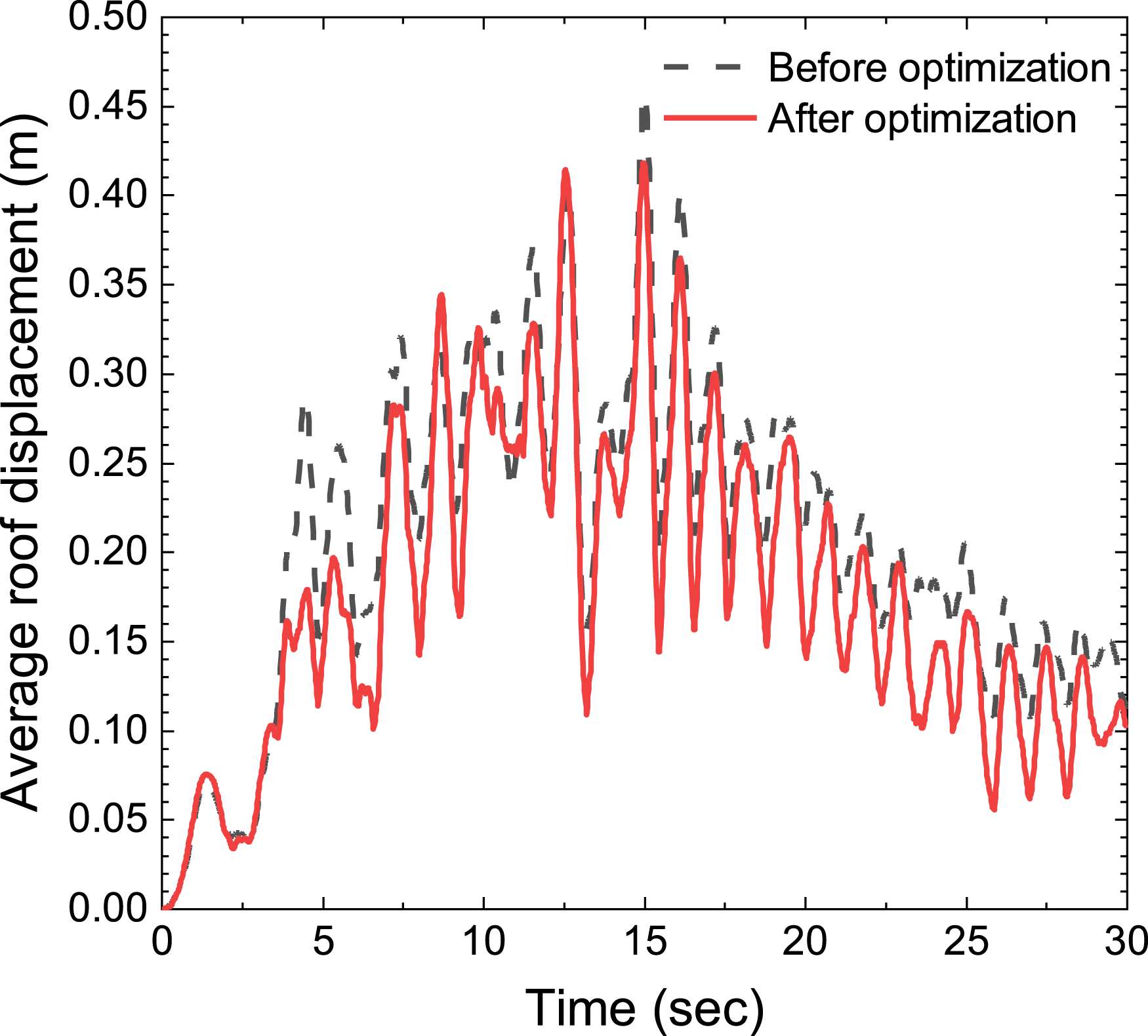
The same reliability analysis and member size optimization are also performed on the MSCSS without LRBs model (Figure 4(b)) and the MSS models (Figure 4(c)). The results show that the reliability of the MSCSS with LRBs is significantly better than the MSCSS without LRBs and the MSS. In Figure 16, the PDFs of the three models are compared. The probability of MSCSS with LRBs is more concentrated around the 0 value of the story drift, indicating that the story drift is smaller and its reliability is higher. The probability distribution ranges of the other two models are wider, and there are two peaks on both sides of the 0 value. There is more probability absorbed by the boundaries, so the reliability for the models is lower. PDFs of Mega-Sub Controlled Structure System with lead rubber bearings, MSCSS without LRBs, and Mega-Sub Structures at the 11thsec (a. Inter-mega-floor drift on the roof; b. Inter-sub-floor drift on the fourth floor of the second sub-structure).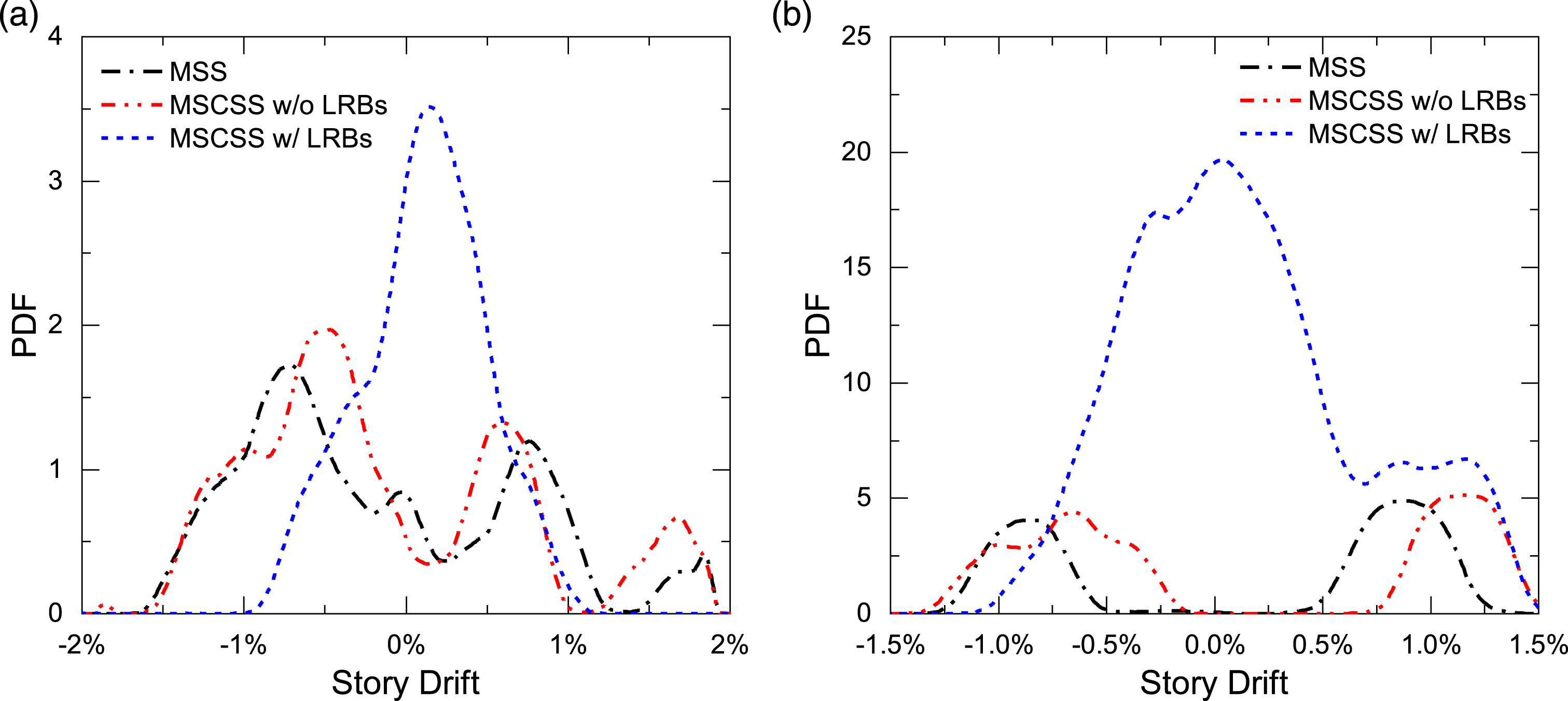
From the above optimization results, it can be seen that the seismic response of the optimized structure decreases significantly. The efficiency of the optimization algorithm could be improved in future research. Optimization may be accelerated using recently developed algorithms, such as Chun-hui He 29 ’s iteration method.
Conclusions
Based on the structural characteristics of MSCSS with LRBs, this paper proposes and presents the “optimal criteria method with two-stage equal reliability.” The reliability of each floor of the structure is obtained by solving the probability density evolution equation. Through member size optimization, the failure probability of each floor is redistributed. The reliability and response of the structure before and after optimization are compared. From the results, the following observation can be made: 1. For both the mega-structure and the sub-structures, if the column size is not optimized and is kept the same on different floors, the reliability of different floors will be inconsistent. The reliability on the top and bottom floors will be higher, while the reliability on the middle floors will be lower. For the case studied, variances of the reliability of the mega-structure and sub-structures before optimization are 1.99×10−02 and 2.18×10−02. The reliability is only 61.3% on the weakest floor. 2. The reliability of the optimized structure is more consistent throughout the height, and the vibration control performance is also improved. Variances of the reliability of the mega-structure and sub-structures after optimization have been reduced to 5.94×10−05 and 3.40×10−03. The reliability on the weakest floor is increased to 82.0%. 3. After optimizing each structural system with the two-stage equal reliability criterion method, compared with MSS without LRB and traditional MSCSS, MSCSS with LRB has a narrower probability density distribution range and shows higher reliability.
Footnotes
Declaration of conflicting interests
The author(s) declared no potential conflicts of interest with respect to the research, authorship, and/or publication of this article.
Funding
The research is financially supported by the National Natural Science Foundation of China (Grant No. 51878274).
