



Abstract
The natural vibration characteristics of the diamond-beaded rope (DBR) based on lumped mass are analyzed both theoretically and experimentally. The dynamic model of the DBR is established by means of the multi-body dynamics theory. According to Lagrange’s equations, the control equation of the DBR is derived. It mainly analyzes the influence of the parameters, such as the motion velocity of the DBR, the tension of the DBR, the length of diamond beads, the quality of diamond beads, and their position in the DBR, on the natural vibration characteristics for the DBR are studied. The results show that the natural frequencies and the corresponding vibration shapes of the DBR based on lumped mass change significantly when the variations of the above parameters are considered. In the process of the movement of the DBR, the random impact force of diamond beaded is the key factor that causes the natural frequency of the DBR to fluctuate., In the high-order modal analysis, the natural frequency and vibration mode of the DBR fluctuate more obviously. The relative error of the result between the calculated and the measured is less than 10%, which validates the proposed method.
Introduction
Diamond-beaded rope saws are widely used in building demolition, stone processing, oil pipeline cutting, and other fields.1–3 The diamond-beaded rope (DBR) consists of diamond beads, isolation sleeve, and steel wire rope. Diamond particles are fixed on the diamond-beaded rope to realize the grinding of objects, the isolation sleeve plays the role of fixing the diamond-beaded rope and lowering the grinding temperature, and the role of the wire rope is connecting the diamond-beaded rope in series, which is the spine of the diamond-beaded rope. The steel wire rope is used as the matrix of the diamond-beaded rope, which makes the diamond-beaded rope show the characteristics of flexible processing during the processing.
In the “flexible” sawing process, diamond-beaded rope, such as the conveyor belt, band saw, elevator cables, and other axially moving materials, produced vibration phenomenon in the work. Although this kind of equipment has many advantages, the noise and vibration produced during operation limit its popularization and application. Many researchers have explored different methods to analyze the vibration of axially moving objects and obtained many research results.4−23
The kinetic equation of an axially moving material can be obtained by the Hamiltonian principle 4 or Newton’s second law of motion. 5 Hu 6 established a method to analyze the nonlinear vibration (free and forced) of the viscoelastic conveyor belt. The differential quadrature method is used to obtain the natural frequency of the lateral vibration of the belt around the equilibrium configuration. Using the differential quadrature method and the Runge–Kutta time discretization method, the forced vibration equation is numerically calculated. The results show that the support end of the viscoelastic conveyor belt pulley caused a non-uniform boundary and static equilibrium configuration, which increased with the increase of transmission speed. Long 7 analyzed the vibration of the belt by the applied torque and the angle of the tension arm. An iterative algorithm for calculating the nonlinear equivalent viscous damping of the tensioner under variable excitation frequency is proposed and compared with the measured results to verify the effectiveness of the proposed method.
Pakar and Bayat8–10 presented and analyzed the nonlinear vibration characteristics of the axially moving conical beam. The numerical solution of the mechanical model is obtained by the Runge–Kutta method. The influence of vibration amplitude on vibration is analyzed. The results show that this analytical expression can approximate the exact solution of the whole amplitude range and reduce the corresponding error of angular frequency relative to Hamiltonian. Ali 11 established a mechanical model to analyze the free nonlinear vibration and forced nonlinear vibration of axially moving beams. The mechanical properties of the Rayleigh beam and the Euler Bernoulli beam under moving load are analyzed, such as moment of inertia, velocity, and gradient. The results show that when the gradient parameter is greater than or less than the critical value, the change of material properties has an opposite effect on the amplitude of free vibration. Tang 12 researched the nonlinear amplitude-frequency response of axially moving viscoelastic sandwich beam under the action of low-frequency and high-frequency main resonance. By transforming nonlinear partial differential equation into nonlinear ordinary differential equation, the complex characteristic function of the system is obtained by using the Galerkin truncation method. The influences of parameters, such as the thickness of the core layer of the beam, average velocity, and initial tension on amplitude-frequency response, are analyzed. Wickert13,14 studied on the complex modal analysis method of gyro continuum, analyzed the axial movement of the beam under arbitrary initial conditions and excitation response, and proposed modal analysis method to solve the system eigenfunctions and natural frequencies.
Abolhassanpour and Shahgholi15,16 presented and analyzed the vibration characteristics of axially moving conical shell. The nonlinear motion equation of the axially moving shell is established by using Hamilton’s principle, and the numerical solution of the equation is obtained by using the fourth order Runge–Kutta method. The results show that when the speed increases by a certain value, the maximum amplitude of the system increases and then decreases with the increase of speed.
Ulsoy 17 researched the vibration and stability of wide band saw, and the dynamics equations are established by Hamilton’s principle, and approximate solutions are solved by the method of Ritz. According to the processing characteristics of wire saw, Song 18 presented and analyzed the vibration characteristics of the wire saw in the process of wire saw processing and the frequency domain response of the wire saw. According to the basic principle of multi-body dynamics, Xu et al. 19 established a dynamic model of an axially moving roller chain based on the lumped mass method, and the influence of chain motion speed, concentrated mass, and chain pitch on chain vibration characteristics were analyzed. Khatami 20 presented and analyzed the vibration characteristics of axially moving strings; the method of translating the characteristic equation is used to reduce the degree of freedom of the differential equation. The time-varying solution of the axial motion string is obtained by a multi-step differential transformation method, and the effects of different parameters, such as velocity, damping, and tension, on the amplitude–frequency response are analyzed. Huang 21 researched the influence of vibration characteristics of diamond wire saw on material loss. The results show that the vibration of diamond wire saw plays a key role in material loss. Wang22,23 presented a method for analyzing the vibration characteristics of the diamond-beaded rope (DBR) based on lumped mass method, and the effects of diamond beads mass, moving speed and number of diamond beads on power spectral density (PSD), and mean square value were analyzed by the principle of random vibration, and the feeding speed of the DBR plays a key role in the removal rate of the material.
However, the above research literature mainly focuses on the vibration characteristics of axially moving materials with uniform unit mass density, none of them concerned about the vibration characteristics of axial movement materials associated with lumped mass. Due to the DBR special structure, it cannot be simply reduced to the traditional theory of axially moving materials model. Obviously, the dynamic characteristics of the DBR cannot be simply simplified to an axial movement theory model.
The primary goal of this research, in this article, is to discuss the natural characteristics of the DBR based on lumped mass. Based on the multi-body dynamics theory, the dynamic model of the DBR is established, meanwhile, the vibration equation of the DBR is solved by using Lagrange’s equations. 24 The influences of the parameters, such as the linear velocity of the DBR, the tension force of the DBR, bead spacing, the weight of beads, and their position in the DBR, on the natural vibration characteristics of the DBR are studied.
Equations of diamond-beaded rope motion
Figure 1 shows a schematic for the powering system of diamond-beaded rope (DBR), which includes the driving wheel and driven wheel, tension wheel, diamond-beaded rope components, etc. The focus of this article is on the natural vibration characteristics of diamond-beaded rope between two guide wheels, so in steady state operation, the diamond-beaded rope (DBR) will be simplified as the lumped mass with uniform distributed concentrated loads. In order to facilitate the calculation, it is assumed that the quality of the diamond beads is the same, the moment of inertia of the diamond beads is constant, and the distance between the diamond beads is constant. The tension of DBR is much greater than gravity, so the gravity effect of diamond beads is ignored. Schematic for the powering system of the diamond-beaded rope.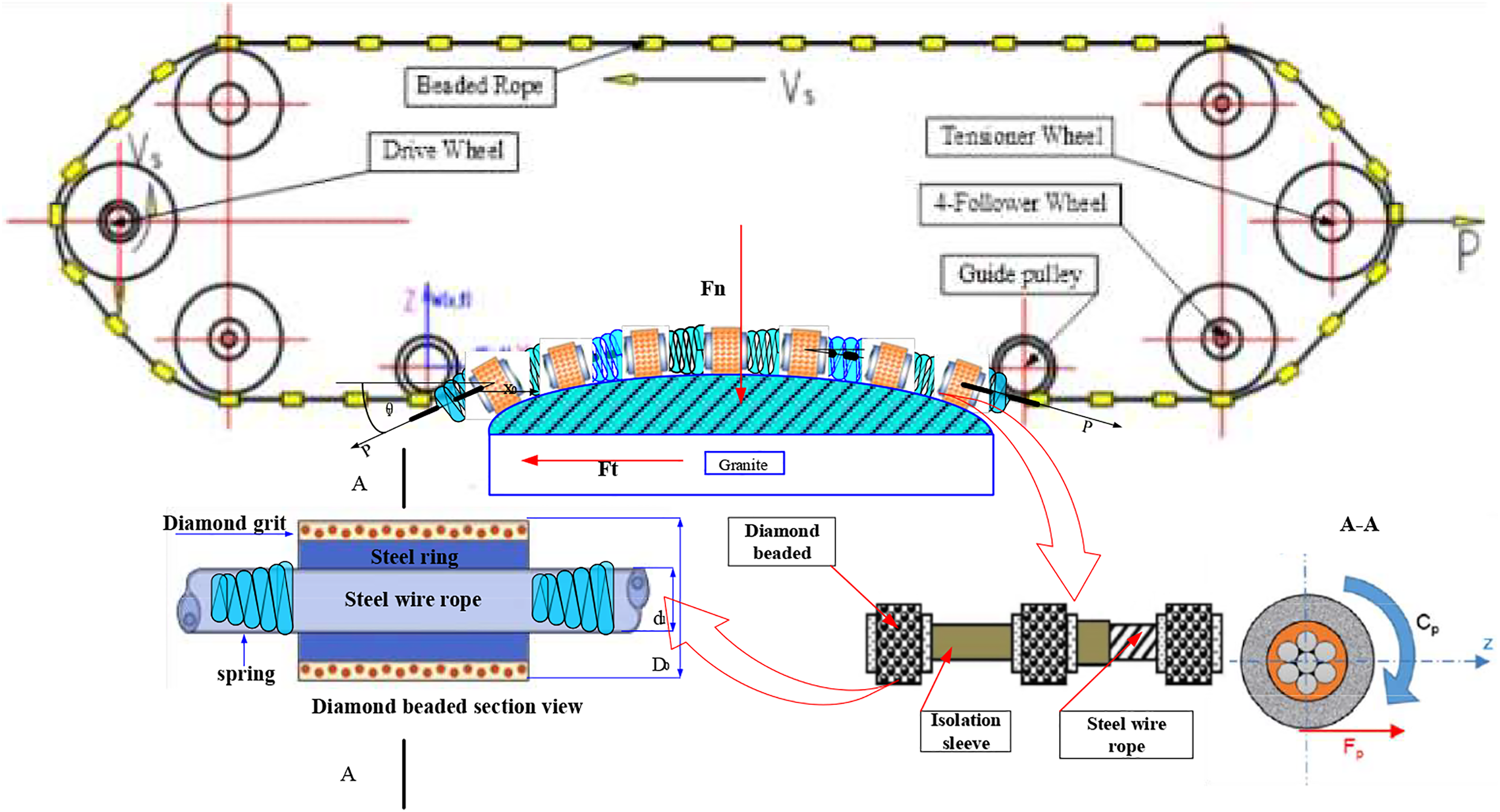
It is assumed that the center of mass of diamond beads is at its geometric center, as described in Figure 2. Ignoring the influence of gravity on diamond beads, the transverse displacement of the diamond bead i can be expressed as Model of diamond-beaded rope cutting systems and cross-section of diamond bead.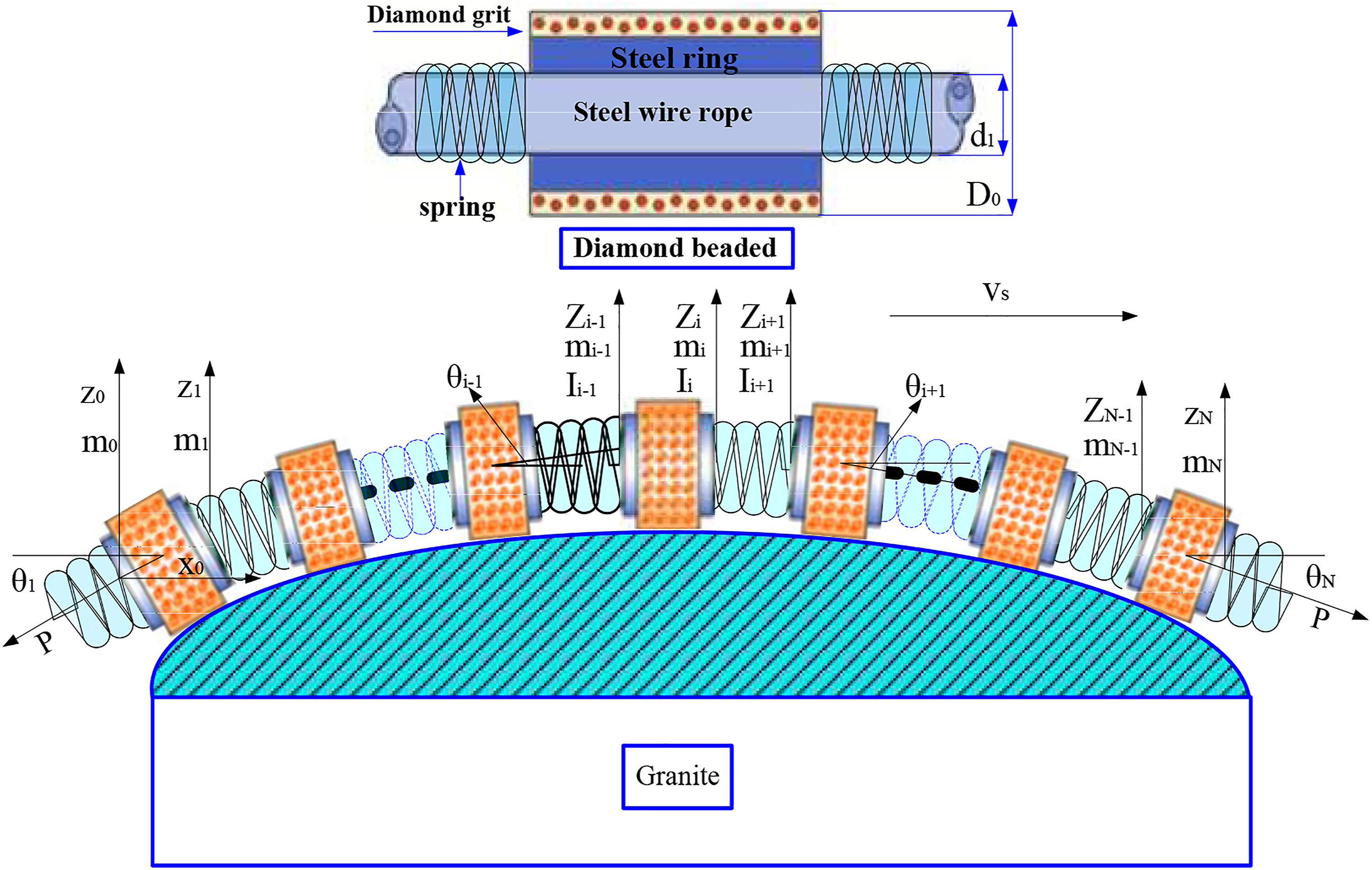

Then the lateral displacement of the rotation angle







Because


where l is the span between two adjacent DB and

According to Lagrange’s equations,4,13 there is



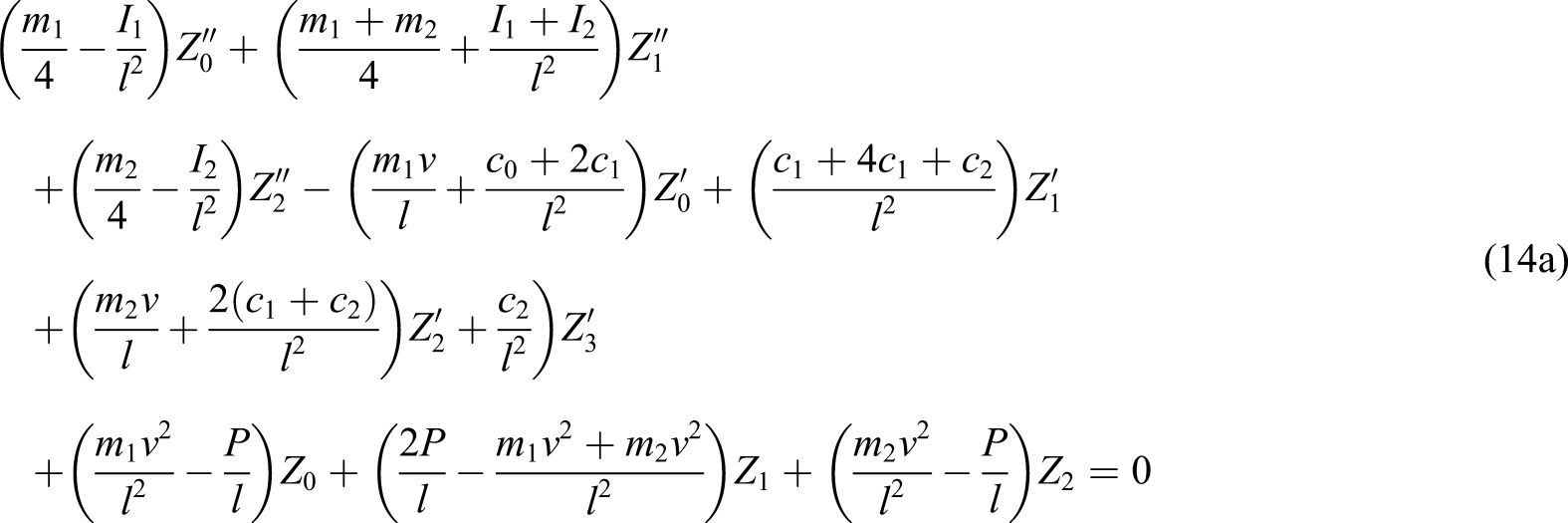
Substituting equation (13a, b) into (12) gives the equation for the first bead of motion
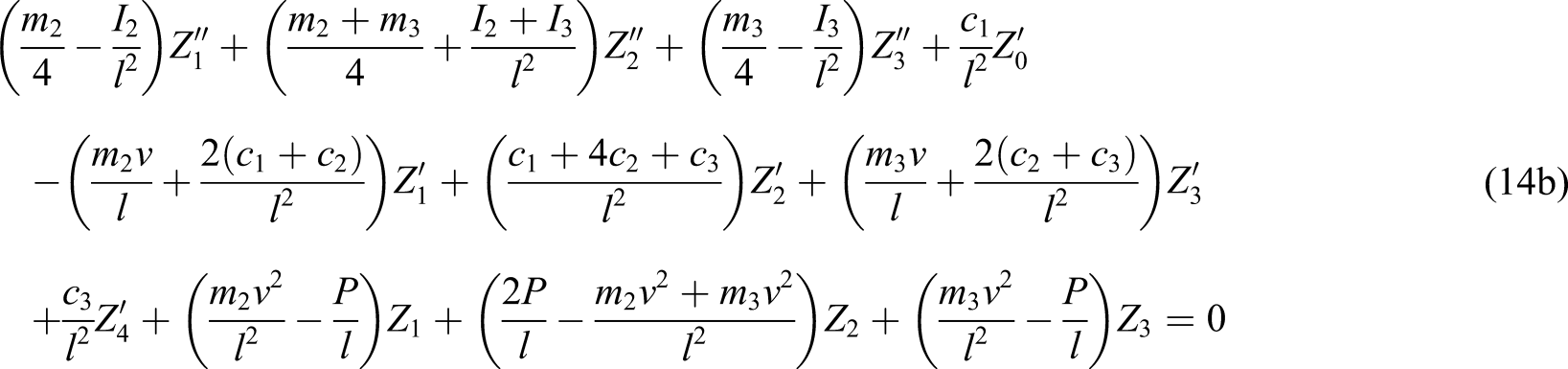
Similarly, when N = 3, we get the second equation of motion of beads as follows
Therefore, the equation of motion of the n-th diamond bead for
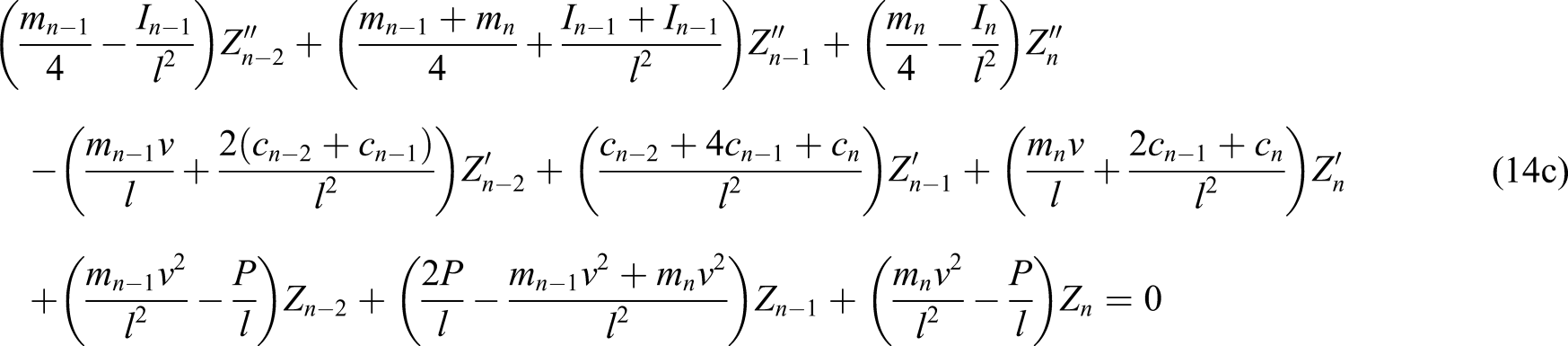
So, the matrix form of the beaded rope lateral vibration dynamic equation was derived

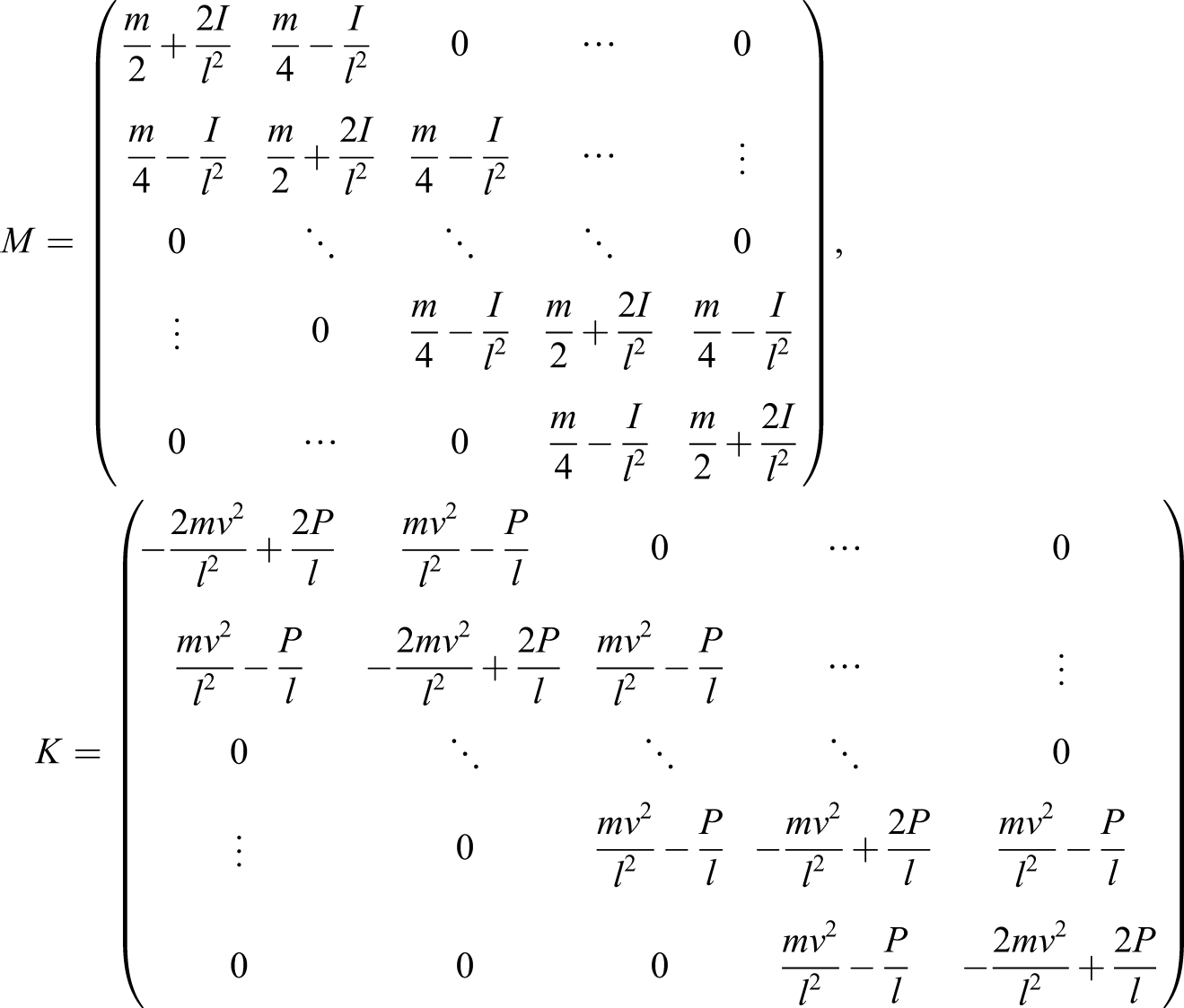
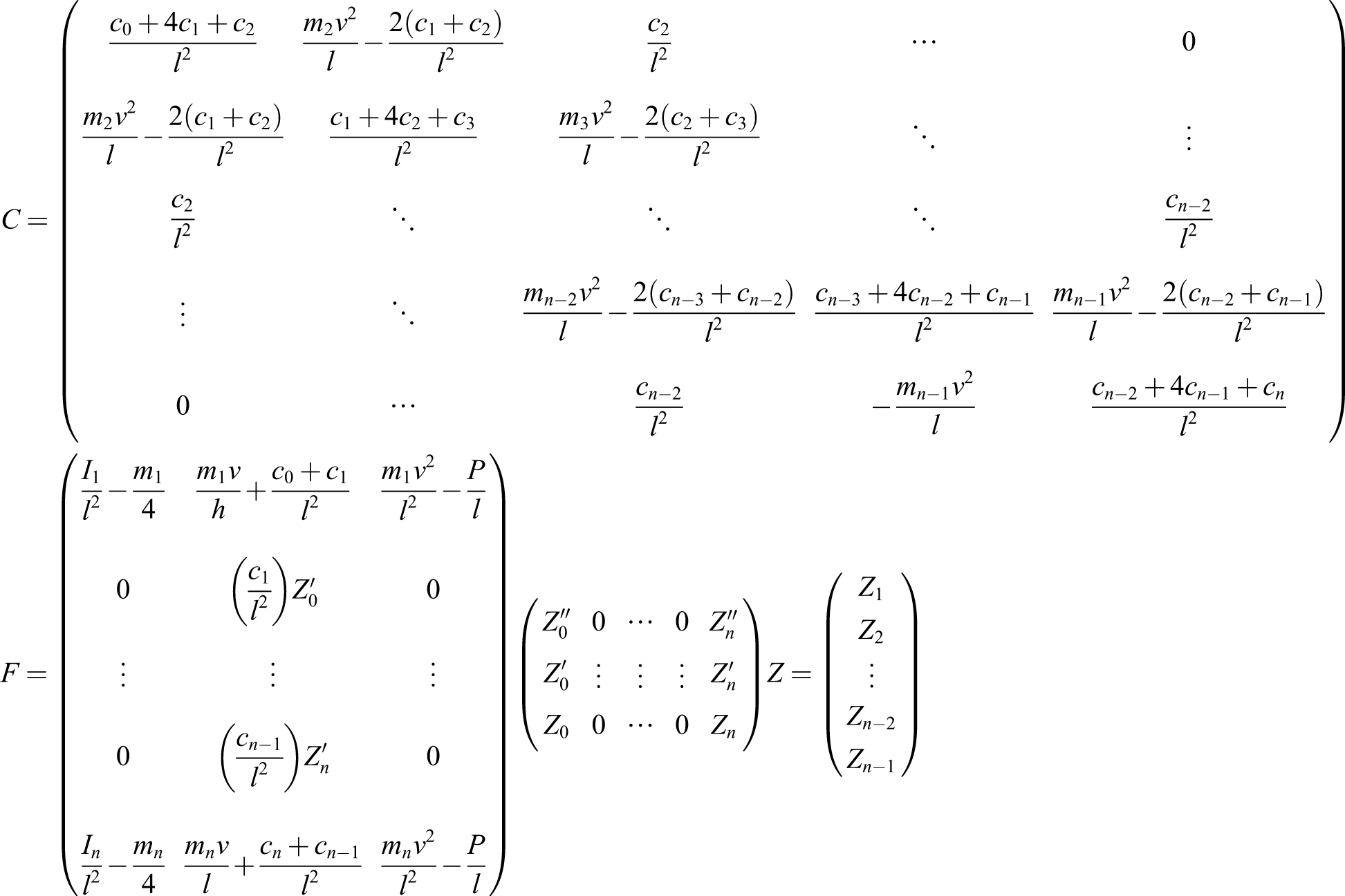
Modal Analysis
Modal analysis is the study of dynamic characteristics of a modern method and is a powerful method to analyze the natural vibration characteristic and modal shapes of mechanical system or structure.9,19–20 As an analysis tool of the natural frequencies and modal shapes of linear vibration,
25
it is used to deal with lateral linear vibration of the diamond-beaded rope (DBR). Ignoring the damping effect and the natural vibration characteristics of the system, equation (15) can be written as follows

The solution of equation (16) for the lateral vibration of the DBR can be described as follows:

So, the second derivative of equation (17) is

By substituting equations (17) and (18) into equation (16), we get equation (19)


If any of the selected values of

Basic parameters of numerical analysis 20 .
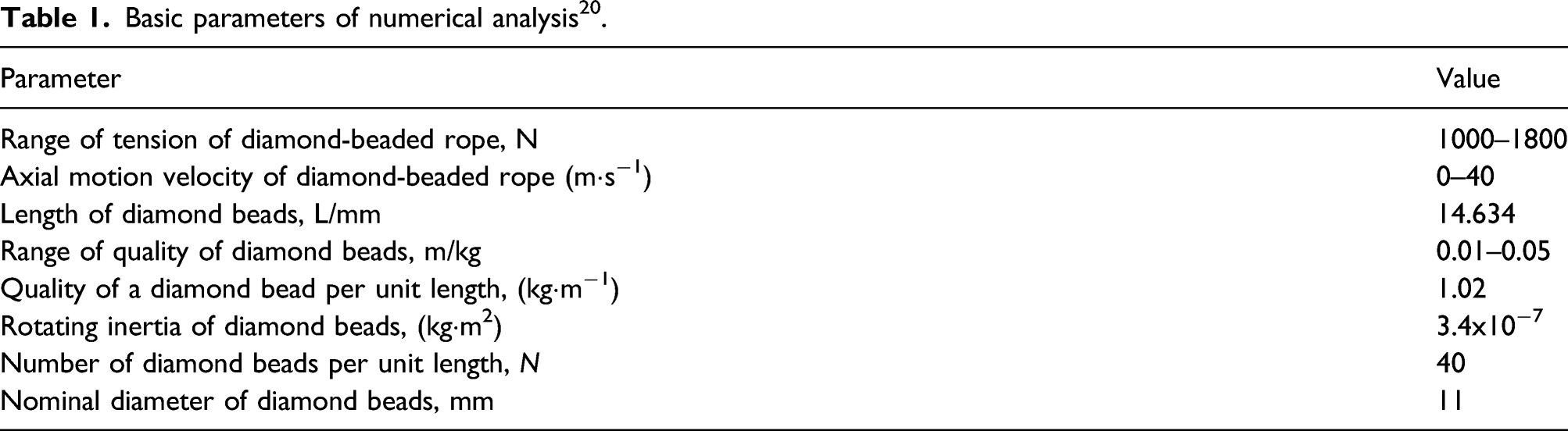
In the numerical analysis, the diamond beads (DB) are simplified as a lumped mass and only one DB exists in the processing of granite, as shown in Figure 3. Along with the axial movement of the DBR, the diamond-beaded rope moves from the first position to the last position. So, in the whole processing of granite, the diamond-beaded rope has N positions. In simulation analysis, we take the first four modes of the system to study the natural vibration characteristics of the DBR with multiple-degrees of freedom. Model of diamond-beaded motion.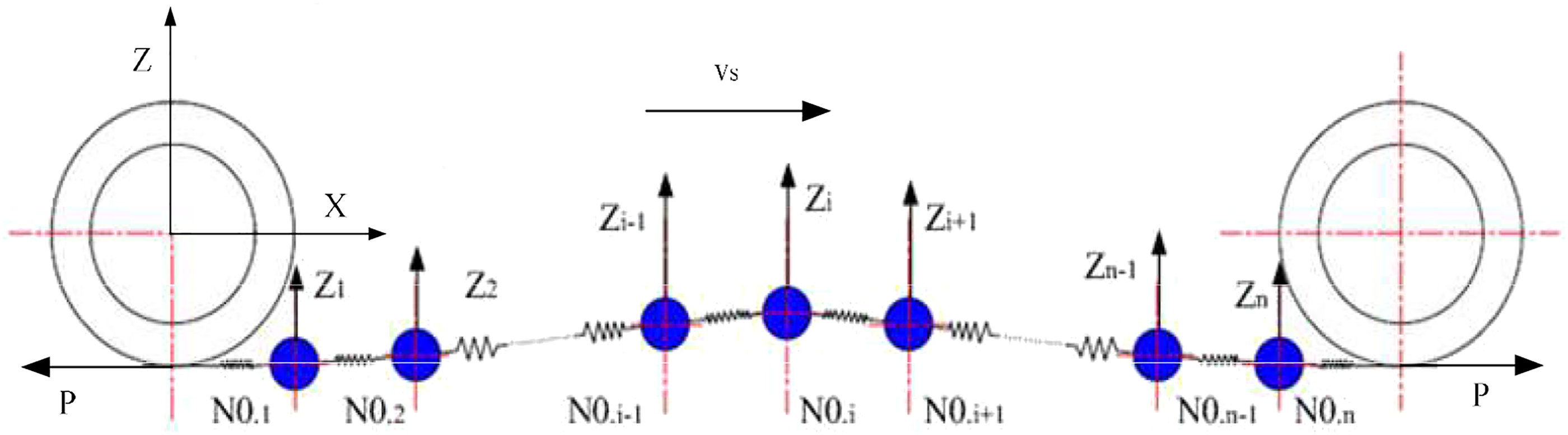
The relationships between natural frequencies, axial velocity, and bead position
The relationship between inherent frequencies of lateral vibration of the diamond-beaded rope, the linear velocity of the beaded rope, and beaded position is shown in Figure 4. Where the quality of the diamond-beaded rope is 0.015 kg and the tension is 1500 N, the linear velocity of the diamond-beaded rope increases from 0 to 40 m/s. Natural frequencies of the diamond-beaded rope versus axially moving velocity. (a) First-order mode, (b) second-order mode, (c) third-order mode, and (d) fourth-order mode.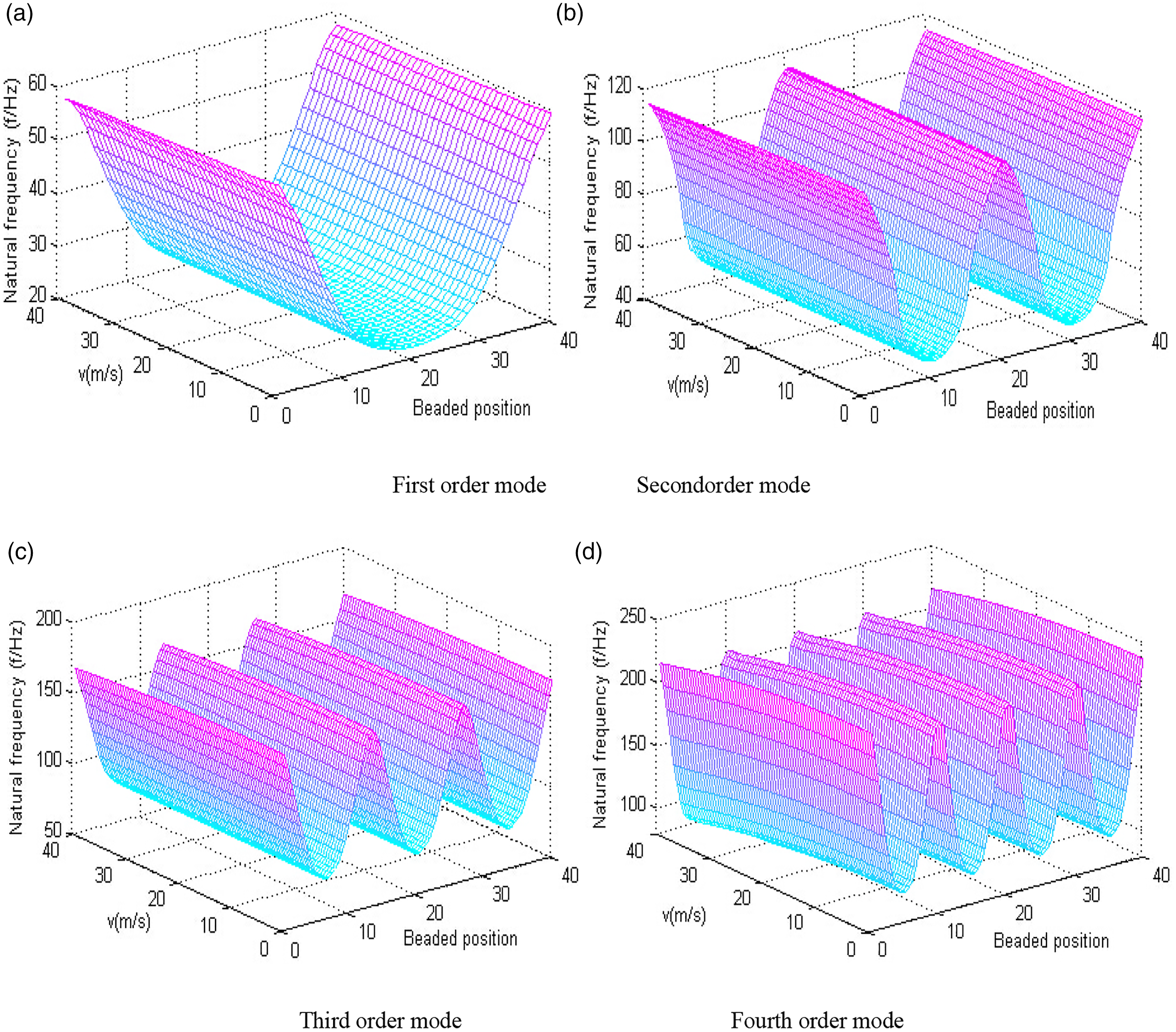
Figure 4 shows that along with increasing of axial velocity, the natural frequencies of diamond-beaded rope decrease correspondingly. Under the high-speed condition, the inherent frequencies of the DBR, especially in the high orders mode, reduction is not obvious. The anisotropic characteristics of granite, the impact force of diamond beads varies randomly, so the natural frequency has twists and turns when the diamond-beaded rope locates at different locations in the processing of granite. So, the natural frequencies of vibration of the DBR are time-varying characteristics. Meanwhile, from Figure 4, it is evident to be obtained that the first-order natural frequency approximation “U” shape and the natural frequencies of the DBR appear symmetrically at the middle position of the beaded. Additionally, along with the movement of diamond-beaded, the natural frequencies of the DBR have fluctuating phenomenon, and with the increase of natural frequency order number, the greater the fluctuating magnitude of natural frequencies.
The relationships between natural frequencies, tension force, and bead position
When we analyze the relation between natural frequency and beaded tension, the mass of the diamond-beaded rope is 0.015 kg and the motion speed of the diamond-beaded rope is 25 m/s. The range of tension of the diamond-beaded rope is from 1000 to 1800N. The relationship between natural frequencies and the tension force of the diamond-beaded rope and bead position is shown in Figure 5. Natural frequencies of the diamond-beaded rope versus tension force. (a) First-order mode, (b) second-order mode, (c) third-order mode, and (d) fourth-order mode.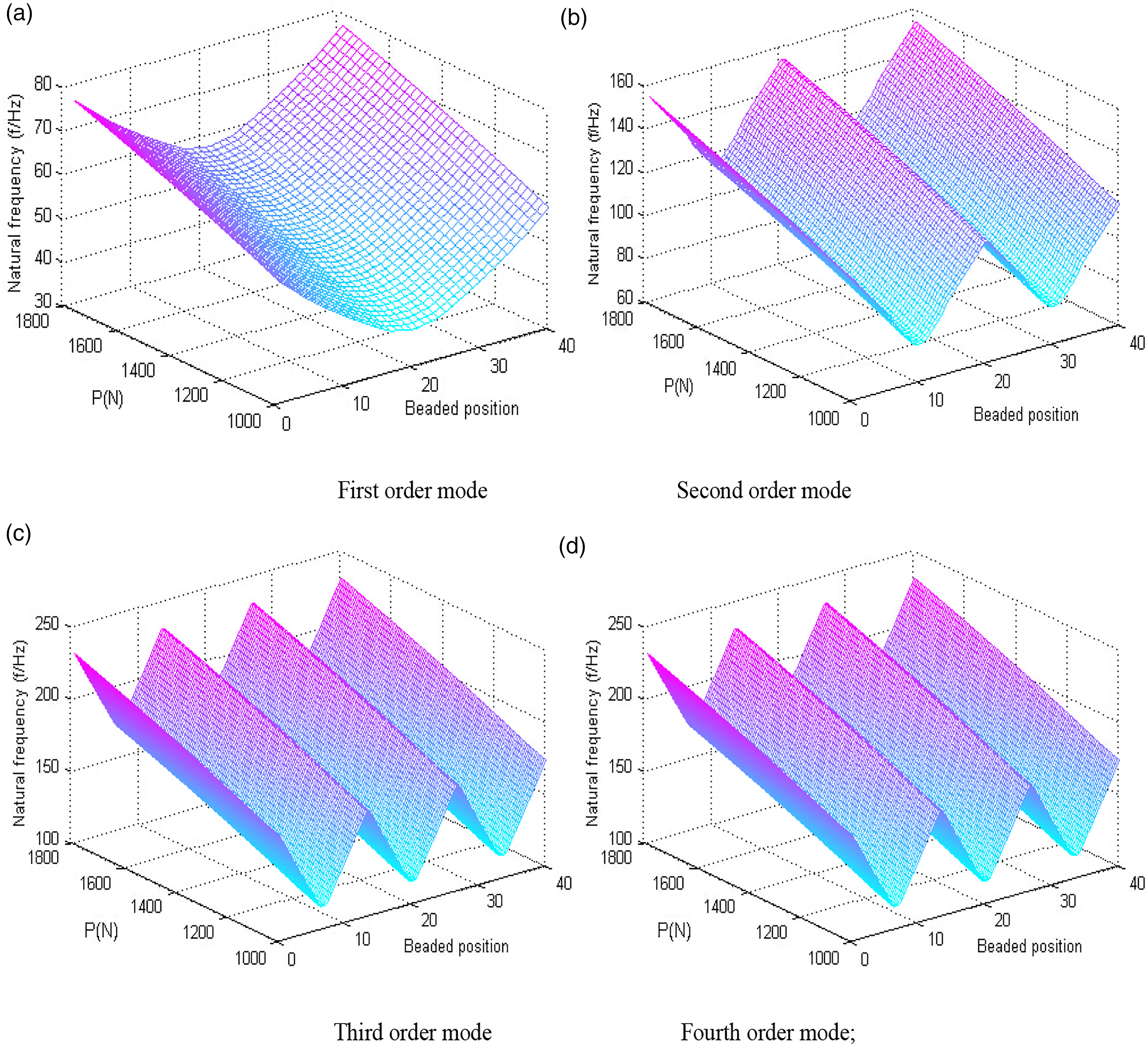
From Figure 5, along with the increase in tension force, the natural frequency of the DBR increases correspondingly. Especially in the high orders mode, the natural frequencies of the DBR increase significantly. The results of numerical analysis were in agreement with the research conclusion by Xiao. 27 It is observed that the inherent frequencies also emerge volatility phenomenon with the movement of beads, and the natural frequencies appear symmetrically at the middle position of the DBR.
The relationships between natural frequencies, the quality of beads, and bead position
The relationships between natural frequencies of the DBR and the quality of diamond-beaded positions are investigated as shown in Figure 6. Where the tension force is 1500 N and axial motion velocity of the diamond-beaded rope is 25 m/s, the range of quality of diamond beads is from 0.01 to 0.05 kg. Natural frequencies of the diamond-beaded rope versus mass of diamond beads. (a) First-order mode, (b) second-order mode, (c) third-order mode, and (d) fourth-order mode.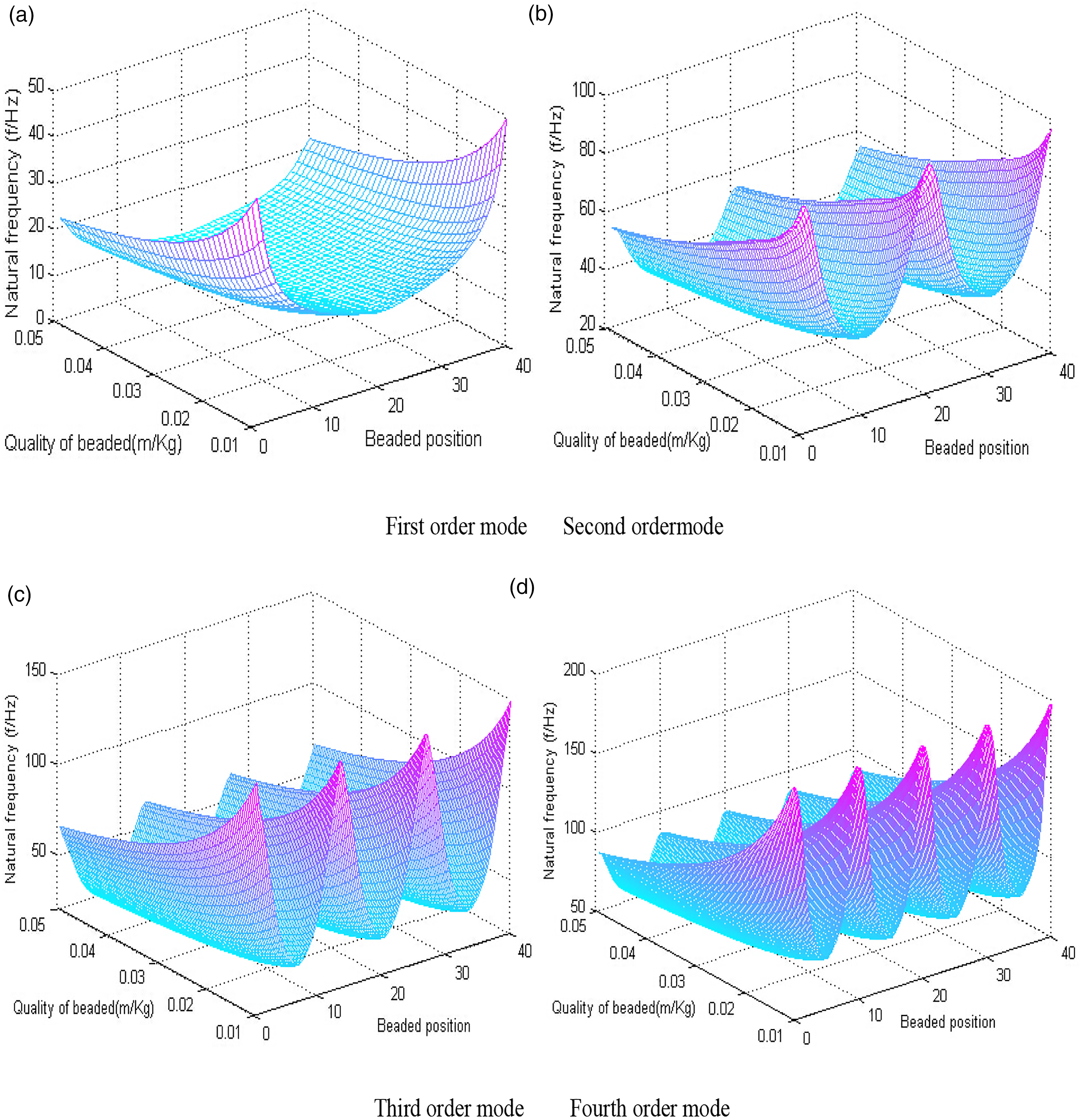
Figure 6 shows that along with the increase of the quality of the diamond-beaded rope, the natural frequencies of the diamond-beaded rope drop-off were more pronounced. It is observed that inherent frequency amplitude changes greatly if located at the beginning of the end position of the diamond beads, compared with the natural frequency of the middle diamond-beaded rope, and especially in the high orders mode, the fluctuating magnitude of natural frequencies increases significantly.
Analysis of vibration model for diamond-beaded rope
The diamond-beaded rope was simplified as a lumped mass, and the characteristics of sawing force during processing are analyzed in Equations of Diamond-Beaded Rope Motion. The motion trajectory of diamond beads is shown in Figure 3, and the vibration deformation of the DBR is different due to the different cutting force. In the simulation, where the motion speed of the diamond-beaded rope is 25 m/s, the tension of the diamond-beaded rope is fixed at 1500 N, and the mass of the diamond-beaded rope is 0.015 kg.
The relationships between the first four order mode shapes of vibration of the DBR and the different position of diamond beads are shown in Figure 7. In the numerical example, suppose there are 40 diamond beads per meter, select the first beaded, fifth beaded, tenth beaded, fifteenth beaded, twentieth beaded, and thirtieth beaded as the object of study. From Figure 7, it is evident to be obtained that the vibration shapes of diamond beads rope change with the position of diamond beads in machining arc, and with increasing modal order, the number of ups and downs of vibration mode also increases. In addition, various order vibration modes are not symmetrical about the DBR midpoint. Mode shapes of the diamond-beaded rope along at different positions: (a) Mode 1, (b) Mode 2, (c) Mode 3, and (d) Mode 4.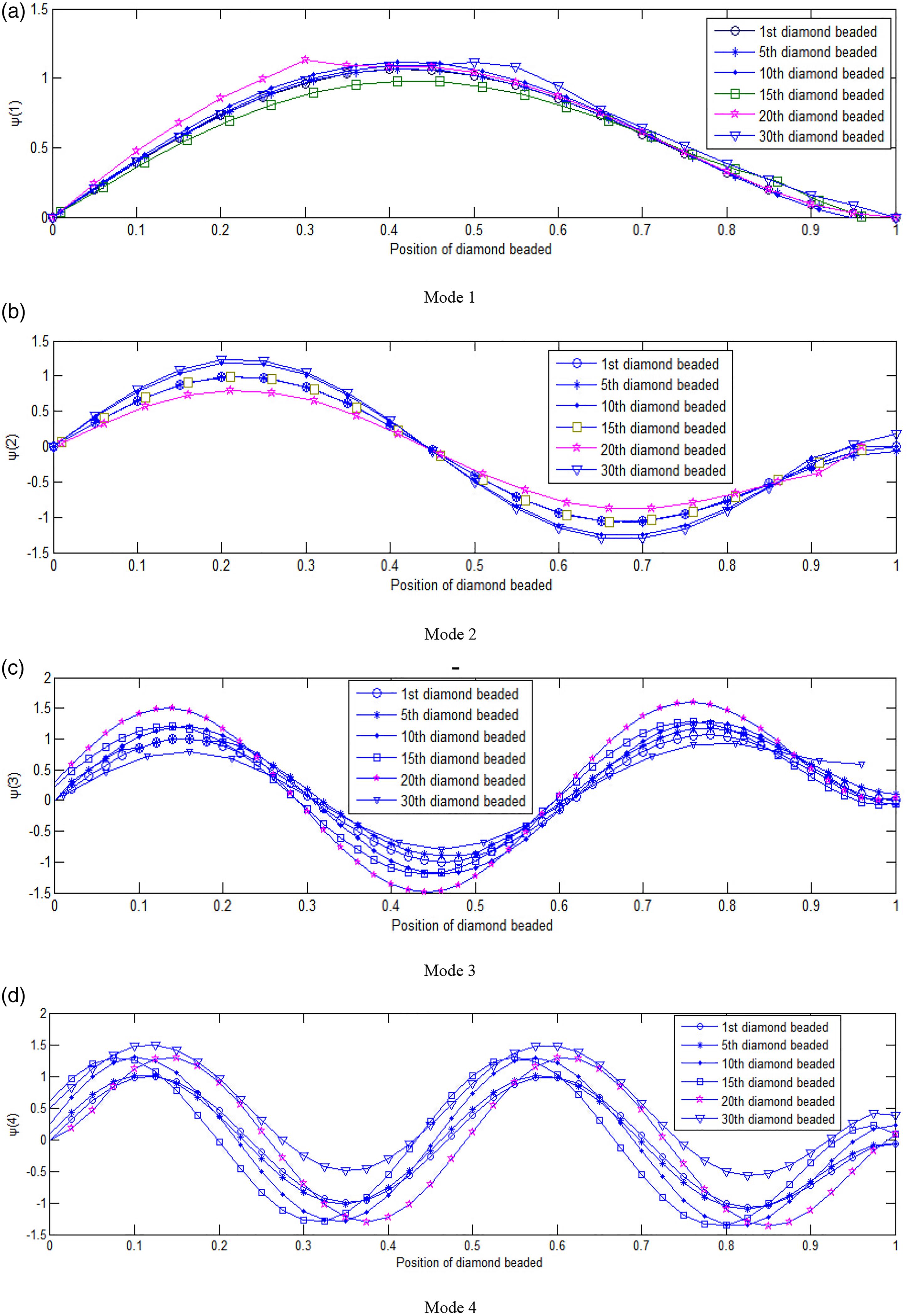
Experimental verification
Experimental setup
An experimental system was used to validate the accuracy of the proposed method for predicting the modal analysis on lateral vibration of the DBR. The experimental analysis of natural frequency of the DBR includes system dynamic test and system modal parameter identification. The signal (time domain signal) collected in the experiment is transformed by Fourier transform (FT), and then the frequency domain signal is deduced and calculated to establish the frequency domain function of the vibration system and complete the identification of its modal parameters. The experimental setup included an external excitation (force hammer), a force transducer (PCB), a data acquisition system (B&K: PULSE), an acceleration sensor (KD), and a CNC diamond saw (HSJ), as shown in Figure 8. Modal test experiment of the beaded rope.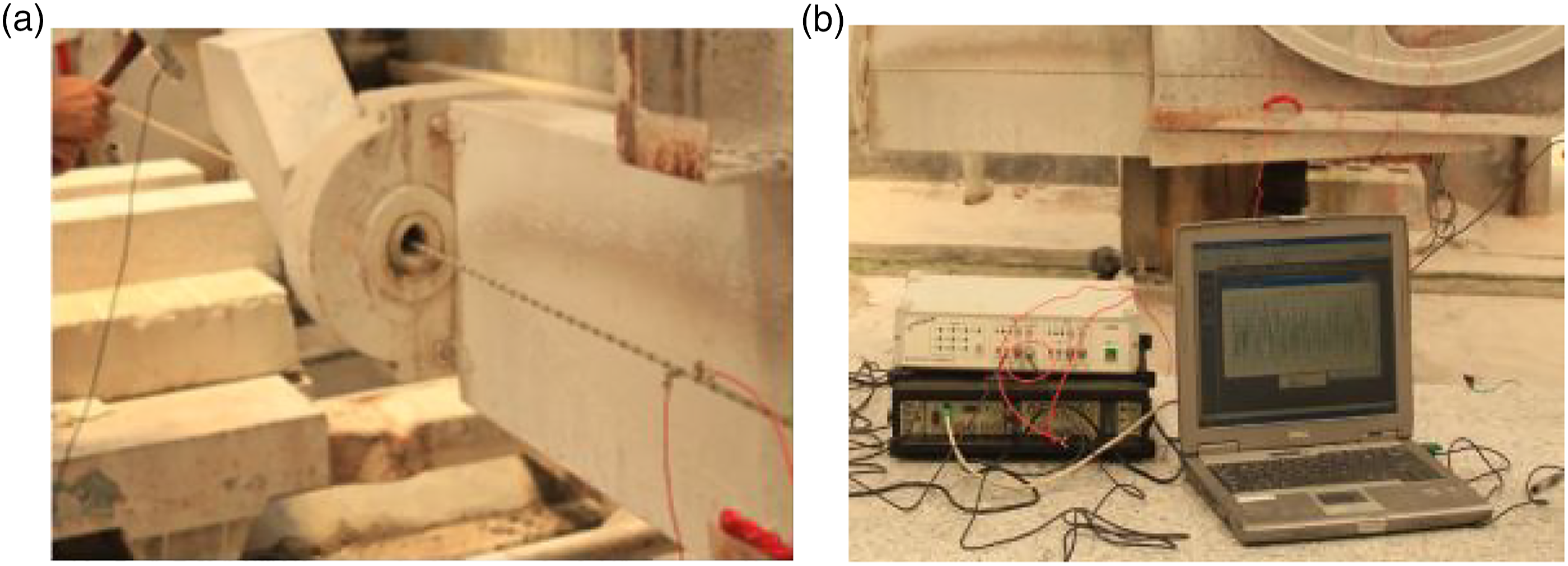
Modal experimental tests for validation of the proposed method
The selection of sampling frequency for modal experiments needs to take into account the problems of modal omission and spectrum confusion. When the sampling frequency is low, the signal will cause spectrum aliasing after Fourier transform, which affects the accuracy of the transfer function. At the same time, under a certain number of sampling points, an excessively high sampling frequency will reduce the frequency resolution and may cause modal omissions, and the sampling frequency of the data acquisition system is 512Hz.
The force hammer sequentially strikes each excitation point on the rope pulley, the collected excitation signal and response signal are simultaneously input into the PULSE data acquisition and modal analysis system. The frequency response function between the excitation signal and the response signal is calculated point by point, and then the modal parameters are identified, the experimental results of natural vibration characteristics of the beaded rope are shown in Figure 9. Modal diagram of the beaded rope.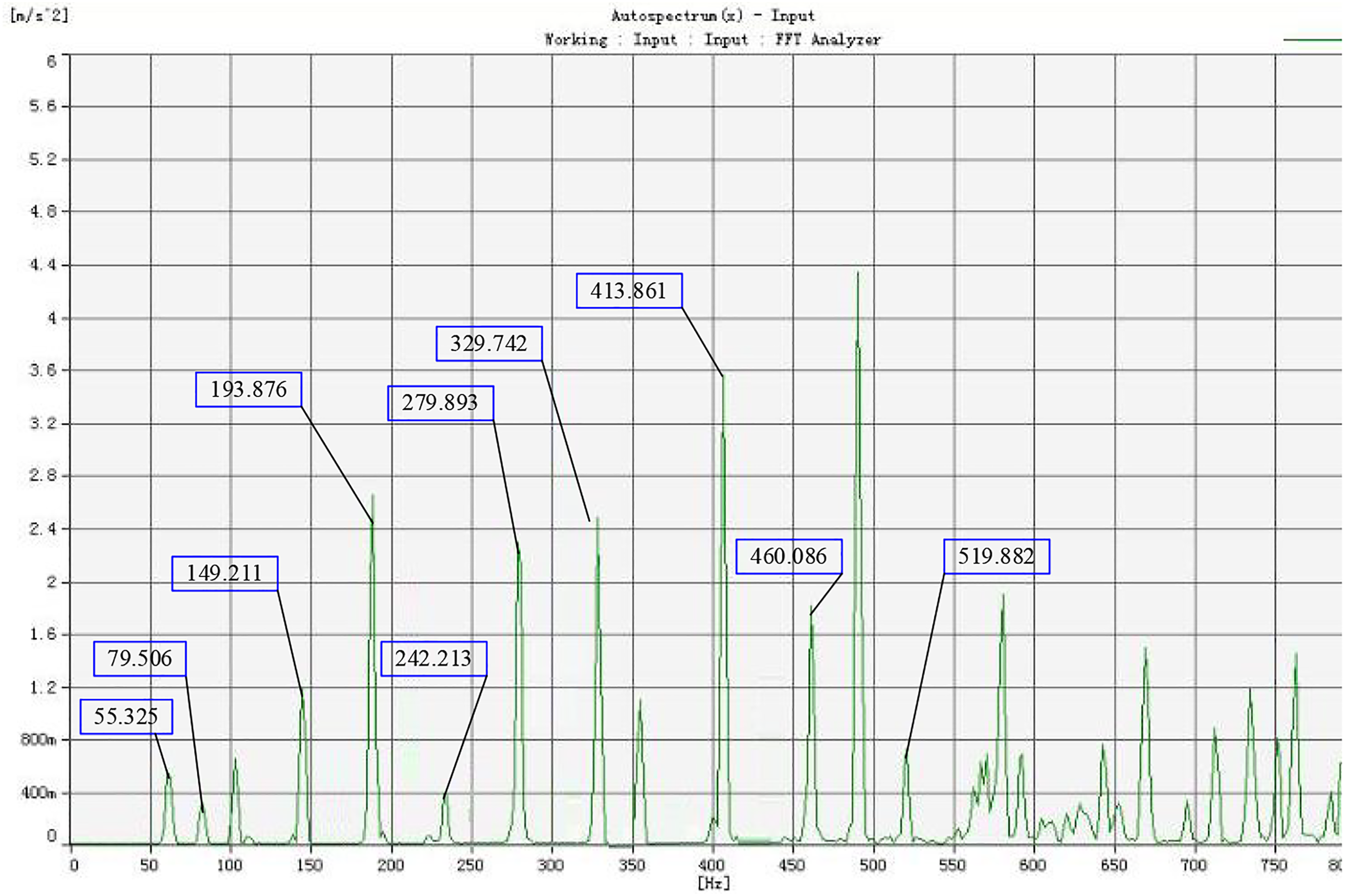
The dimensionless natural frequency of the beaded rope is ω
n
= nπ (1−v2), and the actual natural frequency of the DBR is ψ n = nπ (p−ρ vs2)/L (p ρ)1/2, ρ is the linear density. The tension of the beaded rope varies from 800N to 2000N and the axial velocity of beaded rope is fixed at 25 m/s. The signal (time domain signal) collected in the experiment is transformed by Fourier transform (FT), and then the frequency domain signal is deduced and calculated to establish the frequency domain function of the vibration system and completes the identification of its modal parameters, as shown Figure 10. As the linear speed of the DBR increases, the frequency decreases. As the tension of the diamond-beaded rope increases, the frequency increases and the amplitude decreases and linearly increases. The frequency and amplitude values of the calculated and measured for the diamond-beaded rope (DBR). The tension varies from 1100 N to 1800 N.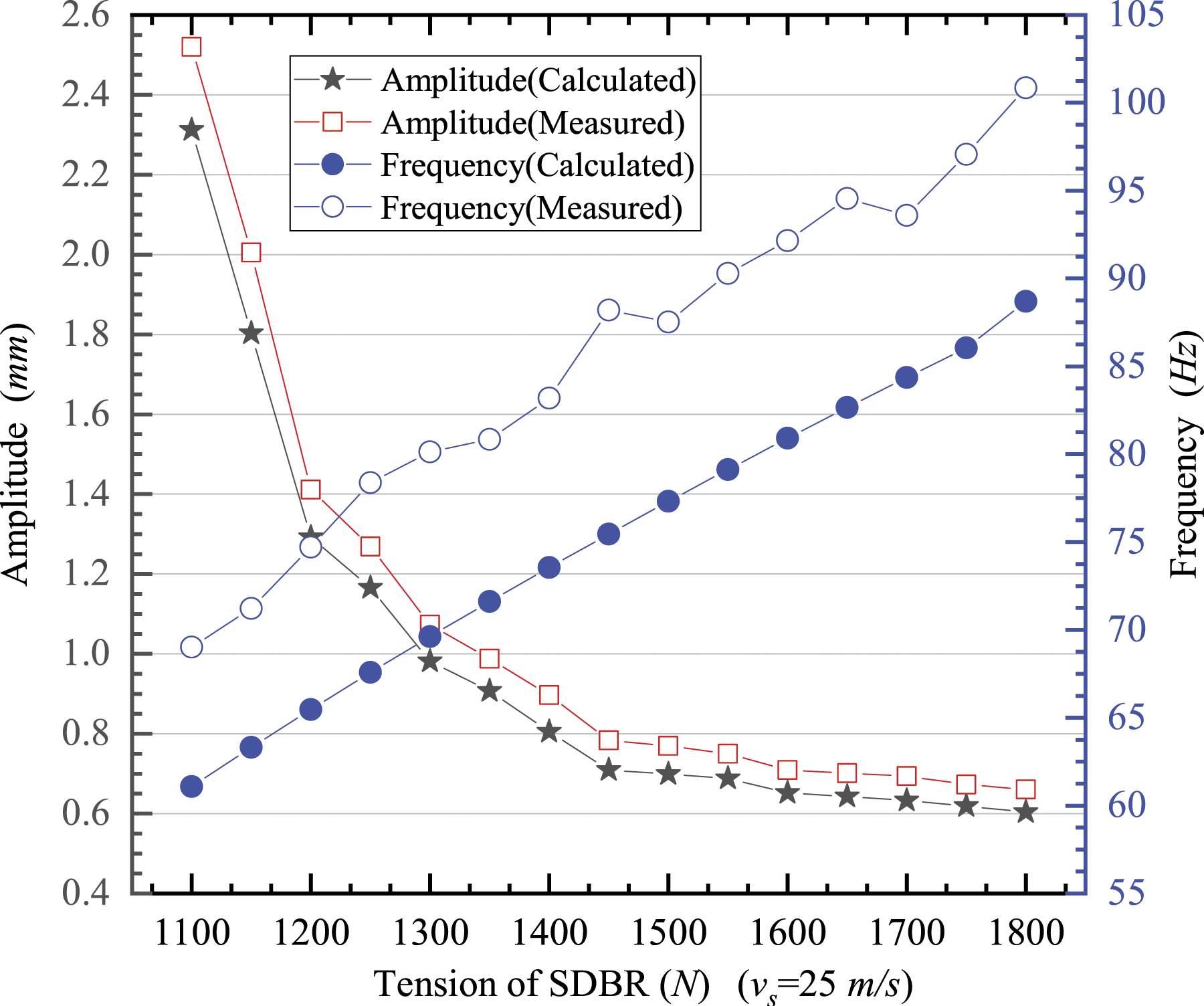
Comparison and analysis of natural frequency of the diamond-beaded rope.
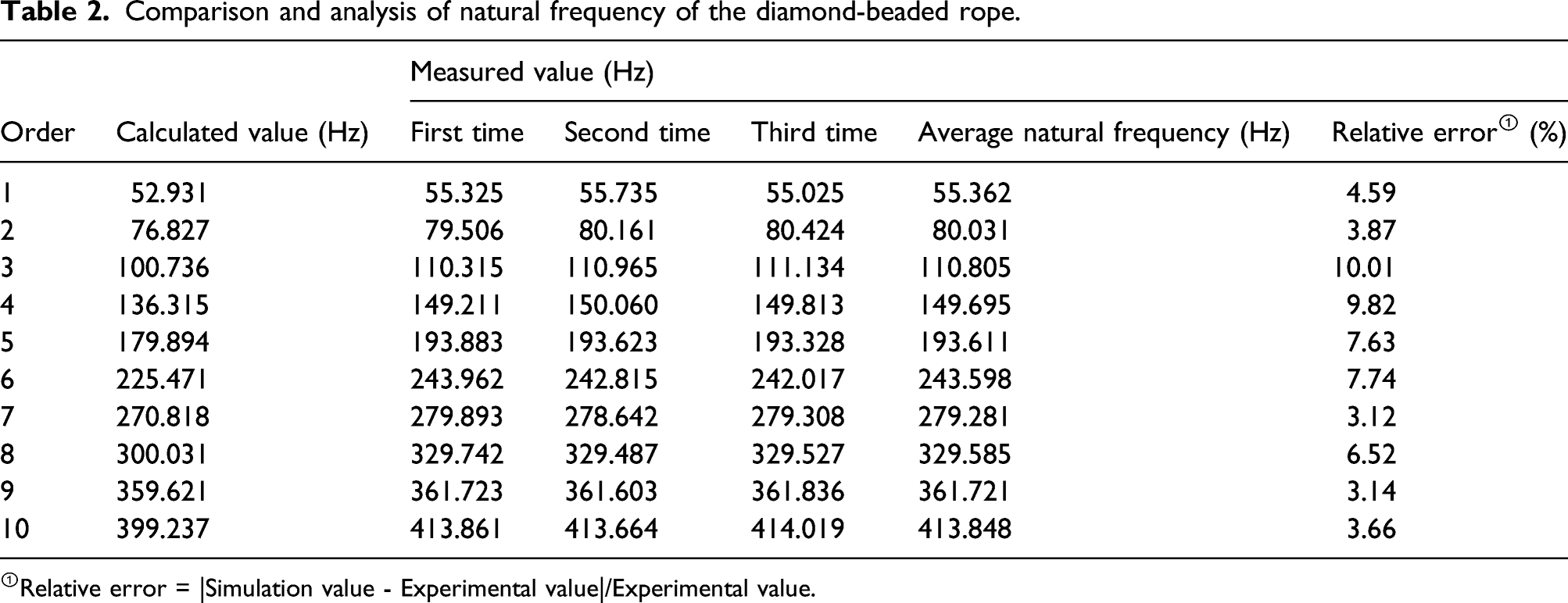
①Relative error = |Simulation value - Experimental value|/Experimental value.
Conclusions
In this article, the results of the natural vibration characteristics of the diamond-beaded rope (DBR) based on lumped mass method are presented. The relationships between natural frequency and velocity, tension, diamond-beaded mass, diamond-beaded position are studied. The conclusions show that: The analysis results of the vibration characteristics of the DBR motion parameters show that along with the movement of the diamond-beaded rope, the natural frequencies of the DBR emerge volatility phenomenon. Especially, the natural frequencies of the order are high and the natural frequency fluctuations also change significantly. The analysis results of the vibration characteristics of the DBR process parameters reveal that the tension of the DBR is the most significant factor that affects the vibration frequencies and amplitude. Along with the increase of the tension force of the DBR, the natural frequencies of the DBR increase more pronounced. However, compared with beaded rope tension, the motion speed of the DBR has little effect on the natural frequencies of the DBR. Additionally, along with the increase of the mass of the diamond beads, the inherent frequencies of the DBR decrease correspondingly, but the magnitude of volatility increases significantly. The vibration shapes of the DBR changes with the position of diamond beads in machining arc, and with increasing modal order, the number of ups and downs of vibration mode also increases. In addition, throughout the modal analysis, all order natural frequencies appear symmetrically at the middle point of the diamond-beaded rope, but mode shapes of the diamond-beaded rope were not symmetrical about the diamond-beaded rope midpoint.
Footnotes
Declaration of conflicting interests
The author(s) declared no potential conflicts of interest with respect to the research, authorship, and/or publication of this article.
Funding
The author(s) disclosed receipt of the following financial support for the research, authorship, and/or publication of this article: The author gratefully acknowledges the support by the National Science Foundation of Shandong, China (No. ZR2020ME116), the Key Research and Development Plan of Shandong Province (No. 2019GGX104044), and the Project of Shandong Province Higher Educational Science and Technology Program (No. J17KA029), and Key Research and Development Plan (Major Scientific and Technological Innovation) Project of Shandong Province (2019JZZY020323).
