




Abstract
This paper presents a numerical approach for the determination of scattering frequencies of two-dimensional acoustic exterior resonance problems using boundary element method combined with a contour integral method. Since the solving range is surrounded by a Jordan curve in the complex plane, the complex eigenvalues can be acquired through evaluating the contour integral along the Jordan curve using the contour integral method. Complex scattering frequencies are directly extracted by the proposed approach, and their corresponding eigenmodes are also presented by evaluating the vibration amplitudes of internal points. The behaviors of the fictitious eigenfrequencies for unbounded domain are also studied. Numerical examples demonstrate the effectiveness of the approach for the resonance problems of unbounded domains.
Introduction
When an incident wave is propagating through the interfaces of two different mediums or encounter a rigid obstacle as shown in Figure 1, the maximum amplitude of the scattering wave can be excited at the real frequencies located in the vicinity of the scattering frequencies. The determination of the scattering frequencies and the corresponding scattering modes provides a convenient approach for the study of the dynamic stability of underwater or floating body such as ships, submarine, submerged constructions, etc. The peaks of the response curve of the excited body by waves imply that the maximum energy is transmitted to the body. The approach can also be applied to the sound resonances of the instruments and light scattering of suspended particles in liquid. Scattering frequencies can be obtained by eigenvalue analysis in the complex plane, since they are relevant to the singularity of scattering matrix. 1
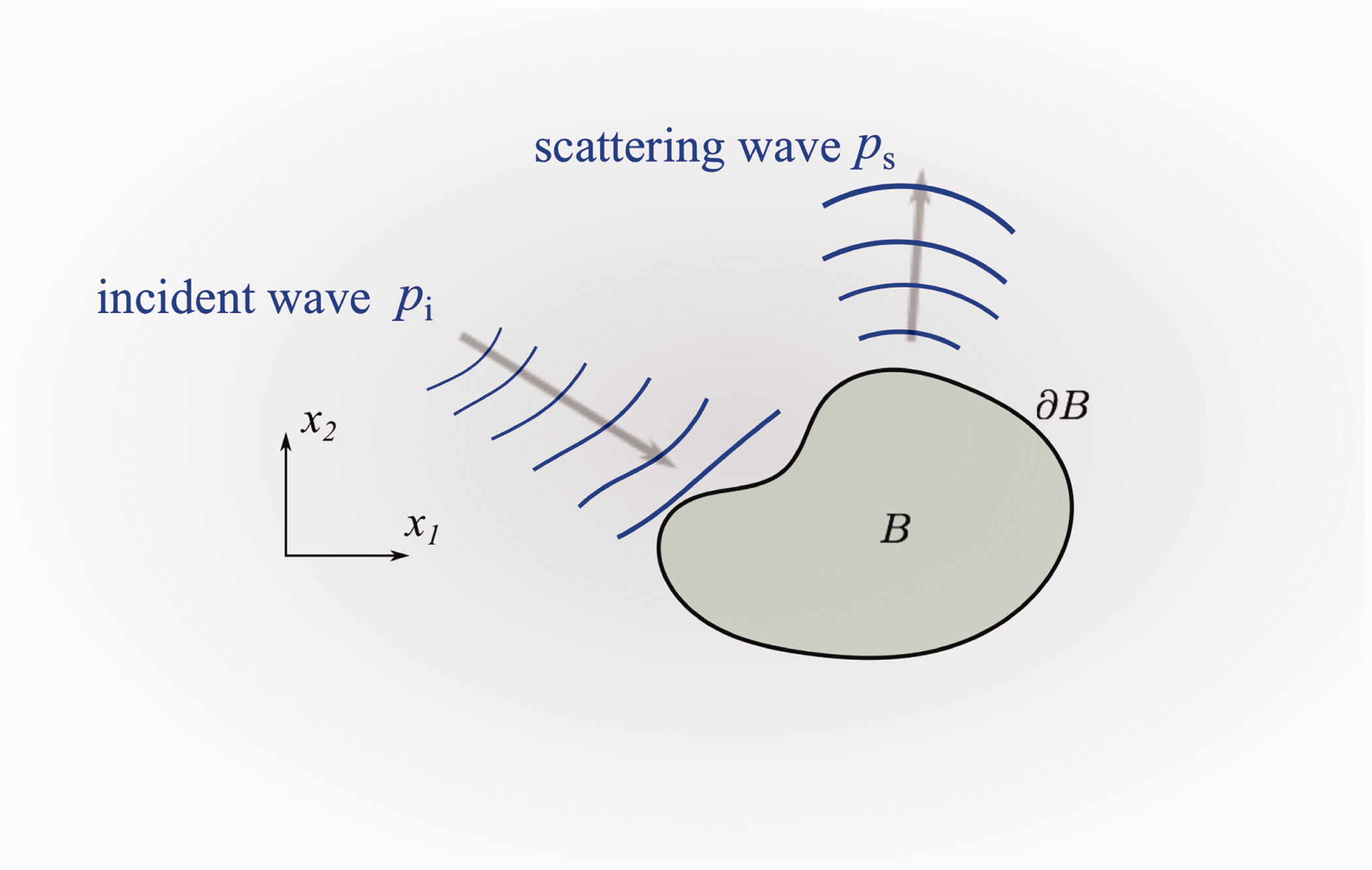
The scattering wave of an obstacle.
The amplitudes of scattering waves by a cylindrical scatterer have poles which are related to zeros of
Among the former investigations of scattering problems, one comes across the previous works presents an exhaustive study of the scattering properties of acoustically soft and hard bodies with geometrically-simple shapes. 5 Important analysis methods and numerical techniques frequently used for electromagnetic wave propagating problems can be found in the literature. 6 T-matrix7,8 approach has been widely used in acoustic and electromagnetic scattering. Multiple scattering problems are studied using T-matrix method for acoustic, electromagnetic, and elastic fields. 9 The conformal mapping approach 10 is developed for both small and large deviations from a circular cross-section and is more efficient than T-matrix method under certain conditions. The partial-wave series expansion (PWSE) method 11 in cylindrical coordinates is adopted to analyze acoustic scattering of a cylindrical quasi-Gaussian beam, and the results are compared with the ones obtained by T-matrix. PWSE11,12 is also applied to the investigation of the radiation forces and torque exerted on a rigid elliptical cylinder. Hybrid smoothed finite element method 13 is developed for acoustic scattering unbounded domains. The analytical solution 14 and semianalytical solution 15 for the scattering on elliptical cylinders are derived, respectively. Particle pairs with corrugated surfaces are considered in electromagnetic problems 15 and a direct analogy with acoustic counterpart is discussed. 16
To simulate an unbounded domain with the finite element method, appropriate boundary conditions have to be imposed on the artificial boundary, which is considered as transparent boundaries.13,17–19 Otherwise, infinite elements 20 have to be employed. Both of the techniques aim at replacing the radiation condition at infinity. Besides the internal discretization, extra parameters for above techniques have to be chosen carefully to keep good results.
In view of the aforementioned limitation, the boundary element method (BEM) is undertaken to extend the modal analysis to the exterior problems. The numerical model with boundary-only discretization offered by the BEM has been widely applied to a variety of exterior physical problems.21–23 Furthermore, the adoption of the fundamental solutions makes the BEM satisfy the radiation condition at infinity automatically. For scattering problems, boundary elements can be employed to simulate arbitrary geometrical cross-section with both smooth and corrugated surfaces, and the accuracy can be improved by adopting higher order elements. For eigenfrequency computations, both interior and exterior problems result in nonlinear eigenvalue problems, since the parameter ω (circular frequency) or k (wave number) is involved in the each element of the system matrix from the boundary integral equations. The nonlinearity comes also from the fundamental solution which is in the form of Hankel functions. The direct search method, 24 however, is a low efficient method which searches the zero points of the determinant of the system matrix from BEM. For complex eigenfrequencies originated in scattering problems, it requires a two-dimensional (2D) search on the complex plane so that the computing cost increases significantly. Recently, it has been shown that the BEM stands out in numerical accuracy for the computation of eigenfrequencies.25–28 In particular, comparing with the finite element method, the BEM yields more accurate eigensolutions corresponding to complex eigenmodes due to the exact interpolation in the internal domain. 29 The domain numerical interpolation may result in an incorrect order of eigenfrequencies, as the mode shape in internal domain is relatively complex comparing with it on the boundary, which means BEM has better results than domain interpolation numerical methods for eigenfrequency analysis. Furthermore, although the BEM takes more computing cost than finite element method or other domain interpolation methods for common static or dynamic problems due to the full system matrix, the combination of BEM and the block Sakurai-Sugiura method (BSSM)30,31 can lead to a parallel computing program framework. Each thread requires a dynamic analysis process but not an eigenvalue analysis, which makes adoption of the fast algorithms possible. The eigenvalue analysis, actually, is carried out in a reduced eigenspace derived using BSSM, and the dimensions of the reduced eigenspace can be chosen depending on situations. The general efficacy of the BEM and BSSM has posed the BEM as a possible alternative to the conventional numerical techniques for modal analysis.26,32 Specifically, since the scattering frequencies are complex numbers with relatively large imaginary parts, they locate in the complex plane (each quadrant) but not the real axis. The contour integral method such as the BSSM is suitable for extracting those complex eigenvalues off the real axis through defining a positive-oriented Jordan curve.
Comparing with the conventional methods, the proposed approach is easier to be applied for engineering analysis with more complex analysis of objects such as aircrafts, vehicles, etc. With the development of isogeometric analysis, 33 and its application to BEM, 34 the modeling of analysis of objects becomes simpler. Therefore, the proposed approach has a potential to be an efficient alternative tool for scattering problems both in acoustic and electromagnetic fields with large and complex models. In this paper, the determination of scattering frequencies for exterior problems is carried out using the BEM, and exterior eigenmodes of cylindrical and square scatterers are investigated. The scattering frequencies of a cylindrical scatterer obtained by the proposed approach show a good agreement with the closed-form solutions. The accuracy and effectivity of the proposed method for solving scattering frequencies of unbounded domains are demonstrated through numerical examples.
Boundary integral equations
Let us consider an exterior domain Ω with boundary S as shown in Figure 2. We suppose that S is piecewise smooth and encloses a simply connected domain B. In this work, acoustic problems of the propagation of the sound are considered, and the sound pressure


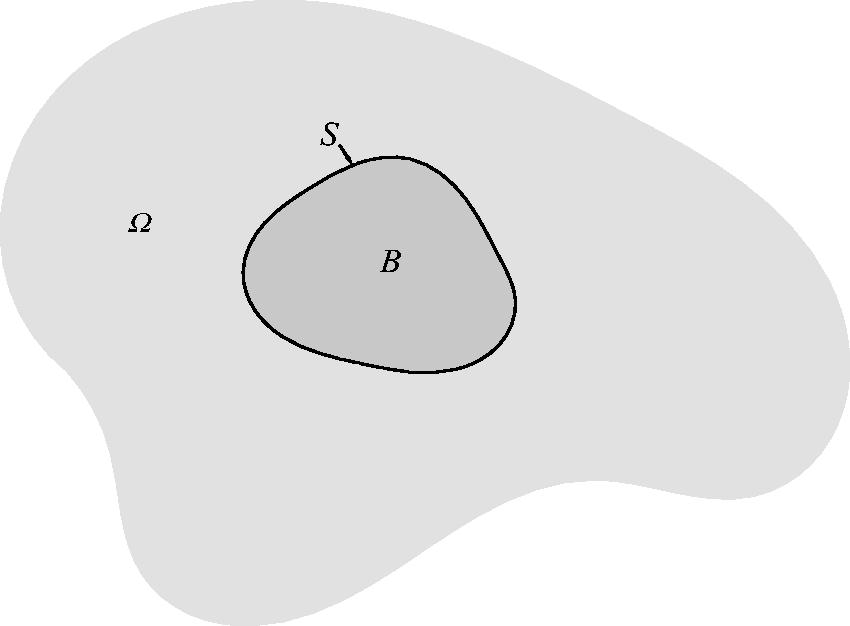
An exterior domain Ω with a closed smooth boundary S.
For governing equation given in equation (1), usually the following boundary conditions are considered


Since the scattering wave is radiated from the surface of the domain B to the infinity, the sound pressure ps must satisfy the Sommerfeld radiation condition

Green’s function for the 2D case is given by

The boundary integral equation can be formulated with Green’s function (equation (6)) as follows


With equations (7) and (8), the boundary integral equation: equation (7)+ α equation (8) for Burton–Miller’s method
35
is formed by a manually specified parameter α. Substituting the homogeneous boundary conditions

Extraction of complex eigenvalues using the BSSM
Due to nonlinearity of the eigenvalue problem provided by equation (9), in this paper, the BSSM is employed for extracting the scattering frequencies distributed in the complex plane. The procedure of utilizing the BSSM for equation (9) is shown in Figure 3. It should be noted that the BEM yields fictitious eigenfrequencies for modal analysis. In previous studies, 36 interior problems produce both real and complex fictitious eigensolutions. For interior problems with linear mediums without damping, there are only real eigenfrequencies considered as the true solutions. The searching domain is a two-dimensional circular area surrounded by a closed Jordan curve defined in BSSM. Therefore, the complex eigenvalues can also be obtained using BSSM as an eigensolver. However, with the adoption of Burton–Miller’s method, the imaginary part of the complex solutions is shifted by adding an imaginary number, while the real eigenvalues (considered as true solutions) remain unchanged. In the beginning, the Burton–Miller’s method is developed for overcoming the difficulties of non-uniqueness associated with fictitious eigenfrequencies resulted by a single boundary integral equation for exterior problems and the method combines the conventional boundary integral equation (so-called conventional BEM) with normal derivative boundary integral equation to ensure the uniqueness. α which is a parameter for Burton–Miller’s method is investigated in the study by Zheng et al. 37 wherein the fictitious eigenfrequencies move along with the changing of α. It is found that the fictitious eigenfrequencies actually just shift off the real axis. However, in this paper, the exterior problems result in fictitious solutions as real eigenfrequencies and the desired scattering frequencies are usually complex numbers. To identify the fictitious eigenfrequencies, it is necessary to utilize Burton–Miller’s method to shift the fictitious ones. In the literature, 20 resonances of a square with a small opening happen both in the interior area and the exterior surface. Thus, in that case, both the real and complex eigenfrequencies are true solutions. Nevertheless, it is another issue out of the scope of this paper. The identification of fictitious solutions is usually carried out by observing the imaginary parts of the results for a simple connected domain. Because of the numerical approaches adopted in the BEM and BSSM, a manually chosen threshold varies for different models. After the extraction of the eigenfrequencies, the eigenvectors are recovered from the projected eigenspace to the original one, and for exterior problems, the eigenvectors that only contain the quantities on the boundary of the BEM models can be extended to the exterior domain using integral equations.
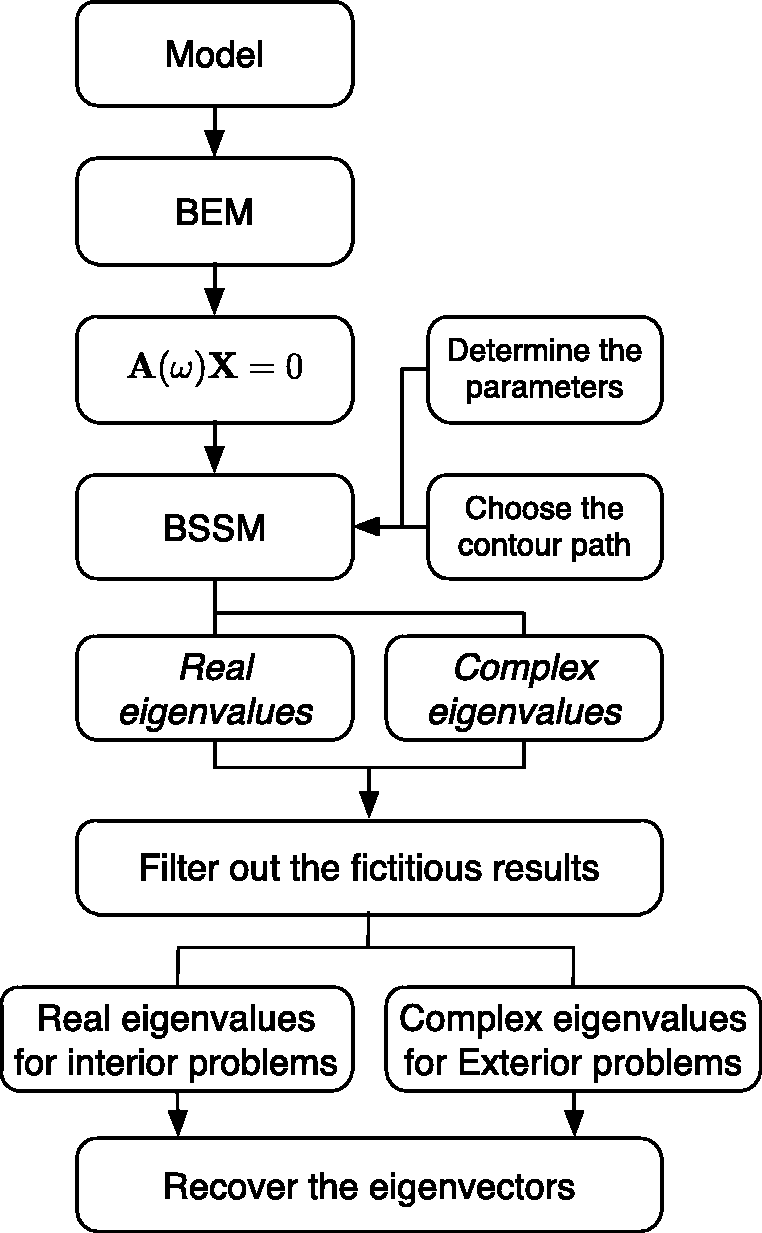
A general procedure for utilizing BSSM in modal analysis by BEM. BSSM: block Sakurai-Sugiura method; BEM: boundary element method.
In this study, the conventional circular integral path is first adopted to extract the eigenvalues which contain the fictitious solutions. The fictitious eigenvalues for exterior resonance problems are real numbers resulted by the boundary integral equations. The behavior of the fictitious solutions are also observed as Burton–Miller’s method is applied and the similar phenomena are found like the one in the study by Gao et al.
25
The parameters of the circular path is defined as follows, ρ is the radius of the circle, γ is the geometric center of the integral path (center of the circle for circular path). The moment matrices are given as follows

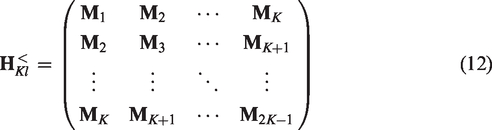
By solving the eigenvalues of the generalized eigenvalue problem

It can be proved that
Let


The contour integrals in equations (10) and (14) are carried out numerically using N-points trapezoidal rule. A circular integration path is defined as


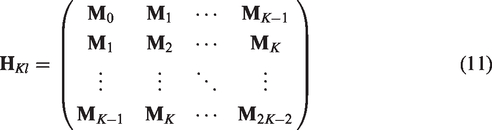
As the number of eigenvalues located inside Γ is not known in advance, the number of the eigenvalues has to be determined. To this end, the singular value decomposition (SVD) of the Hankel matrix is performed. After the Hankel matrices are formed, the SVD of

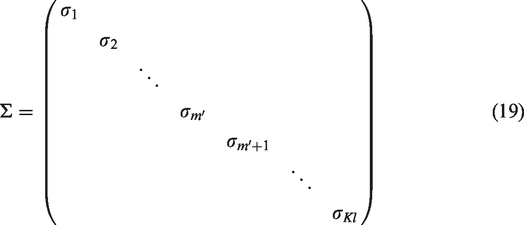
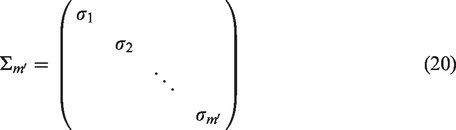
Let

However, the previous study shows that the threshold δ is changing for different numerical models. In order to improve the stability of the algorithm, the threshold
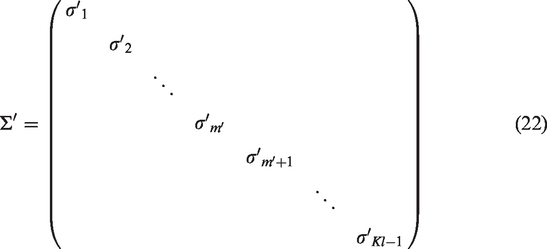

Numerical examples
In this section, examples are given to show the accuracy and effectiveness of the method for the determination of the scattering frequencies. In the first example, a circular cylinder is considered as a scatterer with a soft boundary/hard boundary and the scattering frequencies are related to the zeros of Hankel functions in the complex plane. In the second example, a square scatter with a hybrid boundary condition is given. The sound speed of air is assumed to be C = 333.1306 (m/s).
Cylindrical scatterers
Let us see the scatterer depicted in Figure 4 where the radius


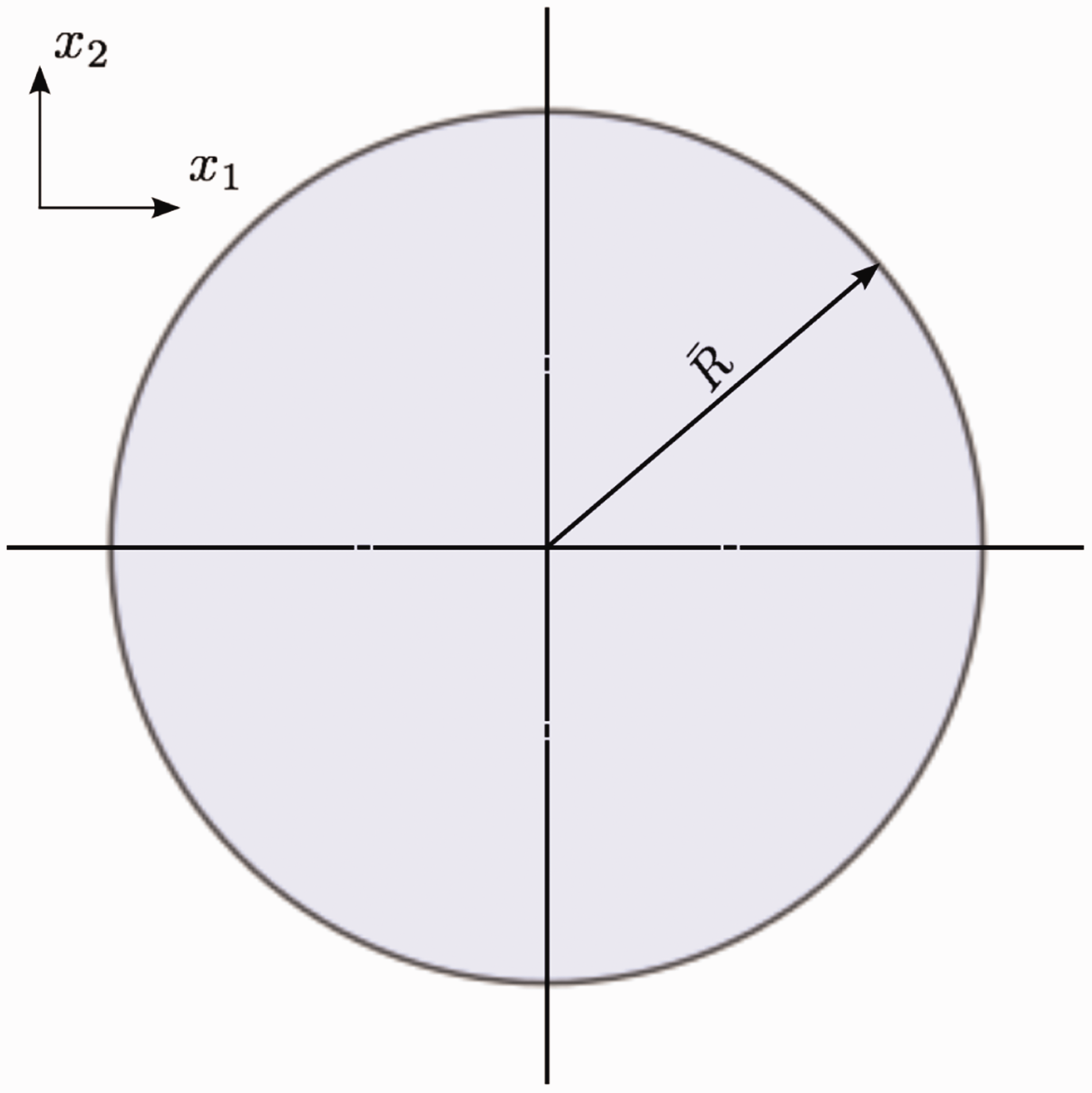
The cylindrical scatterer.
The discretized boundary element model is shown in Figure 5 where the open circular symbols denote the edge points of boundary elements and the filled circular symbols denote the internal points in the unbounded domain. Five hundred internal points are collocated along the radial direction uniformly as five layers. The amplitudes of the eigenmodes at the internal points are computed using integral equations.
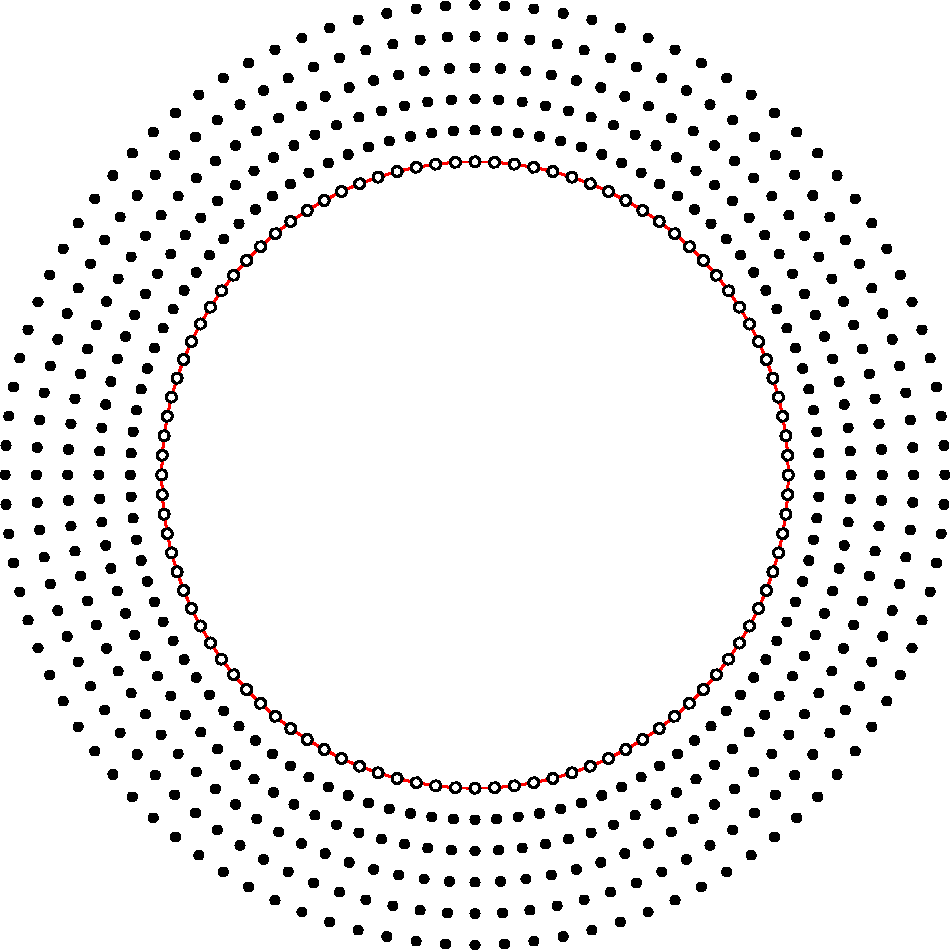
Boundary element discretization for the circular structure.
The closed-form solutions of equation (24) are listed in Table 1. The zeros of

The closed-form solutions of the soft cylindrical scatterer.
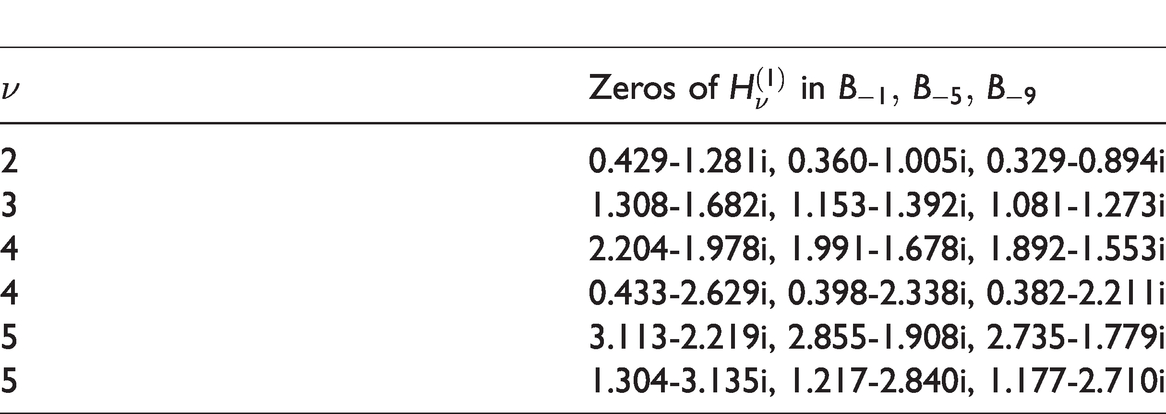
The scattering frequencies of the cylindrical scatterer located in
Eigenfrequencies in the forms of wave numbers for a cylindrical scatterer with a soft boundary.
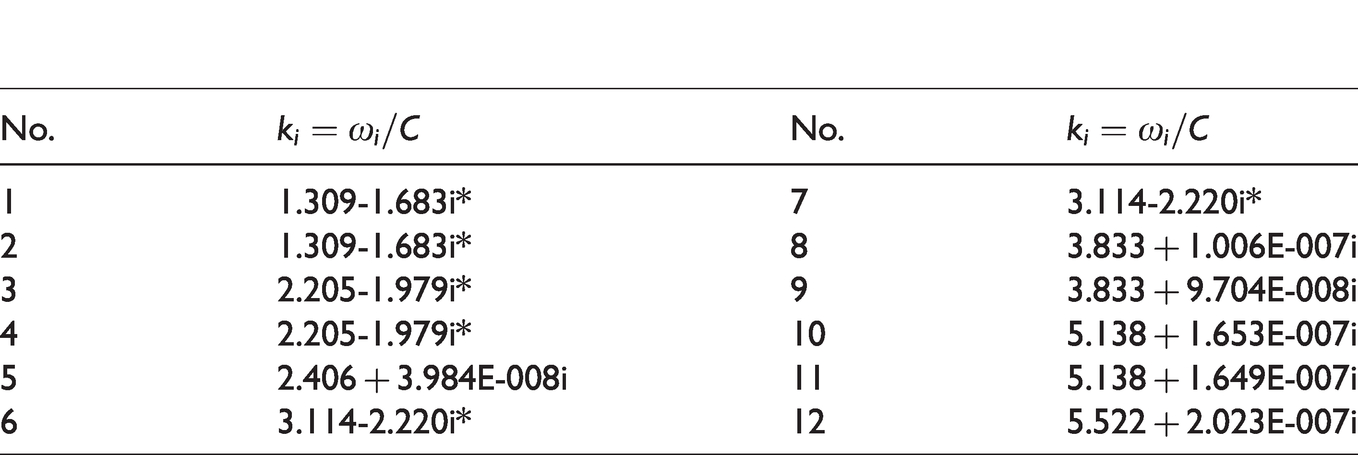
The true eigenfrequencies in the forms of wave numbers for a cylindrical scatterer and their closed forms.
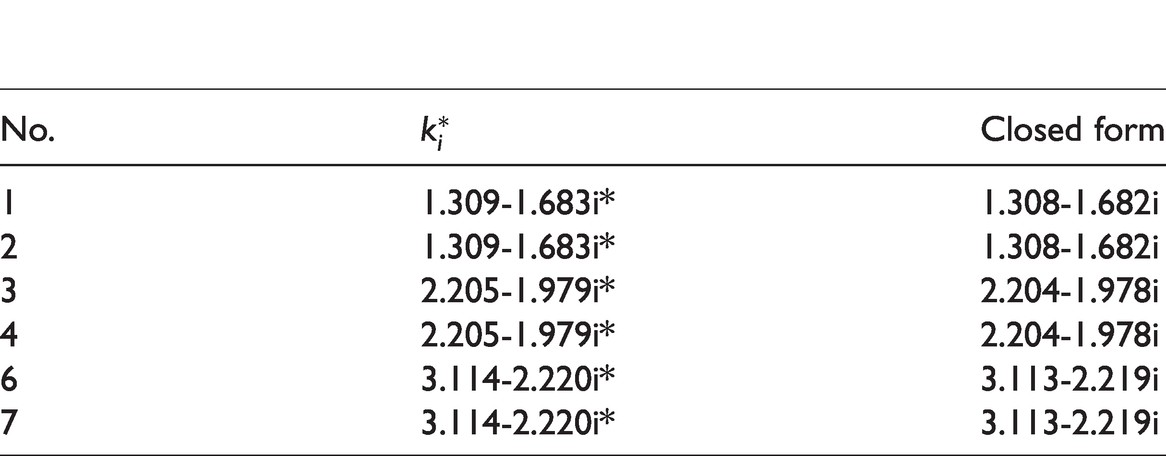
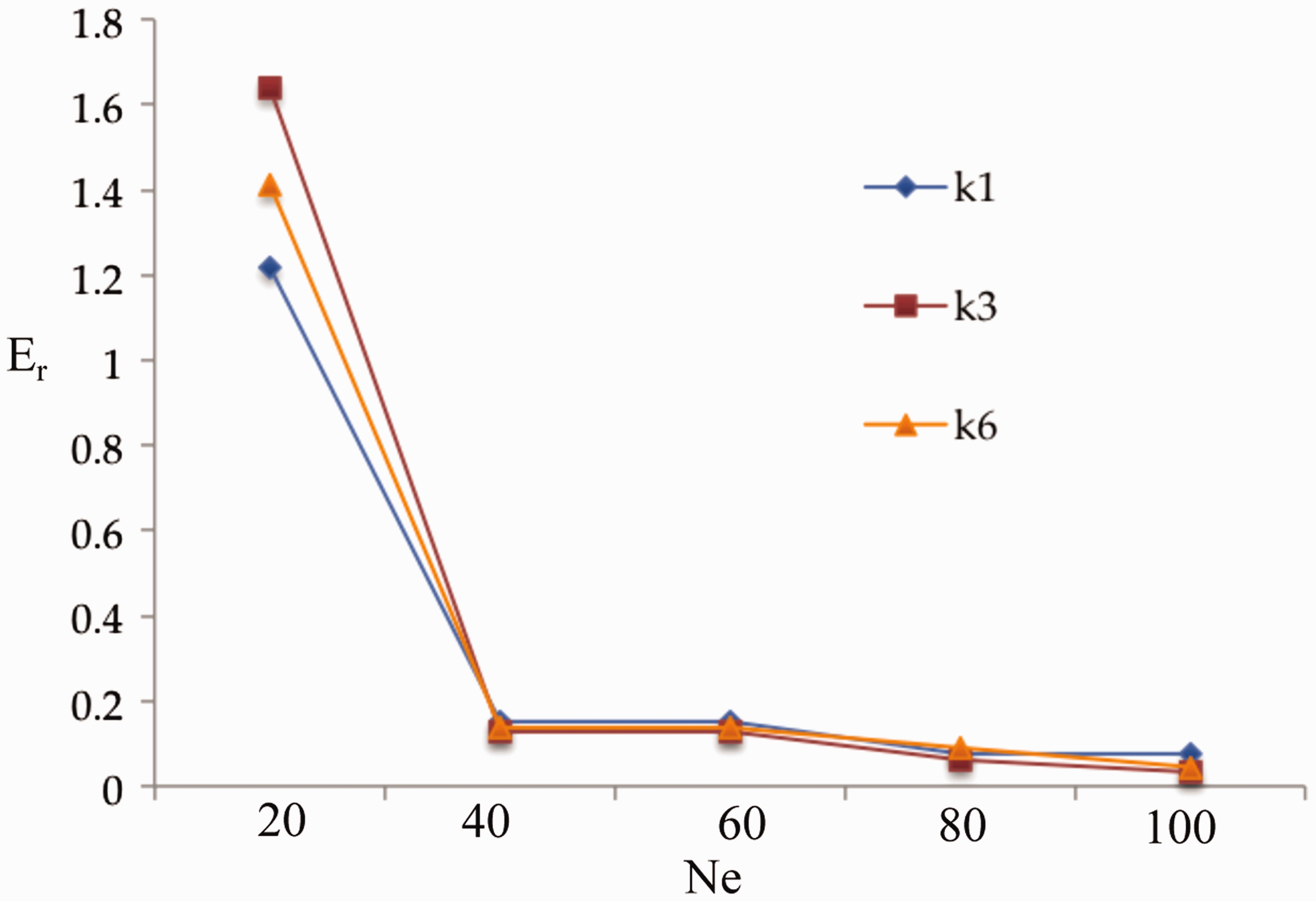
The convergency of the eigensolutions for the soft cylindrical scatterer.
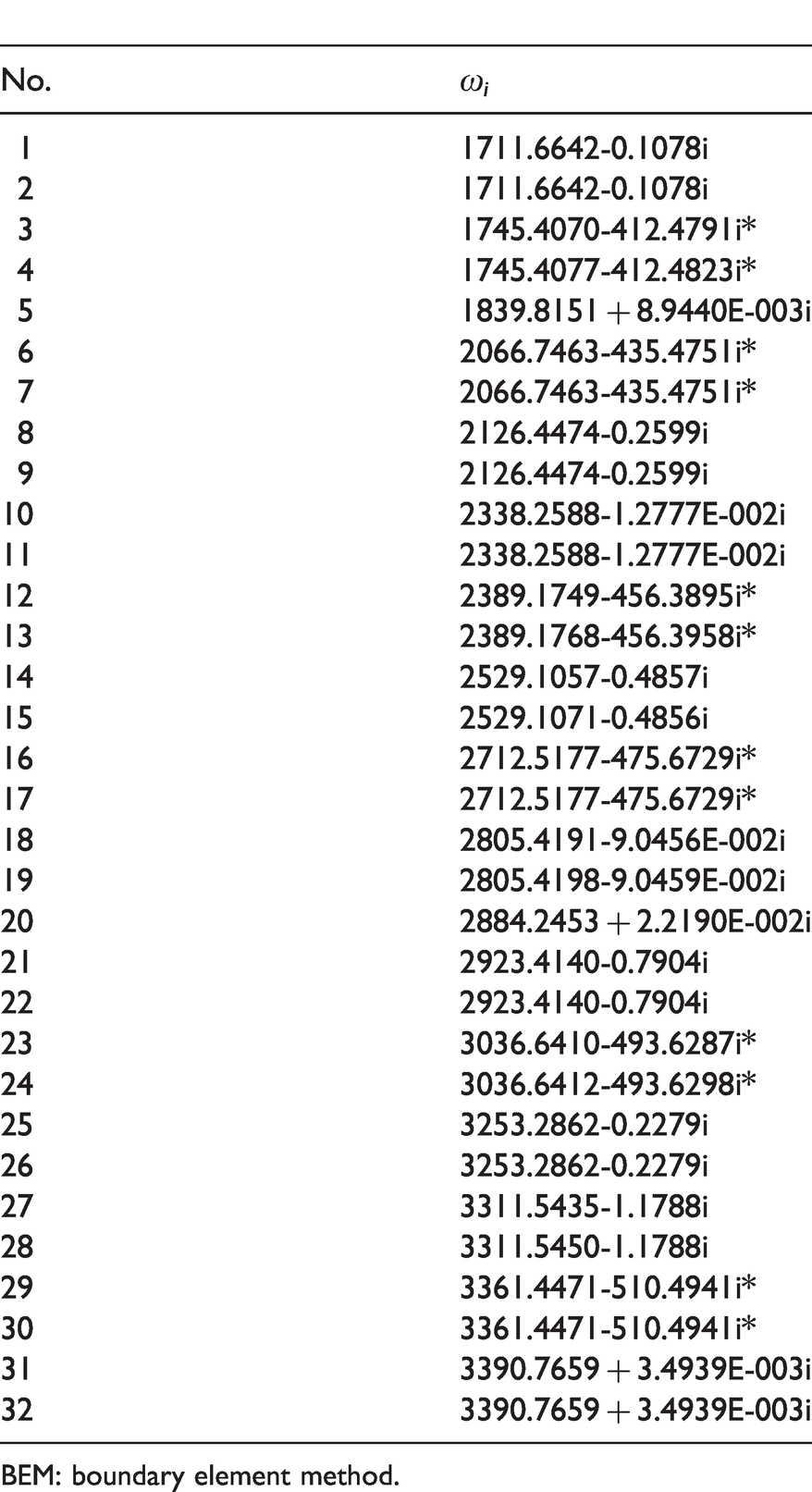
Eigenfrequencies obtained by conventional BEM.
BEM: boundary element method.
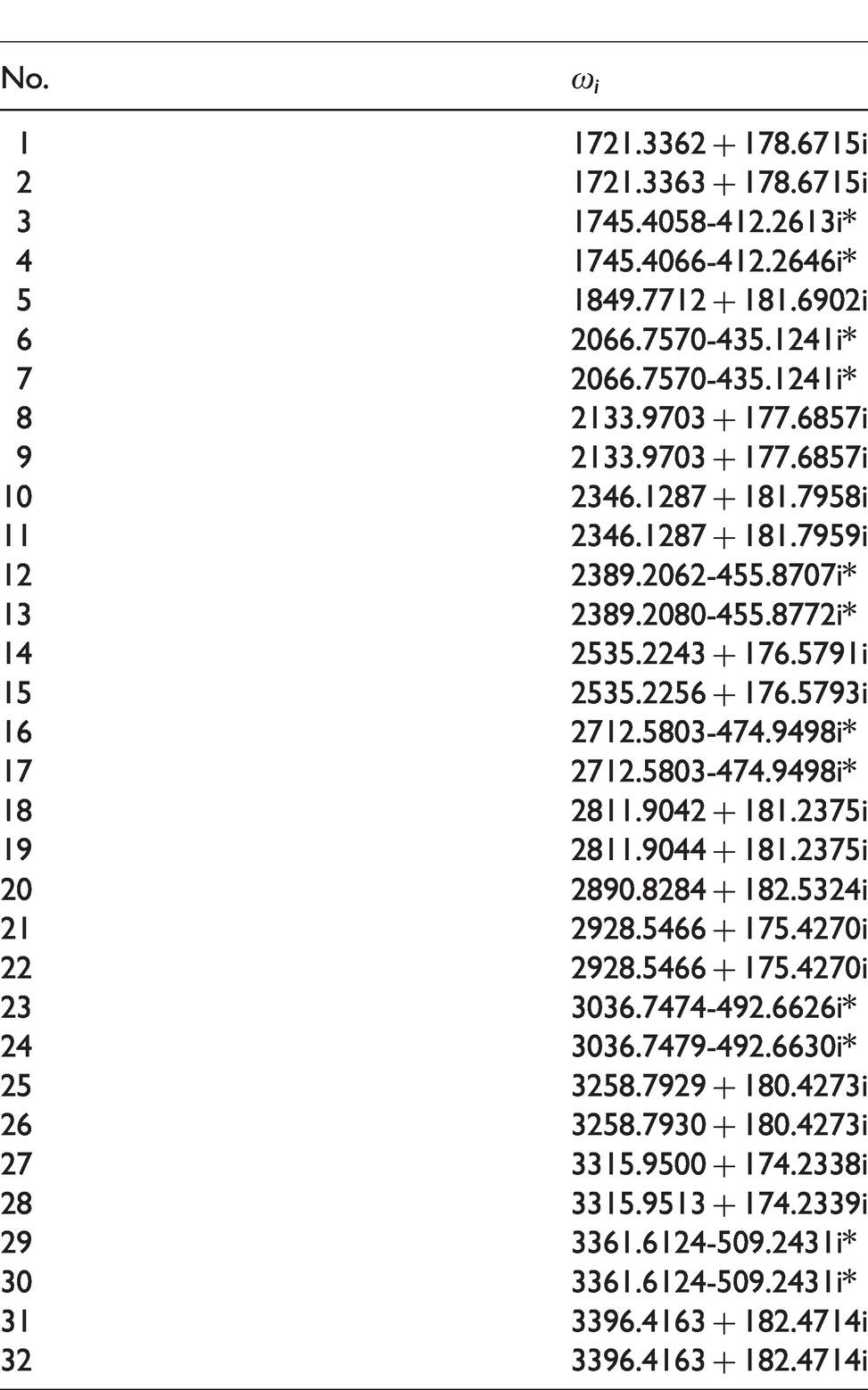
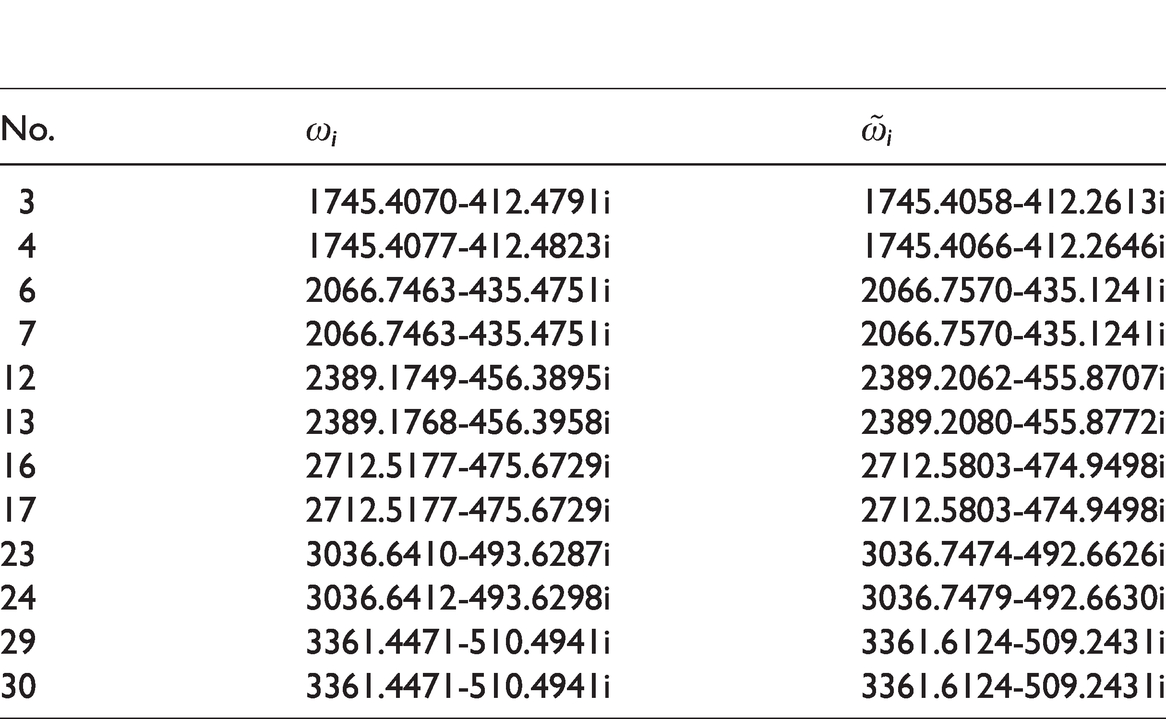
In Table 5, the fictitious real eigenfrequencies are considered as the eigenfrequencies corresponding to the interior problem with Dirichlet boundary conditions 35 and added by components that have relative large imaginary parts. The phenomena are similar with the previous study by Gao et al. 25 in which a complex domain is considered. As a matter of interest, for the exterior resonant problems, however, the behaviors of the complex eigenfrequencies are different from the fictitious ones. It should be noted that the number of eigenfrequencies in Table 5 is same as that in Table 4, and the values of complex eigenfrequencies remain unchanged. The true eigenfrequencies obtained by conventional BEM and Burton–Miller’s method are listed in Table 6 where only true solutions are extracted. The eigenmodes corresponding several scattering frequencies are recovered to the original eigenspace and shown in Figures 7 to 12.
Eigenfrequencies obtained by Burton–Miller’s method.
The true eigenfrequencies obtained by conventional BEM (ωi) and Burton–Miller’s method (
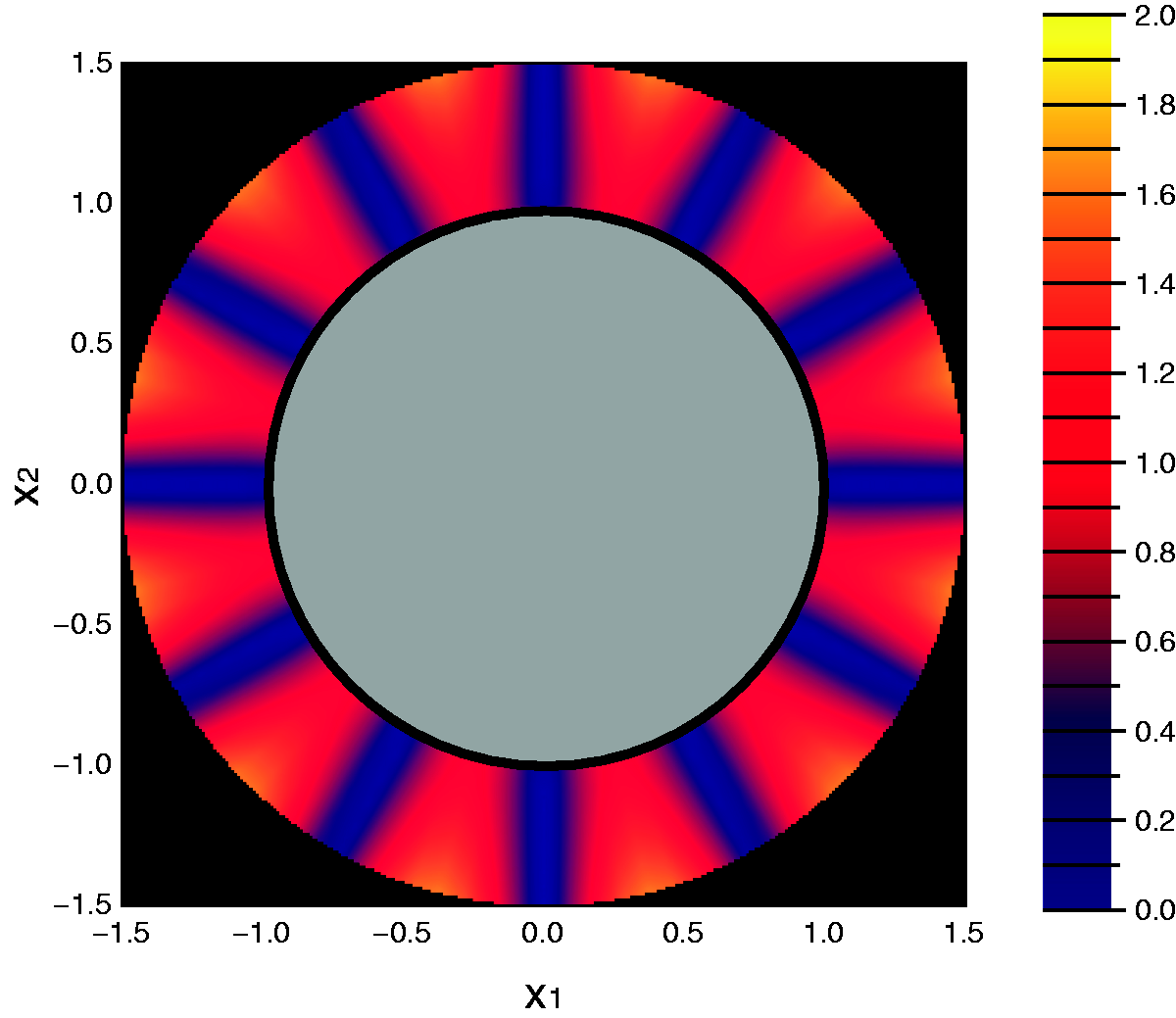
The eigenmode of exterior resonance at ω3.
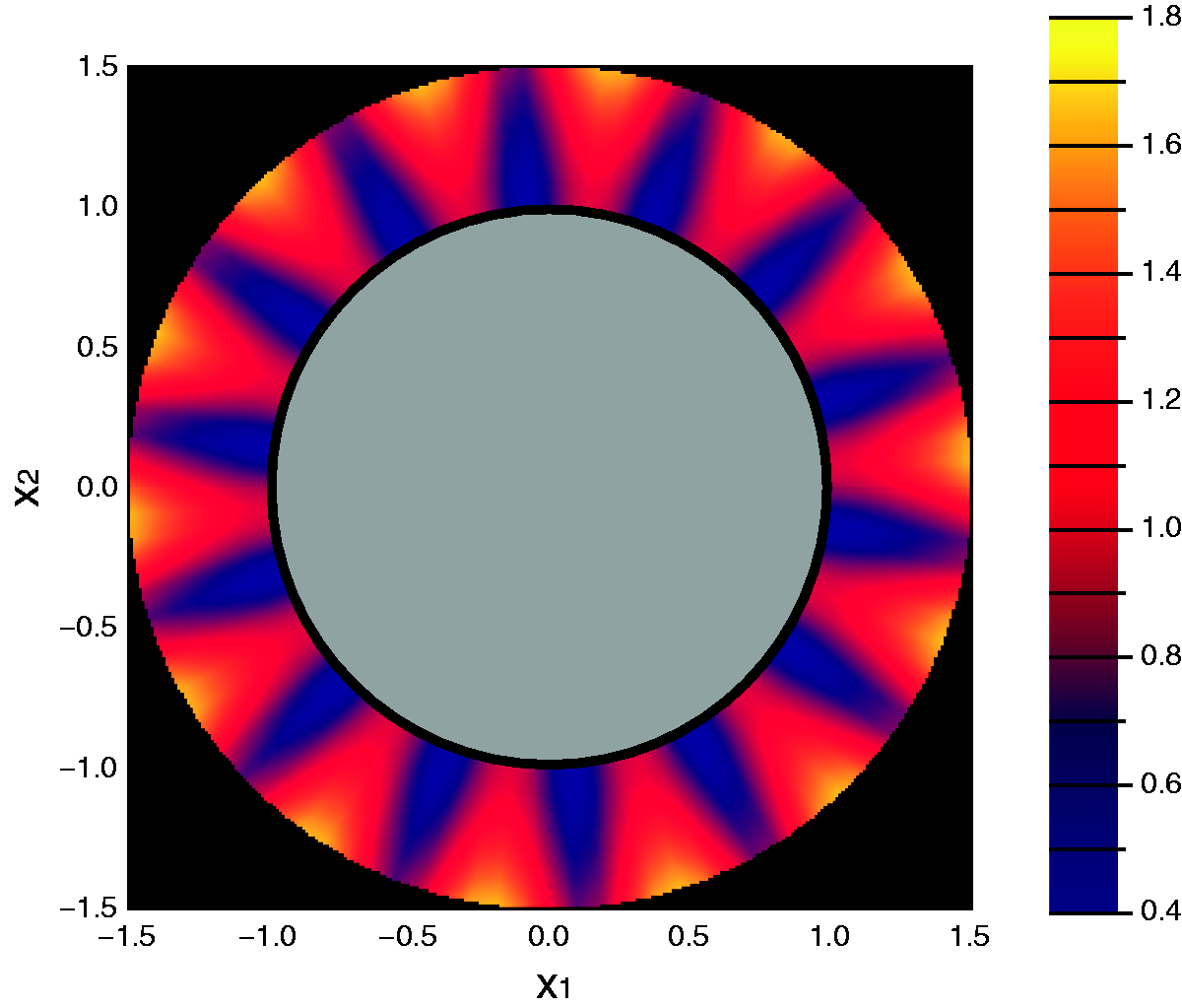
The eigenmode of exterior resonance at ω6.
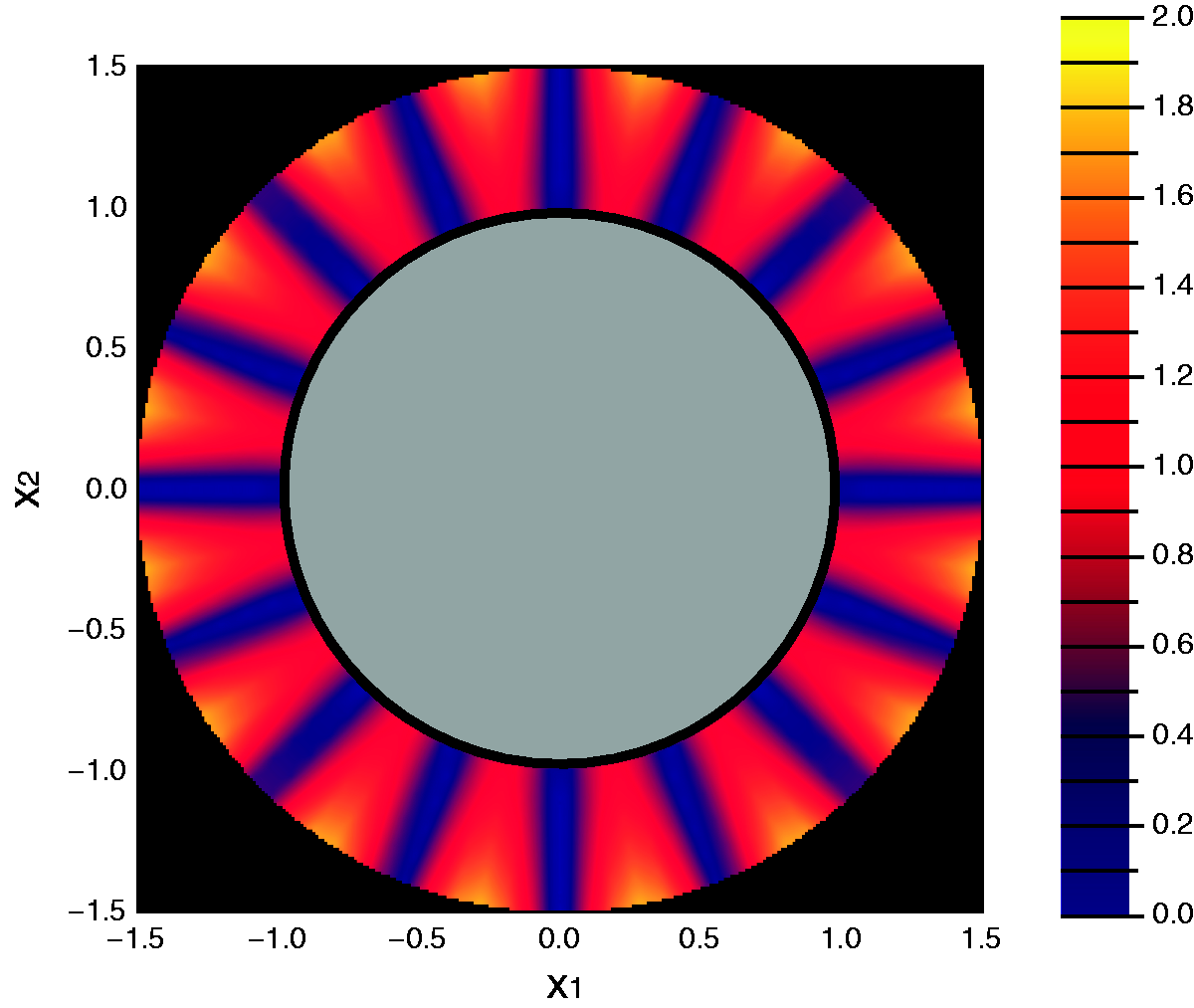
The eigenmode of exterior resonance at ω12.
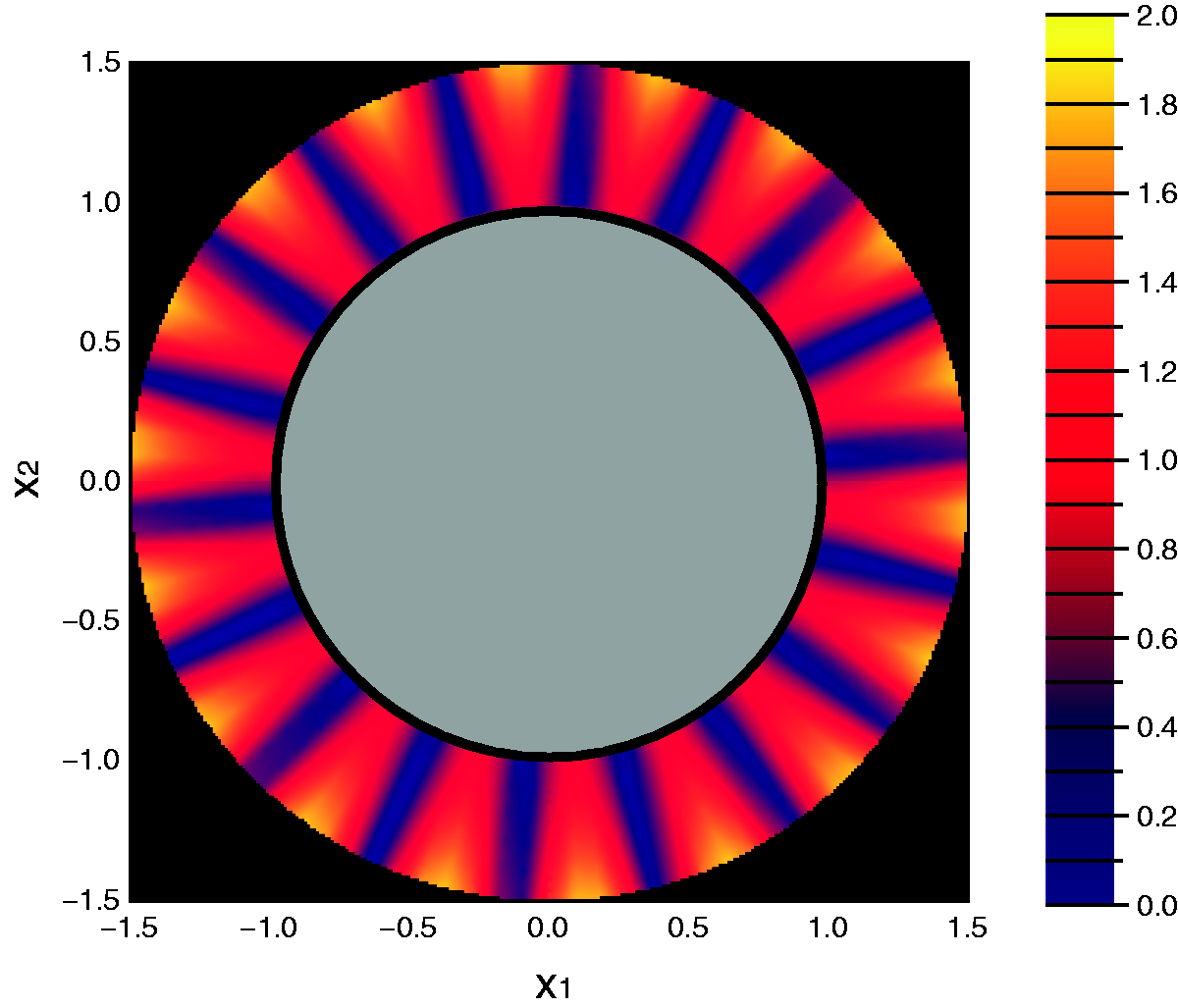
The eigenmode of exterior resonance at ω16.
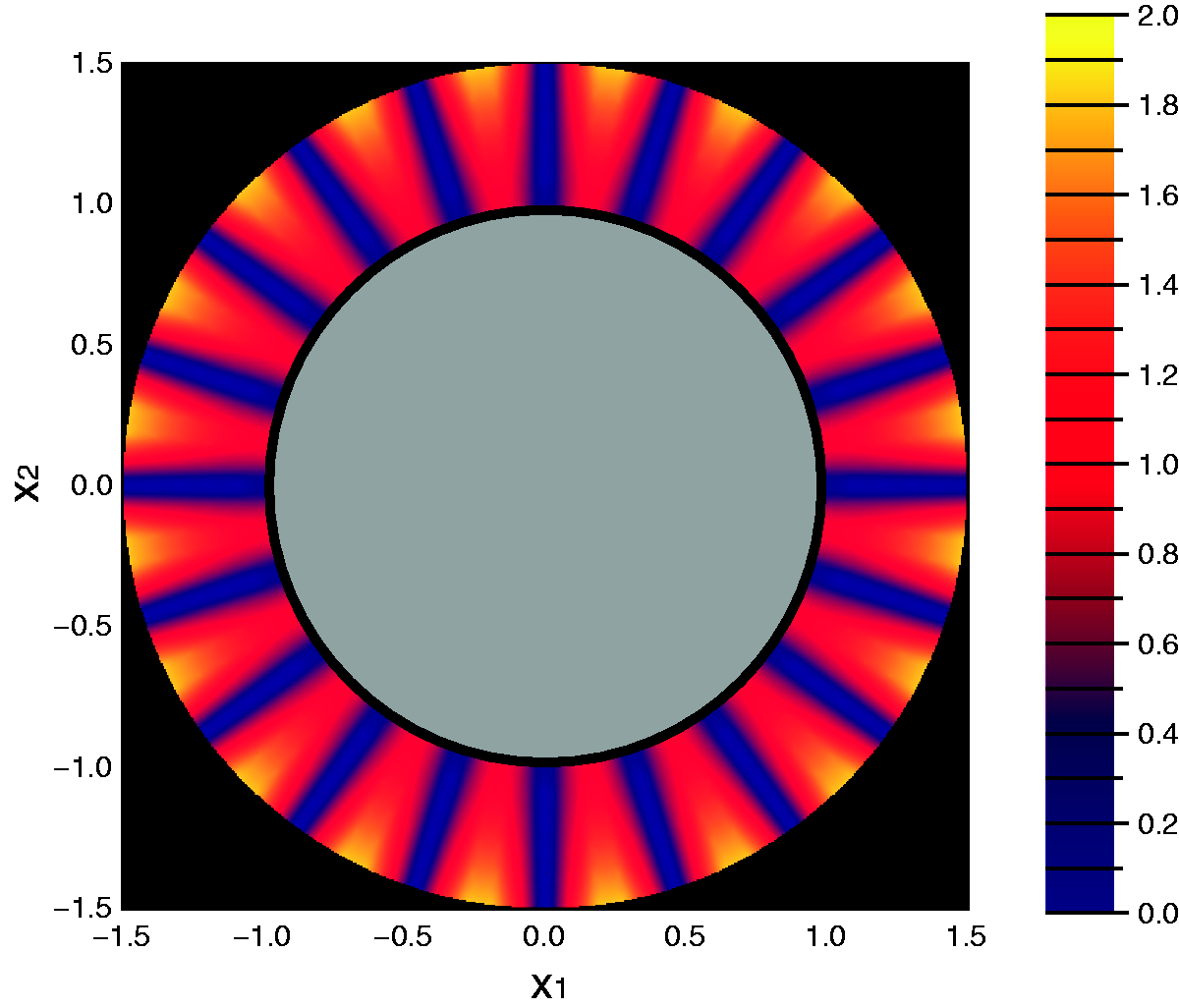
The eigenmode of exterior resonance at ω23.
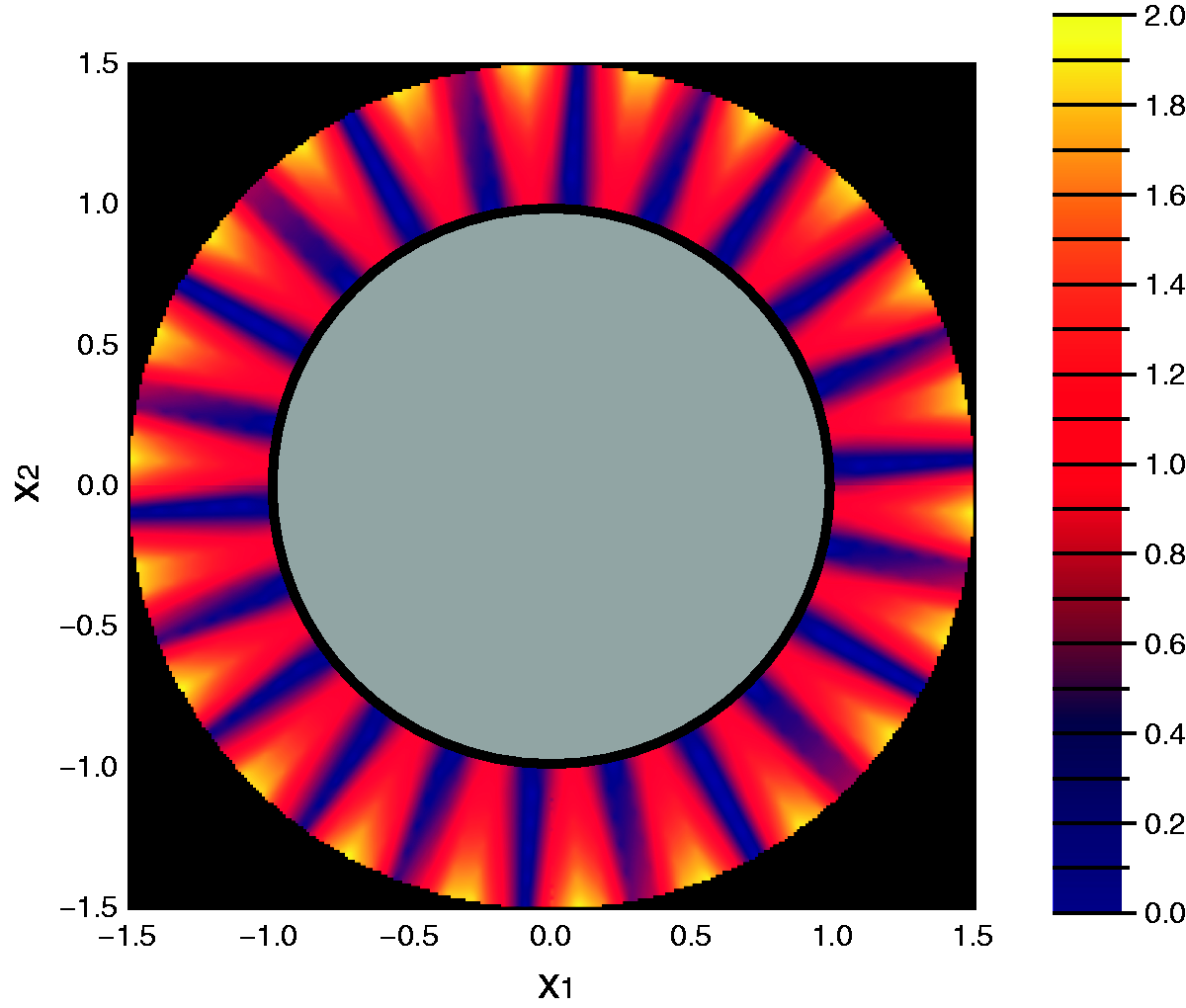
The eigenmode of exterior resonance at ω29.
The true and fictitious solutions of the eigenfrequencies by BEM and Burton–Miller’s method are presented in Figure 13, where the fictitious real eigenfrequencies are shifted by Burton–Miller’s method by adding positive components with large imaginary parts. The complex eigenfrequencies that are considered as the scattering frequencies, however, are not affected by the Burton–Miller’s method. From the study, it can be seen that the scattering frequencies can be obtained using the BEM through the BSSM. Furthermore, the filtering for fictitious eigenfrequencies usually can be carried out in two ways: shifting the fictitious real results off the real axis or adapting a complex contour integral path to filter out the real results. The scatterer is a rigid body in this example, so that all the real eigenfrequencies of the exterior problems are regarded as the fictitious solutions and not required.
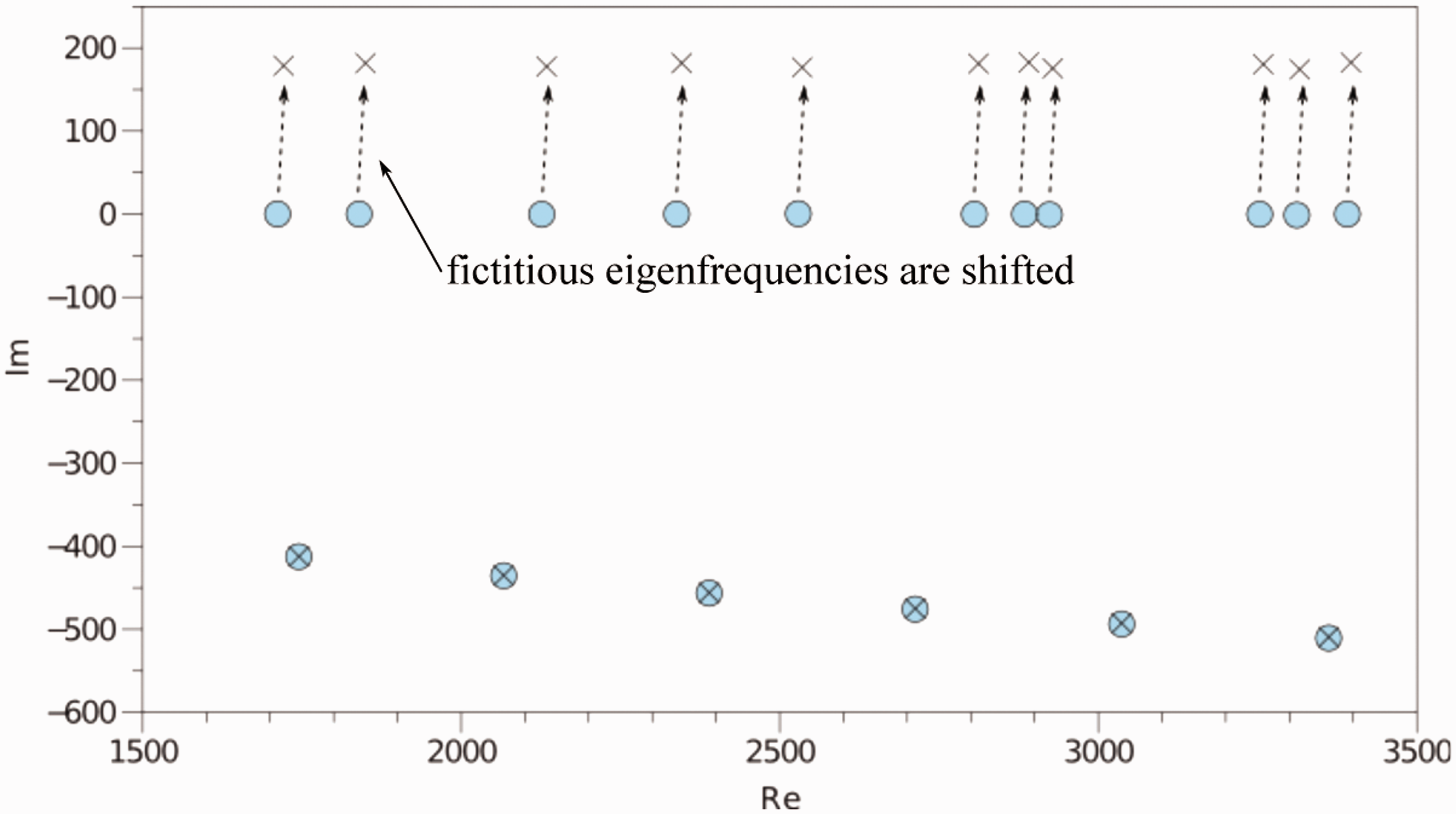
The eigenfrequencies obtained by BEM (circular symbols) and Burton–Miller’s method (cross symbols).
Square scatterer with hybrid boundary conditions
A square scatterer with hybrid boundary conditions is given in Figure 14, where the Neumann boundary conditions are specified on the left and right sides of the square scatterer and The Dirichlet boundary conditions are specified on top and bottom sides. The known quantities on the boundary are considered as p = 0 and q = 0 for modal analysis. The parameters for BSSM are chosen as ρ = 1000,
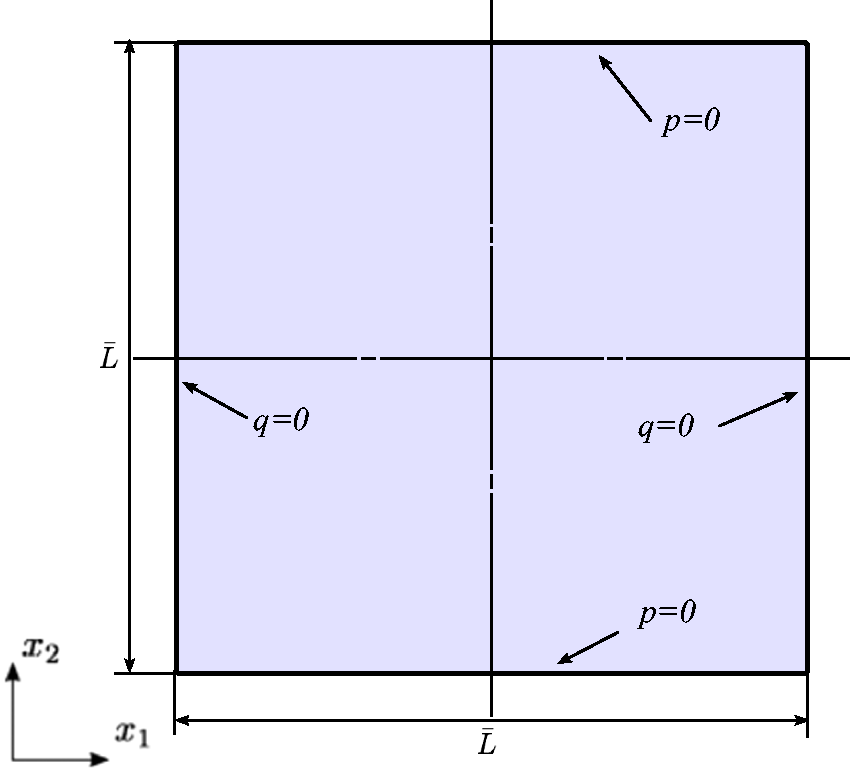
The square scatterer.
Internal points depicted in Figure 15 are utilized to illustrate the amplitude of eigenmodes of the exterior unbounded domain. It should also be noted that the domain is infinite and more internal points can be distributed. The scattering modes are shown in Figures 16 to 19. The results presented in Table 7 includes the fictitious eigenfrequencies (without *) and true solutions (with *). Comparing the results in Tables 7 and 8 in which the eigenfrequencies are obtained through Burton–Miller’s method, the fictitious eigenfrequencies shift from the real axis to the first quadrant. It can be seen that 10 eigenfrequencies are obtained in Table 7; however, the first three eigenfrequencies ω1, ω2, and ω3 are out of the circular region defined by ρ = 1000,
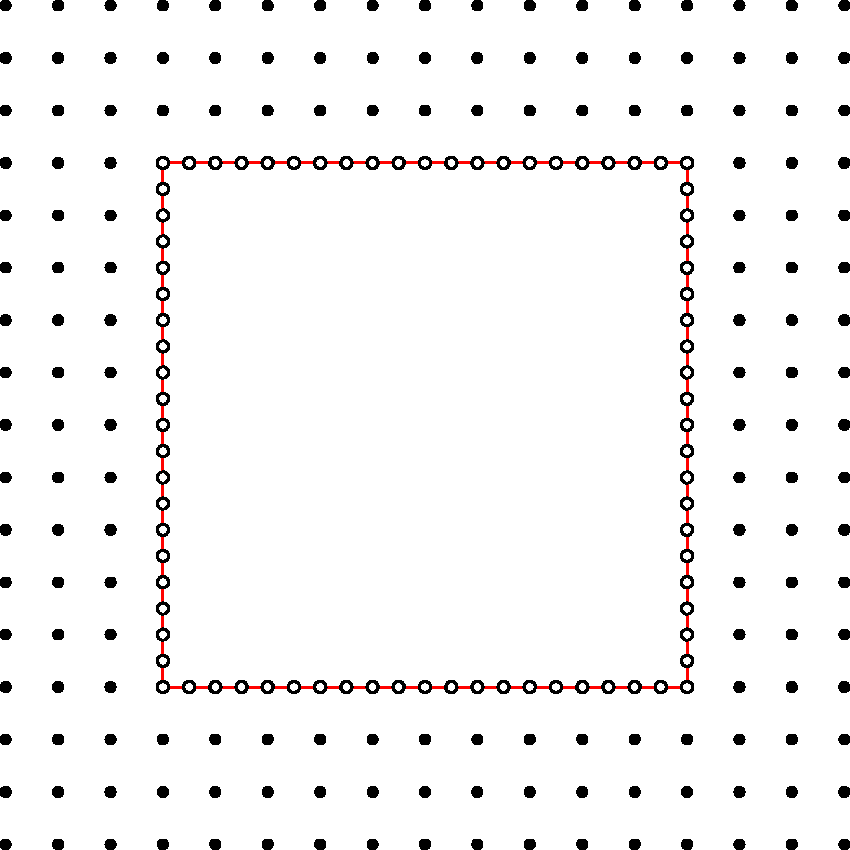
Boundary element discretization for the square scatterer.
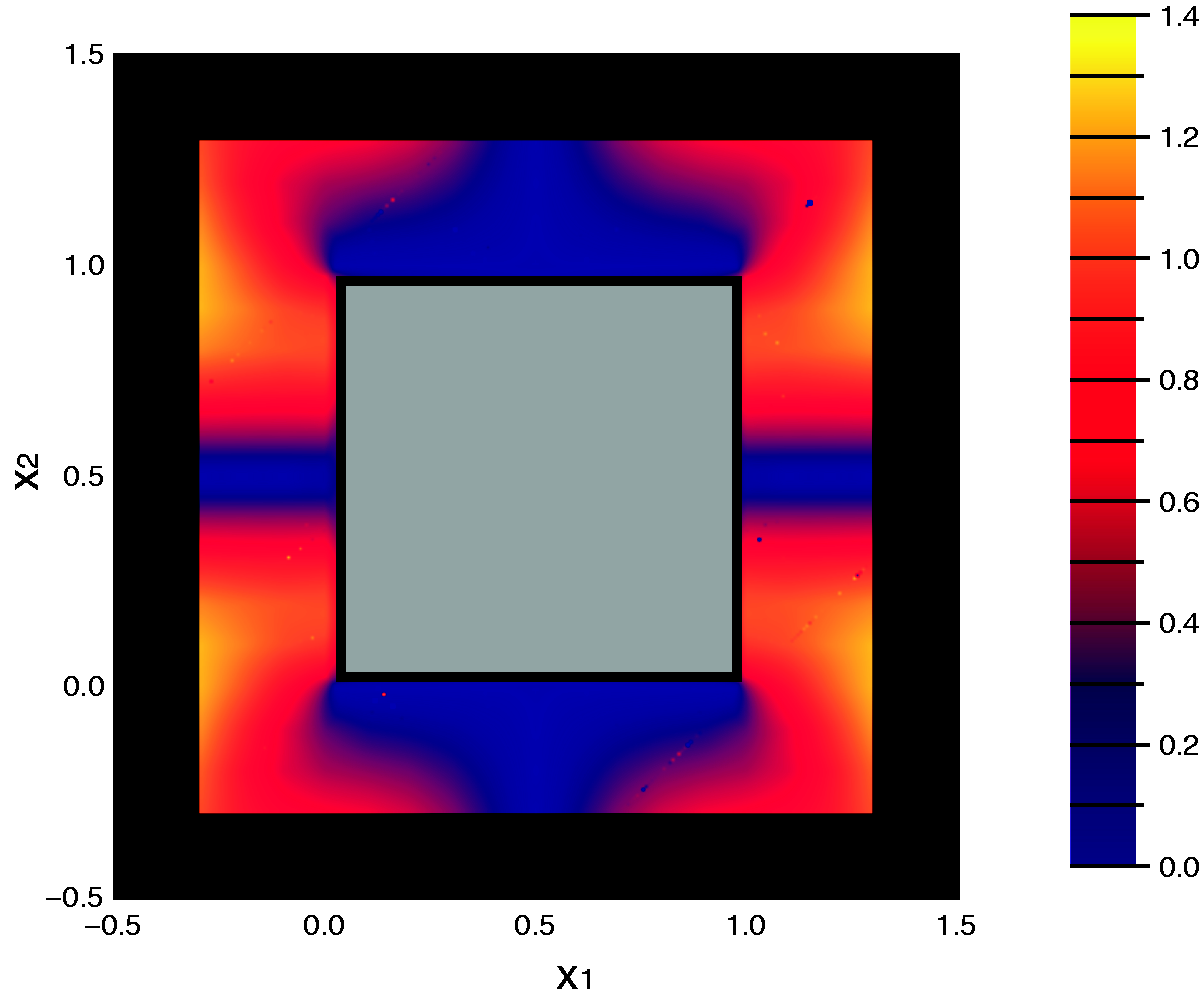
The eigenmode of exterior resonance at ω2 in Table 7.
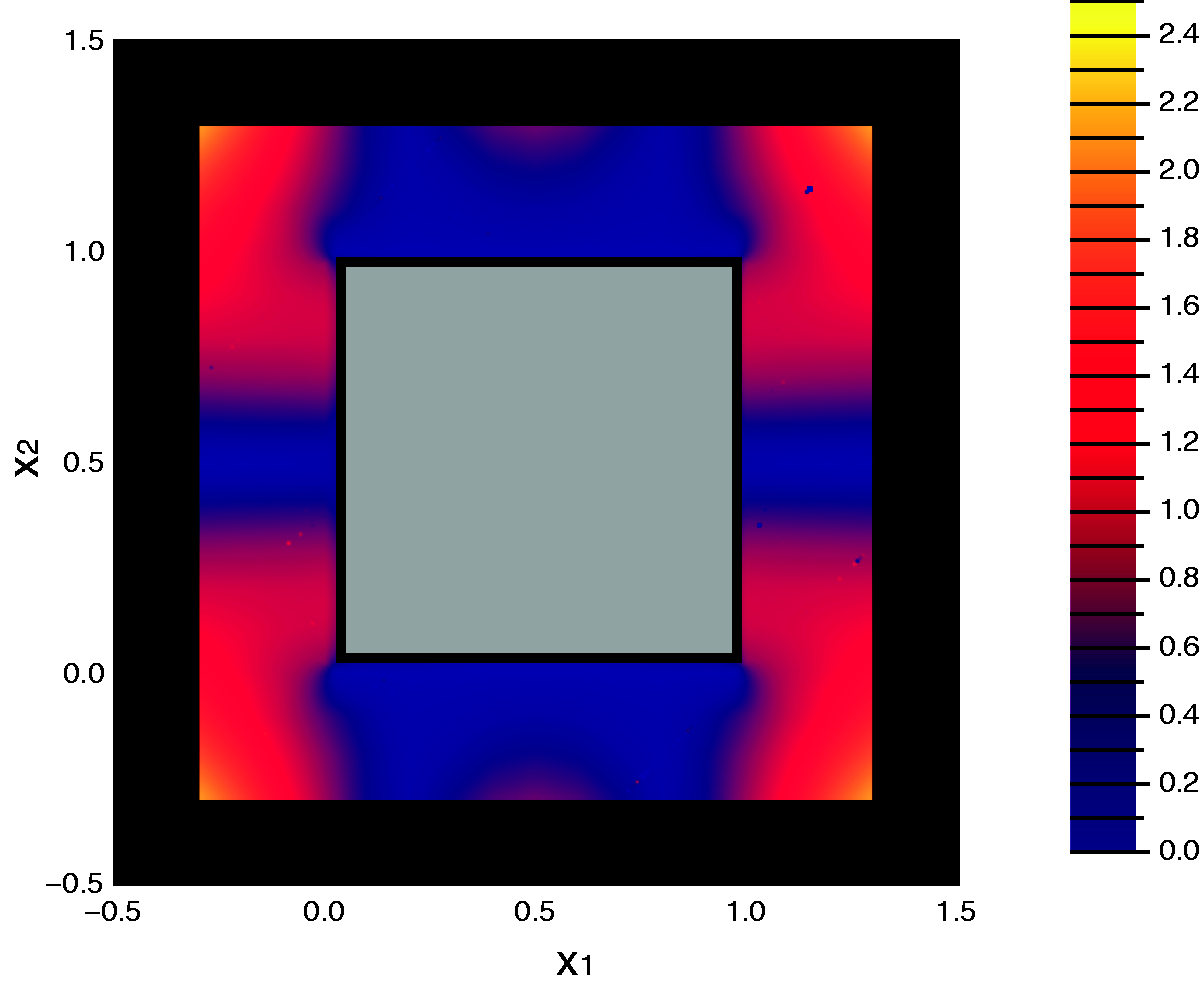
The eigenmode of exterior resonance at ω3 in Table 7.
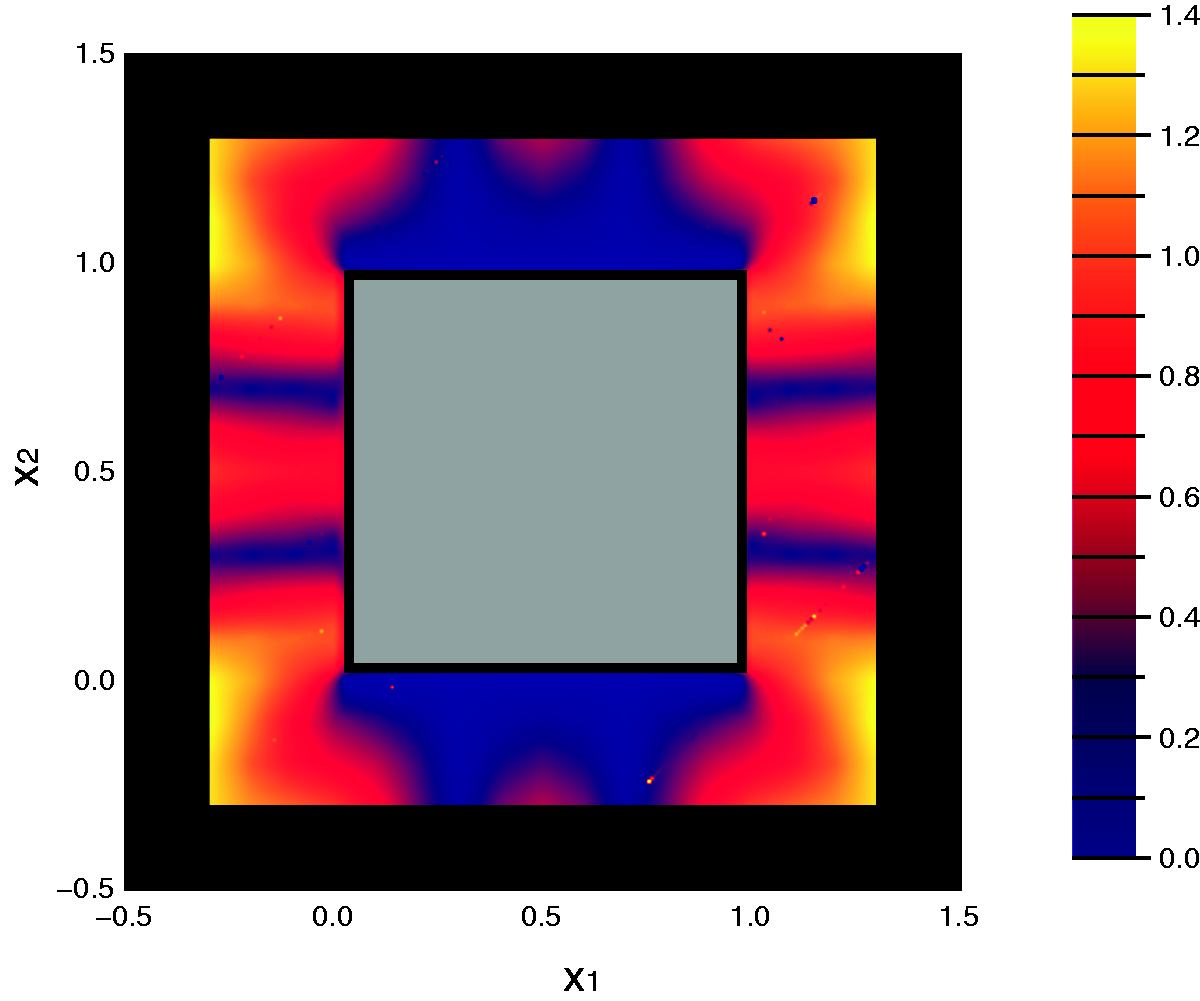
The eigenmode of exterior resonance at ω6 in Table 7.
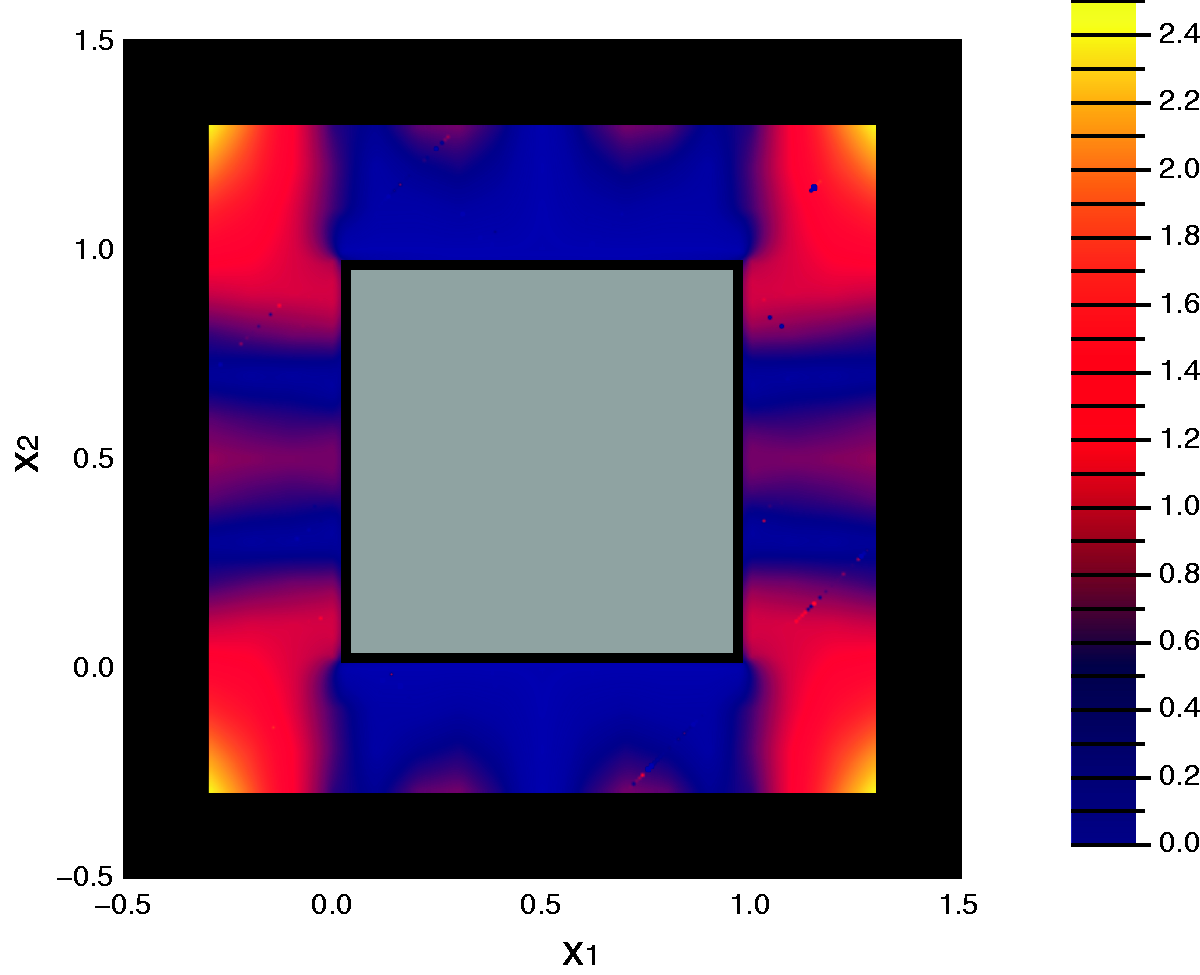
The eigenmode of exterior resonance at ω7 in Table 7.
Eigenfrequencies obtained by conventional BEM.
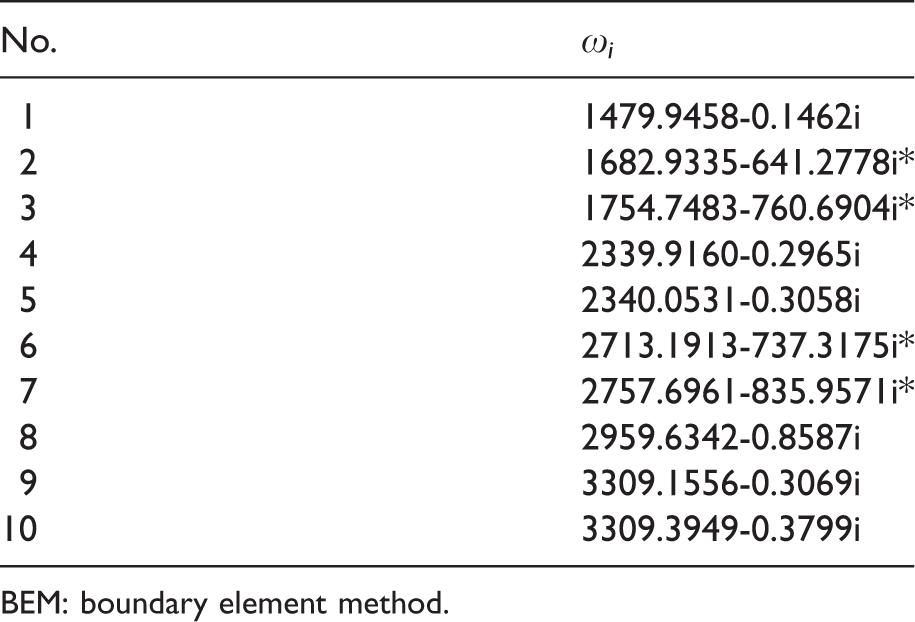
BEM: boundary element method.
Eigenfrequencies obtained by Burton–Miller’s method.
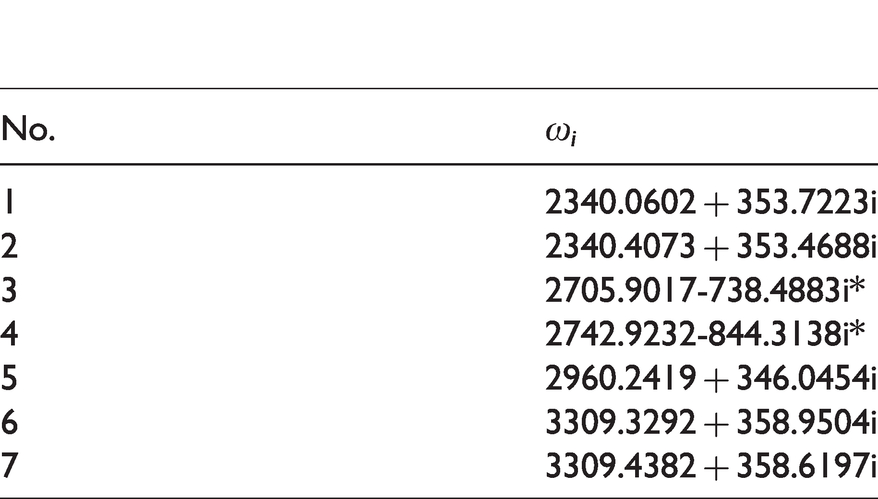
Discussion
Here, some results of scattering frequency analysis based on BEM and BSSM are presented. Since BEM is employing a fundamental solution satisfying the radiation condition and has advantages on unbounded problems, it is convenient to use BEM to simulate unbounded scattering problems. BSSM is employed to project the eigenspace to relatively reduced small eigenspace and extracts the nonlinear eigenvalues derived by BEM. The cylindrical scatter employed in the numerical models provides the scattering frequencies as the zeros of Hankel functions so that we can compare the numerical results obtained by the proposed the method with the closed-form solutions. The relative errors are less than 0.2% with 40 elements. With the effectiveness shown by the accurate results, the solving region is enlarged. Tables 2 and 4 both show the fictitious eigenfrequencies which are real values. The emergence of fictitious eigenvalues is caused by the single boundary integral equation. To identify the fictitious eigenvalues, Burton–Miller’s method is employed, and Table 5 shows that the fictitious eigenvalues are added by positive imaginary parts and move to the first quadrant. To apply this method to scattering frequency problems, users can directly adopt the combined boundary integral equations of Burton–Miller’s method and filter out the fictitious eigenfrequencies by judging their imaginary parts. The real eigenfrequencies, in scattering problems, are all fictitious ones; however, their imaginary parts are not zero due to the numerical errors but they are still very small. Usually, the scattering frequencies of simple shapes are complex values and can be distinguished just by checking the large imaginary parts (comparing with the small nonzero imaginary parts of fictitious eigenfrequencies). However, the imaginary parts of scattering frequencies tend to be zero as the boundary of the scatterer encloses a cavity with small opens (musical instruments such as flutes, holed wind instruments, etc., sometimes result in such cases). Therefore, Burton–Miller’s method is required to identify the true solutions if the true eigenfrequencies have small imaginary parts approximating to zero.
The eigenfrequencies locating near or on the Jordan curve lead to an unstable detection of the reduced eigenspace. From Table 7, it can be seen that the first three eigenfrequencies are out of the Jordan curve but still obtained. However, the first eigenfrequencies
Conclusion
This work for this paper is carried out with the objective of providing a numerical tool for the computation of scattering frequencies for 2D acoustic problems. The scattering frequencies which are complex numbers are given by unbounded domains. The BEM shows a simple modeling procedure for unbounded problems and the accuracy of the numerical solution is relatively high with a small number of elements. Furthermore, the real eigenvalues which are considered as fictitious solutions for unbounded domains are investigated using Burton–Miller’s method. Similar to the bounded interior problems, the fictitious eigenvalues move away from the real axis and the desired scattering frequencies are kept unchanged. The examples show that the numerical approach can carry out the modal analysis for unbounded problems. The investigator believes that the solutions produced in this work are of very high accuracy and there is no missing link in mode sequences in the results.
Footnotes
Declaration of conflicting interests
The author(s) declared no potential conflicts of interest with respect to the research, authorship, and/or publication of this article.
Funding
The author(s) disclosed receipt of the following financial support for the research, authorship, and/or publication of this article: The authors are grateful to the support from the Applied Basic Research Programs of Shanxi Province of China (nos. 201801D221022 and 201801D121021), the Zhejiang Provincial Natural Science Foundation of China (no. LQ14A020004), Wenzhou public welfare science and technology project (no. KZ1603012), the National Natural Science Foundation of China (no. 11872168) and the project sponsored by SRF for ROCS, SEM.