




Abstract
An improved two-step method for multiple cracks detection in beam structures is presented in this paper. First, the crack locations are identified by the mode shape curvatures. Second, samples of varying crack depths at the crack locations and corresponding natural frequencies are used to construct the initial Kriging model in place of the crack detection database. Finally, a particle swarm optimization algorithm is employed to detect the crack depths and update the Kriging model by an optimal point adding process. The numerical simulation and experimental verification of a cantilever beam with two cracks demonstrate that the proposed method is effective. The detection results indicate that the Kriging model can effectively reduce computation time with a similar accuracy. The detection results also indicate that the more natural frequencies used, the higher accuracy of crack depths detected.
Keywords
Introduction
Beam structures appear in a wide range of structural systems such as civil, mechanical, and aeronautical engineering. The crack in structures can lead to significant loss of strength, and, even worse, resulting in catastrophic failure of structures. Therefore, how to monitor and evaluate crack should be considered seriously in both theoretical and experimental research.
A significant number of researches for health monitoring and crack detection have been proposed during recent years.1–3 Some researchers focused on the characteristics of structures with initial crack, including fatigue crack propagation, residual strength, and residual life. Several kinds of nonprobabilistic interval conceptions are introduced by Qiu and Wang. 4 Wang et al. 5 established a new model of nonprobabilistic time-dependent reliability, which integrates interval process theory with the first-passage approach, to achieve the life-cycle safety estimation for cracked structures. A novel method of the time-dependent reliability, which combines the perturbation series expansions with the interval mathematics, was presented for life prediction of fatigue crack growth problems. 6 For crack detection problems, because modal shapes and natural frequencies can be obtained accurately and easily in practice, many researchers employed modal shapes and natural frequencies to identify crack locations and depths.7–10
Generally, the methods using modal shape and natural frequencies for crack detection involve forward and inverse problem analysis. 11 The purpose of forward problem analysis is to develop a numerical simulation model and construct a crack detection database. In the inverse problem analysis, the modal shape calculated via simulation model is used to detect the crack locations, and the measured natural frequencies are used as the inputs to an optimization algorithm to determine the crack depths from the crack detection database. However, the computational cost may be unacceptable because of the repeated analysis of computationally expensive finite element models during the process of constructing the crack detection database. So it is desirable to construct a simple relationship between crack depths and natural frequencies to replace the crack detection database. The surrogate model may be a good alternative to construct the relationship between crack depths and natural frequencies.
Recently, surrogate models were investigated by many researchers. Cho 12 performed an investigation using response surface method to predict the accumulated cracks in concrete structures. And it was shown that the response surface method could be employed to predict the probability of failure for such cracks. Fang and Perera 13 proposed a response surface methodology based on model updating using D-optimal design for damage identification. Gao et al. 14 proposed an effective method based on a Kriging model for crack detection in a plate. The result shows that this method can effectively be used for identifying the crack parameters. Yang et al. 15 presented a new surrogate model based on model updating method using frequency response function for damage identification. The proposed method has good accuracy and robustness, which has been verified by a numerical simulation of a cantilever and experimental test data of a laboratory three-story structure. Ghadami et al. 16 presented an adaptive multiple cracks detection algorithm in beam-like structures. The main advantage of this method is that it can detect adaptively the unknown number of cracks.
Compared with other surrogate models, Kriging model has a higher accuracy, and it can provide both predictive location and prediction error, which is very suitable for global optimization algorithm. 17 Gao et al. 18 presented an idea for the application of Kriging model in crack detection and has a great interest of attentions but still the study of multiple cracks detection in beams with Kriging model is limited.
In this paper, we present an improved two-step method for detecting multiple cracks in beam structures. In the first step, the mode shape curvature is employed to detect the crack locations. The crack depths at the identified locations are then detected in the second step by using particle swarm optimization (PSO) algorithm. In the second step, the meshless local Petrov–Galerkin (MLPG) model is first constructed to simulate the multicracked beam. Then, the initial Kriging model, expressing the relationships between natural frequencies and crack depths, is constructed by samples of various crack depths and corresponding natural frequencies. The initial samples are generated by Latin hypercube sampling (LHS), and corresponding natural frequencies are calculated via MLPG model. The PSO algorithm is used to determine the crack depths by minimizing the objective function related to the measured natural frequencies. After that, the current optimal solution will be used in MLPG analysis and inserted into the initial sample set to update the initial Kriging model, until the surrogate model meets the accuracy requirements. Finally, numerical simulation and experimental investigation demonstrate the effectiveness and efficiency of the presented method.
Theory and formulation
In this section, the theory and formulation of Kriging model is presented in the “Construction of Kriging model” subsection. The initial samples of Kriging model are produced by LHS. “Construction of cracked beam” subsection describes how to construct the model of cracked beam. The model is used to calculate modal shape and corresponding natural frequencies of the cracked beam.
Construction of Kriging model
The Kriging model is an unbiased estimation model with a minimum estimation variance. Its basic concept was proposed by Krige and further deduced by Matheron.
19
The regression equation of Kriging model can be expressed as



For the regression problem

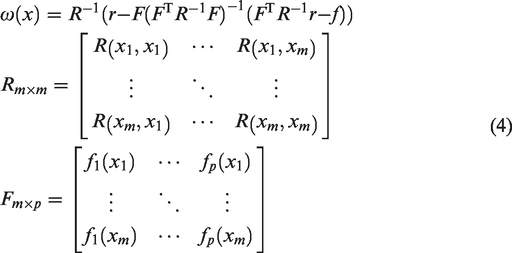
By substituting equations (4) and (5) into equation (3), the predictor can be expressed as

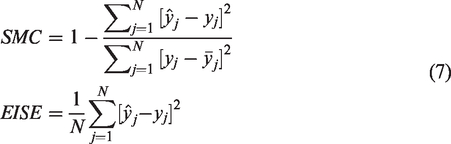
When the initial Kriging model is constructed, its accuracy can be assessed by using the squared multiple correlations (SMCs) and the empirical integrated squared error (EISE) criteria20,21 as follows
Construction of cracked beam
The model of multicracked cantilever beam is shown in Figure 1. lx is the length of cantilever beam, and h is the height of beam. The normalized parameters α = ti/h, β = xi/lx are used to describe the crack locations and crack depths, respectively. Hence, the values of crack locations and depths are limited from 0 to 1. The free vibration equation of a beam with uniform cross-section can be defined by
22


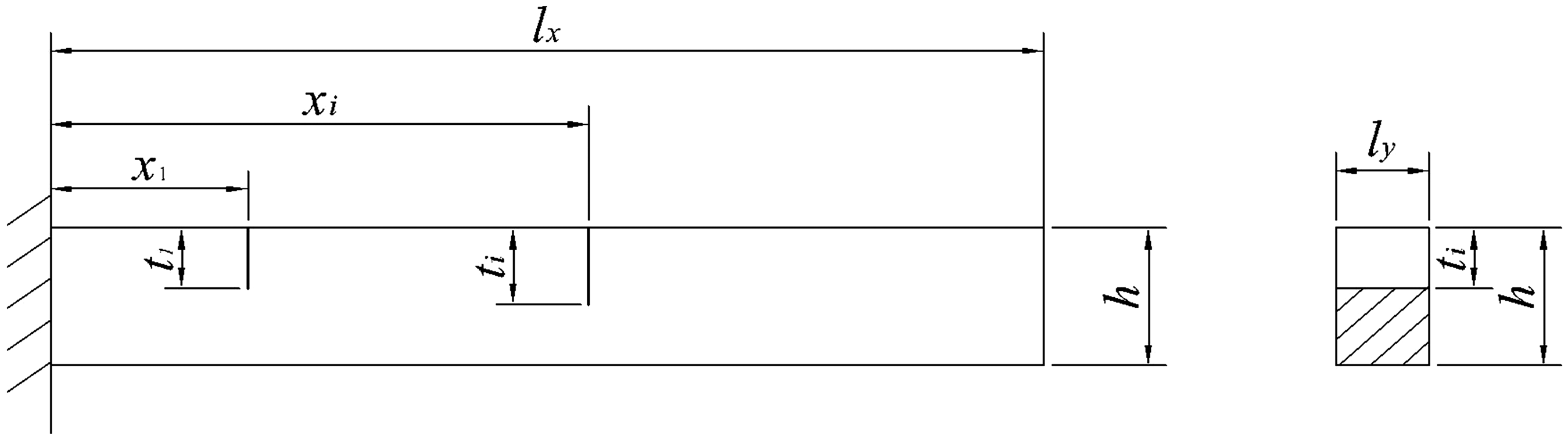
Multicracks cantilever beam model.
Substituting equation (9) back into equation (8), equation (8) can be simplified as

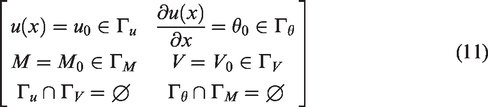
For the cracked beam, the continuity conditions at the crack location

And the discontinuity condition is
23



To apply local weighted-residual equation,
25
equation (10) can be rewritten as

Choosing a reasonable weight function, equation (16) can be rewritten as

The moment M and shear force V related to the displacement u are

Substituting equation (18) into equation (17), we have

When a crack occurs in

The MLS approximation uh(x) of dependent variable u (x) over the global domain






For an arbitrary number of cracks, equation (24) can be rewritten as


Substituting equation (28) into equation (22), we have

Crack detection method
As mentioned above, the crack locations and depths are detected separately in the improved two-step method. The flow chart of the proposed crack detection method is shown in Figure 2. First, the mode shape curvature is employed to detect the crack locations. Second, the initial Kriging model is constructed by samples of various crack depths and corresponding natural frequencies. Then an optimal point adding process for the Kriging model updating is carried out to improve the accuracy of Kriging model. Finally, the measured natural frequencies are employed as inputs to PSO algorithm to determine the crack depths. The details associated with the two steps are given in the “Crack locations detection” and “Crack depths evaluation” subsections.
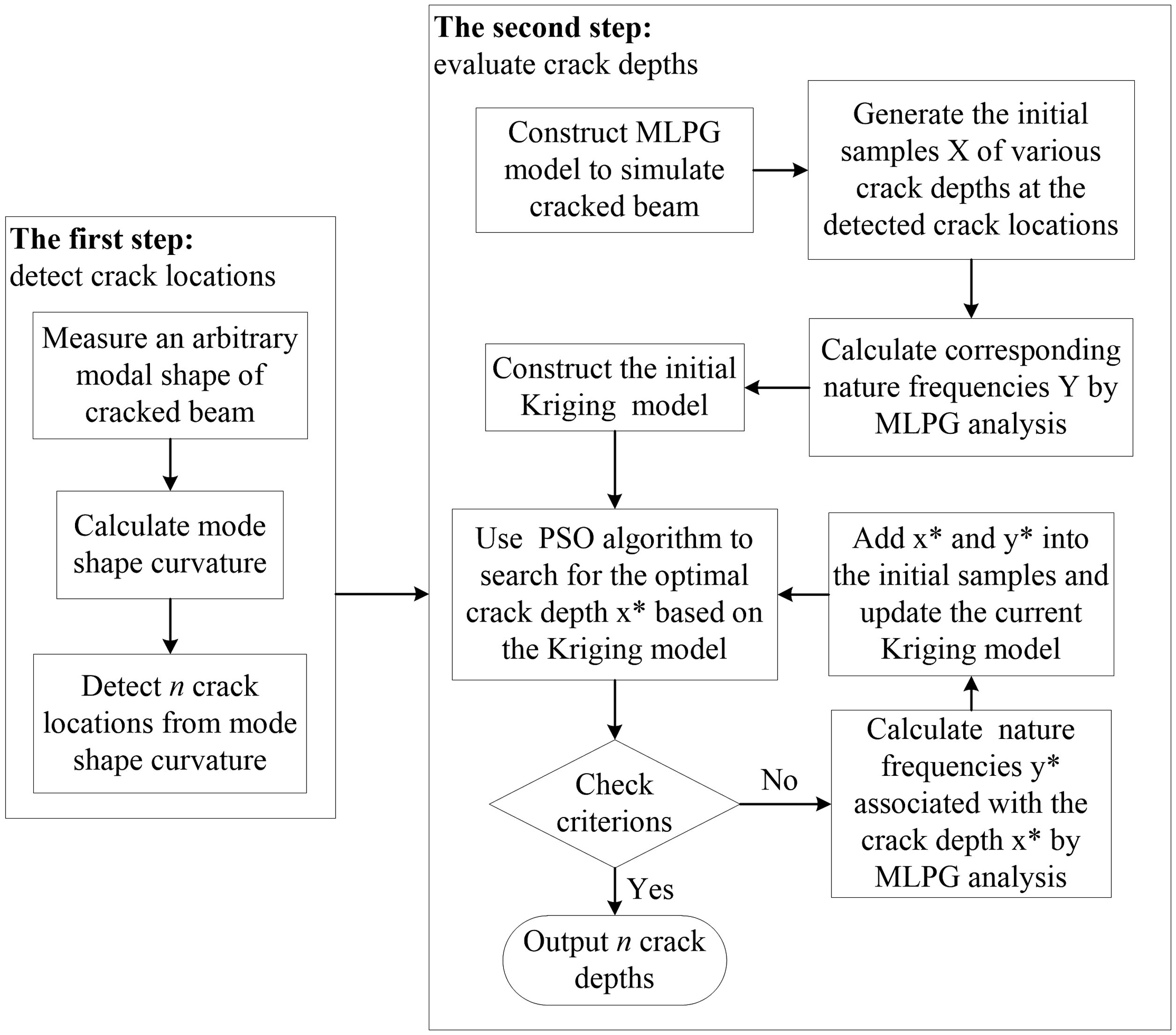
The flow chart of improved two-step method. MLPG: meshless local Petrov–Galerkin; PSO: particle swarm optimization.
Crack locations detection
Obtain an arbitrary modal shape of the cracked beam
In the simulation, the mth modal shape of cracked beam is calculated via the MLPG method. It should be pointed that the finite element model can also be used to obtain the modal shape.
2. Calculate the mode shape curvature
If the mth modal shape Ym is measured, each point Vm,j of mth mode shape curvature Vm can be calculated from the mth modal shape using a central difference approximation as follows
26
3. Detect n crack locations from mode shape curvature

The crack locations can be detected by the peaks or sudden changes in the mode shape curvature of cracked beam.
Crack depths evaluation
Construct MLPG model to simulate cracked beam
The MLPG model can be constructed following the procedure proposed in the “Construction of cracked beam” subsection. The correction stiffness matrix in the associated crack locations is used to simulate the cracked beam, whereas the global mass matrix remains unchanged.
2. Construct the initial Kriging model
As mentioned above, the Kriging model, expressing the relationships between natural frequencies and crack depths, is constructed by samples of various crack depths and corresponding natural frequencies. The initial samples are generated by LHS, and corresponding natural frequencies are calculated via MLPG model.
3. Update the Kriging model by an optimal point adding process
The optimal points are used to update the current Kriging model until the Kriging model meets the accuracy requirements. The SMC and EISE criteria are used to decide whether the model should be updated.
4. Evaluate crack depths using PSO algorithm based on the Kriging model
The crack depths detection is essentially an optimization problem. The PSO algorithm is employed to detect the crack depths of the n cracks, and the first q measured natural frequencies are used as inputs. We use the following objective function to search for the optimal crack depth based on Kriging model
27

To make a clear description on how to evaluate crack depths, we summarized as follows:
Step 1: Generate the initial sampling matrix X (crack depths) by LHS, and calculate corresponding natural frequencies Y by MLPG analysis.
Step 2: The initial Kriging model is constructed with samples X and output Y obtained in step 1.
Step 3: Apply the PSO algorithm to search the optimal crack depth by minimizing discrepancies between the measured natural frequencies
Step 4: Check criteria (
Step 5: Add x* and y* into the X and Y generated in Step 1, respectively. Then update the current Kriging model.
Step 6: Go to step 3 and repeat the process till the criteria are satisfied, and output n crack depths.
Numerical simulation
In order to verify the efficiency of the presented method, a numerical study of a cantilever beam with two cracks is carried out. The parameters of the beam are length lx = 0.5 m, width ly = 0.012 m, height h = 0.02 m, Young’s modulus E = 210 GPa, Poisson’s ratio μ = 0.3, material density ρ = 7860 kg/m3. The normalized parameters α = ti/h, β = xi/lx are used to describe the crack locations and the crack depths. Crack case is considered as β1 = 0.2, β2 = 0.4, and α1 = α2 = 0.1.
The second modal shape shown in Figure 3(a) is available on a 101 × 1 sample grid, which is dense enough to detect crack locations. The second mode shape curvature calculated by equation (30) is shown in Figure 3(b). The two peaks indicate the detected crack locations, i.e. β1* = 0.198, β2* = 0.396, and the detected results are round to the actual locations of cracks. Therefore, the crack locations can be detected by the mode shape curvature.
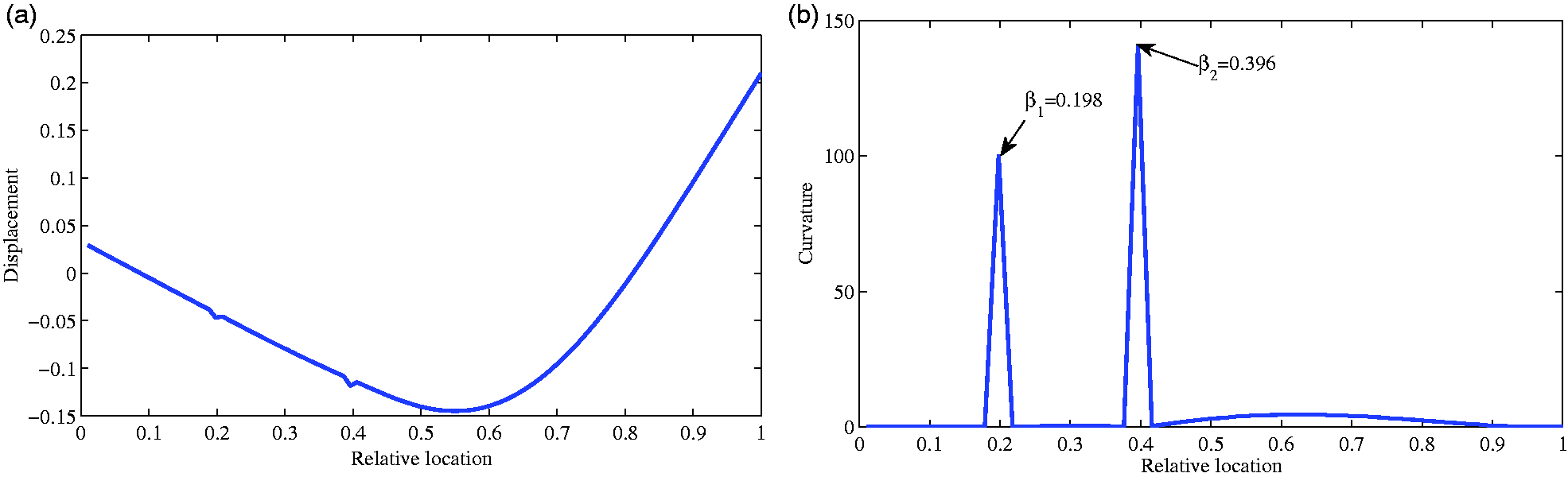
Crack location detection using the second modal shape and the second mode shape curvature. (a) The second modal shape and (b) the second mode shape curvature.
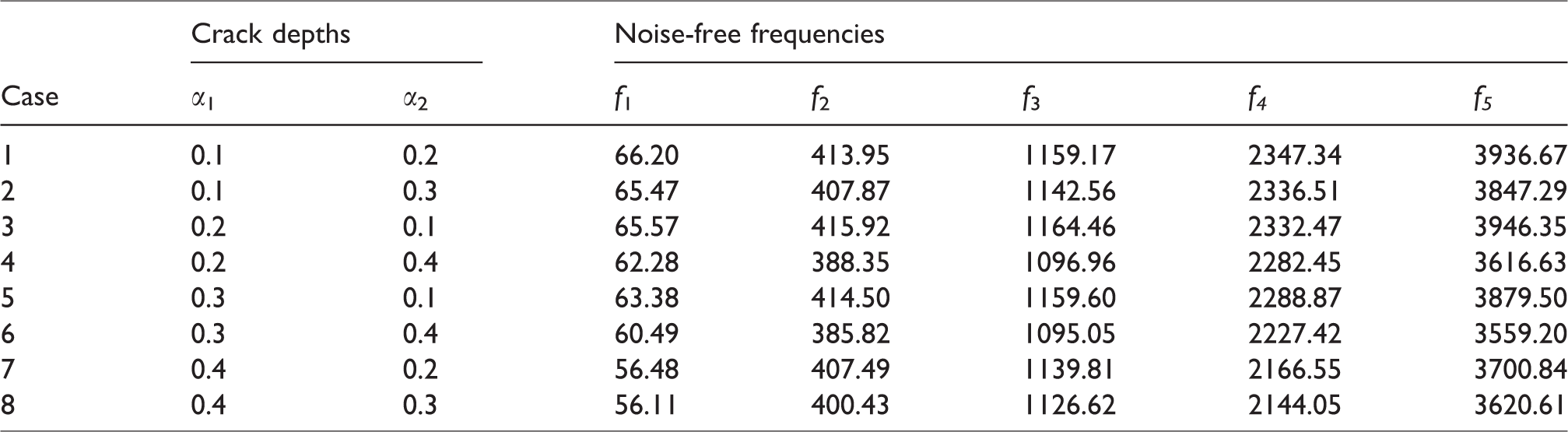
Eight cases with different depth combinations (α1, α2) for the beam with two cracks are shown in Table 1. The first five noise-free frequencies associated with the eight cases calculated by MLPG method are also shown in Table 1.
The first five noise-free frequencies for crack cases.
To simulate the random noise, a random number generator, rand in MATLAB, is used to simulate ±e% noise, i.e.

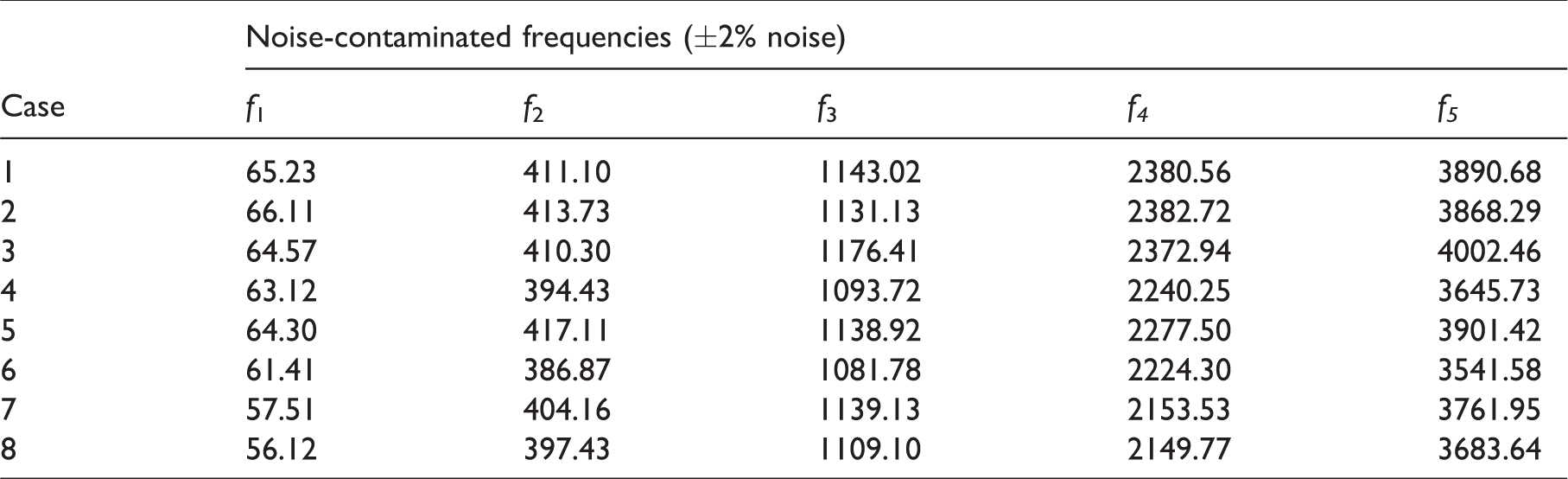
Suppose ±2% (e = 2) random noise is added to the noise-free frequencies according to equation (32), the first five noise-contaminated frequencies are shown in Table 2.
The first five noise-contaminated frequencies for crack cases.
In order to verify the efficiency of Kriging model for crack depths detection, we use 20 samples and corresponding first five noise-contaminated natural frequencies to construct the initial Kriging model. The optimization is implemented with MATLAB using a PSO Toolbox coded by Birge. 28 According to the advice of Birge, the population size is set to 25, and the learning factors c1 and c2 are set to 2. The evaluation results by using Kriging model are shown in Table 3. For the sake of comparison, the crack depths detection by using crack detection database is also applied. To obtain a more accurate crack detection database, α1 and α2 are varied from 0.1 to 0.9 with step length of 0.01. Therefore, there are 6561 (=81 × 81) data points in the crack detection database. The evaluation results by using crack detection database are also shown in Table 3. As shown in the table, we can see clearly that the Kriging model can significantly reduce computation time with a similar accuracy.
The crack depths evaluation results using first five noise-contaminated frequencies.
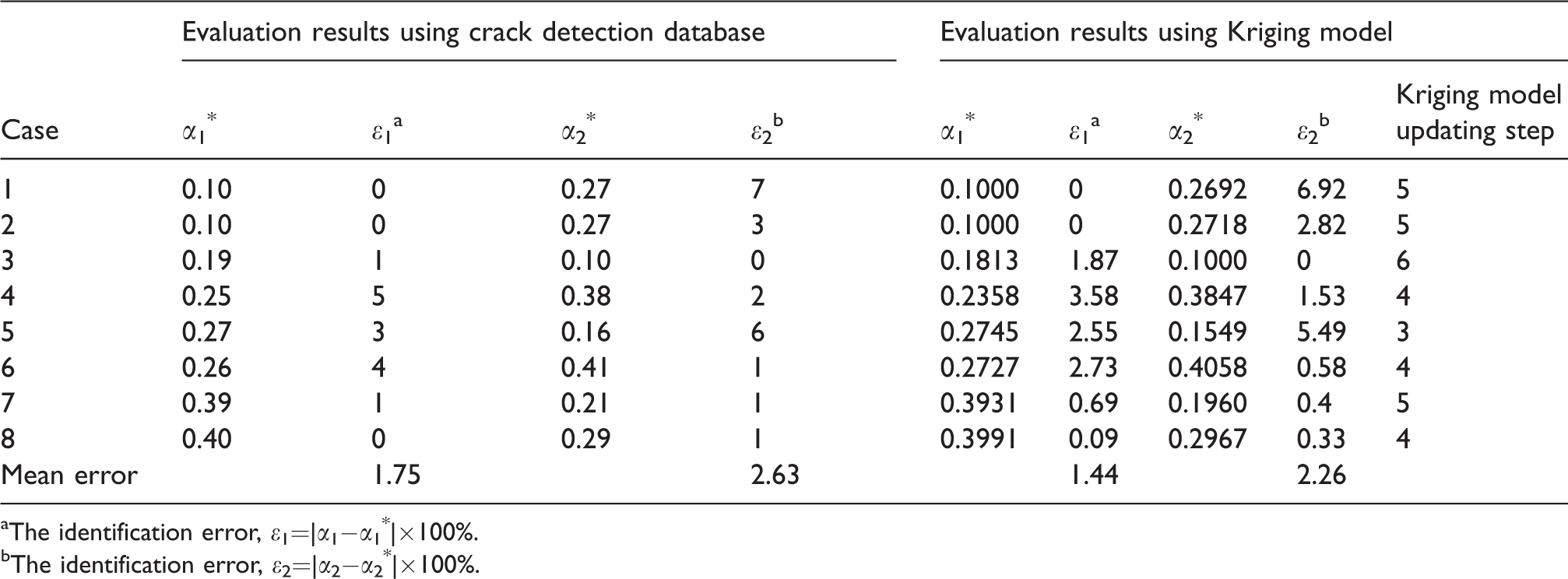
aThe identification error, ε1=|α1−α1*|×100%.
bThe identification error, ε2=|α2−α2*|×100%.
To examine the effect of the number of natural frequencies on the detection accuracy, we use 20 samples and corresponding first three natural frequencies to construct the initial Kriging model. The evaluation results of crack depths are shown in Table 4. Compared with Table 3, the detection results using first five natural frequencies (the mean errors of crack depths are 1.44 and 2.26%, respectively) are better than the results using first three natural frequencies (the mean errors of crack depths are 4.10 and 3.96%, respectively). Therefore, it is preferred to use as many natural frequencies as possible to improve the detection accuracy of crack depths.
The crack depths evaluation results using first three noise-contaminated frequencies.
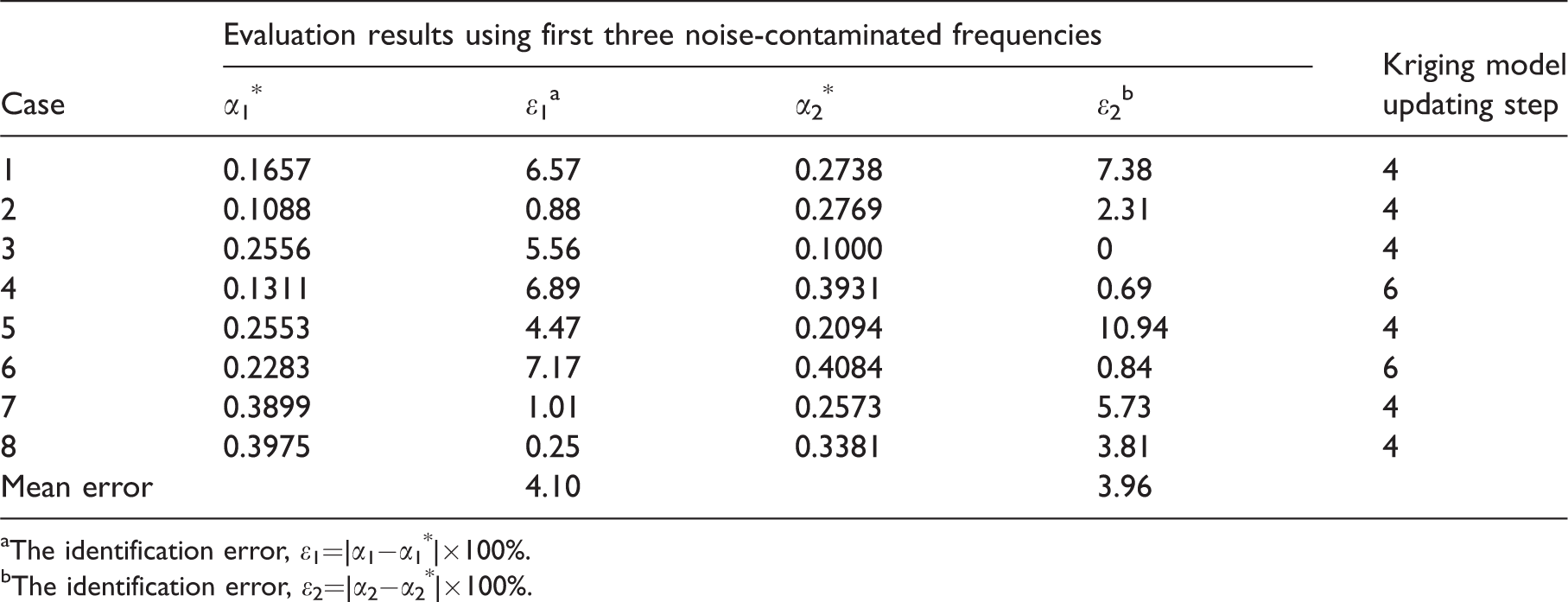
aThe identification error, ε1=|α1−α1*|×100%.
bThe identification error, ε2=|α2−α2*|×100%.
The above results demonstrate that the Kriging model is effective in evaluating crack depths when the data contain certain level of noise.
Experimental verification
In this section, experiments of cantilever beam with two cracks are constructed to verify the validity of the proposed method. The experimental setup is shown in Figure 4. The parameters of the beam are length lx = 0.5 m, width ly = 0.012 m, height h = 0.02 m, Young’s modulus E = 206 GPa, Poisson’s ratio μ = 0.3, material density ρ = 7860 kg/m3.
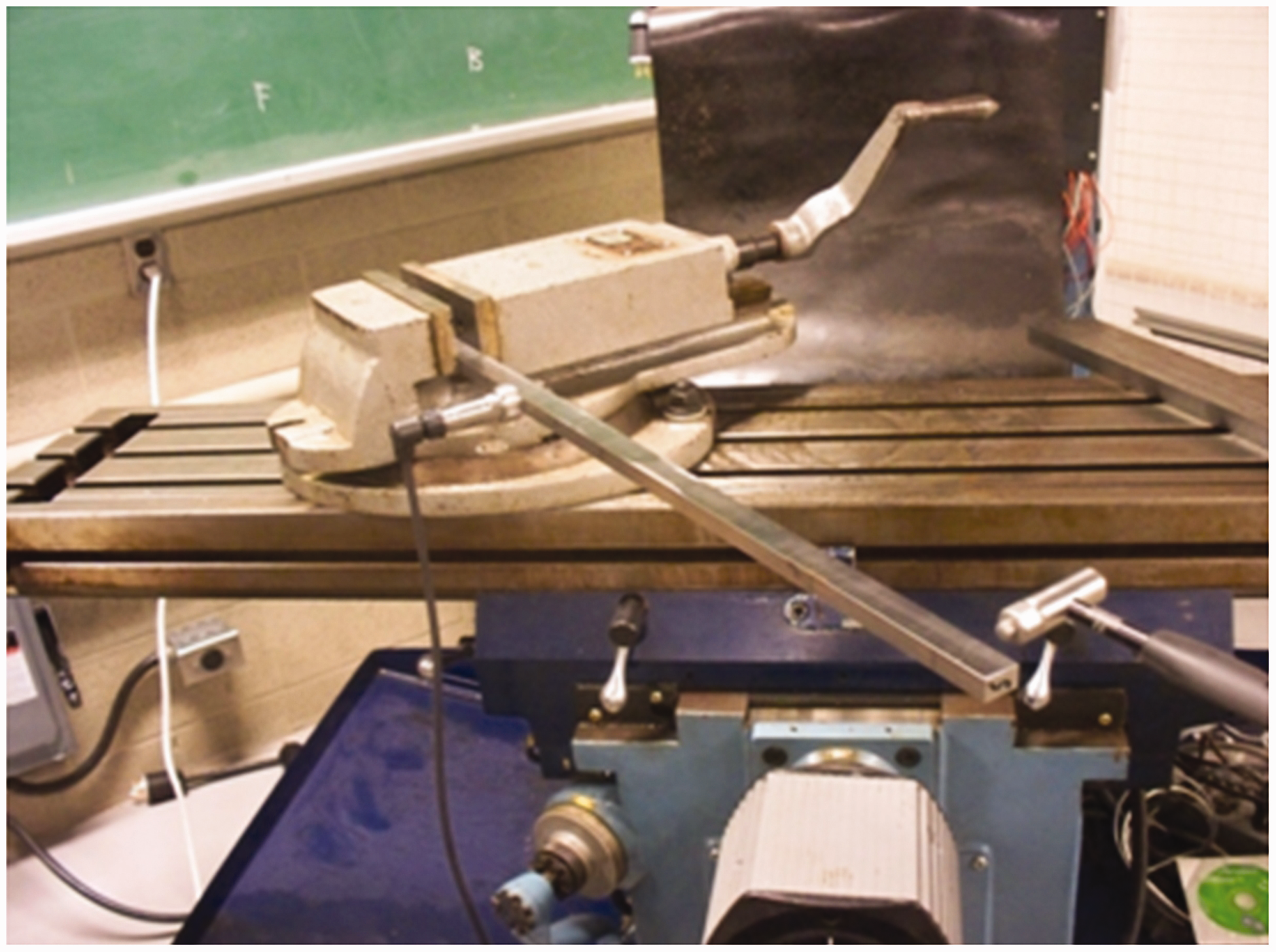
Experimental setup.
The experiments are conducted using two beams. One is intact and the other has two cracks. The locations and depths of two cracks are β1 = 0.16, β2 = 0.76, α1 = 0.42, and α2 = 0.42, respectively. As we know, in a typical impact test, the accelerometer is attached to a single point on the beam (in the experiments, the accelerometer is fixed near the left end of the beam), and the hammer is used to impact it as many points to define its mode shape. In the experimental study, the sampling frequency fs is 5000 Hz and 10,000 data points are collected at each impact points. The first three measured frequencies of cracked beam are f1* = 54.5 Hz, f2* = 338 Hz, f3* = 869 Hz.
The second modal shape is shown in Figure 5(a) and the second mode shape curvature is shown in Figure 5(b). The peaks in Figure 5(b) indicate the detected crack locations, i.e. β1* = 0.16, β2* = 0.76, which are the exact locations of the two cracks.
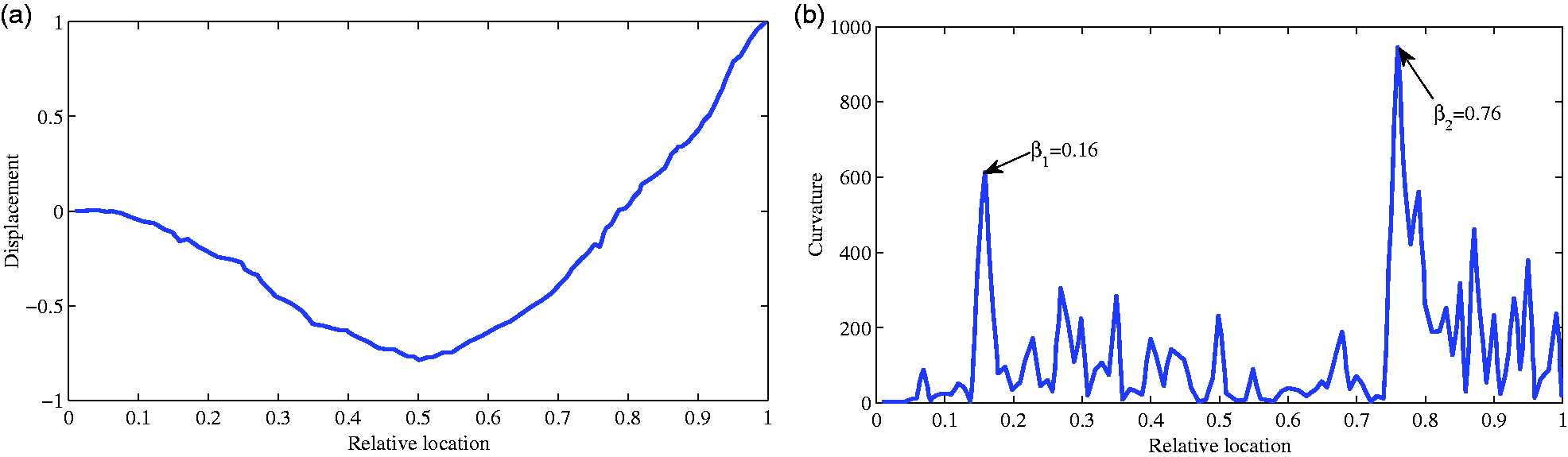
Two crack locations detection using the second mode shape curvature. (a) The second modal shape and (b) the second mode shape curvature.
Sometimes, the large difference between the measured frequencies and the calculated frequencies will make detection results ineffective. To avoid this issue, the “zero-setting” method is used to reduce the difference. The “zero-setting” method is defined by
29

The measured frequencies of the intact beam are f1 = 58.5 Hz, f2 = 338 Hz, f3 = 869 Hz and the calculated frequencies of the intact beam are f1 = 68.23 Hz, f2 = 394.59 Hz, f3 = 1101.48 Hz. Therefore, Young’s modulus calculated by equation (33) is modified as E1* = 151.44 GPa, E2* = 157.48 GPa, E3* = 139.37 GPa.
There are 20 samples and corresponding first three natural frequencies calculated by Em* used to construct the initial Kriging model. And the measured frequencies of the cracked beam are adopted as the inputs of PSO algorithm. The detection results are shown in Figure 6, i.e. α*1 = 0.3973, α2* = 0.3785. The relative errors between the estimated and the actual depths are ε1 = |α1−α1*|×100%=2.27%, ε2 = |α2−α2*|×100%=4.15%. Therefore, the presented method can obtain the results with reasonable accuracy.
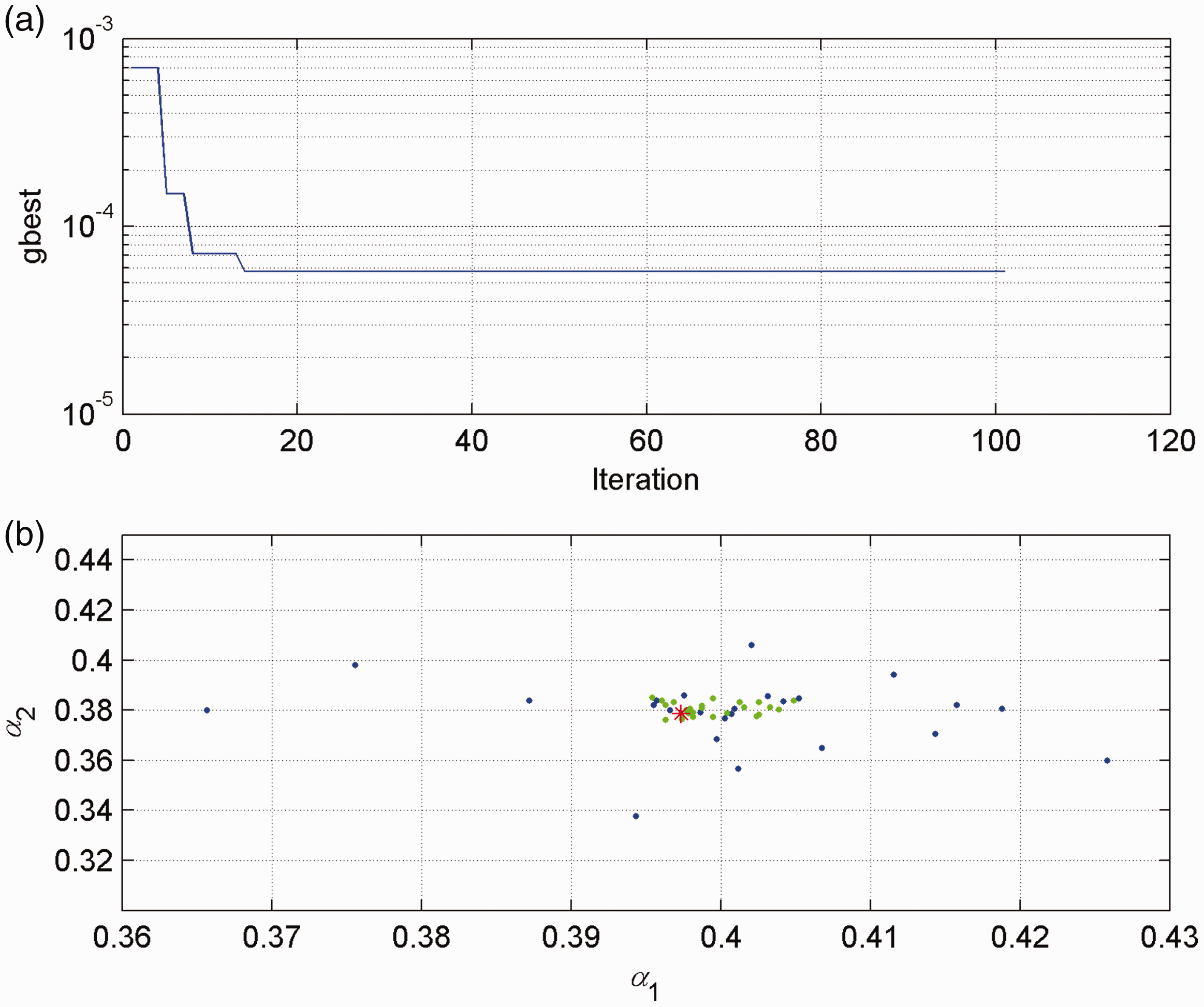
The PSO convergence progress and the optimal particle location represented two crack depths.
Conclusion
An improved two-step method is presented for detecting multiple cracks in beam structures, which is based on mode shape curvature and Kriging surrogate model. First, the crack locations are detected from the mode shape curvature. Then, the initial Kriging model is constructed by samples of various crack depths and corresponding natural frequencies. And an optimal point adding process is carried out to update the initial Kriging model until the Kriging model is sufficiently accurate. Finally, the PSO algorithm is used to evaluate crack depths based on the Kriging model. Both of the simulation and experimental results demonstrate that the presented method is effective to detect multiple cracks in beam structures. The detection results demonstrate that Kriging model can significantly reduce computation time with a similar accuracy. The detection results also indicate that the more natural frequencies used, the higher accuracy of crack depths detected.
Footnotes
Acknowledgements
The authors would like to thank the reviewers and the editor for their valuable comments.
Declaration of conflicting interests
The author(s) declared no potential conflicts of interest with respect to the research, authorship, and/or publication of this article.
Funding
The author(s) disclosed receipt of the following financial support for the research, authorship, and/or publication of this article: The work is supported by the National Natural Science Foundation of China (No. 51565008), Natural Science Foundation of Guangxi (No. 2017JJA160071z), and the Guangxi Key Laboratory of Manufacturing System & Advanced Manufacturing Technology (Nos. 1638012003Z, 1514030006K).