




Abstract
Longitudinal vibration of non-uniform rod has been of great significance in various engineering occasions. The existing works are usually limited to the certain area variation and/or classical boundary condition. Motivated by this limitation, an efficient accurate solution is developed for the longitudinal vibration of a general variable cross-section rod with arbitrary boundary condition. Displacement function is invariantly expressed as the summation of standard Fourier series and supplementary polynomials, with an aim to make the calculation of all derivatives more straightforwardly in the whole solving region [0, L]. Energy principle is employed for system dynamics formulation, with the elastic boundaries considered as potential energy stored in the restraining spring. Arbitrary cross-section area variation is uniformly expanded into Fourier series. Numerical examples are presented for the natural frequency and mode shapes of non-uniform rod of free and clamped boundary conditions and compared with literature data. Results show good agreement with the previous analytical solutions. Influence of cross section area variation on vibration characteristics of non-uniform rods is then studied and discussed. One of the most advantages of the proposed model is that there is no need to reformulate the problem or rewrite the codes when the cross-section area distribution and/or boundary conditions change arbitrarily.
Keywords
Introduction
Many structures in various engineering branches, such as high-rise buildings, towers, machine shafts, gas turbines blades, carbon nanotubes, etc., can be simplified as rod model. In many cases, the excessive vibration of such structures is caused by the longitudinal loads. A good understanding on the longitudinal vibration characteristics of rods is of great importance to ensure correct and reliable design of relevant complex structures. For several decades, much research has been done and well documented for the uniform rod.1,2 In order to describe the real structure more exactly and/or achieve an optimal design, the variation of cross-sectional area, namely the non-uniform rods, should be taken into account. For this reason, longitudinal vibration analysis of non-uniform rods is attracting more and more interests of many investigators.
Earlier investigation 3 showed that the equation of motion for rods with conical cross-sections can be reduced to the form of a wave equation by a change of variable. Raman 4 introduced two different transformation approaches to obtain the general solutions for cross-sectional area variations of rods such as cos(x), sin(x), and exp(–x2). Eisenberger 5 presented exact element method for deriving the exact longitudinal natural frequencies of a variable cross-section rod with polynomial variation in the cross-sectional area. Bapat 6 derived exact solutions for the longitudinal of rod structure with exponential and catenoidal cross-sectional area variations. Abrate 7 derived closed-form solutions for the free longitudinal vibration of rods with the cross-section area varying as A(x) = A0(x/L)2 and A(x) = A0[1 + a(x/L)]2. Kumar and Sujith 8 obtained exact solutions for the longitudinal vibration of non-uniform rods whose cross-section varies as A(x) = (a + bx) n and A(x) = A0 sin2(ax + b). Matsuda et al. 9 compared two approximate methods, modal analysis and Laplace transformation method, for analyzing the longitudinal impulsive response of variable cross-section bars.
Recently, using the fundamental solution of each step rod, Li10–12 proposed a transfer matrix method for determining the longitudinal natural frequencies and mode shapes of multiple-step non-uniform rods. Li et al. 13 then obtained exact analytical solutions for longitudinal vibration of non-uniform rods with concentrated masses coupled by translational springs, in which the cross-sectional area variations are selected as power functions and exponential functions, respectively. Inaudi and Matusevich 14 utilized the domain–partition power series for longitudinal vibration analysis of variable-cross section rods. Zeng and Bert 15 applied the differential transformation procedure to obtain exact solutions for the free axial vibration of a tapered bar with fixed-free boundary condition. Raj and Sujith 16 employed the confluent hypergeometric function and generic transformation to obtain the exact solutions for the longitudinal vibration of variable area rods subjected to classical boundary conditions. Al Kaisy et al. 17 obtained the non-dimensional natural frequency and the normalized mode shapes of non-uniform rod of free and clamped boundary conditions by differential quadrature method. Caliò and Elishakoff 18 derived the trigonometric closed-form solutions for the natural frequencies of rods under three sets of boundary conditions. Arndt et al. 19 studied free longitudinal vibration of fixed–fixed non-uniform bars with sinusoidal and polynomial variation of cross section area by using an adaptive finite element method. Guo and Yang 20 proposed a series method for the free longitudinal vibrations of non-uniform rods, which makes that the Wentzel–Kramers–Brillouin method can be seen as a Taylor expansion of the proposed method at infinity. Moreover, Chang 21 developed an elastic rod model for the study of small-scale effect on axial vibration of non-uniform nanorods by using the nonlocal elasticity in the context of carbo nanotubes.
Most of the aforementioned analytical approaches are usually limited to certain cross section area variations and several boundary conditions; from the practical viewpoint, the boundary conditions will not just confined to these classical cases. For the existing methods, any change of boundary condition and cross-section area functions will always lead to reformulate the theoretical equations and rewrite the codes, which is really a cumbersome process. Literature survey shows an obvious gap that the longitudinal vibration analysis of non-uniform rods with complex boundary conditions should be treated in a more general and unified pattern.
Recently, two authors of this paper have proposed a systematic and efficient smoothed Fourier series method to tackle the panel vibration and acoustical cavity with complicated boundary restraints successfully.22–24 The purpose of the current paper is to establish an accurate Fourier series solution for the free longitudinal vibration of general non-uniform rods with arbitrary end restraints. Energy principle in combination of Rayleigh–Ritz procedure is applied to formulate the problem, in which the displacements are expanded into a modified version of Fourier series with the additional polynomials to make the field function smooth sufficiently in the entire solution region [0, L]. Arbitrary distribution function of cross-sectional area is expressed as Fourier series, which makes all the subsequent calculation be treated in an exact and efficient way. Several numerical examples are then presented to demonstrate the reliability and effectiveness of the current model.
Theoretical model and formulation
Governing equation and general end restraints
As illustrated in Figure 1, longitudinal vibration of rod with arbitrary variation of cross section is considered, with the length L, Young’s modulus E, and mass density ρ. The origin of coordinate system is located at the left end of the rod, so that 0 ≤ x ≤ L. Longitudinal vibration displacement is represented by U(x, t). Arbitrary cross-section area of the rod structure is described by the distribution function A(x). When A(x) is constant with the variation of spatial coordinate, such general case will degenerate to the uniform straight rod. Two types of linear restraining springs with coefficients of k0 and kL are attached to both ends. All the classical boundary conditions can be easily obtained by setting the spring stiffness into zero or infinity, accordingly.

Longitudinal vibration of a non-uniform rod with arbitrary cross-section variation.
For the harmonic vibration, the longitudinal vibration displacement can be written in the following form

where u(x) is the longitudinal displacement field of the rod and ω is the angular frequency of vibration.
Making use of the balance between the internal stress and inertial force at any field point, differential governing equation of the free longitudinal vibration of a non-uniform rod can be obtained as

For the elastically restrained edges considered in this work, as illustrated in Figure 1, based on the force equilibrium and displacement coordination relationship, the following boundary conditions can be derived, namely


Longitudinal modal characteristics of elastically restrained rods can be achieved by solving the governing equation (2) and boundary condition equations (3) and (4), simultaneously, namely the boundary-value problem. Non-uniform rod with functionally distributed cross-sectional area will lead to a variable coefficient differential equation. This will make the solving process much more difficult, and the majority of current study are limited to the non-uniform rod with certain cross-section distribution.
Energy formulation and its improved Fourier series solution
The other way to describe the system dynamics is based on the energy formulation, in which the potential and kinetic energy components are employed to characterize the dynamic behavior. In the energy-based solution framework, admissible function is a key factor affecting the solution convergence and accuracy. When the field functions are constructed smoothly, such solution will be equivalent to solving the governing equation and boundary condition, simultaneously. The potential benefits related with the energy formulation is that the coupled system with general boundary and/or coupling conditions can be easily treated by including the corresponding energy term in the whole framework. For this reason, energy description will be utilized to characterize the longitudinal vibration of non-uniform rod structure in this work.
The system Lagrangian for the free longitudinal vibration of non-uniform rod can be expressed as


and

As shown in equation (6), both the non-uniform cross-section area variation and elastic boundary restraints are taken into account in the framework of potential energy. In the majority of existing work, just certain cross-section distributions are considered, such as A(x) = A0(1 + x)2,
7
A(x) = (a + bx)
4
,
8
and A(x) = A0 sin2(a + bx).
8
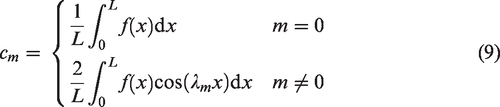
Here, in order to treat the arbitrary cross-section area distribution in a unified pattern, distribution function A(x) will be expanded into the cosine Fourier series. Then, all the non-uniform cross-section area information are converted into the expansion Fourier series coefficients, namely the arbitrary cross-action form can be written as follows

Here, the Fourier expansion coefficients can be calculated from
Once the energy formulation is written down for the non-uniform rod system, the other important task is to construct the admissible function for the longitudinal vibration of rod structure. In the vibration theory, it is normal to assume the displacement into Fourier series for the longitudinal field of elastic rod structure, namely



It can be seen that the first-order differentials with respect to the spatial coordinate at both ends are always zero. However, from the force equilibrium relationship equations (3) and (4), namely the elastic boundary condition, it will not be always zero physically. On the other hand, if the standard Fourier sine series is utilized to expand the longitudinal displacement, the displacement will be always zero at both ends, which is only true for the classical fixed–fixed boundary condition. In other words, the standard Fourier cosine or sine series does not possess the ability for the longitudinal displacement expression of non-uniform rod structure with such elastic boundary conditions.
With the aim to overcome the differential discontinuity of standard Fourier series, supplementary functions are introduced to remove the jump points at both elastic ends. For the longitudinal vibration of a non-uniform rod with general elastic boundary supports, here, the vibration displacement function will be invariantly expanded into an improved Fourier cosine series as


It can be easily found that


Substituting the improved Fourier series admissible function equation (13) into the system Lagrangian function equations (5) to (7), one will obtain
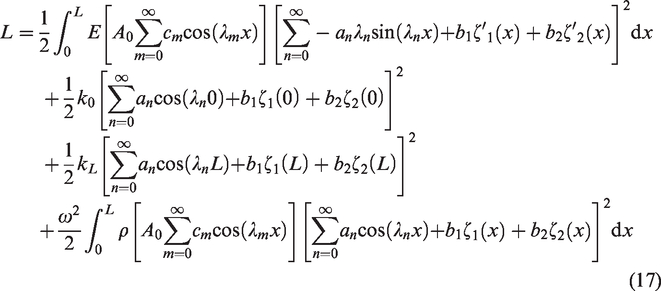
Making use of the Rayleigh–Ritz procedure to minimize the above Lagrangian with respect to all the unknown expansion coefficients, one is able to get a set of linear equations which can be written in a matrix form as

All the natural frequencies and eigenvectors for non-uniform rod structure can now be easily obtained by solving a standard matrix eigenproblem. Each of the eigenvectors contains all the Fourier coefficients for the corresponding mode shape, and its physical mode can be simply derived by substituting the Fourier coefficients into equation (13). In the proposed model, arbitrary cross-section area distribution is all expanded as Fourier series, the non-uniform function information has been converted into the Fourier series coefficients in equation (8). Then all the integrations to obtain the matrix elements in equation (18) are mainly about the calculation between the trigonometric functions as well as the supplementary polynomials, which can be performed analytically through symbolic operation such in Maple. Comparing with those other methods, the obvious advantages are that arbitrary non-uniform cross-section area distribution and elastic boundary conditions can be both treated in a unified pattern, and there is no need to reformulate the theoretical equations or rewrite the codes when any cross-section area function and/or boundary conditions are changed.
Numerical results and discussion
In this section, the aforementioned theoretical formulation will be implemented in MATLAB computing environment, and several numerical examples are then presented to demonstrate the reliability and effectiveness of the proposed model for analyzing longitudinal vibration of non-uniform rods with various boundary conditions. In the current model, boundary conditions are simulated by introducing two artificial springs at both ends, then any classical boundary condition can be easily obtained by setting the stiffness coefficients into infinity or zero, accordingly. When the restraining stiffness is taken as a medium number, elastic restraint is actually achieved. For the non-uniform cross-section area variation, arbitrary distribution function is all expanded into Fourier series, then all the information of non-uniform profile is converted to the Fourier series coefficients. Any change of boundary condition and/or non-uniform rod profile will need no much modification on the theoretical formulations and simulation codes. In the following analysis, non-dimensional frequency parameter and restraining stiffness will be used, with their definitions as
Validation and convergence for a uniform rod
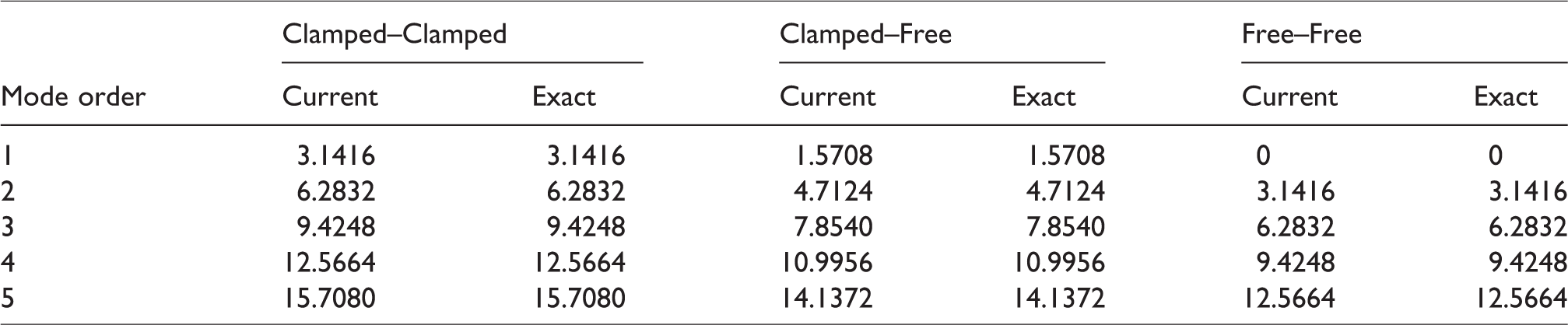
The simplest form for non-uniform cross-section area function A(x) = A0f(x) is that f(x) is constant, namely the familiar uniform rod can be obtained, for which the closed-form exact solution is available for the longitudinal vibration of rod structure with various boundary conditions. Tabulated in Table 1 is the comparison of non-dimensional natural frequencies calculated from the current model and exact formula. It can be seen that these two results can agree with each other very well. Then the correctness of current model can be validated for the prediction of longitudinal modal frequencies of rod with classical boundary conditions.
The first five non-dimensional natural frequencies of uniform rod with three types of classical boundary conditions.
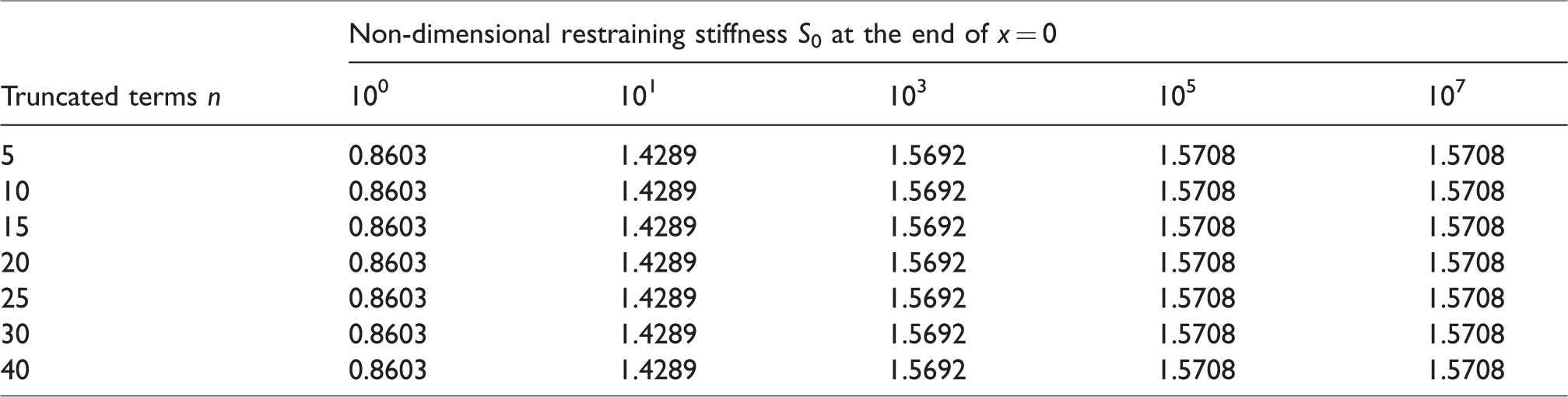
In the practical calculation, a very large number is actually used to represent the infinity for simulating the clamped boundary condition. For such a Fourier series modeling framework, the truncated number will be also an important factor affecting the prediction accuracy. With the aim to check the convergence of the propose model, and also the very large number used for the representation of infinity, the fundamental longitudinal frequency parameter for clamped-free rods are calculated using various truncated number and restraining stiffness, and the results are presented in Table 2. It shows that the current model possesses an excellent convergence property, little Fourier series truncated number, such as n = 5, can lead a good prediction of modal frequency for the very large spring stiffness, and the results can coincide with the exact solution for the clamped-free rod. For the clamped boundary, the value of non-dimensional spring stiffness can be set as 105, and even larger number will cause no variation of fundamental frequency. In the subsequent calculation, the truncated number n = 30 is used to ensure series convergence.
Non-dimensional fundamental frequencies of clamped-free rod calculated using various truncated terms and different restraining stiffnesses.
Non-uniform rod with A(x) = A0 sink(ax + b)
Trigonometric function of non-uniform cross-sectional area will be taken into account in the form of A(x) = A0 sin k (ax + b), in which three varying parameters, namely a, b, and k, can be adjusted to define the non-uniform profiles. In the current modeling framework, all the non-uniform distribution functions are all expanded into Fourier series equation (8) in a unified pattern, the cross-section area variation information is then converted and stored in Fourier coefficients cm, which can be obtained through its definition of equation (9). For this series representation of function distribution, several numerical examples show that the truncated number m = 20 can sufficiently guarantee the convergence, and the non-uniform functions can be described accurately. Comparing the current study on non-uniform rod vibration analysis, in which just certain functions are treated, the problem should be reformulated for various non-uniform function individually. For the proposed model in this paper, any variation of non-uniform function, just the mathematical integration in its definition is needed, and there is no much influence on the whole formulation as well as the main calculation codes.
Table 3 shows the first five frequency parameters of clamped–clamped non-uniform rod with A(x) = A0 sin2 (ax + 1), namely b = 1 and k = 2, for various parameters a. To see the corresponding cross-section area profiles more clearly, plotted in Figure 2 shows the tendency of cross section with various values of a. From this figure, it can be found that the increase of a will lead to a rapid decrease of the rod diameter on the right side, which further means that the rod elastic rigidity is getting smaller. With the aim of validation, the results calculated for the same example using other approach 7 are also presented. From the comparison, excellent agreement between these two methods can be observed, and then the correctness and reliability of the proposed model for the longitudinal modal analysis of non-uniform rod are validated again. Longitudinal displacement mode shapes can be easily obtained by substituting the eigenvectors into the constructed Fourier series equation (13). The first four mode shapes are plotted in Figure 3 for different values of a, with the remaining parameters b = 1 and k = 2. From this figure, it can be clearly observed that the bigger values of a make the elastic rigidity of the rod smaller.
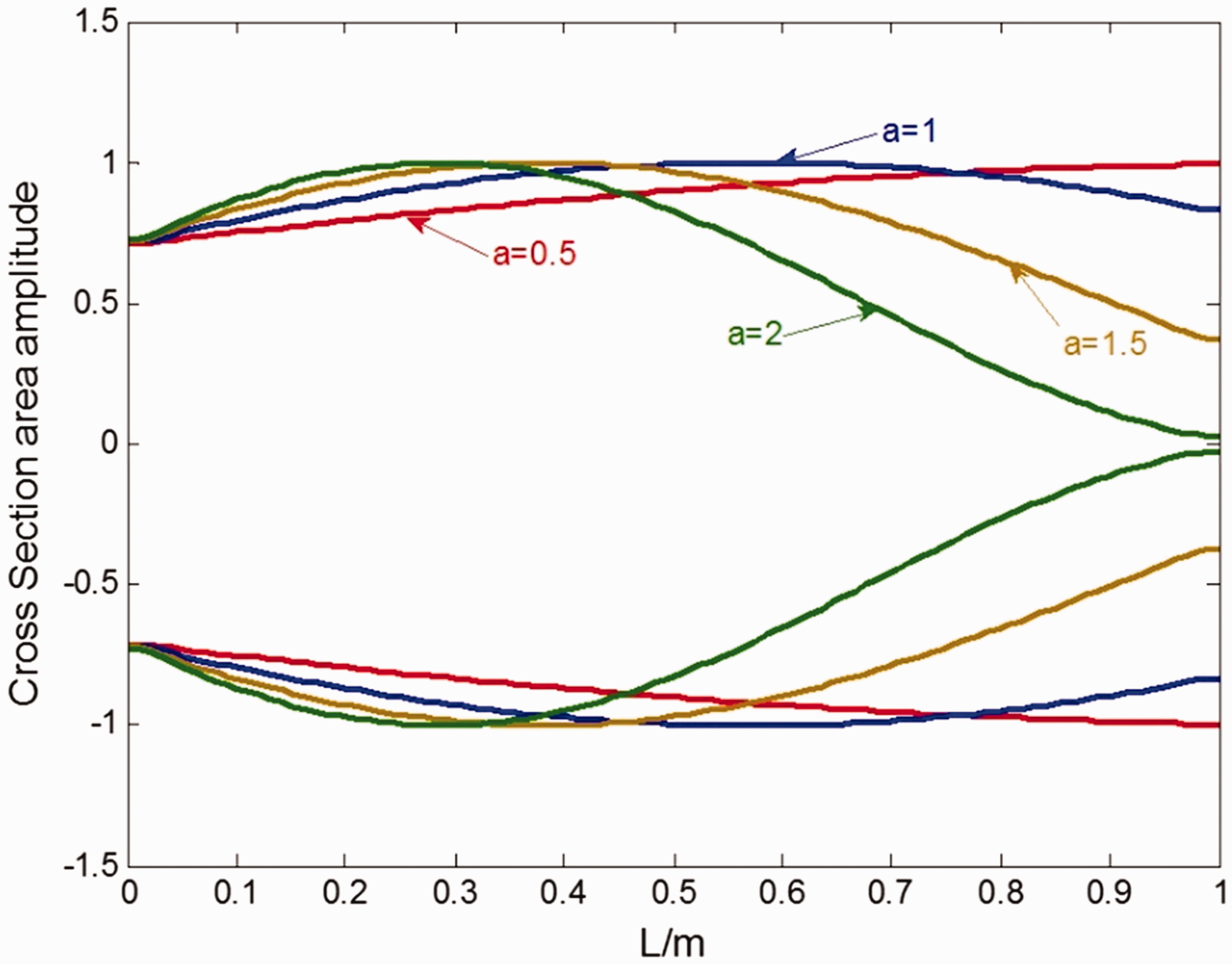
Cross-section area profiles for various coefficient a with b = 1, k = 2.
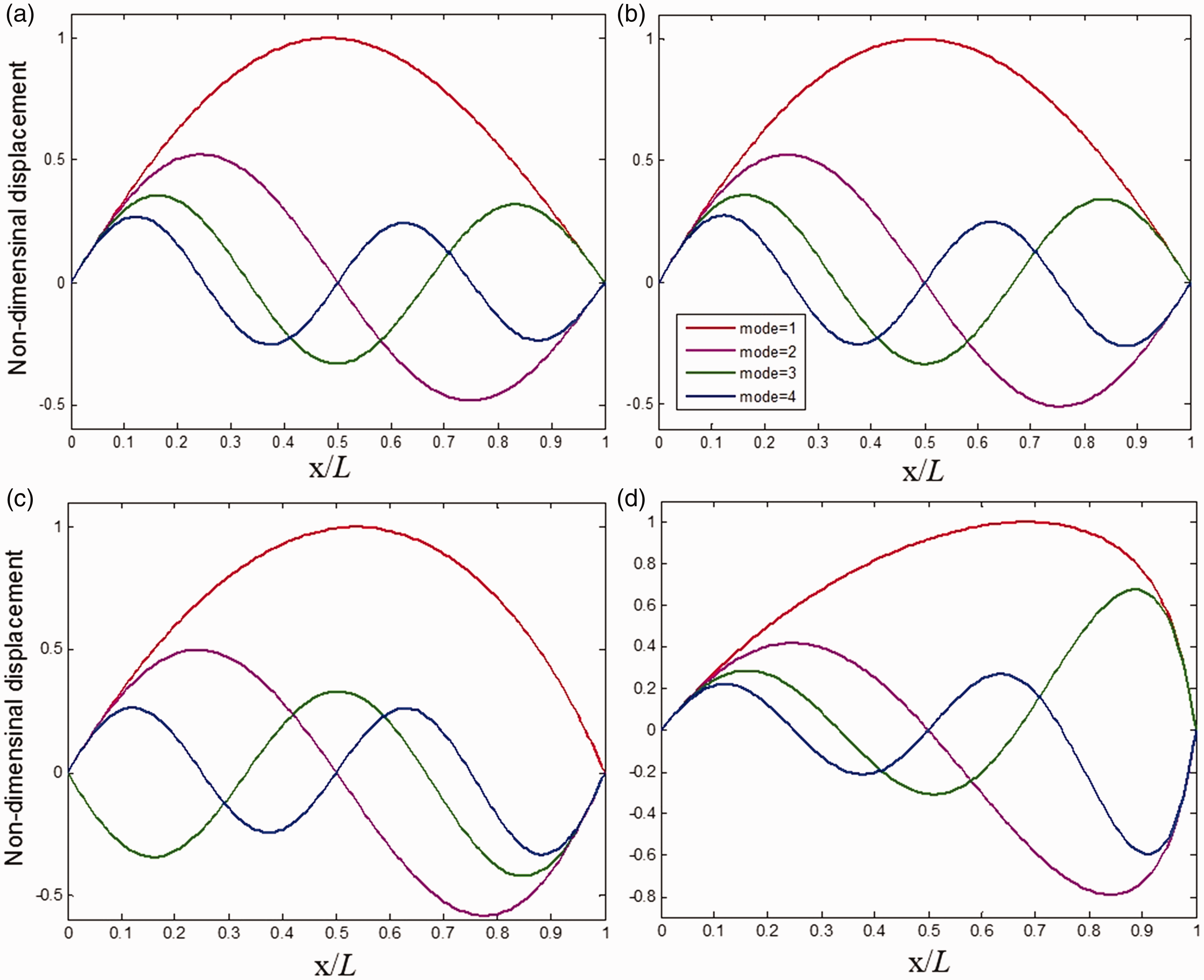
The first four mode shapes of clamped-clamped non-uniform rods for different values of a, with the remaining parameters b = 1 and k = 2. (a) a = 0.5; (b) a = 1; (c) a = 1.5; (d) a = 2.
Non-dimensional natural frequencies of clamped-clamped non-uniform rod with A(x) = A0 sin2(ax + 1).
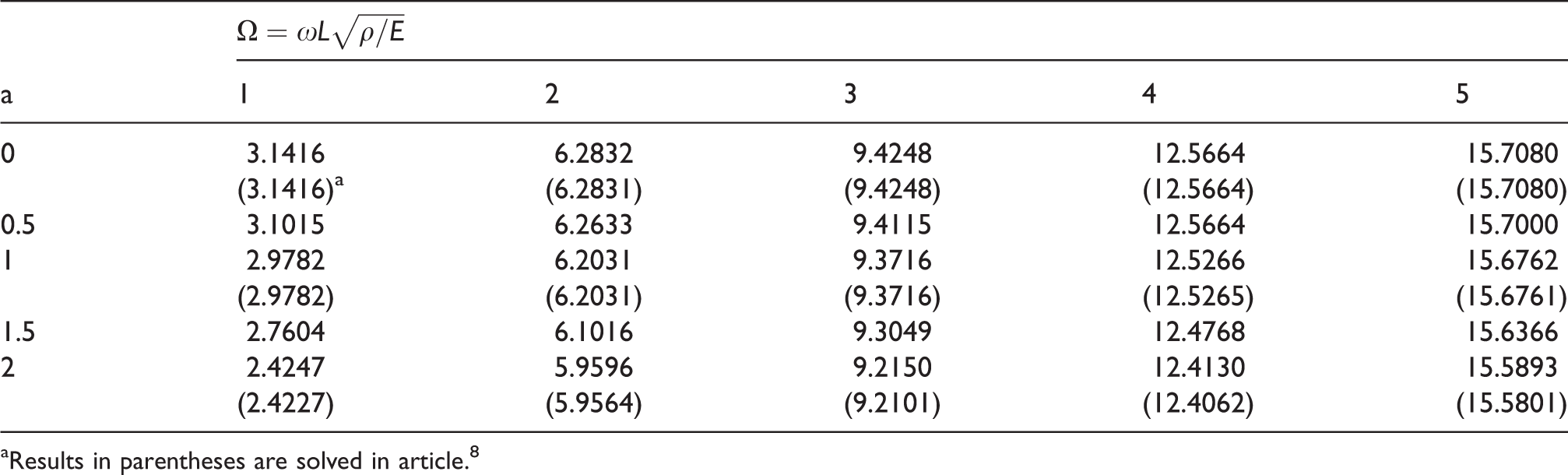
Results in parentheses are solved in article. 8
Non-uniform rod with A(x) = A0(ax + b)k
As the third example, non-uniform rods with the cross-section area variation of A(x) = A0 (ax + b) k will be studied, in which the parameter a takes the values of 0, 1, 2, and with the other parameters b = 1, k = 2. Tabulated in Tables 4 and 5 are the first five modal frequencies for the free–free and clamped-free non-uniform rods with A(x) = A0(ax + 1)2 cross-section area variations, respectively. For the comparison purpose, the results calculated 7 are also presented. From these two tables, as we see that the proposed model can again make a reliable and efficient prediction on the vibration characteristics of non-uniform rods with such function distributions.
Non-dimensional natural frequencies of free–free non-uniform rod with A(x) = A0(ax + 1)2.
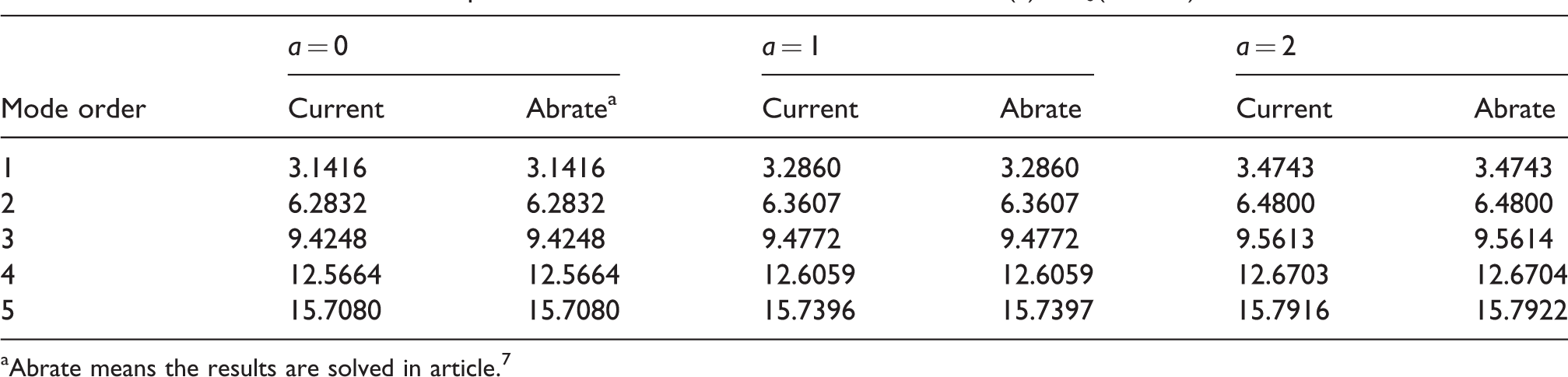
Abrate means the results are solved in article. 7
Non-dimensional natural frequencies of clamped-free non-uniform rod with A(x) = A0(ax + 1)2.
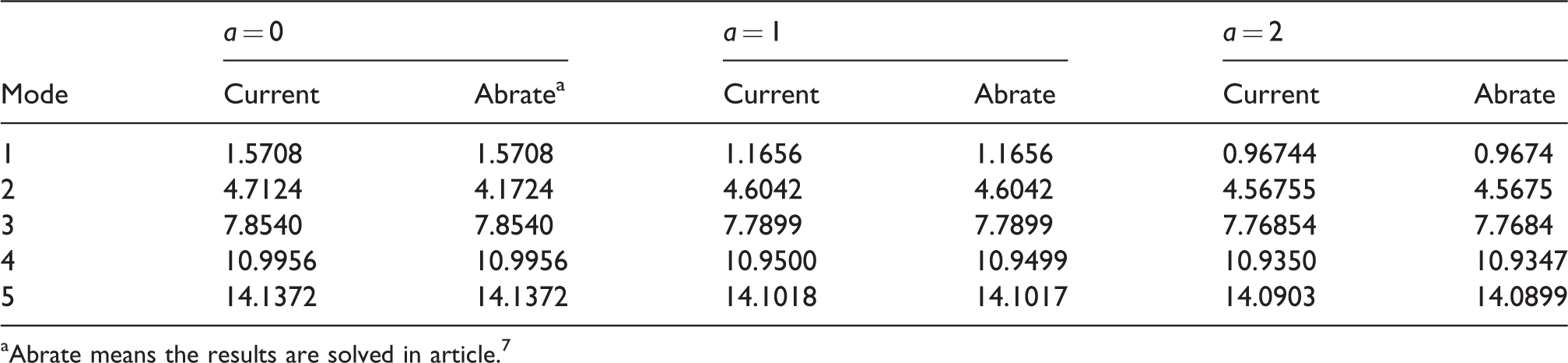
Abrate means the results are solved in article. 7
Obviously, the parameter a has a significant effect on modal frequencies presented in Tables 4 and 5, for these two boundary conditions. With an aim to demonstrate the effect of such parameter more clearly, the fundamental natural frequencies are calculated in the wide range of elastic restraining stiffness at the end x = L, while the other end is fully clamped. The corresponding results are plotted in Figure 4. As we can see that the frequencies gradually raise when the elastic boundary values are 10° to 102, which can be defined as the sensitivity range. When the non-dimensional stiffness S L is larger than 103, this will cause no much variation. Several numerical examples also show that the similar tendency can be observed for higher modes.
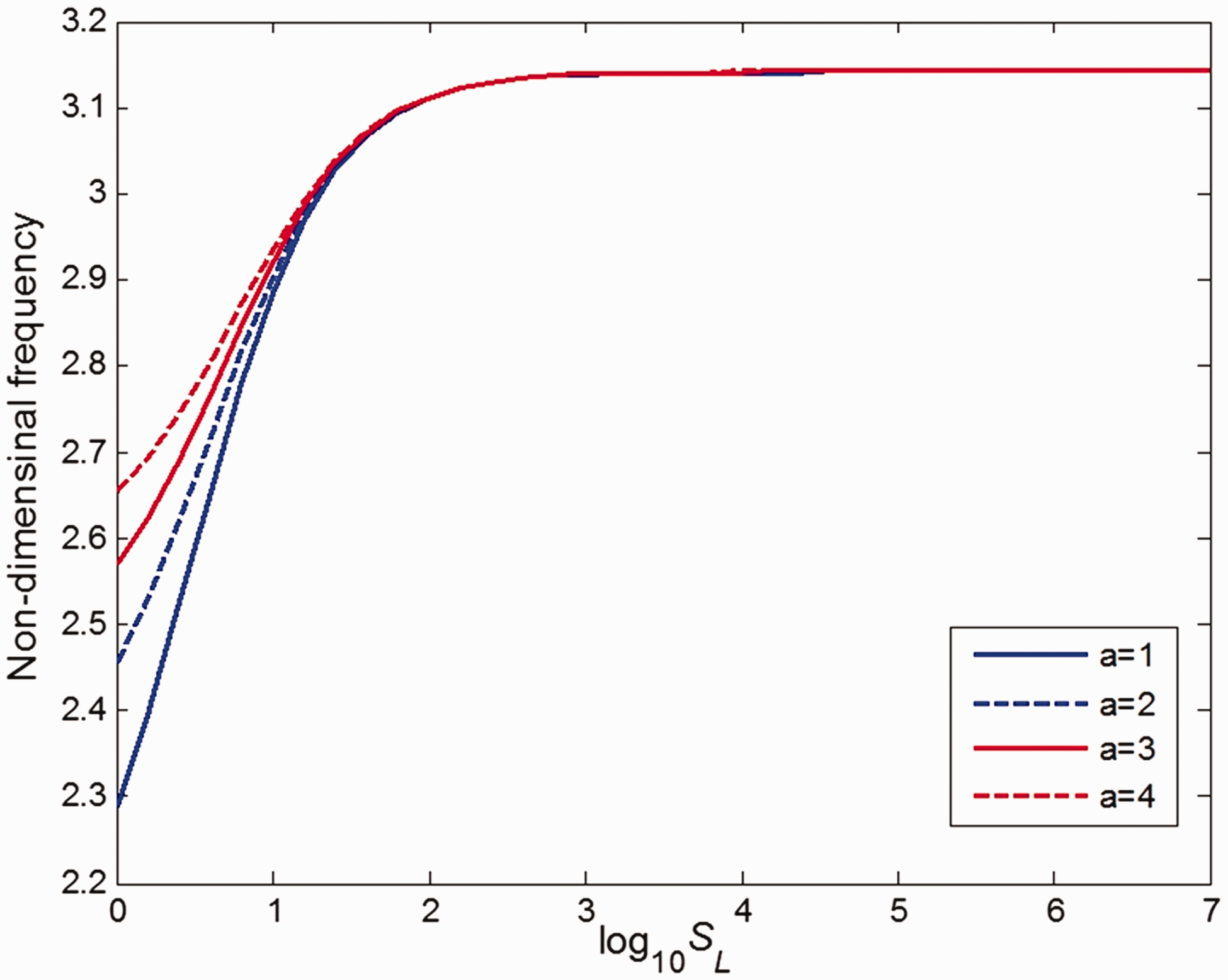
Influence of parameter a on the fundamental natural frequency of clamped-elastic non-uniform rods.
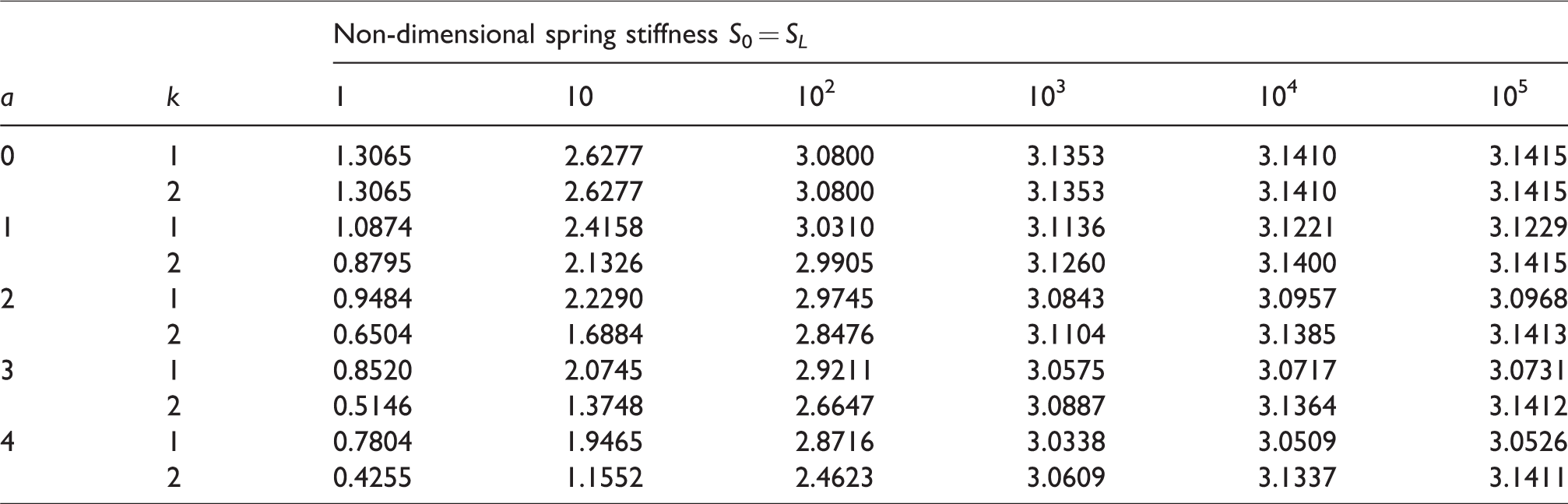
Now, let us consider the elastic boundary restraints at both ends for the non-uniform rods with area variation A(x) = A0(ax + b) k . By setting the restraining stiffness into various finite values on both sides, the fundamental frequency parameters are computed and presented in Table 6 for various a and k. For the case of a = 0, it actually degenerates to the non-uniform rod, when the spring coefficients approach to the infinity such as 105, and the results will be very close to the frequency parameters of uniform rod with clamped–clamed boundary conditions. Furthermore, when the parameters a and k increase, the first modal frequencies will be decreased. Variation of k will cause much significant influence on the fundamental frequencies for the cases of larger a. In order to get a whole picture of the combined effects of parameters a and k, Figure 5 shows the fundamental frequencies of elastically restrained non-uniform rod with different a and k. It can be seen that when both edges are elastically restrained, there are also the sensitizing range. When the spring stiffness gets much larger, the frequencies become steady and will converge to the value corresponding to clamped boundary. These four subplots are not symmetrical about the same elastic boundary line because the diameter of non-uniform rod on x = L side is larger than that of x = 0.
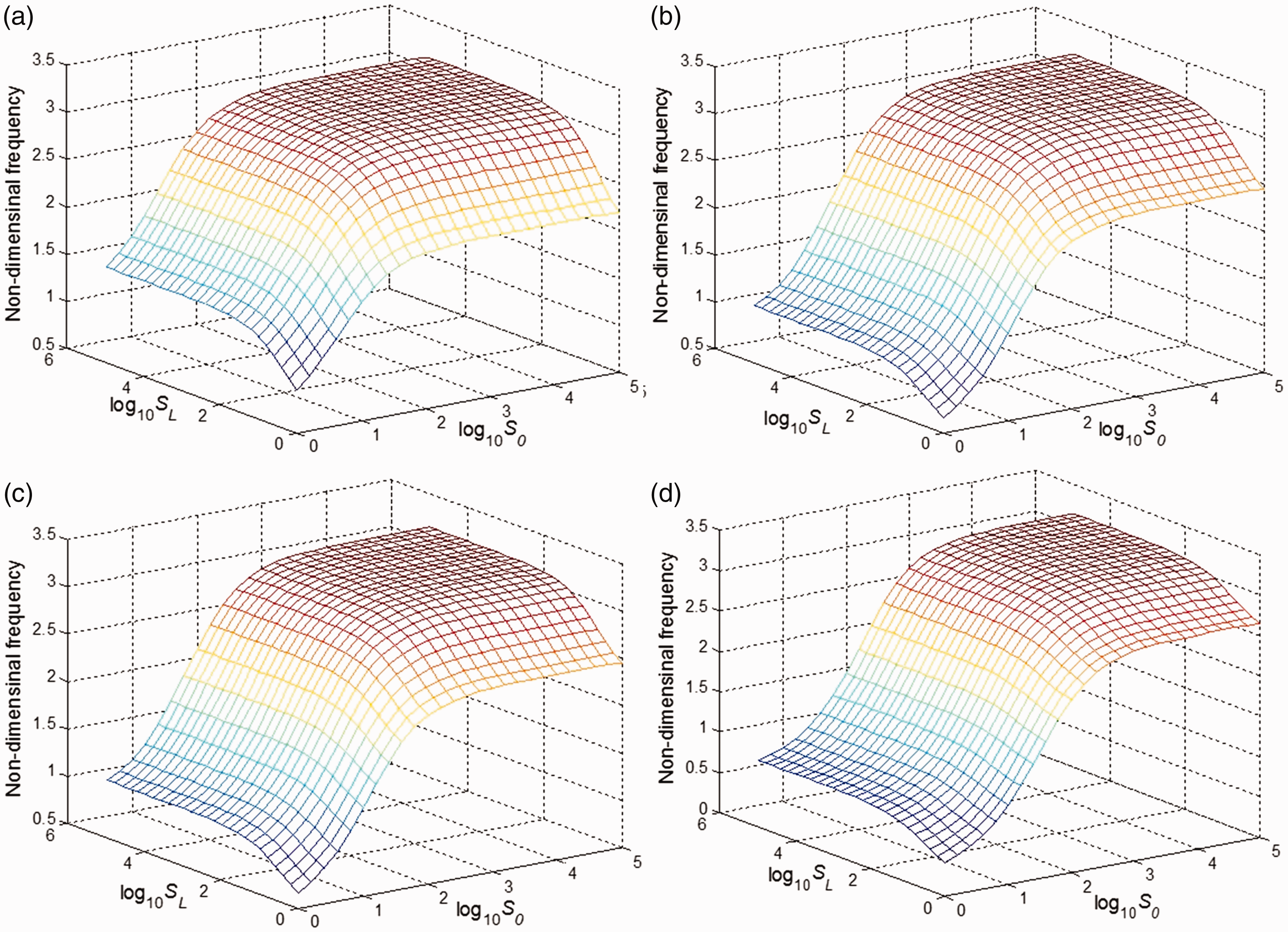
Variation of fundamental frequencies of elastically restrained non-uniform rods with different combination of parameters a and k. (a) a = 2, k = 1; (b) a = 4, k = 1; (c) a = 2, k = 2; (d) a = 4, k = 2.
Non-dimensional fundamental frequencies of elastic restrained non-uniform rods with cross-section area variation A(x) = A0(ax + b) k .
Conclusion
In this paper, a novel and efficient Fourier series solution has been established for the longitudinal vibration analysis of elastically restrained rods with arbitrarily variable cross sections. Longitudinal displacement field is invariantly expanded into a boundary smoothed Fourier series, with its supplementary polynomial introduced to meet the requirement of force equilibrium and displacement continuity for the elastic restraint at both ends. Arbitrary cross-section area variation function is all expressed as Fourier series, with the entire profile information is converted and stored in Fourier coefficients. All the unknown variables are obtained based on energy description of system dynamics, in conjunction with Rayleigh–Ritz procedure. Modal frequencies of various order can be easily obtained through solving a standard eigenvalue problem.
Several numerical examples are then presented to demonstrate the correctness and reliability of the proposed model through comparing with the data calculated from other approaches in literature. Satisfactory agreement has been repeatedly observed for the longitudinal vibration analysis of non-uniform rods with various boundary conditions. Influence of boundary restraint and main parameters of various non-uniform functions on modal characteristics are also discussed and analyzed. For elastic boundary restraint, there exists a sensitive range in which spring stiffness variation will affect the natural frequencies greatly. Comparing with other approaches, arbitrary distribution function and elastic boundary restraint have been treated in the most general sense. Then, any change of boundary condition and/or non-uniform rod profile will need no much modification on theoretical formulations and simulation codes. Moreover, it should be noted that although the current work is focused on the variation of cross-section area, the proposed framework can be easily extended for the treatment of inhomogeneous material distributions.
Highlights
Variations of cross-section area and elastic boundary conditions are described in energy formulation. Boundary smoothed Fourier series is proposed to construct the longitudinal displacement field. The arbitrary cross-section area variation is treated through Fourier series expansion in a unified pattern.
Longitudinal natural frequency and mode shapes versus the combination of non-uniform function and boundary restraint are examined.
Footnotes
Declaration of conflicting interests
The author(s) declared no potential conflicts of interest with respect to the research, authorship, and/or publication of this article.
Funding
The author(s) disclosed receipt of the following financial support for the research, authorship, and/or publication of this article: The authors received financial support from the Fok Ying Tung Education Foundation (Grant No. 161049) for the research, authorship, and/or publication of this article.