Low energy-induced vibration has been ignored, which, however, might lead to damage of a structure. The main purpose of this paper is to study the low energy small solution sequence of systems of Kirchhoff-type equations by the variational approaches. Our result shows that the low energy vibration can be controlled by setting the parameters and this can be used for optimization of structures under small perturbations, e.g. the bridge vibration under winds.
Vibration is the mechanical oscillation of a particle, member, or a body from its position of equilibrium. The vibrations sometimes may be very weak for identification and sometimes may be large and devastating such as earthquakes, winds, and tsunamis.1,2 In vibration study, there are two types of systems – discrete and continuous. Discrete systems are described mathematically by the variables that depend only on time. On the other hand, continuous systems are described by variables that depend on time and space. And therefore, the equations of motion of discrete systems are described by ordinary differential equations, whereas the equations of motion for continuous systems are governed by partial differential equations. There have been many interesting studies in recent years of the nonlinear behaviour of strings in vibration, see Stulov and Kartofelev,3 Issanchou et al.,4 Horgan and Chan,5 Peradze,6 and therein. The Kirchhoff’s model takes into account the changes in length of the string produced by transverse vibrations (see Peradze6). It was proposed by Kirchhoff7 as an extension of the classical D’Alembert’s wave equation for free vibrations of elastic strings. In recent years, many kinds of Kirchhoff-type equations are derived and studied by various methods, for example, in the literature.6,8–13,15
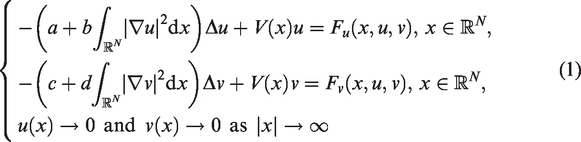
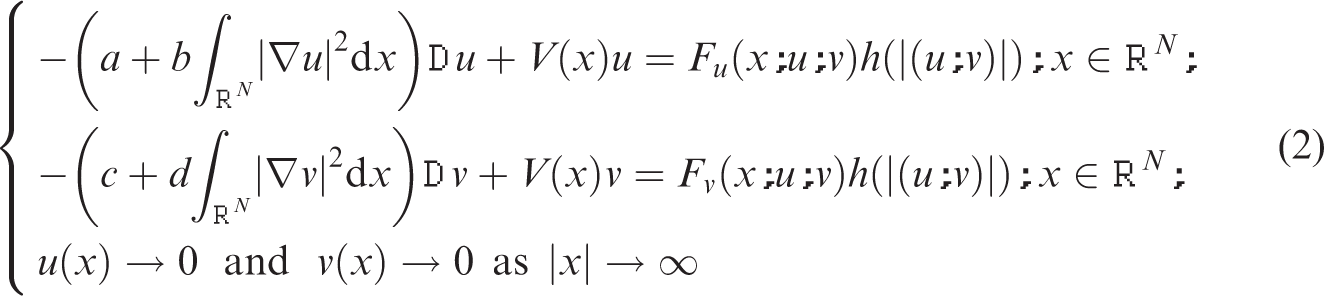
In this paper, we consider the following systems of Kirchhoff-type equations
where constants , , and .
Assume that is the energy functional of system (1). A weak solution sequence of system (1) is said to be a low energy solution sequence if the energy as . A low energy solution sequence is a small solution sequence if as .
Cheng et al.9 studied a -Kirchhoff type system. Recently, Wu14 obtained a sequence of high energy solutions of system (1). After presenting a new proof technique, Zhou et al.16 improved the results obtained in Wu.14
Motivated largely by the work of Zhou et al.,16 we are going to study the low energy solutions of system (1) by the variational approaches in this paper.
In order to state our main result, we need the following assumptions.
satisfies and for each , , where is a constant and denote the Lebesgue measure in .
There exist , , and a positive continuous function such that
for all There exist , and a positive continuous function such that
for and for all
Remark: Here, we need to point out that only the conditions of potential and , which is a basic condition for finding infinitely many solutions, are the same with Zhou et al.16 Moreover, Zhou et al.16 mainly used the version of the mountain pass theorem to prove the results, while our proof depends on a cut-off technique and the below version of mountain pass theorem.
Our main result is the following theorem.
Theorem 1. Assume that conditions and – hold. Then the system (1) possesses infinitely many distinct pairs of low energy small solutions.
Preliminaries
Let
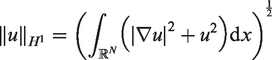
with the norm
Let
with the inner product and the norm
Then is a Hilbert space. Moreover, it is well known that the embedding , is compact under the assumption .
For any , define an inner product and a norm on by
and
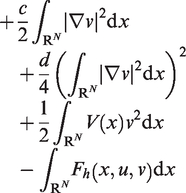
Then is a Hilbert space and by the semi-inverse method17–19 we see that a weak solution of the system (1) is a critical point on of the following functional
By a standard argument, we have the following Lemma.
Lemma 1. If assumptions and hold, then
and is compact, where .
Recall that a sequence is called a Palais–Smale (PS) of if is bounded and . The functional satisfies the PS condition if every PS sequence has a convergent sequence. The next lemma gives the convergent properties of a bounded PS sequence.
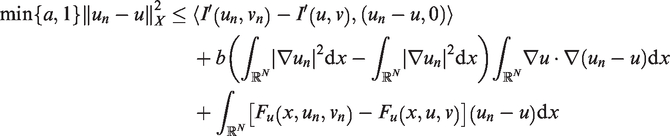
Lemma 2. If holds, then every bounded PS sequence of has a convergent subsequence.Proof. Since is bounded and the embedding is compact for each , passing a subsequence, we can assume that in and for . Clearly
The boundedness of in implies
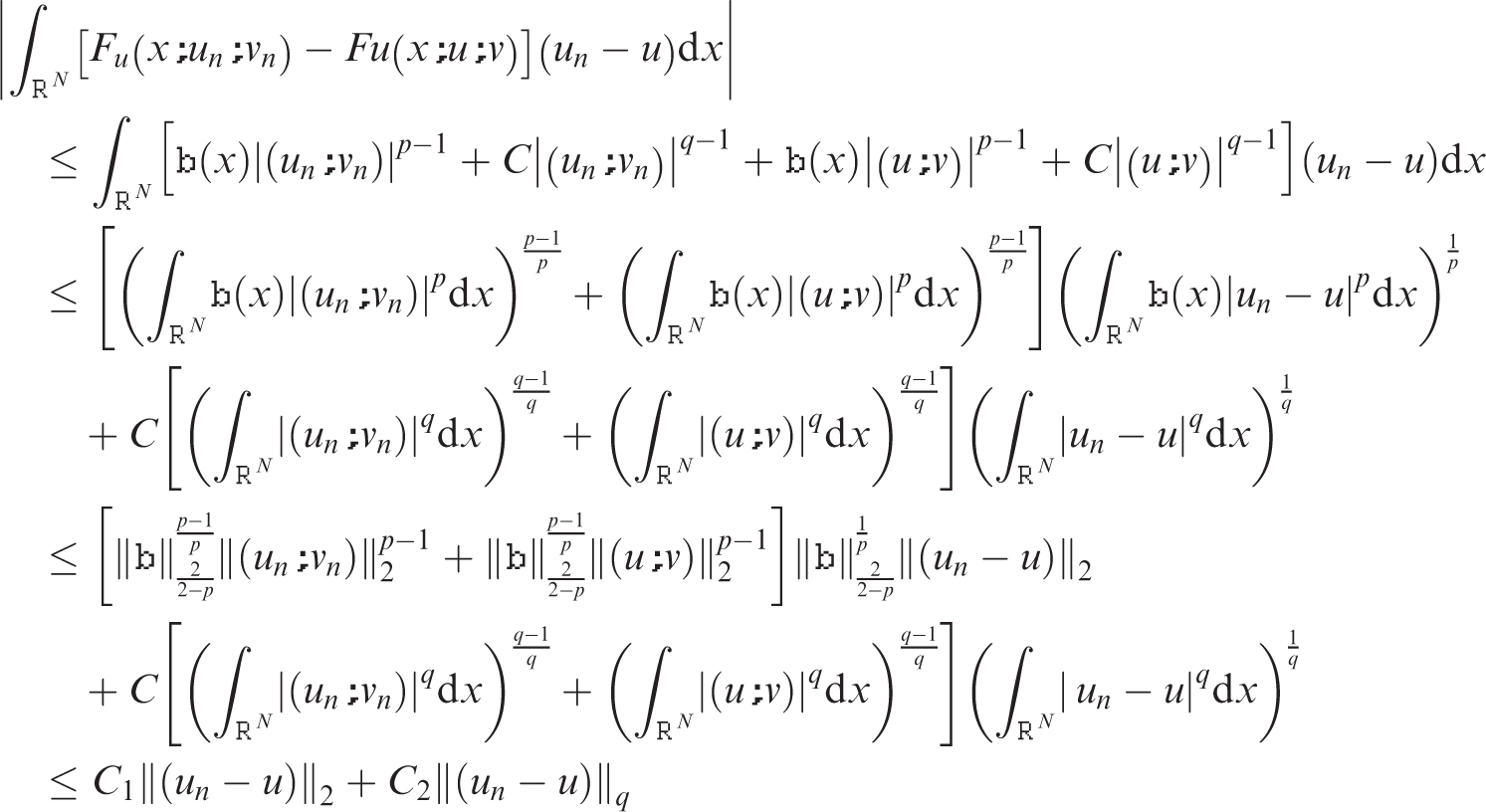
as Moreover, by and Hölder inequality, we have
where . Consequently, by and in , we know that . Using the same method, we can prove . Hence in . This completes the proof.
Lemma 3. If is a critical point of , then and as .
Proof. The conclusion can be obtained by De Giorgi’s iteration (see Liu et al.20(pp898–899)).
Existence of low energy small solutions
We consider the existence of low energy small solutions of system (1) in this section. Our proof of Theorem 1 depends on a cut-off technique and the below version of mountain pass theorem due to Kajikiya.21
Theorem 2. Let be an infinite dimensional Banach space and satisfies and below.
is even, bounded from below, and satisfies the PS condition.
For each , there exists an such that , where
Then either or below holds.
There exists a sequence such that , and . There exist two sequences and such that , , , , , , and and converges to a nonzero limit.
Choose , where is the constant appearing in . We take an even function such that , for , for , and is decreasing in . Consider the equations
We would like to prove that equation (2) has a sequence of weak solutions with in and for all , then the sequence will be the weak solutions sequence of equation (1).
Define a functional on by
for all , where
Since the functions and satisfy condition , Lemma 1 and 2 still hold as the functions and are used in place of the functions and , respectively. Hence and for every , there holds
and every bounded PS sequence of has a convergent subsequence.
We need the following Lemmas.
Lemma 4. Let be a finite dimensional subspace of . Then for any positive integer , there exists such that
for any with , where .
Proof. If the conclusion is false, then there exist and with such that
for all positive integer . Take , then is well defined since . Note that is finite dimensional. There exists a finite dimensional subspace of such that for every . Moreover, is bounded in since all norms are equivalent in a dimensional space. We can assume that, up to a subsequence, in and hence in , a.e. and a.e. .
Since and for all , we obtain for all , which implies that
converges to 0 in measure.
On the other hand, it is obvious that converges to in measure. Since and is positive, . This is a contradiction. The proof is completed.
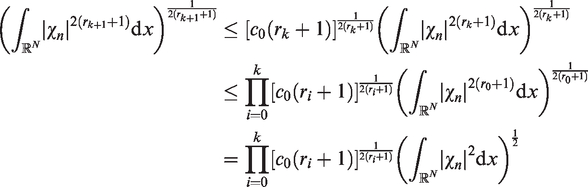
Lemma 5. If is a sequence of critical points of with in , then, up to a subsequence, for all .
Proof. For and , define for and for .
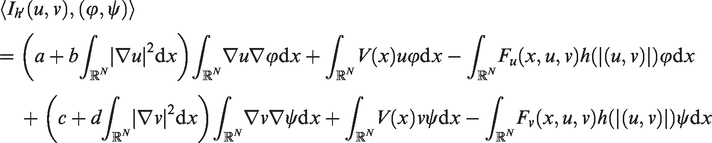
Noting that is a critical point of , we have
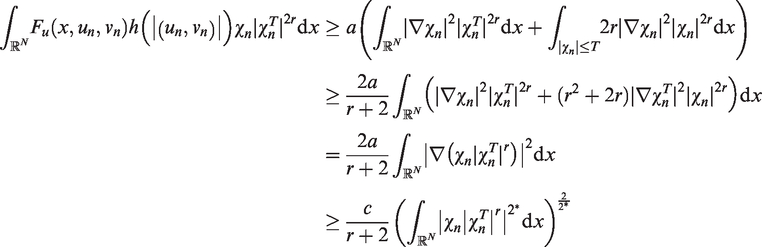
for any . Define and . For , taking as a test function in equation (3), we have
By , there exists constants such that
for and , which implies
Hence
Taking , one has
Let and . Then
Note that is convergent as . We obtain for some constant . Consequently, for large because of in . Hence
for large . Similarly, for large , which concludes
for large . The proof is completed.
Proof of Theorem 1. Obviously, the functional , is even under the assumption . By , we can choose small enough such that
for all , which shows
where is a constant. It can be deduced from the above inequality that is bounded from below and any PS sequence of is bounded in . Furthermore, satisfies the PS condition.
Now, we verify in Theorem 2. Indeed, for each , let be a dimensional subspace of . Then there exist dimensional subspaces of such that . Since all norms are equivalent in there exists a constant such that
for all .
Let and . By Lemma 4, there exists a positive integer such that for any with . Consequently
for with and . Thus, choosing and , we have and .
In view of Theorem 2, has a critical point sequence such that in and . By Lemma 5, up to a subsequence, for every and is a critical point sequence of . The proof is completed.
Conclusions
Low energy oscillators arise in many practical applications, which have been ignored by many researchers. Our paper shows that the low energy can induce various solutions, which might be dangerous to a structure or a machine, or a system. This paper sheds a new light on how to deal with small solutions of such systems.
Footnotes
Acknowledgements
The authors would like to thank the associate editor J.H. He and the anonymous reviewers for their valuable comments and constructive suggestions, which helped to enrich the content and considerably improved the presentation of this paper.
Declaration of conflicting interests
The author(s) declared no potential conflicts of interest with respect to the research, authorship, and/or publication of this article.
Funding
The author(s) disclosed receipt of the following financial support for the research, authorship, and/or publication of this article: The financial assistance received from Kunming University for the research work is duly acknowledged.
References
1.
ChakravertyS.Vibration of plates. Boca Raton: CRC Press, 2009.
2.
WangYAnJ-Y. Amplitude-frequency relationship to a fractional Duffing oscillator arising in microphysics and tsunami motion. J Low Freq Noise Vib Active Control. Epub ahead of print 28 August 2018. DOI: 10.1177/1461348418795813.
3.
StulovAKartofelevD.Vibration of strings with nonlinear supports. Appl Acoust2014;
76: 223–229.
4.
IssanchouCBilbaoSLe CarrouaJL, et al.
A modal-based approach to the nonlinear vibration of strings against a unilateral obstacle: simulations and experiments in the pointwise case. J Sound Vib2017;
393: 229–251.
5.
HorganCOChanAM.Vibration of inhomogeneous strings, roads and membranes. J Sound Vib1999;
225: 503–513.
6.
PeradzeJ.A Kirchhoff type equation in a nonlinear model of shell vibration, ZAMMZ. Z Angew Math Mech2017;
97: 144–158.
7.
KirchhoffG.Mechanik.
Leipzig:
Teubner, 1883.
8.
AlvêsCOCorreaFJSAMaTF.Positive solutions for a quasilinear elliptic equation of Kirchhoff type. Comput Math Appl2005;
49: 85–93.
9.
ChengBWuXLiuJ.Multiplicity of solutions for nonlocal elliptic system of (p, q) Kirchhoff type. Abstr Appl Anal2011;
2011: 1–13.
10.
HeXZouW.Infinitely many positive solutions for Kirchhoff-type problems. Nonlinear Anal2009;
70: 1407–1414.
11.
MaTFMuñoz RiveraJE.Positive solutions for a nonlinear nonlocal elliptic transmission problem. Appl Math Lett2003;
16: 243–248.
12.
MaoAZhangZ.Sign-changing and multiple solutions of Kirchhoff type problems without the P.S. condition. Nonlinear Anal2009;
70: 1275–1287.
13.
PereraKZhangZ.Nontrival solutions of Kirchhoff-type problems via the Yang index. J Differ Equ2006;
221: 246–255.
14.
WuX.High energy solutions of systems of Kirchhoff-type equations in. J Math Phys2012;
53: 1–18.
15.
ZhangZPereraK.Sign changing solutions of Kirchhoff type problems via invariant sets of descent flow. J Math Anal Appl2006;
317: 456–463.
16.
ZhouFWuKWuX.High energy solutions of systems of Kirchhoff-type equations on. Comput Math Appl2013;
66: 1299–1305.
17.
WuYHeJH.A remark on Samuelson’s variational principle in economics. Appl Math Lett2018;
84: 143–147.
18.
HeJH.An alternative approach to establishment of a variational principle for the torsional problem of piezoelastic beams. Appl Math Lett2016;
52: 1–3.
19.
HeJH.Generalized equilibrium equations for shell derived from a generalized variational principle. Appl Math Lett2017;
64: 94–100.
20.
LiuJWangYWangZ.Solutions for quasilinear Schrodinger equations via the Nehari method. Commun Partial Differ Equ2004;
29: 879–901.
21.
KajikiyaR.A critical point theorem related to the symmetric mountain pass lemma and its applications to elliptic equations. J Funct Anal2005;
225: 352–370.