




Abstract
During the dry spinning process for fabrication of cellulose acetate fibers, the moving jet is approximated as a string, and its vibration equation is established. The vibration frequency affects greatly the fiber’s mechanical property and crimp frequency. An experiment was carried out to verify the theoretical prediction.
Introduction
Cellulose diacetate (CA) fiber, which is widely used as cigarette tow, is commonly spun by the dry spinning. 1 The fiber’s cross-section is Y shape (Figure 1), which is produced through triangular nozzles on the spinneret. The nozzle shape affects the spinning process greatly and CA fiber’s morphology and its mechanical property as well. However, the cross-sectional X shape (Figure 2) of CA fiber used as cigarette tow has never been fabricated in any CA tow factories. The nozzle shape plays an important role in CA fiber’s morphology and its mechanical property. Much research has been carried out numerically, theoretically and experimentally to optimize nozzle’s structure.2–4
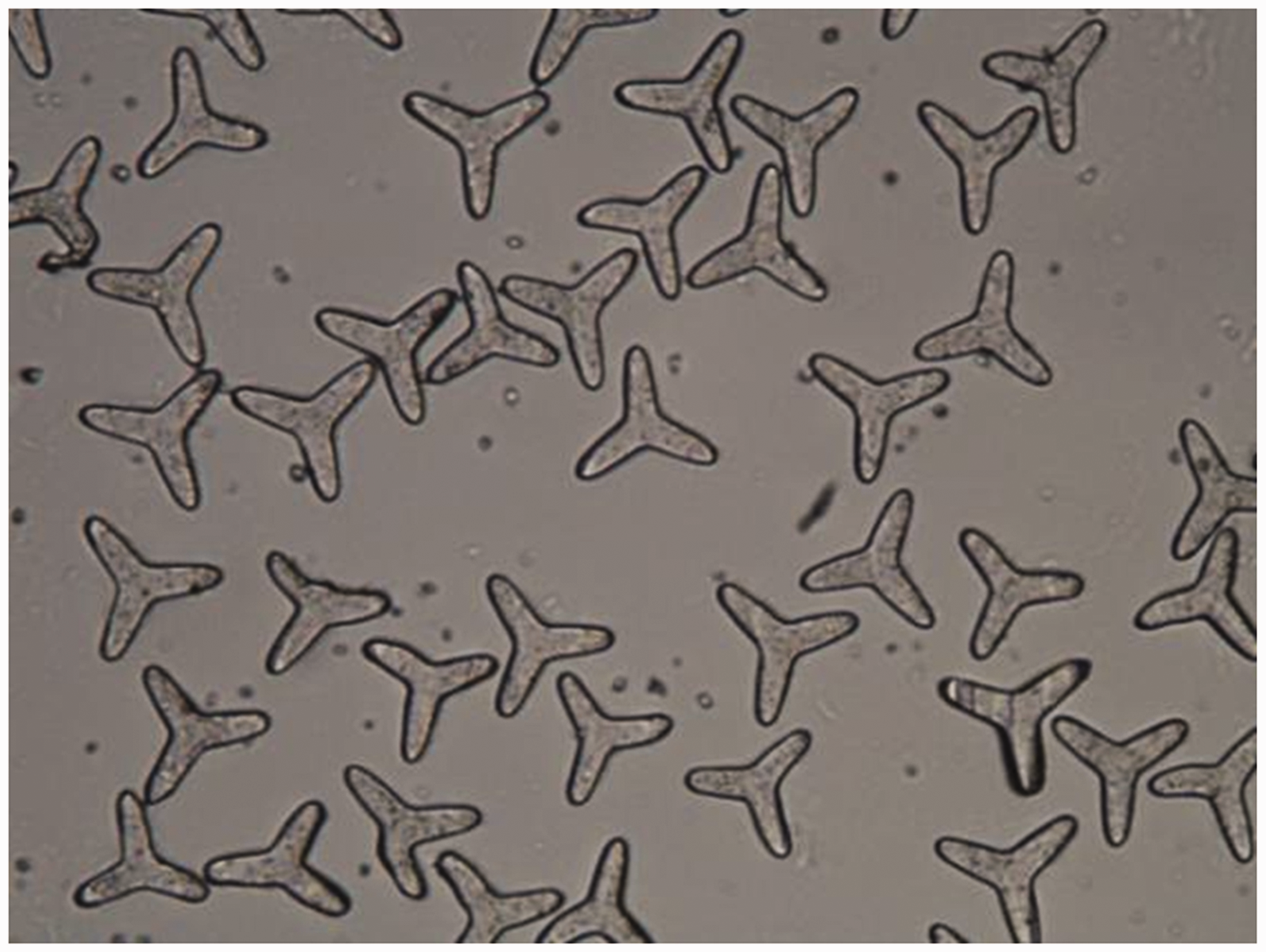
Y cross-sectional shape of CA fiber.
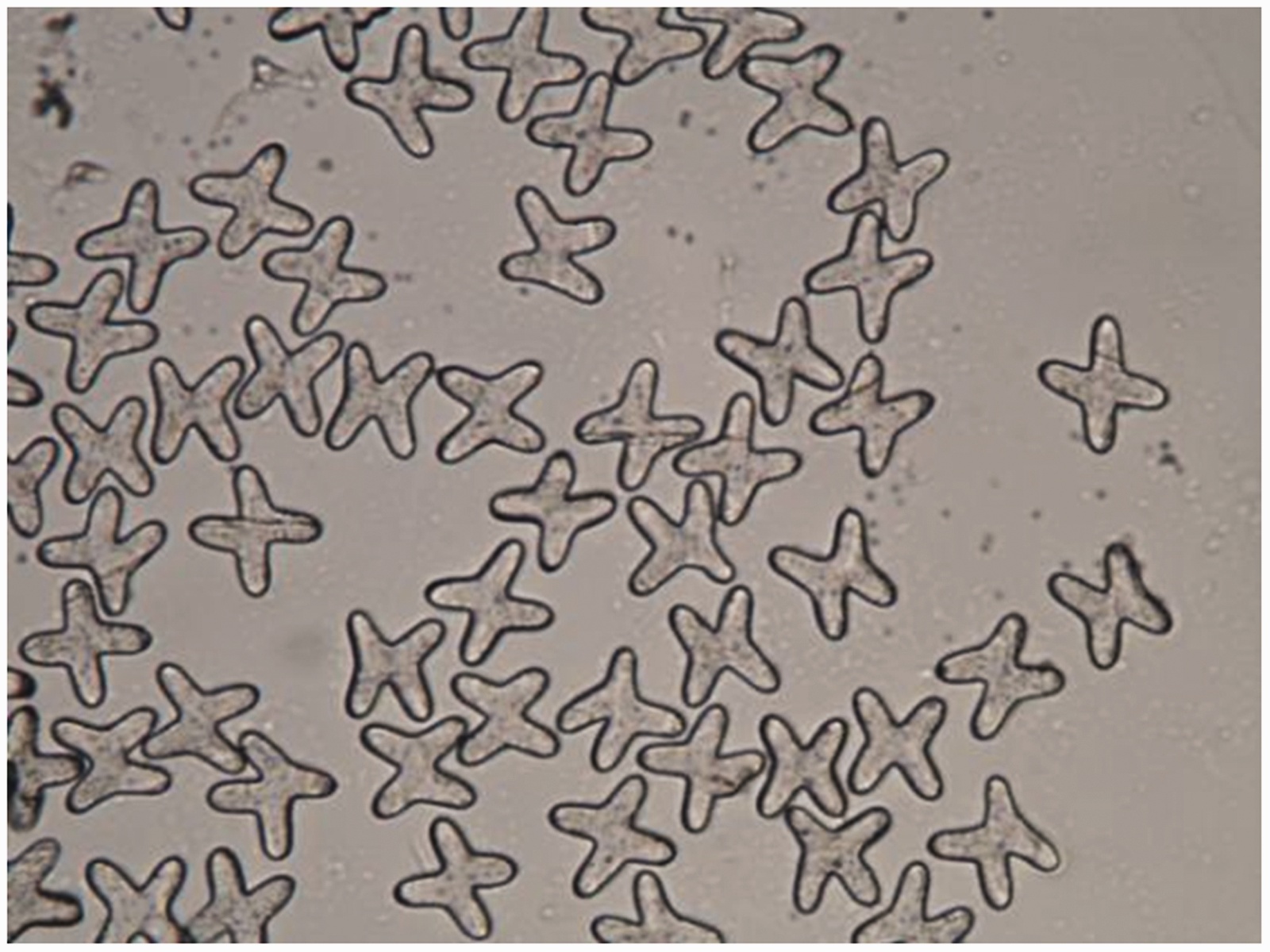
X cross-sectional shape of CA fiber.
Spinning principle
There are four spinning methods to produce CA fibers; they are the melt spinning, the dry spinning, the dry-jet wet spinning, and the electrospinning. The dry spinning is widely used in CA tow factories for mass production of CA fibers as filterable materials in cigarette, while the electrospinning is used to fabricate nanoscale CA fibers,5,6 due to its limited output, the electrospinning technology is very difficult for industrial application. The bubble electrospinning7–16 is the best candidate for mass production of CA nanofibers.
During the dry spinning process (see Figure 3), the CA dope, which is a solution of cellulose acetate in acetone, is extruded from the spinneret at the top of the spinning column and then drawn down by the feed roller at the bottom of the column. In the spinning cabinet, the moving jets are gradually solidified into CA fibers due to solvent evaporation through hot air as illustrated in Figure 3.
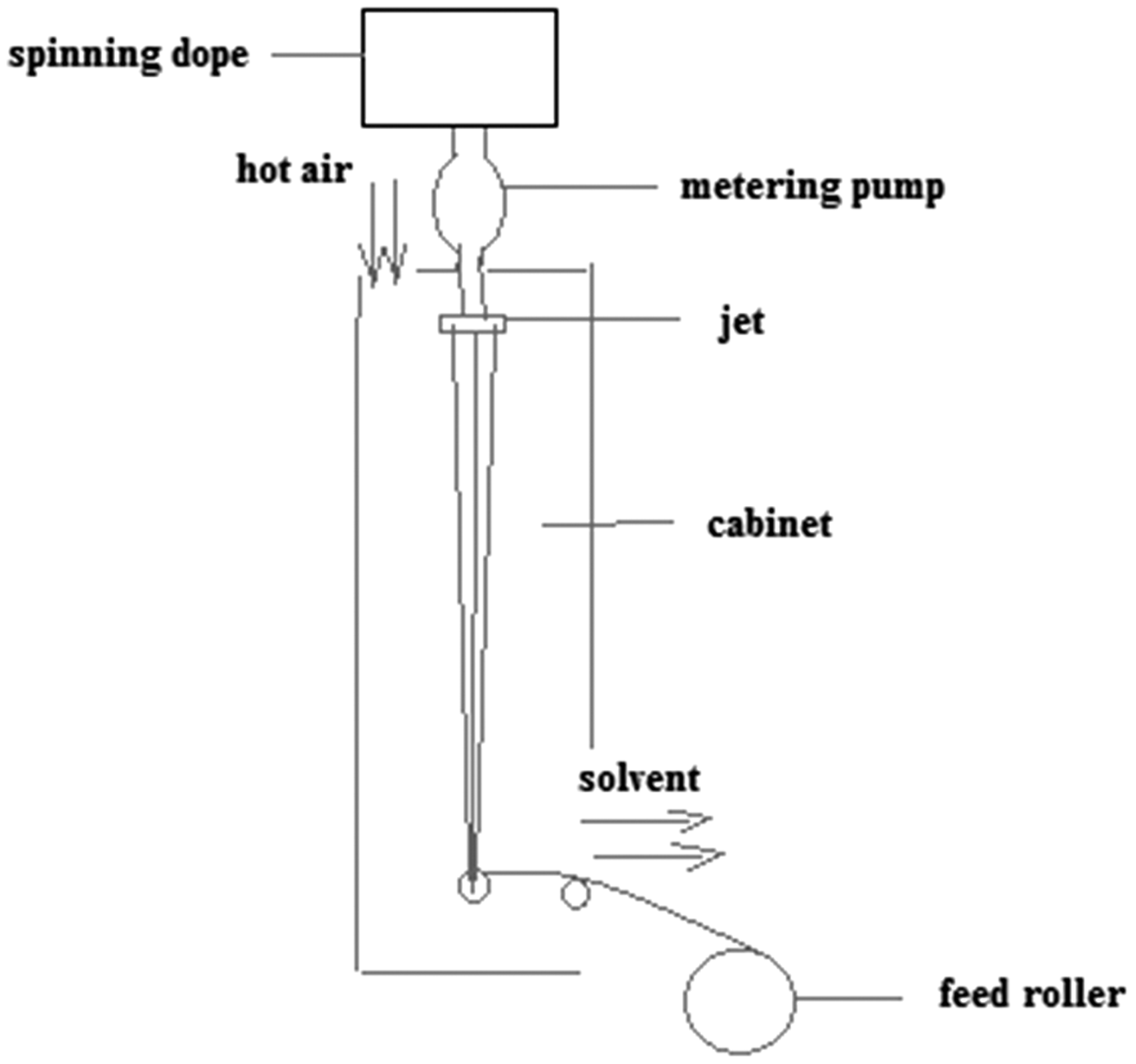
The dry spinning for fabrication of CA fibers.
Vibration of the moving jet
As illustrated in Figure 3, the multiple jets extruded from the spinneret are viscoelastic flow at the initial stage, which is gradually solidified after solvent evaporation.17,18 Similar to the transverse vibration of an axially moving slender fiber,19–22 in our study, a string-like vibration is considered for the moving jet in the spinning process; its vibration equation can be written as

Assuming that T keeps unchanged during the spinning process, equation (1) becomes

The solution of equation (2) is assumed to have the form

In view of equation (3), we re-write equation (2) in the form

Using the Galerkin approximation


We re-write equation (6) in the form

This is a linear oscillator with frequency

The principal shape frequency (see Figure 4) can be written as


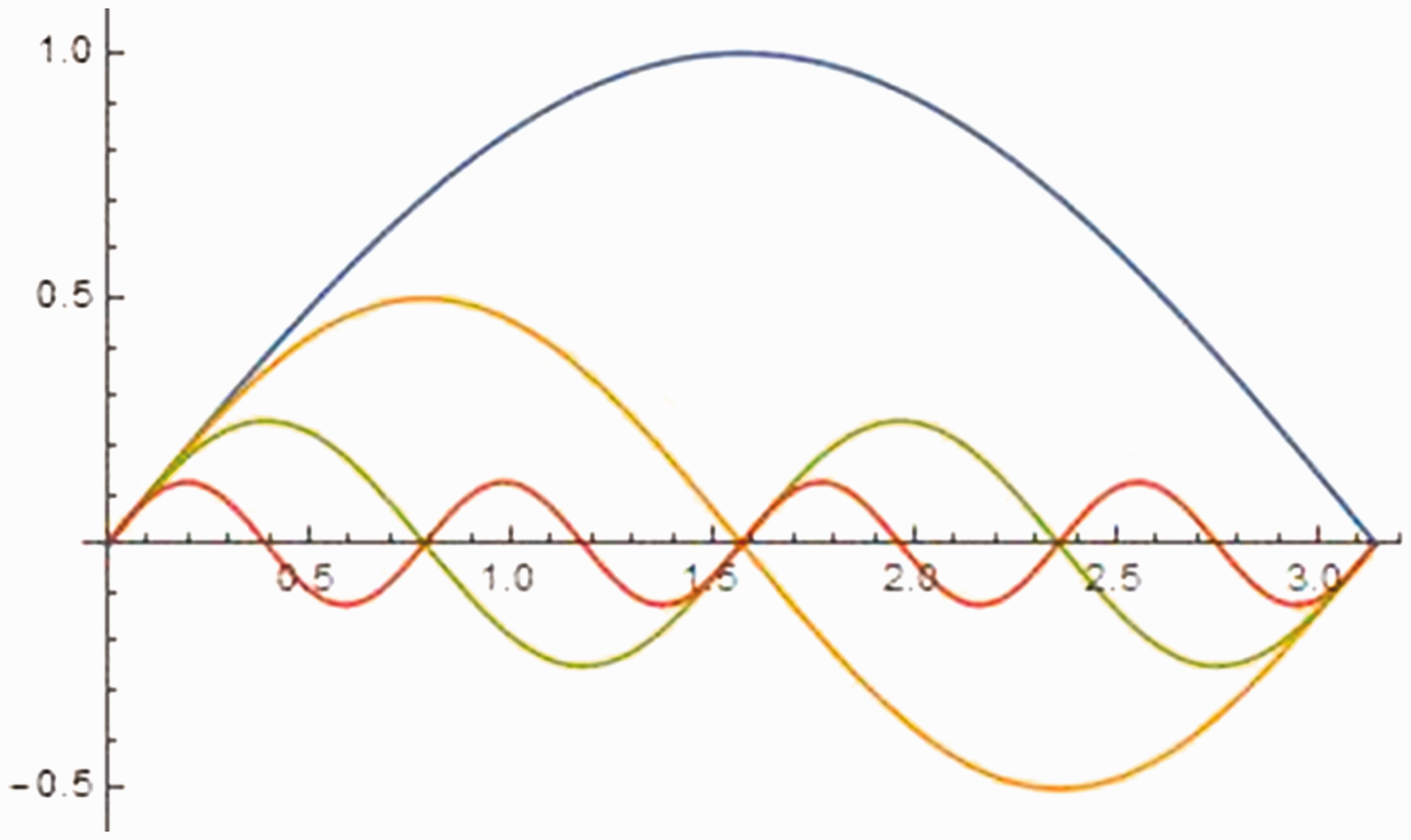
The shape frequencies.
Equation (8) becomes

During the spinning process, the mass conservation ignoring solvent evaporation requires that

Considering the mass equation given in equation (12), we re-write equation (11) in the form

The vibration displacement can be obtained as

Experiment and theoretical verification
In this experiment, different nozzle shapes were used including regular triangle, obtuse triangle, circle, square, and rectangle. The nozzle shape greatly affects the morphology of the CA fibers and their mechanical property. Figure 5 are photos of CA fibers produced by different nozzles.
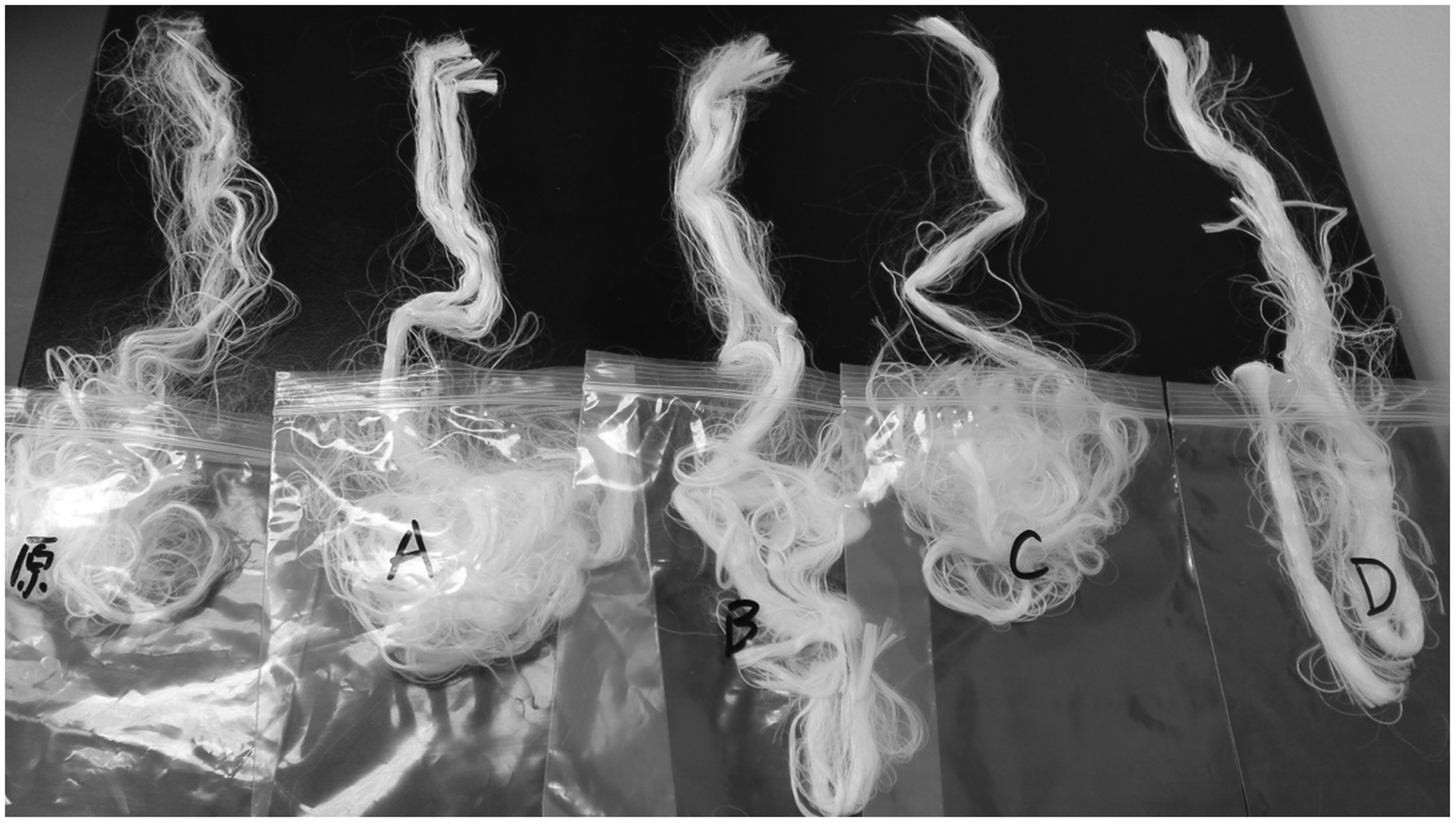
Production samples produced by different nozzles, from left to right: regular triangle, obtuse triangle, circle, square, and rectangle.
Generally the largest elongation of the CA fiber is inversely proportional to


Equation (16) implies that a smaller fiber radius results in a larger elongation of the CA fiber. Table 1 gives the experimental data with different nozzle shape. In Table 1 we can see that the CA fiber’s fiber fineness for two samples produced by rectangle nozzle are, respectively, about 7 dtex and 8.5 dtex, that means the fiber diameters:
Effect of nozzle shapes and CA fiber diameter on mechanical properties.

For different CA fiber sections, we have different moments of inertia

In our experiment, the section areas of CA fibers are same for all samples. Among all section shapes, cylindrical fibers have minimal moment of inertia. The nozzle with the regular triangle shape or rectangle shape will produce Y or X shape fibers as illustrated in Figures 1 and 2, respectively. The X shape fiber has smaller moment of inertia than that of the Y shape fiber, according to equation (17), it has a higher a larger elongation as illustrated in Table 1.
The crimple frequency given in Table 1 is the crimp number in the length of 25 mm. The crimple frequency ( f) scales with 

So the fiber fineness affects little on the crimp frequency.
Discussions and conclusions
For the first time ever, this paper uses the vibration theory to study the spinning process and fiber’s property. Our theoretical approach is generally valid for all spun solutions.
In this paper, we consider the moving jet in the spinning process as a string, and a vibration equation is established to elucidate the main factors that affect the vibration frequency, which plays an important role in fiber’s morphology and mechanism. Our experiment shows that the shape of nozzle will greatly affect the fiber’s section shape, a triangle nozzle results in Y shape fibers, while the rectangle nozzle produces X shape fibers. The different fiber sections have different moments of inertia, which affects fiber’s mechanical property as well. This paper is a preliminary study for the string-like vibration of a moving jet. A more sophisticated model is needed to exactly study the jet vibration, and the nonlinear system has to be solved by the homotopy perturbation method,23–26 and the frequency-amplitude relation becomes much more complex than that discussed in literature. 27
This is a preliminary theoretical analysis on the effect of vibration on the spinning process. To become a fully developed theory, much work including theory and experiment is strongly needed in future.
Footnotes
Declaration of conflicting interests
The author(s) declared no potential conflicts of interest with respect to the research, authorship, and/or publication of this article.
Funding
The author(s) disclosed receipt of the following financial support for the research, authorship, and/or publication of this article: The work is supported by China National Tobacco Company (CNTC) China Tobacco Office (2016) no. 259, Priority Academic Program Development of Jiangsu Higher Education Institutions (PAPD), National Natural Science Foundation of China under grant no. 11372205.