Ultralow-frequency dust acoustic waves in plasma are an important branch of study in plasma physics. Due to the important application of dust acoustic waves in the space environment, industrial processing, and the laboratory, they have aroused great interest in physics and other disciplines. In this paper, dust acoustic waves in dust plasma containing double-temperature ions are studied. According to the equations of dust plasma motion considering the higher order perturbation factors, the (3 + 1)-dimensional Kadomtsev–Petviashvili equation is derived by using multiscale analysis and reduced perturbation methods. The result is a three-dimensional model describing the propagation of waves in space. Compared with the low-dimensional model, this model is more closely aligned with the actual physical situation. Further, to better comprehend the propagation features of dust acoustic waves in plasmas, with the help of the semi-inverse method and the fractional variational principle, the (3 + 1)-dimensional time-space-fractional Kadomtsev–Petviashvili equation is deduced. At the same time, based on the Lie symmetry analysis method, the conservation laws of the time-fractional Kadomtsev–Petviashvili equation are discussed, and the conserved quantities of dust acoustic waves in dual-temperature plasma are obtained. Finally, by virtue of the fractional subequation method, three types of exact analytical solutions of fractional Kadomtsev–Petviashvili equations are given. Drawing on the chirp concept in optical soliton communication, the chirp effect of ultralow-frequency dust acoustic waves is discussed, and the effects of dust temperature, ion temperature, and fractional order on dust acoustic waves in a dual-temperature plasma are studied using the analytical solutions.
In 1929, Langmuir and Tonks introduced the word “plasma” for the first time to indicate the fourth state of matter. Plasma is an ionized gas-like substance comprising atoms and atoms that are deprived by partial electrons and positive and negative electrons generated by ionization. Humans gained an understanding of plasma much later than they did for the other three states of matter. Since the 1950s, plasma physics has matured with the help of controlled thermal fusion research and space technology. In the late 1970s, plasma physics became a new independent branch of physics recognized by the physics community. In recent years, plasma physics has become an important area for human beings to understand and control changes in the global environment and to maintain global communications. For this reason, plasma physics has received increasingly more attention.
To date, various characteristics of ordinary plasma have been extensively studied. However, with the rapid development of science and technology, complex plasmas have emerged. A special aspect of dust plasma compared to ordinary plasma is the presence of dust particles. It is precisely because of this feature that dust plasma exhibits new characteristics that are quite different from ordinary plasma and presents many new physical phenomena. Dust plasma is widely used in the field of cosmology, industrial processing, laboratories, etc. Due to its importance, many scholars have been involved in dust plasma physics since the mid-1990s. In the following decade, dust plasma research developed rapidly, forming a new branch in the plasma discipline.
Collective fluctuations and instability are among the most studied topics in dust plasma physics. In addition to the fluctuation pattern in ordinary plasma, dust plasma also has ultralow-frequency dust acoustic waves oscillating on a time scale of the dust particle movement. This property is because the presence of dust particles can significantly alter the nature and behavior of the plasma into which they are immersed, affecting various plasma fluctuation patterns and producing new, very-low-frequency fluctuation patterns. The dust sound wave was first predicted by Rao et al.1 in 1990. Barkan first confirmed it experimentally in 1995. Since then, interest in the study of dust sound waves and instability has intensified.
In an earlier study, Ghosh et al.2 used a (1 + 1)-dimensional model to study the effect of nonadiabatic dust charge changes in nonlinear dust ion acoustic waves in collision-free dust plasmas. Kadomtsev and Petviashvili3 attempted to describe solitons in (2 + 1) dimensional systems by applying the Kadomtsev–Petviashvili (KP) equation. Subsequently, Duan4 used the reduced perturbation method to derive the (2 + 1)-dimensional KP equation of the nonmagnetized hot dust plasma, which indicates that the nonlinear dust acoustic waves in the hot dust plasma are stable. Gill et al.5 considered the variable dust charge and two-temperature ions to derive the (2 + 1)-dimensional KP equation for the dust plasma in the same way. Pakzad6 studied the propagation of nonlinear waves in a warm dust plasma with variable dust charge, two-temperature ions, and nonthermal electrons based on the KP equation. Saini et al.7 analyzed and numerically discussed the characteristics of dust acoustic solitary waves in dust plasma systems composed of dust fluids and superheated electrons and ions. However, in reality, waves propagate in three-dimensional space. One- and two-dimensional models are limited in solving some practical problems involving dust acoustic waves, which require us to consider a higher dimensional model.
On the other hand, with the development of nonlinear science,8,9 fractional calculus theory has received increasingly more attention. In particular, fractional differential equations abstracted from practical problems have become research hot spots.10,11 However, in the study of some practical problems, most studies have established integer-order models12–15; fractional-order models are few in number. Due to the presence of dispersion and/or dissipation forces, the physical process is nonconservative in the actual plasma system. The classical processing of forces is achieved with an integer-order difference equation, which means that these conservative descriptions are not convenient for dealing with nonconservative physical processes. Therefore, it is necessary to establish a fractional-order model to study dust acoustic waves.
The conservation law16–18 plays a very important role in the study of nonlinear physical phenomena. The symmetry analysis of fractional differential equations19,20 has aroused great interest among researchers. The Lie symmetry analysis method was first introduced by the Norwegian mathematician Lie21 at the end of the 19th century. Noether’s theorem22 famously establishes a relationship between the conservation laws of symmetric and differential equations. Previously, researchers studied the conservation laws of integer-order equations. Only a few scholars have discussed the conservation laws of fractional-order equations.
The solution of nonlinear partial differential equations23–26 has become an indispensable method for mathematics and physics researchers to study nonlinear problems. As fractional differential equations are gradually used to solve problems in optical, thermal, and mechanical systems, the solution of fractional differential equations27,28 has attracted increasingly more attention. The methods for solving fractional differential equations29–31 have also gradually matured, such as the extended Kudryaskov method,32 the method,33 and the monotone iterative method.34 In this paper, the fractional subequation method35 is adopted to derive the exact solutions of the (3 + 1)-dimensional time-space-fractional Kadomtsev–Petviashvili (TSF-KP) equation. The acquisition of the exact analytical solution lays the theoretical foundation for further research on the properties of dust acoustic waves.
The rest of this article is organized as follows. In the next section, based on the dust particle motion equation, the (3 + 1)-dimensional integer-order KP equation is derived using multiscale analysis and perturbation expansion methods.36,37 By virtue of the semi-inverse method and the fractional variation principle,38,39 the integer-order KP equation is transformed into a TSF-KP equation. Then, based on the Lie symmetric analysis method, the conservation laws of the time-fractional KP equation are discussed, and the conserved quantities of the dust acoustic waves during propagation are obtained. Next, the three types of exact analytical solutions of the fractional KP equations are given by the fractional subequation method. Finally, with the help of the exact solutions of the (3 + 1)-dimensional TSF-KP equation, the chirp effect of dust acoustic waves is studied. The effects of dust temperature, ion temperature, ion number density, and fractional order on the characteristics of dust acoustic waves are discussed.
Derivation of the (3 + 1)-dimensional KP equation
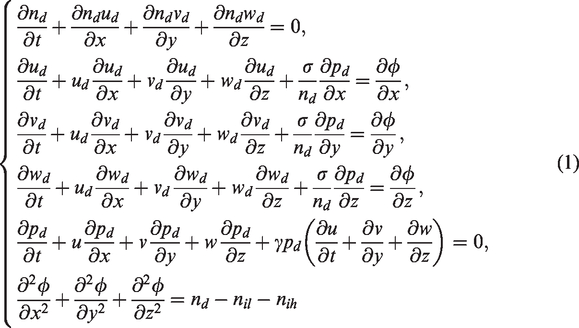
To study ultralow-frequency dust sound waves in dual-temperature dust plasma, we assume that the dust plasma is nonmagnetized, that the sound wave propagates along the x direction, and that the high-order transverse perturbations in the y and z directions are weak. The dual-temperature dust plasma studied in this paper consists of three parts: negatively charged dust particles, low-temperature ions, and high-temperature ions. Dust plasma is electrically neutral under the equilibrium conditions of , where Zd is the number of charges of the undisturbed dust particles, and , and represent the number density of the low-temperature ions, high-temperature ions, and dust particles, respectively. The dynamic behavior of the dust particles is determined by the continuity equation and the momentum equation, and the dimensionless governing equation is as follows
where the particle number density nd is normalized by , the pressure pd is normalized by , Td is the dust temperature, the spatial coordinates (x, y, z) are normalized by the equivalent Debye length , the time t is normalized by the reciprocal of the equivalent dust plasma frequency , the speeds are normalized by the equivalent speed of sound , and the potential is normalized by . is the equivalent temperature, ν and μ are the number density of the nondimensionalized high- and low-temperature ions, respectively, Tl and Th are the temperature of the high- and low-temperature ions, and the ratio between the dust temperature and equivalent temperature is in the case of adiabatic γ = 3.
The number densities of the low- and high-temperature ions satisfy the Boltzmann distribution
where and .
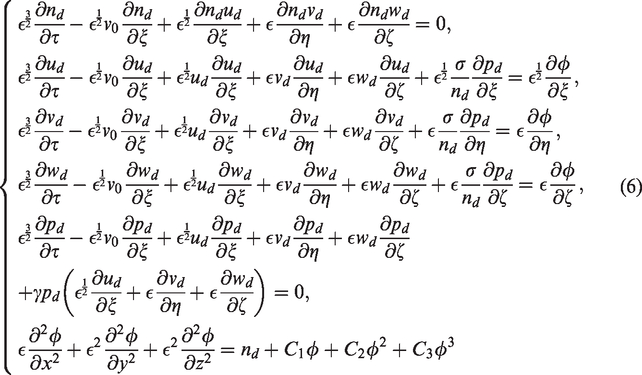
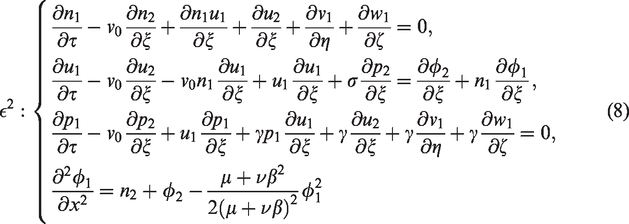
To obtain the KP equation, multiscale analysis and perturbation expansion are used. The independent variables are stretched as
where ϵ represents a small parameter of nonlinear strength, v0 is the speed of the nonlinear dust sound waves, which is dimensionless by Cd. According to equation (3) we have
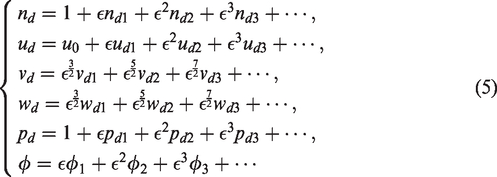
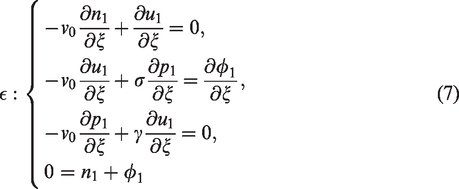
The dependent variables , and are expanded as follows
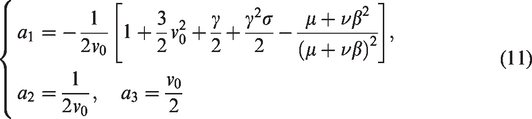
Remark:a1 is the nonlinear coefficient, and a2 and a3 are dispersion coefficients. Assuming there is no high-order lateral disturbance, equation (12) is the KdV equation. Compared with the lower dimensional model, equation (12) is more in line with the actual situation.
Derivation of the (3 + 1)-dimensional TSF-KP equation
Based on the above section, we obtain the (3 + 1)-dimensional KP equation. However, with the development of scientific research, the integer-order model is insufficient for studying the problems in the real world. Fractal calculus40 and fractional calculus41-42 have become hot spots in mathematics and engineering. In 1998, He studied the analytical method of fractional percolation model of porous media,43 and we can see the significance of studying fractional percolation model. To deeply study the ultralow-frequency dust acoustic waves in dust plasma, in this section, we use the semi-inverse method and the fractional variation principle to derive the (3 + 1)-dimensional TSF-KP equation.
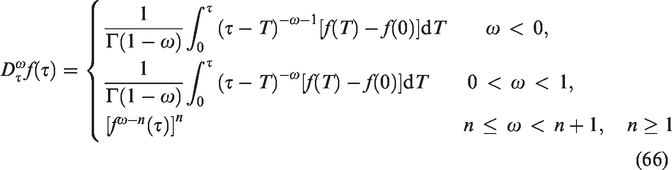
The fractional derivatives are defined as follows:
Definition 1.39 The Riemann–Liouville fractional derivative operator of a function is defined as
Definition 2.39 The modified Riemann–Liouville fractional derivative operator of a function is defined as
In addition to the above definitions, He’s fractional derivative and Caputo’s definition are also frequently used and their definition are as follows:
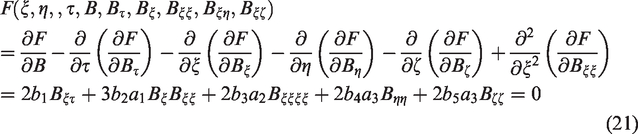
Letting and substituting it into equation (30), we obtain the following equation
Finding the fractional derivative of equation (31), we obtain
Remark:Equation (31) is the (3 + 1)-dimensional TSF-KP equation. When , equation (30) is the integer-order (3 + 1)-dimensional KP equation. Therefore, the fractional model can better describe the propagation of dust sound waves in space.
Conservation laws of (3 + 1) dimensional time-fractional KP equation
To further study the properties of fractional-order models, we study the symmetry and conservation laws of the (3 + 1)-dimensional time-fractional KP equations.
Lie symmetry analysis
The (3 + 1)-dimensional time-fractional KP equation is as follows
Equation (31) is transformed into the form of a fractional partial differential equation as shown below
We consider that equation (4) is invariant under the following one-parameter Lie group of point transformations
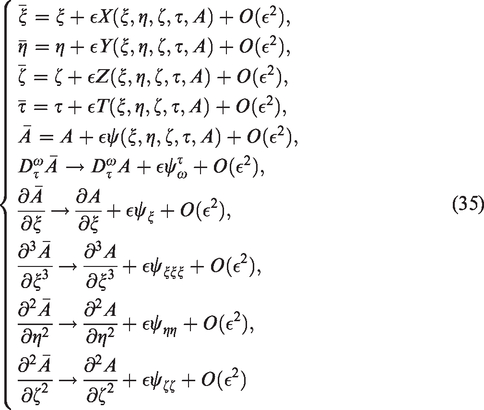
where is the group parameter, ξ, ζ, ψ, τ, η are the infinitesimals of the transformations. The expressions are as follows
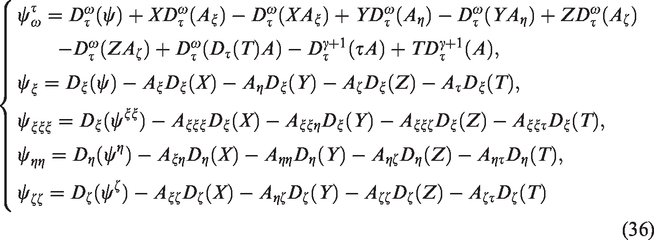
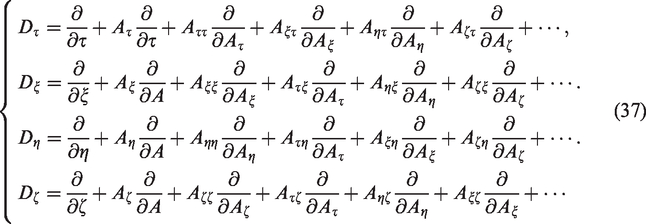
where is the total fractional derivative operator. , and are the total differentiation of τ, ξ, η, and ζ, respectively, and their definitions are as follows
Here, we give the definition of the generalized Leibnitz rule45 as follows
where
Applying the generalized Leibnitz rule, we have
The chain rule for a compound function46 is defined as
According to equations (38) and (41), when f(t) = 1, we can obtain
Using the second prolongation of equation (33), we can obtain the following invariance criteria
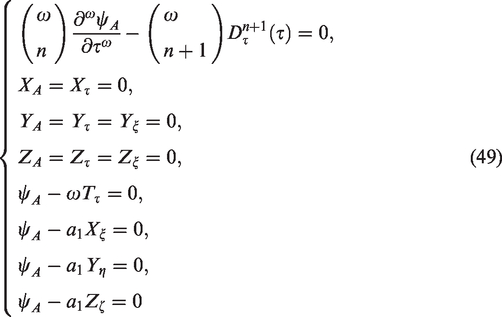
By substituting equations (36) and (44) into equation (48) and setting each individual coefficient equal to 0, the following set of equations can be obtained
By solving equation (49), we have following infinitesimals
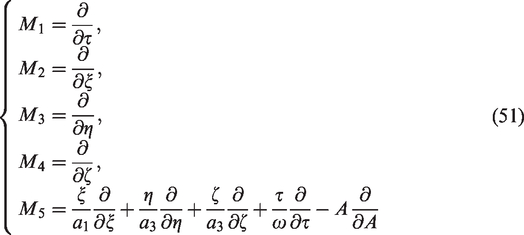
Therefore, the infinitesimal symmetric Lie algebra of equation (33) is spanned by the following infinitesimal generators
Conservation laws
Based on the Lie symmetry analysis method, we study the conservation law of the (3 + 1)-dimensional time-fractional KP equation. The conservation law of equation (33) satisfies the following equation
where , and are the conserved vectors.
A formal Lagrangian of equation (33) can be written in the following form
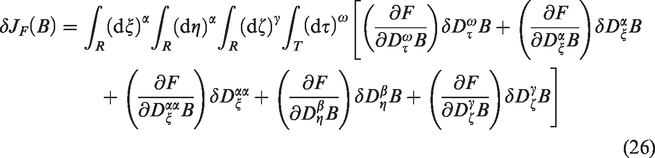
where is a new dependent variable. According to equation (53), an action integral is defined as follows
The Euler–Lagrangian operator is defined as
where is the adjoint operator of , which is defined as follows
where is the right-sided fractional integral operator and is the right-sided Caputo fractional differential operator.
Therefore, we take the adjoint equation of equation (33) as the Euler–Lagrange equation, given by
According to the Riemann–Liouville fractional derivative, the component of conserved vectors is defined as
where is defined as
is defined as
where .
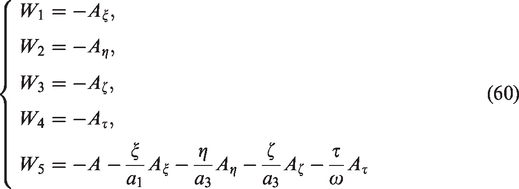
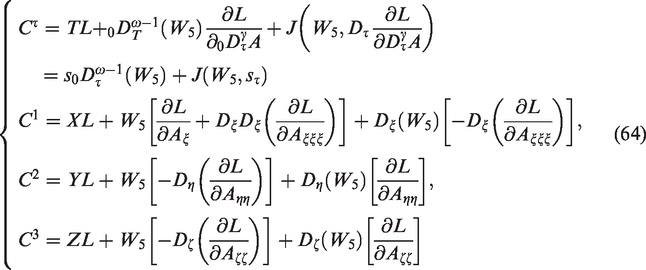
Using W5 as an example to calculate the conserved vector of equation (31) by the above definition, we have
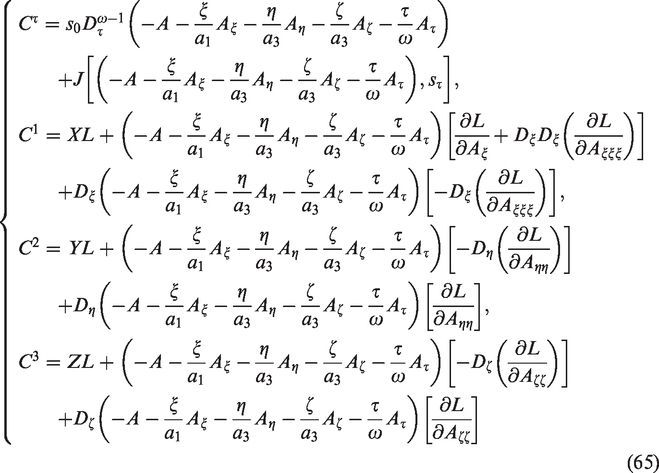
The above equations can be expressed as
Remark: We have obtained a conservation law of W5. Similarly, we can calculate the conservation laws of W1, W2, W3, W4, which are omitted here.
Solution of (3 + 1)-dimensional TSF-KP equation
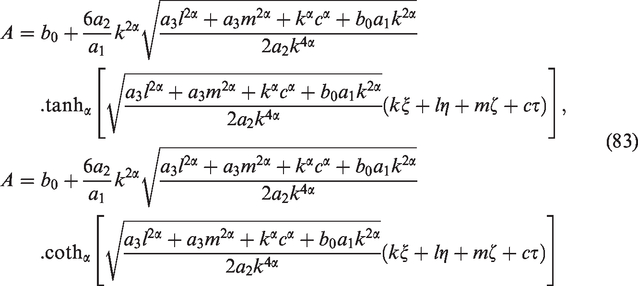
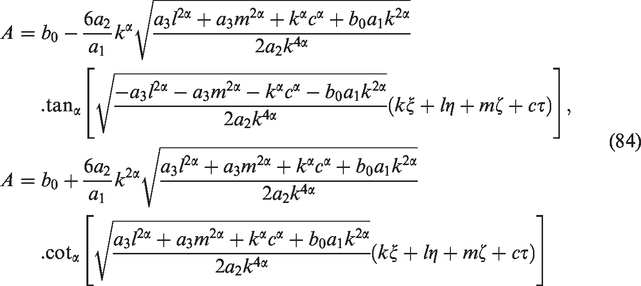
In this section, we use the fractional subequation method to solve the (3 + 1)-dimensional TSF-KP equation and obtain three types of exact solutions.47
Introduction of method
Jumarie’s modified Riemann–Liouville derivative is defined as follows
Some properties of the modified Riemann–Liouville derivative48 are as follows
Step 1
Consider a fractional differential equation given by
where and are Jumarie’s modified Riemann–Liouville derivatives, and is an unknown function.
Step 2
By using the following traveling wave transformation
where k and c are constants, equation (68) is simplified to the following nonlinear fractional ordinary differential equation
where are constant and satisfies the following Riccati equation
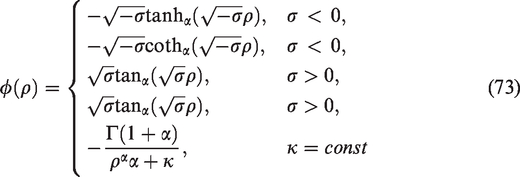
where σ is a constant. The following solution of equation (72) is obtained by using the generalized Exp-function method via Mittag-Leffler functions
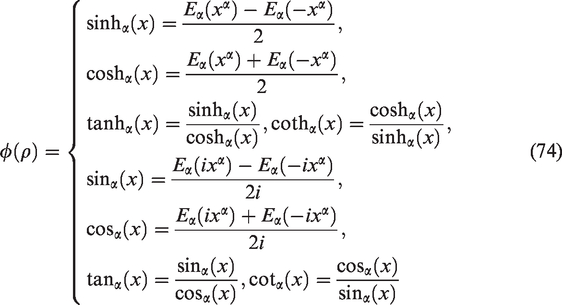
where the generalized hyperbolic and trigonometric functions are defined as
where is the Mittag-Leffler function, which is defined as follows
Step 4
Bringing equations (71) and (72) into equation (70) to obtain a polynomial for and setting all coefficients of (i = 0, 1, 2, …) equal to zero, a set of overdetermined nonlinear algebraic equations for , k, and c are obtained.
Step 5
By solving the equations in step 4, the constants , k, and c are obtained. Substituting these constants and the solutions of equation (72) into equation (71), we can obtain the explicit solutions of equation (68).
Application of the method
The (3 + 1) dimensional TSF-KP equation is as follows
First, through the following traveling wave transformation
Equation (76) changes into a nonlinear fractional-order ordinary differential equation
We suppose equation (76) has the following solution form
where satisfies the following equation
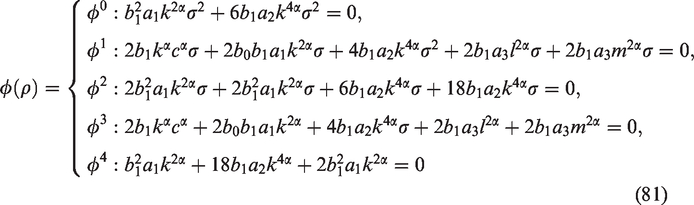
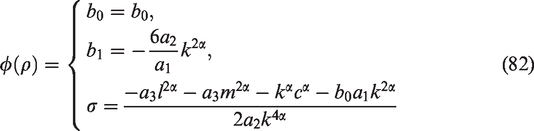
Substituting equations (77), (79), and (80) into equation (78) and then setting all coefficients of (i = 0, 1, 2, 3, 4) to zero, we obtain the following set of algebraic equations for
Suppose equation (86) has the following form of solution
where p, q, s, and d are positive integers, and an and bm are unknown constants. In order to determine the value of p, q, s, and d, the lowest order linear term of equation (86) is balanced with the lowest order nonlinear term.
So both of these methods translate the fractional-order equation, but the difference is fractional subequation method turns the fractional-order equation into nonlinear fractional ODE, the Exp-function method turns the fractional-order equation into nonlinear ODE. The two methods assume different forms of the solution, so some new solutions can be found in the exponential method.
Remark: As α = 1, the solution obtained above can be used as the solution of the integer-order KP equation. The acquisition of the exact solution lays a theoretical foundation for further study of the dust sound waves in the dual-temperature dust plasma.
Chirp effect of dust acoustic waves
In optical soliton communication, the chirp effect refers to the phenomenon of the center wavelength shifting during pulse transmission. Drawing on that idea, in this section, we study the chirp effect of the dispersion and nonlinearity of the KP equation describing dust acoustic waves.
For the TSF-KP equation, taking the fractional order as α = 1, the equation can be rewritten as
where a1 is the nonlinear coefficient, and a2 and a3 are dispersion coefficients.
First, we consider the effect of the nonlinearity on the dust sound waves separately. The equation is written as
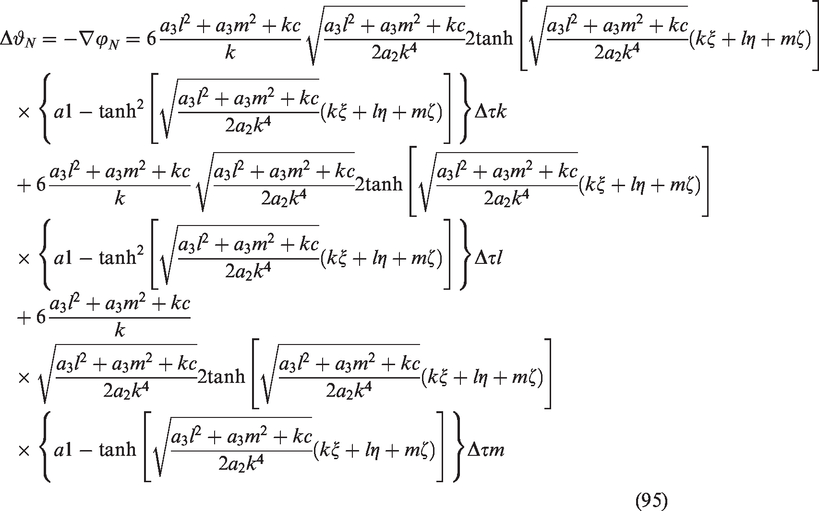
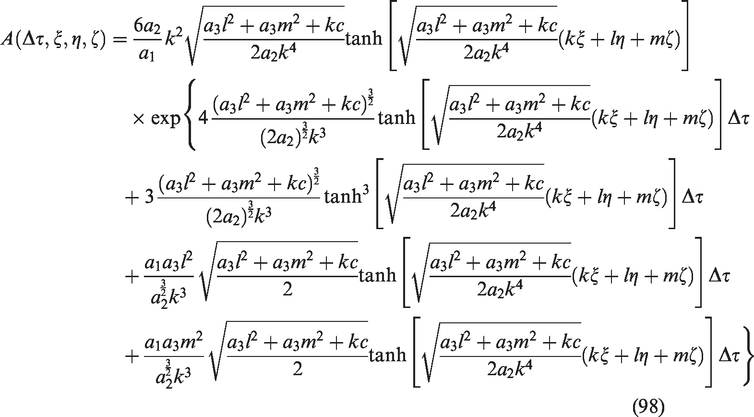
Investigating the condition of time τ from 0 to , where is an infinitesimal variable, and applying equation (91), the approximate solution of equation (92) is
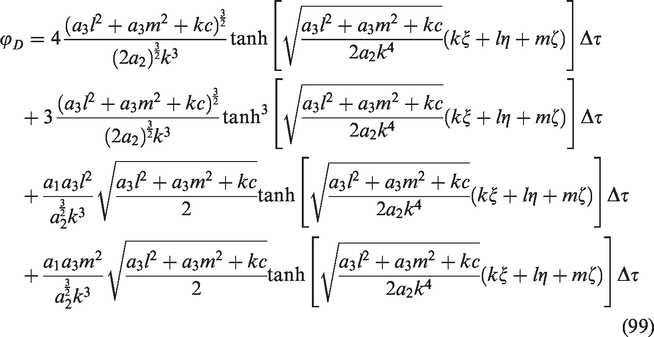
The phase of the wave is
The chirp caused by the nonlinearity is
Second, we consider the effect of dispersion on dust sound waves separately. The equation is as follows
Using the same method, we can obtain the approximate solution of equation (97) as follows
The phase of the wave is
The chirp caused by the dispersion is
are explained in detail in the later section (see Appendix 1).
According to equations (99) and (100), the whole chirp is as follows
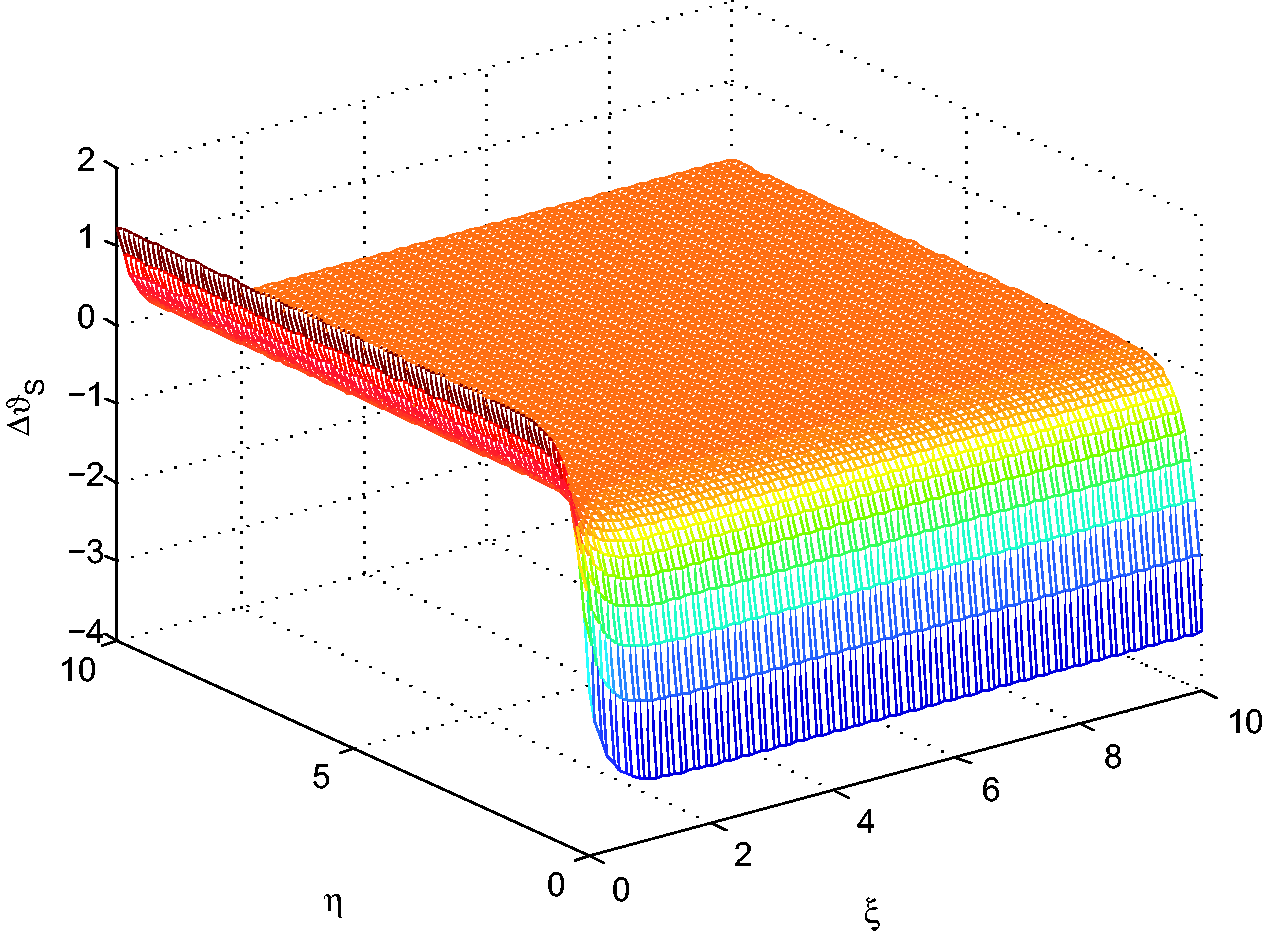
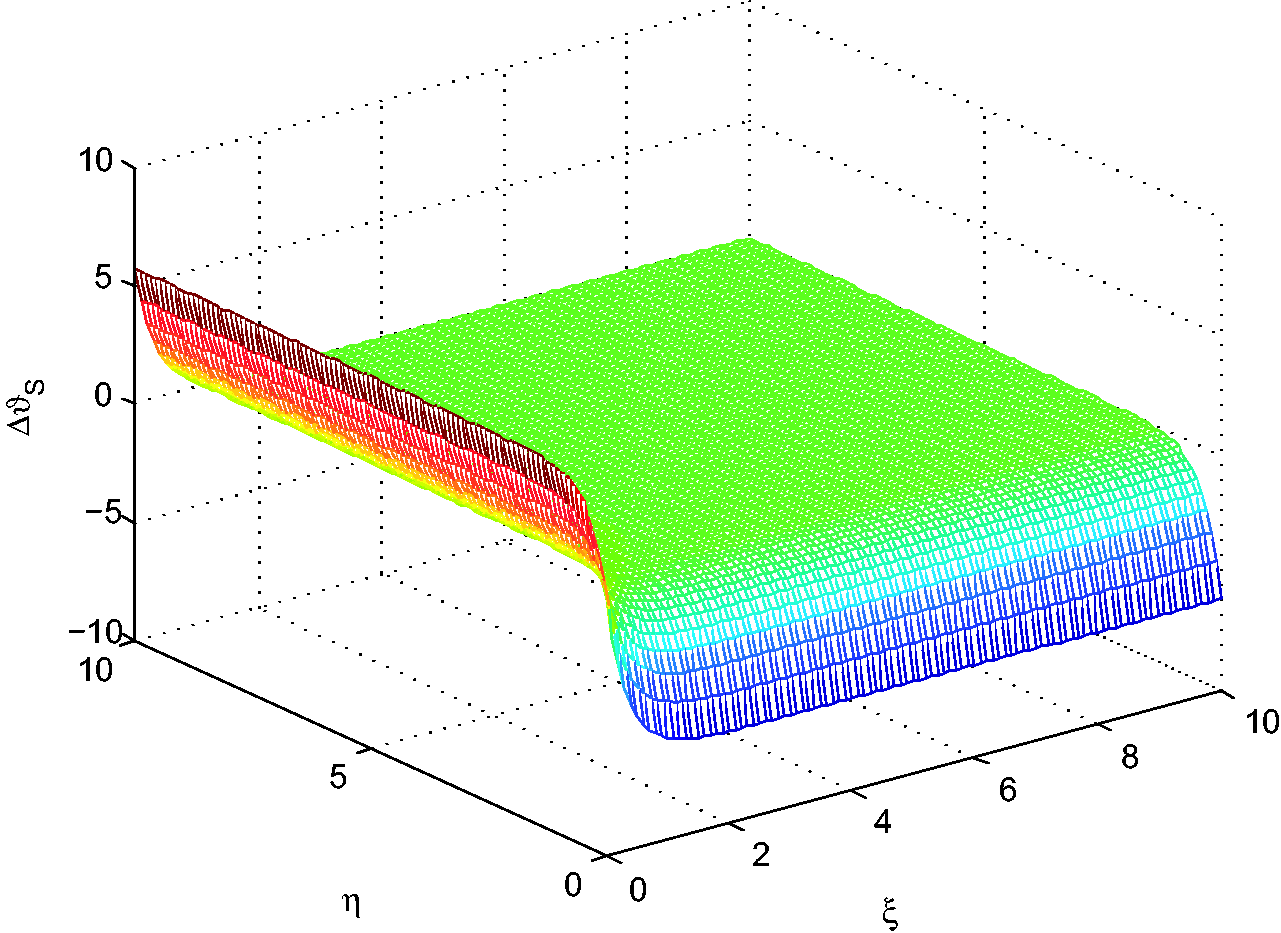
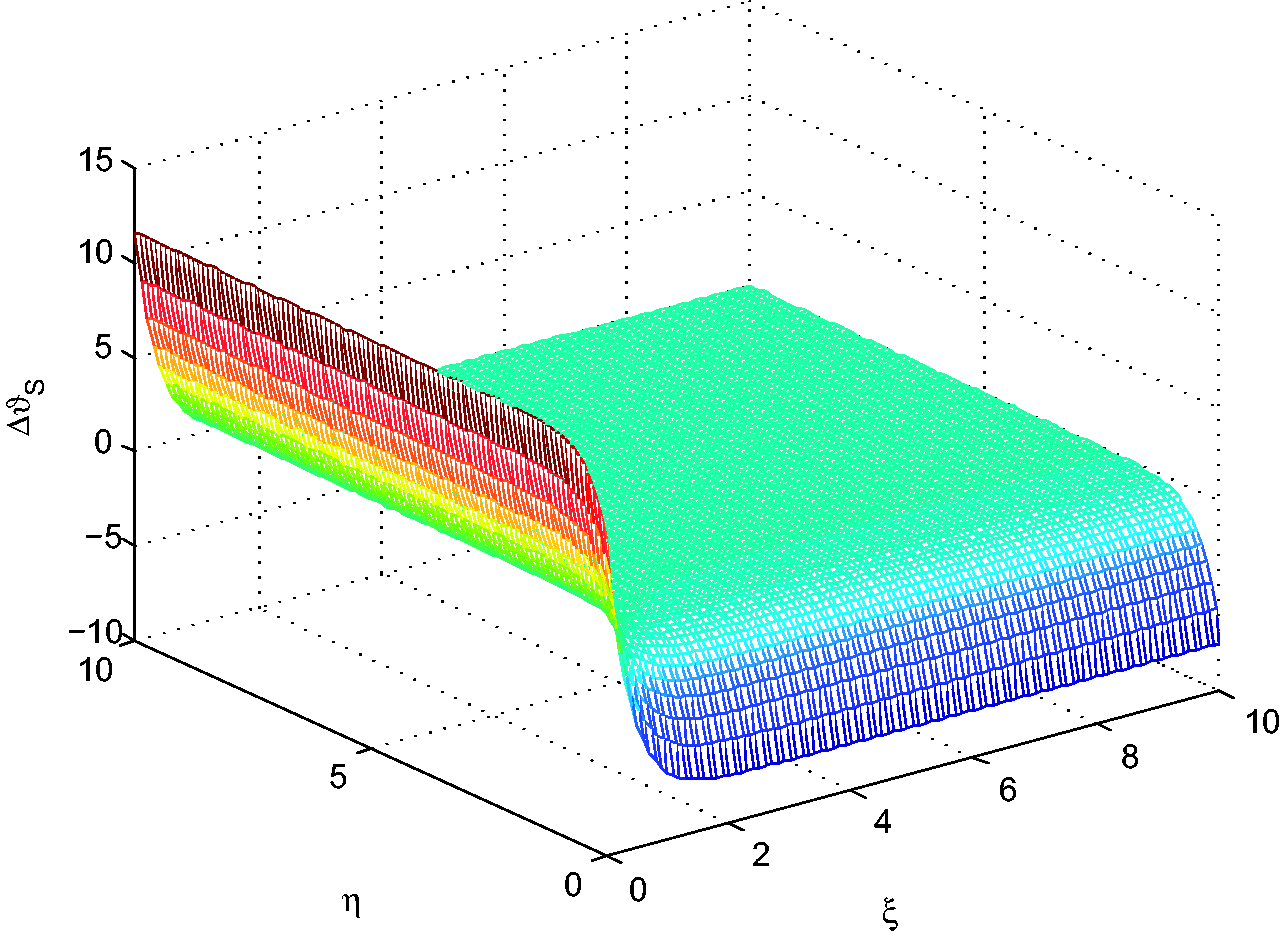
Figures 1 to 3 show the change in total chirp when the velocity v0 of the dust acoustic wave takes different values. It can be seen that the nonlinearity gradually increases and disperses as the velocity v0 of the dust acoustic wave increases.
The total chirp of dust sound waves when .
The total chirp of dust sound waves when .
The total chirp of dust sound waves when .
Study on the nature of dust acoustic waves
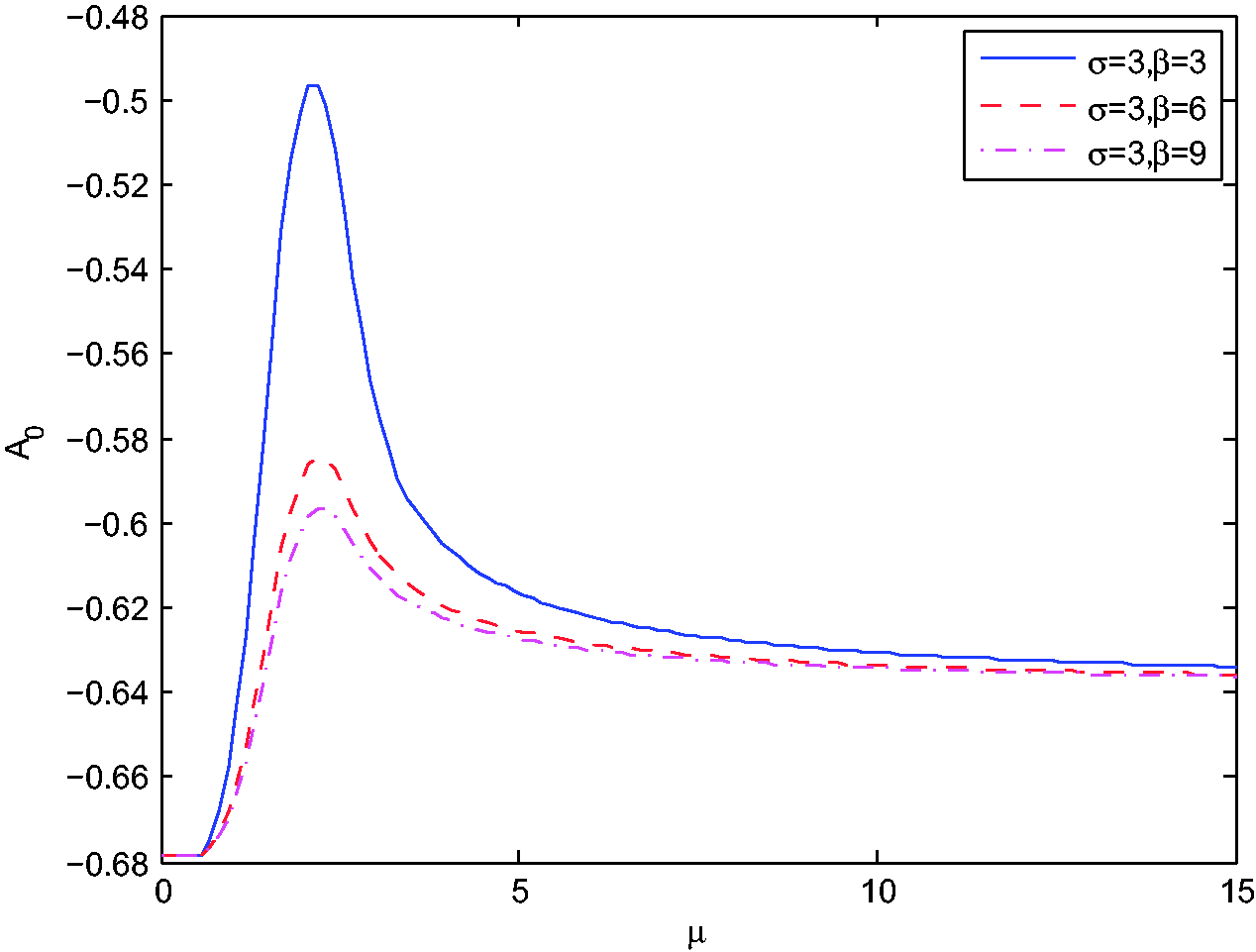
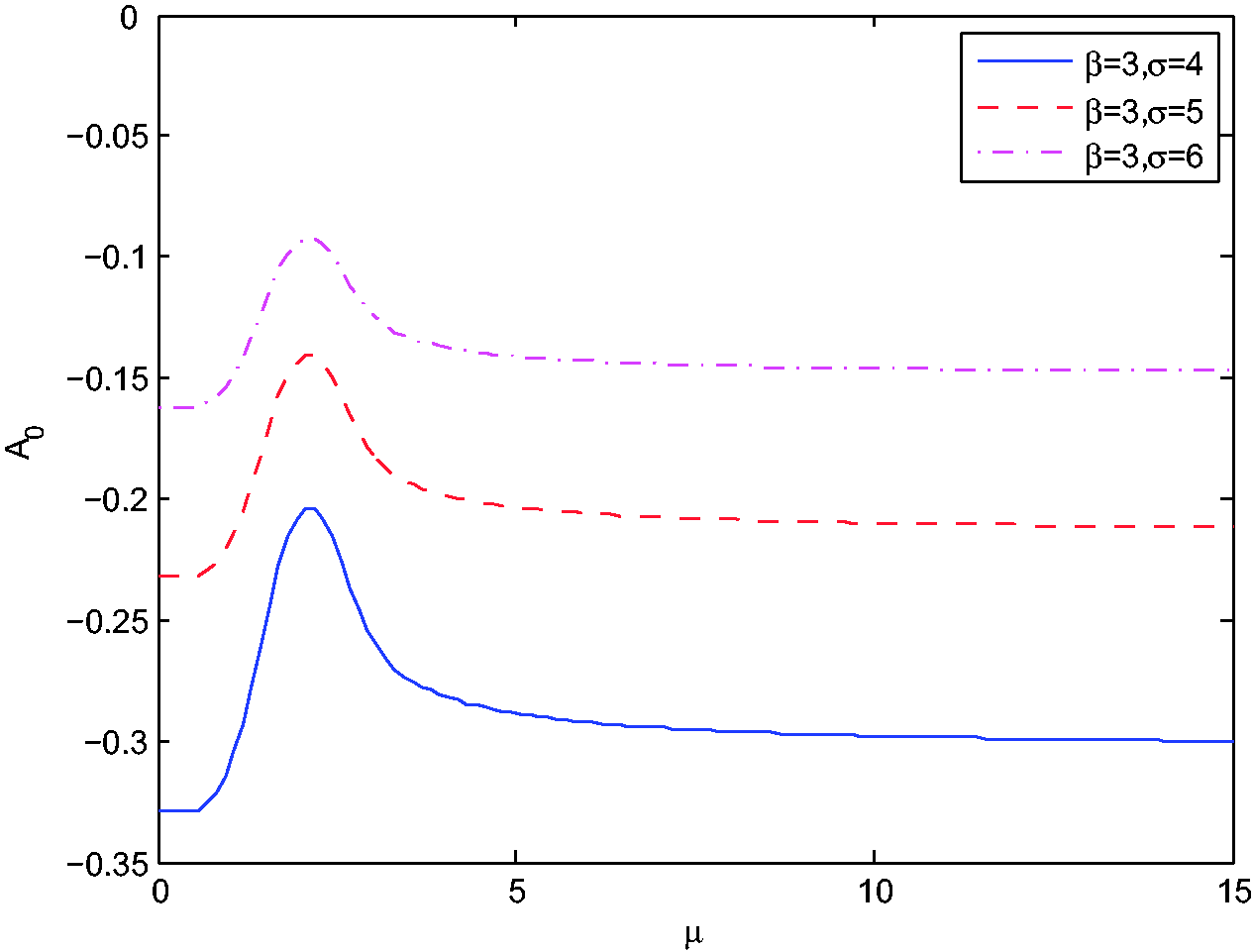
Figures 4 and 5 show the variation of the solitary wave amplitude with number density when σ and β take different values. For a given σ, the solitary amplitude will decrease as β increases. For a given β, the solitary amplitude increases as σ increases. When σ and β are given, the amplitude of the solitary wave will increase at first and then decrease as the number density of the low-temperature ions increases.
The amplitude of the solitary wave changes with μ when σ = 3 and .
The amplitude of the solitary wave changes with μ when β = 3 and .
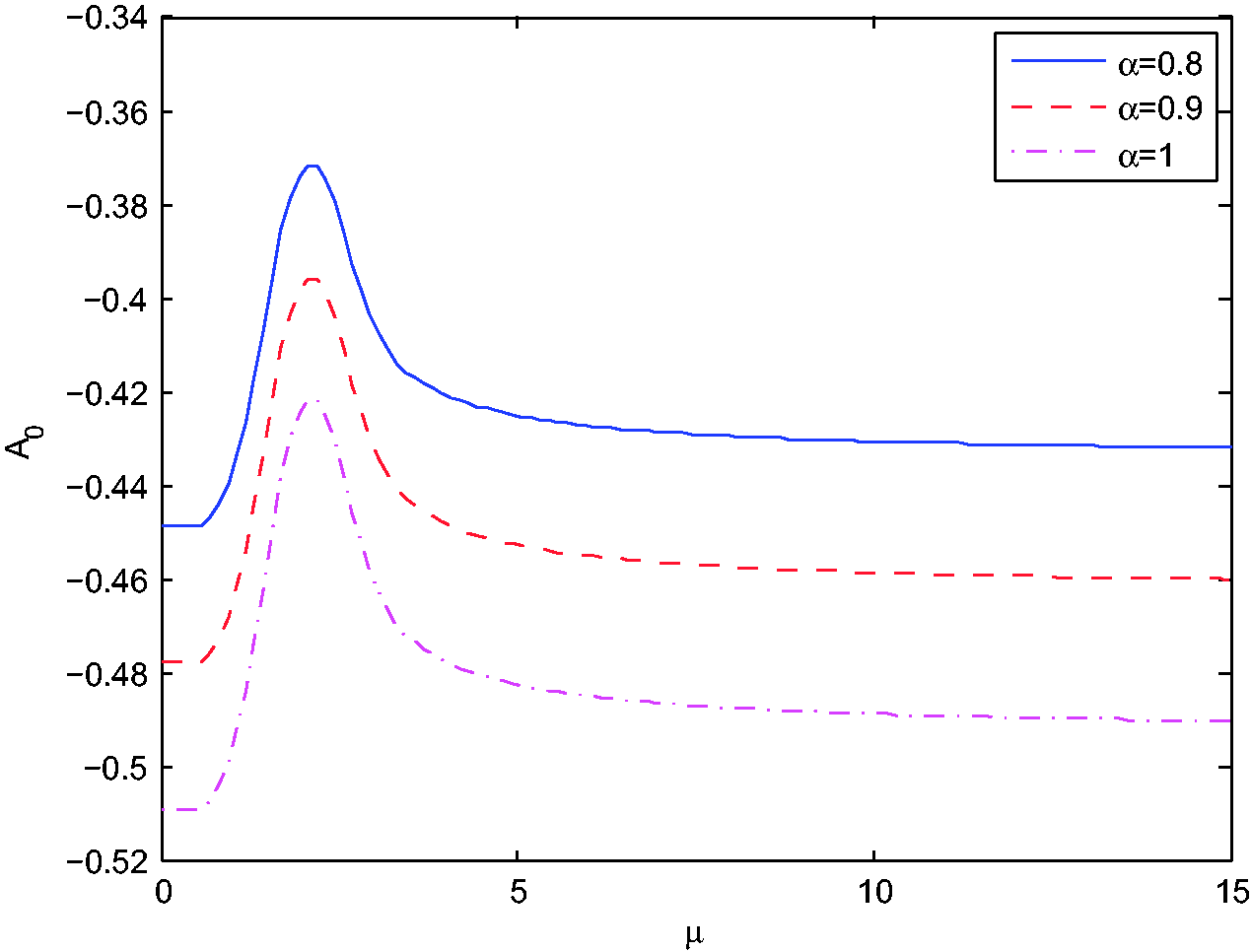
Figure 6 shows the variation of the solitary wave amplitude with the number density of the low-temperature ions when α is taken at different values. As the fractional order is increased, the solitary wave amplitude will be reduced.
The amplitude of the solitary wave changes with μ when .
Discussion
According to the equation of motion for the dust particles, the (3 + 1)-dimensional KP equation is obtained by using multiscale analysis and a reduced perturbation method, and then, a new (3 + 1) equation is given by applying the semi-inverse method and the fractional variation principle. The dimensional TSF-KP equation is more suitable for describing the propagation of dust sound waves of plasma in space. Next, we study the conservation laws and exact solutions of the fractional KP equations and use the exact solutions to study the enthalpy effect of dust sound waves and the effect of dust sound velocity on the total enthalpy. Finally, the effects of dust temperature, ion temperature, ion number density, and fractional order on the acoustic characteristics of dust are discussed.
The concept of fractional derivatives is more suitable for modeling real-world problems than integer derivatives. However, it has certain features that lead to difficulties when applying to real-world problems. We suspect that this might be due to a different definition or the definition itself, Therefore, based on the Riemann–Liouville fractional derivative operator and Ji-Huan He’s fractal derivative, we propose possible forms of modification
1.
where , and k4 are constants.
2.
where , and k4 are constants.
3.
where , and k4 are constants
4.
where , and k4 are constants.
When , the definition of the above amendments was the Riemann–Liouville splitting derivative operator and He’s fractal derivative.51 These parameters have potential value for understanding the application of fractional order in dust plasma when is taken as different values. For example, if can be used to express the wave number in the dust plasma direction. Can the definition of the above form better explain the problem of dust acoustic waves in dust plasma? In future research, we will continue to study such issues.
Footnotes
Declaration of conflicting interests
The author(s) declared no potential conflicts of interest with respect to the research, authorship, and/or publication of this article.
Funding
The author(s) disclosed receipt of the following financial support for the research, authorship, and/ or publication of this article: This work was supported by the Nature Science Foundation of Shandong Province of China (No. ZR2018MA017) and China Postdoctoral Science Foundation funded project (No. 2017M610436).
Appendix 1
References
1.
RaoNNShuklaPKYuMY.Dust-acoustic waves in dusty plasma. Planet Space Sci1990;
38: 543.
2.
GhoshSSarkarSKhanM, et al.
Dust ion acoustic shock waves in a collisionless dusty plasma. Phys Lett A2000;
274: 162–169.
3.
KadomtsevBBPetviashviliVI.On the stability of solitary waves in weakly dispersive media. Sov Phys Dokl1970;
15: 539–541.
4.
DuanWS.The Kadomtsev-Petviashvili (KP) equation of dust acoustic waves for hot dust plasmas. Chaos Soliton Fract2002;
14: 503–506.
5.
GillTSSainiNSKaurH.The Kadomtsev-Petviashvili equation in dusty plasma with variable dust charge and two temperature ions. Chaos Soliton Fract2006;
28: 1106–1111.
6.
PakzadHR.Solitary waves of the Kadomtsev-Petviashvili equation in warm dusty plasma with variable dust charge, two temperature ion and nonthermal electron. Chaos Soliton Fract2009;
42: 874–879.
7.
SainiNSKaurNGillTS.Dust acoustic solitary waves of Kadomstev-Petviashvili (KP) equation in superthermal dusty plasma. Adv Space Res2015;
55: 2873–2882.
HeJH.Some asymptotic methods for strongly nonlinear equations. Int J Mod Phys B2006;
10: 1141–1199.
10.
LuCNFuCYangHW.Time-fractional generalized Boussinesq equation for Rossby solitary waves with dissipation effect in stratified fluid and conservation laws as well as exact solutions. Appl Math Comp2018;
327: 104–116.
11.
DongHHGuoBYYinBS.Generalized fractional supertrace identity for Hamiltonian structure of NLS-MKdK hierarchy with self-consistent sources. Anal Math Phys2016;
6: 99–209.
12.
YangHWXuZHYangDZ.ZK-Burgers equation for three-dimensional Rossby solitary waves and its solutions as well as chirp effect. Adv Differ Equ2016;2016:167.
13.
FengFBKawaharaT.Stationary travelling-wave solutions of an unstable KdV-Burgers equation. Physica D2000;
137: 228–236.
14.
YangJYMaWX.Abundant interaction solutions of the KP equation. Nonlinear Dyn2017;
2: 1539–1544.
15.
ZhaoHQMaWX.Mixed lump-kink solutions to the KP equation. Comput Math Appl2017;
6: 1399–1405.
16.
FuCLuCNYangHW.Time-space fractional (2 + 1) dimensional nonlinear Schrödinger equation for envelope gravity waves in baroclinic atmosphere and conservation laws as well as exact solutions. Adv Diff Equ2018; 2018:
56.
17.
MaWX.Conservation laws by symmetries and adjoint symmetries. Dis Contin Dyn Syst Ser S2018;
4: 707–721.
18.
JohnpillaiAGKhaliqueCM.Conservation laws of KdV equation with time dependent coefficients. Commun Nonlinear Sci Numer Simulat2011;
16: 3081–3089.
19.
SunQMengSMCuiYJ.Existence results for fractional order differential equation with nonlocal Erdelyi-Kober and generalized Riemann-Liouville type integral boundary conditions at resonance. Adv Diff Equ2018;2018:
243.
20.
HeJHWuGCAustinF.The variational iteration method which should be followed. Nonl Sci Lett A2010;
1: 1–30.
21.
LieS.Theorie der transformations-gruppen.
Leipzig:
Teubner, 1890.
22.
NoetherE.Invariant variation problems. Transport Theory and Statistical Physics 1971; 1: 186–207.
23.
GaoLNZiYYYinYH, et al.
Backlund transformation, multiple wave solutions and lump solutions to a (3 + 1)-dimensional nonlinear evolution equation. Nonlinear Dyn2017;
3: 2233–2240.
24.
MaWXZhouY.Lump solutions to nonlinear partial differential equations via Hirota bilinear forms. J Diff Equ2018;
4: 2633–2659.
25.
ZhaoQLLiXY.A Bargmann system and the involutive solutions associated with a new 4-order lattice hierarchy. Anal Math Phys2016;
6: 237–254.
26.
DongHHZhangYFYinBS.Generalized bilinear differential operators, binary bell polynomials, and exact periodic wave solution of Boiti-Leon-Manna-Pempinelli equation.Abs Appl Anal2014; 2014: 738609.
27.
SunQJiHWCuiYJ.Positive solutions for boundary value problems of fractional differential equation with Integral boundary conditions.J Fun Spaces2018; 2018:
6461930.
BaiZBZhangSSunSJ, et al.Monotone iterative method for fractional differential equations. Elec J Diff Equ2016; 6: 1–8.
35.
Mohyud-DinSTNawazTAzharE, et al.
Fractional sub-equation method to space-time fractional Calogero-Degasperis and potential Kadomtsev-Petviashvili equations. J Taiban Univ Sci2017;
11: 258–263.
36.
GuoMFuCZhangYet al.
Study of ion-acoustic solitary waves in a magnetized plasma using the three-dimensional time-space fractional Schamel-KdV equation.Complexity2018; 2018: 6852548.
37.
HeJH.A tutorial and heuristic review on Lagrange multiplier for optimal problems. Nonlinear Sci Lett A2017;
8: 121–148.
38.
BiswasAZhouQUllahMZ, et al.
Optical soliton perturbation with anti-cubic nonlinearity by semi-inverse variational principle. Optik2017;
143: 131–134.
39.
El-WakilSAAbulwafaEMZahranMA, et al.
Time-fractional KdV equation: formulation and solution using variational methods. Nonlinear Dyn2011;
65: 55–63.
40.
HeJH.Fractal calculus and its geometrical explanation. Results Phys2018;
10: 272–276.
41.
WangYDengQG. Fractal derivative model for tsunami travelling. Fractals. Epub ahead of print. DOI: 10.1142/S0218348X19500178.
42.
WangYAnJY. Amplitude-frequency relationship to a fractional Duffing oscillator arising in microphysics and tsunami motion. J Low Freq Noise Vib Active Control. Epub ahead of print. DOI: 10.1016/j.electacta.2018.11.042.
43.
HeJH.Approximate analytical solution for seepage flow with fractional derivatives in porous media. Comput Methods Appl Mech Eng1998; 167: 57–68.
44.
HeJH.A new fractal derivation. Therm Sci .2011;
15(supplement): 145–147.
45.
PodlubnyI.Fractional differential equation.
New York:
Academic Press, 1999.
46.
MillerKSRossB.An introduction to the fractional calculus and fractional differential equations.
New York:
Wiley, 1993.
47.
TaoMSDongHH.Algebro-geometric solutions for a discrete integrable equation.Dis Dyn Nat Soc2017; 2017: 5258375.
48.
JumarieG.Fractional partial differential equations and modified Riemann-Liouville derivative new methods for solution. J Appl Math Comput2007;
24: 31–38.
49.
HeJH.Exp-function method for fractional differential equations. Int J Nonlinear Sci Numer Simul2013;
14: 363–366.
50.
HeJHLiZB.Fractional complex transform for fractional differential equations. Math Comput Appl2010;
15: 970–973.
51.
LiXXTianDHeCHet al. A fractal modification of the surface coverage model for an electrochemical arsenic sensor. Accepted manuscript. 2019; 296: 491–493.