




Abstract
Rotating friction circular plates are the main components of a friction clutch. The vibration and temperature field of these friction circular plates in high speed affect the clutch operation. This study investigates the thermoelastic coupling vibration and stability of rotating friction circular plates. Firstly, based on the middle internal forces resulting from the action of normal inertial force, the differential equation of transverse vibration with variable coefficients for an axisymmetric rotating circular plate is established by thin plate theory and thermal conduction equation considering deformation effect. Secondly, the differential equation of vibration and corresponding boundary conditions are discretized by the differential quadrature method. Meanwhile, the thermoelastic coupling transverse vibrations with three different boundary conditions are calculated. In this case, the change curve of the first two-order dimensionless complex frequencies of the rotating circular plate with the dimensionless angular speed and thermoelastic coupling coefficient are analyzed. The effects of the critical dimensionless thermoelastic coupling coefficient and the critical angular speed on the stability of the rotating circular plate with simply supported and clamped edges are discussed. Finally, the relation between the critical divergence speed and the dimensionless thermoelastic coupling coefficient is obtained. The results provide the theoretical basis for optimizing the structure and improving the dynamic stability of friction clutches.
Keywords
Introduction
Friction clutch is an important part of the transmission system of mineral locomotives. Considering the mining industry background, the friction clutch of Shaanxi XUST-18 explosion-proof mineral locomotive (shown in Figure 1) is used as the sample. By considering friction circular plate as the thin plate (shown in Figure 2), the clutch active shells can be regarded as the boundary supports. Friction circular plates in clutch often work in a varying temperature field; thus, the transverse vibration originated from the varying temperature generally has a significant influence on the operation of the mineral locomotive. Therefore, a study on the thermoelastic coupling transverse vibration of the friction circular plates in clutch is important.
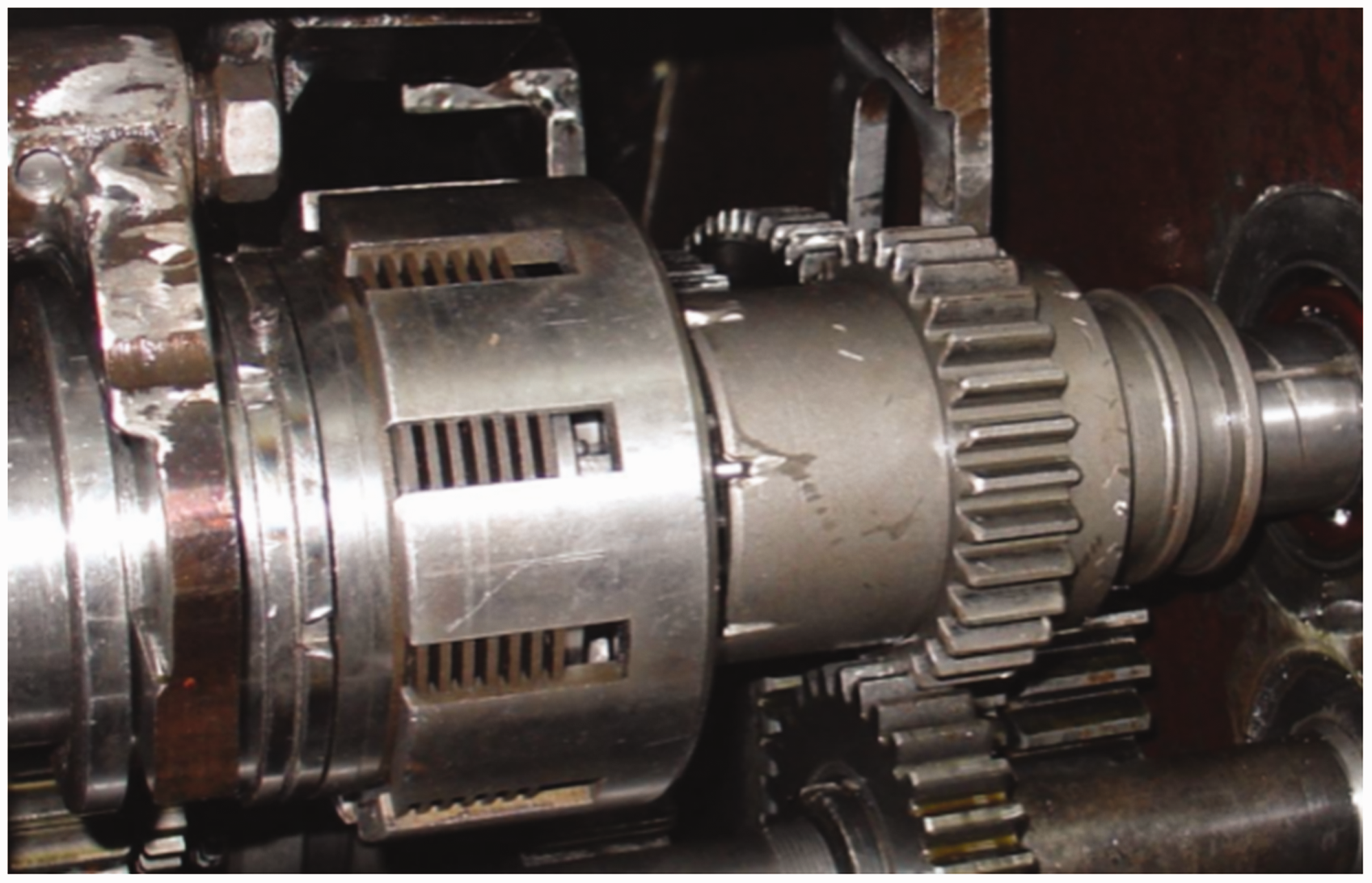
Friction clutch in Shaanxi XUST-18 explosion-proof mineral locomotive.
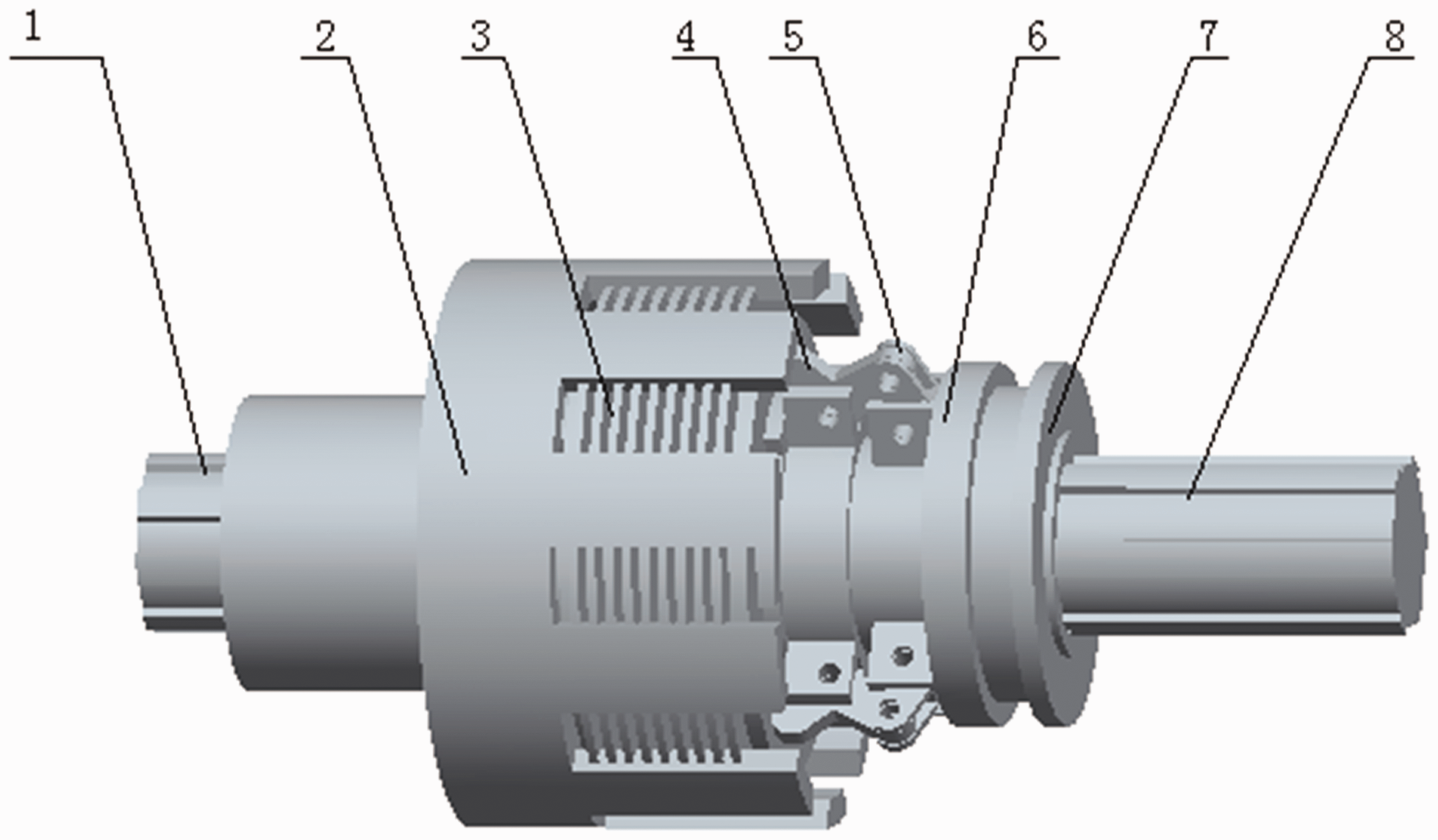
Three-dimensional model of friction clutch: 1, driving shaft; 2, clutch active shell; 3, friction plate combination; 4, hinge mechanism; 5, pin; 6, clutch member; 7, clutch driven member; and 8, driven shaft.
Transverse vibration of the rotating circular plate has been extensively studied over the past few decades, and numerous representative results have been achieved. Some research work focus on the effects of angular speed on transverse vibration. For example, Khorasany and Hutton 1 and Shojaeefard et al. 2 investigated the variation of the natural frequency with the angular speed of the rotating circular plate by the modal expansion method and the Galerkin method, respectively. Maretic 3 used the Galerkin method to analyze the relationship between the natural frequency of the eccentric rotating circular plate and angular speed. Wang et al.4,5analyzed the change situation of the complex frequencies of the rotating circular plate under three boundary conditions with the change of the angular speed. The aforementioned research works have not considered the transverse deflections and dynamic responses. Gupta et al. 6 utilized Rayleigh-Ritz method to calculate the deflections of the first two modes in orthotropic viscoelastic circular plates and discussed the effect of nonhomogeneous value and taper coefficient on the transverse vibration of the circular plate. Heo and Chung 7 studied the dynamic responses of a flexible rotating plate by finite element method and examined the relationship between the vibration characteristics and angular misalignment of the circular plate. On the other hand, some researchers focus on the dynamic stability of the circular plate. Bauer and Eidel 8 analyzed the effects of angular speed on natural frequency and stability by the Galerkin method. Hochlenert et al. 9 studied the instability problem of the circular plate caused by the friction in the brake system. Mottershead and Chan 10 examined the flutter instability of the circular plate under the frictional follower load. Hu and Wang 11 and Li et al. 12 established the magnetoelastic vibration equations of a conductive rotating circular plate by Hamilton principle. They investigated the critical condition of stability of the rotating circular plate by the Galerkin method.
All of the aforementioned studies do not involve the varying temperature. In fact, the circular plate is under the condition of varying temperature environment in actual engineering applications (e.g. the engaging process of friction clutch), so the varying temperature needs to be considered. Sepahi et al. 13 analyzed the effect of varying temperature on the large deflection of the FGM plate. Shu and Zhang 14 used the Galerkin method to discuss the nonlinear thermoelastic vibration of the circular plate with clamped edge. Trajkovski and Cukic 15 studied the vibration problem of the circular plate under the boundary of free and clamped edges with varying temperature. Sun and coworkers16,17analyzed the thermoelastic coupling vibration of micro-circular plates and discussed the effect of component size and different temperatures on the thermal bending moments and vibration amplitude. Salajeghe et al. 18 examined the thermoelastic vibration of micro-circular resonators by von Karman theory and explored the effect of linear and nonlinear analysis on thermoelastic damping. Hao 19 investigated the vibration of circular thin plate micrometer and nanometer electromechanical exciters under heat-elastic damping. Kumar et al. 20 studied a two-dimensional axisymmetric vibration in a homogeneous isotropic micropolar porous thermoelastic circular plate by using the eigenvalue approach and analyzed the displacements, microrotations, volume fraction fields, temperature distributions and stresses in the transformed domain subjected to thermomechanical sources. Bhada et al. 21 used integral transform technique to investigate the thermally induced vibration of an elliptical disk and discussed the thermal moment, normal stresses and normal deflection of disk. The above research works on the thermoelastic coupling vibration of circular plates are mainly focused on the analysis of the coupled term and dynamic term, but the research on the differential equation of thermoelastic coupling vibration is not that much. The differential equation of thermoelastic coupling vibration of the circular plate is a fourth-order partial differential equation with complex variable coefficient, which involves solving a complex eigenvalue problem. Some research work on a high-order partial differential equation had been carried out by the Galerkin method and finite element method.1,3,7,8,11,12,22Yayli23–27used the Fourier sine series and Stoke transformation to analyze the high-order partial differential equation of vibration. The computation in these methods is complicated. In recent years, the differential quadrature method (DQM) has also been applied to compute the high-order partial differential equation of transverse vibration because of its high efficiency and accuracy.28–32However, few works have been presented the study of the high-order partial differential equation of thermoelastic coupling vibration by DQM. In this paper, we mainly use the DQM to solve the differential equation of thermoelastic coupling vibration in order to improve the solving efficiency and accuracy.
This study aims to construct the differential equation of thermoelastic coupling transverse vibration of the rotating circular plate in friction clutch in accordance with the thermal conduction equation and on the basis of the action of linearly distributed normal inertial force along the radial direction. The dimensionless complex frequencies of the rotating circular plate with variable temperature are analyzed by DQM. The change curve of the first two-order dimensionless complex frequencies of the rotating circular plate with the dimensionless angular speed and the dimensionless thermoelastic coupling coefficient are analyzed, which can provide the theoretical basis for optimizing the structure and working condition of friction clutch.
Differential equation of thermoelastic coupling transverse vibration
Differential equation of transverse vibration with varying temperature
Figure 3shows a circular plate with thickness
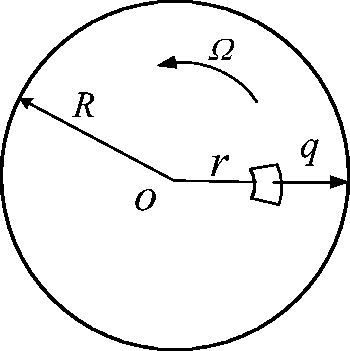
Schematic diagram for the rotating circular plate.
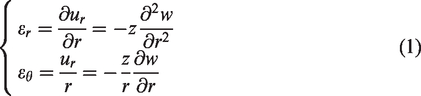
The strain–displacement relation of the rotating circular plate can be given by
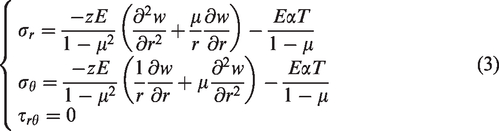
The constitutive equation with the varying temperature

Substituting equation (1)into equation (2)results in
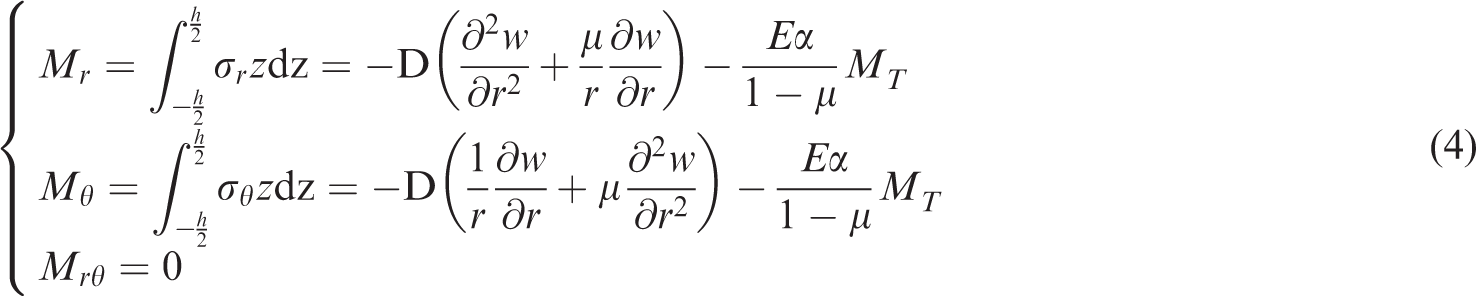
By using equation (3), the bending and twisting moments per unit length are given by
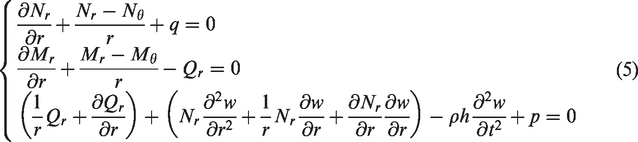
The force and moment balance condition in the axisymmetric circular plate are given by
Based on equations (1)–(5), by using the Kirchhoff theory and D’Alembert’s principle, the differential equation of transverse vibration is given as follows

Given that the varying temperature

Solution of the normal in-plane forces
In order to solve equations (6)and (7), the normal in-plane forces

Based on equation (1), the strain compatibility equation is obtained

Considering that the varying temperature

From equation (10), the solution of

The displacement field component

The boundary conditions of clamped and simply supported edges are given by

The boundary condition of free edge is given by

Substituting equations (11)and (12) into equations (13)and (14), respectively, results in

For clamped and simply supported edges, based on equations (8), (11) and (15), Nrand Nθcan be obtained as


For free edge, based on equations (8), (11) and (15), NRand Nθare given by


Dimensionless differential equation and boundary conditions
The following dimensionless quantities are introduced as follows

Considering that


For simply supported and clamped edges,


For free edge,


The solution of equations (20)and (21) is assumed in the following form

Substituting equation (26)into equations (20)and (21), differential equations of the rotating plate are obtained as


From equation (28), the solution of

Substituting equation (29)into equation (27)results in

The dimensionless thermoelastic coupling coefficient
Considering that the edge of the plate is held at a constant temperature, the three dimensionless boundary conditions are given as follows.
(1) Simply supported edge

(2) Clamped edge

(3) Free edge
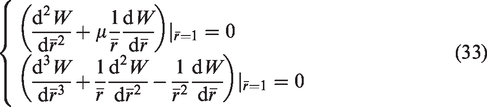
The dimensionless boundary conditions at the center of the plate are given as follows

Discretization method of vibration equation
DQM is used to solve equation (30). DQM34–36approximates the derivatives of the function at the given nodes by weighted sums of the function at the total nodes.
The nodes are calculated by the following formula

Based on the Lagrange interpolation polynomial, the weight coefficients of the first derivative

The weight coefficients of the second, third and fourth derivatives are determined by matrix multiplication
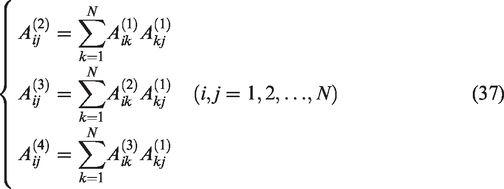
Equation (30)can be discretized into the following form by DQM

The discretization of equations (31)to (33)can be can be expressed as follows.
(1) Simply supported edge

(2) Clamped edge

(3) Free edge
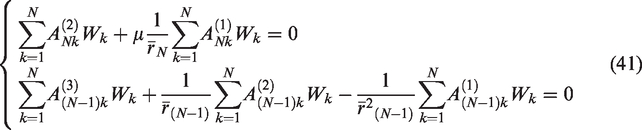
The discretization of equation (34)can be expressed in the following form
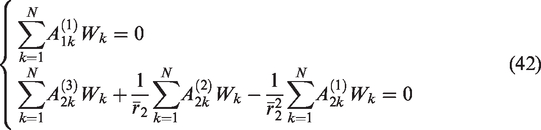
Equation (38), the boundary condition (equation (42)), and one of the boundary conditions (equations (39)–(41)) can be expressed in the matrix form as

Numerical analysis
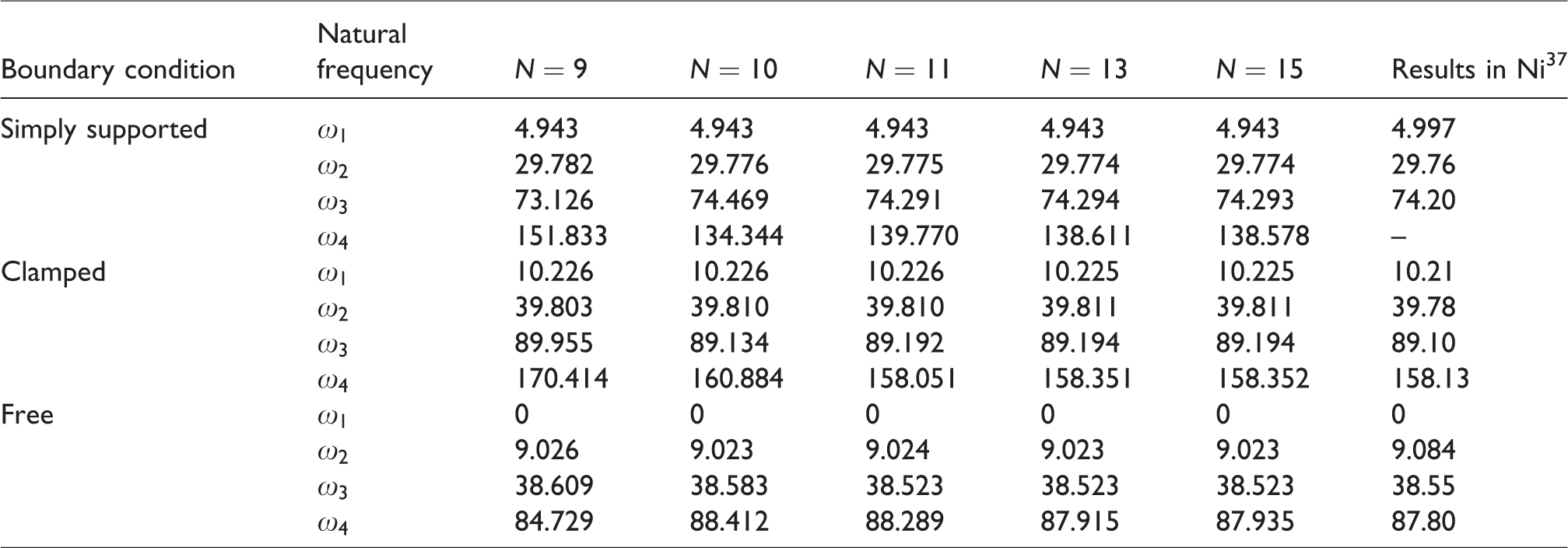
Equation (38)is simplified to the differential equation of transverse vibration of the nonrotating plate at a constant temperature when
First four-order dimensionless natural frequencies of the nonrotating plate with different boundary conditions.
Rotating circular plate in friction clutch with simply supported edge
Figures 4and 5show the variation of the first two-order dimensionless complex frequencies
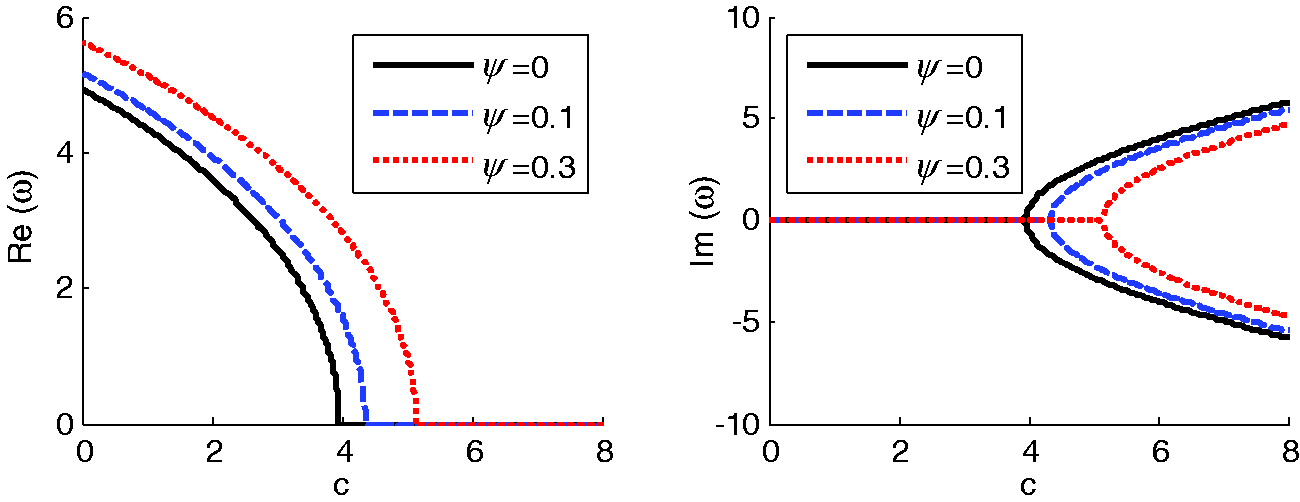
First-order dimensionless complex frequency versus dimensionless angular speed (simply supported edge).
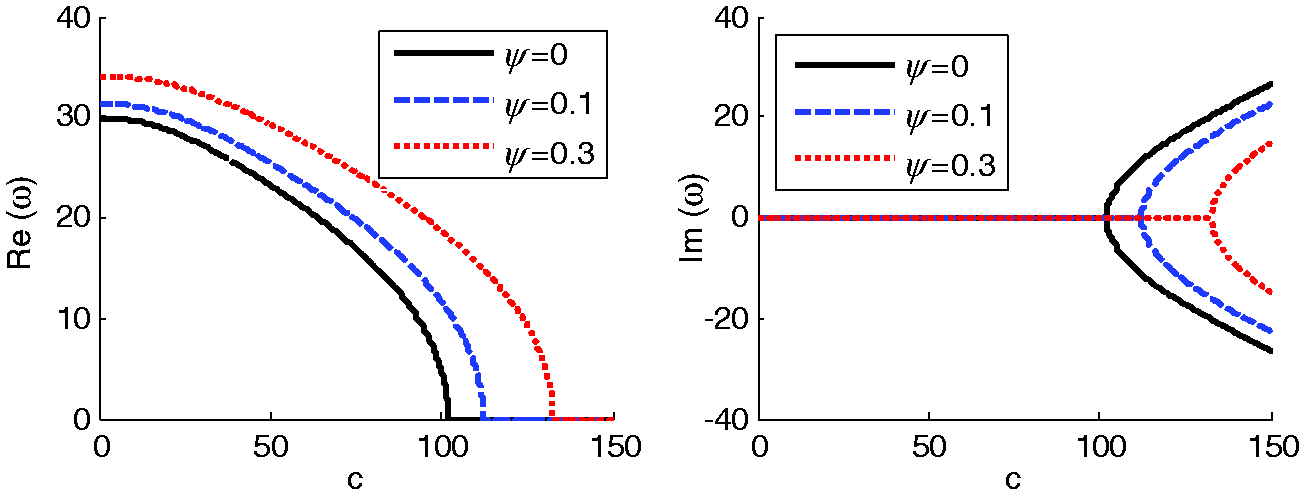
Second-order dimensionless complex frequency versus dimensionless angular speed (simply supported edge).
First two-order dimensionless natural frequencies of the rotating circular plate in friction clutch (

Critical divergence speed of the circular plate in the first-order and second-order modes (simply supported edge).

Figure 6indicates the variation of the first-order complex frequency of the rotating circular plate in friction clutch with the dimensionless thermoelastic coupling coefficient
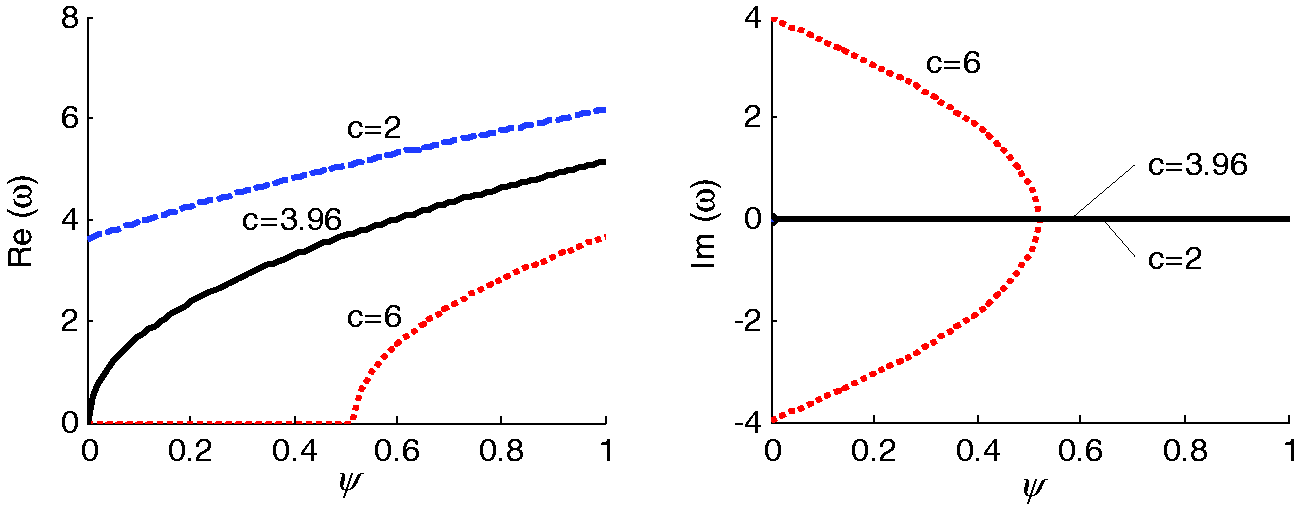
First-order dimensionless complex frequency versus dimensionless thermoelastic coupling coefficient (simply supported edge).
Figure 7presents the variation of the second-order complex frequency of the rotating circular plate in friction clutch with the dimensionless thermoelastic coupling coefficient for
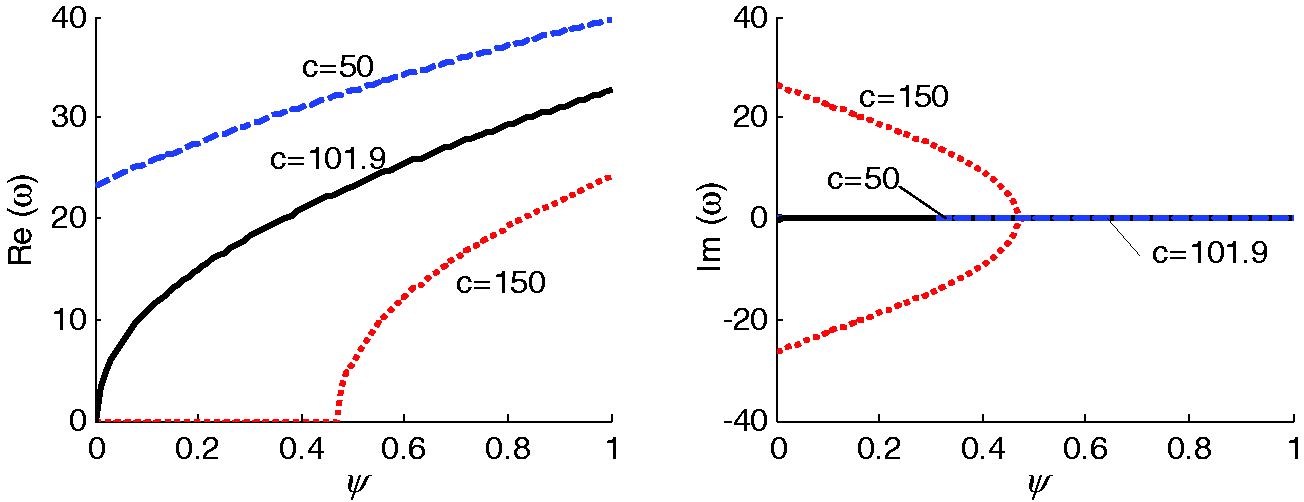
Second-order dimensionless complex frequency versus dimensionless thermoelastic coupling coefficient (simply supported edge).
Figure 8(a)and (b) shows the effects of the dimensionless thermoelastic coupling coefficient on the first two-order critical divergence speeds. It can be seen in Figure 8that, with the increase of the dimensionless thermoelastic coupling coefficient, the first two-order critical divergence speeds of the rotating circular plate with simply supported edge increase.
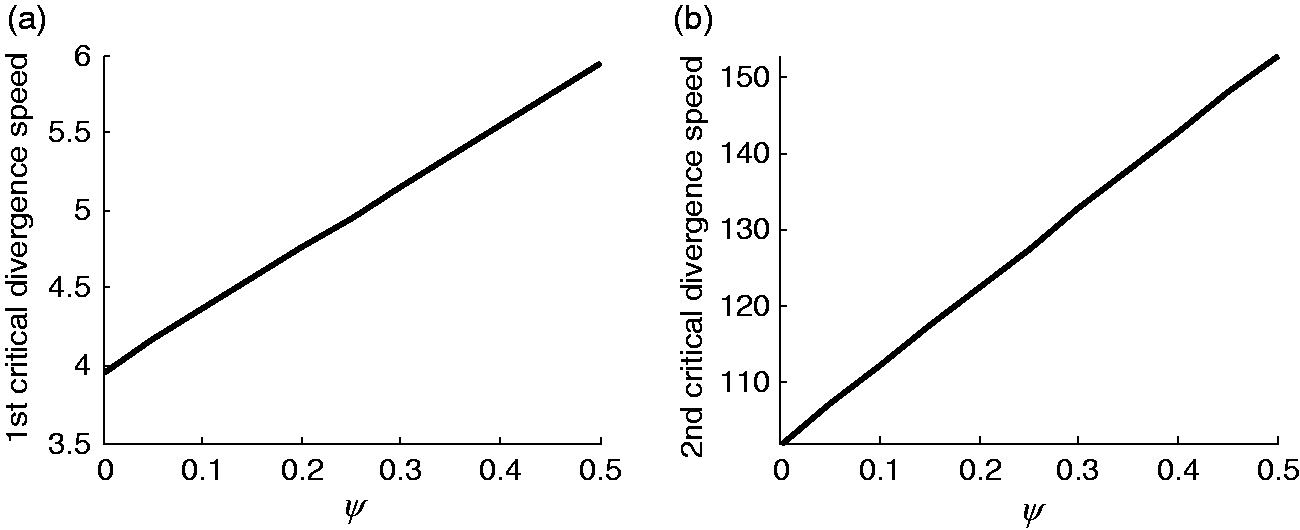
First two-order critical divergence speeds versus dimensionless thermoelastic coupling coefficient: (a) first order and (b) second order.
Rotating circular plate in friction clutch with clamped edge
Figures 9and 10show the variation of the first two-order dimensionless complex frequencies
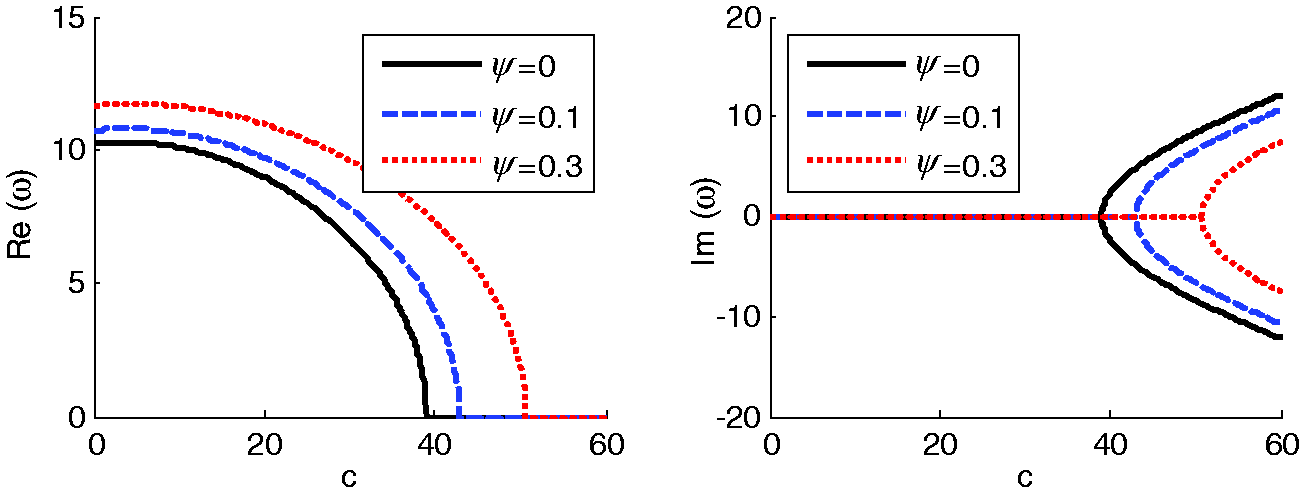
First-order dimensionless complex frequency versus dimensionless angular speed (clamped edge).
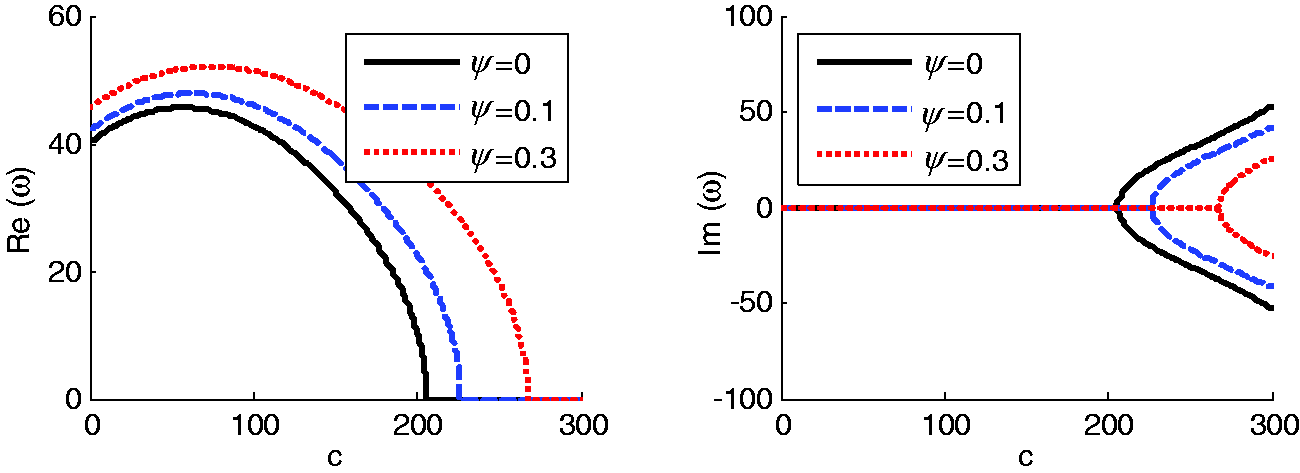
Second-order dimensionless complex frequency versus dimensionless angular speed (clamped edge).
Critical divergence speed of the rotating circular plate in the first-order and second-order modes (clamped edge).

Figures 11and 12indicate the variation of the first two-order dimensionless complex frequencies
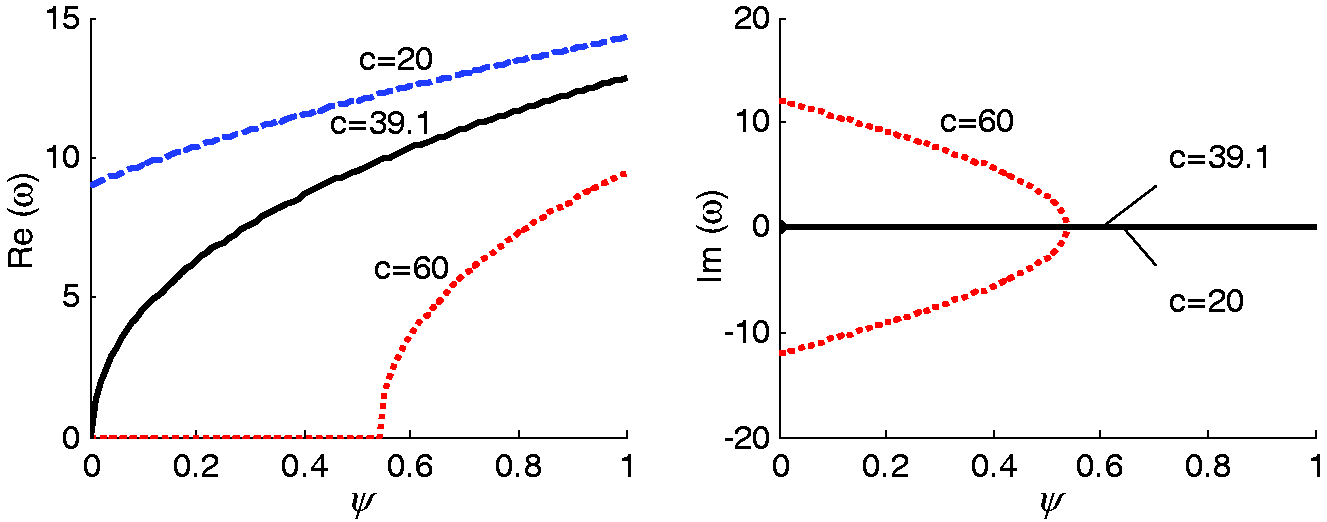
First-order dimensionless complex frequency versus dimensionless thermoelastic coupling coefficient (clamped edge).
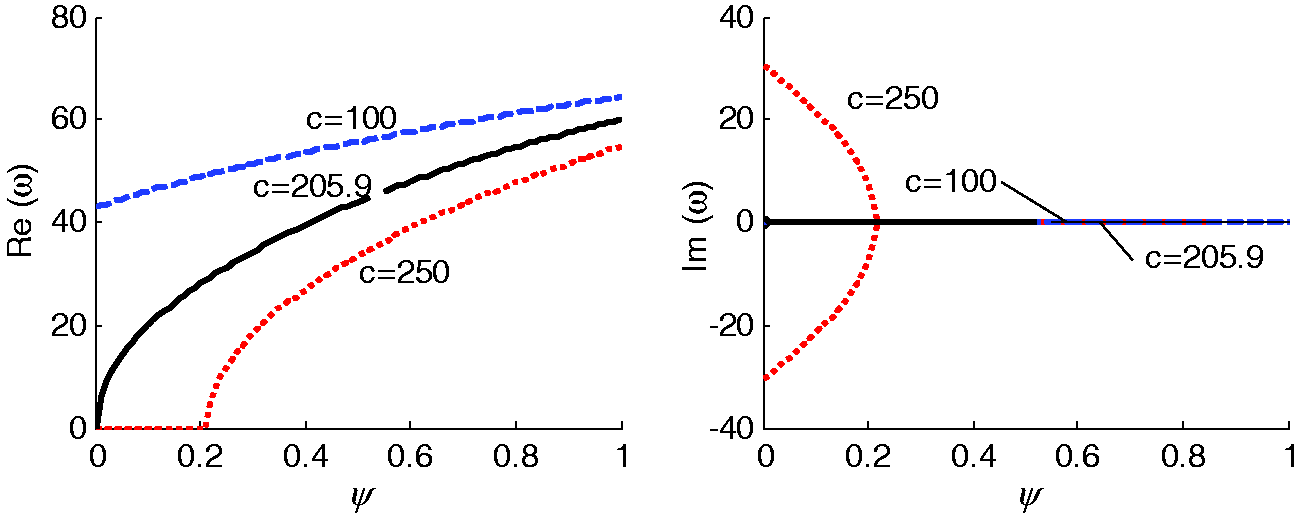
Second-order dimensionless complex frequency versus dimensionless thermoelastic coupling coefficient (clamped edge).
Figure 13(a)and (b) shows the variation of the first two-order critical divergence speed with the dimensionless thermoelastic coupling coefficient. With the increase of the dimensionless thermoelastic coupling coefficient, the first two-order critical divergence speeds of the rotating circular plate with clamped edge increase.
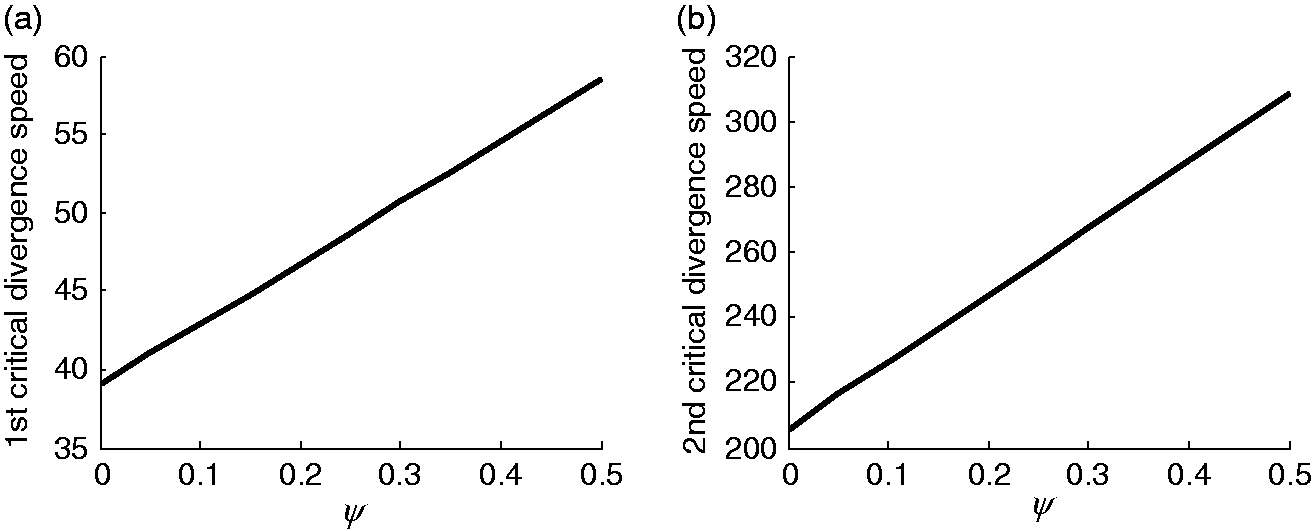
First two-order critical divergence speeds versus dimensionless thermoelastic coupling coefficient: (a) first order and (b) second order.
Rotating circular plate in friction clutch with free edge
Figures 14and 15show the variation of the first two-order dimensionless complex frequencies
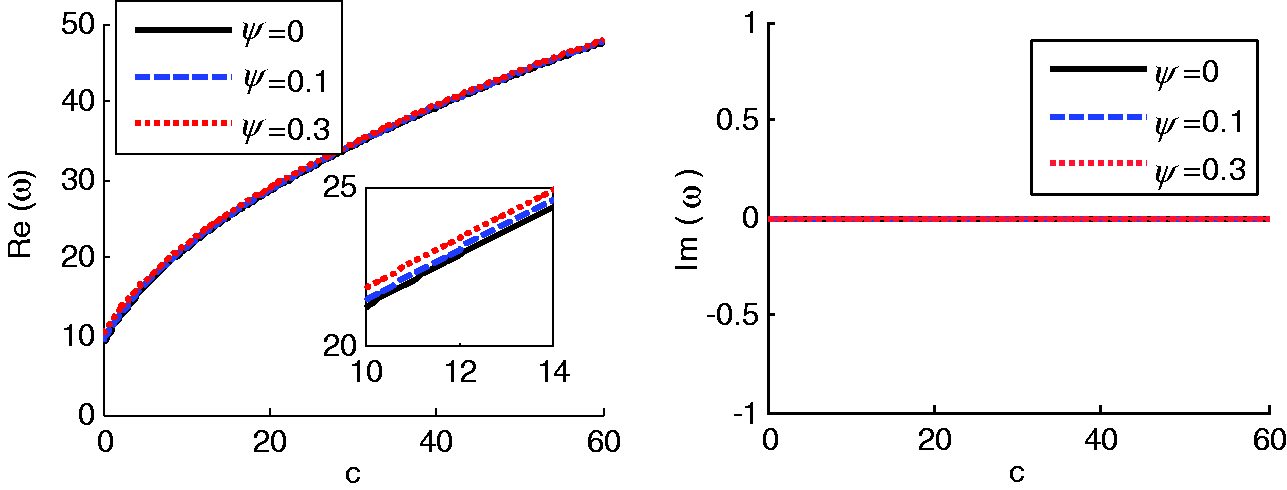
First-order dimensionless complex frequency versus dimensionless angular speed (free edge).
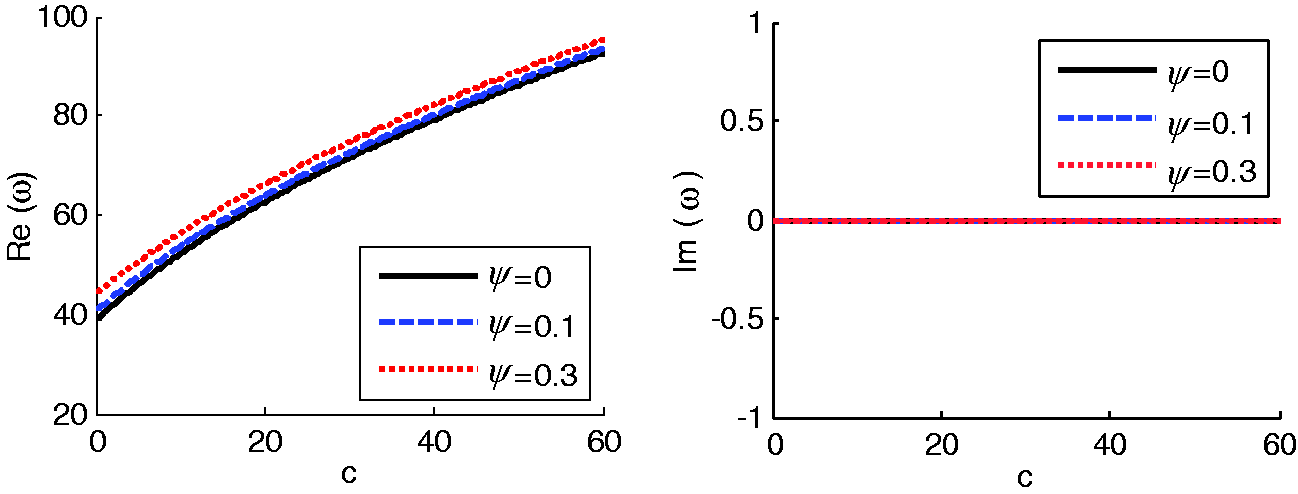
Second-order dimensionless complex frequency versus dimensionless angular speed (free edge).
Conclusions
The rotating circular plate in friction clutch of the Shaanxi XUST-18 explosion-proof mineral locomotive is selected to examine. The thermoelastic coupling transverse vibration and stability of the rotating circular plate in friction clutch with three boundaries are investigated by DQM. The effects of the dimensionless angular speed, the dimensionless thermoelastic coupling coefficient and the boundary condition on transverse vibration and stability are discussed. The results are listed as follows:
As the dimensionless angular speed increases, the real parts of the first two-order dimensionless complex frequencies decrease to zero under the boundary condition of simple supported edge. However, the real parts increase firstly and then decrease to zero under the boundary condition of clamped edge and increase in the range of positive values under the boundary condition of free edge. The first two-order modes exhibit divergence instability under the boundary conditions of simple supported and clamped edges, and the corresponding critical divergence speed in the case of thermoelastic coupling is larger than that in the case of uncoupling. With the increase of the dimensionless thermoelastic coupling coefficient, the critical divergence speed increases under the boundary conditions of simple supported and clamped edges. However, the instability does not occur under the boundary condition of free edge, and the critical divergence speed does not exist. When the dimensionless angular speed is larger than the critical divergence speed (
From these results, this study provides a theoretical basis for optimizing the structure of the friction circular plate in clutch and improving working condition stability for friction clutch.
Footnotes
Declaration of conflicting interests
The author(s) declared no potential conflicts of interest with respect to the research, authorship, and/or publication of this article.
Funding
The author(s) disclosed receipt of the following financial support for the research, authorship, and/ or publication of this article: The authors gratefully acknowledge the support of the National Natural Science Foundation of China (No. 11472211) and the Natural Science Foundation of Education Department of Shaanxi Province of China (No. 2013JK1042).