




Abstract
This research deals with the nonlinear vibration of the functionally graded nano-beams based on the nonlocal elasticity theory considering surface and flexoelectric effects. The flexoelectric functionally graded nano-beam is resting on nonlinear Pasternak foundation. Cubic nonlinearity is assumed for foundation. It is assumed that the material properties of the nano-beam change continuously along the thickness direction according to different patterns of material distribution. In order to include coupling of strain gradients and electrical polarizations in equation of motion, the nonlocal, nonclassical nano-beam model containing flexoelectric effect is employed. In addition, the effects of surface elasticity, di-electricity, and piezoelectricity as well as bulk flexoelectricity are accounted in constitutive relations. The governing equations of motion are derived using Hamilton principle based on first shear deformation beam theory and the nonlocal strain gradient elasticity theory considering residual surface stresses. The differential quadrature method is used to calculate nonlinear natural frequency of flexoelectric functionally graded nano-beam as well as nonlinear vibrational mode shape. After validation of the present numerical results with those results available in literature, full numerical results are presented to investigate the influence of important parameters such as flexoelectric coefficients of the surface and bulk, residual surface stresses, nonlocal parameter, length scale effects (strain gradient parameter), cubic nonlinear Winkler and shear coefficients, power gradient index of functionally graded material, and geometric dimensions on the nonlinear vibration behaviors of flexoelectric functionally graded nano-beam. The numerical results indicate that, considering the flexoelectricity leads to the decrease of the bending stiffness of the flexoelectric functionally graded nano-beams.
Keywords
Introduction
The beams are one of the main components of engineering structures applicable in the mechanical and electrical industries. They can be used in macro-, micro-, or nano-scales. Various analyses of the beam structures in mentioned scales need more consideration and theories. The various environments such as thermal, electrical, and different types of foundation can significantly change the responses of the beams.1,2 In addition, manufacturing of beams with piezoelectric materials leads to intelligent systems that can be used as elements of nano-electro-mechanical-systems. Combination of the above-mentioned aspects of beams leads to an interesting problems in scope of mechanical engineering and nano-electro-mechanical-systems.3,4 In recent years, advances in production of advanced materials have led to the emergence of new materials known as functionally graded materials (FGMs). Smooth and continuous variation of thermo-mechanical properties in a specific direction is the important feature of FGMs. For this reason, in structures made of FGMs, there are smaller stress concentrations and also reduction or elimination of cracking and delamination phenomenon.5–12 Advances in the methods of FGM production and creation of new and intelligent structures made of FGM have encouraged various researchers for presentation of advanced analysis of these structures.13–16
The behaviors of the beams in various subjects were studied by the researchers in the form of articles and books.17–21 One of these main subjects is wave propagation and vibrational analysis of the beams based on various beam theories.22,23 Various beam theories such as the Euler–Bernoulli, Timoshenko or first-order shear deformation, Reddy or parabolic shear deformation, and Levinson beam theories were employed based on the nonlocal differential constitutive relations of Eringen by Reddy. 24 Li et al. 25 developed an analytical model of small-scaled functionally graded (FG) beams for the flexural wave propagation analysis based on the nonlocal strain gradient theory (NSGT). The size-dependent wave propagation analysis of double-piezoelectric nano-beam-systems (DPNBSs) based on Euler–Bernoulli beam model was carried out by Ghorbanpour Arani et al. 26 They concluded that the imposed external voltage is an effective controlling parameter for wave propagation of the coupled system. Ke et al. investigated the dispersion behavior of waves in magneto-electro-elastic nano-beams based on Euler model and Timoshenko nano-beam model. 27 In the other research, a sandwich beam with periodic multiple dissipative resonators in the sandwich core material was investigated for broadband wave mitigation and/or absorption by Chen et al. 28 Joglekar and Mitra 29 presented an analytical–numerical method, based on the use of wavelet spectral finite elements, in order to study the nonlinear interaction of flexural waves with a breathing crack present in a slender beam. Ding et al. 30 studied the propagation and attenuation properties of waves in ordered and disordered periodic composite Timoshenko beams, which consider the effects of axial static load and structural damping. They assumed that beam is resting on elastic foundations and subjected to moving loads of constant amplitude with a constant velocity.
Recently, the influences of the length scales parameters were considered by the researchers in nano- and micro-structures. In the aforementioned studies in order to incorporate the small scales in equations of motions, various theories such as the strain gradient theory and Eringen’s differential nonlocal model were used.31,32 Classical continuum models,33,34 nonlocal continuum theory,35–37 strain gradient theory,38,39 and modified couple stress models40–42 have been used by researchers for analysis of nano/micro systems. Generally, based on the nonlocal continuum theory, the stress at a specified point of the body depends on the strains at other near points. 43 In addition, with regard to the strain gradient theory, the strain energy is a function of the strain and curvature components tensors. 44 Lim et al. 45 carried out an investigation to show that the nonlocal and strain gradient parameters basically described two different physical properties of the structures in nano- and micro-scales. They have presented a new approach and theory to relate the strain gradient and nonlocal theories named as NSGT. This theory is a combination of the two aforementioned theories that incorporated both small scales parameters, namely, nonlocal and strain gradient parameters. Based on the NSGT, Liew et al. 46 analyzed the wave propagation in a single-walled carbon nanotubes by molecular dynamics simulations
Electromechanical coupling between electric fields and mechanical fields has been widely explored in the development of piezoelectricity-based devices in transduction technology, including transducers, sensors, resonators, and energy harvesters. In order to fulfill these applications of piezoelectric nanostructures, it is essential to get a thorough and comprehensive understanding on the electromechanical coupling behaviors of piezoelectric materials at the nano-scale. On the other hand, the flexoelectricity that refers to the spontaneous polarization in response to a nonuniform strain or a strain gradient is a universal effect in all classes of dielectric materials even in the centrosymmetric crystals. According to the aforementioned wide applications and the importance of the subject, the flexoelectricity property is one of the new and interesting subjects in recent times, and many researchers are studying on this subject.
The flexoelectricity is related to a particular electromechanical coupling phenomenon between polarization and strain gradients. 47 Zhang et al. 48 investigated the flexoelectric effect on the electro-elastic responses and the free vibrational behaviors of a piezoelectric nano-plate (PNP). Also, a modified Kirchhoff plate model considering the residual surface stress, surface elasticity, surface piezoelectricity, and flexoelectricity was developed to investigate the electro-elastic responses and vibrational behaviors of a bending PNP by Zhang and Jiang. 49 Other researchers in several investigations studied effects of the flexoelectricity on various behaviors of the beam.50–52 On the other hand, surface effects have significant influence on nano- and micro-structures. 53 Nonlinear free vibration of simply supported FG nano-scale beams with considering surface effects (surface elasticity, tension, and density) and balance condition between the FG nano-beam bulk and its surfaces was investigated by Hosseini-Hashemi and Nazemnezhad. 54 Free vibration of current-carrying nano-scaled beams incorporating Rayleigh, Timoshenko, and higher order beam models considering the surface energy were investigated by Kiani. 55 He studied the effects of surface and shear deformation, electric current, magnetic field strength, and geometric parameters of the nano-beam on the first 10 natural frequencies.
With attention to the literature review mentioned above and author’s knowledge, we can conclude that there is no published work about nonlinear vibration analysis of the FG nano-beams based on the nonlocal elasticity theory considering surface and flexoelectric effects. The nano-beam is rested on Winkler–Pasternak foundation. The material properties of the nano-beam are assumed to change continuously along the thickness direction according to different patterns of material distribution. The effects of surface elasticity, di-electricity, and piezoelectricity as well as bulk flexoelectricity are included in equations to consider coupling of strain gradients and electrical polarizations. First-order shear deformation beam theory (FSDBT), residual surface stresses, and Hamilton’s principle are used to derive the governing equations of motion. The analytical method is used to calculate the nonlinear natural frequency of flexoelectric FG Timoshenko nano-beam as well as nonlinear mode shape. Furthermore, the comprehensive numerical results are presented to investigate the influence of important parameters such as flexoelectricity of the surface and bulk, residual surface stresses, Winkler and shear coefficients, power index, and geometric parameters on the nonlinear vibration behaviors of flexoelectric FG nano-beam.
Material properties of FG nano-beams
In this section, the material properties of flexoelectric FG nano-beam are expressed in detail. The schematic representation of the problem is presented in Figure 1.
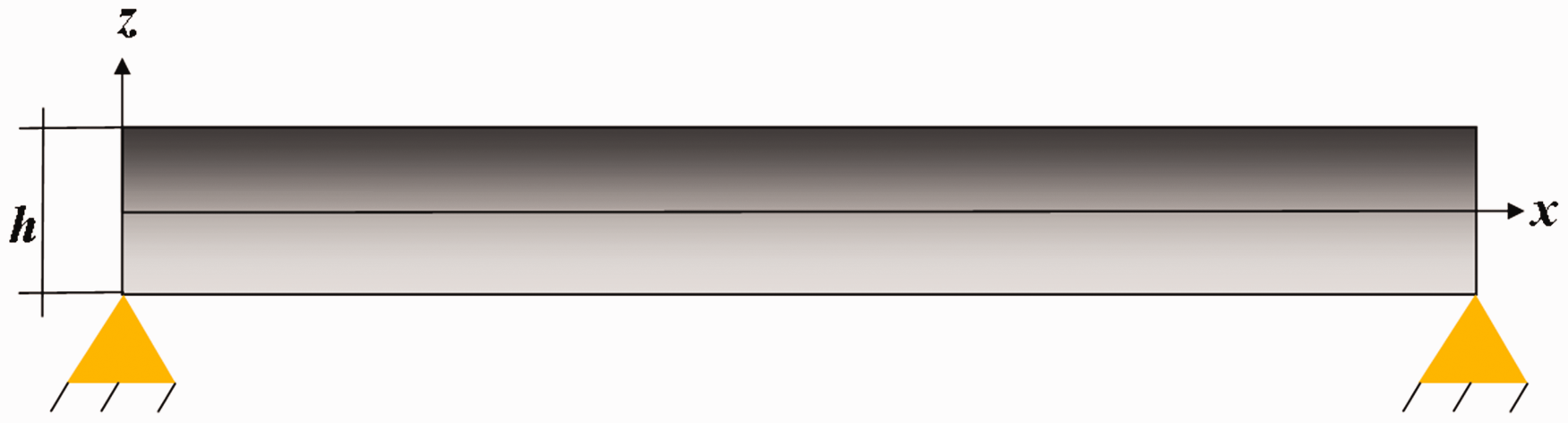
Flexoelectric FG nano-beam and attached coordinate system.
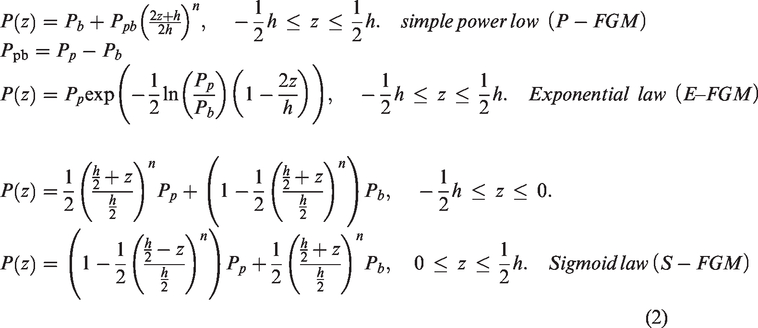
According to this figure, it is assumed that different patterns are used for distribution of the material properties in FG nano-beam along the thickness direction. Based on the aforementioned patterns, the volume fraction of constituent PZH-5H,

In equation (1),
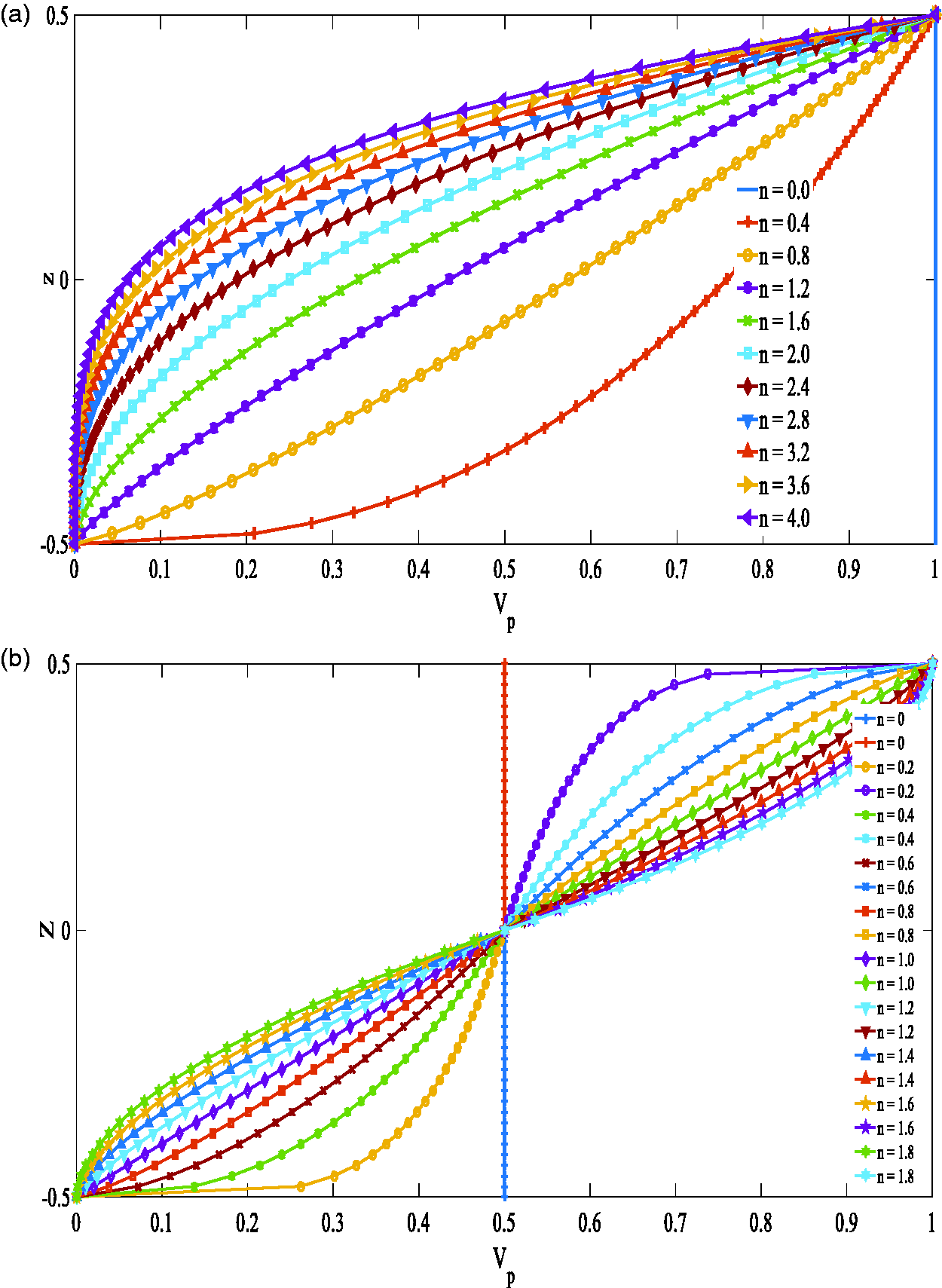
Distribution of materials volume fraction along thickness coordinates for a FG nano-beam. (a) simple power low (P-FGM) and (b) Sigmoid law (S-FGM).
The nonhomogeneous material properties of flexoelectric FG nano-beam are obtained using the mixture Voigt rule.56,57 Based on the aforementioned rule, a symbolic material property
Formulations
For a nano-dielectric material including flexoelectricity effect, the electric Gibbs free energy density function

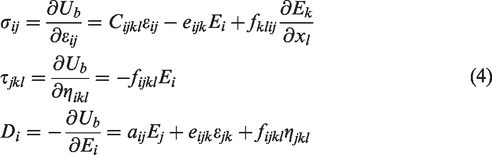

In above equation,
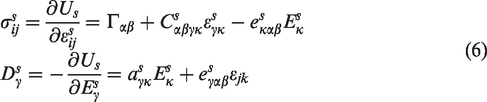



Regarding equation (8), nonzero strains and strain gradients are calculated using equation (7) as follows
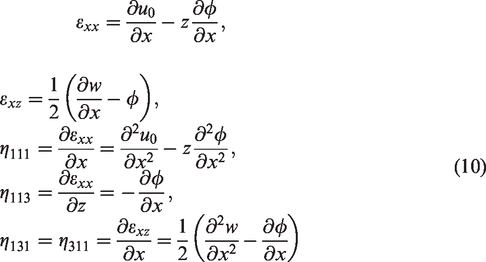
According to the NSGT,12,59 the constitutive relations are rewritten as the following form
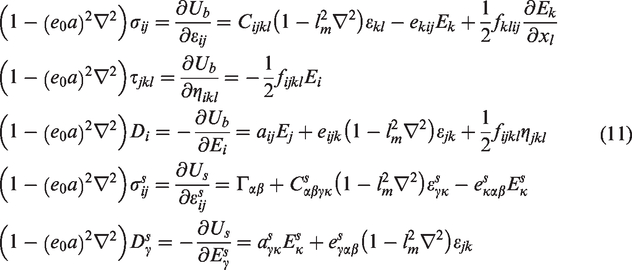
In equation (11),

And consequently the electric field gradient

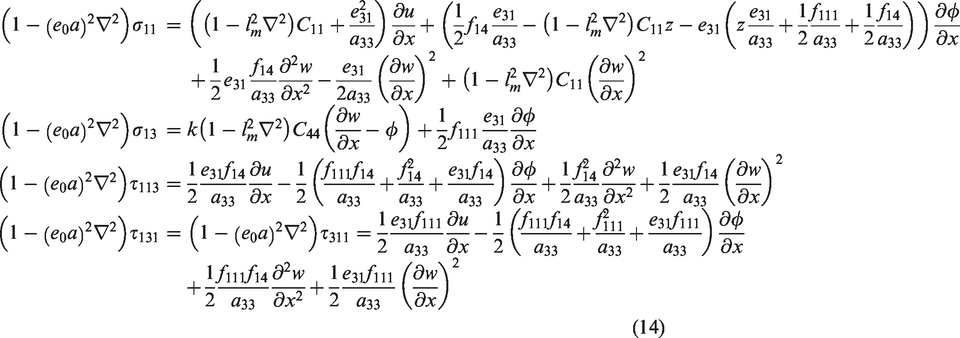
According to equations (10), (11), and (13), the nonzeros stress and moment stresses can be calculated as the following forms


Variation of kinetic energy is represented as

Variations of work done by the external forces and Winkler–Pasternak foundation are written as5,60,61

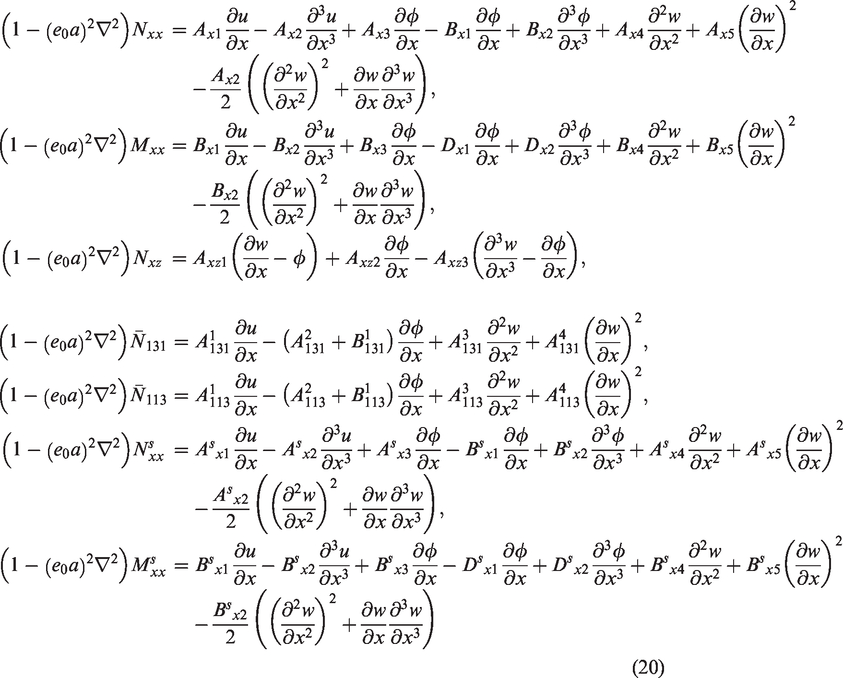
It is noted that,

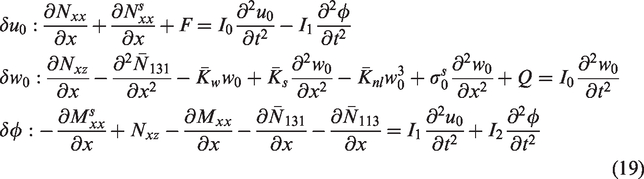
To obtain the equations of motion, equation (20) should be substituted into equation (19). Therefore, three coupled equations of motion are obtained
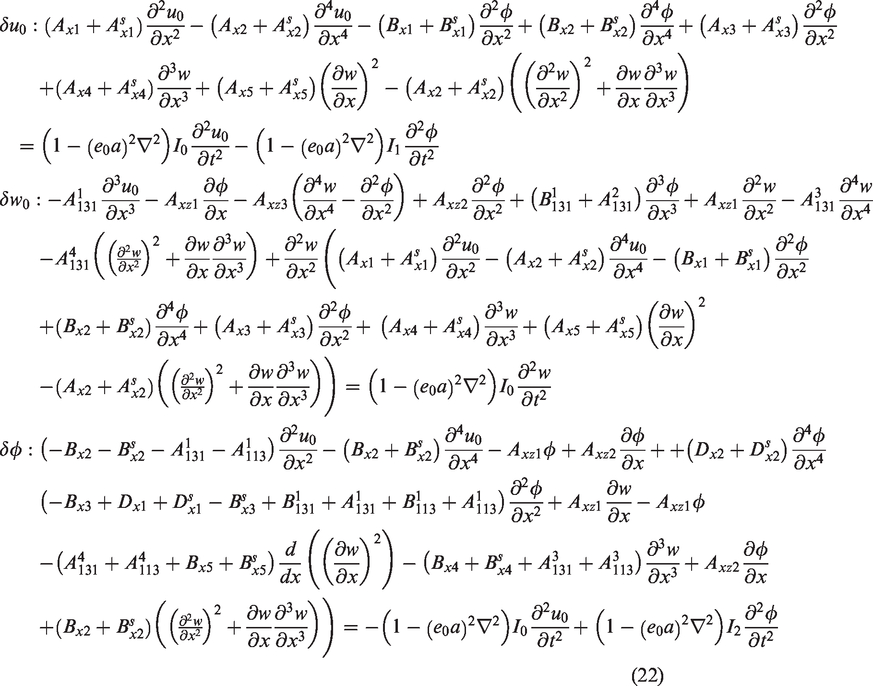
Boundary conditions for solution of equation (31) are defined as
62

Nonlinear vibration analysis
In order to solve the nonlinear governing equations of motion, differential quadrature (DQ) method is employed. Based on the aforementioned method, the approximate solution of a function



Equation (25) is rewritten as the following matrix form

Therefore, the governing equations and boundary conditions are discretized by means of the aforementioned method.61,65 In this investigation, the cosine pattern is employed to generate the DQ point system as the following form

In addition, column vectors for variables

To solve equation (22) and associated boundary conditions (equation (23)) for nonlinear vibration analysis of the sandwich nano-beam by DQ method, the weighting coefficients for the second, third, and fourth derivatives with attention to equation (26) are determined as the following form

In which weighting coefficients
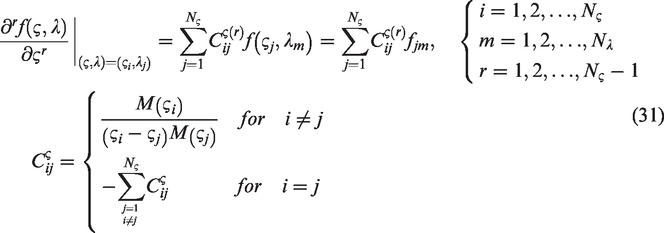
It is noted that in equation (31),

The weighting coefficients for various derivatives such as the second, third, and fourth derivatives are defined as
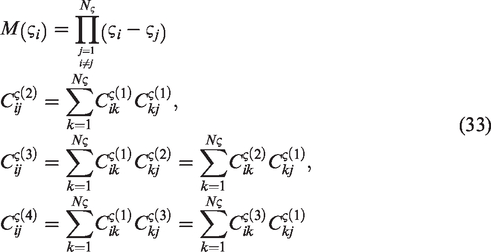
By applying equations (31) and (32) to equation (22), one can obtain a set of ordinary nonlinear equations as
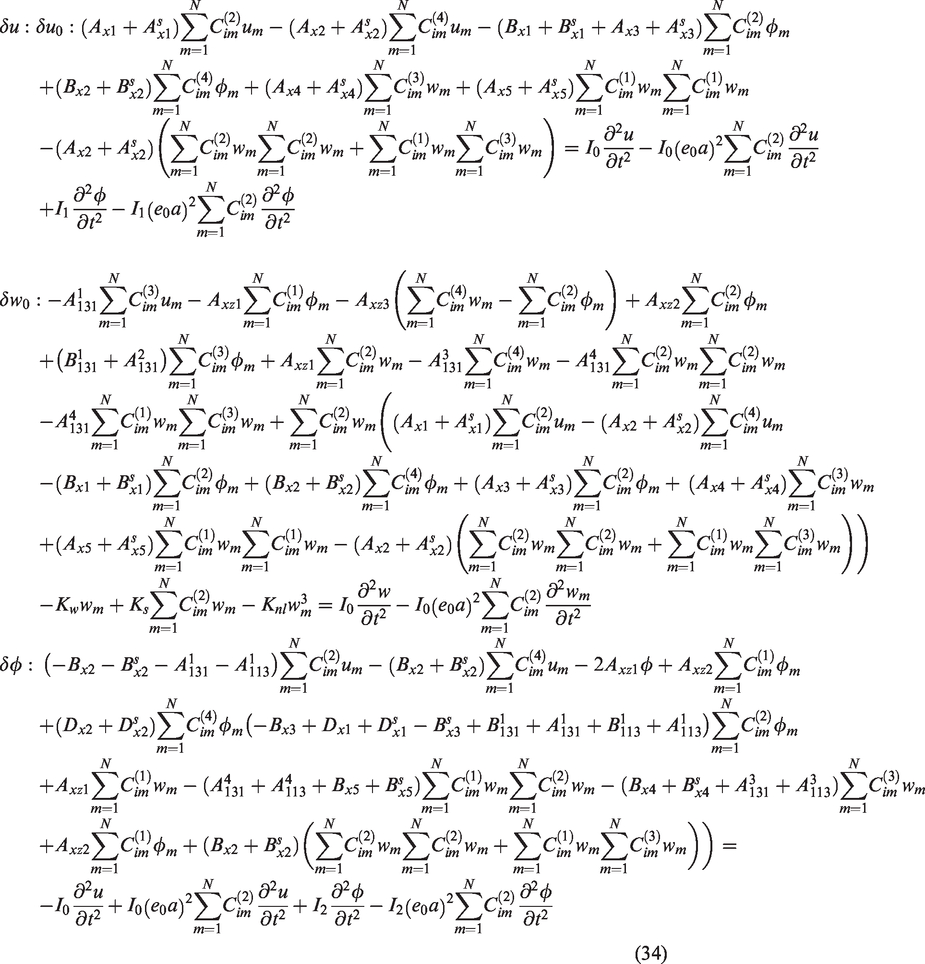
The boundary conditions of the flexoelectric FG nano-beam using DQ method are expressed as
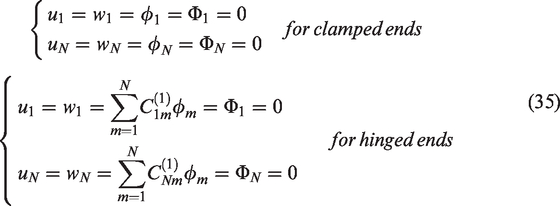
The discretized forms of the governing equations can be expressed as

In this stage, we define the unknown dynamic displacement vector as the following form

To investigate the dynamic problem and free vibration responses, the following time-dependent fields are assumed as


In this study, in order to solve equation (39), a direct iterative process is employed as follows
By ignoring the nonlinear stiffness Using the linear mode shape obtained in previous stage The eigenvector is scaled up again, and step b is repeated until the following relation is satisfied by the frequency values from the two subsequent iterations

where
Numerical results and discussion
In this section, a parametric study is implemented to indicate the influences of nonlocal parameter, power gradient index, geometric dimensions of the beam, surface effects, flexoelectric property and foundation property, and other important parameters on designing and controlling the nonlinear vibrational behaviors. The material properties and geometrical specifications of the flexoelectric FG nano-beam are presented in Table 1.
The material and geometrical properties of the constituent material of the flexoelectric FG nano-beam.66,67

Validation of results
To justify the accuracy of the governing equations and corresponding numerical results, a comparison with existing reference using semi-analytical methods is presented based on Euler–Bernoulli nano-beam theory. Figure 3 shows comparison between the obtained results by solving the governing equations extracted in this study and equation of motion obtained in Ebrahimi and Barati. 47 It is worth noting that the flexoelectricity and surface effects were considered in the study by Ebrahimi and Barati. 47 According to this comparison, it is deduced that the present results are in a good agreement with the obtained results by Ebrahimi and Barati. 47
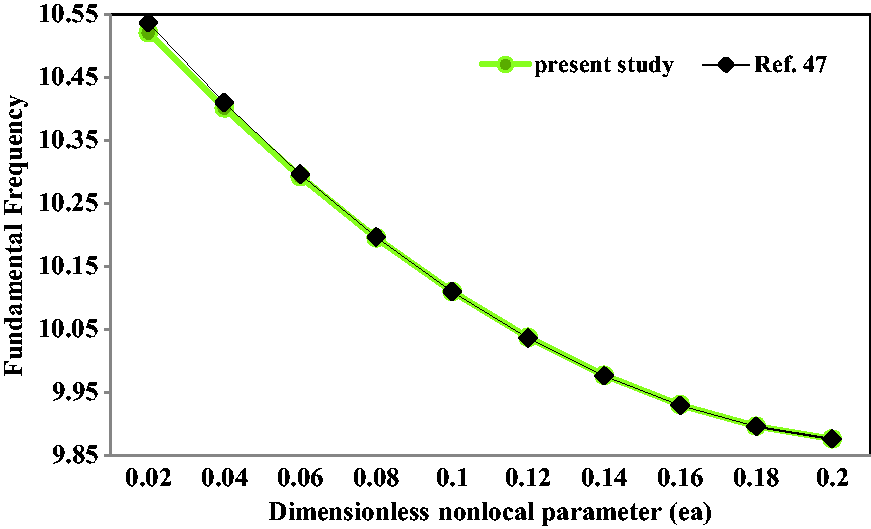
Fundamental frequency versus dimensionless nonlocal parameter (e0a).
Figures 4 and 5 illustrate fundamental linear and nonlinear mode shape of the flexoelectric FG nano-beam for various boundary conditions. According to these figures, it can be concluded that employing the nonlinear analysis leads to modification of results and obtaining more accurate mode shapes rather than linear one. In addition, it is observed that employing the nonlinear analysis gives a little more displacement rather than linear one.
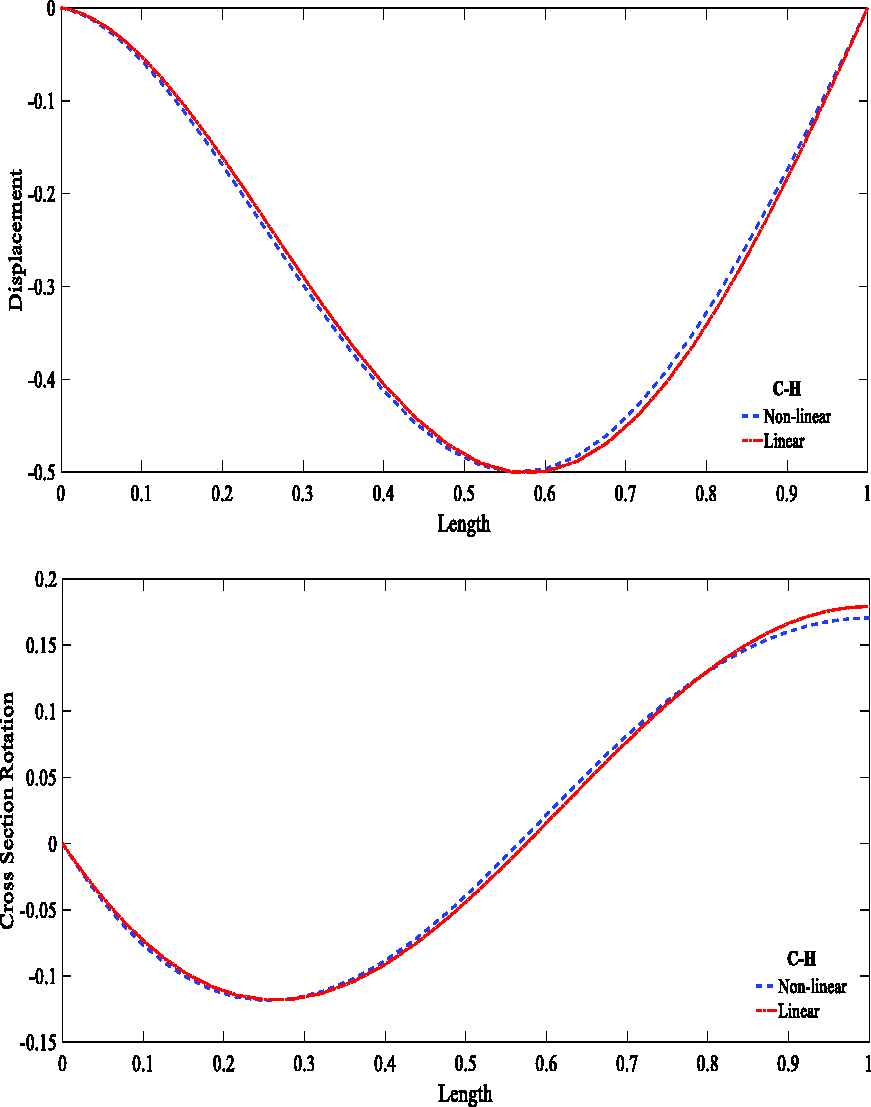
Fundamental nonlinear mode shape of the flexoelectric FG nano-beam with C–H boundary condition.
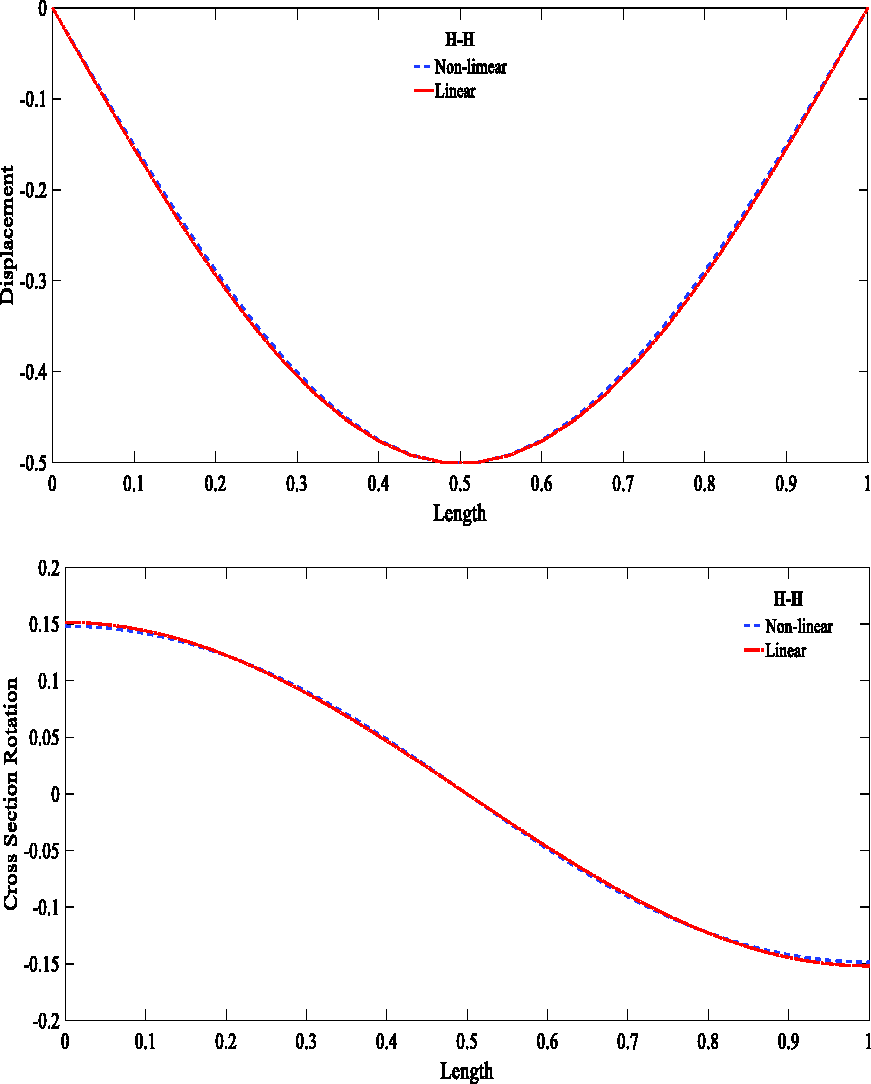
Fundamental nonlinear mode shape of the flexoelectric FG nano-beam with H–H boundary condition.
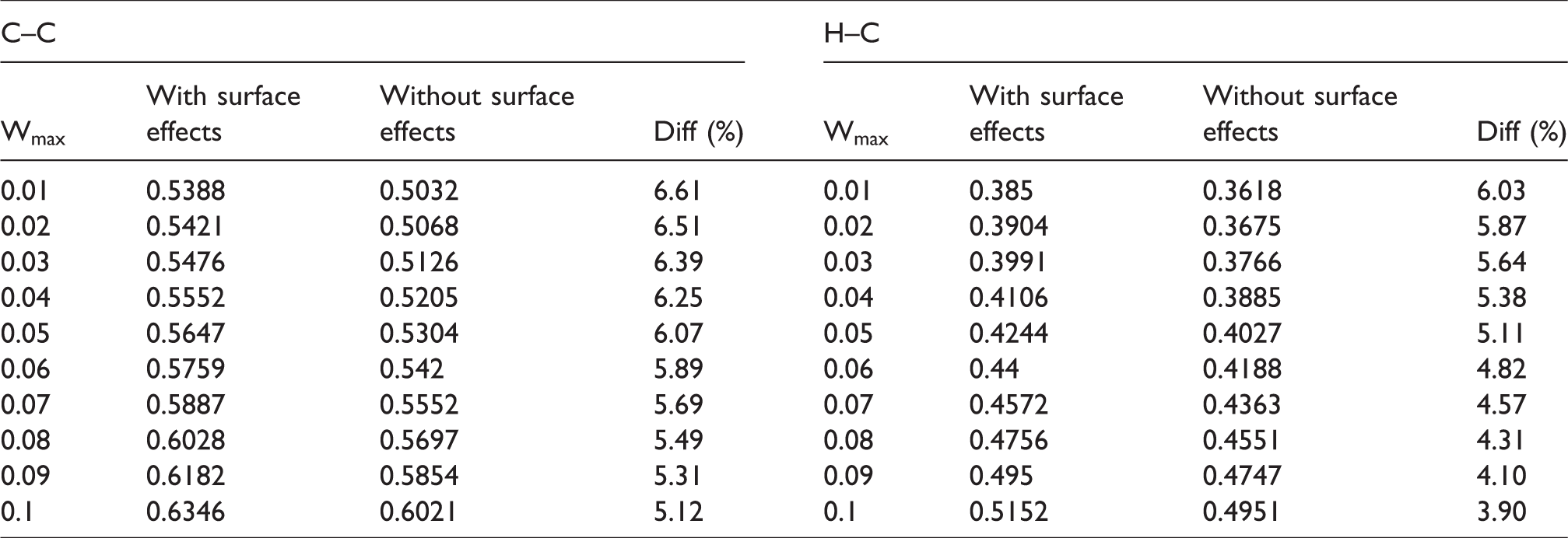
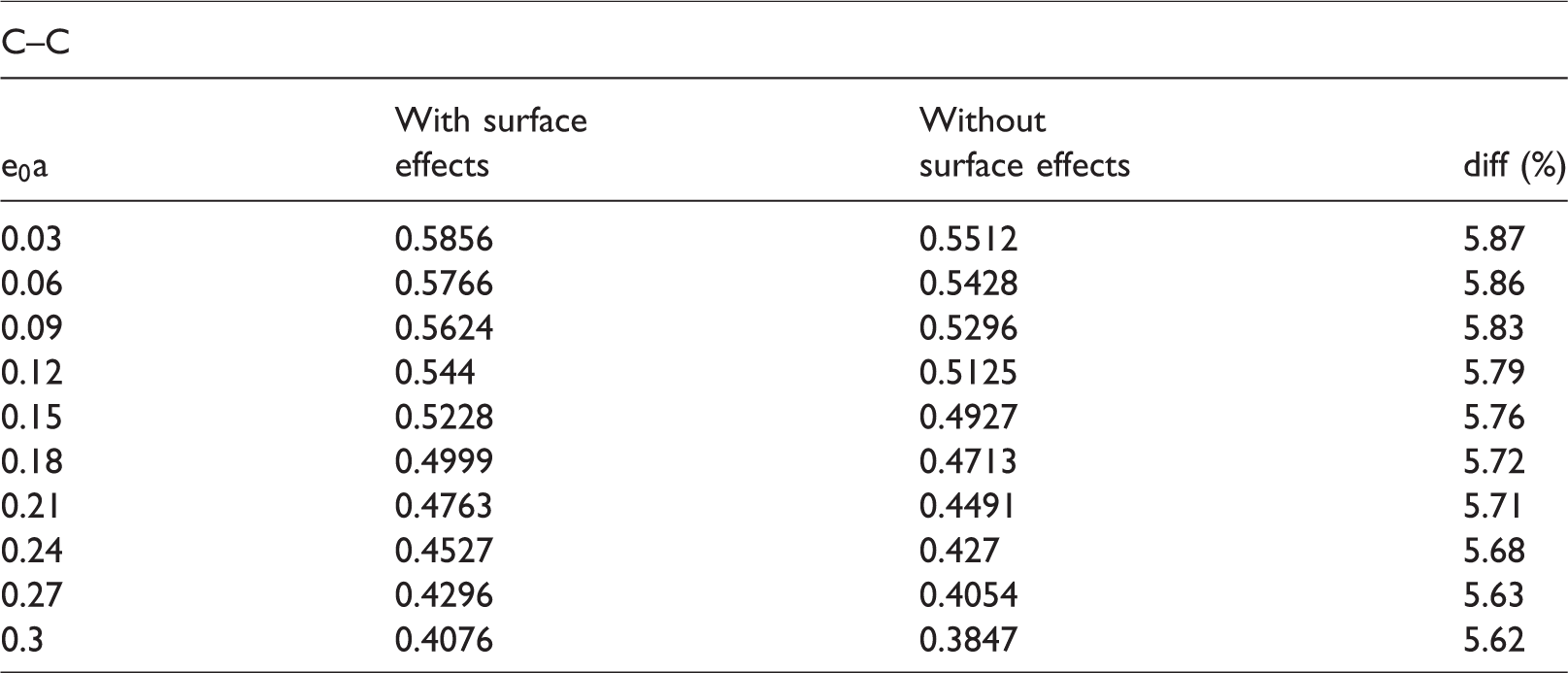
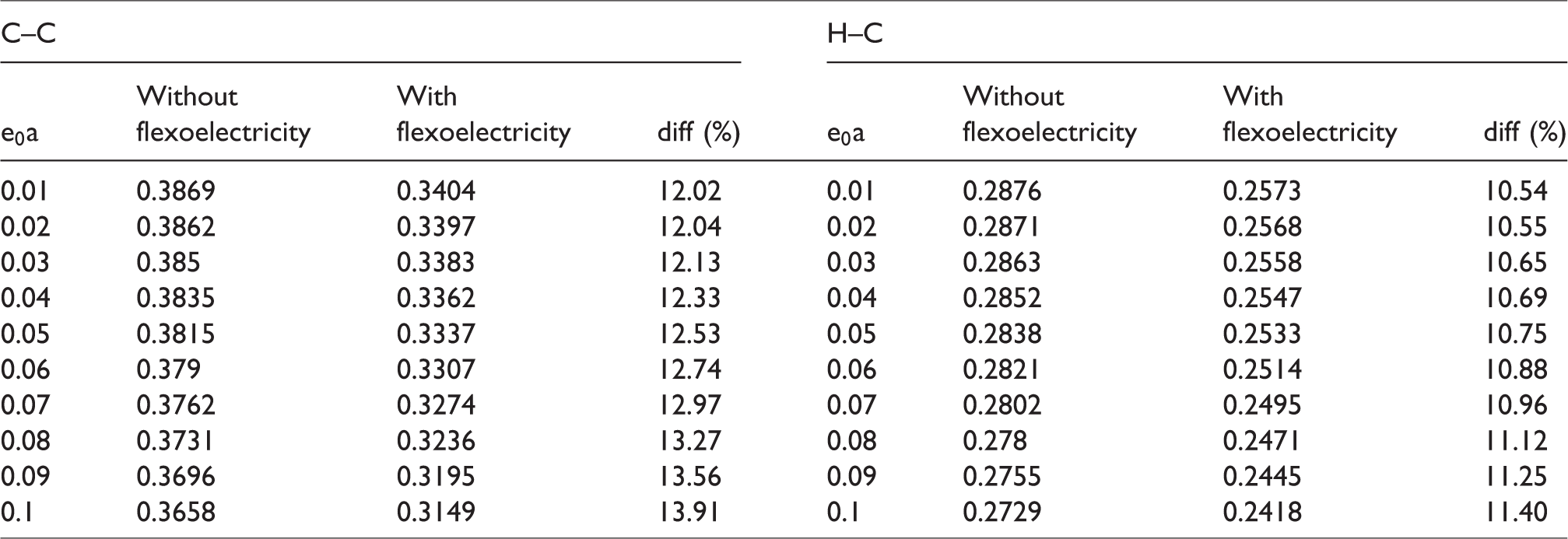
The nonlinear natural frequency of the flexoelectric FG nano-beam for various boundary conditions, nonlocal parameters (
The nonlinear natural frequency for various initial conditions with and without surface effects.
The nonlinear natural frequency for various nonlocal parameters with and without surface effects.
With regard to the obtained results presented in Table 4, the nonlinear natural frequency of the flexoelectric FG nano-beam is significantly increased by disregarding the flexoelectricity. Therefore, it can be concluded that considering the flexoelectricity leads to the decrease of the bending stiffness of the flexoelectric FG nano-beam. Differences between nonlinear natural frequencies obtained with and without flexoelectricity indicate that this phenomenon has significant effects on nonlinear vibrational behavior of the FG nano-beams.
The nonlinear natural frequency for various nonlocal parameters and boundary conditions with and without flexoelectricity.
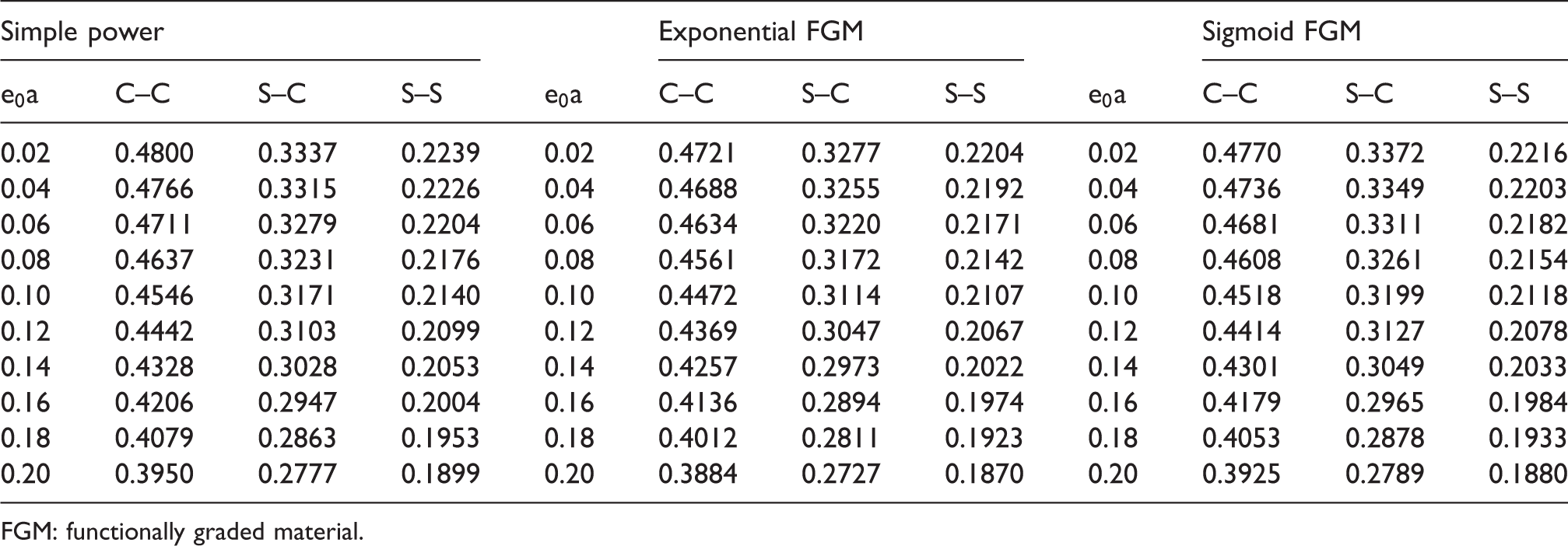
In order to investigate the effects of different patterns for materials distribution on nonlinear vibrational behavior of the flexoelectric FG nano-beams, nonlinear natural frequencies are calculated in Table 5 for three distribution patterns of materials. With regard to the results obtained by different distribution patterns, it is noted that exponential FGM calculated the smaller values for nonlinear natural frequency of the flexoelectric FG nano-beam with respect to simple power and sigmoid patterns in various boundary conditions. In addition, the nonlinear natural frequencies computed by simple power and sigmoid FGMs distribution approximately have near values. Among various boundary conditions considered in this study, C–C has the larger values with respect to other boundary condition such as H–C and S–S.
The nonlinear natural frequency for various FGM distributions.
FGM: functionally graded material.
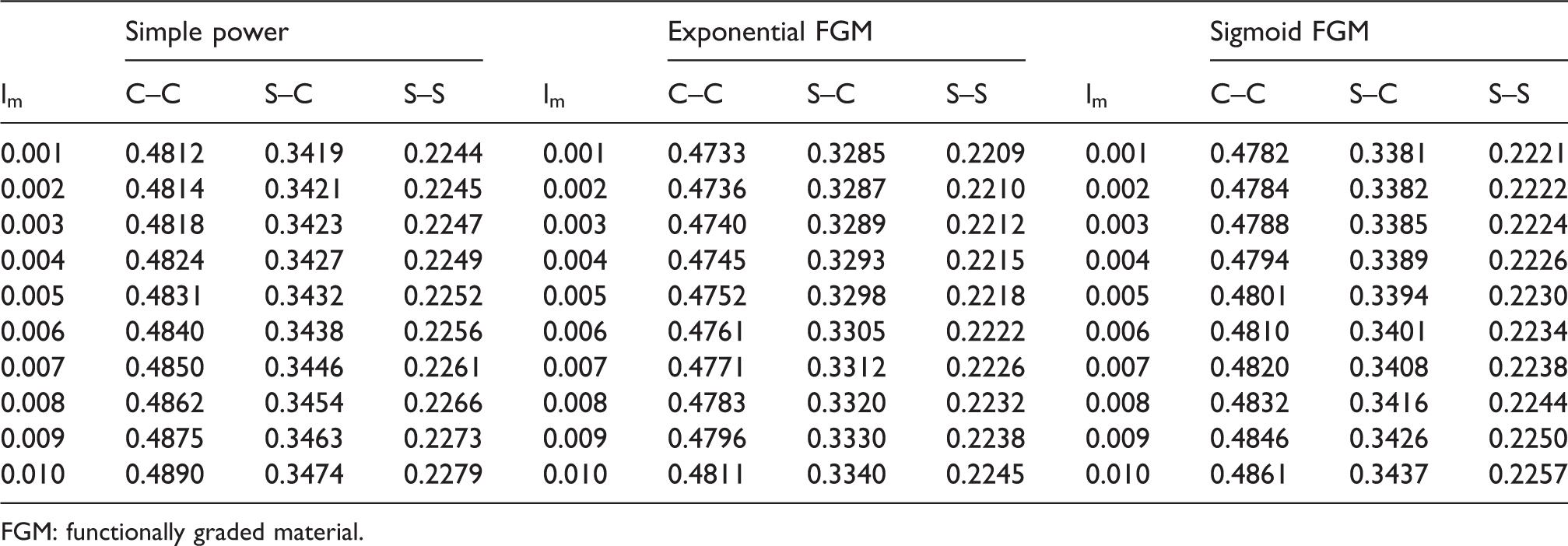
The effects of the strain gradient
The nonlinear natural frequency for various strain gradient parameters.
FGM: functionally graded material.
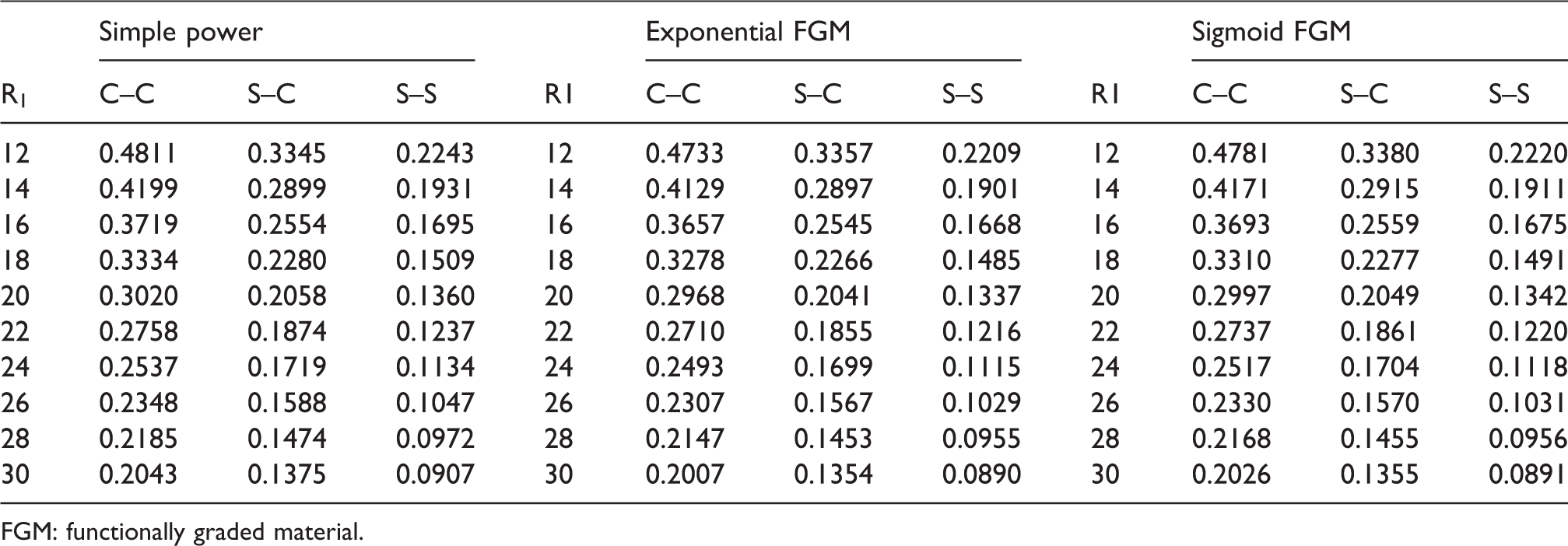
The effects of slender ratios
The nonlinear natural frequency for various slender ratios.
FGM: functionally graded material.
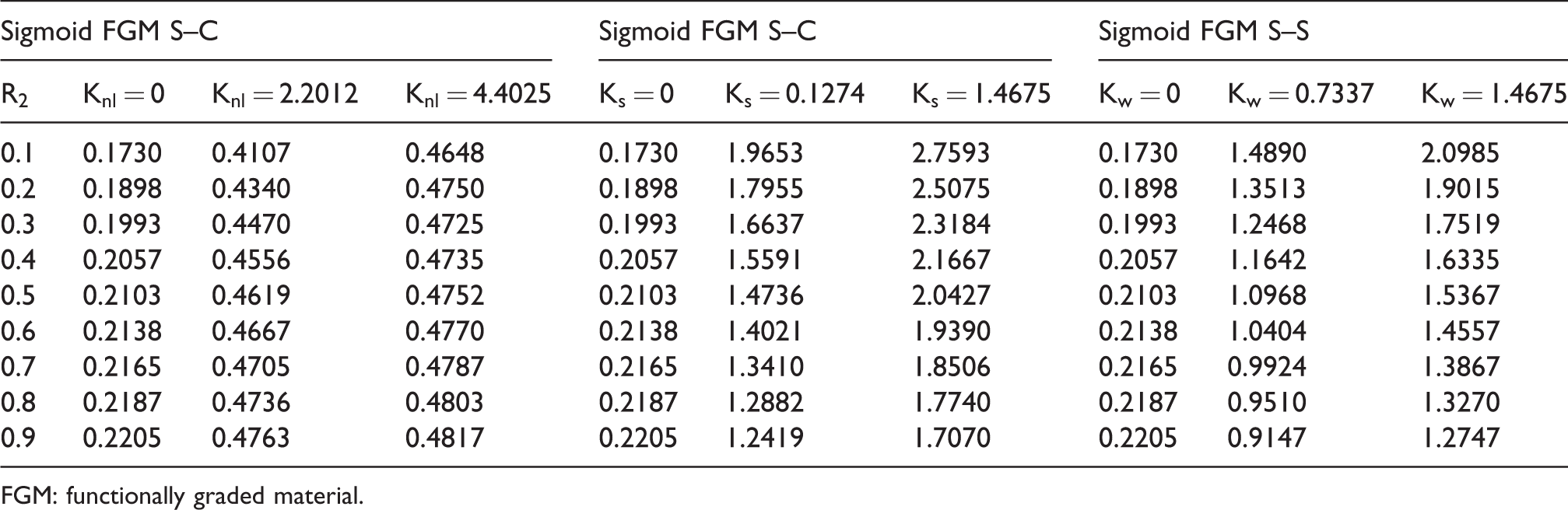
The influences of the nonlinear stiffness coefficient (
The nonlinear natural frequency for various foundation coefficients and width to height ratios.
FGM: functionally graded material.
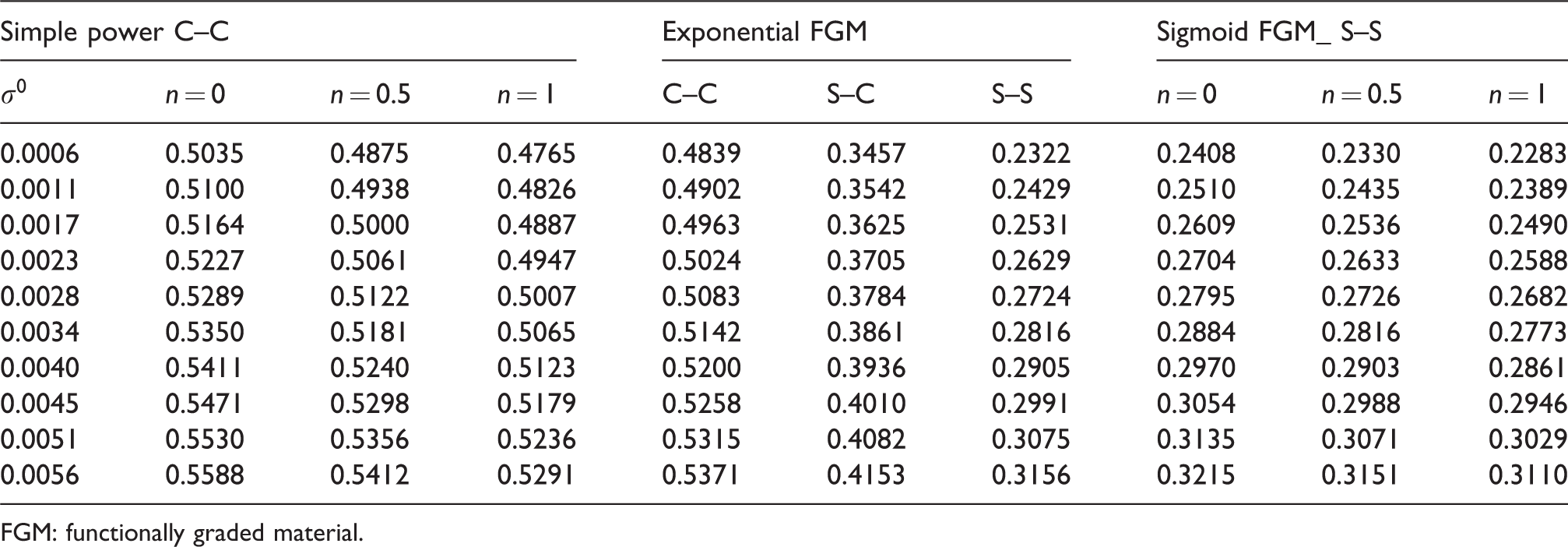
Table 9 shows the influences of the various power index of the distribution patterns of FGMs (
The nonlinear natural frequency for various residual surface stress and power index.
FGM: functionally graded material.
Conclusions
Nonlinear vibration analysis of the flexoelectric FG nano-beams was implemented in this paper. For the first time, the surface effects and flexoelectricity were simultaneously considered in nonlinear vibration analysis of the FG nano-beams resting on cubic nonlinear Winkler–Pasternak foundation. The governing equations were derived with accounting the residual surface stress and the nonlocal strain gradient elasticity. The governing equations were solved by the DQ method to obtain the nonlinear natural frequency, and fundamental nonlinear mode-shape for nonlinear vibration was obtained. The effects of some main parameters such as nonlocal parameter, length scale parameter, power gradient index, geometric parameter, surface effects, flexoelectric property and foundation characteristics, and other important parameters in designing and controlling the nonlinear natural frequency and fundamental mode-shape were studied in detail. The most important results of this study are presented as:
According to the results, the nonlinear natural frequency of the flexoelectric FG nano-beam was significantly increased by disregarding the flexoelectricity property. It means that considering the flexoelectricity leads to decrease the bending stiffness of the flexoelectric FG nano-beams. The differences between nonlinear natural frequencies obtained with and without flexoelectricity indicate that the aforementioned phenomenon has significant effects on nonlinear vibrational behavior of the FG nano-beams. Nonlocal parameter, length scale (gradient parameter), and surface effects have significant effects on nonlinear natural frequency of the flexoelectric FG nano-beams as increasing the nonlocal parameter leads to the decrease of nonlinear natural frequency due to decreasing the bending stiffness of flexoelectric nano-beam. Also, considering the surface effects caused to increase the nonlinear natural frequency. In addition, the nonlinear natural frequency is increased by increasing the residual surface stress. On the other hand, increasing the strain gradient parameter caused an increase in nonlinear natural frequencies of the flexoelectric FG nano-beams. Numerical results indicate that distribution patterns and residual surface stress have main effects on nonlinear behavior of flexoelectric FG nano-beams. With regard to the presented results, employing the exponential FGM leads to the smaller values for nonlinear natural frequencies with respect to simple power and sigmoid patterns in various boundary conditions. Also, it is concluded that in the various distribution patterns, increasing power index leads to the decrease in the nonlinear natural frequencies. Geometric dimensions of the flexoelectric FG nano-beam can strongly change the nonlinear natural frequency. The results indicate that increasing the slender ratio caused a decrease in nonlinear natural frequency and also increasing the width to height ratio of the flexoelectric FG nano-beam lead to increase in the nonlinear natural frequency in various boundary conditions and distribution patterns of FGMs. Investigation on the effect of the cubic nonlinear Winkler–Pasternak foundation parameters on the nonlinear vibrational behavior of the flexoelectric FG nano-beam leads to important conclusions. Increasing the Winkler stiffness (
Footnotes
Declaration of conflicting interests
The author(s) declared no potential conflicts of interest with respect to the research, authorship, and/or publication of this article.
Funding
The author(s) disclosed receipt of the following financial support for the research, authorship, and/or publication of this article: The research described in this paper was financially supported by the University of Kashan. (Grant Number: 463978/025). The authors would like to thank the Iranian Nanotechnology Development Committee for their financial support.