




Abstract
This paper presents a three-dimensional formulation for the free vibrations of thick rectangular plates with general boundary conditions and resting on elastic foundations. The general boundary conditions are imposed by means of penalty function method. The displacements of the plates are expressed by a three-dimensional cosine series and some simple polynomial functions which introduced to ensure and accelerate the convergence of the series representation. All the unknown coefficients can be obtained by using the Rayleigh–Ritz method. Comparisons of the present results with those in available literature demonstrate the accuracy and reliability of the present formulation. Furthermore, parametric investigations are presented including the effects of boundary conditions, geometrical parameters, and elastic foundation.
Keywords
Introduction
Plates are the basic structural elements in most engineering structures, such as ships, automobiles, and architectures. During their operation, those plates are commonly subjected to oscillating loads, which lead to the vibration. Consequently, it is of paramount importance to thoroughly understand the vibration behaviors of plates thus reduce structural vibrations through proper design. In addition, there exists a variety of possible boundary restraint cases for plates in practical assembly and engineering applications. Development of the reliable and efficient techniques for vibration analysis of plates with general boundary conditions is the subject of significant research interest of the present study.
Significant advances on the subject have been achieved during the past few decades. A larger variety of plate theories have been proposed and developed. In most cases, the two-dimensional (2D) theories such as the classic plate theory,1–6 the first-order shear deformation theory7–17 and the higher order deformation theory18–24 were adopted to analyze the vibration problems of those structures. However, since there are some certain kinematic assumptions, those 2D theories only provide approximate solutions. In order to obtain realistic results, an increasing number of researchers employed three-dimensional (3D) elasticity theory to study the vibration problems of plates. Due to no hypotheses are assumed for the distribution field of the deformations and stresses, the 3D analysis not only provides a full spectrum of vibration solutions but also allows further physical insight. Malik and Bert 25 provided 3D solutions for vibration rectangular plates using differential quadrature method. Liew et al. 26 developed a 3D Ritz method for vibration of thick plates in which the effects of thickness ratios and end constraints on the frequencies and mode shapes were investigated. Zhou and co-authors27–30 analyzed 3D vibration characteristics of plates using Ritz method combined with Chebyshev polynomial. Naginoa et al. 31 studied 3D free vibration of rectangular plates via a B-spline Ritz method. A comparison between classical 2D finite elements and an exact 3D solution for free vibration of plates and shells was carried out by Brischetto and Torre 32 . Brischetto 33 proposed 3D equilibrium equations in general orthogonal curvilinear coordinates for free vibration of plates and shells. An analytical solution for free vibration of an incompressible isotropic linear elastic rectangular plate with simply supported boundary conditions was provided by Aimmanee and Batra. 34 It is noted that the Carrera Unified Formulation (CUF) is a powerful framework of analysis of beam, plate, and shell structures and is capable of detecting 3D effects on vibration behavior. 35 Ferreira et al. 36 combined CUF and a radial basis function collocation technique to study vibration behavior of isotropic and cross-ply laminated plates. Later, they proposed a combination of CUF and the generalized differential quadrature technique for vibration analysis of thick isotropic and cross-ply laminated plates. 37 Rezaei and Saidi 38 used CUF in conjunction with state space method to analyzed Levy-type rectangular porous-cellular plates.
A review of the scientific literature in this filed reveals that the available 3D solutions of plates are limited. In addition, most of the previous studies about vibration problems of plates are restricted to classical boundary conditions. It is well recognized that there exists a variety of possible boundary restraint cases especially elastic restraints for plates in practical assembly and engineering applications. Plates on elastic foundations have been widely adopted by many researchers to model interaction between elastic media and plates for various engineering plate problems. Consequently, it is necessary to study vibration behavior of plate with general boundary conditions and resting on elastic foundations. This paper presents a 3D formulation for the free vibrations of thick rectangular plates with general boundary conditions and resting on elastic foundations. The general boundary conditions are imposed by means of penalty function method. The displacements of the plates are expressed by a 3D cosine series and some simple polynomial functions which introduced to ensure and accelerate the convergence of the series representation.39–43 All the unknown coefficients can be obtained by using the Rayleigh–Ritz method. Comparisons of the present results with those in available literature demonstrate the accuracy and reliability of the present formulation. Furthermore, parametric investigations are presented, including the effects of boundary conditions, geometrical parameters, and elastic foundation.
Theoretical formulations
Preliminaries
Consider a rectangular plate on elastic foundation with uniform thickness h, as depicted in Figure 1. The length and width of the plate are denoted by a and b, respectively. The geometry and dimensions are defined with respect to an orthogonal coordinate system (x, y, and z) which is located on the bottom surface. The displacement components along x, y, and z directions of a point in the plate are represented by u, v, and w, respectively. According to 3D elasticity theory, the relationships between strains and displacements are given as follows
44

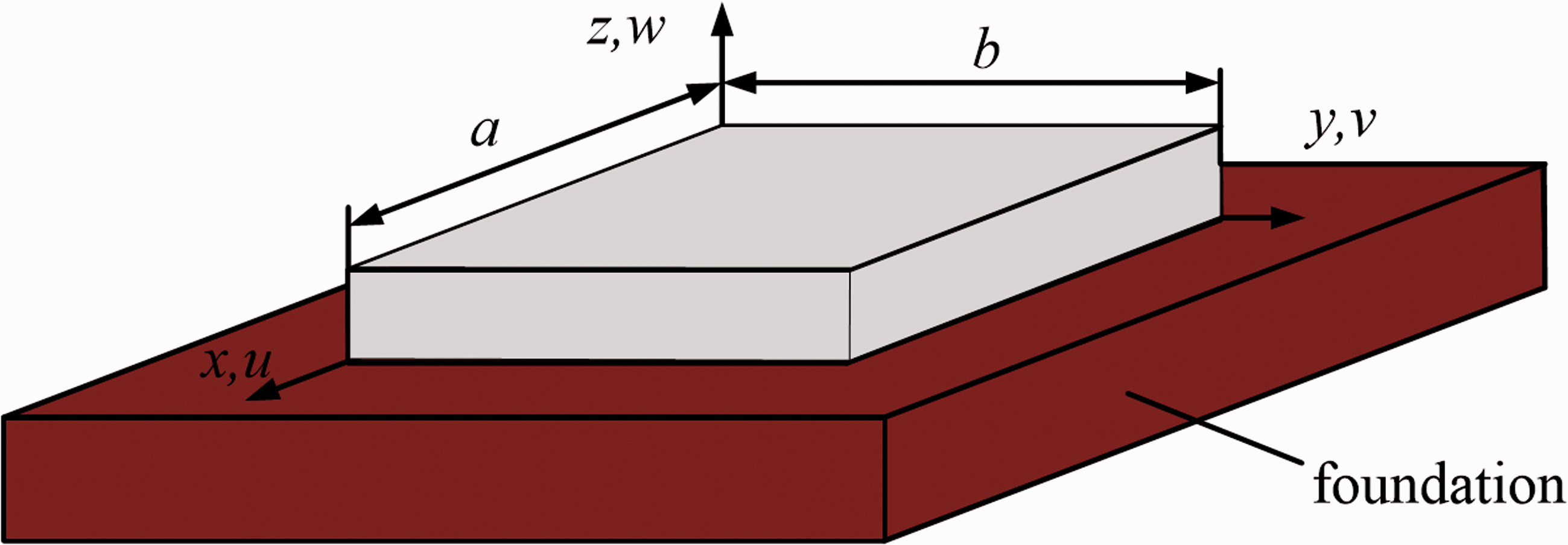
Geometry and coordinate system of a plate on elastic foundation.
Based on Hook’s law, the constitutive relations are given in a matrix form as follows
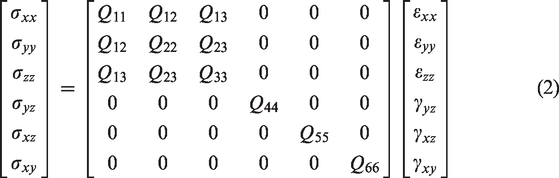
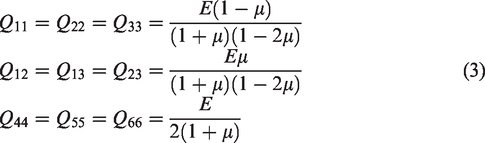
In this work, the bottom surface of the plate is assumed to be continuously rested on an elastic foundation represented by Winkler/Pasternak model. The boundary conditions are imposed by penalty factor of stiffness type, namely, artificial linear springs (ku, kv, and kw). Therefore, the boundary conditions can be defined as follows


Energy functional
The kinetic energy T of the rectangular plate can be expressed as follows

The strain energy U can be written in integral form as follows

The potential energy P can be into two components i.e. potential energy stored in the boundary springs (Pbs) and potential energy stored in elastic foundation (Pef). The Pbs and Pef are given as follows


The energy functional of plates can be expressed as follows

Admissible functions
In Rayleigh–Ritz method, the only constriction to admissible displacement functions is that they should satisfy the geometrical boundary conditions. In this work, the geometrical boundary conditions are imposed by the penalty function method. Consequently, the choice and construction of admissible functions become flexible. Compared with polynomials which maybe lead to instability, Fourier series exhibit an excellent numerical stability.
45
Unfortunately, there exists convergence problem corresponding to the use of Fourier series. Therefore, some auxiliary functions are introduced to eliminate this problem. The displacement components can be expressed as follows
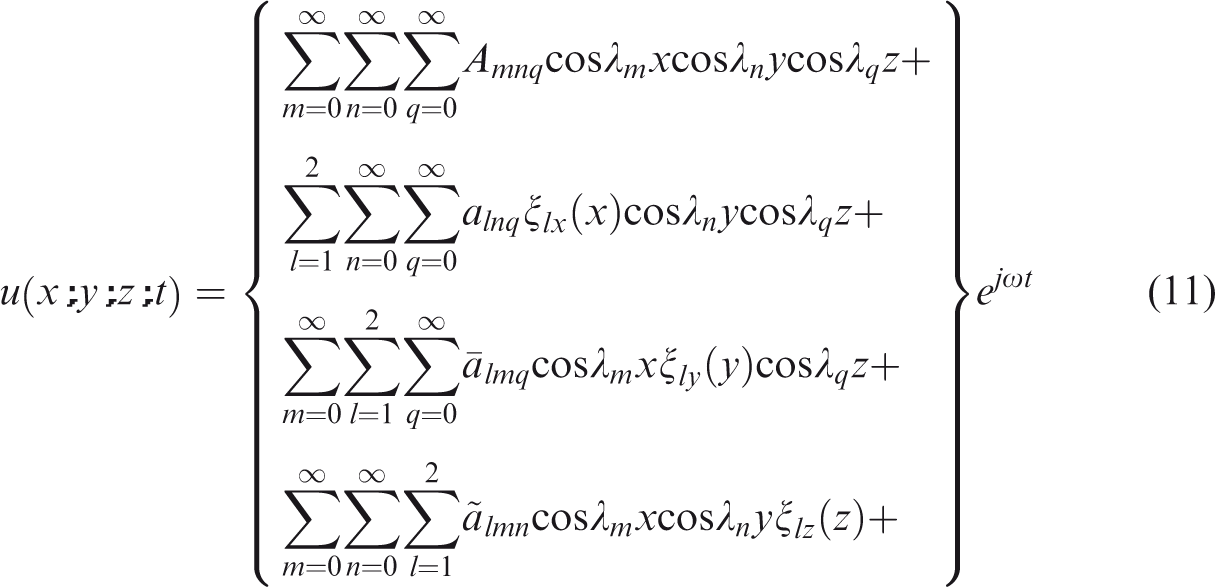
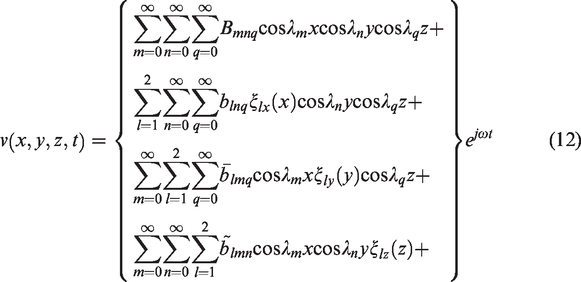
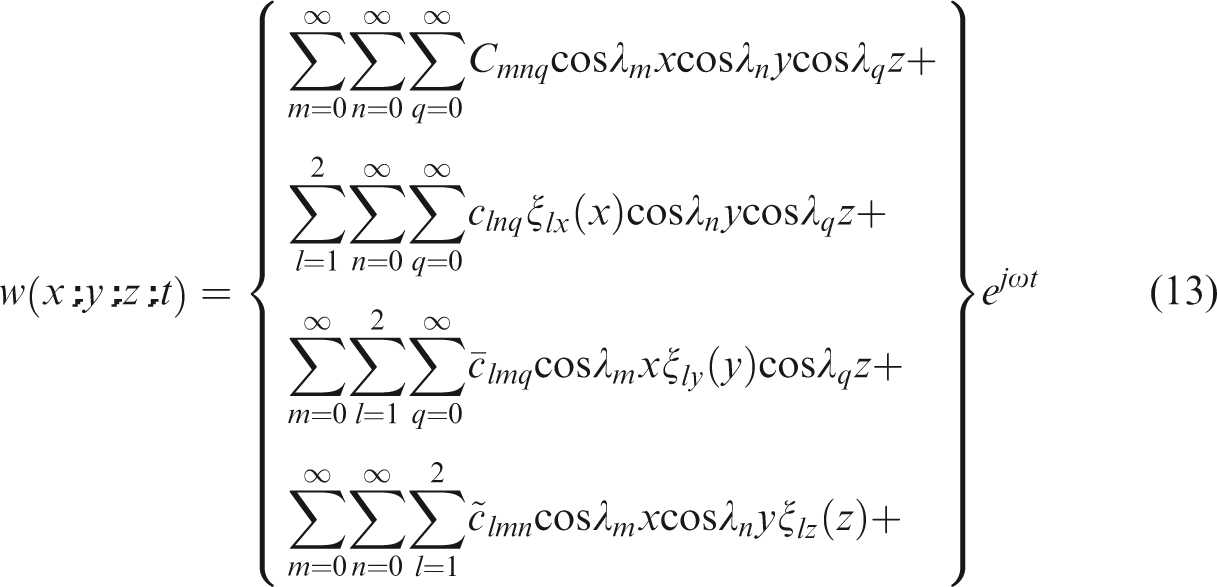



It is easy to verify that

The similar conditions exist for the y- and z-related polynomials. The introductions of these auxiliary functions are for the purpose of removing the discontinuities of the original displacement functions and their derivatives at edges.
Solution procedure
Substituting equations (6) to (9) and (11) to (13) into equation (10), and minimizing energy functional with respect to the unknown coefficients, one can obtain a set of linear algebraic equation as follows


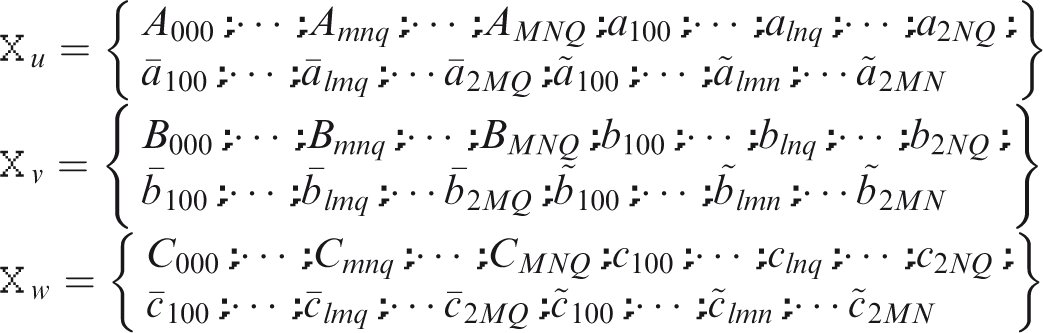
All frequencies and corresponding mode shapes can be obtained by solving equation (17).
Numerical examples and discussion
In this section, a variety of numerical examples on free vibration of thick rectangular plates with general boundary conditions and resting on elastic foundation are given to validate accuracy and reliability of the present method. The typical boundary conditions, namely, clamped (C), simply-supported (S), free (F), and elastic (E) restraints, are considered. For the sake of brevity, the boundary conditions are described uniformly by letter strings. For example, the symbol CSFE represents a rectangular plate with clamped end at x = 0, simply supported edge at y = 0, free boundary condition at x = a, and elastic restraint at y = b. The frequency parameter Ω is defined as follows

Convergence study
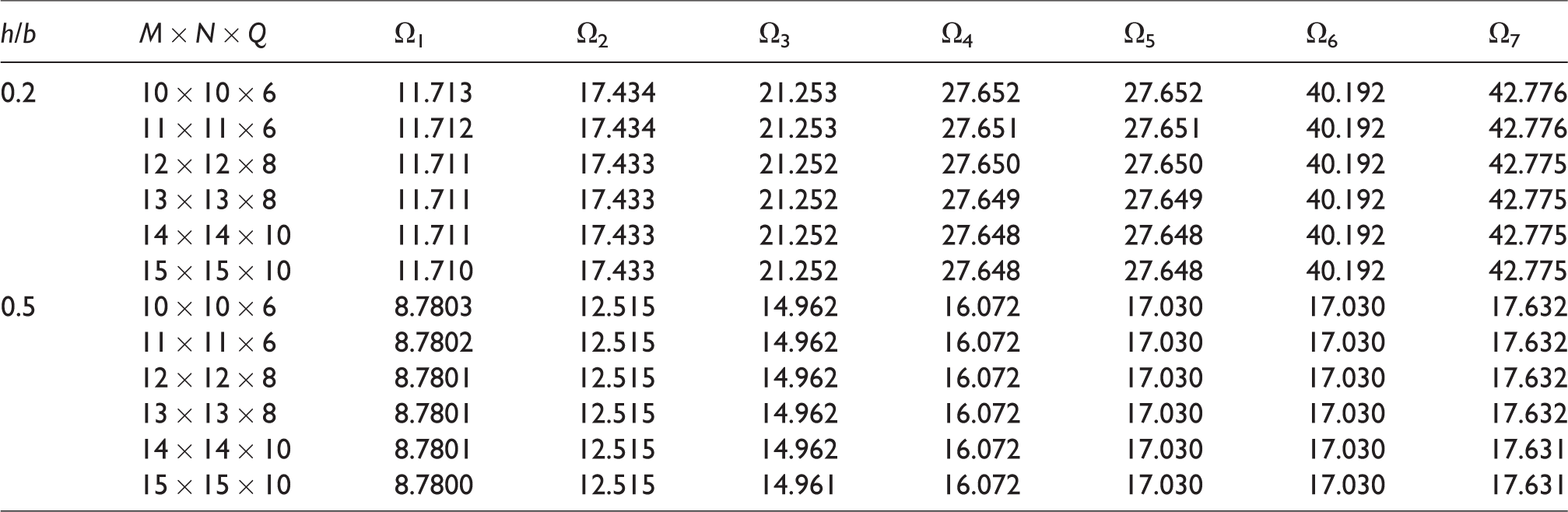
Theoretically, the exact solution can be obtained for the superposition of infinite number in series expression shown in equations (11) to (13). However, in actual calculation, the infinite series must be truncated to M, N, and Q. Consequently, the convergence of the current formulation needs to be checked firstly. Table 1 presents the first seven dimensional frequency parameters Ω of a rectangular plate with different thickness-to-width ratios subjected completely free boundary conditions. The geometrical parameters used in analysis are as follows: a/b = 1, h/b = 0.2, and 0.5. It is obvious that frequency parameters monotonically converge as the truncated numbers increase. M × N × Q = 14 × 14 × 10 will be selected as the truncated numbers in the following calculations.
Convergence of frequency parameters of completely free square plates with different thickness-to-width ratio h/b (μ = 0.3).
In this work, the boundary conditions are handled by artificial boundary springs. In order to determine the appropriate value of the springs’ stiffness for different boundary conditions, it is necessary to investigate the influence of springs’ stiffness on the frequencies of the plate. The variations of the first three dimensional frequency parameters with different value of springs’ stiffness are depicted in Figure 2. The geometrical parameters are as follows: a/b = 1 and h/b = 0.2. The elastic parameters Γi are defined as Γi = lg(ki/D) (i = u, v, and w). The plate is assumed to have free boundary conditions at y = constant and be restrained by only one kind of boundary springs at x = constant. It is obvious that in certain range, the increase in the elastic parameter leads to increase in the frequency parameters, and out of the range, the frequency parameters are almost constant. Based on this, the elastic parameters are defined as follows: Γ = 9 for clamped boundary condition and Γ = 2 for elastic boundary condition.
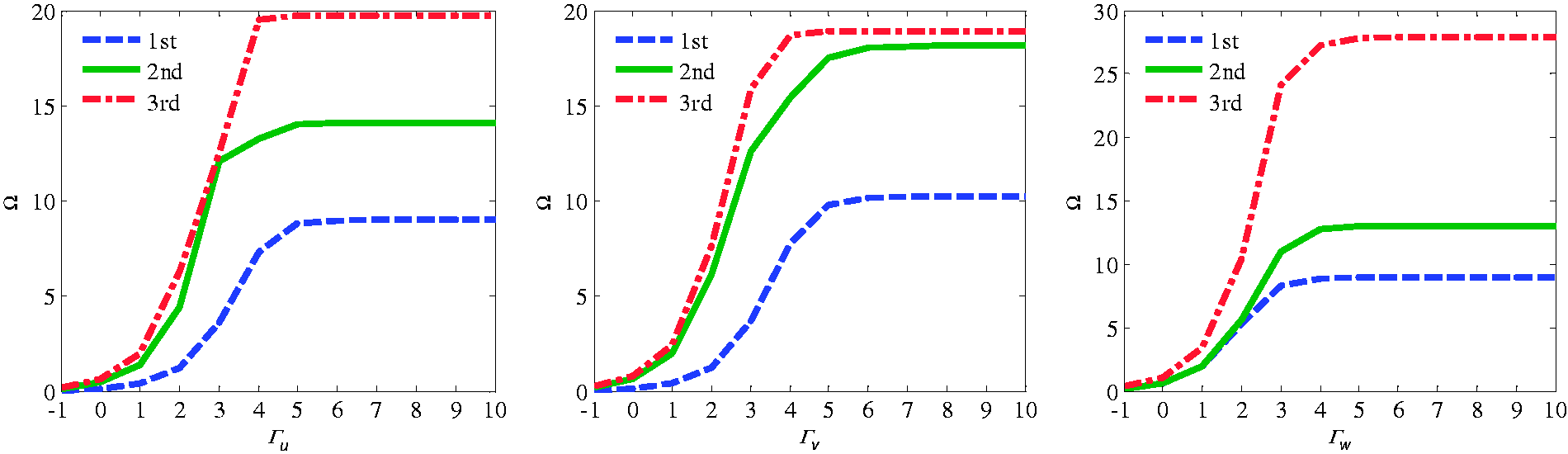
Variations of the first three frequency parameters of the plates with h/b = 0.2 with different value of spring stiffness.
Plate with general boundary conditions
In this subsection, free vibration of the plates with general boundary conditions is investigated. Apart from aforementioned classical boundary conditions, three types of elastic boundary conditions (i.e. E1, E2, and E3) are also considered. The definitions of the boundary conditions and corresponding value of Γ are given in Table 2.
The value of Γ for different boundary conditions (x = constant).

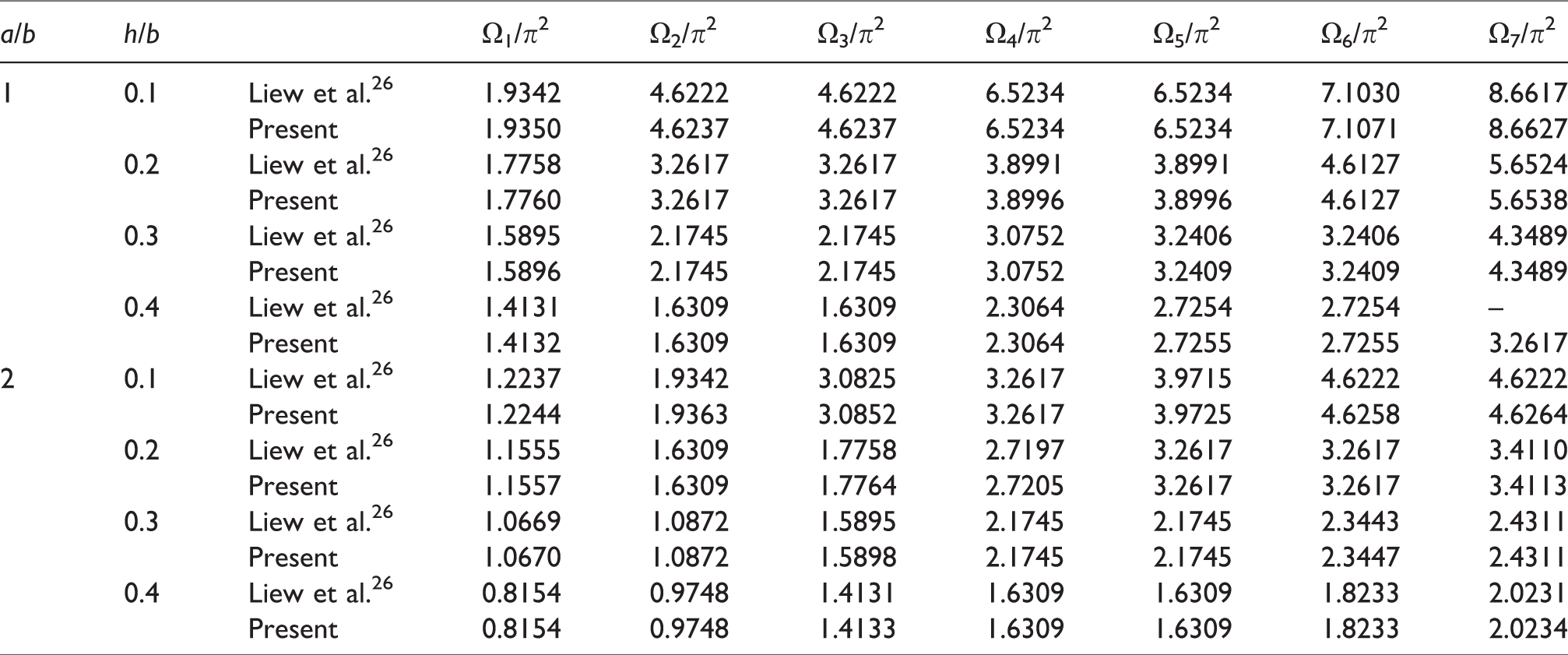
Some comparisons of the present results with those in available literature are presented to demonstrate the accuracy and reliability of the present formulation. The first seven frequency parameters of rectangular simply supported plates with different length-to-width rations and thickness-to-width rations are given in Table 3. The same vibration problem has been studied by Liew et al. 26 using Ritz method in conjunction with 3D theory of elasticity. It can be seen that excellent agreement of the results is achieved. Table 4 presents dimensional frequency parameters Ω of rectangular plate with different boundary conditions. The geometrical parameters are as follows: h/b = 0.2; a/b = 0.5, 1, and 2. The results are compared with those given by Malik and Bert 25 using the differential quadrature (DQ) method. It is observed that results show a great agreement.
First seven frequency parameters of rectangular plates with SSSS boundary conditions (μ = 0.3).
First two frequency parameters of plates with different boundary conditions (h/b = 0.2, μ = 0.3).
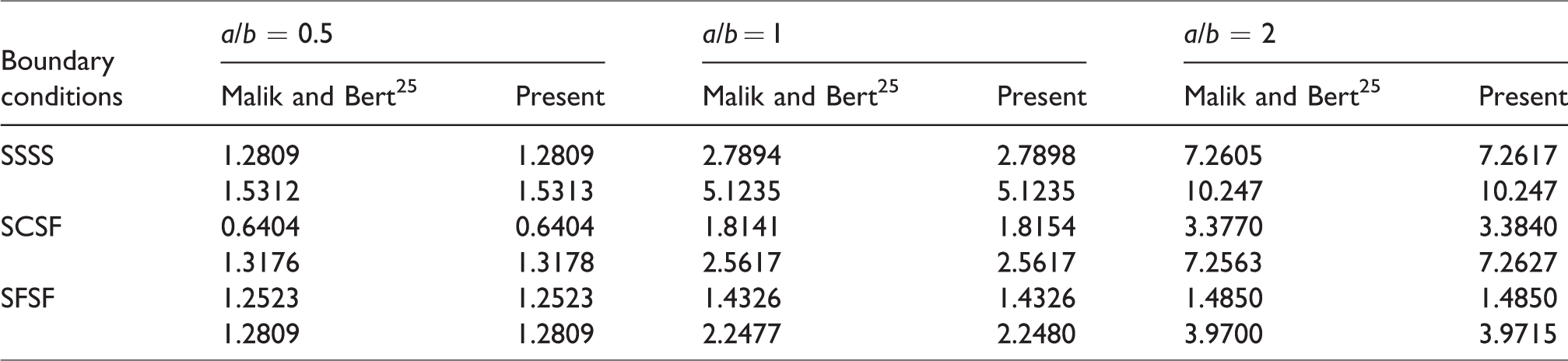
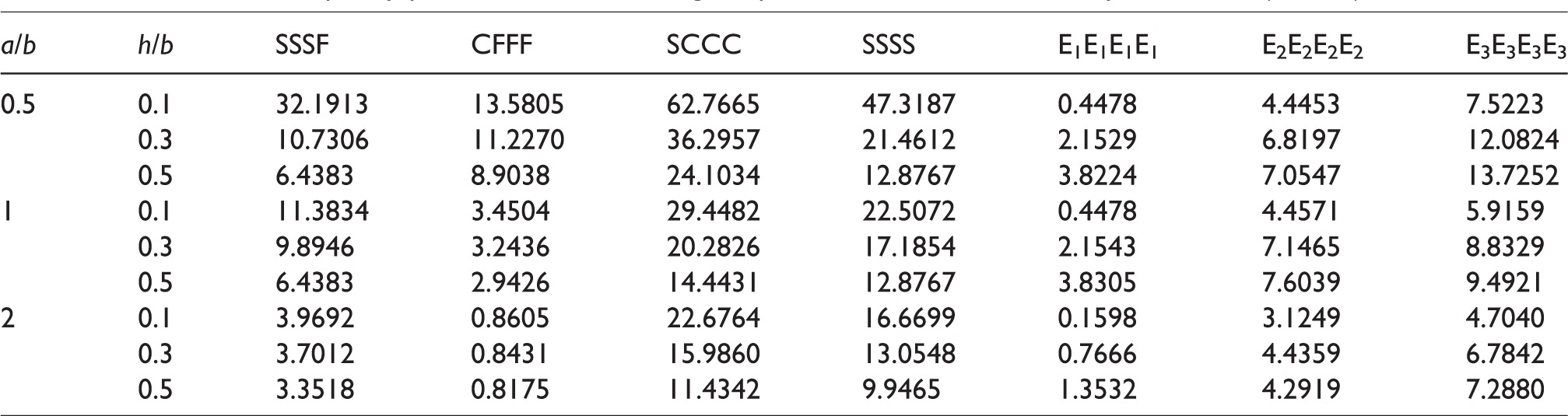
Table 5 presents fundamental frequency parameters Ω of the rectangular plate with different classical and elastic boundary conditions. The geometrical parameters used are taken to be as follows: a/b = 0.5, 1, and 2; h/b = 0.1, 0.2, 0.3, and 0.4. It is obvious that the geometrical parameters and boundary conditions can alter the fundamental frequency parameters of the rectangular plate. In all cases, the increase in the length-to-width ratios leads to decrease in the frequency parameters, which means the frequency parameters are dominated by mass of the plate. The effects of thickness-to-width ratios on the frequency parameters strongly depend on the boundary conditions. For the plate with classical boundary conditions, the frequency parameters decrease as thickness-to-width ratios h/b increases, while an inverse behavior can be obtained for plate with elastic boundary conditions. 3D mode shapes for rectangular thick plate with different boundary conditions are depicted in Figures 3 to 5.
Foundational frequency parameters Ω of rectangular plates with different boundary conditions (μ = 0.3).
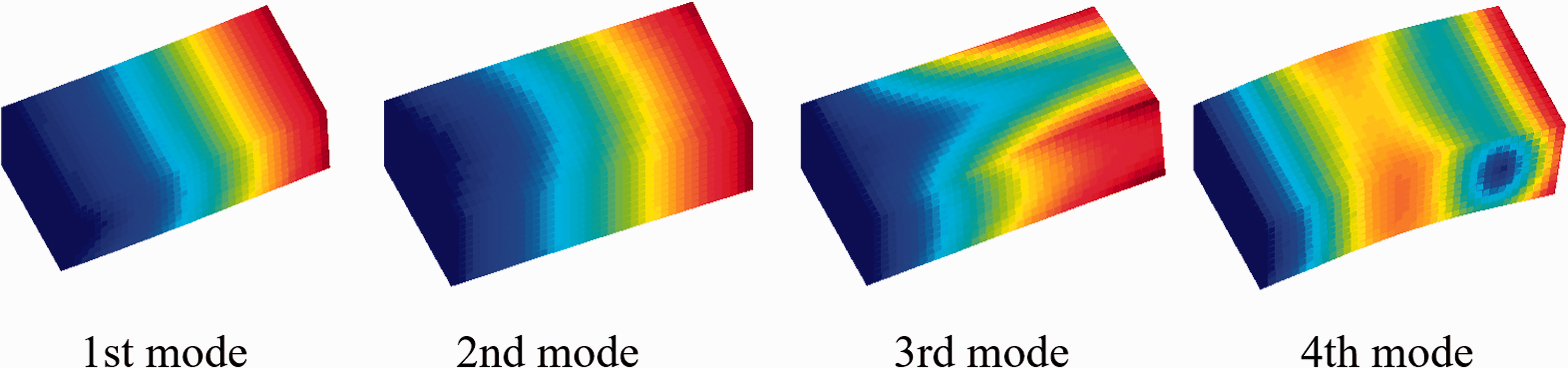
First four mode shapes of rectangular plate with CFFF boundary conditions (a/b = 2, h/b = 0.5).
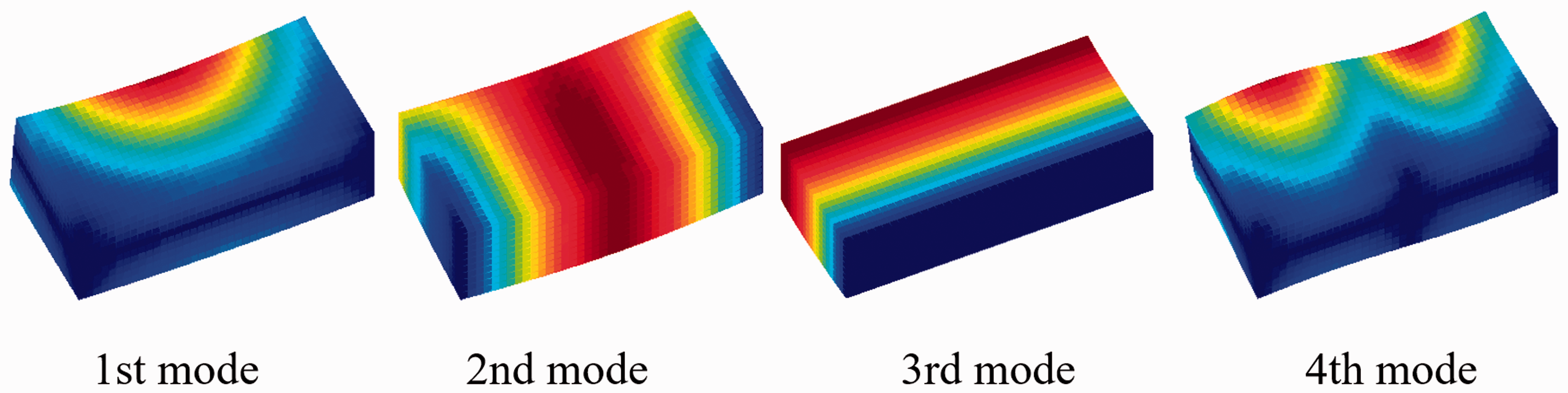
First four mode shapes of rectangular plate with SSSF boundary conditions (a/b = 2, h/b = 0.5).
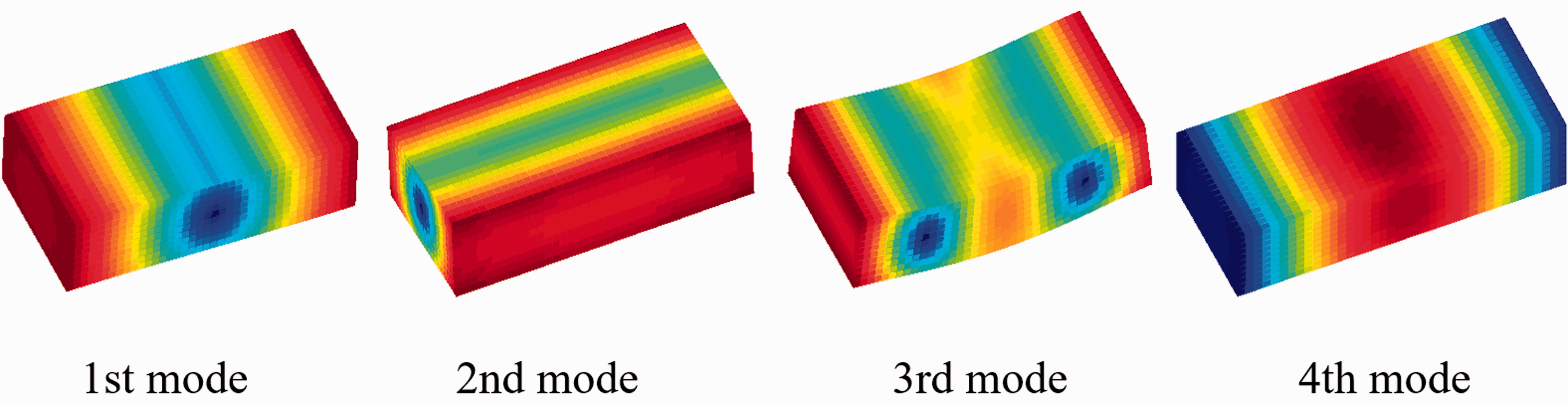
First four mode shapes of rectangular plate with E1E1E1E1 boundary conditions (a/b = 2, h/b = 0.5).
Plate resting on elastic foundation
The comparison of first seven frequency parameters for free vibration of a rectangular plate on elastic foundation with free boundary conditions is present in Table 6. The non-dimensional foundation parameters kg = 100, ks = 10 which are defined as follows:

First seven frequency parameters of square plates on elastic foundation with free edges (kr = 100, ks = 10, μ = 0.3).

In this study, the results of the square plates are compared with the 3D solutions. 16 It can be seen that excellent agreement of the results is achieved.
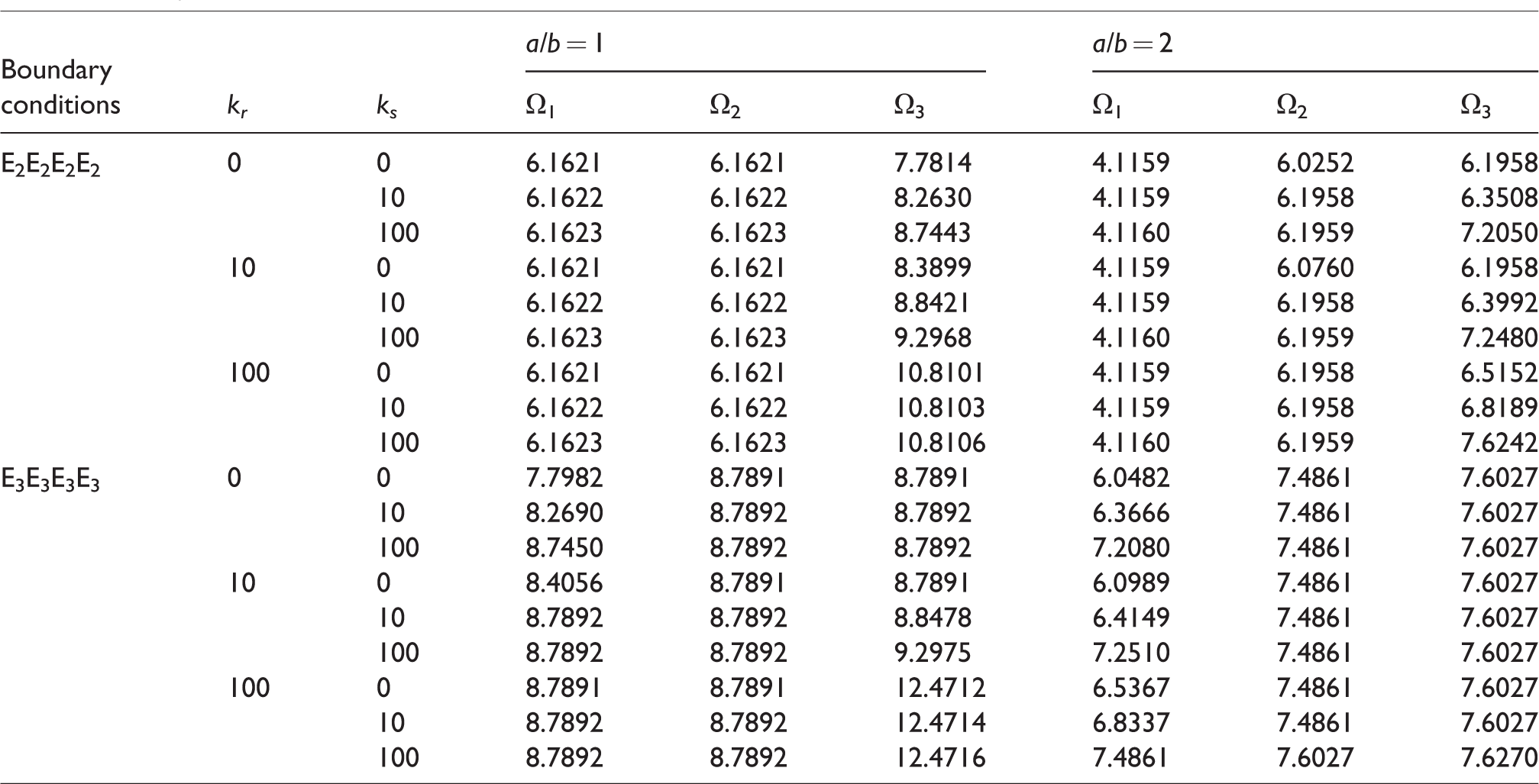
Several new numerical results for free vibration of rectangular plates resting on elastic foundation are presented in Tables 7 and 8. The geometry parameters are given as follows: h/b = 0.2, a/b = 1 and 2. Various boundary conditions i.e SSSS, CSCS, CFCF, E2E2E2E2, and E3E3E3E3, are considered. It is observed that for a plate with given size, some of the frequency parameters increase with increase in the foundation stiffness, while some of those do not distinctly vary with foundation stiffness. It is also found that frequencies of elastically restrained plates are not sensitive to the change of foundation stiffness.
First three frequency parameters Ω of square plates on elastic foundation with different classical boundary conditions (h/b = 0.2, μ = 0.3).
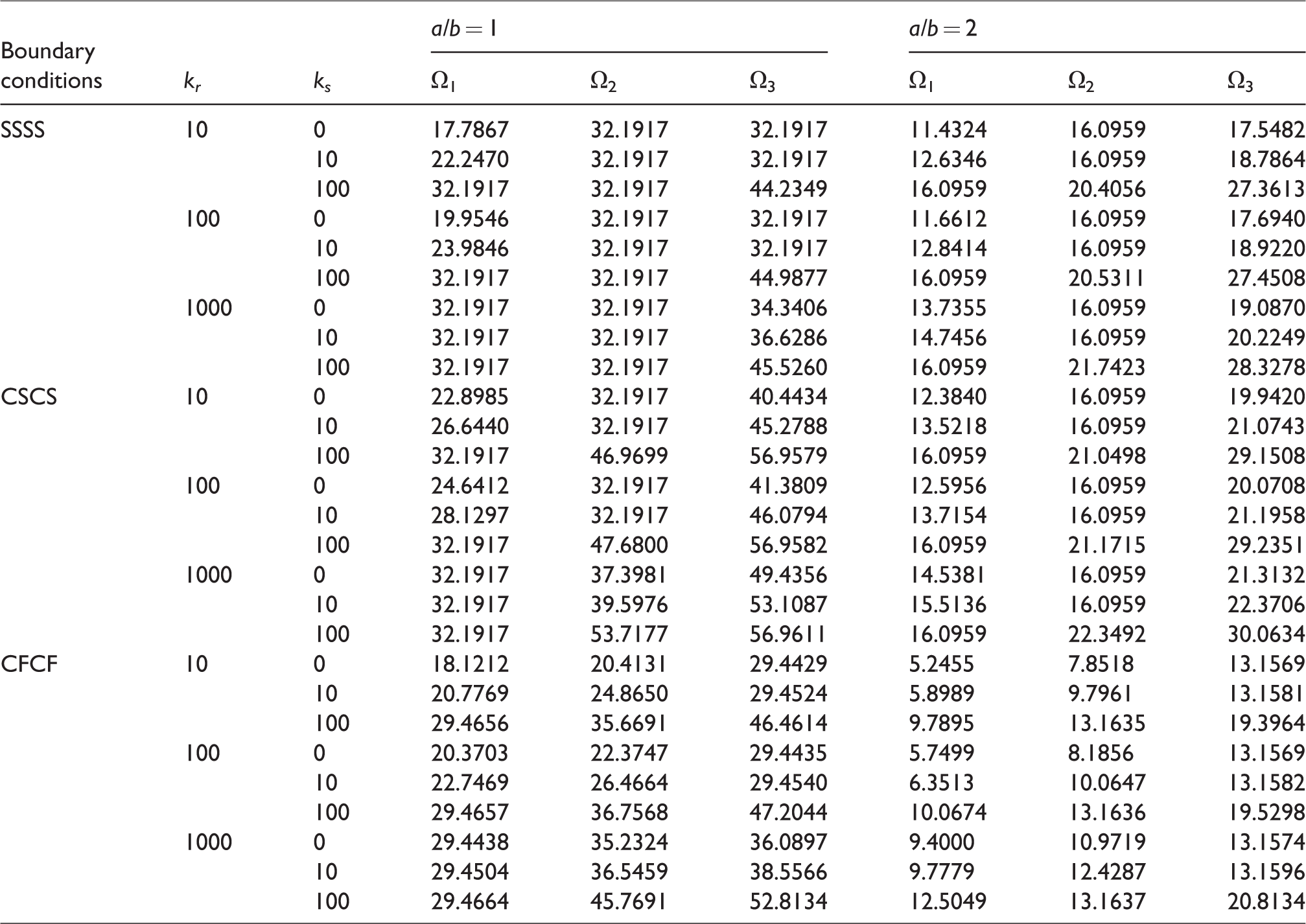
First three frequency parameters Ω of square plates on elastic foundation with elastic boundary conditions (h/b = 0.2, μ = 0.3).
Conclusions
A 3D formulation for the free vibrations of thick rectangular plates with general boundary conditions and resting on elastic foundations is presented. The general boundary conditions are imposed by means of penalty function method. The displacements of the plates are expressed by a 3D cosine series and some simple polynomial functions which introduced to ensure and accelerate the convergence of the series representation. All the unknown coefficients can be obtained by using the Rayleigh–Ritz method. The effects of boundary conditions, geometrical parameters, and elastic foundation on the vibration behavior of the plate are also investigated. It can be found that the increase in the length-to-width ratios leads to decrease in the frequency parameters, and the effects of thickness-to-width ratios on the frequency parameters strongly depend on the boundary conditions. It is observed that the foundation stiffness have significant influence on frequencies.
Furthermore, in contrast to most existing techniques, the current method can be universally applicable to a variety of boundary conditions including all the classical cases, elastic restraints, and their combinations. The change of the boundary conditions is as easy as modifying material properties and geometry dimensions without the need of making any change to the solution procedure. In addition, the proposal solution can be readily applied to shells with more complex boundaries like point supports, non-uniform elastic restraints, mix boundaries, partial supports, and their combinations.
Footnotes
Declaration of conflicting interests
The author(s) declared no potential conflicts of interest with respect to the research, authorship, and/or publication of this article.
Funding
The author(s) disclosed receipt of the following financial support for the research, authorship, and/ or publication of this article: The authors gratefully acknowledge the financial support from the National Natural Science Foundation of China (No. 51705071).