




Abstract
Free torsional vibration of cracked carbon nanotubes with elastic torsional boundary conditions is studied. Eringen’s nonlocal elasticity theory is used in the analysis. Two similar rotation functions are represented by two Fourier sine series. A coefficient matrix including torsional springs and crack parameter is derived by using Stokes’ transformation and nonlocal boundary conditions. This useful coefficient matrix can be used to obtain the torsional vibration frequencies of cracked nanotubes with restrained boundary conditions. Free torsional vibration frequencies are calculated by using Fourier sine series and compared with the finite element method and analytical solutions available in the literature. The effects of various parameters such as crack parameter, geometry of nanotubes, and deformable boundary conditions are discussed in detail.
Keywords
Introduction
The simple beam theory extends to the 18th century while the Timoshenko beam theory that allows for the impact of transverse shear deformation was developed in the 20th century. When the classical beam theories are used for the study of micro tubes and nanotubes, they are determined to be insufficient as the theories could not provide the small-scale impact in mechanical properties. 1 Owing to their superior electrical, mechanical, physical, optical, and chemical properties, a great diversity of nanostructures have been formed as a part of nanoelectromechanical and microelectromechanical systems. For such nanoscale structures which cannot be captured by the classical continuum theory. Therefore, a thorough comprehension of the mechanical behavior at nanoscale is very important. 2
Carbon nanotubes were explored in 1991 by Iijima. 3 Carbon nanotubes are nanomaterials which have tremendous potential in design of new sensors, composite materials, and gas detection. The superior properties of the carbon nanotubes are important instrumental for the improvements in applications.4–16 Other new fields of application of carbon nanotubes are continuously explored. These nanosized structures17–21 show that the superior properties such as physical properties, mechanical properties, chemical properties, etc.
Classical continuum theories are frequently used in order to comprehend the mechanical properties of carbon nanotubes.22–27 The purpose of classical continuum theories may be doubtful in the theoretical analysis of carbon nanotubes, since the theories lack the responsibility of the small-scale effects. 28 Nowadays, many nonclassical continuum theories that integrate material length scales were suggested in the literature to forecast the performance of nanostructures. These consist of nonlocal, gradient elasticity, and couple stress theories or composed of the theories.29–31 Variational formulations and extra boundary conditions within stress gradient elasticity theory with extensions to beam and plate models have been investigated by Polizzotto. 32 Some researchers have investigated the applications of nonlocal elastic models.33,34
Nonlocal theories have been used to widely in some papers such as bending, buckling, vibrations, etc. Literature presented that nonlocal elasticity approach35–43 is a significant technique for modeling mechanical behavior of nanostructures. In the framework of nonlocal elasticity theory, Demir and Civalek 44 have examined the size effects on the torsional vibration of cylindrical tubes, 45 based on the theory of nonlocal continuum mechanics, on the column buckling of multiwalled carbon nanotubes has been investigated. Lu et al. 46 have assessed the multiple shell model and it was improved for the axial buckling of multiwalled carbon nanotubes. Arda and Aydogdu have investigated the statistical torsional deformation and free vibration behaviors of carbon nanotubes. Islam et al. 47 have examined the size effects on the torsional vibration of cylindrical bars. Pradhan and Murmu 48 have reformulated with nonlocal theories the vibration of Euler–Bernoulli beam resting on Winkler elastic foundation. Wang et al. 49 have studied the beam bending solutions based on nonlocal Timoshenko beam theory. A multiple shell model is developed for the axial buckling of multiwalled carbon nanotubes under axial compression by Zhang et al. 50 Free torsional response of cracked nanorods has been explored by several researchers.51–53 A closed-form model for torsion of nanobeams with an enhanced nonlocal formulation has been proposed by Barretta et al. 54 Different theoretical investigations have been performed for the mechanical behaviors of nanobeams and carbon nanotubes in the literature.55–58
In contrast to the rigid supports in which known as free–fixed and fixed–free are not used to describe the exact supporting conditions, the present exact method possesses torsional elastic spring parameters for a better description of real boundary conditions. The classical rigid boundary conditions such as clamped–free, clamped–clamped can be viewed as special cases of the deformable elastic supports. 59 For a clamped support, the dimensionless stiffness value of the torsional spring is infinitely large. For a free edge, the dimensionless stiffness value of the torsional spring is set to be zero. There is strong scientific need to understand the torsional vibration behavior of cracked nanorods in considering the effect of deformable boundary conditions. In this study, free torsional vibration of the cracked nanorods with general elastic spring boundary conditions is investigated on the basis of nonlocal elasticity theory in conjunction with Stokes’ transformation.60,61 The torsional rotation function is represented by a Fourier sine series. A coefficient matrix composed of infinite series is computed by applying a mathematical procedure known as Stokes’ transformation to the nonlocal boundary conditions. The determinant of this coefficient matrix gives the torsional vibration frequencies for the cracked nanotubes with torsional restraints.
Background of theory
For homogenous isotropic elastic solids, the Eringen’s nonlocal elasticity theory is described by the following theoretical four equations
62






Finally, the following equation can be obtained from equation (1)

In equation (7), the differential operator proposed by Eringen and Edelen
62
can be written as follows


For nonlocal elasticity problems formulated in unbounded domains (free–free boundary conditions or elastic boundaries), differential law model by Eringen and Edelen 62 may be considered equivalent to a stress and strain-driven model, due to the tacit fulfillment of nonlocal boundary conditions of vanishing at infinity. So, differential equation model by Eringen and Edelen 62 is effectively exploited to explore Rayleigh surface waves and screw dislocations. Using Eringen’s nonlocal elasticity theory with exponential kernel, there are constitutive boundary conditions and paradoxes in nonlocal elastic nanobeams. 63 They have recently showed the ill-posedness of the Eringen integral model and exact solutions of inflected functionally graded nanobeams in integral elasticity. Barretta et al. 64 have examined the exact solutions of inflected functionally graded nanobeams in integral elasticity.
Formulation of the problem
The equation of motion of torsional vibration problem in nonlocal elasticity is given as follows
44

Due to the fact that the crack separates the carbon nanotube into two parts, rotation function may not be shown by a single torsional function, so that two rotation functions are used in this section. It can be seen in Figure 1 that nanotube is assumed to be divided into two parts by the crack. Therefore, equation (10) can be rewritten as


Modal displacement function
It has been widely accepted that it is very difficult to calculate an exact analytical solution for the cracked nanorods, except for rigid boundary conditions (clamped–free and clamped–clamped). In this paper, a torsional spring is utilized to substitute the effect of crack on the free vibration. The rotations are denoted by


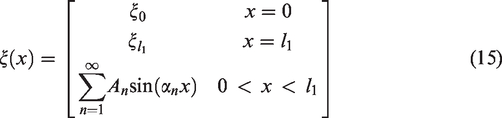
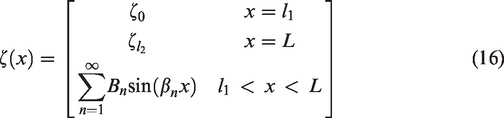


The coefficients (An) in equation (15) can be written as

Taking the first derivative of equation (15) yields
65

Fourier cosine series can be used for equation (20) as follows

The following coefficients can be found


By using the integration by parts rule


The first two derivatives of the selected function can be obtained by employing Stokes’ transformation as follows


Similarly, the first and second derivatives of equation (16) can be calculated with the use of the above algorithm
66


Substituting equations (13), (14), (27), and (29) into equations (11) and (12), the coefficients An and Bn can be obtained in terms of ξ0,




The formulations of the rotations for two parts become




Nonlocal boundary conditions
A carbon nanotube with length L and one crack is located as in Figure 1. Then the following relation can be written

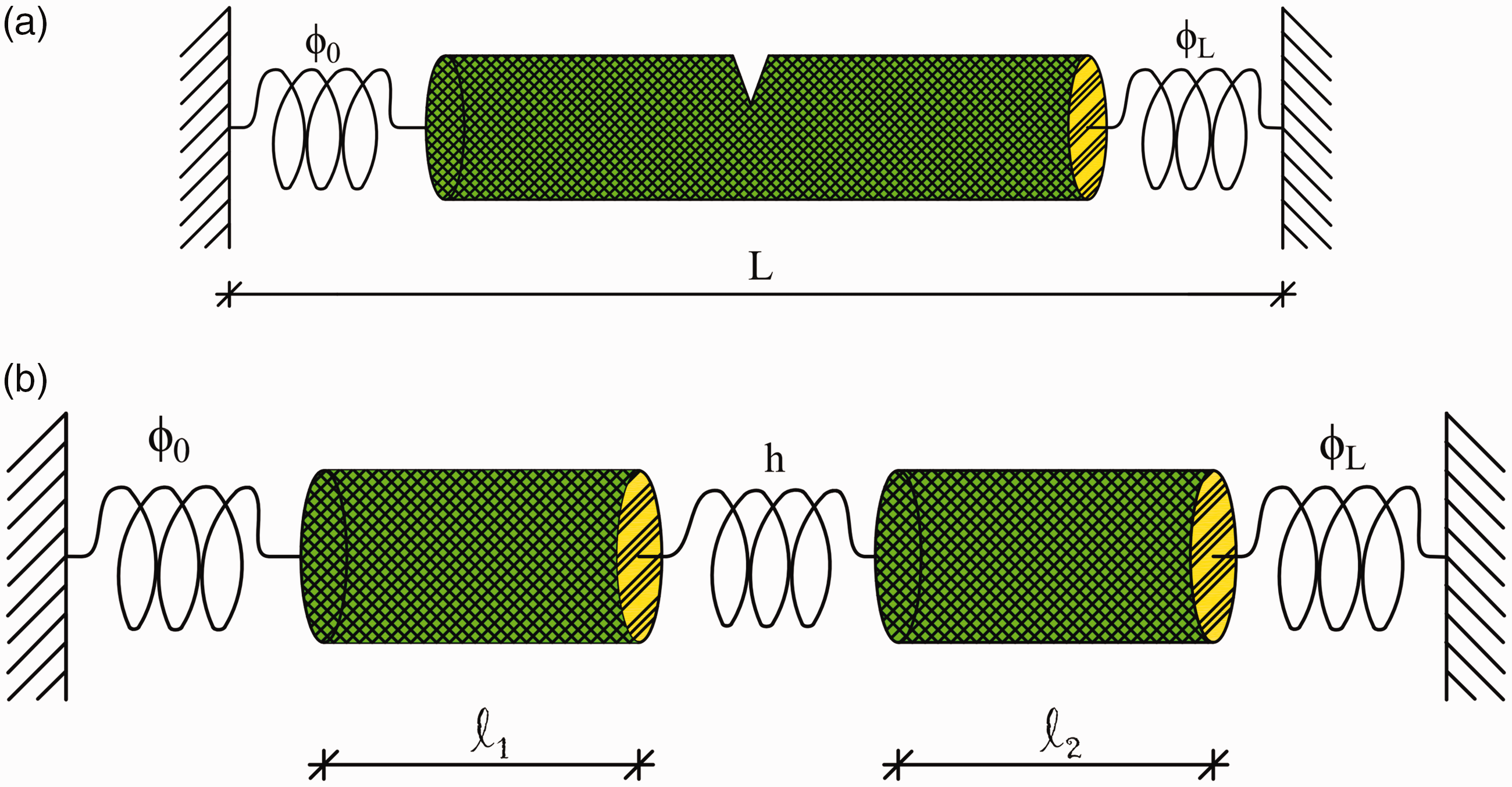
Modeling of a cracked nanotube with torsional restraints.
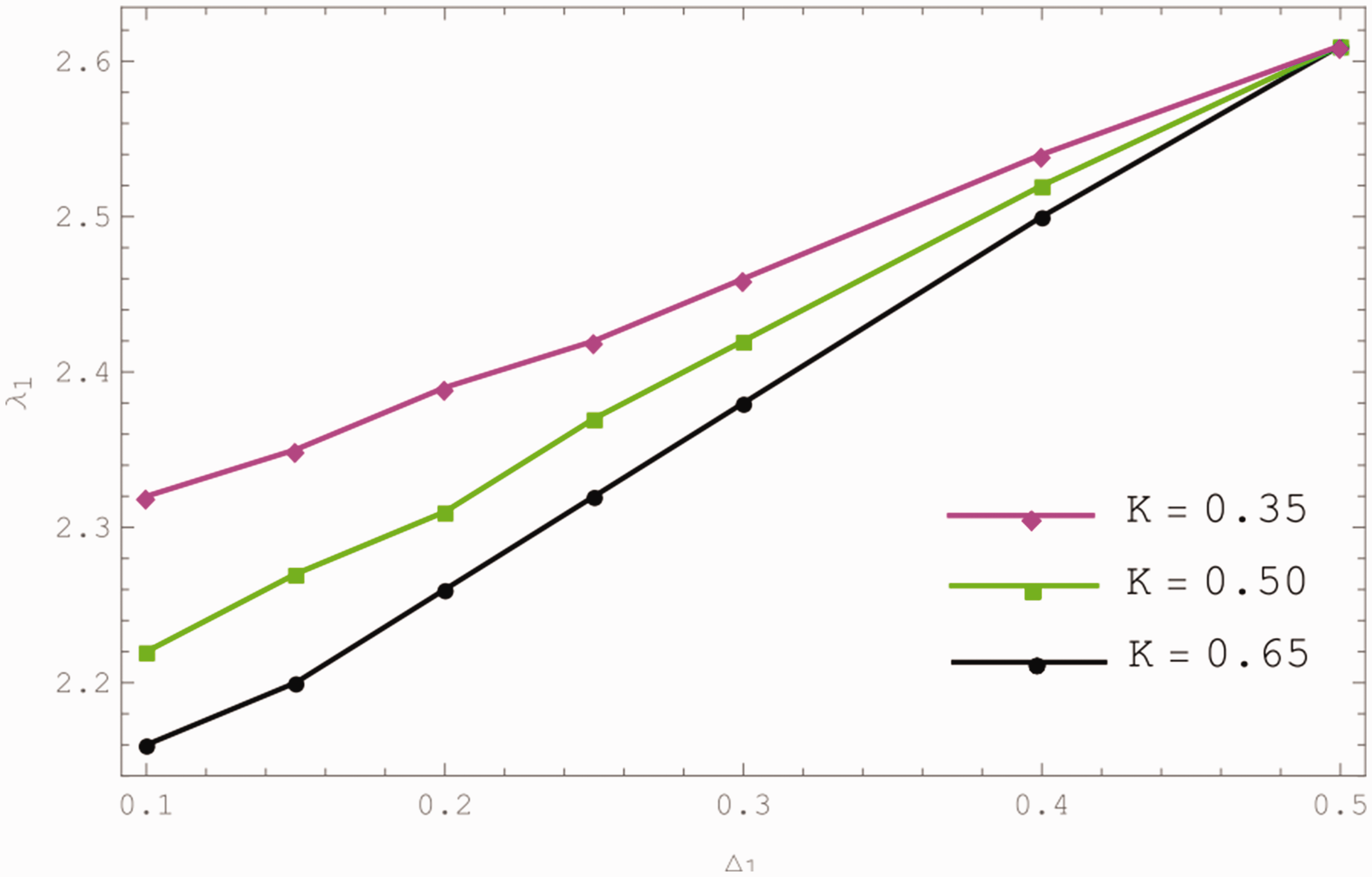
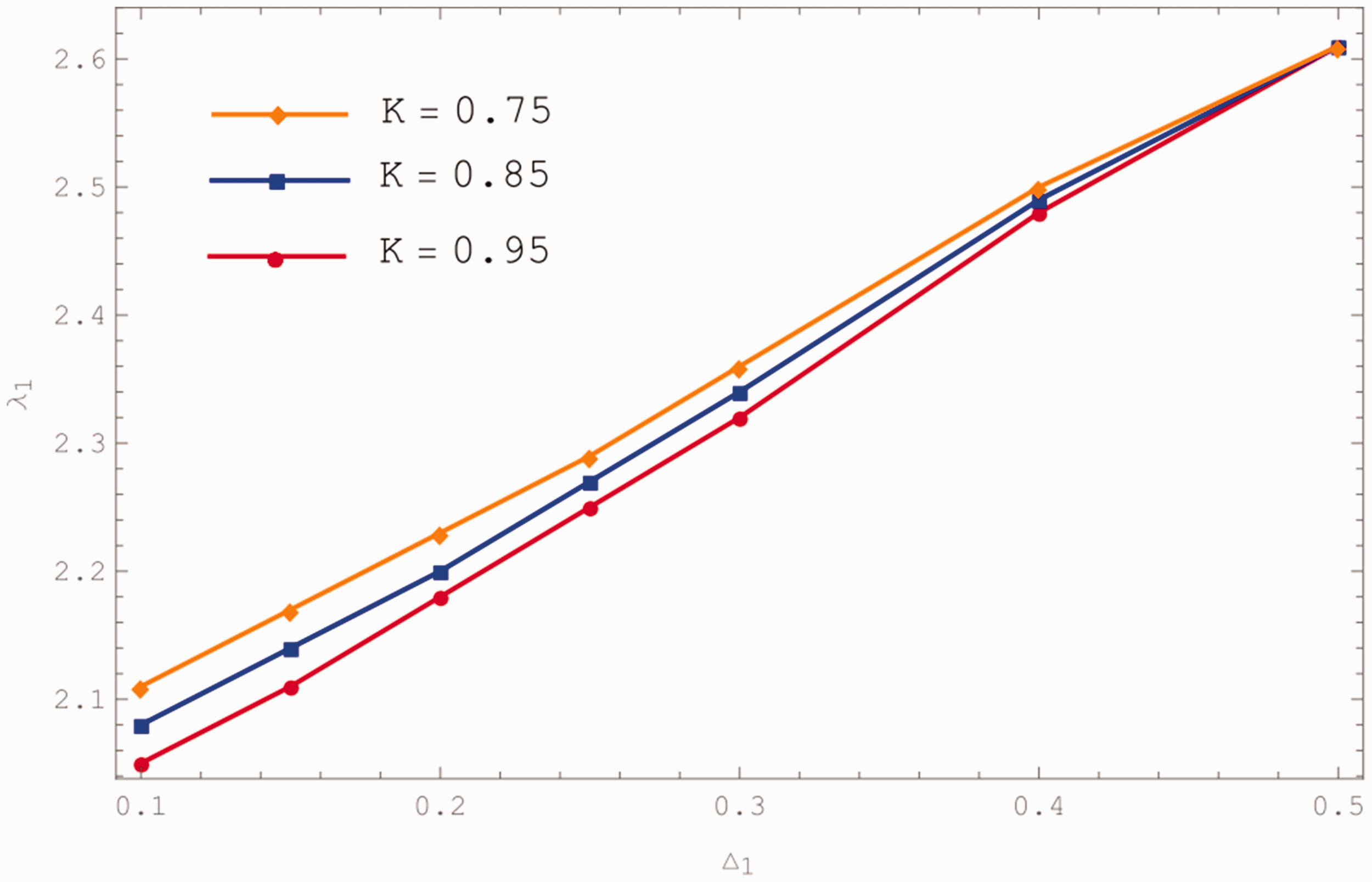
First vibration frequencies as a function of crack location parameter
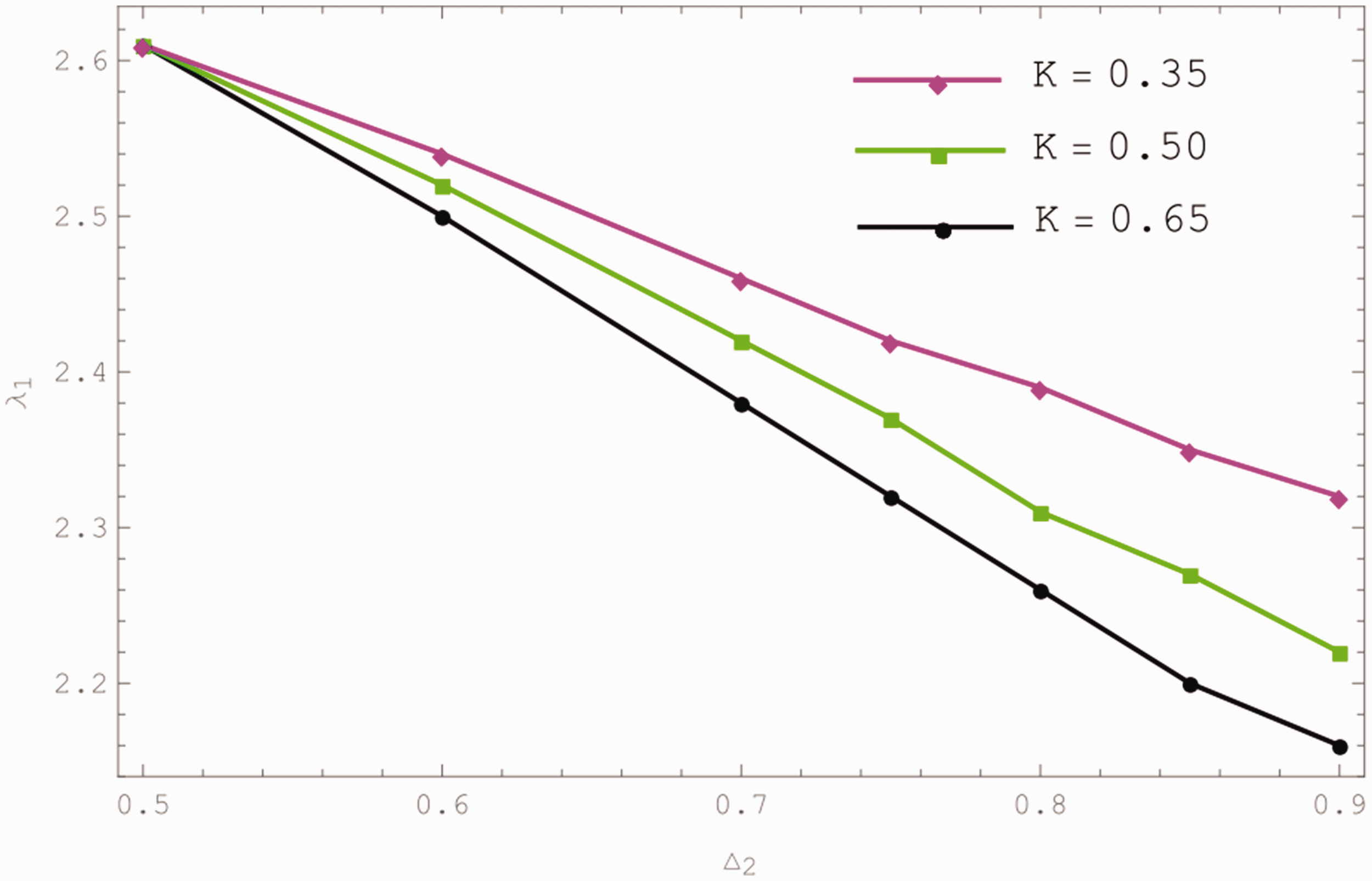
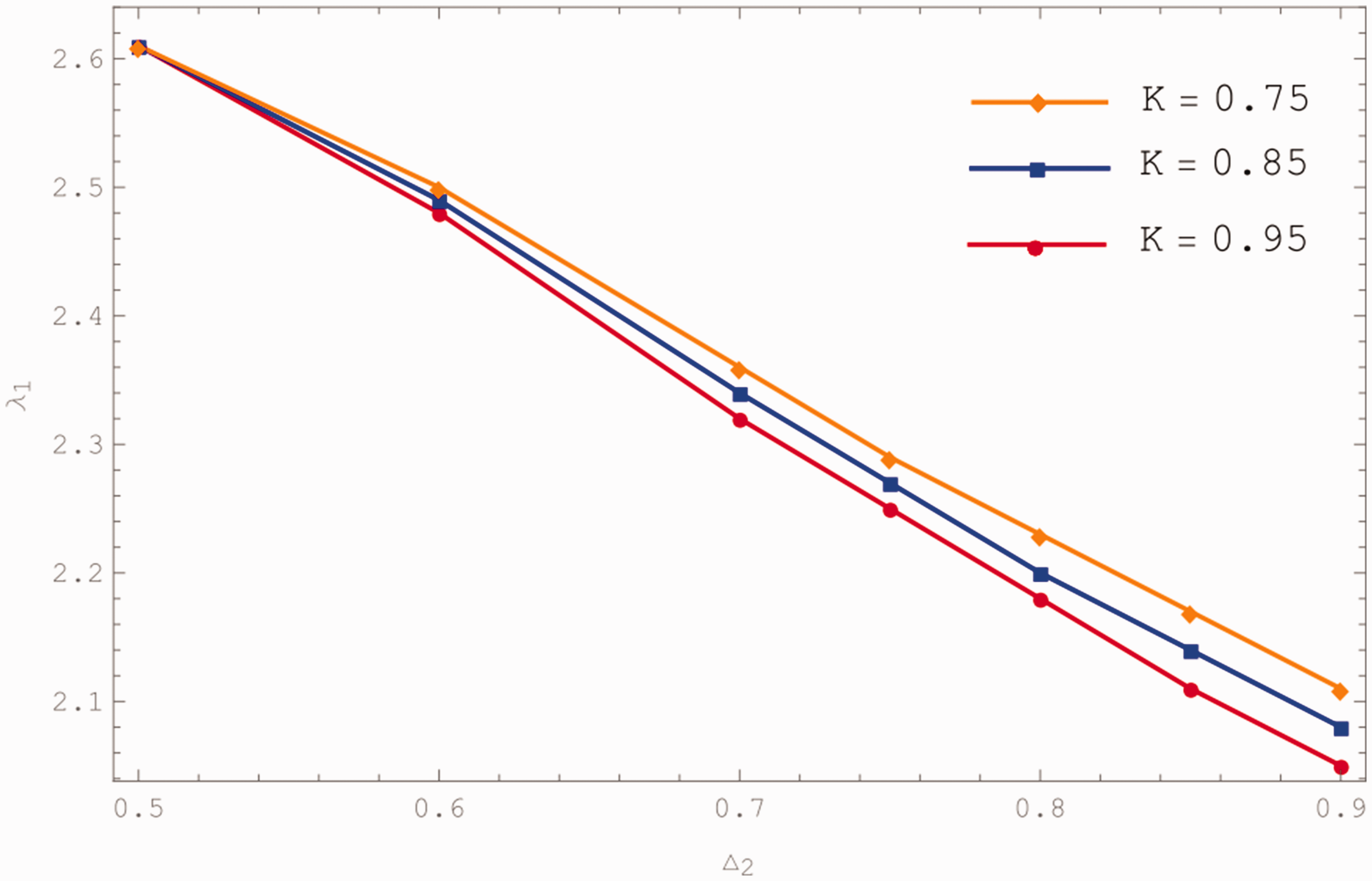
First vibration frequencies as a function of crack location parameter
It is assumed that the crack is located at point l1 from the origin of axes. The carbon nanotube is divided into two segments with lengths l1, l2. Using equations (9) and (10), the nonlocal torque T can be written as

It may be derived from equation (39) that the nonlocal boundary conditions at the torsional spring points can be expressed as






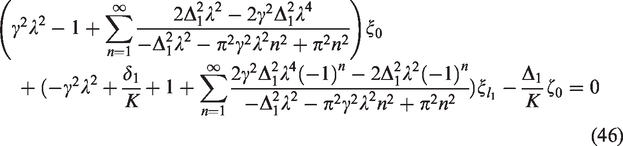








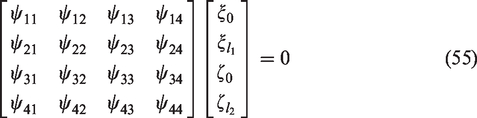












The eigenvalues (λn) are obtained by setting the determinant of the matrix in equation (55) to 0

Numerical results and discussion
In this section, some typical examples are solved to demonstrate the validity of the proposed solution, also quantifying the effects of the nonlocal parameter γ with crack parameter K on the vibrational response of nanotubes. The computed results are obtained using 160 terms in series in equation (68).
Verification studies
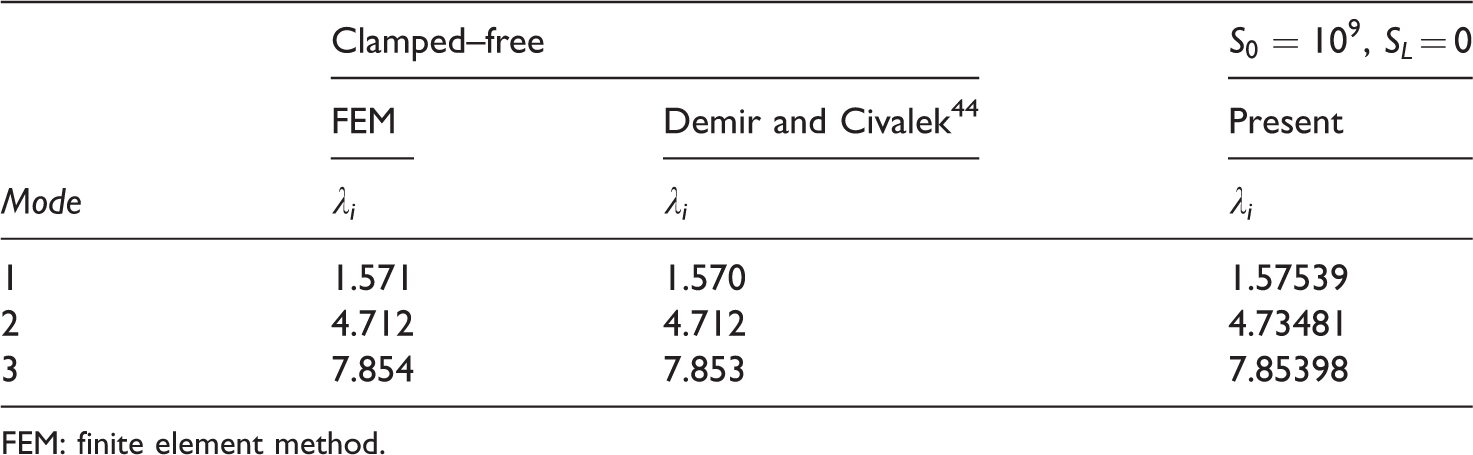
In order to validate the presented method, as well as to demonstrate their implementation to dynamical analysis, a cracked nanotube with hard torsional springs is considered. The torsional springs are taken as
Comparison of the first three torsional frequency parameters of a nanotube with clamped–clamped.
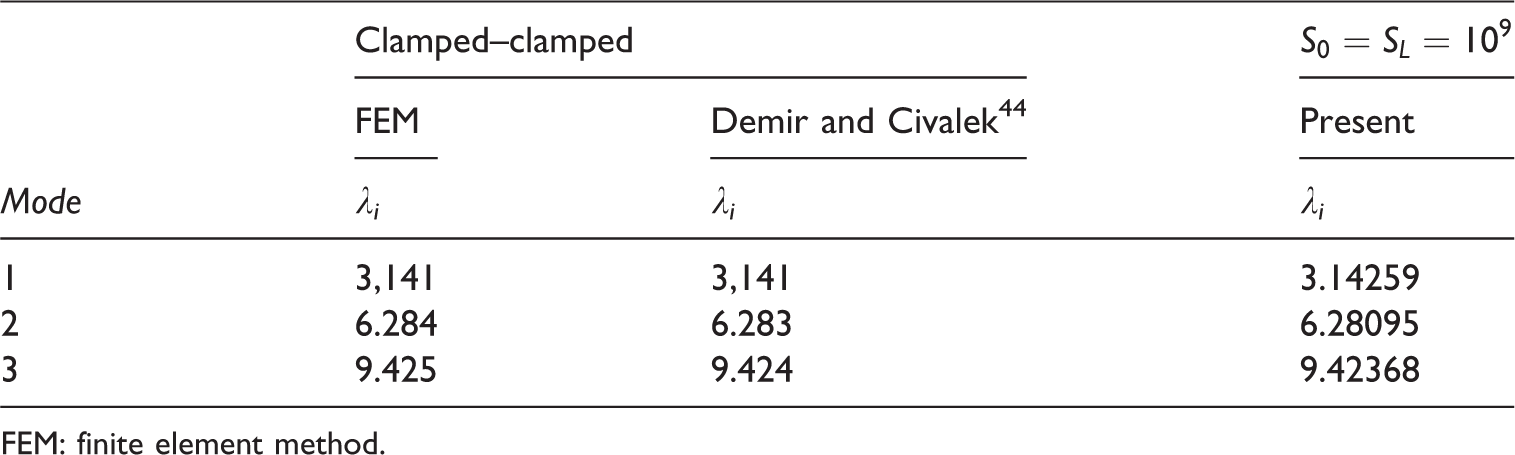
FEM: finite element method.
Comparison of the first three frequency parameters of nanorod with clamped–free ends.
FEM: finite element method.
Effect of crack location and severity
In a fixed–fixed nanorod with a crack, according to equations (44) to (47), so equation (68) will be simplified to following equation

In this section the effect of crack location and severity on the first vibration frequency is investigated by using equations (68) and (69). It can be seen from Figures 2 to 5 that by decreasing crack severity K (i.e. the carbon nanotube becomes stiffer), first torsional frequencies decrease for the constant value of nonlocal parameter. It is clearly shown in Figures 2 to 5 that the effect of crack severity is decreased by increasing small-scale parameter. Figures 4 and 5 show the effect of the
First vibration frequencies as a function of crack location parameter
First vibration frequencies as a function of crack location parameter
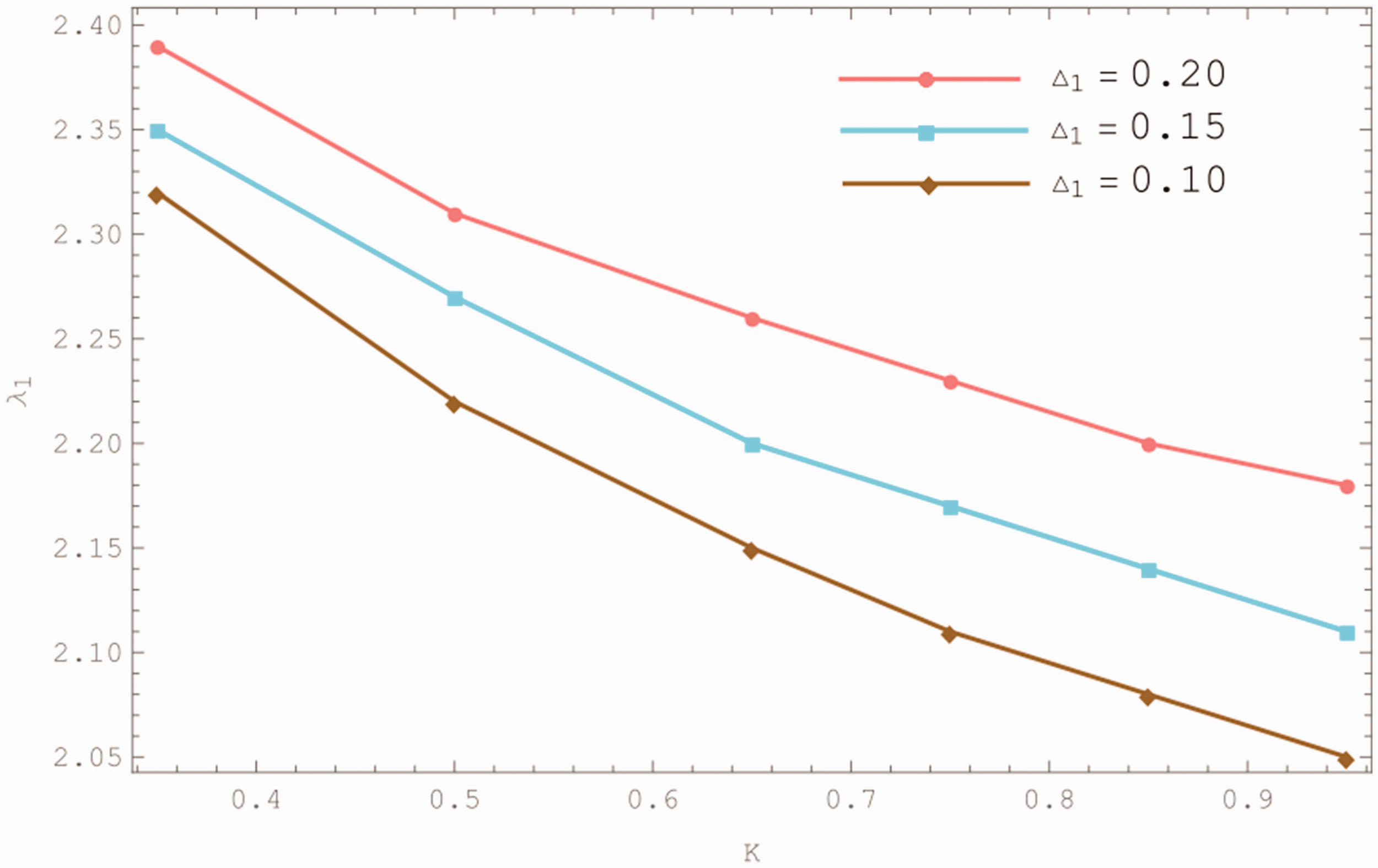
First torsional vibration frequency as a function of crack severity for
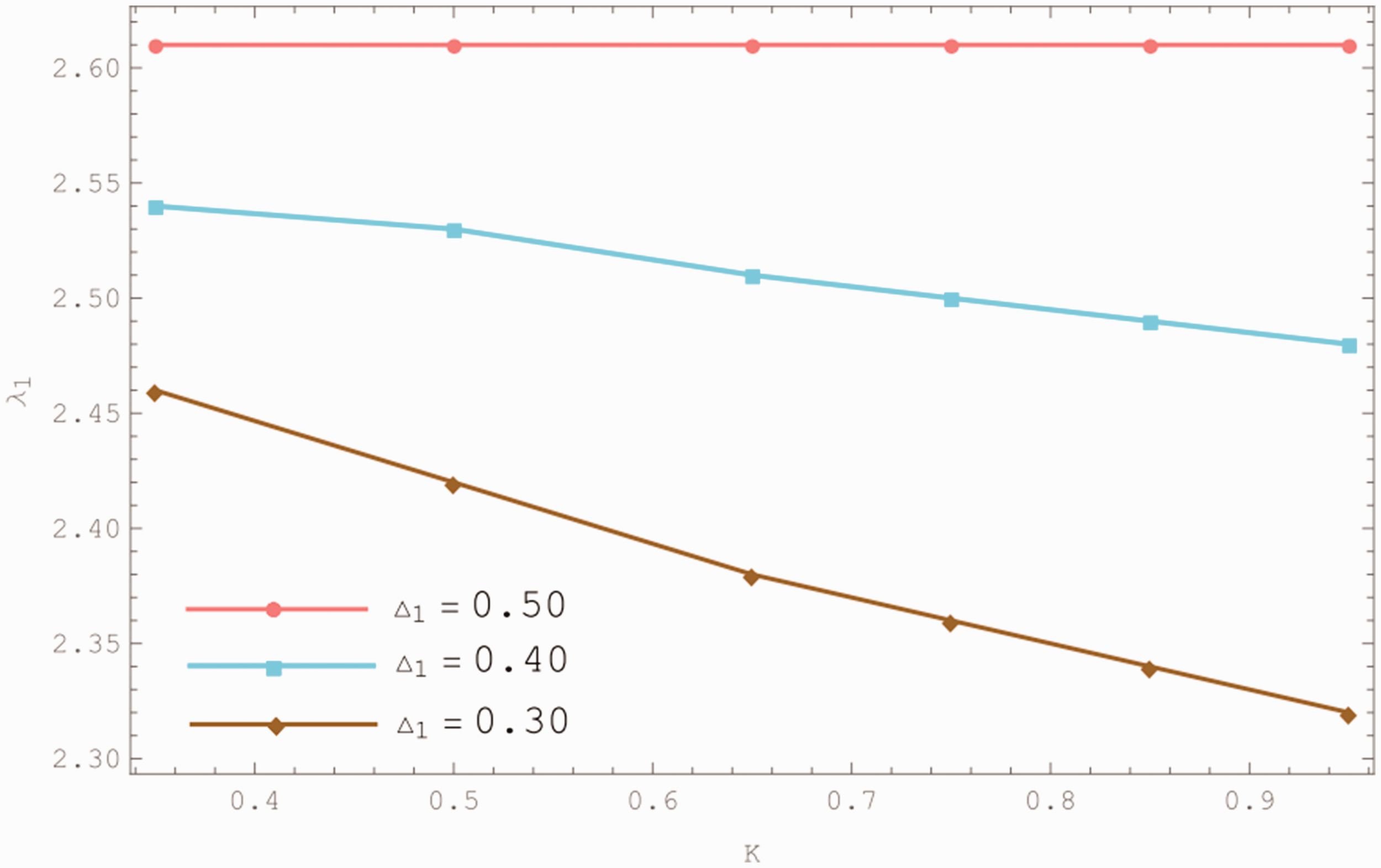
First torsional vibration frequency as a function of crack severity for
Effect of nonlocal parameter
In this subsection, to delineate the effect of small-scale parameter, some numerical case studies are implemented and assessed for the torsional vibration analysis of cracked nanorods, using the derived formulations in the “Formulation of the problem” section. As it is seen from Figures 8 to 14, the first torsional vibration frequency is affected by the nonlocal parameter. This observation is rational, because the torsional rotation is neglected in the clamped–clamped ends and it makes the carbon nanotube behavior invalidly stiffer than the reality. It can be noted that the results predicted by the nonlocal elasticity theory are always greater than those of the classical beam theory. It can be said that the difference among the predicted values is diminishing when the length of the carbon nanotube becomes larger, thereby indicating that the size effect is only significant when the length of the single-walled carbon nanotube is comparable to the nonlocal parameter.
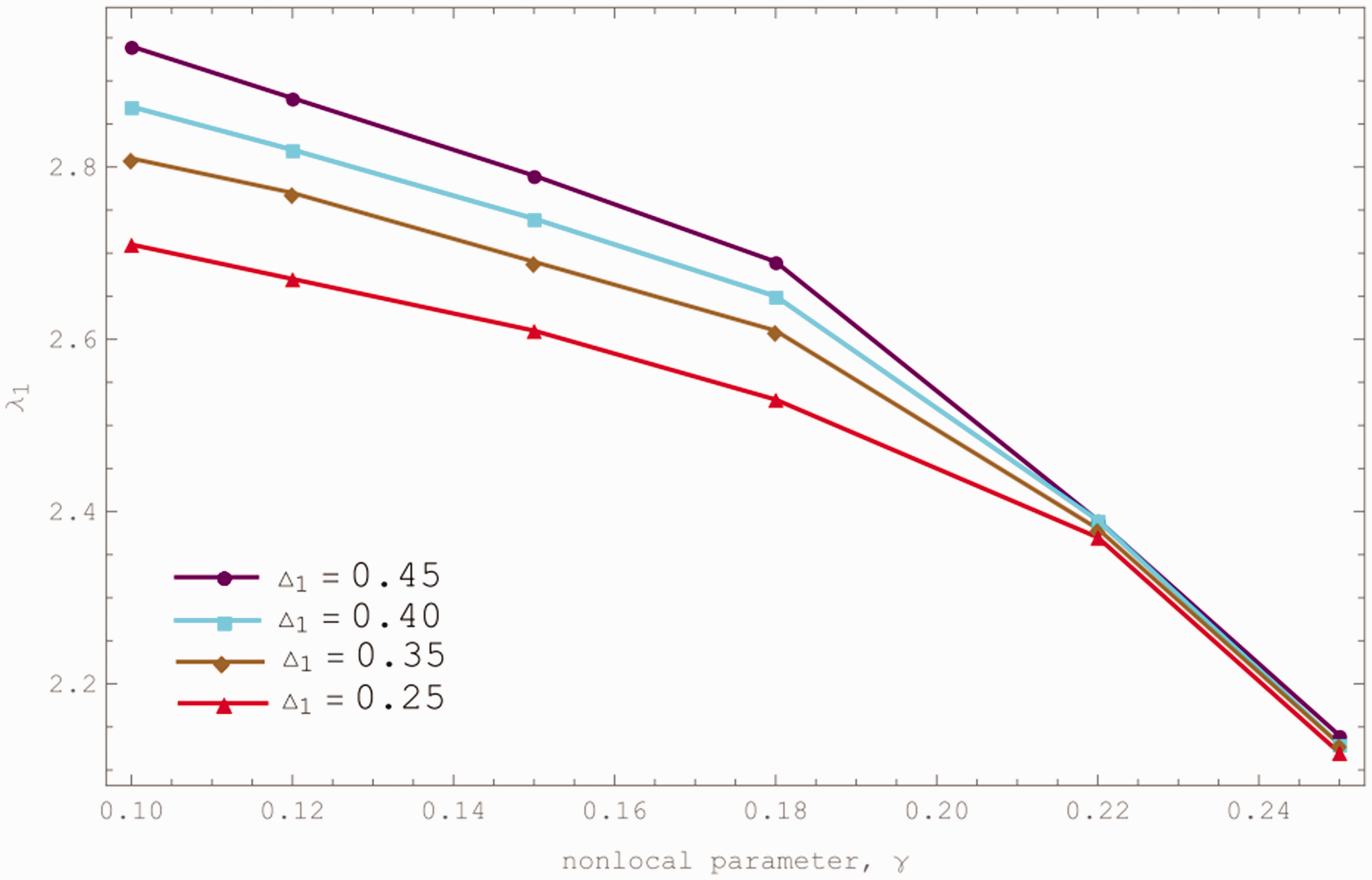
First torsional vibration frequency as a function of nonlocal parameter for K = 0.25.
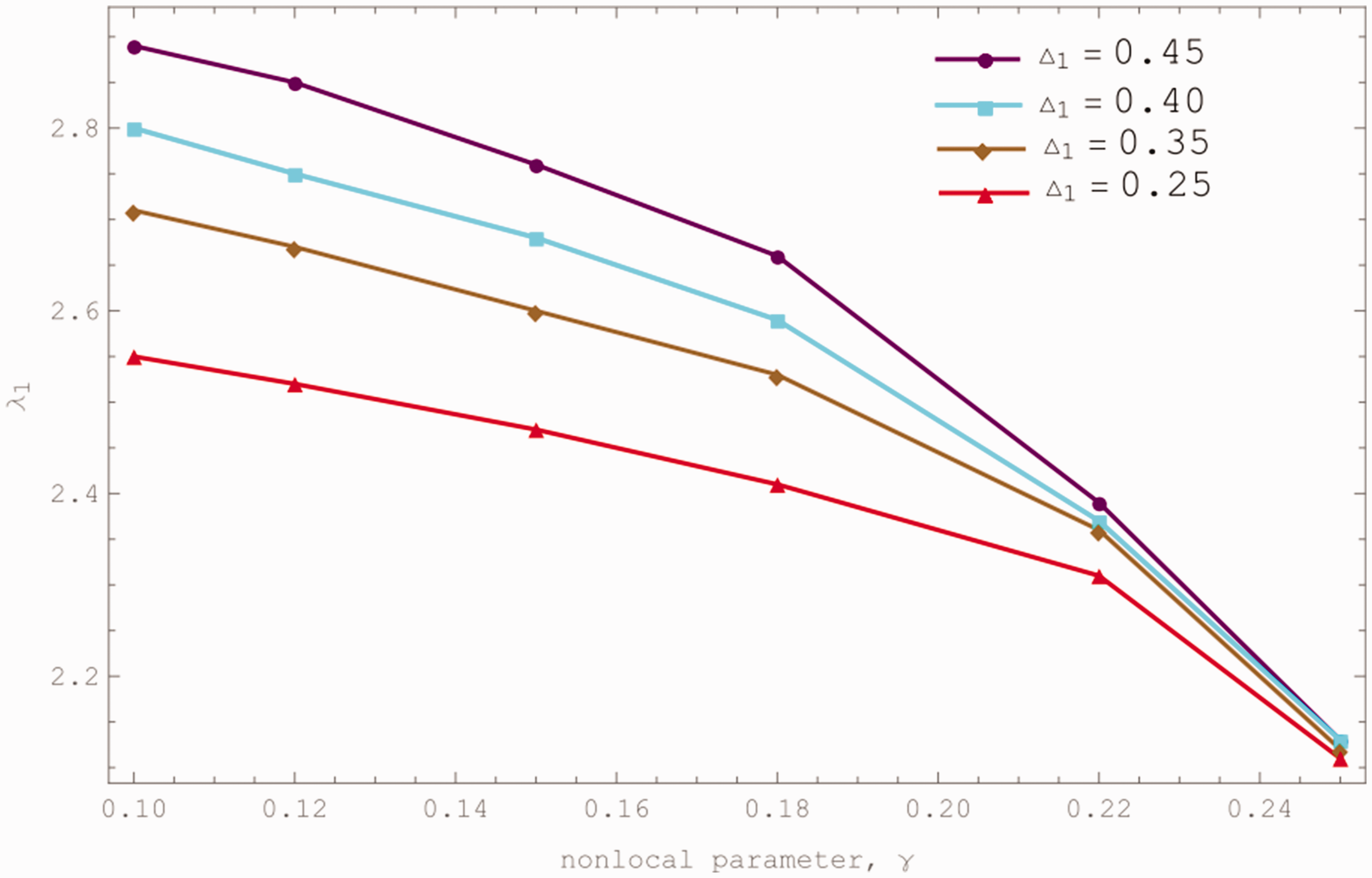
First torsional vibration frequency as a function of nonlocal parameter for K = 0.50.
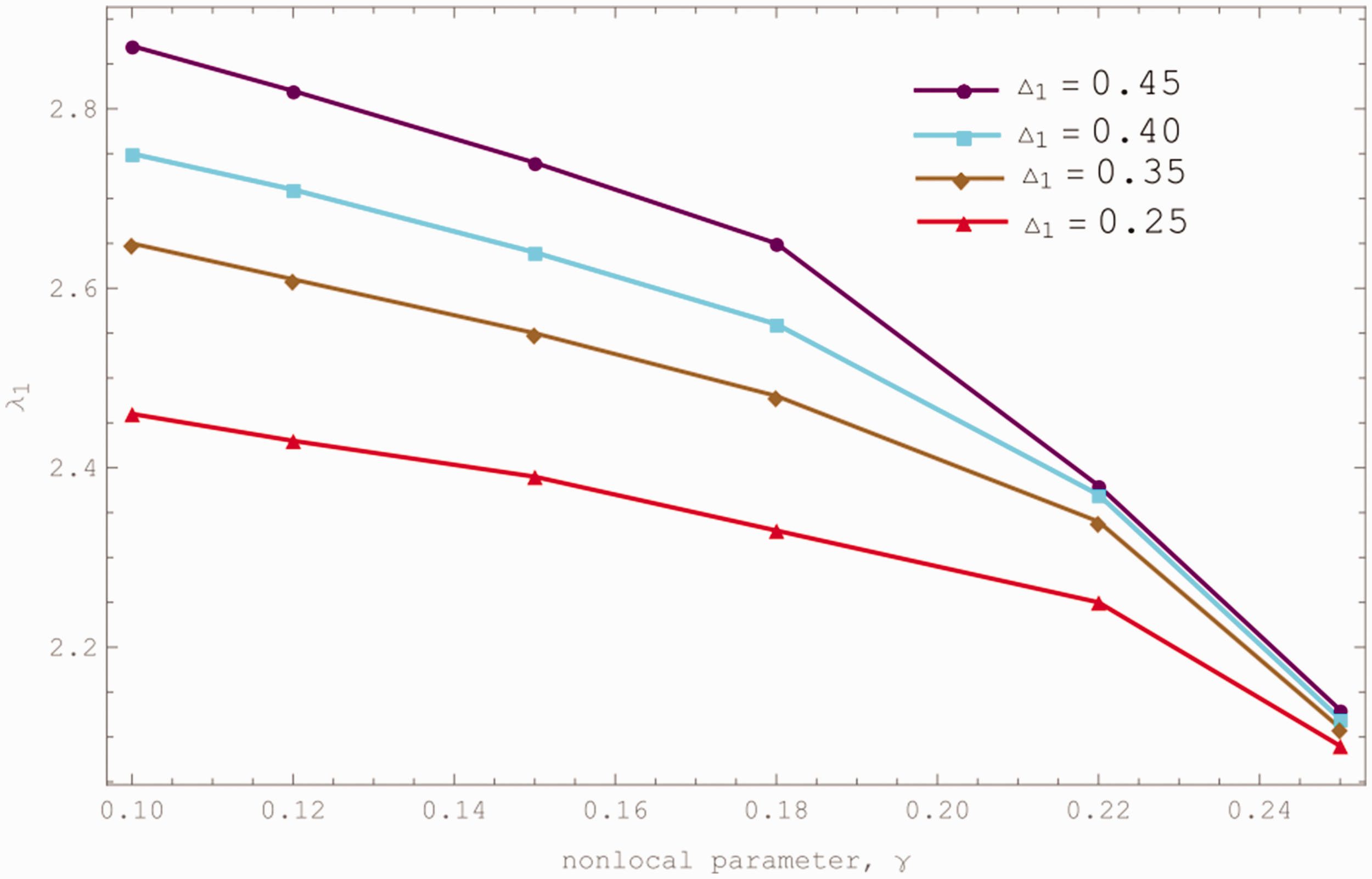
First torsional vibration frequency as a function of nonlocal parameter for K = 0.75.
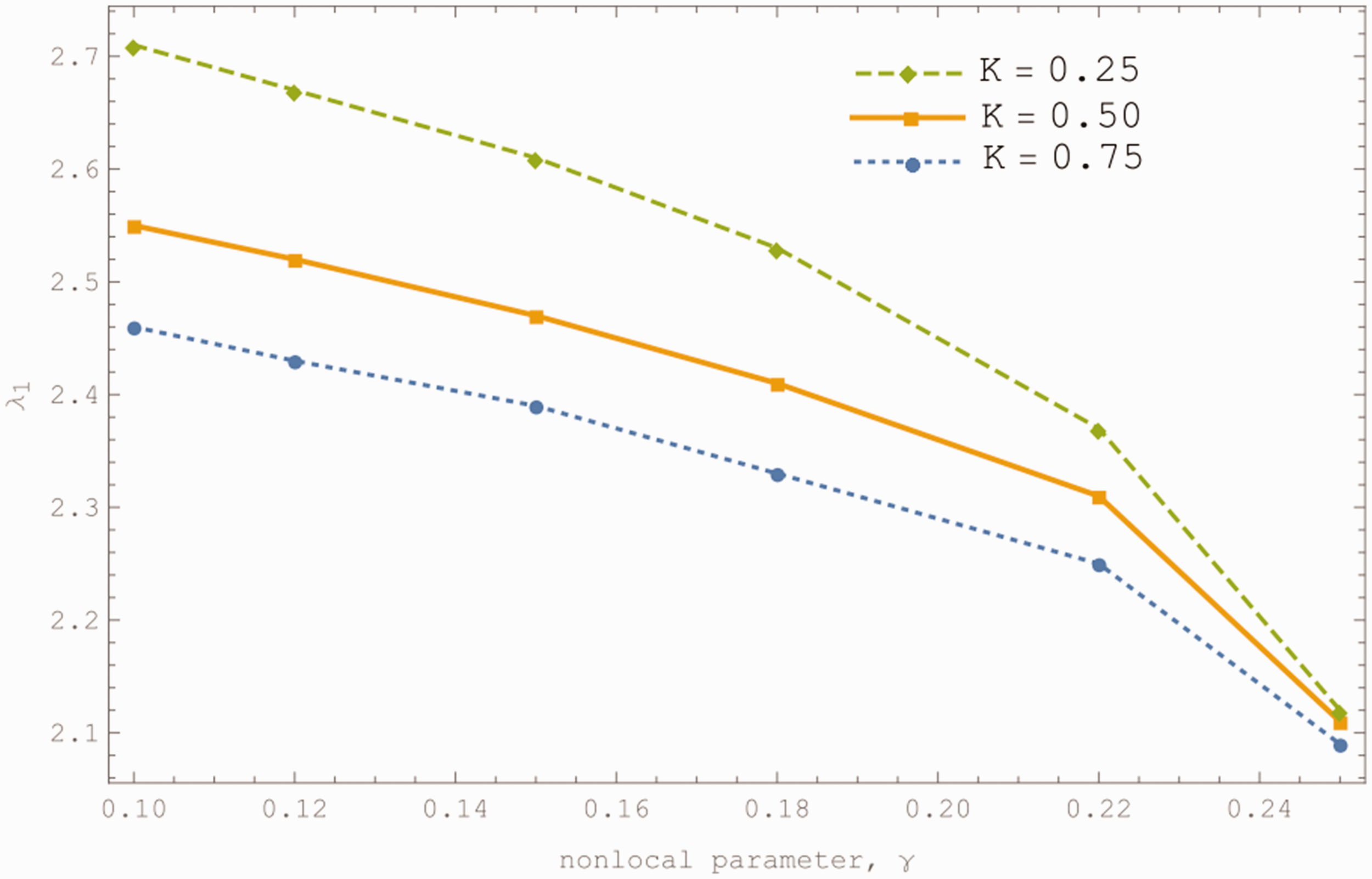
First torsional vibration frequency as a function of nonlocal parameter for
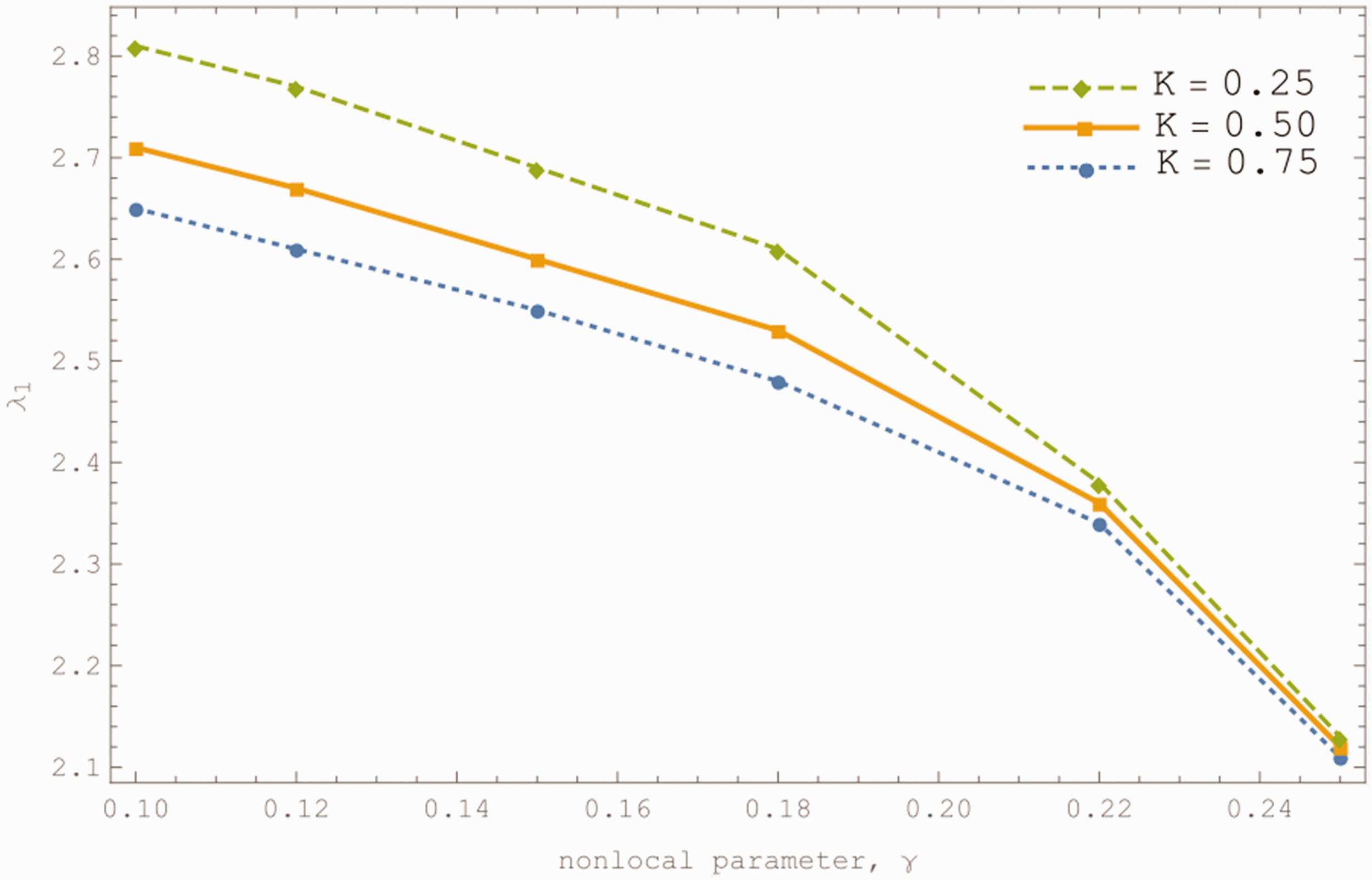
First torsional vibration frequency as a function of nonlocal parameter for
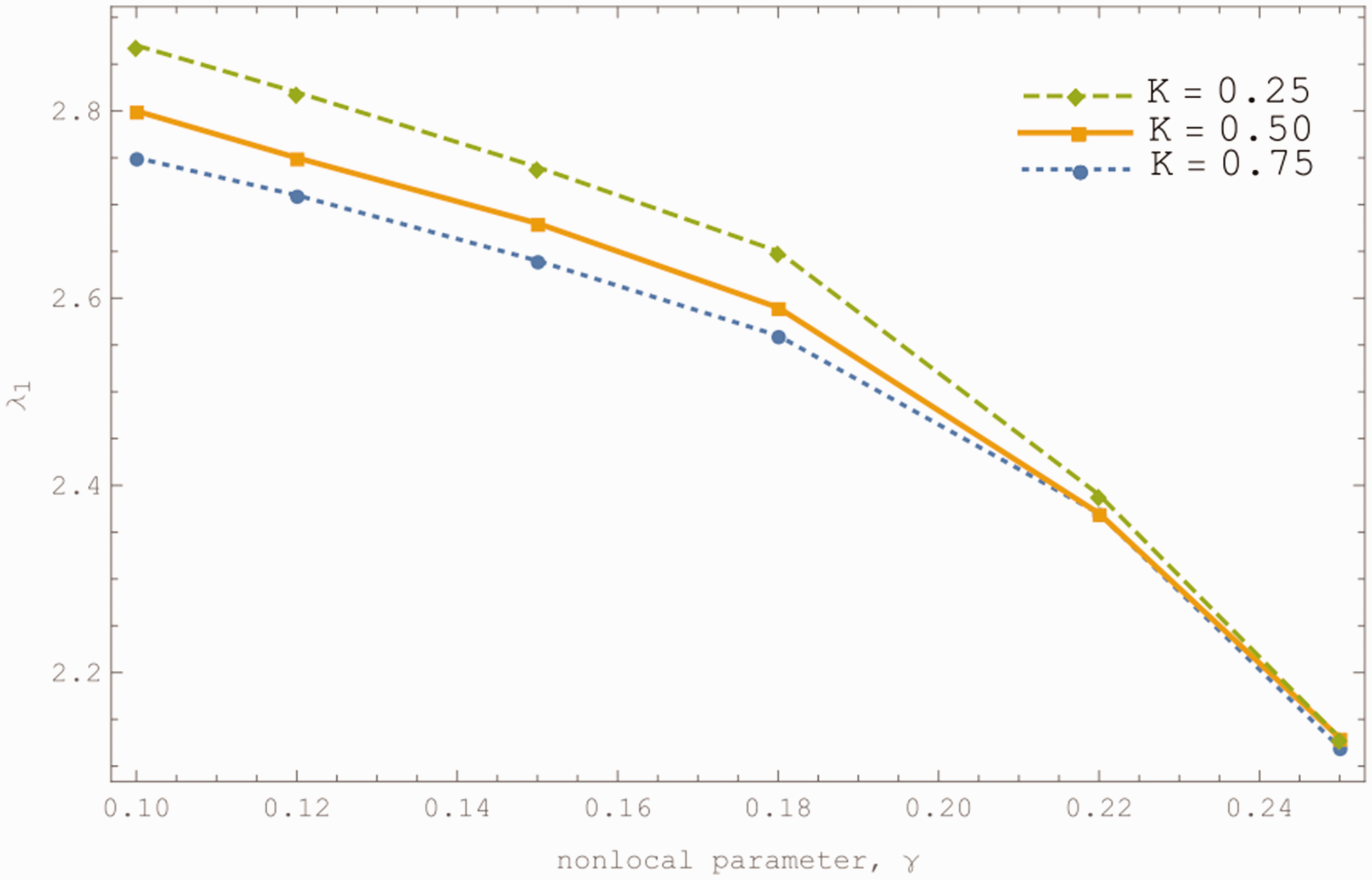
First torsional vibration frequency as a function of nonlocal parameter for
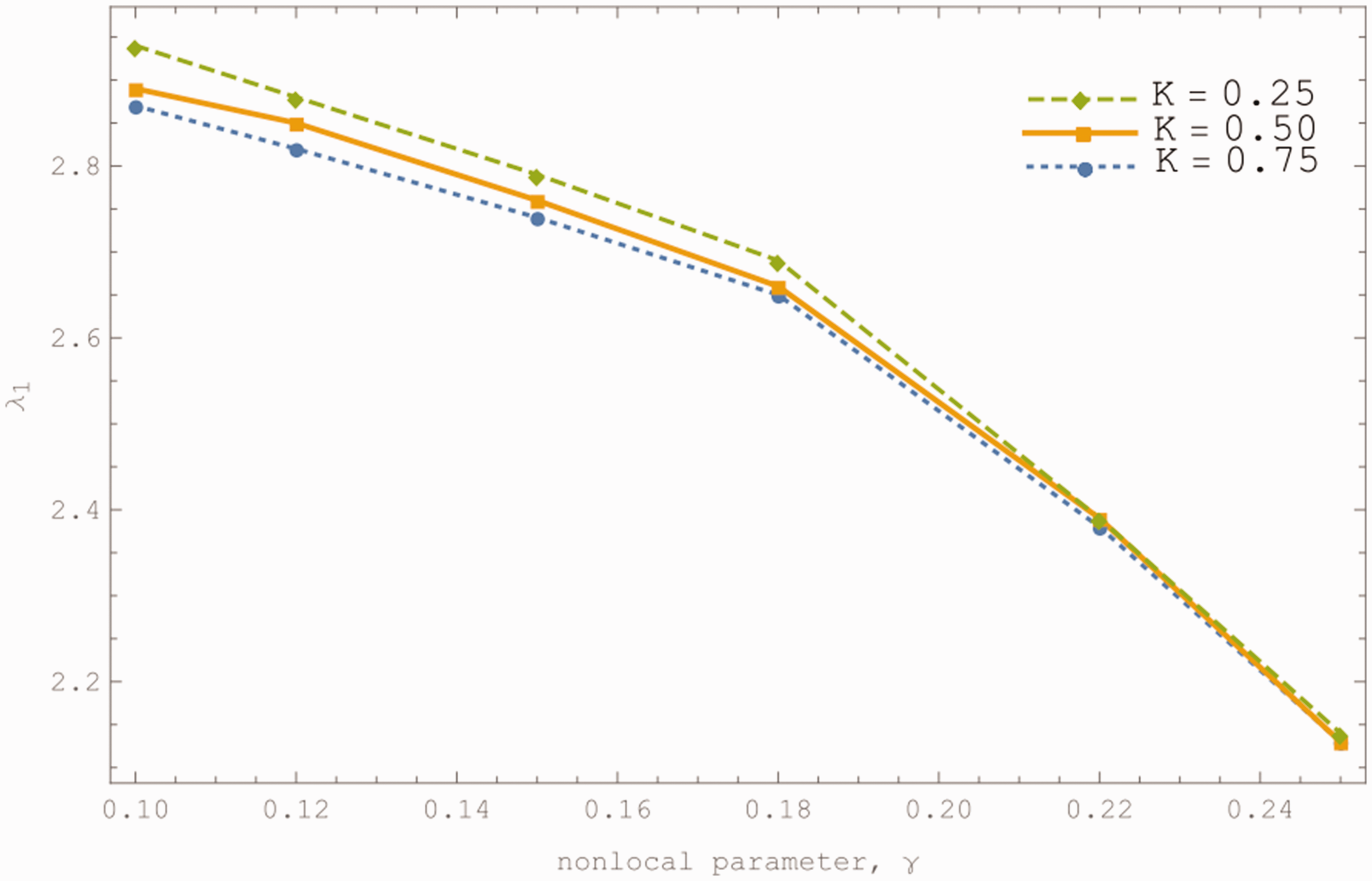
First torsional vibration frequency as a function of nonlocal parameter for
Effect of elastic boundary conditions
In the following example, the effect of elastic medium parameter on the dimensionless vibration frequencies is illustrated in Figure 15(a) to (d). The following mathematical relation is introduced to give a better illustration of the deformable boundary conditions

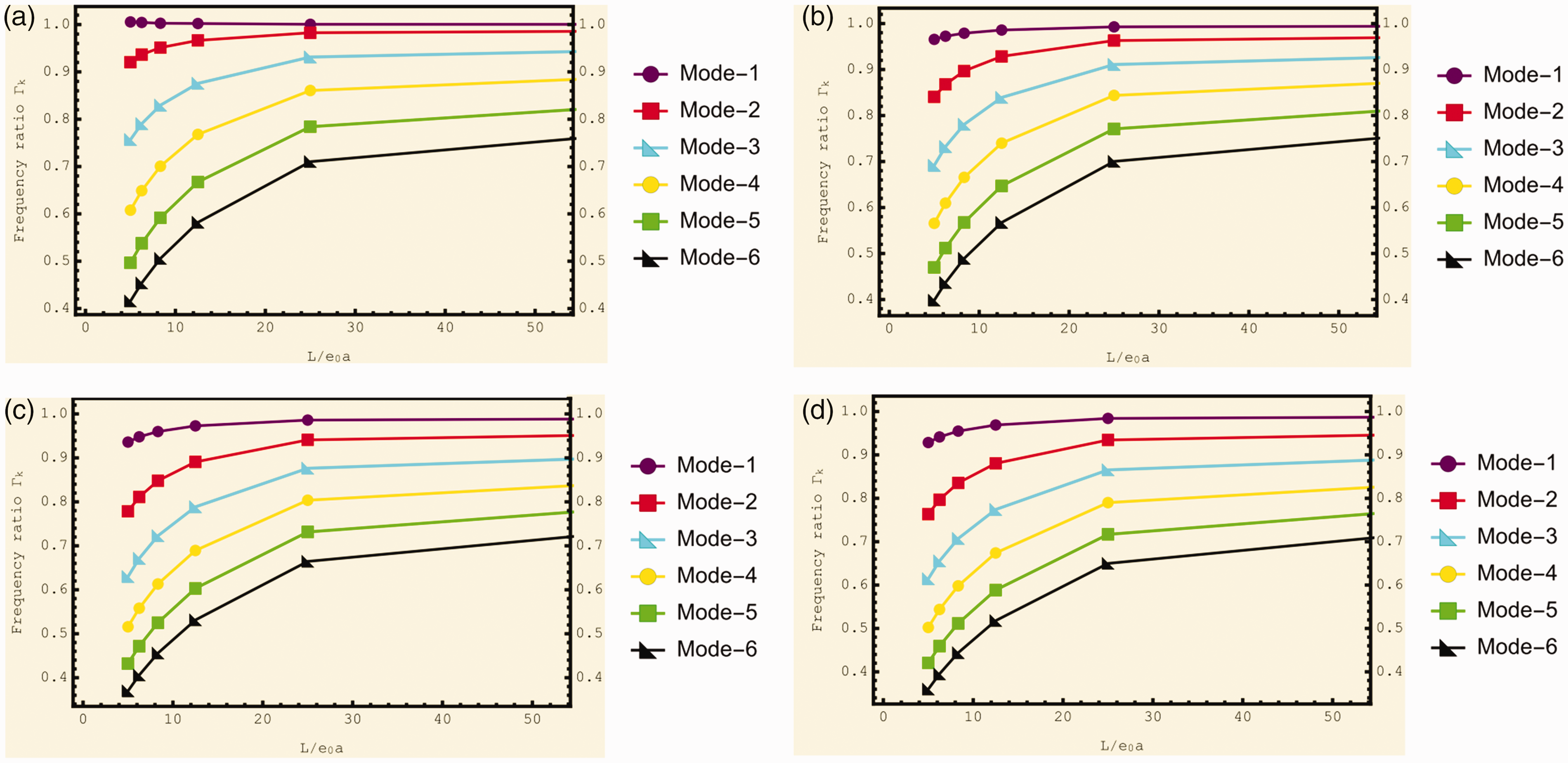
The effect of elastic spring coefficients (
Conclusion
Due to few detailed studies on the torsional vibration analysis of cracked nanotubes with deformable boundary conditions are available, in the current work, a transformation known as “Stokes’ transformation” is applied to the nonlocal elastic boundary conditions. This method gives more flexibility in supporting conditions. It is aimed to construct an exact method for torsional vibration of cracked nanotubes with deformable boundary conditions. A useful coefficient matrix including infinite series is presented for the first time in order to calculate the torsional frequencies. The accuracy of the proposed method, in deriving the torsional vibration frequencies, has been examined by means of numerical example problems. The effects of different parameters are discussed in detail.
It is found that most of the previous studies on the torsional vibration analysis of cracked nanorods have been conducted based on the ignorance of the deformable boundary conditions. As a result, the previous works cannot be utilized in order to thoroughly study the cracked nanorods under investigation. Motivated by this fact, in this work, torsional vibration characteristics of nanorods considering the effects of elastic spring boundary conditions are analyzed. Finally, through some numerical examples, the effect of nonlocal, crack and elastic spring parameters is investigated. It is concluded that various factors such as crack parameter, torsional spring constants, and nonlocal parameter play important roles in free torsional vibration response of nanorod.
Footnotes
Declaration of conflicting interests
The author(s) declared no potential conflicts of interest with respect to the research, authorship, and/or publication of this article.
Funding
The author(s) received no financial support for the research, authorship, and/or publication of this article.