




Abstract
Since the doubly clamped beam-type N/MEMS subjected to the van der Waals attraction is transformed into a mathematical model through Galerkin method, which is a nonlinear differential equation, the spreading residue harmonic balance method is introduced to solve the approximate solution of the nonlinear problem in this paper. The spreading residue harmonic balance method is developed on the basis of the residue harmonic balance method. The disadvantage of the approach is small parameter assumption is needed. In order to improve the accuracy of the approximate solution, the residual of the former order harmonic approximation is introduced. Besides, we compare the second-order spreading residue harmonic balance method solution with the numerical one by the Runge–Kutta method. This proves the availability and validity of spreading residue harmonic balance method.
Keywords
Introduction
Nano/micro-electro-mechanical systems (N/MEMS) refer to the small size of high-tech devices. The N/MEMS are independent intelligent systems and their internal structures are generally micron or nanometer. They are developed on the basis of micro-electronic technology. Consequently, they focus on ultra-precision machining, involving micro-electronics, materials, mechanics, chemistry and other fields. In addition, N/MEMS are used in the production of micro-vibrators, optical sensors, pressure sensors and so on.1–5 In order to facilitate the research, N/MEMS are modeled by Galerkin method, which can be produced by the nonlinear mathematical models. Therefore, it is also important to study the approximate solutions of these nonlinear mathematical models. In 2009, Zand and Ahmadian 6 studied the analytic solutions to predict the dynamic pull-in instability of electrostatically actuated microsystems by homotopy analysis method (HAM). They investigated the influences of different parameters. The results obtained by HAM were compared with what obtained by Runge–Kutta method, and they are quite consistent. Fu et al. 7 put forward the energy balance method (EBM), which has been used to solve the nonlinear oscillator arising in MEMS. HAM was applied to solve the approximate solutions for NEMS under the effect of the Casimir force by Askari and Tahani, 8 and they used the optimized HAM to accelerate the convergence of the approximate solutions. Simultaneously, Fu and Qian 9 used the modified HAM to study the single periodic and period-doubling solutions of a two-degree-of-freedom coupled Duffing system. Rezazadeh et al. 10 researched the oscillation of an electrostatically actuated microbeam by variational iteration method (VIM). The oscillation is transformed into a nonlinear differential equation through the Galerkin method. The analytical approximate solutions are obtained by VIM. Additionally, they drew a conclusion that when applying AC voltage and adjusting its frequency, the microbeam can be stabilized. However, when the applied DC voltage is equal or greater than the pull-in value, the microbeam is unstable.
N/MEMS devices are affected by electrostatic actuated in the aforementioned contents. N/MEMS may also be affected by Casimir and van der Waals (vdW) attractions except the electrostatic actuated. Soroush et al. 11 studied the effects of vdW attractions and Casimir force on the instability of cantilever nano-actuator. They arrived at an analytical solution by the Adomian decomposition, which indicates a reliable method. Koochi et al. 12 employed the homotopy perturbation method (HPM) to derive analytical approximate solutions for the NEMS under vdW forces. They found that vdW forces reduce the NEMS pull-in deflection and voltage. Abadyan et al. 13 investigated the elastic boundary condition on the pull-in instability of beam-type NEMS subjected to vdW attraction and introduced the modified Adomian decomposition (MAD) method. Similarly, Soroush et al. 14 considered the effect of vdW attraction on cantilever and doubly supported beams by MAD method. Due to the high elastic stiffness of nano-beam, the influence of vdW attraction on the instability of double-supported nano-beams is weak. Tahani and Askari 15 introduced a formula to predict the value of MEMS under vdW attraction, and compared the obtained results with those of other literature; it proves the validity and accuracy of the pull-in formulas. In 2016, Askari and Tahani 16 converted electrostatically actuated N/MEMS under the effect of vdW force into a nonlinear equation through Galerkin decomposition method. Then they analyzed the stability of the former by HPM. In 2017, Askari et al. 17 studied the doubly clamped beam-type N/MEMS under the vdW attraction. They solved this system through HAM and analyzed the frequency criterion of this system. Tajaddodianfar et al. 18 stressed the approximate solutions for the frequency response by HAM, and they exemplified two different types of MEMS: one is MEMS resonator with straight microbeam, the other is MEMS resonator with initially curved microbeam.
Many methods have been mentioned above for solving the analytical approximate solutions of nonlinear systems, including HAM, EBM, VIM, HPM, the parameter expanding method and so on. Of these, the HPM was mentioned in Koochi et al. 12 and Askari and Tahani. 16 Besides, Xu 19 applied the parameter expansion method to solve the strongly nonlinear oscillators. Özen Zengin et al. 20 also used the parameter expansion method to study the different strongly nonlinear oscillators and obtained the accurate solutions. The nonlinear amplitude frequency relationship of the nonlinear oscillators was obtained by using the parametric expansion method in Tao. 21 Kimiaeifar et al. 22 employed the parameter expansion method to obtain the exact solutions of non-linear modified van der Pol oscillator. The comparison between the results of the parameter expansion method and the results of the perturbation method showed that the parameter expansion method is effective and convenient. This paper presents another method—the spreading residue harmonic balance method (SRHBM). In the beginning, Guo et al. 23 proposed the residue harmonic balance method (RHBM), which considers Fourier truncated residues to enhance the accuracy of the approximate solutions. They used this method to solve the fractional van der Pol oscillator to prove the effectiveness of this method. Then, they researched the coupled systems exemplified by the damped Duffing resonator driven by a van der Pol oscillator via RHBM. 24 In the same year, they used RHBM to study the nonlinear delayed oscillators. 25 They presented two examples: the delay Liénard oscillator and the delay feedback Duffing system, respectively, and they analyzed the bifurcation of the periodic motion of the system. Moreover, they predicted solutions of many autonomous delay differential systems by the former method. 26 Simultaneously, Xiao et al. 27 studied the fractional order van der Pol oscillator by RHBM. Then, the global RHBM28,29 was presented by Ju et al. and used to solve the approximate solutions of the strongly nonlinear systems. In 2016, Guo and Zhang 30 proposed SRHBM on the basis of RHBM. Lee 31 addressed the multi-level RHBM, which was used to solve a nonlinear panel coupled with extended cavity. Rahman and Lee 32 presented a new modified multi-level RHBM for solving nonlinear single beam and double beam problems. The detail history about the development of parameter expansion technology and the HPM can be seen in He. 33 Likewise, the large amplitude vibration of the doubly clamped beam-type N/MEMS subjected to the vdW attraction is considered in this paper.
The rest of this paper is constructed as follows. In the next section, the mathematical model of the double clamped beam-type N/MEMS subjected to vdW attraction is derived. The subsequent section writes that the nonlinear differential equation is solved by SRHBM. 30 The zero-order, first-order, second-order harmonic approximation solutions and the approximate frequencies are obtained, respectively. Then the numerical simulation is carried out. The phase curves and the time history responses are plotted and compared with the results of Runge–Kutta method. Finally, the conclusions are drawn in the last section.
Mathematical formulation
A model of the doubly clamped beam-type N/MEMS subjected to vdW attraction is shown in Figure 1.














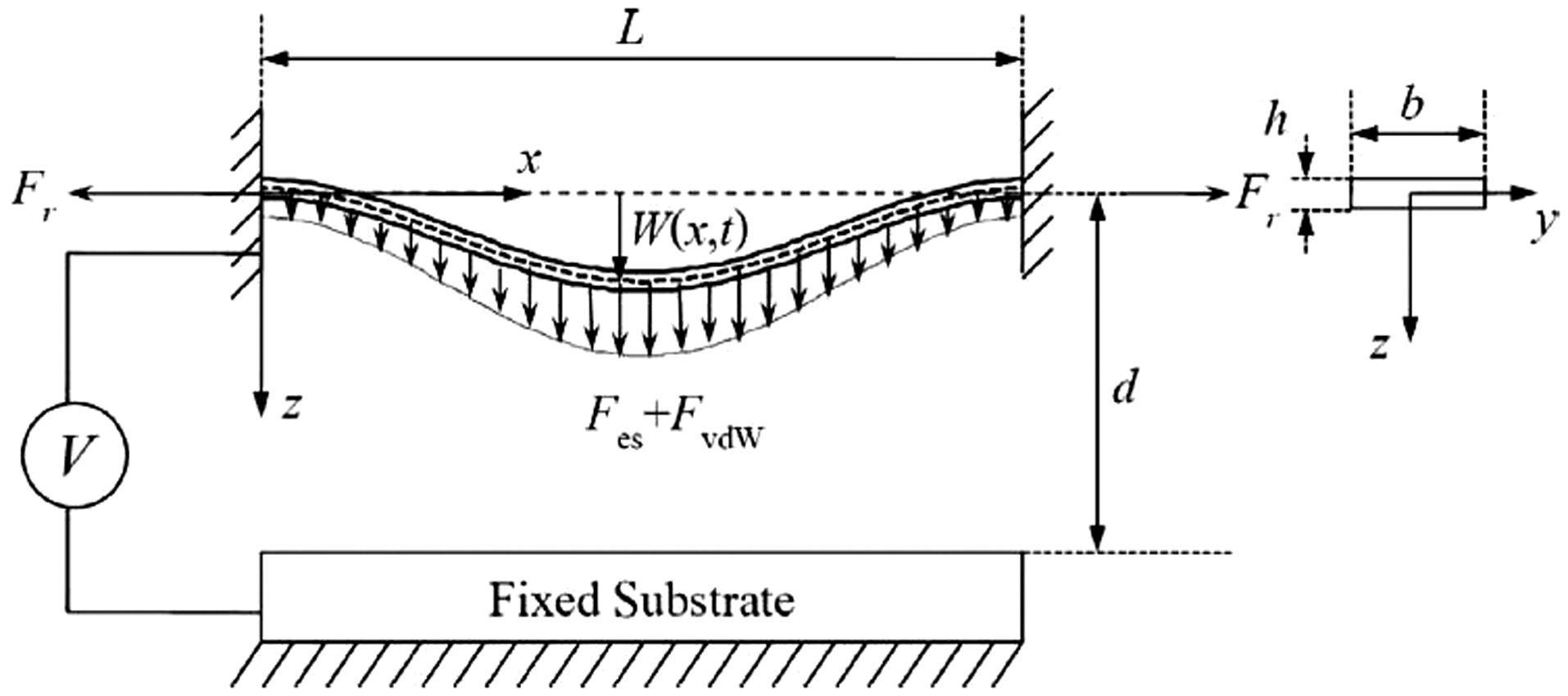
Model of an electrically actuated nano/micro-beam under the effect of vdW force. 17
Application of the SRHBM
To apply the SRHBM
26
in equation (1), we must bring in a new independent variable

It is worth mentioning that
Since equation (3) exists in the periodic solution, the solution can be expressed as a set of base functions

and the steady state solution and the angular frequency are represented, respectively, in the forms33,34

The zeroth-order harmonic approximation
The initial guess solution of

Substituting equation (5) into equation (3), and extracting the coefficients preceding
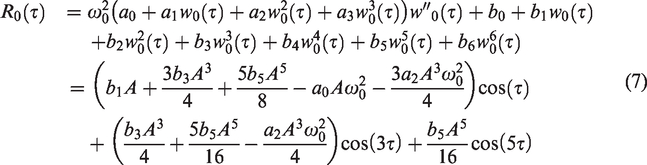
According to Galerkin procedure, equation (7) cannot contain secular term


The zeroth-order approximation solution can be obtained as follows

The first-order harmonic approximation
Similarly, equation (5) is substituted in equation (3) and we present the coefficient of parameter

It is worth mentioning that equation (11) is linear with respect to

Substituting equation (12) in equation (11) and to improve the accuracy, the residual term

Equation (12) is calculated as
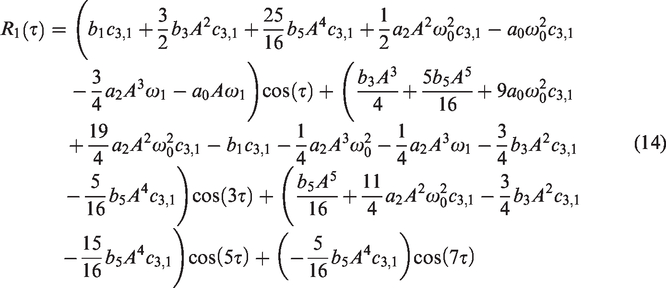
Because



Therefore, the first-order harmonic approximation solution and frequency are written as follows

The second-order harmonic approximation
According to the above calculation process, we can derive the second-order harmonic approximation solution and frequency. Firstly, substituting equation (5) in equation (3) yields the coefficients of the
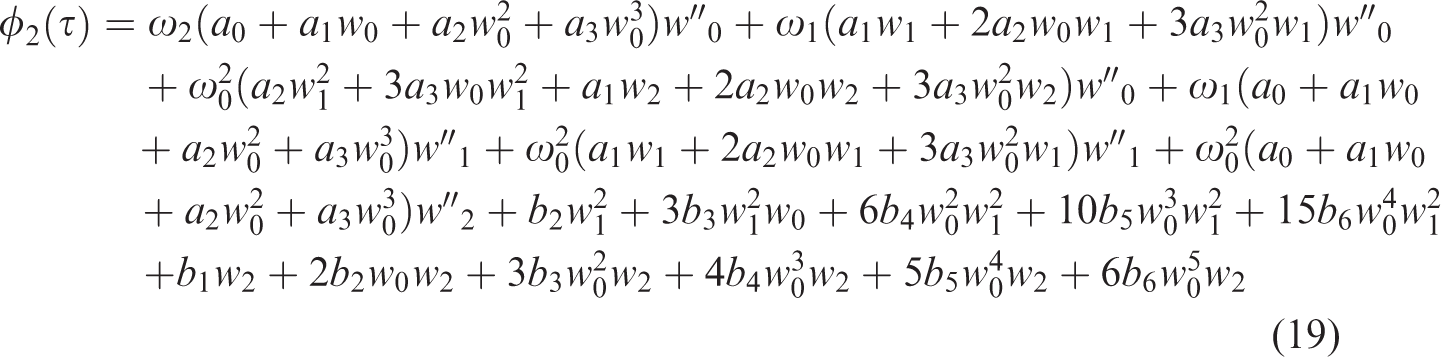
Secondly, we choose the second-order harmonic approximation solution


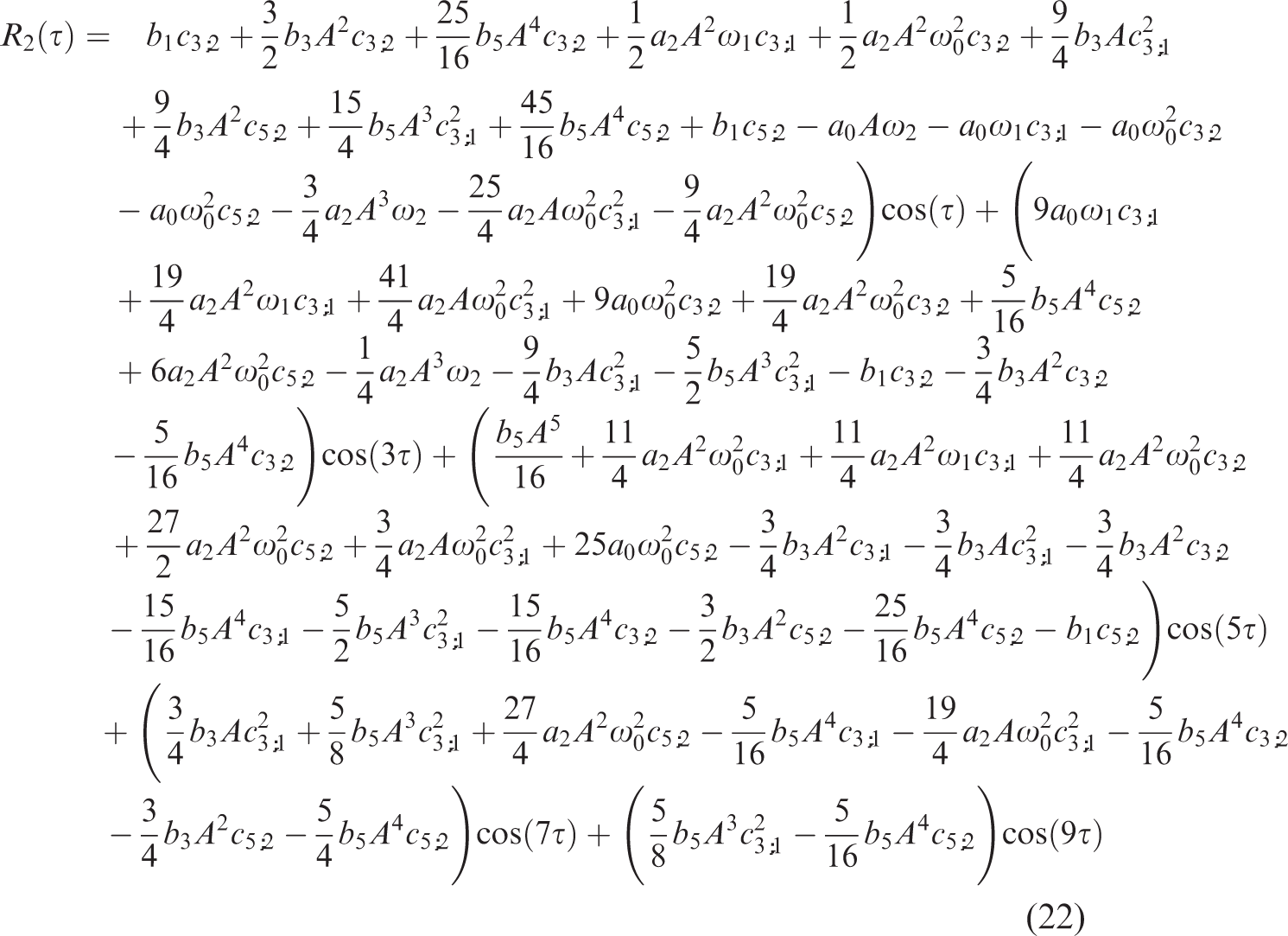
Finally, the coefficients of

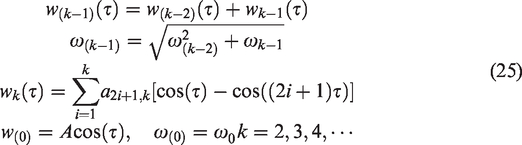
By the zero-order harmonic approximation, the first-order harmonic approximation, and the second-order harmonic approximation, we can sum up that the kth-order harmonic approximation solutions and frequencies are

Results and discussion
To illustrate the effectiveness of SRHBM for solving the nonlinear equation, we compared the approximate solution obtained by the second-order SRHBM with the solution obtained by Runge–Kutta method. According to equations (2.1) to (2.13), we only need to choose different
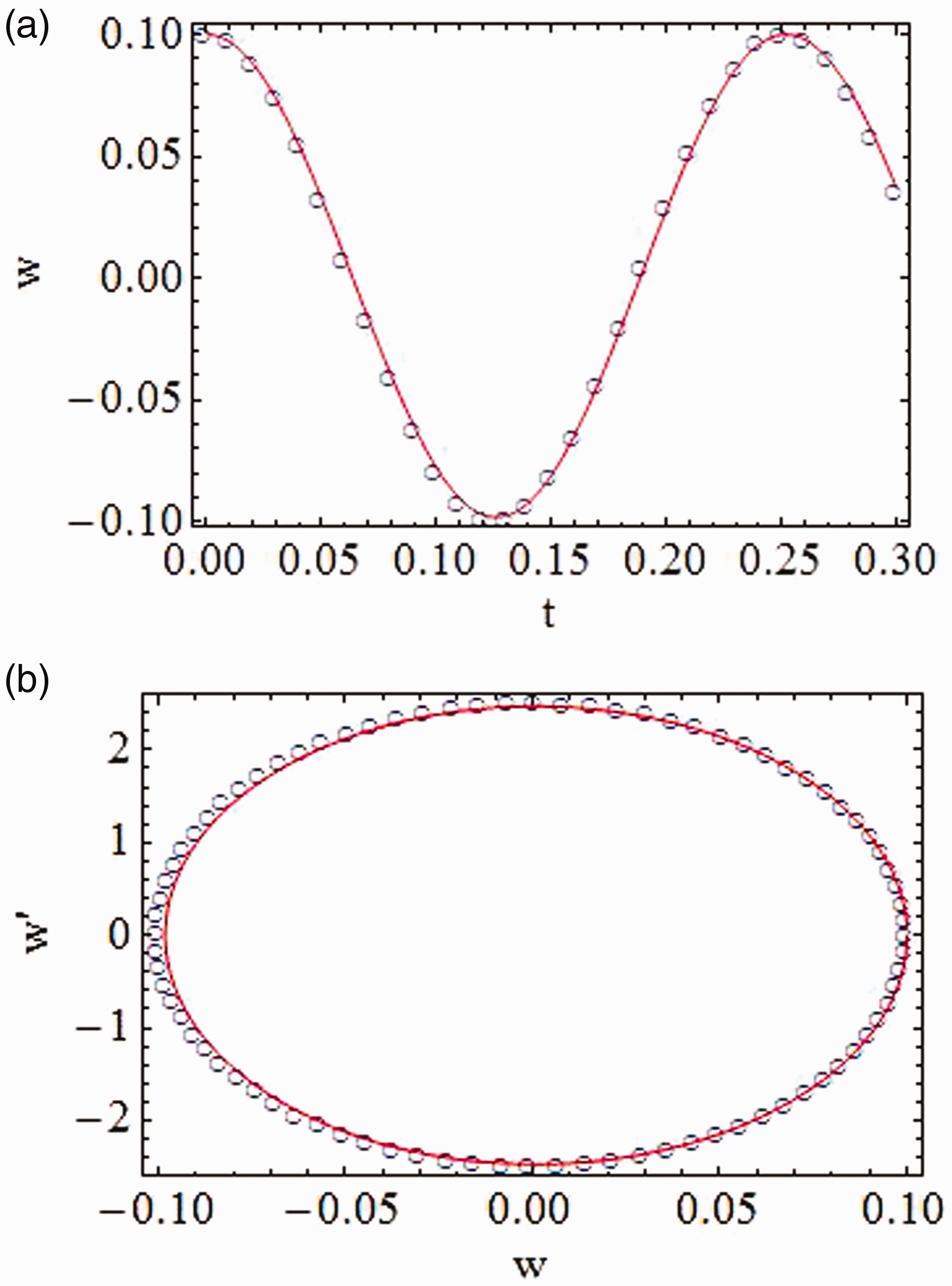
Comparison of second-order SRHBM solution and Runge–Kutta method solution for
In Figure 2, we plotted the phase curve and the time history response when parameters are
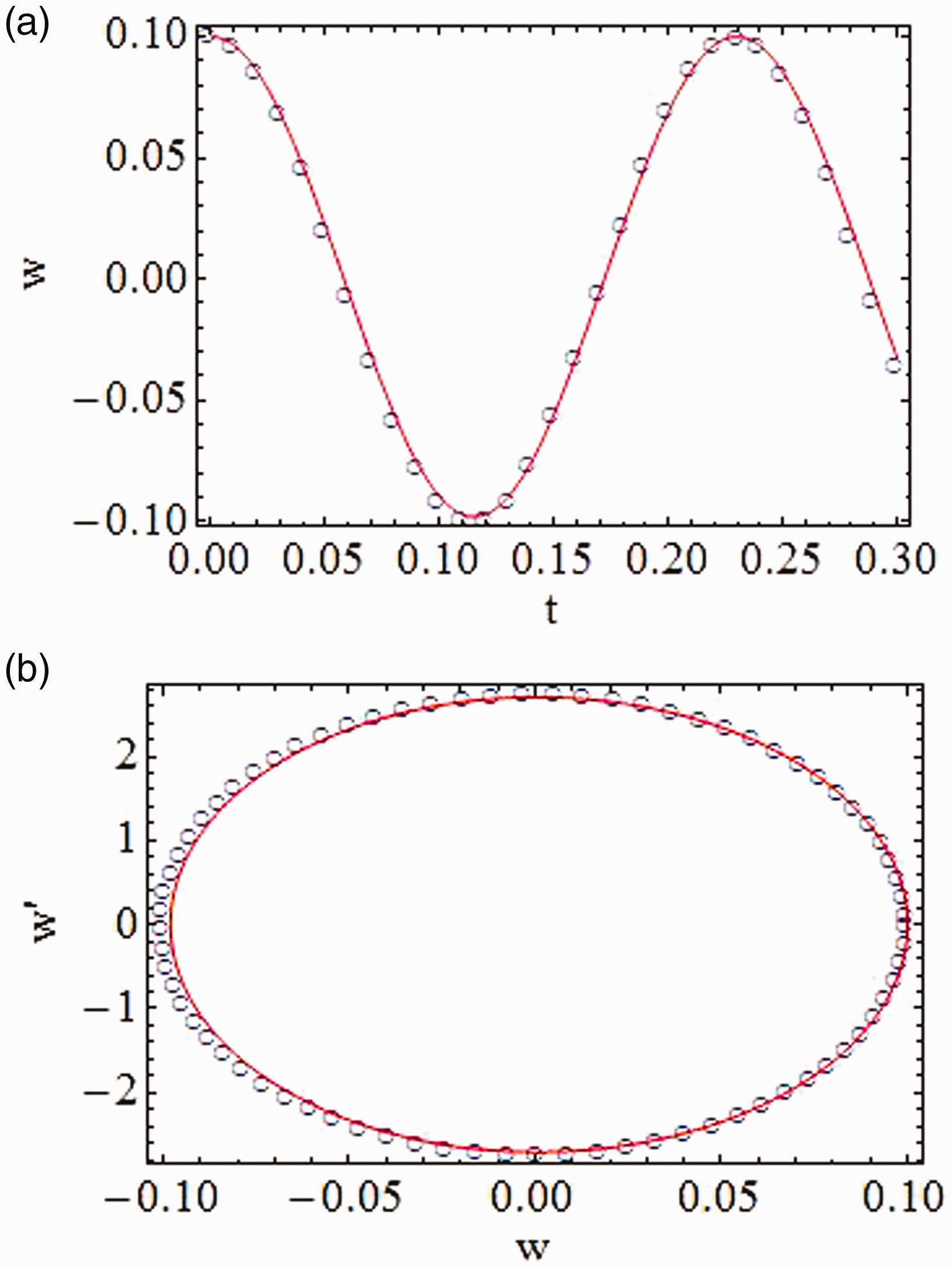
Comparison of second-order SRHBM solution and Runge–Kutta method solution for
To explain the size of the parameter
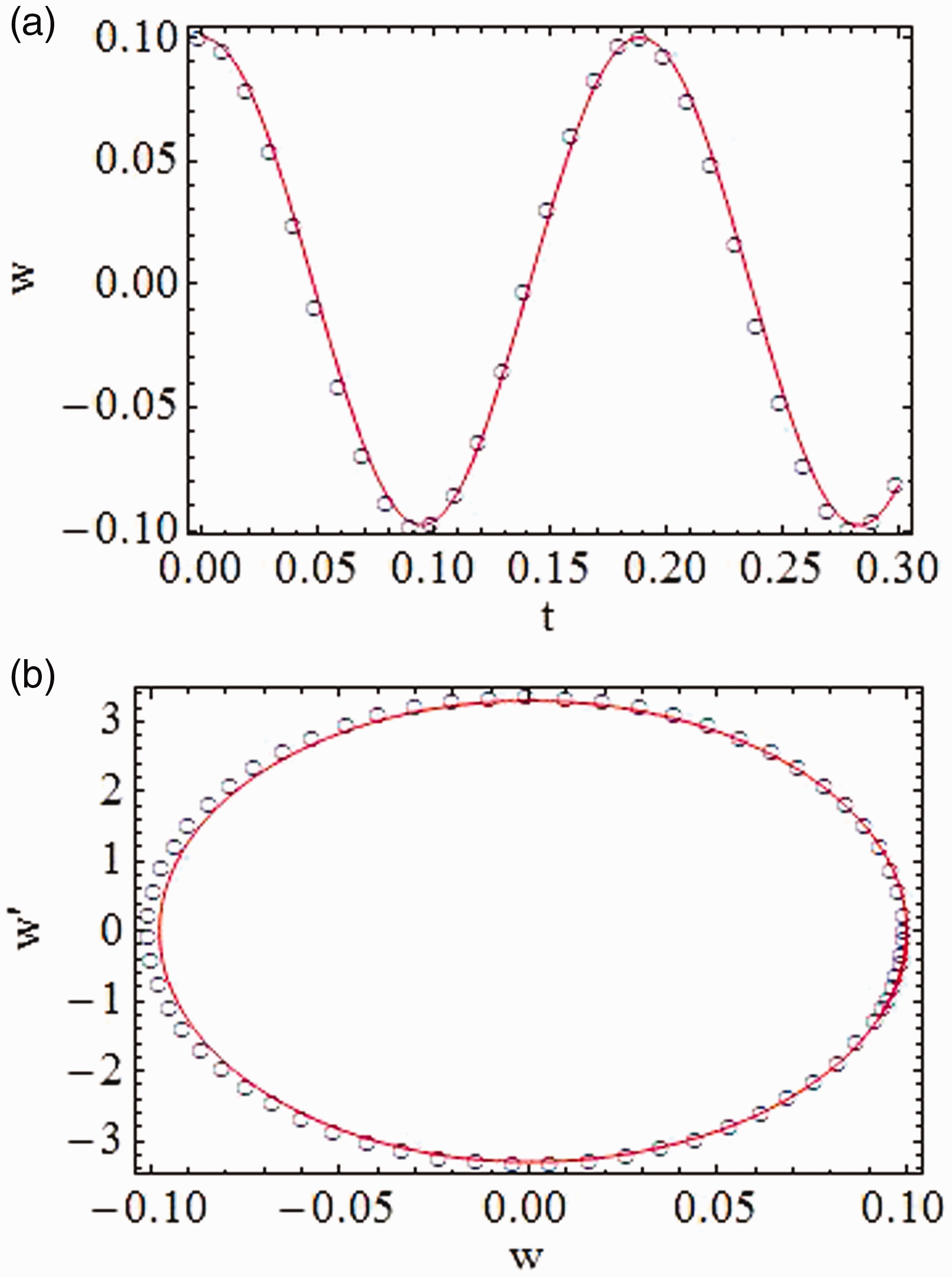
Comparison of second-order SRHBM solution and Runge–Kutta method solution. For
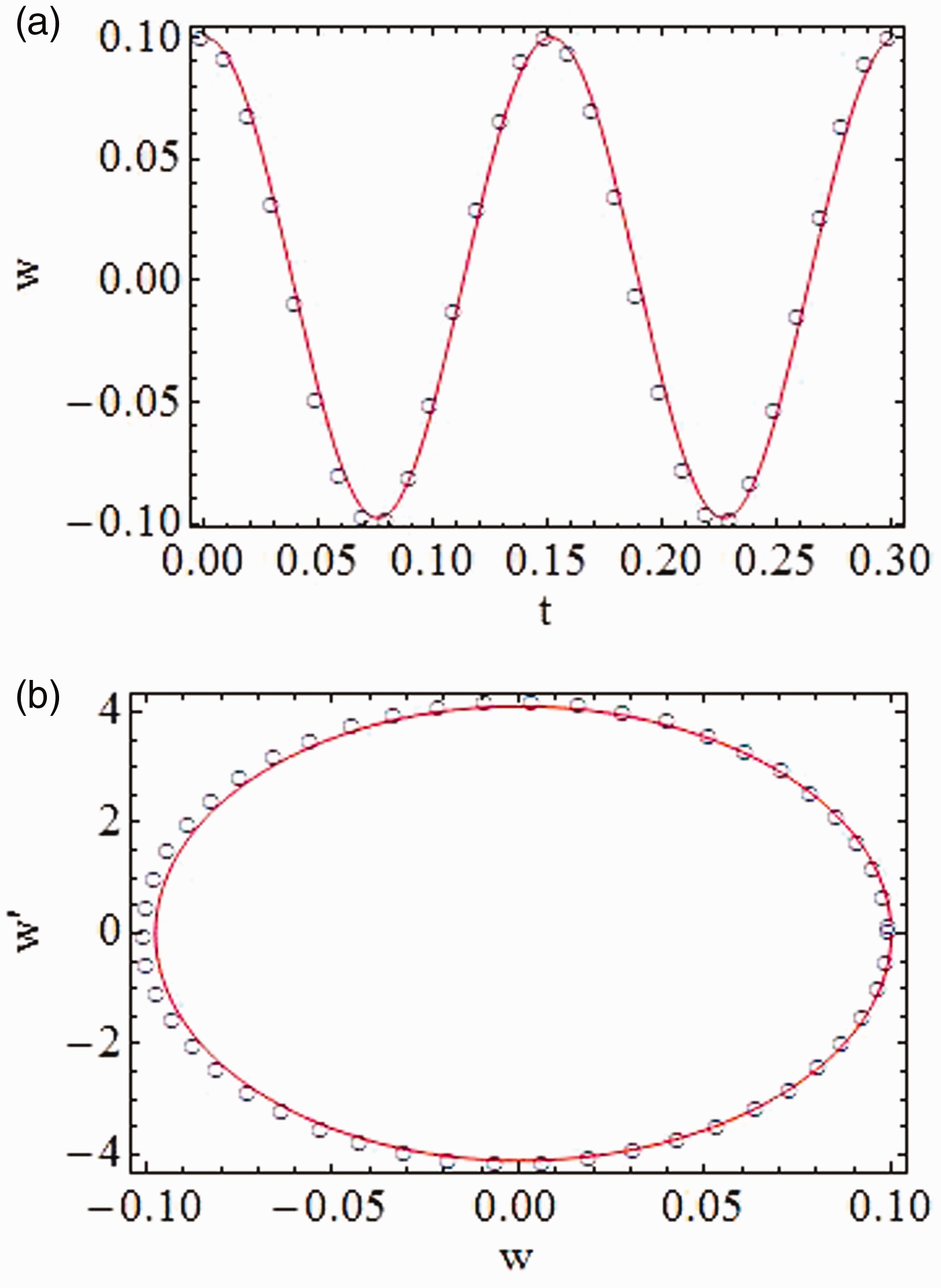
Comparison of second-order SRHBM solution and Runge–Kutta method solution. for
Conclusions
The paper adopts the SRHBM to solve the doubly clamped beam-type N/MEMS under the vdW attraction. The zero-order, the first-order and the second-order approximate solution of this system was obtained by SRHBM. Then, we drew the second-order harmonic approximation phase curves and time history responses for different parameters
Authors' contributions
All the authors contributed equally and significantly in writing this paper. All the authors read and approved the final manuscript.
Footnotes
Acknowledgements
We are grateful to the anonymous reviewers for their constructive suggestions.
Declaration of conflicting interests
The author(s) declared no potential conflicts of interest with respect to the research, authorship, and/or publication of this article.
Funding
The author(s) disclosed receipt of the following financial support for the research, authorship, and/ or publication of this article: The first author gratefully acknowledges the support of the National Natural Science Foundations of China (NNSFC) through grant No. 11572288. The author J. S. Wang acknowledges the support of the Teachers' professional development projects of visiting scholars in Zhejiang Province through grant No. FX2017090.